Market Action

April 1, 2009

Thornburg Mortgage has been a fascinating continuing saga and I have referred to it frequently in conversation over the past six months – it was last mentioned on PrefBlog on August 22. It is the only example I know of in which preferred shareholders were the target of a partial cram-down: reorganizations and bankruptcies are usually an all-or-nothing affair for preferred shareholders, but in this instance they got partial value.

All for naught! Thornburg Mortgage is going bust.

In a startling development some US investors in AIG have been able to figure out who the villains might be (assuming there are villains) when considering excessive bonuses (assuming bonuses are excessive) and are going after the chairman of the board’s compensation committee. A Nobel prize in economics can’t be far behind.

Another banner day for preferreds, with PerpetualDiscounts leading the way and FixedResets not far behind. PerpetualDiscounts now yield 7.26%, equivalent to 10.16% interest at the standard 1.4x equivalency factor; long corporates are now at 7.4% (maybe a tad higher) for a pre-tax interest-equivalent spread of 276bp.

HIMIPref™ Preferred Indices
These values reflect the December 2008 revision of the HIMIPref™ Indices

Values are provisional and are finalized monthly
Index Mean
Current
Yield
(at bid)
Median
YTW
Median
Average
Trading
Value
Median
Mod Dur
(YTW)
Issues Day’s Perf. Index Value
Ratchet 0.00 % 0.00 % 0 0.00 0 -1.0890 % 860.8
FixedFloater 0.00 % 0.00 % 0 0.00 0 -1.0890 % 1,392.1
Floater 5.67 % 5.56 % 75,671 14.57 2 -1.0890 % 1,075.4
OpRet 5.21 % 4.78 % 136,820 3.87 15 0.3322 % 2,080.2
SplitShare 7.01 % 11.10 % 46,959 5.67 3 0.3075 % 1,649.1
Interest-Bearing 6.18 % 9.85 % 31,631 0.72 1 0.1031 % 1,929.6
Perpetual-Premium 0.00 % 0.00 % 0 0.00 0 0.9255 % 1,530.4
Perpetual-Discount 7.09 % 7.26 % 154,345 12.29 71 0.9255 % 1,409.4
FixedReset 6.09 % 5.83 % 769,743 13.72 34 0.5379 % 1,834.7
Performance Highlights
Issue Index Change Notes
PWF.PR.E Perpetual-Discount -1.33 % YTW SCENARIO
Maturity Type : Limit Maturity
Maturity Date : 2039-04-01
Maturity Price : 18.60
Evaluated at bid price : 18.60
Bid-YTW : 7.57 %
BAM.PR.B Floater -1.25 % YTW SCENARIO
Maturity Type : Limit Maturity
Maturity Date : 2039-04-01
Maturity Price : 7.90
Evaluated at bid price : 7.90
Bid-YTW : 5.56 %
W.PR.H Perpetual-Discount -1.09 % YTW SCENARIO
Maturity Type : Limit Maturity
Maturity Date : 2039-04-01
Maturity Price : 19.04
Evaluated at bid price : 19.04
Bid-YTW : 7.26 %
TD.PR.Q Perpetual-Discount 1.00 % YTW SCENARIO
Maturity Type : Limit Maturity
Maturity Date : 2039-04-01
Maturity Price : 21.21
Evaluated at bid price : 21.21
Bid-YTW : 6.74 %
BNS.PR.O Perpetual-Discount 1.01 % YTW SCENARIO
Maturity Type : Limit Maturity
Maturity Date : 2039-04-01
Maturity Price : 20.98
Evaluated at bid price : 20.98
Bid-YTW : 6.82 %
GWO.PR.F Perpetual-Discount 1.02 % YTW SCENARIO
Maturity Type : Limit Maturity
Maturity Date : 2039-04-01
Maturity Price : 19.90
Evaluated at bid price : 19.90
Bid-YTW : 7.48 %
SLF.PR.D Perpetual-Discount 1.03 % YTW SCENARIO
Maturity Type : Limit Maturity
Maturity Date : 2039-04-01
Maturity Price : 14.76
Evaluated at bid price : 14.76
Bid-YTW : 7.61 %
RY.PR.L FixedReset 1.08 % YTW SCENARIO
Maturity Type : Limit Maturity
Maturity Date : 2039-04-01
Maturity Price : 24.28
Evaluated at bid price : 24.33
Bid-YTW : 4.89 %
POW.PR.B Perpetual-Discount 1.10 % YTW SCENARIO
Maturity Type : Limit Maturity
Maturity Date : 2039-04-01
Maturity Price : 17.51
Evaluated at bid price : 17.51
Bid-YTW : 7.69 %
GWO.PR.I Perpetual-Discount 1.14 % YTW SCENARIO
Maturity Type : Limit Maturity
Maturity Date : 2039-04-01
Maturity Price : 15.07
Evaluated at bid price : 15.07
Bid-YTW : 7.54 %
SLF.PR.A Perpetual-Discount 1.15 % YTW SCENARIO
Maturity Type : Limit Maturity
Maturity Date : 2039-04-01
Maturity Price : 15.80
Evaluated at bid price : 15.80
Bid-YTW : 7.59 %
RY.PR.R FixedReset 1.18 % YTW SCENARIO
Maturity Type : Call
Maturity Date : 2014-03-26
Maturity Price : 25.00
Evaluated at bid price : 25.75
Bid-YTW : 5.83 %
HSB.PR.C Perpetual-Discount 1.20 % YTW SCENARIO
Maturity Type : Limit Maturity
Maturity Date : 2039-04-01
Maturity Price : 17.71
Evaluated at bid price : 17.71
Bid-YTW : 7.26 %
RY.PR.H Perpetual-Discount 1.21 % YTW SCENARIO
Maturity Type : Limit Maturity
Maturity Date : 2039-04-01
Maturity Price : 21.39
Evaluated at bid price : 21.71
Bid-YTW : 6.60 %
BMO.PR.L Perpetual-Discount 1.23 % YTW SCENARIO
Maturity Type : Limit Maturity
Maturity Date : 2039-04-01
Maturity Price : 20.55
Evaluated at bid price : 20.55
Bid-YTW : 7.18 %
TD.PR.R Perpetual-Discount 1.24 % YTW SCENARIO
Maturity Type : Limit Maturity
Maturity Date : 2039-04-01
Maturity Price : 21.23
Evaluated at bid price : 21.23
Bid-YTW : 6.74 %
BAM.PR.H OpRet 1.25 % YTW SCENARIO
Maturity Type : Soft Maturity
Maturity Date : 2012-03-30
Maturity Price : 25.00
Evaluated at bid price : 23.50
Bid-YTW : 8.10 %
BMO.PR.J Perpetual-Discount 1.26 % YTW SCENARIO
Maturity Type : Limit Maturity
Maturity Date : 2039-04-01
Maturity Price : 16.91
Evaluated at bid price : 16.91
Bid-YTW : 6.76 %
CM.PR.E Perpetual-Discount 1.27 % YTW SCENARIO
Maturity Type : Limit Maturity
Maturity Date : 2039-04-01
Maturity Price : 19.09
Evaluated at bid price : 19.09
Bid-YTW : 7.35 %
BNS.PR.L Perpetual-Discount 1.32 % YTW SCENARIO
Maturity Type : Limit Maturity
Maturity Date : 2039-04-01
Maturity Price : 16.93
Evaluated at bid price : 16.93
Bid-YTW : 6.79 %
MFC.PR.B Perpetual-Discount 1.35 % YTW SCENARIO
Maturity Type : Limit Maturity
Maturity Date : 2039-04-01
Maturity Price : 15.82
Evaluated at bid price : 15.82
Bid-YTW : 7.44 %
CM.PR.I Perpetual-Discount 1.39 % YTW SCENARIO
Maturity Type : Limit Maturity
Maturity Date : 2039-04-01
Maturity Price : 16.10
Evaluated at bid price : 16.10
Bid-YTW : 7.32 %
RY.PR.F Perpetual-Discount 1.39 % YTW SCENARIO
Maturity Type : Limit Maturity
Maturity Date : 2039-04-01
Maturity Price : 16.78
Evaluated at bid price : 16.78
Bid-YTW : 6.74 %
BAM.PR.I OpRet 1.40 % YTW SCENARIO
Maturity Type : Soft Maturity
Maturity Date : 2013-12-30
Maturity Price : 25.00
Evaluated at bid price : 21.80
Bid-YTW : 8.93 %
CM.PR.G Perpetual-Discount 1.48 % YTW SCENARIO
Maturity Type : Limit Maturity
Maturity Date : 2039-04-01
Maturity Price : 18.53
Evaluated at bid price : 18.53
Bid-YTW : 7.30 %
BNS.PR.K Perpetual-Discount 1.58 % YTW SCENARIO
Maturity Type : Limit Maturity
Maturity Date : 2039-04-01
Maturity Price : 17.98
Evaluated at bid price : 17.98
Bid-YTW : 6.82 %
TD.PR.S FixedReset 1.67 % YTW SCENARIO
Maturity Type : Limit Maturity
Maturity Date : 2039-04-01
Maturity Price : 21.80
Evaluated at bid price : 21.86
Bid-YTW : 4.31 %
HSB.PR.D Perpetual-Discount 1.72 % YTW SCENARIO
Maturity Type : Limit Maturity
Maturity Date : 2039-04-01
Maturity Price : 16.60
Evaluated at bid price : 16.60
Bid-YTW : 7.60 %
W.PR.J Perpetual-Discount 1.72 % YTW SCENARIO
Maturity Type : Limit Maturity
Maturity Date : 2039-04-01
Maturity Price : 20.14
Evaluated at bid price : 20.14
Bid-YTW : 6.99 %
TD.PR.C FixedReset 1.73 % YTW SCENARIO
Maturity Type : Limit Maturity
Maturity Date : 2039-04-01
Maturity Price : 24.63
Evaluated at bid price : 24.68
Bid-YTW : 4.91 %
NA.PR.K Perpetual-Discount 1.84 % YTW SCENARIO
Maturity Type : Limit Maturity
Maturity Date : 2039-04-01
Maturity Price : 21.00
Evaluated at bid price : 21.00
Bid-YTW : 7.10 %
TD.PR.Y FixedReset 1.84 % YTW SCENARIO
Maturity Type : Limit Maturity
Maturity Date : 2039-04-01
Maturity Price : 22.05
Evaluated at bid price : 22.10
Bid-YTW : 4.39 %
BNS.PR.J Perpetual-Discount 1.96 % YTW SCENARIO
Maturity Type : Limit Maturity
Maturity Date : 2039-04-01
Maturity Price : 19.76
Evaluated at bid price : 19.76
Bid-YTW : 6.79 %
ELF.PR.G Perpetual-Discount 1.96 % YTW SCENARIO
Maturity Type : Limit Maturity
Maturity Date : 2039-04-01
Maturity Price : 13.51
Evaluated at bid price : 13.51
Bid-YTW : 8.85 %
PWF.PR.K Perpetual-Discount 2.11 % YTW SCENARIO
Maturity Type : Limit Maturity
Maturity Date : 2039-04-01
Maturity Price : 16.95
Evaluated at bid price : 16.95
Bid-YTW : 7.47 %
POW.PR.C Perpetual-Discount 2.21 % YTW SCENARIO
Maturity Type : Limit Maturity
Maturity Date : 2039-04-01
Maturity Price : 18.94
Evaluated at bid price : 18.94
Bid-YTW : 7.70 %
BNA.PR.C SplitShare 2.25 % Asset coverage of 1.7-:1 as of February 28 according to the company.
YTW SCENARIO
Maturity Type : Hard Maturity
Maturity Date : 2019-01-10
Maturity Price : 25.00
Evaluated at bid price : 11.36
Bid-YTW : 15.51 %
NA.PR.M Perpetual-Discount 2.26 % YTW SCENARIO
Maturity Type : Limit Maturity
Maturity Date : 2039-04-01
Maturity Price : 21.28
Evaluated at bid price : 21.28
Bid-YTW : 7.19 %
RY.PR.B Perpetual-Discount 2.29 % YTW SCENARIO
Maturity Type : Limit Maturity
Maturity Date : 2039-04-01
Maturity Price : 17.90
Evaluated at bid price : 17.90
Bid-YTW : 6.67 %
BMO.PR.K Perpetual-Discount 2.35 % YTW SCENARIO
Maturity Type : Limit Maturity
Maturity Date : 2039-04-01
Maturity Price : 18.75
Evaluated at bid price : 18.75
Bid-YTW : 7.12 %
PWF.PR.G Perpetual-Discount 2.39 % YTW SCENARIO
Maturity Type : Limit Maturity
Maturity Date : 2039-04-01
Maturity Price : 20.11
Evaluated at bid price : 20.11
Bid-YTW : 7.51 %
NA.PR.N FixedReset 2.40 % YTW SCENARIO
Maturity Type : Limit Maturity
Maturity Date : 2039-04-01
Maturity Price : 23.79
Evaluated at bid price : 23.86
Bid-YTW : 4.38 %
CM.PR.P Perpetual-Discount 2.56 % YTW SCENARIO
Maturity Type : Limit Maturity
Maturity Date : 2039-04-01
Maturity Price : 18.83
Evaluated at bid price : 18.83
Bid-YTW : 7.32 %
IAG.PR.A Perpetual-Discount 3.00 % YTW SCENARIO
Maturity Type : Limit Maturity
Maturity Date : 2039-04-01
Maturity Price : 14.76
Evaluated at bid price : 14.76
Bid-YTW : 7.87 %
PWF.PR.H Perpetual-Discount 3.33 % YTW SCENARIO
Maturity Type : Limit Maturity
Maturity Date : 2039-04-01
Maturity Price : 19.25
Evaluated at bid price : 19.25
Bid-YTW : 7.65 %
PWF.PR.L Perpetual-Discount 4.02 % YTW SCENARIO
Maturity Type : Limit Maturity
Maturity Date : 2039-04-01
Maturity Price : 17.08
Evaluated at bid price : 17.08
Bid-YTW : 7.64 %
Volume Highlights
Issue Index Shares
Traded
Notes
RY.PR.X FixedReset 725,748 New issue settled today.
YTW SCENARIO
Maturity Type : Limit Maturity
Maturity Date : 2039-04-01
Maturity Price : 23.14
Evaluated at bid price : 25.02
Bid-YTW : 6.11 %
BMO.PR.O FixedReset 117,942 Recent new issue.
YTW SCENARIO
Maturity Type : Limit Maturity
Maturity Date : 2039-04-01
Maturity Price : 25.07
Evaluated at bid price : 25.12
Bid-YTW : 6.38 %
BMO.PR.K Perpetual-Discount 81,775 Nesbitt crossed 16,000 at 18.50 and sold two blocks to Scotia at the same price, 25,000 & 12,500 shares.
YTW SCENARIO
Maturity Type : Limit Maturity
Maturity Date : 2039-04-01
Maturity Price : 18.75
Evaluated at bid price : 18.75
Bid-YTW : 7.12 %
TD.PR.R Perpetual-Discount 54,500 TD crossed two blocks at 21.19: 11,000 & 38,600 shares.
YTW SCENARIO
Maturity Type : Limit Maturity
Maturity Date : 2039-04-01
Maturity Price : 21.23
Evaluated at bid price : 21.23
Bid-YTW : 6.74 %
MFC.PR.D FixedReset 53,614 Recent new issue.
YTW SCENARIO
Maturity Type : Limit Maturity
Maturity Date : 2039-04-01
Maturity Price : 24.50
Evaluated at bid price : 24.55
Bid-YTW : 6.58 %
GWO.PR.X OpRet 53,161 TD crossed two blocks at 25.05: 25,000 & 14,000 shares.
YTW SCENARIO
Maturity Type : Soft Maturity
Maturity Date : 2013-09-29
Maturity Price : 25.00
Evaluated at bid price : 25.05
Bid-YTW : 4.78 %
There were 39 other index-included issues trading in excess of 10,000 shares.
Issue Comments

RY.PR.X Closes at Small Premium with High Volume

RY.PR.X, the FixedReset issue announced last week had a very solid opening day, trading 725,748 shares in a range of 24.91-09 before closing at 25.02-05, 27×46.

Its vital statistics are:

RY.PR.X FixedReset YTW SCENARIO
Maturity Type : Limit Maturity
Maturity Date : 2039-04-01
Maturity Price : 23.14
Evaluated at bid price : 25.02
Bid-YTW : 6.11 %

This is an issue sure to be at the centre of many trade errors over the course of its existence. A few years back, Royal Bank started a new numbering system for its preferreds, presumably in cooperation with the TSX: Series ‘AA’ has ticker RY.PR.A, Series ‘AB’ has ticker RY.PR.B and so on. It was great, and a lot better than giving Series N the symbol RY.PR.K, for instance.

But now we have Series AV having ticker RY.PR.X. I suspect that the TSX reserves the “V” suffix for USD issues, or perhaps they consider it too soon after the redemption of the old RY.PR.V (USD 250-million, Series K, redeemed in 2003) to recycle the ticker.

One way or another, it would appear a little more communication is in order.

Issue Comments

S&P Downgrades HSB to P-1(low); Confusion Reigns for HSB.PR.E

S&P has announced:

it lowered its issue ratings on the hybrid capital securities of over 60 European financial institutions.

The rating actions followed our review of ratings on the hybrid instruments of financial institutions in Europe. The downgrades reflect our assessment of the deteriorating financial prospects for the European banking industry in the worsening economic environment and our view that European governments and the European Commission (EC) over the medium term may be more willing than previously to encourage or force banks to suspend payments on hybrid securities to preserve cash and build capital. We did not change any of the issuer credit ratings (ICRs) on the banking groups that issue these hybrid securities.

Hybrids for HSBC Bank PLC has been downgraded from A+ to A; HSBC Holdings PLC has been downgraded from A to A-.

The rating of HSBC Bank Canada preferreds, have been reduced from A+ to A, which equates to a change from P-1 to P-1(low) on the national scale.

This has had repercussions for the new issue announced last week, which had been assigned the TSX ticker symbol HSB.PR.E.

The underwriting agreement dated March 24 (available on SEDAR) states:

The Bank shall cause to be delivered to the Underwriters’ Representative on behalf of all Underwriters at the Closing Time, and the Underwriters’ obligations pursuant to this Agreement will be conditional upon:

(j) receipt by the Underwriters of a confirmation in a form reasonably acceptable to them that the Offered Securities have received a final rating from DBRS of Pfd-1 with a negative trend and from S&P of P-1 and A+, using S&P’s Canadian scale for preferred shares and S&P’s global scale for preferred shares, respectively;

It is my understanding that a new term sheet has been issued, but I haven’t seen it.

There is no press release and HSBC has not responded to my inquiry. You can’t expect important people like bankers and underwriters to demean themselves by communicating with investor scum.

This could be fun! Get your popcorn!

Issue Comments

Best & Worst Performers: March 2009

These are total returns, with dividends presumed to have been reinvested at the bid price on the ex-date. The list has been restricted to issues in the HIMIPref™ indices.

March 2009
Issue Index DBRS Rating Monthly Performance Notes (“Now” means “March 31”)
IAG.PR.A PerpetualDiscount Pfd-2(high) -8.73% Now with a pre-tax bid-YTW of 8.10% based on a bid of 14.33 and a limitMaturity.
MFC.PR.C PerpetualDiscount Pfd-1(low) -6.25% Now with a pre-tax bid-YTW of 7.59% based on a bid of 15.01 and a limitMaturity.
MFC.PR.B PerpetualDiscount Pfd-1(low) -5.39% Now with a pre-tax bid-YTW of 7.54% based on a bid of 15.61 and a limitMaturity.
HSB.PR.D PerpetualDiscount Pfd-1 -3.91% Now with a pre-tax bid-YTW of 7.73% based on a bid of 16.32 and a limitMaturity.
GWO.PR.F PerpetualDiscount Pfd-1(low) -3.90% Now with a pre-tax bid-YTW of 7.56% based on a bid of 19.70 and a limitMaturity.
RY.PR.H PerpetualDiscount Pfd-1 +6.24% Now with a pre-tax bid-YTW of 6.69% based on a bid of 21.45 and a limitMaturity.
TD.PR.Q PerpetualDiscount Pfd-1 +6.71% Now with a pre-tax bid-YTW of 6.81% based on a bid of 21.00 and a limitMaturity.
TD.PR.R PerpetualDiscount Pfd-1 +6.72% Now with a pre-tax bid-YTW of 6.72% based on a bid of 20.97 and a limitMaturity.
RY.PR.A PerpetualDiscount Pfd-1 +7.29% Now with a pre-tax bid-YTW of 6.57% based on a bid of 17.22 and a limitMaturity.
BAM.PR.B Floater Pfd-2(low) +9.43% Nice to see one of the BAM floaters on this side of ledger!
Index Construction / Reporting

HIMIPref™ Index Rebalancing: March 2009

HIMI Index Changes, March, 2009
Issue From To Because
PWF.PR.A Floater Scraps Volume
DFN.PR.A SplitShare Scraps Credit
LFE.PR.A SplitShare Scraps Credit
SBN.PR.A SplitShare Scraps Credit

To my chagrin, there are now only three issues left in the SplitShare index, all from BAM Split Corp.: BNA.PR.A, BNA.PR.B and BNA.PR.C.

There were the following intra-month changes:

HIMI Index Changes during March 2009
Issue Action Index Because
FAL.PR.B Delete Scraps Redeemed
MFC.PR.D Add FixedReset New Issue
TD.PR.I Add FixedReset New Issue
CM.PR.M Add FixedReset New Issue
MFC.PR.D Add FixedReset New Issue
RY.PR.T Add FixedReset New Issue
BNS.PR.S Delete FixedReset Coverage Discontinued
MFC.PR.D Add FixedReset New Issue
BMO.PR.O Add FixedReset New Issue
CIU.PR.B Add FixedReset New Issue
HSB.PR.E Add FixedReset New Issue

HSB.PR.E is one of those issues which are sent to try us. It was announced on March 23 with an anticipated closing date of March 31. I have seen nothing to indicate that it didn’t close, but while HSBC Canada may well have received their cheque for $175-250-million, not a single share changed hands on the exchange. With any luck, we’ll see a trade or two tomorrow.

Reader Initiated Comments

Liquidity Fears for PerpetualDiscounts?

An Assiduous Reader writes in and says:

You are very bullish on Perpetual Discount preferred shares.

No I’m not. I’m neither bullish nor bearish. I will go so far as to say that at this moment in time and speaking very generally, I prefer PerpetualDiscounts to other preferred share classes as I believe their net present value of future cash flows and market price exceeds the net present value of future cash flows and market price of the other classes.

Are you not concerned with the reduction of liquidity that is caused by the issuer buying the shares at market prices versus purchasing them at the Call price? Some of those shares also have American style Call options that make them even uglier.

It is possible that issuers could buy up their extant PerpetualDiscount issues to the extent that trading volume would suffer; but I am not aware of this ever having happened.

However, just because something has never happened before doesn’t mean it will never happen – just ask a sub-prime paper mogul contemplating housing prices 25% below peak! So it’s always worthwhile to consider.

The issue of issuer repurchases was last discussed on PrefBlog last fall, in the post Repurchase of Preferred Shares by Issuer, in which I mentioned one of the rare non-split-share issuer bids, Great-West bidding for GWO.PR.E & GWO.PR.X, large issues that will retract in the relatively near future. That particular repurchase was a fizzle.

If the majority of the issued shares have been purchased back by the issuer then you are left stranded and have to hope that they purchase the rest to get rid of the nuisance.

The following example displays the benefit to the issuer:

Issue Dividend Net Price Shares Issued Cash Dividend Yearly
Cost
New Issue 0.40625 24.25 16,000,000 388,000,000 6,500,000 6.70%
Perpetual Discount 0.29375 15.88 16,000,000 254,080,000 4,700,000
New Cash     16,000,000 133,920,000 1,800,000 5.38%

If I am interpeting this table correctly, my interlocutor is saying that a new issue of 16-million shares of Fixed-Resets could be issued with an initial coupon of 6.70% for a cash receipt after underwriting costs of $388-million. These funds could then be used to buy up an extant issue of 16-million shares of PerpetualDiscounts with an original coupon of 4.7% that is trading at 15.88 to yield 7.4%.

The net effect of this action would be $134-million net new cash to the issuer with a net increase in dividend expenses of $1.8-million quarterly, or 5.38% p.a., which would be a nice way to finance.

Well, all I can say is that it’s not happening yet! I can think of several reasons for this:

  • Inability to purchase significant stock at a 7.4% yield. If the price of the PerpetualDiscount in the example went up to $17.54, it would have a current yield of 6.7%, the same as the putative new issue. All that would happen, I think, is that you’d see a pop in the market price for the duration of the buying programme and people like me would say ‘thank you very much’ and swap into other issues.
  • There would be no change in Tier 1 Regulatory Capital, except to the extent that a profit on cancellation was recorded. While the market price of the PerpetualDiscounts may only be about $16, it’s still on the books as $25.
  • Even at 7.4%, the interest-equivalent yield is only about 10.4%. The banks are targetting a ROE in excess of this figure; therefore they would rather repurchase common equity than the PerpetualDiscount

I am not discounting the notion that liquidity might eventually dry up in the PerpetualDiscount market. In a recent post I highlighted the downward trend in PerpetualDiscount Average Trading Value and Assiduous Reader prefhound commented that It sure looks like the fixed reset pref has stolen some of the trading volume from discount prefs.. This may or may not be a factor in the recent elevated spreads against corporates. I suspect not, but it’s something of a chicken-and-egg problem and I’ll reserve judgement until the credit crunch is over!

Volumes are – to date! – sufficient to allow active trading, but we’ll see. It is possible – unlikely, I think, but nevertheless possible – that PerpetualDiscounts could go down the same road travelled by banks’ 100-year floating rate bonds, that were so popular in the eighties and now trade by appointment only at an enormous spread.

Obviously, the fixed resets can suffer the same fate! The only saving grace is that they have a floor on the yield that makes the probability of the option being called higher and saving you from being orphaned.

It would be interesting to know what the median lifetime of a Canadian Bank preferred share before total purchase/recall.

In my essay Are Floating Prefs Money Market Vehicles?, I reported that the average life of called straight perpetual issue was 10.2 years; i.e., just a little over the normal 9-year period before an issue with standard terms can be called at par (a call at $26 is normal after five years, declining by $0.25 annually).

So there you have it, such as it is! Forecasting future prices is chancy enough; forecasting liquidity is worse. All you can do is stay alert for changes and stay diversified.

Market Action

March 31, 2009

Wouldn’t you know it! No sooner do I award plaudits to HOOPP and point out the wonderful thing about being an independent fund manager with a captive clientele (March 25) than the Ontario government comes up with a thoroughly lunatic scheme to make Teachers’ compete for clients:

The government is introducing legislation that, if passed, would expand the mandate of the Ontario Teachers’ Pension Plan (OTPP) Board if the government and the Ontario Teachers’ Federation (as Partners of the Plan) agree. The amendment would permit the OTPP Board to provide pension administration and investment services to other pension plans and institutional investors in the public sector.

  • Benefits would include higher revenues for the OTPP Board, lower administrative costs and enhanced investment opportunities for future OTPP clients.
  • This change is consistent with recommendations of the Expert Commission on Pensions that large pension plans be permitted to offer their services to smaller pension plans to improve investment returns for Ontario pension plans and others

The empire builders and salesmen-wannabes at Teachers’ are thrilled:

“The Ontario government’s proposed amendment to the Teachers’ Pension Act represents an encouraging step forward towards pension reform for thousands of Ontarians,” said Jim Leech, President and CEO of the Ontario Teachers’ Pension Plan (Teachers’). The amendment was introduced as part of the Ontario government’s 2009 budget.

“This move would allow us to help smaller pension plans and other institutions meet their beneficiaries’ needs,” he said. “We could pool significantly large amounts of capital and make our resources, such as our direct investing expertise, available to manage their funds. Their beneficiaries would benefit in gaining expertise, scope and scale.”

You can tell he’s been booking up for this opportunity. He’s using the same words every single investment manager that has ever existed in the history of the entire universe has used to flog his funds.

The report itself completely misses the point:

However, lower investment fees are but one of the many advantages enjoyed by large plans over smaller ones and over individual savers. In terms of income generation, large plans are in a position to hire expert staff to initiate and execute their investment strategies, to make attractive private placements of their investment funds, and to spread the investment risk by acquiring a wider range of investment vehicles. In terms of administrative expense, large plans are able to reduce their unit costs of administration by spreading them across a large plan membership, and they are typically able to offer members enhanced levels of information, education and service. Finally, large plans are more likely to survive than smaller ones, if only because the enterprises (or groups of enterprises) that sponsor them are likely to be more stable or resilient than those that sponsor small plans.

The cumulative effect of all of these advantages is extremely significant. It is so significant, in fact, that plan size may be a greater determinant of a member’s pension than plan design. Or, to make a more modest claim — holding plan design constant — large plans will generally perform better than small ones.

Modest claim, eh? There’s a very easy way to test this: look at the performance of investment managers by AUM and come up with a correlation between size and performance. After all, a large manager has the same ability to “hire expert staff”, “make attractive private placements” and “spread investment risk”. Sadly, the so-called expert commission does not appear to have thought of such a real-world test of their hypothesis.

Incredibly, there are still some people who believe that markets are efficient, notwithstanding the immense profitability of dealers’ proprietary trading and evidence that mutual fund investors have real difficulties getting their timing right. Correct me if I’m wrong, but shouldn’t it be true that if one clearly identifiable group is underperforming the market (pre-fees), then their should be another clearly identifiable group that is outperforming? Just wondering. Somebody has to, the Expert Commission isn’t.

In the investment business, sales isn’t simply a slight extra cost stuck on to the firm’s expenses. Sales is pervasive throughout the organization; from coming up with an interesting story to tell, through avoiding ‘fessing up to mistakes and all the way through to hiring good talkers in preference to good doers until, in the end, investment management is viewed as just another irritating expense rather than the organization’s raison d’etre. And that, ladies and gentlemen, is what costs the money; not piddly little management fees. Not transaction fees either, although transaction costs might.

Teachers can only hope that the proportion of external assets attracted by their manager will remain at less than 10% of the total – say another $10-billion. At that level, sales really will be simply an addendum to the real business of investment management. Any higher though, and there’s a real risk that investment management will become an addendum to the real business of sales.

March came in a lion and left like a lamb, with the PerpetualDiscount market having a great day on decent volume to close with a yield of 7.29%, equivalent to 10.21% at the standard equivalency factor of 1.4x. Long corporates continue to yield a BORING 7.5% (maybe just a hair under), having returned +2.74% over the month, so the pre-tax interest-equivalent spread is ending the quarter at 271bp … still elevated by all but recent standards.

Happy birthday, Malachite Aggressive Preferred Fund!

HIMIPref™ Preferred Indices
These values reflect the December 2008 revision of the HIMIPref™ Indices

Values are provisional and are finalized monthly
Index Mean
Current
Yield
(at bid)
Median
YTW
Median
Average
Trading
Value
Median
Mod Dur
(YTW)
Issues Day’s Perf. Index Value
Ratchet 0.00 % 0.00 % 0 0.00 0 0.8383 % 870.3
FixedFloater 0.00 % 0.00 % 0 0.00 0 0.8383 % 1,407.4
Floater 4.55 % 5.49 % 63,344 14.68 3 0.8383 % 1,087.2
OpRet 5.23 % 4.75 % 130,600 3.87 15 0.3859 % 2,073.3
SplitShare 6.77 % 9.63 % 47,467 4.78 6 2.7153 % 1,644.0
Interest-Bearing 6.19 % 9.96 % 32,922 0.72 1 0.1032 % 1,927.6
Perpetual-Premium 0.00 % 0.00 % 0 0.00 0 1.0363 % 1,516.3
Perpetual-Discount 7.16 % 7.29 % 154,090 12.21 71 1.0363 % 1,396.5
FixedReset 6.12 % 5.91 % 796,648 13.68 33 0.4436 % 1,824.9
Performance Highlights
Issue Index Change Notes
BNA.PR.B SplitShare -1.82 % Asset coverage of 1.7-:1 as of February 28, according to the company. This should increase somewhat for 3/31, as BAM.A closed at 16.86 on Feb. 28 and 17.57 on Mar. 31.
YTW SCENARIO
Maturity Type : Hard Maturity
Maturity Date : 2016-03-25
Maturity Price : 25.00
Evaluated at bid price : 20.53
Bid-YTW : 8.51 %
BAM.PR.O OpRet -1.70 % YTW SCENARIO
Maturity Type : Option Certainty
Maturity Date : 2013-06-30
Maturity Price : 25.00
Evaluated at bid price : 21.38
Bid-YTW : 9.25 %
RY.PR.H Perpetual-Discount -1.38 % YTW SCENARIO
Maturity Type : Limit Maturity
Maturity Date : 2039-03-31
Maturity Price : 21.45
Evaluated at bid price : 21.45
Bid-YTW : 6.69 %
RY.PR.R FixedReset -1.17 % YTW SCENARIO
Maturity Type : Call
Maturity Date : 2014-03-26
Maturity Price : 25.00
Evaluated at bid price : 25.45
Bid-YTW : 6.11 %
BMO.PR.H Perpetual-Discount -1.02 % YTW SCENARIO
Maturity Type : Limit Maturity
Maturity Date : 2039-03-31
Maturity Price : 19.50
Evaluated at bid price : 19.50
Bid-YTW : 6.91 %
BNA.PR.C SplitShare 1.00 % Asset coverage of 1.7-:1 as of February 28, according to the company. This should increase somewhat for 3/31, as BAM.A closed at 16.86 on Feb. 28 and 17.57 on Mar. 31.
YTW SCENARIO
Maturity Type : Hard Maturity
Maturity Date : 2019-01-10
Maturity Price : 25.00
Evaluated at bid price : 11.11
Bid-YTW : 15.86 %
ELF.PR.G Perpetual-Discount 1.02 % YTW SCENARIO
Maturity Type : Limit Maturity
Maturity Date : 2039-03-31
Maturity Price : 13.25
Evaluated at bid price : 13.25
Bid-YTW : 9.02 %
HSB.PR.C Perpetual-Discount 1.04 % YTW SCENARIO
Maturity Type : Limit Maturity
Maturity Date : 2039-03-31
Maturity Price : 17.50
Evaluated at bid price : 17.50
Bid-YTW : 7.35 %
GWO.PR.G Perpetual-Discount 1.04 % YTW SCENARIO
Maturity Type : Limit Maturity
Maturity Date : 2039-03-31
Maturity Price : 17.43
Evaluated at bid price : 17.43
Bid-YTW : 7.53 %
TD.PR.A FixedReset 1.07 % YTW SCENARIO
Maturity Type : Limit Maturity
Maturity Date : 2039-03-31
Maturity Price : 22.71
Evaluated at bid price : 22.75
Bid-YTW : 4.49 %
BNS.PR.K Perpetual-Discount 1.14 % YTW SCENARIO
Maturity Type : Limit Maturity
Maturity Date : 2039-03-31
Maturity Price : 17.70
Evaluated at bid price : 17.70
Bid-YTW : 6.93 %
BNS.PR.M Perpetual-Discount 1.15 % YTW SCENARIO
Maturity Type : Limit Maturity
Maturity Date : 2039-03-31
Maturity Price : 16.66
Evaluated at bid price : 16.66
Bid-YTW : 6.90 %
RY.PR.F Perpetual-Discount 1.22 % YTW SCENARIO
Maturity Type : Limit Maturity
Maturity Date : 2039-03-31
Maturity Price : 16.55
Evaluated at bid price : 16.55
Bid-YTW : 6.84 %
TD.PR.Y FixedReset 1.26 % YTW SCENARIO
Maturity Type : Limit Maturity
Maturity Date : 2039-03-31
Maturity Price : 21.66
Evaluated at bid price : 21.70
Bid-YTW : 4.48 %
BMO.PR.J Perpetual-Discount 1.27 % YTW SCENARIO
Maturity Type : Limit Maturity
Maturity Date : 2039-03-31
Maturity Price : 16.70
Evaluated at bid price : 16.70
Bid-YTW : 6.85 %
NA.PR.L Perpetual-Discount 1.28 % YTW SCENARIO
Maturity Type : Limit Maturity
Maturity Date : 2039-03-31
Maturity Price : 17.46
Evaluated at bid price : 17.46
Bid-YTW : 7.08 %
NA.PR.N FixedReset 1.30 % YTW SCENARIO
Maturity Type : Limit Maturity
Maturity Date : 2039-03-31
Maturity Price : 23.22
Evaluated at bid price : 23.30
Bid-YTW : 4.49 %
NA.PR.M Perpetual-Discount 1.31 % YTW SCENARIO
Maturity Type : Limit Maturity
Maturity Date : 2039-03-31
Maturity Price : 20.81
Evaluated at bid price : 20.81
Bid-YTW : 7.35 %
CM.PR.I Perpetual-Discount 1.34 % YTW SCENARIO
Maturity Type : Limit Maturity
Maturity Date : 2039-03-31
Maturity Price : 15.88
Evaluated at bid price : 15.88
Bid-YTW : 7.42 %
GWO.PR.I Perpetual-Discount 1.36 % YTW SCENARIO
Maturity Type : Limit Maturity
Maturity Date : 2039-03-31
Maturity Price : 14.90
Evaluated at bid price : 14.90
Bid-YTW : 7.62 %
CM.PR.E Perpetual-Discount 1.56 % YTW SCENARIO
Maturity Type : Limit Maturity
Maturity Date : 2039-03-31
Maturity Price : 18.85
Evaluated at bid price : 18.85
Bid-YTW : 7.45 %
CM.PR.G Perpetual-Discount 1.61 % YTW SCENARIO
Maturity Type : Limit Maturity
Maturity Date : 2039-03-31
Maturity Price : 18.26
Evaluated at bid price : 18.26
Bid-YTW : 7.41 %
BNS.PR.R FixedReset 1.62 % YTW SCENARIO
Maturity Type : Limit Maturity
Maturity Date : 2039-03-31
Maturity Price : 21.96
Evaluated at bid price : 22.00
Bid-YTW : 4.56 %
PWF.PR.M FixedReset 1.63 % YTW SCENARIO
Maturity Type : Limit Maturity
Maturity Date : 2039-03-31
Maturity Price : 24.95
Evaluated at bid price : 25.00
Bid-YTW : 5.38 %
RY.PR.I FixedReset 1.72 % YTW SCENARIO
Maturity Type : Limit Maturity
Maturity Date : 2039-03-31
Maturity Price : 22.96
Evaluated at bid price : 23.00
Bid-YTW : 4.37 %
PWF.PR.L Perpetual-Discount 1.73 % YTW SCENARIO
Maturity Type : Limit Maturity
Maturity Date : 2039-03-31
Maturity Price : 16.42
Evaluated at bid price : 16.42
Bid-YTW : 7.95 %
DFN.PR.A SplitShare 1.75 % Asset coverage of 1.5+:1 as of March 13, according to the company. Since then, XFN has improved from 14.17 to 14.70.
YTW SCENARIO
Maturity Type : Hard Maturity
Maturity Date : 2014-12-01
Maturity Price : 10.00
Evaluated at bid price : 8.15
Bid-YTW : 9.63 %
RY.PR.A Perpetual-Discount 1.77 % YTW SCENARIO
Maturity Type : Limit Maturity
Maturity Date : 2039-03-31
Maturity Price : 17.22
Evaluated at bid price : 17.22
Bid-YTW : 6.57 %
SLF.PR.D Perpetual-Discount 1.81 % YTW SCENARIO
Maturity Type : Limit Maturity
Maturity Date : 2039-03-31
Maturity Price : 14.61
Evaluated at bid price : 14.61
Bid-YTW : 7.69 %
GWO.PR.H Perpetual-Discount 1.83 % YTW SCENARIO
Maturity Type : Limit Maturity
Maturity Date : 2039-03-31
Maturity Price : 16.13
Evaluated at bid price : 16.13
Bid-YTW : 7.59 %
TD.PR.S FixedReset 1.85 % YTW SCENARIO
Maturity Type : Limit Maturity
Maturity Date : 2039-03-31
Maturity Price : 21.50
Evaluated at bid price : 21.50
Bid-YTW : 4.39 %
BAM.PR.K Floater 1.87 % YTW SCENARIO
Maturity Type : Limit Maturity
Maturity Date : 2039-03-31
Maturity Price : 7.61
Evaluated at bid price : 7.61
Bid-YTW : 5.77 %
ELF.PR.F Perpetual-Discount 1.89 % YTW SCENARIO
Maturity Type : Limit Maturity
Maturity Date : 2039-03-31
Maturity Price : 14.80
Evaluated at bid price : 14.80
Bid-YTW : 9.01 %
CM.PR.H Perpetual-Discount 1.93 % YTW SCENARIO
Maturity Type : Limit Maturity
Maturity Date : 2039-03-31
Maturity Price : 16.38
Evaluated at bid price : 16.38
Bid-YTW : 7.34 %
SLF.PR.A Perpetual-Discount 2.09 % YTW SCENARIO
Maturity Type : Limit Maturity
Maturity Date : 2039-03-31
Maturity Price : 15.62
Evaluated at bid price : 15.62
Bid-YTW : 7.67 %
RY.PR.W Perpetual-Discount 2.13 % YTW SCENARIO
Maturity Type : Limit Maturity
Maturity Date : 2039-03-31
Maturity Price : 18.69
Evaluated at bid price : 18.69
Bid-YTW : 6.66 %
PWF.PR.F Perpetual-Discount 2.21 % YTW SCENARIO
Maturity Type : Limit Maturity
Maturity Date : 2039-03-31
Maturity Price : 18.00
Evaluated at bid price : 18.00
Bid-YTW : 7.46 %
BNS.PR.N Perpetual-Discount 2.31 % YTW SCENARIO
Maturity Type : Limit Maturity
Maturity Date : 2039-03-31
Maturity Price : 19.50
Evaluated at bid price : 19.50
Bid-YTW : 6.88 %
CM.PR.J Perpetual-Discount 2.33 % YTW SCENARIO
Maturity Type : Limit Maturity
Maturity Date : 2039-03-31
Maturity Price : 15.36
Evaluated at bid price : 15.36
Bid-YTW : 7.34 %
PWF.PR.G Perpetual-Discount 2.51 % YTW SCENARIO
Maturity Type : Limit Maturity
Maturity Date : 2039-03-31
Maturity Price : 19.64
Evaluated at bid price : 19.64
Bid-YTW : 7.69 %
MFC.PR.C Perpetual-Discount 2.67 % YTW SCENARIO
Maturity Type : Limit Maturity
Maturity Date : 2039-03-31
Maturity Price : 15.01
Evaluated at bid price : 15.01
Bid-YTW : 7.59 %
SLF.PR.B Perpetual-Discount 2.86 % YTW SCENARIO
Maturity Type : Limit Maturity
Maturity Date : 2039-03-31
Maturity Price : 15.84
Evaluated at bid price : 15.84
Bid-YTW : 7.65 %
PWF.PR.E Perpetual-Discount 2.95 % YTW SCENARIO
Maturity Type : Limit Maturity
Maturity Date : 2039-03-31
Maturity Price : 18.85
Evaluated at bid price : 18.85
Bid-YTW : 7.46 %
ENB.PR.A Perpetual-Discount 3.25 % YTW SCENARIO
Maturity Type : Limit Maturity
Maturity Date : 2039-03-31
Maturity Price : 23.58
Evaluated at bid price : 23.85
Bid-YTW : 5.83 %
CM.PR.D Perpetual-Discount 3.27 % YTW SCENARIO
Maturity Type : Limit Maturity
Maturity Date : 2039-03-31
Maturity Price : 19.90
Evaluated at bid price : 19.90
Bid-YTW : 7.24 %
BAM.PR.J OpRet 3.49 % YTW SCENARIO
Maturity Type : Soft Maturity
Maturity Date : 2018-03-30
Maturity Price : 25.00
Evaluated at bid price : 18.11
Bid-YTW : 10.22 %
MFC.PR.B Perpetual-Discount 3.72 % YTW SCENARIO
Maturity Type : Limit Maturity
Maturity Date : 2039-03-31
Maturity Price : 15.61
Evaluated at bid price : 15.61
Bid-YTW : 7.54 %
PWF.PR.H Perpetual-Discount 3.73 % YTW SCENARIO
Maturity Type : Limit Maturity
Maturity Date : 2039-03-31
Maturity Price : 18.63
Evaluated at bid price : 18.63
Bid-YTW : 7.90 %
PWF.PR.K Perpetual-Discount 3.75 % YTW SCENARIO
Maturity Type : Limit Maturity
Maturity Date : 2039-03-31
Maturity Price : 16.60
Evaluated at bid price : 16.60
Bid-YTW : 7.63 %
BNA.PR.A SplitShare 3.96 % Asset coverage of 1.7-:1 as of February 28, according to the company. This should increase somewhat for 3/31, as BAM.A closed at 16.86 on Feb. 28 and 17.57 on Mar. 31.
YTW SCENARIO
Maturity Type : Hard Maturity
Maturity Date : 2010-09-30
Maturity Price : 25.00
Evaluated at bid price : 23.65
Bid-YTW : 10.61 %
SBN.PR.A SplitShare 4.36 % Asset coverage of 1.6+:1 as of March 26 according to the company. Since then, BNS has declined from 31.72 to 31.07.
YTW SCENARIO
Maturity Type : Hard Maturity
Maturity Date : 2014-12-01
Maturity Price : 10.00
Evaluated at bid price : 8.86
Bid-YTW : 7.86 %
LFE.PR.A SplitShare 6.93 % Repairing most of the damage from yesterday, when it was down 7.78%. It’s doing this on little volume, trading 2,100 shares today in a range of 7.08-30 before closing at 7.10-47, 34×13. Asset coverage of 1.1-:1 as of March 13 according to the company. Since then, XFN has increased from 14.17 to 14.70.
YTW SCENARIO
Maturity Type : Hard Maturity
Maturity Date : 2012-12-01
Maturity Price : 10.00
Evaluated at bid price : 7.10
Bid-YTW : 16.14 %
Volume Highlights
Issue Index Shares
Traded
Notes
TD.PR.I FixedReset 64,720 Recent new issue.
YTW SCENARIO
Maturity Type : Limit Maturity
Maturity Date : 2039-03-31
Maturity Price : 25.06
Evaluated at bid price : 25.11
Bid-YTW : 6.03 %
RY.PR.T FixedReset 49,806 Recent new issue.
YTW SCENARIO
Maturity Type : Limit Maturity
Maturity Date : 2039-03-31
Maturity Price : 23.17
Evaluated at bid price : 25.11
Bid-YTW : 5.86 %
TD.PR.G FixedReset 48,688 YTW SCENARIO
Maturity Type : Call
Maturity Date : 2014-05-30
Maturity Price : 25.00
Evaluated at bid price : 25.60
Bid-YTW : 5.98 %
PWF.PR.K Perpetual-Discount 48,455 YTW SCENARIO
Maturity Type : Limit Maturity
Maturity Date : 2039-03-31
Maturity Price : 16.60
Evaluated at bid price : 16.60
Bid-YTW : 7.63 %
RY.PR.R FixedReset 48,035 YTW SCENARIO
Maturity Type : Call
Maturity Date : 2014-03-26
Maturity Price : 25.00
Evaluated at bid price : 25.45
Bid-YTW : 6.11 %
BMO.PR.O FixedReset 42,935 Recent new issue.
YTW SCENARIO
Maturity Type : Limit Maturity
Maturity Date : 2039-03-31
Maturity Price : 25.02
Evaluated at bid price : 25.07
Bid-YTW : 6.39 %
There were 33 other index-included issues trading in excess of 10,000 shares.
Interesting External Papers

How Long is a Long-Term Investment?

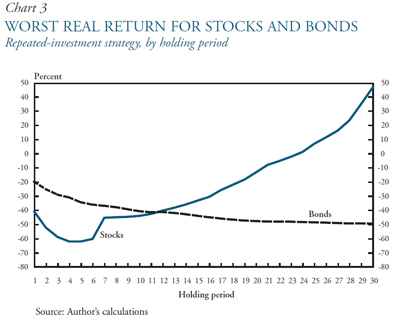
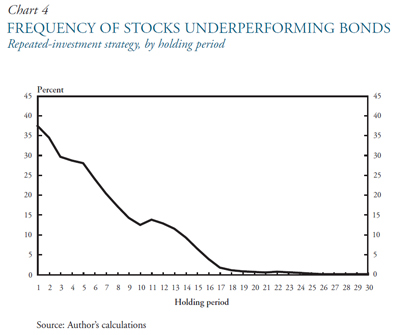
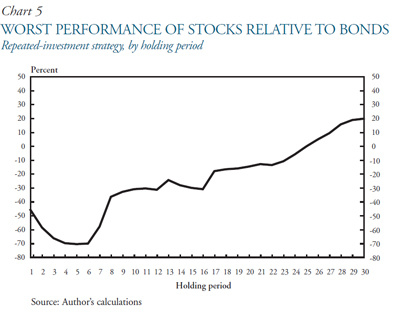
If I don’t give myself a way of finding this article quickly, I’m going to go out of my mind! I think this is a very good exposition of the stocks/bonds conundrum, and regularly spend half an hour looking up the reference – no more!

How Long is a Long-Term Investment? was written by Pu Shen of the Kansas City Fed and published in the Spring 2005 edition of their Economic Review.

Unfortunately, the source-file is copy-protected (why do they do that?) but I can recommend this article as part of the asset allocation process; it has many fascinating graphs. The laboriously re-typed conclusion is:

This article confirms the conventional wisdom that in the United States stocks historically have been safer than long-term government bonds for investors with long holding periods. But the article also shows that the conventional wisdom has only been true for investors who held their portfolios for more than 25 years. For practical purposes, that may be too long a holding period for most investors. Over the years, for investors who have held their portfolios for shorter periods, both stocks and bonds were exposed to substantial risks, and stocks did not necessarily outperform government bonds. This implies that in making asset allocation decisions, investors should think carefully about how long they will be able to hold their portfolios undisturbed and how much risk they are willing to bear.

Update: A little bird has sent me an unlocked version of the paper, so I can reproduce my three favourite graphs:

Interesting External Papers

BIS Releases Working Paper on ABX.HE Pricing

The Bank for International Settlements has announced the release of Working Paper #279, The pricing of subprime mortgage risk in good times and bad: evidence from the ABX.HE indices by Ingo Fender and Martin Scheicher.

This paper investigates the market pricing of subprime mortgage risk on the basis of data for the ABX.HE family of indices, which have become a key barometer of mortgage market conditions during the recent financial crisis. After an introduction into ABX index mechanics and a discussion of historical pricing patterns, we use regression analysis to establish the relationship between observed index returns and macroeconomic news as well as market-based proxies of default risk, interest rates, liquidity and risk appetite. The results imply that declining risk appetite and heightened concerns about market illiquidity—likely due in part to significant short positioning activity—have provided a sizeable contribution to the observed collapse in ABX prices since the summer of 2007. In particular, while fundamental factors, such as indicators of housing market activity, have continued to exert an important influence on the subordinated ABX indices, those backed by AA and AAA exposures have tended to react more to the general deterioration of the financial market environment. This provides further support for the inappropriateness of pricing models that do not sufficiently account for factors such as risk appetite and liquidity risk, particularly in periods of heightened market pressure. In addition, as related risk premia can be captured by unconstrained investors, ABX pricing patterns appear to lend support to government measures aimed at taking troubled assets off banks’ balance sheets—such as the US Troubled Asset Relief Program (TARP).

The authors observe:

With market liquidity vanishing and entire market segments becoming largely dysfunctional, factors other than credit risk became increasingly important drivers of observed prices. This, in turn, rekindled earlier doubts concerning the validity of currently available models for the pricing of credit risk, particularly for portfolio instruments such as mortgage-backed securities and other complex securitisations.

The results presented in this paper suggest that declining risk appetite and heightened concerns about market illiquidity have provided a sizeable contribution to the observed collapse in ABX prices since July 2007. While fundamental factors, such as indicators of housing market activity, have continued to exert an important influence on the subordinated ABX indices, the AA and AAA indices have tended to react more to the general deterioration of the financial market environment, such as declining risk appetite and market liquidity. These results underline the well-established view that risk premia are important components of observed prices for default-risky products, and that the relative importance of non-default risk factors will tend to increase in periods of strong repricing of credit risk. This suggests that theoretical pricing models that do not sufficiently account for these factors may be inappropriate, particularly in periods of heightened market pressure.

Interesting External Papers

The Value of Liquidity

Assiduous Readers will be well aware that I often include articles in the blog for no other reason than to bookmark them. Having just spent twenty minutes trying to find this article after reading it some time ago, it is clear that I shall have to redouble my efforts!

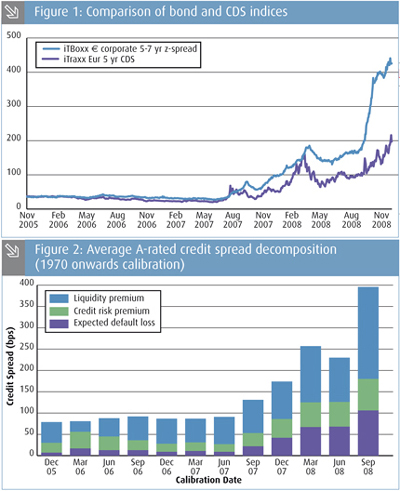
Paul Fulcher of UBS and Colin Wilson of Barrie & Hibbert wrote a nice summary regarding credit spread decomposition for The Actuary, titled Financial Crisis: The Value of Liquidity. I thought they made the central point very well:

The spread on corporate bonds over the liquid risk-free rate (for example, government bonds) represents compensation for several different factors:

A Expected default losses
B Unexpected default risk, such as default and recovery rate risk
C Mark-to-market risk, such as the risk of a fall in the market price of the bond
D Liquidity risk, such as the risk of not finding a ready buyer at the theoretical market price.

Investors concerned with the realisable value of their investment in the short-term require compensation for all these risks.

However, investors who can hold bonds to maturity need compensation only for A and B. Such investors can enjoy the premiums for C and D, and we refer to these collectively as a ‘liquidity premium’.

There are some good references, too: