Market Action

March 13, 2015

Jobs, jobs, … oopsy!:

Canadian employment was little changed in February and the unemployment rate jumped to a five-month high as an oil shock ripples through the economy.

Nationwide employment fell by 1,000 positions, and the jobless rate rose to 6.8 percent, the highest since September, from 6.6 percent in January, Statistics Canada said Friday in Ottawa.

Today’s report also showed wage growth weakening and even deeper losses in the private sector.

Canada’s currency extended losses after the report and was down 0.7 percent to C$1.2779 against its U.S. counterpart at 9:56 a.m. in Toronto. The currency has lost 5.2 percent since the Bank of Canada cut interest rates on Jan. 21 to provide an economic buffer for the oil price shock.

Jobs in the natural resource sector were down 16,900 last month. Alberta, home to the bulk of Canada’s oil production, posted a 14,000 decline in employment and its highest jobless rate since 2011, rising 0.8 percentage points to 5.3 percent. Wages in the province have stagnated since June, when crude prices began a seven-month drop to less than $50 a barrel, from more than $100.

Nationally, gains in public sector employment, which were up 24,300 in February, offset a 29,000 decline in private sector jobs.

By industry, the biggest decline nationally was the 19,900 positions lost in manufacturing, followed by the natural resource sector. Construction and education were the biggest gainers during the month. Average hourly wages rose 1.8 percent in February from a year earlier.

So it looks like the Conservatives won’t aim for re-election on their Economic Action Plan; it seems much wiser to stir up suspicion against and disdain for a domestic minority. I do not believe that the public sector hirings have been for secret policemen, since Bill C-51 has not yet become law and we can count on our wise masters in Ottawa to show scrupulous regard for the law.

Meanwhile, US authorities are licking their chops over another episode of regulatory extortion:

The U.S. Justice Department is seeking about $1 billion each from global banks being investigated for manipulation of currency markets, according to two people familiar with the talks.

The figure is a starting point in settlement discussions, with some banks being asked for more and some less than $1 billion. One bank that has cooperated from the beginning is expected to pay far less, one of the people said. Penalties of about $4 billion are on the table, according to one of the people, though the number could change markedly.

Banks are pushing back harder than in some previous negotiations, including those for mortgage-backed securities, and the final penalties could be lower, people close to the talks said.

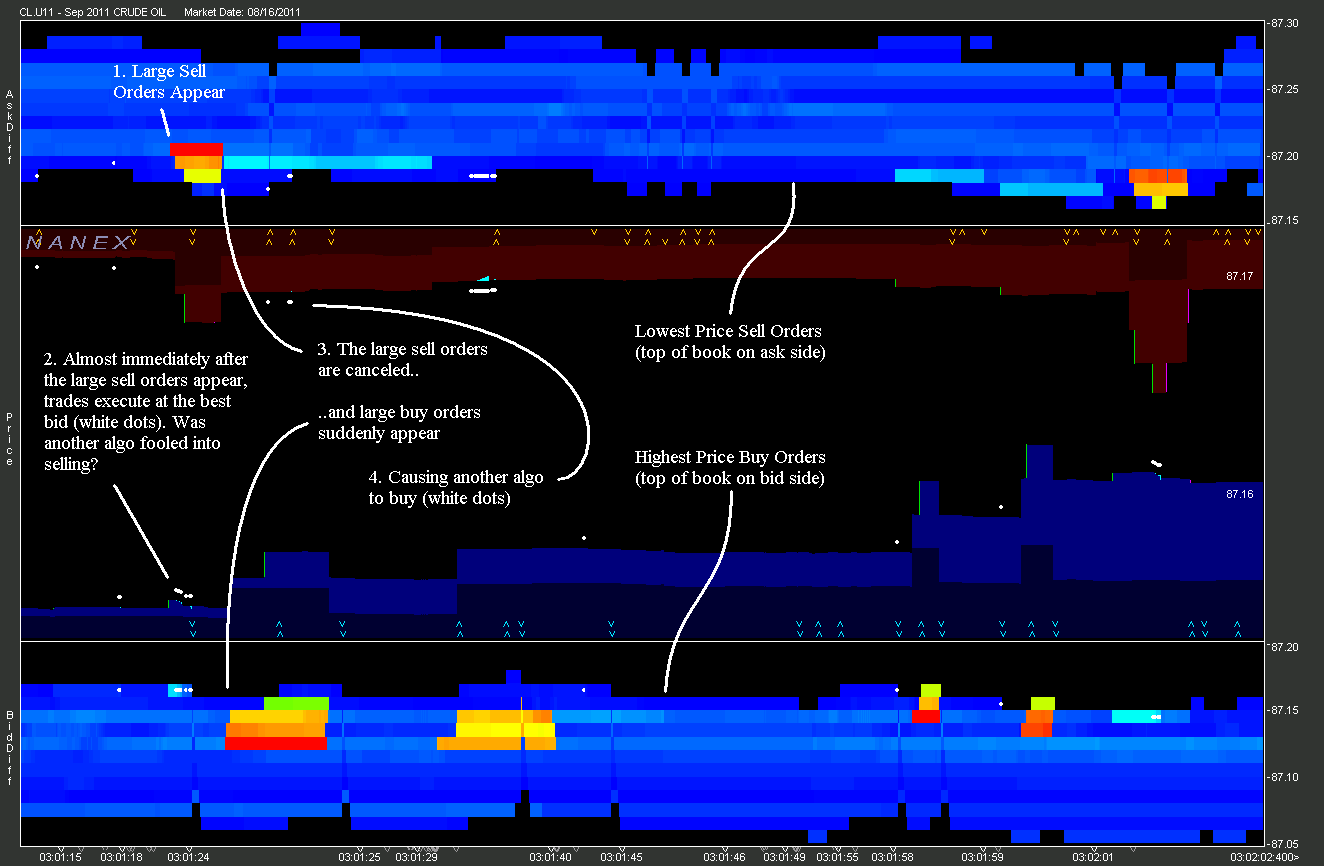
As talks to resolve the U.S. cases advance, the Justice Department and New York’s state banking regulator have opened up a new investigation into whether banks abused a longstanding practice in the currency spot markets known as “last look.” The practice allows banks to back out of unfavorable trades at the last moment.

Last look?

“Last look” refers to the feature on many platforms in which the party that is making markets gets a chance to reject a trade if it doesn’t want to complete.

It dates back to the practice in phone-to-phone trading of checking the price was still in line with the market at the end of a conversation between a dealer and client or broker, aiming to get as close to the prevailing rate as possible.

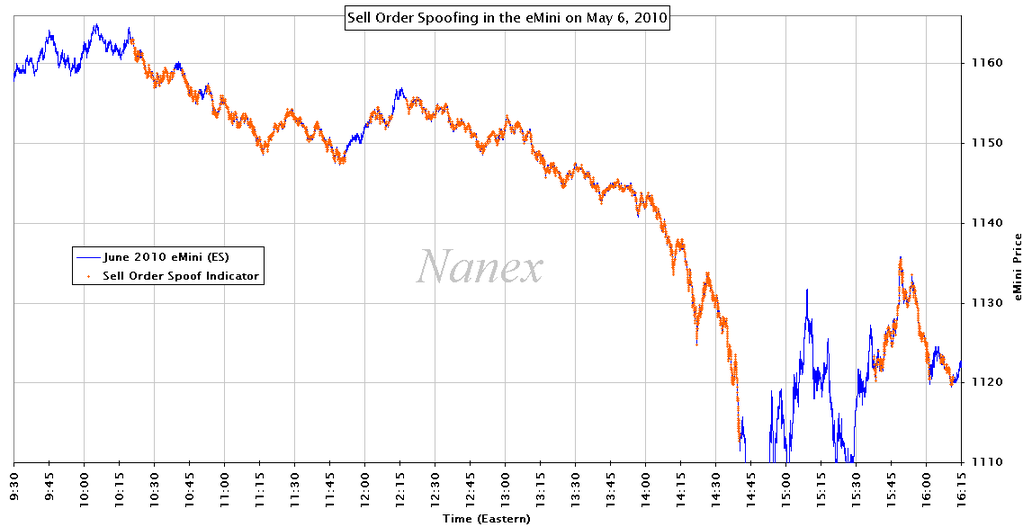
But industry figures worry that it has been used by some trading systems in recent years to systematically reject unfavourable orders or to float false orders that would never be executed to flush out the positions of other players.

Oh, OK. It’s the cool way to say “subject”.

Overall, it was another quiet, mixed day for the Canadian preferred share market, with PerpetualDiscounts off 8bp, FixedResets gaining 1bp and DeemedRetractibles up 4bp. The calm is deceptive, though, as the Performance Highlights table continues to show a lot of churn. Volume was slightly below average.

For as long as the FixedReset market is so violently unsettled, I’ll keep publishing updates of the more interesting and meaningful series of FixedResets’ Implied Volatilities. This doesn’t include Enbridge because although Enbridge has a large number of issues outstanding, all of which are quite liquid, the range of Issue Reset Spreads is too small for decent conclusions. The low is 212bp (ENB.PR.H; second-lowest is ENB.PR.D at 237bp) and the high is a mere 268 for ENB.PF.G.

Remember that all rich /cheap assessments are:
» based on Implied Volatility Theory only
» are relative only to other FixedResets from the same issuer
» assume constant GOC-5 yield
» assume constant Implied Volatility
» assume constant spread

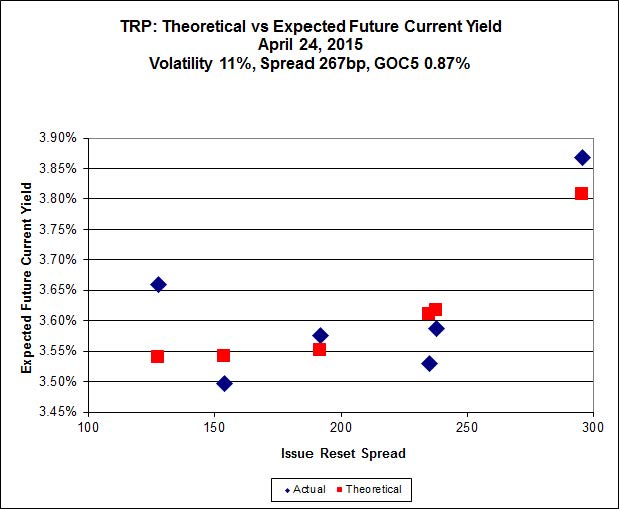
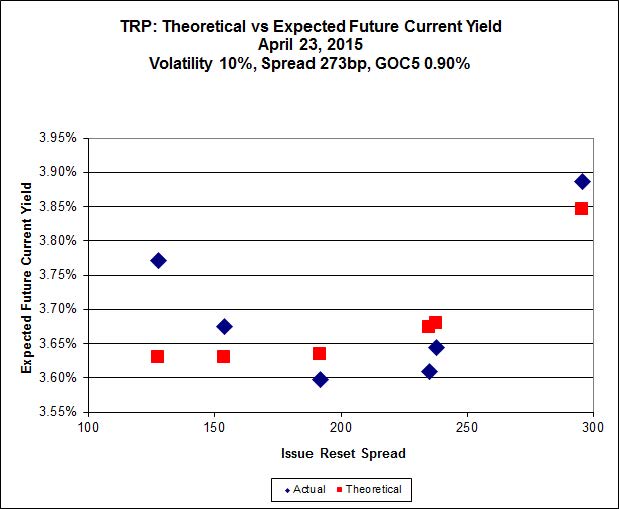
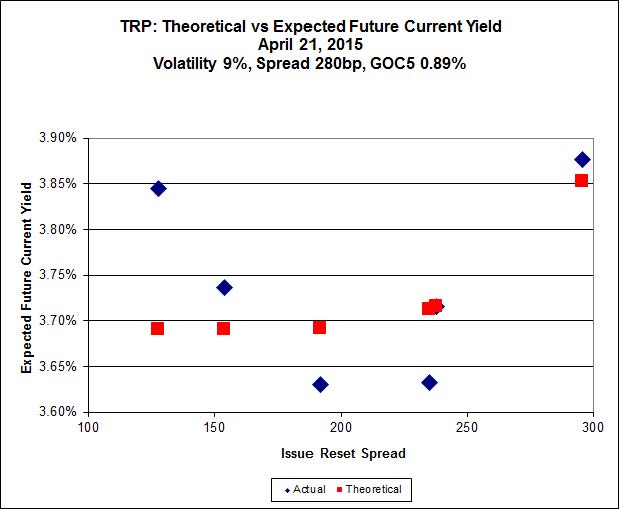
Here’s TRP:

impVol_TRP_150313
Click for Big

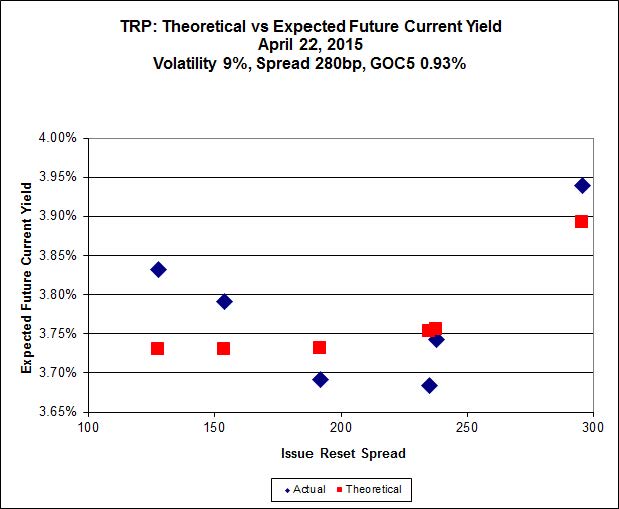
TRP.PR.E, which resets 2019-10-30 at +235, is bid at 23.82 to be $0.82 rich, while TRP.PR.G, resetting 2020-11-30 at +296, is $1.01 cheap at its bid price of 24.78.

impVol_MFC_150313
Click for Big

Another excellent fit, but the numbers are perplexing. Implied Volatility for MFC continues to be a conundrum, although it declined substantially today. It is still too high if we consider that NVCC rules will never apply to these issues; it is still too low if we consider them to be NVCC non-compliant issues (and therefore with Deemed Maturities in the call schedule).

Most expensive is MFC.PR.L, resetting at +216 on 2019-6-19, bid at 24.25 to be $0.58 rich, while MFC.PR.H, resetting at +313bp on 2017-3-19, is bid at 26.01 to be $0.49 cheap.

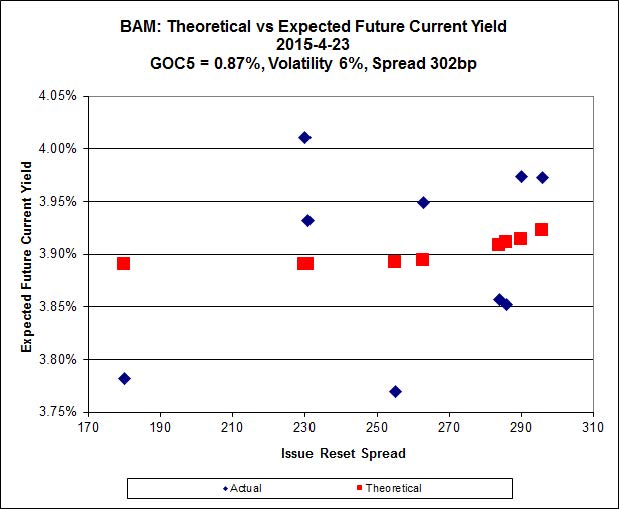
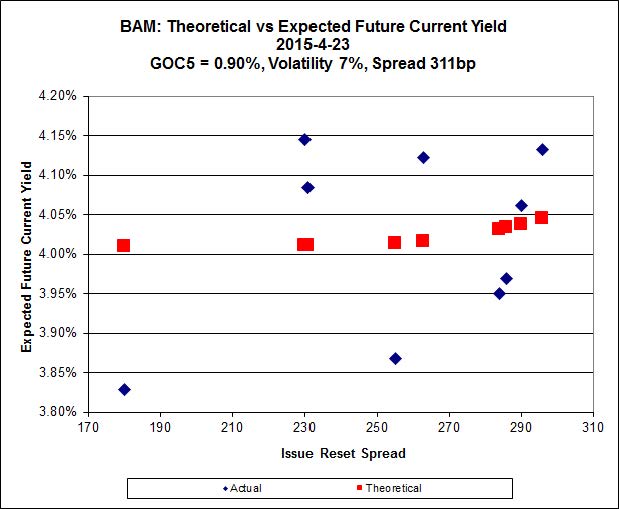
impVol_BAM_150313
Click for Big

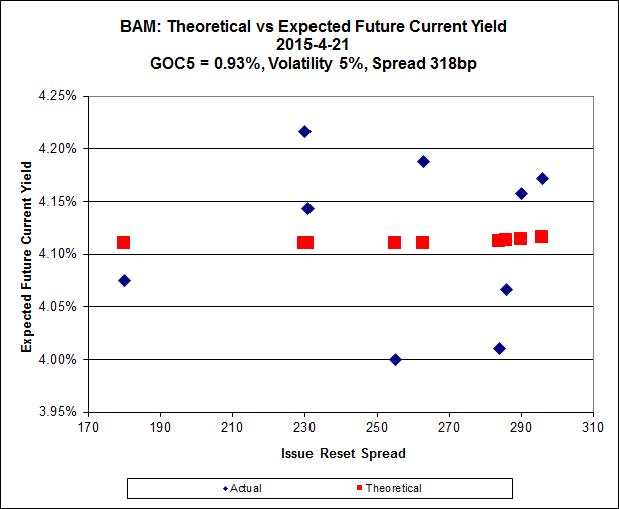
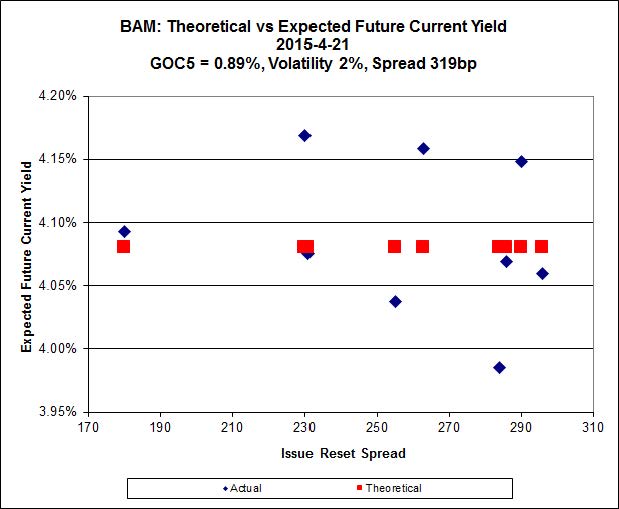
The fit on this series is actually quite reasonable – it’s the scale that makes it look so weird.

The cheapest issue relative to its peers is BAM.PR.R, resetting at +230bp on 2016-6-30, bid at 21.50 to be $0.60 cheap. BAM.PF.E, resetting at +255bp 2020-3-31 is bid at 24.39 and appears to be $0.80 rich.

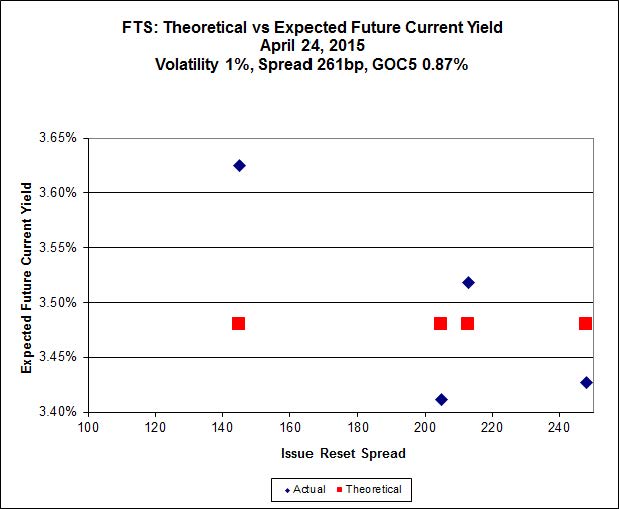
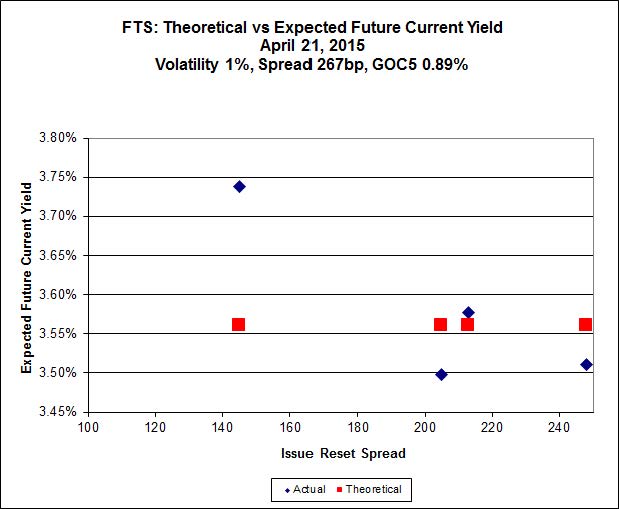
impVol_FTS_150313
Click for Big

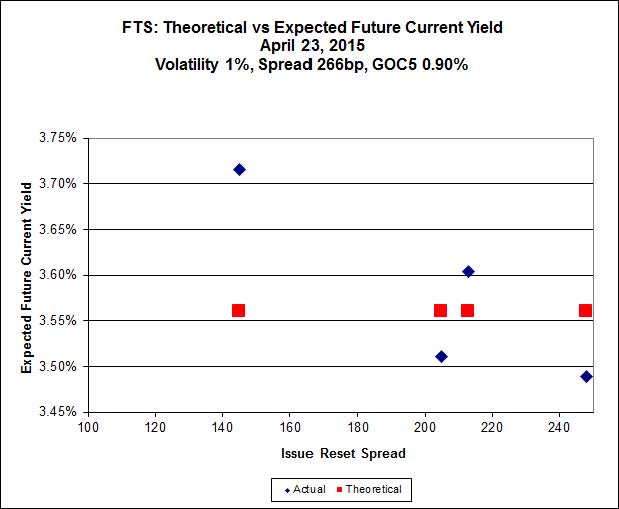
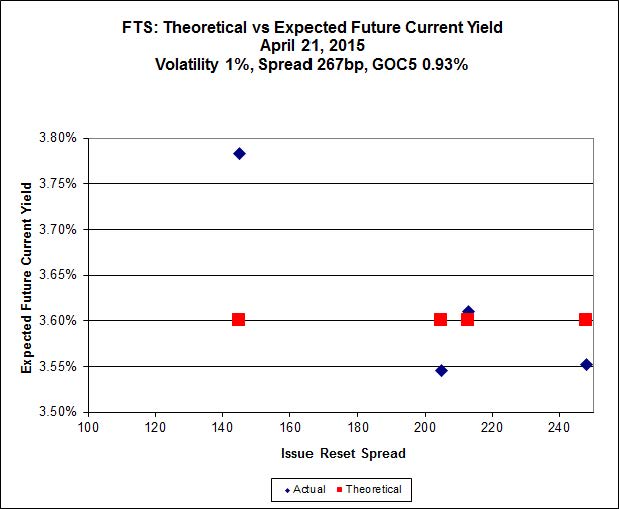
This is just weird because the middle is expensive and the ends are cheap but anyway … FTS.PR.H, with a spread of +145bp, and bid at 16.60, looks $1.45 cheap and resets 2015-6-1. FTS.PR.K, with a spread of +205bp and resetting 2019-3-1, is bid at 23.71 and is $1.03 rich.

pairs_FR_150313
Click for Big

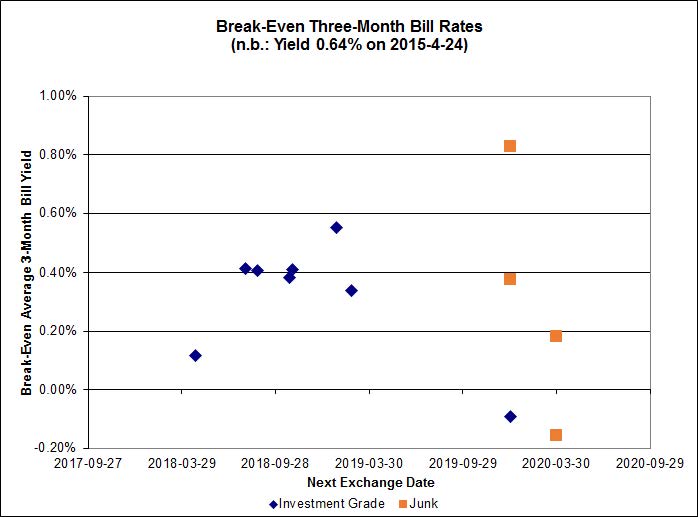
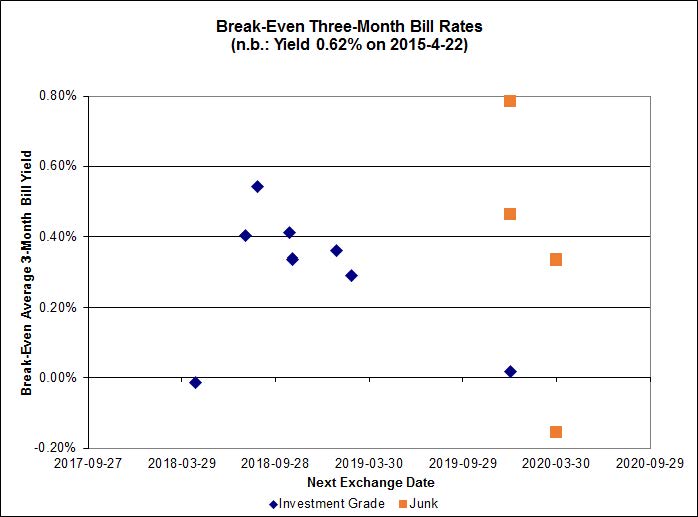
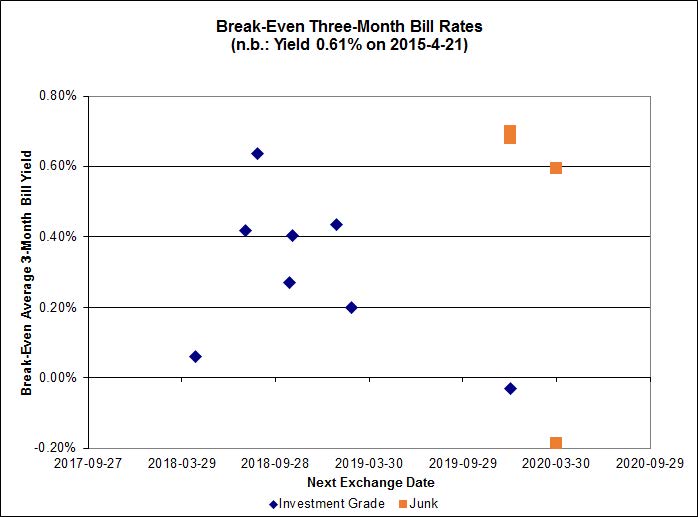
The cancellation of the previously announced deflationary environment had an immediate effect on the implied three month bill rate, with investment-grade pairs predicting an average over the next five years of between 0.00% and 0.10%

pairs_FF_150313
Click for Big

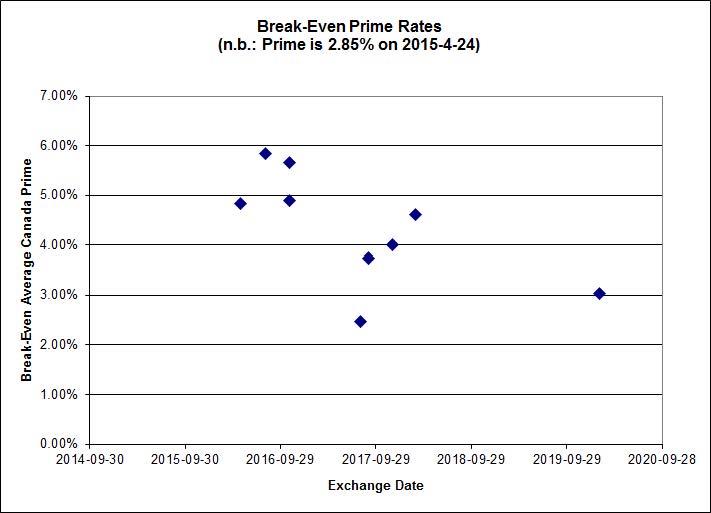
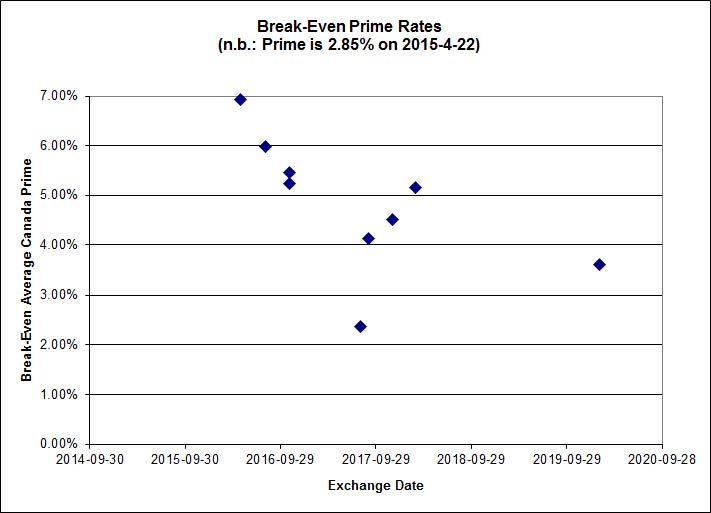
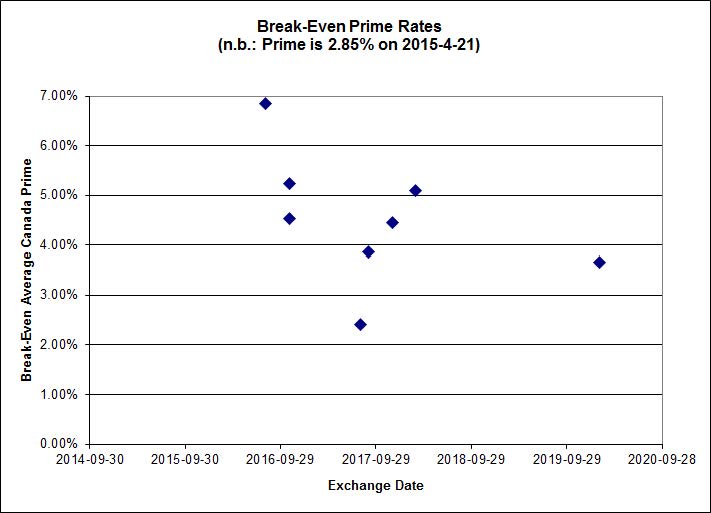
Shall we just say that this exhibits a high level of confidence in the continued rapacity of Canadian banks?

HIMIPref™ Preferred Indices
These values reflect the December 2008 revision of the HIMIPref™ Indices

Values are provisional and are finalized monthly
Index Mean
Current
Yield
(at bid)
Median
YTW
Median
Average
Trading
Value
Median
Mod Dur
(YTW)
Issues Day’s Perf. Index Value
Ratchet 0.00 % 0.00 % 0 0.00 0 0.0000 % 2,382.2
FixedFloater 0.00 % 0.00 % 0 0.00 0 0.0000 % 4,165.2
Floater 3.18 % 3.18 % 68,450 19.31 3 0.0000 % 2,532.5
OpRet 4.07 % 1.31 % 100,250 0.27 1 0.0000 % 2,762.6
SplitShare 4.48 % 4.57 % 53,461 4.44 5 -0.0717 % 3,207.1
Interest-Bearing 0.00 % 0.00 % 0 0.00 0 0.0000 % 2,526.1
Perpetual-Premium 5.29 % 0.83 % 56,717 0.08 25 0.0642 % 2,519.5
Perpetual-Discount 5.03 % 5.01 % 153,307 15.40 9 -0.0800 % 2,782.1
FixedReset 4.39 % 3.51 % 248,913 16.79 85 0.0057 % 2,428.0
Deemed-Retractible 4.91 % -0.77 % 107,878 0.13 37 0.0427 % 2,655.7
FloatingReset 2.49 % 2.93 % 80,342 6.33 8 -0.0107 % 2,333.6
Performance Highlights
Issue Index Change Notes
HSE.PR.A FixedReset -2.69 % YTW SCENARIO
Maturity Type : Limit Maturity
Maturity Date : 2045-03-13
Maturity Price : 17.00
Evaluated at bid price : 17.00
Bid-YTW : 3.91 %
CIU.PR.C FixedReset -2.43 % YTW SCENARIO
Maturity Type : Limit Maturity
Maturity Date : 2045-03-13
Maturity Price : 16.49
Evaluated at bid price : 16.49
Bid-YTW : 3.49 %
MFC.PR.F FixedReset -1.52 % YTW SCENARIO
Maturity Type : Hard Maturity
Maturity Date : 2025-01-31
Maturity Price : 25.00
Evaluated at bid price : 19.45
Bid-YTW : 5.46 %
GWO.PR.N FixedReset -1.08 % YTW SCENARIO
Maturity Type : Hard Maturity
Maturity Date : 2025-01-31
Maturity Price : 25.00
Evaluated at bid price : 18.30
Bid-YTW : 5.86 %
MFC.PR.C Deemed-Retractible -1.01 % YTW SCENARIO
Maturity Type : Hard Maturity
Maturity Date : 2025-01-31
Maturity Price : 25.00
Evaluated at bid price : 23.62
Bid-YTW : 5.24 %
TRP.PR.F FloatingReset 1.07 % YTW SCENARIO
Maturity Type : Limit Maturity
Maturity Date : 2045-03-13
Maturity Price : 18.90
Evaluated at bid price : 18.90
Bid-YTW : 3.23 %
BAM.PR.T FixedReset 1.28 % YTW SCENARIO
Maturity Type : Limit Maturity
Maturity Date : 2045-03-13
Maturity Price : 21.73
Evaluated at bid price : 22.20
Bid-YTW : 3.66 %
SLF.PR.G FixedReset 1.49 % YTW SCENARIO
Maturity Type : Hard Maturity
Maturity Date : 2025-01-31
Maturity Price : 25.00
Evaluated at bid price : 18.40
Bid-YTW : 5.81 %
MFC.PR.B Deemed-Retractible 1.58 % YTW SCENARIO
Maturity Type : Hard Maturity
Maturity Date : 2025-01-31
Maturity Price : 25.00
Evaluated at bid price : 24.40
Bid-YTW : 4.98 %
BAM.PF.E FixedReset 2.05 % YTW SCENARIO
Maturity Type : Limit Maturity
Maturity Date : 2045-03-13
Maturity Price : 22.94
Evaluated at bid price : 24.39
Bid-YTW : 3.62 %
Volume Highlights
Issue Index Shares
Traded
Notes
RY.PR.M FixedReset 196,652 New issue settled today.
YTW SCENARIO
Maturity Type : Limit Maturity
Maturity Date : 2045-03-13
Maturity Price : 22.85
Evaluated at bid price : 24.25
Bid-YTW : 3.51 %
CM.PR.Q FixedReset 140,573 Recent new issue.
YTW SCENARIO
Maturity Type : Limit Maturity
Maturity Date : 2045-03-13
Maturity Price : 23.00
Evaluated at bid price : 24.61
Bid-YTW : 3.57 %
TD.PR.R Deemed-Retractible 136,308 Called for redemption effective April 30.
YTW SCENARIO
Maturity Type : Call
Maturity Date : 2015-04-30
Maturity Price : 25.50
Evaluated at bid price : 25.80
Bid-YTW : 1.10 %
HSE.PR.E FixedReset 86,715 Recent new issue.
YTW SCENARIO
Maturity Type : Limit Maturity
Maturity Date : 2045-03-13
Maturity Price : 23.13
Evaluated at bid price : 24.92
Bid-YTW : 4.36 %
SLF.PR.G FixedReset 71,530 RBC crossed 57,800 at 18.50.
YTW SCENARIO
Maturity Type : Hard Maturity
Maturity Date : 2025-01-31
Maturity Price : 25.00
Evaluated at bid price : 18.40
Bid-YTW : 5.81 %
BIP.PR.A FixedReset 55,400 Recent new issue.
YTW SCENARIO
Maturity Type : Limit Maturity
Maturity Date : 2045-03-13
Maturity Price : 22.96
Evaluated at bid price : 24.50
Bid-YTW : 4.44 %
There were 27 other index-included issues trading in excess of 10,000 shares.
Wide Spread Highlights
Issue Index Quote Data and Yield Notes
MFC.PR.C Deemed-Retractible Quote: 23.62 – 24.27
Spot Rate : 0.6500
Average : 0.4416

YTW SCENARIO
Maturity Type : Hard Maturity
Maturity Date : 2025-01-31
Maturity Price : 25.00
Evaluated at bid price : 23.62
Bid-YTW : 5.24 %

CU.PR.C FixedReset Quote: 23.92 – 24.60
Spot Rate : 0.6800
Average : 0.5189

YTW SCENARIO
Maturity Type : Limit Maturity
Maturity Date : 2045-03-13
Maturity Price : 23.07
Evaluated at bid price : 23.92
Bid-YTW : 3.42 %

ENB.PR.T FixedReset Quote: 20.49 – 20.81
Spot Rate : 0.3200
Average : 0.2024

YTW SCENARIO
Maturity Type : Limit Maturity
Maturity Date : 2045-03-13
Maturity Price : 20.49
Evaluated at bid price : 20.49
Bid-YTW : 4.28 %

CIU.PR.C FixedReset Quote: 16.49 – 16.90
Spot Rate : 0.4100
Average : 0.3123

YTW SCENARIO
Maturity Type : Limit Maturity
Maturity Date : 2045-03-13
Maturity Price : 16.49
Evaluated at bid price : 16.49
Bid-YTW : 3.49 %

BAM.PR.N Perpetual-Discount Quote: 22.33 – 22.64
Spot Rate : 0.3100
Average : 0.2416

YTW SCENARIO
Maturity Type : Limit Maturity
Maturity Date : 2045-03-13
Maturity Price : 21.91
Evaluated at bid price : 22.33
Bid-YTW : 5.31 %

NA.PR.Q FixedReset Quote: 25.30 – 25.50
Spot Rate : 0.2000
Average : 0.1371

YTW SCENARIO
Maturity Type : Hard Maturity
Maturity Date : 2022-01-31
Maturity Price : 25.00
Evaluated at bid price : 25.30
Bid-YTW : 3.35 %

Issue Comments

RY.PR.M Hammered On Low Volume

Royal Bank of Canada has announced:

it has closed its domestic public offering of Non-Cumulative, 5-Year Rate Reset Preferred Shares Series BF. Royal Bank of Canada issued 12 million Preferred Shares Series BF at a price of $25 per share to raise gross proceeds of $300 million.

The offering was underwritten by a syndicate led by RBC Capital Markets. The Preferred Shares Series BF will commence trading on the Toronto Stock Exchange today under the ticker symbol RY.PR.M.

The Preferred Shares Series BF were issued under a prospectus supplement dated March 9, 2015 to the bank’s short form base shelf prospectus dated December 20, 2013.

RY.PR.M is a FixedReset, 3.60%+262, NVCC-compliant, announced March 5. It will be tracked by HIMIPref™ and has been assigned to the FixedReset subindex.

The issue traded 223,152 shares today (consolidated exchanges) in a range of 23.75-67 (which would be rather breathtaking even if the issuer was not a major bank or Canada’s largest company) before closing at 24.25-49 (which is an equally breathtaking spread). Vital statistics are:

RY.PR.M FixedReset YTW SCENARIO
Maturity Type : Limit Maturity
Maturity Date : 2045-03-13
Maturity Price : 22.85
Evaluated at bid price : 24.25
Bid-YTW : 3.51 %

The Implied Volatility calculation is not particularly informative:

impVol_RY_150313
Click for Big

According to the calculation, the two NVCC non-compliant issues, RY.PR.I and RY.PR.L, resetting at +193 and +267, respectively, are quite expensive: this is as it should be, due to the greater certainty that these issues have of being called at the next opportunity.

However, it seems clear that the NVCC-compliant issues, RY.PR.Z, RY.PR.H, RY.PR.J and RY.PR.M are reasonably well aligned with an implied volatility of greater than 40%, which shows continued market confidence that anything issued by a bank will always be worth somewhere close to par value.

Update, 2015-3-19: They had to have an inventory blow-out sale:

Yet RBC’s most recent $300-million deal struggled to find buyers, according to people familiar with the offering, prompting the bank to re-price it. Preferred shares are always sold for $25 each, but RBC’s deal had to be ‘cleaned up,’ or re-priced, at $24.35.

Investors apparently balked because of the coupon RBC tried to offer them. A week before the offering was announced, Toronto-Dominion Bank launched its own preferred share sale, and promised to pay a 3.6 per cent annual coupon. RBC told investors it would pay the same rate – the problem is that underlying bond yields moved between the dates when the deals were offered.

Preferred shares are priced off the five-year Government of Canada bond yield, and this yield climbed roughly 15 basis points higher between the RBC and TD deals. Instead of boosting its preferred share coupon by the same amount, RBC apparently hoped investors wouldn’t notice the shift.

Issue Comments

FFN.PR.A: Name Change

Quadravest has announced:

Financial 15 Split Corp. II (the “Company”) announces a name change to North American Financial 15 Split Corp. Trading on the Toronto Stock Exchange under the new name is expected to commence on Wednesday, March 18, 2015. The Preferred Shares and Class A Shares will continue to trade under the symbols FFN.PR.A and FFN, respectively.

There is no indication of a change in investment policy, which would have to be voted on by shareholders as it’s specified in the prospectus. It may be that Quadravest intends to reposition the fund to take over the space currently occupied by US Financial 15 Split Corp., which was very badly whacked in the Credit Crunch and has a Net Asset Value Per Unit of only $7.24, far below their $10 obligation to FTU.PR.B. The US fund is scheduled for wind-up 2018-12-1.

Market Action

March 12, 2015

There’s an interesting piece on Bloomberg about a guy who exploits death-spiral financing:

What Sason discovered is a way to get shares in desperate and broke companies at big discounts by lending them money. Magna has done deals with at least 80 companies. Of those, the stocks of 71 have gone down since the investment. He can still turn a profit, because the terms of the deals allow him to turn debt into equity at a fixed discount. No matter where the stock is trading, he gets it for less.

Magna functions as a pawnshop for penny stocks—shares of obscure ventures that change hands far from the rules of the New York Stock Exchange. His customers have included a would-be Chilean copper miner, an inventor of thought-controlled phones, and at least two executives later busted for fraud. They come to Sason to trade a lot of their stock for a little bit of money. Often they’re aware the deal is likely to be bad for their shareholders.

If the share price goes lower before Magna can unload its investment, the companies have to give up even more stock, all but eliminating the risk for Sason. Critics call it “death-spiral financing” because it drives stocks into the ground. Others in the field say they sometimes make double, triple, or even 10 times their investment in just a few months.

The business is legal, but the loopholes in securities law it exploits are too sketchy for most of the Ivy League types at banks and hedge funds. At least six other lenders of last resort to penny-stock companies have been sued by the Securities and Exchange Commission for breaking the rules around dumping shares or other violations. One was arrested by the FBI. It’s worked out better for Sason, who hasn’t had any issues with the authorities. He’s using death-spiral profits to diversify Magna and turn himself into an entertainment mogul.

Kevin Carmichael of the Centre for International Governance Innovation (last mentioned on PrefBlog on December 30, 2014) writes a piece in the Globe titled The most alarming thing about Canada’s housing market is routinely ignored:

So Royal Bank of Canada chief executive David McKay thinks Canada’s housing market is just fine. That’s reassuring, to a point. It would be more so if Canada had a public authority in place to verify Mr. McKay’s confidence. The fact there is no such entity undermines Ottawa’s belief that it has something to teach the world about financial regulation.

But the bigger moral hazard is Canada’s housing policy. Most Canadian mortgages are insured, and that insurance is backed by the federal government. There is little reason for a banker to worry much about warning lights in a system like that. In fact, it is a selling point. “What we keep trying to educate is our first loss is covered by government guaranteed insurance,” Mr. McKay said.

In other words, if you are thinking about buying RBC stock, no need to assume the bank would suffer big losses in the event of a housing crash: it will be taxpayers who take the hit. Mr. McKay and the leaders of Canada’s other big banks can make bets on the positive indicators – and play down the bad stuff – because they have relatively little to lose. They have every incentive to go all in on housing – and they have. The chartered banks are holding almost $1-trillion in outstanding residential credit, according to Bank of Canada data.

So there are two problems with this. First, there is no ‘moral hazard associated with CMHC insurance. Moral hazard is the assumption that you’ll be rescued if things go wrong. With CMHC insurance this opprobrious term does not apply because it’s not an assumption. It’s a business transaction. The banks – or their clients – have paid for insurance and are entitled to the benefits of that insurance. Now, one may argue that the insurance is priced too low, or shouldn’t be made so freely available, or anything else you please, but to claim that this is an example of “moral hazard” is to misuse the term.

But the big problem is Mr. Carmichael’s belief that we need a fresh new batch of expensive regulators to tell us when houses are expensive.

There is no single entity that is in charge of deflating the asset-price bubbles that turn into busts if left unchecked. The Bank of Canada has no regulatory power. It could adjust interest rates, but that is a blunt response to a potential bubble in housing, farmland or some other asset. The priority of the Office of the Superintendent of Financial Institutions is making sure none of the big banks fail, not keeping an eye for other weak spots in the broader financial system. That job technically falls to the Finance Department, which, until Canada starts appointing technocrats to run its ministries, will inevitably be controlled by a politician. And a politician always will have an incentive to avoid unpopular decisions such as making it more difficult to buy a home.

The big assumption here is that wise bureaucrats can identify asset bubbles better than anybody else, since mystic infallibility is a perquisite of government employees. This assumption has been discussed in the States, where (in contrast to Canada) public discussion of actual issues by those who might be expected to have some kind of clue is encouraged … for instance, by Ben Bernanke in 2002, when he was a mere Fed governor and not the chair:

My talk today will address a contentious issue, summarized by the following pair of questions: Can the Federal Reserve (or any central bank) reliably identify “bubbles” in the prices of some classes of assets, such as equities and real estate? And, if it can, what if anything should it do about them?

As I will argue today, I think for the Fed to be an “arbiter of security speculation or values” is neither desirable nor feasible.1 Of course, to do its job the Fed must monitor financial markets intensively and continuously. The financial markets are vital components of the economic machinery. Moreover, asset prices contain an enormous amount of useful and timely information about developments in the broader economy, information that should certainly be taken into account in the setting of monetary policy. For example, to the extent that a stock-market boom causes, or simply forecasts, sharply higher spending on consumer goods and new capital, it may indicate incipient inflationary pressures. Policy tightening might therefore be called for–but to contain the incipient inflation not to arrest the stock-market boom per se.2

The second part of my prescription is for the Fed to use its regulatory, supervisory, and lender-of-last-resort powers to protect and defend the financial system. In particular, alone and in concert with other agencies, the Fed should ensure that financial institutions and markets are well prepared for the contingency of a large shock to asset prices. The Fed and other regulators should insist that banks be well capitalized and well diversified and that they stress-test their portfolios against a wide range of scenarios. The Fed can also contribute to reducing the probability of boom-and-bust cycles occurring in the first place, by supporting such objectives as more-transparent accounting and disclosure practices and working to improve the financial literacy and competence of investors.3 Finally, if a sudden correction in asset prices does occur, the Fed’s first responsibility is to do its part to ensure the integrity of the financial infrastructure–in particular, the payments system and the systems for settling trades of securities and other financial instruments. If necessary, the Fed should provide ample liquidity until the immediate crisis has passed. The Fed’s response to the 1987 stock market break is a good example of what I have in mind.4

If we could accurately and painlessly rid asset markets of bubbles, of course we would want to do so. But as a practical matter, this is easier said than done, particularly if we intend to use monetary policy as the instrument, for two main reasons. First, the Fed cannot reliably identify bubbles in asset prices. Second, even if it could identify bubbles, monetary policy is far too blunt a tool for effective use against them.

Wise words indeed! We cannot identify asset bubbles with any more reliability than we can indulge in any other form of market timing, but what we can do is perform stress tests and explore what-if scenarios to examine risks to the financial system.

Next up is Fed Governor Frederic S. Mishkin in a 2008 speech titled How Should We Respond to Asset Price Bubbles?:

At some point, however, the bubble bursts. The collapse in asset prices then leads to a reversal of the feedback loop in which loans go sour, lenders cut back on credit supply, the demand for the assets declines further, and prices drop even more. The resulting loan losses and declines in asset prices erode the balance sheets at financial institutions, further diminishing credit and investment across a broad range of assets. The decline in lending depresses business and household spending, which weakens economic activity and increases macroeconomic risk in credit markets.5 In the extreme, the interaction between asset prices and the health of financial institutions following the collapse of an asset price bubble can endanger the operation of the financial system as a whole.6

To be clear, not all asset price bubbles create these risks to the financial system. For example, the bubble in technology stocks in the late 1990s was not fueled by a feedback loop between bank lending and rising equity values; indeed, the bursting of the tech-stock bubble was not accompanied by a marked deterioration in bank balance sheets. But potential for some asset price bubbles to create larger difficulties for the financial system than others implies that our regulatory framework should be designed to address the potential challenges to the financial system created by these bubbles.

More generally, our approach to regulation should favor policies that will help prevent future feedback loops between asset price bubbles and credit supply. A few broad principles are helpful in thinking about what such policies should look like. First, regulations should be designed with an eye toward fixing market failures. Second, regulations should be designed so as not to exacerbate the interaction between asset price bubbles and credit provision. For example, research has shown that the rise in asset values that accompanies a boom results in higher capital buffers at financial institutions, supporting further lending in the context of an unchanging benchmark for capital adequacy; in the bust, the value of this capital can drop precipitously, possibly even necessitating a cut in lending.15 It is important for research to continue to analyze the role of bank capital requirements in promoting financial stability, including whether capital requirements should be adjusted over the business cycle or whether other changes in our regulatory structure are necessary to ensure macroeconomic efficiency.16 Finally, in general, regulatory policies are appropriately focused on the soundness of individual institutions. However, during certain periods, risks across institutions become highly correlated, and we need to consider whether such policies might need to take account of these higher-stress environments in assessing the resilience of both individual institutions and the financial system as a whole in the face of potential external shocks.

Again, this is good stuff essentially reiterating the thrust of the Bernanke speech with the benefit of some experience and supporting my contentions.

Under Yellen, however, we seem to be moving at least somewhat in the other direction:

The Federal Reserve has created a committee led by Vice Chairman Stanley Fischer to monitor financial stability, reinforcing its efforts to avoid the emergence of asset-price bubbles.

Joining Fischer on the Committee on Financial Stability are Governors Daniel Tarullo and Lael Brainard, according to the central bank’s latest Board Committee list.

Fed officials want to ensure that six years of near-zero interest rates don’t lead to a repeat of the excessive risk-taking that fanned the U.S. housing boom and subsequent financial crisis.

“They’re putting the varsity team on it, but whether or not they’re going to be able to call bubbles better than anyone else is really is an open question,” Drew Matus, deputy U.S. chief economist at UBS Securities LLC in New York, said in an interview yesterday.

As I have said before, I don’t think any bureaucrat has the ability to determine whether or not housing prices are too high or too low and should not have the ability to target them. To consider the question to bark up the wrong tree. The critical question is (in the context of Mr. Carmichael’s article) ‘what might happen if housing prices give up all their real (inflation adjusted) gains from the past ten years in the next year or two?’ What’s that risk and are the probable consequences of such a bust sufficiently horrific that Something Must Be Done?

I have proposed in the past and will continue to propose that banks’ asset mix be an important input into countercyclical capital requirements. For instance, Canadian banks now have about 40% of their assets in mortgages compared to a long term average of 30%. While I have no idea what the “proper” proportion might be (maybe 60% is the magic number!) I do know that this represents a change and that change may be good and may be bad but is always risky. So, I say, it should be OSFI who, in such a situation, tells the banks … ‘OK. For the first 30% of your assets that are mortgages, capital requirements are the same as they always have been. But on the next 5% of mortgage assets, capital requirements are surcharged by 50%. On any amount over 35%, surcharged 100%’. Such a regime allows the banks to conduct business according to profitability, while making ‘excess’ business a little less profitable because it needs more capital.

And, of course, the big villain here is not the inability of the federal government to appoint a House Price Approval Commission, but their fuelling of the fire with massively expanded CMHC guarantees. And, I will note, I discussed on December 27, 2012 the response of David Dodge (the last independent Bank of Canada governor) to the reckless expansion of the CMHC, as quoted by the Globe and Mail in a piece titled Ottawa’s $800-billion housing problem:

It was a sweltering afternoon in July, 2006, and David Dodge was meeting with executives at Canada Mortgage and Housing Corp. in Ottawa, in search of the answer to a pressing question: Why were they lowering their standards in such a reckless fashion?

Now CMHC was abandoning its old ways. It was starting to allow more exotic kinds of mortgages, similar to what lenders were offering in the United States – 35-year loans, and loans on which the buyers had to pay only the interest at first, giving them low monthly payments at first but saddling them with more debt down the road.

To Mr. Dodge, these were irresponsible moves that would encourage some people to borrow too much or jump into the market before they were ready, creating new risks for the economy. “This is a mistake,” he told CMHC brass bluntly.

Lower mortgage standards were going to cause already-frothy house prices to inflate even more – an “excessive exuberance,” the governor called it – as buyers rushed in, borrowing greater amounts of money and purchasing bigger homes than they could otherwise afford.

“This is absolutely not the appropriate thing to do,” a frustrated Mr. Dodge told the meeting.

Yep, Mr. Dodge knew his business all right. Last of a dying breed.

However … say what you like about financial industry regulation, there’s no denying it’s an effective form of foreign aid:

It’s noon inside the offices of ForexChile in Santiago, and dozens of salespeople are working the phones, talking up investments linked to everything from Facebook stock to copper futures. They hold out tantalizing prospects to those on the other end of the line: potential returns of 20 percent, 30 percent, even 40 percent.

Familiar, yes — and illegal if this were the U.S. Because what these people are selling are neither stocks nor bonds nor futures nor funds. They are offering contracts for difference, financial derivatives that are off-limits to retail investors in the U.S. and highly regulated elsewhere.

The scene unfolds daily inside one of the most fashionable business addresses in Chile, where the contracts are perfectly legal and trading in them has exploded. BEFX, another brokerage that sells them, estimates that as much as $14 billion in leveraged trades are made every month. That’s about six times the turnover in the nation’s stocks.

It was a violently mixed day for the Canadian preferred share market, with PerpetualDiscounts losing 41bp, FixedResets up 21bp and DeemedRetractibles gaining 7bp. The Performance Highlights table is dominated by winning FixedResets. Volume was only average – somewhat surprisingly, since I would have expected four new issue settlements in four days to have caused a lot of churn. Well – we’ll see what tomorrow will bring, with the settlement of the new Royal Bank FixedReset, 3.60%+262.

For as long as the FixedReset market is so violently unsettled, I’ll keep publishing updates of the more interesting and meaningful series of FixedResets’ Implied Volatilities. This doesn’t include Enbridge because although Enbridge has a large number of issues outstanding, all of which are quite liquid, the range of Issue Reset Spreads is too small for decent conclusions. The low is 212bp (ENB.PR.H; second-lowest is ENB.PR.D at 237bp) and the high is a mere 268 for ENB.PF.G.

Remember that all rich /cheap assessments are:
» based on Implied Volatility Theory only
» are relative only to other FixedResets from the same issuer
» assume constant GOC-5 yield
» assume constant Implied Volatility
» assume constant spread

Here’s TRP:

impVol_TRP_150312
Click for Big

TRP.PR.E, which resets 2019-10-30 at +235, is bid at 24.12 to be $1.12 rich, while TRP.PR.G, resetting 2020-11-30 at +296, is $0.98 cheap at its bid price of 24.80.

impVol_MFC_150312
Click for Big

Another excellent fit, but the numbers are perplexing. Implied Volatility for MFC continues to be a conundrum, although it declined substantially today. It is still too high if we consider that NVCC rules will never apply to these issues; it is still too low if we consider them to be NVCC non-compliant issues (and therefore with Deemed Maturities in the call schedule).

Most expensive is MFC.PR.L, resetting at +216 on 2019-6-19, bid at 24.05 to be $0.44 rich, while MFC.PR.H, resetting at +313bp on 2017-3-19, is bid at 25.90 to be $0.51 cheap.

impVol_BAM_150312
Click for Big

The fit on this series is actually quite reasonable – it’s the scale that makes it look so weird.

The cheapest issue relative to its peers is BAM.PR.R, resetting at +230bp on 2016-6-30, bid at 21.30 to be $0.65 cheap. BAM.PF.E, resetting at +255bp 2020-3-31 is bid at 23.90 and appears to be $0.46 rich.

impVol_FTS_150312
Click for Big

This is just weird because the middle is expensive and the ends are cheap but anyway … FTS.PR.H, with a spread of +145bp, and bid at 16.60, looks $1.49 cheap and resets 2015-6-1. FTS.PR.K, with a spread of +205bp and resetting 2019-3-1, is bid at 23.72 and is $1.03 rich.

pairs_FR_150312
Click for Big

The cancellation of the previously announced deflationary environment had an immediate effect on the implied three month bill rate, with investment-grade pairs predicting an average over the next five years of between 0.00% and 0.10%

pairs_FF_150312
Click for Big

Shall we just say that this exhibits a high level of confidence in the continued rapacity of Canadian banks?

HIMIPref™ Preferred Indices
These values reflect the December 2008 revision of the HIMIPref™ Indices

Values are provisional and are finalized monthly
Index Mean
Current
Yield
(at bid)
Median
YTW
Median
Average
Trading
Value
Median
Mod Dur
(YTW)
Issues Day’s Perf. Index Value
Ratchet 0.00 % 0.00 % 0 0.00 0 -0.1487 % 2,382.2
FixedFloater 0.00 % 0.00 % 0 0.00 0 -0.1487 % 4,165.2
Floater 3.18 % 3.19 % 70,741 19.28 3 -0.1487 % 2,532.5
OpRet 4.07 % 1.29 % 103,877 0.27 1 -0.0794 % 2,762.6
SplitShare 4.47 % 4.43 % 54,218 4.44 5 -0.0637 % 3,209.4
Interest-Bearing 0.00 % 0.00 % 0 0.00 0 -0.0794 % 2,526.1
Perpetual-Premium 5.30 % 1.48 % 57,411 0.08 25 -0.1049 % 2,517.9
Perpetual-Discount 5.02 % 4.99 % 154,888 15.44 9 -0.4078 % 2,784.4
FixedReset 4.40 % 3.61 % 242,117 16.54 84 0.2058 % 2,427.9
Deemed-Retractible 4.91 % 0.79 % 108,651 0.13 37 0.0748 % 2,654.6
FloatingReset 2.54 % 2.97 % 83,226 6.32 8 -0.0962 % 2,333.9
Performance Highlights
Issue Index Change Notes
FTS.PR.J Perpetual-Premium -1.61 % YTW SCENARIO
Maturity Type : Limit Maturity
Maturity Date : 2045-03-12
Maturity Price : 24.08
Evaluated at bid price : 24.50
Bid-YTW : 4.86 %
BAM.PR.N Perpetual-Discount -1.36 % YTW SCENARIO
Maturity Type : Limit Maturity
Maturity Date : 2045-03-12
Maturity Price : 22.00
Evaluated at bid price : 22.44
Bid-YTW : 5.28 %
BAM.PF.C Perpetual-Discount -1.29 % YTW SCENARIO
Maturity Type : Limit Maturity
Maturity Date : 2045-03-12
Maturity Price : 22.50
Evaluated at bid price : 22.90
Bid-YTW : 5.29 %
BAM.PF.D Perpetual-Discount -1.19 % YTW SCENARIO
Maturity Type : Limit Maturity
Maturity Date : 2045-03-12
Maturity Price : 22.95
Evaluated at bid price : 23.25
Bid-YTW : 5.27 %
MFC.PR.B Deemed-Retractible -1.07 % YTW SCENARIO
Maturity Type : Hard Maturity
Maturity Date : 2025-01-31
Maturity Price : 25.00
Evaluated at bid price : 24.02
Bid-YTW : 5.18 %
MFC.PR.M FixedReset 1.02 % YTW SCENARIO
Maturity Type : Hard Maturity
Maturity Date : 2025-01-31
Maturity Price : 25.00
Evaluated at bid price : 24.73
Bid-YTW : 3.74 %
SLF.PR.I FixedReset 1.04 % YTW SCENARIO
Maturity Type : Call
Maturity Date : 2016-12-31
Maturity Price : 25.00
Evaluated at bid price : 25.34
Bid-YTW : 3.35 %
BAM.PF.G FixedReset 1.05 % YTW SCENARIO
Maturity Type : Limit Maturity
Maturity Date : 2045-03-12
Maturity Price : 23.17
Evaluated at bid price : 25.07
Bid-YTW : 3.82 %
SLF.PR.H FixedReset 1.12 % YTW SCENARIO
Maturity Type : Hard Maturity
Maturity Date : 2025-01-31
Maturity Price : 25.00
Evaluated at bid price : 22.60
Bid-YTW : 4.43 %
TRP.PR.C FixedReset 1.23 % YTW SCENARIO
Maturity Type : Limit Maturity
Maturity Date : 2045-03-12
Maturity Price : 17.26
Evaluated at bid price : 17.26
Bid-YTW : 3.74 %
IAG.PR.G FixedReset 1.35 % YTW SCENARIO
Maturity Type : Call
Maturity Date : 2017-06-30
Maturity Price : 25.00
Evaluated at bid price : 26.25
Bid-YTW : 1.97 %
TRP.PR.B FixedReset 1.40 % YTW SCENARIO
Maturity Type : Limit Maturity
Maturity Date : 2045-03-12
Maturity Price : 15.21
Evaluated at bid price : 15.21
Bid-YTW : 3.65 %
ENB.PR.Y FixedReset 1.42 % YTW SCENARIO
Maturity Type : Limit Maturity
Maturity Date : 2045-03-12
Maturity Price : 20.04
Evaluated at bid price : 20.04
Bid-YTW : 4.36 %
CIU.PR.C FixedReset 2.80 % YTW SCENARIO
Maturity Type : Limit Maturity
Maturity Date : 2045-03-12
Maturity Price : 16.90
Evaluated at bid price : 16.90
Bid-YTW : 3.53 %
Volume Highlights
Issue Index Shares
Traded
Notes
HSE.PR.E FixedReset 609,364 New issue settled today.
YTW SCENARIO
Maturity Type : Limit Maturity
Maturity Date : 2045-03-12
Maturity Price : 23.14
Evaluated at bid price : 24.95
Bid-YTW : 4.42 %
BIP.PR.A FixedReset 388,980 New issue settled today.
YTW SCENARIO
Maturity Type : Limit Maturity
Maturity Date : 2045-03-12
Maturity Price : 22.97
Evaluated at bid price : 24.51
Bid-YTW : 4.51 %
CM.PR.Q FixedReset 236,325 Recent new issue.
YTW SCENARIO
Maturity Type : Limit Maturity
Maturity Date : 2045-03-12
Maturity Price : 23.05
Evaluated at bid price : 24.75
Bid-YTW : 3.62 %
TRP.PR.G FixedReset 111,431 Recent new issue.
YTW SCENARIO
Maturity Type : Limit Maturity
Maturity Date : 2045-03-12
Maturity Price : 23.05
Evaluated at bid price : 24.80
Bid-YTW : 3.79 %
TD.PF.D FixedReset 57,850 Recent new issue.
YTW SCENARIO
Maturity Type : Limit Maturity
Maturity Date : 2045-03-12
Maturity Price : 23.12
Evaluated at bid price : 24.95
Bid-YTW : 3.58 %
GWO.PR.R Deemed-Retractible 51,273 RBC crossed 33,200 at 25.30.
YTW SCENARIO
Maturity Type : Hard Maturity
Maturity Date : 2025-01-31
Maturity Price : 25.00
Evaluated at bid price : 25.30
Bid-YTW : 4.64 %
There were 31 other index-included issues trading in excess of 10,000 shares.
Wide Spread Highlights
Issue Index Quote Data and Yield Notes
GWO.PR.G Deemed-Retractible Quote: 25.35 – 25.88
Spot Rate : 0.5300
Average : 0.3230

YTW SCENARIO
Maturity Type : Call
Maturity Date : 2015-04-11
Maturity Price : 25.00
Evaluated at bid price : 25.35
Bid-YTW : -14.63 %

FTS.PR.J Perpetual-Premium Quote: 24.50 – 25.09
Spot Rate : 0.5900
Average : 0.3994

YTW SCENARIO
Maturity Type : Limit Maturity
Maturity Date : 2045-03-12
Maturity Price : 24.08
Evaluated at bid price : 24.50
Bid-YTW : 4.86 %

MFC.PR.B Deemed-Retractible Quote: 24.02 – 24.50
Spot Rate : 0.4800
Average : 0.3052

YTW SCENARIO
Maturity Type : Hard Maturity
Maturity Date : 2025-01-31
Maturity Price : 25.00
Evaluated at bid price : 24.02
Bid-YTW : 5.18 %

MFC.PR.H FixedReset Quote: 25.90 – 26.25
Spot Rate : 0.3500
Average : 0.2422

YTW SCENARIO
Maturity Type : Call
Maturity Date : 2017-03-19
Maturity Price : 25.00
Evaluated at bid price : 25.90
Bid-YTW : 2.72 %

FTS.PR.G FixedReset Quote: 23.80 – 24.14
Spot Rate : 0.3400
Average : 0.2379

YTW SCENARIO
Maturity Type : Limit Maturity
Maturity Date : 2045-03-12
Maturity Price : 22.82
Evaluated at bid price : 23.80
Bid-YTW : 3.29 %

BAM.PF.F FixedReset Quote: 25.11 – 25.42
Spot Rate : 0.3100
Average : 0.2080

YTW SCENARIO
Maturity Type : Limit Maturity
Maturity Date : 2045-03-12
Maturity Price : 23.23
Evaluated at bid price : 25.11
Bid-YTW : 3.80 %

Issue Comments

HSE.PR.E Firm On Good Volume

Husky Energy has announced that it:

has completed its recently announced public offering of 8,000,000 Cumulative Redeemable Preferred Shares, Series 5 (the “Series 5 Shares”) with a syndicate of underwriters led by TD Securities Inc. and RBC Capital Markets.

The aggregate gross proceeds to Husky from the completed upsized offering are $200 million.

The net proceeds of the offering will be used for the partial repayment of short term debt incurred in connection with the Company’s U.S. refining operations.

The Series 5 Shares were offered by way of prospectus supplement to the short form base shelf prospectus of Husky Energy dated February 23, 2015.

Holders of the Series 5 Shares are entitled to receive a cumulative quarterly fixed dividend yielding 4.50 percent annually for the initial period ending March 31, 2020. Thereafter, the dividend rate will be reset every five years at a rate equal to the five-year Government of Canada bond yield plus 3.57 percent.

Holders of Series 5 Shares will have the right, at their option, to convert their shares into Cumulative Redeemable Preferred Shares, Series 6 (the “Series 6 Shares”), subject to certain conditions, on March 31, 2020 and on March 31 every five years thereafter. Holders of the Series 6 Shares will be entitled to receive cumulative quarterly floating dividends at a rate equal to the 90-day Government of Canada Treasury Bill rate plus 3.57 percent.

The Series 5 Shares are listed on the Toronto Stock Exchange under the symbol HSE.PR.E.

HSE.PR.E is a FixedReset, 4.50%+357, announced March 4. It will be tracked by HIMIPref™ and has been assigned to the FixedReset subindex.

The issue traded 743,664 shares today in a range of 24.85-99 before closing at 24.95-97. Vital statistics are:

HSE.PR.E FixedReset YTW SCENARIO
Maturity Type : Limit Maturity
Maturity Date : 2045-03-12
Maturity Price : 23.14
Evaluated at bid price : 24.95
Bid-YTW : 4.42 %

I am as astonished as I was in the post announcing the issue at the lack of pricing differential between HSE.PR.C, which resets at +313bp on 2019-12-31, and this issue, which resets at +357bp on 2020-3-31, three months later. The former issue closed today at 24.55-60 to yield 4.14-13% to perpetuity, while HSE.PR.E closed at 24.95-97 to yield 4.42%-41 to perpetuity. That is one heck of a lot of yield difference.

Issue Comments

BIP.PR.A Weak On Decent Volume

Brookfield Infrastructure has announced:

the completion of its previously announced issue of Cumulative Class A Preferred Limited Partnership Units, Series 1 (“Series 1 Preferred Units”) in the amount of $125,000,000. The offering was underwritten by a syndicate led by CIBC, RBC Capital Markets, Scotiabank, and TD Securities Inc.

Brookfield Infrastructure issued 5,000,000 Series 1 Preferred Units at a price of $25.00 per unit, for total gross proceeds of $125,000,000. Holders of the Series 1 Preferred Units will be entitled to receive a cumulative quarterly fixed distribution yielding 4.50% annually for the initial period ending June 30, 2020. Thereafter, the distribution rate will be reset every five years at a rate equal to the 5-year Government of Canada bond yield plus 3.56%. The Series 1 Preferred Units will commence trading on the Toronto Stock Exchange this morning under the ticker symbol BIP.PR.A.

BIP.PR.A is a FixedReset, 4.50%+356, announced March 4. It will be tracked by HIMIPref™ and has been assigned to the FixedResets subindex.

As I noted on the post regarding the announcement, the ‘tax considerations’ section of the prospectus (SEDAR, Brookfield Infrastructure Partners L.P. Mar 4 2015 21:37:58 ET, Prospectus supplement – English, PDF 305 K, sorry, I can’t link directly because this is Canada and regulators think you’re shit) is fraught with interest:

For Canadian federal income tax purposes, holders of Series 1 Preferred Units and Series 2 Preferred Units will be allocated a portion of the taxable income of our Partnership based on their proportionate share of distributions received on their units. The allocation of taxable income to such holders may be less than the distributions received and this difference is commonly referred to as a tax deferred return of capital (i.e., returns that are initially non-taxable but which reduce the adjusted cost base of the holder’s units). See “Certain Canadian Federal Income Tax Considerations” for further details. As shown in the table below, the historical 5 year average per unit return of capital (i.e., excess of distributions over allocated taxable income) expressed as a percentage of the annual distributions in respect of units of our Partnership for the period 2010 through 2014 was approximately 50%. Management anticipates a 5 year average per unit return of capital percentage of 50% for the period 2015 through 2019; however, no assurance can be provided this will occur.

  2014 2013 2012 2011 2010
Total distribution C$2.1378 C$1.7883 C$1.4988 C$1.3198 C$1.1277
Total taxable income C$2.1035 C$0.4131 C$0.7939 C$0.4825 C$0.2368
Return of capital C$0.0343 C$1.3752 C$0.7049 C$0.8372 C$0.8909
Income % 98.40% 23.10% 52.97% 36.56% 21.00%
Return of capital % 1.60% 76.90% 47.03% 63.44% 79.00%

The details of the 2014 CANADIAN TAXABLE INCOME CALCULATION (for the non-preferred units, remember!) are mind-boggling:

The table below provides the Canadian taxable income information for Brookfield Infrastructure Partners for its 2014 taxation year.

All amounts are reported in Canadian dollars (unless stated otherwise) and are on a per unit basis by quarter. Taxable income is allcoated to unitholders based upon distributions.

All Canadian non-registered unitholders should have received a Form T5013 from their broker.

The information in the table below can be used by a unitholder to verify the amounts reported on Form T5013.

Quarterly return of capital amounts are determined as (i) the Cdn dollar equivalent of the quarterly distribution using the noon rate on the date of payment (according to the Bank of Canada), minus (ii) Canadian taxable income for the quarter.

Record date 28-Feb 30-May 29-Aug 28-Nov  
Payment date 31-Mar 30-Jun 30-Sep 31-Dec Full Year
Per Unit Distribution US$ $ 0.4800 $ 0.4800 $ 0.4800 $ 0.4800 $ 1 .9200
Cdn$/Unit Cdn$/Unit Cdn$/Unit Cdn$/Unit Cdn$/Unit
Per Unit Distribution $ 0.5305 $ 0.5124 $ 0.5380 $ 0.5568 $ 2 .1378
Canadian source interest $ 0.0049 $ 0.0049 $ 0.0049 $ 0.0049 $ 0.0198
Canadian eligible dividend $ 0.0118 $ 0.0118 $ 0.0118 $ 0.0118 $ 0.0472
Foreign dividend and interest income $ 0.6055 $ 0.6055 $ 0.6055 $ 0.6055 $ 2.4220
Other investment income $ – $ – $ – $ – $ –
Carrying charges $ (0.0994) $ (0.0994) $ (0.0994) $ (0.0994) $ (0.3977)
Capital gain / (loss) $ 0.0030 $ 0.0030 $ 0.0030 $ 0.0030 $ 0.0122
Total tax allocation $ 0.5259 $ 0.5259 $ 0.5259 $ 0.5259 $ 2.1035

BIP.PR.A traded 486,480 shares today (consolidated exchanges) in a range of 24.51-86 before closing at 24.51-60. Vital statistics are:

BIP.PR.A FixedReset YTW SCENARIO
Maturity Type : Limit Maturity
Maturity Date : 2045-03-12
Maturity Price : 22.97
Evaluated at bid price : 24.51
Bid-YTW : 4.51 %
Issue Comments

EMA Removed from Review Developing by DBRS

DBRS has announced that it:

has today removed Emera Inc.’s (Emera or the Company) Issuer Rating and the ratings of its Medium-Term Notes and Cumulative Preferred Shares from Under Review with Developing Implications. DBRS has also confirmed Emera’s Issuer Rating and Medium-Term Notes rating at BBB (high) and the Cumulative Preferred Shares rating at Pfd-3 (high), all with Stable trends. The rating actions follow DBRS’s review of Emera’s funding strategy for its medium-term growth plans, the repayment of the USD 350 million non-revolving credit facility used to partially finance the acquisition of the merchant New England Gas Generation assets, and the closing of a $250 million non-revolving credit facility by Emera Brunswick Pipeline Company (Emera Brunswick) in February 2015. Pro forma these transactions, Emera’s non-consolidated debt-to-capital has now decreased to below 30%. The rating actions also reflect the Company’s reasonable business risk profile for the current rating category and DBRS’s expectation that Emera will maintain its deconsolidated debt-to-capital metric below the 30% threshold.

It’s been quite a while! The imposition of the Review was reported on PrefBlog in August 2013.

EMA has three preferred share issues outstanding: EMA.PR.A, EMA.PR.C and EMA.PR.F (FixedResetS) and EMA.PR.E (PerpetualDiscount). All are tracked by HIMIPref™; all are relegated to the Scraps index on credit concerns.

Press Clippings

BSD.PR.A: Critchley Cites PrefBlog in Financial Post

As kindly pointed out by Assiduous Reader adriandunn in the comments to the post BSD.PR.A Term Extension Proposal: More Sleaze From Company, Barry Critchley has cited PrefBlog in his Financial Post piece PrefBlog doesn’t like the choices offered at Brookfield Soundvest Split Trust:

The website PrefBlog has weighed in on the matter of the upcoming vote by preferred shareholders of Brookfield Soundvest Split Trust on the extension of the term of the securities.

And the website, whose focus is Canadian Preferred Shares: Data and Discussion, is not a big fan of what has been proposed.

For example, it notes that “Brookfield Asset Management is a fine company. I find it very difficult to understand why they are mixed up in this.” BAM owns 50% of the manager.

This isn’t the first time Mr. Critchley has written about BSD.PR.A. On February 27, the Financial Post published No mood for five more years of negative returns from Brookfield Soundvest Split Trust:

We are referring to the situation at Brookfield Soundvest Split Trust, a company with a market cap of $9 million, which has been around for about a decade, and which over the past five years has generated a total return of -5.79% or more than 50 percentage points worse than the composite. By any measure, the fund, whose manager and investment adviser is an affiliate of Brookfield Asset Management, is a dog and Brookfield couldn’t confirm if any of its executives have a stake.

Brookfield declined to comment.

And on March 2 there was Giving the Brookfield Soundvest owners choices on extensions and redemptions:

“It’s been a disappointment for us here,” said Kevin Charlebois, the fund’s chief executive, speaking about the performance, especially for the unitholders who haven’t received distributions nor enjoyed redemption rights for more than three years, and who own a security that trades at a discount to its net asset value.

Issue Comments

AIM.PR.A & FFH.PR.E: Convert Or Hold?

It will be recalled that AIM.PR.A will reset to 4.50% and that FFH.PR.E will reset to 2.91% effective March 31.

Holders of both securities have the option to convert to FloatingResets, which will pay 3-month bills plus 375bp and plus 291bp, respectively. Deadlines for notifying the company of the intent to convert are March 17 and March 16, respectively; note that these are company deadlines and that brokers will generally set their deadlines a day or two in advance, so there’s not much time to lose if you’re planning to convert!

The most logical way to analyze the question of whether or not to convert is through the theory of Preferred Pairs, for which a calculator is available. Briefly, a Strong Pair is defined as a pair of securities that can be interconverted in the future (e.g., AIM.PR.A and the FloatingReset that will exist if enough holders convert). Since they will be interconvertible on this future date, it may be assumed that they will be priced identically on this date (if they aren’t then holders will simply convert en masse to the higher-priced issue). And since they will be priced identically on a given date in the future, any current difference in price must be offset by expectations of an equal and opposite value of dividends to be received in the interim. And since the dividend rate on one element of the pair is both fixed and known, the implied average rate of the other, floating rate, instrument can be determined. Finally, we say, we may compare these average rates and take a view regarding the actual future course of that rate relative to the implied rate, which will provide us with guidance on which element of the pair is likely to outperform the other until the next interconversion date, at which time the process will be repeated.

To this end, we may construct a table showing similar pairs currently trading:

Fixed Reset Fixed Rate Floating Reset Spread over Bills Bid Price
Fixed Reset
Bid Price
Floating Reset
Break-Even 3-Month Bill Rate
Investment Grade
BNS.PR.P 3.35% BNS.PR.A 205 25.31 24.60 0.30%
TD.PR.S 3.371% TD.PR.T 160 25.24 23.90 0.01%
BMO.PR.M 3.39% BMO.PR.R 165 25.20 24.00 0.19%
BNS.PR.Q 3.61% BNS.PR.B 170 25.47 23.86 -0.09%
TD.PR.Y 3.5595% TD.PR.Z 168 25.42 23.85 -0.06%
BNS.PR.R 3.83% BNS.PR.C 188 25.65 24.11 0.13%
RY.PR.I 3.52% RY.PR.K 193 25.39 24.10 0.11%
TRP.PR.A 3.266% TRP.PR.F 192 20.17 18.75 -0.06%
Junk
DC.PR.B 5.688% DC.PR.D 410 25.12 22.11 -1.73%
AZP.PR.B 5.57% AZP.PR.C 418 13.48 12.75 0.48%
FFH.PR.C 4.578% FFH.PR.D 315 23.15 21.00 -0.78%

We can show this graphically by plotting the implied average 3-month bill rate against the next Exchange Date (which is the date to which the average will be calculated).

pairs_FR_150311A
Click for Big

The market appears to have a profound distaste at the moment for floating rate product; the implied rates until the next interconversion are all lower than the current 3-month bill rate and many are negative! While a negative average bill yield over the next 4-5 years is not impossible, I suggest that it’s very unlikely, leading to the conclusion that, as a group, FloatingResets are currently cheap relative to their FixedReset counterparts (since FloatingResets’ total return will be greater if the actual average exceeds the implied average).

Since credit quality of each element of the pair is equal to the other element, it should not make any difference whether the pair examined is investment-grade or junk, although we might expect greater variation of implied rates between junk issues on grounds of lower liquidity. The average in the table above for the junk issues is about -0.70%; for the investment grade issues it is about 0.10%. If we plug in these implied yields and the current bid prices of the FixedResets, we may construct the following table showing consistent prices for the two pairs under consideration:

Estimate of FloatingReset Trading Price In Current Conditionss
  Assumed FloatingReset
Price if Implied Bill
is equal to
FixedReset Bid Price Spread -0.70% +0.10%
AIM.PR.A 20.51 375bp 19.07 19.87
FFH.PR.E 15.00 216bp 13.53 14.34

Based on current market conditions, I suggest that the FloatingResets that may result from conversion of AIM.PR.A and FFH.PR.E will be cheap and trading considerably below the price of the continuing FixedResets. Therefore, I recommend that holders of AIM.PR.A and FFH.PR.E continue to hold these issues and not to convert. I will note that, given the apparent cheapness of the FloatingResets, it may be a good trade to swap the FixedReset for the FloatingReset in the market once both elements of each pair are trading. But that, of course, will depend on the prices at that time.

Market Action

March 11, 2015

Matthew Katke has pleaded guilty to being a bond trader:

A former Nomura Holdings Inc. and Royal Bank of Scotland Group Plc trader pleaded guilty in a securities-fraud case and agreed to cooperate with U.S. prosecutors.

Matthew Katke pleaded guilty Wednesday to conspiracy to commit securities fraud for participating in a multimillion-dollar scheme to cheat customers who bought and sold bonds, U.S. Attorney Deirdre Daly in Connecticut said in a statement. A lawyer for Katke, Richard Albert, declined to comment on the plea.

As part of the scheme, Katke and his co-conspirators made misrepresentations to induce buying customers to pay inflated prices and sellers who were customers to accept deflated prices for bonds, prosecutors said.

It’s basically similar to the Litvak case, last discussed on PrefBlog on March 7, 2014, which is currently being appealed:

But the government failed to prove that Litvak acted with the fraudulent intent necessary for a securities fraud conviction, his attorneys told the Second Circuit Wednesday, adding that the court failed to instruct the jury that they couldn’t convict him without that element.

“The government prosecuted Mr. Litvak for conduct that was not a crime,” attorneys for Litvak wrote in the brief. “The district court’s deficient jury instructions, and its exclusion of evidence central to Mr. Litvak’s defenses of immateriality and good faith, exacerbated the flaws inherent in the government’s theory of the case and enabled the jury to reach a verdict that does not comply with the law.”

But Litvak’s attorneys countered Wednesday that under the government’s theory, “garden-variety statements” made in the course of any negotiation could be used to support felony charges.

“Every car salesman who tells a customer that he cannot lower his price any further because he would earn only a miniscule profit on the sale as it is would be guilty of fraud,” they said in the brief.

Although Litvak was sentenced in July, the Second Circuit in October granted his bail request while he awaits the outcome of his appeal, saying there’s a substantial chance Litvak’s conviction will be overturned.

But the war on markets is being led by weenies who’ve never traded a bond:

Investigators have been finding signs that dealers are lying to clients and striking improper deals such as parking debt, Michael Osnato, head of the complex financial instruments group in the Securities and Exchange Commission’s enforcement division, said in an interview earlier this year. He called bad behavior in the market “more pervasive than we would like.”

So we must all be regulators (until the objective of making everything exchange-traded has been reached):

Regulators have been trying to change behavior on Wall Street after the worst financial crisis since the Great Depression, extracting tens of billions of dollars in settlements for probes ranging from sales of mortgage bonds to the setting of benchmark interest rates.

Banks placed at least eight traders on leave last year amid investigations of activities after the financial crisis in the markets for bonds backed by loans and leases, where trades aren’t executed on exchanges and prices generally aren’t disclosed publicly, people with knowledge of the decisions said at the time.

“People in the industry are scared of making a mistake or even asking a question,” said Andrew J. Frisch, a lawyer who’s represented people against whom enforcement actions have been brought. The heightened scrutiny and sense that it can lead to arbitrary regulatory actions is putting traders on a “knife’s edge,” he said.

The government’s case against former Jefferies Group LLC trader Jesse Litvak raised the specter that certain types of alleged dishonesty can be treated as criminal even though they’re regarded as commonplace by traders and investors. The Litvak case is one model for future potential action by investigators, people with knowledge of the matter said in November.

The agency is using technology to further its policing of markets, combing repositories of data such as Finra’s Trace system to look for red flags instead of waiting for complaints, he said. Employers as well as individuals may be held accountable, he said.

And adult behaviour will no longer be required:

Canter testified for the prosecution saying the spreadsheet showed that Litvak had misled him about how much Jefferies had paid for bonds, including one instance when Canter agreed to raise a bid, yet the firm still paid the original price.

Canter, then AllianceBernstein’s portfolio manager responsible for its public-private investment fund, said Litvak apologized after being confronted following a long weekend. Litvak said it was a “hard year” and that “guys were doing whatever they needed” to make money, according to Canter. Canter said he was “very angry” and yelled at Litvak.

Canter told the jury that he put Jefferies in “the penalty box” after confronting Litvak in November 2011, stopped doing business with the firm for about a month and hadn’t done much with Jefferies since.

Because regulation is wonderful:

David Sutton is looking for the worst possible news about Uber Technologies. An accident in San Francisco, an assault in Boston: Such bad tidings for Uber are ammunition for Sutton, a 48-year-old publicist. “Uber is a creep magnet,” Sutton says in a news release sent to U.S. local and national media outlets in February.

Sutton is a hired gun in the dirty war that’s broken out between old-line taxi companies and Uber, the ride-share phenom. His client, a powerful trade association, represents 1,000 taxi and limousine firms worldwide. These firms want to kill the young juggernaut—or at least buy themselves enough time to develop rival car-hailing apps.

Behind the scenes, one of the world’s largest private transportation companies—a firm few people have probably ever heard of—is exerting pressure through operators like Sutton. The company, Transdev, is Uber’s single biggest competitor. It has 10,000 vehicles in more than 100 cities worldwide, including Denver, London, and Paris, as well as shuttle services to 50 airports in North America. Transdev is co-owned by two French companies—Veolia Environnement, a public utility company, and Caisse des Dépôts et Consignations, a state-owned bank. And it’s lobbying hard to contain the disruption to the $11 billion global taxi market.

Joseph says Transdev subsidiaries have prompted investigations into Uber by sending letters to regulators in core markets like Colorado, Maryland, and Pennsylvania. Transdev was also among the companies that took the battle to a commercial court in Paris, which last year resulted in a 100,000-euro ($107,000) fine for Uber’s UberPop ride-sharing service, Europe’s equivalent of UberX.

On another note, there is push to make American universities more expensive members of the Junior Justice League:

Three U.S. senators introduced a new bill on Wednesday, March 11, that would require all colleges receiving federal funding to appoint an independent advocate to help sexual assault victims.

The revamped Survivor Outreach and Support on Campus Act, also known as the S.O.S. Campus Act, is sponsored by Democratic Senators Barbara Boxer of California, Kirsten Gillibrand of New York, and Tim Kaine of Virginia. It hits the Senate floor weeks after a dozen senators introduced a bipartisan sexual assault bill that would steepen penalties for colleges that fail to report attacks.

If passed, the legislation would require colleges receiving federal funding to appoint a confidential, independent advocate to guide students who’ve reported being sexually assaulted through the disciplinary process. The advocate would help students access medical care and forensic exams, if necessary; make sure students are aware of their options for reporting sexual assault to law enforcement; and help students get counseling and crisis intervention services. They would not require students to report the sexual assault to police or to university officials.

It was a mixed day for the Canadian preferred share market, with PerpetualDiscounts gaining 7bp, FixedResets up 8bp and DeemedRetractibles off 10bp. Despite this apparent calm, the Performance Highlights table shows a lot of churn, dominated by winning FixedResets. Volume was above average.

PerpetualDiscounts now yield 5.01%, equivalent to 6.51% interest at the standard equivalency factor of 1.3x. Long corporates now yield about 3.8%, so the pre-tax interest-equivalent spread (in this context, the “Seniority Spread”) is now about 270bp, a narrowing from the 280bp reported March 4.

For as long as the FixedReset market is so violently unsettled, I’ll keep publishing updates of the more interesting and meaningful series of FixedResets’ Implied Volatilities. This doesn’t include Enbridge because although Enbridge has a large number of issues outstanding, all of which are quite liquid, the range of Issue Reset Spreads is too small for decent conclusions. The low is 212bp (ENB.PR.H; second-lowest is ENB.PR.D at 237bp) and the high is a mere 268 for ENB.PF.G.

Remember that all rich /cheap assessments are:
» based on Implied Volatility Theory only
» are relative only to other FixedResets from the same issuer
» assume constant GOC-5 yield
» assume constant Implied Volatility
» assume constant spread

Here’s TRP:

impVol_TRP_150311
Click for Big

TRP.PR.E, which resets 2019-10-30 at +235, is bid at 24.12 to be $1.15 rich, while TRP.PR.G, resetting 2020-11-30 at +296, is $1.16 cheap at its bid price of 24.71.

impVol_MFC_150311
Click for Big

Another excellent fit, but the numbers are perplexing. Implied Volatility for MFC continues to be a conundrum, although it declined substantially today. It is still too high if we consider that NVCC rules will never apply to these issues; it is still too low if we consider them to be NVCC non-compliant issues (and therefore with Deemed Maturities in the call schedule).

Most expensive is MFC.PR.L, resetting at +216 on 2019-6-19, bid at 24.05 to be $0.47 rich, while MFC.PR.H, resetting at +313bp on 2017-3-19, is bid at 25.89 to be $0.42 cheap.

impVol_BAM_150311
Click for Big

The fit on this series is actually quite reasonable – it’s the scale that makes it look so weird.

The cheapest issue relative to its peers is BAM.PR.R, resetting at +230bp on 2016-6-30, bid at 21.21 to be $0.61 cheap. BAM.PF.E, resetting at +255bp 2020-3-31 is bid at 23.80 and appears to be $0.42 rich.

impVol_FTS_150311
Click for Big

This is just weird because the middle is expensive and the ends are cheap but anyway … FTS.PR.H, with a spread of +145bp, and bid at 16.60, looks $1.51 cheap and resets 2015-6-1. FTS.PR.K, with a spread of +205bp and resetting 2019-3-1, is bid at 23.71 and is $1.01 rich.

pairs_FR_150311
Click for Big

The cancellation of the previously announced deflationary environment had an immediate effect on the implied three month bill rate, with investment-grade pairs predicting an average over the next five years of a whopping 0.10%

pairs_FF_150311
Click for Big

Shall we just say that this exhibits a high level of confidence in the continued rapacity of Canadian banks?

HIMIPref™ Preferred Indices
These values reflect the December 2008 revision of the HIMIPref™ Indices

Values are provisional and are finalized monthly
Index Mean
Current
Yield
(at bid)
Median
YTW
Median
Average
Trading
Value
Median
Mod Dur
(YTW)
Issues Day’s Perf. Index Value
Ratchet 0.00 % 0.00 % 0 0.00 0 2.6243 % 2,385.8
FixedFloater 0.00 % 0.00 % 0 0.00 0 2.6243 % 4,171.4
Floater 3.18 % 3.16 % 71,256 19.35 3 2.6243 % 2,536.2
OpRet 4.07 % 0.99 % 105,146 0.27 1 0.0000 % 2,764.8
SplitShare 4.47 % 4.42 % 54,365 4.45 5 0.1556 % 3,211.5
Interest-Bearing 0.00 % 0.00 % 0 0.00 0 0.0000 % 2,528.1
Perpetual-Premium 5.29 % 0.35 % 56,366 0.08 25 0.0250 % 2,520.6
Perpetual-Discount 5.00 % 5.01 % 157,285 15.40 9 0.0714 % 2,795.8
FixedReset 4.40 % 3.62 % 236,637 16.69 82 0.0751 % 2,422.9
Deemed-Retractible 4.91 % -0.50 % 106,129 0.14 37 -0.0970 % 2,652.6
FloatingReset 2.53 % 2.97 % 84,528 6.32 8 0.2679 % 2,336.1
Performance Highlights
Issue Index Change Notes
TRP.PR.C FixedReset -3.56 % YTW SCENARIO
Maturity Type : Limit Maturity
Maturity Date : 2045-03-11
Maturity Price : 17.05
Evaluated at bid price : 17.05
Bid-YTW : 3.78 %
BAM.PR.R FixedReset -1.56 % YTW SCENARIO
Maturity Type : Limit Maturity
Maturity Date : 2045-03-11
Maturity Price : 21.21
Evaluated at bid price : 21.21
Bid-YTW : 3.96 %
IAG.PR.A Deemed-Retractible -1.43 % YTW SCENARIO
Maturity Type : Hard Maturity
Maturity Date : 2025-01-31
Maturity Price : 25.00
Evaluated at bid price : 24.15
Bid-YTW : 5.03 %
CIU.PR.C FixedReset -1.26 % YTW SCENARIO
Maturity Type : Limit Maturity
Maturity Date : 2045-03-11
Maturity Price : 16.44
Evaluated at bid price : 16.44
Bid-YTW : 3.63 %
BMO.PR.R FloatingReset 1.01 % YTW SCENARIO
Maturity Type : Hard Maturity
Maturity Date : 2022-01-31
Maturity Price : 25.00
Evaluated at bid price : 24.00
Bid-YTW : 2.83 %
BAM.PR.B Floater 1.08 % YTW SCENARIO
Maturity Type : Limit Maturity
Maturity Date : 2045-03-11
Maturity Price : 15.85
Evaluated at bid price : 15.85
Bid-YTW : 3.14 %
BAM.PF.F FixedReset 1.12 % YTW SCENARIO
Maturity Type : Limit Maturity
Maturity Date : 2045-03-11
Maturity Price : 23.24
Evaluated at bid price : 25.12
Bid-YTW : 3.80 %
MFC.PR.M FixedReset 1.16 % YTW SCENARIO
Maturity Type : Hard Maturity
Maturity Date : 2025-01-31
Maturity Price : 25.00
Evaluated at bid price : 24.48
Bid-YTW : 3.86 %
BAM.PR.C Floater 1.35 % YTW SCENARIO
Maturity Type : Limit Maturity
Maturity Date : 2045-03-11
Maturity Price : 15.73
Evaluated at bid price : 15.73
Bid-YTW : 3.16 %
FTS.PR.H FixedReset 1.47 % YTW SCENARIO
Maturity Type : Limit Maturity
Maturity Date : 2045-03-11
Maturity Price : 16.60
Evaluated at bid price : 16.60
Bid-YTW : 3.61 %
IFC.PR.A FixedReset 1.86 % YTW SCENARIO
Maturity Type : Hard Maturity
Maturity Date : 2025-01-31
Maturity Price : 25.00
Evaluated at bid price : 21.39
Bid-YTW : 5.14 %
TRP.PR.A FixedReset 2.33 % YTW SCENARIO
Maturity Type : Limit Maturity
Maturity Date : 2045-03-11
Maturity Price : 20.17
Evaluated at bid price : 20.17
Bid-YTW : 3.66 %
BAM.PR.K Floater 5.62 % YTW SCENARIO
Maturity Type : Limit Maturity
Maturity Date : 2045-03-11
Maturity Price : 15.49
Evaluated at bid price : 15.49
Bid-YTW : 3.21 %
Volume Highlights
Issue Index Shares
Traded
Notes
CM.PR.Q FixedReset 898,300 New issue settled today.
YTW SCENARIO
Maturity Type : Limit Maturity
Maturity Date : 2045-03-11
Maturity Price : 23.07
Evaluated at bid price : 24.80
Bid-YTW : 3.60 %
TD.PF.D FixedReset 212,820 Recent new issue.
YTW SCENARIO
Maturity Type : Limit Maturity
Maturity Date : 2045-03-11
Maturity Price : 23.12
Evaluated at bid price : 24.94
Bid-YTW : 3.58 %
TD.PF.B FixedReset 45,881 Nesbitt crossed 40,000 at 24.60.
YTW SCENARIO
Maturity Type : Limit Maturity
Maturity Date : 2045-03-11
Maturity Price : 23.07
Evaluated at bid price : 24.60
Bid-YTW : 3.29 %
ENB.PF.A FixedReset 31,759 Desjardins bought 15,800 from Nesbitt at 22.00.
YTW SCENARIO
Maturity Type : Limit Maturity
Maturity Date : 2045-03-11
Maturity Price : 21.65
Evaluated at bid price : 22.00
Bid-YTW : 4.31 %
ENB.PF.C FixedReset 30,493 Nesbitt crossed 20,000 at 21.95.
YTW SCENARIO
Maturity Type : Limit Maturity
Maturity Date : 2045-03-11
Maturity Price : 21.59
Evaluated at bid price : 21.93
Bid-YTW : 4.31 %
CM.PR.G Perpetual-Premium 26,357 Called for redemption effective 2015-4-30.
YTW SCENARIO
Maturity Type : Call
Maturity Date : 2015-04-10
Maturity Price : 25.00
Evaluated at bid price : 25.29
Bid-YTW : -1.50 %
There were 38 other index-included issues trading in excess of 10,000 shares.
Wide Spread Highlights
Issue Index Quote Data and Yield Notes
IAG.PR.A Deemed-Retractible Quote: 24.15 – 24.58
Spot Rate : 0.4300
Average : 0.2784

YTW SCENARIO
Maturity Type : Hard Maturity
Maturity Date : 2025-01-31
Maturity Price : 25.00
Evaluated at bid price : 24.15
Bid-YTW : 5.03 %

PWF.PR.T FixedReset Quote: 25.01 – 25.40
Spot Rate : 0.3900
Average : 0.2536

YTW SCENARIO
Maturity Type : Limit Maturity
Maturity Date : 2045-03-11
Maturity Price : 23.26
Evaluated at bid price : 25.01
Bid-YTW : 3.37 %

SLF.PR.E Deemed-Retractible Quote: 23.71 – 24.08
Spot Rate : 0.3700
Average : 0.2389

YTW SCENARIO
Maturity Type : Hard Maturity
Maturity Date : 2025-01-31
Maturity Price : 25.00
Evaluated at bid price : 23.71
Bid-YTW : 5.17 %

GWO.PR.S Deemed-Retractible Quote: 26.27 – 26.61
Spot Rate : 0.3400
Average : 0.2193

YTW SCENARIO
Maturity Type : Hard Maturity
Maturity Date : 2025-01-31
Maturity Price : 25.00
Evaluated at bid price : 26.27
Bid-YTW : 4.60 %

ENB.PR.Y FixedReset Quote: 19.76 – 20.13
Spot Rate : 0.3700
Average : 0.2668

YTW SCENARIO
Maturity Type : Limit Maturity
Maturity Date : 2045-03-11
Maturity Price : 19.76
Evaluated at bid price : 19.76
Bid-YTW : 4.42 %

GWO.PR.I Deemed-Retractible Quote: 23.84 – 24.40
Spot Rate : 0.5600
Average : 0.4618

YTW SCENARIO
Maturity Type : Hard Maturity
Maturity Date : 2025-01-31
Maturity Price : 25.00
Evaluated at bid price : 23.84
Bid-YTW : 5.10 %