Issue Comments

CM.PR.Q Soft on Good Volume

Canadian Imperial Bank of Commerce has announced:

that it has completed the offering of 12 million Basel III-compliant Non-cumulative Rate Reset Class A Preferred Shares Series 43 (the “Series 43 Shares”) priced at $25.00 per share to raise gross proceeds of $300 million.

The offering was made through a syndicate of underwriters led by CIBC World Markets Inc. The Series 43 Shares commence trading on the Toronto Stock Exchange today under the ticker symbol CM.PR.Q.

The Series 43 Shares were issued under a prospectus supplement dated February 27, 2015, to CIBC’s short form base shelf prospectus dated March 11, 2014.

CM.PR.Q is a FixedReset, 3.60%+279, announced February 26. The issue will be tracked by HIMIPref™ and has been assigned to the FixedResets subindex.

CM.PR.Q traded 1,150,500 shares today (consolidated exchanges) in a range of 24.80-89 before closing at 24.80-81. Vital statistics are:

CM.PR.Q FixedReset YTW SCENARIO
Maturity Type : Limit Maturity
Maturity Date : 2045-03-11
Maturity Price : 23.07
Evaluated at bid price : 24.80
Bid-YTW : 3.60 %
Market Action

March 10, 2015

The feds’ buddies at the IMF have proposed a new Canadian civil service expansion plan:

Two key steps are worth considering.

First, providing a mandate for macroprudential oversight of the financial system as a whole to a single entity would strengthen accountability and reinforce policymakers’ ability to identify and respond to future potential crises. Such a body should have participation broad enough to “connect the dots” and form a complete and integrated view of systemic risks with powers to collect the required data.

Second, putting in place a coordination framework to support timely decision-making and test the capacity of both federal and provincial authorities to respond to crisis scenarios would benefit crisis preparedness. Extending the institutional arrangements and frameworks along these lines can help support both the capacity and willingness to act, especially at times of financial stress, and strengthen Canada’s financial system and economy.

The loonie had a rough ride today:

The loonie has touched a high point of 79.37 cents (U.S.) and a low of 78.85 cents today, edging closer to its most recent low of 78.22 cents and, arguably, to the 75-cent level that [chief currency strategist of Bank of Nova Scotia] Ms. [Camilla] Sutton and others expect later this year.

By late afternoon, it stood at 78.87 cents.

The U.S. dollar, in turn, is on a roll, spurred on by stronger economic readings that suggest the Federal Reserve will launch its first interest rate hike soon, possibly in June.

Feeding into that were the uncertainties of Europe, specifically the fears over whether Greece could default on its hefty debts or even leave the euro zone.

And equities got hit:

A looming rate hike from the U.S. Federal Reserve is taking its toll on stocks, currencies and commodities. Markets were a sea of red on Tuesday as the Dow Jones industrial average shed more than 333 points, or 1.8 per cent, the S&P 500 fell 1.7 per cent and the S&P/TSX Composite index gave back more than 200 points, or 1.4 per cent.

The U.S. dollar index rose to its highest level since September, 2003, as the euro continued to crumble and the Canadian dollar retreated below 79 cents (U.S.). The U.S. dollar is soaring as investors anticipate the Fed will begin hiking rates some time this year amid consistently strong readings on the country’s labour market.

But the greenback’s surge is raising concerns about the bottom line for corporate America. A strong U.S. dollar poses a headwind for major U.S. multinational companies that generate a substantial portion of their revenues overseas.

My new favourite SEC Commissioner Daniel M. Gallagher really screwed up when talking about the bond markets today:

With a record notional amount of outstanding corporate debt and dealers unable to commit capital and hold significant inventories, there is a real liquidity crisis brewing. The significant risk is that when the Fed starts to hike interest rates, which some tea leaves tell us could happen as early as this June[13] — investors may rush to exit their positions in high yielding and less liquid debt and may have severe difficulty in doing so.

Interestingly, while the biggest banks have cut back on their positions in more risky debt, insurance companies and mutual funds have increased their positions in those assets.[14] These firms have boosted their holdings of corporate and foreign bonds to $5.1 trillion, a 65% increase since the end of 2008.[15] This has offset the $800 billion decline in holdings at banks and securities firms in the same period.[16] Rather than banks holding the inventory, there are now “ballooning bond funds that own more and more risky debt,” and it is unclear how institutional asset managers and their clients will react when interest rates rise.[17]

Although the SEC may not have a silver bullet to address these issues, there are some discrete steps the agency can take to address the liquidity risks that plague the debt markets. For example, the Commission should be looking at all options for facilitating electronic and on-exchange transactions of these products.

Electronic and on-exchange transactions of these products will harm liquidity, not help it; how many times does this need to be pointed out? Exchange trading leads to thinner, more brittle markets; if Gallagher is seeking to find ways in which a 1994-style bond bear market can be experienced in an orderly fashion, he needs to think more about how to encourage bond salesmen, dark markets and deep pools of opportunistic capital.

While this potential liquidity crisis is a serious risk that warrants serious attention, there is a more discrete and addressable issue in the fixed income markets, an issue that disproportionately impacts retail investors. That issue is the lack of transparency. Retail participation in the municipal and corporate bond market is very high: over 70% in the municipal markets and 40% in the corporate markets.[21] And yet, these markets are incredibly opaque to retail investors.

Footnote [21] See Fed Flow of Funds.

It’s not entirely clear where he gets his 40% figure from. If we examine Table L.212 in the Fed Flow of Funds, December 2014 we see that the Fed estimates there are $11,441.4-billion in Corporate and Foreign Bonds outstanding at the end of 14Q3. Classes of holder that might reasonably be classified as retail are:

  • Household, 919.2
  • Money market mutual funds, 71.1
  • Mutual funds, 2,232.3
  • Closed-end funds, 77.8
  • Exchange-traded funds, 194.4

The total is $3,494.8-billion, which is 30.5% of the total. Maybe he’s also counting

  • Private pension funds, 582.5
  • State and local govt. retirement funds, 433.4
  • Federal government retirement funds, 6.9

This would bring the total to $4,517.6-billion, or 39.5%, which agrees well with his figure.

Regrettably, if he is getting to his 40% figure like that and weeping hysterically over the poor sweet innocent retail investor ravaged by the evil secretive dealers, his argument isn’t even internally consistent. Only the Household holdings, of 919.2-billion, less than 10% of the total outstanding, are being traded by retail; all the rest enjoys the (sometimes dubious!) benefits of professional management and it really doesn’t matter whether or not the finer details of the market are opaque to retail.

I will also point out that share of holdings is by no means equivalent to share of trading. My guess is that retail turnover is lower than institutional turnover, but we’ll leave that question for another day.

If we repeat the exercise for Table L.211, Municipal Securities and Loans, we get a total of $3,631.1-billion, of which:

  • Household, 1,557.6
  • Money market mutual funds, 278.7
  • Mutual funds, 645.4
  • Closed-end funds, 84.2
  • Exchange-traded funds, 13.4
  • Private pension funds, 0
  • State and local govt. retirement funds, 0
  • Federal government retirement funds, 0

Total $2,579.3-billion, or 71.0%, against his claim of “over 70%”, so I suspect I’ve been able to reproduce his calculation.

Well, fine. Maybe the purpose of the corporate and municipal bond markets is, in fact, not the transfer of investment capital from savers to investors, as I have always (perhaps naively) thought. Maybe the purpose of these markets is “to be fair to Granny”. If this is the case, then the idea of exchange trading makes more sense – but let’s be explicit about this in advance of any rule-making, and let us continually bear in mind that changing the system to favour one group will act to the disadvantage of another group. The loss of liquidity and greater volatility that will result from a greater emphasis on exchange trading will result in increased yields; these increased yields will knock some issuers out of the market by rendering marginally profitable investment opportunities economically unfeasible.

Can we please think about what we’re doing, why we’re doing it, what we want to accomplish and just plain think things through a bit?

He redeems himself somewhat with a jab against FSOC, the Financial Stability Oversight Council:

The SEC is also bringing cases against state and local entities — San Diego, New Jersey, Illinois, and most recently Kansas — for making misleading disclosures about the funding of their pension plans. The failure by municipal issuers to provide adequate disclosures of underfunded pension plans is an unpardonable sin. Politically-powerful state workers’ unions, and state constitutional protections for benefits, make the reduction of these liabilities extremely difficult. The failure to set aside adequate funds to cover these liabilities creates a material risk that future payments to bondholders would need to be sacrificed. This risk is not merely theoretical; we have seen it play out already in Detroit’s bankruptcy.[30] Pension liabilities are a true systemic risk, but don’t hold your breath waiting for FSOC to address it. They are probably too busy with Stage 3 assessments of lemonade stands anyway![31]

Footnote [31] I’ll spare you the suspense. Lemonade stands will be designated as systemically important. Expert forecasts of global warming’s effects on summer temperatures create a risk that the sudden withdrawal of sweet, tangy liquid relief from the U.S. financial system could cause a sudden collapse. If you doubt me, this is at least as plausible as FSOC’s designation of insurance companies.

TransAlta Corporation, proud issuer of TA.PR.D, TA.PR.F, TA.PR.H and TA.PR.J, was confirmed at Pfd-3 by DBRS today:

DBRS Limited (DBRS) has today confirmed the Issuer Rating and Unsecured Debt/Medium-Term Notes rating of TransAlta Corporation (TAC or the Company) at BBB and the Preferred Shares rating at Pfd-3, all with Stable trends. The confirmations are based on DBRS’s expectation that TAC will further improve its relatively constrained key credit metrics over the near term to be more in line with the current rating category. Moreover, DBRS notes that TAC’s ratings reflect its high level of contracted output, strong position in the Alberta (the Province) market and reasonable level of geographic and fuel diversification, while also factoring in unplanned outage risks, the challenging wholesale market conditions over the next several years and TAC’s merchant exposure (including post-2020 power purchase agreement expiries in Alberta).

It was a poor day for the Canadian preferred share market, with PerpetualDiscounts losing 38bp, FixedResets down 12bp and DeemedRetractibles off 5bp. The Performance Highlights table is relatively short (by recent standards), with losing Floaters being prominent. Volume was above average.

For as long as the FixedReset market is so violently unsettled, I’ll keep publishing updates of the more interesting and meaningful series of FixedResets’ Implied Volatilities. This doesn’t include Enbridge because although Enbridge has a large number of issues outstanding, all of which are quite liquid, the range of Issue Reset Spreads is too small for decent conclusions. The low is 212bp (ENB.PR.H; second-lowest is ENB.PR.D at 237bp) and the high is a mere 268 for ENB.PF.G.

Remember that all rich /cheap assessments are:
» based on Implied Volatility Theory only
» are relative only to other FixedResets from the same issuer
» assume constant GOC-5 yield
» assume constant Implied Volatility
» assume constant spread

Here’s TRP:

impVol_TRP_150310A

TRP.PR.E, which resets 2019-10-30 at +235, is bid at 24.05 to be $1.12 rich, while TRP.PR.G, resetting 2020-11-30 at +296, is $1.11 cheap at its bid price of 24.72.

impVol_MFC_150310
Click for Big

Another excellent fit, but the numbers are perplexing. Implied Volatility for MFC continues to be a conundrum, although it declined substantially today. It is still too high if we consider that NVCC rules will never apply to these issues; it is still too low if we consider them to be NVCC non-compliant issues (and therefore with Deemed Maturities in the call schedule).

Most expensive is MFC.PR.L, resetting at +216 on 2019-6-19, bid at 24.05 to be $0.50 rich, while MFC.PR.H, resetting at +313bp on 2017-3-19, is bid at 25.75 to be $0.51 cheap.

impVol_BAM_150310
Click for Big

The fit on this series is actually quite reasonable – it’s the scale that makes it look so weird.

The cheapest issue relative to its peers is BAM.PR.R, resetting at +230bp on 2016-6-30, bid at 21.89 to be $0.36 cheap. BAM.PF.E, resetting at +255bp 2020-3-31 is bid at 24.20 and appears to be $0.49 rich.

impVol_FTS_150310
Click for Big

This is just weird because the middle is expensive and the ends are cheap but anyway … FTS.PR.H, with a spread of +145bp, and bid at 16.36, looks $1.68 cheap and resets 2015-6-1. FTS.PR.K, with a spread of +205bp and resetting 2019-3-1, is bid at 23.71 and is $1.13 rich.

pairs_FR_150310
Click for Big

The cancellation of the previously announced deflationary environment had an immediate effect on the implied three month bill rate, with investment-grade pairs predicting an average over the next five years of a whopping 0.10%

pairs_FF_150310
Click for Big

Shall we just say that this exhibits a high level of confidence in the continued rapacity of Canadian banks?

HIMIPref™ Preferred Indices
These values reflect the December 2008 revision of the HIMIPref™ Indices

Values are provisional and are finalized monthly
Index Mean
Current
Yield
(at bid)
Median
YTW
Median
Average
Trading
Value
Median
Mod Dur
(YTW)
Issues Day’s Perf. Index Value
Ratchet 0.00 % 0.00 % 0 0.00 0 -3.4850 % 2,324.8
FixedFloater 0.00 % 0.00 % 0 0.00 0 -3.4850 % 4,064.7
Floater 3.24 % 3.22 % 72,163 19.11 3 -3.4850 % 2,471.4
OpRet 4.07 % 0.98 % 106,820 0.28 1 -0.0397 % 2,764.8
SplitShare 4.48 % 4.62 % 56,197 4.45 5 -0.0359 % 3,206.5
Interest-Bearing 0.00 % 0.00 % 0 0.00 0 -0.0397 % 2,528.1
Perpetual-Premium 5.29 % 0.84 % 56,545 0.08 25 -0.0391 % 2,519.9
Perpetual-Discount 4.98 % 5.02 % 154,748 15.40 9 -0.3764 % 2,793.8
FixedReset 4.41 % 3.65 % 233,337 16.51 81 -0.1167 % 2,421.1
Deemed-Retractible 4.91 % 0.14 % 106,338 0.14 37 -0.0491 % 2,655.2
FloatingReset 2.54 % 2.98 % 85,831 6.32 8 -0.2352 % 2,329.9
Performance Highlights
Issue Index Change Notes
BAM.PR.K Floater -6.75 % Not real. The closing bid was 14.79, compared to a day’s range of 15.56-03, so the reported bid is about 5% below the day’s low. It is not clear whether this is due to inadequate Toronto Stock Exchange reporting or inadequate Toronto Stock Exchange supervision of market-makers.
YTW SCENARIO
Maturity Type : Limit Maturity
Maturity Date : 2045-03-10
Maturity Price : 14.79
Evaluated at bid price : 14.79
Bid-YTW : 3.41 %
BAM.PR.C Floater -1.88 % YTW SCENARIO
Maturity Type : Limit Maturity
Maturity Date : 2045-03-10
Maturity Price : 15.65
Evaluated at bid price : 15.65
Bid-YTW : 3.22 %
BAM.PR.B Floater -1.86 % YTW SCENARIO
Maturity Type : Limit Maturity
Maturity Date : 2045-03-10
Maturity Price : 15.81
Evaluated at bid price : 15.81
Bid-YTW : 3.19 %
FTS.PR.H FixedReset -1.80 % YTW SCENARIO
Maturity Type : Limit Maturity
Maturity Date : 2045-03-10
Maturity Price : 16.36
Evaluated at bid price : 16.36
Bid-YTW : 3.66 %
BAM.PR.N Perpetual-Discount -1.25 % YTW SCENARIO
Maturity Type : Limit Maturity
Maturity Date : 2045-03-10
Maturity Price : 22.66
Evaluated at bid price : 23.00
Bid-YTW : 5.24 %
BAM.PF.A FixedReset -1.09 % YTW SCENARIO
Maturity Type : Limit Maturity
Maturity Date : 2045-03-10
Maturity Price : 23.41
Evaluated at bid price : 25.34
Bid-YTW : 3.82 %
BAM.PR.R FixedReset -1.04 % YTW SCENARIO
Maturity Type : Limit Maturity
Maturity Date : 2045-03-10
Maturity Price : 21.53
Evaluated at bid price : 21.89
Bid-YTW : 3.90 %
CIU.PR.C FixedReset 5.78 % A rebound from yesterday’s poor reported performance. There was also a problem on March 2 / March 3. This nonsense is brought to you courtesy of the Toronto Stock Exchange.
YTW SCENARIO
Maturity Type : Limit Maturity
Maturity Date : 2045-03-10
Maturity Price : 16.65
Evaluated at bid price : 16.65
Bid-YTW : 3.58 %
Volume Highlights
Issue Index Shares
Traded
Notes
TD.PF.D FixedReset 777,595 New issue settled today.
YTW SCENARIO
Maturity Type : Limit Maturity
Maturity Date : 2045-03-10
Maturity Price : 23.12
Evaluated at bid price : 24.95
Bid-YTW : 3.57 %
BMO.PR.S FixedReset 93,075 TD crossed 30,000 at 24.97; RBC crossed 49,200 at 24.95.
YTW SCENARIO
Maturity Type : Limit Maturity
Maturity Date : 2045-03-10
Maturity Price : 23.19
Evaluated at bid price : 24.89
Bid-YTW : 3.31 %
RY.PR.Z FixedReset 59,122 Scotia crossed 50,000 at 24.85.
YTW SCENARIO
Maturity Type : Limit Maturity
Maturity Date : 2045-03-10
Maturity Price : 23.14
Evaluated at bid price : 24.75
Bid-YTW : 3.23 %
ENB.PR.P FixedReset 53,541 TD crossed 25,000 at 20.65.
YTW SCENARIO
Maturity Type : Limit Maturity
Maturity Date : 2045-03-10
Maturity Price : 20.68
Evaluated at bid price : 20.68
Bid-YTW : 4.32 %
CM.PR.P FixedReset 47,505 TD crossed 35,000 at 24.55.
YTW SCENARIO
Maturity Type : Limit Maturity
Maturity Date : 2045-03-10
Maturity Price : 23.01
Evaluated at bid price : 24.55
Bid-YTW : 3.23 %
BMO.PR.T FixedReset 47,178 TD crossed 30,000 at 24.67.
YTW SCENARIO
Maturity Type : Limit Maturity
Maturity Date : 2045-03-10
Maturity Price : 23.07
Evaluated at bid price : 24.63
Bid-YTW : 3.27 %
There were 39 other index-included issues trading in excess of 10,000 shares.
Wide Spread Highlights
Issue Index Quote Data and Yield Notes
BAM.PR.K Floater Quote: 14.79 – 15.90
Spot Rate : 1.1100
Average : 0.6382

YTW SCENARIO
Maturity Type : Limit Maturity
Maturity Date : 2045-03-10
Maturity Price : 14.79
Evaluated at bid price : 14.79
Bid-YTW : 3.41 %

TRP.PR.F FloatingReset Quote: 18.65 – 19.39
Spot Rate : 0.7400
Average : 0.5073

YTW SCENARIO
Maturity Type : Limit Maturity
Maturity Date : 2045-03-10
Maturity Price : 18.65
Evaluated at bid price : 18.65
Bid-YTW : 3.33 %

MFC.PR.M FixedReset Quote: 24.20 – 24.60
Spot Rate : 0.4000
Average : 0.2528

YTW SCENARIO
Maturity Type : Hard Maturity
Maturity Date : 2025-01-31
Maturity Price : 25.00
Evaluated at bid price : 24.20
Bid-YTW : 4.00 %

GWO.PR.I Deemed-Retractible Quote: 24.00 – 24.50
Spot Rate : 0.5000
Average : 0.3542

YTW SCENARIO
Maturity Type : Hard Maturity
Maturity Date : 2025-01-31
Maturity Price : 25.00
Evaluated at bid price : 24.00
Bid-YTW : 5.01 %

BAM.PR.N Perpetual-Discount Quote: 23.00 – 23.34
Spot Rate : 0.3400
Average : 0.2297

YTW SCENARIO
Maturity Type : Limit Maturity
Maturity Date : 2045-03-10
Maturity Price : 22.66
Evaluated at bid price : 23.00
Bid-YTW : 5.24 %

MFC.PR.H FixedReset Quote: 25.75 – 26.05
Spot Rate : 0.3000
Average : 0.2051

YTW SCENARIO
Maturity Type : Call
Maturity Date : 2017-03-19
Maturity Price : 25.00
Evaluated at bid price : 25.75
Bid-YTW : 3.01 %

Issue Comments

TD.PF.D Soft On Good Volume

TD.PF.D is a FixedReset, 3.60%+279, announced February 27. It is NVCC-compliant and will be tracked by HIMIPref™ and has been assigned to the FixedReset subindex.

The issue traded 1,077,395 shares today in a range of 24.795-96 before closing at 24.95-97. Vital statistics are:

TD.PF.D FixedReset YTW SCENARIO
Maturity Type : Limit Maturity
Maturity Date : 2045-03-10
Maturity Price : 23.12
Evaluated at bid price : 24.95
Bid-YTW : 3.57 %

The Implied Volatility calculation has some points of interest:

impVol_TD_150310
Click for Big

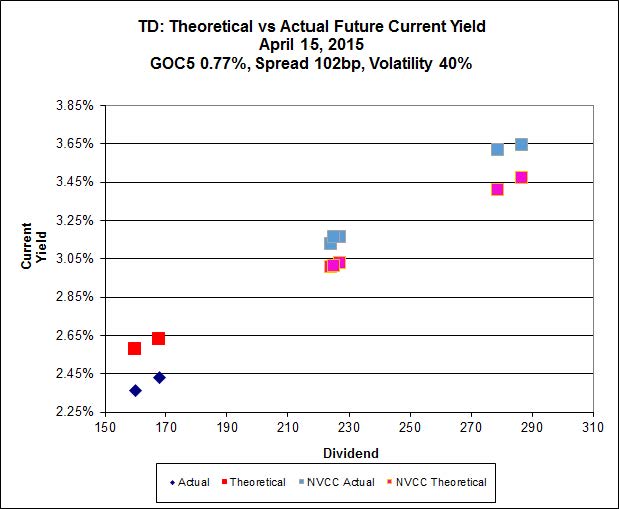
Firstly, the market does not appear to be differentiated between the NVCC compliant and non-compliant issues, as the latter appear to be plotted on a line more or less defined by the former. Additionally, the Implied Volatility is very high – ridiculously high, for NVCC-compliant issues – so I would expect TD.PF.D to outperform the three other compliant issues (TD.PF.A, TD.PF.B and TD.PF.C) as the market comes to realize what the word “perpetual” means.

Market Action

March 9, 2015

There’s a bit more colour about the effect of the US jobs number, discussed March 6 on the treasury long bond:

Since hitting an all-time low of 2.22 percent on Jan. 30, Treasury 30-year bond yields have posted the biggest five-week jump in six years as better-than-forecast employment growth led investors to pull forward wagers for the Federal Reserve to raise interest rates.

The 30-year bond yield rose 25 basis points, or 0.25 percentage point, this week to 2.84 percent, according to Bloomberg Bond Trader prices.

That pushed the yield increase to 62 basis points since January. The move is the biggest since a 1 percentage point rise in the five weeks ended Jan. 30, 2009, after the Fed said it was considering buying Treasuries to help stimulate economic growth.

Yields soared March 6 after the Labor Department reported the U.S. added 295,000 jobs last month, compared with a forecast for a 235,000 gain in a Bloomberg survey. The unemployment rate fell to 5.5 percent, an almost seven-year low, from 5.7 percent.

It was 12th straight month payrolls have increased by at least 200,000, the best run since March 1995. Payrolls rose 3.1 million in 2014, the most in 15 years.

And some colour on the effect of the suspension of Canadian forward guidance:

Pacific Investment Management Co.’s Ed Devlin is getting out of Canadian government bonds, and Bank of Canada Governor Stephen Poloz is the reason why.

Mr. Devlin, who oversees about $17-billion (U.S.), including the Canadian portfolios for the world’s biggest manager of bond funds, said higher yields are needed to compensate for the risk of buying debt whipsawed by Mr. Poloz’s policy pronouncements.

“Investors should require a bigger risk premium to invest in these bonds,” Mr. Devlin said by phone from Los Angeles on Friday. “If you don’t know what they’re going to do, you should get paid more money to invest in them than if they were fairly predictable.”

And there are the usual arguments about this:

Gluskin-Sheff chief economist David Rosenberg said last week the confusion was putting the Bank of Canada’s credibility at risk.

“The fact that they decided to stop offering guidance and start serving up confusion makes me gun-shy about making a call,” Rosenberg told Bloomberg. “If you’re trying to promote economic growth, you probably don’t want to generate too much volatility in the financial markets to achieve that goal.”

But [Dominion Lending Centres Chief Economist Sherry] Cooper says Bay Street should spend more time watching the data, instead of obsessing about what the bank will do.

“What caused this hissy fit on Bay Street was the economists were wrong,” Cooper wrote in a note. “No one expected the rate cut, so caught with their proverbial pants down, the pundits dumped on Poloz for having misled them.”

Cooper said not only was Poloz right to cut rates, but she also sees no reason why the central bank should “telegraph rate moves in advance.”

“The lamentation over the loss of ‘forward guidance’ is pathetic .… Everyone knows that central bank action is data dependent. When the data surprise, all bets are off,” she wrote.

It was a mixed day for the Canadian preferred share market, with PerpetualDiscounts off 15bp, FixedResets down 21bp and DeemedRetractibles gaining 3bp. Volatility was down from the levels we’ve generally seen for the past three months. Volume was low.

For as long as the FixedReset market is so violently unsettled, I’ll keep publishing updates of the more interesting and meaningful series of FixedResets’ Implied Volatilities. This doesn’t include Enbridge because although Enbridge has a large number of issues outstanding, all of which are quite liquid, the range of Issue Reset Spreads is too small for decent conclusions. The low is 212bp (ENB.PR.H; second-lowest is ENB.PR.D at 237bp) and the high is a mere 268 for ENB.PF.G.

Remember that all rich /cheap assessments are:
» based on Implied Volatility Theory only
» are relative only to other FixedResets from the same issuer
» assume constant GOC-5 yield
» assume constant Implied Volatility
» assume constant spread

Here’s TRP:

impVol_TRP_150309
Click for Big

TRP.PR.E, which resets 2019-10-30 at +235, is bid at 24.14 to be $1.20 rich, while TRP.PR.G, resetting 2020-11-30 at +296, is $1.07 cheap at its bid price of 24.75.

impVol_MFC_150309
Click for Big

Another excellent fit, but the numbers are perplexing. Implied Volatility for MFC continues to be a conundrum, although it declined substantially today. It is still too high if we consider that NVCC rules will never apply to these issues; it is still too low if we consider them to be NVCC non-compliant issues (and therefore with Deemed Maturities in the call schedule).

Most expensive is MFC.PR.L, resetting at +216 on 2019-6-19, bid at 23.91 to be $0.34 rich, while MFC.PR.H, resetting at +313bp on 2017-3-19, is bid at 25.91 to be $0.38 cheap.

impVol_BAM_150309
Click for Big

The fit on this series is actually quite reasonable – it’s the scale that makes it look so weird.

The cheapest issue relative to its peers is BAM.PR.Z, resetting at +296bp on 2017-12-31, bid at 25.26 to be $0.45 cheap. BAM.PF.E, resetting at +255bp 2020-3-31 is bid at 24.42 and appears to be $0.61 rich.

impVol_FTS_150309
Click for Big

This is just weird because the middle is expensive and the ends are cheap but anyway … FTS.PR.H, with a spread of +145bp, and bid at 16.66, looks $1.56 cheap and resets 2015-6-1. FTS.PR.K, with a spread of +205bp and resetting 2019-3-1, is bid at 23.77 and is $1.04 rich.

pairs_FR_150309
Click for Big

The cancellation of the previously announced deflationary environment had an immediate effect on the implied three month bill rate, with investment-grade pairs predicting an average over the next five years of a whopping 0.10%.

Not shown is the DC.PR.B / DC.PR.D pair, which implies an average rate of negative 1.77% until its exchange date 2019-9-30.

pairs_FF_150309
Click for Big

Shall we just say that this exhibits a high level of confidence in the continued rapacity of Canadian banks?

HIMIPref™ Preferred Indices
These values reflect the December 2008 revision of the HIMIPref™ Indices

Values are provisional and are finalized monthly
Index Mean
Current
Yield
(at bid)
Median
YTW
Median
Average
Trading
Value
Median
Mod Dur
(YTW)
Issues Day’s Perf. Index Value
Ratchet 0.00 % 0.00 % 0 0.00 0 -0.4777 % 2,408.7
FixedFloater 0.00 % 0.00 % 0 0.00 0 -0.4777 % 4,211.5
Floater 3.12 % 3.16 % 73,188 19.26 3 -0.4777 % 2,560.6
OpRet 4.07 % 0.83 % 105,283 0.28 1 0.0000 % 2,765.8
SplitShare 4.48 % 4.60 % 56,172 4.45 5 0.0080 % 3,207.6
Interest-Bearing 0.00 % 0.00 % 0 0.00 0 0.0000 % 2,529.1
Perpetual-Premium 5.29 % -0.36 % 56,628 0.08 25 -0.0454 % 2,520.9
Perpetual-Discount 4.96 % 5.03 % 154,171 15.08 9 -0.1531 % 2,804.3
FixedReset 4.42 % 3.64 % 233,557 16.51 80 -0.2081 % 2,423.9
Deemed-Retractible 4.90 % 0.02 % 105,071 0.14 37 0.0277 % 2,656.5
FloatingReset 2.53 % 2.91 % 87,195 6.33 8 -0.0854 % 2,335.4
Performance Highlights
Issue Index Change Notes
CIU.PR.C FixedReset -4.61 % YTW SCENARIO
Maturity Type : Limit Maturity
Maturity Date : 2045-03-09
Maturity Price : 15.74
Evaluated at bid price : 15.74
Bid-YTW : 3.79 %
BAM.PR.Z FixedReset -1.71 % YTW SCENARIO
Maturity Type : Limit Maturity
Maturity Date : 2045-03-09
Maturity Price : 23.50
Evaluated at bid price : 25.26
Bid-YTW : 3.92 %
TRP.PR.A FixedReset -1.21 % YTW SCENARIO
Maturity Type : Limit Maturity
Maturity Date : 2045-03-09
Maturity Price : 19.62
Evaluated at bid price : 19.62
Bid-YTW : 3.76 %
PWF.PR.P FixedReset -1.01 % YTW SCENARIO
Maturity Type : Limit Maturity
Maturity Date : 2045-03-09
Maturity Price : 18.65
Evaluated at bid price : 18.65
Bid-YTW : 3.53 %
VNR.PR.A FixedReset 1.11 % YTW SCENARIO
Maturity Type : Limit Maturity
Maturity Date : 2045-03-09
Maturity Price : 23.30
Evaluated at bid price : 24.61
Bid-YTW : 3.84 %
BAM.PR.X FixedReset 1.93 % YTW SCENARIO
Maturity Type : Limit Maturity
Maturity Date : 2045-03-09
Maturity Price : 19.04
Evaluated at bid price : 19.04
Bid-YTW : 3.95 %
Volume Highlights
Issue Index Shares
Traded
Notes
CM.PR.G Perpetual-Premium 352,980 Called for redemption 2015-4-30
YTW SCENARIO
Maturity Type : Call
Maturity Date : 2015-04-08
Maturity Price : 25.00
Evaluated at bid price : 25.28
Bid-YTW : -1.38 %
RY.PR.W Perpetual-Premium 85,708 Nesbitt crossed 85,000 at 25.30.
YTW SCENARIO
Maturity Type : Call
Maturity Date : 2015-04-08
Maturity Price : 25.00
Evaluated at bid price : 25.24
Bid-YTW : -4.58 %
OSP.PR.A SplitShare 66,500 Recent new issue.
YTW SCENARIO
Maturity Type : Hard Maturity
Maturity Date : 2020-03-31
Maturity Price : 10.00
Evaluated at bid price : 10.21
Bid-YTW : 4.60 %
RY.PR.A Deemed-Retractible 35,817 YTW SCENARIO
Maturity Type : Call
Maturity Date : 2015-04-08
Maturity Price : 25.25
Evaluated at bid price : 25.56
Bid-YTW : -8.38 %
RY.PR.J FixedReset 33,480 YTW SCENARIO
Maturity Type : Limit Maturity
Maturity Date : 2045-03-09
Maturity Price : 23.14
Evaluated at bid price : 24.98
Bid-YTW : 3.55 %
BAM.PR.X FixedReset 30,317 YTW SCENARIO
Maturity Type : Limit Maturity
Maturity Date : 2045-03-09
Maturity Price : 19.04
Evaluated at bid price : 19.04
Bid-YTW : 3.95 %
There were 20 other index-included issues trading in excess of 10,000 shares.
Wide Spread Highlights
Issue Index Quote Data and Yield Notes
CIU.PR.C FixedReset Quote: 15.74 – 16.64
Spot Rate : 0.9000
Average : 0.5670

YTW SCENARIO
Maturity Type : Limit Maturity
Maturity Date : 2045-03-09
Maturity Price : 15.74
Evaluated at bid price : 15.74
Bid-YTW : 3.79 %

ENB.PF.G FixedReset Quote: 22.21 – 22.70
Spot Rate : 0.4900
Average : 0.3279

YTW SCENARIO
Maturity Type : Limit Maturity
Maturity Date : 2045-03-09
Maturity Price : 21.77
Evaluated at bid price : 22.21
Bid-YTW : 4.31 %

SLF.PR.G FixedReset Quote: 17.95 – 18.42
Spot Rate : 0.4700
Average : 0.3253

YTW SCENARIO
Maturity Type : Hard Maturity
Maturity Date : 2025-01-31
Maturity Price : 25.00
Evaluated at bid price : 17.95
Bid-YTW : 6.20 %

PWF.PR.P FixedReset Quote: 18.65 – 18.98
Spot Rate : 0.3300
Average : 0.2528

YTW SCENARIO
Maturity Type : Limit Maturity
Maturity Date : 2045-03-09
Maturity Price : 18.65
Evaluated at bid price : 18.65
Bid-YTW : 3.53 %

TRP.PR.A FixedReset Quote: 19.62 – 19.90
Spot Rate : 0.2800
Average : 0.2046

YTW SCENARIO
Maturity Type : Limit Maturity
Maturity Date : 2045-03-09
Maturity Price : 19.62
Evaluated at bid price : 19.62
Bid-YTW : 3.76 %

PVS.PR.C SplitShare Quote: 25.07 – 25.30
Spot Rate : 0.2300
Average : 0.1589

YTW SCENARIO
Maturity Type : Hard Maturity
Maturity Date : 2017-12-10
Maturity Price : 25.00
Evaluated at bid price : 25.07
Bid-YTW : 4.77 %

Market Action

March 6, 2015

Jobs, jobs, jobs!

The U.S. job-creation machine kept exceeding expectations in February. Wages continued to disappoint.

Employers added 295,000 workers to payrolls last month, more than forecast, and the unemployment rate dropped to 5.5 percent, the lowest in almost seven years, figures from the Labor Department showed Friday in Washington. Hourly earnings rose less than forecast.

A lingering appetite to boost headcounts comes as increased purchasing power from cheaper fuel helps drive consumer spending. The jobless rate has now reached the Federal Reserve’s range for what it considers full employment, keeping policy makers on course to raise interest rates this year as persistent job growth sets the stage for a pickup in wages.

The median forecast in a Bloomberg survey of economists called for a 235,000 advance in February payrolls. Estimates ranged from 150,000 to 370,000. Employment in January climbed 239,000. The drop in the unemployment rate was also bigger than projected, and down from 5.7 percent in January.

Average hourly earnings rose 0.1 percent from the prior month after advancing 0.5 percent in January, which was the most since November 2008. The median forecast called for a 0.2 percent gain. Earnings were up 2 percent over the past year, also less than projected and matching the increase on average since the expansion began in mid-2009.

So the previously scheduled deflation has been cancelled:

U.S. stocks fell, with the Standard & Poor’s 500 Index tumbling the most in two months, as better-than-forecast jobs data fueled speculation the Federal Reserve is moving closer to raising interest rates.

The S&P 500 fell 1.4 percent, the most since Jan. 5, to 2,071.26 at 4 p.m. in New York. The equity gauge lost 1.6 percent for the week. The Dow retreated 278.94 points, or 1.5 percent, to 17,856.78 for its worst drop in five weeks. The Nasdaq Composite Index slipped 1.1 percent. More than 7.4 billion shares changed hands on U.S. exchanges, 7.2 percent above the 30-day average.

Utility companies in the S&P 500 tumbled 3.1 percent. Selling picked up in the industry as the rate on 10-year Treasury notes spiked 13 basis points to 2.25 percent, the highest this year. The group’s dividend yield of 3.7 percent is the second-highest in the index.

AllBanc Split Corp., proud issuer of ABK.PR.C, was confirmed at Pfd-2 by DBRS:

Since the last rating action in March 2014, the net asset value of the Company has been slightly volatile, mirroring the performance of Canadian banks over the past year. However, downside protection rose from 60.1% on February 20, 2014, to 62.6% as of February 26, 2015. As a result, the rating of the Class C Preferred Shares has been confirmed at Pfd-2.

It was a mixed day for the Canadian preferred share market, with PerpetualDiscounts off 9bp, FixedResets gaining 26bp and DeemedRetractibles down 15bp. The Performance Highlights table is its usual lengthy self. Volume was high.

For as long as the FixedReset market is so violently unsettled, I’ll keep publishing updates of the more interesting and meaningful series of FixedResets’ Implied Volatilities. This doesn’t include Enbridge because although Enbridge has a large number of issues outstanding, all of which are quite liquid, the range of Issue Reset Spreads is too small for decent conclusions. The low is 212bp (ENB.PR.H; second-lowest is ENB.PR.D at 237bp) and the high is a mere 268 for ENB.PF.G.

Remember that all rich /cheap assessments are:
» based on Implied Volatility Theory only
» are relative only to other FixedResets from the same issuer
» assume constant GOC-5 yield
» assume constant Implied Volatility
» assume constant spread

Here’s TRP:

impVol_TRP_150306
Click for Big

TRP.PR.E, which resets 2019-10-30 at +235, is bid at 24.14 to be $1.18 rich, while TRP.PR.G, resetting 2020-11-30 at +296, is $1.10 cheap at its bid price of 24.71.

impVol_MFC_150306
Click for Big

Another excellent fit, but the numbers are perplexing. Implied Volatility for MFC continues to be a conundrum, although it declined substantially today. It is still too high if we consider that NVCC rules will never apply to these issues; it is still too low if we consider them to be NVCC non-compliant issues (and therefore with Deemed Maturities in the call schedule).

Most expensive is MFC.PR.L, resetting at +216 on 2019-6-19, bid at 24.91 to be $0.30 rich, while MFC.PR.H, resetting at +313bp on 2017-3-19, is bid at 25.88 to be $0.47 cheap.

impVol_BAM_150306
Click for Big

The fit on this series is actually quite reasonable – it’s the scale that makes it look so weird.

The cheapest issue relative to its peers is BAM.PF.X, resetting at +188bp on 2017-6-30, bid at 18.68 to be $0.17 cheap. BAM.PF.E, resetting at +255bp 2020-3-31 is bid at 24.45 and appears to be $0.68 rich.

impVol_FTS_150306
Click for Big

This is just weird because the middle is expensive and the ends are cheap but anyway … FTS.PR.H, with a spread of +145bp, and bid at 16.70, looks $1.51 cheap and resets 2015-6-1. FTS.PR.K, with a spread of +205bp and resetting 2019-3-1, is bid at 23.80 and is $1.13 rich.

pairs_FR_150306
Click for Big

The cancellation of the previously announced deflationary environment had an immediate effect on the implied three month bill rate, with investment-grade pairs predicting an average over the next five years of a whopping 0.10%.

pairs_FF_150306
Click for Big

Shall we just say that this exhibits a high level of confidence in the continued rapacity of Canadian banks?

HIMIPref™ Preferred Indices
These values reflect the December 2008 revision of the HIMIPref™ Indices

Values are provisional and are finalized monthly
Index Mean
Current
Yield
(at bid)
Median
YTW
Median
Average
Trading
Value
Median
Mod Dur
(YTW)
Issues Day’s Perf. Index Value
Ratchet 0.00 % 0.00 % 0 0.00 0 0.9857 % 2,420.3
FixedFloater 0.00 % 0.00 % 0 0.00 0 0.9857 % 4,231.7
Floater 3.11 % 3.14 % 75,974 19.31 3 0.9857 % 2,572.9
OpRet 4.07 % 0.80 % 106,402 0.29 1 0.0794 % 2,765.8
SplitShare 4.48 % 4.54 % 56,213 4.46 5 0.0080 % 3,207.4
Interest-Bearing 0.00 % 0.00 % 0 0.00 0 0.0794 % 2,529.1
Perpetual-Premium 5.29 % -0.78 % 54,523 0.08 25 0.0360 % 2,522.1
Perpetual-Discount 4.95 % 5.03 % 155,274 15.09 9 -0.0927 % 2,808.6
FixedReset 4.41 % 3.43 % 236,285 16.83 80 0.2630 % 2,429.0
Deemed-Retractible 4.90 % -0.16 % 105,040 0.15 37 -0.1502 % 2,655.8
FloatingReset 2.50 % 2.88 % 90,150 6.34 8 -0.1440 % 2,337.4
Performance Highlights
Issue Index Change Notes
TRP.PR.F FloatingReset -3.04 % YTW SCENARIO
Maturity Type : Limit Maturity
Maturity Date : 2045-03-06
Maturity Price : 18.81
Evaluated at bid price : 18.81
Bid-YTW : 3.26 %
SLF.PR.H FixedReset -1.41 % YTW SCENARIO
Maturity Type : Hard Maturity
Maturity Date : 2025-01-31
Maturity Price : 25.00
Evaluated at bid price : 22.38
Bid-YTW : 4.40 %
MFC.PR.B Deemed-Retractible -1.14 % YTW SCENARIO
Maturity Type : Hard Maturity
Maturity Date : 2025-01-31
Maturity Price : 25.00
Evaluated at bid price : 24.32
Bid-YTW : 5.01 %
BNS.PR.Z FixedReset 1.08 % YTW SCENARIO
Maturity Type : Hard Maturity
Maturity Date : 2022-01-31
Maturity Price : 25.00
Evaluated at bid price : 23.30
Bid-YTW : 3.51 %
IAG.PR.G FixedReset 1.21 % YTW SCENARIO
Maturity Type : Call
Maturity Date : 2017-06-30
Maturity Price : 25.00
Evaluated at bid price : 25.92
Bid-YTW : 2.53 %
ENB.PR.H FixedReset 1.25 % YTW SCENARIO
Maturity Type : Limit Maturity
Maturity Date : 2045-03-06
Maturity Price : 18.63
Evaluated at bid price : 18.63
Bid-YTW : 4.17 %
BAM.PR.C Floater 1.26 % YTW SCENARIO
Maturity Type : Limit Maturity
Maturity Date : 2045-03-06
Maturity Price : 16.05
Evaluated at bid price : 16.05
Bid-YTW : 3.14 %
MFC.PR.K FixedReset 1.27 % YTW SCENARIO
Maturity Type : Hard Maturity
Maturity Date : 2025-01-31
Maturity Price : 25.00
Evaluated at bid price : 24.00
Bid-YTW : 3.79 %
ENB.PR.B FixedReset 1.47 % YTW SCENARIO
Maturity Type : Limit Maturity
Maturity Date : 2045-03-06
Maturity Price : 19.31
Evaluated at bid price : 19.31
Bid-YTW : 4.25 %
HSE.PR.A FixedReset 1.48 % YTW SCENARIO
Maturity Type : Limit Maturity
Maturity Date : 2045-03-06
Maturity Price : 17.78
Evaluated at bid price : 17.78
Bid-YTW : 3.73 %
BMO.PR.Q FixedReset 1.53 % YTW SCENARIO
Maturity Type : Hard Maturity
Maturity Date : 2022-01-31
Maturity Price : 25.00
Evaluated at bid price : 23.25
Bid-YTW : 3.53 %
CM.PR.P FixedReset 1.55 % YTW SCENARIO
Maturity Type : Limit Maturity
Maturity Date : 2045-03-06
Maturity Price : 23.02
Evaluated at bid price : 24.59
Bid-YTW : 3.09 %
PWF.PR.P FixedReset 1.84 % YTW SCENARIO
Maturity Type : Limit Maturity
Maturity Date : 2045-03-06
Maturity Price : 18.84
Evaluated at bid price : 18.84
Bid-YTW : 3.28 %
MFC.PR.F FixedReset 2.58 % YTW SCENARIO
Maturity Type : Hard Maturity
Maturity Date : 2025-01-31
Maturity Price : 25.00
Evaluated at bid price : 19.90
Bid-YTW : 5.10 %
IFC.PR.A FixedReset 3.38 % YTW SCENARIO
Maturity Type : Hard Maturity
Maturity Date : 2025-01-31
Maturity Price : 25.00
Evaluated at bid price : 20.78
Bid-YTW : 5.37 %
Volume Highlights
Issue Index Shares
Traded
Notes
RY.PR.J FixedReset 105,427 TD bought blocks of 12,600 and 11,400 from anonymous, both at 25.05. Nesbitt bought 10,000 from anonymous at 25.03.
YTW SCENARIO
Maturity Type : Limit Maturity
Maturity Date : 2045-03-06
Maturity Price : 23.15
Evaluated at bid price : 25.02
Bid-YTW : 3.42 %
ENB.PR.B FixedReset 74,341 TD crossed 50,000 at 19.20.
YTW SCENARIO
Maturity Type : Limit Maturity
Maturity Date : 2045-03-06
Maturity Price : 19.31
Evaluated at bid price : 19.31
Bid-YTW : 4.25 %
TRP.PR.G FixedReset 49,200 Recent new issue.
YTW SCENARIO
Maturity Type : Limit Maturity
Maturity Date : 2045-03-06
Maturity Price : 23.02
Evaluated at bid price : 24.71
Bid-YTW : 3.69 %
BNS.PR.Y FixedReset 48,813 To be extended.
YTW SCENARIO
Maturity Type : Hard Maturity
Maturity Date : 2022-01-31
Maturity Price : 25.00
Evaluated at bid price : 22.40
Bid-YTW : 3.58 %
RY.PR.A Deemed-Retractible 31,651 RBC crossed 11,500 at 25.59.
YTW SCENARIO
Maturity Type : Call
Maturity Date : 2015-04-05
Maturity Price : 25.25
Evaluated at bid price : 25.50
Bid-YTW : -6.04 %
BAM.PR.X FixedReset 29,945 RBC bought 17,900 from TD at 18.79.
YTW SCENARIO
Maturity Type : Limit Maturity
Maturity Date : 2045-03-06
Maturity Price : 18.68
Evaluated at bid price : 18.68
Bid-YTW : 3.83 %
There were 44 other index-included issues trading in excess of 10,000 shares.
Wide Spread Highlights
Issue Index Quote Data and Yield Notes
MFC.PR.F FixedReset Quote: 19.90 – 20.48
Spot Rate : 0.5800
Average : 0.3639

YTW SCENARIO
Maturity Type : Hard Maturity
Maturity Date : 2025-01-31
Maturity Price : 25.00
Evaluated at bid price : 19.90
Bid-YTW : 5.10 %

PWF.PR.S Perpetual-Discount Quote: 25.13 – 25.58
Spot Rate : 0.4500
Average : 0.2779

YTW SCENARIO
Maturity Type : Limit Maturity
Maturity Date : 2045-03-06
Maturity Price : 24.70
Evaluated at bid price : 25.13
Bid-YTW : 4.81 %

RY.PR.F Deemed-Retractible Quote: 25.53 – 26.08
Spot Rate : 0.5500
Average : 0.4084

YTW SCENARIO
Maturity Type : Call
Maturity Date : 2015-05-24
Maturity Price : 25.25
Evaluated at bid price : 25.53
Bid-YTW : -0.16 %

FTS.PR.J Perpetual-Premium Quote: 25.05 – 25.37
Spot Rate : 0.3200
Average : 0.2125

YTW SCENARIO
Maturity Type : Limit Maturity
Maturity Date : 2045-03-06
Maturity Price : 24.62
Evaluated at bid price : 25.05
Bid-YTW : 4.75 %

BAM.PF.A FixedReset Quote: 25.60 – 25.91
Spot Rate : 0.3100
Average : 0.2094

YTW SCENARIO
Maturity Type : Limit Maturity
Maturity Date : 2045-03-06
Maturity Price : 23.49
Evaluated at bid price : 25.60
Bid-YTW : 3.63 %

ENB.PR.H FixedReset Quote: 18.63 – 18.92
Spot Rate : 0.2900
Average : 0.1991

YTW SCENARIO
Maturity Type : Limit Maturity
Maturity Date : 2045-03-06
Maturity Price : 18.63
Evaluated at bid price : 18.63
Bid-YTW : 4.17 %

Issue Comments

GCS.PR.A Upgraded to Pfd-2 by DBRS

Global Champions Split Corp., proud issuer of GCS.PR.A, has been upgraded to Pfd-2 by DBRS:

DBRS Limited (DBRS) has today upgraded the rating of the Class A Preferred Shares, Series 1 (the Preferred Shares) issued by Global Champions Split Corp. (the Company) to Pfd-2 from Pfd-2 (low). The Company issued 2,000,000 Preferred Shares at an issue price of $25.00 per Preferred Share and an equal number of capital shares (the Capital Shares) on March 7, 2013.

The redemption date for the Preferred Shares will be on or about July 31, 2019. Net proceeds from the initial offering were used to invest in a portfolio of common shares of 15 international large capitalization companies (the Portfolio).

The Portfolio may be comprised of non-U.S. dollar denominated securities. The Company intends to substantially hedge all of the Portfolio’s investments denominated in currencies other than the U.S. dollar back to U.S. dollars. Dividends received on the Portfolio securities denominated in currencies other than U.S. dollars are currently being hedged back to U.S. dollars, but the Company is not required to do so. Distributions to holders of the Preferred Shares are denominated in Canadian dollars and are hedged back to U.S. dollars unless the net asset value (NAV) of the Company is less than the aggregate original issue price of the Class A Preferred Shares.

On March 7, 2014, DBRS confirmed the rating of the Preferred Shares at Pfd-2 (low) mainly based on the sufficient downside protection available to holders of the Preferred Shares. Since then, the NAV of the Company (after adjusting for exchange rates) has increased, with downside protection increasing from 52% to 61% and remaining with a positive trend over the past few months. As a result, the rating of the Class A Preferred Shares has been upgraded to Pfd-2 from Pfd-2 (low).

GCS.PR.A is a SplitShare paying 4.00% (probably) eligible dividends, maturing July 31, 2019; it commenced trading March 7, 2013 after its initial mention on PrefBlog on 2013-2-15.

Issue Comments

AQN.PR.A & AQN.PR.D Unaffected by Common Panic

Algonquin Power & Utilities Corp. has announced:

that the issuance of fourth quarter and year-end financial results previously scheduled for today, and the conference call previously scheduled for 10:00 a.m. eastern time on Friday, March 6, 2015 have been rescheduled. APUC now plans to release 2014 fourth quarter and year-end financial results on Thursday, March 26, 2015 after market close. APUC will hold an earnings conference call at 10:00 a.m. eastern time on Friday, March 27, 2015, hosted by Chief Executive Officer, Ian Robertson and Chief Financial Officer, David Bronicheski.

Well, at least they’re confident that they know the names of the CEO and CFO! That’s a good sign!

Further:

In an emailed statement to Inside the Market prior to the post-market release from Siskinds, a spokesperson commented, “We have rescheduled the release of our year-end financial results in order to allow our auditors to complete their audit work. … We are continuing to work with our auditors to finalize the results.”

So there’s the smell of fat fees in the air:

Siskinds LLP today announced that it has commenced an investigation into the accounting and other practices and disclosures of Algonquin Power & Utilities Corp (TSE:AQN).

Siskinds LLP is evaluating a possible class action on behalf of persons who purchased shares or other securities of Algonquin Power & Utilities Corp.

Common stock holders panicked, sending the price of common down 9%, with volume five or six times the February daily average.

But the preferred market yawned. AQN.PR.A was quoted at 21.95-14 today compared with 21.87-00 yesterday; AQN.PR.D closed at 25.00-05 compared with yesterday’s 25.15-40.

Volume was no great shakes either. AQN.PR.A traded 6,645 shares today, higher than normal, but nobody could call it a deluge (unless, of course, they were a rigorously supervised and extremely dedicated Toronto Stock Exchange market maker, of course); AQN.PR.D traded 6,700 shares, again higher than normal, but somehow, through heroic efforts and the tough but fair supervision of the unsung heroes in the highly efficient Toronto Stock Exchange Market Maker Supervision Department, the market maker managed to cope with the torrent.

I will confess to some curiosity regarding the reason for the delay in financials. We will see!

Issue Comments

BSD.PR.A Term Extension Proposal: More Sleaze From Company

Brookfield Soundvest Capital Management Ltd., manager of Brookfield Soundvest Split Trust (the “Trust” in the following extract, also referred to in this post as “BSD”) has announced (emphasis added):

that the board of directors of the Manager has approved proposed extraordinary resolutions (the “Extraordinary Resolutions”), one relating to the preferred securities (the “Preferred Securities”) of the Trust and one relating to the trust units (the “Units”) of the Trust, to be presented to the holders of the Preferred Securities (the “Preferred Securityholders”) and the holders of the Units (the “Unitholders”), as the case may be, at a special meeting of the Preferred Securityholders and the Unitholders (the “Meeting”).

The Extraordinary Resolution relating to the Preferred Securities will allow the Trust to implement the following:

  • •extend the term of the Preferred Securities for additional five-year renewal terms following the scheduled maturity date of March 31, 2015;
  • •determine the interest rate on the Preferred Securities for each subsequent extended five-year renewal term of the Preferred Securities, and set the interest rate for the first renewal term at 6.0% per annum; and
  • •provide the Preferred Securityholders with the right to retract and receive repayment of their Preferred Securities on March 31, 2015, and at the end of each subsequent renewal term of the Preferred Securities, if they so choose (the “Preferred Special Repayment Right”).


The Extraordinary Resolution relating to the Units will allow the Trust to implement the following:

  • •provide the Unitholders with the right to retract, in the aggregate, a number of Units not exceeding the number of Preferred Securities tendered under the Preferred Special Repayment Right on March 31, 2015 and at the end of each subsequent renewal term of the Preferred Securities, if they so choose (the “Unit Special Retraction Right”), and receive redemption proceeds equal to the net asset value per Unit as of such dates, and to the extent that more Units are tendered for retraction under the Unit Special Retraction Right than Preferred Securities tendered for repayment under the Preferred Special Repayment Right, Units so tendered will be redeemed on a pro rata basis;


Even though the Meeting will not be held until March 27, 2015 and the outcome of the vote will not be known until then, (i) Preferred Securityholders who wish to exercise the Preferred Special Repayment Right must give notice to the Trust through their advisor no later than 5:00 p.m. (Eastern time) on March 13, 2015, and (ii) Unitholders who wish to exercise the Unit Special Retraction Right must give notice to the Trust through their advisor no later than 5:00 p.m. (Eastern time) on March 20, 2015.

Assiduous Readers will remember this company for its press release criticized in the post BSD.PR.A to Allow Retractions. They have a long history of downplaying to the point of invisibility the fact that retractions were suspended in October 2008 due to their exercise of their discretion. This discretion was utilized again in October, 2011 (again using obfuscatory language to disguise the fact that this was an exercise of discretion) and has not yet been reversed.

But are they competent money managers? Well, according to the 2013 Management Report of Fund Performance, the total return of the Capital Units from inception (March 16, 2005) to December 31, 2013, net of issuance costs, was -6.8%. Total Return of the S&P/TSX Composite Return Index, which they chose as their benchmark, was +6.1%. So the Capital Units underperformed by 12.9% … ANNUALIZED. ‘Nuff said? They did not publish Whole Unit performance for the period, and I certainly can’t be bothered to work it out.

However, in this particular case they have outdone themselves by requiring that notice of exercise of the Preferred Special Repayment Right be served on the company before this right actually exists.

Brookfield Asset Management is a fine company. I find it very difficult to understand why they are mixed up in this:

To the knowledge of the directors and executive officers of the Trust, the only person or company that beneficially owns, directly or indirectly, or exercises control or direction over the Preferred Securities or the Units carrying more than 10% of the voting rights attached to all outstanding Preferred Securities or Units, as the case may be, as at February 19, 2015, is Brookfield Asset Management Inc., which holds 455,045 Units, representing 11.29% of the outstanding Units.

The Manager, 50% owned by Brookfield Asset Management Inc. and 50% owned by entities controlled by Kevin Charlebois, has been the Trust’s manager as well as its investment advisor since its inception. The Manager is located at 100 Sparks Street, 9th Floor, Ottawa, Ontario, K1P 5B7.

So who are the directors of the manager who have approved the proposed extraordinary resolutions and “that the Preferred Securityholders and the Unitholders vote in favour of their Extraordinary Resolution to be considered at the Meeting.” I’m sure they’re all very proud of their roles, so let’s highlight their names:

Name and Municipality Position with the Manager Principal Occupation
Kevin Charlebois
Ottawa, Ontario
Director, President, Chief Executive Officer, Chief Investment Officer and
Secretary
Same
George Myhal
Toronto, Ontario
Director, Chairman President and Chief Executive Officer, Partners Value Fund Inc.
Gail Cecil
Toronto, Ontario
Director President, Chief Executive Officer and Managing Director, Brookfield Investment Management (Canada) Inc.
Audrey Charlebois
Ottawa, Ontario
Director Same
Gabrielle Lenz
Ottawa, Ontario
Chief Financial Officer and Controller Same

Note that, “Partners Value Fund Inc.” is a different company from “Partners Value Split Inc., the preferreds of which I often recommend as a SplitShare investment. Mr. Myhal is not an officer of PVS, thank God, and neither is Gail Cecil. Regrettably, however, Partners Value Fund Inc. holds all the Junior Preferred shares and all the capital units and all the Class A voting shares in PVS, so they certainly have influence. In turn Partners Limited controls approximately 49% of Partners Value Fund (SEDAR, Partners Value Fund Inc. (formerly BAM Investments Corp.) Oct 16 2014 18:08:14 ET Issuer bid circular – English PDF 518 K, I am not permitted to link directly, sorry). And then, of course, we get into the depressing world of Brookfield Asset Management governance.

Brookfield Soundvest Split Trust (BSD) ain’t cheap, either! According to the 2013 Management Report of Fund Performance:

The MER before interest expense for the years ended December 31, 2013 and 2012 on the combined units was 1.8% and 1.8%, respectively.

This is ridiculous. A MER of about 1.8% and Asset Coverage of a miserable 1.3-:1 on the preferreds. I’m not even going to bother doing a proper Split Share Credit Quality analysis of the Preferreds. It’s not worth it. I know it will be awful, whatever the precise numbers are, and this fund and this sponsor make me sick.

I recommend that holders of BSD.PR.A: (i) Vote NO on the Special Resolution, and (ii) serve notice of exercise of the Preferred Special Repayment Right.

… or you could just sell the garbage, of course. It’s trading near par.

There may be problems with your brokerage with respect to the exercise of the Preferred Special Retraction Right; I have been advised that TD Direct Investing had no idea of how to process it, but it seems quite likely that any broker will be scratching their heads over how to exercise a right that will not exist until two weeks after the deadline. Please let me know in the comments of how you fare in jumping through these ridiculous, abusive hoops. And don’t waste any time on this! The deadline for notification of the company is only a week hence!

Market Action

March 5, 2015

Canadians are loading up on debt:

Canadians have taken on $80-billion worth of mortgages, personal loans and credit card debt in the past year, Royal Bank of Canada found, with much of that growth coming in the past three months. Household debt totalled $1.82-trillion in January, eclipsing the country’s GDP, which stood at an annualized $1.65-trillion in December.

Most of the growth came from new residential mortgages, which rose 5.4 per cent in January compared to a year earlier, to nearly $1.3-trillion.

Homeowners weren’t the only ones taking on new debt. Business credit jumped 8.3 per cent in January, the fastest rate of expansion since 2007 as worries over the oil sector pushed more companies toward short-term loans, RBC said.

With all that, it’s a good thing we’ve all got good jobs!

Several reports have concluded that the country’s job market is not as strong as it looks and now a study from Canadian Imperial Bank of Commerce paints an even worse picture. According to the bank’s analysis, job quality has fallen to its lowest level in more than two decades. A CIBC index that measures 25 years worth of data on part-time versus full-time work, paid versus self-employment and compensation trends, has fallen to its lowest level on record.

One notable shift is that a smaller portion of the labour market now has higher bargaining power, or high-paying jobs, while a larger segment has lower bargaining power, [Benjamin Tal, CIBC’s deputy chief economist,] said. “This is the main reason why the income gap is rising, which I believe is the number one economic, social issue facing the country in this decade.”

The CIBC index tracks three components, all of which are showing a deterioration. The first indicated that the number of part-time positions has risen “much faster” than that of full-time jobs since the 1980s. (Over the past year, though, some of this has reversed as full-time jobs rose faster). Self-employment is another measure, as economists tend to view it as less stable and, on average, lower paying than salaried employment. The number of self-employed workers has been on a “steeper incline” over the past 25 years, and in the past year grew four times faster than the number of paid employees, the CIBC report said.

On compensation, the bank said low-paying full-time jobs have risen faster than mid-paying jobs over much of the past two decades, which in turn have risen more quickly than high-paying jobs. And in the past year “the job-creation gap between low- and high-paying jobs has widened,” with low-wage full-time paid positions rising at twice the pace of high-paying jobs.

Mark Cuban may not be the most academic of sources, but he probably knows more than I do about the problems of angel investors:

For those who can’t figure out how to be Angels. You can sign up to be part of the new excitement called Equity Crowd Funding. Equity Crowd Funding allows you to join the masses to chase investments with as little as 5k dollars. Oh the possibilities !!

I have absolutely not doubt in my mind that most of these individual Angels and crowd funders are currently under water in their investments. Absolutely none. I say most. The percentage could be higher

Why ?

Because there is ZERO liquidity for any of those investments. None. Zero. Zip.

All those Angel investments in all those apps and startups. All that crowdfunded equity. All in search of their unicorn because the only real salvation right now is an exit or cash pay out from operations. The SEC made sure that there is no market for any of these companies to go public and create liquidity for their Angels. The market for sub 25mm dollar raises is effectively dead. DOA . Gone. Thanks SEC. And with the new Equity CrowdFunding rules yet to be finalized, there is no reason to believe that the SEC will be smart enough to create some form of liquidity for all those widows and orphans who will put their $5k into the dream only to realize they can’t get any cash back when they need money to fix their car.

Longevity risk has been a fascination of mine over the past few years; it was briefly mentioned yesterday. But there are interesting wrinkles with respect to women:

Black women have a much higher mortality rate, but it has declined significantly—23 percent since 1999. Hispanic women also posted declines. (Hispanics of all age groups, both men and women, have lower mortality rates than average, a demographic phenomenon known as the Hispanic paradox.)

Part of the jump in the death rate for whites is explained by the epidemic of prescription painkiller abuse and overdoses that disproportionately affected whites. But that accounts for only half the total increase, according to the report. Other causes of death on the rise include suicide and respiratory disease. Some declined, including traffic deaths, homicides, and the cancers most closely linked to smoking.

The pattern may reflect “a systematic reversal in the long-term trend of mortality decline” for white women, according to the Urban Institute paper. Such a shift could be linked to social and economic circumstances. Poorer people generally have poorer health for a variety of reasons, and growing inequality could be weighing on death rates.

“It’s possible that as this group of women ages, there could be a reversal of a very long-term decline in the death rate,” said Nan Marie Astone, a senior fellow at the Urban Institute and the lead author of the report. America isn’t really used to the idea of declining life expectancy. The next few decades might change that.

whiteWomenMortality
Click for Big


allWomenMortality
Click for Big

It was a quiet, mixed day for the Canadian preferred share market, with PerpetualDiscounts off 7bp, FixedResets down 8bp and DeemedRetractibles gaining 1bp. Enbridge FixedResets were prominent in the bad part of the Performance Highlights table. Volume was quite high, with eight issues breaking the 100,000 barrier.

For as long as the FixedReset market is so violently unsettled, I’ll keep publishing updates of the more interesting and meaningful series of FixedResets’ Implied Volatilities. This doesn’t include Enbridge because although Enbridge has a large number of issues outstanding, all of which are quite liquid, the range of Issue Reset Spreads is too small for decent conclusions. The low is 212bp (ENB.PR.H; second-lowest is ENB.PR.D at 237bp) and the high is a mere 268 for ENB.PF.G.

Remember that all rich /cheap assessments are:
» based on Implied Volatility Theory only
» are relative only to other FixedResets from the same issuer
» assume constant GOC-5 yield
» assume constant Implied Volatility
» assume constant spread

Here’s TRP:

impVol_TRP_150305
Click for Big

TRP.PR.E, which resets 2019-10-30 at +235, is bid at 24.37 to be $1.38 rich, while TRP.PR.G, resetting 2020-11-30 at +296, is $1.16 cheap at its bid price of 24.70.

impVol_MFC_150305
Click for Big

Another excellent fit, but the numbers are perplexing. Implied Volatility for MFC continues to be a conundrum, although it declined substantially today. It is still too high if we consider that NVCC rules will never apply to these issues; it is still too low if we consider them to be NVCC non-compliant issues (and therefore with Deemed Maturities in the call schedule).

Most expensive is MFC.PR.M, resetting at +236 on 2019-12-19, bid at 24.61 to be $0.34 rich, while MFC.PR.H, resetting at +313bp on 2017-3-19, is bid at 25.85 to be $0.55 cheap.

impVol_BAM_150305
Click for Big

The fit on this series is actually quite reasonable – it’s the scale that makes it look so weird.

The cheapest issue relative to its peers is BAM.PF.F, resetting at +286bp on 2019-9-30, bid at 25.117 to be $0.26 cheap. BAM.PF.E, resetting at +255bp 2020-3-31 is bid at 24.30 and appears to be $0.54 rich.

impVol_FTS_150305
Click for Big

This is just weird because the middle is expensive and the ends are cheap but anyway … FTS.PR.H, with a spread of +145bp, and bid at 16.74, looks $1.48 cheap and resets 2015-6-1. FTS.PR.K, with a spread of +205bp and resetting 2019-3-1, is bid at 23.79 and is $1.06 rich.

pairs_FR_150305
Click for Big

This is rather odd – the investment grade break-even rates are clustered around zero, with one outlier: the TRP.PR.A / TRP.PR.F pair, clocking in at more realistic 1.04%.

pairs_FF_150305
Click for Big

Shall we just say that this exhibits a high level of confidence in the continued rapacity of Canadian banks?

HIMIPref™ Preferred Indices
These values reflect the December 2008 revision of the HIMIPref™ Indices

Values are provisional and are finalized monthly
Index Mean
Current
Yield
(at bid)
Median
YTW
Median
Average
Trading
Value
Median
Mod Dur
(YTW)
Issues Day’s Perf. Index Value
Ratchet 0.00 % 0.00 % 0 0.00 0 -0.2093 % 2,396.6
FixedFloater 0.00 % 0.00 % 0 0.00 0 -0.2093 % 4,190.4
Floater 3.14 % 3.18 % 76,141 19.22 3 -0.2093 % 2,547.8
OpRet 4.07 % 1.07 % 107,355 0.29 1 0.0397 % 2,763.7
SplitShare 4.48 % 4.59 % 56,421 4.46 5 0.1638 % 3,207.1
Interest-Bearing 0.00 % 0.00 % 0 0.00 0 0.0397 % 2,527.1
Perpetual-Premium 5.29 % -2.04 % 56,570 0.08 25 -0.0219 % 2,521.2
Perpetual-Discount 4.95 % 5.02 % 156,320 15.09 9 -0.0695 % 2,811.2
FixedReset 4.42 % 3.50 % 238,534 16.75 80 -0.0803 % 2,422.6
Deemed-Retractible 4.90 % 0.02 % 106,692 0.09 37 0.0085 % 2,659.8
FloatingReset 2.50 % 2.92 % 90,513 6.35 8 -0.3666 % 2,340.7
Performance Highlights
Issue Index Change Notes
ENB.PF.G FixedReset -2.18 % YTW SCENARIO
Maturity Type : Limit Maturity
Maturity Date : 2045-03-05
Maturity Price : 21.89
Evaluated at bid price : 22.40
Bid-YTW : 4.12 %
TRP.PR.F FloatingReset -2.02 % YTW SCENARIO
Maturity Type : Limit Maturity
Maturity Date : 2045-03-05
Maturity Price : 19.40
Evaluated at bid price : 19.40
Bid-YTW : 3.16 %
ENB.PF.A FixedReset -1.72 % YTW SCENARIO
Maturity Type : Limit Maturity
Maturity Date : 2045-03-05
Maturity Price : 21.89
Evaluated at bid price : 22.35
Bid-YTW : 4.08 %
ENB.PF.C FixedReset -1.63 % YTW SCENARIO
Maturity Type : Limit Maturity
Maturity Date : 2045-03-05
Maturity Price : 21.87
Evaluated at bid price : 22.33
Bid-YTW : 4.08 %
TRP.PR.E FixedReset -1.54 % YTW SCENARIO
Maturity Type : Limit Maturity
Maturity Date : 2045-03-05
Maturity Price : 22.96
Evaluated at bid price : 24.37
Bid-YTW : 3.38 %
IFC.PR.A FixedReset -1.52 % YTW SCENARIO
Maturity Type : Hard Maturity
Maturity Date : 2025-01-31
Maturity Price : 25.00
Evaluated at bid price : 20.10
Bid-YTW : 5.79 %
BAM.PR.T FixedReset -1.20 % YTW SCENARIO
Maturity Type : Limit Maturity
Maturity Date : 2045-03-05
Maturity Price : 21.75
Evaluated at bid price : 22.23
Bid-YTW : 3.65 %
PWF.PR.T FixedReset -1.20 % YTW SCENARIO
Maturity Type : Limit Maturity
Maturity Date : 2045-03-05
Maturity Price : 23.19
Evaluated at bid price : 24.80
Bid-YTW : 3.26 %
ENB.PF.E FixedReset -1.19 % YTW SCENARIO
Maturity Type : Limit Maturity
Maturity Date : 2045-03-05
Maturity Price : 21.93
Evaluated at bid price : 22.44
Bid-YTW : 4.09 %
BAM.PF.A FixedReset 1.11 % YTW SCENARIO
Maturity Type : Limit Maturity
Maturity Date : 2045-03-05
Maturity Price : 23.47
Evaluated at bid price : 25.55
Bid-YTW : 3.64 %
GWO.PR.N FixedReset 1.37 % YTW SCENARIO
Maturity Type : Hard Maturity
Maturity Date : 2025-01-31
Maturity Price : 25.00
Evaluated at bid price : 18.50
Bid-YTW : 5.64 %
TRP.PR.B FixedReset 1.62 % YTW SCENARIO
Maturity Type : Limit Maturity
Maturity Date : 2045-03-05
Maturity Price : 15.09
Evaluated at bid price : 15.09
Bid-YTW : 3.41 %
SLF.PR.G FixedReset 2.14 % YTW SCENARIO
Maturity Type : Hard Maturity
Maturity Date : 2025-01-31
Maturity Price : 25.00
Evaluated at bid price : 18.13
Bid-YTW : 5.89 %
BAM.PR.X FixedReset 2.37 % YTW SCENARIO
Maturity Type : Limit Maturity
Maturity Date : 2045-03-05
Maturity Price : 18.54
Evaluated at bid price : 18.54
Bid-YTW : 3.86 %
TRP.PR.C FixedReset 3.81 % YTW SCENARIO
Maturity Type : Limit Maturity
Maturity Date : 2045-03-05
Maturity Price : 17.71
Evaluated at bid price : 17.71
Bid-YTW : 3.41 %
Volume Highlights
Issue Index Shares
Traded
Notes
TD.PR.R Deemed-Retractible 443,286 Called for redemption 2015-4-30.
YTW SCENARIO
Maturity Type : Call
Maturity Date : 2015-04-30
Maturity Price : 25.50
Evaluated at bid price : 25.80
Bid-YTW : 0.94 %
RY.PR.J FixedReset 392,232 Scotia crossed blocks of 25,000 and 200,000, both at 25.03. TD crossed 10,000 at 25.06. Nesbitt crossed 55,800 at 25.03; RBC crossed 25,000 at the same price.
YTW SCENARIO
Maturity Type : Limit Maturity
Maturity Date : 2045-03-05
Maturity Price : 23.15
Evaluated at bid price : 25.00
Bid-YTW : 3.42 %
TRP.PR.B FixedReset 218,647 RBC crossed 176,300 at 15.19.
YTW SCENARIO
Maturity Type : Limit Maturity
Maturity Date : 2045-03-05
Maturity Price : 15.09
Evaluated at bid price : 15.09
Bid-YTW : 3.41 %
SLF.PR.G FixedReset 206,510 RBC crossed 177,200 at 18.40.
YTW SCENARIO
Maturity Type : Hard Maturity
Maturity Date : 2025-01-31
Maturity Price : 25.00
Evaluated at bid price : 18.13
Bid-YTW : 5.89 %
TRP.PR.G FixedReset 182,740 Recent new issue.
YTW SCENARIO
Maturity Type : Limit Maturity
Maturity Date : 2045-03-05
Maturity Price : 23.02
Evaluated at bid price : 24.70
Bid-YTW : 3.69 %
CU.PR.C FixedReset 146,811 RBC crossed 131,300 at 24.10.
YTW SCENARIO
Maturity Type : Limit Maturity
Maturity Date : 2045-03-05
Maturity Price : 23.09
Evaluated at bid price : 23.98
Bid-YTW : 3.34 %
GWO.PR.N FixedReset 118,601 RBC crossed 100,000 at 18.70.
YTW SCENARIO
Maturity Type : Hard Maturity
Maturity Date : 2025-01-31
Maturity Price : 25.00
Evaluated at bid price : 18.50
Bid-YTW : 5.64 %
MFC.PR.N FixedReset 106,500 Desjardins crossed 100,000 at 24.50.
YTW SCENARIO
Maturity Type : Hard Maturity
Maturity Date : 2025-01-31
Maturity Price : 25.00
Evaluated at bid price : 24.29
Bid-YTW : 3.81 %
There were 45 other index-included issues trading in excess of 10,000 shares.
Wide Spread Highlights
Issue Index Quote Data and Yield Notes
ENB.PF.C FixedReset Quote: 22.33 – 22.79
Spot Rate : 0.4600
Average : 0.3158

YTW SCENARIO
Maturity Type : Limit Maturity
Maturity Date : 2045-03-05
Maturity Price : 21.87
Evaluated at bid price : 22.33
Bid-YTW : 4.08 %

BNS.PR.B FloatingReset Quote: 23.89 – 24.24
Spot Rate : 0.3500
Average : 0.2467

YTW SCENARIO
Maturity Type : Hard Maturity
Maturity Date : 2022-01-31
Maturity Price : 25.00
Evaluated at bid price : 23.89
Bid-YTW : 2.92 %

PWF.PR.E Perpetual-Premium Quote: 25.49 – 25.78
Spot Rate : 0.2900
Average : 0.2017

YTW SCENARIO
Maturity Type : Call
Maturity Date : 2015-04-04
Maturity Price : 25.00
Evaluated at bid price : 25.49
Bid-YTW : -11.95 %

CU.PR.C FixedReset Quote: 23.98 – 24.44
Spot Rate : 0.4600
Average : 0.3818

YTW SCENARIO
Maturity Type : Limit Maturity
Maturity Date : 2045-03-05
Maturity Price : 23.09
Evaluated at bid price : 23.98
Bid-YTW : 3.34 %

BNS.PR.P FixedReset Quote: 25.40 – 25.64
Spot Rate : 0.2400
Average : 0.1656

YTW SCENARIO
Maturity Type : Hard Maturity
Maturity Date : 2022-01-31
Maturity Price : 25.00
Evaluated at bid price : 25.40
Bid-YTW : 2.88 %

ELF.PR.F Perpetual-Premium Quote: 25.15 – 25.36
Spot Rate : 0.2100
Average : 0.1406

YTW SCENARIO
Maturity Type : Limit Maturity
Maturity Date : 2045-03-05
Maturity Price : 24.92
Evaluated at bid price : 25.15
Bid-YTW : 5.34 %

Issue Comments

BNS.PR.Y To Be Extended

Bank of Nova Scotia has announced:

that it does not intend to exercise its right to redeem the currently outstanding Non-cumulative 5-Year Rate Reset Preferred Shares Series 30 of Scotiabank (the “Preferred Shares Series 30”) on April 26, 2015 and, as a result, subject to certain conditions, the holders of Preferred Shares Series 30 have the right to convert all or part of their Preferred Shares Series 30 on a one-for-one basis into Non-cumulative Floating Rate Preferred Shares Series 31 of Scotiabank (the “Preferred Shares Series 31”) on April 26, 2015. Holders who do not exercise their right to convert their Preferred Shares Series 30 into Preferred Shares Series 31 on such date will retain their Preferred Shares Series 30.

The foregoing conversions are subject to the conditions that: (i) if Scotiabank determines that there would be less than one million Preferred Shares Series 30 outstanding after April 26, 2015, then all remaining Preferred Shares Series 30 will automatically be converted into Preferred Shares Series 31 on a one-for-one basis on April 26, 2015, and (ii) alternatively, if Scotiabank determines that there would be less than one million Preferred Share Series 31 outstanding after April 26, 2015, no Preferred Shares Series 30 will be converted into Preferred Shares Series 31. In either case, Scotiabank shall give a written notice to that effect to holders of Series 30 Preferred Shares no later than April 17, 2015.

The dividend rate applicable to the Preferred Shares Series 30 for the five-year period commencing on April 26, 2015 and ending on April 25, 2020, and the dividend rate applicable to the Preferred Shares Series 31 for the three-month period commencing on April 26, 2015, and ending on July 25, 2015, will be determined on March 27, 2015 and announced by way of a press release on March 30, 2015.

Beneficial owners of Preferred Shares Series 30 who wish to exercise their right of conversion should communicate as soon as possible with their broker or other nominee and ensure that they follow their instructions in order to meet the deadline to exercise such right, which is 5:00 p.m. (EDT) on April 13, 2015.

There are no surprises here, since BNS.PR.Y is a FixedReset, 3.85%+100, that commenced trading 2010-4-12 after being announced March 29.

The Implied Volatility calculation shows a very high value for Implied Volatility; this is reasonable since all the BNS FixedResets are NVCC non-compliant and hence are expected to be redeemed on or prior to 2022-1-31.

impVol_BNS_150305
Click for Big