Market Action

October 2, 2014

Treasury trading is going electronic:

While investors traditionally negotiated prices for U.S. Treasuries by telephone, they’re increasingly turning to computer-based marketplaces for a range of price quotes from different dealers. A record 48 percent of trades in U.S. government debt have occurred on electronic platforms this year, up from 31 percent in 2012, according to a Greenwich Associates study released yesterday.

There’s a new pseudo-scandal:

A high-frequency trader was indicted for “spoofing,” the placing and immediate canceling of orders to manipulate commodities markets, in what the U.S. Justice Department says is the first criminal case of its kind.

Michael Coscia, 52, of Rumson, New Jersey, the principal of Panther Energy Trading LLC, was indicted by a federal grand jury in Chicago and charged with six counts of commodities fraud and six of spoofing. He’s accused of illegally reaping nearly $1.6 million as a result of orders placed through CME Group Inc. (CME) and European futures markets in 2011.

Matt Levine of Bloomberg is a superb journalist. He not only explains the allegations better than the news story did, he also adds some wise words of his own:

Basically, spoofing doesn’t hurt fundamental investors directly.11 Fundamental investors trade based on fundamental views of value, not order-book information, so they shouldn’t be thrown off by fake bids and offers. Also they probably trade too slowly to even notice this sort of spoofing. Spoofing only directly hurts market-makers, whose job is to buy and sell in reaction to changes in supply and demand. In most modern markets, that means primarily high-frequency traders. If the FBI is going after spoofing, that’s good for other high-frequency traders. The reason to crack down on spoofing is that high-frequency traders are socially valuable and need to be protected.

I wouldn’t object to exchange-initiated rules about order cancellation – say, a black-out period of one second, so an order can’t be cancelled until it has been live for a second. But anti-spoofing laws – with criminal penalties, yet! – aren’t just silly, they’re extremely difficult to enforce.

Canadian Utilities, proud issuer of , has been confirmed at Pfd-2(high) by DBRS:

DBRS has today confirmed the ratings of the Unsecured Debentures and Issuer Rating of Canadian Utilities Limited (CU or the Company) at “A,” along with confirming the Commercial Paper and Cum. Preferred Shares at R-1 (low) and Pfd-2 (high), respectively, all with Stable trends. The confirmation reflects (a) the low-risk regulated electric and gas business of its wholly owned subsidiary, CU Inc. (CUI; rated A (high) by DBRS), which accounts for approximately 65% of consolidated earnings, (b) the self-sustaining and minimal funding requirements for its non-regulated operations, and (c) the low level of debt at the holding company level ($200 million). The one-notch differential in the ratings of CU and CUI primarily reflects structural subordination at CU.

It was a poor day for the Canadian preferred share market, with PerpetualDiscounts losing 10bp, FixedResets down 8bp and DeemedRetractibles off 1bp. Volatility, while modest, was comprised entirely of losing FixedResets. Volume was low.

HIMIPref™ Preferred Indices
These values reflect the December 2008 revision of the HIMIPref™ Indices

Values are provisional and are finalized monthly
Index Mean
Current
Yield
(at bid)
Median
YTW
Median
Average
Trading
Value
Median
Mod Dur
(YTW)
Issues Day’s Perf. Index Value
Ratchet 3.10 % 3.08 % 25,038 19.51 1 0.3320 % 2,691.5
FixedFloater 0.00 % 0.00 % 0 0.00 0 -0.2334 % 4,121.7
Floater 2.89 % 3.04 % 60,571 19.67 4 -0.2334 % 2,767.6
OpRet 4.05 % 2.45 % 100,049 0.08 1 0.0395 % 2,729.3
SplitShare 4.29 % 3.86 % 95,393 3.87 5 0.0557 % 3,152.3
Interest-Bearing 0.00 % 0.00 % 0 0.00 0 0.0395 % 2,495.6
Perpetual-Premium 5.47 % 2.78 % 73,032 0.08 18 0.0109 % 2,445.7
Perpetual-Discount 5.33 % 5.17 % 101,710 15.08 18 -0.0981 % 2,583.3
FixedReset 4.21 % 3.75 % 179,084 8.64 73 -0.0752 % 2,554.2
Deemed-Retractible 5.00 % 2.50 % 102,204 0.39 42 -0.0067 % 2,563.0
FloatingReset 2.56 % 0.18 % 79,785 0.25 6 -0.0326 % 2,540.9
Performance Highlights
Issue Index Change Notes
SLF.PR.G FixedReset -1.74 % YTW SCENARIO
Maturity Type : Hard Maturity
Maturity Date : 2025-01-31
Maturity Price : 25.00
Evaluated at bid price : 21.50
Bid-YTW : 4.87 %
TRP.PR.C FixedReset -1.50 % YTW SCENARIO
Maturity Type : Limit Maturity
Maturity Date : 2044-10-02
Maturity Price : 21.08
Evaluated at bid price : 21.08
Bid-YTW : 3.82 %
TRP.PR.B FixedReset -1.03 % YTW SCENARIO
Maturity Type : Limit Maturity
Maturity Date : 2044-10-02
Maturity Price : 19.20
Evaluated at bid price : 19.20
Bid-YTW : 3.82 %
Volume Highlights
Issue Index Shares
Traded
Notes
RY.PR.Z FixedReset 64,553 RBC crossed 50,000 at 25.40.
YTW SCENARIO
Maturity Type : Limit Maturity
Maturity Date : 2044-10-02
Maturity Price : 23.32
Evaluated at bid price : 25.40
Bid-YTW : 3.69 %
RY.PR.W Perpetual-Premium 56,082 RBC crossed 50,000 at 25.20.
YTW SCENARIO
Maturity Type : Call
Maturity Date : 2014-11-01
Maturity Price : 25.00
Evaluated at bid price : 25.15
Bid-YTW : 3.97 %
ENB.PR.P FixedReset 38,000 TD crossed 35,000 at 24.02.
YTW SCENARIO
Maturity Type : Limit Maturity
Maturity Date : 2044-10-02
Maturity Price : 22.79
Evaluated at bid price : 23.94
Bid-YTW : 4.23 %
BMO.PR.K Deemed-Retractible 37,429 TD crossed 35,000 at 25.96.
YTW SCENARIO
Maturity Type : Call
Maturity Date : 2014-11-25
Maturity Price : 25.50
Evaluated at bid price : 25.95
Bid-YTW : -3.10 %
TD.PR.O Deemed-Retractible 31,887 Called for redemption October 31.
YTW SCENARIO
Maturity Type : Call
Maturity Date : 2014-11-30
Maturity Price : 25.00
Evaluated at bid price : 25.29
Bid-YTW : 2.79 %
GWO.PR.S Deemed-Retractible 27,500 Scotia crossed 23,300 at 25.60.
YTW SCENARIO
Maturity Type : Hard Maturity
Maturity Date : 2025-01-31
Maturity Price : 25.00
Evaluated at bid price : 25.58
Bid-YTW : 5.00 %
There were 22 other index-included issues trading in excess of 10,000 shares.
Wide Spread Highlights
Issue Index Quote Data and Yield Notes
SLF.PR.G FixedReset Quote: 21.50 – 21.90
Spot Rate : 0.4000
Average : 0.2590

YTW SCENARIO
Maturity Type : Hard Maturity
Maturity Date : 2025-01-31
Maturity Price : 25.00
Evaluated at bid price : 21.50
Bid-YTW : 4.87 %

TRP.PR.C FixedReset Quote: 21.08 – 21.40
Spot Rate : 0.3200
Average : 0.1933

YTW SCENARIO
Maturity Type : Limit Maturity
Maturity Date : 2044-10-02
Maturity Price : 21.08
Evaluated at bid price : 21.08
Bid-YTW : 3.82 %

SLF.PR.D Deemed-Retractible Quote: 22.29 – 22.45
Spot Rate : 0.1600
Average : 0.1018

YTW SCENARIO
Maturity Type : Hard Maturity
Maturity Date : 2025-01-31
Maturity Price : 25.00
Evaluated at bid price : 22.29
Bid-YTW : 5.90 %

ELF.PR.F Perpetual-Discount Quote: 24.03 – 24.22
Spot Rate : 0.1900
Average : 0.1356

YTW SCENARIO
Maturity Type : Limit Maturity
Maturity Date : 2044-10-02
Maturity Price : 23.72
Evaluated at bid price : 24.03
Bid-YTW : 5.52 %

BAM.PR.N Perpetual-Discount Quote: 21.02 – 21.15
Spot Rate : 0.1300
Average : 0.0817

YTW SCENARIO
Maturity Type : Limit Maturity
Maturity Date : 2044-10-02
Maturity Price : 21.02
Evaluated at bid price : 21.02
Bid-YTW : 5.69 %

ENB.PR.F FixedReset Quote: 24.22 – 24.40
Spot Rate : 0.1800
Average : 0.1322

YTW SCENARIO
Maturity Type : Limit Maturity
Maturity Date : 2044-10-02
Maturity Price : 22.99
Evaluated at bid price : 24.22
Bid-YTW : 4.19 %

Market Action

October 1, 2014

PIMCo doesn’t love us any more:

Pacific Investment Management Co.’s Total Return ETF slashed its holdings of Canadian debt to 2.1 percent from 9.2 percent in the five days ending yesterday, according to data compiled by Bloomberg.

The $3 billion exchange-traded fund, which follows a similar investment strategy as Newport Beach, California-based Pimco’s flagship $222 billion mutual fund, was run by co-founder Bill Gross before his sudden departure on Sept. 26.

Pimco has less invested in Canada than benchmarks recommend, said Ed Devlin, who oversees $17 billion, including the Canadian portfolios, for Pimco. He said he prefers markets such as Mexico.

“We still think Canada is a relatively unattractive market when we look at rates around the world,” Devlin said at the Bloomberg Canadian Fixed-Income Conference in New York yesterday. “Other markets are much more attractive.”

Devlin noted the yield on the Canadian 10-year bond, at about 2.1 percent, is in line with inflation. “What’s fun about that? Not much,” he said.

Equities started the quarter on the wrong foot:

The Standard & Poor’s/TSX Composite Index (SPTSX) fell 155.07 points, or 1 percent, to 14,805.44 at 4 p.m. in Toronto, retreating for a third straight day. The index lost 4.3 percent in September, the most since May 2012, and fell 1.2 percent in the third quarter.

U.S. stocks tumbled today amid concern over economic growth in Europe and geopolitical turmoil as the Federal Reserve prepares to end its bond-buying program. The Russell 2000 Index (RTY) dropped more than 10 percent from a record reached in March, meeting the common definition of a correction.

Equities fell as Italy cut its growth forecast, German manufacturing shrank and euro-area factories lowered prices in September by the most in more than a year. The weakness underlined the mounting challenge facing policy makers before the European Central Bank meets tomorrow.

… but bonds were on fire!

Treasuries gained the most in more than eight months as yields higher relative to most Group of Seven nations increased demand from investors worldwide concerned global growth is stalling.

Benchmark 10-year notes yielded almost the most versus their German counterparts since 1999 after the dollar touched a two-year high versus the euro yesterday. The European Central Bank may detail its plan to buy asset-backed securities tomorrow amid slowdowns in Germany in France. Stocks tumbled, pushing the Russell 2000 Index into a correction, and bolstering the haven appeal of U.S. government securities.

The U.S. 10-year yield fell 10 basis points, or 0.10 percentage point, to 2.39 percent as of 5 p.m. in New York, according to Bloomberg Bond Trader data. It’s the biggest drop since Jan. 23. The 2.375 percent security rose 29/32, or $9.06 per $1,000 face amount, to 99 28/32.

U.S. 10-year notes yielded 1.48 percentage points more than their German counterparts after reaching 1.57 on Sept. 17, the most since June 1999. They were 1.85 percentage points higher than those of Japanese peers, up from 0.63 percentage point in May 2012.

Meanwhile, for you brokers out there worrying about clients leaving you after a not very exciting quarter … PIMCo feels your pain:

Pimco CEO Douglas Hodge said this week during a conference call that the firm is expecting and is ready for client redemptions. Pimco could see withdrawals of 10 percent to 30 percent, Sanford Bernstein said in a report. Pimco has not disclosed how much money has left the firm since Gross’s departure.

Investors yanked a record $446.5 million from Pimco’s $2.9 billion Total Return ETF after Gross’ departure from the firm on Sept. 26., before slowing redemptions to $98 million on Sept. 29 and $87 million yesterday. The exchange-traded fund follows a similar investment strategy as the Pimco Total Return mutual fund.

Pimco’s largest competitors had already been benefiting this year as investors have moved away from the firm’s Total Return into top-performing rivals as well as flexible funds that can protect from rising interest rates. Pimco’s Total Return Fund has lagged behind competitors this year, trailing 62 percent of its peers, according to data compiled by Bloomberg.

It was a mixed day for the Canadian preferred share market, with PerpetualDiscounts down 16bp, FixedResets gaining 1bp and DeemedRetractibles up 6bp. Volatility was minimal. Volume was low.

HIMIPref™ Preferred Indices
These values reflect the December 2008 revision of the HIMIPref™ Indices

Values are provisional and are finalized monthly
Index Mean
Current
Yield
(at bid)
Median
YTW
Median
Average
Trading
Value
Median
Mod Dur
(YTW)
Issues Day’s Perf. Index Value
Ratchet 0.00 % 0.00 % 0 0.00 1 0.0962 % 2,682.6
FixedFloater 0.00 % 0.00 % 0 0.00 0 0.0962 % 4,131.3
Floater 2.88 % 3.02 % 61,331 19.71 4 0.0962 % 2,774.0
OpRet 4.05 % 2.80 % 101,337 0.08 1 -0.0395 % 2,728.2
SplitShare 4.30 % 3.85 % 96,747 3.87 5 -0.3496 % 3,150.6
Interest-Bearing 0.00 % 0.00 % 0 0.00 0 -0.0395 % 2,494.6
Perpetual-Premium 5.47 % 1.25 % 73,032 0.08 18 0.0656 % 2,445.5
Perpetual-Discount 5.33 % 5.17 % 101,991 15.10 18 -0.1552 % 2,585.8
FixedReset 4.21 % 3.75 % 179,926 8.62 73 0.0134 % 2,556.1
Deemed-Retractible 5.00 % 2.21 % 103,894 0.25 42 0.0647 % 2,563.2
FloatingReset 2.56 % -7.01 % 79,076 0.08 6 0.0260 % 2,541.8
Performance Highlights
Issue Index Change Notes
BAM.PF.B FixedReset -1.43 % YTW SCENARIO
Maturity Type : Limit Maturity
Maturity Date : 2044-10-01
Maturity Price : 23.13
Evaluated at bid price : 24.80
Bid-YTW : 4.17 %
ELF.PR.G Perpetual-Discount -1.14 % YTW SCENARIO
Maturity Type : Limit Maturity
Maturity Date : 2044-10-01
Maturity Price : 21.63
Evaluated at bid price : 21.63
Bid-YTW : 5.51 %
Volume Highlights
Issue Index Shares
Traded
Notes
BMO.PR.T FixedReset 115,350 RBC crossed 50,000 at 25.30 and crossed 20,200 at the same price.
YTW SCENARIO
Maturity Type : Limit Maturity
Maturity Date : 2044-10-01
Maturity Price : 23.27
Evaluated at bid price : 25.32
Bid-YTW : 3.75 %
BMO.PR.W FixedReset 108,300 Scotia crossed 16,200 at 25.07 and 50,000 at 25.10.
YTW SCENARIO
Maturity Type : Limit Maturity
Maturity Date : 2044-10-01
Maturity Price : 23.18
Evaluated at bid price : 25.08
Bid-YTW : 3.72 %
TD.PR.O Deemed-Retractible 97,641 Called for redemption October 31.
YTW SCENARIO
Maturity Type : Call
Maturity Date : 2014-10-31
Maturity Price : 25.00
Evaluated at bid price : 25.27
Bid-YTW : 1.71 %
FTS.PR.M FixedReset 95,523 Recent new issue.
YTW SCENARIO
Maturity Type : Limit Maturity
Maturity Date : 2044-10-01
Maturity Price : 23.22
Evaluated at bid price : 25.21
Bid-YTW : 3.95 %
BNS.PR.O Deemed-Retractible 85,610 Nesbitt crossed blocks of 50,000 and 30,000, both at 26.30.
YTW SCENARIO
Maturity Type : Call
Maturity Date : 2014-10-31
Maturity Price : 25.75
Evaluated at bid price : 26.27
Bid-YTW : -7.64 %
TD.PF.B FixedReset 71,036 Scotia crossed two blocks of 30,000 each, both at 25.12.
YTW SCENARIO
Maturity Type : Limit Maturity
Maturity Date : 2044-10-01
Maturity Price : 23.21
Evaluated at bid price : 25.10
Bid-YTW : 3.76 %
There were 21 other index-included issues trading in excess of 10,000 shares.
Wide Spread Highlights
Issue Index Quote Data and Yield Notes
FTS.PR.H FixedReset Quote: 20.79 – 21.24
Spot Rate : 0.4500
Average : 0.3169

YTW SCENARIO
Maturity Type : Limit Maturity
Maturity Date : 2044-10-01
Maturity Price : 20.79
Evaluated at bid price : 20.79
Bid-YTW : 3.76 %

NA.PR.Q FixedReset Quote: 25.91 – 26.25
Spot Rate : 0.3400
Average : 0.2261

YTW SCENARIO
Maturity Type : Call
Maturity Date : 2017-11-15
Maturity Price : 25.00
Evaluated at bid price : 25.91
Bid-YTW : 2.75 %

BAM.PR.E Quote: 24.10 – 24.48
Spot Rate : 0.3800
Average : 0.2710

YTW SCENARIO
Maturity Type : Limit Maturity
Maturity Date : 2044-10-01
Maturity Price : 23.80
Evaluated at bid price : 24.10
Bid-YTW : 3.10 %

TRP.PR.A FixedReset Quote: 22.45 – 22.68
Spot Rate : 0.2300
Average : 0.1436

YTW SCENARIO
Maturity Type : Limit Maturity
Maturity Date : 2044-10-01
Maturity Price : 21.93
Evaluated at bid price : 22.45
Bid-YTW : 3.93 %

GWO.PR.M Deemed-Retractible Quote: 26.33 – 26.59
Spot Rate : 0.2600
Average : 0.1745

YTW SCENARIO
Maturity Type : Call
Maturity Date : 2015-03-31
Maturity Price : 26.00
Evaluated at bid price : 26.33
Bid-YTW : 3.08 %

CGI.PR.D SplitShare Quote: 25.06 – 25.30
Spot Rate : 0.2400
Average : 0.1645

YTW SCENARIO
Maturity Type : Soft Maturity
Maturity Date : 2023-06-14
Maturity Price : 25.00
Evaluated at bid price : 25.06
Bid-YTW : 3.76 %

Issue Comments

Massive S&P Downgrade of Bank Preferreds

Standard & Poor’s has announced:

  • •On Sept. 18, 2014, we published our global criteria for rating bank hybrid capital instruments (see “Bank Hybrid Capital And Nondeferrable Subordinated Debt Methodology And Assumptions”).
  • •Following the criteria publication, we are lowering our issue credit ratings on 68 Canadian bank hybrid capital instruments and removing the “Under Criteria Observation” designation from the ratings.
  • •We believe that banking regulators are adopting a tougher “bail-in” stance (where investors share in the cost of a government’s rescue of a failing bank) toward hybrid capital instruments compared with our expectations in late 2011.
  • •This increases the possibility that banks might have to use hybrid capital instruments to a greater extent to absorb losses, and that regulators would be prepared to see such instruments absorb losses as a response to a bank stress.

Standard & Poor’s Ratings Services today said it lowered its issue credit ratings on 68 bank hybrid capital instruments issued by Canadian banks, and affirmed the ratings on 60 instruments. In addition, we removed the “Under Criteria Observation” (UCO) designation from the ratings, which we had labeled as UCO following the release of our new bank hybrid criteria on Sept. 18 (for more information, see “Bank Hybrid Capital And Nondeferrable Subordinated Debt Methodology And Assumptions” published Sept. 18, 2014, on RatingsDirect).

We have lowered the ratings one notch on Tier 1 preferred shares issued by Bank of Montreal, The Bank of Nova Scotia, Canadian Imperial Bank of Commerce, Laurentian Bank of Canada, National Bank of Canada, Royal Bank of Canada, and The Toronto-Dominion Bank. We have affirmed the ratings on subordinated debt issues of the same issuers that had been placed under criteria observation. We have lowered the ratings on HSBC Bank Canada’s preferred shares and subordinated debt by two and one notches, respectively, based on our group rating methodology and the parent-level ratings on HSBC.

The downgrades reflect our view that regulators in Canada and elsewhere are adopting a tougher “bail-in” stance (where investors share in the cost of a government’s rescue of a failing bank) toward hybrid capital instruments compared with our expectations in late 2011. This increases the possibility that banks might have to use hybrid capital instruments to a greater extent to absorb losses, for example, through coupon nonpayment or conversion to common equity. We believe new regulations position regulators to stop banks from making their payments to hybrid capital investors at what we consider to be earlier-than-before points in the deterioration of a bank’s financial strength. (For details, see “Increasing Bail-In Risks For Bank Hybrid Capital Instruments Are Behind Our Proposed Criteria Change,” published Feb. 6, 2014.

In our view, the risks for hybrid capital instruments are higher in jurisdictions such as Canada that are adopting the Basel III framework. The updated criteria provide a consistent basis for applying notches to reflect heightened risks of coupon nonpayment due to the Basel III capital conservation buffer mechanism, and to reflect the risk associated with a contractual or statutory conversion or write-down mechanism. The changes to Tier 1 hybrid instrument ratings in Canada reflect the application of an additional notch for coupon nonpayment risk arising from implementation of the Basel III framework.

COMPANIES WITH AFFECTED OUTSTANDING ISSUES (PARENTS ONLY LISTED)
Bank of Montreal
The Bank of Nova Scotia
Caisse centrale Desjardins
Central 1 Credit Union
Canadian Imperial Bank of Commerce
HSBC Bank Canada
Laurentian Bank of Canada
National Bank of Canada
Royal Bank of Canada
Toronto-Dominion Bank (The)

Affected issues are:

New Ratings From S&P 2014-09-29
Issuer Basel III Status
NVCC
Issues New Rating
BMO Non-compliant BMO.PR.J, BMO.PR.K, BMO.PR.L, BMO.PR.M, BMO.PR.P, BMO.PR.Q, BMO.PR.R P-2(low)
Compliant BMO.PR.S, BMO.PR.T, BMO.PR.W P-3(high)
BNS Non-compliant BNS.PR.A, BNS.PR.B, BNS.PR.C, BNS.PR.L, BNS.PR.M, BNS.PR.N, BNS.PR.O, BNS.PR.P, BNS.PR.Q, BNS.PR.R, BNS.PR.Y, BNS.PR.Z P-2
Compliant None extant. Shelf prospectus rating is preliminary P-2(low)
CM Non-compliant None  
Compliant CM.PR.D, CM.PR.E, CM.PR.G*, CM.PR.O P-3(high)
HSB Non-compliant HBS.PR.C, HSB.PR.D P-2
Compliant None  
LB Non-compliant LB.PR.F P-3
Compliant LB.PR.H P-3(low)
NA Non-compliant NA.PR.L, NA.PR.M, NA.PR.Q P-2(low)
Compliant NA.PR.S P-3(high)
RY Non-compliant RY.PR.A***, RY.PR.B***, RY.PR.C***, RY.PR.D***, RY.PR.E***, RY.PR.F, RY.PR.G***, RY.PR.I, RY.PR.K***, RY.PR.L, RY.PR.Y P-2(high)
Compliant RY.PR.H, RY.PR.Z, RY.PR.W** P-2
TD Non-compliant TD.PR.O, TD.PR.P, TD.PR.Q, TD.PR.R, TD.PR.S, TD.PR.T, TD.PR.Y, TD.PR.Z P-2(high)
Compliant TD.PF.A, TD.PF.B P-2
* CM.PR.G not listed by S&P. Group assignment made by author
** RY.PR.W not listed by S&P. Non-compliant at present, but is convertible into common at issuer’s option, therefore I have deemed it to be compliant
*** Seven RY non-compliant issues are not listed by S&P

All this follows the S&P announcement discussed on PrefBlog in the post S&P Sets Outlook-Negative on Canadian Banks.

The “tougher ‘bail-in’ stance” referred to in the S&P release was discussed on PrefBlog in the post Feds Consulting on Bank Recapitalization Regime.

Issue Comments

DGS.PR.A Resets To 5.25%, Unchanged

A full year ago, DGS.PR.A extended term from 2014-11-30 to 2019-11-28, but did not announce a dividend rate for the coming period – this was fine for preferred shareholders since part of the deal was a retraction at par, exercisable for the original maturity date.

Since then, DGS.PR.A has gotten bigger three times – in October 2013, January 2014 and July 2014 – as, clearly, the sponsor is prepared to put some money into marketing a Split Share Corp as long as it has a decent time to run. I haven’t been recommending it, though, pending notification of the new rate.

Brompton Group announced the new rate on September 23:

Dividend Growth Split Corp. (the “Fund”) announced today that the distribution rate for the Preferred Shares for the 5 year term from December 1, 2014 to November 28, 2019 will be $0.525 per annum (5.25% on the original issue price of $10) payable quarterly. This rate is unchanged from the rate for the previous term. The Preferred Share distribution rate is based on current market rates for preferred shares with similar terms. In addition, the Fund intends to maintain the targeted monthly Class A Share distribution at $0.10 per Class A Share.

The Fund previously announced on October 1, 2013 the extension of the term of the Class A Shares and the Preferred Shares to November 28, 2019 from November 30, 2014. The extension allows shareholders to continue to enjoy the benefit of the Funds’ portfolio of common shares of high quality, large capitalization companies, which have among the highest dividend growth rates of those companies included in the S&P/TSX Composite Index. Currently, the portfolio consists of common shares of the following 20 companies:

Great-West Lifeco Inc. The Bank of Nova Scotia AGF Management Limited Shaw Communications Inc.
Industrial Alliance Insurance and Financial Services Inc. Canadian Imperial Bank of Commerce IGM Financial Inc. TELUS Corporation
Manulife Financial Corporation National Bank of Canada Power Corporation of Canada Canadian Utilities Limited
Sun Life Financial Inc. Royal Bank of Canada Manitoba Telecom Services Enbridge Inc.
Bank of Montreal The Toronto-Dominion Bank Rogers Communications Inc. TransCanada Corporation

In connection with the extension, shareholders who do not wish to continue their investment in the Fund, may retract their Preferred Shares or Class A Shares on November 28, 2014 pursuant to a special retraction right and receive a retraction price that is calculated in the same way that such price would be calculated if the Fund were to terminate on November 30, 2014. Notice must be given by November 14, 2014 at 5:00 p.m. (Toronto time) in order to exercise this right.

I received an eMail about this:

I am one of your newsletter subscribers and I purchased DGS.PR.A on your advice last year (thank-you!).

You are probably aware that it is maturing soon with the option to extend for another five years at the same rate (see below). If you had any advice about whether I should bail out or stay in I would be very appreciative.

Also, I have never been in this situation before… do I contact Dividend Growth Split Corp directly or do I contact my stock broker and ask them to inform Dividend Growth Split Corp if I want to retract?

Flattery will get you everywhere! Well, I know nothing of this client’s financial situation or what else he has in his portfolio, but I will say that the reset of 5.25% is very good for holders; if the position made sense for him a year ago, it almost certainly makes sense for him today. Barring unusual portfolio goals and issuer concentration issues, I say hold on to it.

At today’s bid of 10.13, the issue yields 5.05% to maturity 2019-11-28, which is quite good considering that the issue has quite good credit quality, given a NAV of $18.75 as of September 25 to back up each $10 preferred share.

And if you do want to get rid of it, don’t retract! Unless you have very high transaction costs, you’ll get more money selling in the market, given the current bid of $10.13.

DGS.PR.A is tracked by HIMIPref™ but is relegated to the Scraps index on credit concerns; note that these credit concerns relate only to the Probability of Default and completely ignore the prospects for Recovery Given Default – and this latter figure will be quite substantial, particularly when compared with that of Operating Companies, which is expected to be zero.

Issue Comments

DC.PR.D Commences Trading

Assiduous Reader prefQC gently reminds me that DC.PR.D, the FloatingReset recently converted from DC.PR.B has commenced trading – and I forgot all about it!

At any rate, it has started on a strong note, closing at 24.91-15 today vs. DC.PR.B’s 24.56-68, a very nice premium for the exchange. Vital statistics are:

DC.PR.D FloatingReset YTW SCENARIO
Maturity Type : Call
Maturity Date : 2019-09-30
Maturity Price : 25.00
Evaluated at bid price : 24.91
Bid-YTW : 4.86 %

Assiduous Readers might be a little upset that they missed this, particularly since I said:

It is difficult to formulate a recommendation regarding whether holders of DC.PR.B should convert. The two issues resulting after partial conversion will, of course, form a Strong Pair and may be analyzed with the Pairs Equivalency Calculator. Performing an analysis of all current FixedReset/FloatingReset pairs results in the following chart:

FRPairs_140902
Click for Big

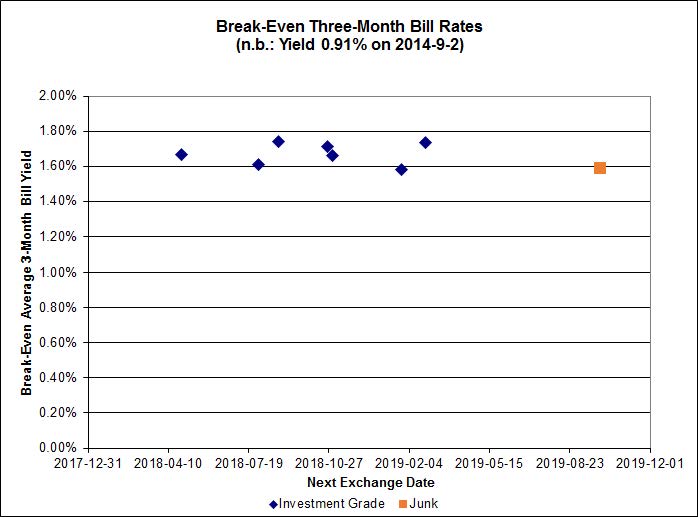
This chart was created with the assumed price of the new DC FloatingReset set to 25.22, the same as the price of DC.PR.B. According to this, the DC FloatingReset looks a little bit cheap … but not much. To get to the average Breakeven 3-Month Bill Yield of 1.67%, the price would only need to increase by $0.08, to 25.30.

Mind you, I also said:

Those with a taste for speculation, however, will find the conversion to the FloatingReset attractive, since there’s not much downside and potentially quite a bit of upside.

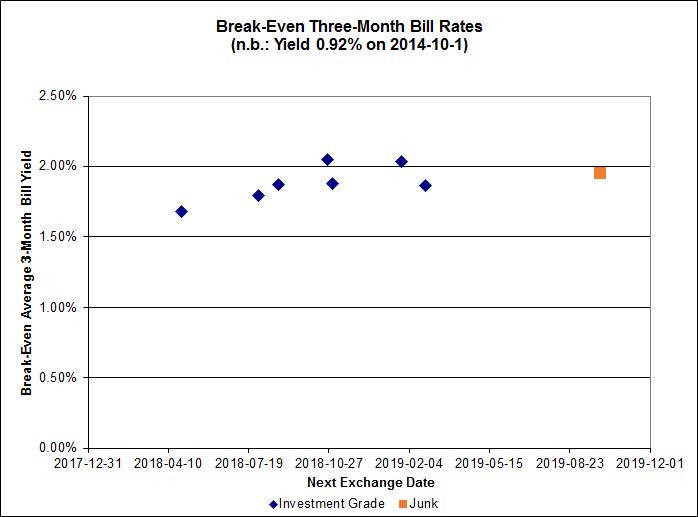
However, look at the current chart of break-even T-bill yields:

FR_breakeven_141001
Click for Big

That’s the implied rate for the DC.PR.B / DC.PR.D pair way over on the right, the only member so far of the “Junk” group – I remain very interested regarding whether the implied rates for junk and investment-grade will diverge. They shouldn’t … but you never know!

Anyway, the implied break-even three-month T-bill rate until the next exchange in September 2019 for this pair is 1.95%, just a hair over the 1.88% average for investment-grade and clearly inside the range. The interesting part of this, however, is what has happened to the average break-even rate since my recommendation as of September 2: the investment-grade average has increased from 1.67% to 1.88%. That’s a big move and has resulted in the big gap between the prices of DC.PR.B and DC.PR.D. What has happened, more or less, is that FixedResets have moved down in price, while FloatingResets are largely unchanged.

I will note that, assuming the three-month bill rate increases uniformly over the five years until the next exchange, this is predicting a yield in September 2019 of about 3%. Fancier expectations should be higher, since most pundits expect policy rates to be kept on hold for the next year, maybe two.

DC.PR.D will be tracked by HIMIPref™, but relegated to the Scraps index on credit concerns.

New Issues

New Issue: BAM FixedReset, 4.50%+284

Brookfield Asset Management has announced:

that it has agreed to issue 8,000,000 Class A Preferred Shares, Series 42 on a bought deal basis to a syndicate of underwriters led by TD Securities Inc., RBC Capital Markets, CIBC and Scotiabank for distribution to the public. The Preferred Shares, Series 42 will be issued at a price of C$25.00 per share, for gross proceeds of C$200,000,000. Holders of the Preferred Shares, Series 42 will be entitled to receive a cumulative quarterly fixed dividend yielding 4.50% annually for the initial period ending June 30, 2020. Thereafter, the dividend rate will be reset every five years at a rate equal to the 5-year Government of Canada bond yield plus 2.84%.

Brookfield has granted the underwriters an option, exercisable until 48 hours prior to closing, to purchase up to an additional 2,000,000 Preferred Shares, Series 42 which, if exercised, would increase the gross offering size to C$250,000,000. The Preferred Shares, Series 42 will be offered in all provinces of Canada by way of a supplement to Brookfield’s existing short form base shelf prospectus. The Preferred Shares, Series 42 may not be offered or sold in the United States or to U.S. persons absent registration or an applicable exemption from the registration requirements under the U.S. Securities Act.

Brookfield intends to use the net proceeds of the issue of Preferred Shares, Series 42 for general corporate purposes. The offering of Preferred Shares, Series 42 is expected to close on or about October 8, 2014.

Later, they further announced:

that as a result of strong investor demand for its previously announced offering it has agreed to increase the size of the offering to 12,000,000 Class A Preferred Shares, Series 42. The Preferred Shares, Series 42 will be issued at a price of C$25.00 per share, for gross proceeds of C$300,000,000. There will not be an underwriters’ option as was previously granted. The Preferred Shares, Series 42 are being offered on a bought deal basis by a syndicate of underwriters led by TD Securities Inc., RBC Capital Markets, CIBC and Scotiabank.

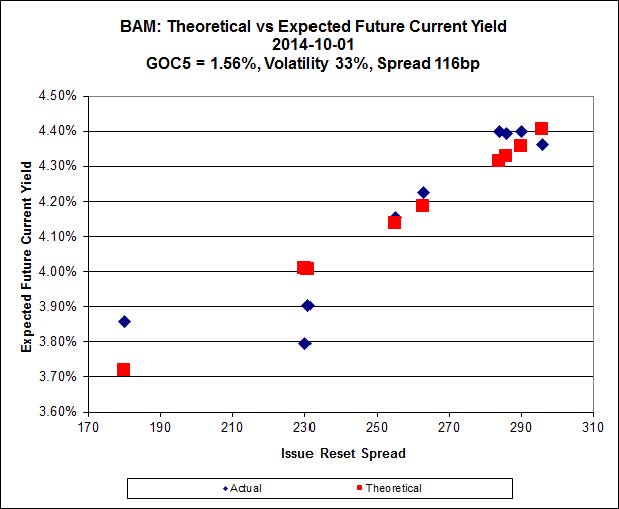
This issue looks fairly priced against BAM.PF.F, a FixedReset 4.50+286, that started trading in June, but looks reasonably cheap against its lower-spread siblings, according to Implied Volatility Theory:

ImpVol_BAM_FR_141001
Click for Big
Market Action

September 30, 2014

The downside of the elimination of bankruptcy law as it relates to banks is becoming apparent:

But after studying the proposals, National Bank Financial analyst Peter Routledge found that, under the new rules, commmon shareholders should be much more concerned, because they are quickly treated as collateral damage under the new regime. Should a new crisis emerge, common shareholders could be quickly wiped out, and that could rewrite the survival playbook.

Employing standard banking assumptions about leverage ratios and balance sheet sizes, Mr. Routledge discovered that just a 6 per cent drop in asset values, possibly from writing down a loan book and securities portfolio, would deplete a bank’s common equity capital. Because the bank’s existing common shareholders would then be wiped out, the preferred shareholders and bondholders would have their securities converted into common shares – making them the bank’s new owners.

Under the old rules, governments tried their best to protect common shareholders by setting up bailout schemes such as the Troubled Asset Relief Program, which purchased preferred shares and took toxic debt off of bank balance sheets, but did not upend the common equity investor base.

Mr. Routledge worries too few people appreciate just how easy it is to wipe out the existing shareholders under the proposed rules. When people start to realize this, possibly during the next crisis, he fears it will have disastrous implications for troubled banks.

Speaking of banks and debt:

Debt reduction through austerity reduces spending and thus slows growth; slower growth reduces incoming revenues and thus limits the ability to reduce debt.

This is a factor in the stubborn lack of global capital investment that has been limiting economic expansion – and Canada is no exception.

Standard & Poor’s on Monday pointed a finger at consumer debt as it lowered its 2014 growth forecast for the Canadian economy to 2.3 per cent from 2.5 per cent.

“Consumers might still be postponing purchases, worried about the heavy debt burdens they built up in the past decade, and this could be short-circuiting the growth we normally see in recoveries,” said S&P global fixed income analyst Robert Palombi. Without that consumer pick-up, he said, businesses lack a key catalyst to invest in expansion, which in turn has stifled employment growth.

New OSFI honcho Jeremy Rudin gave a speech to the Economic Club of Canada but didn’t say anything of interest.

The ruble’s in trouble:

Prospects Russia is considering capital controls amid the worst performance in emerging markets for the nation’s bonds and currency sent the ruble tumbling past the level at which the central bank said it would step in.

The ruble temporarily slid beyond 44.40 against the Bank of Russia’s basket of dollars and euros after two officials said policy makers are considering temporary restrictions if net outflows rise significantly. It pared declines after the central bank said it isn’t considering limits on cross-border capital movements. The yield on 10-year bonds rose six basis points to 9.42 percent, bringing this quarter’s increase to 102 basis points. The Micex Index pared its first gain in four days.

Reimposing restrictions on the flow of money that were abandoned eight years ago threatens to worsen a selloff in Russian assets that has gained momentum as the U.S. and European Union expanded sanctions over the conflict in Ukraine. The ruble slid 14 percent versus the dollar this quarter, breaking record lows in the past three days.

“Capital outflows should sharply increase now,” Stanislav Kopylov, who helps manage 45 billion rubles ($1.14 billion) at UralSib Asset Management in Moscow, said by phone from Moscow. “When you’re threatened like that, you need to urgently pull out the cash.”

And so much for Putin’s grandiose dreams of having a reserve currency:

After proclaiming in 2007 that the ruble was poised to become a haven for global investors, the Russian leader has watched it fade, a victim of his nation’s stagnating economy since the land grab in Ukraine. Now so much money is leaving Russia that its central bank is considering temporary capital controls, according to two officials with direct knowledge of the discussions.

The ruble’s share of global trading dropped to 0.4 percent from 0.6 percent since 2012, falling five places to rank 18th most-traded in the world, while the yuan tripled to 1.5 percent, according to the Society for Worldwide Interbank Financial Telecommunication, or SWIFT. Even as protests in Hong Kong this week challenged China’s leadership, direct trading began between the yuan and the euro, capping a year in which trade with European Union nations grew 12 percent.

It was a mixed day for the Canadian preferred share market, with PerpetualDiscounts gaining 2bp, FixedResets up 8bp and DeemedRetractibles off 1bp. Volatility was low. Volume was low.

Now to figure out why PrefInfo isn’t working.

HIMIPref™ Preferred Indices
These values reflect the December 2008 revision of the HIMIPref™ Indices

Values are provisional and are finalized monthly
Index Mean
Current
Yield
(at bid)
Median
YTW
Median
Average
Trading
Value
Median
Mod Dur
(YTW)
Issues Day’s Perf. Index Value
Ratchet 0.00 % 0.00 % 0 0.00 0 -0.1783 % 2,680.0
FixedFloater 4.20 % 3.46 % 24,464 18.41 1 0.0000 % 4,127.3
Floater 2.89 % 3.01 % 63,851 19.70 4 -0.1783 % 2,771.4
OpRet 4.05 % 2.18 % 93,842 0.08 1 0.0000 % 2,729.2
SplitShare 4.28 % 3.63 % 100,021 3.87 5 0.1978 % 3,161.6
Interest-Bearing 0.00 % 0.00 % 0 0.00 0 0.0000 % 2,495.6
Perpetual-Premium 5.49 % 2.53 % 75,479 0.08 20 -0.0650 % 2,443.9
Perpetual-Discount 5.29 % 5.17 % 103,207 15.16 16 0.0190 % 2,589.8
FixedReset 4.21 % 3.75 % 177,244 8.47 74 0.0813 % 2,555.8
Deemed-Retractible 5.01 % 2.21 % 104,719 0.40 42 -0.0105 % 2,561.5
FloatingReset 2.56 % -5.17 % 79,595 0.08 6 0.1761 % 2,541.1
Performance Highlights
Issue Index Change Notes
CM.PR.D Perpetual-Premium -1.50 % Called for redemption October 31
YTW SCENARIO
Maturity Type : Call
Maturity Date : 2014-10-30
Maturity Price : 25.00
Evaluated at bid price : 24.97
Bid-YTW : 1.47 %
PWF.PR.P FixedReset 1.00 % YTW SCENARIO
Maturity Type : Limit Maturity
Maturity Date : 2044-09-30
Maturity Price : 22.70
Evaluated at bid price : 23.15
Bid-YTW : 3.57 %
Volume Highlights
Issue Index Shares
Traded
Notes
BMO.PR.W FixedReset 117,600 Desjardins crossed two blocks of 50,000 each, both at 25.13.
YTW SCENARIO
Maturity Type : Limit Maturity
Maturity Date : 2044-09-30
Maturity Price : 23.18
Evaluated at bid price : 25.08
Bid-YTW : 3.72 %
BMO.PR.T FixedReset 63,200 TD crossed 25,000 at 25.30.
YTW SCENARIO
Maturity Type : Limit Maturity
Maturity Date : 2044-09-30
Maturity Price : 23.26
Evaluated at bid price : 25.30
Bid-YTW : 3.75 %
CM.PR.E Perpetual-Premium 57,899 NVCC like CM.PR.D, which has been Called for redemption October 31
YTW SCENARIO
Maturity Type : Call
Maturity Date : 2014-10-30
Maturity Price : 25.00
Evaluated at bid price : 25.12
Bid-YTW : -5.75 %
TD.PR.O Deemed-Retractible 57,750 Called for redemption October 31.
YTW SCENARIO
Maturity Type : Call
Maturity Date : 2014-10-31
Maturity Price : 25.00
Evaluated at bid price : 25.27
Bid-YTW : 1.65 %
FTS.PR.M FixedReset 57,290 Recent new issue.
YTW SCENARIO
Maturity Type : Call
Maturity Date : 2019-12-01
Maturity Price : 25.00
Evaluated at bid price : 25.25
Bid-YTW : 3.93 %
BNS.PR.Y FixedReset 54,870 TD crossed 49,300 at 24.02.
YTW SCENARIO
Maturity Type : Hard Maturity
Maturity Date : 2022-01-31
Maturity Price : 25.00
Evaluated at bid price : 24.01
Bid-YTW : 3.44 %
There were 24 other index-included issues trading in excess of 10,000 shares.
Wide Spread Highlights
Issue Index Quote Data and Yield Notes
IAG.PR.A Deemed-Retractible Quote: 22.90 – 23.22
Spot Rate : 0.3200
Average : 0.2208

YTW SCENARIO
Maturity Type : Hard Maturity
Maturity Date : 2025-01-31
Maturity Price : 25.00
Evaluated at bid price : 22.90
Bid-YTW : 5.72 %

BNS.PR.N Deemed-Retractible Quote: 26.15 – 26.37
Spot Rate : 0.2200
Average : 0.1298

YTW SCENARIO
Maturity Type : Call
Maturity Date : 2014-10-30
Maturity Price : 25.75
Evaluated at bid price : 26.15
Bid-YTW : -3.38 %

CU.PR.E Perpetual-Discount Quote: 24.20 – 24.45
Spot Rate : 0.2500
Average : 0.1667

YTW SCENARIO
Maturity Type : Limit Maturity
Maturity Date : 2044-09-30
Maturity Price : 23.81
Evaluated at bid price : 24.20
Bid-YTW : 5.10 %

IFC.PR.A FixedReset Quote: 23.70 – 24.00
Spot Rate : 0.3000
Average : 0.2182

YTW SCENARIO
Maturity Type : Hard Maturity
Maturity Date : 2025-01-31
Maturity Price : 25.00
Evaluated at bid price : 23.70
Bid-YTW : 4.30 %

GWO.PR.H Deemed-Retractible Quote: 23.60 – 23.90
Spot Rate : 0.3000
Average : 0.2260

YTW SCENARIO
Maturity Type : Hard Maturity
Maturity Date : 2025-01-31
Maturity Price : 25.00
Evaluated at bid price : 23.60
Bid-YTW : 5.60 %

IFC.PR.C FixedReset Quote: 25.49 – 25.72
Spot Rate : 0.2300
Average : 0.1560

YTW SCENARIO
Maturity Type : Call
Maturity Date : 2016-09-30
Maturity Price : 25.00
Evaluated at bid price : 25.49
Bid-YTW : 3.20 %

New Issues

New Issue: NA FixedReset, 3.90%+225

National Bank of Canada has announced (although not yet on their website):

that it has entered into an agreement with a group of underwriters led by National Bank Financial Inc. for an issue on a bought deal basis of 8 million non-cumulative 5-year rate reset first preferred shares series 32 (the “Series 32 Preferred Shares”), at a price of $25.00 per share, to raise gross proceeds of $200 million.

National Bank has also granted the underwriters an option to purchase, on the same terms, up to an additional 2 million Series 32 Preferred Shares. This option is exercisable in whole or in part by the underwriters at any time up to two business days prior to closing. The maximum gross proceeds raised under the offering will be $250 million should this option be exercised in full.

The Series 32 Preferred Shares will yield 3.90% annually, payable quarterly, as and when declared by the Board of Directors of National Bank, for the initial period ending February 15, 2020. The first of such dividends, if declared, shall be payable on February 15, 2015. Thereafter, the dividend rate will reset every five years at a level of 225 basis points over the then 5-year Government of Canada bond yield. Subject to regulatory approval, National Bank may redeem the Series 32 Preferred Shares in whole or in part at par on February 15, 2020 and on February 15 every five years thereafter.

Holders of the Series 32 Preferred Shares will have the right to convert their shares into an equal number of non-cumulative floating rate first preferred shares series 33 (the “Series 33 Preferred Shares”), subject to certain conditions, on February 15, 2020, and on February 15 every five years thereafter. Holders of the Series 33 Preferred Shares will be entitled to receive quarterly floating dividends, as and when declared by the Board of Directors of National Bank, equal to the 90-day Government of Canada Treasury Bill rate plus 225 basis points.

The net proceeds of the offering will be used for general corporate purposes and are expected to qualify as Tier 1 capital for National Bank. The expected closing date is on or about October 9, 2014. National Bank intends to file in Canada a prospectus supplement to its October 5, 2012 base shelf prospectus in respect of this issue.

They later announced (again, not yet on their website):

that as a result of strong investor demand for its previously announced domestic public offering of Non-cumulative 5-Year Rate Reset First Preferred Shares Series 32, the size of the offering has been increased to 12 million shares. The gross proceeds of the offering will now be $300 million. The offering will be underwritten by a syndicate led by National Bank Financial Inc. The expected closing date is October 9, 2014.

The net proceeds of the offering will be used for general corporate purposes and are expected to qualify as Tier 1 capital for National Bank.

Issue Comments

CM.PR.D To Be Redeemed

The Canadian Imperial Bank of Commerce has announced:

its intention to redeem all of its issued and outstanding Non-cumulative Class A Preferred Shares Series 26 (TSX: CM.PR.D), for cash. The redemptions will occur on October 31, 2014. The redemption price is $25.00 per Series 26 share.

The $0.359375 quarterly dividend announced on August 28, 2014 will be the final dividend on the Series 26 shares and will be paid on October 28, 2014, covering the period to October 31, 2014, to shareholders of record on September 29, 2014.

Holders of the Series 26 shares should contact the financial institution, broker or other intermediary through which they hold the shares to confirm how they will receive their redemption proceeds.

CM.PR.D is a NVCC compliant Straight Perpetual, paying 5.75%.

Issue Comments

S&P Affirms BPO, Credit-Watch Removed

Standard and Poor’s has announced:

  • •Brookfield Property Partners L.P. completed its acquisition of former affiliate and large office landlord Brookfield Office Properties Inc.
  • •Operating fundamentals have improved for office landlords as the U.S. economy has recovered, employment has strengthened, and new office supply additions have been muted.
  • •We are affirming our ‘BBB-‘ corporate credit rating on Brookfield Office and removing all ratings from CreditWatch with developing implications. The outlook is stable.
  • •The stable outlook reflects our view that the company’s competitively positioned office portfolio, with improving occupancy, good quality tenants, and below market rents will support leverage and fixed-charge coverage at current levels.

Standard & Poor’s Ratings Services today affirmed its ‘BBB-‘ corporate credit rating on Brookfield Office Properties Inc. (Brookfield Office), ‘BB+’ rating on the company’s unsecured debt, and ‘BB’ rating on its preferred stock. We removed all ratings on the company from CreditWatch, where we placed them with developing implications on Oct. 4, 2013. These actions affect roughly $1.7 billion of rated corporate debt and preferred securities.

We would lower ratings if leverage rises to 60%, fixed-charge coverage measures deteriorate to the 1.3x level, or the common dividend is not adequately supported by operations, since these measures would be more reflective of an “aggressive” financial risk profile. An increase in speculative development activity would also pressure ratings.

We don’t see potential for upgrade momentum over the next few years despite the company’s “strong” business risk profile until the financial risk profile is more firmly positioned within the “significant” category. Specifically, we would look for fixed-charge coverage measures above 1.7x, debt to EBITDA of less than 10x, and stronger coverage of the common dividend. The prudent pursuit and financing of the company’s expanding development pipeline would also be an important consideration for ratings improvement.

The “Watch – Developing” status was previously reported on PrefBlog.

The ultimate parent, Brookfield Asset Management, has the following preferred shares outstanding:
FixedResets BAM.PF.A, BAM.PF.B, BAM.PF.E, BAM.PF.F, BAM.PR.R, BAM.PR.T, BAM.PR.X, BAM.PR.Z
Floaters BAM.PR.B, BAM.PR.C, BAM.PR.K
RatchetRate BAM.PR.E
FixedFloater BAM.PR.G
OperatingRetractible BAM.PR.J
Straight Perpetual BAM.PR.M, BAM.PR.N, BAM.PF.C, BAM.PF.D

BPO has the following preferred share issues outstanding:
OperatingRetractible BPO.PR.H, BPO.PR.J, BPO.PR.K,
FixedReset BPO.PR.L, BPO.PR.N, BPO.PR.P, BPO.PR.R, BPO.PR.T,
Floaters BPO.PR.W, BPO.PR.X, BPO.PR.Y

In addition, there are the following split shares dependent upon BPO:
BPS.PR.U, BPS.PR.A, BPS.PR.B and BPS.PR.C