Issue Comments

XMF.PR.A Refuses to Wind Up

M Split Corp has announced:

This sharp decline in Manulife has resulted in the Company’s net asset value being reduced significantly and as mentioned in previous updates, has required the Company to implement the Priority Equity Portfolio Protection Plan (the “Plan”) in accordance with the prospectus. As a result of implementing the Plan, the Company has been required to sell the vast majority of the Manulife common shares held in the Portfolio and acquire fixed income securities.

The Company’s total net asset value is approximately $8.37 per unit as at June 18, 2009, consisting of less than 1% common shares of Manulife. The reduced exposure to Manulife will materially limit the future impact of price movements of Manulife shares on the net asset value of the Company and lower the ability of the Company to generate income from dividends and its covered call option writing program.

The significant price decline of Manulife has made it extremely difficult to achieve the original stated objectives for both classes of shares. The Company established a normal course issuer’s bid which allows the Company to repurchase units in the market when trading prices are at a discount to the net asset value.

Subsequent to the unsuccessful shareholder vote on February 5, 2009 of the reorganization proposal, the Company has continued to dialogue with certain larger shareholders to try and establish potential solutions for reorganizing the Company that would be suitable for all shareholders and result in a successful shareholder vote. Outside of certain larger shareholders, the remaining shareholders had voted overwhelmingly in support of management’s latest proposal.

The Company has received several shareholder requests to wind up the Company. In response to this request, the Company would like to remind all shareholders that all such reorganization proposals must receive a 66 2/3 favorable vote by both the Class A shareholders and the Preferred shareholders voting separately by class. This requirement is outlined in the Company’s prospectus and is part of the articles of incorporation of the Company. Under any kind of termination proposal at the current time, Class A shareholders would receive no value for their Class A shares since the net asset value per unit is below $10. The Class A shares have traded in a range between $0.27 and $0.78 since February 5, 2009 and closed at $0.40 on June 18, 2009. As such, the Company does not believe that this proposal is in the best interests of the Class A shareholders and any proposal that would provide no value to the Class A shareholders would ultimately never be approved by Class A shareholders.

The Company will continue to seek solutions that will balance and meet the interests of both Classes of shareholders and also result in a successful vote. The costs of holding a meeting are significant to the Company and, as such, the Company will only bring forward a proposal that has a high probability of being passed by the requisite majorities of each Class of shareholders.

Huh. Providing no value – indeed, taking away value – for the preferred shareholders didn’t seem to stop their last proposal from coming to vote.

XMF.PR.A is currently quoted at 7.07-28, while XMF is at 0.36-50. The company should buy the maximum permitted under its issuer bid, remind shareholders of their retraction rights, and propose a wind-up that will pay the common shareholders a nominal sum. Waiving management fees, or a good chunk thereof, would be a good thing too, but I’m not holding my breath!

XMF.PR.A is not tracked by HIMIPref™.
Issue Comments

MFC Disclosure under Review by OSC

A Globe & Mail story highlights a Manulife Financial Press Release that states:

On a separate matter unrelated to prior announcements made today by Manulife Financial Corporation, the Company stated that it received an enforcement notice from staff of the Ontario Securities Commission (OSC) this week relating to its disclosure before March 2009 of risks related to its variable annuity guarantee and segregated funds business. The OSC notice indicates that it is the preliminary conclusion of OSC staff that the Company failed to meet its continuous disclosure obligations related to its exposure to market price risk in its segregated funds and variable annuity guaranteed products. The Company has the opportunity to respond to the notice before OSC staff makes a decision whether to commence proceedings, and the Company intends to cooperate with OSC staff. The Company believes that its disclosure satisfied applicable disclosure requirements.

The prior announcements that the company is so anxious to emphasize are separate and unrelated are retirement of the CFO and Capital Update; the Capital Update trumpets MCCSR but makes no reference to the degree of double leverage inherent in the MFC holdco / insurance sub. structure. They never do, of course, but it is something that preferred shareholders in the holdco (MFC.PR.A, MFC.PR.B, MFC.PR.C, MFC.PR.D & MFC.PR.E) should bear firmly in mind at all times.

With respect to double-leverage, it is of interest to note that Manulife issued $1-billion of 5-Year MTNs at 4.896%, closing 2009-6-2, with the pricing supplement stating:

Approximately $730 million of the net proceeds to MFC from the sale of the Notes will be applied to reduce amounts outstanding under the Credit Facility and the balance of the net proceeds will be utilized for general corporate purposes of MFC.

There are – quite properly – no announcements regarding the enforcement notice regarding disclosure on the OSC website.

The MFC preferreds were last mentioned on PrefBlog when downgraded to A- [Negative Outlook] by Fitch.

DRIPs

SLF DRIP: Preferred Dividends into Possibly Discounted Common

Sun Life Financial has announced:

amendments to its Canadian Dividend Reinvestment and Share Purchase Plan (the “Plan”). The three major Plan changes are:

1. Subject to Toronto Stock Exchange (TSX) approval, Sun Life may issue common shares from treasury at a discount to the average market price to dividend reinvestment participants. At this time and until further notice, the discount will be 2%. To date, common shares issued under the Plan have been purchased through the TSX with no discount to the average market price.

2. Canadian-resident preferred shareholders will be able to participate in the Plan by electing to have dividends paid on their preferred shares reinvested in common shares of Sun Life Financial Inc.

3. Sun Life has also agreed to pay, on behalf of Plan participants, all fees associated with the Plan, other than brokerage commission payable on the sale of common shares held through the Plan.

The changes will be effective starting with the dividends payable on June 30, 2009 to common and preferred shareholders of record on May 27, 2009. The revised Plan is contained in the Amended and Restated Offering Circular which is available at www.sunlife.com or www.cibcmellon.com.

Sun Life may amend or cancel the discount at any time, and Sun Life will continue to determine whether common shares will be purchased under the Plan through the TSX (in which case the discount will not apply) or be newly-issued from treasury. No discount will apply on common shares acquired by participants through optional cash purchases.

The FAQ section of the Amended and Restated Offering Circular states:

The Corporation will announce by press release whether purchases of common shares under the Plan will be made on the open market or through treasury and the applicable discount, if any, included in the Market Price for common shares issued from treasury on a dividend reinvestment.

… while Section E.5 of the

The price that will be paid for Common Shares under the Plan on any Dividend Payment Date (the “Market Price”) will be determined as follows:

For Treasury Purchases, the Market Price will be equal to the weighted average closing trading price of the Common Shares on the Toronto Stock Exchange on the five trading days preceding the Dividend Payment Date, subject to a possible discount of up to 5% that may be applied on Treasury Purchases of Dividend Shares. No discount will apply on Treasury Purchases of Optional Cash Purchase Shares.

For Market Purchases of Dividend Shares and Optional Cash Purchase Shares, the Market Price allocated to each Plan Share, or fraction thereof, acquired by the Plan Agent under the Plan on each Dividend Payment Date will be the volume-weighted average of the applicable best efforts open market purchase price paid per Common Share by the Plan Agent for all Common Shares purchased on that Dividend Payment Date under the Plan.

The Corporation will announce by press release whether purchases of Common Shares under the Plan will be Market Purchases or Treasury Purchases and the applicable discount, if any, for Treasury Purchases of Dividend Shares.

This is, frankly, pretty useless information. I am unable to find one of the fabled press releases and suspect that they will be released only after the end of the registration period, making it impossible to plan.

I do not bother reporting reinvestment plans that do not include a discount to market price and was of two minds as to whether to report this one … but the potential is there – do with it as you see fit.

I recommend an eMail to Sun Life Shareholder Services demanding that, at the very least, the company commit itself one way or the other at time of dividend declaration.

The last mention of Sun Life preferreds in general on PrefBlog reported S&P’s one-notch bond-scale downgrade. These preferreds trade with the symbols SLF.PR.A, SLF.PR.B, SLF.PR.C, SLF.PR.D, SLF.PR.E & SLF.PR.F.

Interesting External Papers

DBRS: Bank Capital Levels Robust

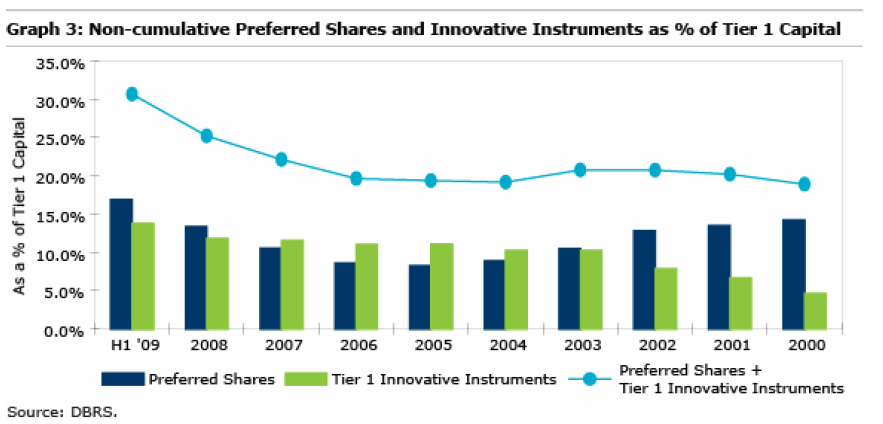
DBRS has published a newsletter highlighting Canadian bank capital levels, which is interesting in the light of their Review-Negative of non-Equity Tier 1 Capital.

They make the following rather curious statement:

DBRS believes the bank’s ability to access the capital markets for funding in good and bad times is an importantconsideration in its capital profile.

Well… has the ability of the banks to access capital markets in bad times really been tested? “Challenging” times, OK. “Difficult” times, why not? But can the past two years really be described as “bad” for Canadian banks?

They note:

The mix, quality and composition of capital are other important considerations in the overall assessment of capital. Thequality of capital has been a key rating consideration in DBRS’s assessment of Canadian banks for an extended periodof time. DBRS has a preference for common equity over hybrids, as the first loss cushion for bondholders and othersenior creditors. On average, 17% and 14% of the regulatory Tier 1 capital is made up of preferred shares andinnovative instruments, respectively, which DBRS views as reasonable. DBRS expects the quality of capital to remainrelatively steady given the recent focus by the market on “core capital,” although OSFI does allow this percentage tonow go as high as 40%, up from 30% as of November 2008.


Click for big
Market Action

June 19, 2009

The Bank for International Settlements has released its Core Principles for Effective Deposit Insurance Systems.

Quis custodiet ipsos custodes?:

The Securities and Exchange Commission today charged two accountants who produced bogus financial statements and an Antiguan regulator who took bribes to look the other way as Robert Allen Stanford conducted an alleged $8 billion Ponzi scheme.

“Instead of buying the safe and sound investments he promised his clients, Stanford bought Antigua’s top securities cop,” said Robert Khuzami, Director of the SEC’s Division of Enforcement. “While Stanford quarterbacked his massive Ponzi scheme, he paid the referee to spy on the huddles and provide an insider’s play-by-play of the SEC’s investigation.”

The SEC’s complaint alleges that King facilitated the Ponzi scheme by ensuring that the FSRC conducted sham audits and examinations of SIB’s books and records. In exchange for bribes paid to him over a period of several years, King made sure that the FSRC did not examine SIB’s investment portfolio. King also provided Stanford with access to the FSRC’s confidential regulatory files on him, including the SEC’s requests for information from FSRC in its investigation. King went so far as to allow Stanford to essentially dictate the FSRC’s responses to the SEC on those information requests. King made false assurances that there was no cause for concern about Stanford International Bank. He collaborated with Stanford to withhold significant information being requested by the SEC.

Speaking of scams, the FDIC is warning of a new one:

FDIC-insured institutions should be aware of any unsolicited deposits received through third-party referrals. Certain insurance companies and other financial services firms are offering above-market rate certificates of deposit (CDs) through FDIC-insured institutions to attract customers. However, the actual rate offered by the insured institution is usually much lower. In some cases, these third parties use the FDIC official sign, seal, logo or similar representations in connection with these offers.

When a customer expresses an interest in buying a CD, the third party takes the customer’s contact information for future marketing opportunities. When the customer buys the FDIC-insured CD, the third party refers the customer to an insured institution’s Web site. For the customer to receive the above-market rate CD, the third party must make a payment to the issuing institution on behalf of the customer to “make up” the difference between the institution’s actual rate and the above-market rate. This may misrepresent the actual rate offered by the insured institution by adding “promotional” funding to the principal balance of the CD, and therefore could be contradictory with the institution’s Truth-in-Savings disclosures. Institutions may become aware of such practices when they receive two checks for the purchase of a single CD. All insured institutions should have controls in place to flag unusual deposit activity.

Hmm … so at a relatively small cost, you get an address list of people who are willing to write large cheques … I couldn’t figure out the point of the scam at first!

The law firm of Wachtell, Lipton has come out strongly against Credit Default Swaps:

Any action the Commission attempts to take against manipulative short selling will not be completely effective without parallel, reinforcing reforms applied to the derivatives market, particularly with respect to credit default swaps (“CDS”). The responsiveness of equity prices to changes in CDS spreads makes the purchase of CDS a powerful device for bear raids, particularly when used in connection with short sales. Combining a short sale with the purchase of CDS sends a false signal into the marketplace about a company’s credit and, accordingly, causes a drop in the stock price that makes the short position profitable. Such manipulation is dangerously cost-effective, as a relatively small investment in an institution’s CDS is sufficient to spark rumors of default or a ratings downgrade and immediately sink stock prices.

To prevent this and other abuses of the CDS market, we believe that only those who are economically exposed to the underlying credit risk of a company should be allowed to buy CDS protection on the company. The purchase of a “naked” CDS, made by a purchaser with no exposure to the reference company, is more akin to gambling than obtaining insurance, and such instruments are capable of causing serious distortions in the market. A prohibition on naked CDS would allow the appropriate use of these instruments while restraining those using the CDS market in a manipulative and abusive way. As an intermediate step, the Commission should use its ability to regulate short sales to require a waiting period between any purchase of a CDS and short sale involving the same reference company. In addition, to alert the marketplace to situations when CDS are being used to manipulate share prices in conjunction with short selling, the Commission should require disclosure when an actual or synthetic short position in a company’s equity securities is accompanied by a long position in the company’s CDS.

Combining a short sale with the purchase of CDS sends a false signal into the marketplace about a company’s credit, eh? I guess there’s no possibility – none whatsoever – that it could be sending a true signal into the marketplace?

Volume in the preferred share market was off slightly today, but the market was able to advance a little.

HIMIPref™ Preferred Indices
These values reflect the December 2008 revision of the HIMIPref™ Indices

Values are provisional and are finalized monthly
Index Mean
Current
Yield
(at bid)
Median
YTW
Median
Average
Trading
Value
Median
Mod Dur
(YTW)
Issues Day’s Perf. Index Value
Ratchet 0.00 % 0.00 % 0 0.00 0 0.3432 % 1,225.7
FixedFloater 7.02 % 5.48 % 34,418 16.34 1 0.0000 % 2,150.2
Floater 3.11 % 3.38 % 78,920 18.80 3 0.3432 % 1,531.3
OpRet 4.97 % 3.78 % 134,662 0.92 14 -0.1409 % 2,193.3
SplitShare 5.80 % 6.36 % 62,405 4.22 3 0.3817 % 1,880.9
Interest-Bearing 5.96 % 6.95 % 23,135 0.51 1 0.3992 % 1,999.1
Perpetual-Premium 0.00 % 0.00 % 0 0.00 0 0.1831 % 1,740.9
Perpetual-Discount 6.32 % 6.30 % 166,903 13.38 71 0.1831 % 1,603.4
FixedReset 5.67 % 4.80 % 533,118 4.35 40 0.0361 % 2,012.0
Performance Highlights
Issue Index Change Notes
BAM.PR.B Floater -2.57 % YTW SCENARIO
Maturity Type : Limit Maturity
Maturity Date : 2039-06-19
Maturity Price : 11.36
Evaluated at bid price : 11.36
Bid-YTW : 3.46 %
PWF.PR.M FixedReset -1.32 % YTW SCENARIO
Maturity Type : Call
Maturity Date : 2014-03-02
Maturity Price : 25.00
Evaluated at bid price : 26.16
Bid-YTW : 5.11 %
BAM.PR.I OpRet -1.02 % YTW SCENARIO
Maturity Type : Soft Maturity
Maturity Date : 2013-12-30
Maturity Price : 25.00
Evaluated at bid price : 24.31
Bid-YTW : 6.21 %
BNS.PR.R FixedReset 1.38 % YTW SCENARIO
Maturity Type : Limit Maturity
Maturity Date : 2039-06-19
Maturity Price : 24.95
Evaluated at bid price : 25.00
Bid-YTW : 4.72 %
GWO.PR.H Perpetual-Discount 1.38 % YTW SCENARIO
Maturity Type : Limit Maturity
Maturity Date : 2039-06-19
Maturity Price : 18.35
Evaluated at bid price : 18.35
Bid-YTW : 6.65 %
RY.PR.H Perpetual-Discount 1.53 % YTW SCENARIO
Maturity Type : Limit Maturity
Maturity Date : 2039-06-19
Maturity Price : 23.67
Evaluated at bid price : 23.86
Bid-YTW : 5.99 %
W.PR.H Perpetual-Discount 1.59 % YTW SCENARIO
Maturity Type : Limit Maturity
Maturity Date : 2039-06-19
Maturity Price : 21.74
Evaluated at bid price : 21.74
Bid-YTW : 6.46 %
BNA.PR.C SplitShare 2.14 % Asset coverage of 1.9-:1 as of May 31 according to the company.
YTW SCENARIO
Maturity Type : Hard Maturity
Maturity Date : 2019-01-10
Maturity Price : 25.00
Evaluated at bid price : 15.75
Bid-YTW : 10.71 %
TRI.PR.B Floater 3.58 % YTW SCENARIO
Maturity Type : Limit Maturity
Maturity Date : 2039-06-19
Maturity Price : 15.03
Evaluated at bid price : 15.03
Bid-YTW : 2.61 %
Volume Highlights
Issue Index Shares
Traded
Notes
BMO.PR.P FixedReset 890,295 New issue settled today.
YTW SCENARIO
Maturity Type : Limit Maturity
Maturity Date : 2039-06-19
Maturity Price : 23.15
Evaluated at bid price : 25.09
Bid-YTW : 5.07 %
GWO.PR.H Perpetual-Discount 207,120 RBC crossed 200,000 at 18.35.
YTW SCENARIO
Maturity Type : Limit Maturity
Maturity Date : 2039-06-19
Maturity Price : 18.35
Evaluated at bid price : 18.35
Bid-YTW : 6.65 %
BAM.PR.P FixedReset 97,810 Recent new issue.
YTW SCENARIO
Maturity Type : Call
Maturity Date : 2014-10-30
Maturity Price : 25.00
Evaluated at bid price : 25.43
Bid-YTW : 6.74 %
BMO.PR.K Perpetual-Discount 54,480 Nesbitt bought two blocks from RBC, 33,000 and 18,000 shares, both at 21.72.
YTW SCENARIO
Maturity Type : Limit Maturity
Maturity Date : 2039-06-19
Maturity Price : 21.34
Evaluated at bid price : 21.65
Bid-YTW : 6.12 %
MFC.PR.E FixedReset 46,659 Recent new issue.
YTW SCENARIO
Maturity Type : Call
Maturity Date : 2014-10-19
Maturity Price : 25.00
Evaluated at bid price : 25.45
Bid-YTW : 5.31 %
RY.PR.D Perpetual-Discount 43,500 RBC crossed 34,700 at 18.49.
YTW SCENARIO
Maturity Type : Limit Maturity
Maturity Date : 2039-06-19
Maturity Price : 18.41
Evaluated at bid price : 18.41
Bid-YTW : 6.19 %
There were 33 other index-included issues trading in excess of 10,000 shares.
Issue Comments

BMO.PR.P Settles at Slight Premium on Huge Volume

BMO.PR.P, the new FixedReset 5.40%+241 announced last week, settled today and traded 889,295 shares in a range of 25.05-19 before closing at 25.09-12, 10×18.

The deal size was 14-million shares (=$350-million) with a 2-million share (=$50-million) greenshoe. It is not clear whether or not the greenshoe has been exercised.

Vital statistics are:

BMO.PR.P FixedReset YTW SCENARIO
Maturity Type : Limit Maturity
Maturity Date : 2039-06-19
Maturity Price : 23.15
Evaluated at bid price : 25.09
Bid-YTW : 5.07 %

BMO.PR.P has been added to the HIMIPref™ FixedResets subindex.

Issue Comments

YPG.PR.A & YPG.PR.B: Guidance from Bonds

YPG Holdings has launched a 5-Year MTN issue with a 7.30% coupon:

Yellow Pages Group announced today an offering by YPG Holdings Inc. (the “Company”) of Medium Term Notes for gross proceeds of $260 million. The net proceeds from the issuance of the Notes will be used for general corporate purposes, to repay indebtedness outstanding under the Company’s commercial paper program and to repay an amount of $200 million under its term credit facility. This offering is scheduled to close on or about June 25, 2009.

Pursuant to this offering, the Company will issue $260 million of 7.30% Series 7 Notes (compounded semi-annually), which will be dated June 25, 2009, will mature on February 2, 2015 and will be issued at a price of $100.00.

The Series 7 Notes will be guaranteed by Yellow Pages Income Fund (TSX: YLO.UN), YPG Trust, YPG LP, Yellow Pages Group Co., Trader Corporation, YPG (USA) Holdings, Inc., Yellow Pages Group, LLC and YPG Directories, LLC. The Notes have been assigned a rating of BBB (high) with a stable trend by DBRS Limited and a rating of BBB- with a stable outlook from Standard & Poor’s Rating Service.

Their ability to issue on these terms provides credibility to their previously announced issuer bid for YPG.PR.A and YPG.PR.B. The former closed yesterday at 22.50-58 to yield 7.52%-7.40% to retraction 2012-12-31, while the latter closed at 17.35-49 to yield 10.84%-10.71% to retraction 2017-6-30. There is, of course, a difference in the credit quality between the MTNs and the preferreds, but that’s a very high tax-adjusted spread!

YPG.PR.A and YPG.PR.B are both tracked by HIMIPref™ but are relegated to the “Scraps” index on credit concerns.

Market Action

June 18, 2009

The New York Times points out – albeit disapprovingly – one of the good elements of the Obama regulation plan: it leaves Credit Rating Agencies alone:

The proposals call for the agencies to improve disclosure and release more detailed information, as well as establish policies for “managing and disclosing conflicts of interest.”

But the plan does not alter the issuer-pay model, whereby the companies selling securities pay to have them rated. Nor does it encourage competitors to enter the industry, which many regard as an oligopoly.

The proposal does call for regulators to reduce their reliance on agency ratings when deciding whether structured investments are safe enough for banks, insurance companies, pension funds and money market mutual fund investors. Regulators should encourage more independent analysis, a Treasury official said, but the administration did not propose an alternative standard.

Bank of Canada Governor Mark Carney gave a speech today:

The performance of core funding markets during the crisis intensified the financial panic and helped trigger the recession. This is totally unacceptable. As a consequence, one of the Bank of Canada’s top priorities is to promote institutional changes to create more robust core funding markets. Promising avenues to break such (il)liquidity spirals include introducing clearing houses, standardizing products, implementing through-the-cycle margining, and ensuring more effective netting.

Does anybody else think this is non-sequiter? When I think of “core funding”, I think of deposits, deposit notes and GICs. One might well make the argument that the “promising avenues” might contain a mathod whereby the market for these instruments remains stable … but Mr. Carney doesn’t.

There is a possibility that the panel surveyed to calculate US LIBOR will increase:

The dollar rose versus the euro yesterday for the first time in three days after British Bankers’ Association said it may allow more institutions to take part in the daily survey that sets Libor, the benchmark for more than $360 trillion of financial products around the world.

“It would be a wider group of banks, so some ‘weaker’ ones who would submit higher rates, thus Libor would aggregate higher,” said Scott Ainsbury, a portfolio manager at New York- based FX Concepts Inc., the world’s largest currency hedge fund with about $12 billion in assets.

Not much price action today in Canadian Preferreds, but volume continued high.

HIMIPref™ Preferred Indices
These values reflect the December 2008 revision of the HIMIPref™ Indices

Values are provisional and are finalized monthly
Index Mean
Current
Yield
(at bid)
Median
YTW
Median
Average
Trading
Value
Median
Mod Dur
(YTW)
Issues Day’s Perf. Index Value
Ratchet 0.00 % 0.00 % 0 0.00 0 -5.2289 % 1,221.5
FixedFloater 7.02 % 5.48 % 35,706 16.32 1 0.0000 % 2,150.2
Floater 3.12 % 3.36 % 81,292 18.86 3 -5.2289 % 1,526.1
OpRet 4.96 % 3.78 % 135,875 0.92 14 0.0931 % 2,196.4
SplitShare 5.82 % 6.24 % 59,589 4.23 3 -0.3499 % 1,873.7
Interest-Bearing 5.99 % 7.69 % 23,215 0.52 1 -0.1992 % 1,991.2
Perpetual-Premium 0.00 % 0.00 % 0 0.00 0 0.1097 % 1,737.7
Perpetual-Discount 6.32 % 6.30 % 167,613 13.38 71 0.1097 % 1,600.4
FixedReset 5.68 % 4.83 % 536,966 4.35 39 -0.0800 % 2,011.3
Performance Highlights
Issue Index Change Notes
TRI.PR.B Floater -12.06 % Traded 8,100 shares in a range of 14.80-16.15 before closing at 14.51-15.89 (!). Somebody took out the bid with a sale of 2500 shares at $14.80 at 3:59, with the last ten trades of the day totalling 6200 shares in the last eight minutes of trading … whatever the merits of floaters may be, liquidity is not one of them!
YTW SCENARIO
Maturity Type : Limit Maturity
Maturity Date : 2039-06-18
Maturity Price : 14.51
Evaluated at bid price : 14.51
Bid-YTW : 2.71 %
BNS.PR.R FixedReset -1.40 % YTW SCENARIO
Maturity Type : Limit Maturity
Maturity Date : 2039-06-18
Maturity Price : 24.61
Evaluated at bid price : 24.66
Bid-YTW : 4.83 %
GWO.PR.H Perpetual-Discount -1.36 % YTW SCENARIO
Maturity Type : Limit Maturity
Maturity Date : 2039-06-18
Maturity Price : 18.10
Evaluated at bid price : 18.10
Bid-YTW : 6.74 %
CU.PR.B Perpetual-Discount -1.12 % YTW SCENARIO
Maturity Type : Limit Maturity
Maturity Date : 2039-06-18
Maturity Price : 24.32
Evaluated at bid price : 24.62
Bid-YTW : 6.14 %
BAM.PR.O OpRet 1.10 % YTW SCENARIO
Maturity Type : Option Certainty
Maturity Date : 2013-06-30
Maturity Price : 25.00
Evaluated at bid price : 23.81
Bid-YTW : 6.35 %
CIU.PR.A Perpetual-Discount 1.14 % YTW SCENARIO
Maturity Type : Limit Maturity
Maturity Date : 2039-06-18
Maturity Price : 18.60
Evaluated at bid price : 18.60
Bid-YTW : 6.25 %
CIU.PR.B FixedReset 1.17 % YTW SCENARIO
Maturity Type : Call
Maturity Date : 2014-07-01
Maturity Price : 25.00
Evaluated at bid price : 27.60
Bid-YTW : 4.51 %
PWF.PR.M FixedReset 1.96 % YTW SCENARIO
Maturity Type : Call
Maturity Date : 2014-03-02
Maturity Price : 25.00
Evaluated at bid price : 26.51
Bid-YTW : 4.78 %
Volume Highlights
Issue Index Shares
Traded
Notes
GWO.PR.X OpRet 129,915 RBC crossed 120,000 at 25.85.
YTW SCENARIO
Maturity Type : Soft Maturity
Maturity Date : 2013-09-29
Maturity Price : 25.00
Evaluated at bid price : 25.75
Bid-YTW : 4.01 %
BAM.PR.P FixedReset 74,039 Recent new issue.
YTW SCENARIO
Maturity Type : Call
Maturity Date : 2014-10-30
Maturity Price : 25.00
Evaluated at bid price : 25.37
Bid-YTW : 6.79 %
RY.PR.I FixedReset 72,325 National crossed 50,000 at 25.00.
YTW SCENARIO
Maturity Type : Limit Maturity
Maturity Date : 2039-06-18
Maturity Price : 24.66
Evaluated at bid price : 24.71
Bid-YTW : 4.84 %
RY.PR.N FixedReset 66,625 TD bought 12,900 from National at 26.65.
YTW SCENARIO
Maturity Type : Call
Maturity Date : 2014-03-26
Maturity Price : 25.00
Evaluated at bid price : 26.71
Bid-YTW : 4.77 %
PWF.PR.I Perpetual-Discount 66,000 Nesbitt bought two blocks from RBC, 14,500 at 22.78 and 15,000 at 22.80, then crossed 32,000 at 22.88.
YTW SCENARIO
Maturity Type : Limit Maturity
Maturity Date : 2039-06-18
Maturity Price : 22.55
Evaluated at bid price : 22.76
Bid-YTW : 6.70 %
RY.PR.D Perpetual-Discount 63,145 RBC crossed blocks of 23,900 and 25,000 shares, both at 18.49.
YTW SCENARIO
Maturity Type : Limit Maturity
Maturity Date : 2039-06-18
Maturity Price : 18.39
Evaluated at bid price : 18.39
Bid-YTW : 6.20 %
There were 46 other index-included issues trading in excess of 10,000 shares.
New Issues

New Issue: BNA SplitShares, 5-Year, 7.35%

BAM Split Corp has entered into a bought-deal refunding the BNA.PR.A, which pays 6.25% and matures 2010-9-30, but is redeemable at par commencing 2010-10-1.

Issue: BAM Split Corp. Cumulative Class AA preferred shares, Series 4

Size: 5-million shares (= $125-million)

Dividend: 7.25% paid quarterly (=$0.453125 quarterly, =$1.8125 p.a.). First coupon payable Sept. 7 for $0.26318, based on closing July 9.

Redemption: Will be redeemed 2014-7-9 at lesser of $25.00 or NAV. Optional redemption at $26.00 at any time – company may redeem early only if Capital Units retracted or there is a takeover bid for BAM.A

Retraction: Into Debentures. No Cash Retractions (except that the 2014-7-9 counts as a retraction for analytical purposes)! Debs pay interest of 7.35%, same maturity and – I PRESUME – are senior to prefs. Check the prospectus when available.

Update: BNA Press Release