I am pleased to announce that PrefBlog is now a member of the BlogBurst network.
BlogBurst is an aggregator with an impressive client list – including Reuters, which displays the feed on their story pages.
There was a report today of another sub-prime winner:
Harbinger Capital Partners, the hedge fund firm run by former Barclays Capital trader Philip Falcone, generated returns of more than 65 percent this year, helped by bets against subprime-mortgage bonds and gains on commodities.Harbinger’s $2.5 billion Special Situations fund increased 9.9 percent last month and more than 100 percent in 2007, said two of the firm’s investors. The $11 billion Harbinger Capital Partners fund rose 5.4 percent last month and 65 percent this year.
Lucky or smart? Does it matter?
The Fed released Commercial Paper Outstandings today; it would appear the situation is normalizing rapidly. ABCP outstanding was down about $6-billion on the week, a nice chunk of change but relatively small in the context of the $906-billion total outstanding. Quality spreads, while still high compared to the last six years, are in decline.
The following posts were either written or updated today:
… which should go a long way towards explaining the brevity of today’s round-up!
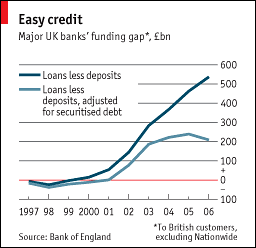
There are some very thoughtful essays regarding the Northern Rock bail-out in the WSG Economics Blog and the Economist. There’s another link to an Economist article about the funding gap in British banking … there is an increased reliance on commercial paper, as opposed to deposits, to fund bank loans:
Meanwhile, the preferred share market showed a little stability today. There were some rather violent individual moves, but most of these were reversals of previous silliness.
| Note that these indices are experimental; the absolute and relative daily values are expected to change in the final version. In this version, index values are based at 1,000.0 on 2006-6-30 | |||||||
| Index | Mean Current Yield (at bid) | Mean YTW | Mean Average Trading Value | Mean Mod Dur (YTW) | Issues | Day’s Perf. | Index Value |
| Ratchet | 4.67% | 4.61% | 835,153 | 16.04 | 1 | 0.0000% | 1,043.7 |
| Fixed-Floater | 4.89% | 4.76% | 102,176 | 15.82 | 7 | +0.2812% | 1,036.3 |
| Floater | 4.50% | 2.84% | 78,528 | 10.72 | 3 | +0.0275% | 1,044.2 |
| Op. Retract | 4.85% | 4.04% | 78,762 | 3.16 | 15 | +0.0129% | 1,028.5 |
| Split-Share | 5.13% | 4.78% | 86,372 | 4.06 | 15 | +0.0997% | 1,047.7 |
| Interest Bearing | 6.33% | 6.40% | 55,359 | 3.63 | 3 | +0.1539% | 1,045.3 |
| Perpetual-Premium | 5.62% | 5.38% | 96,670 | 8.30 | 17 | +0.2682% | 1,018.1 |
| Perpetual-Discount | 5.32% | 5.35% | 211,463 | 14.90 | 45 | +0.0100% | 945.7 |
| Major Price Changes | |||
| Issue | Index | Change | Notes |
| MFC.PR.C | PerpetualDiscount | -1.5730% | Now with a pre-tax bid-YTW of 5.18% based on a bid of 21.90 and a limitMaturity. |
| BAM.PR.J | OpRet | -1.3514% | Now with a pre-tax bid-YTW of 5.17% based on a bid of 25.55 and a softMaturity 2018-3-30 at 25.00. |
| RY.PR.C | PerpetualDiscount | -1.0816% | Now with a pre-tax bid-YTW of 5.31% based on a bid of 21.95 and a limitMaturity. |
| ELF.PR.G | PerpetualDiscount | +1.1848% | Now with a pre-tax bid-YTW of 5.59% based on a bid of 21.35 and a limitMaturity. |
| PWF.PR.I | PerpetualPremium | +1.4769% | This has just gone ex-dividend for $0.375, so expect to see a drop in trading price on October 5. Now with a pre-tax bid-YTW of 5.21% based on a bid of 26.11 and a call 2012-5-30 at 25.00. |
| POW.PR.C | PerpetualPremium (for now!) | +2.0483% | Now with a pre-tax bid-YTW of 5.84% based on a bid of 24.91 and a limitMaturity. |
| Volume Highlights | |||
| Issue | Index | Volume | Notes |
| BCE.PR.Z | FixFloat | 153,168 | |
| BAM.PR.N | PerpetualDiscount | 115,690 | Now with a pre-tax bid-YTW of 6.03% based on a bid of 19.85 and a limitMaturity. |
| GWO.PR.E | OpRet | 105,732 | Now with a pre-tax bid-YTW of 3.62% based on a bid of 25.91 and a call 2009-4-30 at 26.00. |
| RY.PR.K | OpRet | 84,864 | Scotia crossed 25,000 at 25.15. Now with a pre-tax bid-YTW of 4.87% based on a bid of 25.10 and a softMaturity 2008-8-23 at 25.00. |
| GWO.PR.I | PerpetualDiscount | 62,980 | Scotia crossed 50,000 at 21.60. Now with a pre-tax bid-YTW of 5.23% based on a bid of 21.60 and a limitMaturity. |
There were eleven other index-included $25.00-equivalent issues trading over 10,000 shares today.
I received the following communication recently:
new BMO & BNS preferred shares
These are apparently bought issues, but if you recommend them I would consider a purchase. I have taken an interest and a position in various preferred since reading your articles in the Canadian Money Saver. Until then, I was nothing more than a passive observer. I am 76 years old, wife is 71 this year and our pensions are inadequate to replace my income before retiring more than 10 years ago. Now a considerable portion of my investments are in bank, insurance and utility companies common and more recently preferred shares. Unfortunately I also have about 10% in BCE bonds in RRIF. Would you consider the new issues at 5.25% a good investment in a non- registered account? Except for CU all other preferred shares that I have are below par with approx 4.5% coupon. I have more than 10% cash to invest. Would it be prudent to wait?
Well, I’ll take a stab at it, but I have the horrible sinking feeling that I am not only going to frustrate my inquirer, but I’ll probably offend him as well.
The basic problem with the query is the implicit assumption that market-timing is possible – if you recommend them I would consider a purchase … Would it be prudent to wait?.
I can’t time the markets. Neither can anybody else. There is no shortage of bozos who will claim that they can time the markets on behalf of their clients – and even believe it themselves – but when you look at their justification for such belief, you will invariably find that they have been looking at the past with rose-coloured glasses and making excuses for the times that they got it wrong. The way to unmask these people is to ask them for a “CFA Institute compliant composite performance report from inception to present”. Information about what this means is readily available. Essentially, the standards insist that every single dollar under management be assigned to a particular composite and that clients be informed of the existence of each composite. You won’t find many stockbrokers or advisors who have such a thing – and most of those guys will get fairly huffy when asked.
Market-timing is not possible, but this does not mean investors should just buy a generic batch of index funds and forget about it. There are two mechanisms whereby professional money management can add value:
And yes, this discourse is relevant to the original question! My correspondent is asking for advice on market timing, but he should really be asking himself two questions:
Let’s try to answer the first part of that question. The couple is retired; in their seventies; they have at least some investments; they need income. There is a fair bit of detail missing from the query:
It is impossible, for me or anybody else, to provide investment advice without knowledge of these issues … well, I shouldn’t say “impossible”, because it’s done all the time. A better word is “reckless”.
So lets make a few generic points:
…should stick to names rated “AA” or better.
I recommend that investments in preferred shares be restricted to those names rated Pfd-1(low) or better.
Which, at long last, brings us back to the subject of the inquiry: the BMO & BNS new issues. My correspondent notes that they are “bought issues”, but this indicates nothing more than that the underwriters have guaranteed to the issuers that the issue will be sold … in other words, they have agreed to buy the entire issue for resale, rather than acting on an agency ‘best efforts’ basis.
They are both highly rated, meeting the quality needs I outlined above. And when they were first announced, they were far superior to most issues on the market … but then the market fell. At present, I estimate the fair value of both of these issues to be a little above $24.80, which means there is other stuff out there that might yield a little bit more with comparable risk.
My correspondent is in the unfortunate position of being protected from rapacious Ontario-based portfolio managers by the brave heroes of his provincial securities commission – and I have not yet been able to extract sufficient expressions of interest in his province to make it worth my while to register with his commission. So, unfortunately, I cannot offer him a subscription to PrefLetter, which was developed to be useful to investors finding themselves in precisely his position – that is, having money allocated to preferred shares, but not sure which ones.
I suggest, however, that he may wish to keep an eye on this blog, watch the commentaries for mention of good yields, check out the characteristics of the issues of interest on PrefInfo … and to get some professional advice on asset allocation, based on his own particular circumstances.
Update, 2007-10-5: I forgot the ad for the fund! While PrefLetter is designed for do-it-yourself investors who want a place to start, there are funds available: I reviewed three funds last year and another last spring … but I trust I won’t be criticized too severely for recommending my own fund for those investors who seek to outperform the indices and are either “accredited” or have $150,000 to invest. Unlike PrefLetter, Malachite Aggressive Preferred Fund is available to all such investors in Canada.
Update, 2007-10-19: I should also link to two of my other posts on this general topic: One Bull Checks in and Reflections on a Bull
The latest passion on the Street is telling everybody how lousy everything is! PIMCO & TIAA-CREF hate the market, Greenspan hates the market, Credit Suisse hates the market … there’s no shortage. But it takes two to make a market! James Hamilton at Econbrowser takes a look at recent indicators and points out that – so far, anyway – the problems in the US housing market haven’t spread to other areas of the US economy. So take your choice!
The BIS Quarterly Review has a good review of the credit crunch.
I’ve updated the post about the Globe’s reporting of Dickson’s speech with a link and extract from the National Post’s article, which is much more reflective of what was actually said. You almost wonder if the reporters are reporting the same speech!
Fitch Ratings has announced that it completed its review of 2006-vintage sub-prime issues:
For first- and second-lien transactions combined, Fitch has affirmed 2,228 classes with a par balance of $155.1 billion and downgraded 1,003 classes with a par balance of $18.4 billion. While Fitch’s reviewed all rating categories, downgrades were most heavily concentrated among classes originally rated ‘BBB+’ or lower. Fitch believes that those classes that have been downgraded to below-investment grade have substantial risk of principal loss. However those bonds remaining investment grade still exhibit the ability to withstand the higher projected collateral default and loss expectations without principal loss. Those classes affirmed at ‘AAA’ are able to withstand a substantial multiple of expected collateral performance without experiencing loss.
This action was gleefully reported by Bloomberg and commented upon by Joseph Mason, an associate professor at Drexel University. Mr. Mason has testified to the Subcommittee on Capital Markets, Insurance, and Government … woo-hoo! I haven’t read his testimony thoroughly yet, but a quick skim suggests that he doesn’t like the Credit Rating Agencies very much! I’d better get cracking on my reading, because his faculty web-page pointed me to a paper on the value of recourse which has implications for bank-sponsored ABCP. Briefly, it would appear – the authors claim – that the market is implicitly assuming that there will be support for conduits even when there doesn’t need to be; this is very similar to the US mortgage GSEs and implicit ‘off-balance-sheet’ Treasury backing.
By providing recourse in cases where none is explicitly required, the sponsor demonstrates the presence of de facto recourse and therefore previously unreported contingent liabilities. The present paper examines the effects of these revelations on the sponsor. On the face of it, one might expect that revealing previously unreported contingent liabilities could heighten asymmetric information about firm conditions, resulting in poor short- and long-term stock price performance, poor long-term financial performance, and reduced proceeds from subsequent loan sales. However, we find that, conditional on being in a position where honoring implicit recourse has become necessary and conditional on actually providing that recourse, the sponsors, on average, exhibit improved short- and long-term stock price performance, improved long-term financial performance, and similar proceeds from subsequent loan sales.
This is of interest in terms of assessing market discipline and credit analysis of the banks. For example, note 5 of the 2006 BMO Financials discloses that almost CAD 80-billion of liquidity guarantees had been extended, none of which found its way into risk-weighted assets (that’s none. N-U-N. none). Given the bank’s capital of CAD 16,641-billion, reported risk-weighted assets of CAD 162,794 and a CCF of 10%, this would not make a huge difference to the tier 1 capital ratio. But – given recent experience – is the CCF of 10% high enough? Eighty-billion landing suddenly on their balance sheet might give them collywobbles – and Rule #1 states that Everything Bad Happens at the Same Time.
Market discipline is something of a worry, despite the investment industry’s constant reiteration that we’re such a bunch of tough guys. However, Beloved Leader And Economic Genius for Life Stephen Harper is taking care of an oversight, and reminding investors that they are stupid:
Sources told The Canadian Press on Tuesday that Industry Minister Jim Prentice is concerned about foreign state-owned entities snapping up Canadian resource firms.
Among those currently being reviewed, sources said, is the PrimeWest acquisition, part of TAQA’s stated goal of dramatically growing its presence in Canada’s energy sector.
At a late Wednesday news conference in Ottawa, Prime Minister Stephen Harper said his government will address the lack of a national security test for foreign takeovers of Canadian companies.
It’s about time this country was protected from foreigners offering enormous bundles of cash! If such sums ever reach Canadian hands, we’ll just blow it on beer and prostitutes.
Volume picked up today, but perpetuals continued their slide. I confess that I find this continued weakness somewhat odd … but market volatility brings trading opportunities, and the passage of time brings dividends, so my curiosity is somewhat muted.
| Note that these indices are experimental; the absolute and relative daily values are expected to change in the final version. In this version, index values are based at 1,000.0 on 2006-6-30 | |||||||
| Index | Mean Current Yield (at bid) | Mean YTW | Mean Average Trading Value | Mean Mod Dur (YTW) | Issues | Day’s Perf. | Index Value |
| Ratchet | 4.67% | 4.61% | 869,811 | 16.05 | 1 | -2.0000% | 1,043.7 |
| Fixed-Floater | 4.90% | 4.78% | 103,642 | 15.81 | 7 | +0.2704% | 1,033.4 |
| Floater | 4.50% | 2.84% | 79,333 | 10.71 | 3 | -0.1093% | 1,043.9 |
| Op. Retract | 4.85% | 4.24% | 78,184 | 3.35 | 15 | +0.0310% | 1,028.4 |
| Split-Share | 5.13% | 4.86% | 87,498 | 4.06 | 15 | +0.0134% | 1,046.6 |
| Interest Bearing | 6.34% | 6.44% | 55,061 | 3.63 | 3 | +0.2054% | 1,043.7 |
| Perpetual-Premium | 5.64% | 5.41% | 95,431 | 8.33 | 17 | -0.2414% | 1,015.4 |
| Perpetual-Discount | 5.32% | 5.35% | 211,430 | 14.90 | 45 | -0.1464% | 945.6 |
| Major Price Changes | |||
| Issue | Index | Change | Notes |
| POW.PR.C | PerpetualPremium (for now!) | -2.3990% | Closed at 24.41-28, but the low for the day was actually 25.05. Now with a pre-tax bid-YTW of 5.96% based on a bid of 24.41 and a limitMaturity. |
| RY.PR.G | PerpetualDiscount | -2.2727% | This one actually came back from its low of 21.25, the price at which about one-third of the day’s volume traded. It was one of the big gainers yesterday, but gave all that up and more. Now with a pre-tax bid-YTW of 5.30% based on a bid of 21.50 and a limitMaturity. |
| BCE.PR.B | Ratchet | -2.0000% | |
| RY.PR.C | PerpetualDiscount | -1.5965% | Now with a pre-tax bid-YTW of 5.25% based on a bid of 22.19 and a limitMaturity. |
| GWO.PR.I | PerpetualDiscount | -1.2844% | Now with a pre-tax bid-YTW of 5.25% based on a bid of 21.52 and a limitMaturity. |
| SLF.PR.B | PerpetualDiscount | -1.1648% | Giving up most of yesterday’s gain. Now with a pre-tax bid-YTW of 5.27% based on a bid of 22.91 and a limitMaturity. |
| RY.PR.A | PerpetualDiscount | -1.1537% | Now with a pre-tax bid-YTW of 5.26% based on a bid of 21.42 and a limitMaturity. |
| CM.PR.J | PerpetualDiscount | -1.0152% | Now with a pre-tax bid-YTW of 5.25% based on a bid of 21.45 and a limitMaturity. |
| Volume Highlights | |||
| Issue | Index | Volume | Notes |
| NTL.PR.F | Scraps (would be ratchet, but there are credit concerns) | 224,419 | Nesbitt crossed 198,500 at 15.25. |
| BNS.PR.M | PerpetualDiscount | 99,715 | Nesbitt crossed 25,000 at 21.63. Now with a pre-tax bid-YTW of 5.20% based on a bid of 21.60 and a limitMaturity. |
| BMO.PR.J | PerpetualDiscount | 64,500 | Now with a pre-tax bid-YTW of 5.26% based on a bid of 21.60 and a limitMaturity. |
| GWO.PR.E | OpRet | 51,432 | Scotia crossed 48,800 at 25.95. Now with a pre-tax bid-YTW of 3.78% based on a bid of 25.80 and a call 2011-4-30 at 25.00. |
| GWO.PR.X | OpRet | 50,598 | Scotia crossed 50,000 at 26.70. The appearance of both GWO retractibles in the volume-leader list leads me to suspect that something’s up. Now with a pre-tax bid-YTW of 3.41% based on a bid of 26.65 and a call 2009-10-30 at 26.00. |
| MFC.PR.A | OpRet | 50,545 | Scotia crossed 50,000 at 25.80. Now with a pre-tax bid-YTW of 3.76% based on a bid of 25.66 and a softMaturity 2015-12-18 at 25.00. |
There were nineteen other index-included $25.00-equivalent issues trading over 10,000 shares today.
OK – found it!
It’s section 2128.03.3.1 Liquidity Facilities Supporting ABCP of the Fed Supervision Manual – 2007:
The Board’s risk-based capital guidelines impose a 10 percent credit-conversion factor on unused portions of eligible short-term liquidity facilities supporting ABCP. A 50 percent creditconversion factor applies to eligible ABCP liquidity facilities having a maturity of greater than one year. To be an eligible ABCP liquidity facility and qualify for the 10 or 50 percent credit-conversion factor, the facility must be subject to an asset-quality test at the time of inception that does not permit funding against (1) assets that are 90 days or more past due, (2) assets that are in default, and (3) assets or exposures that are externally rated below investment grade at the time of funding if the assets or exposures were externally rated at the inception of the facility. However, a liquidity facility may also be an eligible liquidity facility if it funds against assets that are guaranteed—either conditionally or unconditionally—by the U.S. government, U.S. government agencies, or by an OECD central government, regardless of whether the assets are 90 days past due, in default, or externally rated investment grade.
This rule appears to be similar to the Canadian requirements. There was a note in the source for this post that changes in the international rules were expected, but that these might not impact Canada. I will be checking to see whether the relevant section of the Fed manual was changed in the intervening period.
Update: Got it! Notice of Final Rule, Liquidity Facilities Supporting ABCP:
Under the current risk-based capital standards, liquidity facilities with an original maturity of over one year (that is, long-term liquidity facilities) are converted to an on-balance sheet credit equivalent amount using the 50 percent credit conversion factor. Prior to this final rule, liquidity facilities with an original maturity of one year or less (that is, short-term liquidity facilities) were converted to an on-balance sheet credit equivalent amount utilizing the zero percent credit conversion factor. As a result, such short-term liquidity facilities were not subject to any risk-based capital charge prior to this rule.
…
After consideration of the comments, the agencies have decided to impose a 10 percent credit conversion factor on eligible short-term liquidity facilities supporting ABCP, as opposed to the 20 percent credit conversion factor set forth in the NPR. A 50 percent credit conversion factor will continue to apply to eligible long-term ABCP liquidity facilities. These credit conversion factors will apply regardless of whether the structure issuing the ABCP meets the definition of an “ABCP program” under the final rule. For example, a capital charge would apply to an eligible short-term liquidity facility that provides liquidity support to ABCP where the ABCP constitutes less than 50 percent of the securities issued causing the issuing structure not to meet this final rule’s definition of an “ABCP program.” However, if a banking organization (1) does not meet this final rule’s definition of an “ABCP program” and must include the program’s assets in its risk-weighted asset base, or (2) otherwise chooses to include the program’s assets in risk-weighted assets, then there will be no risk-based capital requirement assessed against any liquidity facilities that support that program’s ABCP. In addition, ineligible liquidity facilities will be treated as recourse obligations or direct credit substitutes.The resulting credit equivalent amount would then be risk-weighted according to the underlying assets or the obligor, after considering any collateral or guarantees, or external credit ratings, if applicable. For example, if an eligible short-term liquidity facility providing liquidity support to ABCP covered an asset-backed security (ABS) externally rated AAA, then the notional amount of the liquidity facility would be converted at 10 percent to an on-balance sheet credit equivalent amount and assigned to the 20 percent risk weight category appropriate for AAA-rated ABS.6
I love the internet!
Update, 2007-10-4: CFO magazine published a very good article, Longer Paper Routes dealing with the issues. The relationship to the Financial Accounting Standards Board’s Financial Interpretation No. 46 (FIN 46) was discussed in The Securitization Conduit in 2002.
Some people – normal people – may be curious as to why I’m spending so much time on this, when it doesn’t have anything much to do with preferred shares or bonds … it’s banking regulation that has mainly an effect on the money market. Well, it’s all background, and I’ll study it for the same reason as I study banking panics and bankruptcies. The better I understand it, the more likely I am to avoid related pitfalls in the future … and all pitfalls in the financial markets are related.
I have developed a hypothesis regarding the collapse of the Canadian non-bank ABCP market that I am now attempting to falsify:
I’m going to keep gnawing away at this one …
Another Update, 2007-10-4: How much does Global Liquidity cost? Let’s make the following assumptions:
There are probably other assumptions inherent in the following calculation, but I’ll work them out eventually! So we calculate:
15bp! That’s a lot! And this calculation is making some fairly generous assumptions as well. The 15bp has to come out of somebody’s pocket:
Considering that the Commercial Paper / T-Bill 90-day spread was only about 30bp last March, 15bp is an enormous cost.
So how, assuming I’m not barking up the completely wrong tree here, was the US market able to absorb it?
These are total returns, with dividends presumed to have been reinvested at the bid price on the ex-date. The list has been restricted to issues in the HIMIPref™ indices.
| Issue | Index | DBRS Rating | Monthly Performance | Notes (“Now” means “September 28”) |
| CIU.PR.A | PerpetualDiscount | Pfd-2(high) | -5.27% | Now with a pre-tax bid-YTW of 5.38% based on a bid of 21.55 and a limitMaturity. |
| BNS.PR.M | PerpetualDiscount | Pfd-1 | -5.22% | Now with a pre-tax bid-YTW of 5.18% based on a bid of 21.66 and a limitMaturity. |
| MFC.PR.C | PerpetualDiscount | Pfd-1(low) | -4.35% | Now with a pre-tax bid-YTW of 5.15% based on a bid of 22.00 and a limitMaturity. |
| BNS.PR.L | PerpetualDiscount | Pfd-1 | -4.33% | Now with a pre-tax bid-YTW of 5.17% based on a bid of 21.77 and a limitMaturity. |
| SLF.PR.B | PerpetualDiscount | Pfd-1(low) | -4.33% | Now with a pre-tax bid-YTW of 5.30% based on a bid of 22.76 and a limitMaturity. |
| … | … | … | … | … |
| BCE.PR.B | RatchetRate | Pfd-2(low) Review Negative |
+2.50% | Recent conversion from Fixed-Floater BCE.PR.A |
| GWO.PR.E | OpRet | Pfd-1(low) | +2.72% | Odd. Why would this one do so well? I can think of two possible reasons:
One or the other, anyway. Now with a pre-tax bid-YTW of 3.88% based on a bid of 25.70 and a call 2011-4-30 at 25.00. |
| BNA.PR.B | SplitShare | Pfd-2(low) | +2.87% | Asset Coverage of 3.38:1, according to the company. Rating is constrained by the fact that the underlying asset is shares of BAM.A. Now with a pre-tax bid-YTW of 5.20% based on a bid of 24.70 and a hardMaturity 2016-3-25 at 25.00. |
| BAM.PR.B | Floater | Pfd-2(low) | +2.97% | |
| BAM.PR.G | FixFloat | Pfd-2(low) | +3.19% |
A much more random sample than was the case last month, although two trends stand out:
The article Developments and Issues in the Canadian Market for Asset-Backed Commercial Paper, published in the Bank of Canada Financial System Review in 2003 is most interesting.
Because the assets are typically of longer maturity than the ABCP financing them, some sort of liquidity buffer is required to protect against rollover risk and timing mismatches. Hence, ABCP issuance programs purchase liquidity protection. At a minimum, such protection must safeguard against what the Office of the Superintendent of Financial Institutions (OSFI) calls a “general market disruption,” which is defined by market participants as a situation in which “not a single dollar of corporate or assetbacked commercial paper can be placed in the market—at any price.”9
A general market disruption is a highly unlikely event, and Canadian liquidity facilities, which do not cover anything beyond this minimum criterion, have never been triggered. According to OSFI (1994), a bank providing liquidity protection that embeds protection against other risks, like credit risk, would incur regulatory capital charges that, when passed on to the issuance program, could make the ABCP less economical.
U.S. regulatory charges have, however, been lighter on liquidity facilities that offer some degree of credit protection. Hence, liquidity enhancement for U.S. ABCP programs typically covers more than just general market disruptions, offering some elements of protection against credit risk.10
I was happy to find a definitive reference to the capital requirement for liquidity support – it is OSFI guideline B5:
An eligible liquidity facility that is in compliance with the conditions and scenarios described in sections 4.3.1, 4.3.2, and 4.3.3 is subject to the following capital treatment:
• for a facility that is available in the event of a general market disruption, a 0% credit conversion factor (CCF) applies;
• for a facility with an original maturity of one year or less or that is unconditionally cancellable at any time without prior notice, a 10% CCF applies; or
• for a facility with an original maturity of more than one year, a 50% CCF applies
Update, 2007-10-4: I note that the capitalization rules were mentioned by Dodge in a September, 2007 speech:
Another issue related to securitization concerns the capitalization of banks. If banks are moving securitized loans off their balance sheets, but still providing liquidity guarantees for these securities, how much capital should they be required to set aside? The authorities at the Basel Committee may need to revisit this issue in light of recent experiences.
Faircourt Asset Management has announced:
In connection with the annual redemption of the Trust, 483,911 Trust Units were submitted for redemption without matching Preferred Securities. Based on the terms of the annual redemption as detailed in the Final Prospectus dated February 27, 2006, and in order to maintain appropriate balance in the Trust between the Trust Units and Preferred Securities, the Manager announces that $4,839,110 in aggregate principal amount of the Trust’s 5.75% outstanding Preferred Securities (the “Preferred Securities”) will be redeemed on October 22, 2007 (the “Redemption Date”) at a price of $10.5347 for each $10.00 principal amount of Securities, being equal to the aggregate of (i) $10.5000 (the “Redemption Price”), and (ii) all accrued and unpaid interest hereon to but excluding the Redemption Date. The notice date of the Preferred Securities redemption is October 3, 2007. Unitholders who submitted unmatched Trust Units will receive $10.5308 per Trust Unit ($11.0308 Net Asset Value per Trust Unit less the $0.5000 call premium on the Preferred Securities)
Not bad, considering that FCS.PR.A closed today at 9.90-05 and the amount called represents about one-sixth of the outstanding!
FCS.PR.A is not tracked by HIMIPref™.
The private equity bid for Sallie Mae has been revised – the much lower price is attributed to cuts in the US Federal subsidy of student loans. Accrued Interest called it right! The idea that the bidders believe they’ll be able to finance a $20-billion takeover is a good sign for the credit markets. It looks as if the target company will not agree instantly to the proposed price reduction.
There’s more than one takeover in the news as cross-border shopping is taking off … TD is buying a US bank for $8.5-billion, doubling the size of their US operation. RBC has spent $2.2-billion on a Trinidadian bank. Even the Montreal Exchange is increasing its stake in the Boston Options Exchange. Despite this, the ‘Hollowing-Out Crowd’ is flexing its muscles in the apparent belief that Canadians are too stupid to charge a good price for assets and too lazy to put cash to good use once a sale closes.
Despite periodic chatter that the ‘market believes the credit crunch is over’, I’ll stick to my guns and say we haven’t seen the worst yet. Interest rate adjustments take some time to percolate through the system – and there was bad news from US housing today, with liquidity drying up a lot. However, in another sign that the market is reacting rationally to changed circumstances, there are rumours that:
Goldman Sachs Group Inc. may buy Litton Loan Servicing LP, the Houston-based servicer of U.S. subprime mortgages, said people with knowledge of the matter.
…
Goldman may be betting it can increase the value of mortgage assets by reworking loan terms to make it easier for borrowers to pay their debt, said Terry Couto, a partner at Newbold Advisors, a mortgage-consulting firm.Buying a servicing business would allow the owners “to go out and buy distressed loan portfolios, or work out what they already own,” Couto said.
Don’t take the brevity of this post as a sign I am ignoring you! The following posts are new today:
Additionally, I added some new information to MAPF Performance : September, 2007 and the “fair price” of the two new issues. So read all that stuff instead.
Overall performance in the preferred share market was mixed, enlivened somewhat by the slowing, but never-the-less continuing decline in the PerpetualDiscount index. It is now down 3.89% from its value on September 24, and not much above the recent worst level of 943.3 reached on June 12.
| Note that these indices are experimental; the absolute and relative daily values are expected to change in the final version. In this version, index values are based at 1,000.0 on 2006-6-30 | |||||||
| Index | Mean Current Yield (at bid) | Mean YTW | Mean Average Trading Value | Mean Mod Dur (YTW) | Issues | Day’s Perf. | Index Value |
| Ratchet | 4.58% | 4.49% | 904,582 | 16.20 | 1 | 0.0000% | 1,065.0 |
| Fixed-Floater | 4.92% | 4.79% | 105,171 | 15.79 | 7 | +0.2247% | 1,030.6 |
| Floater | 4.49% | 2.83% | 79,770 | 10.73 | 3 | -0.2171% | 1,045.1 |
| Op. Retract | 4.85% | 4.24% | 77,084 | 3.35 | 15 | +0.1248% | 1,028.0 |
| Split-Share | 5.14% | 4.91% | 87,340 | 4.07 | 15 | +0.1504% | 1,046.5 |
| Interest Bearing | 6.35% | 6.52% | 55,752 | 3.63 | 3 | -0.0512% | 1,041.6 |
| Perpetual-Premium | 5.62% | 5.38% | 95,565 | 8.28 | 17 | +0.0549% | 1,017.8 |
| Perpetual-Discount | 5.31% | 5.34% | 211,203 | 14.92 | 45 | -0.1045% | 947.0 |
| Major Price Changes | |||
| Issue | Index | Change | Notes |
| ELF.PR.F | PerpetualDiscount | -2.0000% | Now with a pre-tax bid-YTW of 5.53% based on a bid of 24.01 and a limitMaturity. |
| BMO.PR.J | PerpetualDiscount | -1.6018% | New low today of 21.26. This was the volume leader for today. Technical analysis, anyone? Now with a pre-tax bid-YTW of 5.30% based on a bid of 21.50 and a limitMaturity. |
| RY.PR.G | PerpetualDiscount | +1.0565% | Now with a pre-tax bid-YTW of 5.18% based on a bid of 22.00 and a limitMaturity. |
| HSB.PR.D | PerpetualDiscount | +1.0748% | Now with a pre-tax bid-YTW of 5.13% based on a bid of 24.45 and a limitMaturity. |
| BAM.PR.G | FixFloat | +1.0998% | |
| SLF.PR.B | PerpetualDiscount | +1.3555% | Now with a pre-tax bid-YTW of 5.20% based on a bid of 23.18 and a limitMaturity. |
| Volume Highlights | |||
| Issue | Index | Volume | Notes |
| BMO.PR.J | PerpetualDiscount | 147,910 | Now with a pre-tax bid-YTW of 5.30% based on a bid of 21.50 and a limitMaturity. |
| BMO.PR.H | PerpetualPremium | 128,741 | Now with a pre-tax bid-YTW of 5.23% based on a bid of 25.13 and a limitMaturity. |
| BCE.PR.A | FixFloat | 57,200 | RBC crossed 50,000 at 24.63. |
| SLF.PR.D | PerpetualDiscount | 38,726 | Now with a pre-tax bid-YTW of 5.17% based on a bid of 21.61 and a limitMaturity. |
| NA.PR.L | PerpetualDiscount | 32,900 | Now with a pre-tax bid-YTW of 5.38% based on a bid of 22.86 and a limitMaturity. |
There were fourteen other index-included $25.00-equivalent issues trading over 10,000 shares today.
Performance of the HIMI Indices for September was:
| Total Return, September 2007 | |
| Index | Performance |
| Ratchet | +1.96% |
| FixFloat | +0.95% |
| Floater | +0.67% |
| OpRet | +0.25% |
| SplitShare | +0.10% |
| Interest | +0.06% |
| PerpetualPremium | -0.93% |
| PerpetualDiscount | -2.61% |
As has been discussed elsewhere the Claymore ETF returned -1.23% on the month; this number is after all fees and expenses.
Malachite Aggressive Preferred Fund, managed by Hymas Investment Management, returned -0.70% on the month. Returns assume reinvestment of dividends and are reported after expenses but before fees. Past performance is not a guarantee of future performance. You can lose money investing in Malachite Aggressive Preferred Fund or any other fund.
The return of the “BMO Capital Markets 50” in August was -1.35%, but this will not be analyzed in detail due to the proprietary nature of this index.