Market Action

June 25, 2009

The populist movement against Wall Street is having the desired effect:

Wall Street’s largest trade group has started a campaign to counter the “populist” backlash against bankers, enlisting two former aides to Treasury Secretary Henry Paulson to spearhead the effort.

Michele Davis, Paulson’s former spokeswoman, and Jim Wilkinson, his former chief of staff, are among those leading the effort. SIFMA is paying their firm, Brunswick Group LLC, a monthly retainer of $70,000, the documents show. Both Davis and Wilkinson declined to comment. Paulson left office in January.

Assisting them is a Democratic polling company, Brilliant Corners Research and Strategies, which is paid $5,000 a month. It is run by pollster Cornell Belcher, who worked on President Barack Obama’s campaign. BKSH & Associates Worldwide, a lobbying firm chaired by Republican strategist Charlie Black, signed on for $10,000.

I’ve been figuring that Dubai would be the logical refuge for hedge funds made unwelcome in the G-7. But who knows? Maybe it’s Singapore:

Assan Din, a former Lehman Brothers Holdings Inc. credit trader, is setting up a hedge fund to trade corporate bonds and derivatives in Asia.

SaKa Capital’s fund, which will have a capacity of more than $500 million, will start in September with $25 million to $50 million sourced mainly from founding members and friends, Din, 38, said. The Singapore-based firm will subsequently raise capital from institutional investors, including U.S. pension funds and endowments, once it builds a track record, he added.

A nice little bump in volume today, with a good solid up-day for preferreds. I suspect that some of the relatively short list of price movers were there because some players didn’t know (or didn’t care) that CM went ex-Dividend today.

HIMIPref™ Preferred Indices
These values reflect the December 2008 revision of the HIMIPref™ Indices

Values are provisional and are finalized monthly
Index Mean
Current
Yield
(at bid)
Median
YTW
Median
Average
Trading
Value
Median
Mod Dur
(YTW)
Issues Day’s Perf. Index Value
Ratchet 0.00 % 0.00 % 0 0.00 0 -0.3170 % 1,216.7
FixedFloater 7.09 % 5.52 % 35,008 16.29 1 0.0000 % 2,126.6
Floater 3.13 % 3.48 % 77,919 18.56 3 -0.3170 % 1,520.0
OpRet 4.96 % 2.64 % 127,509 0.10 14 -0.0420 % 2,200.9
SplitShare 5.77 % 6.35 % 67,090 4.21 3 0.1819 % 1,890.3
Interest-Bearing 5.99 % 8.19 % 21,362 0.50 1 -0.1994 % 1,989.2
Perpetual-Premium 0.00 % 0.00 % 0 0.00 0 0.1125 % 1,740.3
Perpetual-Discount 6.33 % 6.37 % 162,056 13.45 71 0.1125 % 1,602.8
FixedReset 5.67 % 4.77 % 498,361 4.35 40 0.2120 % 2,015.1
Performance Highlights
Issue Index Change Notes
CIU.PR.B FixedReset -3.45 % YTW SCENARIO
Maturity Type : Call
Maturity Date : 2014-07-01
Maturity Price : 25.00
Evaluated at bid price : 26.55
Bid-YTW : 5.45 %
BAM.PR.H OpRet -1.33 % YTW SCENARIO
Maturity Type : Soft Maturity
Maturity Date : 2012-03-30
Maturity Price : 25.00
Evaluated at bid price : 25.21
Bid-YTW : 5.43 %
NA.PR.N FixedReset -1.02 % YTW SCENARIO
Maturity Type : Limit Maturity
Maturity Date : 2039-06-25
Maturity Price : 25.09
Evaluated at bid price : 25.14
Bid-YTW : 4.90 %
GWO.PR.G Perpetual-Discount 1.01 % YTW SCENARIO
Maturity Type : Limit Maturity
Maturity Date : 2039-06-25
Maturity Price : 20.03
Evaluated at bid price : 20.03
Bid-YTW : 6.54 %
CM.PR.L FixedReset 1.10 % YTW SCENARIO
Maturity Type : Call
Maturity Date : 2014-05-30
Maturity Price : 25.00
Evaluated at bid price : 26.94
Bid-YTW : 4.64 %
BAM.PR.J OpRet 1.10 % YTW SCENARIO
Maturity Type : Soft Maturity
Maturity Date : 2018-03-30
Maturity Price : 25.00
Evaluated at bid price : 22.10
Bid-YTW : 7.25 %
CM.PR.K FixedReset 1.13 % YTW SCENARIO
Maturity Type : Limit Maturity
Maturity Date : 2039-06-25
Maturity Price : 25.15
Evaluated at bid price : 25.20
Bid-YTW : 4.94 %
ELF.PR.G Perpetual-Discount 1.14 % YTW SCENARIO
Maturity Type : Limit Maturity
Maturity Date : 2039-06-25
Maturity Price : 16.80
Evaluated at bid price : 16.80
Bid-YTW : 7.24 %
CM.PR.I Perpetual-Discount 1.32 % YTW SCENARIO
Maturity Type : Limit Maturity
Maturity Date : 2039-06-25
Maturity Price : 18.41
Evaluated at bid price : 18.41
Bid-YTW : 6.39 %
PWF.PR.M FixedReset 1.34 % YTW SCENARIO
Maturity Type : Call
Maturity Date : 2014-03-02
Maturity Price : 25.00
Evaluated at bid price : 26.40
Bid-YTW : 4.90 %
HSB.PR.D Perpetual-Discount 1.45 % YTW SCENARIO
Maturity Type : Limit Maturity
Maturity Date : 2039-06-25
Maturity Price : 19.65
Evaluated at bid price : 19.65
Bid-YTW : 6.40 %
CM.PR.M FixedReset 1.45 % YTW SCENARIO
Maturity Type : Call
Maturity Date : 2014-08-30
Maturity Price : 25.00
Evaluated at bid price : 26.87
Bid-YTW : 4.77 %
Volume Highlights
Issue Index Shares
Traded
Notes
BMO.PR.P FixedReset 318,203 Recent new issue.
YTW SCENARIO
Maturity Type : Limit Maturity
Maturity Date : 2039-06-25
Maturity Price : 23.14
Evaluated at bid price : 25.07
Bid-YTW : 5.08 %
CM.PR.I Perpetual-Discount 74,912 Nesbitt crossed 13,400 at 18.42.
YTW SCENARIO
Maturity Type : Limit Maturity
Maturity Date : 2039-06-25
Maturity Price : 18.41
Evaluated at bid price : 18.41
Bid-YTW : 6.39 %
CM.PR.M FixedReset 60,770 Global Securities (who?) crossed 17,100 at 27.38 (special settlement, I’m sure) and then crossed another 17,100 at 26.72 in what appears to be some kind of dividend capture scenario.
YTW SCENARIO
Maturity Type : Call
Maturity Date : 2014-08-30
Maturity Price : 25.00
Evaluated at bid price : 26.87
Bid-YTW : 4.77 %
BNS.PR.M Perpetual-Discount 57,875 RBC crossed 20,600 at 18.75.
YTW SCENARIO
Maturity Type : Limit Maturity
Maturity Date : 2039-06-25
Maturity Price : 18.60
Evaluated at bid price : 18.60
Bid-YTW : 6.16 %
TD.PR.O Perpetual-Discount 45,919 YTW SCENARIO
Maturity Type : Limit Maturity
Maturity Date : 2039-06-25
Maturity Price : 20.06
Evaluated at bid price : 20.06
Bid-YTW : 6.16 %
MFC.PR.E FixedReset 42,225 Recent new issue.
YTW SCENARIO
Maturity Type : Call
Maturity Date : 2014-10-19
Maturity Price : 25.00
Evaluated at bid price : 25.16
Bid-YTW : 5.58 %
There were 56 other index-included issues trading in excess of 10,000 shares.
Interesting External Papers

A Question of Liquidity: The Great Banking Run of 2008?

The Boston Fed has released a paper by Judit Montoriol-Garriga and Evan Sekeris titled A Question of Liquidity: The Great Banking Run of 2008?:

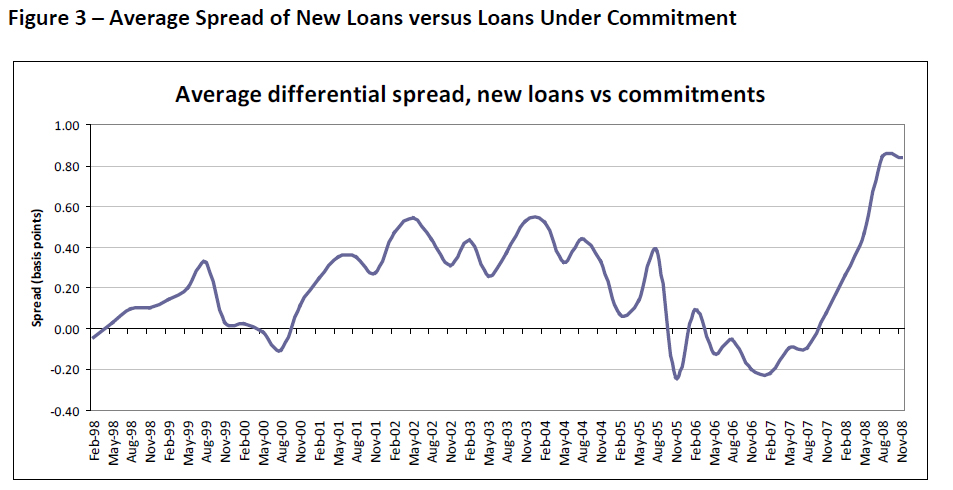
The current financial crisis has given rise to a new type of bank run, one that affects both the banks’ assets and liabilities. In this paper we combine information from the commercial paper market with loan level data from the Survey of Terms of Business Loans to show that during the 2007-2008 financial crises banks suffered a run on credit lines. First, as in previous crises, we find an increase in the usage of credit lines as commercial spreads widen, especially among the lowest quality firms. Second, as the crises deepened, firms drew down their credit lines out of fear that the weakened health of their financial institution might affect the availability of the funds going forward. In particular, we show that these precautionary draw-downs are strongly correlated with the perceived default risk of their bank. Finally, we conclude that these runs on credit lines have weakened banks further, curtailing their ability to effectively fulfill their role as financial intermediaries.

The authors note:

In order to test this hypothesis we used Credit Default Swap prices for the largest banks in our sample as a measure of how stressed the bank is perceived to be by the market. After controlling for other parameters, we found that banks with high CDS prices experienced significantly higher draw downs than banks with lower ones. In other words, when a bank was thought to be at high risk of default, firms that had credit lines with them were more likely to use them than if their credit line was with a healthier bank. This was a run on the banks by investors who ran away from the financial paper market which in turn triggered a run by borrowers of the weakest banks. This sequence of events was made possible by the combination of an increased reliance on the commercial paper market by financial institutions for their short term liquidity needs and the, often lax, underwriting of credit lines during the good years.

The authors suggest a hard look at the capital treatment of off-balance sheet committments:

However, lower quality firms can use the lines of credit that they negotiated prior to the crisis at significantly better terms when credit standards were lax. Banks find themselves lending to these businesses at spreads that no longer reflect the risk they are exposed to. These “forced” loans crowd-out new loans to either lower risk businesses or to equally risky businesses but with spreads that better reflect their financial health.
In light of this inefficient use of credit lines in the 2007-2008 crisis, one may call into question whether the current regulatory framework is appropriate to deal with situations of market illiquidity. In particular, regulators may need to reconsider the regulation on bank capital requirements for off-balance sheet items such as unused commitments, and more generally, strengthen prudential oversight of liquidity risk management.


Click for big
Market Action

June 24, 2009

C-EBS pays attention to the needs of investors when assessing the investment worthiness of banks, in accordance with the Basel Pillar 3 philosophy; this stands as a great contrast to OSFI. In C-EBS latest effort, they evaluate bank disclosures to investors:

In line with the July 2008 ECOFIN conclusions CEBS also analysed the Pillar 3 disclosures provided by 25 banks. CEBS recognises that a huge effort has been made to provide market participants with information allowing for better assessment of bank’s risk profile and capital adequacy.

Banks have notably enhanced the level of quantitative and qualitative information regarding credit risk and securitisation activities; however there are specific areas where further improvements could be made:

•the composition and characteristics of own funds;
•the back testing information for credit risk and market risk;
•the quantitative information on credit risk mitigations and counterparty credit risk; and
•the granularity of information on securitisations.
CEBS will continue to closely monitor Pillar 3 disclosures in order to ensure that market discipline mechanism operates effectively and contributes to enhance the quality and the comparability of the Pillar 3 disclosures.

While it is not envisaged issuing guidance in the area of Pillar 3 disclosures at this stage, CEBS nevertheless intends to foster further convergence of Pillar 3 disclosure practices through liaison with the industry. For this purpose an open meeting is foreseen to be held in early autumn 2009.

I understand that New York will probably soon have a subway stop named after Barclays:

Commuters passing through the Atlantic Avenue-Pacific Street and Flatbush Avenue subway station in Prospect Heights may soon hear the word “Barclays” to the already long subway station name.

Barclays, a London-based bank company, is the first buyer in the MTA’s five-year effort to sell the names of subway stations to raise more revenue. The company would pay the MTA installments of $200,000 per year over the next 20 years.

Now that times are tough and the idea has the imprimatur of a world-class city, perhaps Toronto-me-too will consider it. I continue to think that we could make an awful lot of money from Pfizer through a name change to “Viagra Makes Your Coxwell” station; I can’t understand why such an obvious source of revenue remains unexploited.

The SEC has requested public comment on a plan to continue to allow Money Market Fund sponsors to lie to investors:

The agency’s five commissioners voted 5-0 today to seek public comment on a plan to require that funds hold more liquid assets and reduce the average maturity of securities in their portfolios. The proposals resemble recommendations made in March by the Investment Company Institute, a Washington-based industry group.

The funds aren’t required to value their holdings at current market prices, except to reflect a permanent markdown. That lets them maintain a constant net-asset value, or NAV, and sell and redeem shares at $1 apiece. Funds drop below $1 a share when permanent losses exceed 0.5 percent of net assets, forcing the NAV to be rounded down to 99 cents.

President Barack Obama’s administration, in a plan for overhauling financial regulation released June 17, called on government agencies including the SEC, the Treasury Department and the Federal Reserve to review whether money funds should adopt a floating NAV. The Obama proposal also requested study of ways money funds could obtain access to “emergency” funding from “private sources.”

Andrew Donohue, director of the SEC unit that oversees money managers, said in an April speech that the stable $1 share prices encourages investors to flee money funds at the first sign of trouble.

The Investment Company Institute proposals have been discussed on PrefBlog.

Guys, guys, guys. Investment comes with risk. Pretending there’s no risk won’t make it so; it will simply increase the severity of public reaction when the internal contradictions blow up the model. This was proved beyond the shadow of a doubt after Reserve Primary explosion required extraordinary policy measures to ensure that the World as We Know It did not disappear completely. The Volcker proposals are far superior.

The FOMC statement was released today:

In these circumstances, the Federal Reserve will employ all available tools to promote economic recovery and to preserve price stability. The Committee will maintain the target range for the federal funds rate at 0 to 1/4 percent and continues to anticipate that economic conditions are likely to warrant exceptionally low levels of the federal funds rate for an extended period. As previously announced, to provide support to mortgage lending and housing markets and to improve overall conditions in private credit markets, the Federal Reserve will purchase a total of up to $1.25 trillion of agency mortgage-backed securities and up to $200 billion of agency debt by the end of the year. In addition, the Federal Reserve will buy up to $300 billion of Treasury securities by autumn. The Committee will continue to evaluate the timing and overall amounts of its purchases of securities in light of the evolving economic outlook and conditions in financial markets. The Federal Reserve is monitoring the size and composition of its balance sheet and will make adjustments to its credit and liquidity programs as warranted.

PerpetualDiscounts had a good day today, while most of the market was pretty quiet on lower volume. PerpetualDiscounts now yield 6.38%, equivalent to 8.93% interest at the standard 1.4x conversion factor. Meanwhile, long corporates are taking a breather, returning 5.66% month-to-date, 17.01% year-to-date, with a yield of about 6.45%; the pre-tax interest-equivalent spread is thus about 250bp, little changed from last week’s 255bp.

HIMIPref™ Preferred Indices
These values reflect the December 2008 revision of the HIMIPref™ Indices

Values are provisional and are finalized monthly
Index Mean
Current
Yield
(at bid)
Median
YTW
Median
Average
Trading
Value
Median
Mod Dur
(YTW)
Issues Day’s Perf. Index Value
Ratchet 0.00 % 0.00 % 0 0.00 0 -0.7864 % 1,220.6
FixedFloater 7.09 % 5.52 % 34,749 16.28 1 0.0000 % 2,126.6
Floater 3.12 % 3.47 % 77,932 18.58 3 -0.7864 % 1,524.9
OpRet 4.95 % 2.99 % 129,138 0.10 14 0.3216 % 2,201.9
SplitShare 5.78 % 5.95 % 65,487 4.21 3 0.4875 % 1,886.9
Interest-Bearing 5.98 % 7.74 % 21,682 0.50 1 -0.2982 % 1,993.2
Perpetual-Premium 0.00 % 0.00 % 0 0.00 0 0.2306 % 1,738.3
Perpetual-Discount 6.33 % 6.38 % 164,069 13.33 71 0.2306 % 1,601.0
FixedReset 5.67 % 4.79 % 501,420 4.34 40 0.0400 % 2,010.8
Performance Highlights
Issue Index Change Notes
BAM.PR.K Floater -1.92 % YTW SCENARIO
Maturity Type : Limit Maturity
Maturity Date : 2039-06-24
Maturity Price : 11.22
Evaluated at bid price : 11.22
Bid-YTW : 3.51 %
BNS.PR.L Perpetual-Discount -1.10 % YTW SCENARIO
Maturity Type : Limit Maturity
Maturity Date : 2039-06-24
Maturity Price : 18.80
Evaluated at bid price : 18.80
Bid-YTW : 6.10 %
GWO.PR.I Perpetual-Discount -1.10 % YTW SCENARIO
Maturity Type : Limit Maturity
Maturity Date : 2039-06-24
Maturity Price : 17.15
Evaluated at bid price : 17.15
Bid-YTW : 6.60 %
NA.PR.L Perpetual-Discount -1.00 % YTW SCENARIO
Maturity Type : Limit Maturity
Maturity Date : 2039-06-24
Maturity Price : 19.75
Evaluated at bid price : 19.75
Bid-YTW : 6.24 %
POW.PR.D Perpetual-Discount 1.11 % YTW SCENARIO
Maturity Type : Limit Maturity
Maturity Date : 2039-06-24
Maturity Price : 19.09
Evaluated at bid price : 19.09
Bid-YTW : 6.57 %
BNA.PR.C SplitShare 1.22 % Asset coverage of 1.9-:1 as of May 31 according to the company.
YTW SCENARIO
Maturity Type : Hard Maturity
Maturity Date : 2019-01-10
Maturity Price : 25.00
Evaluated at bid price : 15.80
Bid-YTW : 10.68 %
BAM.PR.J OpRet 1.44 % YTW SCENARIO
Maturity Type : Soft Maturity
Maturity Date : 2018-03-30
Maturity Price : 25.00
Evaluated at bid price : 21.86
Bid-YTW : 7.41 %
IAG.PR.A Perpetual-Discount 1.52 % YTW SCENARIO
Maturity Type : Limit Maturity
Maturity Date : 2039-06-24
Maturity Price : 17.42
Evaluated at bid price : 17.42
Bid-YTW : 6.65 %
HSB.PR.D Perpetual-Discount 1.84 % YTW SCENARIO
Maturity Type : Limit Maturity
Maturity Date : 2039-06-24
Maturity Price : 19.37
Evaluated at bid price : 19.37
Bid-YTW : 6.50 %
BAM.PR.H OpRet 2.00 % YTW SCENARIO
Maturity Type : Call
Maturity Date : 2010-10-30
Maturity Price : 25.25
Evaluated at bid price : 25.55
Bid-YTW : 4.73 %
MFC.PR.B Perpetual-Discount 3.20 % YTW SCENARIO
Maturity Type : Limit Maturity
Maturity Date : 2039-06-24
Maturity Price : 19.04
Evaluated at bid price : 19.04
Bid-YTW : 6.16 %
Volume Highlights
Issue Index Shares
Traded
Notes
GWO.PR.X OpRet 155,903 Can’t tell your players without a programme! Scotia led off, crossing 25,000 shares at 25.85; Nesbit bought 22,900 from Anonymous at 25.90; RBC crossed 25,000 at 25.90; Nesbitt bought three blocks of 10,000 each from TD, all at 25.90; Nesbitt bought 25,000 from RBC at 25.90 and 10,000 from Desjardins at the same price. The yield at this price is 3.88%, as noted below, 5.43% interest equivalent; happiness is working for a motivated buyer!
YTW SCENARIO
Maturity Type : Soft Maturity
Maturity Date : 2013-09-29
Maturity Price : 25.00
Evaluated at bid price : 25.90
Bid-YTW : 3.88 %
BMO.PR.P FixedReset 135,932 Recent new issue.
YTW SCENARIO
Maturity Type : Limit Maturity
Maturity Date : 2039-06-24
Maturity Price : 23.13
Evaluated at bid price : 25.02
Bid-YTW : 5.10 %
BNS.PR.P FixedReset 97,072 RBC crossed blocks of 12,000 and 38,000 and 19,500, all at 25.25.
YTW SCENARIO
Maturity Type : Limit Maturity
Maturity Date : 2039-06-24
Maturity Price : 25.12
Evaluated at bid price : 25.17
Bid-YTW : 4.81 %
SLF.PR.A Perpetual-Discount 71,887 Nesbitt crossed 44,800 at 17.94.
YTW SCENARIO
Maturity Type : Limit Maturity
Maturity Date : 2039-06-24
Maturity Price : 17.85
Evaluated at bid price : 17.85
Bid-YTW : 6.70 %
MFC.PR.D FixedReset 68,662 Scotia bought 10,000 from CIBC at 26.50; CIBC crossed 38,300 at the same price.
YTW SCENARIO
Maturity Type : Call
Maturity Date : 2014-07-19
Maturity Price : 25.00
Evaluated at bid price : 26.49
Bid-YTW : 5.33 %
MFC.PR.E FixedReset 65,244 Recent new issue.
YTW SCENARIO
Maturity Type : Call
Maturity Date : 2014-10-19
Maturity Price : 25.00
Evaluated at bid price : 25.13
Bid-YTW : 5.61 %
There were 30 other index-included issues trading in excess of 10,000 shares.
Issue Comments

IQW.PR.C & IQW.PR.D: The End is Nigh

Quebecor World has announced:

the voting results for Quebecor World’s Third Amended Joint Plan of Reorganization (the “U.S. Plan”). Voting by classes of creditors entitled to vote on the Plan reflected broad-based support for the U.S. Plan, with all classes entitled to vote receiving the applicable affirmative vote as required under the U.S. Bankruptcy Code. Of the more than 2,800 ballots cast, 2,485, or 86.4%, of all voting creditors aggregated across classes voted to accept the U.S. Plan. Based on total dollar amount of claims voted, 88.9% of the total claims, or US$1.82 billion, aggregated across classes voted to accept the U.S. Plan. Although no assurances can be made, Quebecor World believes that the U.S. Plan satisfies the requirements of the Bankruptcy Code and is confirmable.

In addition, Quebecor World also announced that its Second Amended and Restated Canadian Plan of Reorganization and Compromise (the “Canadian Plan”) was approved by affected creditors at the creditors’ meeting held earlier today. At the Canadian meeting of affected creditors of Quebecor World, the Canadian Plan was approved by approximately 96% of those affected creditors who voted in person or by proxy, representing approximately 89% of the total value of affected claims that were voted at the meeting.

A joint confirmation hearing on the U.S. Plan and the Canadian Plan is scheduled to occur on June 30, 2009 in the U.S. Bankruptcy Court for the Southern District of New York and the Quebec Superior Court, and Quebecor World anticipates the consummation of the U.S. Plan and the Canadian Plan in mid-July 2009.
Details of the voting results including votes on a class-by-class basis will be available at the following websites:
http://www.donlinrecano.com/cases/caseinfo.aspx?cl=qw
http://documentcentre.eycan.com/pages/main.aspx?SID=54
And hyperlinked from: http://www.quebecorworld.com/restructuring.aspx

The restructuring plan states:

(iii) to change each issued and outstanding Subordinate Voting Share, Multiple Voting Share, Series 3 Cumulative Redeemable First Preferred Share and Series 5 Cumulative Redeemable First Preferred Share into 0.000001 of a Redeemable Share;

(iv) immediately following the redemption of all of the Redeemable Shares in accordance with Section 1.4 of Schedule I hereto, to cancel, remove and delete the authorized share capital of the Corporation, consisting of the Multiple Voting Shares, Subordinate Voting Shares, the First Preferred Shares issuable in series and the Redeemable Shares (collectively, the “Cancelled Classes of Shares”), along with the rights, privileges, restrictions and conditions attached to the Cancelled Classes of Shares and all rights to accrued dividends in respect of all of such classes and series of shares;

All of the outstanding Redeemable Shares and fractional interests therein shall be automatically redeemed by the Corporation immediately following their issuance, which issuance is provided for in item [(iii)] of the Corporation’s Articles of Reorganization on Form 14 to which this Schedule I is attached, without notice to the holders of such Redeemable Shares, on payment of CDN$0.01 for each whole Redeemable Share (the “Redemption Price”).

So each IQW.PR.C & IQW.PR.D share will be turned into one one-millionth of a Redeemable Share and each Redeemable Share will be instantly redeemed for a penny.

IQW.PR.C & IQW.PR.D were last mentioned on PrefBlog when they were suspended from trading on the TSX.

Update, 2009-7-26: It’s done.

Market Action

June 23, 2009

I mentioned the proxy battle over Trinorth Capital on June 11Management won. No concession or acknowledgement from the self-proclaimed Concerned Shareholders yet … I’m not holding my breath. However, management can now get back to doing what it does best: suspending dividends on their funds.

Speculation regarding Bernanke’s reappointment is mounting, with Larry Summers mentioned as a possible candidate. I can’t find great fault with Bernanke’s macro-economic handling of the crisis; it turned out that letting Lehman go was a mistake, but I, for one, didn’t forsee just how horribly things would turn out after that. Of greater concern is interference in private companies (the BAC/MER merger), but I think that one can be hung on Paulson.

Tara Perkins of the Globe passes on some speculation regarding the MFC/OSC Disclosure Kerfuffle:

The Ontario Securities Commission (OSC) appears to be examining whether Manulife properly disclosed, prior to last fall, how much risk it would face if markets tanked, noted Genuity Capital Markets analyst Mario Mendonca. Before then, Manulife only disclosed what would happen to it if stock markets fell by 10 per cent. Markets dropped more than 20 per cent in the fourth quarter.

It’s possible, although it would be most unfair if MFC was singled out for this practice when the effects of a 10% drop is all that’s disclosed by any insurer. I’m not saying, mind you, that I am against such improved disclosure; the effect of equity market declines on guarantees can be decidedly non-linear.

Who says that Dealbreaker is all fun ‘n’ games? Today there’s a very informative, yet entertaining, essay on Credit Default Swaps in Kazakhstan:

Emerging Markets and derivatives are like alcohol and barbiturates: each on its own has attractions but create a recipe for choking on one’s own vomit when combined.

There’s always some crazy eventuality that an emerging market can generate that defies the most thoughtfully drafted contract.

Mark Carney showed Canadian regulators’ traditional contempt for investors with some selective disclosure in Washington:

Bank of Canada Governor Mark Carney said his country’s recession is now as deep as in the U.S., according to a person who heard his remarks today in Washington.

Carney, 44, spoke at the Woodrow Wilson International Center for Scholars. No cameras or recording devices were allowed at the event, according to organizers.

Debt-Decoupling, a moral hazard feature of Credit Default Swaps is complicating restructuring efforts:

In the cover story for the The Deal magazine published Monday, Richard Morgan tells about the dire situation Gannett Co. (NYSE:GCI) finds itself in after nearly three-quarters of bondholders, hedged with credit default swaps, declined an exchange offer that expired May 5. Thanks to the CDSs, they stand to get a better payoff if Gannett defaults.

Morgan followed that story up with a report on McClatchy Co. (NYSE:MNI) in The Deal Pipeline on Monday (subscription required). It too tried to do an exchange offer on some troubled bonds, but reported last week that only a small minority of holders went for the offer, valued at around 33 cents on the dollar. Thanks to their CDS hedges, the bondholders can expect 100 cents if McClatchy defaults.

It’s an incentive some call perverse, and also one that couldn’t have existed before the CDS market sprang up. As Morgan writes, CDSs began the decade as a $900 billion market but ended last year with a notional value of $42 trillion. That’s a lot bigger than the $25 trillion market for outstanding corporate bonds, municipal bonds and structured investment vehicles that CDSs were designed to reference.

Dealbreaker remarks:

One of the primary complaints about the CDS market was the use of CDS by market participants as purely speculative tools. In this case, the players that hold the debt are hedging their exposure through CDS and capitalizing on a negative basis play. If hedging debt exposure through CDS becomes the next true villain in the attack on derivatives, there is really no hope for this market.

The “negative basis” refers to the fact that a long-bond plus protection-buy position will yield more than available elsewhere in the market with equivalent risk – this is due to funding pressures, since it’s hard (risky, anyway) nowadays to lever up a physical bond position 10:1; you can only do that by selling CDSs, driving down the spread. The newspapers’ woes are similar to problems highlighted by the Lyondell bankruptcy:

The potential for dispute and complexity in workouts and bankruptcies by reason of the existence of CDS was illustrated recently in the U.S. bankruptcy proceeding of the U.S. subsidiary of LyondellBasell, the world’s third-largest petrochemicals group. The U.S. company, LyondellBasell Chemical Company, filed for bankruptcy in New York in January 2009 after attempts to restructure its $26 billion debt were unsuccessful.70 The bankruptcy triggered a “default” under LyondellBasell Chemical Company’s CDS (i.e. CDS naming this company as the reference entity), but because its European parent and affiliates were not in bankruptcy, CDS covering bonds of those companies were not triggered.

Creditors sought to sue LyondellBasell’s parent company in Europe on guarantees and other obligations. These creditors included bondholders, and the U.S. company believed that the bondholders were seeking to enforce claims with the goal of triggering protection payments under their credit default swap contracts, which could have led to other parts of the corporate group being pushed into insolvency in Europe. Ultimately, U.S.-based LyondellBasell Chemical Company was able to persuade the U.S. bankruptcy court that such actions in Europe could undermine the chances of completing a successful bankruptcy in the U.S. The bankruptcy court issued a 60-day injunction prohibiting enforcement actions in Europe.

“The threat of CDS holders trying to force companies into an insolvency in order to trigger their recovery rights against their CDS counterparty will almost certainly be an issue in the wave of debt restructurings this year,” predicted LyondellBasell’s attorneys.

Note that legal manoeuverings regarding LyondellBasell have been phrenetic:

LyondellBasell Industries announced that LyondellBasell Industries AF S.C.A. has been voluntarily added to Lyondell Chemical Company’s reorganization filing under Chapter 11 of the U.S. Bankruptcy Code to protect the European holding company against claims by certain financial and U.S. trade creditors.

LyondellBasell Industries AF S.C.A. is a holding company incorporated in Luxembourg. It does not manufacture or sell products, and has no employees.

LyondellBasell is exercising an option available under U.S. law to prevent creditors from enforcing guarantees by LyondellBasell AF S.C.A. for pre-petition obligations of LyondellBasell’s U.S. businesses. It also prevents bondholders of Senior Notes due in 2015 from potentially pursuing remedies against LyondellBasell AF S.C.A. after an interest payment due on the notes in February was not paid. The company obtained a 60-day restraining order from the U.S. bankruptcy court in February to allow time for LyondellBasell to protect its European assets from these claims.

Extending Chapter 11 protection to LyondellBasell Industries AF S.C.A. is not an insolvency proceeding under any European law. No LyondellBasell manufacturing operation located outside of the United States has applied for or become involved in insolvency or bankruptcy proceedings in its respective home country.

… but they bought themselves enough time to get something done

The European Commission Monday cleared U.S.-based industrial holding group Access Industries and German investor Andreas Heeschen’s ProChemie Holding to create a joint venture to take over troubled chemical company LyondellBasell Industries.

Both parties will have a 50% stake in LyondellBasell, parts of which are currently under bankruptcy protection, through a new holding company called ProChemie GmbH.

LyondellBasell was previously wholly owned by Access industries.

… the moral of the story being “Holding company guarantees are not necessarily worth much.”

The market drifted down just a tad today, with volume continuing high.

HIMIPref™ Preferred Indices
These values reflect the December 2008 revision of the HIMIPref™ Indices

Values are provisional and are finalized monthly
Index Mean
Current
Yield
(at bid)
Median
YTW
Median
Average
Trading
Value
Median
Mod Dur
(YTW)
Issues Day’s Perf. Index Value
Ratchet 0.00 % 0.00 % 0 0.00 0 1.2473 % 1,230.3
FixedFloater 7.09 % 5.53 % 34,655 16.27 1 0.0000 % 2,126.6
Floater 3.10 % 3.44 % 78,738 18.66 3 1.2473 % 1,536.9
OpRet 4.97 % 3.72 % 134,026 0.10 14 0.0564 % 2,194.8
SplitShare 5.81 % 6.32 % 63,733 4.21 3 -0.4550 % 1,877.7
Interest-Bearing 5.96 % 7.10 % 21,891 0.50 1 0.1992 % 1,999.1
Perpetual-Premium 0.00 % 0.00 % 0 0.00 0 -0.0327 % 1,734.3
Perpetual-Discount 6.34 % 6.36 % 163,312 13.37 71 -0.0327 % 1,597.3
FixedReset 5.68 % 4.81 % 508,451 4.34 40 -0.0724 % 2,010.0
Performance Highlights
Issue Index Change Notes
HSB.PR.D Perpetual-Discount -3.79 % YTW SCENARIO
Maturity Type : Limit Maturity
Maturity Date : 2039-06-23
Maturity Price : 19.02
Evaluated at bid price : 19.02
Bid-YTW : 6.62 %
BNA.PR.C SplitShare -2.13 % Asset coverage of 1.9-:1 as of May 31, according to the company. This issue has been volatile ever since the five year refunding issue was announced.
YTW SCENARIO
Maturity Type : Hard Maturity
Maturity Date : 2019-01-10
Maturity Price : 25.00
Evaluated at bid price : 15.61
Bid-YTW : 10.85 %
POW.PR.D Perpetual-Discount -1.51 % YTW SCENARIO
Maturity Type : Limit Maturity
Maturity Date : 2039-06-23
Maturity Price : 18.88
Evaluated at bid price : 18.88
Bid-YTW : 6.64 %
CU.PR.A Perpetual-Discount -1.36 % YTW SCENARIO
Maturity Type : Limit Maturity
Maturity Date : 2039-06-23
Maturity Price : 23.02
Evaluated at bid price : 23.28
Bid-YTW : 6.29 %
CIU.PR.A Perpetual-Discount -1.35 % YTW SCENARIO
Maturity Type : Limit Maturity
Maturity Date : 2039-06-23
Maturity Price : 18.26
Evaluated at bid price : 18.26
Bid-YTW : 6.38 %
SLF.PR.B Perpetual-Discount -1.25 % YTW SCENARIO
Maturity Type : Limit Maturity
Maturity Date : 2039-06-23
Maturity Price : 18.23
Evaluated at bid price : 18.23
Bid-YTW : 6.63 %
GWO.PR.G Perpetual-Discount -1.10 % YTW SCENARIO
Maturity Type : Limit Maturity
Maturity Date : 2039-06-23
Maturity Price : 19.78
Evaluated at bid price : 19.78
Bid-YTW : 6.62 %
POW.PR.A Perpetual-Discount 1.01 % YTW SCENARIO
Maturity Type : Limit Maturity
Maturity Date : 2039-06-23
Maturity Price : 21.10
Evaluated at bid price : 21.10
Bid-YTW : 6.66 %
BNS.PR.L Perpetual-Discount 1.12 % YTW SCENARIO
Maturity Type : Limit Maturity
Maturity Date : 2039-06-23
Maturity Price : 19.01
Evaluated at bid price : 19.01
Bid-YTW : 6.03 %
BAM.PR.I OpRet 1.22 % YTW SCENARIO
Maturity Type : Soft Maturity
Maturity Date : 2013-12-30
Maturity Price : 25.00
Evaluated at bid price : 24.91
Bid-YTW : 5.60 %
MFC.PR.C Perpetual-Discount 1.36 % YTW SCENARIO
Maturity Type : Limit Maturity
Maturity Date : 2039-06-23
Maturity Price : 17.83
Evaluated at bid price : 17.83
Bid-YTW : 6.36 %
BAM.PR.K Floater 4.00 % YTW SCENARIO
Maturity Type : Limit Maturity
Maturity Date : 2039-06-23
Maturity Price : 11.44
Evaluated at bid price : 11.44
Bid-YTW : 3.44 %
Volume Highlights
Issue Index Shares
Traded
Notes
BMO.PR.P FixedReset 167,895 Recent new issue.
YTW SCENARIO
Maturity Type : Limit Maturity
Maturity Date : 2039-06-23
Maturity Price : 23.13
Evaluated at bid price : 25.03
Bid-YTW : 5.09 %
RY.PR.I FixedReset 154,555 RBC crossed 100,000 at 25.06; National bought 15,400 from Nesbitt at 25.04.
YTW SCENARIO
Maturity Type : Limit Maturity
Maturity Date : 2039-06-23
Maturity Price : 24.98
Evaluated at bid price : 25.03
Bid-YTW : 4.74 %
MFC.PR.E FixedReset 80,170 Recent new issue.
YTW SCENARIO
Maturity Type : Call
Maturity Date : 2014-10-19
Maturity Price : 25.00
Evaluated at bid price : 25.18
Bid-YTW : 5.56 %
CM.PR.I Perpetual-Discount 79,961 YTW SCENARIO
Maturity Type : Limit Maturity
Maturity Date : 2039-06-23
Maturity Price : 18.42
Evaluated at bid price : 18.42
Bid-YTW : 6.50 %
SLF.PR.E Perpetual-Discount 62,659 RBC crossed 40,000 at 16.90, then another 19,800 at 16.95.
YTW SCENARIO
Maturity Type : Limit Maturity
Maturity Date : 2039-06-23
Maturity Price : 16.91
Evaluated at bid price : 16.91
Bid-YTW : 6.70 %
BNS.PR.Q FixedReset 57,990 National bought two blocks from Nesbitt at 25.00; of 11,000 and 12,500 shares.
YTW SCENARIO
Maturity Type : Limit Maturity
Maturity Date : 2039-06-23
Maturity Price : 24.91
Evaluated at bid price : 24.96
Bid-YTW : 4.58 %
There were 44 other index-included issues trading in excess of 10,000 shares.
Interesting External Papers

Developments in Business Financing

There’s a very good review of the impact of the Credit Crunch on markets and the law thereof, prepared by Theresa Einhorn of Haynes & Boone LLP, The Corporate Debt Market And Credit Derivatives.

Section headings are:

  • The Top Ten – Credit Crunch is #1
  • Rates are High and “Covenant Tight” Replaces “Covenant Light”
  • The Credit Markets are a Market and the Stock Market is a Sideshow
  • A New Risk for Borrowers – Defaulting Lenders Fail to Fund under Corporate Lines of Credit.
  • Survival Strategies During the Credit Crunch: Restructuring by Repurchase or Exchange of Debt
  • Credit Default Swaps Market Disruption Clauses in Credit Agreements
  • Market-Based Pricing for Loans – Pricing Based on CDS
  • Hybrid Securities
  • Investing in Distressed Debt and Other Distressed Assets
Market Action

June 22, 2009

In recognition of the fact that investors get so much regulatory paper from their brokers that they don’t read it, the Canadian Securities Administrators are requiring the delivery of more paper. I’ll bet a nickel that every year the “Fund Facts” gets enlarged ‘because Granny didn’t know she could lose money if so-and-so went bankrupt’, until about twenty years from now, when new “Fund Briefer Facts” becomes mandated and then lucky buyers get even more mail to throw away without reading. Still, it keeps the regulators busy and Proactively Working In The Best Interest Of Investors, and that’s what counts, right?

Julia Dickson gave a speech in Vancouver lauding financial oligopolies:

One lesson everyone is relearning is the importance of proper consolidated oversight and supervision of financial groups, especially systemically important financial groups. This lesson has arisen in the context of AIG, where the parent holding company was regulated, but not to the extent required of a systemically important group of its size.

Canada is relatively well placed in this regard as there is already considerable consolidated oversight and supervision of the Canadian financial sector. The large securities firms are owned by the big banks, which OSFI oversees, meaning that securities firms must meet the same prudential standards as their parent bank. As well, the general structural model for large financial services groups is that they are headed by a regulated financial institution, which is overseen by OSFI, versus the holding company structure commonly seen in other jurisdictions.

Having a regulated Canadian financial institution at the top of such organizations enhances our ability to understand the risks facing the conglomerate. Further, given OSFI’s regulatory authority at the top level, we can intervene and require action to be taken, no matter where in the group we may have identified potential problems.

As a regulator, you need to have knowledge of the financial status and risk profile of all affiliates within a financial group. Indeed, as demonstrated by the AIG case, small parts of big companies can be hugely problematic.

She did not go so far as to say she wished to see an elimination of the holding company structure for insurers, but she is clearly headed in that direction. It is very disappointing to see such regulatory hostility to the concept of a layered financial system: banks – securities dealers – hedge funds, that can work quite well provided there are clear lines between the layers.

Plain vanilla for everyone! That’s the Canadian way!

C-EBS has published a consultation paper on implementation of hybrid capital guidelines.

Christopher Whalen, head of International Risk Analytics, had some home-truths for the Senate today:

Trading in credit-default swaps should be banned, Christopher Whalen, managing director of Institutional Risk Analytics in Hawthorne, California, said in prepared testimony for today’s Senate hearing. Regulators are too cozy with the banks in the market to be counted on to make changes, he said.

“The views of the existing financial regulatory agencies, and particularly the Federal Reserve Board and Treasury, should get no consideration from the committee since the view of these agencies are largely duplicative of the views of JPMorgan Chase & Co. and the large OTC dealers,” he said in the remarks.

I can’t find the full text of his testimony, but they will probably be posted soon.

Equities got hit today after the World Bank warned of lower future growth. The only way out of this mess is to hire more regulators:

Global Development Finance 2009: Charting a Global Recovery, warns that the world is entering an era of slower growth that will require tighter and more effective oversight of the financial system.

Perhaps in sympathy, PerpetualDiscounts were off somewhat today; while FixedResets were also down the loss of the latter was negligible. Volume continued high.

HIMIPref™ Preferred Indices
These values reflect the December 2008 revision of the HIMIPref™ Indices

Values are provisional and are finalized monthly
Index Mean
Current
Yield
(at bid)
Median
YTW
Median
Average
Trading
Value
Median
Mod Dur
(YTW)
Issues Day’s Perf. Index Value
Ratchet 0.00 % 0.00 % 0 0.00 0 -0.8682 % 1,215.1
FixedFloater 7.09 % 5.54 % 34,558 16.26 1 -1.0968 % 2,126.6
Floater 3.13 % 3.44 % 78,268 18.66 3 -0.8682 % 1,518.0
OpRet 4.97 % 3.65 % 134,539 0.10 14 0.0141 % 2,193.6
SplitShare 5.78 % 6.44 % 64,042 4.22 3 0.2890 % 1,886.3
Interest-Bearing 5.98 % 7.46 % 22,779 0.51 1 -0.1988 % 1,995.2
Perpetual-Premium 0.00 % 0.00 % 0 0.00 0 -0.3465 % 1,734.9
Perpetual-Discount 6.34 % 6.36 % 165,003 13.40 71 -0.3465 % 1,597.8
FixedReset 5.67 % 4.81 % 526,037 4.35 40 -0.0276 % 2,011.4
Performance Highlights
Issue Index Change Notes
BAM.PR.K Floater -5.34 % Not a particularly meaningful decline, since only 3,500 shares traded and this was in a range of 11.50-75; the closing quote was 11.00-49, 1×5 after a trade with eight minutes left in the day took out the bid.
YTW SCENARIO
Maturity Type : Limit Maturity
Maturity Date : 2039-06-22
Maturity Price : 11.00
Evaluated at bid price : 11.00
Bid-YTW : 3.58 %
MFC.PR.B Perpetual-Discount -2.38 % YTW SCENARIO
Maturity Type : Limit Maturity
Maturity Date : 2039-06-22
Maturity Price : 18.43
Evaluated at bid price : 18.43
Bid-YTW : 6.36 %
BAM.PR.J OpRet -2.25 % YTW SCENARIO
Maturity Type : Soft Maturity
Maturity Date : 2018-03-30
Maturity Price : 25.00
Evaluated at bid price : 21.70
Bid-YTW : 7.51 %
IAG.PR.C FixedReset -1.65 % YTW SCENARIO
Maturity Type : Call
Maturity Date : 2014-01-30
Maturity Price : 25.00
Evaluated at bid price : 25.57
Bid-YTW : 5.64 %
RY.PR.H Perpetual-Discount -1.47 % YTW SCENARIO
Maturity Type : Limit Maturity
Maturity Date : 2039-06-22
Maturity Price : 23.34
Evaluated at bid price : 23.51
Bid-YTW : 6.08 %
SLF.PR.E Perpetual-Discount -1.46 % YTW SCENARIO
Maturity Type : Limit Maturity
Maturity Date : 2039-06-22
Maturity Price : 16.82
Evaluated at bid price : 16.82
Bid-YTW : 6.73 %
IGM.PR.A OpRet -1.44 % YTW SCENARIO
Maturity Type : Call
Maturity Date : 2009-07-30
Maturity Price : 26.00
Evaluated at bid price : 26.02
Bid-YTW : 3.65 %
RY.PR.A Perpetual-Discount -1.40 % YTW SCENARIO
Maturity Type : Limit Maturity
Maturity Date : 2039-06-22
Maturity Price : 18.25
Evaluated at bid price : 18.25
Bid-YTW : 6.18 %
CU.PR.A Perpetual-Discount -1.34 % YTW SCENARIO
Maturity Type : Limit Maturity
Maturity Date : 2039-06-22
Maturity Price : 23.31
Evaluated at bid price : 23.60
Bid-YTW : 6.20 %
POW.PR.D Perpetual-Discount -1.29 % YTW SCENARIO
Maturity Type : Limit Maturity
Maturity Date : 2039-06-22
Maturity Price : 19.17
Evaluated at bid price : 19.17
Bid-YTW : 6.54 %
SLF.PR.D Perpetual-Discount -1.24 % YTW SCENARIO
Maturity Type : Limit Maturity
Maturity Date : 2039-06-22
Maturity Price : 16.69
Evaluated at bid price : 16.69
Bid-YTW : 6.71 %
CL.PR.B Perpetual-Discount -1.23 % YTW SCENARIO
Maturity Type : Limit Maturity
Maturity Date : 2039-06-22
Maturity Price : 23.00
Evaluated at bid price : 23.27
Bid-YTW : 6.75 %
BAM.PR.G FixedFloater -1.10 % YTW SCENARIO
Maturity Type : Limit Maturity
Maturity Date : 2039-06-22
Maturity Price : 25.00
Evaluated at bid price : 15.33
Bid-YTW : 5.54 %
RY.PR.F Perpetual-Discount -1.09 % YTW SCENARIO
Maturity Type : Limit Maturity
Maturity Date : 2039-06-22
Maturity Price : 18.07
Evaluated at bid price : 18.07
Bid-YTW : 6.24 %
BMO.PR.J Perpetual-Discount -1.07 % YTW SCENARIO
Maturity Type : Limit Maturity
Maturity Date : 2039-06-22
Maturity Price : 18.42
Evaluated at bid price : 18.42
Bid-YTW : 6.19 %
CM.PR.H Perpetual-Discount -1.00 % YTW SCENARIO
Maturity Type : Limit Maturity
Maturity Date : 2039-06-22
Maturity Price : 18.81
Evaluated at bid price : 18.81
Bid-YTW : 6.50 %
BAM.PR.I OpRet 1.23 % YTW SCENARIO
Maturity Type : Soft Maturity
Maturity Date : 2013-12-30
Maturity Price : 25.00
Evaluated at bid price : 24.61
Bid-YTW : 5.91 %
BNA.PR.C SplitShare 1.27 % Asset coverage of 1.9-:1 as of May 31 according to the company.
YTW SCENARIO
Maturity Type : Hard Maturity
Maturity Date : 2019-01-10
Maturity Price : 25.00
Evaluated at bid price : 15.95
Bid-YTW : 10.54 %
TRI.PR.B Floater 1.46 % YTW SCENARIO
Maturity Type : Limit Maturity
Maturity Date : 2039-06-22
Maturity Price : 15.25
Evaluated at bid price : 15.25
Bid-YTW : 2.57 %
Volume Highlights
Issue Index Shares
Traded
Notes
BMO.PR.P FixedReset 282,931 Recent new issue.
YTW SCENARIO
Maturity Type : Limit Maturity
Maturity Date : 2039-06-22
Maturity Price : 23.13
Evaluated at bid price : 25.04
Bid-YTW : 5.09 %
MFC.PR.E FixedReset 86,160 Recent new issue.
YTW SCENARIO
Maturity Type : Call
Maturity Date : 2014-10-19
Maturity Price : 25.00
Evaluated at bid price : 25.25
Bid-YTW : 5.50 %
TD.PR.O Perpetual-Discount 79,131 National crossed two blocks at 20.04, of 30,000 and 24,000 shares.
YTW SCENARIO
Maturity Type : Limit Maturity
Maturity Date : 2039-06-22
Maturity Price : 19.96
Evaluated at bid price : 19.96
Bid-YTW : 6.19 %
BAM.PR.P FixedReset 63,575 Recent new issue.
YTW SCENARIO
Maturity Type : Call
Maturity Date : 2014-10-30
Maturity Price : 25.00
Evaluated at bid price : 25.30
Bid-YTW : 6.87 %
BMO.PR.L Perpetual-Discount 54,550 Nesbitt crossed 30,000 at 23.90.
YTW SCENARIO
Maturity Type : Limit Maturity
Maturity Date : 2039-06-22
Maturity Price : 23.62
Evaluated at bid price : 23.80
Bid-YTW : 6.16 %
CM.PR.I Perpetual-Discount 51,356 YTW SCENARIO
Maturity Type : Limit Maturity
Maturity Date : 2039-06-22
Maturity Price : 18.38
Evaluated at bid price : 18.38
Bid-YTW : 6.51 %
There were 43 other index-included issues trading in excess of 10,000 shares.
Issue Comments

NTL.PR.F & NTL.PR.G Suspended from Trading

The Toronto Stock Exchange has announced:

SUSPENDED – Nortel Networks Limited (the “Company”) – The Cumulative Redeemable Class A Preferred Shares, Series 5 (Symbol: NTL.PR.F) and the Non-Cumulative Redeemable Class A Preferred Shares, Series 7 (Symbol: NTL.PR.G) will be suspended from trading effective immediately as a result of the Company’s June 19, 2009 news release. Further information will be forthcoming regarding the Company’s expected delisting application.

The last mention of these issues on PrefBlog occurred when the company requested restrictions on trading.

Both issues have been tracked by HIMIPref™, but are relegated to the “Scraps” index on credit concerns. Tracking will cease immediately.

Update, 2009-6-23: The TSX has announced:

CHANGES IN STOCK LIST Nortel Networks Limited (the “Company”) – Further to TSX Bulletin #2009-0795, at the request of the Company, the Cumulative Redeemable Class A Preferred Shares, Series 5 (Symbol: NTL.PR.F) and the Non-Cumulative Redeemable Class A Preferred Shares, Series 7 (Symbol: NTL.PR.G) (collectively the “Shares”) will be delisted at the close of market on June 26, 2009. Trading in the Company’s Shares will remain suspended.

Issue Comments

XCM.PR.A Refuses to Wind-Up

Commerce Split Corp. has announced:

The Company’s total net asset value is approximately $8.85 per unit as at June 18, 2009, consisting of less than 16% common shares of CIBC. The reduced exposure to CIBC will materially limit the future impact of price movements of CIBC shares on the net asset value of the Company and lower the ability of the Company to generate income from
dividends and its covered call option writing program.

The significant price decline of CIBC and the resultant implementation of the Priority Equity Protection Plan have made it extremely difficult to achieve the original stated objectives for both classes of shares. The Company established a normal course issuer’s bid which allows the Company to re-purchase units in the market when trading prices are at a discount to the net asset value.

Subsequent to the unsuccessful shareholder vote on February 5, 2009 of the reorganization proposal, the Company has continued to dialogue with certain larger shareholders to try and establish potential solutions for reorganizing the Company that would be suitable for all shareholders and result in a successful shareholder vote. Outside of certain larger shareholders, the remaining shareholders had voted overwhelmingly in support of management’s latest proposal.

The Company has received several shareholder requests to wind up the Company. In response to this request, the Company would like to remind all shareholders that all such reorganization proposals must receive a 66 2/3 favorable vote by both the Class A shareholders and the Preferred shareholders voting separately by class. This requirement is outlined in the Company’s prospectus and is part of the articles of incorporation of the Company. Under any kind of termination proposal at the current time, Class A shareholders would receive no value for their Class A shares since the net asset value per unit is below $10. The Class A shares have traded in a range between $0.36 and $1.84 since February 5, 2009 and closed at $1.02 on June 18, 2009. As such, the Company does not believe that this proposal is in the best interests of the Class A shareholders and any proposal that would provide no value to the Class A shareholders would ultimately never be approved by Class A shareholders.

The Company will continue to seek solutions that will balance and meet the interests of both Classes of shareholders and also result in a successful vote. The costs of holding a meeting are significant to the Company and, as such, the Company will only bring forward a proposal that has a high probability of being passed by the requisite majorities of each Class of shareholders.

Huh. Providing no value – indeed, taking away value – for the preferred shareholders didn’t seem to stop their last proposal from coming to vote.

XCM.PR.A is currently quoted at 7.20-31, while XCM is at 1.05-18. The company should buy the maximum permitted under its issuer bid when this can be done at or below NAV, remind shareholders of their retraction rights, and propose a wind-up that will pay the common shareholders a nominal sum. Waiving management fees, or a good chunk thereof, would be a good thing too, but I’m not holding my breath!

XCM.PR.A is not tracked by HIMIPref™.