Interesting External Papers

Financial Stability Oversight Council Publishes 2011 Report

The Financial Stability Oversight Council (comprised of an alphabet soup of US financial regulators) has released its 2011 Annual Report.

There are many items of interest in this excellent report; one issue that I find interesting is the regulation of money market funds:

The stable, rounded $1 NAV fosters an expectation that MMF share prices will not fluctuate. However, when shareholders perceive that a fund may suffer losses, each shareholder has an incentive to redeem shares before other shareholders, causing a run on the fund. Such redemptions can accelerate the likelihood of a break-the-buck event to the extent that the fund’s asset sales to meet redemptions significantly depress the market value of the fund’s remaining assets. In such a scenario, the ability of early redeemers to receive the full $1 NAV is essentially subsidized by the losses absorbed by remaining shareholders.


Click for Big

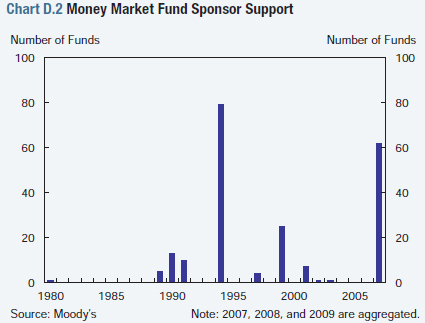
MMFs invest in assets that may lose value, but funds have no formal capital buffers or insurance to absorb loss and maintain their stable NAV. When losses do occur, MMFs have historically relied on discretionary sponsor support to maintain a stable NAV and preserve the franchise value of fund management businesses (Chart D.2). That support may come in the form of capital contributions or the purchase of assets that have lost value, for example.

Sponsors do not commit to support an MMF in advance, however, because an explicit commitment may require the sponsor to consolidate the fund on its balance sheet. Thus, although investors ostensibly bear the risk of an MMF breaking the buck, sponsors have in the past borne that risk themselves, fostering the perceived safety of MMF investments. Moreover, the uncertainty about the availability and sufficiency of such support during crises, and the fact that many MMFs lack deep-pocketed sponsors, contribute to their susceptibility to runs.

Expectation of Government Support

Given the unprecedented government support of MMFs during the crisis in 2008 and 2009, even sophisticated institutional investors and fund managers may have the impression that the government would be ready to support the industry again with the same tools.

Although these new rules are a positive first step, the SEC recognizes that they address only some of the features that make MMFs susceptible to runs, and that more should be done to address systemic risks posed by MMFs and their structural vulnerabilities.

The report takes a much more reasonable view of the Flash Crash than did the highly politicized SEC report:

During periods of violent price movements, market liquidity can evaporate as hedging strategies to protect against market risk become strained or directly amplify the price movements. For example, in the October 1987 equity market crash, portfolio insurance programs were designed to sell when prices declined; in fact, they were set to sell at an increasing rate, thereby accelerating the market decline. Similarly, in the flash crash of May 6, 2010, liquidity evaporated and market functioning deteriorated rapidly. Regulators have added circuit breakers in equity markets to mitigate such dynamics (see Section 5.3.4), but this event illustrated the potential fragility of market liquidity, particularly in areas characterized by rapid innovation and change in market behaviors.

The role of exchange traded funds (ETFs) during the flash crash has focused attention on these products. The rapid rise of ETFs has been driven by the attraction of gaining liquid exposure to less liquid asset classes—such as commodities and certain emerging markets—without having to execute trades directly in less liquid markets (Chart E.1). However, the liquidity of ETFs depends heavily on the support of market makers and on market functioning in the underlying asset. The relationship between ETF turnover and market volatility bears further analysis, and regulators must continue to monitor the development of more complex products in both U.S. and foreign-domiciled funds that might heighten liquidity concerns.

One item of great interest to me was developments in the idea that insurance companies should be regulated at the consolidated level – there is not a single mention of this in the report, so for the moment I will assume that this highly desirable reform has been dropped. Instead, the report discusses the new Federal Insurance Office (FIO), which is just another micromanaging job-creation scheme.

Publications

Opinion: IIROC's Slush Fund

Why does IIROC have so much money to spend? Where does it go? What changes are necessary?

Look for the opinion link!

See also the draft version with footnotes.

Update, 2011-8-29: Janet McFarland of the Globe published a piece today titled Regulators mum on plans for ABCP settlement payments. It focussed on the delays in spending the new money rather than past improprieties, but there was one nugget of new information:

In an e-mailed statement, IIROC said it is working with the OSC “on a co-ordinated and consistent approach” for the money, and “public disclosure will be made at an appropriate time.”

Hmm … they’ve never ‘worked with the OSC’ before to determine how to spend their cash … one wonders what is going on in the background.

Market Action

July 26, 2011

The SEC has invented more paperwork:

The rule contains the following requirements:

Filing a Form: Traders who engage in a substantial level of trading activity will be required to identify themselves to the SEC by filing a form, Form 13H, with the Commission. A “large trader” will be defined as a person whose transactions in exchange-listed securities equal or exceed two million shares or $20 million during any calendar day, or 20 million shares or $200 million during any calendar month.

The rule provides guidance on certain types of transactions that can be excluded for purposes of calculating trading levels.

Getting an Identification Number: After it files Form 13H to register with the Commission, the SEC will then assign each large trader a unique large trader identification number (LTID), which will allow the agency to efficiently identify and analyze trading activity by the large trader. A large trader will be required to disclose to its broker-dealers its LTID and highlight all of the accounts at the broker-dealer through which the large trader trades.

Recordkeeping, Reporting, and Monitoring: The rule requires broker-dealers to maintain and report data that is largely identical to the information covered by the Commission’s Electronic Blue Sheets (EBS) system – the system the SEC currently uses to collect transaction data from broker-dealers. The only additional items that broker-dealers will be required to maintain and report are the LTID and the time a transaction occurs. Accordingly, the rule leverages the existing EBS system, with modifications, to accommodate the specific requirements of the new rule. In addition, the rule requires broker-dealers to monitor whether their customers meet the threshold levels that define a “large trader” (based on transactions handled at the broker-dealer) in order to encourage compliance by their customers with the requirement to identify themselves as large traders to the SEC.

Ready Access to Data: The rule requires transaction data to be available for reporting on the morning after the day the transactions were effected. When the SEC requests data from broker-dealers, it would not under normal circumstances require responses earlier than the opening of business on the day after it makes its request. Prompt access to this data will assist the SEC in reconstructing market activity and performing other trading analyses, and also will assist in investigations of manipulative, abusive, and other illegal trading activity.

The Ontario Ministry of Pretending to Do Things So We Can All Feel Good has:

released comprehensive teacher guidelines that identify places in the Grade 4 through 12 curriculum where financial literacy can be inserted into classes as varied as mathematics, computer science and native studies.

Ontario, for example, suggests that in high school, “when studying classical civilizations, students could address aspects of trade, economics and use of money in ancient times,” according to the new teacher guidelines.

It was another positive day on the Canadian preferred share market, with PerpetualDiscounts winning 20bp, FixedResets up 2bp and DeemedRetractibles gaining 5bp. Volatility was low; volume was below average.

HIMIPref™ Preferred Indices
These values reflect the December 2008 revision of the HIMIPref™ Indices

Values are provisional and are finalized monthly
Index Mean
Current
Yield
(at bid)
Median
YTW
Median
Average
Trading
Value
Median
Mod Dur
(YTW)
Issues Day’s Perf. Index Value
Ratchet 0.00 % 0.00 % 0 0.00 0 0.2234 % 2,461.2
FixedFloater 0.00 % 0.00 % 0 0.00 0 0.2234 % 3,701.7
Floater 2.46 % 2.24 % 37,409 21.69 4 0.2234 % 2,657.5
OpRet 4.85 % 2.47 % 57,713 0.75 9 -0.0896 % 2,454.2
SplitShare 5.24 % 2.13 % 51,044 0.58 6 0.0657 % 2,512.9
Interest-Bearing 0.00 % 0.00 % 0 0.00 0 -0.0896 % 2,244.1
Perpetual-Premium 5.67 % 4.89 % 133,803 0.82 13 -0.0760 % 2,095.6
Perpetual-Discount 5.40 % 5.34 % 110,240 14.79 17 0.2003 % 2,216.1
FixedReset 5.14 % 3.10 % 205,110 2.64 58 0.0163 % 2,327.8
Deemed-Retractible 5.06 % 4.68 % 271,058 7.86 47 0.0497 % 2,176.0
Performance Highlights
Issue Index Change Notes
TRP.PR.B FixedReset -1.17 % YTW SCENARIO
Maturity Type : Limit Maturity
Maturity Date : 2041-07-26
Maturity Price : 23.35
Evaluated at bid price : 25.30
Bid-YTW : 3.28 %
BAM.PR.N Perpetual-Discount 1.36 % YTW SCENARIO
Maturity Type : Limit Maturity
Maturity Date : 2041-07-26
Maturity Price : 22.02
Evaluated at bid price : 22.38
Bid-YTW : 5.34 %
Volume Highlights
Issue Index Shares
Traded
Notes
BNS.PR.Z FixedReset 163,952 National crossed 78,000 at 24.20.
YTW SCENARIO
Maturity Type : Hard Maturity
Maturity Date : 2022-01-31
Maturity Price : 25.00
Evaluated at bid price : 24.25
Bid-YTW : 3.90 %
HSB.PR.E FixedReset 107,279 RBC crossed blocks of 49,500 and 50,000, both at 27.68.
YTW SCENARIO
Maturity Type : Call
Maturity Date : 2014-06-30
Maturity Price : 25.00
Evaluated at bid price : 27.58
Bid-YTW : 3.08 %
MFC.PR.B Deemed-Retractible 58,042 RBC crossed 50,000 at 22.75.
YTW SCENARIO
Maturity Type : Hard Maturity
Maturity Date : 2022-01-31
Maturity Price : 25.00
Evaluated at bid price : 22.72
Bid-YTW : 5.92 %
RY.PR.G Deemed-Retractible 56,470 Nesbitt crossed 30,000 at 24.45.
YTW SCENARIO
Maturity Type : Hard Maturity
Maturity Date : 2022-01-31
Maturity Price : 25.00
Evaluated at bid price : 24.52
Bid-YTW : 4.72 %
HSB.PR.D Deemed-Retractible 52,654 RBC crossed 49,400 at 24.85.
YTW SCENARIO
Maturity Type : Hard Maturity
Maturity Date : 2022-01-31
Maturity Price : 25.00
Evaluated at bid price : 24.82
Bid-YTW : 5.16 %
SLF.PR.E Deemed-Retractible 51,120 Nesbitt crossed 46,400 at 22.25.
YTW SCENARIO
Maturity Type : Hard Maturity
Maturity Date : 2022-01-31
Maturity Price : 25.00
Evaluated at bid price : 22.17
Bid-YTW : 6.04 %
There were 27 other index-included issues trading in excess of 10,000 shares.
Wide Spread Highlights
Issue Index Quote Data and Yield Notes
TCA.PR.Y Perpetual-Premium Quote: 50.15 – 50.64
Spot Rate : 0.4900
Average : 0.3203

YTW SCENARIO
Maturity Type : Call
Maturity Date : 2014-03-05
Maturity Price : 50.00
Evaluated at bid price : 50.15
Bid-YTW : 5.46 %

FTS.PR.C OpRet Quote: 26.00 – 26.49
Spot Rate : 0.4900
Average : 0.3288

YTW SCENARIO
Maturity Type : Call
Maturity Date : 2011-08-25
Maturity Price : 25.50
Evaluated at bid price : 26.00
Bid-YTW : -8.42 %

TRP.PR.A FixedReset Quote: 25.90 – 26.19
Spot Rate : 0.2900
Average : 0.1924

YTW SCENARIO
Maturity Type : Call
Maturity Date : 2014-12-31
Maturity Price : 25.00
Evaluated at bid price : 25.90
Bid-YTW : 3.60 %

GWO.PR.L Deemed-Retractible Quote: 25.20 – 25.42
Spot Rate : 0.2200
Average : 0.1543

YTW SCENARIO
Maturity Type : Hard Maturity
Maturity Date : 2022-01-31
Maturity Price : 25.00
Evaluated at bid price : 25.20
Bid-YTW : 5.64 %

BNS.PR.T FixedReset Quote: 27.15 – 27.35
Spot Rate : 0.2000
Average : 0.1411

YTW SCENARIO
Maturity Type : Call
Maturity Date : 2014-04-25
Maturity Price : 25.00
Evaluated at bid price : 27.15
Bid-YTW : 2.97 %

PWF.PR.A Floater Quote: 23.01 – 23.60
Spot Rate : 0.5900
Average : 0.5361

YTW SCENARIO
Maturity Type : Limit Maturity
Maturity Date : 2041-07-26
Maturity Price : 22.72
Evaluated at bid price : 23.01
Bid-YTW : 2.24 %

Market Action

July 25, 2011

This is getting monotonous:

Greece’s sovereign credit rating was cut three steps by Moody’s Investors Service, which said the European Union’s financing package for the debt-laden nation implies “substantial economic losses” for private creditors.

Greece’s long-term foreign currency debt was downgraded to Ca from Caa1, the ratings company said in a statement in London today. Moody’s assigned a developing outlook to the ratings and said it will re-assess the credit risk profile of any outstanding or new securities issued by the Greek government after Greece’s debt exchange has been completed.

It occurs to me … one way that the Greek government hid debt was to enter into currency swaps with a present value far different from zero at trade-time. This was not just allowable under the rules at that time, but even encouraged and everybody knew they were doing it; this made it a little harder for the politicians to say it was all the brokers’ (Goldman Sachs’) fault, but somehow they managed.

I haven’t seen anything about these things for a while. Could it be possible that lenders through a swap facility will get off scot-free?

Who wants to take responsibility for this bond market effect?

A cut in the U.S. government’s AAA grade could force investors to sell asset-backed securities tied to student loans, causing spreads to widen “significantly,” according to Citigroup Inc.

“A ratings downgrade would be a significant blow” to the $250 billion government-guaranteed sector, Citigroup analysts led by Mary Kane said in a July 22 report. “The likelihood of forced selling is elevated.”

Citigroup sees a 50 percent chance of a ratings cut this year as the U.S. struggles to reduce its long-term debt. Many investors buy student-loan securities specifically because they’re so highly rated and a U.S. government credit risk, according to analysts at the New York-based lender. Money managers with rating-based guidelines would be forced to sell into a sinking market, affecting the sector more than other asset-backed debt tied to consumers, commercial mortgages and corporate loans, they wrote.

The situation worries me. I don’t think there’s any imminent danger, and I’ve written about this before … but remember the last days of the Roman Republic. You had two parties: the “good men” and the “populists”, nominally representing basically the old traditional oligarchy and the new guys looking in, respectively. Their main political purpose was to ensure that the other party couldn’t do anything – so little got done and everybody got frustrated and angry. Then along came Julius Caesar: smart, ambitious and ruthless, who staged a coup. All the US needs is another two decades or so of log-jam, and I’ll start taking bets.

S&P revised its outlook on BAM:

  • We are revising our outlook on Brookfield Asset Management to stable from negative.
  • At the same time, we are affirming our ratings on the company, including our ‘A-‘ corporate credit and ‘A-2’ short-term ratings.
  • We base the outlook revision on the improved operating performance and outlook in Brookfield’s operating subsidiaries. It also reflects the
    company’s continued ability to execute its asset management strategy by attracting external investment capital, while maintaining company-level cash flow coverage measures in line with our expectation for the ratings.

It was a good day for the Canadian preferred share market, with PerpetualDiscounts winning 19bp, FixedResets up 1bp and DeemedRetractibles gaining 17bp. Volatility was minimal; volume was low.

HIMIPref™ Preferred Indices
These values reflect the December 2008 revision of the HIMIPref™ Indices

Values are provisional and are finalized monthly
Index Mean
Current
Yield
(at bid)
Median
YTW
Median
Average
Trading
Value
Median
Mod Dur
(YTW)
Issues Day’s Perf. Index Value
Ratchet 0.00 % 0.00 % 0 0.00 0 0.3066 % 2,455.7
FixedFloater 0.00 % 0.00 % 0 0.00 0 0.3066 % 3,693.4
Floater 2.47 % 2.24 % 38,826 21.69 4 0.3066 % 2,651.6
OpRet 4.84 % 1.99 % 57,920 0.18 9 0.1110 % 2,456.4
SplitShare 5.23 % 1.44 % 51,791 0.59 6 -0.1330 % 2,511.2
Interest-Bearing 0.00 % 0.00 % 0 0.00 0 0.1110 % 2,246.1
Perpetual-Premium 5.67 % 4.96 % 134,826 0.58 13 0.0806 % 2,097.2
Perpetual-Discount 5.42 % 5.42 % 109,456 14.75 17 0.1858 % 2,211.7
FixedReset 5.14 % 3.08 % 198,269 2.64 58 0.0130 % 2,327.4
Deemed-Retractible 5.06 % 4.69 % 268,234 7.88 47 0.1725 % 2,174.9
Performance Highlights
Issue Index Change Notes
GWO.PR.I Deemed-Retractible 1.07 % YTW SCENARIO
Maturity Type : Hard Maturity
Maturity Date : 2022-01-31
Maturity Price : 25.00
Evaluated at bid price : 22.76
Bid-YTW : 5.71 %
Volume Highlights
Issue Index Shares
Traded
Notes
BMO.PR.M FixedReset 511,230 An extraordinary number of block trades went through today, every single one of them at 26.23! Nesbitt crossed 157,900 and RBC bought 25,000 and 10,000 from anonymous. RBC then bought 16,400 and 23,600 from Nesbitt; then crossed another 50,000. Scotia crossed 10,000; TD bought 10,000 from Nesbitt. RBC bought 43,400 from Nesbitt. TD crossed 25,000; RBC crossed blocks of 25,000 shares, 10,000 and 24,100; and TD closed off proceedings by crossing 26,700.
YTW SCENARIO
Maturity Type : Call
Maturity Date : 2013-08-25
Maturity Price : 25.00
Evaluated at bid price : 26.26
Bid-YTW : 2.92 %
BNS.PR.Z FixedReset 135,688 National sold 10,000 to TD at 24.20, then 10,000 to anonymous at 24.08, then blocks of 20,000 and 11,500 to RBC at 24.00; then 36,900 to TD at 24.05. TD crossed 25,000 at 24.16.
YTW SCENARIO
Maturity Type : Hard Maturity
Maturity Date : 2022-01-31
Maturity Price : 25.00
Evaluated at bid price : 24.20
Bid-YTW : 3.92 %
TD.PR.M OpRet 101,500 Nesbitt crossed 50,000 at 25.55; Desjardins and RBC both crossed 25,000 at the same price.
YTW SCENARIO
Maturity Type : Call
Maturity Date : 2011-08-24
Maturity Price : 25.50
Evaluated at bid price : 25.56
Bid-YTW : 0.82 %
BAM.PR.X FixedReset 78,495 National crossed 60,000 at 24.98.
YTW SCENARIO
Maturity Type : Limit Maturity
Maturity Date : 2041-07-25
Maturity Price : 23.06
Evaluated at bid price : 24.85
Bid-YTW : 4.00 %
BMO.PR.N FixedReset 72,800 RBC crossed 65,000 at 27.61.
YTW SCENARIO
Maturity Type : Call
Maturity Date : 2014-02-25
Maturity Price : 25.00
Evaluated at bid price : 27.60
Bid-YTW : 2.76 %
TD.PR.K FixedReset 71,274 Nesbitt crossed 67,000 at 27.33.
YTW SCENARIO
Maturity Type : Call
Maturity Date : 2014-07-31
Maturity Price : 25.00
Evaluated at bid price : 27.34
Bid-YTW : 2.97 %
There were 22 other index-included issues trading in excess of 10,000 shares.
Wide Spread Highlights
Issue Index Quote Data and Yield Notes
POW.PR.B Perpetual-Discount Quote: 24.40 – 24.74
Spot Rate : 0.3400
Average : 0.2172

YTW SCENARIO
Maturity Type : Limit Maturity
Maturity Date : 2041-07-25
Maturity Price : 24.15
Evaluated at bid price : 24.40
Bid-YTW : 5.51 %

FTS.PR.F Perpetual-Discount Quote: 24.60 – 24.98
Spot Rate : 0.3800
Average : 0.2921

YTW SCENARIO
Maturity Type : Limit Maturity
Maturity Date : 2041-07-25
Maturity Price : 24.31
Evaluated at bid price : 24.60
Bid-YTW : 5.04 %

RY.PR.N FixedReset Quote: 26.81 – 27.13
Spot Rate : 0.3200
Average : 0.2411

YTW SCENARIO
Maturity Type : Call
Maturity Date : 2014-02-24
Maturity Price : 25.00
Evaluated at bid price : 26.81
Bid-YTW : 3.12 %

RY.PR.E Deemed-Retractible Quote: 24.31 – 24.71
Spot Rate : 0.4000
Average : 0.3242

YTW SCENARIO
Maturity Type : Hard Maturity
Maturity Date : 2022-01-31
Maturity Price : 25.00
Evaluated at bid price : 24.31
Bid-YTW : 4.82 %

FTS.PR.E OpRet Quote: 27.15 – 27.52
Spot Rate : 0.3700
Average : 0.2962

YTW SCENARIO
Maturity Type : Call
Maturity Date : 2013-06-01
Maturity Price : 25.75
Evaluated at bid price : 27.15
Bid-YTW : 2.15 %

W.PR.H Perpetual-Discount Quote: 24.74 – 24.99
Spot Rate : 0.2500
Average : 0.1830

YTW SCENARIO
Maturity Type : Limit Maturity
Maturity Date : 2041-07-25
Maturity Price : 23.64
Evaluated at bid price : 24.74
Bid-YTW : 5.55 %

Issue Comments

Almost 25% of BCE.PR.I Converted to Ratchet Rate

BCE Inc. has announced:

that 3,245,010 of its 14,000,000 fixed-rate Cumulative Redeemable First Preferred Shares, Series AI (series AI preferred shares) have been tendered for conversion on August 1, 2011, on a one-for-one basis, into floating-rate Cumulative Redeemable First Preferred Shares, Series AJ (series AJ preferred shares). Consequently, BCE will issue 3,245,010 new series AJ preferred shares on August 1, 2011.

The remaining series AI preferred shares will continue to be listed on The Toronto Stock Exchange under the symbol BCE.PR.I. The series AI preferred shares will pay on a quarterly basis, for the five-year period beginning on August 1, 2011, as and when declared by the Board of Directors of BCE, a fixed dividend based on an annual dividend rate of 4.15%.

The series AJ preferred shares will pay a monthly floating adjustable cash dividend for the five-year period beginning on August 1, 2011, as and when declared by the Board of Directors of BCE. The monthly floating adjustable dividend for any particular month will be calculated based on the prime rate for such month and using the Designated Percentage for such month representing the sum of the adjustment factor (based on the market price of the series AJ preferred shares in the preceding month) and the Designated Percentage for the preceding month. The series AJ preferred shares will be listed on The Toronto Stock Exchange under the symbol BCE.PR.J and will start trading at the opening of the market on August 2, 2011.

BCE.PR.I is tracked by HIMIPref™, but is assigned to the Scraps index on credit concerns. BCE.PR.J will be tracked by HIMIPref™ when it commences trading. The issues and exchange potential were discussed on PrefBlog in the post BCE.PR.I: Rate Change to 4.15%; Exchangeable to Ratchets

Market Action

July 22, 2011

Trader Corporations debt deal closed:

Trader Corp. late yesterday completed an offering of secured notes via sole bookrunner RBC Capital Markets, sources said. Terms were inked at the middle of talk, with a $15 million upsizing, to $290 million, after a 103 prepay option was removed from the deal, sources note. Beyond that, terms include a first call at par plus 75% of the coupon to balance the shorter-than-typical call protection on a seven-year tenor. Issuance comes under Rule 144A for life. Proceeds support the buyout of the classified-ads-magazine publisher by Apax Partners from Montreal-based Yellow Media. The assets being acquired comprise AutoTrader.ca and a roughly 30% interest in Dealer Dot Com. Yellow Media’s real-estate, employment and LesPAC.com businesses are excluded from the proposed asset sale.

Settlement is July 28, so we should soon see definitive timing of the YLO deal.

Speaking of junk, Fitch has declared default on Greece:

Fitch ratings agency declared Greece would be in temporary default as the result of a second bailout, which Athens said had bought it breathing space.

But the agency pledged to give Greece a higher, “low speculative grade” rating after its bonds had been exchanged and said Athens now had some hope of tackling its debt mountain, which most economists still expect to force a deeper restructuring in the future.

Ratings agencies Standard & Poor’s and Moody’s are likely to follow Fitch’s lead since banks and insurers are expected to write down the value of Greek bonds by around 20 percent, with more losses maybe to follow.

“We have long thought that the most likely outcome for Greek bondholders would be that they would take a small haircut first followed by a larger one at a later date. To give Greece a fighting chance they probably need a write down close to 65 per cent,” said Gary Jenkins, head of fixed income research at Evolution.

The default will cost a big pile of money:

Europe’s biggest banks stand to lose 20.6 billion euros ($29.7 billion) on their Greek government bonds after lenders in the region pledged to contribute to a new rescue package for Greece.

Banks will voluntarily agree to write down the value of their Greek securities by 21 percent as part of the bond exchange and debt buyback program, the Institute of International Finance said in a statement today. Europe’s 90 biggest banks hold about 98 billion euros of Greek debt, according to the European Banking Authority.

Which just goes to show: private enterprise can sometimes screw up big-time, but nobody, nobody, can screw up like government.

The Financial Post has a bit today on the TMX / Maple talks:

“If TMX and Maple got together, if they were to agree on something, whatever they agree on would probably have a better chance of passing competition reviews in Canada,” said Ed Ditmire, an analyst with Macquarie Capital in New York.

The Competition Bureau is reviewing Maple’s offer, which includes plans to integrate the Toronto Stock Exchange with the Alpha Group alternative trading system (ATS), the TSX’s largest domestic competitor.

The move would result in the combined entity controlling more than 80% of Canadian stock trading and has raised concerns it would give TMX-Alpha too much power over listing prices.

Earlier this week, the bureau requested more information to complete its review of the proposed deal.

“It is inconceivable it should be an issue for the competition bureau, given other (ATS) players such as Chi-X and PureTrading could fill any void,” said independent analyst Chris Damas.

I don’t quite understand that. How often are the banks going to have a void when they make a decisions as to where to place a limit order? I looked at the website for Chris Damas’ firm, BCMI Research, but was unable to find any performance data, so I skipped down to later in the FP article:

“It’s not as simple an issue as people let out to be,” said Thomas Caldwell, chairman of Caldwell Securities, who conceded that Maple’s competition hurdles were not insurmountable.

“It’s about some major institutions basically trying to gain control of the pricing mechanisms. So from that perspective, let’s call a spade a shovel here. It’s actually a remutualization (of the TMX) with a little bit of window dressing.”

Caldwell, who has not been shy about his opposition to the Maple offer and the nationalist rhetoric surrounding the deal, said he was “open” to Maple should the two sides find a middle ground that addressed concerns over access, pricing, and a promise by Maple’s key members to eventually reduce their ownership over time.

OK, that part I understand, except for the part about how the competition hurdles are surmountable.

Interesting bit on fiduciary responsibilities of doctors:

When you go to a walk-in clinic, instead of a hospital emergency department, your doctor gets financially dinged for it.

If that clinic billed Ontario for an intermediate assessment done on your son, for example, your doctor would lose $33.10 from his so-called access bonus because he’s in a family health network; or in a family health organization or on a blended salary model. That, however, does not give him the right to threaten to fire you from his medical practice and it is highly inappropriate for him to suggest as much.

I called Ontario’s Health Minister Deb Matthews about your question and she’s heard other stories of doctors suggesting to patients they go to an emergency instead of a walk-in clinic, though not necessarily threatening to fire them.

“That is disappointing,” Ms. Matthews says in a telephone interview, “the doctor would put their compensation ahead of the best possible care for their patient.”

Not disappointing. Expected. This is a dumb dinging system: it is the patient who should have been dinged for the $33.10. Why is it that bureaucrats always assume that everybody in the world is a Good Scout?

I recently had occasion to send some registered mail; today, when I checked to see whether it had been delivered, I was startled to see a note on the Canada Post tracking website that I should call customer service. ‘Uh-oh’, I thought, or words to that effect, ‘this can’t be good’. So I call and it turns out everything was fine – the delivery has been made, albeit one day later than I thought would be the case. So why did I have to call customer service? It seems that tracking numbers can be duplicated and when they are the computerization doesn’t work properly.

Leave it to Canada Post to carefully build a system involving eleven digit tracking numbers, and then duplicate them! Good old Canada Post, always good for a laugh!

It was a good day for the Canadian preferred share market, with PerpetualDiscounts up 6bp, FixedResets gaining 7bp and DeemedRetractibles winning 15bp. Not much volatility. Volume was low.

HIMIPref™ Preferred Indices
These values reflect the December 2008 revision of the HIMIPref™ Indices

Values are provisional and are finalized monthly
Index Mean
Current
Yield
(at bid)
Median
YTW
Median
Average
Trading
Value
Median
Mod Dur
(YTW)
Issues Day’s Perf. Index Value
Ratchet 0.00 % 0.00 % 0 0.00 0 0.0472 % 2,448.2
FixedFloater 0.00 % 0.00 % 0 0.00 0 0.0472 % 3,682.1
Floater 2.48 % 2.27 % 39,449 21.64 4 0.0472 % 2,643.4
OpRet 4.85 % 1.81 % 59,760 0.19 9 0.1240 % 2,453.7
SplitShare 5.23 % 1.42 % 52,202 0.60 6 0.0785 % 2,514.6
Interest-Bearing 0.00 % 0.00 % 0 0.00 0 0.1240 % 2,243.6
Perpetual-Premium 5.67 % 4.88 % 135,035 0.59 13 0.1950 % 2,095.5
Perpetual-Discount 5.43 % 5.43 % 108,639 14.75 17 0.0645 % 2,207.6
FixedReset 5.15 % 3.12 % 200,581 2.65 58 0.0740 % 2,327.1
Deemed-Retractible 5.07 % 4.68 % 267,852 7.88 47 0.1522 % 2,171.2
Performance Highlights
Issue Index Change Notes
RY.PR.W Perpetual-Discount -1.28 % YTW SCENARIO
Maturity Type : Limit Maturity
Maturity Date : 2041-07-22
Maturity Price : 24.29
Evaluated at bid price : 24.61
Bid-YTW : 4.96 %
IAG.PR.A Deemed-Retractible -1.14 % YTW SCENARIO
Maturity Type : Hard Maturity
Maturity Date : 2022-01-31
Maturity Price : 25.00
Evaluated at bid price : 22.48
Bid-YTW : 5.97 %
PWF.PR.O Perpetual-Premium 1.34 % YTW SCENARIO
Maturity Type : Call
Maturity Date : 2018-10-31
Maturity Price : 25.00
Evaluated at bid price : 25.65
Bid-YTW : 5.38 %
PWF.PR.F Perpetual-Discount 1.47 % YTW SCENARIO
Maturity Type : Limit Maturity
Maturity Date : 2041-07-22
Maturity Price : 23.92
Evaluated at bid price : 24.16
Bid-YTW : 5.45 %
Volume Highlights
Issue Index Shares
Traded
Notes
BMO.PR.J Deemed-Retractible 66,355 RBC crossed 27,900 at 25.00.
YTW SCENARIO
Maturity Type : Hard Maturity
Maturity Date : 2022-01-31
Maturity Price : 25.00
Evaluated at bid price : 25.01
Bid-YTW : 4.61 %
CM.PR.H Deemed-Retractible 57,122 Called for redemption.
YTW SCENARIO
Maturity Type : Call
Maturity Date : 2012-04-30
Maturity Price : 25.50
Evaluated at bid price : 25.73
Bid-YTW : 3.34 %
BNS.PR.L Deemed-Retractible 46,040 RBC crossed blocks of 25,000 and 17,300, both at 24.95.
YTW SCENARIO
Maturity Type : Hard Maturity
Maturity Date : 2022-01-31
Maturity Price : 25.00
Evaluated at bid price : 24.95
Bid-YTW : 4.54 %
GWO.PR.I Deemed-Retractible 37,660 Desjardins crossed 30,000 at 22.47.
YTW SCENARIO
Maturity Type : Hard Maturity
Maturity Date : 2022-01-31
Maturity Price : 25.00
Evaluated at bid price : 22.52
Bid-YTW : 5.84 %
IFC.PR.A FixedReset 35,075 Recent new issue.
YTW SCENARIO
Maturity Type : Hard Maturity
Maturity Date : 2022-01-31
Maturity Price : 25.00
Evaluated at bid price : 25.01
Bid-YTW : 4.05 %
BNS.PR.O Deemed-Retractible 32,280 TD crossed 20,000 at 26.25.
YTW SCENARIO
Maturity Type : Call
Maturity Date : 2016-04-27
Maturity Price : 25.25
Evaluated at bid price : 26.30
Bid-YTW : 4.57 %
There were 26 other index-included issues trading in excess of 10,000 shares.
Wide Spread Highlights
Issue Index Quote Data and Yield Notes
RY.PR.X FixedReset Quote: 27.11 – 27.45
Spot Rate : 0.3400
Average : 0.2219

YTW SCENARIO
Maturity Type : Call
Maturity Date : 2014-08-24
Maturity Price : 25.00
Evaluated at bid price : 27.11
Bid-YTW : 3.20 %

IAG.PR.A Deemed-Retractible Quote: 22.48 – 22.78
Spot Rate : 0.3000
Average : 0.1874

YTW SCENARIO
Maturity Type : Hard Maturity
Maturity Date : 2022-01-31
Maturity Price : 25.00
Evaluated at bid price : 22.48
Bid-YTW : 5.97 %

TRP.PR.B FixedReset Quote: 25.55 – 25.85
Spot Rate : 0.3000
Average : 0.1918

YTW SCENARIO
Maturity Type : Limit Maturity
Maturity Date : 2041-07-22
Maturity Price : 23.43
Evaluated at bid price : 25.55
Bid-YTW : 3.15 %

BAM.PR.P FixedReset Quote: 27.10 – 27.36
Spot Rate : 0.2600
Average : 0.1532

YTW SCENARIO
Maturity Type : Call
Maturity Date : 2014-09-30
Maturity Price : 25.00
Evaluated at bid price : 27.10
Bid-YTW : 4.33 %

RY.PR.E Deemed-Retractible Quote: 24.28 – 24.60
Spot Rate : 0.3200
Average : 0.2411

YTW SCENARIO
Maturity Type : Hard Maturity
Maturity Date : 2022-01-31
Maturity Price : 25.00
Evaluated at bid price : 24.28
Bid-YTW : 4.83 %

GWO.PR.H Deemed-Retractible Quote: 23.42 – 23.75
Spot Rate : 0.3300
Average : 0.2537

YTW SCENARIO
Maturity Type : Hard Maturity
Maturity Date : 2022-01-31
Maturity Price : 25.00
Evaluated at bid price : 23.42
Bid-YTW : 5.73 %

Market Action

July 21, 2011

Here’s an interesting snippet on the Yellow / Apax / Traders’ deal:

Apax-owned Trader Media, which publishes Auto Trader, will take on £150m of additional debt to fund a dividend for the private equity firm. The new loan is the first covenant-lite package to be issued in Europe for four years, according to law firm Eversheds.

In order to secure lender support for its dividend, Apax has also offered to defer £50m of its dividend strip until Trader Media’s gearing –or net debt to earnings before interest, taxes, depreciation and amortisation ratio- falls below about five times, according to Mark Spinner, a partner at Eversheds.

He added that leveraged buyouts currently have an average gearing multiple in the region of three and a half to four times.

Another Apax Partners portfolio company, Dutch directories publisher Truvo, which the firm acquired alongside Cinven in 2004, issued one of the first covenant-lite debt structures in Europe in 2007. Truvo filed for bankruptcy protection last year, following two years of declining sales. The firm posted a net loss of €260.8m in 2009.

Spinner said Trader Media was not as risky an investment for banks. “Trader Media is clearly a very good company and as such is almost certainly seen as a good credit risk for the banks prepared to inject an additional £150m..

Yesterday’s rant on water prices was timely, since Willem Buiter thinks water will be bigger than oil:

I expect to see a globally integrated market for fresh water within 25 to 30 years. Once the spot markets for water are integrated, futures markets and other derivative water-based financial instruments — puts, calls, swaps — both exchange-traded and OTC will follow. There will be different grades and types of fresh water, just the way we have light sweet and heavy sour crude oil today. Water as an asset class will, in my view, become eventually the single most important physical-commodity based asset class, dwarfing oil, copper, agricultural commodities and precious metals.

Possible, but it’s equally likely that Mohammed must go to the mountain. If I were a Big Noise at one of the huge asset management shops – with so many hundreds of billions under management that it becomes possible to put serious money into tail event scenarios while retaining a prudent portfolio – I’d be looking seriously at Cleveland. Buy lots of land and water rights in Cleveland, hope to stay cash flow neutral through rentals to farmers, and wait. Detroit, too, is a place where vast quantities of Great Lakes real-estate are available at depressed prices.

Rumour are swirling that the Europeans may face reality:

Euro-area leaders may accept a temporary Greek default and widen the scope of their rescue fund as officials intensify efforts to resolve the region’s 21-month sovereign debt crisis.

With Greece being charged about 35 percent to borrow for two years, government chiefs meeting in Brussels are devising a second aid package that could tip it into default for a few days. They may also cut interest rates on loans to Greece, Portugal and Ireland to about 3.5 percent and could double the repayment time to at least 15 years.

Europe’s main rescue fund, boosted just last month to 440 billion euros ($632 billion), may be allowed to buy bonds directly from investors, help recapitalize banks and offer International Monetary Fund-style precautionary credit-lines to repel speculative attacks.

What, no subsidized daycare or aid for farmers? What kind of European rescue fund is that?

Further details are slowly coming out:

The Greek financing package will consist of 109 billion euros from the euro region and the IMF. Financial institutions will contribute 50 billion euros after agreeing to a series of bond exchanges and buybacks that will also cut Greece’s debt load, the leaders’ communiqué said.

The European Commission plans to brief reporters on the package’s technical details at 1 p.m. in Brussels.

The leaders sought to regain the initiative after market turmoil intensified amid a spat between ECB President Jean- Claude Trichet and German Chancellor Angela Merkel over how to manage the crisis. The outlook was worsened by signs that Greece was backsliding on axing its budget deficit as it struggles to cut a debt of 143 percent of gross domestic product. A Bank of America Merrill Lynch poll this week showed investors trimming their European stock holdings to the lowest in more than a year.

Banks will reduce Greece’s debt by 13.5 billion euros by exchanging bonds and “potentially much more” through a buyback program still to be outlined by governments, said the Institute of International Finance, a Washington-based group representing banks.

Investors will have the option to exchange existing Greek debt into four instruments. Three will be fully collateralized by AAA-rated zero-coupon securities and have a 30-year maturity, and the fourth will be for 15 years and partially collateralized by funds held in an escrow account.

Crisis managers are aiming for a 90 percent participation rate from Greek bondholders.

One wonders what the participation rate will be in bond funds sponsored by the banks!
And:

Participating investors would see on average a 21 percent reduction in the net present value of their existing Greek bonds, the IIF estimates. [ Institute of International Finance Managing Director Charles] Dallara said the effects on bank profits, balance sheets and capital structure will be handled on an institution-by-institution basis.

S&P confirmed Brookfield Renewable Power the operator and 34% owner of Brookfield Renewable Power Fund, which is the sole owner of Brookfield Renewable Power Preferred Equity Inc., which is the issuer of BRF.PR.A:

  • We are affirming our ‘BBB’ long-term rating on Brookfield Renewable Power
    Inc. (BRPI).

  • At the same time, we are revising our short-term rating on BRPI to ‘A-2’ from ‘A-3’, based on the ‘BBB’ long-term rating and the company’s adequate liquidity.
  • The rating action follows our assessment that the company’s cash flows remain in line with our expectations despite challenging hydrology in
    2010.

  • The stable outlook reflects our view that BRPI’s improved business risk profile and strong financial flexibility support the ratings despite our concerns about its high debt and resulting weak coverage measures for the ratings.

Although financial measures (both consolidated and at the company level) are weak for the ratings, we believe strong financial flexibility and its strategic relationship with its corporate
parent, Brookfield Asset Management Inc. (Brookfield; A-/Negative/A-2), mitigate this. The weak financial measures reflect BRPI’s practice of using substantial project-level debt in its operating companies or investments. Although these debts are nonrecourse to the company, they increase the variability of cash flows distributable to BRPI, as they are available only after operating needs and debt servicing requirements at the operating company level are satisfied. Exposure to hydrological risk and wholesale power price volatility, albeit reducing, also constrain the ratings.

It was a good day for the Canadian preferred share market, with PerpetualDiscounts winning 29bp, FixedResets gaining 5bp and DeemedRetractibles up 7bp. Volume was very light.

HIMIPref™ Preferred Indices
These values reflect the December 2008 revision of the HIMIPref™ Indices

Values are provisional and are finalized monthly
Index Mean
Current
Yield
(at bid)
Median
YTW
Median
Average
Trading
Value
Median
Mod Dur
(YTW)
Issues Day’s Perf. Index Value
Ratchet 0.00 % 0.00 % 0 0.00 0 -0.3624 % 2,447.1
FixedFloater 0.00 % 0.00 % 0 0.00 0 -0.3624 % 3,680.4
Floater 2.48 % 2.28 % 38,888 21.59 4 -0.3624 % 2,642.2
OpRet 4.85 % 2.61 % 62,103 0.19 9 -0.0641 % 2,450.6
SplitShare 5.23 % 1.41 % 54,329 0.60 6 -0.0964 % 2,512.6
Interest-Bearing 0.00 % 0.00 % 0 0.00 0 -0.0641 % 2,240.9
Perpetual-Premium 5.68 % 5.00 % 136,955 0.60 13 -0.0716 % 2,091.5
Perpetual-Discount 5.43 % 5.43 % 108,258 14.64 17 0.2947 % 2,206.1
FixedReset 5.14 % 3.11 % 201,804 2.65 58 0.0489 % 2,325.4
Deemed-Retractible 5.07 % 4.74 % 256,134 8.07 47 0.0721 % 2,167.9
Performance Highlights
Issue Index Change Notes
PWF.PR.A Floater -1.42 % YTW SCENARIO
Maturity Type : Limit Maturity
Maturity Date : 2041-07-21
Maturity Price : 22.38
Evaluated at bid price : 22.64
Bid-YTW : 2.28 %
FTS.PR.F Perpetual-Discount 1.28 % YTW SCENARIO
Maturity Type : Limit Maturity
Maturity Date : 2041-07-21
Maturity Price : 24.23
Evaluated at bid price : 24.52
Bid-YTW : 5.05 %
RY.PR.W Perpetual-Discount 1.68 % YTW SCENARIO
Maturity Type : Call
Maturity Date : 2014-02-24
Maturity Price : 25.00
Evaluated at bid price : 24.93
Bid-YTW : 4.85 %
BNS.PR.Z FixedReset 3.38 % YTW SCENARIO
Maturity Type : Hard Maturity
Maturity Date : 2022-01-31
Maturity Price : 25.00
Evaluated at bid price : 24.45
Bid-YTW : 3.75 %
Volume Highlights
Issue Index Shares
Traded
Notes
GWO.PR.H Deemed-Retractible 57,527 RBC crossed 16,400 at 23.35; Scotia and TD crossed 20,000 each at 23.38.
YTW SCENARIO
Maturity Type : Hard Maturity
Maturity Date : 2022-01-31
Maturity Price : 25.00
Evaluated at bid price : 23.38
Bid-YTW : 5.75 %
RY.PR.D Deemed-Retractible 53,320 RBC crossed 46,000 at 24.67.
YTW SCENARIO
Maturity Type : Hard Maturity
Maturity Date : 2022-01-31
Maturity Price : 25.00
Evaluated at bid price : 24.74
Bid-YTW : 4.74 %
RY.PR.G Deemed-Retractible 38,252 RBC crossed 10,700 at 24.61; then 14,400 at 24.65.
YTW SCENARIO
Maturity Type : Hard Maturity
Maturity Date : 2022-01-31
Maturity Price : 25.00
Evaluated at bid price : 24.66
Bid-YTW : 4.78 %
RY.PR.F Deemed-Retractible 30,326 RBC crossed 11,700 at 24.64.
YTW SCENARIO
Maturity Type : Hard Maturity
Maturity Date : 2022-01-31
Maturity Price : 25.00
Evaluated at bid price : 24.64
Bid-YTW : 4.74 %
RY.PR.W Perpetual-Discount 29,323 YTW SCENARIO
Maturity Type : Call
Maturity Date : 2014-02-24
Maturity Price : 25.00
Evaluated at bid price : 24.93
Bid-YTW : 4.85 %
CM.PR.G Perpetual-Premium 23,300 YTW SCENARIO
Maturity Type : Call
Maturity Date : 2014-05-01
Maturity Price : 25.00
Evaluated at bid price : 25.09
Bid-YTW : 5.22 %
There were 14 other index-included issues trading in excess of 10,000 shares.
Wide Spread Highlights
Issue Index Quote Data and Yield Notes
GWO.PR.N FixedReset Quote: 25.02 – 25.50
Spot Rate : 0.4800
Average : 0.3003

YTW SCENARIO
Maturity Type : Hard Maturity
Maturity Date : 2022-01-31
Maturity Price : 25.00
Evaluated at bid price : 25.02
Bid-YTW : 3.47 %

FTS.PR.H FixedReset Quote: 25.32 – 26.00
Spot Rate : 0.6800
Average : 0.5324

YTW SCENARIO
Maturity Type : Limit Maturity
Maturity Date : 2041-07-21
Maturity Price : 23.37
Evaluated at bid price : 25.32
Bid-YTW : 3.41 %

PWF.PR.O Perpetual-Premium Quote: 25.31 – 25.75
Spot Rate : 0.4400
Average : 0.3132

YTW SCENARIO
Maturity Type : Call
Maturity Date : 2018-10-31
Maturity Price : 25.00
Evaluated at bid price : 25.31
Bid-YTW : 5.60 %

PWF.PR.F Perpetual-Discount Quote: 23.81 – 24.46
Spot Rate : 0.6500
Average : 0.5480

YTW SCENARIO
Maturity Type : Limit Maturity
Maturity Date : 2041-07-21
Maturity Price : 23.54
Evaluated at bid price : 23.81
Bid-YTW : 5.52 %

CM.PR.P Deemed-Retractible Quote: 25.60 – 25.92
Spot Rate : 0.3200
Average : 0.2264

YTW SCENARIO
Maturity Type : Call
Maturity Date : 2012-10-29
Maturity Price : 25.00
Evaluated at bid price : 25.60
Bid-YTW : 3.44 %

NA.PR.P FixedReset Quote: 27.01 – 27.37
Spot Rate : 0.3600
Average : 0.2727

YTW SCENARIO
Maturity Type : Call
Maturity Date : 2014-02-15
Maturity Price : 25.00
Evaluated at bid price : 27.01
Bid-YTW : 3.16 %

Market Action

July 20, 2011

European banks will need lots of capital:

Banks in the European Union could face fines of up to 10 percent of turnover if they fail to comply with tougher capital and liquidity rules, the bloc’s financial services chief said on Wednesday.

Michel Barnier, the EU’s internal market commissioner, unveiled draft laws in Brussels to implement the new global Basel III accord, which will force 8,200 banks in the EU to hold more and better quality capital over six years from 2013 in a bid to shield taxpayers in a future financial crisis.

Banks will have to raise 460 billion euros of extra capital to fully comply by the start of 2019, which Barnier said would hit economic growth by 0.1 percent for every 1 percent increase in capital and cut the risk of a big banking crisis by 70 percent.

One of the most amazing things about arithmetic is that ownership of a company will always total 100%:

For the second time in less than a month, a fund manager has crossed the 10 per cent ownership threshold in Sino-Forest Corp. (TRE-T4.900.6214.49%)

The latest buyer is Singapore-based Richard Chandler Corp. On Wednesday the fund manager announced that it purchased another 2.5 million shares, bringing its total ownership to 26.7 million shares, or 10.9 per cent of the company (hence the new disclosure).

This is something new: Google’s in the malware detection game:

Google Inc. has detected a “large number” of Windows-based computers infected with a specific type of malicious software, and the company behind the world’s largest search engine is warning Web users they might be affected.

“This is important,” Matt Cutts, the software engineer who leads the company’s Webspam team, wrote in a post on Tuesday night.

“If you go to Google and do a search (any word will do) right now, check to see whether you get a “Your computer appears to be infected” warning at the top of the search results,” he said in comments last edited at 8:22 p.m. ET.

Google security engineer Damian Menscher explained in a post to the Google blog this particular type of malware causes infected computers to reroute traffic sent to the Google homepage through a small group of intermediary or “proxy” servers.

The widespread infection was recently discovered during a routine maintenance check and confirmed by security engineers at several companies, he said.

A great source of cheap entertainment during the current drought is to wander around looking at all the neatly trimmed brown lawns – nobody wants to water their lawns any more since the city is gouging on the water rates. A neighbor tells me that a friend of hers has put down astroturf – which sounds bizarre to me, but she tells me it’s getting more popular – which stands out now, looking more like a Saharan oasis than a front lawn. So anyway, I found a reasonable-looking source for North American water rates:

The Circle of Blue survey includes data on water rates and water usage from the 20 largest U.S. cities, according to the 2000 Census, and ten regionally representative cities to gain a broad view of urban water pricing. The survey comes as municipal water departments and their customers across the country contend with the ironic and unintended consequence of the economic recession and water conservation. In most major cities water use is declining while rates charged to residential customers are rising.

The effect of the crossing trends is less severe in Chicago, Detroit and Milwaukee, where municipal water is supplied by the lakes and prices range from $24.12 to $28.36.

“The reason why rates are so low in the Great Lakes region is proximity to abundant water,” said Nick Schroeck, executive director of the Great Lakes Environmental Law Center in Detroit. “Moving water takes an extraordinary amount of energy. Energy costs are higher in arid regions where water has to be brought from far away. For us, you look at the larger cities, and they are right on one of the lakes. It’s easy to get water to the population centers.”

The city tells me that I use about 100 gallons per day (which I think is a gross exaggeration. Half a ton per day? I don’t see it.) and recently charged me about $30/month, of which about 40% is for water. So call it $12/month for 100 gallons per day of water; or, if I was four people using water at the same per capita rate, call it roughly $50 month.

Now look at the comparative figures:Chicago, $24. New York, $42; Detroit, $28. Looks like we’re getting gouged all right! Typically, the Water Department’s budget document compares Toronto’s water rates to little rinky dink neighbors that are not right on the lake, and provides no comparable figures for cities that are actually comparable (Chicago, Detroit, Cleveland …).

It was a mixed day on the Canadian preferred shares market, with PerpetualDiscounts losing 13bp, FixedResets gaining 7bp and DeemedRetractibles up 6bp. Volatility was quiet. Volume was very high.

PerpetualDiscounts now yield 5.51%, equivalent to 7.16% at the standard equivalency factor of 1.3x. Long corporates now yield about 5.2% (a little under, maybe?) so the pre-tax interest-equivalent spread (also called the Seniority Spread) is now about 200bp, a widening from the 190bp reported on July 13, as yields have increased on PerpetualDiscounts and stayed put for corporates.

HIMIPref™ Preferred Indices
These values reflect the December 2008 revision of the HIMIPref™ Indices

Values are provisional and are finalized monthly
Index Mean
Current
Yield
(at bid)
Median
YTW
Median
Average
Trading
Value
Median
Mod Dur
(YTW)
Issues Day’s Perf. Index Value
Ratchet 0.00 % 0.00 % 0 0.00 0 0.9718 % 2,456.0
FixedFloater 0.00 % 0.00 % 0 0.00 0 0.9718 % 3,693.8
Floater 2.46 % 2.26 % 40,225 21.57 4 0.9718 % 2,651.8
OpRet 4.85 % 2.39 % 62,926 0.20 9 0.1326 % 2,452.2
SplitShare 5.23 % 1.40 % 54,387 0.60 6 0.0266 % 2,515.0
Interest-Bearing 0.00 % 0.00 % 0 0.00 0 0.1326 % 2,242.3
Perpetual-Premium 5.68 % 4.90 % 138,314 0.76 13 0.1082 % 2,093.0
Perpetual-Discount 5.44 % 5.51 % 107,951 14.67 17 -0.1315 % 2,199.7
FixedReset 5.14 % 3.12 % 206,559 2.65 58 0.0671 % 2,324.2
Deemed-Retractible 5.07 % 4.78 % 257,740 8.09 47 0.0601 % 2,166.3
Performance Highlights
Issue Index Change Notes
FTS.PR.F Perpetual-Discount -1.18 % YTW SCENARIO
Maturity Type : Limit Maturity
Maturity Date : 2041-07-20
Maturity Price : 23.93
Evaluated at bid price : 24.21
Bid-YTW : 5.12 %
PWF.PR.F Perpetual-Discount -1.04 % YTW SCENARIO
Maturity Type : Limit Maturity
Maturity Date : 2041-07-20
Maturity Price : 23.58
Evaluated at bid price : 23.85
Bid-YTW : 5.51 %
FTS.PR.C OpRet 1.04 % YTW SCENARIO
Maturity Type : Call
Maturity Date : 2011-08-19
Maturity Price : 25.50
Evaluated at bid price : 26.12
Bid-YTW : -14.69 %
PWF.PR.A Floater 3.82 % YTW SCENARIO
Maturity Type : Limit Maturity
Maturity Date : 2041-07-20
Maturity Price : 22.82
Evaluated at bid price : 23.10
Bid-YTW : 2.26 %
Volume Highlights
Issue Index Shares
Traded
Notes
RY.PR.G Deemed-Retractible 144,245 Desjardins bought blocks of 13,800 and 13,200 from RBC at 24.60; RBC crossed 100,000 at the same price.
YTW SCENARIO
Maturity Type : Hard Maturity
Maturity Date : 2022-01-31
Maturity Price : 25.00
Evaluated at bid price : 24.55
Bid-YTW : 4.83 %
BAM.PR.R FixedReset 83,350 National crossed 68,100 at 25.87.
YTW SCENARIO
Maturity Type : Limit Maturity
Maturity Date : 2041-07-20
Maturity Price : 23.41
Evaluated at bid price : 25.81
Bid-YTW : 4.28 %
GWO.PR.H Deemed-Retractible 80,221 Scotia crossed 23,400 at 23.43; National sold 13,500 to RBC at 23.35, then crossed 28,400 at 23.38.
YTW SCENARIO
Maturity Type : Hard Maturity
Maturity Date : 2022-01-31
Maturity Price : 25.00
Evaluated at bid price : 23.35
Bid-YTW : 5.76 %
HSB.PR.E FixedReset 66,608 National crossed 60,000 at 27.58.
YTW SCENARIO
Maturity Type : Call
Maturity Date : 2014-06-30
Maturity Price : 25.00
Evaluated at bid price : 27.55
Bid-YTW : 3.11 %
TRP.PR.B FixedReset 61,420 National crossed 25,000 at 25.70, then 21,500 at 25.84.
YTW SCENARIO
Maturity Type : Limit Maturity
Maturity Date : 2041-07-20
Maturity Price : 23.51
Evaluated at bid price : 25.84
Bid-YTW : 3.10 %
MFC.PR.C Deemed-Retractible 59,309 National sold 10,000 to anonymous at 22.10, then crossed 21,000 at 22.14.
YTW SCENARIO
Maturity Type : Hard Maturity
Maturity Date : 2022-01-31
Maturity Price : 25.00
Evaluated at bid price : 22.13
Bid-YTW : 6.07 %
There were 53 other index-included issues trading in excess of 10,000 shares.
Wide Spread Highlights
Issue Index Quote Data and Yield Notes
BNS.PR.Z FixedReset Quote: 23.65 – 24.65
Spot Rate : 1.0000
Average : 0.7263

YTW SCENARIO
Maturity Type : Hard Maturity
Maturity Date : 2022-01-31
Maturity Price : 25.00
Evaluated at bid price : 23.65
Bid-YTW : 4.13 %

PWF.PR.F Perpetual-Discount Quote: 23.85 – 24.49
Spot Rate : 0.6400
Average : 0.4361

YTW SCENARIO
Maturity Type : Limit Maturity
Maturity Date : 2041-07-20
Maturity Price : 23.58
Evaluated at bid price : 23.85
Bid-YTW : 5.51 %

HSB.PR.D Deemed-Retractible Quote: 24.75 – 25.10
Spot Rate : 0.3500
Average : 0.2557

YTW SCENARIO
Maturity Type : Hard Maturity
Maturity Date : 2022-01-31
Maturity Price : 25.00
Evaluated at bid price : 24.75
Bid-YTW : 5.19 %

GWO.PR.H Deemed-Retractible Quote: 23.35 – 23.68
Spot Rate : 0.3300
Average : 0.2468

YTW SCENARIO
Maturity Type : Hard Maturity
Maturity Date : 2022-01-31
Maturity Price : 25.00
Evaluated at bid price : 23.35
Bid-YTW : 5.76 %

FTS.PR.C OpRet Quote: 26.12 – 26.50
Spot Rate : 0.3800
Average : 0.3118

YTW SCENARIO
Maturity Type : Call
Maturity Date : 2011-08-19
Maturity Price : 25.50
Evaluated at bid price : 26.12
Bid-YTW : -14.69 %

BAM.PR.M Perpetual-Discount Quote: 22.13 – 22.37
Spot Rate : 0.2400
Average : 0.1726

YTW SCENARIO
Maturity Type : Limit Maturity
Maturity Date : 2041-07-20
Maturity Price : 21.86
Evaluated at bid price : 22.13
Bid-YTW : 5.40 %

Market Action

July 19, 2011

The BoC remains on hold:

Overall, the Bank projects the economy will expand by 2.8 per cent in 2011, 2.6 per cent in 2012, and 2.1 per cent in 2013, returning to capacity in the middle of 2012.

Total CPI inflation is expected to remain above 3 per cent in the near term, largely reflecting temporary factors such as significantly higher food and energy prices. Core inflation is slightly firmer than anticipated, owing to temporary factors and to more persistent strength in the prices of some services. Core inflation is now expected to remain around 2 per cent over the projection horizon. Total CPI inflation is expected to return to the 2 per cent target by the middle of 2012 as temporary factors unwind, excess supply in the economy is gradually absorbed, labour compensation growth stays modest, productivity recovers, and inflation expectations remain well-anchored.

The Bank’s projection assumes that authorities are able to contain the ongoing European sovereign debt crisis, although there are clear risks around this outcome.

Reflecting all of these factors, the Bank has decided to maintain the target for the overnight rate at 1 per cent. To the extent that the expansion continues and the current material excess supply in the economy is gradually absorbed, some of the considerable monetary policy stimulus currently in place will be withdrawn, consistent with achieving the 2 per cent inflation target. Such reduction would need to be carefully considered.

Ooooh! It will have to be carefully considered! I hadn’t realized that! Thank goodness Mr. Carney is governor!

Frankly, I think the BoC is getting a little behind the curve.

The fight over BMO’s annuity continues:

A handful of the top life insurers have banded together and written a letter to the Office of the Superintendent of Financial Institutions, demanding that the regulator immediately stop Bank of Montreal from selling a product that it recently rolled out called BMO Lifetime Cash Flow.

The product provides buyers 55 and older with guaranteed payments for life. But banks are not allowed to sell most types of insurance in their branches, and the life insurance sector thinks this product is suspiciously similar to an annuity – which is one of the insurance products that are forbidden in bank branches.

The largest players have pooled their legal resources and crafted a detailed letter for OSFI outlining why they believe BMO’s product violates the federal Bank Act. And, they complain, the result is that banks have obtained an advantage over insurers.

That’s because BMO does not have to abide by the same capital and reserve requirements as an insurer who issues annuities, says the letter, a copy of which was obtained by the Globe.

Sure sounds like an annuity to me, although I haven’t heard BMO’s side of it. The answer, however, is not prohibition – the answer is an encouragement of specialization by the capital rules. Similarly to my belief that financial institutions should make a choice between banking and trading – and pay a surcharge on the capital charges required for activities that are outside their specialty – banks and insurers should make a choice between banking and insurance. BMO should be allowed to sell all the annuities it wants – but it should be putting up at least 25% extra capital on these products because insurance is not its specialty.

Moody’s downgraded TRE:

Moody’s Investors Service Inc. downgraded the debt of Sino-Forest Corp. Tuesday morning.

The rating agency cut the corporate family and senior unsecured debt ratings of the troubled forestry company to B1, or “speculative,” from Ba2 and said it continues to review the company for a further possible action.

The move, which affects US$1.9-billion of debt, does not come as a surprise after Moody’s indicated in early June it put Sino-Forest under review for possible downgrade and Standard & Poor’s cut its credit rating for the company on Jun. 30.

Ken Chan, a Moody’s vice-president and senior analyst, said the action reflects the ratings agency’s feeling that Sino-Forest’s operations have been negatively affected by the company’s current investigations commissioned following the research report from Muddy Waters LLC.

“Its financial performances are expected to weaken and therefore be more appropriately positioned in the single-B level,” Mr. Chan said, adding, “The company’s ability to access external funding from the bank and capital markets is also significantly and adversely affected in the interim.”

Moody’s also put five states on Review-Negative:

Five of the 15 states with top bond ratings from Moody’s Investors Service may be downgraded because their dependence on federal revenue makes them vulnerable to a U.S. credit cut should talks to raise the debt limit fail.

Maryland, New Mexico, South Carolina, Tennessee and Virginia are under review, New York-based Moody’s said in a statement today. The action affects $24 billion of general- obligation and related debt, Moody’s said. The states are rated Aaa, Moody’s top municipal grade.

Tara Perkins of the Globe reports that no Canadian banks are G-SIFIs:

No Canadian banks are currently considered “systemically important,” this country’s financial regulator says.

No Canadian banks are on the current list of 28 banks that made the cut (an honour that institutions do not want, since it means tougher requirements), says a spokesman for the Office of the Superintendent of Financial Institutions.

Most observers didn’t expect any of the Canadian banks to be on the list, although there has been some debate about Royal Bank of Canada, the country’s largest.

But OSFI notes that the process of determining which banks are on the list is dynamic, because inputs such as size are constantly changing for all banks.

Every day, a little freedom is eroded:

Sorry, parents, but no little Lucifers will be entering this world. Not in New Zealand, anyways.

The country’s Registrar of Births, Deaths and Marriages is cracking down on parents who want to give their little bundle of joy names that are too creative.

It effectively banned the name Lucifer after getting the request from not one, not two but three parents.

Funny, I thought it was the Registrar’s job to record things, not to judge whether or not the parents were looney-tunes. But I guess I’m old fashioned.

It was a positive day for the Canadian preferred share market, with PerpetualDiscounts up 4bp, FixedResets winning 10bp and DeemedRetractibles gaining 6bp. Volatility was low. Volume was average.

HIMIPref™ Preferred Indices
These values reflect the December 2008 revision of the HIMIPref™ Indices

Values are provisional and are finalized monthly
Index Mean
Current
Yield
(at bid)
Median
YTW
Median
Average
Trading
Value
Median
Mod Dur
(YTW)
Issues Day’s Perf. Index Value
Ratchet 0.00 % 0.00 % 0 0.00 0 -0.1538 % 2,432.3
FixedFloater 0.00 % 0.00 % 0 0.00 0 -0.1538 % 3,658.2
Floater 2.49 % 2.35 % 40,823 21.32 4 -0.1538 % 2,626.3
OpRet 4.86 % 2.24 % 62,662 0.20 9 0.0728 % 2,448.9
SplitShare 5.23 % 1.40 % 55,233 0.60 6 0.2166 % 2,514.4
Interest-Bearing 0.00 % 0.00 % 0 0.00 0 0.0728 % 2,239.3
Perpetual-Premium 5.69 % 5.01 % 128,369 0.84 13 -0.0274 % 2,090.7
Perpetual-Discount 5.43 % 5.46 % 109,556 14.69 17 0.0447 % 2,202.5
FixedReset 5.14 % 3.14 % 199,594 2.66 58 0.1044 % 2,322.7
Deemed-Retractible 5.07 % 4.77 % 255,316 7.89 47 0.0584 % 2,165.0
Performance Highlights
Issue Index Change Notes
PWF.PR.A Floater -1.33 % YTW SCENARIO
Maturity Type : Limit Maturity
Maturity Date : 2041-07-19
Maturity Price : 22.01
Evaluated at bid price : 22.25
Bid-YTW : 2.35 %
TRI.PR.B Floater 1.08 % YTW SCENARIO
Maturity Type : Limit Maturity
Maturity Date : 2041-07-19
Maturity Price : 23.20
Evaluated at bid price : 23.50
Bid-YTW : 2.21 %
BAM.PR.O OpRet 1.25 % YTW SCENARIO
Maturity Type : Option Certainty
Maturity Date : 2013-06-30
Maturity Price : 25.00
Evaluated at bid price : 26.02
Bid-YTW : 2.99 %
Volume Highlights
Issue Index Shares
Traded
Notes
SLF.PR.E Deemed-Retractible 109,208 Nesbitt crossed 100,000 at 21.95.
YTW SCENARIO
Maturity Type : Hard Maturity
Maturity Date : 2022-01-31
Maturity Price : 25.00
Evaluated at bid price : 21.95
Bid-YTW : 6.15 %
BMO.PR.M FixedReset 98,300 Anonymous sold a block of 10,000 to TD and blocks of 10,000 and 15,300 to RBC, all at 26.21. RBC crosse 25,400 at 26.23.
YTW SCENARIO
Maturity Type : Call
Maturity Date : 2013-08-25
Maturity Price : 25.00
Evaluated at bid price : 26.23
Bid-YTW : 2.96 %
IAG.PR.F Deemed-Retractible 53,203 Desjardins crossed 50,000 at 25.80.
YTW SCENARIO
Maturity Type : Hard Maturity
Maturity Date : 2022-01-31
Maturity Price : 25.00
Evaluated at bid price : 25.75
Bid-YTW : 5.60 %
TD.PR.A FixedReset 40,873 Nesbitt crossed 30,000 at 26.07.
YTW SCENARIO
Maturity Type : Call
Maturity Date : 2014-01-31
Maturity Price : 25.00
Evaluated at bid price : 26.07
Bid-YTW : 3.17 %
TD.PR.C FixedReset 34,256 Nesbitt crossed 30,000 at 26.52.
YTW SCENARIO
Maturity Type : Call
Maturity Date : 2014-01-31
Maturity Price : 25.00
Evaluated at bid price : 26.51
Bid-YTW : 3.04 %
BMO.PR.K Deemed-Retractible 24,516 YTW SCENARIO
Maturity Type : Call
Maturity Date : 2016-11-25
Maturity Price : 25.00
Evaluated at bid price : 25.92
Bid-YTW : 4.66 %
There were 30 other index-included issues trading in excess of 10,000 shares.
Wide Spread Highlights
Issue Index Quote Data and Yield Notes
FTS.PR.E OpRet Quote: 27.12 – 27.75
Spot Rate : 0.6300
Average : 0.4383

YTW SCENARIO
Maturity Type : Call
Maturity Date : 2013-06-01
Maturity Price : 25.75
Evaluated at bid price : 27.12
Bid-YTW : 2.19 %

BMO.PR.K Deemed-Retractible Quote: 25.92 – 26.32
Spot Rate : 0.4000
Average : 0.2376

YTW SCENARIO
Maturity Type : Call
Maturity Date : 2016-11-25
Maturity Price : 25.00
Evaluated at bid price : 25.92
Bid-YTW : 4.66 %

PWF.PR.A Floater Quote: 22.25 – 23.00
Spot Rate : 0.7500
Average : 0.6533

YTW SCENARIO
Maturity Type : Limit Maturity
Maturity Date : 2041-07-19
Maturity Price : 22.01
Evaluated at bid price : 22.25
Bid-YTW : 2.35 %

TD.PR.I FixedReset Quote: 27.15 – 27.39
Spot Rate : 0.2400
Average : 0.1519

YTW SCENARIO
Maturity Type : Call
Maturity Date : 2014-07-31
Maturity Price : 25.00
Evaluated at bid price : 27.15
Bid-YTW : 3.20 %

TCA.PR.X Perpetual-Premium Quote: 50.11 – 50.50
Spot Rate : 0.3900
Average : 0.3032

YTW SCENARIO
Maturity Type : Call
Maturity Date : 2013-10-15
Maturity Price : 50.00
Evaluated at bid price : 50.11
Bid-YTW : 5.43 %

IGM.PR.B Perpetual-Premium Quote: 25.55 – 25.89
Spot Rate : 0.3400
Average : 0.2652

YTW SCENARIO
Maturity Type : Call
Maturity Date : 2018-12-31
Maturity Price : 25.00
Evaluated at bid price : 25.55
Bid-YTW : 5.54 %