Market Action

October 16, 2014

The SEC is gleefully trumpeting its contribution to market inefficiency:

An SEC investigation found that Athena Capital Research used an algorithm that was code-named Gravy to engage in a practice known as “marking the close” in which stocks are bought or sold near the close of trading to affect the closing price. The massive volumes of Athena’s last-second trades allowed Athena to overwhelm the market’s available liquidity and artificially push the market price – and therefore the closing price – in Athena’s favor. Athena was acutely aware of the price impact of its algorithmic trading, calling it “owning the game” in internal e-mails.

The SEC’s order finds that Athena’s manipulative scheme focused on trading in order imbalances in securities at the close of the trading day. Imbalances occur when there are more orders to buy shares than to sell shares (or vice versa) at the close for any given stock. Every day at the close of trading, NASDAQ runs a closing auction to fill all on-close orders at the best price, one that is not too distant from the price of the stock just before the close. Athena placed orders to fill imbalances in securities at the close of trading, and then traded or “accumulated” shares on the continuous market on the opposite side of its order.

According to the SEC’s order, Athena’s algorithmic strategies became increasingly focused on ensuring that the firm was the dominant firm – and sometimes the only one – trading desirable stock imbalances at the end of each trading day. The firm implemented additional algorithms known as “Collars” to ensure that Athena’s orders received priority over other orders when trading imbalances. These eventually resulted in Athena’s imbalance-on-close orders being at least partially filled more than 98 percent of the time. Athena’s ability to predict that it would get filled on almost every imbalance order allowed the firm to unleash its manipulative Gravy algorithm to trade tens of thousands of stocks right before the close of trading. As a result, these stocks traded at artificial prices that NASDAQ then used to set the closing prices for on-close orders as part of its closing auction. Athena’s high frequency trading scheme enabled its orders to be executed at more favorable prices.

Athena did not admit or deny the charges, so in the first place this is clearly just another example of regulatory extortion.

But in addition I fail to see anything wrong with the substance of the matter. In order for this to work, we need a situation at the end of the day where the total density of offers (bids) is small relative to the number of imbalanced buy-on-close (sell-on-close) orders; that is to say, if there is only 100 shares buy-on-close imbalance, then it makes no sense to buy 1,000 shares immediately prior to move the price by a dime. On the other hand, it makes all kinds of sense the other way ’round.

So think about it. There’s an issue that might have – for instance – ten blocks of 500 shares each offered at penny increments. And somebody puts in a buy-on-close order for 10,000 shares. There’s a technical term that may be used for a person like this: “moron”.

I cannot think of any legitimate reason for a portfolio manager – even if it’s granny, managing her $20,000 portfolio – to use ‘on close’ orders. The best illegitimate reason I can think of is the manager of an index fund wanting to make absolutely certain that his trade will not affect the tracking error of the portfolio; and what this does is cost his investors money, not because of tracking error, but because the index itself has lost money relative to what otherwise would have been the case. So the PM and his moronic investors (one party or the other has to be moronic!) are getting burned due to the pursuit of a trading strategy that pays no attention whatsoever to the fundamentals of what they are doing.

And, I claim, that is a Good Thing.

This happens all the time with the major indices due to pre-announcement of index changes. Say an issue gets added to the index. The price should go up, right? Supply and demand. But what happens is that it’s pre-announced, so the price goes up during the interim period and the index funds can buy in gradually, while the index itself buys at the higher price. So what we get is reduced, possibly even negative, tracking costs … but the index underperforms what its returns would have been had there been no pre-announcement.

But the index fund sponsor can then take out large advertisements touting their low tracking errors and investors can hide their heads in the sand regarding the performance of their index relative to an honestly calculated meta-inde, which is always a very popular investment strategy.

It’s too bad for Athena, which presumably was offered a choice between paying $1-million to the SEC or paying $2-million to their lawyers and getting randomly chosen for the next 17 completely randomized in-depth compliance examinations. But Assiduous Readers will note the similarities between this case and the various scandal-shock-horror stories about moronic portfolio managers entering stupid orders to be filled at the fixing price in the gold market (discussed February 27, 2014) and in the LIBOR market (discussed December 19, 2012) and in the FX market (discussed September 16, 2014); the regulators needed a villain and chose Athena. After all, stupid, lazy people must be protected. Isn’t that what capital markets are for?

Matt Levine of Bloomberg takes a harsher view:

At 3:50 p.m., Nasdaq tells everyone that, say, there’s a buy imbalance of 224,638 shares of EBay at its current trading price of $23.55. That means that, if trading stopped right there and the closing auction was held at 3:50, there would be more buyers than sellers at $23.55, and the closing price would be $23.60 or $23.65 or $24 or something, and the close would look very volatile.

But trading doesn’t stop right there. There’s still 10 minutes left. And what happens is, people step in to fix the imbalance. They say: OK, if the auction really has 224,638 more buyers than sellers, I will sell those 224,638 shares. (This is called an “Imbalance-Only-On-Close Order.”) And then they go out and buy those 224,638 shares in the continuous market over the next 10 minutes. They buy from people who want to sell now, in order to sell to people who want to buy later.

This is a classic market-making function. The people doing this — and they’re not really people, they’re algorithmic high-frequency trading firms — are intermediating across time. There are sellers now, there are buyers later, and the HFT market-makers buy from the sellers and sell to the buyers, giving everyone a smoother and fairer and more informative price.

Basically you’ll notice in what I described that the market maker buys at its average price, and then sells at its final price. It has incentives to make those prices as different as possible. One way to make those prices different is to try to buy really efficiently, so you buy at a low average price. Another way to make the prices different is to make the final price really sloppy and inefficient, so you sell at a high final price. That’s what Athena did: It bought about half of the shares it was going to buy smoothly over the last nine minutes and 58 seconds, getting a reasonable average price on half of the shares. That’s “Meat.” Then it would buy the other half sloppily in the last two seconds, pushing up the final price really high and leading to a high sale price. That’s “Gravy.” Gravy is how it made its money.

Speaking of idiotic regulation, there appears to be some consensus that price transparency for bonds is a good thing:

Arguably, the U.S. already has a big lead on Canada in that regard because of the TRACE system that FINRA runs. Dealers have to report corporate bond trades to TRACE. That data is then available to market users through financial information providers.

Why doesn’t Canada have an equivalent, challenged another panelist, markets entrepreneur Doug Steiner?

The answer, [executive director and chief operating officer of the Ontario Securities Commission] Ms. [Maureen] Jensen said, is twofold. There’s the fragmentation of the regulatory landscape in Canada, and the concentration of dealers.

That of course is a reference to the fact that the biggest bond dealers in Canada are a handful of bank-owned firms. They have every incentive not to share such data, because it will cut into profits.

First, it might be really nice if the implications of transparency were investigated, or thought about, or, hell, I’d be happy with a simple “acknowledge” at this point. Price transparency invariably leads to smaller inventories and thinner, more brittle markets. In the corporate bond market as a whole, it has led to an increased proportion of exempt, non-public, issues and to the rise of Credit Default Swaps. But who cares? Teacher didn’t talk about that in kindergarten; teacher talked about being nice to each other.

I will take some solace in the idea that this is beginning to get noticed:

Corporate bond values are swinging the most in more than a year and here’s one reason why: Wall Street’s biggest banks are following the crowd and selling, too.

Take junk bonds, which have lost 2 percent in the past month. Dealers, which traditionally used their own money to take bonds off clients desperate to sell during sinking markets, sold a net $2 billion of the securities during the period, according to data compiled by Trace, the bond-price reporting system of the Financial Industry Regulatory Authority.

Banks have cut debt holdings in the face of higher capital requirements and curbs of proprietary trading under the U.S. Dodd-Frank Act’s Volcker Rule. Their lack of desire to take risks has had the unintended consequence of exacerbating price swings amid the rout now, said Jon Breuer, a credit trader at Peridiem Global Investors LLC in Los Angeles, California.

Prices will probably keep swinging until it looks like the global economy’s regaining its footing. Or until investors gain faith that central banks can save the day, once again.

Just don’t count on Wall Street dealers to prop up the market. Those days appear to be over.

Soon every day will look like the credit crunch, in which a ridiculously thin market in Asset Backed Securities went ridiculously low … leading to apparent capital problems … leading to a crisis … leading to increased hiring of regulators … oh.

Meanwhile, the economy is looking so dismal there are informed calls for more quantitative easing:

Federal Reserve Bank of St. Louis President James Bullard challenged his fellow central bankers to honor pledges to adjust bond purchases in response to incoming economic reports and to keep inflation stable.

Bullard said the Fed should consider delaying plans to end its bond-buying program at the end of this month to halt a decline in expected inflation. The Fed has tapered purchases to $15 billion a month from $85 billion in December 2012.

“We said the taper was data dependent,” he said in an interview today in Washington. The Fed’s message should be that “we are watching and we’re ready and we are willing to do things to defend our inflation target.”

Bullard’s comments reflect growing concern among Fed policy makers that global economic weakness threatens to push inflation in the U.S. to dangerously low levels. His worries may be reflected in the Fed’s next policy statement, even if his proposal to extend asset purchases isn’t adopted, said Jonathan Wright, a former central bank official.

Assiduous Reader Nestor asked in yesterday’s comments:

James, is is safe to say, all things being equal, that the preferred shares will react positively to the lower treasury and corporate yields?

Yes. No. Maybe. It depends. The correlation between treasury and corporate yields will depend largely on what is driving the changes in yield. If the concern is “interest rates”, then these yields should move together and correlations should increase. If the concern is “credit”, then yields will be unrelated – or even negatively related – and correlations will decrease.

For example, consider this chart originally published in the August, 2009, edition of PrefLetter:

corrSpreadHist
Click for Big

Some changes, eh? Correlation analysis can be useful, but it is all too often used as a substitute for analysis rather than as an aid, with results that are often grievous and always funny.

Another chart that offers hours of amusement is:

ThreeYearCorrPDIEBonds
Click for Big

In the above chart, “PDIE” stands for “Perpetual Discount Interest Equivalent”. You can see that although the correlation with corporate bonds is generally pretty good, that is not always the case – and certainly not on a day-to-day basis. On the other hand, Assiduous Readers will note that by-and-large, the “Seniority Spread” (interest-equivalent yield of PerpetualDiscounts less yield of long corporate bonds) is generally pretty stable – which is not to say “always” pretty stable, nor is it to say “unchanging for decades”.

Another question resulting from yesterday’s post came from Assiduous Reader prefQC, who asked:

I’ve been following (with interest!) your blogs on a regular basis for over a year now. However, I am struck by the fact that you virtually always qualify the overall daily trading volume as “low”, “very awfully low”, “below average” etc. — it is very rarely “high”. So then, just what is your definition of “average” trading volume ?

I answered the question in a strict definitional sense, but I have two representative pictures I’d like to show you:

Average Daily Volume CIU.PR.CPL_140912_Body_Chart_10
Click for Big

Average Daily Volume ELF.PR.GPL_140912_Body_Chart_13
Click for Big

So you can see that the Average Daily Volume calculated by HIMIPref™ (an exponential moving average that is adjusted to reduce the impact of single day spikes in volume) for CIU.PR.C and ELF.PR.G has declined precipitously over the past six months odd. While I do not compute more general gauges of daily volume (why would I?) it is my anecdotal hypothesis that these two charts are representative of a large swath of the preferred share market, and thus there have been an increasing number of ‘low volume’ days in 2014. Maybe I’ll have to revise my definitions of ‘low volume’!

********************* Update ****************

Sharp-eyed and cynical Assiduous Readers will have noted that I told a fib in the above paragraph, because I do, in fact, compute (and store!) more general gauges of daily volume, in the form of the “Median Daily Trading Value” that I report every single day on the market summary. Here’s the chart for the last year of DeemedRetractibles … chosen because it’s a reasonably large sample with minimal contamination from new issues and movements of individual issues between indices:

DRMedianDailyTrading
Click for Big

*********************************************

It was a mixed day for the Canadian preferred share market, with PerpetualDiscounts flat, FixedResets gaining 6bp and DeemedRetractibles off 6bp. Volatility was muted. Volume … (drum-roll, please!) … was … wait for it … VERY LOW!

HIMIPref™ Preferred Indices
These values reflect the December 2008 revision of the HIMIPref™ Indices

Values are provisional and are finalized monthly
Index Mean
Current
Yield
(at bid)
Median
YTW
Median
Average
Trading
Value
Median
Mod Dur
(YTW)
Issues Day’s Perf. Index Value
Ratchet 3.09 % 3.08 % 23,003 19.51 1 1.7176 % 2,702.7
FixedFloater 0.00 % 0.00 % 0 0.00 0 0.0559 % 4,061.0
Floater 2.93 % 3.11 % 62,625 19.46 4 0.0559 % 2,726.8
OpRet 4.04 % 2.90 % 106,133 0.08 1 0.0000 % 2,732.5
SplitShare 4.29 % 4.05 % 82,460 3.83 5 0.3196 % 3,155.8
Interest-Bearing 0.00 % 0.00 % 0 0.00 0 0.0000 % 2,498.6
Perpetual-Premium 5.50 % 3.37 % 73,366 0.08 18 -0.0461 % 2,447.8
Perpetual-Discount 5.34 % 5.17 % 96,800 15.07 18 -0.0048 % 2,585.4
FixedReset 4.24 % 3.73 % 171,179 16.47 75 0.0568 % 2,542.3
Deemed-Retractible 5.03 % 3.10 % 100,964 0.45 42 -0.0583 % 2,555.2
FloatingReset 2.56 % -1.43 % 63,002 0.08 6 0.0458 % 2,546.1
Performance Highlights
Issue Index Change Notes
PVS.PR.D SplitShare 1.46 % YTW SCENARIO
Maturity Type : Hard Maturity
Maturity Date : 2021-10-08
Maturity Price : 25.00
Evaluated at bid price : 24.25
Bid-YTW : 5.13 %
BAM.PR.E Ratchet 1.72 % YTW SCENARIO
Maturity Type : Limit Maturity
Maturity Date : 2044-10-16
Maturity Price : 23.88
Evaluated at bid price : 24.28
Bid-YTW : 3.08 %
Volume Highlights
Issue Index Shares
Traded
Notes
NA.PR.M Deemed-Retractible 84,860 RBC bought two blocks of 10,000 each and one of 14,400 from anonymous at 26.35, and bought 17,900 from Nesbitt at 26.34 and crossed 10,000 at 26.36.
YTW SCENARIO
Maturity Type : Call
Maturity Date : 2014-11-15
Maturity Price : 25.75
Evaluated at bid price : 26.27
Bid-YTW : -22.92 %
POW.PR.G Perpetual-Premium 77,839 Nesbitt crossed 75,000 at 26.00.
YTW SCENARIO
Maturity Type : Call
Maturity Date : 2021-04-15
Maturity Price : 25.00
Evaluated at bid price : 25.90
Bid-YTW : 4.98 %
ENB.PF.C FixedReset 55,854 Desjardins crossed 49,200 at 25.00.
YTW SCENARIO
Maturity Type : Limit Maturity
Maturity Date : 2044-10-16
Maturity Price : 23.11
Evaluated at bid price : 24.92
Bid-YTW : 4.16 %
PWF.PR.T FixedReset 54,500 RBC crossed 50,000 at 25.92.
YTW SCENARIO
Maturity Type : Call
Maturity Date : 2019-01-31
Maturity Price : 25.00
Evaluated at bid price : 25.87
Bid-YTW : 3.30 %
NA.PR.W FixedReset 44,525 Recent new issue.
YTW SCENARIO
Maturity Type : Limit Maturity
Maturity Date : 2044-10-16
Maturity Price : 23.04
Evaluated at bid price : 24.70
Bid-YTW : 3.74 %
RY.PR.Z FixedReset 22,420 RBC crossed 11,000 at 25.40.
YTW SCENARIO
Maturity Type : Limit Maturity
Maturity Date : 2044-10-16
Maturity Price : 23.32
Evaluated at bid price : 25.41
Bid-YTW : 3.61 %
There were 16 other index-included issues trading in excess of 10,000 shares.
Wide Spread Highlights
Issue Index Quote Data and Yield Notes
PVS.PR.C SplitShare Quote: 25.73 – 26.90
Spot Rate : 1.1700
Average : 1.0291

YTW SCENARIO
Maturity Type : Hard Maturity
Maturity Date : 2017-12-10
Maturity Price : 25.00
Evaluated at bid price : 25.73
Bid-YTW : 4.05 %

ENB.PR.Y FixedReset Quote: 23.45 – 23.79
Spot Rate : 0.3400
Average : 0.2077

YTW SCENARIO
Maturity Type : Limit Maturity
Maturity Date : 2044-10-16
Maturity Price : 22.52
Evaluated at bid price : 23.45
Bid-YTW : 4.16 %

PWF.PR.R Perpetual-Premium Quote: 25.57 – 25.95
Spot Rate : 0.3800
Average : 0.2525

YTW SCENARIO
Maturity Type : Call
Maturity Date : 2021-04-30
Maturity Price : 25.00
Evaluated at bid price : 25.57
Bid-YTW : 5.07 %

PWF.PR.A Floater Quote: 20.76 – 21.15
Spot Rate : 0.3900
Average : 0.2802

YTW SCENARIO
Maturity Type : Limit Maturity
Maturity Date : 2044-10-16
Maturity Price : 20.76
Evaluated at bid price : 20.76
Bid-YTW : 2.55 %

BAM.PF.F FixedReset Quote: 25.08 – 25.31
Spot Rate : 0.2300
Average : 0.1493

YTW SCENARIO
Maturity Type : Limit Maturity
Maturity Date : 2044-10-16
Maturity Price : 23.19
Evaluated at bid price : 25.08
Bid-YTW : 4.30 %

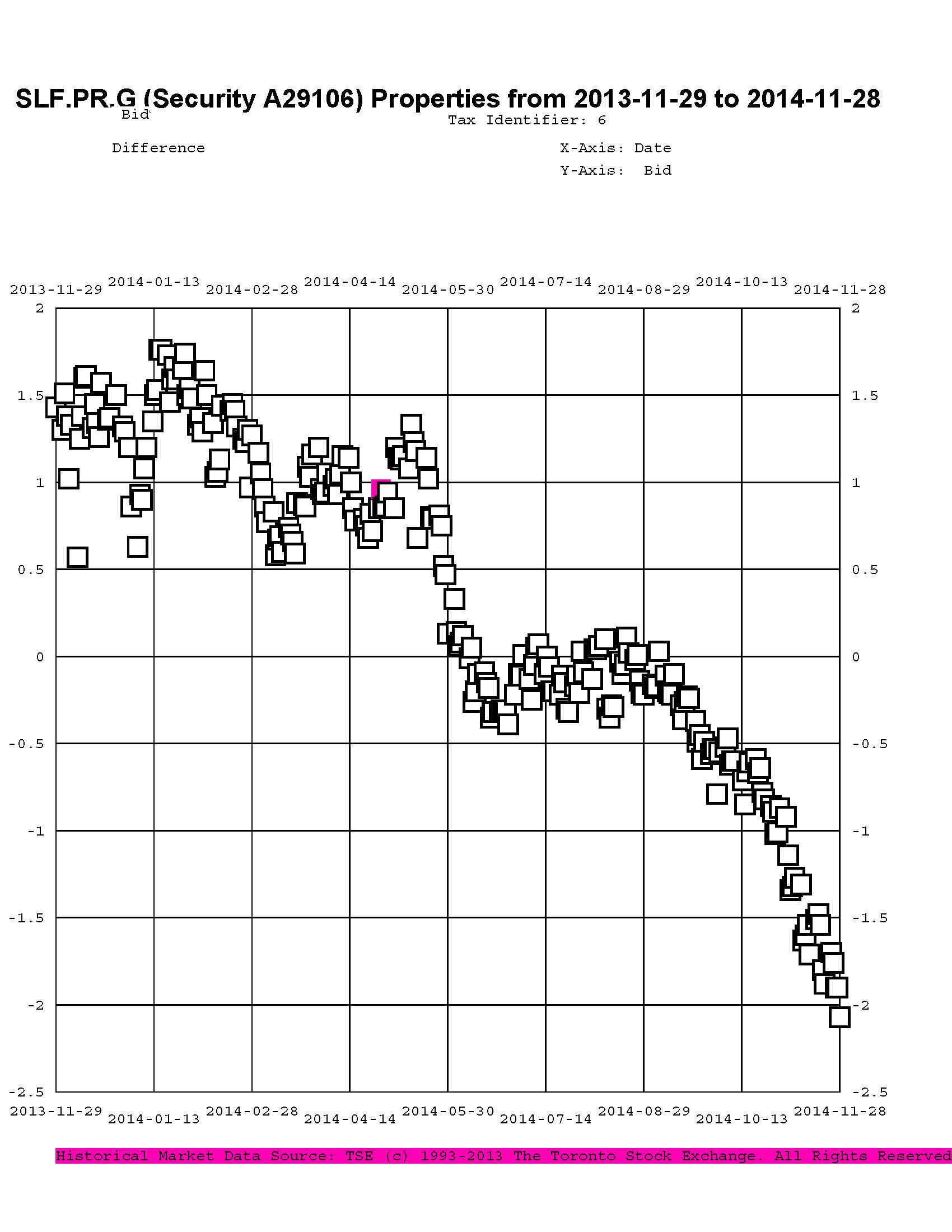
SLF.PR.E Deemed-Retractible Quote: 22.20 – 22.41
Spot Rate : 0.2100
Average : 0.1403

YTW SCENARIO
Maturity Type : Hard Maturity
Maturity Date : 2025-01-31
Maturity Price : 25.00
Evaluated at bid price : 22.20
Bid-YTW : 6.04 %

Market Action

October 15, 2014

It was a nice day to own bonds:

Treasuries surged, with benchmark 10-year yields falling the most since March 2009, as a decline in retail sales prompted traders to reduce wagers the Federal Reserve will raise interest rates in 2015.

Rates on federal fund futures show traders betting that the Fed will raise interest rates in December 2015, with chances of an increase in September fading to 32 percent from 46 percent yesterday and 67 percent two months ago, according to data compiled by Bloomberg. The benchmark 10-year yield traded below 2 percent for the first time since June 2013 even as the Fed is forecast to end its quantitative easing this month. A market gauge of inflation expectations fell to the lowest in 15 months while crude oil tumbled in a bear market.

The benchmark 10-year yield fell 14 basis points, or 0.14 percentage points, to 2.06 percent as of 2:17 p.m. New York time and reached the lowest since May 2013. The 2.375 percent note due in August 2024 rose 1 1/4, or $12.50 per $1,000 face value, to 102 26/32. The yield fell as much as 34 basis points and reached 1.86 percent, the lowest level since May 2013.

The 30-year bond rose more than four points and the yield fell as much as 28 basis points to 2.67 percent, touching the lowest level since September 2012, before trading at 2.83 percent.

The 10-year break-even rate, derived from the difference between yields on Treasuries and inflation-linked debt of similar maturities, shrank to 1.86 percentage points, the least since June 2013.

Retail sales declined 0.3 percent after a 0.6 percent August gain that was the biggest in four months, Commerce Department figures showed. The median forecast of 81 economists surveyed by Bloomberg called for a 0.1 percent decline.

Four bucks on long Treasuries! Wow! Equities weren’t quite so happy, but it it could have been worse:

An afternoon rebound helped the Standard & Poor’s 500 Index pare its biggest intraday plunge since 2011 amid speculation the selloff was overdone.

The S&P 500 lost 0.8 percent to 1,862.49 at 4 p.m. in New York, trimming an earlier plunge of as much as 3 percent. The index pared its gain for the year to less than 0.8 percent and has tumbled 7.4 percent since a record on Sept. 18. The Dow Jones Industrial Average fell 173.45 points, or 1.1 percent, to 16,141.74 after dropping as much as 460 points. The Russell 2000 Index of smaller companies jumped 1 percent.

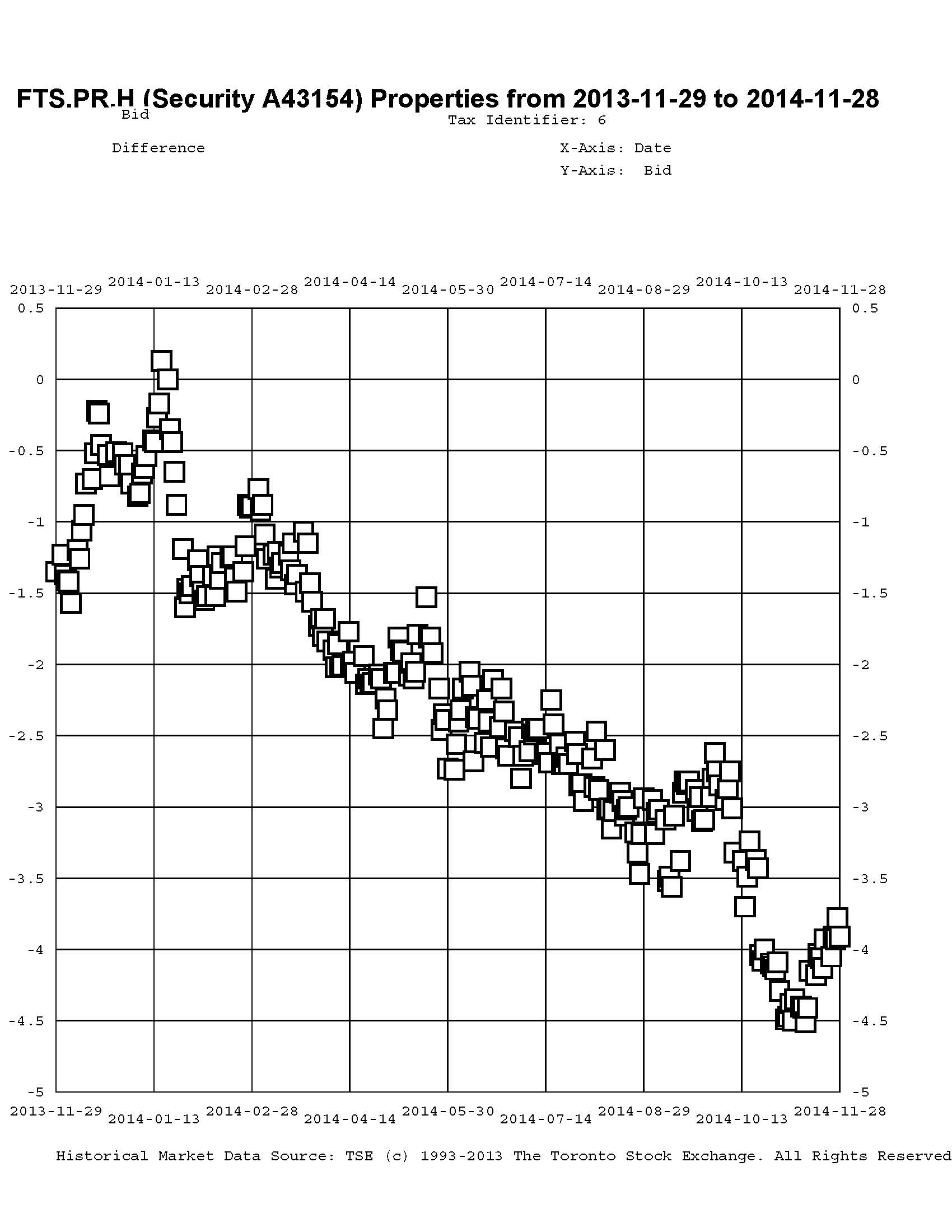
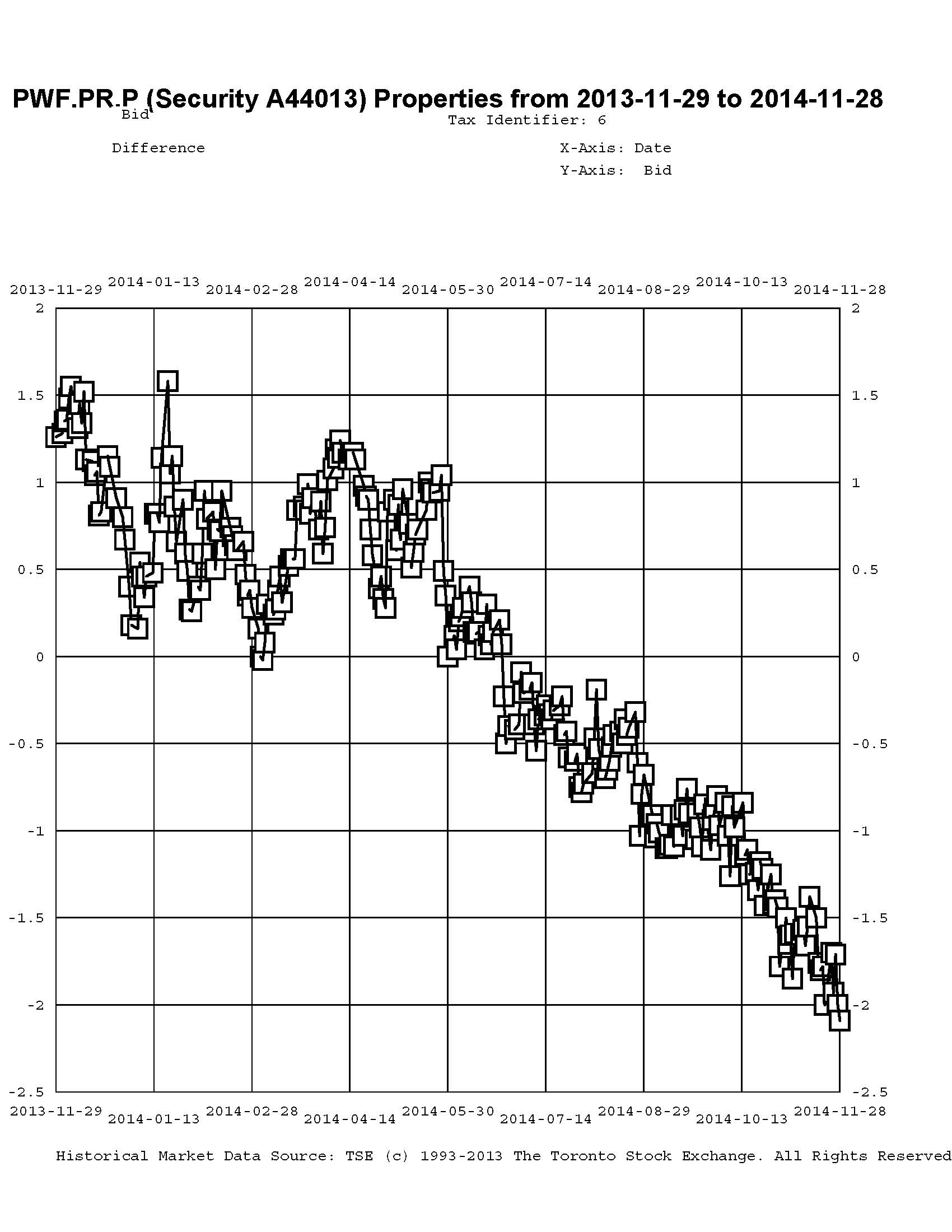
It was a poor day for the Canadian preferred share market, however, as it took its cue from equities, with PerpetualDiscounts down 19bp, FixedResets losing 21bp and DeemedRetractibles off 6bp. Volatility was high and dominated by losers – the only winner was PVS.PR.D, which had a bogus bid yesterday and, if we look at actual trades, was actually down significantly on the day. Volume was low.

PerpetualDiscounts now yield 5.18%, equivalent to 6.73% interest at the standard equivalency factor of 1.3x. Long corporates now yield about 4.05% (maybe a hair more), so the pre-tax interest equivalent spread is now about 270bp, a significant widening from the 250bp reported October 8.

HIMIPref™ Preferred Indices
These values reflect the December 2008 revision of the HIMIPref™ Indices

Values are provisional and are finalized monthly
Index Mean
Current
Yield
(at bid)
Median
YTW
Median
Average
Trading
Value
Median
Mod Dur
(YTW)
Issues Day’s Perf. Index Value
Ratchet 3.14 % 3.13 % 22,846 19.38 1 -0.6658 % 2,657.0
FixedFloater 0.00 % 0.00 % 0 0.00 0 -0.4036 % 4,058.7
Floater 2.93 % 3.10 % 60,469 19.48 4 -0.4036 % 2,725.3
OpRet 4.04 % 2.76 % 107,700 0.08 1 0.0000 % 2,732.5
SplitShare 4.30 % 3.82 % 83,225 3.83 5 0.4562 % 3,145.8
Interest-Bearing 0.00 % 0.00 % 0 0.00 0 0.0000 % 2,498.6
Perpetual-Premium 5.50 % 3.18 % 73,736 0.08 18 -0.1075 % 2,449.0
Perpetual-Discount 5.34 % 5.18 % 97,101 15.09 18 -0.1913 % 2,585.5
FixedReset 4.24 % 3.73 % 173,345 16.46 75 -0.2141 % 2,540.8
Deemed-Retractible 5.03 % 2.95 % 101,389 0.45 42 -0.0573 % 2,556.7
FloatingReset 2.56 % 0.00 % 63,285 0.08 6 -0.0588 % 2,545.0
Performance Highlights
Issue Index Change Notes
TRP.PR.C FixedReset -2.14 % YTW SCENARIO
Maturity Type : Limit Maturity
Maturity Date : 2044-10-15
Maturity Price : 20.57
Evaluated at bid price : 20.57
Bid-YTW : 3.81 %
PWF.PR.P FixedReset -1.50 % YTW SCENARIO
Maturity Type : Limit Maturity
Maturity Date : 2044-10-15
Maturity Price : 21.81
Evaluated at bid price : 22.30
Bid-YTW : 3.53 %
TRP.PR.A FixedReset -1.37 % YTW SCENARIO
Maturity Type : Limit Maturity
Maturity Date : 2044-10-15
Maturity Price : 21.38
Evaluated at bid price : 21.65
Bid-YTW : 3.99 %
FTS.PR.H FixedReset -1.33 % YTW SCENARIO
Maturity Type : Limit Maturity
Maturity Date : 2044-10-15
Maturity Price : 20.01
Evaluated at bid price : 20.01
Bid-YTW : 3.79 %
ELF.PR.F Perpetual-Discount -1.07 % YTW SCENARIO
Maturity Type : Limit Maturity
Maturity Date : 2044-10-15
Maturity Price : 23.67
Evaluated at bid price : 23.94
Bid-YTW : 5.56 %
PVS.PR.D SplitShare 2.84 % YTW SCENARIO
Maturity Type : Hard Maturity
Maturity Date : 2021-10-08
Maturity Price : 25.00
Evaluated at bid price : 23.90
Bid-YTW : 5.38 %
Volume Highlights
Issue Index Shares
Traded
Notes
CM.PR.O FixedReset 216,846 RBC crossed 52,400 at 25.25. TD crossed two blocks of 51,600 each, both at 25.25; Nesbitt crossed 53,000 at the same price.
YTW SCENARIO
Maturity Type : Limit Maturity
Maturity Date : 2044-10-15
Maturity Price : 23.24
Evaluated at bid price : 25.20
Bid-YTW : 3.68 %
BNS.PR.P FixedReset 155,537 Scotia crossed 152,700 at 25.30.
YTW SCENARIO
Maturity Type : Call
Maturity Date : 2018-04-25
Maturity Price : 25.00
Evaluated at bid price : 25.17
Bid-YTW : 3.11 %
MFC.PR.K FixedReset 99,386 TD sold blocks of 10,400 and 11,600 to anonymous at 25.01, then crossed 73,400 at 24.95.
YTW SCENARIO
Maturity Type : Hard Maturity
Maturity Date : 2025-01-31
Maturity Price : 25.00
Evaluated at bid price : 24.90
Bid-YTW : 3.86 %
TD.PF.A FixedReset 98,665 TD bought 11,900 from Scotia at 25.07, then crossed 12,700 at 25.00. RBC crossed 38,600 at 24.99.
YTW SCENARIO
Maturity Type : Limit Maturity
Maturity Date : 2044-10-15
Maturity Price : 23.16
Evaluated at bid price : 25.00
Bid-YTW : 3.66 %
BMO.PR.T FixedReset 90,460 TD crossed 36,700 at 25.15.
YTW SCENARIO
Maturity Type : Limit Maturity
Maturity Date : 2044-10-15
Maturity Price : 23.27
Evaluated at bid price : 25.30
Bid-YTW : 3.69 %
POW.PR.G Perpetual-Premium 81,374 Nesbitt crossed 73,700 at 26.00.
YTW SCENARIO
Maturity Type : Call
Maturity Date : 2021-04-15
Maturity Price : 25.00
Evaluated at bid price : 25.90
Bid-YTW : 4.98 %
There were 24 other index-included issues trading in excess of 10,000 shares.
Wide Spread Highlights
Issue Index Quote Data and Yield Notes
TRP.PR.C FixedReset Quote: 20.57 – 21.20
Spot Rate : 0.6300
Average : 0.4257

YTW SCENARIO
Maturity Type : Limit Maturity
Maturity Date : 2044-10-15
Maturity Price : 20.57
Evaluated at bid price : 20.57
Bid-YTW : 3.81 %

CU.PR.E Perpetual-Discount Quote: 23.91 – 24.44
Spot Rate : 0.5300
Average : 0.3562

YTW SCENARIO
Maturity Type : Limit Maturity
Maturity Date : 2044-10-15
Maturity Price : 23.54
Evaluated at bid price : 23.91
Bid-YTW : 5.17 %

TRP.PR.A FixedReset Quote: 21.65 – 22.20
Spot Rate : 0.5500
Average : 0.3831

YTW SCENARIO
Maturity Type : Limit Maturity
Maturity Date : 2044-10-15
Maturity Price : 21.38
Evaluated at bid price : 21.65
Bid-YTW : 3.99 %

FTS.PR.H FixedReset Quote: 20.01 – 20.48
Spot Rate : 0.4700
Average : 0.3252

YTW SCENARIO
Maturity Type : Limit Maturity
Maturity Date : 2044-10-15
Maturity Price : 20.01
Evaluated at bid price : 20.01
Bid-YTW : 3.79 %

BAM.PR.T FixedReset Quote: 24.22 – 24.65
Spot Rate : 0.4300
Average : 0.3019

YTW SCENARIO
Maturity Type : Limit Maturity
Maturity Date : 2044-10-15
Maturity Price : 23.17
Evaluated at bid price : 24.22
Bid-YTW : 3.99 %

PVS.PR.C SplitShare Quote: 25.90 – 26.90
Spot Rate : 1.0000
Average : 0.8746

YTW SCENARIO
Maturity Type : Call
Maturity Date : 2015-12-10
Maturity Price : 25.50
Evaluated at bid price : 25.90
Bid-YTW : 3.82 %

Market Action

October 14, 2014

The Fed is very excited about a new extension to regulatory power:

The Board of Governors of the Federal Reserve System and the Federal Deposit Insurance Corporation welcome the announcement today by the International Swaps and Derivatives Association (ISDA) of the agreement of a new resolution stay protocol.

This initiative is an important step toward mitigating the financial stability risks associated with the early termination of bilateral, OTC derivatives contracts triggered by the failure of a global banking firm with significant cross-border derivatives activities. Initially, 18 large banking organizations have agreed to sign onto the protocol. The protocol provides for temporary stays on certain default and early termination rights within standard ISDA derivatives contracts in the event one of the large banking organizations is subject to an insolvency or resolution proceeding in its home jurisdiction.

The resolution stay amendments of the protocol are intended to facilitate an orderly resolution of a major global banking firm and reduce the potential negative impact of the resolution on financial stability by giving the bankruptcy court or resolution authority the ability to prevent early termination of financial contracts of the firm’s global subsidiaries. The Federal Reserve and the FDIC are encouraged by this effort and look forward to the continuation of this important work.

ISDA adds:

The Protocol essentially enables adhering counterparties to opt into certain overseas resolution regimes via a change to their derivatives contracts. While many existing national resolution frameworks impose stays on early termination rights following the start of resolution proceedings, these stays might only apply to domestic counterparties trading under domestic law agreements, and so might not capture cross-border trades.

Regulators have committed to develop new regulations in their jurisdictions in 2015 that will promote broader adoption of the stay provisions beyond the G-18 banks. Banks have also committed through the Protocol to expand coverage once such regulations are enacted to include a stay that could be used when a US financial holding company becomes subject to proceedings under the US Bankruptcy Code. Those regulations will be made under the rule-making process in each jurisdiction.

The contractual approach is meant to support current statutory regimes and ensure wider, more consistent application. By adhering to the Protocol, the G-18 banks will extend the coverage of stays to more than 90% of their outstanding derivatives notional, and that proportion will increase as other firms sign the Protocol.

The backgrounder (available via a link on the ISDA release) gleefully celebrates the coming extension of regulatory power over investors:

Buy-side firms are not included in the first phase. These institutions are unable to voluntarily adopt the protocol due to fiduciary responsibilities to their clients. By voluntarily giving up advantageous contractual rights, they potentially leave themselves open to lawsuits. The FSB has recognised this issue, and FSB members have committed to encourage broader adoption of the protocol by imposing new regulations in their jurisdictions throughout 2015.

Hyperinflation has been rescheduled:

Federal Reserve Vice Chairman Stanley Fischer said weaker-than-expected global growth could prompt the U.S. central bank to slow the pace of eventual interest-rate increases.

“If foreign growth is weaker than anticipated, the consequences for the U.S. economy could lead the Fed to remove accommodation more slowly than otherwise,” Fischer said in speech today in Washington.

Fischer, 70, said the Fed won’t raise rates until the U.S. expansion “has advanced far enough,” and most emerging markets should be able to weather the increase.

Fischer’s remarks highlight growing concern among U.S. central bank officials about the impact of a global slowdown and a strengthening dollar. He spoke to central bankers and finance ministers gathered in Washington for the annual meetings of the World Bank and International Monetary Fund.

The Fed’s policy making body last month expressed concern that weak demand, particularly in Europe, could add to the dollar’s appreciation, hurting U.S. exporters and damping inflation, according to minutes released Oct. 8.

I’m a big fan of transparency at the top of central banks – even, or perhaps especially, when it gets ugly:

Mario Draghi and Jens Weidmann are clashing anew over how much more stimulus the ailing euro-area economy needs from the European Central Bank.

As Europe’s woes again proved the chief concern at weekend meetings of the International Monetary Fund in Washington, President Draghi repeated he’s ready to expand the ECB’s balance sheet by as much as 1 trillion euros ($1.3 trillion) to beat back the threat of deflation. Bundesbank head Weidmann responded by saying that a target value isn’t set in stone.

The differences at the heart of policy making risk leaving the ECB hamstrung as the region’s economy stalls and inflation fades further from the central bank’s target of just below 2 percent. History suggests Draghi will ultimately prevail over his German colleague.

The public nature of the dispute will force Draghi to disclose more of his thinking than might otherwise be the case – and this is a Good Thing.

But I’m wondering about the ‘set in stone’ metaphor. Is it mixed? You can carve something in stone, which means the same thing as casting it in iron, but can you actually set something in stone to make it permanent? You can set it in concrete, if you like, and you can set a stone in a ring or a driveway, for instance, but I’m not fully convinced that “set in stone” means much. The intending meaning doesn’t match any of the standard dictionary definitions of “set”, nor does this standard dictionary list “set in stone” as an idiom. It’s all very curious.

Anyway, there is considerable controversy regarding Germany’s approach:

In Washington, Mr. Schaeuble not only endured lectures from longtime critics such as Larry Summers, the former U.S. Treasury Secretary who in an unusually frank panel discussion accused Germany of leading Europe down a path of Japanese-style deflation with a misguided focus on budget consolidation.

He also had to listen to advice from traditional allies such as Finland’s Jyrki Katainen, a future vice president of the European Commission, who warned that Germany could not remain strong forever if it failed to invest more in its own infrastructure and education system.

In its lead editorial on Sunday, conservative newspaper Die Welt argued that a weakening German economy should force a policy rethink and warned that Schaeuble’s push to achieve a “schwarze Null” – a federal budget that is in the black – in 2015 should not turn into a mindless “fetish.”

The Sueddeutsche Zeitung suggested Chancellor Angela Merkel’s Christian Democrats (CDU) risked turning into the “Tea Party of Europe” with their single-minded focus on deficit reduction.

Meanwhile, it appears that hyperinflation has been rescheduled again:

When it comes to spurring inflation in the U.S. economy, the bond market is becoming convinced that the Federal Reserve has almost no chance of achieving its 2 percent target before the end of the decade.

Inflation expectations have plummeted in the past three months, with yields of Treasuries (BUSY) implying consumer prices will rise an average 1.5 percent annually through the third quarter of 2019. In the past decade, those predictions have come within 0.1 percentage point of the actual rate of price increases in the following five years, data compiled by Bloomberg show.

Based on the gap between yields of government notes and TIPS, traders have scaled back estimates for average inflation through 2019 by a half-percentage point since June to 1.52 percent, Fed data compiled by Bloomberg show.

That decline has significance for policy makers because yields have historically been accurate in predicting the future pace of annual cost-of-living increases.

The market’s five-year forecast has understated actual inflation based on the U.S. consumer price index by a median of just 0.04 percentage point since the data began in 2003.

… and nominals had a good day:

Treasuries climbed, with two-year note yields dropping the most in more than a year, as signs of economic weakness in Germany fueled speculation that slowing global growth will delay Federal Reserve interest-rate increases.

Thirty-year bond yields dropped below 3 percent for the first time since May 2013 as reports showed U.K. inflation dropped to a five-year low in September and German investor confidence eroded. A gauge of inflation expectations measured by the difference between yields on 10-year notes and similar-maturity inflation-index debt traded close to the lowest in more than a year. Volatility reached the highest level since January.

The two-year note yield dropped five basis points, or 0.05 percentage point, to 0.38 percent at 3:02 p.m. New York time, according to Bloomberg Bond Trader prices. The 0.5 percent securities maturing in September 2016 added 3/32, or 94 cents per $1,000 face amount, to 100 7/32. The yield fell as much as six basis points, the largest decline since September 2013.

The 30-year (USGG30YR) bond fell five basis points to 2.96 percent and touched 2.94 percent, the lowest since May 3, 2013. The benchmark 10-year yield dropped seven basis points to 2.21 percent. It earlier reached 2.19 percent, a level not seen since June 2013.

And equities – particularly energies – got thumped:

U.S. stocks may have perked up today but the commodity-sensitive Toronto market slipped into correction mode.

Equities in Toronto moved into that zone this morning, though pulled back later, only to drop further again in the afternoon, closing down more than 190 points, or 1.3 per cent, at 14,036.68. That marked a drop of some 10 per cent from its peak in early September, thus meeting the definition of a correction.

But is it a plot?

The decline in oil prices may be depriving Russian President Vladimir Putin of his biggest ally.

Oil has been the key to Putin’s grip on power since he took over from Boris Yeltsin in 2000, fueling a booming economy that grew 7 percent on average from 2000 to 2008.

Brent crude is down more than 20 percent from its June high, cutting billions of dollars in tax revenue from Russia’s most valuable export. The budget will fall into deficit next year if oil is less than $104 a barrel, according to investment bank Sberbank CIB. At $90, close to the current level, Russia will have a shortfall of 1.2 percent of gross domestic product.

Top Kremlin officials said after the annexation of Crimea that they expected the U.S. to artificially push oil prices down in collaboration with Saudi Arabia in order to damage Russia, according to Khryshtanovskaya. Putin’s spokesman, Dmitry Peskov, didn’t respond to a request for comment on this issue, nor did he respond over four days of calls requesting comment about oil’s importance to Putin.

“Prices are being manipulated,” state-run Rosneft’s spokesman Mikhail Leontyev said Oct. 12 in an interview with Russkaya Sluzhba Novostei radio. “Saudi Arabia has started offering big discounts on oil. This is political manipulation, manipulation by Saudi Arabia, which can end badly for it.”

The reason Saudi Arabia cut its crude prices earlier this month was to boost margins for refinery clients and the move didn’t signal rising competition for market share, a person familiar with the nation’s oil policy said last week.

It was a mixed day for the Canadian preferred share market, with PerpetualDiscounts gaining 9bp, FixedResets down 4bp and DeemedRetractibles off 3bp. Volatility was average, with some of the usual stupidity in recorded figures brought to you courtesy of the twerps at the Toronto Stock Exchange. Volume was extremely low.

HIMIPref™ Preferred Indices
These values reflect the December 2008 revision of the HIMIPref™ Indices

Values are provisional and are finalized monthly
Index Mean
Current
Yield
(at bid)
Median
YTW
Median
Average
Trading
Value
Median
Mod Dur
(YTW)
Issues Day’s Perf. Index Value
Ratchet 3.12 % 3.12 % 23,796 19.44 1 -1.1111 % 2,674.8
FixedFloater 0.00 % 0.00 % 0 0.00 0 -0.2776 % 4,075.1
Floater 2.92 % 3.09 % 60,786 19.51 4 -0.2776 % 2,736.3
OpRet 4.04 % 2.62 % 108,755 0.08 1 0.0000 % 2,732.5
SplitShare 4.32 % 3.81 % 84,249 3.83 5 -0.6828 % 3,131.5
Interest-Bearing 0.00 % 0.00 % 0 0.00 0 0.0000 % 2,498.6
Perpetual-Premium 5.49 % 1.52 % 74,288 0.08 18 -0.0307 % 2,451.6
Perpetual-Discount 5.33 % 5.14 % 97,606 15.07 18 0.0933 % 2,590.4
FixedReset 4.23 % 3.72 % 165,837 16.47 75 -0.0370 % 2,546.3
Deemed-Retractible 5.03 % 2.93 % 99,645 0.36 42 -0.0277 % 2,558.2
FloatingReset 2.56 % -0.48 % 64,095 0.08 6 -0.1826 % 2,546.5
Performance Highlights
Issue Index Change Notes
PVS.PR.D SplitShare -4.95 % Not real, since there’s a bid on Alpha at 24.10 and the low for the day was 24.24, so this is either the Toronto Exchange continuing its tradition of sloppy market making, or a bid at the close was cancelled before 4:30.
YTW SCENARIO
Maturity Type : Hard Maturity
Maturity Date : 2021-10-08
Maturity Price : 25.00
Evaluated at bid price : 23.24
Bid-YTW : 5.86 %
TRP.PR.B FixedReset -1.30 % YTW SCENARIO
Maturity Type : Limit Maturity
Maturity Date : 2044-10-14
Maturity Price : 19.00
Evaluated at bid price : 19.00
Bid-YTW : 3.74 %
BAM.PR.E Ratchet -1.11 % YTW SCENARIO
Maturity Type : Limit Maturity
Maturity Date : 2044-10-14
Maturity Price : 23.75
Evaluated at bid price : 24.03
Bid-YTW : 3.12 %
Volume Highlights
Issue Index Shares
Traded
Notes
NA.PR.W FixedReset 140,963 Recent new issue.
YTW SCENARIO
Maturity Type : Limit Maturity
Maturity Date : 2044-10-14
Maturity Price : 23.06
Evaluated at bid price : 24.78
Bid-YTW : 3.72 %
BAM.PF.G FixedReset 83,982 Recent new issue.
YTW SCENARIO
Maturity Type : Limit Maturity
Maturity Date : 2044-10-14
Maturity Price : 23.14
Evaluated at bid price : 25.05
Bid-YTW : 4.28 %
BNS.PR.P FixedReset 48,275 Scotia crossed 25,000 at 25.28 and bought two blocks of 10,000 each from TD at 25.27 a piece.
YTW SCENARIO
Maturity Type : Call
Maturity Date : 2018-04-25
Maturity Price : 25.00
Evaluated at bid price : 25.24
Bid-YTW : 3.02 %
BMO.PR.T FixedReset 42,300 YTW SCENARIO
Maturity Type : Limit Maturity
Maturity Date : 2044-10-14
Maturity Price : 23.27
Evaluated at bid price : 25.30
Bid-YTW : 3.68 %
RY.PR.I FixedReset 41,289 Nesbitt crossed 40,000 at 25.53.
YTW SCENARIO
Maturity Type : Call
Maturity Date : 2019-02-24
Maturity Price : 25.00
Evaluated at bid price : 25.50
Bid-YTW : 3.16 %
ENB.PR.D FixedReset 41,050 Nesbitt crossed 37,200 at 24.07.
YTW SCENARIO
Maturity Type : Limit Maturity
Maturity Date : 2044-10-14
Maturity Price : 22.94
Evaluated at bid price : 24.04
Bid-YTW : 4.03 %
There were 12 other index-included issues trading in excess of 10,000 shares.
Wide Spread Highlights
Issue Index Quote Data and Yield Notes
PVS.PR.D SplitShare Quote: 23.24 – 24.24
Spot Rate : 1.0000
Average : 0.5555

YTW SCENARIO
Maturity Type : Hard Maturity
Maturity Date : 2021-10-08
Maturity Price : 25.00
Evaluated at bid price : 23.24
Bid-YTW : 5.86 %

PVS.PR.C SplitShare Quote: 25.90 – 26.90
Spot Rate : 1.0000
Average : 0.7372

YTW SCENARIO
Maturity Type : Call
Maturity Date : 2015-12-10
Maturity Price : 25.50
Evaluated at bid price : 25.90
Bid-YTW : 3.81 %

BAM.PR.Z FixedReset Quote: 25.62 – 25.88
Spot Rate : 0.2600
Average : 0.1794

YTW SCENARIO
Maturity Type : Call
Maturity Date : 2017-12-31
Maturity Price : 25.00
Evaluated at bid price : 25.62
Bid-YTW : 4.06 %

TRP.PR.B FixedReset Quote: 19.00 – 19.26
Spot Rate : 0.2600
Average : 0.1818

YTW SCENARIO
Maturity Type : Limit Maturity
Maturity Date : 2044-10-14
Maturity Price : 19.00
Evaluated at bid price : 19.00
Bid-YTW : 3.74 %

PWF.PR.R Perpetual-Premium Quote: 25.67 – 25.90
Spot Rate : 0.2300
Average : 0.1597

YTW SCENARIO
Maturity Type : Call
Maturity Date : 2021-04-30
Maturity Price : 25.00
Evaluated at bid price : 25.67
Bid-YTW : 5.00 %

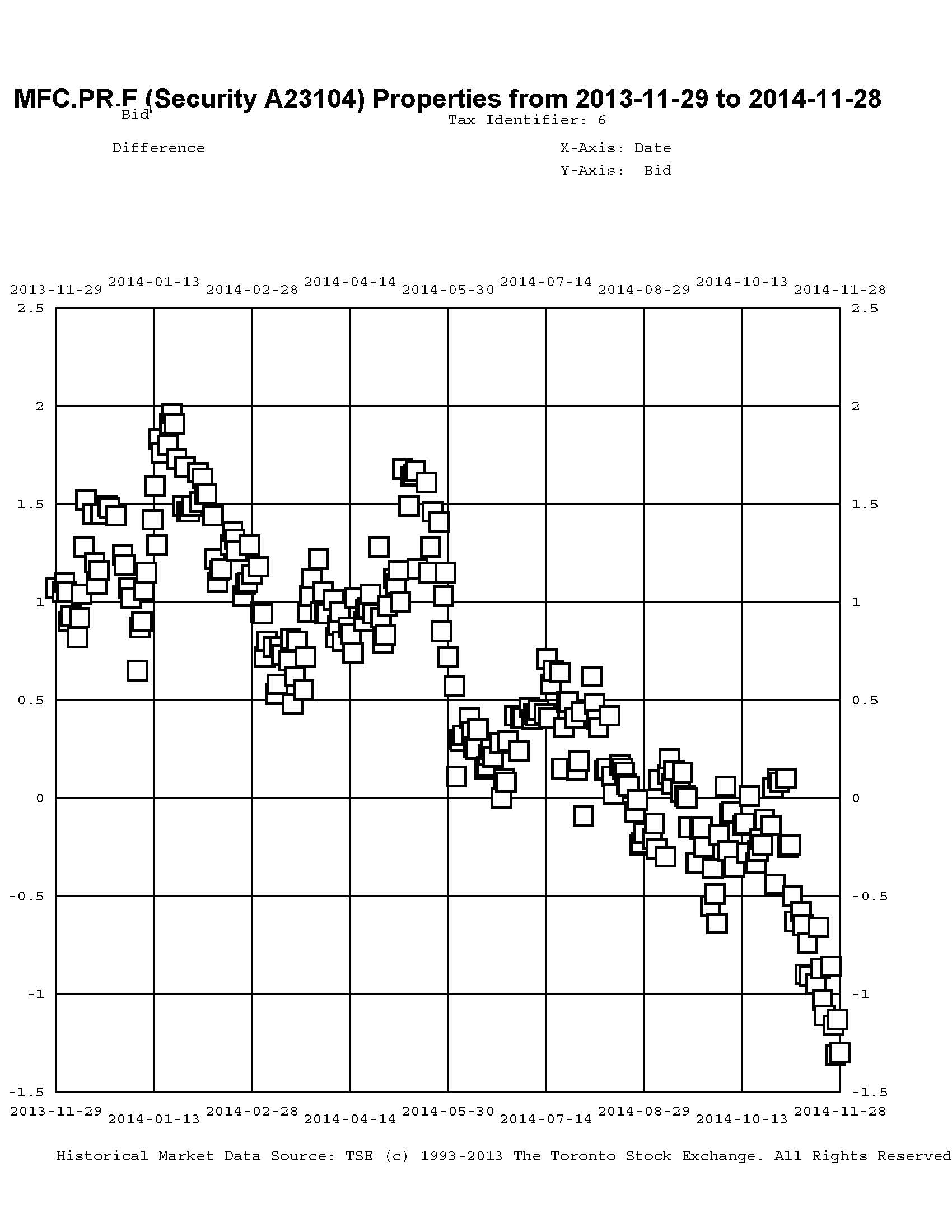
MFC.PR.F FixedReset Quote: 22.20 – 22.80
Spot Rate : 0.6000
Average : 0.5375

YTW SCENARIO
Maturity Type : Hard Maturity
Maturity Date : 2025-01-31
Maturity Price : 25.00
Evaluated at bid price : 22.20
Bid-YTW : 4.58 %

PrefLetter

October PrefLetter Released!

The October, 2014, edition of PrefLetter has been released and is now available for purchase as the “Previous edition”. Those who subscribe for a full year receive the “Previous edition” as a bonus.

The regular appendices reporting on DeemedRetractibles and FixedResets are included.

PrefLetter may now be purchased by all Canadian residents.

Until further notice, the “Previous Edition” will refer to the October, 2014, issue, while the “Next Edition” will be the November, 2014, issue, scheduled to be prepared as of the close November 14 and eMailed to subscribers prior to market-opening on November 17.

PrefLetter is intended for long term investors seeking issues to buy-and-hold. At least one recommendation from each of the major preferred share sectors is included and discussed.

Note: My verbosity has grown by such leaps and bounds that it is no longer possible to deliver PrefLetter as an eMail attachment – it’s just too big for my software! Instead, I have sent passwords – click on the link in your eMail and your copy will download.

Note: The PrefLetter website has a Subscriber Download Feature. If you have not received your copy, try it!

Note: PrefLetter eMails sometimes runs afoul of spam filters. If you have not received your copy within fifteen minutes of a release notice such as this one, please double check your (company’s) spam filtering policy and your spam repository – there are some hints in the post Sympatico Spam Filters out of Control. If it’s not there, contact me and I’ll get you your copy … somehow!

Note: There have been scattered complaints regarding inability to open PrefLetter in Acrobat Reader, despite my practice of including myself on the subscription list and immediately checking the copy received. I have had the occasional difficulty reading US Government documents, which I was able to resolve by downloading and installing the latest version of Adobe Reader. Also, note that so far, all complaints have been from users of Yahoo Mail. Try saving it to disk first, before attempting to open it.

Note: There have been other scattered complaints that double-clicking on the links in the “PrefLetter Download” email results in a message that the password has already been used. I have been able to reproduce this problem in my own eMail software … the problem is double-clicking. What happens is the first click opens the link and the second click finds that the password has already been used and refuses to work properly. So the moral of the story is: Don’t be a dick! Single Click!

Note: Assiduous Reader DG informs me:

In case you have any other Apple users: you need to install a free App from the apple store called “FileApp”. It comes with it’s own tutorial and allows you to download and save a PDF file.

Issue Comments

DGS.PR.A Semi-Annual Report 14H1

Dividend Growth Split Corp. has released its Semi-Annual Report to June 30, 2014.

Figures of interest are:

MER: According to the report:

Excluding the Preferred share distributions and issuance costs, MER per Class A share was 0.98% for the first six months of 2014 compared to 1.04% in 2013. This ratio is more representative of the ongoing efficiency of the administration of the Fund.

Average Net Assets: We need this to calculate portfolio yield, and it’s a nightmare due to the share issuance.The average of the beginning and end of period assets is: (224.5-million + 184.6-million)/2 = 204.6-million. Distributions paid on preferred shares were $2,913,292, at $0.525 p.a. for half a year, implies an average of 11.098-million units outstanding, at an average NAVPU of 18.70, implies average assets of $207.5-million, which is surprisingly close. So call the average assets $206-million.

Underlying Portfolio Yield: Total Income (dividends, securities lending and interest) of $4.40-million over half a year divided by average net assets of $206-million is 4.3% p.a..

Income Coverage: Net income before realized and unrealized capital gains and before share issuance costs is $3.29-million to cover preferred dividends of $2.98-million is 110%.

Issue Comments

FTN.PR.A Got Bigger in September

Another late post!

On August 12, 2014, Quadravest announced:

Financial 15 Split Corp. (the “Company”) announces that it will issue Rights to all Class A Shareholders thereby allowing existing shareholders to increase their investment in the Company. Each Class A Shareholder will be entitled to receive one Right for each Class A Share held as of the record date of August 25, 2014. Six Rights will entitle the holder to purchase a Unit consisting of one Class A Share at $10.25 and one Preferred Share at $10.00 for the total subscription price of $20.25. The Rights are exercisable at any time once issued and will expire at 5:00 p.m. (EST) on September 19, 2014.

The net proceeds from the subscription of Units will be used to acquire additional securities in accordance with the Company’s investment objectives. The exercise price is consistent with current trading prices and accretive to the most recently published net asset value per Unit. The offering is expected to increase the trading liquidity of the Company and reduce the management expense ratio.

Both the Preferred Shares and Class A Shares trade on the Toronto Stock Exchange (the “TSX”) under the symbol “FTN.PR.A” and “FTN” respectively. The Rights will be listed and will trade on the TSX until 12:00 noon (EST) on September 19, 2014. The Rights will be eligible for exercise on and following August 26, 2014.

The Company invests in a high quality portfolio consisting of 15 financial services companies made up of Canadian and U.S. issuers as follows: Bank of Montreal, The Bank of Nova Scotia, Canadian Imperial Bank of Commerce, Royal Bank of Canada, Toronto-Dominion Bank, National Bank of Canada, Manulife Financial Corporation, Sun Life Financial, Great-West Lifeco, CI
Financial Corp, Bank of America, Citigroup Inc., Goldman Sachs Group, JP Morgan Chase & Co. and Wells Fargo & Co.

This was followed by an announcement on September 22:

Financial 15 Split Corp. (the “Company”) is pleased to announce that it has issued 2,020,098 Class A shares and 2,020,098 Preferred shares pursuant to its recently completed rights offering. Total proceeds amounted to $40.9 million. Holders of rights were given the opportunity to purchase one Class A share at $10.25 and one Preferred share at $10.00 for total price per unit of $20.25.

Financial 15 invests in a high quality portfolio of North American financial institutions and is benefiting from strong share price performance of Canadian and US banks. The Company invests in a high quality portfolio consisting of 15 financial services companies made up of Canadian and U.S. issuers as follows: Bank of Montreal, The Bank of Nova Scotia, Canadian Imperial Bank of Commerce, Royal Bank of Canada, Toronto-Dominion Bank, National Bank of Canada, Manulife Financial Corporation, Sun Life Financial, Great-West Lifeco, CI Financial Corp, Bank of America, Citigroup Inc., Goldman Sachs Group, JP Morgan Chase & Co. and Wells Fargo & Co.

FTN.PR.A was last mentioned on PrefBlog in connection with its 14H1 Semi-Annual Report. FTN.PR.A is tracked by HIMIPref™ but relegated to the Scraps index on credit concerns.

Issue Comments

PVS Semi-Annual Report, June 2014

Partners Value Split Corp. has released its Semi-Annual Report to June 30, 2014.

The company has the following issues outstanding: PVS.PR.A, PVS.PR.B, PVS.PR.C and PVS.PR.D.

Figures of interest are:

MER: I suggest it is best to include the amortization of share issue costs in MER – after all, this is a charge against the stated value of the company. Therefore, expenses were $213,000 (regular expenses) + $710,000 (amortization) = $923,000 for six months on assets of $2.348-billion (see below) or 8bp p.a..

Average Net Assets: We need this to calculate portfolio yield and MER. There were negligible capital transactions, so we’ll just take the average of the beginning and end of period assets (including preferred shares) so: [(1.501-billion + 0.690-billion) + (1.816-billion + 0.690-billon)]/2 = $2.348-billion

Underlying Portfolio Yield: Total Income of $21.0-million divided by average net assets of $2,348-million is 1.79% p.a..

Income Coverage: Net income of $20.846-million less amortization of $0.710-million is $20.136-million to cover senior preferred dividends of $12.993-million is 155%. However, I consider it prudent to include the $5-million stated entitlement of the Junior preferreds, even though less than half of this was actually paid in 2013 because the Juniors can be retracted at any time, which could prove embarrassing in times of extreme stress. So I’d say income coverage is 112%.

Issue Comments

TD Sells Sponsored Company Agreements To Timbercreek

This is late … really late! But better late than never.

On August 22, TD Bank announced:

TD Sponsored Companies Inc. (“TDSCI”) is pleased to announce that shareholders of TD Split Inc. (TSX:TDS), 5Banc Split Inc. (TSX:FBS) and Big 8 Split Inc. (TSX:BIG) (collectively, the “Funds”) today approved the proposed change in the administrator and investment manager of the Funds to Timbercreek Asset Management Ltd. (“Timbercreek”) from TDSCI, as more fully described in the Funds’ management information circular dated July 3, 2014.

The Transaction is expected to close in the middle of September 2014, subject to, among other conditions, obtaining all required regulatory approvals, at which time Timbercreek will become the administrator and investment fund manager of each Fund.

On September 19 it was further announced:

TD Sponsored Companies Inc. (“TDSCI”) and Timbercreek Asset Management Ltd. (“Timbercreek”) announced today the completion of the previously announced transaction pursuant to which Timbercreek has acquired the rights to administer and manage TD Split Inc., 5Banc Split Inc. and Big 8 Split Inc. (collectively, the “Funds”).

As a result of the transaction, Timbercreek now acts as administrator and investment fund manager of the Funds.

According to information on SEDAR, to which I am not permitted to link directly because I am a member of the public and the Canadian Securities Administrators have determined that scumbag members of the public are not permitted to link to public documents, but one of which is referenced as “TD Split Inc. Aug 1 2014 10:50:29 ET Management information circular – English PDF 91 K”:

Recently, TDSCI determined that acting as administrator for closed-end funds does not represent a core business focus going forward and is therefore seeking to exit the closed-end fund business at this time. On June 24, 2014, TDSCI and Timbercreek announced that they had entered into a definitive agreement (the ‘‘Transaction’’) pursuant to which Timbercreek agreed to acquire the rights to act as administrator and investment fund manager to the Funds under (i) the administration agreement dated November 15, 2010 between TD Split Inc. and TDSCI, (ii) the administration agreement dated December 15, 2011 between 5Banc Split Inc. and TDSCI and (iii) the administration agreement dated December 15, 2013 between Big 8 Split Inc. and TDSCI (collectively, the ‘‘Administration Agreements’’ and each, an ‘‘Administration Agreement’’).

Timbercreek Asset Management Ltd. has a value oriented investment philosophy, and specializes in providing conservatively managed, risk averse alternative asset class investment opportunities to institutions, trusts and endowment funds, discretionary investment advisors and qualified individuals. Timbercreek, a wholly owned subsidiary of Timbercreek Asset Management Inc., is an investment management company that employs a conservative and risk averse approach to real estate based investments. Timbercreek Asset Management Inc. is principally owned by 2314716 Ontario Limited, which in turn is principally owned, directly or indirectly, by R. Blair Tamblyn, Ugo Bizzarri and Tye Bousada. Its head office is located at 1000 Yonge Street, Suite 500, Toronto, Ontario, M4W 2K2.

The preferred shares affected, with links to their new websites, are:

Market Action

October 10, 2014

CU Inc. has announced:

it will issue $200,000,000 of 4.094% Debentures maturing on October 19, 2054, at a price of $100.00 to yield 4.094%. This issue was sold by RBC Dominion Securities Inc., BMO Nesbitt Burns Inc., TD Securities Inc., Scotia Capital Inc. and CIBC World Markets Inc. Proceeds from the issue will be used to finance capital expenditures, to repay existing indebtedness, and for other general corporate purposes of ATCO Electric Ltd. and ATCO Gas and Pipelines Ltd.

CIU.PR.A is trading in-line with the CU PerpetualDiscounts at about 5.12%, which is an interest-equivalent 6.66%, meaning that the Seniority Spread for CIU is about 256bp, in line with the index averages. Which is always nice to confirm on an individual company basis!

I think Parakeet Poloz has been told to stop providing forward guidance. He’s listed as the author of a BoC Discussion Paper, Integrating Uncertainty and Monetary Policy-Making: A Practitioner’s Perspective:

This paper discusses how central banking is evolving in light of recent experience, with particular emphasis on the incorporation of uncertainty into policy decision-making. The sort of post-crisis uncertainty that central banks are dealing with today is more profound than that which is typically subjected to rigorous analysis and does not lend itself easily to formal modelling. As a practical matter, the policy-maker is dependent on macro models to develop a coherent monetary policy plan, and this burden of coherence means that fundamental uncertainty must be incorporated explicitly into the policy formulation process. As suggested here, doing so transforms policy formulation from an exercise in reverse engineering to one of risk management, one consequence of which is to inject a little more realism about uncertainty into the policy narrative, while trusting markets to wrestle with the data flow and deliver two-way trading. The evolution is likely to be a long one—researchers are encouraged to keep focusing on developing a practical understanding of how the economy works, one that admits that rules around economic behaviour are not cast in stone, but are almost certainly subject to variation through time and events.

Helping people to appreciate the underlying reality and the limitations of our craft without invalidating our core value proposition is a challenging task. More importantly, the business of central banking is being reinvented in real time in reaction to these realities. At the Bank of Canada, some of the key manifestations of this evolution, as I have tried to motivate above, are:
(i) explicitly building forecast ranges or scenario modelling around key assumption variables, such as potential output, the neutral interest rate and the world price of oil, into our public policy dialogue;
(ii) pointing to key elements of fundamental uncertainty, analyzing the associated policy risks carefully and openly, and laying out complementary research as we learn more about those risks;
(iii) investing more in consultations with Canadian business people and financial market participants, both in the form of surveys and in frank, face-to-face conversations around alternative interpretations of the macroeconomic data;
(iv) bringing a more fulsome narrative to the policy decision-making process, based on a risk-management framework rather than the more conventional policy engineering model; and,
(v) bringing to the table more research on real-financial linkages and financial stability risks to generate a richer set of considerations that influence day-to-day policy thinking.

If the Parakeet and his masters want to emphasize the uncertainty of forecasting, they would be much better advised to appoint strong, independently minded people to the rate-setting committee, publicizing the dissenting votes with a brief rationale, and encouraging members of the committee to make speeches giving their views. Just like the FOMC. And, as I’ve noted before, I feel quite certain that a lot of these dissenting speeches are orchestrated … ‘Bob, I don’t think you’re right on this one, but you might be! Why not highlight that in a speech so the possibility gets some discussion?’

There were good Canadian jobs numbers:

Canada’s jobs numbers have followed a perfect pattern this year, with gains one month followed by losses the next.

September was no different. The country added a better-than-expected 74,100 jobs last month and – in a complete reversal of the prior month – most of the gains were in full-time positions, and in the private sector.

To put things in a longer-term perspective, employment has grown by a still-muted average of 13,000 jobs per month in the past year. But last month’s increase was an improvement in the jobs picture.

David Parkinson snipes in the Globe:

Statscan reports the “standard error” for the overall survey at 28,500. That means that statistically speaking, 68 per cent of the time the actual monthly job-change figure will be within a range of 28,500 plus or minus the figure Statscan reports; the other 32 per cent of the time, it will be a figure outside that range.

The standard error on the private-sector employment figure is 38,200, while for self-employment it’s 25,900.

What this means is that big numbers in the survey need to be taken with a grain of salt.

But anyway … jobs? Schmobs!:

Now, as longer-run inflation expectations erode in financial markets, the Federal Open Market Committee is shifting its focus toward prices after putting its main emphasis on jobs for months. Several officials worried that “inflation might persist below” the committee’s target for “quite some time,” minutes from the Sept. 16-17 meeting said.

Too-low inflation “is getting to be a real issue again,” said former Fed Governor Laurence Meyer. With inflation at 1.5 percent according to the Fed’s preferred index, Meyer said FOMC policy makers aren’t likely to raise interest rates, even if the economy approaches full employment, defined as a jobless rate of 5.2 percent to 5.5 percent. Unemployment was 5.9 percent last month.

Policy makers including regional Fed Presidents William Dudley of New York, Charles Evans of Chicago and Narayana Kocherlakota of Minneapolis have in recent days all mentioned below-target inflation as a risk that weighs against raising interest rates too soon.

And the stock market blew us another raspberry:

The Standard & Poor’s 500 Index (SPX) posted the biggest weekly drop in two years as concern about chipmaker earnings fueled a rout across the technology industry.

The Dow Jones Industrial Average (INDU) erased gains for the year as Intel Corp., Microsoft Corp. and Cisco Systems Inc. fell more than 3.5 percent. Microchip Technology Inc. tumbled 12 percent said quarterly revenue was crimped by a decline in China sales and warned of an industry correction. Juniper Networks Inc. sank 9.1 percent after reporting preliminary results that missed its own forecast.

The S&P 500 lost 1.2 percent to 1,906.09 as of 4 p.m. in New York. The index fell 3.1 percent for the week, the biggest drop since May 2012.

European Central Bank President Mario Draghi clashed with Germany’s finance minister yesterday over the steps needed to revive growth in the euro area, while Federal Reserve officials have said the U.S. economy may be at risk from a global slowdown.

The S&P 500 has fallen for the past three weeks, the longest run since January. It’s down 5.2 percent from a record on Sept. 18, trimming its gain for the year to 3 percent.

The Canadian preferred market declined today, with PerpetualDiscounts down 5bp, FixedResets losing 9bp and DeemedRetractibles off 3bp. Losing FixedResets dominated the Performance Highlights table. Volume was very low.

HIMIPref™ Preferred Indices
These values reflect the December 2008 revision of the HIMIPref™ Indices

Values are provisional and are finalized monthly
Index Mean
Current
Yield
(at bid)
Median
YTW
Median
Average
Trading
Value
Median
Mod Dur
(YTW)
Issues Day’s Perf. Index Value
Ratchet 3.09 % 3.07 % 23,169 19.52 1 1.6736 % 2,704.9
FixedFloater 0.00 % 0.00 % 0 0.00 0 0.2923 % 4,086.5
Floater 2.91 % 3.08 % 61,768 19.54 4 0.2923 % 2,743.9
OpRet 4.04 % 2.08 % 109,999 0.08 1 -0.0788 % 2,732.5
SplitShare 4.29 % 4.06 % 85,520 3.85 5 0.0364 % 3,153.0
Interest-Bearing 0.00 % 0.00 % 0 0.00 0 -0.0788 % 2,498.6
Perpetual-Premium 5.49 % 0.40 % 77,349 0.09 18 0.1054 % 2,452.4
Perpetual-Discount 5.33 % 5.15 % 96,621 15.07 18 -0.0502 % 2,588.0
FixedReset 4.23 % 3.69 % 167,525 16.49 75 -0.0925 % 2,547.2
Deemed-Retractible 5.03 % 2.59 % 100,736 0.46 42 -0.0258 % 2,558.9
FloatingReset 2.55 % -0.48 % 63,281 0.09 6 -0.0522 % 2,551.1
Performance Highlights
Issue Index Change Notes
TRP.PR.A FixedReset -1.91 % YTW SCENARIO
Maturity Type : Limit Maturity
Maturity Date : 2044-10-10
Maturity Price : 21.70
Evaluated at bid price : 22.10
Bid-YTW : 3.89 %
TRP.PR.C FixedReset -1.68 % YTW SCENARIO
Maturity Type : Limit Maturity
Maturity Date : 2044-10-10
Maturity Price : 21.01
Evaluated at bid price : 21.01
Bid-YTW : 3.73 %
FTS.PR.H FixedReset -1.55 % YTW SCENARIO
Maturity Type : Limit Maturity
Maturity Date : 2044-10-10
Maturity Price : 20.28
Evaluated at bid price : 20.28
Bid-YTW : 3.73 %
MFC.PR.F FixedReset -1.47 % YTW SCENARIO
Maturity Type : Hard Maturity
Maturity Date : 2025-01-31
Maturity Price : 25.00
Evaluated at bid price : 22.05
Bid-YTW : 4.65 %
BAM.PR.E Ratchet 1.67 % YTW SCENARIO
Maturity Type : Limit Maturity
Maturity Date : 2044-10-10
Maturity Price : 23.89
Evaluated at bid price : 24.30
Bid-YTW : 3.07 %
Volume Highlights
Issue Index Shares
Traded
Notes
NA.PR.W FixedReset 185,568 Recent new issue.
YTW SCENARIO
Maturity Type : Limit Maturity
Maturity Date : 2044-10-10
Maturity Price : 23.05
Evaluated at bid price : 24.73
Bid-YTW : 3.73 %
MFC.PR.M FixedReset 94,096 Scotia crossed 67,000 at 25.23.
YTW SCENARIO
Maturity Type : Call
Maturity Date : 2019-12-19
Maturity Price : 25.00
Evaluated at bid price : 25.25
Bid-YTW : 3.83 %
TD.PF.A FixedReset 75,330 Nesbitt crossed 67,200 at 25.10.
YTW SCENARIO
Maturity Type : Limit Maturity
Maturity Date : 2044-10-10
Maturity Price : 23.19
Evaluated at bid price : 25.11
Bid-YTW : 3.63 %
BAM.PF.G FixedReset 62,600 Recent new issue.
YTW SCENARIO
Maturity Type : Limit Maturity
Maturity Date : 2044-10-10
Maturity Price : 23.14
Evaluated at bid price : 25.05
Bid-YTW : 4.28 %
TD.PF.B FixedReset 58,643 RBC crossed 25,000 at 25.05; Scotia crossed 20,000 at the same price.
YTW SCENARIO
Maturity Type : Limit Maturity
Maturity Date : 2044-10-10
Maturity Price : 23.19
Evaluated at bid price : 25.04
Bid-YTW : 3.65 %
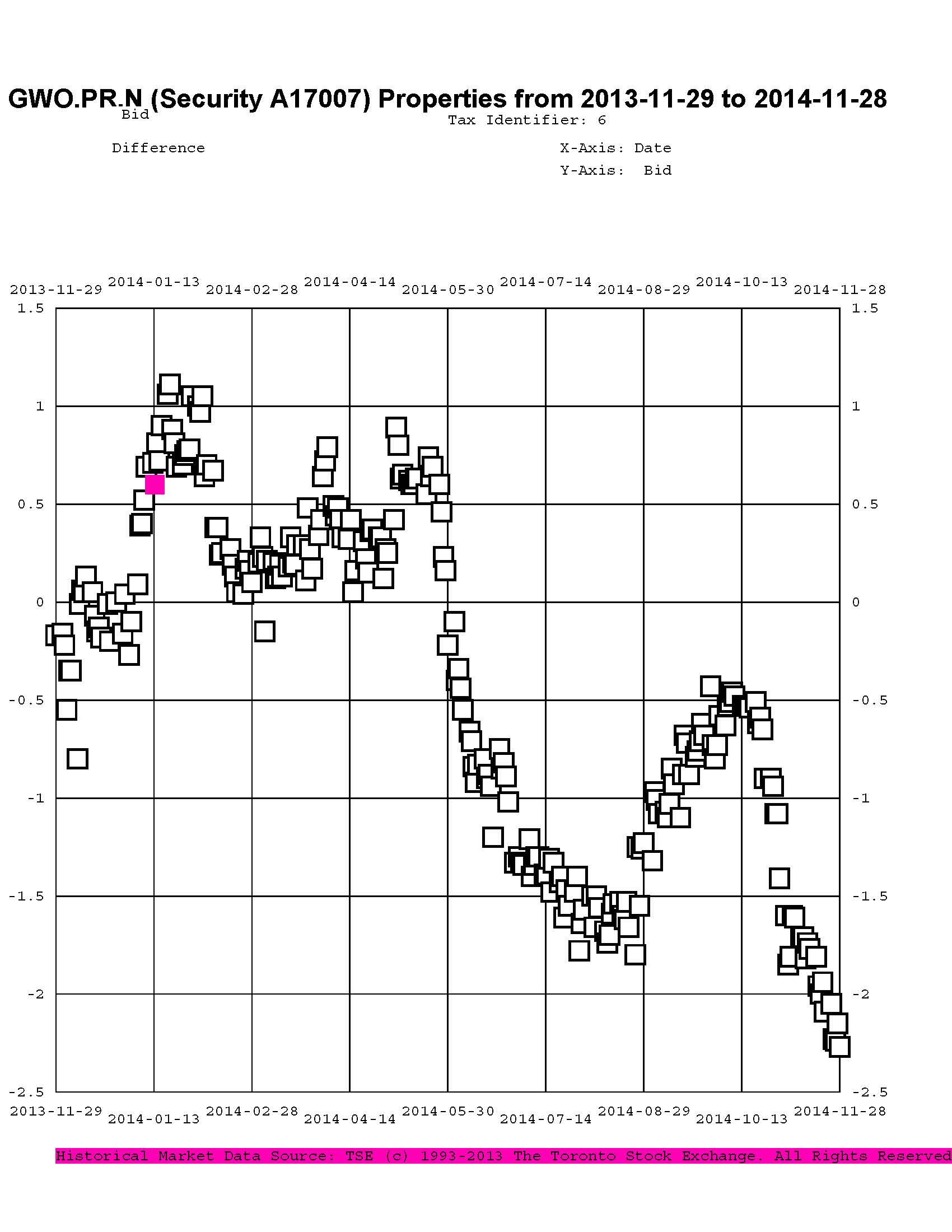
GWO.PR.N FixedReset 42,509 Nesbitt crossed 35,000 at 21.82.
YTW SCENARIO
Maturity Type : Hard Maturity
Maturity Date : 2025-01-31
Maturity Price : 25.00
Evaluated at bid price : 21.77
Bid-YTW : 4.55 %
There were 17 other index-included issues trading in excess of 10,000 shares.
Wide Spread Highlights
Issue Index Quote Data and Yield Notes
MFC.PR.F FixedReset Quote: 22.05 – 22.80
Spot Rate : 0.7500
Average : 0.4689

YTW SCENARIO
Maturity Type : Hard Maturity
Maturity Date : 2025-01-31
Maturity Price : 25.00
Evaluated at bid price : 22.05
Bid-YTW : 4.65 %

TRP.PR.C FixedReset Quote: 21.01 – 21.35
Spot Rate : 0.3400
Average : 0.2254

YTW SCENARIO
Maturity Type : Limit Maturity
Maturity Date : 2044-10-10
Maturity Price : 21.01
Evaluated at bid price : 21.01
Bid-YTW : 3.73 %

IGM.PR.B Perpetual-Premium Quote: 25.80 – 26.21
Spot Rate : 0.4100
Average : 0.3157

YTW SCENARIO
Maturity Type : Call
Maturity Date : 2018-12-31
Maturity Price : 25.00
Evaluated at bid price : 25.80
Bid-YTW : 4.99 %

SLF.PR.B Deemed-Retractible Quote: 23.51 – 23.77
Spot Rate : 0.2600
Average : 0.1796

YTW SCENARIO
Maturity Type : Hard Maturity
Maturity Date : 2025-01-31
Maturity Price : 25.00
Evaluated at bid price : 23.51
Bid-YTW : 5.62 %

CU.PR.G Perpetual-Discount Quote: 22.17 – 22.40
Spot Rate : 0.2300
Average : 0.1581

YTW SCENARIO
Maturity Type : Limit Maturity
Maturity Date : 2044-10-10
Maturity Price : 21.85
Evaluated at bid price : 22.17
Bid-YTW : 5.12 %

SLF.PR.D Deemed-Retractible Quote: 22.04 – 22.28
Spot Rate : 0.2400
Average : 0.1721

YTW SCENARIO
Maturity Type : Hard Maturity
Maturity Date : 2025-01-31
Maturity Price : 25.00
Evaluated at bid price : 22.04
Bid-YTW : 6.06 %

Issue Comments

DBRS Withdraws Rating on INE

DBRS has announced that it:

has today discontinued the Issuer Rating and Preferred Shares rating for Innergex Renewable Energy Inc. (the Company). DBRS notes that this action is unrelated to the credit profile of the Company.

This is an unsolicited rating. This rating was not initiated at the request of the issuer or rated entity and did not include participation by the issuer or any related third party.

DBRS had downgraded the preferreds to Pfd-4(high) in March, 2013.

Innergex has two issues outstanding, INE.PR.A, a FixedReset 5.00%+279 that commenced trading in September 2010 and INE.PR.C, a Straight Perpetual, 5.75%, that commenced trading in December 2012.

The two issues continue to be rated P-3 by S&P.