Market Action

April 8, 2010

What’s a Grecian earn?:

Greece will probably be forced to request a financial rescue after a European Union aid pledge failed to stop Greek borrowing costs from surging, said economists at AXA Group and Nomura International Plc.

Greek bonds dropped for a seventh day today, driving up the yield on the 10-year security to 7.5 percent, with Prime Minister George Papandreou’s government needing to sell 11.6 billion euros ($15.4 billion) of debt by the end of May. The yield premium over benchmark German bonds widened to the most since the euro’s debut in 1999, based on Bloomberg generic data.

Let’s have a big hand for the newly Assiduous Reader mega56. Only been studying the pref market for twenty minutes and he’s already on the right track!

Regarding perpetuals and rising interest rates. I’ve read in many places that perpetuals are risky during a phase where rates are rising, stay away. When I’m looking at the numbers, I don’t see it.

Example: CM.PR.E currently sits at 22.43 @$1.40
a. if it gets called (worst), you’ve got a nice gain @25.00
b. if price drops with rising rates, you still get the dividend

I’m missing the downside here.

Geez, at this rate he’ll be my competition in a few weeks!

There was some testimony to the Crisis Committee regarding Citigroup and CDOs:

Nobody could have predicted that the bank’s highest-rated collateralized debt obligations — created by repackaging mortgage bonds into new securities — would lose so much money, Prince said. The chief risk officer didn’t understand the risks, nor did Citigroup’s senior traders and bankers, he said.

“Everyone, including our risk managers, other banks and CDO structurers, all believed that these securities held virtually no risk,” Prince, 60, said. “It is hard for me to fault the traders who made the decisions to retain these positions on Citi’s books.”

Not so hard for me! Assiduous Readers will know that CDOs have been in the news quite a lot lately:Tranche Retention in the sub-prime CDO Market, The Story of the CDO Market Meltdown and Hull & White on AAA Tranches of Subprime. In the last paper, Hull & White demonstrated that CDO risk evaluation was faulty as the distributions of the risks of the securities held in the CDO were significantly different from the distributions of the risks of more normal instruments.

But it doesn’t matter. It really doesn’t matter. It happened this time and it will happen next time. Traders are business school smiley-boys, who have the job of quoting securities, rolling over their inventory, making the spread each time and telling the customer whatever he wants to hear. Whenever they suffer from delusions of intelligence, trouble ensues. Trading is different from investing and the two simply don’t mix very well. The key mistake at Citigroup – and elsewhere – was allowing traders to accumulate aged inventory, and not to impose a capital charge on this aged inventory.

The Ontario government’s plan to reduce generic drug costs has led DBRS to put Shoppers’ Drug Mart on review negative. With respect to the plan itself, I’m amused by the existence of trailer fees in the drug business:

Eliminating abuse of the system by ending so-called ‘professional allowances’ – payments generic drug companies make to pharmacy owners intended to fund patient services, but are instead being used by many pharmacies as rebates to fund fringe benefits, bonuses, overhead costs and boost profits

… but perplexed by …

Lowering the cost of generic drugs by at least 50%, to 25% of the cost of the original brand name drug for Ontario’s public drug system, private employer drug plans, and people who pay for drugs out-of-pocket, saving taxpayers millions

How is this possible? Is there no competition for generic drugs? Has the drug plan been run with no attempt to lower the price to whatever the manufacturers will bear? Or has the price been supported by a dispensing oligopoly? How on earth is it even possible to reduce costs by 50% by simple government fiat? Shoppers’ response to the plan has the amusing phrase:

Key tenants of these proposals included:

… indicating illiteracy, but no real arguments about the economics of the Ontario drug plan paying for, you know, drugs.

The Canadian preferred share market continued to see heavy trading today and, in a sharp reversal of recent experience, PerpetualDiscounts gained 50bp while FixedResets fell 25bp, bringing yields on the latter up to 3.83%. Good volatility is evident on the Performance highlights table; FixedResets continue to dominate volume.

HIMIPref™ Preferred Indices
These values reflect the December 2008 revision of the HIMIPref™ Indices

Values are provisional and are finalized monthly
Index Mean
Current
Yield
(at bid)
Median
YTW
Median
Average
Trading
Value
Median
Mod Dur
(YTW)
Issues Day’s Perf. Index Value
Ratchet 2.63 % 2.67 % 55,159 20.77 1 0.0000 % 2,105.2
FixedFloater 4.89 % 3.01 % 46,671 20.15 1 0.6787 % 3,234.8
Floater 1.91 % 1.66 % 45,775 23.43 4 -0.0847 % 2,419.1
OpRet 4.88 % 3.58 % 104,919 1.11 10 0.1050 % 2,314.7
SplitShare 6.36 % -2.41 % 134,956 0.08 2 0.2197 % 2,146.5
Interest-Bearing 0.00 % 0.00 % 0 0.00 0 0.1050 % 2,116.5
Perpetual-Premium 5.86 % 4.76 % 33,713 15.90 2 -0.1014 % 1,838.8
Perpetual-Discount 6.23 % 6.26 % 190,379 13.57 76 0.4964 % 1,709.4
FixedReset 5.45 % 3.83 % 433,559 3.67 43 -0.2519 % 2,176.8
Performance Highlights
Issue Index Change Notes
RY.PR.L FixedReset -1.74 % YTW SCENARIO
Maturity Type : Call
Maturity Date : 2014-03-26
Maturity Price : 25.00
Evaluated at bid price : 26.60
Bid-YTW : 4.04 %
IAG.PR.F Perpetual-Discount -1.52 % YTW SCENARIO
Maturity Type : Limit Maturity
Maturity Date : 2040-04-08
Maturity Price : 23.12
Evaluated at bid price : 23.27
Bid-YTW : 6.44 %
RY.PR.I FixedReset -1.33 % YTW SCENARIO
Maturity Type : Call
Maturity Date : 2014-03-26
Maturity Price : 25.00
Evaluated at bid price : 25.96
Bid-YTW : 4.11 %
GWL.PR.O Perpetual-Premium -1.19 % YTW SCENARIO
Maturity Type : Limit Maturity
Maturity Date : 2040-04-08
Maturity Price : 24.56
Evaluated at bid price : 25.00
Bid-YTW : 4.76 %
GWO.PR.F Perpetual-Discount -1.04 % YTW SCENARIO
Maturity Type : Limit Maturity
Maturity Date : 2040-04-08
Maturity Price : 23.44
Evaluated at bid price : 23.75
Bid-YTW : 6.25 %
BAM.PR.B Floater -1.01 % YTW SCENARIO
Maturity Type : Limit Maturity
Maturity Date : 2040-04-08
Maturity Price : 17.57
Evaluated at bid price : 17.57
Bid-YTW : 2.25 %
CM.PR.H Perpetual-Discount 1.00 % YTW SCENARIO
Maturity Type : Limit Maturity
Maturity Date : 2040-04-08
Maturity Price : 19.12
Evaluated at bid price : 19.12
Bid-YTW : 6.30 %
PWF.PR.O Perpetual-Discount 1.03 % YTW SCENARIO
Maturity Type : Limit Maturity
Maturity Date : 2040-04-08
Maturity Price : 22.44
Evaluated at bid price : 22.55
Bid-YTW : 6.45 %
PWF.PR.H Perpetual-Discount 1.03 % YTW SCENARIO
Maturity Type : Limit Maturity
Maturity Date : 2040-04-08
Maturity Price : 22.23
Evaluated at bid price : 22.51
Bid-YTW : 6.39 %
NA.PR.M Perpetual-Premium 1.04 % YTW SCENARIO
Maturity Type : Limit Maturity
Maturity Date : 2040-04-08
Maturity Price : 24.04
Evaluated at bid price : 24.25
Bid-YTW : 6.18 %
TD.PR.O Perpetual-Discount 1.05 % YTW SCENARIO
Maturity Type : Limit Maturity
Maturity Date : 2040-04-08
Maturity Price : 20.21
Evaluated at bid price : 20.21
Bid-YTW : 6.02 %
POW.PR.A Perpetual-Discount 1.06 % YTW SCENARIO
Maturity Type : Limit Maturity
Maturity Date : 2040-04-08
Maturity Price : 21.63
Evaluated at bid price : 21.88
Bid-YTW : 6.43 %
BMO.PR.L Perpetual-Discount 1.09 % YTW SCENARIO
Maturity Type : Limit Maturity
Maturity Date : 2040-04-08
Maturity Price : 23.95
Evaluated at bid price : 24.16
Bid-YTW : 6.09 %
CM.PR.J Perpetual-Discount 1.11 % YTW SCENARIO
Maturity Type : Limit Maturity
Maturity Date : 2040-04-08
Maturity Price : 18.15
Evaluated at bid price : 18.15
Bid-YTW : 6.22 %
TD.PR.P Perpetual-Discount 1.13 % YTW SCENARIO
Maturity Type : Limit Maturity
Maturity Date : 2040-04-08
Maturity Price : 21.27
Evaluated at bid price : 21.55
Bid-YTW : 6.09 %
BMO.PR.H Perpetual-Discount 1.15 % YTW SCENARIO
Maturity Type : Limit Maturity
Maturity Date : 2040-04-08
Maturity Price : 21.90
Evaluated at bid price : 21.90
Bid-YTW : 6.15 %
CM.PR.G Perpetual-Discount 1.17 % YTW SCENARIO
Maturity Type : Limit Maturity
Maturity Date : 2040-04-08
Maturity Price : 21.60
Evaluated at bid price : 21.60
Bid-YTW : 6.27 %
IAG.PR.E Perpetual-Discount 1.23 % YTW SCENARIO
Maturity Type : Limit Maturity
Maturity Date : 2040-04-08
Maturity Price : 23.62
Evaluated at bid price : 23.80
Bid-YTW : 6.35 %
ELF.PR.F Perpetual-Discount 1.32 % YTW SCENARIO
Maturity Type : Limit Maturity
Maturity Date : 2040-04-08
Maturity Price : 19.20
Evaluated at bid price : 19.20
Bid-YTW : 6.95 %
PWF.PR.L Perpetual-Discount 1.37 % YTW SCENARIO
Maturity Type : Limit Maturity
Maturity Date : 2040-04-08
Maturity Price : 20.01
Evaluated at bid price : 20.01
Bid-YTW : 6.39 %
BNS.PR.J Perpetual-Discount 1.41 % YTW SCENARIO
Maturity Type : Limit Maturity
Maturity Date : 2040-04-08
Maturity Price : 21.60
Evaluated at bid price : 21.60
Bid-YTW : 6.10 %
RY.PR.B Perpetual-Discount 1.50 % YTW SCENARIO
Maturity Type : Limit Maturity
Maturity Date : 2040-04-08
Maturity Price : 19.60
Evaluated at bid price : 19.60
Bid-YTW : 6.09 %
CM.PR.I Perpetual-Discount 1.95 % YTW SCENARIO
Maturity Type : Limit Maturity
Maturity Date : 2040-04-08
Maturity Price : 18.86
Evaluated at bid price : 18.86
Bid-YTW : 6.25 %
BNS.PR.O Perpetual-Discount 2.09 % YTW SCENARIO
Maturity Type : Limit Maturity
Maturity Date : 2040-04-08
Maturity Price : 22.85
Evaluated at bid price : 23.00
Bid-YTW : 6.10 %
Volume Highlights
Issue Index Shares
Traded
Notes
TD.PR.K FixedReset 112,275 National bought blocks of 12,000 and 10,000 from GMP at 27.61; Nesbitt bought blocks of 25,000 and 23,000 from GMP at the same price.
YTW SCENARIO
Maturity Type : Call
Maturity Date : 2014-08-30
Maturity Price : 25.00
Evaluated at bid price : 27.40
Bid-YTW : 3.80 %
MFC.PR.D FixedReset 80,115 Desjardins crossed two blocks of 25,000 shares, one at 27.85, the other at 27.84. YTW SCENARIO
Maturity Type : Call
Maturity Date : 2014-07-19
Maturity Price : 25.00
Evaluated at bid price : 27.77
Bid-YTW : 3.93 %
RY.PR.Y FixedReset 76,932 RBC crossed 15,000 and 30,000, both at 27.65.
YTW SCENARIO
Maturity Type : Call
Maturity Date : 2014-12-24
Maturity Price : 25.00
Evaluated at bid price : 27.61
Bid-YTW : 3.90 %
RY.PR.A Perpetual-Discount 76,810 Nesbitt crossed 50,000 at 18.65.
YTW SCENARIO
Maturity Type : Limit Maturity
Maturity Date : 2040-04-08
Maturity Price : 18.65
Evaluated at bid price : 18.65
Bid-YTW : 6.06 %
TD.PR.I FixedReset 72,985 Nesbitt bought 25,200 from Raymond James at 27.65; anonymous crossed (?) 10,000 at 27.51.
YTW SCENARIO
Maturity Type : Call
Maturity Date : 2014-08-30
Maturity Price : 25.00
Evaluated at bid price : 27.36
Bid-YTW : 3.83 %
BNS.PR.X FixedReset 70,160 RBC crossed 50,000 at 27.40; Desjardins crossed 10,000 at 27.42.
YTW SCENARIO
Maturity Type : Call
Maturity Date : 2014-05-25
Maturity Price : 25.00
Evaluated at bid price : 27.40
Bid-YTW : 3.72 %
There were 55 other index-included issues trading in excess of 10,000 shares.
Market Action

April 7, 2010

Think we’ve got it tough in the Canadian preferred share market? Be grateful you’re not holding Greek bonds!

U.S. and European stocks fell, led by commodity producers as oil and copper dropped, while the premium investors demand to hold Greek bonds widened to the most since 1998 on speculation the nation may default.

Greece’s 10-year bond yields rose 0.16 percentage point to 7.14 percent and the yield premium to German debt widened to 4.03 percentage points, the most since before the euro was introduced in 1999.

How bad is it? CDSs on Greece are now trading above terrorist levels:

Swaps tied to Greece rose to 415 basis points today while those on Iceland traded at about 400 basis points, according to Markit data. The North American Markit index climbed the most since March 22 amid investor concern that contagion from a Greece default could spread to other assets, said Gavan Nolan, an analyst at Markit Group in London.

Remember Jim Kelsoe, proud portfolio manager of the worst bond fund in the history of the universe (so far)? He was last mentioned on PrefBlog on May 9, 2008. Now the SEC is alleging that his fund returns were, in fact, overstated:

The SEC’s Division of Enforcement alleges that Morgan Keegan failed to employ reasonable procedures to internally price the portfolio securities in five funds managed by Morgan Asset, and consequently did not calculate accurate “net asset values” (NAVs) for the funds. Morgan Keegan recklessly published these inaccurate daily NAVs, and sold shares to investors based on the inflated prices.

“This scheme had two architects — a portfolio manager responsible for lies to investors about the true value of the assets in his funds, and a head of fund accounting who turned a blind eye to the fund’s bogus valuation process,” said Robert Khuzami, Director of the SEC’s Division of Enforcement.

William Hicks, Associate Director in the SEC’s Atlanta Regional Office, said, “This misconduct masked from investors the true impact of the subprime mortgage meltdown on these funds.”

According to the Commission’s order instituting administrative proceedings, the SEC’s Enforcement Division alleges that James C. Kelsoe, Jr., the portfolio manager of the funds and an employee of Morgan Asset and Morgan Keegan, arbitrarily instructed the firm’s Fund Accounting department to make “price adjustments” that increased the fair values of certain portfolio securities. The price adjustments ignored lower values for those same securities quoted by various dealers as part of the pricing validation process. The Enforcement Division further alleges that Kelsoe actively screened and manipulated the pricing quotes obtained from at least one broker-dealer. With many of the funds’ securities backed by subprime mortgages, Kelsoe’s actions fraudulently prevented a reduction in the NAVs of the funds that otherwise should have occurred as a result of the deterioration in the subprime securities market.

Lots of winners and losers on a volatile day of continued heavy volume in which selling pressure on PerpetualDiscounts eased off a bit … they were down only 2bp today which, considering recent returns, is practically a win! It is interesting to speculate that the buying came from switches out of FixedResets, as they were down 16bp on the day to take yields up to 3.74%. FixedResets again scored a shut-out on the volume table.

PerpetualDiscounts now yield 6.30%, equivalent to 8.82% interest at the standard equivalency factor of 1.4x. Long Corporates continue their insouciance towards whatever it is that’s causing the current paroxysm in the preferred share market, having returned +8bp (total return) on the month-to-date and are now yielding about 5.7% (maybe a bit over?). Thus, the pre-tax interest-equivalent spread (also called the Seniority Spread) stands at about 310bp, rocketting upwards from the +285 bp reported March 31 and pushing well over what had been until recently the one-year high in the low 290s.

HIMIPref™ Preferred Indices
These values reflect the December 2008 revision of the HIMIPref™ Indices

Values are provisional and are finalized monthly
Index Mean
Current
Yield
(at bid)
Median
YTW
Median
Average
Trading
Value
Median
Mod Dur
(YTW)
Issues Day’s Perf. Index Value
Ratchet 2.63 % 2.67 % 55,865 20.78 1 -2.4091 % 2,105.2
FixedFloater 4.92 % 3.04 % 48,473 20.10 1 -0.3157 % 3,212.9
Floater 1.91 % 1.66 % 46,075 23.43 4 -0.0605 % 2,421.2
OpRet 4.88 % 3.57 % 107,784 1.11 10 0.0733 % 2,312.2
SplitShare 6.37 % -2.63 % 135,348 0.08 2 -0.1097 % 2,141.8
Interest-Bearing 0.00 % 0.00 % 0 0.00 0 0.0733 % 2,114.3
Perpetual-Premium 5.86 % 3.14 % 33,377 0.64 2 -0.3511 % 1,840.7
Perpetual-Discount 6.26 % 6.30 % 188,334 13.51 76 -0.0210 % 1,700.9
FixedReset 5.44 % 3.74 % 422,758 3.68 43 -0.1569 % 2,182.3
Performance Highlights
Issue Index Change Notes
BAM.PR.E Ratchet -2.41 % YTW SCENARIO
Maturity Type : Limit Maturity
Maturity Date : 2040-04-07
Maturity Price : 21.80
Evaluated at bid price : 21.47
Bid-YTW : 2.67 %
IAG.PR.E Perpetual-Discount -2.08 % YTW SCENARIO
Maturity Type : Limit Maturity
Maturity Date : 2040-04-07
Maturity Price : 23.35
Evaluated at bid price : 23.51
Bid-YTW : 6.43 %
IAG.PR.A Perpetual-Discount -1.89 % YTW SCENARIO
Maturity Type : Limit Maturity
Maturity Date : 2040-04-07
Maturity Price : 18.20
Evaluated at bid price : 18.20
Bid-YTW : 6.38 %
HSB.PR.E FixedReset -1.68 % YTW SCENARIO
Maturity Type : Call
Maturity Date : 2014-07-30
Maturity Price : 25.00
Evaluated at bid price : 27.50
Bid-YTW : 4.16 %
HSB.PR.C Perpetual-Discount -1.68 % YTW SCENARIO
Maturity Type : Limit Maturity
Maturity Date : 2040-04-07
Maturity Price : 20.50
Evaluated at bid price : 20.50
Bid-YTW : 6.28 %
PWF.PR.H Perpetual-Discount -1.57 % YTW SCENARIO
Maturity Type : Limit Maturity
Maturity Date : 2040-04-07
Maturity Price : 21.81
Evaluated at bid price : 22.28
Bid-YTW : 6.45 %
HSB.PR.D Perpetual-Discount -1.33 % YTW SCENARIO
Maturity Type : Limit Maturity
Maturity Date : 2040-04-07
Maturity Price : 20.02
Evaluated at bid price : 20.02
Bid-YTW : 6.30 %
GWO.PR.G Perpetual-Discount -1.20 % YTW SCENARIO
Maturity Type : Limit Maturity
Maturity Date : 2040-04-07
Maturity Price : 20.56
Evaluated at bid price : 20.56
Bid-YTW : 6.38 %
CU.PR.A Perpetual-Discount -1.15 % YTW SCENARIO
Maturity Type : Limit Maturity
Maturity Date : 2040-04-07
Maturity Price : 23.73
Evaluated at bid price : 24.03
Bid-YTW : 6.11 %
TRP.PR.A FixedReset -1.13 % YTW SCENARIO
Maturity Type : Call
Maturity Date : 2015-01-30
Maturity Price : 25.00
Evaluated at bid price : 25.31
Bid-YTW : 4.36 %
MFC.PR.C Perpetual-Discount 1.02 % YTW SCENARIO
Maturity Type : Limit Maturity
Maturity Date : 2040-04-07
Maturity Price : 17.90
Evaluated at bid price : 17.90
Bid-YTW : 6.36 %
SLF.PR.E Perpetual-Discount 1.14 % YTW SCENARIO
Maturity Type : Limit Maturity
Maturity Date : 2040-04-07
Maturity Price : 17.71
Evaluated at bid price : 17.71
Bid-YTW : 6.41 %
BAM.PR.R FixedReset 1.34 % YTW SCENARIO
Maturity Type : Limit Maturity
Maturity Date : 2040-04-07
Maturity Price : 23.11
Evaluated at bid price : 25.03
Bid-YTW : 5.13 %
SLF.PR.D Perpetual-Discount 1.45 % YTW SCENARIO
Maturity Type : Limit Maturity
Maturity Date : 2040-04-07
Maturity Price : 17.55
Evaluated at bid price : 17.55
Bid-YTW : 6.40 %
MFC.PR.B Perpetual-Discount 1.59 % YTW SCENARIO
Maturity Type : Limit Maturity
Maturity Date : 2040-04-07
Maturity Price : 18.57
Evaluated at bid price : 18.57
Bid-YTW : 6.33 %
RY.PR.C Perpetual-Discount 1.77 % YTW SCENARIO
Maturity Type : Limit Maturity
Maturity Date : 2040-04-07
Maturity Price : 18.95
Evaluated at bid price : 18.95
Bid-YTW : 6.17 %
SLF.PR.C Perpetual-Discount 1.85 % YTW SCENARIO
Maturity Type : Limit Maturity
Maturity Date : 2040-04-07
Maturity Price : 17.60
Evaluated at bid price : 17.60
Bid-YTW : 6.38 %
CL.PR.B Perpetual-Discount 1.92 % YTW SCENARIO
Maturity Type : Limit Maturity
Maturity Date : 2040-04-07
Maturity Price : 24.09
Evaluated at bid price : 24.40
Bid-YTW : 6.45 %
Volume Highlights
Issue Index Shares
Traded
Notes
TD.PR.S FixedReset 404,505 Nesbitt crossed 400,000 at 25.80. Nice ticket!
YTW SCENARIO
Maturity Type : Call
Maturity Date : 2013-08-30
Maturity Price : 25.00
Evaluated at bid price : 25.76
Bid-YTW : 3.96 %
TD.PR.G FixedReset 216,205 Nesbitt crossed 200,000 at 27.50.
YTW SCENARIO
Maturity Type : Call
Maturity Date : 2014-05-30
Maturity Price : 25.00
Evaluated at bid price : 27.58
Bid-YTW : 3.53 %
TD.PR.K FixedReset 130,956 Nesbitt crossed 100,000 at 27.61.
YTW SCENARIO
Maturity Type : Call
Maturity Date : 2014-08-30
Maturity Price : 25.00
Evaluated at bid price : 27.65
Bid-YTW : 3.56 %
RY.PR.P FixedReset 124,140 RBC bought 25,000 from anonymous at 27.48, then crossed 37,400 at 27.50.
YTW SCENARIO
Maturity Type : Call
Maturity Date : 2014-03-26
Maturity Price : 25.00
Evaluated at bid price : 27.50
Bid-YTW : 3.78 %
TD.PR.I FixedReset 122,598 Nesbitt crossed 100,000 at 27.61.
YTW SCENARIO
Maturity Type : Call
Maturity Date : 2014-08-30
Maturity Price : 25.00
Evaluated at bid price : 27.63
Bid-YTW : 3.58 %
TRP.PR.A FixedReset 120,075 RBC bought 33,300 from anonymous at 25.51; Scotia bought 13,000 from anonymous at 25.50. RBC crossed 28,400 at 25.51.
YTW SCENARIO
Maturity Type : Call
Maturity Date : 2015-01-30
Maturity Price : 25.00
Evaluated at bid price : 25.31
Bid-YTW : 4.36 %
SLF.PR.F FixedReset 108,165 RBC bought 15,000 from anonymous at 27.10; RBC crossed two blocks of 30,000 each at 27.20; Desjardins crossed 20,000 at 27.20.
YTW SCENARIO
Maturity Type : Call
Maturity Date : 2014-07-30
Maturity Price : 25.00
Evaluated at bid price : 27.17
Bid-YTW : 3.88 %
BMO.PR.P FixedReset 101,068 Scotia crossed blocks of 58,300 and 30,000 at 26.55.
YTW SCENARIO
Maturity Type : Call
Maturity Date : 2015-03-27
Maturity Price : 25.00
Evaluated at bid price : 26.55
Bid-YTW : 4.16 %
There were 69 other index-included issues trading in excess of 10,000 shares.
Regulation

SEC Proposes ABS Tranche Retention Requirement

The Securities and Exchange Commission has proposed a new rule, Asset Backed Securities:

We are proposing significant revisions to Regulation AB and other rules regarding the offering process, disclosure and reporting for asset-backed securities. Our proposals would revise filing deadlines for ABS offerings to provide investors with more time to consider transaction-specific information, including information about the pool assets. Our proposals also would repeal the current credit ratings references in shelf eligibility criteria for asset-backed issuers and establish new shelf eligibility criteria that would include, among other things, a requirement that the sponsor retain a portion of each tranche of the securities that are sold and a requirement that the issuer undertake to file Exchange Act reports on an ongoing basis so long as its public securities are outstanding. We also are proposing to require that, with some exceptions, prospectuses for public offerings of asset-backed securities and ongoing Exchange Act reports contain specified asset-level information about each of the assets in the pool. The asset-level information would be provided according to proposed standards and in a tagged data format using eXtensible Markup Language (XML). In addition, we are proposing to require, along with the prospectus filing, the filing of a computer program of the contractual cash flow provisions expressed as downloadable source code in Python, a commonly used open source interpretive programming language. We are proposing new information requirements for the safe harbors for exempt offerings and resales of asset-backed securities and are also proposing a number of other revisions to our rules applicable to asset-backed securities.

Some of this stuff is sort-of good, for example Our proposals would revise filing deadlines for ABS offerings to provide investors with more time to consider transaction-specific information, including information about the pool assets, but appears to intend a more stringent process for ABS than for actual bonds. When an institutional investor is offered a new issue, for example, only bare-bones information is available: generally just the coupon (perhaps expressed as a spread) and term. There might be some mention of special features.

However, for these offerings, documentation is simply not available. You want to read through the pricing supplement or the prospectus? Tough luck, Charlie, ain’t got it. You want some or not? If you wait for the documentation, the issue’s been sold out by the time you get it.

Thus, new issue bond investors are typically entirely reliant on the knowledge and good will of the underwriters’ salesmen or, to put it another way, new issue bond investors are fools.

Of more interest, however, is the tranche retention requirement: Our proposals also would repeal the current credit ratings references in shelf eligibility criteria for asset-backed issuers and establish new shelf eligibility criteria that would include, among other things, a requirement that the sponsor retain a portion of each tranche of the securities that are sold and a requirement that the issuer undertake to file Exchange Act reports on an ongoing basis so long as its public securities are outstanding.

Tranche retention has become the rallying cry throughout the crisis for those who believe that the world would be a much better place if only there were more rules. John Hull supports tranche retention but admits that tranche retention was already in effect throughout the crisis, albeit in different parts of the underwriting firm. The opposite approach, encouraging arm’s length sales to third parties, was urged by Krahen and Wilde in 2005, as cited in the story of the CDO meltdown. Note that a major problem that exacerbated the crisis was collateral substitution in CDOs in which – effectively – investment decisions for a CDO were made primarily for the benefit of the most junior tranche; mandatory tranche retention will exacerbate, not address, this problem; it should be noted in mitigation, however, that the SEC proposes to require that a portion of each tranche be retained.

Ain’t no substitute for forcing long term investors to think! Since the sell-side is congenitally incapable of such a thing, I continue to suggest that the regulatory regime focus on disaggregating the trading part of the street from the investing side; the Volcker Rule is overkill, but allowing financial institutions to choose – one choice per institution! – between regulatory capital regimes intended to penalize aged inventories for traders, and penalize trading activities by investors will go very far to actually accomplishing something.

However, back to the SEC’s proposal. As usual, the SEC (and other American institutions, such as the Fed) the SEC at least pays lip service to the idea that it takes two to make an argument, as opposed to the continuous intellectual dishonesty forthcoming from, for instance, OSFI. Thus – and I trust Assiduous Readers are sitting down – opposing viewpoints are discussed and heavily footnoted:

Risk retention requirements are being considered in the U.S. and internationally. In the U.S., proposals with such requirements have come in several different forms.108 Risk retention requirements have recently garnered support.109 On the other hand, some are concerned that mandatory risk retention will not necessarily result in improved asset quality, may not be calibrated to reflect the risk in any given pool and across different asset classes, and may conflict with various other goals and purposes of securitization.110

(110) See, e.g., comment letter from American Securitization Forum and comment letter from American Bar Association on the FDIC Securitization Proposal.

I believe that the American Securitization Forum’s letter is this one, similarly I believe that this is the ABA letter.

Market Action

April 6, 2010

With help from the clerk of the committee, I can now post a link to The Standing Committee on Government Agencies Report on the OSC.

Preferred shares took a massive whacking today on very high volume. PerpetualDiscounts lost 126bp, while FixedResets were down 43bp – about what one might expect, given the respective Modified Durations. FixedResets again scored a shut-out on the volume highlights table.

That’s the worst day in over a year for PerpetualDiscounts. There were two worse days in 2009, March 5 and March 9. There were 17 worse days in 2008, eight of them in November.

The bright side of this is that I anticipate increased opportunities for heavy relative-values trading. My reports of candidate trades are getting lengthier…

HIMIPref™ Preferred Indices
These values reflect the December 2008 revision of the HIMIPref™ Indices

Values are provisional and are finalized monthly
Index Mean
Current
Yield
(at bid)
Median
YTW
Median
Average
Trading
Value
Median
Mod Dur
(YTW)
Issues Day’s Perf. Index Value
Ratchet 2.56 % 2.62 % 56,260 20.96 1 0.0000 % 2,157.2
FixedFloater 4.91 % 3.03 % 50,268 20.13 1 -0.5830 % 3,223.1
Floater 1.90 % 1.66 % 46,440 23.43 4 0.0000 % 2,422.6
OpRet 4.88 % 3.67 % 108,295 1.12 10 -0.0150 % 2,310.5
SplitShare 6.37 % -0.57 % 137,129 0.08 2 0.0879 % 2,144.1
Interest-Bearing 0.00 % 0.00 % 0 0.00 0 -0.0150 % 2,112.8
Perpetual-Premium 5.79 % 3.12 % 33,691 0.64 2 -0.8158 % 1,847.2
Perpetual-Discount 6.25 % 6.29 % 187,978 13.49 76 -1.2576 % 1,701.3
FixedReset 5.42 % 3.69 % 408,963 3.68 43 -0.4343 % 2,185.7
Performance Highlights
Issue Index Change Notes
CL.PR.B Perpetual-Discount -3.39 % YTW SCENARIO
Maturity Type : Limit Maturity
Maturity Date : 2040-04-06
Maturity Price : 23.66
Evaluated at bid price : 23.94
Bid-YTW : 6.57 %
SLF.PR.C Perpetual-Discount -2.92 % YTW SCENARIO
Maturity Type : Limit Maturity
Maturity Date : 2040-04-06
Maturity Price : 17.28
Evaluated at bid price : 17.28
Bid-YTW : 6.50 %
BNS.PR.K Perpetual-Discount -2.78 % YTW SCENARIO
Maturity Type : Limit Maturity
Maturity Date : 2040-04-06
Maturity Price : 19.24
Evaluated at bid price : 19.24
Bid-YTW : 6.26 %
NA.PR.L Perpetual-Discount -2.75 % YTW SCENARIO
Maturity Type : Limit Maturity
Maturity Date : 2040-04-06
Maturity Price : 19.45
Evaluated at bid price : 19.45
Bid-YTW : 6.35 %
ELF.PR.G Perpetual-Discount -2.56 % YTW SCENARIO
Maturity Type : Limit Maturity
Maturity Date : 2040-04-06
Maturity Price : 17.10
Evaluated at bid price : 17.10
Bid-YTW : 6.99 %
PWF.PR.E Perpetual-Discount -2.54 % YTW SCENARIO
Maturity Type : Limit Maturity
Maturity Date : 2040-04-06
Maturity Price : 21.51
Evaluated at bid price : 21.51
Bid-YTW : 6.53 %
RY.PR.C Perpetual-Discount -2.41 % YTW SCENARIO
Maturity Type : Limit Maturity
Maturity Date : 2040-04-06
Maturity Price : 18.62
Evaluated at bid price : 18.62
Bid-YTW : 6.28 %
RY.PR.G Perpetual-Discount -2.22 % YTW SCENARIO
Maturity Type : Limit Maturity
Maturity Date : 2040-04-06
Maturity Price : 18.46
Evaluated at bid price : 18.46
Bid-YTW : 6.19 %
BAM.PR.R FixedReset -2.18 % YTW SCENARIO
Maturity Type : Limit Maturity
Maturity Date : 2040-04-06
Maturity Price : 22.99
Evaluated at bid price : 24.70
Bid-YTW : 5.21 %
SLF.PR.A Perpetual-Discount -2.16 % YTW SCENARIO
Maturity Type : Limit Maturity
Maturity Date : 2040-04-06
Maturity Price : 18.53
Evaluated at bid price : 18.53
Bid-YTW : 6.47 %
PWF.PR.I Perpetual-Discount -2.14 % YTW SCENARIO
Maturity Type : Limit Maturity
Maturity Date : 2040-04-06
Maturity Price : 23.48
Evaluated at bid price : 23.78
Bid-YTW : 6.43 %
PWF.PR.F Perpetual-Discount -2.14 % YTW SCENARIO
Maturity Type : Limit Maturity
Maturity Date : 2040-04-06
Maturity Price : 20.62
Evaluated at bid price : 20.62
Bid-YTW : 6.51 %
RY.PR.E Perpetual-Discount -2.07 % YTW SCENARIO
Maturity Type : Limit Maturity
Maturity Date : 2040-04-06
Maturity Price : 18.46
Evaluated at bid price : 18.46
Bid-YTW : 6.19 %
RY.PR.W Perpetual-Discount -2.06 % YTW SCENARIO
Maturity Type : Limit Maturity
Maturity Date : 2040-04-06
Maturity Price : 20.43
Evaluated at bid price : 20.43
Bid-YTW : 6.09 %
BMO.PR.J Perpetual-Discount -2.04 % YTW SCENARIO
Maturity Type : Limit Maturity
Maturity Date : 2040-04-06
Maturity Price : 18.72
Evaluated at bid price : 18.72
Bid-YTW : 6.11 %
SLF.PR.E Perpetual-Discount -2.01 % YTW SCENARIO
Maturity Type : Limit Maturity
Maturity Date : 2040-04-06
Maturity Price : 17.51
Evaluated at bid price : 17.51
Bid-YTW : 6.48 %
RY.PR.D Perpetual-Discount -1.96 % YTW SCENARIO
Maturity Type : Limit Maturity
Maturity Date : 2040-04-06
Maturity Price : 18.50
Evaluated at bid price : 18.50
Bid-YTW : 6.18 %
SLF.PR.D Perpetual-Discount -1.87 % YTW SCENARIO
Maturity Type : Limit Maturity
Maturity Date : 2040-04-06
Maturity Price : 17.30
Evaluated at bid price : 17.30
Bid-YTW : 6.49 %
BNS.PR.M Perpetual-Discount -1.87 % YTW SCENARIO
Maturity Type : Limit Maturity
Maturity Date : 2040-04-06
Maturity Price : 18.35
Evaluated at bid price : 18.35
Bid-YTW : 6.15 %
RY.PR.F Perpetual-Discount -1.87 % YTW SCENARIO
Maturity Type : Limit Maturity
Maturity Date : 2040-04-06
Maturity Price : 18.35
Evaluated at bid price : 18.35
Bid-YTW : 6.16 %
MFC.PR.E FixedReset -1.86 % YTW SCENARIO
Maturity Type : Call
Maturity Date : 2014-10-19
Maturity Price : 25.00
Evaluated at bid price : 26.45
Bid-YTW : 4.29 %
BMO.PR.H Perpetual-Discount -1.85 % YTW SCENARIO
Maturity Type : Limit Maturity
Maturity Date : 2040-04-06
Maturity Price : 21.80
Evaluated at bid price : 21.80
Bid-YTW : 6.18 %
SLF.PR.B Perpetual-Discount -1.73 % YTW SCENARIO
Maturity Type : Limit Maturity
Maturity Date : 2040-04-06
Maturity Price : 18.73
Evaluated at bid price : 18.73
Bid-YTW : 6.47 %
BNS.PR.L Perpetual-Discount -1.72 % YTW SCENARIO
Maturity Type : Limit Maturity
Maturity Date : 2040-04-06
Maturity Price : 18.26
Evaluated at bid price : 18.26
Bid-YTW : 6.18 %
MFC.PR.C Perpetual-Discount -1.72 % YTW SCENARIO
Maturity Type : Limit Maturity
Maturity Date : 2040-04-06
Maturity Price : 17.72
Evaluated at bid price : 17.72
Bid-YTW : 6.42 %
CM.PR.D Perpetual-Discount -1.69 % YTW SCENARIO
Maturity Type : Limit Maturity
Maturity Date : 2040-04-06
Maturity Price : 22.42
Evaluated at bid price : 22.71
Bid-YTW : 6.33 %
NA.PR.M Perpetual-Premium -1.64 % YTW SCENARIO
Maturity Type : Limit Maturity
Maturity Date : 2040-04-06
Maturity Price : 24.33
Evaluated at bid price : 24.55
Bid-YTW : 6.21 %
RY.PR.B Perpetual-Discount -1.64 % YTW SCENARIO
Maturity Type : Limit Maturity
Maturity Date : 2040-04-06
Maturity Price : 19.20
Evaluated at bid price : 19.20
Bid-YTW : 6.22 %
BNS.PR.O Perpetual-Discount -1.56 % YTW SCENARIO
Maturity Type : Limit Maturity
Maturity Date : 2040-04-06
Maturity Price : 22.56
Evaluated at bid price : 22.70
Bid-YTW : 6.18 %
RY.PR.H Perpetual-Discount -1.54 % YTW SCENARIO
Maturity Type : Limit Maturity
Maturity Date : 2040-04-06
Maturity Price : 23.51
Evaluated at bid price : 23.70
Bid-YTW : 6.05 %
BMO.PR.P FixedReset -1.51 % YTW SCENARIO
Maturity Type : Call
Maturity Date : 2015-03-27
Maturity Price : 25.00
Evaluated at bid price : 26.69
Bid-YTW : 4.04 %
PWF.PR.L Perpetual-Discount -1.51 % YTW SCENARIO
Maturity Type : Limit Maturity
Maturity Date : 2040-04-06
Maturity Price : 20.20
Evaluated at bid price : 20.20
Bid-YTW : 6.45 %
PWF.PR.O Perpetual-Discount -1.51 % YTW SCENARIO
Maturity Type : Limit Maturity
Maturity Date : 2040-04-06
Maturity Price : 22.71
Evaluated at bid price : 22.84
Bid-YTW : 6.48 %
CIU.PR.A Perpetual-Discount -1.45 % YTW SCENARIO
Maturity Type : Limit Maturity
Maturity Date : 2040-04-06
Maturity Price : 18.98
Evaluated at bid price : 18.98
Bid-YTW : 6.15 %
CM.PR.J Perpetual-Discount -1.38 % YTW SCENARIO
Maturity Type : Limit Maturity
Maturity Date : 2040-04-06
Maturity Price : 17.88
Evaluated at bid price : 17.88
Bid-YTW : 6.31 %
POW.PR.A Perpetual-Discount -1.36 % YTW SCENARIO
Maturity Type : Limit Maturity
Maturity Date : 2040-04-06
Maturity Price : 21.44
Evaluated at bid price : 21.70
Bid-YTW : 6.48 %
ENB.PR.A Perpetual-Discount -1.35 % YTW SCENARIO
Maturity Type : Limit Maturity
Maturity Date : 2040-04-06
Maturity Price : 23.74
Evaluated at bid price : 24.05
Bid-YTW : 5.78 %
POW.PR.D Perpetual-Discount -1.33 % YTW SCENARIO
Maturity Type : Limit Maturity
Maturity Date : 2040-04-06
Maturity Price : 19.32
Evaluated at bid price : 19.32
Bid-YTW : 6.51 %
CM.PR.H Perpetual-Discount -1.31 % YTW SCENARIO
Maturity Type : Limit Maturity
Maturity Date : 2040-04-06
Maturity Price : 18.86
Evaluated at bid price : 18.86
Bid-YTW : 6.38 %
PWF.PR.G Perpetual-Discount -1.31 % YTW SCENARIO
Maturity Type : Limit Maturity
Maturity Date : 2040-04-06
Maturity Price : 23.18
Evaluated at bid price : 23.44
Bid-YTW : 6.42 %
ELF.PR.F Perpetual-Discount -1.30 % YTW SCENARIO
Maturity Type : Limit Maturity
Maturity Date : 2040-04-06
Maturity Price : 19.00
Evaluated at bid price : 19.00
Bid-YTW : 7.02 %
NA.PR.K Perpetual-Discount -1.29 % YTW SCENARIO
Maturity Type : Limit Maturity
Maturity Date : 2040-04-06
Maturity Price : 23.45
Evaluated at bid price : 23.75
Bid-YTW : 6.26 %
POW.PR.C Perpetual-Discount -1.27 % YTW SCENARIO
Maturity Type : Limit Maturity
Maturity Date : 2040-04-06
Maturity Price : 22.28
Evaluated at bid price : 22.56
Bid-YTW : 6.45 %
TCA.PR.Y Perpetual-Discount -1.25 % YTW SCENARIO
Maturity Type : Limit Maturity
Maturity Date : 2040-04-06
Maturity Price : 45.43
Evaluated at bid price : 47.40
Bid-YTW : 5.87 %
PWF.PR.K Perpetual-Discount -1.20 % YTW SCENARIO
Maturity Type : Limit Maturity
Maturity Date : 2040-04-06
Maturity Price : 19.70
Evaluated at bid price : 19.70
Bid-YTW : 6.42 %
TD.PR.Q Perpetual-Discount -1.20 % YTW SCENARIO
Maturity Type : Limit Maturity
Maturity Date : 2040-04-06
Maturity Price : 22.55
Evaluated at bid price : 22.69
Bid-YTW : 6.18 %
RY.PR.A Perpetual-Discount -1.18 % YTW SCENARIO
Maturity Type : Limit Maturity
Maturity Date : 2040-04-06
Maturity Price : 18.45
Evaluated at bid price : 18.45
Bid-YTW : 6.13 %
GWO.PR.H Perpetual-Discount -1.17 % YTW SCENARIO
Maturity Type : Limit Maturity
Maturity Date : 2040-04-06
Maturity Price : 19.40
Evaluated at bid price : 19.40
Bid-YTW : 6.31 %
IAG.PR.F Perpetual-Discount -1.17 % YTW SCENARIO
Maturity Type : Limit Maturity
Maturity Date : 2040-04-06
Maturity Price : 23.46
Evaluated at bid price : 23.62
Bid-YTW : 6.34 %
TD.PR.P Perpetual-Discount -1.14 % YTW SCENARIO
Maturity Type : Limit Maturity
Maturity Date : 2040-04-06
Maturity Price : 21.42
Evaluated at bid price : 21.42
Bid-YTW : 6.15 %
PWF.PR.H Perpetual-Discount -1.12 % YTW SCENARIO
Maturity Type : Limit Maturity
Maturity Date : 2040-04-06
Maturity Price : 22.72
Evaluated at bid price : 23.00
Bid-YTW : 6.37 %
CM.PR.E Perpetual-Discount -1.12 % YTW SCENARIO
Maturity Type : Limit Maturity
Maturity Date : 2040-04-06
Maturity Price : 21.89
Evaluated at bid price : 22.15
Bid-YTW : 6.33 %
BNS.PR.J Perpetual-Discount -1.11 % YTW SCENARIO
Maturity Type : Limit Maturity
Maturity Date : 2040-04-06
Maturity Price : 21.36
Evaluated at bid price : 21.36
Bid-YTW : 6.16 %
IAG.PR.A Perpetual-Discount -1.07 % YTW SCENARIO
Maturity Type : Limit Maturity
Maturity Date : 2040-04-06
Maturity Price : 18.55
Evaluated at bid price : 18.55
Bid-YTW : 6.25 %
Volume Highlights
Issue Index Shares
Traded
Notes
MFC.PR.E FixedReset 184,281 TD crossed 81,700 at 26.97. RBC crossed two blocks of 18,500 each at 26.92 and one of 26,600 at the same price.
YTW SCENARIO
Maturity Type : Call
Maturity Date : 2014-10-19
Maturity Price : 25.00
Evaluated at bid price : 26.45
Bid-YTW : 4.29 %
RY.PR.R FixedReset 97,185 DIBC bought 12,000 from anonymous at 27.85, then blocks of 14,900 and 16,600 from Nesbitt at the same price.
YTW SCENARIO
Maturity Type : Call
Maturity Date : 2014-03-26
Maturity Price : 25.00
Evaluated at bid price : 27.78
Bid-YTW : 3.51 %
RY.PR.P FixedReset 85,950 RBC bought 24,500 from anonymous at 27.60, then crossed 40,000 at the same price.
YTW SCENARIO
Maturity Type : Call
Maturity Date : 2014-03-26
Maturity Price : 25.00
Evaluated at bid price : 27.60
Bid-YTW : 3.68 %
BMO.PR.O FixedReset 82,815 Nesbitt crossed 40,000 at 28.40; National bought 11,000 from Desjardins at 28.39.
YTW SCENARIO
Maturity Type : Call
Maturity Date : 2014-06-24
Maturity Price : 25.00
Evaluated at bid price : 28.36
Bid-YTW : 3.33 %
HSB.PR.E FixedReset 75,848 RBC bought 14,300 from Scotia at 28.00; RBC crossed 35,000 at 28.00.
YTW SCENARIO
Maturity Type : Call
Maturity Date : 2014-07-30
Maturity Price : 25.00
Evaluated at bid price : 27.97
Bid-YTW : 3.71 %
RY.PR.Y FixedReset 69,689 National crossed 15,000 at 28.03, then bought 11,700 from anonymous at 27.90.
YTW SCENARIO
Maturity Type : Call
Maturity Date : 2014-12-24
Maturity Price : 25.00
Evaluated at bid price : 27.81
Bid-YTW : 3.71 %
There were 77 other index-included issues trading in excess of 10,000 shares.
Issue Comments

Enbridge Pipelines Issues 30-Year Paper

I can’t find any definitive information on this issue but DBRS reports:

DBRS has today assigned a rating of A (high) with a Stable trend to Enbridge Pipelines Inc.’s $350 million 4.45% unsecured medium-term notes (Notes) issue maturing on April 6, 2020, and $300 million 5.33% Notes maturing on April 6, 2040.
The Notes will rank equally with all of Enbridge Pipelines Inc.’s existing senior unsecured indebtedness. Net proceeds from the issue will be used to repay short-term indebtedness and for other general corporate purposes.

Thirty year Enbridge Pipelines paper at 5.33%, eh? Given continuing carnage in the preferred share market, it’s nice to see how the other half lives!

Enbridge Pipelines is 100% owned by Enbridge. It issued $200-million in 30-year notes at 5.35 in a prospectus supplement dated 2009-11-23. That issue had a Canada Call at +33bp, but no unusual features.

ENB.PR.A closed today at 24.05-10 to yield 5.78% dividend at the bid, equivalent to 8.09% interest at the standard equivalency factor of 1.4x; a spread (assuming credit equivalency) of +276bp. ENB.PR.A was last mentioned on PrefBlog in the post TXPR Rebalancing Effect on Market (it was removed from TXPR in January). ENB.PR.A is tracked by HIMIPref™ and is a member of the PerpetualDiscounts subindex.

Issue Comments

XCM.PR.A Reorg Completed

This one is complex. Assiduous Readers will recall that the former XCM has been reorganized into two parts: Original Commerce Split Corp. and New Commerce Split Fund, which are what one might call “virtual” funds sharing the same set of books (rather like different classes of mutual fund units).

As the website states:

Original Commerce Split Corp. offers two types of shares, a Class A (YCM.X) and a Priority Equity (YCM.PR.X).

New Commerce Split Corp. offers three types of shares, a Capital share (YCM), a Class I Preferred (YCM.PR.A) and a Class II Preferred (YCM.PR.B).

The Reorg Summary is (emphasis added):

At the opening of trading on March 26, 2010:

Holders of Priority Equity Shares (Symbol: XCM.PR.A) that did not elect to remain in the Original Commerce Split Fund will have each of the Priority Equity Shares that they hold converted into the following new securities in the New Commerce Split Fund:

  • 1. One $5.00 Class I Preferred Share (Symbol: YCM.PR.A) (the “Class I Preferred Share”);
  • 2. One $5.00 Class II Preferred Share (Symbol: YCM.PR.B) (the “Class II Preferred Share”);
  • 3. One half 2011 Warrant (Symbol: YCM.WT); and
  • 4. One 2012 Warrant (Symbol: YCM.WT.A).

Holders of Priority Equity Shares (Symbol: XCM.PR.A) that did elect to remain in the Original Commerce Split Fund will have each of the Priority Equity Shares that they hold converted into the following new security in the Original Commerce Split Fund:

  • 1. One Priority Equity Share 2010 (Symbol: YCM.PR.X).

Holders of Class A Shares (Symbol: XCM) that did not elect to remain in the Original Commerce Split Fund will have each of the Class A Shares that they hold converted into the following securities (in order to achieve the required balancing objectives as previously discussed in the March 10, 2010 press release):

  • 1. 0.7167721 of a Capital Share in the New Commerce Split Fund (Symbol: YCM); and
  • 2. 0.283228 of a Class A Share 2010 in the Original Commerce Split Fund (Symbol: YCM.X)

Holders of existing Class A Shares (Symbol: XCM) who elected to remain in the Original Commerce Split Fund will have each of the Class A Shares that they hold converted into the following security in the Original Commerce Split Fund:

  • 1. One Class A Share 2010 (Symbol: YCM.X)

Original Commerce Split Corp states:

that the opening net asset value per unit for the newly reorganized Original Commerce Split Fund was $9.36 as of the close of business on March 25, 2010. There were 1,707,491 units outstanding for total net assets of $16.0 million as at March 25, 2010. The net assets of the Original Commerce Split Fund are currently allocated approximately 82.7% to the Priority Equity Portfolio Protection Plan and approximately 17.3% to CIBC common shares. The Original Commerce Split Fund will continually rebalance the portfolio between the requirements of the Priority Equity Protection Plan and maintaining direct exposure to CIBC common stock.

The following is a summary of some of the principal provisions of the Priority Equity Shares 2010 and Class A Shares 2010 of the Original Commerce Split Fund. In general, these two classes of shares will retain the same characteristics as the existing Priority Equity and Class A Shares.

Priority Equity Shares 2010
Priority Equity Shares 2010 (Symbol YCM.PR.X) will continue to have the repayment target of $10 per share on December 1, 2014 as the primary investment objective. The Fund will continue to implement the Priority Equity Portfolio Protection Plan described in the original prospectus. Dividends are anticipated to remain suspended for the foreseeable future in order to preserve cash and to assist in rebuilding the net asset value of the Original Commerce Split Fund. Since the dividends on the Priority Equity Shares are cumulative, the suspended dividends (and all subsequent dividends not paid) will be accrued and are recorded as a liability in determining the net asset value of the Original Commerce Split Fund. The current amount of accrued dividends is $0.5688 per share representing 13 months of suspended dividends.

Class A Shares 2010
Class A Shares 2010 (Symbol: YCM.X) will continue to participate in any net asset value growth over $10.00 per Unit and dividends would be reinstated only if and when the net asset value per Unit exceeds $12.50. Each “Unit” consists of one Priority Equity Share 2010 and one Class A Share 2010.

New Commerce Split Fund has announced:

that the opening net asset value per unit for the newly reorganized New Commerce Split Fund was approximately $9.94 as of the close of business on March 25, 2010. There were 3,824,009 units outstanding for total net assets of approximately $38.0 million as at March 25, 2010. The New Commerce Split Fund will now begin to initiate its full investment plan and increase its investment in CIBC common shares and its supplemental covered call writing program.

The following is a summary of some of the principal provisions of the Class I Preferred Shares, Class II Preferred Shares, 2011 Warrants, 2012 Warrants and Capital Shares of the New Commerce Split Fund:

Class I Preferred Shares
Each Class I Preferred Share (Symbol: YCM.PR.A) pays fixed cumulative preferential monthly dividends to yield 7.50% per annum on the $5.00 notional issue price and has a repayment objective on December 1, 2014 or such other date as the Company may be terminated (the “Termination Date”) of $5.00. The dividend payable in respect of the month of March 2010 will be accrued and is expected to be paid with the April 2010 dividend, payable May 10, 2010 to shareholders of record on April 30, 2010.

Class II Preferred Shares
Each Class II Preferred Share (Symbol: YCM.PR.B) pays distributions to yield 7.50% per annum on the $5.00 notional issue price if and when the net asset value per Unit exceeds $12.50 and has a repayment objective on the Termination Date of $5.00. Each “Unit” consists of one Class I Preferred Share, one Class II Preferred Share and one Capital Share. As the net asset value per Unit is currently less than $12.50, no dividends will initially be paid on the Class II Preferred Shares.

2011 Warrant
Each whole 2011 Warrant (Symbol: YCM.WT) can be exercised to purchase one Unit for an exercise price of $10.00 per Unit at specified times until February 28, 2011.

2012 Warrant
Each 2012 Warrant (Symbol: YCM.WT.A) can be exercised to purchase one Unit for an exercise price of $12.50 per Unit at specified times until February 28, 2012.

Capital Shares
Capital Shares (Symbol: YCM) will continue to participate in any net asset value growth over $10.00 per Unit and dividends would be reinstated only if and when the net asset value per Unit exceeds $15.00. The dividend rate on the Capital Shares will be set by the Board of Directors of the Company at its discretion, based on market conditions. No dividend payments will be made on the Capital Shares unless all dividends on the Class I Preferred Shares and, if applicable, Class II Preferred Shares have been declared and paid.

XCM.PR.A was last mentioned on PrefBlog when reorg details were announced. XCM.PR.A was not tracked by HIMIPref™; there are no plans to commence tracking YCM.PR.X, YCM.PR.A or YCM.PR.B.

Issue Comments

XMF.PR.A Reorg Completed

M Split Corp has announced (on March 23, so I’m a little late with this):

the opening net asset value per unit for the newly reorganized Company was $9.01 per unit as of the close of business on March 22, 2010. There were 2,846,795 units outstanding for total net assets of $25.6 million as at March 22, 2010. The Company will begin to initiate its full investment plan and increase its investment in Manulife common shares and its supplemental covered call writing program. Trading will begin today on the TSX under the following new stock symbols listed below:

XMF.PR.B – the Class I Preferred Share
XMF.PR.C – the Class II Preferred Share
XMF.WT – the 2011 Warrant
XMF.WT.A – the 2012 Warrant
XMF.A – the Capital Share

The following is a summary of some of the principal provisions of the Class I Preferred Shares, Class II Preferred Shares, 2011 Warrants, 2012 Warrants and Capital Shares:

Class I Preferred Shares
Each Class I Preferred Share (Symbol: XMF.PR.B) pays fixed cumulative preferential monthly dividends to yield 7.50% per annum on the $5.00 notional issue price and having a repayment objective on December 1, 2014 or such other date as the Company may be terminated (the “Termination Date”) of $5.00.

Class II Preferred Shares
Each Class II Preferred Share (Symbol: XMF.PR.C) pays distributions to yield 7.50% per annum on the $5.00 notional issue price if and when the net asset value per Unit exceeds $12.50 and having a repayment objective on the Termination Date of $5.00. Each “Unit” consists of one Class I Preferred Share, one Class II Preferred Share and one Capital Share.

2011 Warrant
Each 2011 Warrant (Symbol: XMF.WT) can be exercised to purchase one Unit for an exercise price of $10.00 per Unit at specified times until February 28, 2011.

2012 Warrant
Each 2012 Warrant (Symbol: XMF.WT.A) can be exercised to purchase one Unit for an exercise price of $12.50 per Unit at specified times until February 28, 2012.

Capital Shares
Capital Shares (Symbol: XMF.A) will continue to participate in any net asset value growth over $10.00 per Unit and dividends would be reinstated only if and when the net asset value per Unit exceeds $15.00. The dividend rate on the Capital Shares will be set by the Board of Directors of the Company at its discretion, based on market conditions. No dividend payments will be made on the Capital Shares unless all dividends on the Class I Preferred Shares and, if applicable, Class II Preferred Shares have been declared and paid.

For additional information regarding the provisions attached to the Class I Preferred Shares, Class II Preferred Shares, 2011 Warrants, 2012 Warrants and Capital Shares, reference should be made to the Company’s Management Information Circular dated December 23,2009.

The effective date and a reminder of the terms of the reorg were announced March 19:

At the opening of trading on March 23, 2010, holders of Priority Equity Shares (Symbol: XMF.PR.A) will have received the following securities in exchange for each Priority Equity Share held:

1. One $5.00 Class I Preferred Share (Symbol: XMF.PR.B) (the “Class I Preferred Share”);
2. One $5.00 Class II Preferred Share (Symbol: XMF.PR.C) (the “Class II Preferred Share”);
3. One 2011 Warrant (Symbol: XMF.WT); and
4. One 2012 Warrant (Symbol: XMF.WT.A).

As previously announced, since more Priority Equity Shares were tendered for retraction under the special retraction right than Class A Shares, the outstanding Class A Shares will effectively be consolidated (the “Consolidation”) through an adjustment to the number of Capital Shares to be issued to holders of Class A Shares in the Reorganization. The Consolidation will be implemented so that following the Reorganization, there will be an equal number of Capital Shares, Class I Preferred Shares and Class II Preferred Shares outstanding.

As a result of the Reorganization and the Consolidation, holders of Class A Shares (Symbol: XMF) will receive 0.944808 of a Capital Share (Symbol: XMF.A) in exchange for each Class A Share held.

XMF.PR.A was last mentioned on PrefBlog in the post XMF.PR.A Announces Reorg Details. XMF.PR.A was not tracked by HIMIPref™; there are no current plans to track XMF.PR.B or XMF.PR.C.

Market Action

April 5, 2010

The jobs number on Friday was encouraging:

Payrolls rose by 162,000 workers last month, the third gain in the past five months and the most since March 2007, figures from the Labor Department showed today in Washington.

Among the top indicators the group uses is payrolls, according to its Web site. The government revised the January and February job count up by a combined 62,000, putting the March gain at 224,000 after including the updated data.

This knocked Treasuries for loop:

Government securities fell for a second consecutive week ahead of the Treasury’s scheduled offering of $82 billion of notes and bonds next week, including a record-tying $40 billion sale of three-year securities.

The 10-year note yield rose 9 basis points, or 0.09 percentage point, to 3.94 percent, according to BGCantor Market Data. The yield touched the highest this week since it reached 4 percent on June 11. Two-year note yields rose 6 basis points to 1.1 percent. Thirty-year bond yields increased to as high as 4.81 percent, also the most since June.

… and over the weak, investors decided that German debt is better than EU promises:

The yield on Germany’s 10-year bund, Europe’s benchmark government security, fell 7 basis points in the week to 3.09 percent as of 5:30 p.m. in London yesterday. It dropped to 3.05 percent on March 23, the lowest this year. The two-year note yield slipped 5 basis points to 0.95 percent.

The Greek 10-year yield advanced 33 basis points to 6.56 percent, and the two-year yield soared 69 basis points to 5.28 percent.

The New York Times has an editorial on taxation of hedge fund fees:

To add insult to injury, some hedge fund managers and, more commonly, private equity fund managers are able to pay a much lower rate of tax than the typical working professional.

The tax disparity results from an outdated rule that lets a money manager in a private partnership treat a chunk of his fees as if they were long-term capital gains, taxed at a special low rate of 15 percent. Fees for managing someone else’s money should be taxed as ordinary income, like wages and salary, at rates as high as 35 percent.

President Obama has included a provision to end that special treatment in his most recent budget. For three years running, the House has passed a bill to close the loophole. In the Senate both Democrats and Republicans have resisted, all for fear of losing lucrative campaign donations.

This has been an issue for quite some time I remember commenting on the issue on the old “Captain’s Quarters” blog (the principal, Ed Morrisey, has now moved to Hot Air) … the idea of fixing the loophole by other commenters as a tax increase. By me, it’a a loophole. Preferential taxation of capital gains – regardless of what it may actually accomplish – should be restricted to those who have skin in the game. A hedge fund manager who achieves a total return of -100% will suffer a loss of capital only to the extent he has invested in the fund: capital gains tax rates should apply only to his earnings on that capital at risk.

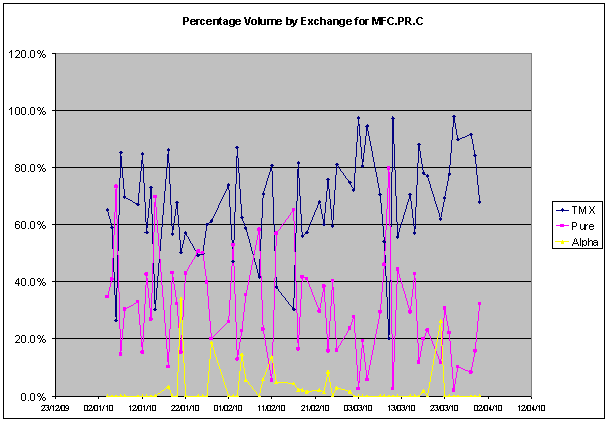
Assiduous Reader GAndreone sends in this chart of Exchange Market Share for MFC.PR.C for your edification:


Click for Big

An interesting trend is corporate bonds that step-up on downgrades:

Bonds with built-in protection against rating cuts are making up a record share of debt issues as investors hedge against a slowdown in the economic recovery.

Anheuser-Busch InBev NV, the brewer of Budweiser and Stella Artois, is among companies issuing so-called step-up bonds, whose interest increases if a borrower is downgraded. Sales surged to $37.3 billion in March, or 12.4 percent of all debt issued, according to data compiled by Bloomberg. Most of the notes are sold in the U.S., where almost half of bonds rated as so-called junk or on the cusp of non-investment grade include the protection.

Anheuser-Busch InBev, the world’s largest brewer, sold $3.25 billion of bonds with a step-up coupon on March 24, Bloomberg data show. The conditions require the Leuven, Belgium- based company to pay 25 basis points more in interest for every one rating notch it’s cut below investment grade, up to a maximum of 200 basis points, according to Bloomberg data. The brewer is rated Baa2 by Moody’s and one level higher at BBB+ by S&P.

It’s an interesting problem due to the potential for a cascading decline in credit quality. Quick! You’re the Grand Pooh-Bah of Financial Stability! Can you do anything? Should you do anything?

It has taken over a year, but finally the world is noticing the sheer brilliance and uncanny accuracy of PrefBlog’s commentary. Assiduous Readers will remember that I support internal management for large pension funds; not because of cost but because internal management has a captive customer, can concentrate of achieving good returns and doesn’t have to spend time, effort, and client portfolio positioning on the necessity of bringing in the Assets Under Management. As best as I can recall, I last discussed this on March 31, 2009. Janet McFarland has written a feature for the Globe, Canada’s Pension Funds: stronger returns, at a cost:

Despite the higher salary costs in Canada, internal management has been a bigger advantage than it has been a cost, said pension specialist Keith Ambachtsheer, director of the International Centre for Pension Management at the University of Toronto.

Research shows internal teams not only save money by cutting high external money management fees, but also perform better as investors because they are more closely aligned to the mission of the pension fund, he said.

According to data from CEM Benchmarking, internal management improves returns by 0.5 per cent annually over external management, Mr. Ambachtsheer said.

It is disappointing that the article followed fashionability to the extent it did, by focussing almost exclusively on the aspect of fees. It is far more interesting, and far more important for public policy purposes, to consider the aspect of the effects of structure on gross investment return.

The Globe also had an astonishingly patronizing editorial in today’s print edition (it does not appear to be available on-line) titled “The next complexity”:

The challenge for the future, however, is how to formulate rules that will cover the new mind-bending products that will emerge in the next wave of irrational exuberance and excessive financial ingenuity. In other words, legislators and regulators will need to decide what is too complex for unsophisticated investors.

I have some succinct advice for the Globe’s editorial board: shove it. While wearing my hat as a retail investor, I don’t want any pandering politician or smarmy regulator deciding what is and what is not too complex for unsophisticated investors who haven’t been annointed. Show me somebody – anybody – who got seriously hurt by ABCP and I’ll show you a fool. Canadian ABCP was a good product, of very good credit quality. The market was done in by lack of liquidity, not credit; and the only people who were badly hurt by it were the ones who were overexposed. Ain’t nothing gonna protect anybody from the downside of overexposure, whether it’s to ABCP or securities that have been blessed by the really, really savvy investors on the Globe’s editorial board.

I haven’t been able to find a copy of the report itself on-line. This may mean I’m insufficiently sophisticated at finding things, but it wouldn’t surpise me to learn that access to the report has been restricted to those smart enough to agree with the committee’s conclusions.

What the ABCP and Lehman crises showed was simply that the implicit sponsor guarantee on Money Market Funds needs to become explicit. Full stop.

Crash! Bang! Smash ’em up! PerpetualDiscounts got hit severely today, losing 76bp to bring median yield to 6.22%, while FixedResets were almost precisely flat. The performance highlights indicate that it was the major, high quality banks that bore the brunt of the sell off, although there are a few familiar names amongst the losers. Volume continued to be quite heavy and FixedResets scored a shut-out on the volume highlights table.

HIMIPref™ Preferred Indices
These values reflect the December 2008 revision of the HIMIPref™ Indices

Values are provisional and are finalized monthly
Index Mean
Current
Yield
(at bid)
Median
YTW
Median
Average
Trading
Value
Median
Mod Dur
(YTW)
Issues Day’s Perf. Index Value
Ratchet 2.56 % 2.62 % 55,977 20.96 1 -0.2268 % 2,157.2
FixedFloater 4.88 % 3.00 % 48,787 20.16 1 1.0879 % 3,242.0
Floater 1.90 % 1.67 % 46,110 23.42 4 -0.0242 % 2,422.6
OpRet 4.86 % 2.37 % 108,247 0.15 10 0.0814 % 2,310.9
SplitShare 6.37 % -0.80 % 137,257 0.08 2 0.1100 % 2,142.3
Interest-Bearing 0.00 % 0.00 % 0 0.00 0 0.0814 % 2,113.1
Perpetual-Premium 5.75 % 3.11 % 35,074 0.64 2 -0.0795 % 1,862.4
Perpetual-Discount 6.16 % 6.22 % 176,015 13.60 76 -0.7632 % 1,722.9
FixedReset 5.39 % 3.58 % 412,656 3.65 43 0.0009 % 2,195.3
Performance Highlights
Issue Index Change Notes
BNS.PR.N Perpetual-Discount -2.71 % YTW SCENARIO
Maturity Type : Limit Maturity
Maturity Date : 2040-04-05
Maturity Price : 21.17
Evaluated at bid price : 21.17
Bid-YTW : 6.22 %
BMO.PR.K Perpetual-Discount -2.23 % YTW SCENARIO
Maturity Type : Limit Maturity
Maturity Date : 2040-04-05
Maturity Price : 21.09
Evaluated at bid price : 21.09
Bid-YTW : 6.32 %
TD.PR.P Perpetual-Discount -2.22 % YTW SCENARIO
Maturity Type : Limit Maturity
Maturity Date : 2040-04-05
Maturity Price : 21.90
Evaluated at bid price : 22.00
Bid-YTW : 6.08 %
TD.PR.R Perpetual-Discount -1.70 % YTW SCENARIO
Maturity Type : Limit Maturity
Maturity Date : 2040-04-05
Maturity Price : 22.99
Evaluated at bid price : 23.15
Bid-YTW : 6.17 %
BNS.PR.L Perpetual-Discount -1.69 % YTW SCENARIO
Maturity Type : Limit Maturity
Maturity Date : 2040-04-05
Maturity Price : 18.58
Evaluated at bid price : 18.58
Bid-YTW : 6.07 %
BAM.PR.N Perpetual-Discount -1.69 % YTW SCENARIO
Maturity Type : Limit Maturity
Maturity Date : 2040-04-05
Maturity Price : 16.91
Evaluated at bid price : 16.91
Bid-YTW : 7.09 %
BNS.PR.J Perpetual-Discount -1.59 % YTW SCENARIO
Maturity Type : Limit Maturity
Maturity Date : 2040-04-05
Maturity Price : 21.60
Evaluated at bid price : 21.60
Bid-YTW : 6.09 %
BMO.PR.H Perpetual-Discount -1.55 % YTW SCENARIO
Maturity Type : Limit Maturity
Maturity Date : 2040-04-05
Maturity Price : 21.91
Evaluated at bid price : 22.21
Bid-YTW : 6.04 %
TCA.PR.X Perpetual-Discount -1.55 % YTW SCENARIO
Maturity Type : Limit Maturity
Maturity Date : 2040-04-05
Maturity Price : 45.63
Evaluated at bid price : 47.65
Bid-YTW : 5.84 %
POW.PR.A Perpetual-Discount -1.52 % YTW SCENARIO
Maturity Type : Limit Maturity
Maturity Date : 2040-04-05
Maturity Price : 21.75
Evaluated at bid price : 22.00
Bid-YTW : 6.39 %
BNS.PR.O Perpetual-Discount -1.50 % YTW SCENARIO
Maturity Type : Limit Maturity
Maturity Date : 2040-04-05
Maturity Price : 22.90
Evaluated at bid price : 23.06
Bid-YTW : 6.08 %
BAM.PR.M Perpetual-Discount -1.46 % YTW SCENARIO
Maturity Type : Limit Maturity
Maturity Date : 2040-04-05
Maturity Price : 16.87
Evaluated at bid price : 16.87
Bid-YTW : 7.11 %
BNS.PR.M Perpetual-Discount -1.42 % YTW SCENARIO
Maturity Type : Limit Maturity
Maturity Date : 2040-04-05
Maturity Price : 18.70
Evaluated at bid price : 18.70
Bid-YTW : 6.03 %
TD.PR.O Perpetual-Discount -1.39 % YTW SCENARIO
Maturity Type : Limit Maturity
Maturity Date : 2040-04-05
Maturity Price : 20.52
Evaluated at bid price : 20.52
Bid-YTW : 6.03 %
POW.PR.D Perpetual-Discount -1.36 % YTW SCENARIO
Maturity Type : Limit Maturity
Maturity Date : 2040-04-05
Maturity Price : 19.58
Evaluated at bid price : 19.58
Bid-YTW : 6.42 %
RY.PR.C Perpetual-Discount -1.34 % YTW SCENARIO
Maturity Type : Limit Maturity
Maturity Date : 2040-04-05
Maturity Price : 19.08
Evaluated at bid price : 19.08
Bid-YTW : 6.12 %
RY.PR.B Perpetual-Discount -1.31 % YTW SCENARIO
Maturity Type : Limit Maturity
Maturity Date : 2040-04-05
Maturity Price : 19.52
Evaluated at bid price : 19.52
Bid-YTW : 6.12 %
PWF.PR.G Perpetual-Discount -1.25 % YTW SCENARIO
Maturity Type : Limit Maturity
Maturity Date : 2040-04-05
Maturity Price : 23.49
Evaluated at bid price : 23.75
Bid-YTW : 6.33 %
BMO.PR.J Perpetual-Discount -1.24 % YTW SCENARIO
Maturity Type : Limit Maturity
Maturity Date : 2040-04-05
Maturity Price : 19.11
Evaluated at bid price : 19.11
Bid-YTW : 5.98 %
CM.PR.I Perpetual-Discount -1.21 % YTW SCENARIO
Maturity Type : Limit Maturity
Maturity Date : 2040-04-05
Maturity Price : 18.72
Evaluated at bid price : 18.72
Bid-YTW : 6.29 %
TD.PR.Q Perpetual-Discount -1.19 % YTW SCENARIO
Maturity Type : Limit Maturity
Maturity Date : 2040-04-05
Maturity Price : 23.15
Evaluated at bid price : 23.32
Bid-YTW : 6.12 %
MFC.PR.B Perpetual-Discount -1.07 % YTW SCENARIO
Maturity Type : Limit Maturity
Maturity Date : 2040-04-05
Maturity Price : 18.41
Evaluated at bid price : 18.41
Bid-YTW : 6.39 %
PWF.PR.I Perpetual-Discount -1.02 % YTW SCENARIO
Maturity Type : Limit Maturity
Maturity Date : 2040-04-05
Maturity Price : 23.94
Evaluated at bid price : 24.30
Bid-YTW : 6.29 %
SLF.PR.D Perpetual-Discount -1.01 % YTW SCENARIO
Maturity Type : Limit Maturity
Maturity Date : 2040-04-05
Maturity Price : 17.63
Evaluated at bid price : 17.63
Bid-YTW : 6.37 %
BAM.PR.G FixedFloater 1.09 % YTW SCENARIO
Maturity Type : Limit Maturity
Maturity Date : 2040-04-05
Maturity Price : 25.00
Evaluated at bid price : 22.30
Bid-YTW : 3.00 %
HSB.PR.C Perpetual-Discount 1.17 % YTW SCENARIO
Maturity Type : Limit Maturity
Maturity Date : 2040-04-05
Maturity Price : 20.84
Evaluated at bid price : 20.84
Bid-YTW : 6.17 %
Volume Highlights
Issue Index Shares
Traded
Notes
TD.PR.E FixedReset 311,050 Nesbitt crossed 300,000 at 28.10. Nice ticket!
YTW SCENARIO
Maturity Type : Call
Maturity Date : 2014-05-30
Maturity Price : 25.00
Evaluated at bid price : 28.11
Bid-YTW : 3.39 %
RY.PR.T FixedReset 247,850 Nesbitt bought 13,200 from CIBC at 28.05 and crossed 120,000 at the same price. Nesbitt then crossed 100,000 at 28.06.
YTW SCENARIO
Maturity Type : Call
Maturity Date : 2014-09-23
Maturity Price : 25.00
Evaluated at bid price : 28.05
Bid-YTW : 3.51 %
RY.PR.X FixedReset 116,486 TD crossed 30,000 at 28.00; RBC crossed 35,000 at the same price.
YTW SCENARIO
Maturity Type : Call
Maturity Date : 2014-09-23
Maturity Price : 25.00
Evaluated at bid price : 28.01
Bid-YTW : 3.56 %
RY.PR.Y FixedReset 77,325 National crossed 15,000 and Nesbitt crossed 30,000, both at 28.00; National crossed 15,000 at 28.03.
YTW SCENARIO
Maturity Type : Call
Maturity Date : 2014-12-24
Maturity Price : 25.00
Evaluated at bid price : 28.00
Bid-YTW : 3.54 %
TD.PR.K FixedReset 54,627 Nesbitt crossed 25,000 at 28.25 and bought 11,000 from anonymous at 28.20.
YTW SCENARIO
Maturity Type : Call
Maturity Date : 2014-08-30
Maturity Price : 25.00
Evaluated at bid price : 28.20
Bid-YTW : 3.40 %
TD.PR.G FixedReset 52,432 Nesbitt bought 12,500 from CIBC at 28.05.
YTW SCENARIO
Maturity Type : Call
Maturity Date : 2014-05-30
Maturity Price : 25.00
Evaluated at bid price : 28.07
Bid-YTW : 3.43 %
There were 51 other index-included issues trading in excess of 10,000 shares.
Issue Comments

DGS.PR.A To Get Bigger

Dividend Growth Split Corp. has announced (via SEDAR; press release dated 2010-4-1; management’s too lazy to put it on their web site [Update: But see the comments!]):

it has filed a preliminary short form prospectus with respect to a treasury offering of preferred shares and class A shares.

Dividend Growth Split Corp. invests in a portfolio of common shares of high quality, large capitalization companies, which have among the highest dividend growth rates of those companies included in the S&P/TSX Composite Index. Subsequent to the closing of this offering, the portfolio will consist of common shares of the following 20 companies:

The preferred shares will be offered at a price of $10.00 per share. The closing price of the preferred shares on the TSX on March 31, 2010 was $10.32. The investment objectives for the preferred shares are to provide their holders with fixed cumulative preferential quarterly cash distributions in the amount of $0.13125 per preferred share to yield 5.25% per annum on the original issue price, and to return the original issue price to holders of preferred shares at the time of redemption on November 30, 2014.

The class A shares will be offered at a price of $9.75 per share. The closing price of the class A shares on the TSX on March 31, 2010 was $9.95. The investment objectives for the class A shares are to provide their holders with regular monthly cash distributions targeted to be $0.10 per class A share, and to provide the opportunity for growth in net asset value per class A share.

The red-herring prospectus filed on SEDAR does not specify a closing date.

DGS.PR.A was last mentioned on PrefBlog when it was upgraded to Pfd-3 by DBRS. It is not tracked by HIMIPref™ as it is too small an issue to trade efficiently (slightly over 2-million shares outstanding on 2009-12-31, according to the 2009 Annual Report … but that could change!

Index Construction / Reporting

Index Performance: March 2010

Performance of the HIMIPref™ Indices for March, 2010, was:

Total Return
Index Performance
March 2010
Three Months
to
March 31, 2010
Ratchet +8.85%* +32.94%*
FixFloat +7.56% +17.20%
Floater +3.04% +19.91%
OpRet +0.09% -0.99%
SplitShare +0.13% +1.88%
Interest +0.09%**** -0.99%****
PerpetualPremium -1.96% -1.70%
PerpetualDiscount -3.33% -3.51%
FixedReset +0.57% +0.89%
* The last member of the RatchetRate index was transferred to Scraps at the February, 2009, rebalancing; subsequent performance figures are set equal to the Floater index

Independent measurement was resumed when an issue qualified for inclusion (transferred from Scraps) at the February January, 2010, rebalancing.

**** The last member of the InterestBearing index was transferred to Scraps at the June, 2009, rebalancing; subsequent performance figures are set equal to the OperatingRetractible index
Passive Funds (see below for calculations)
CPD -0.96% -1.31%
DPS.UN +1.74% +1.22%
Index
BMO-CM 50 -0.66% +0.33%
TXPR Total Return -0.86% -0.95%

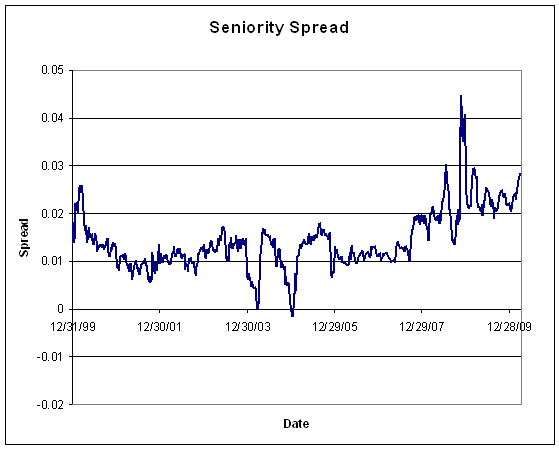
The pre-tax interest equivalent spread of PerpetualDiscounts over Long Corporates (which I also refer to as the Seniority Spread) ended the month at +285bp, a sharp increase from the +235bp recorded at February month-end. The decline in the PerpetualDiscount index was entirely due to an increase in the spread over corporates, since yields on long corporates actually declined from 5.9% to 5.8%.


Click for big

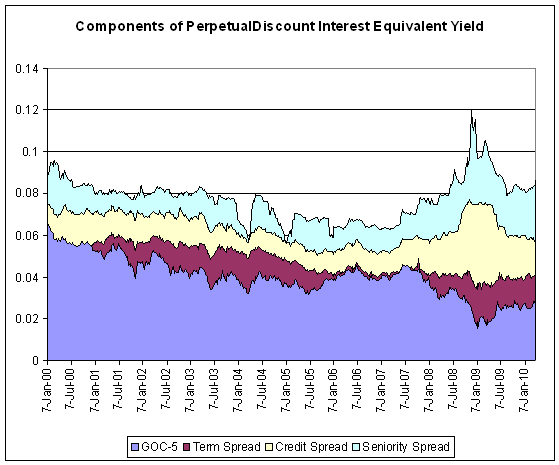
The Seniority Spread is now the largest component of PerpetualDiscount Interest-Equivalent yields:


Click for big

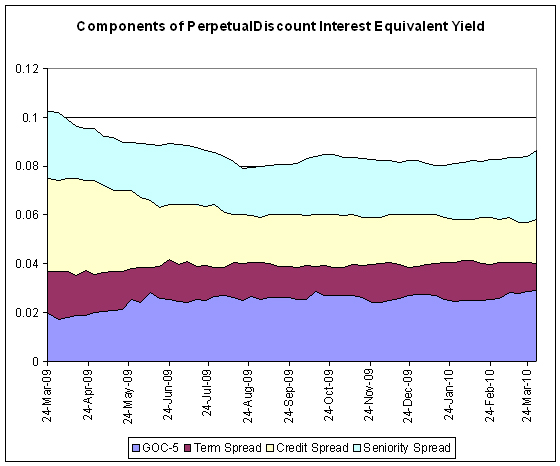
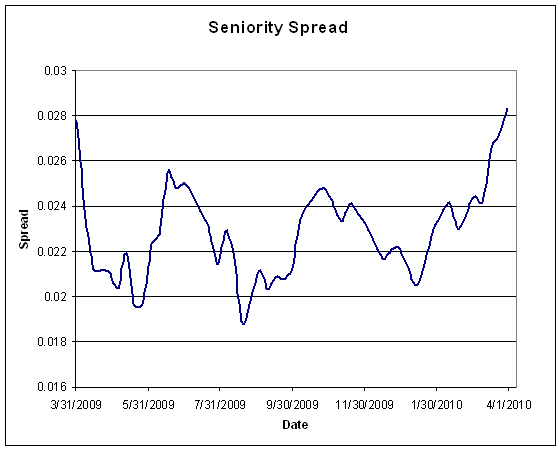
The seniority spread is at a one-year high:


Click for big

And the Seniority Spread is well above long-term levels:


Click for big

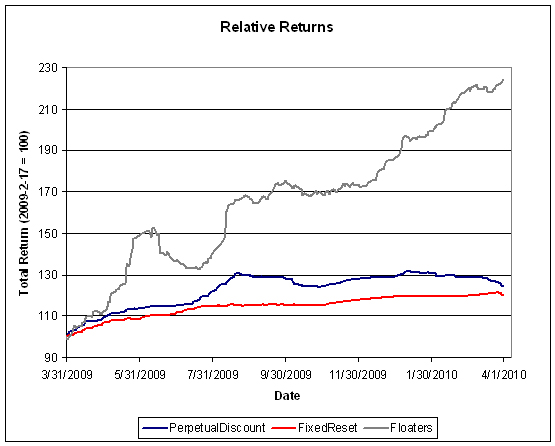
The relative returns on Floaters over the past year continues to impress:


Click for big

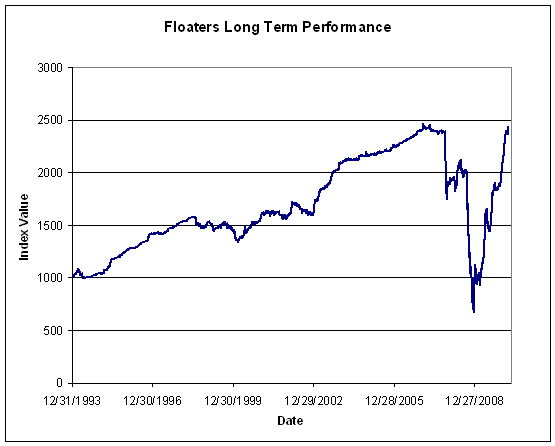
But one must remember how they got there:


Click for big

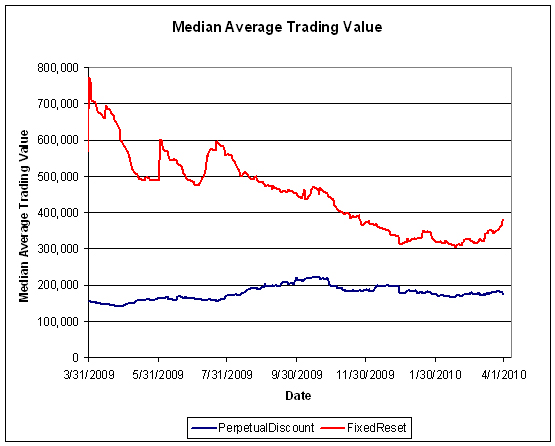
FixedReset volume picked up during the month. Volume may be under-reported due to the influence of Alternative Trading Systems (as discussed in the November PrefLetter), but I am biding my time before incorporating ATS volumes into the calculations, to see if the effect is transient or not.


Click for big

As discussed in February, the impressive returns of the past year cannot continue indefinately. The long term return on a fixed income instrument is its yield – 6.2% for a PerpetualDiscount, and about 3.6% to the call date for a FixedReset, as of April 1. The FixedReset index set a new low yield in March, highlighted by RY.PR.R’s brief flirtation with sub-3% levels.

Compositions of the passive funds were discussed in the September edition of PrefLetter.

Claymore has published NAV and distribution data (problems with the page in IE8 can be kludged by using compatibility view) for its exchange traded fund (CPD) and I have derived the following table:

CPD Return, 1- & 3-month, to March 31, 2010
Date NAV Distribution Return for Sub-Period Monthly Return
December 31, 2009 16.89      
January 29 16.80     -0.53%
February 26, 2010 16.83     +0.18%
March 26 16.64 0.21 +0.12% -0.96%
March 31, 2009 16.46 0.00 -1.08%
Quarterly Return -1.31%

Claymore currently holds $435,437,774 (advisor & common combined) in CPD assets, up about $15-million from the $420,750,223 reported last month and up about $62-million from the $373,729,364 reported at year-end.

The DPS.UN NAV for March 31 has been published so we may calculate the approximate March returns. On March 29, it went ex-Dividend for $0.30 according to the TMX.

DPS.UN NAV Return, March-ish 2010
Date NAV Distribution Return for sub-period Return for period
February 24, 2010 19.91      
March 29, 2010 20.09 ** 0.30 +2.41% +1.59%
March 31, 2010 19.93   -0.80%
Estimated February Ending Stub -0.12% *
Estimated March Return +1.47% ***
*CPD had a NAVPU of 16.81 on February 24 and 16.83 on February 26, hence the total return for the period for CPD was +0.12%. The return for DPS.UN in this period is presumed to be equal.
** The March 31 NAVPU was $19.93. CPD had a NAV of 16.46 on March 31 and 16.59 on March 29. Thus, a NAVPU of 20.09 for DPS on March 29 has been estimated
*** The estimated February return for DPS.UN’s NAV is therefore the product of three period returns, +2.41%, -0.80% and -0.12% to arrive at an estimate for the calendar month of +1.47%

Now, to see the DPS.UN quarterly NAV approximate return, we refer to the calculations for January and February:

DPS.UN NAV Returns, three-month-ish to end-March-ish, 2010
January-ish +1.39%
February-ish -1.61%
March-ish +1.47%
Three-months-ish +1.22%