Regulatory Capital

Risk Weight of Credit Default Swaps

I’m sure I’ve referenced this somewhere in this blog, but I can’t find it!

Page 768 of the enormous Commercial Bank Examination Manual states:

For risk-based capital purposes, total-rate-ofreturn swaps and credit-default swaps generally should be treated as off-balance-sheet direct credit substitutes. The notional amount of a contract should be converted at 100 percent to determine the credit-equivalent amount to be included in the risk-weighted assets of a guarantor. A bank that provides a guarantee through a credit derivative transaction should assign its credit exposure to the risk category appropriate to the obligor of the reference asset or any collateral. On the other hand, a bank that owns the underlying asset upon which effective credit protection has been acquired through a credit derivative may, under certain circumstances, assign the unamortized portion of the underlying asset to the risk category appropriate to the guarantor (for example, the 20 percent risk category if the guarantor is an OECD bank).

Whether the credit derivative is considered an eligible guarantee for purposes of risk-based capital depends on the actual degree of credit protection. The amount of credit protection actually provided by a credit derivative may be limited depending on the terms of the arrangement. In this regard, for example, a relatively restrictive definition of a default event or a materiality threshold that requires a comparably high percentage of loss to occur before the guarantor is obliged to pay could effectively limit the amount of credit risk actually transferred
in the transaction. If the terms of the credit derivative arrangement significantly limit the degree of risk transference, then the beneficiary bank cannot reduce the risk weight of the ‘‘protected’’ asset to that of the guarantor bank. On the other hand, even if the transfer of credit risk is limited, a bank providing limited credit protection through a credit derivative should
hold appropriate capital against the underlying exposure while it is exposed to the credit risk of the reference asset.

It should be noted, however, that in the States the notional value of the swaps does not affect the Leverage Ratio.

The Risk-Weighting is the same in Canada, according to the Capital Adequacy Guidelines:

The face amount (notional principal amount) of off-balance sheet instruments does not always reflect the amount of credit risk in the instrument. To approximate the potential credit exposure of non-derivative instruments, the notional amount is multiplied by the appropriate credit conversion factor (CCF) to derive a credit equivalent amount25. The credit equivalent amount is treated in a manner similar to an on-balance sheet instrument and is assigned the risk weight appropriate to the counterparty or, if relevant, the guarantor or collateral. The categories of credit conversion factors are outlined below.
100% Conversion factor
• Direct credit substitutes (general guarantees of indebtedness and guarantee-type instruments, including standby letters of credit serving as financial guarantees for, or supporting, loans and securities),

However, off-balance-sheet instruments such as CDSs do count towards assets in the calculation of the Assets to Capital multiple.

Market Action

March 11, 2009

There is a report that the London Office of AIG’s now notorious Financial Products Group took on notional exposure of USD 500-billion in sub-prime CDSs … not bad leverage for one office of one division, considering AIG’s total equity was $104-billion in June 07, just before the fun started.

Econbrowser‘s James Hamilton advocates having AIG default on its CDSs:

But the issue for me has always been not to exact retribution or instill market discipline, but instead the very pragmatic question of how to use available resources to minimize collateral damage. I accept the argument that a complete failure of AIG would have unacceptable consequences. The relevant question then is, what combination of parties is going to absorb the loss?

The concern I wish to raise is that any reasonable answer to that question would include Goldman Sachs, Merrill Lynch, Societe Generale, and Calyon, to pick a few names at random, as major contributors to this particular collateral-damage-minimization relief fund.

Then there’s the domino effect to consider. What do we do when this brings down the next player who can’t continue operations without those payments AIG (or the taxpayers) were supposedly going to deliver? I say, we implement the parallel operation there.

I can’t agree. This would have knock-on effects akin to another Lehman; the cure would be worse than the disease. The policy focus should not be on minimizing cost, but on minimizing harm.

I certainly agree that it is unfortunated that taxpayers are getting hurt and it is clear that regulation must be improved. However, pain is part of the game. Western economies in general and Amercian taxpayers in particular have been well served by the financial system.

Who wants to live in a country without a functional banking system, particularly the mortgage market? I don’t know what the system is like now, but I understand the Indian mortgage market was basically non-existent not too many years ago. So the middle class had to save all their lives to buy a place and maybe be able to look around by the time they were 55. Housing 55! There’s a good insurance slogan!

However, the drumbeat of retribution continues:

Debt investors are an attractive target because of the size of their holdings — more than $1 trillion just at the four largest U.S. banks — and because they’ve emerged almost unscathed so far. Since any reduction in debt at a bank helps boost capital ratios, members of Congress including U.S. Representative Brad Sherman, a California Democrat, say it’s time for bondholders to share the pain.

“These banks can go into receivership, shed their shareholders, shed or reduce the amount they owe to their bondholders and come back out much stronger institutions,” said Sherman, who sits on the House Financial Services Committee, in a statement to Bloomberg News. More U.S. capital might be offered as part of the package, he said.

Go for it, Sherman. Regardless of the situation a year ago, these institutions now have TARP money and bond-holders are senior to TARP money. You might find yourself on the wrong end of a cramdown.

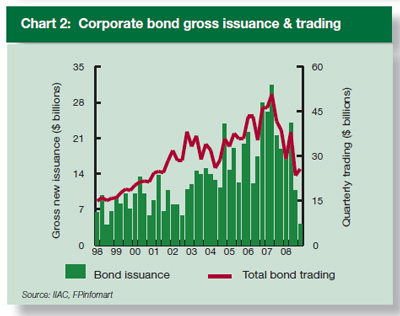
With this kind of talk floating around, is it any wonder the US Corporate market is dysfunctional?:

I think the corporate bond market is still fractured. It is not as dysfunctional as it was in October and November but the realization that solid well established companies need to provide as much of a concession as these entities are here is a sign that there is a very long road to travel before the corporate bond market functions with a degree of normality.

Meanwhile, the GSEs are a continuing disaster:

Freddie Mac, the mortgage-finance company thrust into a leading role in President Barack Obama’s homeowner rescue plans, said it will tap $30.8 billion in federal aid as its loan holdings and other assets deteriorated.

The company, which owns or guarantees more than 20 percent of U.S. home loans, today posted a wider fourth-quarter net loss of $23.9 billion, or $7.37 a share. The results pushed the value of Freddie’s assets below its liabilities, the McLean, Virginia- based company said in a statement, and come as Chief Executive Officer David Moffett leaves after six months on the job.

Freddie and larger competitor Fannie Mae have been pressured to carry out policy initiatives, including offering low-cost mortgage refinancings, since the government takeover. The often conflicting demands of appeasing regulators and pursuing profit may have led Moffett to resign, [F&R Capital Markets analyst Paul] Miller said.

“They want these guys to refi mortgages without new appraisals and to keep mortgage rates very low; those are not sound business decisions,” Miller said. “They are being used as a public policy tool to save the housing market. That is just going to make it more difficult for them to be floated out as public companies down the road.”

In what is almost certainly an orchestrated move, Bernanke’s proposed Financial Stability Regulator has attracted support:

JPMorgan Chase & Co. Chief Executive Officer Jamie Dimon said the U.S. needs a “systemic risk regulator” and should set up procedures to deal with potential failures of large financial institutions.

“Failure is fine as long as it’s orderly, controlled, leads to resolution and doesn’t cause systemic failure,” Dimon, 52, said at a conference hosted by the U.S. Chamber of Commerce in Washington.

Dimon said at a Feb. 3 conference that he believed the Federal Reserve should have the authority to regulate all companies within the banking system.

CDS junkies, by the way, may wish to read the Observations on Management of Recent Credit Default Swap Credit Events.

The Cleveland Fed has released its March Econotrends, with an interesting chart-pack on the impact of credit easing so far. The Fed’s balance sheet has begun to bloat again:

Annoyed at having been called insane, PerpetualDiscounts rose 90bp to yield 7.52%, equivalent to 10.53% interest at the standard equivalency factor of 1.4x. Long Corporates now yield 7.6%, so the pre-tax interest-equivalent spread is now about 290bp … certainly at the high end of its range, although nowhere near the November end-of-the-world levels.

HIMIPref™ Preferred Indices
These values reflect the December 2008 revision of the HIMIPref™ Indices

Values are provisional and are finalized monthly
Index Mean
Current
Yield
(at bid)
Median
YTW
Median
Average
Trading
Value
Median
Mod Dur
(YTW)
Issues Day’s Perf. Index Value
Ratchet 0.00 % 0.00 % 0 0.00 0 1.3141 % 783.1
FixedFloater 0.00 % 0.00 % 0 0.00 0 1.3141 % 1,266.5
Floater 5.05 % 5.96 % 62,739 14.00 3 1.3141 % 978.4
OpRet 5.34 % 5.12 % 138,130 3.91 15 0.1546 % 2,028.8
SplitShare 7.11 % 10.48 % 54,848 4.79 6 0.3421 % 1,560.5
Interest-Bearing 6.28 % 13.25 % 37,376 0.76 1 -1.0352 % 1,870.9
Perpetual-Premium 0.00 % 0.00 % 0 0.00 0 0.9033 % 1,434.2
Perpetual-Discount 7.53 % 7.52 % 164,704 11.92 71 0.9033 % 1,320.8
FixedReset 6.27 % 5.90 % 683,625 13.67 31 -0.0028 % 1,764.3
Performance Highlights
Issue Index Change Notes
NA.PR.N FixedReset -2.94 % YTW SCENARIO
Maturity Type : Limit Maturity
Maturity Date : 2039-03-11
Maturity Price : 22.06
Evaluated at bid price : 22.12
Bid-YTW : 4.70 %
BAM.PR.O OpRet -2.11 % YTW SCENARIO
Maturity Type : Option Certainty
Maturity Date : 2013-06-30
Maturity Price : 25.00
Evaluated at bid price : 20.00
Bid-YTW : 10.93 %
RY.PR.E Perpetual-Discount -1.74 % YTW SCENARIO
Maturity Type : Limit Maturity
Maturity Date : 2039-03-11
Maturity Price : 15.82
Evaluated at bid price : 15.82
Bid-YTW : 7.20 %
CIU.PR.A Perpetual-Discount -1.45 % YTW SCENARIO
Maturity Type : Limit Maturity
Maturity Date : 2039-03-11
Maturity Price : 16.26
Evaluated at bid price : 16.26
Bid-YTW : 7.15 %
BMO.PR.L Perpetual-Discount -1.43 % YTW SCENARIO
Maturity Type : Limit Maturity
Maturity Date : 2039-03-11
Maturity Price : 19.32
Evaluated at bid price : 19.32
Bid-YTW : 7.60 %
DFN.PR.A SplitShare -1.38 % Asset coverage of 1.5-:1 as of February 27 according to the company.
YTW SCENARIO
Maturity Type : Hard Maturity
Maturity Date : 2014-12-01
Maturity Price : 10.00
Evaluated at bid price : 7.84
Bid-YTW : 10.48 %
ACO.PR.A OpRet -1.35 % YTW SCENARIO
Maturity Type : Soft Maturity
Maturity Date : 2011-11-30
Maturity Price : 25.00
Evaluated at bid price : 25.60
Bid-YTW : 4.89 %
CM.PR.M FixedReset -1.25 % YTW SCENARIO
Maturity Type : Limit Maturity
Maturity Date : 2039-03-11
Maturity Price : 22.94
Evaluated at bid price : 24.45
Bid-YTW : 6.29 %
PWF.PR.F Perpetual-Discount -1.23 % YTW SCENARIO
Maturity Type : Limit Maturity
Maturity Date : 2039-03-11
Maturity Price : 16.10
Evaluated at bid price : 16.10
Bid-YTW : 8.32 %
BNS.PR.K Perpetual-Discount -1.14 % YTW SCENARIO
Maturity Type : Limit Maturity
Maturity Date : 2039-03-11
Maturity Price : 17.30
Evaluated at bid price : 17.30
Bid-YTW : 7.06 %
SBN.PR.A SplitShare -1.06 % Asset coverage of 1.5-:1 as of March 5 according to Mulvihill.
YTW SCENARIO
Maturity Type : Hard Maturity
Maturity Date : 2014-12-01
Maturity Price : 10.00
Evaluated at bid price : 8.42
Bid-YTW : 8.97 %
STW.PR.A Interest-Bearing -1.04 % Asset coverage of 1.4+:1 as of March 5, based on Capital Unit NAV of 2.02. and 1.99 Capital Units per Preferred.
YTW SCENARIO
Maturity Type : Hard Maturity
Maturity Date : 2009-12-31
Maturity Price : 10.00
Evaluated at bid price : 9.56
Bid-YTW : 13.25 %
CM.PR.E Perpetual-Discount 1.02 % YTW SCENARIO
Maturity Type : Limit Maturity
Maturity Date : 2039-03-11
Maturity Price : 17.76
Evaluated at bid price : 17.76
Bid-YTW : 8.04 %
GWO.PR.E OpRet 1.03 % YTW SCENARIO
Maturity Type : Soft Maturity
Maturity Date : 2014-03-30
Maturity Price : 25.00
Evaluated at bid price : 24.50
Bid-YTW : 5.12 %
IGM.PR.A OpRet 1.03 % YTW SCENARIO
Maturity Type : Soft Maturity
Maturity Date : 2013-06-29
Maturity Price : 25.00
Evaluated at bid price : 25.41
Bid-YTW : 5.27 %
TD.PR.C FixedReset 1.04 % YTW SCENARIO
Maturity Type : Limit Maturity
Maturity Date : 2039-03-11
Maturity Price : 23.26
Evaluated at bid price : 23.30
Bid-YTW : 5.16 %
PWF.PR.G Perpetual-Discount 1.11 % YTW SCENARIO
Maturity Type : Limit Maturity
Maturity Date : 2039-03-11
Maturity Price : 18.20
Evaluated at bid price : 18.20
Bid-YTW : 8.27 %
POW.PR.A Perpetual-Discount 1.14 % YTW SCENARIO
Maturity Type : Limit Maturity
Maturity Date : 2039-03-11
Maturity Price : 17.75
Evaluated at bid price : 17.75
Bid-YTW : 8.07 %
TD.PR.R Perpetual-Discount 1.16 % YTW SCENARIO
Maturity Type : Limit Maturity
Maturity Date : 2039-03-11
Maturity Price : 19.99
Evaluated at bid price : 19.99
Bid-YTW : 7.13 %
BNS.PR.M Perpetual-Discount 1.26 % YTW SCENARIO
Maturity Type : Limit Maturity
Maturity Date : 2039-03-11
Maturity Price : 16.10
Evaluated at bid price : 16.10
Bid-YTW : 7.11 %
BNS.PR.O Perpetual-Discount 1.26 % YTW SCENARIO
Maturity Type : Limit Maturity
Maturity Date : 2039-03-11
Maturity Price : 20.05
Evaluated at bid price : 20.05
Bid-YTW : 7.11 %
CM.PR.I Perpetual-Discount 1.28 % YTW SCENARIO
Maturity Type : Limit Maturity
Maturity Date : 2039-03-11
Maturity Price : 15.00
Evaluated at bid price : 15.00
Bid-YTW : 7.99 %
BNS.PR.N Perpetual-Discount 1.37 % YTW SCENARIO
Maturity Type : Limit Maturity
Maturity Date : 2039-03-11
Maturity Price : 18.51
Evaluated at bid price : 18.51
Bid-YTW : 7.22 %
MFC.PR.B Perpetual-Discount 1.40 % YTW SCENARIO
Maturity Type : Limit Maturity
Maturity Date : 2039-03-11
Maturity Price : 14.50
Evaluated at bid price : 14.50
Bid-YTW : 8.08 %
RY.PR.H Perpetual-Discount 1.41 % YTW SCENARIO
Maturity Type : Limit Maturity
Maturity Date : 2039-03-11
Maturity Price : 20.80
Evaluated at bid price : 20.80
Bid-YTW : 6.88 %
SLF.PR.A Perpetual-Discount 1.44 % YTW SCENARIO
Maturity Type : Limit Maturity
Maturity Date : 2039-03-11
Maturity Price : 13.39
Evaluated at bid price : 13.39
Bid-YTW : 8.92 %
RY.PR.L FixedReset 1.44 % YTW SCENARIO
Maturity Type : Limit Maturity
Maturity Date : 2039-03-11
Maturity Price : 23.20
Evaluated at bid price : 23.24
Bid-YTW : 5.09 %
CM.PR.J Perpetual-Discount 1.46 % YTW SCENARIO
Maturity Type : Limit Maturity
Maturity Date : 2039-03-11
Maturity Price : 14.57
Evaluated at bid price : 14.57
Bid-YTW : 7.88 %
PWF.PR.E Perpetual-Discount 1.49 % YTW SCENARIO
Maturity Type : Limit Maturity
Maturity Date : 2039-03-11
Maturity Price : 17.00
Evaluated at bid price : 17.00
Bid-YTW : 8.25 %
CM.PR.D Perpetual-Discount 1.54 % YTW SCENARIO
Maturity Type : Limit Maturity
Maturity Date : 2039-03-11
Maturity Price : 18.47
Evaluated at bid price : 18.47
Bid-YTW : 7.94 %
SLF.PR.D Perpetual-Discount 1.58 % YTW SCENARIO
Maturity Type : Limit Maturity
Maturity Date : 2039-03-11
Maturity Price : 12.85
Evaluated at bid price : 12.85
Bid-YTW : 8.70 %
TD.PR.P Perpetual-Discount 1.60 % YTW SCENARIO
Maturity Type : Limit Maturity
Maturity Date : 2039-03-11
Maturity Price : 18.46
Evaluated at bid price : 18.46
Bid-YTW : 7.24 %
CM.PR.K FixedReset 1.63 % YTW SCENARIO
Maturity Type : Limit Maturity
Maturity Date : 2039-03-11
Maturity Price : 21.52
Evaluated at bid price : 21.85
Bid-YTW : 4.99 %
CU.PR.A Perpetual-Discount 1.67 % YTW SCENARIO
Maturity Type : Limit Maturity
Maturity Date : 2039-03-11
Maturity Price : 21.35
Evaluated at bid price : 21.35
Bid-YTW : 6.86 %
BNS.PR.L Perpetual-Discount 1.67 % YTW SCENARIO
Maturity Type : Limit Maturity
Maturity Date : 2039-03-11
Maturity Price : 16.41
Evaluated at bid price : 16.41
Bid-YTW : 6.98 %
CM.PR.P Perpetual-Discount 1.73 % YTW SCENARIO
Maturity Type : Limit Maturity
Maturity Date : 2039-03-11
Maturity Price : 17.61
Evaluated at bid price : 17.61
Bid-YTW : 7.97 %
BAM.PR.M Perpetual-Discount 1.77 % YTW SCENARIO
Maturity Type : Limit Maturity
Maturity Date : 2039-03-11
Maturity Price : 12.20
Evaluated at bid price : 12.20
Bid-YTW : 9.79 %
BAM.PR.N Perpetual-Discount 1.77 % YTW SCENARIO
Maturity Type : Limit Maturity
Maturity Date : 2039-03-11
Maturity Price : 12.18
Evaluated at bid price : 12.18
Bid-YTW : 9.81 %
ENB.PR.A Perpetual-Discount 1.77 % YTW SCENARIO
Maturity Type : Limit Maturity
Maturity Date : 2039-03-11
Maturity Price : 22.71
Evaluated at bid price : 23.00
Bid-YTW : 6.02 %
CM.PR.H Perpetual-Discount 1.87 % YTW SCENARIO
Maturity Type : Limit Maturity
Maturity Date : 2039-03-11
Maturity Price : 15.28
Evaluated at bid price : 15.28
Bid-YTW : 8.01 %
BAM.PR.J OpRet 1.87 % YTW SCENARIO
Maturity Type : Soft Maturity
Maturity Date : 2018-03-30
Maturity Price : 25.00
Evaluated at bid price : 17.51
Bid-YTW : 10.66 %
ELF.PR.G Perpetual-Discount 1.92 % YTW SCENARIO
Maturity Type : Limit Maturity
Maturity Date : 2039-03-11
Maturity Price : 13.30
Evaluated at bid price : 13.30
Bid-YTW : 9.16 %
SLF.PR.E Perpetual-Discount 2.02 % YTW SCENARIO
Maturity Type : Limit Maturity
Maturity Date : 2039-03-11
Maturity Price : 13.16
Evaluated at bid price : 13.16
Bid-YTW : 8.59 %
GWO.PR.G Perpetual-Discount 2.12 % YTW SCENARIO
Maturity Type : Limit Maturity
Maturity Date : 2039-03-11
Maturity Price : 15.40
Evaluated at bid price : 15.40
Bid-YTW : 8.49 %
PWF.PR.A Floater 2.14 % YTW SCENARIO
Maturity Type : Limit Maturity
Maturity Date : 2039-03-11
Maturity Price : 11.45
Evaluated at bid price : 11.45
Bid-YTW : 3.85 %
HSB.PR.D Perpetual-Discount 2.16 % YTW SCENARIO
Maturity Type : Limit Maturity
Maturity Date : 2039-03-11
Maturity Price : 16.80
Evaluated at bid price : 16.80
Bid-YTW : 7.47 %
NA.PR.K Perpetual-Discount 2.28 % YTW SCENARIO
Maturity Type : Limit Maturity
Maturity Date : 2039-03-11
Maturity Price : 20.15
Evaluated at bid price : 20.15
Bid-YTW : 7.37 %
POW.PR.D Perpetual-Discount 2.36 % YTW SCENARIO
Maturity Type : Limit Maturity
Maturity Date : 2039-03-11
Maturity Price : 15.62
Evaluated at bid price : 15.62
Bid-YTW : 8.19 %
TD.PR.Q Perpetual-Discount 2.38 % YTW SCENARIO
Maturity Type : Limit Maturity
Maturity Date : 2039-03-11
Maturity Price : 20.20
Evaluated at bid price : 20.20
Bid-YTW : 7.05 %
GWO.PR.I Perpetual-Discount 2.55 % YTW SCENARIO
Maturity Type : Limit Maturity
Maturity Date : 2039-03-11
Maturity Price : 14.10
Evaluated at bid price : 14.10
Bid-YTW : 8.02 %
PWF.PR.K Perpetual-Discount 2.55 % YTW SCENARIO
Maturity Type : Limit Maturity
Maturity Date : 2039-03-11
Maturity Price : 14.90
Evaluated at bid price : 14.90
Bid-YTW : 8.48 %
BMO.PR.H Perpetual-Discount 3.03 % YTW SCENARIO
Maturity Type : Limit Maturity
Maturity Date : 2039-03-11
Maturity Price : 19.06
Evaluated at bid price : 19.06
Bid-YTW : 7.04 %
POW.PR.C Perpetual-Discount 3.20 % YTW SCENARIO
Maturity Type : Limit Maturity
Maturity Date : 2039-03-11
Maturity Price : 18.73
Evaluated at bid price : 18.73
Bid-YTW : 7.92 %
PWF.PR.L Perpetual-Discount 3.80 % YTW SCENARIO
Maturity Type : Limit Maturity
Maturity Date : 2039-03-11
Maturity Price : 15.31
Evaluated at bid price : 15.31
Bid-YTW : 8.50 %
BNS.PR.S FixedReset 4.00 % YTW SCENARIO
Maturity Type : Limit Maturity
Maturity Date : 2039-03-11
Maturity Price : 23.46
Evaluated at bid price : 26.00
Bid-YTW : 5.50 %
PWF.PR.H Perpetual-Discount 4.31 % YTW SCENARIO
Maturity Type : Limit Maturity
Maturity Date : 2039-03-11
Maturity Price : 18.15
Evaluated at bid price : 18.15
Bid-YTW : 8.08 %
BNA.PR.B SplitShare 4.53 % Asset coverage of 1.7-:1 as of February 28 according to the company.
YTW SCENARIO
Maturity Type : Hard Maturity
Maturity Date : 2016-03-25
Maturity Price : 25.00
Evaluated at bid price : 21.01
Bid-YTW : 8.02 %
Volume Highlights
Issue Index Shares
Traded
Notes
TD.PR.P Perpetual-Discount 124,400 Scotia crossed 21,300 at 18.50, then another 95,000 at the same price.
YTW SCENARIO
Maturity Type : Limit Maturity
Maturity Date : 2039-03-11
Maturity Price : 18.46
Evaluated at bid price : 18.46
Bid-YTW : 7.24 %
RY.PR.T FixedReset 83,101 Recent new issue.
YTW SCENARIO
Maturity Type : Limit Maturity
Maturity Date : 2039-03-11
Maturity Price : 23.07
Evaluated at bid price : 24.83
Bid-YTW : 5.90 %
TD.PR.I FixedReset 80,955 Recent new issue.
YTW SCENARIO
Maturity Type : Limit Maturity
Maturity Date : 2039-03-11
Maturity Price : 23.09
Evaluated at bid price : 24.88
Bid-YTW : 5.96 %
CM.PR.L FixedReset 55,289 National bought 13,800 from TD at 25.00.
YTW SCENARIO
Maturity Type : Limit Maturity
Maturity Date : 2039-03-11
Maturity Price : 24.78
Evaluated at bid price : 24.83
Bid-YTW : 6.40 %
BNS.PR.X FixedReset 48,297 Scotia bought 25,000 from HSBC at 25.15.
YTW SCENARIO
Maturity Type : Limit Maturity
Maturity Date : 2039-03-11
Maturity Price : 25.16
Evaluated at bid price : 25.21
Bid-YTW : 6.22 %
CM.PR.M FixedReset 44,785 Recent new issue.
YTW SCENARIO
Maturity Type : Limit Maturity
Maturity Date : 2039-03-11
Maturity Price : 22.94
Evaluated at bid price : 24.45
Bid-YTW : 6.29 %
There were 28 other index-included issues trading in excess of 10,000 shares.
Issue Comments

POW: Results 4Q08

Power Corporation has announced:

Power Financial Corporation’s operating earnings for the year ended December 31, 2008 were $1,974 million or $2.69 per share, compared with $2,082 million or $2.84 per share in 2007.

Other items, not included in operating earnings, were a net charge of $637 million or $0.90 per share in 2008, compared with a net charge of $38 million or $0.05 in 2007. Other items in 2008 consisted of Power Financial’s share of non-recurring items recorded by Lifeco, IGM and Pargesa. The main components of other items in 2008 were the write-down of intangibles assets
and goodwill relating to the acquisition of Putnam in 2007 ($983 million), the gain from the sale of health business at Great-West Life & Annuity ($472 milion), and the write-down of Pargesa’s investments in Lafarge and Pernod Ricard ($328 million for 2008).

As a result, net earnings were $1,337 million or $1.79 per share in 2008, compared with $2,044 million or $2.79 per share in 2007.

About three-quarters of net consolidated annual earnings were derived from Great-West Lifeco.

Power Corp. issues tracked by HIMIPref™ are POW.PR.A, POW.PR.B, POW.PR.C, POW.PR.D and POW.PR.F. The first four are included in the PerpetualDiscount Subindex; POW.PR.F has been relegated to “Scraps” on volume concerns.

Issue Comments

CIR.PR.A: DBRS Discontinues Rating

DBRS has announced that it:

has today discontinued its rating on the Preferred Shares issued by Copernican International Financial Split Corp. at the request of AIC Investment Services Inc. (the Promoter).

CIR.PR.A was last mentioned on the post regarding the DBRS Mass Downgrade of SplitShares, at a time when its asset coverage was 0.5+:1. The issue had been downgraded to Pfd-5(low) in November, when the asset coverage was 0.7+:1. The asset coverage was 0.4-:1 as of March 6.

Hmm … I believe I detect a trend!

CIR.PR.A is not tracked by HIMIPref™.

New Issues

New Issue: BMO Fixed-Reset 6.50%+458

BMO has announced:

a domestic public offering of $150 million of Non-Cumulative 5-year Rate Reset Class B Preferred Shares Series 21 (the “Preferred Shares”). The offering will be underwritten on a bought deal basis by a syndicate led by BMO Capital Markets. The Bank has granted to the underwriters an option to purchase up to an additional $75 million of the Preferred Shares exercisable at any time up to two days before closing.

The Preferred Shares will be issued to the public at a price of $25.00 per Preferred Share and holders will be entitled to receive non-cumulative preferential fixed quarterly dividends for an initial five years, as and when declared by the board of directors of the Bank, payable in the amount of $0.40625 per Preferred Share, to yield 6.50 per cent annually.

Thereafter, the dividend rate will reset every five years to be equal to the 5-Year Government of Canada Bond Yield plus 4.58 per cent. Subject to certain conditions, holders may elect to convert any or all of their Preferred Shares into an equal number of Non-Cumulative Floating Rate Class B Preferred Shares Series 22 on May 25, 2014 and on May 25th of every fifth year thereafter. Holders of the Preferred Shares Series 22 will be entitled to receive non-cumulative preferential floating rate quarterly dividends, as and when declared by the board of directors of the Bank, equal to the then 3-month Government of Canada Treasury Bill yield plus 4.58 per cent.

The anticipated closing date is March 20, 2009. The net proceeds from the offering will be used by the Bank for general corporate purposes.

This is another one with a fat first dividend: $0.70342 payable August 25 (assuming a March 20 closing) … so circle the summer ex-date in your calendars, because dividend capture could be lucrative!

Update: Woo-hoo! It’s hot-cake city! BMO has announced:

that as a result of strong investor demand for its previously announced domestic public offering of Non-Cumulative 5-year Rate Reset Class B Preferred Shares Series 21 (the “Preferred Shares”), the size of the offering has been increased to 8 million shares. The gross proceeds of the offering will now be $200 million. The offering will be underwritten on a bought deal basis by a syndicate led by BMO Capital Markets. The Bank has granted to the underwriters an option to purchase up to an additional $75 million of the Preferred Shares exercisable at any time up to two days before closing.

Market Action

March 10, 2009

Julia Dickson of OFSI made some remarks to the Commons Finance Committee, but there was nothing startling there. She emphasized the importance of having high quality capital in the banks (lots of common!) but neglected to highlight OSFI’s recent debasement of capital quality.

More and more, I am taking the view that OSFI made a very serious mistake when changing the MCCSR rules at Manulife’s behest. To preserve the integrity of the regulatory system, they should have insisted on seeing some pain – in the form of forced equity issuance – first. There’s no point in having rules if they’ll be relaxed at the first hint of trouble; that attitude is coming home to roost with the GM Pension Plan.

Pierre Duguay of the Bank of Canada also made some remarks.

The end of the world appears to have been postponed:

Manulife Financial Corp. shares rallied from their lowest level in nine years, climbing 18 percent after CEO Vikram Pandit said Citigroup was profitable in January and February. Royal Bank of Canada surged 14 percent.

Canadian insurance companies, beaten down to the lowest in more than 11 years yesterday on concern that plunging equity markets will further erode their capital, led the rally in Toronto today.

Manulife, Canada’s largest insurer, advanced C$1.68 to C$10.88, rising from the lowest since March 2000. Smaller competitor Sun Life Financial Inc. gained 17 percent to C$17.53. Power Financial Corp. added 14 percent, the most more than 21 years.

Also helping financial shares today were remarks from Federal Reserve Chairman Ben S. Bernanke urging an overhaul of financial regulations. Lawmakers and supervisors should rethink everything from the amounts firms set aside against potential trading losses and deposit-insurance fees to protections for money-market funds, Bernanke said in remarks prepared for an address to the Council on Foreign Relations in Washington.

The speech was important enough to merit its own post.

A very sloppy day today, with prices all over the map; PerpetualDiscounts were modestly lower once the dust had cleared.

HIMIPref™ Preferred Indices
These values reflect the December 2008 revision of the HIMIPref™ Indices

Values are provisional and are finalized monthly
Index Mean
Current
Yield
(at bid)
Median
YTW
Median
Average
Trading
Value
Median
Mod Dur
(YTW)
Issues Day’s Perf. Index Value
Ratchet 0.00 % 0.00 % 0 0.00 0 3.4181 % 773.0
FixedFloater 0.00 % 0.00 % 0 0.00 0 3.4181 % 1,250.1
Floater 5.04 % 5.94 % 63,881 13.87 3 3.4181 % 965.7
OpRet 5.32 % 5.35 % 143,359 3.91 15 -0.1702 % 2,025.7
SplitShare 7.14 % 10.17 % 55,493 4.80 6 -0.8860 % 1,555.1
Interest-Bearing 6.21 % 11.81 % 38,925 0.77 1 0.5203 % 1,890.5
Perpetual-Premium 0.00 % 0.00 % 0 0.00 0 -0.1003 % 1,421.3
Perpetual-Discount 7.59 % 7.54 % 167,055 11.86 71 -0.1003 % 1,309.0
FixedReset 6.27 % 5.88 % 689,004 13.69 31 -0.3529 % 1,764.3
Performance Highlights
Issue Index Change Notes
BNS.PR.Q FixedReset -7.57 % Not as bad as it looks, but still pretty bad! This traded 16,515 shares in a range of 19.98-22.00 (!) before closing at 19.41-20.49 (!) 1×15.
YTW SCENARIO
Maturity Type : Limit Maturity
Maturity Date : 2039-03-10
Maturity Price : 19.41
Evaluated at bid price : 19.41
Bid-YTW : 4.96 %
DFN.PR.A SplitShare -5.58 % A complete crush on heavy volume – heavy for a split-share, anyway! Traded 71,563 shares in a range of 7.76-8.41 before closing at 7.95-14, 2×3 … so it could have been worse! Asset coverage of 1.5-:1 as of February 27, according to the company.
YTW SCENARIO
Maturity Type : Hard Maturity
Maturity Date : 2014-12-01
Maturity Price : 10.00
Evaluated at bid price : 7.95
Bid-YTW : 10.17 %
BNA.PR.B SplitShare -4.33 % Asset coverage of 1.7-:1 as of February 28 according to the company.
YTW SCENARIO
Maturity Type : Hard Maturity
Maturity Date : 2016-03-25
Maturity Price : 25.00
Evaluated at bid price : 20.10
Bid-YTW : 8.81 %
TD.PR.C FixedReset -3.72 % YTW SCENARIO
Maturity Type : Limit Maturity
Maturity Date : 2039-03-10
Maturity Price : 23.02
Evaluated at bid price : 23.06
Bid-YTW : 5.21 %
SLF.PR.A Perpetual-Discount -3.51 % YTW SCENARIO
Maturity Type : Limit Maturity
Maturity Date : 2039-03-10
Maturity Price : 13.20
Evaluated at bid price : 13.20
Bid-YTW : 9.05 %
BAM.PR.J OpRet -3.31 % YTW SCENARIO
Maturity Type : Soft Maturity
Maturity Date : 2018-03-30
Maturity Price : 25.00
Evaluated at bid price : 17.52
Bid-YTW : 10.94 %
TD.PR.Y FixedReset -3.23 % YTW SCENARIO
Maturity Type : Limit Maturity
Maturity Date : 2039-03-10
Maturity Price : 19.46
Evaluated at bid price : 19.46
Bid-YTW : 4.96 %
CM.PR.D Perpetual-Discount -2.99 % YTW SCENARIO
Maturity Type : Limit Maturity
Maturity Date : 2039-03-10
Maturity Price : 18.19
Evaluated at bid price : 18.19
Bid-YTW : 8.06 %
CU.PR.B Perpetual-Discount -2.73 % YTW SCENARIO
Maturity Type : Limit Maturity
Maturity Date : 2039-03-10
Maturity Price : 21.40
Evaluated at bid price : 21.40
Bid-YTW : 7.08 %
PWF.PR.L Perpetual-Discount -2.64 % YTW SCENARIO
Maturity Type : Limit Maturity
Maturity Date : 2039-03-10
Maturity Price : 14.75
Evaluated at bid price : 14.75
Bid-YTW : 8.83 %
PWF.PR.H Perpetual-Discount -2.25 % YTW SCENARIO
Maturity Type : Limit Maturity
Maturity Date : 2039-03-10
Maturity Price : 17.40
Evaluated at bid price : 17.40
Bid-YTW : 8.43 %
RY.PR.G Perpetual-Discount -2.23 % YTW SCENARIO
Maturity Type : Limit Maturity
Maturity Date : 2039-03-10
Maturity Price : 15.76
Evaluated at bid price : 15.76
Bid-YTW : 7.23 %
BNA.PR.A SplitShare -2.19 % Asset coverage of 1.7-:1 as of February 28 according to the company.
YTW SCENARIO
Maturity Type : Hard Maturity
Maturity Date : 2010-09-30
Maturity Price : 25.00
Evaluated at bid price : 22.30
Bid-YTW : 14.37 %
TD.PR.M OpRet -2.12 % YTW SCENARIO
Maturity Type : Soft Maturity
Maturity Date : 2013-10-30
Maturity Price : 25.00
Evaluated at bid price : 24.91
Bid-YTW : 4.94 %
TD.PR.P Perpetual-Discount -2.05 % YTW SCENARIO
Maturity Type : Limit Maturity
Maturity Date : 2039-03-10
Maturity Price : 18.17
Evaluated at bid price : 18.17
Bid-YTW : 7.35 %
CL.PR.B Perpetual-Discount -1.96 % YTW SCENARIO
Maturity Type : Limit Maturity
Maturity Date : 2039-03-10
Maturity Price : 20.55
Evaluated at bid price : 20.55
Bid-YTW : 7.64 %
GWO.PR.I Perpetual-Discount -1.93 % YTW SCENARIO
Maturity Type : Limit Maturity
Maturity Date : 2039-03-10
Maturity Price : 13.75
Evaluated at bid price : 13.75
Bid-YTW : 8.22 %
PWF.PR.I Perpetual-Discount -1.86 % YTW SCENARIO
Maturity Type : Limit Maturity
Maturity Date : 2039-03-10
Maturity Price : 19.00
Evaluated at bid price : 19.00
Bid-YTW : 8.05 %
SLF.PR.B Perpetual-Discount -1.82 % YTW SCENARIO
Maturity Type : Limit Maturity
Maturity Date : 2039-03-10
Maturity Price : 13.50
Evaluated at bid price : 13.50
Bid-YTW : 8.94 %
ENB.PR.A Perpetual-Discount -1.78 % YTW SCENARIO
Maturity Type : Limit Maturity
Maturity Date : 2039-03-10
Maturity Price : 22.33
Evaluated at bid price : 22.60
Bid-YTW : 6.13 %
BNS.PR.R FixedReset -1.70 % YTW SCENARIO
Maturity Type : Limit Maturity
Maturity Date : 2039-03-10
Maturity Price : 20.25
Evaluated at bid price : 20.25
Bid-YTW : 4.94 %
ELF.PR.G Perpetual-Discount -1.66 % YTW SCENARIO
Maturity Type : Limit Maturity
Maturity Date : 2039-03-10
Maturity Price : 13.05
Evaluated at bid price : 13.05
Bid-YTW : 9.34 %
BAM.PR.N Perpetual-Discount -1.53 % YTW SCENARIO
Maturity Type : Limit Maturity
Maturity Date : 2039-03-10
Maturity Price : 12.26
Evaluated at bid price : 12.26
Bid-YTW : 10.00 %
RY.PR.F Perpetual-Discount -1.40 % YTW SCENARIO
Maturity Type : Limit Maturity
Maturity Date : 2039-03-10
Maturity Price : 15.49
Evaluated at bid price : 15.49
Bid-YTW : 7.28 %
MFC.PR.B Perpetual-Discount -1.38 % YTW SCENARIO
Maturity Type : Limit Maturity
Maturity Date : 2039-03-10
Maturity Price : 14.30
Evaluated at bid price : 14.30
Bid-YTW : 8.19 %
CM.PR.H Perpetual-Discount -1.32 % YTW SCENARIO
Maturity Type : Limit Maturity
Maturity Date : 2039-03-10
Maturity Price : 15.00
Evaluated at bid price : 15.00
Bid-YTW : 8.16 %
RY.PR.I FixedReset -1.14 % YTW SCENARIO
Maturity Type : Limit Maturity
Maturity Date : 2039-03-10
Maturity Price : 21.71
Evaluated at bid price : 21.75
Bid-YTW : 4.60 %
BNS.PR.K Perpetual-Discount -1.13 % YTW SCENARIO
Maturity Type : Limit Maturity
Maturity Date : 2039-03-10
Maturity Price : 17.50
Evaluated at bid price : 17.50
Bid-YTW : 6.98 %
BAM.PR.M Perpetual-Discount -1.13 % YTW SCENARIO
Maturity Type : Limit Maturity
Maturity Date : 2039-03-10
Maturity Price : 12.28
Evaluated at bid price : 12.28
Bid-YTW : 9.99 %
BNS.PR.O Perpetual-Discount -1.10 % YTW SCENARIO
Maturity Type : Limit Maturity
Maturity Date : 2039-03-10
Maturity Price : 19.80
Evaluated at bid price : 19.80
Bid-YTW : 7.20 %
NA.PR.K Perpetual-Discount 1.03 % YTW SCENARIO
Maturity Type : Limit Maturity
Maturity Date : 2039-03-10
Maturity Price : 19.70
Evaluated at bid price : 19.70
Bid-YTW : 7.54 %
NA.PR.N FixedReset 1.29 % YTW SCENARIO
Maturity Type : Limit Maturity
Maturity Date : 2039-03-10
Maturity Price : 22.72
Evaluated at bid price : 22.79
Bid-YTW : 4.56 %
GWO.PR.G Perpetual-Discount 1.34 % YTW SCENARIO
Maturity Type : Limit Maturity
Maturity Date : 2039-03-10
Maturity Price : 15.08
Evaluated at bid price : 15.08
Bid-YTW : 8.67 %
ACO.PR.A OpRet 1.37 % YTW SCENARIO
Maturity Type : Call
Maturity Date : 2009-12-31
Maturity Price : 25.50
Evaluated at bid price : 25.95
Bid-YTW : 3.59 %
GWO.PR.H Perpetual-Discount 1.37 % YTW SCENARIO
Maturity Type : Limit Maturity
Maturity Date : 2039-03-10
Maturity Price : 14.75
Evaluated at bid price : 14.75
Bid-YTW : 8.26 %
MFC.PR.C Perpetual-Discount 1.46 % YTW SCENARIO
Maturity Type : Limit Maturity
Maturity Date : 2039-03-10
Maturity Price : 13.22
Evaluated at bid price : 13.22
Bid-YTW : 8.58 %
IAG.PR.A Perpetual-Discount 1.54 % YTW SCENARIO
Maturity Type : Limit Maturity
Maturity Date : 2039-03-10
Maturity Price : 14.50
Evaluated at bid price : 14.50
Bid-YTW : 7.97 %
PWF.PR.F Perpetual-Discount 1.56 % YTW SCENARIO
Maturity Type : Limit Maturity
Maturity Date : 2039-03-10
Maturity Price : 16.30
Evaluated at bid price : 16.30
Bid-YTW : 8.21 %
RY.PR.W Perpetual-Discount 1.61 % YTW SCENARIO
Maturity Type : Limit Maturity
Maturity Date : 2039-03-10
Maturity Price : 17.69
Evaluated at bid price : 17.69
Bid-YTW : 7.01 %
POW.PR.B Perpetual-Discount 1.64 % YTW SCENARIO
Maturity Type : Limit Maturity
Maturity Date : 2039-03-10
Maturity Price : 16.76
Evaluated at bid price : 16.76
Bid-YTW : 8.17 %
CM.PR.K FixedReset 2.38 % YTW SCENARIO
Maturity Type : Limit Maturity
Maturity Date : 2039-03-10
Maturity Price : 21.50
Evaluated at bid price : 21.50
Bid-YTW : 5.10 %
SBN.PR.A SplitShare 2.41 % Asset coverage of 1.5-:1 as of March 5 according to the company.
YTW SCENARIO
Maturity Type : Hard Maturity
Maturity Date : 2014-12-01
Maturity Price : 10.00
Evaluated at bid price : 8.51
Bid-YTW : 8.73 %
BMO.PR.H Perpetual-Discount 2.78 % YTW SCENARIO
Maturity Type : Limit Maturity
Maturity Date : 2039-03-10
Maturity Price : 18.50
Evaluated at bid price : 18.50
Bid-YTW : 7.25 %
BMO.PR.J Perpetual-Discount 2.80 % YTW SCENARIO
Maturity Type : Limit Maturity
Maturity Date : 2039-03-10
Maturity Price : 15.41
Evaluated at bid price : 15.41
Bid-YTW : 7.39 %
PWF.PR.E Perpetual-Discount 4.56 % YTW SCENARIO
Maturity Type : Limit Maturity
Maturity Date : 2039-03-10
Maturity Price : 16.75
Evaluated at bid price : 16.75
Bid-YTW : 8.37 %
POW.PR.A Perpetual-Discount 4.71 % YTW SCENARIO
Maturity Type : Limit Maturity
Maturity Date : 2039-03-10
Maturity Price : 17.55
Evaluated at bid price : 17.55
Bid-YTW : 8.17 %
ELF.PR.F Perpetual-Discount 4.72 % YTW SCENARIO
Maturity Type : Limit Maturity
Maturity Date : 2039-03-10
Maturity Price : 14.85
Evaluated at bid price : 14.85
Bid-YTW : 9.15 %
BAM.PR.K Floater 5.18 % Encouraging, but this one is known to be – ahem! – volatile. Traded 8,250 shares in a range of 7.01-50 before closing at 7.31-50, 3×3.
YTW SCENARIO
Maturity Type : Limit Maturity
Maturity Date : 2039-03-10
Maturity Price : 7.31
Evaluated at bid price : 7.31
Bid-YTW : 6.10 %
BAM.PR.B Floater 7.14 % Those eager to find a turnaround for the BAM floaters will like this. Traded 4,300 shares in a range of 7.25-53, before closing at 7.50-89, 75×5. Nice sized bid!
YTW SCENARIO
Maturity Type : Limit Maturity
Maturity Date : 2039-03-10
Maturity Price : 7.50
Evaluated at bid price : 7.50
Bid-YTW : 5.94 %
LFE.PR.A SplitShare 8.17 % It did this on good volume, too! Traded 31,510 shares in a range of 5.90-24 before closing at 6.22-63, 48×22. Maybe all the life companes aren’t going to go bankrupt, after all! Asset coverage of 1.0+:1 as of February 27 according to the company … but it should be noted that both SLF & MFC are still down substantially month-to-date, despite today’s heroics. I’ll bet a nickel these preferreds are currently underwater.
YTW SCENARIO
Maturity Type : Hard Maturity
Maturity Date : 2012-12-01
Maturity Price : 10.00
Evaluated at bid price : 6.22
Bid-YTW : 20.43 %
Volume Highlights
Issue Index Shares
Traded
Notes
CM.PR.H Perpetual-Discount 321,387 National crossed a block of 272,000 at 15.00, then another 30,000 at the same price.
YTW SCENARIO
Maturity Type : Limit Maturity
Maturity Date : 2039-03-10
Maturity Price : 15.00
Evaluated at bid price : 15.00
Bid-YTW : 8.16 %
RY.PR.T FixedReset 126,120 Recent new issue.
YTW SCENARIO
Maturity Type : Limit Maturity
Maturity Date : 2039-03-10
Maturity Price : 23.09
Evaluated at bid price : 24.88
Bid-YTW : 5.88 %
TD.PR.I FixedReset 103,359 Recent new issue.
YTW SCENARIO
Maturity Type : Limit Maturity
Maturity Date : 2039-03-10
Maturity Price : 23.09
Evaluated at bid price : 24.86
Bid-YTW : 5.96 %
DFN.PR.A SplitShare 71,563 YTW SCENARIO
Maturity Type : Hard Maturity
Maturity Date : 2014-12-01
Maturity Price : 10.00
Evaluated at bid price : 7.95
Bid-YTW : 10.17 %
RY.PR.D Perpetual-Discount 50,330 YTW SCENARIO
Maturity Type : Limit Maturity
Maturity Date : 2039-03-10
Maturity Price : 15.62
Evaluated at bid price : 15.62
Bid-YTW : 7.30 %
CM.PR.M FixedReset 47,360 Recent new issue.
YTW SCENARIO
Maturity Type : Limit Maturity
Maturity Date : 2039-03-10
Maturity Price : 23.05
Evaluated at bid price : 24.76
Bid-YTW : 6.20 %
There were 24 other index-included issues trading in excess of 10,000 shares.
Banking Crisis 2008

Bernanke Opines on Financial Regulation

Bernanke made an important speech today on the future of financial regulation:

The global imbalances were the joint responsibility of the United States and our trading partners, and although the topic was a perennial one at international conferences, we collectively did not do enough to reduce those imbalances. However, the responsibility to use the resulting capital inflows effectively fell primarily on the receiving countries, particularly the United States. The details of the story are complex, but, broadly speaking, the risk-management systems of the private sector and government oversight of the financial sector in the United States and some other industrial countries failed to ensure that the inrush of capital was prudently invested, a failure that has led to a powerful reversal in investor sentiment and a seizing up of credit markets. In certain respects, our experience parallels that of some emerging-market countries in the 1990s, whose financial sectors and regulatory regimes likewise proved inadequate for efficiently investing large inflows of saving from abroad.

I’ll buy it … but he’s skating around the responsibility of the Fed. If, in fact, there was a lack of prudence in the investment of capital, the implication is that monetary policy was too loose. It also implies fiscal policy was too loose.

Looking to the future, however, it is imperative that policymakers address this issue by better supervising systemically critical firms to prevent excessive risk-taking and by strengthening the resilience of the financial system to minimize the consequences when a large firm must be unwound.

Achieving more effective supervision of large and complex financial firms will require a number of actions. First, supervisors need to move vigorously–as we are already doing–to address the weaknesses at major financial institutions in capital adequacy, liquidity management, and risk management that have been revealed by the crisis. In particular, policymakers must insist that the large financial firms that they supervise be capable of monitoring and managing their risks in a timely manner and on an enterprise-wide basis. In that regard, the Federal Reserve has been looking carefully at risk-management practices at systemically important institutions to identify best practices, assess firms’ performance, and require improvement where deficiencies are identified. Any firm whose failure would pose a systemic risk must receive especially close supervisory oversight of its risk-taking, risk management, and financial condition, and be held to high capital and liquidity standards.[footnote]

Footnote:Such an approach would also help offset the incentives for financial firms to become too big to fail.

This is good, and I am particularly encourage by the reference to high capital standards and offsetting the incentives for financial firms to become too big to fail. I have argued before – and I will argue again – that there should be a sliding scale of regulatory charges to capital based on size; and to prevent games-playing this should be calculated as an increment to Risk-Weighted-Assets. If, for example, a factor of (Lesser of (a) 1.0, or (b) pre-increment RWA / $250-billion) were to be applied to RWA, then any firm growing beyond $250-billion in RWA will find itself needing more and more capital to operate; smaller, regional, banks will be in the sweet spot.

Second, we must ensure a robust framework–both in law and practice–for consolidated supervision of all systemically important financial firms organized as holding companies. The consolidated supervisors must have clear authority to monitor and address safety and soundness concerns in all parts of the organization, not just the holding company. Broad-based application of the principle of consolidated supervision would also serve to eliminate gaps in oversight that would otherwise allow risk-taking to migrate from more-regulated to less-regulated sectors.

He’s still angry about AIG, as mentioned on March 3.

Third, looking beyond the current crisis, the United States also needs improved tools to allow the orderly resolution of a systemically important nonbank financial firm, including a mechanism to cover the costs of the resolution.

I’m not such a big fan of this point. With all the best intentions, it will create a Regulator of Everything. His primary example is the jawboning by the New York Fed – led by his former underling and current boss – on CDS clearinghouses, which may well be a good solution, but should not be a mandated solution. The mandated solution should be realistic capital charges for exposure and concentration; let the private sector determine whether the overhead of a central clearinghouse is worthwhile.

In light of the importance of money market mutual funds–and, in particular, the crucial role they play in the commercial paper market, a key source of funding for many businesses–policymakers should consider how to increase the resiliency of those funds that are susceptible to runs. One approach would be to impose tighter restrictions on the instruments in which money market mutual funds can invest, potentially requiring shorter maturities and increased liquidity. A second approach would be to develop a limited system of insurance for money market mutual funds that seek to maintain a stable net asset value. For either of these approaches or others, it would be important to consider the implications not only for the money market mutual fund industry itself, but also for the distribution of liquidity and risk in the financial system as a whole.

“Money Market Fund” is a term defined in Ontario securities law and I’ll assume the situation is similar in the states. It should be a simple matter to bring MMFs under the supervision of bank regulators so that they are regulated as banks, and required to have (and to disclose regularly) the usual amounts of Tier 1 and Total Capital.

Because banks typically find raising capital to be difficult in economic downturns or periods of financial stress, their best means of boosting their regulatory capital ratios during difficult periods may be to reduce new lending, perhaps more so than is justified by the credit environment. We should review capital regulations to ensure that they are appropriately forward-looking, and that capital is allowed to serve its intended role as a buffer–one built up during good times and drawn down during bad times in a manner consistent with safety and soundness.

I couldn’t agree more. Higher capital charges for new – or expanded – relationships should be implemented. Or, perhaps, just apply a surcharge for year-over-year increases in (Risk Weighted) assets.

How could macroprudential policies be better integrated into the regulatory and supervisory system? One way would be for the Congress to direct and empower a governmental authority to monitor, assess, and, if necessary, address potential systemic risks within the financial system. The elements of such an authority’s mission could include, for example, (1) monitoring large or rapidly increasing exposures–such as to subprime mortgages–across firms and markets, rather than only at the level of individual firms or sectors; (2) assessing the potential for deficiencies in evolving risk-management practices, broad-based increases in financial leverage, or changes in financial markets or products to increase systemic risks; (3) analyzing possible spillovers between financial firms or between firms and markets, such as the mutual exposures of highly interconnected firms; and (4) identifying possible regulatory gaps, including gaps in the protection of consumers and investors, that pose risks for the system as a whole. Two areas of natural focus for a systemic risk authority would be the stability of systemically critical financial institutions and the systemically relevant aspects of the financial infrastructure that I discussed earlier.

I wonder if at this point in the speech he was coughing theatrically and pointing at himself?

Some commentators have proposed that the Federal Reserve take on the role of systemic risk authority; others have expressed concern that adding this responsibility would overburden the central bank. The extent to which this new responsibility might be a good match for the Federal Reserve depends a great deal on precisely how the Congress defines the role and responsibilities of the authority, as well as on how the necessary resources and expertise complement those employed by the Federal Reserve in the pursuit of its long-established core missions.

It seems to me that we should keep our minds open on these questions. We have been discussing them a good deal within the Federal Reserve System, and their importance warrants careful consideration by legislators and other policymakers. As a practical matter, however, effectively identifying and addressing systemic risks would seem to require the involvement of the Federal Reserve in some capacity, even if not in the lead role.

* cough, cough *

Financial crises will continue to occur, as they have around the world for literally hundreds of years. Even with the sorts of actions I have outlined here today, it is unrealistic to hope that financial crises can be entirely eliminated, especially while maintaining a dynamic and innovative financial system. Nonetheless, these steps should help make crises less frequent and less virulent, and so contribute to a better functioning national and global economy.

Thank you, Mr. Bernanke! Expectations of a New Millennium of Bank Regulation are far too high at the moment. Shit happens. Get used to it.

Regulation

OSFI Proposes Tweak to Reverse-Mortgage Capital Charges

There is an issue with Reverse Mortgages, to wit:

Reverse mortgages more closely resemble investments in real estate than they do residential mortgages as defined in the Basel Framework. Reverse mortgages are limited recourse loans – the lender looks solely to the residential property securing the loan for repayment of principal, accrued interest and costs. Assuming there is no event of default, the amount recovered on a reverse mortgage is capped at the fair market value of the home at the time it is sold and the lender has no recourse to the borrower for any shortfalls.

In contrast, a residential mortgage is, first of all, an exposure to an individual person secured by recourse to a residential property. The lender has recourse to the borrower for any shortfalls or deficiencies in property value.

Nevertheless, under appropriately conservative conditions, a large number of reverse mortgages should be able to qualify for the 35% qualifying residential mortgage risk weight under the Standardized Approach. We are proposing that only the Standardized Approach be made available for this type of lending, as this is consistent with the treatment observed in other Basel member countries.

OSFI has proposed the following table of capital charges is (LTV = Loan-to-Value):

Proposed Reverse Mortgage
Capital Charges
March 2009
Initial LTV   Current LTV Risk Weight
<= 40% and <= 60% 35%
>40% and <= 60% 50%
    >60% and <= 75% 75%
    >75% and <= 85% 100%
    >85% Partial Deduction

The treatment of “sub-prime reverse mortgages” (current LTV > 85%) is:

Where a reverse mortgage exposure has a current LTV greater than 85%, the exposure amount that exceeds 85% LTV is deducted from capital. The remaining amount is riskweighted at 100%.

New Issues

New Issue: CU Inc Fixed-Reset 6.70%+481

CU Inc. has announced:

it has entered into an agreement with a syndicate of underwriters led by BMO Capital Markets, and including RBC Capital Markets and TD Securities Inc. The underwriters have agreed to buy 6,400,000 6.70% Cumulative Redeemable Preferred Shares Series 2 at a price of $25.00 per share for aggregate gross proceeds of $160,000,000.

The Series 2 Preferred Shares will be issued to the public at a price of $25.00 per share and holders will be entitled to receive fixed cumulative preferential cash dividends, payable quarterly for an initial period of five years, as and when declared by the board of directors of the Corporation, at a rate of $1.675 per share, to yield 6.70% annually. Thereafter, the dividend rate will reset every five years to the then current 5-Year Government of Canada bond yield plus 4.81%. On June 1, 2014, and on June 1 of every fifth year thereafter, the Corporation may redeem the Series 2 Preferred Shares in whole or in part at par.

Holders may elect to convert any or all of their Series 2 Preferred Shares into an equal number of Cumulative Redeemable Preferred Shares Series 3 on June 1, 2014, and on June 1 of every fifth year thereafter. Holders of the Series 3 Preferred Shares will be entitled to receive quarterly floating rate cumulative preferential cash dividends, as and when declared by the board of directors, equal to the then current 3-month Government of Canada Treasury Bill yield plus 4.81%. The Corporation may redeem the Series 3 Preferred Shares in whole or in part at par.

The offering is being made only in the provinces of Canada by means of a prospectus and the closing date of the issue is expected to be on or about March 27, 2009. The Corporation intends to use the proceeds to purchase preferred shares to be issued by its wholly owned operating subsidiaries, ATCO Electric Ltd. and ATCO Gas and Pipelines Ltd. It is expected that these subsidiaries will use the proceeds to fund a portion of their 2009 capital expenditure programs, to repay existing indebtedness, and for other general corporate purposes.

The initial dividend will be payable June 1 for $0.30288 assuming a March 27 closing.

I am not a big fan of this interlocking preferred share structure – it makes credit analysis more difficult and makes me wonder why they aren’t injecting capital into their operating subs via common equity. I can only assume it’s some kind of regulatory gymnastics:

Rate base for each utility is the aggregate of the AUC approved investment in property, plant and equipment, less accumulated depreciation, and unamortized contributions by utility customers for extensions to plant, plus an allowance for working capital. The utilities earn a return on rate base intended to meet the cost of the debt and preferred share components of rate base and to provide share owners with a fair return on the common equity component of rate base.

The AUC approves rates of return for the debt and preferred share components of rate base based on the actual or forecast weighted average cost of each utility’s debt and preferred shares and establishes the capital structure for each utility.

It is possible – though not spelt out in the press release – that the Series X or Series W preferreds issued by CU Inc.’s subs to CU Inc.’s parent will be redeemed:

The Series W preferred shares are redeemable commencing on March 1, 2008 at the stated value plus a 4% premium for the next 12 months plus accrued and unpaid dividends. The redemption premium declines by 1% in each succeeding 12 month period until March 1, 2012.

The Series X preferred shares are redeemable commencing June 1, 2008 at the stated value plus a 4% premium for the next 12 months plus accrued and unpaid dividends. The redemption premium declines by 1% in each succeeding 12 month period until June 1, 2012.

… in which case this would be a method whereby Canadian Utilities is replacing parent-level debt with subsidiary debt. Assiduous Readers will remember that the proceeds from the CIU.PR.A issue were used to redeem three CU issues.

Still, this should be an interesting issue … a fixed-reset from a utility with a cumulative coupon will be considered attractive by many.

Market Action

March 9, 2009

Not a fun day for preferreds, with PerpetualDiscounts getting hammered … although not quite as badly as on March 5. They are now down 5.19% for March to date.

HIMIPref™ Preferred Indices
These values reflect the December 2008 revision of the HIMIPref™ Indices

Values are provisional and are finalized monthly
Index Mean
Current
Yield
(at bid)
Median
YTW
Median
Average
Trading
Value
Median
Mod Dur
(YTW)
Issues Day’s Perf. Index Value
Ratchet 0.00 % 0.00 % 0 0.00 0 -5.5910 % 747.4
FixedFloater 0.00 % 0.00 % 0 0.00 0 -5.5910 % 1,208.8
Floater 5.22 % 6.37 % 64,032 13.25 3 -5.5910 % 933.8
OpRet 5.31 % 5.35 % 144,733 3.92 15 -0.4499 % 2,029.1
SplitShare 7.07 % 9.24 % 55,968 4.82 6 -1.3028 % 1,569.0
Interest-Bearing 6.24 % 12.46 % 39,057 0.77 1 2.7807 % 1,880.7
Perpetual-Premium 0.00 % 0.00 % 0 0.00 0 -1.2554 % 1,422.7
Perpetual-Discount 7.59 % 7.60 % 168,311 11.80 71 -1.2554 % 1,310.3
FixedReset 6.25 % 5.92 % 700,233 13.67 31 -0.5234 % 1,770.6
Performance Highlights
Issue Index Change Notes
PWF.PR.A Floater -12.08 % Not nearly as bad as it looks … but there are no bids! This traded 1,700 shares, in a single trade at 12.75, before closing at 11.21-12.75 (!), 2×3.
YTW SCENARIO
Maturity Type : Limit Maturity
Maturity Date : 2039-03-09
Maturity Price : 11.21
Evaluated at bid price : 11.21
Bid-YTW : 3.93 %
MFC.PR.C Perpetual-Discount -7.78 % Whoosh! Traded 12,680 shares in a range of 13.11-86 before closing at 13.03-39, 5×4. YTW SCENARIO
Maturity Type : Limit Maturity
Maturity Date : 2039-03-09
Maturity Price : 13.03
Evaluated at bid price : 13.03
Bid-YTW : 8.70 %
GWO.PR.G Perpetual-Discount -5.64 % Not as bad as it looks … but close! Traded 10,093 shares in a range of 15.12-67 before closing at 14.88-10, 4×6.
YTW SCENARIO
Maturity Type : Limit Maturity
Maturity Date : 2039-03-09
Maturity Price : 14.88
Evaluated at bid price : 14.88
Bid-YTW : 8.78 %
RY.PR.W Perpetual-Discount -4.92 % YTW SCENARIO
Maturity Type : Limit Maturity
Maturity Date : 2039-03-09
Maturity Price : 17.41
Evaluated at bid price : 17.41
Bid-YTW : 7.12 %
ELF.PR.F Perpetual-Discount -4.45 % YTW SCENARIO
Maturity Type : Limit Maturity
Maturity Date : 2039-03-09
Maturity Price : 14.18
Evaluated at bid price : 14.18
Bid-YTW : 9.59 %
BMO.PR.H Perpetual-Discount -3.85 % YTW SCENARIO
Maturity Type : Limit Maturity
Maturity Date : 2039-03-09
Maturity Price : 18.00
Evaluated at bid price : 18.00
Bid-YTW : 7.45 %
BNA.PR.A SplitShare -3.80 % Asset coverage of 1.7-:1 as of February 28, according to the company.
YTW SCENARIO
Maturity Type : Hard Maturity
Maturity Date : 2010-09-30
Maturity Price : 25.00
Evaluated at bid price : 22.80
Bid-YTW : 12.76 %
CM.PR.K FixedReset -3.67 % YTW SCENARIO
Maturity Type : Limit Maturity
Maturity Date : 2039-03-09
Maturity Price : 21.00
Evaluated at bid price : 21.00
Bid-YTW : 5.23 %
CM.PR.H Perpetual-Discount -3.49 % YTW SCENARIO
Maturity Type : Limit Maturity
Maturity Date : 2039-03-09
Maturity Price : 15.20
Evaluated at bid price : 15.20
Bid-YTW : 8.05 %
CU.PR.A Perpetual-Discount -3.40 % YTW SCENARIO
Maturity Type : Limit Maturity
Maturity Date : 2039-03-09
Maturity Price : 21.00
Evaluated at bid price : 21.00
Bid-YTW : 6.98 %
RY.PR.L FixedReset -3.39 % YTW SCENARIO
Maturity Type : Limit Maturity
Maturity Date : 2039-03-09
Maturity Price : 22.76
Evaluated at bid price : 22.80
Bid-YTW : 5.19 %
W.PR.J Perpetual-Discount -3.37 % YTW SCENARIO
Maturity Type : Limit Maturity
Maturity Date : 2039-03-09
Maturity Price : 18.90
Evaluated at bid price : 18.90
Bid-YTW : 7.57 %
MFC.PR.B Perpetual-Discount -3.33 % YTW SCENARIO
Maturity Type : Limit Maturity
Maturity Date : 2039-03-09
Maturity Price : 14.50
Evaluated at bid price : 14.50
Bid-YTW : 8.08 %
PWF.PR.E Perpetual-Discount -3.32 % YTW SCENARIO
Maturity Type : Limit Maturity
Maturity Date : 2039-03-09
Maturity Price : 16.02
Evaluated at bid price : 16.02
Bid-YTW : 8.76 %
SLF.PR.D Perpetual-Discount -3.15 % YTW SCENARIO
Maturity Type : Limit Maturity
Maturity Date : 2039-03-09
Maturity Price : 12.60
Evaluated at bid price : 12.60
Bid-YTW : 8.87 %
POW.PR.A Perpetual-Discount -3.12 % YTW SCENARIO
Maturity Type : Limit Maturity
Maturity Date : 2039-03-09
Maturity Price : 16.76
Evaluated at bid price : 16.76
Bid-YTW : 8.56 %
LFE.PR.A SplitShare -3.04 % Asset coverage of 1.0+:1 as of February 27, according to the company.
YTW SCENARIO
Maturity Type : Hard Maturity
Maturity Date : 2012-12-01
Maturity Price : 10.00
Evaluated at bid price : 5.75
Bid-YTW : 23.08 %
PWF.PR.L Perpetual-Discount -2.88 % YTW SCENARIO
Maturity Type : Limit Maturity
Maturity Date : 2039-03-09
Maturity Price : 15.15
Evaluated at bid price : 15.15
Bid-YTW : 8.59 %
CM.PR.E Perpetual-Discount -2.82 % YTW SCENARIO
Maturity Type : Limit Maturity
Maturity Date : 2039-03-09
Maturity Price : 17.58
Evaluated at bid price : 17.58
Bid-YTW : 8.12 %
CM.PR.P Perpetual-Discount -2.79 % YTW SCENARIO
Maturity Type : Limit Maturity
Maturity Date : 2039-03-09
Maturity Price : 17.41
Evaluated at bid price : 17.41
Bid-YTW : 8.06 %
SLF.PR.E Perpetual-Discount -2.74 % YTW SCENARIO
Maturity Type : Limit Maturity
Maturity Date : 2039-03-09
Maturity Price : 12.79
Evaluated at bid price : 12.79
Bid-YTW : 8.84 %
SLF.PR.C Perpetual-Discount -2.73 % YTW SCENARIO
Maturity Type : Limit Maturity
Maturity Date : 2039-03-09
Maturity Price : 12.84
Evaluated at bid price : 12.84
Bid-YTW : 8.71 %
GWO.PR.I Perpetual-Discount -2.71 % YTW SCENARIO
Maturity Type : Limit Maturity
Maturity Date : 2039-03-09
Maturity Price : 14.02
Evaluated at bid price : 14.02
Bid-YTW : 8.06 %
PWF.PR.G Perpetual-Discount -2.70 % YTW SCENARIO
Maturity Type : Limit Maturity
Maturity Date : 2039-03-09
Maturity Price : 18.00
Evaluated at bid price : 18.00
Bid-YTW : 8.36 %
CU.PR.B Perpetual-Discount -2.65 % YTW SCENARIO
Maturity Type : Limit Maturity
Maturity Date : 2039-03-09
Maturity Price : 21.73
Evaluated at bid price : 22.00
Bid-YTW : 6.87 %
BMO.PR.J Perpetual-Discount -2.47 % YTW SCENARIO
Maturity Type : Limit Maturity
Maturity Date : 2039-03-09
Maturity Price : 14.99
Evaluated at bid price : 14.99
Bid-YTW : 7.60 %
BNS.PR.N Perpetual-Discount -2.35 % YTW SCENARIO
Maturity Type : Limit Maturity
Maturity Date : 2039-03-09
Maturity Price : 18.26
Evaluated at bid price : 18.26
Bid-YTW : 7.32 %
BNS.PR.Q FixedReset -2.33 % YTW SCENARIO
Maturity Type : Limit Maturity
Maturity Date : 2039-03-09
Maturity Price : 21.00
Evaluated at bid price : 21.00
Bid-YTW : 4.56 %
GWO.PR.J FixedReset -2.18 % YTW SCENARIO
Maturity Type : Limit Maturity
Maturity Date : 2039-03-09
Maturity Price : 22.86
Evaluated at bid price : 22.90
Bid-YTW : 5.57 %
TD.PR.A FixedReset -2.02 % YTW SCENARIO
Maturity Type : Limit Maturity
Maturity Date : 2039-03-09
Maturity Price : 21.76
Evaluated at bid price : 21.80
Bid-YTW : 4.64 %
BNA.PR.C SplitShare -1.94 % YTW SCENARIO
Maturity Type : Hard Maturity
Maturity Date : 2019-01-10
Maturity Price : 25.00
Evaluated at bid price : 10.60
Bid-YTW : 16.45 %
BAM.PR.O OpRet -1.89 % YTW SCENARIO
Maturity Type : Option Certainty
Maturity Date : 2013-06-30
Maturity Price : 25.00
Evaluated at bid price : 20.75
Bid-YTW : 10.33 %
ELF.PR.G Perpetual-Discount -1.85 % YTW SCENARIO
Maturity Type : Limit Maturity
Maturity Date : 2039-03-09
Maturity Price : 13.27
Evaluated at bid price : 13.27
Bid-YTW : 9.18 %
CM.PR.I Perpetual-Discount -1.84 % YTW SCENARIO
Maturity Type : Limit Maturity
Maturity Date : 2039-03-09
Maturity Price : 14.93
Evaluated at bid price : 14.93
Bid-YTW : 8.03 %
CM.PR.J Perpetual-Discount -1.69 % YTW SCENARIO
Maturity Type : Limit Maturity
Maturity Date : 2039-03-09
Maturity Price : 14.50
Evaluated at bid price : 14.50
Bid-YTW : 7.91 %
GWO.PR.H Perpetual-Discount -1.69 % YTW SCENARIO
Maturity Type : Limit Maturity
Maturity Date : 2039-03-09
Maturity Price : 14.55
Evaluated at bid price : 14.55
Bid-YTW : 8.37 %
RY.PR.D Perpetual-Discount -1.63 % YTW SCENARIO
Maturity Type : Limit Maturity
Maturity Date : 2039-03-09
Maturity Price : 15.65
Evaluated at bid price : 15.65
Bid-YTW : 7.28 %
TD.PR.O Perpetual-Discount -1.54 % YTW SCENARIO
Maturity Type : Limit Maturity
Maturity Date : 2039-03-09
Maturity Price : 17.25
Evaluated at bid price : 17.25
Bid-YTW : 7.15 %
BAM.PR.J OpRet -1.52 % YTW SCENARIO
Maturity Type : Soft Maturity
Maturity Date : 2018-03-30
Maturity Price : 25.00
Evaluated at bid price : 18.12
Bid-YTW : 10.41 %
CM.PR.G Perpetual-Discount -1.51 % YTW SCENARIO
Maturity Type : Limit Maturity
Maturity Date : 2039-03-09
Maturity Price : 16.99
Evaluated at bid price : 16.99
Bid-YTW : 8.11 %
BAM.PR.H OpRet -1.51 % YTW SCENARIO
Maturity Type : Soft Maturity
Maturity Date : 2012-03-30
Maturity Price : 25.00
Evaluated at bid price : 22.90
Bid-YTW : 9.46 %
CM.PR.D Perpetual-Discount -1.47 % YTW SCENARIO
Maturity Type : Limit Maturity
Maturity Date : 2039-03-09
Maturity Price : 18.75
Evaluated at bid price : 18.75
Bid-YTW : 7.82 %
HSB.PR.C Perpetual-Discount -1.43 % YTW SCENARIO
Maturity Type : Limit Maturity
Maturity Date : 2039-03-09
Maturity Price : 17.20
Evaluated at bid price : 17.20
Bid-YTW : 7.60 %
W.PR.H Perpetual-Discount -1.42 % YTW SCENARIO
Maturity Type : Limit Maturity
Maturity Date : 2039-03-09
Maturity Price : 18.75
Evaluated at bid price : 18.75
Bid-YTW : 7.49 %
BMO.PR.K Perpetual-Discount -1.33 % YTW SCENARIO
Maturity Type : Limit Maturity
Maturity Date : 2039-03-09
Maturity Price : 17.12
Evaluated at bid price : 17.12
Bid-YTW : 7.77 %
BNS.PR.M Perpetual-Discount -1.31 % YTW SCENARIO
Maturity Type : Limit Maturity
Maturity Date : 2039-03-09
Maturity Price : 15.82
Evaluated at bid price : 15.82
Bid-YTW : 7.24 %
MFC.PR.A OpRet -1.24 % YTW SCENARIO
Maturity Type : Soft Maturity
Maturity Date : 2015-12-18
Maturity Price : 25.00
Evaluated at bid price : 23.80
Bid-YTW : 4.95 %
MFC.PR.D FixedReset -1.24 % YTW SCENARIO
Maturity Type : Limit Maturity
Maturity Date : 2039-03-09
Maturity Price : 23.76
Evaluated at bid price : 23.80
Bid-YTW : 6.74 %
BAM.PR.N Perpetual-Discount -1.19 % YTW SCENARIO
Maturity Type : Limit Maturity
Maturity Date : 2039-03-09
Maturity Price : 12.45
Evaluated at bid price : 12.45
Bid-YTW : 9.84 %
RY.PR.A Perpetual-Discount -1.18 % YTW SCENARIO
Maturity Type : Limit Maturity
Maturity Date : 2039-03-09
Maturity Price : 15.91
Evaluated at bid price : 15.91
Bid-YTW : 7.08 %
RY.PR.I FixedReset -1.12 % YTW SCENARIO
Maturity Type : Limit Maturity
Maturity Date : 2039-03-09
Maturity Price : 21.96
Evaluated at bid price : 22.00
Bid-YTW : 4.55 %
RY.PR.B Perpetual-Discount -1.04 % YTW SCENARIO
Maturity Type : Limit Maturity
Maturity Date : 2039-03-09
Maturity Price : 16.21
Evaluated at bid price : 16.21
Bid-YTW : 7.34 %
NA.PR.N FixedReset 1.03 % YTW SCENARIO
Maturity Type : Limit Maturity
Maturity Date : 2039-03-09
Maturity Price : 22.44
Evaluated at bid price : 22.50
Bid-YTW : 4.62 %
TD.PR.R Perpetual-Discount 1.17 % YTW SCENARIO
Maturity Type : Limit Maturity
Maturity Date : 2039-03-09
Maturity Price : 19.95
Evaluated at bid price : 19.95
Bid-YTW : 7.14 %
PWF.PR.F Perpetual-Discount 1.26 % YTW SCENARIO
Maturity Type : Limit Maturity
Maturity Date : 2039-03-09
Maturity Price : 16.05
Evaluated at bid price : 16.05
Bid-YTW : 8.34 %
BMO.PR.M FixedReset 1.42 % YTW SCENARIO
Maturity Type : Limit Maturity
Maturity Date : 2039-03-09
Maturity Price : 20.75
Evaluated at bid price : 20.75
Bid-YTW : 4.52 %
BAM.PR.B Floater 1.45 % YTW SCENARIO
Maturity Type : Limit Maturity
Maturity Date : 2039-03-09
Maturity Price : 7.00
Evaluated at bid price : 7.00
Bid-YTW : 6.37 %
PWF.PR.K Perpetual-Discount 1.75 % YTW SCENARIO
Maturity Type : Limit Maturity
Maturity Date : 2039-03-09
Maturity Price : 14.50
Evaluated at bid price : 14.50
Bid-YTW : 8.71 %
POW.PR.B Perpetual-Discount 2.68 % YTW SCENARIO
Maturity Type : Limit Maturity
Maturity Date : 2039-03-09
Maturity Price : 16.49
Evaluated at bid price : 16.49
Bid-YTW : 8.30 %
STW.PR.A Interest-Bearing 2.78 % Asset coverage of 1.4+:1 as of March 5, based on Capital Unit NAV of 2.02. and 1.99 Capital Units per Preferred.
YTW SCENARIO
Maturity Type : Hard Maturity
Maturity Date : 2009-12-31
Maturity Price : 10.00
Evaluated at bid price : 9.61
Bid-YTW : 12.46 %
Volume Highlights
Issue Index Shares
Traded
Notes
RY.PR.T FixedReset 361,250 New issue settled today.
YTW SCENARIO
Maturity Type : Limit Maturity
Maturity Date : 2039-03-09
Maturity Price : 23.05
Evaluated at bid price : 24.76
Bid-YTW : 5.92 %
TD.PR.I FixedReset 103,495 Recent new issue.
YTW SCENARIO
Maturity Type : Limit Maturity
Maturity Date : 2039-03-09
Maturity Price : 23.07
Evaluated at bid price : 24.83
Bid-YTW : 5.97 %
BNS.PR.T FixedReset 87,120 TD bought two blocks from RBC: 16,700 at 25.06 and 19,600 at 25.03.
YTW SCENARIO
Maturity Type : Limit Maturity
Maturity Date : 2039-03-09
Maturity Price : 24.96
Evaluated at bid price : 25.01
Bid-YTW : 6.05 %
CM.PR.M FixedReset 48,510 Recent new issue.
YTW SCENARIO
Maturity Type : Limit Maturity
Maturity Date : 2039-03-09
Maturity Price : 23.05
Evaluated at bid price : 24.75
Bid-YTW : 6.20 %
RY.PR.R FixedReset 45,184 YTW SCENARIO
Maturity Type : Call
Maturity Date : 2014-03-26
Maturity Price : 25.00
Evaluated at bid price : 25.29
Bid-YTW : 6.17 %
MFC.PR.D FixedReset 36,505 Recent new issue.
YTW SCENARIO
Maturity Type : Limit Maturity
Maturity Date : 2039-03-09
Maturity Price : 23.76
Evaluated at bid price : 23.80
Bid-YTW : 6.74 %
There were 22 other index-included issues trading in excess of 10,000 shares.