Issue Comments

AZP.PR.B To Reset To 5.57%

Atlantic Power Corporation and Atlantic Power Preferred Equity Ltd. have announced:

the dividend rate on Preferred Equity’s outstanding Cumulative Rate Reset Preferred Shares, Series 2 (the “Series 2 Shares”) will be reset on December 31, 2014, using a reset dividend rate (the “Reset Dividend Rate”) calculated on December 1, 2014.

The Reset Dividend Rate was calculated on December 1, 2014 to be 5.57%, representing the sum of the Canadian Government five-year bond yield of 1.39% plus 4.18%.

Such Reset Dividend Rate will commence with the March 31, 2015 dividend payment to the holders of the Series 2 Shares and continue through the December 31, 2019 dividend payment to the holders of the Series 2 Shares, at which time such Reset Dividend Rate will again be reset.

On December 31, 2014 and again on December 31 of every fifth year thereafter, the holders of Series 2 Shares have the right to convert their Series 2 Shares, on a one-for-one basis, into Cumulative Floating Rate Preferred Shares (the “Series 3 Shares”).

The Series 3 Shares dividend rate was calculated on December 1, 2014 to be 5.09%, representing the sum of the Canadian Government 90-day Treasury Bill yield (using the three-month average result of .91%) plus 4.18%.

Holders of Series 2 Shares who wish to convert such securities to Series 3 Shares should contact the financial institution, broker or other intermediary through which they hold the Series 2 Shares to exercise this conversion privilege. Notice of the exercise of the conversion privilege must be received by Preferred Equity not earlier than December 1, 2014 and not later than 5:00 p.m. (Toronto time) on December 16, 2014.

If after giving effect to all Election Notices, there would remain outstanding less than 1 million Series 2 Shares, then all remaining outstanding Series 2 Shares will automatically convert into Series 3 Shares, on a one-for-one basis on December 31, 2014. Holders of the Series 2 Shares will not be permitted to convert their Series 2 Shares into Series 3 Shares if, after giving effect to all Election Notices, there would be outstanding less than 1 million Series 3 Shares.

Inquiries should be directed to Preferred Equity’s registrar and transfer agent, Computershare Trust Company of Canada, at (800) 564-6253.

AZP.PR.B used to be CZP.PR.B, which used to be EPP.PR.B, and throughout has been a FixedReset, 7.00%+418, which commenced trading 2009-11-2 after being announced 2009-10-13. You can’t tell your players without a programme!

The new rate of 5.57% is a sharp drop from 7.00%, just over 20% of the coupon in fact. This probably explains recent weakness in the issue’s price, although the company has not exactly been a picture of health lately.

Using similar arguments to those made with respect to TRP.PR.A, I suggest that conversion to the FloatingReset issue is currently favoured, with a projected price on the FloatingReset of 12.35 compared to 12.10 for the FixedReset … which looks better in percentage terms than absolutes! However, any decision should be made at the last possible moment – which will be earlier than the company’s last possible moment of 5pm, December 16, 2014. Check with your broker to determine what their deadline is!

Issue Comments

TRP.PR.A To Reset To 3.266%

TransCanada Corporation has announced:

that it has notified the registered shareholder of its Cumulative Redeemable First Preferred Shares, Series 1 (Series 1 Shares) of the Conversion Privilege and Dividend Rate Notice.

Beginning on December 1, 2014 and ending on December 16, 2014, holders of the Series 1 Shares will have the right to choose one of the following options with regard to their shares:
1.To retain any or all of their Series 1 Shares and continue to receive a fixed quarterly dividend; or
2.To convert, on a one-for-one basis, any or all of their Series 1 Shares into Cumulative Redeemable First Preferred Shares, Series 2 (Series 2 Shares) of TransCanada and receive a floating quarterly dividend.

Holders of the Series 1 Shares and the Series 2 Shares will have the opportunity to convert their shares again on December 31, 2019, and every five years thereafter as long as the shares remain outstanding.

Effective December 1, 2014, the Annual Fixed Dividend Rate for the Series 1 shares was set for the next five year period at 3.266 per cent.

Effective December 1, 2014, the Floating Quarterly Dividend for the Series 2 Shares was set for the first Quarterly Floating Rate Period (being the period from and including December 31, 2014, to but excluding March 31, 2015) at 2.815 per cent. The Floating Quarterly Dividend Rate will be reset every quarter.

The Series 1 Shares are issued in “book entry only” form and, as such, the sole registered holder of the Series 1 Shares is the Canadian Depositary for Securities Limited (CDS). All rights of beneficial holders of Series 1 Shares must be exercised through CDS or the CDS participant through which the Series 1 Shares are held. The deadline for the registered shareholder to provide notice of exercise of the right to convert Series 1 Shares into Series 2 Shares is 5 p.m. (ET) on December 16, 2014. Any notices received after this deadline will not be valid. As such, holders of Series 1 Shares who wish to exercise their right to convert their shares should contact their broker or other intermediary for more information and it is recommended that this be done well in advance of the deadline in order to provide the broker or other intermediary with time to complete the necessary steps.

For more information on the terms of, and risks associated with an investment in, the Series 1 Shares and the Series 2 Shares, please see the Corporation’s prospectus supplement dated September 22, 2009 which can be found under the Corporation’s profile on SEDAR at www.sedar.com.

TRP.PR.A is a FixedReset, 4.60%+192, which closed 2009-9-30 after being announced 2009-9-22.

From 4.60% coupon to 3.266% is a big hit – a 29% reduction. And it’s a big issue – $550-million par value. I anticipate a lot of highly unhappy brokerage customers who may, as has been speculated previously, be overselling the issue so they don’t have to see any reduced dividends.

The new rate of 3.266% implies that the GOC-5 rate at time of measurement was 1.346%, which sounds about right according to what I saw yesterday (the BoC says yesterday’s close was 1.38%), but it is most interesting to note that CBID says today’s close 1.45%. Conspiracy theories regarding manipulation of the GOC-5 rate on a day when three issues reset may be recorded in the comments.

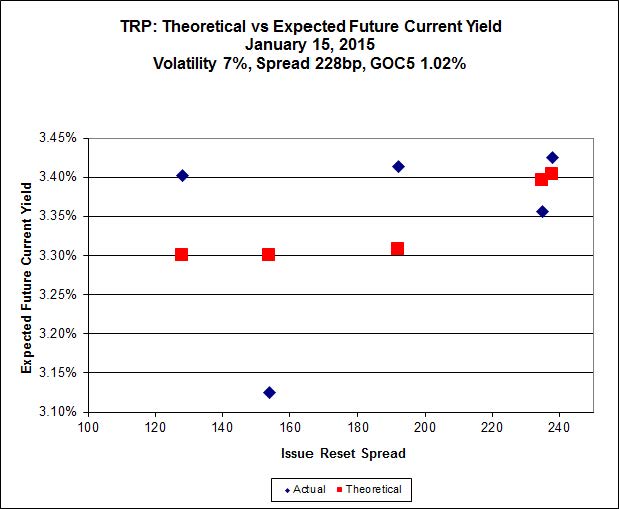
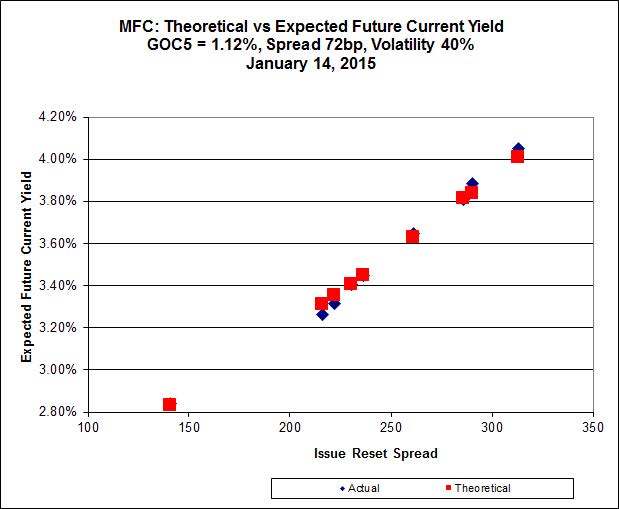
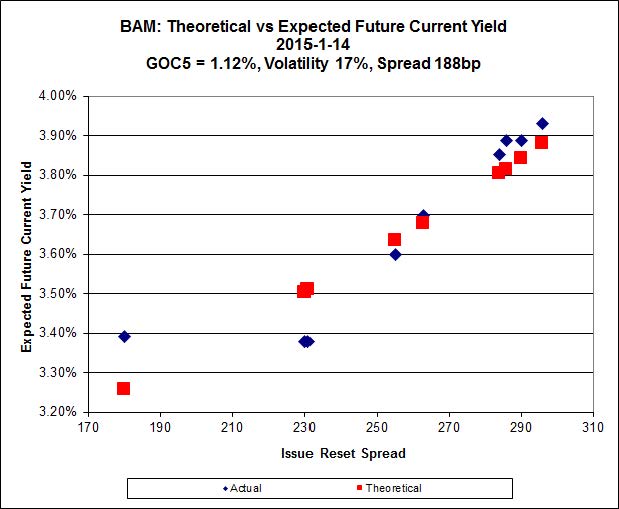
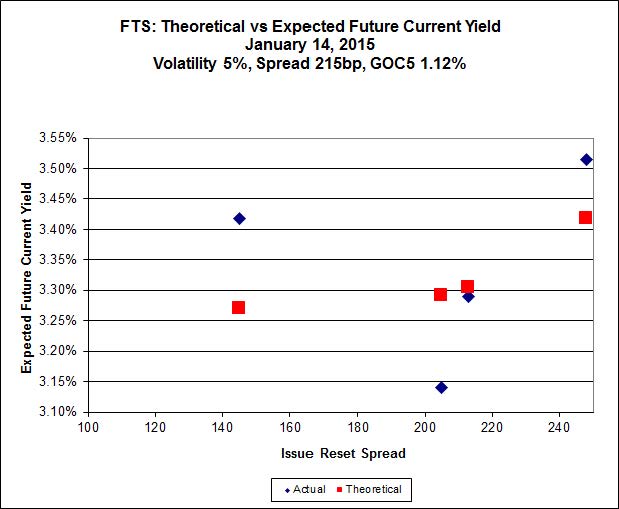
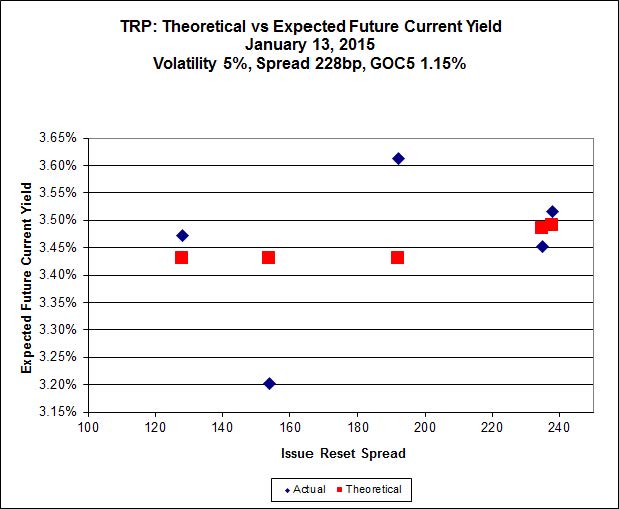
Prices for the TRP issues are very strange: consider that TRP.PR.A, bid at 21.15, is priced lower than TRP.PR.C, which is a FixedReset, 4.40%+154, resetting 2016-1-30, bid at 21.77. One can only suppose that the market expects some dramatic changes in the five year Canada yield over the next year! Implied Volatility analysis – which assumes, among many other things, that GOC-5 will not change, ever – suggests that TRP.PR.A is now $1.44 cheap while TRP.PR.C is $1.73 expensive (both relative only to other TRP FixedResets, not to anything else). Well … place yer bets, gennelmen, place yer bets!

impVol_TRP_141202

So, the perennial question was most recently asked by Assiduous Reader janbjarne and will be highlighted because of the flattering introduction:

Thank you for the very informative Prefblog and PrefLetter.

Your comments on how underpriced TRP.PR.A appears are interesting. Any thoughts on the pending conversion? A few months ago I thought that converting to the floater was a no-brainer. Now I am not so sure as both the TD.PR.Y/Z and the DC.PR.B/D pairs are trading at the same price.

Well, I’m not sure either! If you want absolute certainty, ask a stockbroker! Just don’t be so rude as to remind him of his prediction later!

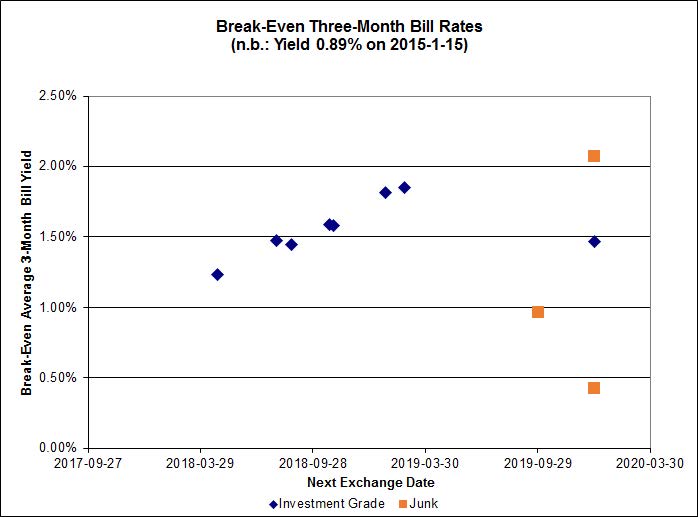
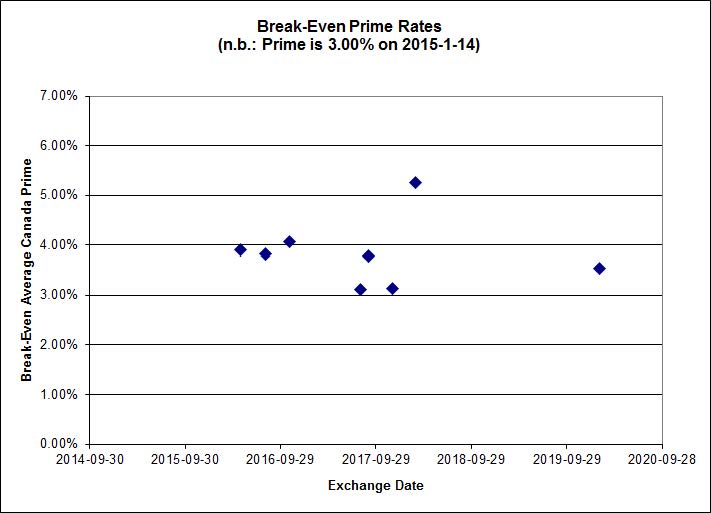
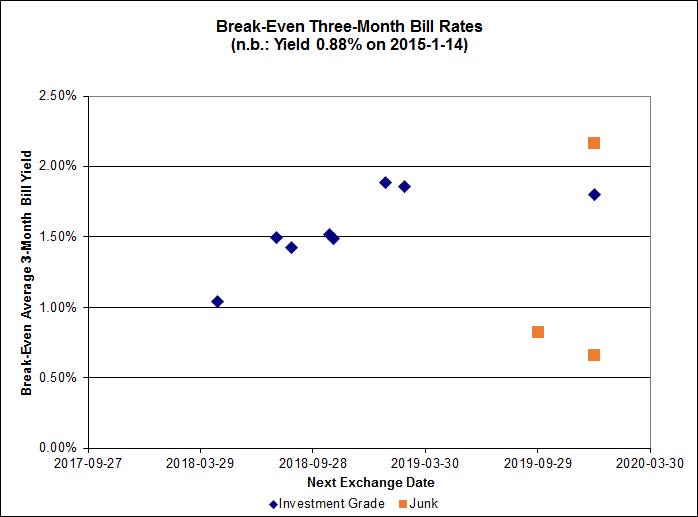
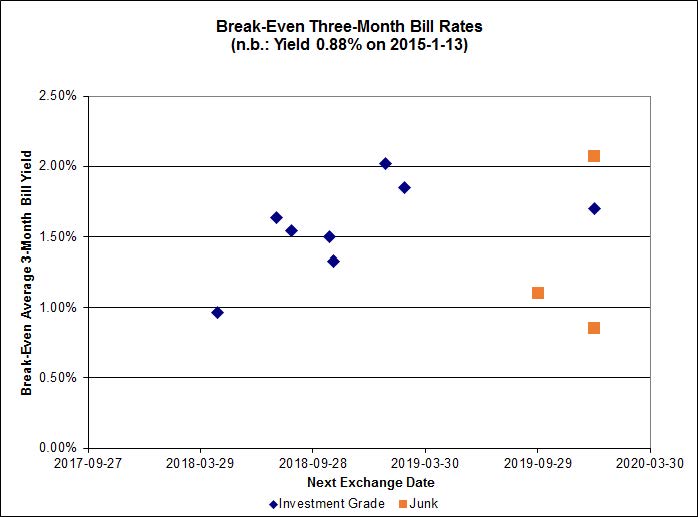
We can make an informed guess, though, using the Pair Equivalency Calculator which is explained in the article Preferred Pairs. We can examine all the currently trading FixedReset / FloatingReset pairs and determine the break-even average three-month bill rate for each pair:

pairEquivalents_bills_141202
Click for Big

There’s a fair bit of scatter, but the average for investment grade is 1.70% … that is, for each member of each pair to have an identical total return over the period until the next Exchange Date, the average bill rate until that date must be X, and the average of the Xs calculated for each pair is 1.70%, implying (assuming a steady increase in yields) a rate on the end date of 2.55%.

If we then reverse the calculation, the predicted price for the TRP FloatingReset is, given a bid of 21.15 for TRP.PR.A and an average bill rate of 1.70%, equal to 21.53: that is to say, we predict an immediate profit of $0.38 to result from conversion.

Even if we say that the average bill rate will be 1.54%, the lowest of the estimates, the predicted price of the FloatingReset should be 21.36, a profit of $0.21 … no great shakes, but it does indicate that the expectations of at least not losing are reasonably well-founded.

It should be remembered, though, that things can change dramatically in the course of even just a few weeks. The DC.PR.B / DC.PR.D conversion was a missed opportunity, because the break-even rate observed in the market changed dramatically between the date at which the estimate was made and the date the newly issued FloatingReset commenced trading..

Instructions are required by the company by December 16. I suggest holders first check with their broker to see what their broker’s deadline is (it’s usually a day or two earlier) and wait until the last minute before repeating the calculation and making up their mind. But at this point, it looks as if conversion to FloatingReset is the better bet.

Market Action

December 2, 2014

They’re playing a sad song in Australia:

Australia’s economy expanded slower than economists forecast in the third quarter, underscoring the central bank’s decision to keep interest rates at a record low. The currency fell to its lowest since July 2010.

Gross domestic product advanced 0.3 percent from the previous three months, when it rose 0.5 percent, a Bureau of Statistics report released in Sydney today showed. The result compared with a median estimate of a 0.7 percent gain from a Bloomberg News survey of 29 economists.

The Reserve Bank of Australia has kept its benchmark rate unchanged at a record low for 16 months as it seeks to encourage spending by consumers and companies to offset falling mining investment. Australian firms, outside of property, have opted to pay dividends or salt away cash rather than invest in new projects as they wait for higher household demand, which has been damped by an 11-year-high unemployment rate.

and there are funding cuts all over:

Funding cuts at Australia’s leading scientific institution CSIRO have led to world-leading researchers seeing their positions abolished. At least one of these, Dr. San Thang, is so committed to his work that he has continued his role unpaid. What makes the story even more poignant is that at the same time Thang was let go, there was speculation he might share a Nobel Prize in Chemistry.

… and the same tune in Russia:

Russia’s economic crisis deepened as the government acknowledged it’s heading for recession and a former central banker spoke of “some panic” in the financial system as oil prices plunged.

Speaking a day after President Vladimir Putin said Russia is scrapping a proposed $45 billion pipeline to Europe, the government predicted the economy will contract next year and canceled a bond auction. It was also forced to pledge 39.95 billion rubles ($740 million) to support OAO Gazprombank, at least the third lender to secure a capital injection since U.S. and European Union sanctions curbed their ability to borrow.

SBN.PR.A was confirmed at Pfd-3 by DBRS:

Based on the most recent dividend paid on the BNS Shares, the dividend income net of management fees and other expenses is expected to cover approximately 47% of the Preferred Share distributions. Holders of the Class A Shares are expected to receive regular monthly cash distributions in an amount targeted to be 6% per annum on the net asset value of the Class A Shares.

On September 5, 2014, DBRS confirmed the ratings of the Preferred Shares at Pfd-3. Since then, the performance of the Company has been volatile, with downside protection decreasing since the last rating action in September 2014 (50.3% as of November 20, 2014). Despite the drop, downside protection remain at levels typically seen at the Pfd-3 level.

It was a mixed day for the Canadian preferred share market, with PerpetualDiscounts down 18bp, FixedResets off 12bp and DeemedRetractibles gaining 7bp. Volatility was average, dominated by FixedReset losers. Volume was above average.

HIMIPref™ Preferred Indices
These values reflect the December 2008 revision of the HIMIPref™ Indices

Values are provisional and are finalized monthly
Index Mean
Current
Yield
(at bid)
Median
YTW
Median
Average
Trading
Value
Median
Mod Dur
(YTW)
Issues Day’s Perf. Index Value
Ratchet 0.00 % 0.00 % 0 0.00 0 0.1710 % 2,522.8
FixedFloater 0.00 % 0.00 % 0 0.00 0 0.1710 % 3,994.1
Floater 2.99 % 3.10 % 62,509 19.41 4 0.1710 % 2,681.9
OpRet 4.40 % -12.64 % 26,659 0.08 2 -0.0391 % 2,758.5
SplitShare 4.28 % 3.85 % 45,402 3.75 5 0.0820 % 3,191.4
Interest-Bearing 0.00 % 0.00 % 0 0.00 0 -0.0391 % 2,522.4
Perpetual-Premium 5.42 % -7.85 % 76,863 0.09 20 -0.0391 % 2,482.4
Perpetual-Discount 5.13 % 5.06 % 113,667 15.37 15 -0.1807 % 2,674.1
FixedReset 4.17 % 3.55 % 177,070 8.51 73 -0.1158 % 2,579.6
Deemed-Retractible 4.97 % -1.97 % 98,743 0.16 40 0.0703 % 2,616.5
FloatingReset 2.53 % 1.20 % 60,844 0.16 5 -0.1252 % 2,551.4
Performance Highlights
Issue Index Change Notes
TRP.PR.B FixedReset -1.79 % YTW SCENARIO
Maturity Type : Limit Maturity
Maturity Date : 2044-12-02
Maturity Price : 18.07
Evaluated at bid price : 18.07
Bid-YTW : 3.70 %
FTS.PR.K FixedReset -1.31 % YTW SCENARIO
Maturity Type : Limit Maturity
Maturity Date : 2044-12-02
Maturity Price : 23.14
Evaluated at bid price : 24.77
Bid-YTW : 3.46 %
SLF.PR.G FixedReset -1.15 % YTW SCENARIO
Maturity Type : Hard Maturity
Maturity Date : 2025-01-31
Maturity Price : 25.00
Evaluated at bid price : 20.70
Bid-YTW : 5.01 %
GWO.PR.Q Deemed-Retractible 1.19 % YTW SCENARIO
Maturity Type : Hard Maturity
Maturity Date : 2025-01-31
Maturity Price : 25.00
Evaluated at bid price : 25.41
Bid-YTW : 4.92 %
Volume Highlights
Issue Index Shares
Traded
Notes
W.PR.J Perpetual-Premium 120,100 Desjardins bought 115,800 from anonymous at 25.18.
YTW SCENARIO
Maturity Type : Call
Maturity Date : 2015-01-01
Maturity Price : 25.00
Evaluated at bid price : 25.24
Bid-YTW : 2.86 %
CU.PR.E Perpetual-Discount 77,000 Nesbitt crossed 75,000 at 24.60.
YTW SCENARIO
Maturity Type : Limit Maturity
Maturity Date : 2044-12-02
Maturity Price : 24.09
Evaluated at bid price : 24.51
Bid-YTW : 5.01 %
TRP.PR.A FixedReset 41,583 Will reset 2014-12-31 to 3.266%
YTW SCENARIO
Maturity Type : Limit Maturity
Maturity Date : 2044-12-02
Maturity Price : 21.15
Evaluated at bid price : 21.15
Bid-YTW : 3.90 %
BMO.PR.S FixedReset 40,194 Nesbitt crossed 36,700 at 25.52.
YTW SCENARIO
Maturity Type : Call
Maturity Date : 2019-05-25
Maturity Price : 25.00
Evaluated at bid price : 25.50
Bid-YTW : 3.55 %
TRP.PR.D FixedReset 36,067 YTW SCENARIO
Maturity Type : Limit Maturity
Maturity Date : 2044-12-02
Maturity Price : 23.31
Evaluated at bid price : 25.30
Bid-YTW : 3.65 %
BMO.PR.J Deemed-Retractible 30,335 Nesbitt crossed 25,600 at 25.79.
YTW SCENARIO
Maturity Type : Call
Maturity Date : 2015-01-01
Maturity Price : 25.50
Evaluated at bid price : 25.75
Bid-YTW : -6.35 %
There were 36 other index-included issues trading in excess of 10,000 shares.
Wide Spread Highlights
Issue Index Quote Data and Yield Notes
GWO.PR.I Deemed-Retractible Quote: 23.20 – 23.68
Spot Rate : 0.4800
Average : 0.3165

YTW SCENARIO
Maturity Type : Hard Maturity
Maturity Date : 2025-01-31
Maturity Price : 25.00
Evaluated at bid price : 23.20
Bid-YTW : 5.41 %

NEW.PR.D SplitShare Quote: 32.69 – 33.45
Spot Rate : 0.7600
Average : 0.6146

YTW SCENARIO
Maturity Type : Call
Maturity Date : 2015-06-26
Maturity Price : 32.07
Evaluated at bid price : 32.69
Bid-YTW : 2.09 %

MFC.PR.H FixedReset Quote: 26.07 – 26.45
Spot Rate : 0.3800
Average : 0.2395

YTW SCENARIO
Maturity Type : Call
Maturity Date : 2017-03-19
Maturity Price : 25.00
Evaluated at bid price : 26.07
Bid-YTW : 2.58 %

MFC.PR.C Deemed-Retractible Quote: 23.21 – 23.50
Spot Rate : 0.2900
Average : 0.2095

YTW SCENARIO
Maturity Type : Hard Maturity
Maturity Date : 2025-01-31
Maturity Price : 25.00
Evaluated at bid price : 23.21
Bid-YTW : 5.43 %

FTS.PR.K FixedReset Quote: 24.77 – 25.00
Spot Rate : 0.2300
Average : 0.1686

YTW SCENARIO
Maturity Type : Limit Maturity
Maturity Date : 2044-12-02
Maturity Price : 23.14
Evaluated at bid price : 24.77
Bid-YTW : 3.46 %

PWF.PR.L Perpetual-Premium Quote: 25.24 – 25.45
Spot Rate : 0.2100
Average : 0.1510

YTW SCENARIO
Maturity Type : Call
Maturity Date : 2015-10-31
Maturity Price : 25.00
Evaluated at bid price : 25.24
Bid-YTW : 4.54 %

Issue Comments

A Trend in Pricing

As noted in MAPF Portfolio Composition: November 2014, this year’s trend for the fund to sell Straight Perpetuals to buy FixedResets continued and even accelerated during the month.

In addition, Assiduous Reader prefQC asked:

A question concerning fixed-reset DeemedRetractable MFC.PR.F:

Late 2013, as fears of imminently increasing interest rates were at a bit of a frenzy, MFC.PR.F fell to a new one-year low, recovering gradually in mid-January 2014 as fears of significant rate increases waned.

Now, as interest rates are in contrast falling to unexpected lows and the outlook for increasing interest rates is rather gloomy, MFC.PR.F appears to be on the way to testing those previous lows again.

What gives here? Of course we are one year closer to the June 2016 reset date with its modest reset spread, but other than that, the behavior of MFC.PR.F seems contradictory. Any ideas?

.

Therefore it is interesting to look at the price trend of some of these pairs. We’ll start with GWO.PR.N / GWO.PR.I; the fund sold the latter to buy the former at a takeout of about $1.00 in mid-June, 2014; relative prices over the past year are plotted as:

GWOPRN_GWOPRI_bidDiff_141128
Click for Big

Given that the current take-out is $2.27, this is clearly a trade that has not worked out very well.

In July, 2014, I reported sales of SLF.PR.D to purchase SLF.PR.G at a take-out of about $0.15:

SLFPRG_SLFPRD_bidDiff_141128
Click for Big

There were similar trades in August, 2014 (from SLF.PR.C) at a take-out of $0.35. The current take-out is $2.07, so that hasn’t worked very well either.

The trend paused in September, 2014 and, indeed, can be said to have reversed, with the fund selling SplitShares (PVS.PR.B at 25.25-30) to purchase PerpetualDiscounts (BAM.PR.M / BAM.PR.N at about 21.25), a trade which worked out favourably and has been sort-of reversed (into PVS.PR.D) in November 2014.

In October 2014 there was another bit of counterflow, as the fund sold more SplitShares (CGI.PR.D at about 25.25) to purchase more PerpetualDiscounts (CU.PR.F and CU.PR.G, at about 21.25) which again worked out well and was reversed in November, selling the CU issues at about 22.45 to purchase low-spread FixedResets (TRP.PR.A and TRP.PR.B) at about 21.50 and 18.75 (post dividend equivalent), which was basically down by transaction costs at month-end.

And November saw the third insurer-based sector swap, as the fund sold MFC.PR.C to buy the FixedReset MFC.PR.F at a post-dividend-adjusted take-out of about $0.85 … given a month-end take-out of about $1.30, that’s another regrettable trade.

MFCPRF_MFCPRC_bidDiff_141128
Click for Big

This trend is not restricted to the insurance sector. Other pairs of interest are BAM.PR.X / BAM.PR.M:

BAMPRX_BAMPRN_bidDiff_141128
Click for Big

… and FTS.PR.H / FTS.PR.J:

FTSPRH_FTSPRJ_bidDiff_141128
Click for Big

… and PWF.PR.P / PWF.PR.S:

PWFPRP_PWFPRS_bidDiff_141128
Click for Big

I will agree that the fund’s trades highlighted in this post may be decried as cases of monumental bad timing, but I should point out that in May, 2014, the fund was 63.9% Straight / 9.5% FixedReset
while in November 2014 the fund was 42.6% Straight / 39.0% FixedReset. Given that the indices are roughly 30% Straight / 60% FixedReset, it is apparent that the fund was extremely overweighted in Straights / underweighted in FixedResets in May 2014 and that this qualitative tilt remains – just not quite so extreme.

Summarizing the charts above in tabular form, we see:

FixedReset Straight Take-out
November 2013
Take-out
MAPF Trade
Take-out
November 2014
GWO.PR.N
3.65%+130
GWO.PR.I
4.5%
$0.17 $1.00 $2.27
SLF.PR.G
4.35%+141
SLF.PR.D
4.45%
($1.43) $0.25 $2.07
MFC.PR.F
4.20%+141
MFC.PR.C
4.50%
($1.07) $0.86 $1.30
BAM.PR.X
4.60%+180
BAM.PR.M
4.75%
($2.81)   $0.35
FTS.PR.H
4.25%+145
FTS.PR.J
4.75%
$1.35   $3.91
PWF.PR.P
4.40%+160
PWF.PR.S
4.80%
($1.26)   $2.09
The ‘Take-Out’ is the bid price of the Straight less the bid price of the FixedReset; approximate execution prices are used for the “MAPF Trade” column. Bracketted figures in the ‘Take-Out’ columns indicate a ‘Pay-Up’

So why is all this happening? One should take care in explaining market movements, but it is my belief that in the latter half of 2013 we were dealing with the ‘taper tantrum’ – the market’s fears that Fed tapering and subsequent tapering would lead to massive spikes in yields; this led to a great preference for FixedResets over Straights. Now, with the economic news getting less inflationary with every news story and Europe and Japan desperately trying to reflate their sluggish economies, the market seems to think that these rate increases are still a long way off … leading to a great preference for Straights over FixedResets.

Market Action

December 1, 2014

Moody’s downgraded Japan:

Moody’s Investors Service on Monday downgraded Japan’s sovereign debt rating by one notch to A1, citing rising uncertainty over the country’s ability to hit its debt-reduction goal.

The announcement briefly sent the yen to a seven-year low against the dollar and pushed 10-year Japanese government bond (JGB) futures down by 10 ticks.

The U.S. rating agency said the outlook was stable.

Tom Byrne, regional credit officer of Moody’s, said the downgrade was closely linked to [Japanese Prime Minister] Mr. [Shinzo] Abe’s decision to delay next year’s scheduled sales tax hike, which made it more challenging for Japan to achieve its target of reducing the primary budget deficit in fiscal 2020.

“There is concern that fiscal policy in its current state will not achieve the long-term fiscal goals,” he said.

Hours before Moody’s announcement, Mr. Abe had stressed in a televised public debate that Japan remained committed to fiscal reform, and that the Bank of Japan’s ultraloose policy was not aimed at monetizing public debt.

But Moody’s warned that the BOJ’s efforts to achieve its 2-per-cent inflation target through aggressive money printing may push up bond yields and raise government borrowing costs.

Remember that US recovery that would save the world?

U.S. stocks fell for a second day as weaker data on Black Friday sales and China manufacturing overshadowed a rebound in oil and expansion in American factories.

Retailers in the Standard & Poor’s 500 Index (SPX) fell the most in a month as post-Thanksgiving holiday sales came in below forecasts. Apple Inc. fell as much as 6.4 percent in early trading before paring the loss in half. Chevron Corp. and Exxon Mobil Corp. gained at least 2 percent as crude oil ended a four-day skid.

The S&P 500 fell 0.7 percent to 2,053.44 at 4 p.m. in New York. The Dow Jones Industrial Average slumped 51.44 points, or 0.3 percent, to 17,776.8. The technology-heavy Nasdaq 100 Index lost 1.2 percent. About 7.6 billion listed shares changed hands in the U.S., 13 percent higher than the three-month daily average.

Black Friday, as noted above, was a fizzle:

Spending tumbled an estimated 11 percent over the weekend from a year earlier, the Washington-based National Retail Federation said yesterday. And more than 6 million shoppers who had been expected to hit stores never showed up.

Consumers were unmoved by retailers’ aggressive discounts and longer Thanksgiving hours, raising concern that signs of recovery in recent months won’t endure. Retailers also were targeted by protesters, who called on consumers to boycott Black Friday to make a statement about police violence. Still, the NRF cast the decline in a positive light, saying it showed shoppers were confident enough to skip the initial rush for discounts.

There may be relatively little effect on Canada, though, as Roy Osing reminds us that our main product is mewling sycophancy:

… I was less than impressed with the organization structure he proposed. It was a structure I had “lived with” in my previous life and could see the pluses and minuses.

When asked whether I could support the proposed structure, I asked for time to consider it before declaring my position.

One of my peers virtually condemned it and with his “outside voice” declared his non-support; he left the company soon thereafter.

A previous president once told me “Roy, if your boss puts forward what you consider to be a ‘dumb idea’, you only have two choices: one, support it and try to make it work; or two, leave.”

And there’s the usual amount of rate punditry:

Poloz will keep his benchmark overnight rate at 1 percent Dec. 3 according to all 22 economists surveyed by Bloomberg News through Nov. 28, stretching the pause that began with Mark Carney in 2010. That would make it the longest since February 1944 to September 1950, exceeding the October 1950 to January 1955 hiatus.

While Fed policy makers debate the language they might use to flag potential policy-rate increases, their Canadian counterparts say they remain focused on providing stimulus to bring the world’s 11th-largest economy back to full output over the next two years.

Canada’s economic growth slowed to a 2.8 percent annualized pace in the third quarter from 3.6 percent the prior three months, Statistics Canada reported Nov. 28. In contrast, U.S. growth came in at 3.9 percent.

Poloz won’t raise rates until the fourth quarter of next year, according to a Bloomberg economist survey. The quarter-point increase forecast for Canada compares with an estimated Fed move to 1 percent from 0.25 percent over that time.

The anticipation of rising Fed rates has is already helping keep Canadian bond yields lower than Treasuries. Canada’s five-year bonds had a 1.35 percent yield at 9:25 a.m. Toronto time today, while similar Treasuries yielded 1.46 percent.

In honour of Cyber Monday, the Canadian preferred share market was on sale today, with PerpetualDiscounts down 12bp, FixedResets losing 18bp and DeemedRetractibles off 11bp. Volatility was high and comprised almost entirely of losers. Volume was below average.

HIMIPref™ Preferred Indices
These values reflect the December 2008 revision of the HIMIPref™ Indices

Values are provisional and are finalized monthly
Index Mean
Current
Yield
(at bid)
Median
YTW
Median
Average
Trading
Value
Median
Mod Dur
(YTW)
Issues Day’s Perf. Index Value
Ratchet 0.00 % 0.00 % 0 0.00 0 -0.9738 % 2,518.5
FixedFloater 0.00 % 0.00 % 0 0.00 0 -0.9738 % 3,987.3
Floater 2.99 % 3.11 % 62,372 19.39 4 -0.9738 % 2,677.3
OpRet 4.39 % -12.35 % 25,827 0.08 2 -0.0195 % 2,759.6
SplitShare 4.28 % 3.90 % 47,274 3.75 5 -0.3161 % 3,188.8
Interest-Bearing 0.00 % 0.00 % 0 0.00 0 -0.0195 % 2,523.3
Perpetual-Premium 5.42 % -8.03 % 71,155 0.09 20 -0.0897 % 2,483.4
Perpetual-Discount 5.12 % 5.06 % 114,040 15.36 15 -0.1241 % 2,678.9
FixedReset 4.17 % 3.51 % 178,614 8.64 73 -0.1848 % 2,582.5
Deemed-Retractible 4.97 % -1.78 % 99,350 0.09 40 -0.1064 % 2,614.6
FloatingReset 2.53 % -0.48 % 59,985 0.08 5 -0.0469 % 2,554.6
Performance Highlights
Issue Index Change Notes
HSE.PR.A FixedReset -4.13 % Completely legitimate and not just another Toronto Stock Exchange screw up, for a change. The closing quote was 21.81-00 and all trades after 2:30 pm were under 22.00, although the VWAP for the day was 22.22. The thumping is probably due to the HSE new issue, FixedReset, 4.50%+313 announced today.
YTW SCENARIO
Maturity Type : Limit Maturity
Maturity Date : 2044-12-01
Maturity Price : 21.47
Evaluated at bid price : 21.81
Bid-YTW : 3.61 %
MFC.PR.F FixedReset -1.45 % YTW SCENARIO
Maturity Type : Hard Maturity
Maturity Date : 2025-01-31
Maturity Price : 25.00
Evaluated at bid price : 21.81
Bid-YTW : 4.59 %
BAM.PR.M Perpetual-Discount -1.25 % YTW SCENARIO
Maturity Type : Limit Maturity
Maturity Date : 2044-12-01
Maturity Price : 21.73
Evaluated at bid price : 22.08
Bid-YTW : 5.46 %
GWO.PR.N FixedReset -1.13 % YTW SCENARIO
Maturity Type : Hard Maturity
Maturity Date : 2025-01-31
Maturity Price : 25.00
Evaluated at bid price : 21.03
Bid-YTW : 4.74 %
BAM.PR.B Floater -1.10 % YTW SCENARIO
Maturity Type : Limit Maturity
Maturity Date : 2044-12-01
Maturity Price : 17.02
Evaluated at bid price : 17.02
Bid-YTW : 3.11 %
CGI.PR.D SplitShare -1.06 % YTW SCENARIO
Maturity Type : Soft Maturity
Maturity Date : 2023-06-14
Maturity Price : 25.00
Evaluated at bid price : 25.23
Bid-YTW : 3.62 %
MFC.PR.G FixedReset 1.18 % YTW SCENARIO
Maturity Type : Call
Maturity Date : 2016-12-19
Maturity Price : 25.00
Evaluated at bid price : 25.82
Bid-YTW : 2.65 %
Volume Highlights
Issue Index Shares
Traded
Notes
TRP.PR.A FixedReset 172,040 RBC crossed 142,100 at 21.39.
YTW SCENARIO
Maturity Type : Limit Maturity
Maturity Date : 2044-12-01
Maturity Price : 21.32
Evaluated at bid price : 21.32
Bid-YTW : 3.86 %
RY.PR.B Deemed-Retractible 124,636 National crossed 120,000 at 25.44.
YTW SCENARIO
Maturity Type : Call
Maturity Date : 2014-12-31
Maturity Price : 25.25
Evaluated at bid price : 25.40
Bid-YTW : -1.48 %
TRP.PR.D FixedReset 80,232 RBC crossed 65,000 at 25.46.
YTW SCENARIO
Maturity Type : Limit Maturity
Maturity Date : 2044-12-01
Maturity Price : 23.33
Evaluated at bid price : 25.39
Bid-YTW : 3.63 %
ENB.PR.N FixedReset 57,172 RBC crossed 37,600 at 24.85.
YTW SCENARIO
Maturity Type : Limit Maturity
Maturity Date : 2044-12-01
Maturity Price : 23.13
Evaluated at bid price : 24.66
Bid-YTW : 3.98 %
TD.PF.A FixedReset 51,001 Scotia crossed 41,400 at 25.53.
YTW SCENARIO
Maturity Type : Limit Maturity
Maturity Date : 2044-12-01
Maturity Price : 23.32
Evaluated at bid price : 25.50
Bid-YTW : 3.47 %
PWF.PR.L Perpetual-Premium 47,395 YTW SCENARIO
Maturity Type : Call
Maturity Date : 2015-10-31
Maturity Price : 25.00
Evaluated at bid price : 25.35
Bid-YTW : 4.03 %
There were 26 other index-included issues trading in excess of 10,000 shares.
Wide Spread Highlights
Issue Index Quote Data and Yield Notes
BAM.PF.G FixedReset Quote: 25.80 – 26.30
Spot Rate : 0.5000
Average : 0.2987

YTW SCENARIO
Maturity Type : Call
Maturity Date : 2020-06-30
Maturity Price : 25.00
Evaluated at bid price : 25.80
Bid-YTW : 3.81 %

BAM.PF.F FixedReset Quote: 25.71 – 26.15
Spot Rate : 0.4400
Average : 0.2765

YTW SCENARIO
Maturity Type : Call
Maturity Date : 2019-09-30
Maturity Price : 25.00
Evaluated at bid price : 25.71
Bid-YTW : 4.05 %

GWO.PR.Q Deemed-Retractible Quote: 25.11 – 25.50
Spot Rate : 0.3900
Average : 0.2728

YTW SCENARIO
Maturity Type : Hard Maturity
Maturity Date : 2025-01-31
Maturity Price : 25.00
Evaluated at bid price : 25.11
Bid-YTW : 5.07 %

TD.PR.R Deemed-Retractible Quote: 26.32 – 26.79
Spot Rate : 0.4700
Average : 0.3614

YTW SCENARIO
Maturity Type : Call
Maturity Date : 2014-12-31
Maturity Price : 25.75
Evaluated at bid price : 26.32
Bid-YTW : -15.06 %

SLF.PR.A Deemed-Retractible Quote: 24.25 – 24.50
Spot Rate : 0.2500
Average : 0.1663

YTW SCENARIO
Maturity Type : Hard Maturity
Maturity Date : 2025-01-31
Maturity Price : 25.00
Evaluated at bid price : 24.25
Bid-YTW : 5.11 %

CU.PR.G Perpetual-Discount Quote: 22.50 – 22.75
Spot Rate : 0.2500
Average : 0.1686

YTW SCENARIO
Maturity Type : Limit Maturity
Maturity Date : 2044-12-01
Maturity Price : 22.19
Evaluated at bid price : 22.50
Bid-YTW : 5.01 %

Issue Comments

FTN.PR.A To Get Bigger

Quadravest has announced:

Financial 15 Split Corp. (the “Company”) is pleased to announce it has filed a preliminary short form prospectus in each of the provinces of Canada with respect to an offering of Preferred Shares and Class A Shares of the Company. The offering will be co-led by National Bank Financial Inc., CIBC, RBC Capital Markets and will also include Scotia Capital Inc., BMO Capital Markets, GMP Securities L.P., Canaccord Genuity Corp. and Raymond James.

The Preferred Shares will be offered at a price of $10.00 per Preferred Share to yield 5.25% and the Class A Shares will be offered at a price of $9.75 per Class A Share to yield 15.5%. The closing price on the TSX of each of the Preferred Shares and the Class A Shares on November 28, 2014 was $10.14 and $10.04, respectively.

Since inception of the Company, the aggregate dividends paid on the Preferred Shares have been $5.75 per share and the aggregate dividends paid on the Class A Shares have been $12.61 per share, for a combined total of $18.36. All distributions to date have been made in tax advantage eligible Canadian dividends or capital gains dividends.

The net proceeds of the secondary offering will be used by the Company to invest in an actively managed, high quality portfolio consisting of 15 financial services companies made up of Canadian and U.S. issuers as follows:

Bank of Montreal National Bank of Canada Bank of America Corp.
The Bank of Nova Scotia Manulife Financial Corporation Citigroup Inc.
Canadian Imperial Bank of Commerce Sun Life Financial Services of Canada Inc. Goldman Sachs Group Inc.
Royal Bank of Canada Great-West Lifeco Inc. JP Morgan Chase & Co.
The Toronto-Dominion Bank CI Financial Corp. Wells Fargo & Co.

The Company’s investment objectives are:

Preferred Shares:
i. to provide holders of the Preferred Shares with fixed, cumulative preferential monthly cash dividends currently in the amount of $0.04375 per Preferred Share to yield 5.25% annually, to be set by the Board of Directors annually subject to a minimum of 5.25% until 2020; and
ii. on or about the termination date, currently December 1, 2020 (subject to further 5 year extensions thereafter), to pay the holders of the Preferred Shares $10.00 per Preferred Share.

Class A Shares:
i. to provide holders of the Class A Shares with regular monthly cash dividends in an amount to be determined by the Board of the Directors and currently targeted to be $0.1257 per Class A Share; and
ii. to permit holders to participate in all growth in the net asset value of the Company above $10 per Unit, by paying holders on or about the termination date of December 1, 2020 (subject to further 5 year extensions thereafter) such amounts as remain in the Company after paying $10 per Preferred Share.

The sales period of this overnight offering will end at 9:00 a.m. EST on December 2, 2014.

That’s a pretty hefty premium over NAV! The NAVPU of the fund was $17.78 on November 28.

FTN.PR.A was last mentioned on PrefBlog in connection with its Rights Offering that closed in September, 2014. FTN.PR.A is tracked by HIMIPref™, but relegated to the Scraps index on credit concerns.

Update, 2014-12-2: They raised $38.3-million:

Financial 15 Split Corp. (the “Company”) is pleased to announce it has completed the overnight marketing of up to 1,939,000 Preferred Shares and up to 1,939,000 Class A Shares. Total proceeds of the offering are expected to be approximately $38.3 million.

The offering is being co-led by National Bank Financial Inc., CIBC, RBC Capital Markets and will also include Scotia Capital Inc., BMO Capital Markets, GMP Securities L.P., Canaccord Genuity Corp. and Raymond James.

The sales period of the overnight offering has now ended.

New Issues

New Issue: HSE FixedReset, 4.50%+313

Husky Energy has announced that it:

has agreed to issue to a syndicate of underwriters led by Scotia Capital Inc. and TD Securities Inc. (collectively the “Underwriters”) for distribution to the public 8,000,000 Cumulative Rate Reset Preferred Shares, Series 3 (the “Series 3 Shares”).

The Series 3 Shares will be issued at a price of $25.00 per Series 3 Share, for aggregate gross proceeds of $200 million. Holders of the Series 3 Shares will be entitled to receive a cumulative quarterly fixed dividend yielding 4.50 percent annually for the initial period ending December 31, 2019. Thereafter, the dividend rate will be reset every five years at a rate equal to the five-year Government of Canada bond yield plus 3.13 percent.

Holders of Series 3 Shares will have the right, at their option, to convert their shares into Cumulative Rate Reset Preferred Shares, Series 4 (the “Series 4 Shares”), subject to certain conditions, on December 31, 2019 and on December 31 every five years thereafter. Holders of the Series 4 Shares will be entitled to receive cumulative quarterly floating dividends at a rate equal to the 90-day Government of Canada Treasury Bill rate plus 3.13 percent.

Husky has granted the Underwriters an option, exercisable in whole or in part prior to closing, to purchase up to an additional 2,000,000 Series 3 Shares at the same offering price. The Series 3 Shares will be offered by way of prospectus supplement to the short form base shelf prospectus of Husky Energy dated December 31, 2012.

The prospectus supplement will be filed with securities regulatory authorities in all provinces of Canada, except Quebec.

The net proceeds from this offering will be used to further support the Company’s strong balance sheet and business plan as well as for general corporate purposes, which may include, among other things, the partial repayment of the 3.75% medium-term notes due in 2015.

The offering is expected to close on or about December 9, 2014, subject to customary closing conditions and receipt of required regulatory approvals.

This is a useful issue, as it provides a good distinction with HSE.PR.A, which is a FixedReset, 4.45%+173, which closed 2011-3-18. One hundred and forty basis points difference in Issue Reset Spread is not to be sneezed at!

Update, 2014-12-2 : Upsized:

Husky Energy (TSX:HSE) is increasing the size of its previously announced offering of Cumulative Rate Reset Preferred Shares, Series 3 (the “Series 3 Shares”) to 10 million shares, due to positive investor response.

The aggregate gross proceeds from the upsized offering will be $250 million. Closing of the offering is expected on or about December 9, 2014, subject to customary closing conditions and receipt of required regulatory approvals.

MAPF

MAPF Performance: November 2014

The fund outperformed significantly in November, due largely to its overweight position in Straight Perpetuals.

relPerf_141128
Click for Big

relYield_141128
Click for Big

I continue to believe that the decline in the preferred share market remains overdone; the following table shows the increase in yields since May 22, 2013, of some fixed income sectors:

Yield Changes
May 22, 2013
to
November 28, 2014
Sector Yield
May 22
2013
Yield
October 31
2014
Change
Five-Year Canadas 1.38% 1.38% 0
Long Canadas 2.57% 2.33% -24bp
Long Corporates 4.15% 4.05% -10bp
FixedResets
Investment Grade
(Interest Equivalent)
3.51% 4.64% +113bp
Perpetual-Discounts
Investment Grade
(Interest Equivalent)
6.34% 6.51% +17bp
The change in yield of PerpetualDiscounts is understated due a massive influx of issues from the PerpetualPremium sub-index over the period, which improved credit quality. When the four issues that comprised the PerpetualDiscount sub-index as of May 22, 2013 are evaluated as of November 28, 2014, the interest-equivalent yield is 6.98% and thus the change is +64bp.

This will probably be the last time I trot out comparisons between current conditions and those of May, 2013; PerpetualDiscounts have edged back far enough that the total return since then is only just barely negative, while five year Canadas are identical (!) and long Canadas are below their May, 2013, levels (!!).

ZPR, is an ETF comprised of FixedResets and Floating Rate issues and a very high proportion of junk issues, returned +%, +% and +% over the past one-, three- and twelve-month periods, respectively (according to the fund’s data), versus returns for the TXPL index of +0.34%, -0.38% and +4.31% respectively. The fund has been able to attract assets of about $1,116-million since inception in November 2012; AUM increased by $21-million in November; given an index return of +0.34% an increase of less than $1-million was expected, indicating that money is still flowing into the fund. I feel that the flows into and out of this fund are very important in determining the performance of its constituents.

TXPR had returns over one- and three-months of +0.73% and +0.61%, respectively with CPD performance within expectations.

Returns for the HIMIPref™ investment grade sub-indices for October were as follows:

HIMIPref™ Indices
Performance to October 30, 2014
Sub-Index 1-Month 3-month
Ratchet N/A N/A
FixFloat N/A N/A
Floater +1.16% -0.84%
OpRet +0.61% +1.13%
SplitShare +1.06% +1.50%
Interest N/A N/A
PerpetualPremium +0.77% +1.85%
PerpetualDiscount +2.05% +2.69%
FixedReset +0.58% +0.59%
DeemedRetractible +1.24% +1.97%
FloatingReset +0.16% +0.96%

Malachite Aggressive Preferred Fund’s Net Asset Value per Unit as of the close November 28, 2014, was $10.6865.

Returns to November 28, 2014
Period MAPF BMO-CM “50” Index TXPR
Total Return
CPD – according to Blackrock
One Month +1.52% +0.64% +0.73% N/A
Three Months +1.49% +0.39% +0.61% N/A
One Year +10.58% +3.81% +5.53% +5.08%
Two Years (annualized) +4.36% +2.56% +2.62% N/A
Three Years (annualized) +7.02% +3.72% +3.72% +3.22%
Four Years (annualized) +5.37% +4.33% +3.87% N/A
Five Years (annualized) +7.88% +5.88% +5.05% +4.43%
Six Years (annualized) +18.72% +10.26% +9.34%  
Seven Years (annualized) +13.35% +5.15% +4.27%  
Eight Years (annualized) +10.88% +3.61%    
Nine Years (annualized) +10.39% +3.70%    
Ten Years (annualized) +9.99% +3.80%    
Eleven Years (annualized) +10.42% +4.01%    
Twelve Years (annualized) +11.98% +4.31%    
Thirteen Years (annualized) +10.87% +4.17%    
MAPF returns assume reinvestment of distributions, and are shown after expenses but before fees.
CPD Returns are for the NAV and are after all fees and expenses.
Figures for National Bank Preferred Equity Income Fund (formerly Omega Preferred Equity) (which are after all fees and expenses) for 1-, 3- and 12-months are +0.65%, +0.97% and +5.50%, respectively, according to Morningstar after all fees & expenses. Three year performance is +4.09%; five year is +5.42%
Figures for Jov Leon Frazer Preferred Equity Fund Class I Units (which are after all fees and expenses) for 1-, 3- and 12-months are -0.04%, -0.81% and +1.19% respectively, according to Morningstar. Three Year performance is +0.93%; five-year is +2.43%
Figures for Manulife Preferred Income Class Adv [into which was merged Manulife Preferred Income Fund (formerly AIC Preferred Income Fund)] (which are after all fees and expenses) for 1-, 3- and 12-months are +0.47%, -0.15% & +4.00%, respectively.
Figures for Horizons AlphaPro Preferred Share ETF (which are after all fees and expenses) for 1-, 3- and 12-months are +0.68%, +0.60% & +5.18%, respectively. Three year performance is +4.56%
Figures for National Bank Preferred Equity Fund (formerly Altamira Preferred Equity Fund) are +0.70%, +0.51% and +4.26% for one-, three- and twelve months, respectively.
The figure for BMO S&P/TSX Laddered Preferred Share Index ETF is +0.41%, -0.46% and +4.03% for one-, three- and twelve-months, respectively.
Figures for NexGen Canadian Preferred Share Tax Managed Fund (Dividend Tax Credit Class, the best performing) are +%, +% and +% for one-, three- and twelve-months, respectively. (Figures to November 28 have not be published as of December 14)
Figures for BMO Preferred Share Fund are +0.64% and +2.97% for the past three- and twelve-months, respectively.
Figures for PowerShares Canadian Preferred Share Index Class, Series Fare +0.80%, +0.33% and +4.36% for the past one, three and twelve months, respectively. The three year figure is +2.00%

MAPF returns assume reinvestment of dividends, and are shown after expenses but before fees. Past performance is not a guarantee of future performance. You can lose money investing in Malachite Aggressive Preferred Fund or any other fund. For more information, see the fund’s main page. The fund is available either directly from Hymas Investment Management or through a brokerage account at Odlum Brown Limited.

A problem that has bedevilled the market over the past two years has been the OSFI decision not to grandfather Straight Perpetuals as Tier 1 bank capital, and their continued foot-dragging regarding a decision on insurer Straight Perpetuals has segmented the market to the point where trading has become much more difficult. The fund occasionally finds an attractive opportunity to trade between GWO issues, which have a good range of annual coupons (but in which trading is now hampered by the fact that the low-coupon issues are trading near par and are callable at par in the near term), but is “stuck” in the MFC and SLF issues, which have a much narrower range of coupon, while the IAG DeemedRetractibles are quite illiquid. Until the market became so grossly segmented, this was not so much of a problem – but now banks are not available to swap into (because they are so expensive) and non-regulated companies are likewise deprecated (because they are not DeemedRetractibles; they should not participate in the increase in value that will follow the OSFI decision I anticipate and, in addition, are analyzed as perpetuals). The fund’s portfolio is, in effect ‘locked in’ to the MFC & SLF issues due to projected gains from a future OSFI decision, to the detriment of trading gains particularly in May, 2013, when the three lowest-coupon SLF DeemedRetractibles (SLF.PR.C, SLF.PR.D and SLF.PR.E) were the worst performing DeemedRetractibles in the sub-index, and in June, 2013, when the insurance-issued DeemedRetractibles behaved like PerpetualDiscounts in a sharply negative market.

However, it will be noted, as discussed in several reports on Portfolio Composition since June, 2014, there has been a continuing series of trades from DeemedRetractibles into low-Spread FixedResets of the same issuer … so there are some opportunities to trade, although they don’t happen often!

In October, insurance DeemedRetractibles outperformed bank DeemedRetractibles:

insBank_straightPerf_141128
Click for Big

… and were about equal to Unregulated Straight Perpetuals.

insUnreg_straightPerf_141128
Click for Big

Of the regressions for data in the above two charts, the Adjusted Correlation of the Bank DeemedRetractible performance (not shown) is slightly negative, Unregulated Straight Perpetuals come in at 31% and Insurance DeemedRetractibles are at 75%.

A lingering effect of the downdraft of 2013 has been the return of measurable Implied Volatility (all Implied Volatility calculations use bids from November 28):

impVol_GWO_141128
Click for Big

impVol_PWF_141128
Click for Big

However, while the fit for PWF is good and the Implied Volatility is high, there are many local minima for the spread:

impVol_PWF_141128_fit_varVol
Click for Big

impVol_PWF_141128_fit_varSpread
Click for Big

Implied Volatility of
Two Series of Straight Perpetuals
November 28, 2014
Issuer Pure Yield Implied Volatility
GWO 3.87% (-0.47) 18% (+2)
PWF 0.04% (-0.18) 39% (-1)
Bracketted figures are changes since September month-end

It is disconcerting to see the difference between GWO and PWF; if anything, we would expect the implied volatility for GWO to be higher, given that the DeemedRetraction – not yet given significant credence by the market – implies a directionality in prices. On the other hand, the PWF issues are mostly trading above par, which in practice tends to add directionality although this makes no sense. The GWO data with the best fit derived for PWF is distinguishable from the best fit; the best fit has a lower Sum of Squared Errors (1.28 vs. 2.85):

impVol_GWO_PWFBest_141128
Click for Big

In the September, 2013, edition of PrefLetter, I extended the theory of Implied Volatility to FixedResets – relating the option feature of the Issue Reset Spreads to a theoretical non-callable Market Spread.

impVol_BPO_141128
Click for Big

impVol_FFH_141128
Click for Big

Implied Volatility of
Two Series of FixedResets
August 29, 2014
Issuer Market Reset Spread
(Non-Callable)
Implied Volatility
BPO 100bp (-3) 40% (0)
FFH 307bp (-9) 8% (0)
Bracketted figures are changes since October month-end

These are very interesting results: The BPO issues are trading as if calls are a certainty, while FFH issues are trading as if calls are much less likely; this is probably due to the market’s over-reacting to the fact that all of the BPO issues are trading above par, while only one of the five FFH issues shares that happy status. The FFH series continues to be perplexing, this time with the four lower-coupon issues showing virtually no implied volatility – with the highest coupon issue (FFH.PR.K) being well off the mark … all I can think of is that the market has decided that FFH.PR.K, with an Issue Reset Spread of 351bp, is sure to be called in 2017, while the other four (highest spread is FFH.PR.C, +315) are not at all likely to be called. Note that FFH.PR.C will have its first Reset Date on 2014-12-31 and it would appear, given its bid of 24.90, that the market expects a reset rather than a call for redemption.

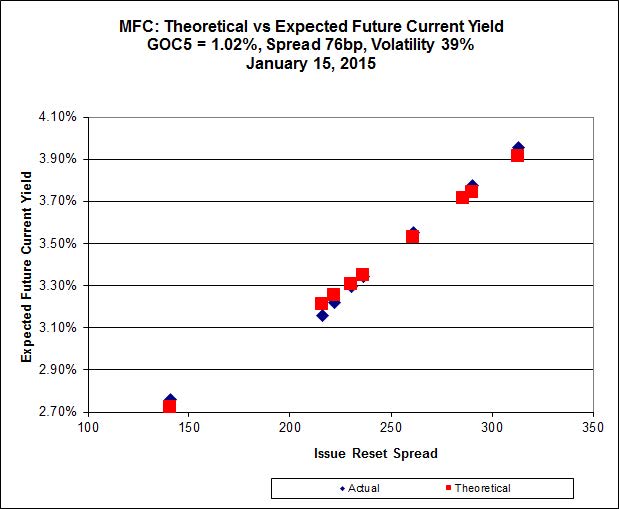
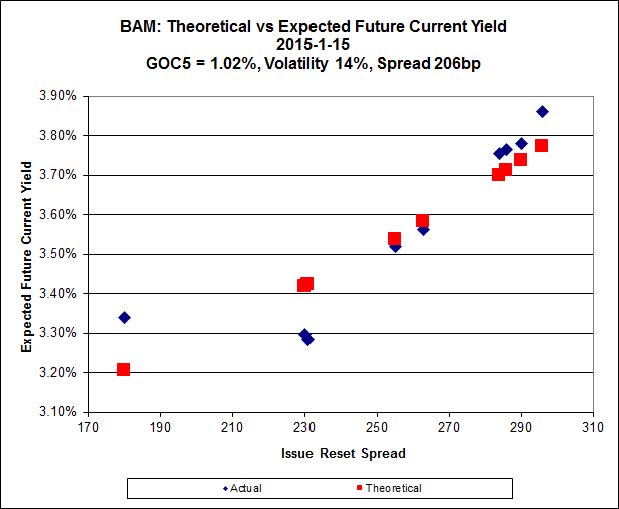
The Implied Volatility calculation for the TRP FixedResets is most interesting:

impVol_TRP_141128Click for Big

According to this calculation, TRP.PR.A is $1.56 cheap to theory, being bid at 21.46 compared to a theoretical price of 23.02. A portion of this difference is due to the approximations that have gone into the calculation, which assumes that all issues have three years to their call date and, critically, are all paying their long-term dividend rate right now. In an environment in which, given a GOC5 yield of 1.38%, virtually all dividend rates are expected to drop on reset, the time to reset and the degree of difference in the interim is important.

We can make some approximate adjustments to the theoretical prices:

Issue Current Rate Issue Reset Spread Next Reset Date Expected Future Rate Difference per annum Dividends before Reset Total Difference
TRP.PR.A $1.15 192bp 2014-12-31 $0.825 $0.325 0 $0.00
TRP.PR.B $1.00 128bp 2015-6-30 $0.665 $0.335 2 $0.17
TRP.PR.C $1.10 154bp 2016-1-30 $0.73 $0.37 4 $0.37
TRP.PR.D $1.00 238bp 2019-4-30 $0.94 $0.06 17 $0.25
TRP.PR.E $1.0625 235bp 2019-10-30 $0.9325 $0.13 19 $0.62

So a more precise calculation could be performed by subtracting $0.17 from the actual bid of TRP.PR.B, since the calculation otherwise assumes the dividend payments before reset will be $0.665/4 instead of $1.00/4; if we assume that the market is accounting for this, then subtraction of the excess from the market price will give a first-order approximation of what the market is actually paying for the expected future dividend stream (with the difference left undiscounted! That’s just another complication!).

However, making these adjustments doesn’t change the situation much, which is why I usually can’t be bothered:

impVol_TRP_adjPx_141128
Click for Big

And, with these adjustments, we still find that TRP.PR.A is cheap to theory, with an adjusted actual price of 21.46 compared to a theoretical price of $22.73 – so the adjusted calculation shows it being $1.27 cheap to theory, compared to the unadjusted calculation’s figure of $1.56 cheap to theory. The changes due to the price adjustments are significant, but do not lead to any changes in issue rankings.

I suspect that the market is simply over-reacting to an expected change in dividends that is both significant and imminent. It will be most interesting to learn, as more data becomes accumulated, whether this is always the case, for junk FixedResets as well as investment-grade, for expected increases as well as decreases.

Those of you who have been paying attention will remember that in a “normal” market (which we have not seen in well over a year) the slope of this line is related to the implied volatility of yields in Black-Scholes theory, as discussed in the January, 2010, edition of PrefLetter. As has been previously noted, very high levels of Implied Volatility (in the 40% range, at which point the calculation may be considered virtually meaningless) imply a very strong expectation of directionality in future prices – i.e, an expectation that all issues will be redeemed at par.

It is significant that the preferred share market knows no moderation. I suggest that a good baseline estimate for Volatility over a three year period is 15% but the observed figure is generally higher in a rising market and lower in a declining one … with, of course, a period of adjustment in between, which I suspect we are currently experiencing.

Sometimes everything works … sometimes it’s 50-50 … sometimes nothing works. The fund seeks to earn incremental return by selling liquidity (that is, taking the other side of trades that other market participants are strongly motivated to execute), which can also be referred to as ‘trading noise’ – although for quite some time, noise trading has taken a distant second place to the sectoral play on insurance DeemedRetractibles; something that dismays me, particularly given that the market does not yet agree with me regarding the insurance issues! There were a lot of strongly motivated market participants during the Panic of 2007, generating a lot of noise! Unfortunately, the conditions of the Panic may never be repeated in my lifetime … but the fund will simply attempt to make trades when swaps seem profitable, without worrying about the level of monthly turnover.

There’s plenty of room for new money left in the fund. I have shown in PrefLetter that market pricing for FixedResets is very often irrational and I have lots of confidence – backed up by my bond portfolio management experience in the markets for Canadas and Treasuries, and equity trading on the NYSE & TSX – that there is enough demand for liquidity in any market to make the effort of providing it worthwhile (although the definition of “worthwhile” in terms of basis points of outperformance changes considerably from market to market!) I will continue to exert utmost efforts to outperform but it should be borne in mind that there will almost inevitably be periods of underperformance in the future.

The yields available on high quality preferred shares remain elevated, which is reflected in the current estimate of sustainable income.

Calculation of MAPF Sustainable Income Per Unit
Month NAVPU Portfolio
Average
YTW
Leverage
Divisor
Securities
Average
YTW
Capital
Gains
Multiplier
Sustainable
Income
per
current
Unit
June, 2007 9.3114 5.16% 1.03 5.01% 1.3240 0.3524
September 9.1489 5.35% 0.98 5.46% 1.3240 0.3773
December, 2007 9.0070 5.53% 0.942 5.87% 1.3240 0.3993
March, 2008 8.8512 6.17% 1.047 5.89% 1.3240 0.3938
June 8.3419 6.034% 0.952 6.338% 1.3240 $0.3993
September 8.1886 7.108% 0.969 7.335% 1.3240 $0.4537
December, 2008 8.0464 9.24% 1.008 9.166% 1.3240 $0.5571
March 2009 $8.8317 8.60% 0.995 8.802% 1.3240 $0.5872
June 10.9846 7.05% 0.999 7.057% 1.3240 $0.5855
September 12.3462 6.03% 0.998 6.042% 1.3240 $0.5634
December 2009 10.5662 5.74% 0.981 5.851% 1.1141 $0.5549
March 2010 10.2497 6.03% 0.992 6.079% 1.1141 $0.5593
June 10.5770 5.96% 0.996 5.984% 1.1141 $0.5681
September 11.3901 5.43% 0.980 5.540% 1.1141 $0.5664
December 2010 10.7659 5.37% 0.993 5.408% 1.0298 $0.5654
March, 2011 11.0560 6.00% 0.994 5.964% 1.0298 $0.6403
June 11.1194 5.87% 1.018 5.976% 1.0298 $0.6453
September 10.2709 6.10%
Note
1.001 6.106% 1.0298 $0.6090
December, 2011 10.0793 5.63%
Note
1.031 5.805% 1.0000 $0.5851
March, 2012 10.3944 5.13%
Note
0.996 5.109% 1.0000 $0.5310
June 10.2151 5.32%
Note
1.012 5.384% 1.0000 $0.5500
September 10.6703 4.61%
Note
0.997 4.624% 1.0000 $0.4934
December, 2012 10.8307 4.24% 0.989 4.287% 1.0000 $0.4643
March, 2013 10.9033 3.87% 0.996 3.886% 1.0000 $0.4237
June 10.3261 4.81% 0.998 4.80% 1.0000 $0.4957
September 10.0296 5.62% 0.996 5.643% 1.0000 $0.5660
December, 2013 9.8717 6.02% 1.008 5.972% 1.0000 $0.5895
March, 2014 10.2233 5.55% 0.998 5.561% 1.0000 $0.5685
June 10.5877 5.09% 0.998 5.100% 1.0000 $0.5395
September 10.4601 5.28% 0.997 5.296% 1.0000 $0.5540
November, 2014 10.6865 4.86% 0.986 4.929% 1.0000 $0.5267
NAVPU is shown after quarterly distributions of dividend income and annual distribution of capital gains.
Portfolio YTW includes cash (or margin borrowing), with an assumed interest rate of 0.00%
The Leverage Divisor indicates the level of cash in the account: if the portfolio is 1% in cash, the Leverage Divisor will be 0.99
Securities YTW divides “Portfolio YTW” by the “Leverage Divisor” to show the average YTW on the securities held; this assumes that the cash is invested in (or raised from) all securities held, in proportion to their holdings.
The Capital Gains Multiplier adjusts for the effects of Capital Gains Dividends. On 2009-12-31, there was a capital gains distribution of $1.989262 which is assumed for this purpose to have been reinvested at the final price of $10.5662. Thus, a holder of one unit pre-distribution would have held 1.1883 units post-distribution; the CG Multiplier reflects this to make the time-series comparable. Note that Dividend Distributions are not assumed to be reinvested.
Sustainable Income is the resultant estimate of the fund’s dividend income per current unit, before fees and expenses. Note that a “current unit” includes reinvestment of prior capital gains; a unitholder would have had the calculated sustainable income with only, say, 0.9 units in the past which, with reinvestment of capital gains, would become 1.0 current units.
DeemedRetractibles are comprised of all Straight Perpetuals (both PerpetualDiscount and PerpetualPremium) issued by BMO, BNS, CM, ELF, GWO, HSB, IAG, MFC, NA, RY, SLF and TD, which are not exchangable into common at the option of the company (definition refined in May, 2011). These issues are analyzed as if their prospectuses included a requirement to redeem at par on or prior to 2022-1-31 (banks) or 2025-1-31 (insurers and insurance holding companies), in addition to the call schedule explicitly defined. See OSFI Does Not Grandfather Extant Tier 1 Capital, CM.PR.D, CM.PR.E, CM.PR.G: Seeking NVCC Status and the January, February, March and June, 2011, editions of PrefLetter for the rationale behind this analysis.
Yields for September, 2011, to January, 2012, were calculated by imposing a cap of 10% on the yields of YLO issues held, in order to avoid their extremely high calculated yields distorting the calculation and to reflect the uncertainty in the marketplace that these yields will be realized. From February to September 2012, yields on these issues have been set to zero. All YLO issues held were sold in October 2012.

Significant positions were held in DeemedRetractible, SplitShare and NVCC non-compliant regulated FixedReset issues on November 28; all of these currently have their yields calculated with the presumption that they will be called by the issuers at par prior to 2022-1-31 (banks) or 2025-1-31 (insurers and insurance holding companies) or on a different date (SplitShares) This presents another complication in the calculation of sustainable yield, which also assumes that redemption proceeds will be reinvested at the same rate.

I no longer show calculations that assume the conversion of the entire portfolio into PerpetualDiscounts, as the fund has only a small position in these issues.

I will also note that the sustainable yield calculated above is not directly comparable with any yield calculation currently reported by any other preferred share fund as far as I am aware. The Sustainable Yield depends on:
i) Calculating Yield-to-Worst for each instrument and using this yield for reporting purposes;
ii) Using the contemporary value of Five-Year Canadas (set at 1.49% for the November 28 calculation) to estimate dividends after reset for FixedResets.

Most funds report Current Yield. For instance, ZPR reports a “Dividend Yield” of 4.5% as of August 29, 2014, but this is the Current Yield, a meaningless number. The Current Yield of MAPF was 4.89% as of August 29, but I will neither report that with any degree of prominence nor take any great pleasure in the fact that it’s a little higher than the ZPR number. It’s meaningless; to discuss it in the context of portfolio reporting is misleading.

However, BMO has taken a significant step forward in that they are no longer reporting the “Portfolio Yield” directly on their website; the information is taken from the “Enhanced Fund Profile” which is available only as a PDF link. CPD doesn’t report this metric on the CPD fact sheet or on their website. I may have one less thing to mock the fundcos about!

It should be noted that the concept of this Sustainable Income calculation was developed when the fund’s holdings were overwhelmingly PerpetualDiscounts – see, for instance, the bottom of the market in November 2008. It is easy to understand that for a PerpetualDiscount, the technique of multiplying yield by price will indeed result in the coupon – a PerpetualDiscount paying $1 annually will show a Sustainable Income of $1, regardless of whether the price is $24 or $17.

Things are not quite so neat when maturity dates and maturity prices that are different from the current price are thrown into the mix. If we take a notional Straight Perpetual paying $5 annually, the price is $100 when the yield is 5% (all this ignores option effects). As the yield increases to 6%, the price declines to 83.33; and 83.33 x 6% is the same $5. Good enough.

But a ten year bond, priced at 100 when the yield is equal to its coupon of 5%, will decline in price to 92.56; and 92.56 x 6% is 5.55; thus, the calculated Sustainable Income has increased as the price has declined as shown in the graph:


Click for Big

The difference is because the bond’s yield calculation includes the amortization of the discount; therefore, so does the Sustainable Income estimate.

Different assumptions lead to different results from the calculation, but the overall positive trend is apparent. I’m very pleased with the long-term results! It will be noted that if there was no trading in the portfolio, one would expect the sustainable yield to be constant (before fees and expenses). The success of the fund’s trading is showing up in

  • the very good performance against the index
  • the long term increases in sustainable income per unit

As has been noted, the fund has maintained a credit quality equal to or better than the index; outperformance has generally been due to exploitation of trading anomalies.

Again, there are no predictions for the future! The fund will continue to trade between issues in an attempt to exploit market gaps in liquidity, in an effort to outperform the index and keep the sustainable income per unit – however calculated! – growing.

MAPF

MAPF Portfolio Composition: November 2014

Turnover spiked in November to about 23%.

There is extreme segmentation in the marketplace, with OSFI’s NVCC rule changes in February 2011 having had the effect of splitting the formerly relatively homogeneous Straight Perpetual class of preferreds into three parts:

  • Unaffected Straight Perpetuals
  • DeemedRetractibles explicitly subject to the rules (banks)
  • DeemedRetractibles considered by me, but not (yet!) by the market, to be likely to be explicitly subject to the rules in the future (insurers and insurance holding companies)

This segmentation, and the extreme valuation differences between the segments, has cut down markedly on the opportunities for trading. Another trend that hasn’t helped was the migration of PerpetualDiscounts into PerpetualPremiums (due to price increases) in early 2013 – many of the PerpetualPremiums had negative Yields-to-Worst and those that don’t aren’t particularly thrilling; speaking very generally, PerpetualPremiums are to be avoided, not traded! While market weakness since the peak of the PerpetualDiscount subindex in May, 2013, has mitigated the situation somewhat, the population of PerpetualDiscounts is still exceeded by that of PerpetualPremiums – most of which are trading at a negative Yield-to-Worst.

To make this more clear, it used to be that there were 70-odd Straight Perpetuals and I was more or less indifferent as to which ones I owned (subject, of course, to issuer concentration concerns and other risk management factors). Thus, if any one of these 70 were to go down in price by – say – $0.25, I would quite often have something in inventory that I’d be willing to swap for it. The segmentation means that I am no longer indifferent; in addition to checking the valuation of a potential buy to other Straights, I also have to check its peer group. This cuts down on the potential for trading.

There is no real hope that this situation will be corrected in the near-term. OSFI has indicated that the long-promised “Draft Definition of Capital” for insurers will not be issued “for public consultation in late 2012 or early 2013”, as they fear that it might encourage speculation in the marketplace. It is not clear why OSFI is so afraid of informed speculation, since the constant speculation in the marketplace is currently less informed than it would be with a little bit of regulatory clarity.

As a result of this delay, I have extended the Deemed Maturity date for insurers and insurance holding companies by three years (to 2025-1-31), in the expectation that when OSFI finally does provide clarity, they will allow the same degree of lead-in time for these companies as they did for banks. This had a major effect on the durations of preferred shares subject to the change but, fortunately, not much on their calculated yields as most of these issues were either trading near par when the change was made or were trading at sufficient premium that a par call was expected on economic grounds. However, with the declines in the market over the past nine months, the expected capital gain on redemption of the insurance-issued DeemedRetractibles has become an important component of the calculated yield.

Due to further footdragging by OSFI, I will be extending the DeemedMaturity date for insurance issues by another two years in the near future.

Sectoral distribution of the MAPF portfolio on November 28 was as follows:

MAPF Sectoral Analysis 2014-11-28
HIMI Indices Sector Weighting YTW ModDur
Ratchet 0% N/A N/A
FixFloat 0% N/A N/A
Floater 0% N/A N/A
OpRet 0% N/A N/A
SplitShare 6.8% (+4.7) 4.35% 6.28
Interest Rearing 0% N/A N/A
PerpetualPremium 0% N/A N/A
PerpetualDiscount 4.7% (-15.6) 5.38% 14.74
Fixed-Reset 39.0% (+16.0) 4.38% 11.40
Deemed-Retractible 37.9% (-6.5) 5.30% 8.03
Scraps (Various) 10.2% (+0.2) 5.80% 11.05
Cash 1.4% (+1.1) 0.00% 0.00
Total 100% 4.86% 9.74
Totals and changes will not add precisely due to rounding. Bracketted figures represent change from October month-end. Cash is included in totals with duration and yield both equal to zero.
DeemedRetractibles are comprised of all Straight Perpetuals (both PerpetualDiscount and PerpetualPremium) issued by BMO, BNS, CM, ELF, GWO, HSB, IAG, MFC, NA, RY, SLF and TD, which are not exchangable into common at the option of the company. These issues are analyzed as if their prospectuses included a requirement to redeem at par on or prior to 2022-1-31 (banks) or 2025-1-3 (insurers and insurance holding companies), in addition to the call schedule explicitly defined. See OSFI Does Not Grandfather Extant Tier 1 Capital, CM.PR.D, CM.PR.E, CM.PR.G: NVCC Status Confirmed and the January, February, March and June, 2011, editions of PrefLetter for the rationale behind this analysis. (all recent editions have a short summary of the argument included in the “DeemedRetractible” section)

Note that the estimate for the time this will become effective for insurers and insurance holding companies was extended by three years in April 2013, due to the delays in OSFI’s providing clarity on the issue.

The “total” reflects the un-leveraged total portfolio (i.e., cash is included in the portfolio calculations and is deemed to have a duration and yield of 0.00.). MAPF will often have relatively large cash balances, both credit and debit, to facilitate trading. Figures presented in the table have been rounded to the indicated precision.

The big shift during the month was from PerpetualDiscounts (selling CU.PR.F and CU.PR.G, mostly in the range 22.45-50, almost all after earning the dividend on November 5) into FixedResets (TRP.PR.A at around 21.80, prior to earning the dividend of $0.2875, and TRP.PR.B at around 19.00, mostly prior to earning the dividend of 0.25). At month-end, CU.PR.F were bid at about 22.50, so that side is basically flat, while the post-dividend bid on TRP.PR.A was 21.46 (basically flat after accounting for the dividend) and 18.54 on TRP.PR.B (down about $0.25). So these trades were basically down by transaction costs.

Another sectoral shift was from PerpetualDiscounts (BAM.PR.M at about 21.90 and BAM.PR.N at about 22.20) into SplitShares (PVS.PR.D, about half before and half after the November 19 dividend, at an average post-dividend equivalent price of about 24.55). Given month end bids of 22.36 for BAM.PR.M and BAM.PR.N and 24.71 for PVS.PR.D, these trades were a little behind at month-end … largely because the two BAM issues spiked by a bit more than 1% each on November 28, making the timing of these trades look awful.

In addition, there was movement from DeemedRetractibles (MFC.PR.C, the bulk of it pre-dividend, at a post-dividend adjusted price of about 23.00) into FixedResets (MFC.PR.F, the bulk of it pre-dividend, at a post-dividend adjusted price of 22.14, but these prices were all over the map). Given month-end, post-dividend bids of 23.43 for MFC.PR.C and 22.13 for MFC.PR.F, these trades were executed too early and are underwater by about $0.40.

While these changes are dramatic, it will be noted that the fund is still heavily overweighted in Straight Perpetuals (almost all DeemedRetractibles now) and underweighted in FixedResets relative to the index, which is roughly 31% Straight and 60% FixedReset.

Credit distribution is:

MAPF Credit Analysis 2014-11-28
DBRS Rating Weighting
Pfd-1 0 (0)
Pfd-1(low) 24.7% (-0.3)
Pfd-2(high) 40.1% (-10.8)
Pfd-2 0%
Pfd-2(low) 23.6% (+12.8)
Pfd-3(high) 1.2% (+0.4)
Pfd-3 4.3% (-0.2)
Pfd-3(low) 3.5% (-0.1)
Pfd-4(high) 0.7% (0)
Pfd-4 0%
Pfd-4(low) 0% (0)
Pfd-5(high) 0% (0)
Pfd-5 0.5% (0)
Cash 1.4% (+1.1)
Totals will not add precisely due to rounding. Bracketted figures represent change from Octoberber month-end.
The fund holds a position in AZP.PR.B, which is rated P-5 by S&P and is unrated by DBRS
A position held in NPI.PR.A is not rated by DBRS, but has been included as “Pfd-3(high)” in the above table on the basis of its S&P rating of P-3(high).

The change in credit distribution is due largely to the sale of the CU PerpetualDiscounts (Pfd-2(high)) into TRP FixedResets (Pfd-2(low)).

Liquidity Distribution is:

MAPF Liquidity Analysis 2014-11-28
Average Daily Trading Weighting
<$50,000 13.0% (-0.4)
$50,000 – $100,000 2.5% (-2.2)
$100,000 – $200,000 54.6% (-24.6)
$200,000 – $300,000 14.9% (+12.4)
>$300,000 13.6% (+13.6)
Cash 1.4% (+1.1)
Totals will not add precisely due to rounding. Bracketted figures represent change from October month-end.

MAPF is, of course, Malachite Aggressive Preferred Fund, a “unit trust” managed by Hymas Investment Management Inc. Further information and links to performance, audited financials and subscription information are available the fund’s web page. The fund may be purchased either directly from Hymas Investment Management or through a brokerage account at Odlum Brown Limited. A “unit trust” is like a regular mutual fund, but is sold by offering memorandum rather than prospectus. This is cheaper, but means subscription is restricted to “accredited investors” (as defined by the Ontario Securities Commission) or those who subscribe for $150,000+. Fund past performances are not a guarantee of future performance. You can lose money investing in MAPF or any other fund.

A similar portfolio composition analysis has been performed on the Claymore Preferred Share ETF (symbol CPD) (and other funds) as of August 31, 2012, and published in the October (mainly methodology), November (most funds), and December (ZPR) 2012, PrefLetter. While direct comparisons are difficult due to the introduction of the DeemedRetractible class of preferred share (see above) it is fair to say:

  • MAPF credit quality is better
  • MAPF liquidity is a bit lower
  • MAPF Yield is higher
  • Weightings
    • MAPF is much more exposed to DeemedRetractibles
    • MAPF is much less exposed to Operating Retractibles
    • MAPF is much more exposed to SplitShares
    • MAPF is less exposed to FixFloat / Floater / Ratchet
    • MAPF weighting in FixedResets is much lower
Regulation

Prof. Jeffrey MacIntosh on the National Securities Regulator

The following was originally part of the daily market report for November 28, 2014, but on reflection I have decided it deserves its own post.

A trade group that wants me to write them a cheque alerted me to a series of articles by Prof. Jeffrey MacIntosh on the new national securities regulator proposal. Assiduous Readers with extremely good memories will not need to be reminded that Prof. MacIntosh wrote a very good article on Pegged Orders. The first article of his new series, National Regulator 1: The Grand Market Regulator: Be afraid, very afraid, decries the enormous powers that are proposed:

In a provision that would be very much at home in Albania, North Korea, or The Peoples Republic of China, the federal legislation empowers the “Chief Regulator,” without holding a hearing or even giving advance notice, to “issue a notice of violation [for breach of the statute or regulations]… if the Chief Regulator has reasonable grounds to believe that the person has committed a violation.” The notice may specify a penalty of as much as $1-million for an individual and $15-million for non-individuals.

It is only after this notice is delivered that the person from whom the fine is demanded has an opportunity to make representations, and these representations are made to the very person who levied the fine in the first place – the Chief Regulator. Despite the potential economic burden, the pertinent burden of proof in the hearing is the civil standard (balance of probabilities) rather than the more demanding criminal law standard (beyond a reasonable doubt). Any director or officer “who authorized, permitted or acquiesced in the contravention” is potentially liable for the full amount of the fine.

The Chief Regulator can also order any person with a connection to capital markets to furnish the regulator (the “Authority”) with any kind of information, including information that is personal and/or confidential. No judicial warrant is required.

This information can be passed on to a law enforcement agency or “a governmental or regulatory authority, in Canada or elsewhere.” Indeed, it can be passed on to anyone of the Authority’s choosing. It can also be made public, if “the public interest in disclosure outweighs any private interest in keeping the information confidential.”

The statute specifically excludes any appeal to a court; the only appeal is to the regulatory tribunal.

The second article, A Category 5 blizzard of red tape is headed for Canada’s market players, decries changes in the laws:

Insider trading laws, for example, will now apply to any public company, and not just one that is a reporting issuer in Canada. They will also apply not merely to a purchase or sale of securities, but to any act in furtherance of a trade, a change with completely unknown ramifications. While under current rules, certain insiders are liable to the company in whose securities they trade for any “benefit or advantage” they receive, the new legislation extends the liability to include any benefit or advantage received by “all other persons as a result of the contravention.” Similarly, under current legislation only persons who actually trade with an insider have a right of action. Under the proposal, all persons trading on the opposite side of the market when an insider trades will have a cause of action, with no limitation on the aggregate damages that may be claimed. In a large public company, an insider trading profit of $100 could lead to an aggregate liability in the millions.

In the past, major overhauls of corporate or securities laws have invariably been effected by appointing a blue ribbon panel of experts to consult widely with stakeholders, ruminate at length, and publish a detailed report indicating not only the panel’s recommendations for change but the whys and wherefores of the proposed changes. Not in this case.

Shades of OSFI! The third article, Where are the efficiencies?, casts doubt on promised savings:

The agreement between the provinces and the feds, however, provides initially for the secondment, and subsequently for the transfer to the CMRA of all provincial employees currently engaged in securities regulation. In addition, no provincial regulator will disappear. Rather, each will morph into a branch office of the CMRA. Thus, there appear to be essentially no initial economies in moving to a cooperative regulator. Savings can only be achieved in the long run through expensive buy-out packages or attrition.

No doubt this is a handy-dandy inducement to get more provinces and territories to sign up, since no one in any of those respective organizations need hand out any pink slips. And indeed, to the extent that duplication is in fact eliminated, many employees will end up with a substantially reduced workload.

The final article in the series, The regulatory Leviathan, voices concern regarding accountability:

Various features of the CCMRA suggest that the administrative officials who staff the agency will be largely unaccountable to anyone. One of these arises out of the pesky little problem of maintaining legislative uniformity going forward, which will require legislative amendments in each and every one of the provinces and territories that are party to the scheme. Given the overwhelming lack of importance of securities regulation to the polity, and therefore the average politician, moving the legislative behemoth in a single jurisdiction is labour enough. Doing it in multiple jurisdictions is like attempting to safely shepherd an army of banana slugs across King and Bay during rush hour.

Unfortunately, the proposed cure for this problem is worse than the disease. The CCMRA essentially cuts the various legislatures out of the regulatory process. This is done by turning the uniform provincial legislation (the Provincial Capital Markets Act, or PCMA) into a skeleton, and imbuing the CMRA with the authority to tack on the fleshy structures that constitute the pith and substance of the regulatory apparatus. They do this via a purely administrative rulemaking process.

Market actors who are treated badly by securities regulators have little incentive to fight back. The practical imperative is almost always to get on with the business at hand. And everyone knows that fighting the regulator by insisting on a regulatory hearing is a mugs game. The regulators have made it clear that they will treat those who don’t “cooperate” (i.e. settle on Commission-dictated terms) much more harshly than those who role over and play dead. And if they decide to cream you, your right of appeal plus $4.08 will buy you a Grande Latte at Starbucks. Added to this is the powerful and ever-present incentive of securities lawyers and their clients to remain in the good books of the regulators, lest present squalls breed future tempests.

OSFI Squared! This is why we need academics – practitioners and practicing lawyers are too subject to intimidation.