Issue Comments

BDS.PR.A may be Called on Proposed Reorganization

Brompton Group has announced:

The Manager is proposing that the new investment strategy be modelled after its successful Brompton VIP Income Fund (“VIP”), which is actively managed by MFC Global. VIP has generated compound total returns of approximately 15% per annum since inception of the fund in February 2002 to March 31, 2008 based on net asset value. During 2007, VIP generated an annual total return of 15.9% which compares favourably with the 6.6% total return attained by the S&P/TSX Income Trust Index over the same period. In order to address the potentially shrinking income trust sector, VIP’s investment universe will be broadened to include high dividend paying common shares, convertible debt instruments, preferred shares and other debt instruments.

In order to effect the change in investment strategy, unitholders of EWI, BWI, BTH, BTF and BDS will be given the opportunity to merge with VIP. These mergers will provide unitholders with the opportunity to hold an investment in a fund with an established track record of providing high total returns for unitholders, access to a top-ranked portfolio management team and an investment mandate that is designed to continue to meet investor objectives of income and growth. The fund will also have a large market capitalization and as such has the potential for increased liquidity and lower general and administration costs per unit. Unitholders of BSR, which is already actively managed by MFC Global, will also be given the opportunity to merge with VIP. This merger addresses the same uncertainty concerning the future of income trusts and it is expected to result in significantly lower costs for BSR unitholders, as the management fee will be reduced, and VIP’s larger fund size will provide the potential for lower general and administration costs per unit and increased liquidity. As part of the reorganization, it is anticipated that the preferred securities issued by BDS will be called for redemption in June 2008.

The special meetings of unitholders of the Funds have been called and will be held on June 9, 2008 for all Funds except BDS, which will have a special meeting date of July 2, 2008.

BDS.PR.A is not tracked by HIMIPref™. According to the prospectus:

In addition, the Preferred Securities may be called by the Trust prior to the Maturity Date, at a price which until May 31, 2005 will be equal to $10.40 and which will decline by $0.10 each year thereafter to $10.00 after May 31, 2008, plus any accrued and unpaid interest thereon.

It closed today on the TSX at 10.04-17, 9×3. It is currently rated Pfd-2 by DBRS, with a 6.0% coupon (as interest) and asset coverage of 2.3:1 as of the Dec. 31/07 financials.

Regulatory Capital

Regulatory Capital Data from OSFI

Assiduous Readers will remember that in the post Bank Regulation: The Assets to Capital Multiple, I performed some very rough calculations for Royal Bank and got a somewhat surprising result – a figure in excess of the OSFI standard limit.

These Assiduous Readers will also remember that I got put in my place pretty smartly by the Royal Bank Investor Relations Department:

Thank you for your question about our assets to capital multiple (ACM). In keeping with prior quarter-end practice, we did not disclose our ACM in Q1/08 but were well within the OSFI minimum requirement. Our ACM is disclosed on a quarterly basis (with a 6-7 week lag) on OSFI’s website. We understand this should be available over the next few days. Below is an excerpt from the OSFI guidelines outlining the calculation of the ACM. We hope this helps.

I hadn’t been aware that OSFI reported data … but they do! There is an excellent bank data resource page on the site that I found through the banks section of the sitemap.

According to OSFI, the assets-to-capital multiple for Royal Bank as of Q4-2007 was 19.94. It’s a good thing nobody sneezed at the time, or they would have been over-limit! I am all agog for the Q1-2008 data to be published so I can determine what Royal Bank’s standards for “well within the OSFI minimum requirement” mean. In the meantime, I have added a link to the reporting page to the blogroll, under the heading “Online Resources”.

Market Action

April 17, 2008

This is about as far as one can get from preferred shares … but it’s interesting! There has been a lot of kerfuffle lately about the seeming randomness of the commodity futures basis in the States. Econbrowser has a guest-poster, Professor Scott Irwin, who explains what this means and why it’s important.

My suspicion is that it will have something to do with unsettled credit conditions. If you’re going to buy spot grain and sell a futures contract about it, you have a storage and financing problem that needs to be solved. First you need storage, then you need a price on your storage, then you need financing, then you need a price on your financing. It’s not just the spot and future price! I suspect that the financing requirements are injecting a little randomness into the process … I was once speaking to a bank rep, who very seriously intoned “The Bank [the capital “B” was audible] does not finance arbitrage.” Now, he was a very junior bank employee, but those were good times! I’m no expert, but I’ll bet on the financing aspect.

Prof. Irwin points out that there is an official hearing April 22 … we’ll see what comes of that. The post has some good comments.

Calculated Risk references a Times article that indicates:

It is understood that the Treasury about to finalise a scheme under which the Bank would allow lenders to swap their mortgage-backed assets for government bonds rather than cash. Lenders would be able to use the gilts as collateral for loans from other banks. It is hoped that the move will ease the seizure in the credit markets and lead to a drop in mortgage rates for homeowners.

It is not clear to me whether the word “swap” means “collateralize a loan with”, as in the Fed’s TSLF, or “trade”, as in Willem Buiter’s idea mentioned yesterday. I think the former is a great idea, provided that the loan is at a penalty rate; I have yet to be convinced that desperate measures such as the latter are necessary.

However, there is no doubt that excesses in the UK were just as spectacular as those in the US:

Richard Lee spent 5.3 million pounds ($10 million) buying 20 rental homes across the U.K. with just 150,000 pounds of his own money. Today, the properties are worth about 60 percent less and owned by the banks that financed the purchases.

The idea of outright government purchases of debt is hardly unique to the UK. There are plans afoot to have the US purchase student loans:

The U.S. House of Representatives, trying to avert a looming shortage in available student loans, approved allowing the Department of Education to buy federally guaranteed loans that lenders are unable to sell to private investors.

The global credit crunch has raised student-loan makers’ financing costs, and they’re unable to raise the rates they charge for federally guaranteed loans because the rates are locked in by the government.

SLM Corp., known as Sallie Mae, has stopped offering consolidation loans, which allow borrowers to combine several loans into a single one charging a lower rate. The company said today that new student loans are being made only at a loss.

Agencies in several states including Massachusetts, Michigan and Pennsylvania have announced plans to stop providing federally guaranteed student loans.

The legislation passed by the House today would let lenders sell their debt to the Department of Education at a premium. The move is designed to give investors more confidence in securities backed by the loans.

A similar bill has been introduced in the Senate. A Bush administration statement yesterday backed most provisions of the House measure while recommending some changes to ensure that the secretary of education has “the necessary authority and flexibility needed to respond to the unfolding situation.” The legislation is H.R. 5715

What tangled webs are a surprise, when first we seek to subsidize!

Volume dropped off to light levels, but the market edged up with low price volatility.

Note that these indices are experimental; the absolute and relative daily values are expected to change in the final version. In this version, index values are based at 1,000.0 on 2006-6-30
Index Mean Current Yield (at bid) Mean YTW Mean Average Trading Value Mean Mod Dur (YTW) Issues Day’s Perf. Index Value
Ratchet 5.10% 5.14% 28,897 15.33 2 +0.2053% 1,089.3
Fixed-Floater 4.80% 5.21% 63,975 15.26 8 +0.0772% 1,041.9
Floater 5.02% 5.06% 64,880 15.41 2 -0.0538% 830.3
Op. Retract 4.85% 3.53% 85,405 3.28 15 -0.0282% 1,047.4
Split-Share 5.36% 5.94% 87,135 4.08 14 -0.0590% 1,032.2
Interest Bearing 6.16% 6.22% 63,151 3.89 3 -0.1684% 1,099.8
Perpetual-Premium 5.92% 5.60% 193,254 5.51 7 +0.0284% 1,016.5
Perpetual-Discount 5.66% 5.69% 320,057 13.65 64 +0.1177% 922.0
Major Price Changes
Issue Index Change Notes
BCE.PR.G FixFloat -1.2340%  
FBS.PR.B SplitShare +1.0363% Asset coverage of just under 1.6:1 as of April 10, according to TD Securities. Now with a pre-tax bid-YTW of 5.68% based on a bid of 9.75 and a
W.PR.J PerpetualDiscount +1.4388% Now with a pre-tax bid-YTW of 5.87% based on a bid of 23.97 and a limitMaturity.
CIU.PR.A PerpetualDiscount +1.9431% Now with a pre-tax bid-YTW of 5.43% based on a bid of 21.51 and a limitMaturity.
Volume Highlights
Issue Index Volume Notes
BNS.PR.J PerpetualDiscount 132,090 Now with a pre-tax bid-YTW of 5.48% based on a bid of 23.77 and a limitMaturity.
GWO.PR.F PerpetualPremium 132,023 Now with a pre-tax bid-YTW of 4.56% based on a bid of 26.22 and a call 2008-10-30 at 26.00.
NTL.PR.F Scraps (would be Ratchet, but there are credit concerns) 125,375
TD.PR.O PerpetualDiscount 103,150 Now with a pre-tax bid-YTW of 5.26% based on a bid of 23.11 and a limitMaturity.
PIC.PR.A SplitShare 106,981 Asset coverage of just under 1.5:1 as of April 10, according to Mulvihill.
NA.PR.M PerpetualDiscount 39,120 Now with a pre-tax bid-YTW of 6.07% based on a bid of 24.87 and a limitMaturity.

There were nine other index-included $25-pv-equivalent issues trading over 10,000 shares today.
Issue Comments

GBA.PR.A Downgraded to Pfd-4(high) by DBRS

DBRS has announced that it:

DBRS has today downgraded the Preferred Shares issued by GlobalBanc Advantaged 8 Split Corp. (the Company) to Pfd-4 (high) from Pfd-3 (high) with a Stable trend. The rating had been placed Under Review with Developing Implications on March 19, 2008.

In June 2007, the Company raised gross proceeds of $54 million by issuing 2.7 million Preferred Shares (at $10 each) and an equal amount of Class A Shares (at $10 each) to provide downside protection of approximately 47% to the Preferred Shares (after issuance costs).

The net proceeds from the initial offering were used to purchase a portfolio of Canadian securities that were pledged to the National Bank of Canada (the Counterparty) to enter a forward agreement (the Forward Agreement) in order to gain exposure to a portfolio of common shares (the Bank Portfolio) issued by eight of the world’s largest banks – Citigroup Inc., Bank of America Corporation (DE), The Royal Bank of Scotland Group plc, UBS AG, Banco Santander SA, BNP Paribas, Société Générale and Deutsche Bank AG.

Holders of the Preferred Shares receive fixed cumulative quarterly distributions equal to 4.5% per annum. The Company provides Class A Shareholders with distributions of capital gains when declared by the board of directors. Since inception, the Capital Shareholders have received a total of $0.0485 per share, a return of less than 0.5% of the initial share price.

Based on the most recent dividends paid by its underlying companies, the Bank Portfolio can generate enough yield to pay the fixed preferred distributions and other annual expenses. However, changes in dividend policy by any of the banks included in the Bank Portfolio could cause a potential grind on the net asset value (NAV).

Since inception, the NAV has dropped from about $19 to $11.95 per share (as of April 15, 2008), a decline of 37%. As a result, the current downside protection available to the Preferred Shareholders is approximately 16%. The decline in NAV can be attributed to the Bank Portfolio’s 100% concentration in the international banking industry. In general, the valuations of the common shares of international banks have experienced significant volatility over the last year due to credit concerns and large writedowns.

The downgrade of the Preferred Shares is based on the lower level of asset coverage available to cover the Preferred Shares principal.

The redemption date for both classes of shares issued is December 15, 2012.

GBA.PR.A is not tracked by HIMIPref™. The DBRS mass review of financial splits was discussed on March 19. This action follows a downgrade from Pfd-2 on 2008-1-16. That was FAST!

Issue Comments

CBW.PR.A Downgraded to Pfd-3(low) by DBRS

DBRS has announced that it:

has today downgraded the Preferred Shares issued by Copernican World Banks Split Corp. (the Company) to Pfd-3 (low) from Pfd-2 (low) with a Stable trend. The rating had been placed Under Review with Developing Implications on March 19, 2008.

In November 2007, the Company raised gross proceeds of $96.1 million by issuing 4.805 million Preferred Shares (at $10 each) and an equal amount of Class A Shares (at $10 each). The initial structure provided downside protection of 50% to the Preferred Shares as all issuance costs were paid by AIC Investment Services Inc. (the Manager).

The net proceeds from the offering were used to invest in a portfolio of common shares (the Portfolio) issued by bank-based financial institutions with strong credit quality (World Banks). The Portfolio is actively managed by the Manager to invest in World Banks that have at least a US$1 billion market capitalization and exhibit the potential for attractive dividend yields and strong earnings growth momentum. It is expected that a minimum of 80% of all foreign content will be hedged back to the Canadian dollar at all times to mitigate net asset value (NAV) volatility relating to foreign currency exchange fluctuation.

Holders of the Preferred Shares receive fixed cumulative quarterly dividends yielding 5.25% per annum. The Company aims to provide holders of the Class A Shares with monthly distributions targeted at 8.0% per annum.

There is an asset coverage test in place that does not permit the Company to make monthly distributions to the Class A Shares if the dividends on the Preferred Shares are in arrears or if the NAV of the Portfolio is less than $15 after giving effect to such distributions. Since the Company’s NAV has decreased below $15, distributions to the Class A Shares are currently suspended, which greatly reduces the grind on the Portfolio going forward.
The credit quality of the Portfolio is strong and globally diversified, but the NAV of the Portfolio has experienced downward pressure due to its concentration in the financial industry. Since inception, the NAV has dropped from $20 per share to $13.06 (as of April 11, 2008), a decline of about 35%. As a result, the current downside protection available to the Preferred Shareholders is approximately 23%.

The downgrade of the Preferred Shares is based on the greatly reduced asset coverage available to cover repayment of principal.

The redemption date for both classes of shares issued is December 2, 2013.

CBW.PR.A is not tracked by HIMIPref™. The DBRS mass review of financial split shares has been previously discussed.

Update: Financial statements and other information is available on the fund’s website.

Issue Comments

CIR.PR.A Downgraded to Pfd-3 by DBRS

DBRS has announced that it:

has today downgraded the Preferred Shares issued by Copernican International Financial Split Corp. (the Company) to Pfd-3 from Pfd-2 (low) with a Stable trend. The rating had been placed Under Review with Developing Implications on March 19, 2008.

In March 2007, the Company raised gross proceeds of $150 million by issuing 7.5 million Preferred Shares (at $10 each) and an equal amount of Class A Shares (at $10 each). The initial structure provided downside protection of 50% to the Preferred Shares as all issuance costs were paid by AIC Investment Services Inc. (the Manager).

The net proceeds from the offering were used to invest in a portfolio of common shares (the Portfolio) issued by international financial institutions (IFS) with strong credit quality. The Portfolio is actively managed by the Manager to invest in IFS that have at least a US$1 billion market capitalization and exhibit the potential for attractive dividend yields and strong earnings growth momentum. It is expected that a minimum of 80% of all foreign content will be hedged back to the Canadian dollar at all times to mitigate net asset value (NAV) volatility relating to foreign currency exchange fluctuation.

Holders of the Preferred Shares receive fixed cumulative quarterly dividends yielding 5.0% per annum. The Company aims to provide holders of the Class A Shares with monthly distributions targeted at 8.0% per annum.

There is an asset coverage test in place that does not permit the Company to make monthly distributions to the Class A Shares if the dividends on the Preferred Shares are in arrears or if the NAV of the Portfolio is less than $16.50 after giving effect to such distributions. Furthermore, the Company cannot make special distributions to the Class A Shares if the NAV drops to less than $20, unless the distribution is required to eliminate tax on net capital gains. Since the Company’s NAV has decreased below $16.50, distributions to the Class A Shares are currently suspended, which greatly reduces the grind on the Portfolio going forward.

The credit quality of the Portfolio is strong and globally diversified, but the NAV of the Portfolio has experienced downward pressure due to its concentration in the financial industry. Since inception, the NAV has dropped from $20 per share to $13.81 (as of April 11, 2008), a decline of more than 30%. As a result, the current downside protection available to the Preferred Shareholders is approximately 28%.

The downgrade of the Preferred Shares is based on the greatly reduced asset coverage available to cover repayment of principal.

The redemption date for both classes of shares issued is December 2, 2013

CIR.PR.A is not tracked by HIMIPref™. The DBRS mass review of financial splitshares has been reported on PrefBlog.

Issue Comments

ASC.PR.A Downgraded to Pfd-2(low) by DBRS

DBRS has announced:

has today downgraded the Preferred Shares issued by AIC Global Financial Split Corp. (the Company) to Pfd-2 (low) from Pfd-2 (high) with a Stable trend. The rating had been placed Under Review with Developing Implications on March 19, 2008.

In 2004, the Company issued 1.6 million Preferred Shares at $10 each and 1.6 million of Class A Shares at $15 each. The initial structure provided downside protection of approximately 58% (net of expenses).

The net proceeds from the offering were invested in a portfolio (the Portfolio) that included common equities selected from leading bank-based, insurance-based and investment management–based financial services companies with strong credit ratings. The Portfolio is actively managed by AIC Investment Services (the Manager) to invest in companies that have at least a US$1 billion market capitalization. The weighted-average credit rating of the Portfolio will be at least equivalent to “A” at all times. To mitigate net asset value (NAV) volatility relating to foreign currency exchange fluctuation, it is expected that a minimum of 90% of all foreign content will be hedged back to the Canadian dollar for the life of the transaction.

Holders of the Preferred Shares receive fixed cumulative quarterly dividends yielding 5.25% per annum. The Company aims to provide holders of the Class A Shares with monthly distributions targeted at 8.0% per annum.

There is an asset coverage test in place that does not permit the Company to make monthly distributions to the Class A Shares if the dividends on the Preferred Shares are in arrears or if the net asset value (NAV) of the Portfolio is less than $15 after giving effect to such distributions. Since the NAV has been greater than $15 since inception, the Class A Shareholders have received a consistent dividend on their investment. As a result, the Company requires greater returns from capital appreciation to maintain the current NAV of the Company.

In December 2006, when the Preferred Shares were upgraded to Pfd-2 (high), the NAV was $27.50, providing downside protection of about 64%. Since then, the NAV has declined 33% to $18.45, and the current downside protection available to the Preferred Shares is approximately 46%. The credit quality of the Portfolio is strong and globally diversified, but the NAV of the Portfolio has experienced downward pressure due to its concentration in the financial industry.

The downgrade of the Preferred Shares is based on the reduced asset coverage available to cover repayment of principal.

The redemption date for both classes of shares issued is May 31, 2011.

The mass review of Financial Split-Shares was discussed on Prefblog on March 19. The 2-notch downgrade of this issue – with asset coverage of 1.8+:1 and only 3 years (and a bit) to maturity signals a new get-tough attitude by DBRS.

ASC.PR.A is tracked by HIMIPref™; it was removed from the SplitShares index at the end of April 2007, due to volume concerns. It had been upgraded to Pfd-2(high) in late 2006.

Index Construction / Reporting

Home-made Indices with Intra-Day Updating

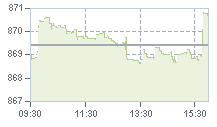
Assiduous Reader kaspu has complained about the volatility of the S&P/TSX Preferred Share Index (TXPR on Bloomberg) – or, at least, the reported volatility.

The problem is that this index is based on actual trades; hence, it can bounce around a lot when 100 shares trade at the ask, $1 above the bid. For instance, today:

This sort of behaviour is endemic to indices created by small shops without much market knowledge or experience. Readers in need of indices with more precision may wish to use the HIMIPref™ Indices, which are, of course, based on much less volatile bid prices.

“Gummy” has announced a new spreadsheet, available from his website. This spreadsheet allows the download of bid and ask prices – and lots of other information – for stocks reported (with a 20 minute delay) by Yahoo. It strikes me that with minimal effort, one could reproduce TXPR (using the defined basket of CPD) and update the index at the touch of a button, with minimal set-up time required.

The Gummy Stuff website, by the way, is reliable AS FAR AS IT GOES. Dr. Ponzo is math-oriented to a much greater degree than investment-oriented and does not always respect hallowed fixed income market conventions. In other words, I have found that things are properly calculated in accordance with the (usually stated) assumptions, but these assumptions are not necessarily the ones I might make when performing a calculation with the same purpose.

With respect to Kaspu‘s question about other indices … the latest CPD literature references the “Desjardins Preferred Share Universe Index”, which is new to me … and I have no further information. Claymore may be preparing for a showdown with the TSX about licensing fees (you should find out what they want for DEX bond data … it’s a scandal).

Additionally, there is the BMO Capital Markets “50” index, but that is available only to Nesbitt clients … maybe at a library, if you have a really good one nearby that gets their preferred share reports.

Update, 2008-5-1: “Gummy” has announced a spreadsheet that does exactly this! Just watch out for dividend ex-Dates!

Miscellaneous News

TD Securities Analysis Link Added to Blogroll

I’ve made a few additions to the blogroll lately – usually I don’t mention them – and there’s one that needs to be explained.

I’ve added TD Securities Public Currency and Research to the list, largely in the hopes that more of this research will be made public.

Read it, don’t read it, your choice, but remember the basic rules about dealer research:

  • The data is excellent
  • The ideas are interesting
  • The actual value of specific trade recommendations is dubious

I’ve also added a link to the Gummy Stuff website, which contains a plethora of utilities that are very useful for retail investors.

Issue Comments

NA.PR.M Settles Slightly Below Par

The new issue of National Bank 6.00% Perpetuals, announced March 31 and reported to have experienced brisk demand settled today, trading 412,080 shares in a range of 24.80-95, closing at 24.86-93, 10×25.

I have not seen an announcement regarding the greenshoe, but this is exercisable for 30 days after closing. The TSX website reflects the advertised 6-million-share ($150-million) size of the offering.

Comparables at the close are:

NA.PR.M and Comparables, 4/16
Issue Quote Dividend YTW CurvePrice
NA.PR.K 24.66-78 1.4625 5.93% 24.82
NA.PR.L 20.92-30 1.2125 5.80% 21.66
NA.PR.M 24.86-93 1.50 6.07% 25.44
BMO.PR.L 24.75-77 1.45 5.91% 25.33