Month: December 2008

Issue Comments

NTL.PR.F & NTL.PR.G : DBRS Downgrades to "D"

DBRS has announced that it:

has today downgraded its preferred share ratings of Nortel Network Limited to D from Pfd-5 (low). Nortel Networks Limited is a wholly owned subsidiary of Nortel Networks Corporation (collectively, Nortel or the Company). This rating action follows the Under Review with Negative Implications status, where the ratings were placed November 10, 2008 (see press release dated November 10, 2008). Nortel’s long-term debt remains Under Review with Negative Implications.

This rating action results from Nortel suspending its dividend payments on its preferred shares. This suspension begins with its November 2008 dividends, which will not be paid on December 12, 2008. The last dividend the Company paid was on November 12, 2008, on its Series 5 preferred shares (cumulative) and its Series 7 preferred shares (non-cumulative) as originally declared on July 31, 2008.

DBRS notes that on November 10, 2008 Nortel released its Q3 2008 results, which were below DBRS’s expectations, and lowered its outlook for the year. Additionally, Nortel announced the suspension of its preferred share dividends in an effort to preserve its liquidity. Shortly after this announcement, DBRS placed all of Nortel’s ratings Under Review with Negative Implications.

Notes:
DBRS’s ratings on technology companies are primarily based on factors such as the product suite, the base of customers, the competitive landscape, research and development initiatives, gross operating margins and the financial profile.

These issues were last discussed on PrefBlog when Nortel announced its intention to default.

NTL.PR.F & NTL.PR.G are tracked by HIMIPref™. They would be included in the “Ratchet” index, but have been relegated to “Scraps” on credit concerns.

Regulation

OSFI Loosens Rules on Innovative Tier 1 Capital

OSFI has released Advisories on Innovative Tier 1 Instruments.

I have not yet reviewed the intricacies of the advisories, but it appears that the the draft advisory I thought was so appalling has been adopted in toto. Canadians can be, er, proud to declare that we are basically the only jurisdiction that allows cumulative Tier 1 Capital.

Update, 2008-12-15 From the Advisory on Innovative Tier 1 Instruments:

A new form of loan-based innovative instrument will now qualify for inclusion in Tier 1 capital. Under this structure, the special purpose vehicle (SPV) issuing the innovative instrument will issue a 99-year security to investors and the SPV will use the proceeds from such issuance to acquire an inter-company debt instrument from the FRE with maturity conditions that are the same as the public issue. Under specified circumstances to maintain cash resources in the FRE, and as a result of contractual obligations between the investors, the SPV and the FRE, the investors in the SPV securities will receive directly issued preferred shares of the FRE to satisfy interest and/or principal payments on the innovative instrument.

the risk premium (over the risk-free rate) reflected in the dividend rate on the Tier 1-qualifying preferred shares issued pursuant to an automatic conversion must be established at the time the innovative instrument is issued and must not exceed the risk premium (over the risk-free rate) reflected in the dividend rate of comparable shares as at that date (i.e. upon the original issuance of the innovative instrument).

innovative instruments can now include securities which mature in 99 years. These, however, will be subject to straight-line amortization for regulatory capital purposes beginning 10 years prior to maturity.

An innovative instrument is now permitted to be “share cumulative” where under specified circumstances to maintain cash resources in the FRE, and as a result of contractual obligations between the investors, the SPV and the FRE, deferred cash coupons on the innovative instrument become payable in Tier 1-qualifying perpetual preferred shares of the FRE2, subject to the following requirements:

  • Cash coupons on the innovative instrument can be deferred at any time, at the FRE management’s complete discretion, with no limit on the duration of the deferral, apart from the maturity of the instrument.
  • The preferred shares issued by the FRE will initially be held in trust and will only be distributed to the holders of the innovative instrument to pay for deferred coupons once the cash coupons on the innovative instrument are resumed or when the innovative instruments are no longer outstanding (e.g. maturity of the innovative instrument, conversion of innovative instrument into preferred shares of the FRE, etc.).

And, from the Innovative Tier 1 and Other Capital Clarifications:

The adoption and current interpretation of the Accounting Standards Board’s Accounting Guideline 15 (AcG 15) results in Canadian “loan-based” innovative Tier 1 SPVs no longer being consolidated with the sponsoring FRE that owns the common securities and the interpretation also results in certain Financing Entities used by FREs to issue Tier 2 capital instruments no longer being consolidated with the FRE.

OSFI has determined that:

  • For “loan-based” innovative Tier 1 instruments, the SPV will no longer be required to be consolidated as a precondition for the public issue to be treated as innovative Tier 1 capital of the FRE.


Principle #9(b) under the Interim Appendix to Guideline A-2 (Banks/T&L/Life), “Principles Governing Inclusion of Innovative Instruments in Tier 1 Capital” states that “the main features of innovative instruments, including those features designed to achieve Tier 1 capital status (for example, the triggers and mechanisms used to achieve loss absorption), must be publicly disclosed in the FRE’s annual report to shareholders.”
This disclosure requirement is even more important now that capital will include innovative Tier 1 capital instruments that do not appear on the FRE’s balance sheet. In future, regulatory approvals for the issuance of loan-based innovative Tier 1 instruments will be conditional on acceptable plans for adequate disclosure of the main regulatory capital features of these instruments in the annual report to shareholders.

So bank balance sheets just got even more difficult to understand. If the SPV is not consolidated, then something that looks like a loan will magically count as Tier 1 Capital. I don’t know who’s at fault here, but I don’t like it!

A FRE has recently approached OSFI regarding the inclusion of a “make-whole” provision in the terms and conditions of a Tier 2-qualifying instrument issued into a foreign market. The provision states that, if tax laws change such that the FRE is required to withhold or account for any present or future tax, assessment or governmental charge by any Canadian tax authority, the FRE will pay noteholders an additional amount needed so that the net amount received by the noteholders, after such a withholding, will equal the amount that would have been received had no such withholding been required.

OSFI has assessed this provision and determined that it will permit such “make-whole” provisions in Tier 2 capital.

Whoosh! That came out of the blue!

Interesting External Papers

BoC Releases December 2008 Financial System Review

The Bank of Canada has released its December 2008 Financial System Review.

An interesting comment was:

Further improvements by some Canadian banks would be desirable to align disclosure standards, particularly regarding valuation techniques, more closely with the best practices of leading foreign banks. On the issue of transparency of structured products, progress in implementing the [Financial Stability Forum] recommendations has been slow to materialize, and there is a role for provincial securities commissions to advance this initiative.

… which seems to be a nice way of saying the banks here are falling behind. The Financial Stability Forum has been discussed on PrefBlog.

Also of interest was a short section on revision of bank capital rules to reduce the procyclicity inherent in the current rules:

These concerns have motivated proposals that argue that systemic risks can be mitigated if macroeconomic conditions are taken into account in the design of capital regulations. Under these proposals, banks would be required to build up a capital buffer during the boom part of the cycle—thereby strengthening their balance sheets and reducing the risk that financial imbalances will develop from excessive easing of financial conditions. During a downturn, banks would be allowed to draw down these buffers, which would alleviate the need to liquidate assets or restrict loan growth at a time when credit conditions and asset prices are already under stress. Thus, minimum capital requirements would move procyclically—the reverse of what happens under the current Basel II framework— and would help moderate cyclical fluctuations in the economy. This strategy could be implemented by linking capital requirements to movements in macroeconomic indicators of the state of the credit cycle, such as loan growth and asset prices.

Another question is whether there should be a rules-based approach linking capital requirements in a predetermined way to observable variables such as loan or asset growth, or whether discretion should be used to adjust the minimum capital ratios. In a system with discretion, it would be necessary to define the appropriate roles for the prudential regulator and for other agencies (such as the central bank) that have a broader macroeconomic perspective.

I like the last bit – ‘Give us the work, not OSFI!’

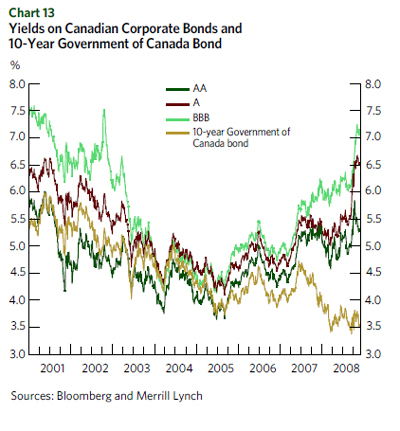
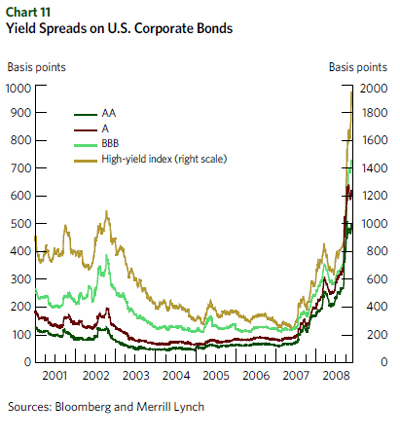
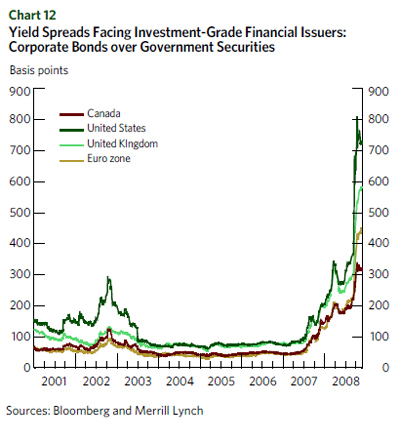
Longer-term credit markets have also deteriorated since the publication of the June FSR, as perceived default risk rose and the dysfunction in short term funding markets spread to longer-term debt markets. With the cost of financing trading positions higher and more uncertain, the liquidity premium demanded by agents also increased. This, in turn, contributed to the widening of credit spreads relative to government securities beyond what would be expected solely from the increase in default risk and expected losses. Yield spreads on corporate bonds around the globe rose to all-time highs in both the secondary bond and credit default swap markets, with the increase being particularly significant for high-yield and lower-rated issuers, reflecting an increasing degree of credit tiering (Chart 11).

There is a very topical note on DB Pension Funding:

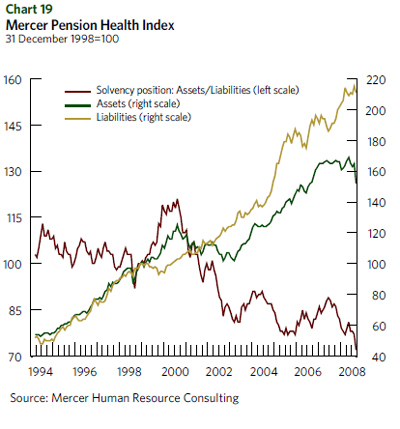
Firms that sponsor defined-benefit (DB) pension plans are facing additional pressures. The funding condition of DB plans in Canada has deteriorated sharply in recent months as a consequence of the severe sell-off in equity markets. Chart 19 presents the trend in Mercer’s Pension Health Index, which incorporates indexes of the assets, liabilities, and funding positions (assets less liabilities) of a representative DB plan in Canada. Note that assets have recently been falling, whereas liabilities have continued to rise. Firms are required to make special contributions to eliminate deficits over a time period specified by the pension regulators. These contributions adversely affect the
earnings and cash flow of the sponsoring corporation.

Bank asset quality is always of interest:

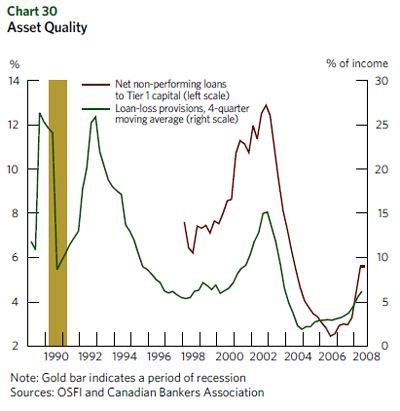
Profits and return on equity for the major Canadian banks have been on an improving track since the apparent trough in the first quarter of 2008, when writedowns seem to have peaked (Chart 29). Since the start of the turmoil, the major banks have reported cumulative capital market writedowns of almost $12 billion on a pre-tax basis. For the fourth quarter, five banks have pre-announced additional writedowns totalling around $2 billion.

As discussed, the volatility in the value of the securities portfolios of financial
institutions has continued (through the requirements of fair value accounting) to adversely affect their earnings.20 Recently, changes were announced by the Canadian Accounting Standards Board (AcSB), which mirror recent changes in International Accounting Standards (IAS). These modifications permit financial institutions, in some cases, to reclassify assets from the “held for trading” account to the banking book. This change is expected to reduce future volatility in the earnings of some banks. Several banks have since reclassified assets under these guidelines.

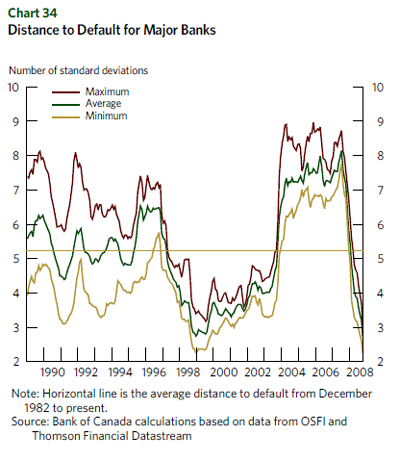
Of particular interest to preferred share investors is the banks’ “Distance to Default”, which is based solely on market prices – not on any fundamental analysis:

An assessment of overall default risk derived from market data, the distance to default for major Canadian banks, suggests a deterioration in their perceived credit quality since the June 2008 FSR (Chart 34). Driven by continued volatility in bank share prices, this measure has, in fact, reached its
lowest point on record.

And finally, given the recent MFC fiasco:

While the level of disclosure at life and health insurance companies has improved in recent years, it is generally not as detailed as that of banks, and recent events have underlined the need for further enhancements. For example, it would be desirable for life and health insurance companies to provide more information about the consolidated capital position of the enterprise as a whole, not just at the unconsolidated operating company level.

Thats the review section. There are also articles titled:

  • Credit, Asset Prices, and Financial Stress in Canada
  • Fair Value Accounting and Financial Stability
  • The Impact of Sovereign Wealth Funds on the International Financial System
  • Liquidity Risk at Banks: Trends and Lessons Learned from the Recent Turmoil
  • A Model of Housing Boom and Bust in a Small Open Economy
  • The Role of Bank Capital in the Propogation of Shocks
  • Good Policies or Good Fortune: What Drove the Compression in Emerging-Market Spreads?
Issue Comments

BCE Deal Dead

BCE Acquisition has announced:

that the agreement to acquire BCE Inc. (TSX, NYSE: BCE) has been terminated in accordance with its terms.

Receipt of a solvency opinion from a nationally recognized valuation firm was included in the June 30, 2007 definitive agreement between the Purchaser and BCE as a mutual closing condition. The agreement of the Purchaser and BCE to both the selection of KPMG to serve as the valuation firm and the form of the solvency opinion was reflected in the July 4, 2008 amendment to the definitive agreement. Because KPMG has concluded that a required test for the solvency opinion was not met, this mutual condition to completion of the acquisition could not be, and was not, satisfied. Accordingly, the Purchaser terminated the agreement in accordance with its terms. Under these circumstances neither party owes a termination fee to the other.

There is no telling what will happen now. In an ideal world, we return to the status quo ante and the BCE Prefs retain their Pfd-2(low) / P-2(low) credit rating. But Bloomberg reports other ideas:

BCE Inc., the Canadian phone company that had been planning to go private for the past 18 months, may have to buy back shares or restore its dividend to placate investors now that its leveraged buyout has fallen apart.

But I’m afraid that in the absence of strong, credible statements from BCE regarding their capital structure going forward, BCE prefs remain rather more speculative than I like.

The last post in this saga was BCE Buyout in Trouble; Prefs Plunge.

BCE has the following preferred shares outstanding: BCE.PR.A, BCE.PR.B, BCE.PR.C, BCE.PR.D, BCE.PR.E, BCE.PR.F, BCE.PR.G, BCE.PR.H, BCE.PR.I, BCE.PR.R, BCE.PR.S, BCE.PR.T, BCE.PR.Y & BCE.PR.Z

Update, 2008-12-11: BCE is desperately grandstanding:

BCE Inc. (TSX, NYSE: BCE) today announced that it received last evening from the Purchaser, a company formed by an investor group led by Teachers’ Private Capital, the private investment arm of the Ontario Teachers’ Pension Plan, and affiliates of Providence Equity Partners Inc., Madison Dearborn Partners, LLC, and Merrill Lynch Global Private Equity, a notice purporting to terminate the Definitive Agreement dated June 29, 2007, as amended. BCE disputes that the Purchaser was entitled to terminate the Definitive Agreement, as such notice was delivered prematurely, prior to the outside date for closing of the transaction, and therefore invalid. Given the Purchaser’s position, the BCE privatization
transaction will not proceed.

As previously announced, the closing of the privatization transaction is contingent upon the fulfillment of several closing conditions, including, pursuant to Section 8.1(f) of the Definitive Agreement, the receipt at the effective time of a positive solvency opinion from KPMG. Earlier this morning, KPMG confirmed that it would not be able to deliver an opinion that BCE would
meet, post transaction, the solvency tests set out in the Definitive Agreement.

In light of these developments, BCE will be terminating the Definitive Agreement in accordance with its terms, and will be demanding payment of the $1.2-billion break-up fee from the Purchaser. All closing conditions have been satisfied by BCE, other than the solvency opinion, a condition to closing that was to be satisfied by its nature at the effective time. Under such circumstances, the agreement provides that the break up fee will be owed to BCE by the Purchaser. The Purchaser has taken the position that it is not obligated to pay the break-up fee.

In addition, the BCE Board intends that immediately following termination of the Definitive Agreement in accordance with its terms, it will address a reinstatement of its common share dividend beginning with its fourth quarter common share dividend payable on January 15, 2009, and that it will return capital to its shareholders through a Normal Course Issuer Bid.

I would have a lot more confidence in the credit quality of the BCE Prefs if they indicated the size of the Normal Course Issuer Bid.

Market Action

December 10, 2008

This is funny. Goldman is being criticized for advising shorting municipal credit (via credit default swaps):

It’s “disturbing” to advise investors to bet against the financial health of a state whose bonds Goldman helps sell, Assemblyman Gary S. Schaer, a Democrat who chairs the Financial Institutions and Insurance Committee, said last week in a letter to Chief Executive Officer Lloyd C. Blankfein.

“New Jersey needs to maximize its presence in the credit markets, not to see its presence undermined.” Schaer wrote.

As part of a September presentation to institutional investors on “Best Long and Short Risk Strategies,” Goldman recommended buying credit-default swaps on “a basket of liquid State General Obligation credits with current and worsening fiscal outlooks,” including California, Florida, Nevada, Ohio, Wisconsin and Michigan.

The firm also recommended the derivatives on states with “significant unfunded pension” and other retiree obligations, including Illinois, Connecticut, Hawaii, New Jersey, Massachusetts and Nevada.

The practice of betting against such states is “distasteful,” said Frank Hoadley, Wisconsin’s director of capital finance in Madison.

Didn’t we do the whole “analyst independence” thing a few years ago? However, the original Newark Star-Ledger story, while attempting to sell newspapers, is better balanced than Bloomberg’s efforts.

I do apologize … but I am YET AGAIN neglecting to present the price-movement and volume-highlight tables. At some point, perhaps, I will have caught up on other committments – but not tonight.

Note that these indices are experimental; the absolute and relative daily values are expected to change in the final version. In this version, index values are based at 1,000.0 on 2006-6-30.
The Fixed-Reset index was added effective 2008-9-5 at that day’s closing value of 1,119.4 for the Fixed-Floater index.
Index Mean Current Yield (at bid) Mean YTW Mean Average Trading Value Mean Mod Dur (YTW) Issues Day’s Perf. Index Value
Ratchet N/A N/A N/A N/A 0 N/A N/A
Fixed-Floater 7.50% 7.85% 93,464 12.74 6 -4.0589% 705.4
Floater 9.56% 9.85% 72,723 9.52 2 +3.0634% 371.0
Op. Retract 5.46% 6.42% 146,946 3.97 15 +0.7500% 990.9
Split-Share 6.95% 13.38% 73,707 3.95 14 -0.1942% 887.0
Interest Bearing 9.69% 20.82% 55,306 2.78 3 -0.2190% 756.4
Perpetual-Premium N/A N/A N/A N/A N/A N/A N/A
Perpetual-Discount 7.79% 7.92% 212,362 11.50 71 +0.0649% 709.9
Fixed-Reset 6.02% 5.38% 1,081,559 14.48 16 +0.5017% 995.8
Better Communication, Please!

STW.PR.A: Stealth Redemption Confirmed

The essence of the redemption noted by Assiduous Reader erikd has been confirmed:

STW.PR.A has been called at $10.2 + accrued for total of $10.3173913 per share. 33.8575% of preferred shares have been called. This is a good premium to last friday’s trading price.

source is bloomberg, under news of the capital shares
I grabbed the screen at work. It will trade ex-redemption on Dec 9th, and supposed to get redeemed on Dec 12th.

I have confirmed with investor relations at Middlefield that the size is at least approximately correct; the redemption price per the prospectus is indeed 10.20.

The closing quote on Dec 8 – the last cum-redemption day, according to erikd, and the day he posted his note – was 9.11-18, on volume of 9227 shares. Yesterday was 8.64-87 on 5,294 shares. Today was 8.80-26, 13×2 on no volume.

I don’t know when the information was posted on Bloomberg, but if I had sold shares prior to the ex-redemption date and after the posting, I’d be pretty upset. According to me, a sizable redemption at a premium of more than 10% to market price counts as material information. Nothing was on their website, and investor relations could not confirm or deny immediately.

Their investor relations representative emphasized that they were not in breach of regulatory requirements. That may well be the case (it is not my place to judge) but I will suggest that:

  • The redemption was material information.
  • Bloomberg is a paid service; advising Bloomberge does not (or should not) constitute public disclosure
  • Therefore – whatever the strict legalities might be – I consider this a case of selective disclosure
  • If Middlefield did indeed follow minimum regulatory standards, that’s not good enough. They should have more consideration for their investors’ interests than that.
  • Let’s see a press release next time!

I will also be most interested to learn whether Middlefield purchased preferred according to the issuer bid. I will suggest that, given that STW.PR.A has not closed above 9.60 in at least a month, it would have been in the best interests of the fund to have exercised this right to the maximum extent possible.

I have noted a previous STW.PR.A stealth redemption.

STW.PR.A is tracked by HIMIPref™ and is part of the InterestBearing subindex. Given the low asset coverage ratio, it will probably be downgraded at some point in the near future at which point it will be relegated to “Scraps”. It is also possible that reduced liquidity due to the reduced float will be a prior cause for relegation.

Issue Comments

Weston on Review-Developing by DBRS

DBRS has announced that it:

has today placed the long-term and short-term ratings of George Weston Limited (Weston or the Company) – the Notes & Debentures at BBB, the Preferred Shares at Pfd-3 and the Commercial Paper at R-2 (high) – Under Review with Developing Implications.

The action follows Weston’s announcement today that its subsidiary, Dunedin Holdings S.a.r.l. (Dunedin), has entered into an agreement to sell its U.S. fresh bread and baked goods business to Grupo Bimbo for net proceeds of approximately US$2.5 billion. The completion of the transaction is subject to normal closing conditions, including regulatory approval; if the closing conditions are met, the parties expect the transaction to close in the first quarter of 2009.

Although the transaction represents an opportunity for Weston to realize a significant gain on the sale of this business, which it acquired in 2001, it will fundamentally alter the Company’s profile as the business to be sold represents more than half of Weston’s (ex-Loblaw Companies Limited (Loblaw)) operating income.

Dunedin contributed US$255 million of EBITDA to Weston’s consolidated results for the 52-weeks ended October 4, 2008. On this basis, DBRS estimates Weston’s pro forma (from continuing businesses) EBITDA for the same period to be approximately $175 million – this estimate also adjusts for the December 1, 2008 sale of Neilson Dairy (approximately $50 million of annual EBITDA) to Saputo Inc. for net proceeds of approximately $400 million.

The proposed divestiture of these assets would also have a meaningful impact on Weston’s financial risk profile. DBRS estimates the Company would have total cash and cash equivalents of more than $3.5 billion, after repaying $250 million of notes that come due in February 2009 and satisfying it current intention to redeem approximately $265 million of preferred shares in 2009. This cash and equivalent balance would compare to an estimated gross debt balance of $775 million (after February 2009) and preferred share balance of $835 million.

In its review, DBRS will focus on Weston’s intention with regards to its large cash and cash equivalent balance, its remaining operating business and its investment in Loblaw. DBRS believes that with an appropriate financial profile, Weston has the ability to remain placed in the BBB rating category with its continuing businesses (i.e., gross debt-to-pro forma EBITDA a maximum of 2.5 times).

The ratings for Loblaw (rated BBB and R-2 (middle) with Negative trends) remain unaffected at this point as DBRS believes the proposed transaction, in and of itself, does not impact the credit risk profile of Loblaw.

We’ll see what happens! Presumably the credit would be adversely affected if they use the excess cash to privatize Loblaws:

Speculation has swirled over what the company could do with its bulked up bank account.

Galen Weston said the company could look towards opportunities in either the United States or Canada, and the possibility of expanding its frozen bakery business.

There have also been suggestions that Weston is planning to buy out minority shareholders of Loblaw Cos. (TSX: L.TO), Canada’s largest supermarket operator. That would cost Weston about $3.5 billion at current stock values.

Galen Weston briefly addressed the rumours after an analyst question.

“The way we look at our position in the baking and supermarket business is there’s a lot more opportunity to come,” he said, without mentioning specifics.

Outstanding Weston issues are WN.PR.A, WN.PR.B, WN.PR.C, WN.PR.D and WN.PR.E. They were last mentioned on PrefBlog en masse when Loblaws was downgraded. All issues are tracked by HIMIPref™, but are incorporated in the Scraps index due to credit concerns.

Update: S&P is much more emphatic:

Standard & Poor’s Ratings Services today said it placed its ratings, including its ‘BBB’ long-term corporate credit rating, on Toronto-based George Weston Ltd. on CreditWatch with negative implications. This means that we could either lower or affirm the ratings after completion of our review.

“The CreditWatch placement follows the company’s announcement that its subsidiary, Dunedin Holdings SARL, is in discussions with Mexico-based Grupo Bimbo S.A.B. de C.V. about the possible divestment of George Weston’s U.S. fresh bread and baked goods business,” said Standard & Poor’s credit analyst Lori Harris. Although total estimated sales proceeds and their redeployment are currently unknown, there is market speculation about whether the proceeds will be used for the possible privatization of George Weston’s 62%-owned subsidiary Loblaw Companies Ltd. (BBB/Negative/–) or of George Weston itself.

“In Standard & Poor’s opinion, the deployment of potential sales proceeds for privatization or acquisitions, combined with the absence of the EBITDA for the U.S. fresh baked goods business, could lead to higher debt levels and weaker credit protection measures,” Ms. Harris added. With adjusted debt to EBITDA of about 4.4x for the 12 months ended Oct. 4, 2008, George Weston’s credit measures are already weak for the ratings in our view.

While the ratings on George Weston and Loblaw are currently the same, the rating relationship between the two remains one of linkage, not equalization, with each rating jointly influenced by the respective credit profiles. In the event of the sale, Standard & Poor’s would reevaluate the key parent-subsidiary relationship, including the strategic importance and ownership structure, to determine the rating links between George Weston and Loblaw. The ratings could become equalized should the relationship become significantly closer.

Standard & Poor’s will monitor current developments and meet with management to discuss the proposed divestment and use of proceeds. The resolution of the CreditWatch placement depends on the transaction closing and subsequent redeployment of funds, the revised capital structure, and George Weston’s future business and financial strategies.
Market Action

December 9, 2008

With all this rate-cutting, here’s a little bit of history for you: Four-Week US T-Bills were auctioned off at 0% today. A big fat zero, to three decimal places.

Preferred share volume remained heavy today (well … heavy for the preferred market, I mean!) while prices eased off after yesterday’s gains.

Note that these indices are experimental; the absolute and relative daily values are expected to change in the final version. In this version, index values are based at 1,000.0 on 2006-6-30.
The Fixed-Reset index was added effective 2008-9-5 at that day’s closing value of 1,119.4 for the Fixed-Floater index.
Index Mean Current Yield (at bid) Mean YTW Mean Average Trading Value Mean Mod Dur (YTW) Issues Day’s Perf. Index Value
Ratchet N/A N/A N/A N/A 0 N/A N/A
Fixed-Floater 7.19% 7.52% 90,573 13.08 6 -1.2930% 735.2
Floater 9.85% 10.16% 69,970 9.28 2 -2.9216% 359.9
Op. Retract 5.50% 6.88% 145,387 4.04 15 +0.5511% 983.5
Split-Share 6.93% 13.28% 72,752 3.95 14 +0.3167% 888.7
Interest Bearing 9.67% 21.42% 56,961 2.82 3 -5.0826% 758.1
Perpetual-Premium N/A N/A N/A N/A N/A N/A N/A
Perpetual-Discount 7.80% 7.92% 209,091 11.50 71 -0.4855% 709.4
Fixed-Reset 6.05% 5.41% 1,106,660 14.44 16 +0.3609% 990.8
Major Price Changes
Issue Index Change Notes
FIG.PR.A InterestBearing -8.5308% Asset coverage of 1.0+:1 as of December 4, based on Capital Unit NAV of 0.39 according to Faircourt and 0.71 Capital Units per preferred. Now with a pre-tax bid-YTW of 18.60% based on a bid of 5.79 and a hardMaturity 2014-12-31 at 10.00. Closing quote of 5.79-09, 2×2. Day’s range of 5.02-6.21.
STW.PR.A InterestBearing -5.1592% Asset coverage of 1.3-:1 as of December 4 according to Middlefield. Assiduous Reader erikd advises that there has been a rather large stealth-redemption; as of 4:30 pm, Middlefield’s Investor Relations department was unable to confirm or deny the report. A note on the November 30 NAV states “(Redemption Price Payable December 12, 2008)” Now with a pre-tax bid-YTW of 22.27% based on a bid of 8.64 and a hardMaturity 2009-12-31. Closing quote of 8.64-87, 60×1. Day’s range of 8.79-83.
BAM.PR.B Floater -4.0761%  
DFN.PR.A SplitShare -4.0586% Asset coverage of 1.7+:1 as of November 28 according to the company. Now with a pre-tax bid-YTW of 8.58% based on a bid of 8.51 and a hardMaturity 2014-12-1 at 10.00. Closing quote of 8.51-06, 3×1. Day’s range of 8.72-85.
GWO.PR.G PerpetualDiscount -4.0219% Now with a pre-tax bid-YTW of 8.30% based on a bid of 15.75 and a limitMaturity. Closing quote 15.75-17, 7×5. Day’s range of 15.67-48.
FBS.PR.B SplitShare -3.6765% Asset coverage of 1.0+:1 as of December 4 according to TD Securities. Now with a pre-tax bid-YTW of 13.71% based on a bid of 7.86 and a hardMaturity 2011-12-15 at 10.00. Closing quote of 7.86-00, 32×17. Day’s range of 7.76-00.
SBN.PR.A SplitShare -3.0879% Asset coverage of 1.7-:1 as of December 4 according to Mulvihill. Now with a pre-tax bid-YTW of 9.48% based on a bid of 8.16 and a hardMaturity 2014-12-1 at 10.00. Closing quote of 8.16-39, 3×1. Day’s range of 8.28-30.
BCE.PR.G FixFloat -2.9375%  
GWO.PR.I PerpetualDiscount -2.7465% Now with a pre-tax bid-YTW of 8.19% based on a bid of 13.81 and a limitMaturity. Closing quote 13.81-90, 4×12. Day’s range of 13.61-25.
SLF.PR.A PerpetualDiscount -2.6756% Now with a pre-tax bid-YTW of 8.20% based on a bid of 14.55 and a limitMaturity. Closing quote 14.55-65, 1×8. Day’s range of 14.27-19.
ALB.PR.A SplitShare -2.6366% Asset coverage of 1.2-:1 as of December 4 according to Scotia Managed Companies. Now with a pre-tax bid-YTW of 14.56% based on a bid of 20.31 and a hardMaturity 2011-2-28 at 25.00. Closing quote of 20.31-48, 46×1. Day’s range of 20.31-86.
FTN.PR.A SplitShare -2.6277% Asset coverage of 1.6-:1 as of November 28 according to the company. Now with a pre-tax bid-YTW of 12.73% based on a bid of 12.73% based on a bid of 6.67 and a hardMaturity 2015-12-1 at 10.00.
BCE.PR.C FixFloat -2.5215%  
PWF.PR.I PerpetualDiscount -2.2857% Now with a pre-tax bid-YTW of 8.13% based on a bid of 18.81 and a limitMaturity. Closing quote 18.81-00, 4×7. Day’s range of 18.75-25.
CM.PR.D PerpetualDiscount -2.1476% Now with a pre-tax bid-YTW of 8.25% based on a bid of 17.77 and a limitMaturity. Closing quote 17.77-99, 3×3. Day’s range of 17.87-30.
BCE.PR.Z FixFloat -2.0888%  
SLF.PR.E PerpetualDiscount -2.0863% Now with a pre-tax bid-YTW of 8.31% based on a bid of 13.61 and a limitMaturity. Closing quote 13.61-75, 2×16. Day’s range of 13.52-90.
MFC.PR.A OpRet -2.0317% Now with a pre-tax bid-YTW of 4.71% based on a bid of 24.11 and a softMaturity 2015-12-18 at 25.00. Closing quote of 24.11-66, 3×3. Day’s range of 24.05-99.
BNS.PR.N PerpetualDiscount -2.0157% Now with a pre-tax bid-YTW of 7.64% based on a bid of 17.50 and a limitMaturity. Closing quote 17.50-67, 10×9. Day’s range of 17.55-25.
RY.PR.F PerpetualDiscount +2.0653% Now with a pre-tax bid-YTW of 7.35% based on a bid of 15.32 and a limitMaturity. Closing quote 15.32-48. Day’s range of 15.03-75.
BAM.PR.H OpRet +2.2500% Now with a pre-tax bid-YTW of 13.24% based on a bid of 20.45 and a softMaturity 2012-3-30 at 25.00. Closing quote of 20.45-00, 5×10. Day’s range of 20.20-50.
NA.PR.N FixedReset +3.1630%  
LFE.PR.A SplitShare +3.9744% Asset coverage of 1.7-:1 as of November 28 according to the company. Now with a pre-tax bid-YTW of 11.41% based on a bid of 8.11 and a hardMaturity 2012-12-1 at 10.00. Closing quote of 8.11-23, 7×1. Day’s range of 7.91-24.
LBS.PR.A SplitShare +4.2802% Asset coverage of 1.4-:1 as of December 4 according to Brompton Group. Now with a pre-tax bid-YTW of 10.72% based on a bid of 8.04 and a hardMaturity 2013-11-29 at 10.00. Closing quote of 8.04-24, 24×3. Day’s range of 7.70-25.
BAM.PR.O OpRet +10.3333% Now with a pre-tax bid-YTW of 16.17% based on a bid of 16.55 and optionCertainty 2013-6-30 at 25.00. Closing quote of 16.55-17.60, 5×1. Day’s range of 15.65-17.25.
BNA.PR.B SplitShare +13.4089% Asset coverage of 1.6+:1 as of December 4 based on BAM.A at 16.72 and 2.4 BAM.A per unit. Now with a pre-tax bid-YTW of 11.67% based on a bid of 17.00 and a hardMaturity 2016-3-25 at 25.00. Closing quote of 17.00-50, 10×11. Day’s range of 16.19-18.00.
Volume Highlights
Issue Index Volume Notes
WN.PR.B Scraps (would be OpRet but there are credit concerns) 386,360 Desjardins crossed a block of 300,000, then 50,000, then 28,400 all at 25.05. Now with a pre-tax bid-YTW of 6.57% based on a bid of 25.06 and OptionCertainty 2009-6-30.
BNS.PR.J PerpetualDiscount 247,193 Nesbitt crossed 110,600 at 18.00. Now with a pre-tax bid-YTW of 7.43% based on a bid of 17.98 and a limitMaturity.
RY.PR.N FixedReset 109,740 Nesbitt bought 12,900 from Canaccord at 25.00. Recent new issue
MFC.PR.A OpRet 53,035 TD crossed 24,300 at 24.05. See above
RY.PR.I FixedReset 50,961 RBC crossed 23,700 at 21.40.
RY.PR.B PerpetualDiscount 49,197 Desjardins bought 26,300 from anonymous at 16.15. Now with a pre-tax bid-YTW of 7.39% based on a bid of 16.10 and a limitMaturity.

There were seventy-four index-included $25-pv-equivalent issues trading over 10,000 shares today

Banking Crisis 2008

Bank Rate Cut 75bp; Prime 50bp. Canada Prime Now 3.50%

The Bank of Canada cut by 75bp today:

The Bank of Canada today announced that it is lowering its target for the overnight rate by three-quarters of a percentage point to 1 1/2 per cent. The operating band for the overnight rate is correspondingly lowered, and the Bank Rate is now 1 3/4 per cent.

The outlook for the world economy has deteriorated significantly and the global recession will be broader and deeper than previously anticipated. Global financial markets remain severely strained. Measures taken by major governments are beginning to encourage credit flows, although it will take some time before conditions in financial markets normalize. In addition, a series of recently announced monetary and fiscal policy actions will also support global economic growth.

While Canada’s economy evolved largely as expected during the summer and early autumn, it is now entering a recession as a result of the weakness in global economic activity. The recent declines in terms of trade, real income growth, and confidence are prompting more cautious behaviour by households and businesses.

All of these factors imply a lower profile for core inflation than had been projected at the time of the last Monetary Policy Report in October.

Several factors are helping to counterbalance the negative drag from the global economic and financial developments. The depreciation of the Canadian dollar will continue to provide an important offset to the effects of weaker global demand and lower commodity prices. As well, money markets and overall credit conditions in Canada are responding to significant and ongoing efforts to provide liquidity to the Canadian financial system.

In light of the weakening outlook for growth and inflation, the Bank of Canada lowered its policy interest rate by a total of 75 basis points in October and by an additional 75 basis points today. These monetary policy actions provide timely and significant support to the Canadian economy.

The Bank will continue to monitor carefully economic and financial developments in judging to what extent further monetary stimulus will be required to achieve the 2 per cent inflation target over the medium term.

The banks did not fully participate:

  • TD, down 50bp, now 3.50%
  • CIBC, down 50bp, now 3.50%
  • Scotia, down 50bp, now 3.50%
  • Royal, down 50bp, now 3.50
  • BMO, down 50bp, now 3.50%

At the penultimate cut, TD threw down the gauntlet by not maintaining the spread; this resulted in a $25-billion liquidity injection, later increased to $75-billion which maintained the historical relationship.

The most recent cut in the overnight rate maintained the spread.

Given that What-Debt? has run away from Parliament, it will be most interesting to see if there is any political reaction to this turn of events. Quick! Call Duceppe so Spend-Every-Penny will know what to oppose!

Issue Comments

RY.PR.N Settles Without Incident

The Royal Bank Fixed-Reset 6.25%+350 announced November 24 settled today on good volume and little price movement – a departure from recent norms for which the underwriters will doubtless be grateful!

It traded 389,932 shares in a range of 24.85-05, closing at 25.00-03, 40×177. From the bid of 25.00, the YTW is 5.89% to the limitMaturity, while the yield to the five year call is 6.27%.