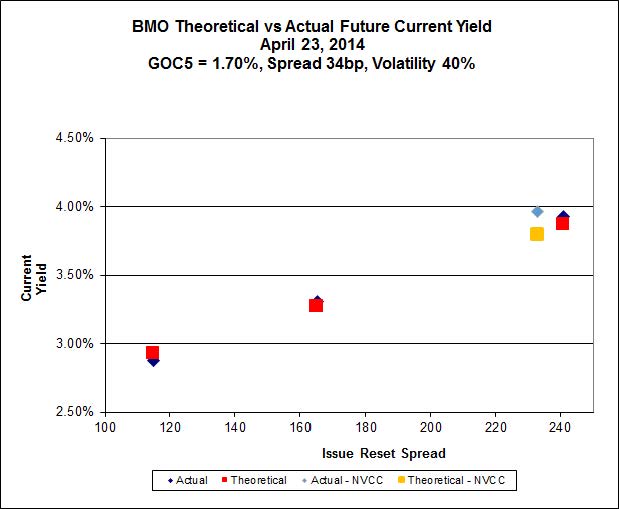
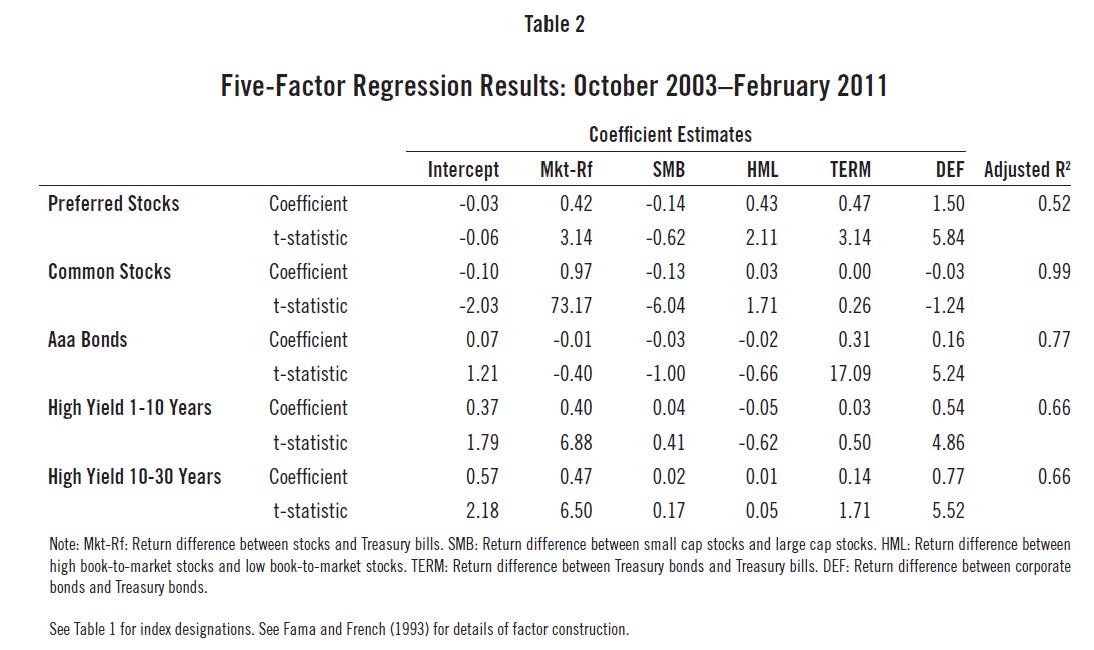
I renewed my mockery of Target Benefit Plans yesterday. Assiduous Reader MG writes in and says:
I used to be a pension actuary, however a long time ago. So I asked someone who retired more recently what he thought about target benefit plans. Here is the answer I received:
I am not sure of the details of the federal proposal. However, if it looks like the New Brunswick arrangements, then you get pooling of mortality risk, limited pooling of investment risk (across generations), and economies of scale with respect to plan expenses. In essence, you can think of it as a pooled RRSP. Employer contributions will be more or less fixed (limited ability to change contributions), employee contributions and benefits go up and down with plan experience
+++++++++++++++++++++++++++++
Essentially I believe you are correct that employees assume most of the risks but it appears that it is not one-sided, i.e. they can win or lose depending on results.I don’t believe this a great deal. I think it will have a limited impact. Except for some pooling, the main advantage is that it allows members to have a better idea of what the ultimate benefits might be (assuming assumptions are realized) which is a weakness of defined contribution plans.
Fair enough. I’m not sure how the beneficiary reporting is handled, but it seems to me that this reporting could be realized inside the framework of a one-choice DC plan by (i) Estimating the accumulated value on the projected retirement date, and (ii) Estimating the monthly benefit of a no-guaranty life annuity purchased on that date.
But there were some more details today:
The Conservative government released extensive details on a proposed target benefit plan Thursday that would see federal legislation lay out the rules as to what these funds would look like and how they should be managed.
…
“Base benefits” could be reduced in cases where the pension fund is in deficit, but would have a high level of protection and could only be lowered “as a last resort,” according to the Finance Canada consultation paper released Thursday. Meanwhile “ancillary benefits” would have “a lower but reasonable level of protection” and would be reduced before base benefits were reduced and could also be increased when the plan is in a surplus situation.
…
[Minister of State for Finance Kevin] Sorenson argued it would be better than a defined contribution plan.“Unlike defined contribution plans, target benefit plans would offer a more predictable stream of benefit payments and high benefit security, since the target benefits would be based on a per-determined formula,” he said. “Members and retirees would benefit from the pooling of longevity risk, which is not a feature of defined contribution plans.”
Well, OK. But pooling of longevity risk can be accomplished with an annuity. The basic problem is familiar; I wrote an article about it some time ago in another context and now can’t remember the article: risk cannot be destroyed. It can only be passed on or changed in form. And while I seem some risk-pooling for the beneficiaries here, I see no indication that the company bears any; therefore, it’s a DC plan with bells and whistles.
Tapering is old news. The new worry is credit quality:
Corporate dealmaking that helped propel the Standard & Poor’s 500 stocks index to a record is playing out differently for debt investors, who must contend with the biggest threat to credit grades since 2009.
With borrowings to fund mergers and acquisitions accelerating amid an improving economy, the number of credit-ratings cuts linked to such deals is exceeding increases by the most since the fourth quarter of 2009, according to data from Moody’s Analytics. The firm’s credit-assessment unit lowered 96 ratings during the year ended March, while raising the rankings on 78.
The damage to balance sheets is coming amid a growing chorus of concerns that a sixth year of record-low interest rates engineered by the Federal Reserve has left bond prices overvalued and allowed borrowers to get away with financings that they wouldn’t be able to do in normal times. Valeant Pharmaceuticals International Inc. is pursuing Allergan Inc. in a takeover that may drop the Botox maker to junk status.
The Valeant / Allergan deal became notable for taxation reasons as well:
GE can tap the $57 billion of cash it has amassed overseas to finance a purchase of most of France’s Alstom SA (ALO), a person with knowledge of the matter said. By doing so, GE would take advantage of its overseas profits instead of bringing them back to the U.S., where they would be taxed at a higher rate.
Valeant’s pursuit of rival Allergan Inc. underscores another twist. Many drugmakers are buying companies in low-tax countries and then setting up operations there to avoid U.S. taxes. If the Canadian company succeeds in buying Allergan, the combined entity would have a tax rate in the single digits, Valeant Chief Executive Officer Michael Pearson said. Allergan paid a tax rate of about 26 percent in 2013, data compiled by Bloomberg show.
“You have effectively created an incentive to move to a low-tax country,” said Gordon Caplan, a partner at law firm Willkie Farr & Gallagher in New York. “There is competition between high-tax countries and low-tax countries.”
U.S. companies are keeping cash offshore to avoid paying up to a 35 percent tax rate on profits they earn around the world. They only pay taxes when the cash is repatriated. By spending money overseas, the effective cost for a buyer can also be lowered, making acquisitions easier.
I was surprised to hear a little while ago that many high-school students can’t do long division and was even more surprised to have that confirmed by a young relative. So I read an article in a men’s magazine titled 5 Math Lessons You Don’t Really Need in the Real World with great interest:
#5. Long Division
Long division is a calculation technique where one number can be divided by another using nothing more than note paper and a tremendous amount of time. And despite all the horrible things that have happened to my brain since grade five, I basically still remember how to do it. You start at the left and pick the largest nominator that can fit in the regulator, then take the leftovers and add them to the next downmost digit of the dividule, then repeat. Right?
Note that I’m talking about the usefulness of long division specifically here. Everyone obviously has to understand how basic division works, as that comes up all the time in the real world, when dividing up apples among friends or whatever. But the only division you ever really need to do in the real world is with integers under 100, and that takes rote memorization really, not long division. So what good is long division?
What They Say This Is Used For:
Long division is meant for those occasions when we need to divide large numbers and we don’t have a calculator at hand.
What a Normal Human Being Might Actually Use This For:
Nothing.
Basically the only people who use long division now are fifth-grade teachers teaching long division to fifth graders. Long division was added to our math curriculum in a primitive era when people smoked for their health and calculators were rare. But that’s obviously no longer the case; right now you probably have three or four devices within arm’s reach capable of doing division.
I’ve thought a bit about this – and even left a comment on another anti-long-division blog post, which I’m not sure will be published – arguing that right off the top of my head I can think of five crushing pro-long-division arguments:
- It’s a reasonably easy to understand algorithm for solving what looks incomprehensible in terms of procedures that are already known
- The thing that’s already known is multiplication – long division serves as good drill for multiplication without actually looking like drill
- It can serve as an introduction to the concept of limits
- It can help illustrate the difference between rational and irrational numbers
- It’s what I learned in school, therefore everybody should learn it in school
I like to think the first point is most important, although I confess that I’m not sure whether the last point is really what I’m trying to justify. Algorithms are important. The author of the other blog post I mentioned suggest the Euclidean algorithm as a competing example, but I think long division is better, since it builds on material already known.
And the introduction to algorithms is important and should be emphasized as such: a major complaint I have regarding my mathematical education is that nobody ever explained why we were being taught something. Not even once. Putting these abstract concepts – such as long division – into a framework would be much more satisfactory.
Just as another f’rinstance, the second item on Cracked writer’s list of complaints is Geometric Proofs. which is dismissed with:
All of this stuff is super useful if you’re an engineer. Actually, let’s say mandatory. Yeah. I’d kind of like the guys we have building bridges to really “get” triangles, thanks.
Also, the technique of taking simple axioms and combining those into more complicated theorems is great training for more complicated mathematical proofs. This is useful if you want to continue your career in mathematics, which boy, man, are you sure you want to continue your career in mathematics?
Two problems with that – first, yes, we want engineers to “get” triangles. But we also want people who “get” triangles to realize that they “get” them and realize that this makes them part of a skilled group. We don’t want to take a randomly chosen group of 18 year olds and send them off to engineering school. High school is not just about cramming irrelevant detail into your head, it’s also about becoming exposed to various simple things and learning what you like and what you’re good at.
Also – and this is a long-standing grievance of mine – the process of “taking simple axioms and combining those into more complicated theorems” isn’t a one way street into more mathematics. It’s the whole basis of argument! I have often thought that the first week of trigonometry – which I believe occurs in Grade 10 – should actually be taught in conjunction with English class, in which the English teacher discusses debating and argument. These aren’t just intimately related subjects, they’re the same damn thing; it’s just that axioms underlying mathematics are simpler and should therefore be easier to understand. Attacking a false argument about capital punishment is exactly the same process as attacking a false proof that two angles are equal, and this should be emphasized in mathematical education.
However, the proof of the pudding is in the eating. I suspect that none of the official pro- or anti-long-division contenders have actually tested education in the presence or absence of long-division to test their hypotheses. This is because they didn’t pay attention to the role of experimentation in confirming or negating hypotheses in their grade 11 physics class; or perhaps their physics teacher didn’t explain why you have to do experiments.
Three cheers for Rob Ford!
DBRS has today confirmed the ratings of the City of Toronto (the City or Toronto) at AA. All trends remain Stable, reflective of the City’s ability to levy taxes on a large, well-diversified economy, and its demonstrated fiscal prudence in recent years.
…
The City posted a $1.3 billion operating surplus in 2012, on better-than-expected revenue growth and lower spending.
…
DBRS notes that fiscal resolve has improved notably in recent years. The City estimates that the ongoing Service Review Program and other restraint measures have led to over $900 million in operating budget savings and generated an additional $30 million in user fee revenues between 2011 and 2014.
It was a strong day for the Canadian preferred share market, with PerpetualDiscounts winning 26bp, FixedResets gaining 13bp and DeemedRetractibles up 15bp. Volatility was surprisingly low, given the sharp move. Volume was average.
| HIMIPref™ Preferred Indices These values reflect the December 2008 revision of the HIMIPref™ Indices Values are provisional and are finalized monthly |
|||||||
| Index | Mean Current Yield (at bid) |
Median YTW |
Median Average Trading Value |
Median Mod Dur (YTW) |
Issues | Day’s Perf. | Index Value |
| Ratchet | 0.00 % | 0.00 % | 0 | 0.00 | 0 | -0.6461 % | 2,402.9 |
| FixedFloater | 4.65 % | 3.89 % | 32,184 | 17.73 | 1 | 0.2456 % | 3,688.9 |
| Floater | 3.03 % | 3.17 % | 50,582 | 19.30 | 4 | -0.6461 % | 2,594.5 |
| OpRet | 4.36 % | -5.19 % | 34,694 | 0.11 | 2 | -0.0774 % | 2,696.3 |
| SplitShare | 4.81 % | 4.28 % | 62,766 | 4.22 | 5 | -0.0556 % | 3,087.6 |
| Interest-Bearing | 0.00 % | 0.00 % | 0 | 0.00 | 0 | -0.0774 % | 2,465.5 |
| Perpetual-Premium | 5.54 % | -7.81 % | 105,402 | 0.08 | 13 | -0.0966 % | 2,388.2 |
| Perpetual-Discount | 5.39 % | 5.37 % | 110,877 | 14.66 | 23 | 0.2572 % | 2,502.0 |
| FixedReset | 4.66 % | 3.54 % | 193,335 | 4.17 | 80 | 0.1348 % | 2,540.0 |
| Deemed-Retractible | 5.02 % | -4.29 % | 145,779 | 0.14 | 42 | 0.1455 % | 2,500.9 |
| FloatingReset | 2.66 % | 2.44 % | 170,466 | 4.24 | 5 | 0.0000 % | 2,481.2 |
| Performance Highlights | |||
| Issue | Index | Change | Notes |
| BAM.PR.B | Floater | -1.01 % | YTW SCENARIO Maturity Type : Limit Maturity Maturity Date : 2044-04-24 Maturity Price : 16.58 Evaluated at bid price : 16.58 Bid-YTW : 3.19 % |
| BNS.PR.Q | FixedReset | 1.37 % | YTW SCENARIO Maturity Type : Call Maturity Date : 2018-10-25 Maturity Price : 25.00 Evaluated at bid price : 25.81 Bid-YTW : 2.84 % |
| IAG.PR.A | Deemed-Retractible | 1.51 % | YTW SCENARIO Maturity Type : Hard Maturity Maturity Date : 2025-01-31 Maturity Price : 25.00 Evaluated at bid price : 22.80 Bid-YTW : 5.78 % |
| Volume Highlights | |||
| Issue | Index | Shares Traded |
Notes |
| BMO.PR.S | FixedReset | 174,180 | Recent new issue YTW SCENARIO Maturity Type : Call Maturity Date : 2019-05-25 Maturity Price : 25.00 Evaluated at bid price : 25.44 Bid-YTW : 3.64 % |
| IAG.PR.E | Deemed-Retractible | 63,992 | Nesbitt crossed 50,000 at 25.96. YTW SCENARIO Maturity Type : Call Maturity Date : 2017-12-31 Maturity Price : 25.25 Evaluated at bid price : 25.90 Bid-YTW : 5.31 % |
| RY.PR.Z | FixedReset | 63,868 | TD crossed two blocks of 25,000 each, both at 25.70. YTW SCENARIO Maturity Type : Call Maturity Date : 2019-05-24 Maturity Price : 25.00 Evaluated at bid price : 25.66 Bid-YTW : 3.37 % |
| BMO.PR.Q | FixedReset | 55,464 | TD crossed 30,000 at 24.82. YTW SCENARIO Maturity Type : Hard Maturity Maturity Date : 2022-01-31 Maturity Price : 25.00 Evaluated at bid price : 24.84 Bid-YTW : 3.39 % |
| ENB.PR.Y | FixedReset | 53,014 | Nesbitt crossed 17,800 at 24.08 and sold 10,000 to anonymous at 24.10. TD crossed 11,300 at 24.10. YTW SCENARIO Maturity Type : Limit Maturity Maturity Date : 2044-04-24 Maturity Price : 22.77 Evaluated at bid price : 24.03 Bid-YTW : 4.20 % |
| NA.PR.S | FixedReset | 51,808 | YTW SCENARIO Maturity Type : Call Maturity Date : 2019-05-15 Maturity Price : 25.00 Evaluated at bid price : 25.60 Bid-YTW : 3.54 % |
| There were 33 other index-included issues trading in excess of 10,000 shares. | |||
| Wide Spread Highlights | ||
| Issue | Index | Quote Data and Yield Notes |
| RY.PR.L | FixedReset | Quote: 26.33 – 26.77 Spot Rate : 0.4400 Average : 0.2602 YTW SCENARIO |
| IGM.PR.B | Perpetual-Premium | Quote: 25.90 – 26.19 Spot Rate : 0.2900 Average : 0.1873 YTW SCENARIO |
| BNA.PR.E | SplitShare | Quote: 25.65 – 25.85 Spot Rate : 0.2000 Average : 0.1210 YTW SCENARIO |
| TD.PR.R | Deemed-Retractible | Quote: 26.58 – 26.85 Spot Rate : 0.2700 Average : 0.1925 YTW SCENARIO |
| BAM.PR.X | FixedReset | Quote: 21.67 – 21.87 Spot Rate : 0.2000 Average : 0.1262 YTW SCENARIO |
| MFC.PR.A | OpRet | Quote: 25.70 – 25.90 Spot Rate : 0.2000 Average : 0.1272 YTW SCENARIO |