Market Action

August 3, 2011

Dealbreaker has a surprisingly thoughtful piece on the US credit rating:

That’s probably the best way to interpret market reactions. Rates on the $10 trillion of publicly held Treasuries couldn’t be tighter, suggesting that there’s no real market worry about the U.S.’s ability to pay off its debts. But CDS notionals keep increasing (albeit in a still small and illiquid market) and CDS levels are wide of AA corporates because the U.S. is actually more likely to default than Colgate Palmolive is. Because it would not occur to anyone at Colgate Palmolive to just stop paying its debts. But we’re going to have to keep rasing the debt ceiling, and every time we do, half of Congress is going to say that they prefer to default.

The idiotic Federal Aviation Administration crisis is symptiomatic:

The U.S. House of Representatives and Senate finished voting on legislation this week and recessed for the month of August without extending the FAA’s funding authority, which expired at midnight July 22. That idled about 70,000 construction-related workers and furloughed 4,000 FAA employees. The FAA also is forgoing $28.6 million in aviation taxes each day the deadlock continues. That would add up to $1.3 billion by the time Congress resumes legislative business on Sept. 7.

Transportation Secretary Ray LaHood said legislators should return to Washington and pass an extension without cutting subsidies for flights to 13 rural airports. The cuts were in a House-passed bill to extend the FAA’s authority through Sept. 16 that was introduced by Representative John Mica, the Florida Republican who chairs the transportation committee in that body.

Senate Majority Leader Harry Reid, a Nevada Democrat, said yesterday he was prepared to accept the House bill. Other Senate Democrats refused, said Adam Jentleson, a spokesman for Reid.

The FAA’s last multi-year funding bill expired in 2007. Congress has passed 20 limited extensions since then without adopting a new long-term authorization measure.

It was a good day for the Canadian preferred share market, with PerpetualDiscounts winning 21bp, FixedResets gaining 9bp and DeemedRetractibles up 14bp. Volatility was minimal. Volume was average.

Yellow Media reports on 11Q2 tomorrow before the opening, so YLO preferreds could have an interesting day!

HIMIPref™ Preferred Indices
These values reflect the December 2008 revision of the HIMIPref™ Indices

Values are provisional and are finalized monthly
Index Mean
Current
Yield
(at bid)
Median
YTW
Median
Average
Trading
Value
Median
Mod Dur
(YTW)
Issues Day’s Perf. Index Value
Ratchet 0.00 % 0.00 % 0 0.00 0 -0.0479 % 2,410.7
FixedFloater 0.00 % 0.00 % 0 0.00 0 -0.0479 % 3,625.7
Floater 2.51 % 2.33 % 33,951 21.45 4 -0.0479 % 2,602.9
OpRet 4.84 % 2.05 % 54,382 0.16 9 0.1282 % 2,455.9
SplitShare 5.26 % 3.11 % 69,186 0.56 4 0.0804 % 2,515.2
Interest-Bearing 0.00 % 0.00 % 0 0.00 0 0.1282 % 2,245.6
Perpetual-Premium 5.67 % 4.95 % 130,491 0.80 14 0.0169 % 2,099.9
Perpetual-Discount 5.37 % 5.42 % 112,349 14.74 16 0.2132 % 2,219.6
FixedReset 5.15 % 3.14 % 214,005 2.65 58 0.0934 % 2,328.4
Deemed-Retractible 5.06 % 4.64 % 270,990 7.85 46 0.1383 % 2,182.2
Performance Highlights
Issue Index Change Notes
GWO.PR.J FixedReset 1.50 % YTW SCENARIO
Maturity Type : Call
Maturity Date : 2013-12-31
Maturity Price : 25.00
Evaluated at bid price : 27.00
Bid-YTW : 2.80 %
FTS.PR.F Perpetual-Discount 2.68 % YTW SCENARIO
Maturity Type : Limit Maturity
Maturity Date : 2041-08-03
Maturity Price : 24.62
Evaluated at bid price : 24.91
Bid-YTW : 4.99 %
Volume Highlights
Issue Index Shares
Traded
Notes
BNS.PR.P FixedReset 107,561 YTW SCENARIO
Maturity Type : Call
Maturity Date : 2013-04-25
Maturity Price : 25.00
Evaluated at bid price : 25.95
Bid-YTW : 2.78 %
BMO.PR.P FixedReset 100,990 YTW SCENARIO
Maturity Type : Call
Maturity Date : 2015-02-25
Maturity Price : 25.00
Evaluated at bid price : 26.95
Bid-YTW : 3.00 %
RY.PR.D Deemed-Retractible 71,606 YTW SCENARIO
Maturity Type : Hard Maturity
Maturity Date : 2022-01-31
Maturity Price : 25.00
Evaluated at bid price : 24.64
Bid-YTW : 4.67 %
RY.PR.C Deemed-Retractible 60,318 YTW SCENARIO
Maturity Type : Hard Maturity
Maturity Date : 2022-01-31
Maturity Price : 25.00
Evaluated at bid price : 24.92
Bid-YTW : 4.63 %
TRP.PR.C FixedReset 36,712 YTW SCENARIO
Maturity Type : Limit Maturity
Maturity Date : 2041-08-03
Maturity Price : 23.46
Evaluated at bid price : 25.85
Bid-YTW : 3.24 %
RY.PR.R FixedReset 35,606 YTW SCENARIO
Maturity Type : Call
Maturity Date : 2014-02-24
Maturity Price : 25.00
Evaluated at bid price : 26.81
Bid-YTW : 3.16 %
There were 28 other index-included issues trading in excess of 10,000 shares.
Wide Spread Highlights
Issue Index Quote Data and Yield Notes
NA.PR.P FixedReset Quote: 26.92 – 27.43
Spot Rate : 0.5100
Average : 0.3699

YTW SCENARIO
Maturity Type : Call
Maturity Date : 2014-02-15
Maturity Price : 25.00
Evaluated at bid price : 26.92
Bid-YTW : 3.35 %

FTS.PR.G FixedReset Quote: 26.25 – 26.56
Spot Rate : 0.3100
Average : 0.1859

YTW SCENARIO
Maturity Type : Call
Maturity Date : 2013-09-01
Maturity Price : 25.00
Evaluated at bid price : 26.25
Bid-YTW : 3.22 %

PWF.PR.A Floater Quote: 22.25 – 23.60
Spot Rate : 1.3500
Average : 1.2412

YTW SCENARIO
Maturity Type : Limit Maturity
Maturity Date : 2041-08-03
Maturity Price : 22.01
Evaluated at bid price : 22.25
Bid-YTW : 2.33 %

FTS.PR.E OpRet Quote: 27.03 – 27.58
Spot Rate : 0.5500
Average : 0.4502

YTW SCENARIO
Maturity Type : Call
Maturity Date : 2013-06-01
Maturity Price : 25.75
Evaluated at bid price : 27.03
Bid-YTW : 2.44 %

SLF.PR.A Deemed-Retractible Quote: 23.36 – 23.69
Spot Rate : 0.3300
Average : 0.2418

YTW SCENARIO
Maturity Type : Hard Maturity
Maturity Date : 2022-01-31
Maturity Price : 25.00
Evaluated at bid price : 23.36
Bid-YTW : 5.68 %

FTS.PR.H FixedReset Quote: 25.35 – 26.05
Spot Rate : 0.7000
Average : 0.6157

YTW SCENARIO
Maturity Type : Limit Maturity
Maturity Date : 2041-08-03
Maturity Price : 23.38
Evaluated at bid price : 25.35
Bid-YTW : 3.25 %

Market Action

August 2, 2011

Christophe Chamley, a professor of economics at Boston University, writes an interesting piece on Bloomberg about the Spanish default of 1575:

At that time of costly communications, periodic commercial fairs were essential events for the economic activity throughout Europe. Credit was rolled over from fair to fair by bankers, and lending agreements were renegotiated. With the Spanish commercial credit market frozen, the fairs couldn’t be held. Indeed, the main fair that was held twice a year at Medina del Campo was canceled. In short, the default caused a banking collapse, which led to a severe recession.

After two years, in November 1577, the cities caved, agreeing to a very large tax increase. The king resumed debt payments to the bankers. As the king explained in the settlement agreement, called Medio General, the bankers were joined in their demands “by the petition of the delegates of the cities with particular urgency about the same business.” In other words, the cities were begging the king to restore the business of trade. The fairs at Medina del Campo resumed late in the next year, but they had lost their preeminence forever.

It was a quiet day on the Canadian preferred share market, with PerpetualDiscounts up 1bp, FixedResets winning 3bp and DeemedRetractibles flat. Volatility was minimal. Volume was pathetic.

HIMIPref™ Preferred Indices
These values reflect the December 2008 revision of the HIMIPref™ Indices

Values are provisional and are finalized monthly
Index Mean
Current
Yield
(at bid)
Median
YTW
Median
Average
Trading
Value
Median
Mod Dur
(YTW)
Issues Day’s Perf. Index Value
Ratchet 0.00 % 0.00 % 0 0.00 0 -0.3697 % 2,411.9
FixedFloater 0.00 % 0.00 % 0 0.00 0 -0.3697 % 3,627.4
Floater 2.51 % 2.34 % 34,103 21.41 4 -0.3697 % 2,604.2
OpRet 4.85 % 2.29 % 55,107 0.16 9 -0.0726 % 2,452.7
SplitShare 5.26 % 4.16 % 72,058 0.56 4 0.0287 % 2,513.2
Interest-Bearing 0.00 % 0.00 % 0 0.00 0 -0.0726 % 2,242.8
Perpetual-Premium 5.67 % 4.87 % 132,069 0.80 14 0.1653 % 2,099.6
Perpetual-Discount 5.38 % 5.42 % 110,486 14.76 16 0.0079 % 2,214.8
FixedReset 5.15 % 3.13 % 215,758 2.62 58 0.0307 % 2,326.2
Deemed-Retractible 5.06 % 4.71 % 274,049 7.86 46 0.0035 % 2,179.2
Performance Highlights
Issue Index Change Notes
GWO.PR.J FixedReset -1.52 % YTW SCENARIO
Maturity Type : Call
Maturity Date : 2013-12-31
Maturity Price : 25.00
Evaluated at bid price : 26.60
Bid-YTW : 3.47 %
RY.PR.F Deemed-Retractible 1.03 % YTW SCENARIO
Maturity Type : Hard Maturity
Maturity Date : 2022-01-31
Maturity Price : 25.00
Evaluated at bid price : 24.50
Bid-YTW : 4.69 %
Volume Highlights
Issue Index Shares
Traded
Notes
MFC.PR.D FixedReset 57,847 RBC crossed 50,000 at 27.39.
YTW SCENARIO
Maturity Type : Call
Maturity Date : 2014-06-19
Maturity Price : 25.00
Evaluated at bid price : 27.36
Bid-YTW : 3.45 %
BNS.PR.Q FixedReset 52,106 Nesbitt crossed 24,000 at 26.06.
YTW SCENARIO
Maturity Type : Call
Maturity Date : 2013-10-25
Maturity Price : 25.00
Evaluated at bid price : 26.05
Bid-YTW : 3.09 %
BNS.PR.L Deemed-Retractible 44,727 RBC crossed 25,000 at 24.95.
YTW SCENARIO
Maturity Type : Hard Maturity
Maturity Date : 2022-01-31
Maturity Price : 25.00
Evaluated at bid price : 24.98
Bid-YTW : 4.54 %
BNS.PR.P FixedReset 42,475 RBC bought 24,800 from anonymous and 12,300 from Nesbitt, all at 25.95.
YTW SCENARIO
Maturity Type : Call
Maturity Date : 2013-04-25
Maturity Price : 25.00
Evaluated at bid price : 25.90
Bid-YTW : 2.89 %
GWO.PR.N FixedReset 38,467 RBC crossed 37,800 at 24.80.
YTW SCENARIO
Maturity Type : Hard Maturity
Maturity Date : 2022-01-31
Maturity Price : 25.00
Evaluated at bid price : 24.78
Bid-YTW : 3.49 %
BNS.PR.T FixedReset 38,278 Desjardins crossed 10,000 at 27.25; RBC crossed 25,000 at the same price.
YTW SCENARIO
Maturity Type : Call
Maturity Date : 2014-04-25
Maturity Price : 25.00
Evaluated at bid price : 27.20
Bid-YTW : 2.92 %
There were 15 other index-included issues trading in excess of 10,000 shares.
Wide Spread Highlights
Issue Index Quote Data and Yield Notes
PWF.PR.A Floater Quote: 22.11 – 23.60
Spot Rate : 1.4900
Average : 1.1218

YTW SCENARIO
Maturity Type : Limit Maturity
Maturity Date : 2041-08-02
Maturity Price : 21.87
Evaluated at bid price : 22.11
Bid-YTW : 2.34 %

FTS.PR.F Perpetual-Discount Quote: 24.26 – 24.96
Spot Rate : 0.7000
Average : 0.4801

YTW SCENARIO
Maturity Type : Limit Maturity
Maturity Date : 2041-08-02
Maturity Price : 23.98
Evaluated at bid price : 24.26
Bid-YTW : 5.12 %

GWO.PR.J FixedReset Quote: 26.60 – 27.21
Spot Rate : 0.6100
Average : 0.3922

YTW SCENARIO
Maturity Type : Call
Maturity Date : 2013-12-31
Maturity Price : 25.00
Evaluated at bid price : 26.60
Bid-YTW : 3.47 %

FTS.PR.H FixedReset Quote: 25.35 – 26.00
Spot Rate : 0.6500
Average : 0.5233

YTW SCENARIO
Maturity Type : Limit Maturity
Maturity Date : 2041-08-02
Maturity Price : 23.38
Evaluated at bid price : 25.35
Bid-YTW : 3.24 %

RY.PR.P FixedReset Quote: 26.98 – 27.33
Spot Rate : 0.3500
Average : 0.2254

YTW SCENARIO
Maturity Type : Call
Maturity Date : 2014-02-24
Maturity Price : 25.00
Evaluated at bid price : 26.98
Bid-YTW : 2.89 %

CIU.PR.C FixedReset Quote: 25.00 – 25.90
Spot Rate : 0.9000
Average : 0.7784

YTW SCENARIO
Maturity Type : Limit Maturity
Maturity Date : 2041-08-02
Maturity Price : 23.17
Evaluated at bid price : 25.00
Bid-YTW : 3.17 %

Interesting External Papers

Squam Lake Group on Money Market Fund Regulation

Christopher Condon and Robert Schmidt of Bloomberg report that:

Money-market mutual funds would be forced to create capital buffers equaling 1 percent to 3 percent of assets to protect against losses under a plan now favored by staff at the U.S. Securities and Exchange Commission, according to three people briefed on the regulator’s deliberations.

Top SEC officials, seeking to make money funds safer, prefer the plan over another capital buffer idea crafted by Fidelity Investments and calls to eliminate the funds’ stable share price, said the people, who asked not to be identified because they weren’t authorized to speak publicly. The concept is based on recommendations submitted to the agency in January by university economists known as the Squam Lake Group.

Readers will remember the Squam Lake proposal on contingent capital, which I didn’t like, but was a whole lot better than OSFI’s idiotic approach.

I reported in May that the SEC was grinding ahead on MMF regulation; readers will remember that I have a long-standing interest in the topic.

The Squam Lake Proposal for MMF regulation points out:

In the past, without the prospect of government guarantees, whenever money market funds threatened to break the buck, it had been common for their managers to bail them out in order to preserve the franchise values of their fund management businesses. Between August 2007 and December 31, 2009, at least 36 U.S. and 26 European money market funds received support from their sponsor or parent [footnote] because of losses incurred on their holdings of distressed or defaulted assets, as well as the costs of meeting the redemption demands of investors through sales of assets. Going forward, if sponsors believe that their funds will receive government support, their incentive to bail out their own funds may be substantially reduced, particularly given the squeeze on profitability associated with exceptionally low money-market interest rates.

Footnote: See “Sponsor Report to Key Money Market Funds,” by Henry Shilling, Moody’s Investor Service, !ugust 9, 2010; The forms of support included capital contributions, purchases of distressed securities at par, letters of credit, capital support agreements, and letters of indemnity or performance guarantees.

They propose a capital buffer:

Thus, as an alternative to floating NAV, a second broad approach, which we focus on below, preserves the stable NAV structure but enhances its safety by requiring sponsors to establish contractually secure buffers that could absorb at least moderate investment losses to their money market fund investors. This is akin to a capital requirement for stable-N!V funds; The President’s Working Group Report (2010) describes various alternatives, including some forms of liquidity facility or insurance that are consistent in spirit with this approach, but it does not make a specific recommendation. [footnote]

Footnote: See “Report of the President’s Working Group on Financial Markets: Money Market Fund Reform Options,” October 2010, [published by the Treasury] which suggests that money market funds continue to pose systemic risk. Among the alternative policies described in the President’s Working Group Report are: conversion of all funds to floating NAV; a private or public insurance scheme for stable-NAV funds; a rule by which large redemptions would be paid in kind (that is, with a portfolio of assets held by the fund); a two-tier system of both floating-NAV and stable-NAV funds under which stable-NAV funds would be required to have some support mechanism; a two-tier system under which stable-NAV funds are only available to retail investors; a rule forcing stable-NAV funds to convert to special purpose banks, holding capital and having access to lender of last resort facilities, and for which depositors would have some insurance coverage.

The Squam Lake group proposes:

The manager of a stable-NAV money market fund must provide dedicated liquid financial resources that, in combination with those represented by the assets of the fund class investors, are sufficient to achieve a net buffer of “X” per dollar of net asset value. These additional resources are to be drawn upon as needed to support fund redemptions at one dollar per share until the fund converts to a floating-NAV or until the buffer resources are exhausted. That is, at the end of each business day, the combined resources available to fund investors represented by the sum of dedicated additional sources and the previous day’s marked-to-market per-share value of the fund’s assets must exceed 1+X per share held as of the end of the current day. The fund must convert to a floating-NAV fund within a regulatory transition period, such as 60 days, in the event that the fund manager falls out of compliance with this buffer requirement.

They do not formally recommend a buffer size (that is, the value of X in the proposal) but indicate that 3% is a good place to start discussion:

When setting the size “X” of a required buffer, regulators may wish to consider the amounts by which money market funds have broken the buck in the past, or the amounts per share that fund sponsors have contributed in order to prevent them from breaking the buck. In the two-day period following Lehman’s bankruptcy, the Reserve Primary Fund reported a minimum share price of 97 cents.9 Had redemptions not been halted by the Reserve Fund’s sponsors, a fire sale of additional assets could have caused significant additional losses. A buffer of at least $0.03 per share would therefore have been necessary to prevent the Reserve Fund from breaking the buck.

Another consideration in determining the size of a buffer requirement is the concentration of fund assets among the debt instruments of a small number of borrowers. As of June 2010, for example, the top 5 exposures of U.S. prime money market fund assets, were all to European banks, with each of the 5 banks representing an exposure of at least 2.5% of aggregate fund assets.

Frankly, I think this is unnecessarily complex and specialized. Money market funds are, essentially, banks. They should be regulated as banks.

Update, 2011-8-3: The Fidelity plan is a little different:

Given that tepid response, the SEC is discussing other ideas such as those suggested by Fidelity Investments, which opposed the notion of a liquidity bank in its comment letters to the President’s Working Group.

Under the Fidelity proposal, money market funds would create a capital reserve or an “NAV buffer” by charging investors more over a period of time, said Norman Lind, head of trading for the taxable- and municipal-money-market desks at Fidelity Management and Research Co., the investment adviser for Fidelity’s family of mutual funds.

The SEC would work with fund boards to determine a range that a fund should keep for capital reserve, he said during a panel discussion.

“Let’s say you retain five basis points per year and you accrue that over time,” Mr. Lind said. “The idea is that once you have a buffer in place … you stop charging that fee.”

Unlike the ICI’s proposal, Fidelity thinks that its idea is simple to implement and doesn’t require regulatory changes, Mr. Lind said.

I don’t get it, frankly. Who owns the buffer?

MAPF

MAPF Performance: July 2011

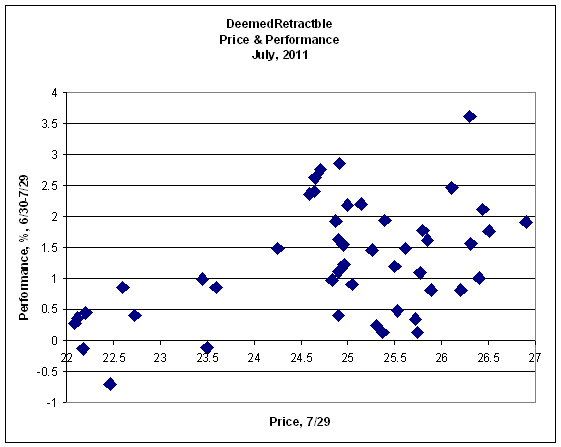
The fund had a disappointing month, dragged down by its holdings in YLO preferreds and the lower-coupon DeemedRetractibles.

DeemedRetractibles exhibited a very surprising relationship between Price and Performance, as illustrated by:

Click for big

As for the holdings in YLO preferreds – which were topped up during the month to maintain a weighting of about 3.5% in the face of declining price – what can I say? While I certainly agree that this is not a tip-top credit – which is why I’m limiting exposure to 3.5% – I cannot fathom why the preferreds are trading at only a little over half price – particularly since the sale of Trader Corporation to Apax closed on July 28.

I received an eMail from a client early in the month:

Hi James, TD Newcrest has downgraded this company from hold to reduce in its Morning Action Notes today … It seems to me a good enough reason to not hold their securities in MAPF, even if it is a minor position, with the risk rating raised to high. Why wait for the credit agencies to follow?

Well, in general terms, as I have often stated: Sell Side analysis is a superb source of data, a very good source of ideas and a laughable source of actionable investment advice. It should always be remembered that sell-side analysis does not have performance as its object: the purpose of sell-side analysis is to get you to change your mind about a particular issue so that you’ll trade more.

For instance:

A couple of analysts did come to Sino’s defence, most notably Dundee’s Richard Kelertas. In a remarkable conference call on Tuesday, he jumped way outside his mandate and accused Mr. Block of committing his own fraud, calling his research “a pile of crap.” If he’s right, he will go down as the hero of the saga. If he’s wrong, he will be remembered like former Nesbitt analyst Egizio Bianchini, who backed Bre-X after the fraud allegations (though it worked out fine for Mr. Bianchini, now vice chair at BMO Capital Markets).

Additionally, I will note:

TD Newcrest analyst Scott Cuthbertson threw in the towel on Yellow Media Inc. (YLO-T2.08-0.08-3.70%), slashing his price target by half to $2 and downgrading it to “sell” after having recommended investors hold it since the beginning of March 2010, when the stock traded around $6.

Generally speaking, I think stocks become more attractive when the price moves down, not less. It is, of course, possible that YLO’s business prospects deteriorated even more rapidly than the share price – but I find that idea a little hard to justify from the financial statements. I couldn’t find any data readily available on Mr. Cuthbertson’s track record – but, as implied above, performance is irrelevant for sell-side analysis.

The reference in the client eMail to the credit rating agencies is also interesting: as I showed in the June edition of PrefLetter, a similarly precipituous decline in the BBD preferreds (back in 2002) lasted for a little over half a year; the actual downgrade marked the end of the panic and the issues recovered in price almost immediately. Presumably, the actual downgrade got more players to look at the issue seriously and decide – ‘hey! This is a not so good credit, but the price indicates imminent bankruptcy and I don’t think the situation is that serious!’

So anyway, I’m sticking to my guns. Whatever the merits (or faults) of YLO common as an investment, I can’t for the life of me figure out why the preferreds are trading so low – and until I can figure that out, I’m going to assume that this is simply another episode of mass hysteria, brought about by retail’s tendency to see all things in a binary light: there’s either no problems at all, or bankruptcy is imminent, with nothing in between. This is just another case of the relatively random fluctuations in market price brought about by supply and demand imbalances that are the fund’s bread and butter, writ large. I will also note that eMails such as the one I received are how the retail perspective transmits to institutional portfolios: I can assure you that in this kind of situation, with dramatic market movements and heavy media coverage, a lot of Portfolio Managers sell (sometimes against their better judgement, if they have any) simply so they won’t have to explain their holdings to their clients. The business is, in general, not about performance; it’s about story telling.

In the meantime, however, the fund’s holdings of YLO preferreds cost about 0.62% in return for the month.

The fund’s Net Asset Value per Unit as of the close July 29 was $11.0683.

Returns to July 29, 2011
Period MAPF Index CPD
according to
Claymore
One Month -0.46% +0.87% +0.74%
Three Months +2.70% +2.69% +2.05%
One Year +15.79% +13.10% +9.56%
Two Years (annualized) +15.62% +11.48% N/A
Three Years (annualized) +27.92% +9.79% +7.29%
Four Years (annualized) +18.09% +5.17%  
Five Years (annualized) +15.47% +4.25%  
Six Years (annualized) +13.58% +4.06%  
Seven Years (annualized) +12.67% +4.20%  
Eight Years (annualized) +13.47% +4.43%  
Nine Years (annualized) +13.46% +4.63%  
Ten Years (annualized) +13.24% +4.57%  
The Index is the BMO-CM “50”
MAPF returns assume reinvestment of distributions, and are shown after expenses but before fees.
CPD Returns are for the NAV and are after all fees and expenses.
* CPD does not directly report its two-year returns.
Figures for Omega Preferred Equity (which are after all fees and expenses) for 1-, 3- and 12-months are +0.75%, +2.24% and +10.45%, respectively, according to Morningstar after all fees & expenses. Three year performance is +8.00%.
Figures for Jov Leon Frazer Preferred Equity Fund Class I Units (which are after all fees and expenses) for 1-, 3- and 12-months are +0.13%, +0.80% and +6.69% respectively, according to Morningstar
Figures for Manulife Preferred Income Fund (formerly AIC Preferred Income Fund) (which are after all fees and expenses) for 1-, 3- and 12-months are +0.68%, +2.40% & +7.39%, respectively
Figures for Horizons AlphaPro Preferred Share ETF are not yet available (inception date 2010-11-23)

MAPF returns assume reinvestment of dividends, and are shown after expenses but before fees. Past performance is not a guarantee of future performance. You can lose money investing in Malachite Aggressive Preferred Fund or any other fund. For more information, see the fund’s main page. The fund is available either directly from Hymas Investment Management or through a brokerage account at Odlum Brown Limited.

Sometimes everything works … sometimes the trading works, but sectoral shifts overwhelm the increment … sometimes nothing works. The fund seeks to earn incremental return by selling liquidity (that is, taking the other side of trades that other market participants are strongly motivated to execute), which can also be referred to as ‘trading noise’. There were a lot of strongly motivated market participants during the Panic of 2007, generating a lot of noise! Unfortunately, the conditions of the Panic may never be repeated in my lifetime … but the fund will simply attempt to make trades when swaps seem profitable, without worrying about the level of monthly turnover.

There’s plenty of room for new money left in the fund. I have shown in recent issues of PrefLetter that market pricing for FixedResets is demonstrably stupid and I have lots of confidence – backed up by my bond portfolio management experience in the markets for Canadas and Treasuries, and equity trading on the NYSE & TSX – that there is enough demand for liquidity in any market to make the effort of providing it worthwhile (although the definition of “worthwhile” in terms of basis points of outperformance changes considerably from market to market!) I will continue to exert utmost efforts to outperform but it should be borne in mind that there will almost inevitably be periods of underperformance in the future.

The yields available on high quality preferred shares remain elevated, which is reflected in the current estimate of sustainable income.

Calculation of MAPF Sustainable Income Per Unit
Month NAVPU Portfolio
Average
YTW
Leverage
Divisor
Securities
Average
YTW
Capital
Gains
Multiplier
Sustainable
Income
per
current
Unit
June, 2007 9.3114 5.16% 1.03 5.01% 1.2857 0.3628
September 9.1489 5.35% 0.98 5.46% 1.2857 0.3885
December, 2007 9.0070 5.53% 0.942 5.87% 1.2857 0.4112
March, 2008 8.8512 6.17% 1.047 5.89% 1.2857 0.4672
June 8.3419 6.034% 0.952 6.338% 1.2857 $0.4112
September 8.1886 7.108% 0.969 7.335% 1.2857 $0.4672
December, 2008 8.0464 9.24% 1.008 9.166% 1.2857 $0.5737
March 2009 $8.8317 8.60% 0.995 8.802% 1.2857 $0.6046
June 10.9846 7.05% 0.999 7.057% 1.2857 $0.6029
September 12.3462 6.03% 0.998 6.042% 1.2857 $0.5802
December 2009 10.5662 5.74% 0.981 5.851% 1.0819 $0.5714
March 2010 10.2497 6.03% 0.992 6.079% 1.0819 $0.5759
June 10.5770 5.96% 0.996 5.984% 1.0819 $0.5850
September 11.3901 5.43% 0.980 5.540% 1.0819 $0.5832
December 2010 10.7659 5.37% 0.993 5.408% 1.0000 $0.5822
March, 2011 11.0560 6.00% 0.994 5.964% 1.0000 $0.6594
June 11.1194 5.87% 1.018 5.976% 1.0000 $0.6645
July, 2011 11.0683 6.14% 0.995 6.109% 1.0000 $0.6762
NAVPU is shown after quarterly distributions of dividend income and annual distribution of capital gains.
Portfolio YTW includes cash (or margin borrowing), with an assumed interest rate of 0.00%
The Leverage Divisor indicates the level of cash in the account: if the portfolio is 1% in cash, the Leverage Divisor will be 0.99
Securities YTW divides “Portfolio YTW” by the “Leverage Divisor” to show the average YTW on the securities held; this assumes that the cash is invested in (or raised from) all securities held, in proportion to their holdings.
The Capital Gains Multiplier adjusts for the effects of Capital Gains Dividends. On 2009-12-31, there was a capital gains distribution of $1.989262 which is assumed for this purpose to have been reinvested at the final price of $10.5662. Thus, a holder of one unit pre-distribution would have held 1.1883 units post-distribution; the CG Multiplier reflects this to make the time-series comparable. Note that Dividend Distributions are not assumed to be reinvested.
Sustainable Income is the resultant estimate of the fund’s dividend income per current unit, before fees and expenses. Note that a “current unit” includes reinvestment of prior capital gains; a unitholder would have had the calculated sustainable income with only, say, 0.9 units in the past which, with reinvestment of capital gains, would become 1.0 current units.
DeemedRetractibles are comprised of all Straight Perpetuals (both PerpetualDiscount and PerpetualPremium) issued by BMO, BNS, CM, ELF, GWO, HSB, IAG, MFC, NA, RY, SLF and TD, which are not exchangable into common at the option of the company (definition refined in May). These issues are analyzed as if their prospectuses included a requirement to redeem at par on or prior to 2022-1-31, in addition to the call schedule explicitly defined. See OSFI Does Not Grandfather Extant Tier 1 Capital, CM.PR.D, CM.PR.E, CM.PR.G: Seeking NVCC Status and the January, February, March and June, 2011, editions of PrefLetter for the rationale behind this analysis.

Significant positions were held in DeemedRetractible and FixedReset issues on June 30; all of the former and most of the latter currently have their yields calculated with the presumption that they will be called by the issuers at par prior to 2022-1-31. This presents another complication in the calculation of sustainable yield. The fund also holds a position in a SplitShare (BNA.PR.C) and an OperatingRetractible Scrap (YLO.PR.B) which also have their yields calculated with the expectation of a maturity.

However, if the entire portfolio except for the PerpetualDiscounts were to be sold and reinvested in these issues, the yield of the portfolio would be the 5.67% shown in the MAPF Portfolio Composition: July 2011 analysis (which is greater than the 5.44% index yield on July 29). Given such reinvestment, the sustainable yield would be $11.0683 * 0.0567 = $0.6276, a decrease from the $11.1194 * 0.0565 = $0.6282, reported in June.

Different assumptions lead to different results from the calculation, but the overall positive trend is apparent. I’m very pleased with the results! It will be noted that if there was no trading in the portfolio, one would expect the sustainable yield to be constant (before fees and expenses). The success of the fund’s trading is showing up in

  • the very good performance against the index
  • the long term increases in sustainable income per unit

As has been noted, the fund has maintained a credit quality equal to or better than the index; outperformance is due to constant exploitation of trading anomalies.

Again, there are no predictions for the future! The fund will continue to trade between issues in an attempt to exploit market gaps in liquidity, in an effort to outperform the index and keep the sustainable income per unit – however calculated! – growing.

MAPF

MAPF Portfolio Composition, July 2011

Turnover declined even further in July, to less than 2%.

Trades were, as ever, triggered by a desire to exploit transient mispricing in the preferred share market (which may be thought of as “selling liquidity”), rather than any particular view being taken on market direction, sectoral performance or credit anticipation.

MAPF Sectoral Analysis 2011-7-29
HIMI Indices Sector Weighting YTW ModDur
Ratchet 0% N/A N/A
FixFloat 0% N/A N/A
Floater 0% N/A N/A
OpRet 0% N/A N/A
SplitShare 9.2% (0) 6.62% 6.16
Interest Rearing 0% N/A N/A
PerpetualPremium 0.0% (0) N/A N/A
PerpetualDiscount 10.9% (-0.4) 5.67% 14.38
Fixed-Reset 10.0% (+0.6) 3.00% 2.55
Deemed-Retractible 60.8% (+1.6) 5.90% 8.08
Scraps (Various) 9.7% (+0.5) 10.60% 8.60
Cash -0.5% (-2.3) 0.00% 0.00
Total 100% 6.14% 8.13
Totals and changes will not add precisely due to rounding. Bracketted figures represent change from June month-end. Cash is included in totals with duration and yield both equal to zero.
DeemedRetractibles are comprised of all Straight Perpetuals (both PerpetualDiscount and PerpetualPremium) issued by BMO, BNS, CM, ELF, GWO, HSB, IAG, MFC, NA, RY, SLF and TD, which are not exchangable into common at the option of the company. These issues are analyzed as if their prospectuses included a requirement to redeem at par on or prior to 2022-1-31, in addition to the call schedule explicitly defined. See OSFI Does Not Grandfather Extant Tier 1 Capital, CM.PR.D, CM.PR.E, CM.PR.G: Seeking NVCC Status and the January, February, March and June, 2011, editions of PrefLetter for the rationale behind this analysis.

The “total” reflects the un-leveraged total portfolio (i.e., cash is included in the portfolio calculations and is deemed to have a duration and yield of 0.00.). MAPF will often have relatively large cash balances, both credit and debit, to facilitate trading. Figures presented in the table have been rounded to the indicated precision.

Credit distribution is:

MAPF Credit Analysis 2011-7-29
DBRS Rating Weighting
Pfd-1 0 (0)
Pfd-1(low) 50.0% (+1.5)
Pfd-2(high) 22.7% (+0.7)
Pfd-2 0 (0)
Pfd-2(low) 18.1% (-2.2)
Pfd-3(high) 6.2% (-0.2)
Pfd-3 3.5% (+0.7)
Cash -0.5% (-2.3)
Totals will not add precisely due to rounding. Bracketted figures represent change from June month-end.
A position held in ELF preferreds has been assigned to Pfd-2(low)

Liquidity Distribution is:

MAPF Liquidity Analysis 2011-7-29
Average Daily Trading Weighting
<$50,000 5.5% (0)
$50,000 – $100,000 21.1% (+1.5)
$100,000 – $200,000 22.4% (-0.9)
$200,000 – $300,000 18.5% (+1.9)
>$300,000 33.0% (-0.2)
Cash -0.5% (-2.3)
Totals will not add precisely due to rounding. Bracketted figures represent change from June month-end.

MAPF is, of course, Malachite Aggressive Preferred Fund, a “unit trust” managed by Hymas Investment Management Inc. Further information and links to performance, audited financials and subscription information are available the fund’s web page. The fund may be purchased either directly from Hymas Investment Management or through a brokerage account at Odlum Brown Limited. A “unit trust” is like a regular mutual fund, but is sold by offering memorandum rather than prospectus. This is cheaper, but means subscription is restricted to “accredited investors” (as defined by the Ontario Securities Commission) or those who subscribe for $150,000+. Fund past performances are not a guarantee of future performance. You can lose money investing in MAPF or any other fund.

A similar portfolio composition analysis has been performed on the Claymore Preferred Share ETF (symbol CPD) as of August 31, 2010, and published in the September, 2010, PrefLetter. While direct comparisons are difficult due to the introduction of the DeemedRetractible class of preferred share (see above) it is fair to say:

  • MAPF credit quality is better
  • MAPF liquidity is a higher
  • MAPF Yield is higher
  • Weightings in
    • MAPF is much more exposed to DeemedRetractibles
    • MAPF is much less exposed to Operating Retractibles
    • MAPF is slightly more exposed to SplitShares
    • MAPF is less exposed to FixFloat / Floater / Ratchet
    • MAPF weighting in FixedResets is much lower
Market Action

July 29, 2011

Moody’s put Spain on Review-Negative:

Spain faces a possible downgrade by Moody’s Investors Service as its regions struggle to cut budget deficits and last week’s Greek bailout increases the risk that bondholders will have to pay for further European rescues.

Moody’s is reviewing the nation’s Aa2 classification, the ratings company said in a statement today. A cut would probably be “limited to one notch,” Moody’s said. The euro fell. Spain has the same credit rating as Italy, which is also on review for downgrade at Moody’s.

The trouble with regulators, as a class, is their inability to think things through. Increased transparency in the public bond market has brought with it reduction of choice for public investors, as more deals are done on a private placement basis, and thinner markets for the ones that remain, as capital gets redeployed to more profitable areas. Another example of this is hedge fund regulation:

There’s a two-word explanation for closing what was once one of the world’s biggest hedge funds and consistently one of the best-performing — with returns of about 30 percent annually in its first 30 years: Dodd-Frank. The law requires hedge funds to register with the Securities and Exchange Commission and provide information about customers, employees and assets. By returning outsiders’ money, Soros Fund Management escapes that rule and the loss of privacy that goes with it.

“An unfortunate consequence of these new circumstances is that we will no longer be able to manage assets for anyone other than a family client as defined under the regulations,” the brothers wrote in a letter to investors.

Or maybe regulators do think things through – a regulator’s ideal world is one in which everybody holds only plain-vanilla investments, nobody every complains and regulators are never subjected to criticism, informed or otherwise.

I would love to offer Malachite Aggressive Preferred Fund to the general public … but the process isn’t just expensive, it’s stupid expensive. To make such an idea work, I would have to convert my firm into just another marketting and distribution firm, with investment management tacked on as an unfortunate operating expense to be minimized.

There has been lots of noise about the City of Toronto cost-cutting programme … the problem as I see it is not so much that the City is doing things it doesn’t need to do (although there’s plenty of that) as it is that it grossly overpays for what it does. Take librarians, for example. CUPE BC claims that Toronto librarians make almost $35/hr – and that report was dated June, 2007! Add pension and benefits to that and I’ll bet there’s not much change from $100,000 annually. My girlfriend tells me that when she goes to the library and uses the scanner to check out books, there are generally three – count ’em, three – librarians watching her do it.

YLO closed the Trader Corp. deal yesterday, but it didn’t do them much good on the market as three of their four preferreds were down significantly on the day (bid/bid) – the exception was the short-term retractible, YLO.PR.A.

These issues did horribly on the month, occupying four of the bottom six positions on the total returns ranking of the HIMIPref™ universe: only YLD.PR.B (worst) and BBD.PR.D (fifth worst) managed to break the hegemony. Total returns for the YLO prefs ranged from -6.4% (YLO.PR.A) to -18.4% (YLO.PR.D).

The Canadian preferred share market closed the month on a mixed note,with PerpetualDiscounts down 2bp, FixedResets down 2bp and DeemedRetractibles gaining 7bp. Volatility was low. Volume was … pretty close to non-existent!

PerpetualDiscounts now yield 5.44%, equivalent to 7.07% interest at the standard equivalency factor of 1.3x. Long Corporates now yield about 5.1% (maybe a little under) (!) so the pre-tax interest-equivalent spread is now about 200bp, a widening from the 185bp reported on July 27 as the two yields have moved in opposite directions over the past two days.

And that’s it for another month!

HIMIPref™ Preferred Indices
These values reflect the December 2008 revision of the HIMIPref™ Indices

Values are provisional and are finalized monthly
Index Mean
Current
Yield
(at bid)
Median
YTW
Median
Average
Trading
Value
Median
Mod Dur
(YTW)
Issues Day’s Perf. Index Value
Ratchet 0.00 % 0.00 % 0 0.00 0 -1.1669 % 2,420.8
FixedFloater 0.00 % 0.00 % 0 0.00 0 -1.1669 % 3,640.9
Floater 2.50 % 2.33 % 35,393 21.47 4 -1.1669 % 2,613.8
OpRet 4.85 % 2.31 % 55,997 0.17 9 -0.1322 % 2,454.5
SplitShare 5.24 % 2.15 % 52,341 0.57 6 0.0379 % 2,512.5
Interest-Bearing 0.00 % 0.00 % 0 0.00 0 -0.1322 % 2,244.4
Perpetual-Premium 5.67 % 4.89 % 130,516 0.81 13 0.0959 % 2,096.1
Perpetual-Discount 5.41 % 5.44 % 109,798 14.76 17 -0.0247 % 2,214.7
FixedReset 5.15 % 3.16 % 217,897 2.63 58 -0.0229 % 2,325.5
Deemed-Retractible 5.06 % 4.69 % 275,258 7.84 47 0.0745 % 2,179.1
Performance Highlights
Issue Index Change Notes
PWF.PR.A Floater -4.05 % YTW SCENARIO
Maturity Type : Limit Maturity
Maturity Date : 2041-07-29
Maturity Price : 22.03
Evaluated at bid price : 22.26
Bid-YTW : 2.33 %
PWF.PR.E Perpetual-Discount -1.03 % YTW SCENARIO
Maturity Type : Limit Maturity
Maturity Date : 2041-07-29
Maturity Price : 23.68
Evaluated at bid price : 24.89
Bid-YTW : 5.49 %
FTS.PR.G FixedReset 1.08 % YTW SCENARIO
Maturity Type : Call
Maturity Date : 2013-09-01
Maturity Price : 25.00
Evaluated at bid price : 26.25
Bid-YTW : 3.19 %
IAG.PR.F Deemed-Retractible 1.15 % YTW SCENARIO
Maturity Type : Hard Maturity
Maturity Date : 2022-01-31
Maturity Price : 25.00
Evaluated at bid price : 26.30
Bid-YTW : 5.34 %
Volume Highlights
Issue Index Shares
Traded
Notes
IFC.PR.A FixedReset 31,562 Recent new issue.
YTW SCENARIO
Maturity Type : Hard Maturity
Maturity Date : 2022-01-31
Maturity Price : 25.00
Evaluated at bid price : 25.01
Bid-YTW : 4.09 %
BNS.PR.Y FixedReset 26,805 National crossed 25,000 at 25.34.
YTW SCENARIO
Maturity Type : Hard Maturity
Maturity Date : 2022-01-31
Maturity Price : 25.00
Evaluated at bid price : 25.17
Bid-YTW : 3.28 %
RY.PR.W Perpetual-Discount 23,420 YTW SCENARIO
Maturity Type : Limit Maturity
Maturity Date : 2041-07-29
Maturity Price : 24.43
Evaluated at bid price : 24.75
Bid-YTW : 4.94 %
RY.PR.A Deemed-Retractible 20,811 YTW SCENARIO
Maturity Type : Hard Maturity
Maturity Date : 2022-01-31
Maturity Price : 25.00
Evaluated at bid price : 24.71
Bid-YTW : 4.58 %
MFC.PR.F FixedReset 19,524 YTW SCENARIO
Maturity Type : Hard Maturity
Maturity Date : 2022-01-31
Maturity Price : 25.00
Evaluated at bid price : 25.03
Bid-YTW : 3.88 %
TD.PR.G FixedReset 17,044 YTW SCENARIO
Maturity Type : Call
Maturity Date : 2014-04-30
Maturity Price : 25.00
Evaluated at bid price : 27.19
Bid-YTW : 2.91 %
There were 11 other index-included issues trading in excess of 10,000 shares.
Wide Spread Highlights
Issue Index Quote Data and Yield Notes
PWF.PR.A Floater Quote: 22.26 – 23.24
Spot Rate : 0.9800
Average : 0.7181

YTW SCENARIO
Maturity Type : Limit Maturity
Maturity Date : 2041-07-29
Maturity Price : 22.03
Evaluated at bid price : 22.26
Bid-YTW : 2.33 %

NEW.PR.C SplitShare Quote: 14.25 – 14.69
Spot Rate : 0.4400
Average : 0.2682

YTW SCENARIO
Maturity Type : Call
Maturity Date : 2012-06-26
Maturity Price : 13.70
Evaluated at bid price : 14.25
Bid-YTW : 2.15 %

CIU.PR.C FixedReset Quote: 25.01 – 25.81
Spot Rate : 0.8000
Average : 0.6451

YTW SCENARIO
Maturity Type : Limit Maturity
Maturity Date : 2041-07-29
Maturity Price : 23.18
Evaluated at bid price : 25.01
Bid-YTW : 3.39 %

RY.PR.Y FixedReset Quote: 27.20 – 27.64
Spot Rate : 0.4400
Average : 0.2865

YTW SCENARIO
Maturity Type : Call
Maturity Date : 2014-11-24
Maturity Price : 25.00
Evaluated at bid price : 27.20
Bid-YTW : 3.17 %

PWF.PR.E Perpetual-Discount Quote: 24.89 – 25.20
Spot Rate : 0.3100
Average : 0.1945

YTW SCENARIO
Maturity Type : Limit Maturity
Maturity Date : 2041-07-29
Maturity Price : 23.68
Evaluated at bid price : 24.89
Bid-YTW : 5.49 %

FTS.PR.E OpRet Quote: 27.08 – 27.48
Spot Rate : 0.4000
Average : 0.2979

YTW SCENARIO
Maturity Type : Call
Maturity Date : 2013-06-01
Maturity Price : 25.75
Evaluated at bid price : 27.08
Bid-YTW : 2.31 %

Issue Comments

FTN.PR.A: 11H1 Semi-Annual Report

Financial 15 Split Inc. has released its Semi-Annual Report to May 31, 2011.

There’s an interesting line item in the statement of expenses: Capital tax, $7,103. I can’t figure that one out, and it’s not mentioned anywhere else in the document … but it’s minor, so we’ll let it go.

Figures of interest are:

MER: 1.22% of the whole unit value.

Average Net Assets: We need this to calculate portfolio yield. [147.6-million (NAV, beginning of period) + 147.8-million (NAV, end of period)] / 2 = about 148-million.

Underlying Portfolio Yield: Dividends received (net of withholding) of 2,216,733, times two (semi-annual) divided by average net assets of 148-million is 3.00%

Income Coverage: Net Investment Income of 1,286,575 divided by Preferred Share Distributions of 2,428,897 is 53%.

Issue Comments

FFN.PR.A 11H1 Semi-Annual Report

Financial 15 Split Corp. II has released its Semi-Annual Report to May 31, 2011.

Figures of interest are:

MER: 1.16% of the whole unit value

Average Net Assets: We need this to calculate portfolio yield. No change in Number of Units Outstanding, so just calculate as [83.1-million (NAV at beginning of period) + 84.6-million (NAV at end of period)] / 2 = 84-million, more or less.

Underlying Portfolio Yield: Dividends received (net of withholding) of 1,203,296 times two because it’s only half a year divided by average net assets of 84-million is 2.86%

Income Coverage: Net Investment Income of 703,329 divided by Preferred Share Distributions of 1,493,166 is 47%.

Market Action

July 28, 2011

According to the chatterati, credit rating agencies are heroes this week:

At a House subcommittee hearing yesterday, U.S. financial regulators acknowledged that the rating companies lately have been doing a better job. Alarmed by Greece’s unsustainable borrowing, the companies have slashed Greek debt to below investment grade. Troubles in Ireland, Portugal and Spain aren’t as severe, but those countries are under appropriately close scrutiny by rating services. Even the U.S. has been tagged for a downgrade if it can’t sort out its debt-ceiling and spending problems — and maybe even if it does.

It was a quiet, slightly negative day for the Canadian preferred share market, with PerpetualDiscounts up 2bp, FixedResets losing 6bp and DeemedRetractibles down 3bp. Big volume continued for BNS.PR.Z, but was otherwise volume was only average.

HIMIPref™ Preferred Indices
These values reflect the December 2008 revision of the HIMIPref™ Indices

Values are provisional and are finalized monthly
Index Mean
Current
Yield
(at bid)
Median
YTW
Median
Average
Trading
Value
Median
Mod Dur
(YTW)
Issues Day’s Perf. Index Value
Ratchet 0.00 % 0.00 % 0 0.00 0 -0.0942 % 2,449.4
FixedFloater 0.00 % 0.00 % 0 0.00 0 -0.0942 % 3,683.9
Floater 2.48 % 2.24 % 35,654 21.68 4 -0.0942 % 2,644.7
OpRet 4.84 % 1.74 % 56,737 0.17 9 0.1965 % 2,457.7
SplitShare 5.24 % 2.23 % 52,602 0.58 6 0.0265 % 2,511.5
Interest-Bearing 0.00 % 0.00 % 0 0.00 0 0.1965 % 2,247.4
Perpetual-Premium 5.68 % 4.83 % 132,372 0.81 13 -0.1535 % 2,094.1
Perpetual-Discount 5.41 % 5.41 % 110,846 14.76 17 0.0222 % 2,215.2
FixedReset 5.15 % 3.11 % 217,641 2.63 58 -0.0551 % 2,326.1
Deemed-Retractible 5.06 % 4.67 % 275,572 7.82 47 -0.0271 % 2,177.5
Performance Highlights
Issue Index Change Notes
PWF.PR.O Perpetual-Premium -1.16 % YTW SCENARIO
Maturity Type : Call
Maturity Date : 2018-10-31
Maturity Price : 25.00
Evaluated at bid price : 25.50
Bid-YTW : 5.49 %
SLF.PR.G FixedReset -1.12 % YTW SCENARIO
Maturity Type : Hard Maturity
Maturity Date : 2022-01-31
Maturity Price : 25.00
Evaluated at bid price : 25.56
Bid-YTW : 3.61 %
PWF.PR.F Perpetual-Discount 1.08 % YTW SCENARIO
Maturity Type : Limit Maturity
Maturity Date : 2041-07-28
Maturity Price : 24.18
Evaluated at bid price : 24.44
Bid-YTW : 5.39 %
FTS.PR.E OpRet 1.26 % YTW SCENARIO
Maturity Type : Call
Maturity Date : 2013-06-01
Maturity Price : 25.75
Evaluated at bid price : 27.35
Bid-YTW : 1.74 %
Volume Highlights
Issue Index Shares
Traded
Notes
BNS.PR.Z FixedReset 901,885 TD crossed two blocks of 100,000 each and one of 30,000, all at 24.25. RBC crossed blocks of 500,000 shares, 112,000 and 50,000, all at 24.25.
YTW SCENARIO
Maturity Type : Hard Maturity
Maturity Date : 2022-01-31
Maturity Price : 25.00
Evaluated at bid price : 24.25
Bid-YTW : 3.90 %
BNS.PR.T FixedReset 108,993 RBC crossed 100,000 at 27.20.
YTW SCENARIO
Maturity Type : Call
Maturity Date : 2014-04-25
Maturity Price : 25.00
Evaluated at bid price : 27.17
Bid-YTW : 2.94 %
BNS.PR.P FixedReset 80,961 Nesbitt crossed blocks of 50,000 and 26,000, both at 26.05.
YTW SCENARIO
Maturity Type : Call
Maturity Date : 2013-04-25
Maturity Price : 25.00
Evaluated at bid price : 25.85
Bid-YTW : 2.99 %
CM.PR.K FixedReset 80,960 RBC crossed 18,300 at 27.00; Nesbitt crossed 50,000 at 26.95.
YTW SCENARIO
Maturity Type : Call
Maturity Date : 2014-07-31
Maturity Price : 25.00
Evaluated at bid price : 26.90
Bid-YTW : 2.70 %
TD.PR.N OpRet 80,275 Desjardins crossed blocks of 60,000 and 15,000, both at 25.55.
YTW SCENARIO
Maturity Type : Call
Maturity Date : 2011-08-27
Maturity Price : 25.50
Evaluated at bid price : 25.61
Bid-YTW : -1.18 %
SLF.PR.C Deemed-Retractible 78,904 Desjardins crossed 75,000 at 22.10.
YTW SCENARIO
Maturity Type : Hard Maturity
Maturity Date : 2022-01-31
Maturity Price : 25.00
Evaluated at bid price : 22.09
Bid-YTW : 6.04 %
There were 34 other index-included issues trading in excess of 10,000 shares.
Wide Spread Highlights
Issue Index Quote Data and Yield Notes
IAG.PR.C FixedReset Quote: 26.95 – 27.27
Spot Rate : 0.3200
Average : 0.2020

YTW SCENARIO
Maturity Type : Call
Maturity Date : 2013-12-31
Maturity Price : 25.00
Evaluated at bid price : 26.95
Bid-YTW : 3.06 %

CIU.PR.C FixedReset Quote: 24.90 – 25.49
Spot Rate : 0.5900
Average : 0.4754

YTW SCENARIO
Maturity Type : Limit Maturity
Maturity Date : 2041-07-28
Maturity Price : 23.14
Evaluated at bid price : 24.90
Bid-YTW : 3.41 %

POW.PR.C Perpetual-Discount Quote: 25.06 – 25.43
Spot Rate : 0.3700
Average : 0.2581

YTW SCENARIO
Maturity Type : Call
Maturity Date : 2011-12-06
Maturity Price : 25.00
Evaluated at bid price : 25.06
Bid-YTW : 5.72 %

POW.PR.D Perpetual-Discount Quote: 23.87 – 24.24
Spot Rate : 0.3700
Average : 0.2691

YTW SCENARIO
Maturity Type : Limit Maturity
Maturity Date : 2041-07-28
Maturity Price : 23.59
Evaluated at bid price : 23.87
Bid-YTW : 5.27 %

IAG.PR.E Deemed-Retractible Quote: 25.92 – 26.25
Spot Rate : 0.3300
Average : 0.2353

YTW SCENARIO
Maturity Type : Call
Maturity Date : 2018-12-31
Maturity Price : 25.00
Evaluated at bid price : 25.92
Bid-YTW : 5.50 %

FTS.PR.H FixedReset Quote: 25.35 – 25.80
Spot Rate : 0.4500
Average : 0.3671

YTW SCENARIO
Maturity Type : Limit Maturity
Maturity Date : 2041-07-28
Maturity Price : 23.38
Evaluated at bid price : 25.35
Bid-YTW : 3.48 %

Issue Comments

YLO Closes Trader Corporation Sale

Yellow Media has announced:

the successful completion of the sale of Trader Corporation’s automotive segment to Funds advised by Apax Partners. The transaction, previously announced on March 25, 2011, was completed for a net purchase consideration of $708 million, net of expenses and estimated working capital, fees and other adjustments.

This divestiture will enable the Company to strengthen its capital structure and focus all of its efforts on YPG’s digital transformation and organic execution in its core business. The proceeds from the sale will be largely used to reduce indebtedness and for general corporate purposes.

I’ve been checking every day since the Trader Corp. debt issue closed on July 22! As noted on July 27, their 11Q2 financials will be released on August 4.

This is not the kind of thing I usually report on PrefBlog … but the YLO issues have been … somewhat volatile in recent months. YLO has four issues outstanding, the retractibles YLO.PR.A and YLO.PR.B; and the FixedResets YLO.PR.C and YLO.PR.D. All are tracked by HIMIPref™; all are relegated to the Scraps index on credit concerns.

The June edition of PrefLetter contained a short appendix on YLO; I won’t decide until I look at the financials, but I suspect that the August edition will have another.