Interesting External Papers

Making Sense of the SubPrime Crisis

The Boston Fed has released a paper titled Making Sense of the SubPrime Crisis by Kristopher S. Gerardi, Andreas Lehnert, Shane M. Sherland, and Paul S. Willen with the abstract:

This paper explores the question of whether market participants could have or should have anticipated the large increase in foreclosures that occurred in 2007 and 2008. Most of these foreclosures stem from loans originated in 2005 and 2006, leading many to suspect that lenders originated a large volume of extremely risky loans during this period. However, the authors show that while loans originated in this period did carry extra risk factors, particularly increased leverage, underwriting standards alone cannot explain the dramatic rise in foreclosures. Focusing on the role of house prices, the authors ask whether market participants underestimated the likelihood of a fall in house prices or the sensitivity of foreclosures to house prices. The authors show that, given available data, market participants should have been able to understand that a significant fall in prices would cause a large increase in foreclosures, although loan‐level (as opposed to ownership‐level) models would have predicted a smaller rise than actually occurred. Examining analyst reports and other contemporary discussions of the mortgage market to see what market participants thought would happen, the authors find that analysts, on the whole, understood that a fall in prices would have disastrous consequences for the market but assigned a low probability to such an outcome.

As an illustration of the risks inherent in estimating tail risk – or even defining which is the tail and which is the belly, there are so many people claiming it was always obvious – they cite:

As an illustrative example, consider a 2005 analyst report published by a large investment bank: it analyzed a representative deal composed of 2005 vintage loans and argued it would face 17 percent cumulative losses in a “meltdown” scenario in which house prices fell 5 percent over the life of the deal. Their analysis is prescient: the ABX index (an index that represents a basket of credit default swaps on high-risk mortgages and home equity loans) currently implies that such a deal will actually face losses of 18.3 percent over its life. The problem was that the report only assigned a 5 percent probability to the meltdown scenario, whereas it assigned a 15 percent probability and a 50 percent probability to scenarios in which house prices grew 11 percent and 5 percent, respectively, over the life of the deal.

With regard to the obviousness of the housing bubble, they point out:

Broadly speaking, we maintain the assumption that while, in the aggregate, lending standards may indeed have affected house price dynamics (we are agnostic on this point), no individual market participant felt that he could affect prices with his actions. Nor do we analyze whether the housing market was overvalued in 2005 and 2006, and whether a collapse of house prices was
therefore, to some extent, predictable. There was a lively debate during that period, with some arguing that housing was reasonably valued (see Himmelberg, Mayer, and Sinai 2005 and McCarthy and Peach 2004) and others arguing that it was overvalued (see Gallin 2006, Gallin 2008, and Davis, Lehnert, and Martin 2008).

The Fed’s researchers are not impressed by the current demonization of the “originate and distribute” model:

Many have argued that a major driver of the subprime crisis was the increased use of securitization. In this view, the “originate to distribute” business model of many mortgage finance companies separated the underwriter making the credit extension decision from exposure to the ultimate credit quality of the borrower and thus created an incentive to maximize lending volume without concern for default rates. In addition, information asymmetries, unfamiliarity with the market, or other factors prevented investors who were buying the credit risk fromputting in place effective controls for these incentives. While this argument is intuitively persuasive, our results are not consistent with such an explanation. One of our key findings is that most of the uncertainty about losses stemmed from uncertainty about the evolution of house prices and not from uncertainty about the quality of the underwriting. All that said, our models do not perfectly predict the defaults that occurred, and these often underestimate the number of defaults. One possible explanation is that there was an unobservable deterioration of underwriting standards in 2005 and 2006. But another possible explanation is that our model of the highly non-linear relationship between prices and foreclosures is wanting. No existing research successfully separates the two explanations.

Resets? Schmresets!

No discussion of the subprime crisis of 2007 and 2008 is complete without mention of the interest rate resets built into many subprime mortgages that virtually guaranteed large payment increases. Many commentators have attributed the crisis to the payment shock associated with the first reset of subprime 2/28 mortgages. However, the evidence from loan-level data shows that resets cannot account for a significant portion of the increase in foreclosures. Both Mayer, Pence, and Sherlund (2008) and Foote, Gerardi, Goette, and Willen (2007) show that the overwhelming majority of defaults on subprime adjustable-rate mortgages (ARM) occur long before the first reset. In other words, many lenders would have been lucky had borrowers waited until the first reset to default.

One interesting and doomed to be unrecognized factor is:

Investors allocated appreciable fractions of their portfolios to the subprime market because, in one key sense, it was considered less risky than the prime market. The issue was prepayments, and the evidence showed that subprime borrowers prepaid much less efficiently than prime borrowers, meaning that they did not immediately exploit advantageous changes in interest rates to refinance into lower rate loans. Thus, the sensitivity of the income stream from a pool of subprime loans to interest rate changes was lower than the sensitivity of a pool of prime mortgages.

Mortgage pricing revolved around the sensitivity of refinancing to interest rates; subprime loans appeared to be a useful class of assets whose cash flow was not particularly correlated with interest rate shocks.

Risks may be represented as:

if we let f represent foreclosures, p represent prices, and t represent time, then we can decompose the growth in foreclosures over time, df/dt, into a part corresponding to the change in prices over time and a part reflecting the sensitivity of foreclosures to prices:

df/dt = df/dp × dp/dt.

Our goal is to determine whether market participants underestimated df/dp, the sensitivity of foreclosures to prices, or whether dp/dt, the trajectory of house prices, came out much worse than they expected.

And how about those blasted Credit Rating Agencies (they work for the issuers, you know):

As a rating agency, S&P was forced to focus on the worst possible scenario rather than the most likely one. And their worst-case scenario is remarkably close to what actually happened. In September of 2005, they considered the following:

  • a 30 percent house price decline over two years for 50 percent of the pool
  • a 10 percent house price decline over two years for 50 percent of the pool.
  • an economy that was“slowing but not recessionary”
  • a cut in Fed Funds rate to 2.75 percent
  • a strong recovery in 2008.

In this scenario, they concluded that cumulative losses would be 5.82 percent.

Their problem was in forecasting the major losses that would occur later. As a Bank C analyst recently said, “The steepest part of the loss ramp lies straight ahead.” S&P concluded that none of the investment grade tranches of RMBSs would be affected at all — that is, no defaults or downgrades would occur. In May of 2006, they updated their scenario to include a minor recession in 2007, and they eliminated both the rate cut and the strong recovery. They still saw no downgrades of any A-rated bonds or most of the BBB-rated bonds. They did expect widespread defaults, but this was, after all, a scenario they considered “highly unlikely.” Although S&P does not provide detailed information on their model of credit losses, it is impossible to avoid concluding that their estimates of df/dp were way off. They obviously appreciated that df/dp was not zero, but their estimates were clearly too small.

As I’ve stressed whenever discussing the role of Credit Rating Agencies, their rating represent advice and opinion (necessarily, since it involves predictions of the future); the receipt of credit reports is not limited to the peak of Mount Sinai. Some disputed this advice:

The problems with the S&P analysis did not go unnoticed. Bank A analysts disagreed sharply with S&P:

Our loss projections in the S&P scenario are vastly different from S&P’s projections with the same scenario. For 2005 subprime loans, S&P predicts lifetime cumulative losses of 5.8 percent, which is less than half our number… We believe that S&P numbers greatly understate the risk of HPA declines.

The irony of this is that both S&P and Bank A ended up quite bullish, but for different reasons. S&P apparently believed that df/dp was low, whereas most analysts appear to have believed that dp/dt was unlikely to fall substantially.

And other forecasts were equally unlucky:

Bank B analysts actually assigned probabilities to various house price outcomes. They considered five scenarios:

Name Scenario Probability
(1) Aggressive 11% HPA over the life of the pool 15%
(2) [No name] 8% HPA over the life of the pool 15%
(3) Base HPA slows to 5% by year-end 2005 50%
(4) Pessimistic 0% HPA for the next 3 years, 5% thereafter 15%
(5) Meltdown -5% for the next 3 years, 5% thereafter 5%

Over the relevant period, HPA actually came in a little below the -5 percent of the meltdown scenario, according to the Case-Shiller index. Reinforcing the idea that they viewed the meltdown as implausible, the analysts devoted no time to discussing the consequences of the meltdown scenario even though it is clear from tables in the paper that it would lead to widespread defaults and downgrades, even among the highly rated investment grade subprime ABS.

The authors conclude:

In the end, one has to wonder whether market participants underestimated the probability of a house price collapse or misunderstood the consequences of such a collapse. Thus, in Section 4, we describe our reading of the mountain of research reports, media commentary, and other written records left by market participants of the era. Investors were focused on issues such as small differences in prepayment speeds that, in hindsight, appear of secondary importance to the credit losses stemming from a house price
downturn. When they did consider scenarios with house price declines, market participants as a whole appear to have correctly identified the subsequent losses. However, such scenarios were labeled as “meltdowns” and ascribed very low probabilities. At the time, there was a lively debate over the future course of house prices, with disagreement over valuation metrics and even the correct index with which to measure house prices. Thus, at the start of 2005, it was genuinely possible to be convinced that nominal U.S. house prices would not fall substantially.

This is a really superb paper; so good that it will be ignored in the coming regulatory debate. The impetus to tell the story that people want to hear hasn’t changed – only the details of the story.

PrefBlog’s Assiduous Readers, however, will file this one under “Forecasting”, with a copy to “Tail Risk”.
New Issues

New Issue: BNS Fixed-Reset 6.25%+446

Bank of Nova Scotia has announced:

a domestic public offering of 8 million non-cumulative 6.25% 5-year rate reset preferred shares Series 28 (the “Preferred Shares Series 28”) at a price of $25.00 per share, for gross proceeds of $200 million.

Holders of Preferred Shares Series 28 will be entitled to receive a non-cumulative quarterly fixed dividend for the initial period ending April 25, 2014 yielding 6.25% per annum, as and when declared by the Board of Directors of Scotiabank. Thereafter, the dividend rate will reset every five years at a rate equal to 4.46% over the 5-year Government of Canada bond yield. Holders of Preferred Shares Series 28 will, subject to certain conditions, have the right to convert all or any part of their shares to non-cumulative floating rate preferred shares Series 29 (the “Preferred Shares Series 29”) of Scotiabank on April 26, 2014 and on April 26 every five years thereafter.

Holders of the Preferred Shares Series 29 will be entitled to receive a non-cumulative quarterly floating dividend at a rate equal to the 3-month Government of Canada Treasury Bill yield plus 4.46%, as and when declared by the Board of Directors of Scotiabank. Holders of Preferred Shares Series 29 will, subject to certain conditions, have the right to convert all or any part of their shares to Preferred Shares Series 28 on April 26, 2019 and on April 26 every five years thereafter.

The Bank has agreed to sell the Preferred Shares Series 28 to a syndicate of underwriters led by Scotia Capital Inc. on a bought deal basis. The Bank has granted to the underwriters an option to purchase up to an additional 2 million Preferred Shares Series 28 at closing, which option is exercisable by the underwriters any time up to 48 hours before closing.

Closing is expected to occur on or after January 30, 2009. This domestic public offering is part of Scotiabank’s ongoing and proactive management of its Tier 1 capital structure.

The initial dividend – if declared! – will be $0.37671 payable April 28, based on anticipated closing January 30.

Update: They’re selling like hotcakes! Scotia has announced:

that as a result of strong investor demand for its domestic public offering of non-cumulative 5-year rate reset preferred shares Series 28 (the “Preferred Shares Series 28”), the size of the offering has been increased to 10 million Preferred Shares Series 28. The gross proceeds of the offering will now be $250 million.

Update, 2009-1-29: This issue will trade as BNS.PR.X.

New Issues

New Issue: Royal Bank Fixed-Reset 6.25%+450

Royal Bank has announced:

a domestic public offering of $200 million of Non-Cumulative, 5 year rate reset Preferred Shares Series AR.

The bank will issue 8.0 million Preferred Shares Series AR priced at $25 per share and holders will be entitled to receive non-cumulative quarterly fixed dividend for the initial period ending February 24, 2014 in the amount of $1.5625 per share, to yield 6.25% annually. The bank has granted the Underwriters an option, exercisable in whole or in part, to purchase up to an additional 3.0 million Preferred Shares at the same offering price.

Subject to regulatory approval, on or after February 24, 2014, the bank may redeem the Preferred Shares Series AR in whole or in part at par. Thereafter, the dividend rate will reset every five years at a rate equal to 4.50% over the 5-year Government of Canada bond yield. Holders of Preferred Shares Series AR will, subject to certain conditions, have the right to convert all or any part of their shares to non-cumulative floating rate preferred shares Series AS (the “Preferred Shares Series AS”) on February 24, 2014 and on February 24 every five years thereafter.

Holders of the Preferred Shares Series AS will be entitled to receive a non-cumulative quarterly floating dividend at a rate equal to the 3-month Government of Canada Treasury Bill yield plus 4.50%. Holders of Preferred Shares Series AS will, subject to certain conditions, have the right to convert all or any part of their shares to Preferred Shares Series AR on February 24, 2019 and on February 24 every five years thereafter.

The offering will be underwritten by a syndicate led by RBC Capital Markets. The expected closing date is January 29, 2009.

We routinely undertake funding transactions to maintain strong capital ratios and a cost effective capital structure. Net proceeds from this transaction will be used for general business purposes.

The first dividend will be $0.49229 payable May 24, based on anticipated closing January 29.

Update, 2009-1-22: Royal announced on Jan 21:

that as a result of strong investor demand for its domestic public offering of Non-Cumulative, 5 year rate reset Preferred Shares Series AR (the “Preferred Shares Series AR”), the size of the offering has been increased to 10 million shares. The gross proceeds of the offering will now be $250 million. In addition, the bank has granted the Underwriters an option, exercisable in whole or in part, to purchase up to an additional 3 million Preferred Shares Series AR at a price of $25 per share. The offering will be underwritten by a syndicate led by RBC Capital Markets. The expected closing date is January 29, 2009.

… and announced on Jan 22:

that as a result of strong investor demand for its domestic public offering of Non-Cumulative, 5 year rate reset Preferred Shares Series AR (the “Preferred Shares Series AR”), the bank has increased the Underwriters option to 4 million Preferred Shares Series AR at a price of $25 per share.

Update, 2009-1-28: This will trade with the symbol RY.PR.R.

Interesting External Papers

Canadian Budget Baseline Projections

The Parliamentary Budget Officer has released a Pre-Budget Economic and Fiscal Briefing and it makes for news that’s as bad as may be expected:

Before accounting for any new fiscal measures to be introduced in Budget 2009, this more sluggish economic outlook suggests a further deterioration in the budget balance relative to PBO’s November EFA.
o The updated economic outlook based on the PBO survey average results in a status quo budgetary deficit reaching $13 billion in 2009-10, equivalent to 0.8% of GDP.
o On a cumulative basis, status quo budget deficits amount to $46 billion over 2009-10 to 2013-14.
o PBO currently judges that the balance of risks to its fiscal outlook is tilted to the downside, reflecting the possibility of weaker-than-expected economic performance and relatively optimistic assumptions about corporate profits.
o The January survey’s low forecasts are used to illustrate potential downside economic risks and imply significantly larger deficits on a status quo basis, averaging $21 billion annually over the next five fiscal years.


Further, rough estimates indicate that the Government has a structural surplus of about $6 billion — though more work needs to be undertaken in this area. Thus, any permanent fiscal actions (e.g., permanent tax cuts or permanent spending increases) exceeding $6 billion annually would likely result in structural deficits, limiting the Government’s ability to manage future cost pressures due to, for example, population ageing

The total effect of the recession over the period of 2009-14, according to the average scenario (Table 2 of the report) is $45.9-billion – and this is before any special spending; the deficit arises from automatic stabilizers and revenue decreases. It will take many, many years of Spend-Every-Penny’s rosy scenarios before that money is paid back.

Interesting External Papers

BoC Research on Commodities and Inflation

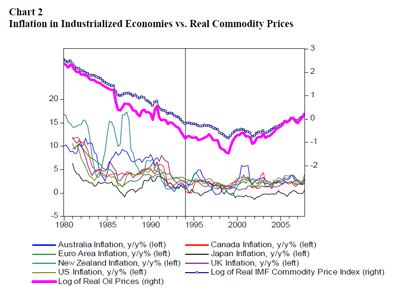
I have, on occasion, suggested that resource stocks make an appropriate hedge to the inflation risk embodied by a position in PerpetualDiscounts. With this in mind, it is heartening to see a Bank of Canada Discussion Paper titled Are Commodity Prices Useful Leading Indicators of Inflation?:

Commodity prices have increased dramatically and persistently over the past several years, followed by a sharp reversal in recent months. These large and persistent movements in commodity prices raise questions about their implications for global inflation. The process of globalization has motivated much debate over whether global factors have become more important in driving the inflation process. Since commodity prices respond to global demand and supply conditions, they are a potential channel through which foreign shocks could influence domestic inflation. The author assesses whether commodity prices can be used as effective leading indicators of inflation by evaluating their predictive content in seven major industrialized economies. She finds that, since the mid-1990s in those economies, commodity prices have provided significant signals for inflation. While short-term increases in commodity prices can signal inflationary pressures as early as the following quarter, the size of this link is relatively small and declines over time. The results suggest that monetary policy has generally accommodated the direct effects of short-term commodity price movements on total inflation. While indirect effects of short-term commodity price movements on core inflation have remained relatively muted, more persistent movements appear to influence inflation expectations and signal changes in both total and core inflation at horizons relevant for monetary policy. The results also suggest that commodity price movements may provide larger signals for inflation in the commodity-exporting countries examined than in the commodity-importing economies.

I will admit that the link drawn in this paper is reversed from my thesis: I am not so much concerned about what causes inflation, as I am with determining what will retain its value in the event of inflation. Still, the more links the better, say I, and I will leave for others to show a link between commodity prices and resource stock returns.

Banking Crisis 2008

ABCP: The Finale

DBRS has announced that it:

today assigned final ratings of “A” to the Master Asset Vehicle I Class A-1 Notes and Class A-2 Notes and the Master Asset Vehicle II Class A-1 Notes and Class A-2 Notes. DBRS has also assigned final ratings to certain of the Master Asset Vehicle III Notes as follows: Class 5A Notes – AAA, Class 7A Notes – AAA, Class 10A Notes – AA (high), Class 12A Notes – AA (high), Class 15A Notes – AAA and Class 16A Notes – A (low).

There was a teleconference at noon today; slides are available.

I have no information as yet regarding quotations on these instruments. I suspect that these notes will not be available to retail because, you know, you’re just not smart enough.

Update: A replay of the teleconference is available:

until the close of business on January 28, 2009.

The teleconference presentation slides are also available at www.dbrs.com or by clicking the link below.

TELECONFERENCE REPLAY ACCESS NUMBERS
Telephone: +1 416 695 5800 or +1 800 408 3053
Pass Code: 328-1452

Banking Crisis 2008

Banks: How Big is too Big?

Willem Buiter has an excellent blog post today advocating that the UK nationalize all “high-street” banks:

But even if the UK is not the next European country to face a sovereign debt challenge, there is a non-negligible risk that before too long, the growing exposure of the British sovereign to the banking system (and especially to the foreign currency funding risk faced by the UK banking system), together with the 9 and 10 percent of GDP general government fiscal deficits expected for the next couple of years, may prompt a loss of confidence by the global financial community in the British banks, currency and sovereign.

We may well witness the UK authorities going cap-in-hand to the IMF, the EU, the ECB and the fiscally super-solvent EU member states (if there are any left), prompted by a triple crisis (banking, sterling and sovereign debt), to request a bail out.

The balance sheets of the British banks are too large and the quality of the assets they hold too uncertain/dodgy, for the British government to be able to continue its current policy of extending its guarantees to ever-growing shares of the banks’ liabilities and assets, without this impairing the solvency of the sovereign.

Limiting the exposure of the sovereign to what is fiscally sustainable may imply giving up on saving (all of) the banks.

This builds upon his analysis of the Icelandic situation, which was discussed on November 5.

What caught my eye,however, was the massive numbers involved in British banking:

RBS, at the end of June 2008 had a balance sheet of just under two trillion pounds. The pro forma figure ws £1,730 bn, the statutory figure £1,948 (don’t ask). For reference, UK GDP is around £1,500 bn. Equity was £67 bn pro forma and £ 104bn statutory, respectively, giving leverage ratios of 25.8 (pro forma) and 18.7 (statutory), respectively.

Lloyds-TSB Group (now part of the Lloyds Banking Group) reported a balance sheet as of June 30, 2008 of £ 368 bn and shareholders equity of £11 bn, giving a leverage ratio of just over 33. Of course, for all these banks, the risk-adjusted assets to capital ratios are much lower, but because the risk-weightings depend both on private information of the banks (including internal models) and on the rating agencies, they are, in my view, worth nothing – they are the answer from the banks to the question “how much capital do you want to hold?”. That the answer is “not very much, really”, should not come as a surprise. For the same date, HBOS, the other half of the new Lloyds Banking Group, reported assets of £681 bn and equity of £21 bn, giving a leverage ratio of just over 32; Barclays reported total assets of £1,366 bn and shareholders equity of £33bn giving a leverage ratio of 41, and HSBC (including subsidiaries) reported assets of £2,547 bn and equity of £134 bn for a leverage ratio of 19.

The total balance sheets of these banks about to around 440% of annual UK GDP.

440%! While it must be remembered that a balance sheet is a measure of wealth, while GDP is a measure of income, this is a staggering figure anyway.

And let us not forget the mechanism whereby Royal Bank of Scotland got into trouble:

The scale of losses at RBS is breathtaking. The bank, which also owns NatWest, estimated that bad debts and writedowns on past acquisitions could leave it as much as £28 billion in the red for 2008, nearly double Vodafone’s record £15 billion loss in 2006.

The bank’s admission that it had paid between £15 billion and £20 billion too much for the Dutch bank ABN Amro last year prompted an angry response from Mr Brown.

The Prime Minister was furious that British taxpayers were now having to pay for losses that were incurred on foreign investments.

“Almost all their losses are in the sub-prime markets in America and related to the acquisition of the bank ABN Amro,” he said. “And these are irresponsible risks which were taken by a bank with people’s money in the United Kingdom.”

So, I took myself to the OSFI Bank Data Lookup Page and found that “Total All Banks CONSOLIDATED MONTHLY BALANCE SHEET” as of November 30 showed total assets of $3,213,563-million, supported by common equity of $122,117-million, preferred shares of $14,205-million, and sub-debt of $41,235-million (I’m pretty sure that OSFI’s line for sub-debt includes Innovative Tier 1 Capital). So, for quick comparison purposes, banks reporting to OSFI lever up their common equity with a ratio of 26:1 (total capital is levered up 18:1).

Also, Statistics Canada reports that Canada’s GDP at current prices is $1,639,540-million … so, rounding off a few million here and there, we arrive at a bank asset to GDP ratio of about 200% … well below the UK figure, even though the UK figure includes only their megabanks, while I have no reason to believe that the OSFI figure is not comprehensive.

It’s early days yet, but I’m beginning to wonder whether or not banking regulation should be rationed … Canada might say, for instance, “Only 300% of GDP will be allowed. Licences to purchase the right to have regulated – and implicitly protected – assets will be auctioned off annually for staggered 5- and 10-year terms.” Only a rough idea, but rough ideas are where good ideas come from … sometimes, eventually.

Such rationing runs the risk – if you want to call it that – of bloating the shadow-banking system, made up of things like non-banking leasing companies, payroll cheque cashing outfits, hedge funds and, currently, money market funds but that is not necessarily a bad thing.

Market Action

January 20, 2009

Econbrowser‘s James Hamilton is advocating executive compensation laws:

Lehman Brothers: $27 million for CEO Richard Fuld. The financial freeze that followed the collapse of Lehman is seen by many as the key event that turned the recession of 2007-08 into the frightening freefall currently under way

What caused that principle to go so badly awry in the present instance? I believe there was an unfortunate interaction between financial innovations and lack of regulatory oversight, which allowed the construction of new financial instruments with essentially any risk-reward profile desired and the ability to leverage one’s way into an arbitrarily large position in such an instrument. The underlying instrument of choice was a security with a high probability of doing slightly better than the market and a small probability of a big loss. For example, a subprime loan extended in 2005 would earn the lender a higher yield in the event that house prices continued to rise, but perform quite badly when the housing market turned down. By taking a leveraged position in such assets, the slightly higher yield became an enormously higher yield, and while the game was on, the short-term performance looked wonderful. If the agent is compensated on the basis of current performance alone, and the principal lacks good information on the exact nature of the risks, the result is a tragically toxic incentive structure.

My interest in this issue is not so much to exact revenge on those who created our current problems, but instead to ask, how can we change the incentives so that this kind of problem is not repeated again? And that in turn leads me to wonder, why limit the proposals above only to a handful of companies?

Despite Prof. Hamilton’s protestations, I consider this a classic example of American vindictiveness.

In the first place, it was not Fuld’s compensation that caused the credit freeze of 4Q08: it was the sudden withdrawal of $400-billion from money market funds that accomplished that little trick. No individual, no company and not even any industry is able – or willing – to withstand the cumulative effect of uninformed decisions by millions of retail customers.

To ascribe blame for the Credit Crunch on Wall Street policies is as superficial as blaming the Tech Boom and subsequent wreck on IPO specialists and Tech Funds. Retail was coming to them, insisting on get-rich-quick internet investments – and got them. End of story.

Our reaction to the Credit Crunch should be informed by our reaction to, say, a horrific and avoidable traffic accident. We can throw the book at the driver, if it makes us feel better. It won’t stop future accidents. We can improve the regulation of that particular intersection, with improved sightlines and signage; it might cut accidents at that corner, but won’t do a thing for the next block down the street. If we’re really serious about banning accidents, we have to ban cars; we will probably find that the cure is worse than the disease.

There are definitely some aspects of regulation that can be improved – removing the right of directors and shareholders to hire whoever they like at whatever it costs is not one of them – but to try and tame the business cycle with regulation is a fool’s game. As with the Great Moderation, as with the Soviet Union, that’s the sort of thing that works very, very well … until one day, quite suddenly, it doesn’t.

I will also note Dealbreaker‘s estimate of $1-trillion in fees paid in the course of the mortgage boom … so, in defense of the executives:

  • if they’d turned down that kind of money, investors would have hired a pig more aggressive in getting to the trough
  • what killed the investment banks was not so much their horrific losses, but risk-aversion by their lenders

Am I giving Wall Street a free pass? No. I pointed out in the post SEC & BSC that Wall Street covered its need to tick the “risk management” box by hiring people who didn’t know what they were doing and then ignoring what they said. But the way to get ahead in any large organization – whether it’s an investment bank, a regulator, government, or Honest Bob’s Financial Planning Boutique – is to figure out what your boss (and your clients) want to hear and telling it to them. No amount of well-intentioned regulation will ever change that.

On a related topic, US & International financials got cremated today:

Banks fell after the U.K.’s second bank-bailout plan in three months raised concern the financial crisis is deepening. The government of Prime Minister Gordon Brown said it will spend an extra 100 billion pounds ($142 billion) to support banks and increase its stake in Royal Bank of Scotland Group Plc (RBS:LN).

Royal Bank of Scotland American depositary receipts (RBS:US) plunged 69 percent to $3.33. ADRs of Lloyds Banking Group Plc (LYG:US), the U.K.’s biggest mortgage lender, tumbled 58 percent to $2.61.

JPMorgan Chase & Co. (JPM:US) retreated 21 percent to $18.09. Citigroup Inc. (C:US) lost 20 percent to $2.80. Wells Fargo & Co. (WFC:US), which Friedman Billings Ramsey Group Inc. said will probably cut its dividend during the first half of this year, sank 24 percent to $14.23.

Bank of America Corp. (BAC:US) dropped the most in the Dow Jones Industrial Average, slumping 29 percent to $5.10. The biggest U.S. lender by assets needs at least $80 billion to restore capital to minimum levels required by regulators, according to Friedman, Billings, Ramsey Group Inc. analyst Paul Miller.

MGIC Investment Corp. (MTG:US) slid 24 percent, the most since Dec. 1, to $2.13. The largest U.S. mortgage insurer posted a sixth straight loss and predicted an unprofitable 2009 as the deepening U.S. recession will cause more homeowner defaults. The company’s fourth-quarter operating loss of $2.06 a share was worse than the expected deficit of $1.14, according to the average estimate of six analysts surveyed by Bloomberg.

Regions Financial Corp. (RF:US) lost 24 percent to $4.60, the steepest decline since Sept. 29. The Alabama bank that expanded in Florida a year before the mortgage market collapsed posted a fourth-quarter loss of 35 cents a share, excluding a goodwill charge. Nineteen analysts surveyed by Bloomberg estimated Regions would post a 9-cent loss for the quarter.

Other regional banks also slipped. PNC Financial Services Group Inc. (PNC:US) sank 41 percent to $22. Sovereign Bancorp Inc. (SOV:US) fell 18 percent to $2.

State Street Corp. (STT:US) had the biggest drop in the Standard & Poor’s 500 Index, sliding 59 percent to $14.89. The world’s largest money manager for institutions said 2009 operating profit will be little changed from last year after fourth quarter earnings fell 71 percent.

Other asset-management firms also declined. Bank of New York Mellon Corp. (BK:US) fell 17 percent to $19. Northern Trust Corp. (NTRS:US) slid 14 percent to $43.93. Legg Mason Inc. (LM:US) fell 18 percent to $17.34. American Capital Ltd. (ACAS:US) dropped 20 percent to $3.66. Calamos Asset Management Inc. (CLMS:US) slid 16 percent to $5.29.

Not a bad day, altogether. SplitShares got whacked, not surprisingly given their dependence on financial common stock. But if the decline in PerpetualDiscounts was credit-related, then why were Fixed-Resets up? Volume continues to be quite good. BNS.PR.T closes tomorrow … and then there will be no more new issues announced but not closed!

HIMIPref™ Preferred Indices
These values reflect the December 2008 revision of the HIMIPref™ Indices

Values are provisional and are finalized monthly
Index Mean
Current
Yield
(at bid)
Median
YTW
Median
Average
Trading
Value
Median
Mod Dur
(YTW)
Issues Day’s Perf. Index Value
Ratchet 6.88 % 7.45 % 39,695 13.62 2 -0.3459 % 868.3
FixedFloater 7.32 % 6.93 % 159,135 13.76 8 -1.1259 % 1,399.1
Floater 6.02 % 5.60 % 33,854 14.51 4 -0.5615 % 1,014.3
OpRet 5.31 % 4.78 % 147,879 4.06 15 0.5441 % 2,020.7
SplitShare 6.21 % 9.97 % 86,174 4.14 15 -2.8635 % 1,791.2
Interest-Bearing 7.19 % 8.77 % 38,622 0.90 2 -1.0453 % 1,967.8
Perpetual-Premium 0.00 % 0.00 % 0 0.00 0 -0.3602 % 1,560.1
Perpetual-Discount 6.86 % 6.84 % 233,027 12.75 71 -0.3602 % 1,436.8
FixedReset 5.90 % 4.79 % 846,152 15.32 21 0.1879 % 1,833.0
Performance Highlights
Issue Index Change Notes
WFS.PR.A SplitShare -7.32 % Asset coverage of 1.2+:1 as of January 8 according to Mulvihill. Hardly surprising that something with a name like “World Financial Services” got hammered today!
YTW SCENARIO
Maturity Type : Hard Maturity
Maturity Date : 2011-06-30
Maturity Price : 10.00
Evaluated at bid price : 8.86
Bid-YTW : 10.91 %
FFN.PR.A SplitShare -5.69 % Asset coverage of 1.1+:1 as of January 15, according to the company.
YTW SCENARIO
Maturity Type : Hard Maturity
Maturity Date : 2014-12-01
Maturity Price : 10.00
Evaluated at bid price : 7.46
Bid-YTW : 11.48 %
FTN.PR.A SplitShare -5.21 % Asset coverage of 1.3+:1 as of January 15, according to the company.
YTW SCENARIO
Maturity Type : Hard Maturity
Maturity Date : 2015-12-01
Maturity Price : 10.00
Evaluated at bid price : 8.01
Bid-YTW : 9.38 %
LBS.PR.A SplitShare -5.17 % Asset coverage of 1.4-:1 as of January 15 according to the company.
YTW SCENARIO
Maturity Type : Hard Maturity
Maturity Date : 2013-11-29
Maturity Price : 10.00
Evaluated at bid price : 8.25
Bid-YTW : 9.97 %
DFN.PR.A SplitShare -4.13 % Asset coverage of 1.7-:1 as of January 15 according to the company.
YTW SCENARIO
Maturity Type : Hard Maturity
Maturity Date : 2014-12-01
Maturity Price : 10.00
Evaluated at bid price : 8.81
Bid-YTW : 7.95 %
PWF.PR.K Perpetual-Discount -3.92 % YTW SCENARIO
Maturity Type : Limit Maturity
Maturity Date : 2039-01-20
Maturity Price : 17.42
Evaluated at bid price : 17.42
Bid-YTW : 7.15 %
ALB.PR.A SplitShare -3.20 % Asset coverage of 1.2-:1 as of January 15, according to Scotia.
YTW SCENARIO
Maturity Type : Hard Maturity
Maturity Date : 2011-02-28
Maturity Price : 25.00
Evaluated at bid price : 19.65
Bid-YTW : 17.22 %
BCE.PR.Z FixedFloater -3.08 % YTW SCENARIO
Maturity Type : Limit Maturity
Maturity Date : 2039-01-20
Maturity Price : 25.00
Evaluated at bid price : 15.11
Bid-YTW : 7.51 %
FIG.PR.A Interest-Bearing -3.07 % Asset coverage of 1.1-:1 as of January 19, based on Capital Units NAV of 1.70 and 0.53 Capital Units per preferred.
YTW SCENARIO
Maturity Type : Hard Maturity
Maturity Date : 2014-12-31
Maturity Price : 10.00
Evaluated at bid price : 7.27
Bid-YTW : 13.21 %
BCE.PR.R FixedFloater -3.03 % YTW SCENARIO
Maturity Type : Limit Maturity
Maturity Date : 2039-01-20
Maturity Price : 25.00
Evaluated at bid price : 16.00
Bid-YTW : 7.03 %
BAM.PR.B Floater -2.96 % YTW SCENARIO
Maturity Type : Limit Maturity
Maturity Date : 2039-01-20
Maturity Price : 8.51
Evaluated at bid price : 8.51
Bid-YTW : 7.29 %
FBS.PR.B SplitShare -2.91 % Asset coverage of 1.1-:1 as of January 15, according to TD Securities.
YTW SCENARIO
Maturity Type : Hard Maturity
Maturity Date : 2011-12-15
Maturity Price : 10.00
Evaluated at bid price : 8.01
Bid-YTW : 13.56 %
BNA.PR.A SplitShare -2.74 % Asset coverage of 1.8+:1 as of December 31 according to the company.
YTW SCENARIO
Maturity Type : Hard Maturity
Maturity Date : 2010-09-30
Maturity Price : 25.00
Evaluated at bid price : 23.10
Bid-YTW : 11.94 %
BCE.PR.C FixedFloater -2.44 % YTW SCENARIO
Maturity Type : Limit Maturity
Maturity Date : 2039-01-20
Maturity Price : 25.00
Evaluated at bid price : 16.00
Bid-YTW : 7.18 %
POW.PR.D Perpetual-Discount -2.37 % YTW SCENARIO
Maturity Type : Limit Maturity
Maturity Date : 2039-01-20
Maturity Price : 18.12
Evaluated at bid price : 18.12
Bid-YTW : 6.97 %
IAG.PR.A Perpetual-Discount -1.93 % YTW SCENARIO
Maturity Type : Limit Maturity
Maturity Date : 2039-01-20
Maturity Price : 16.77
Evaluated at bid price : 16.77
Bid-YTW : 6.95 %
DF.PR.A SplitShare -1.80 % Asset coverage of 1.4-:1 as of January 15, according to the company.
YTW SCENARIO
Maturity Type : Hard Maturity
Maturity Date : 2014-12-01
Maturity Price : 10.00
Evaluated at bid price : 8.75
Bid-YTW : 8.09 %
SBN.PR.A SplitShare -1.73 % Asset coverage of 1.7+:1 as of January 8 according to Mulvihill.
YTW SCENARIO
Maturity Type : Hard Maturity
Maturity Date : 2014-12-01
Maturity Price : 10.00
Evaluated at bid price : 9.11
Bid-YTW : 7.18 %
RY.PR.C Perpetual-Discount -1.66 % YTW SCENARIO
Maturity Type : Limit Maturity
Maturity Date : 2039-01-20
Maturity Price : 17.80
Evaluated at bid price : 17.80
Bid-YTW : 6.59 %
TD.PR.C FixedReset -1.65 % YTW SCENARIO
Maturity Type : Limit Maturity
Maturity Date : 2039-01-20
Maturity Price : 24.35
Evaluated at bid price : 24.40
Bid-YTW : 4.79 %
GWO.PR.I Perpetual-Discount -1.62 % YTW SCENARIO
Maturity Type : Limit Maturity
Maturity Date : 2039-01-20
Maturity Price : 15.79
Evaluated at bid price : 15.79
Bid-YTW : 7.22 %
BNS.PR.M Perpetual-Discount -1.60 % YTW SCENARIO
Maturity Type : Limit Maturity
Maturity Date : 2039-01-20
Maturity Price : 17.20
Evaluated at bid price : 17.20
Bid-YTW : 6.58 %
BAM.PR.N Perpetual-Discount -1.58 % YTW SCENARIO
Maturity Type : Limit Maturity
Maturity Date : 2039-01-20
Maturity Price : 11.87
Evaluated at bid price : 11.87
Bid-YTW : 10.19 %
PPL.PR.A SplitShare -1.54 % Asset coverage of 1.4+:1 as of January 15 according to the company.
YTW SCENARIO
Maturity Type : Hard Maturity
Maturity Date : 2012-12-01
Maturity Price : 10.00
Evaluated at bid price : 8.93
Bid-YTW : 8.36 %
CM.PR.K FixedReset -1.48 % YTW SCENARIO
Maturity Type : Limit Maturity
Maturity Date : 2039-01-20
Maturity Price : 22.41
Evaluated at bid price : 23.30
Bid-YTW : 4.49 %
BAM.PR.K Floater -1.48 % YTW SCENARIO
Maturity Type : Limit Maturity
Maturity Date : 2039-01-20
Maturity Price : 8.01
Evaluated at bid price : 8.01
Bid-YTW : 7.75 %
NA.PR.L Perpetual-Discount -1.45 % YTW SCENARIO
Maturity Type : Limit Maturity
Maturity Date : 2039-01-20
Maturity Price : 17.02
Evaluated at bid price : 17.02
Bid-YTW : 7.15 %
RY.PR.G Perpetual-Discount -1.34 % YTW SCENARIO
Maturity Type : Limit Maturity
Maturity Date : 2039-01-20
Maturity Price : 17.68
Evaluated at bid price : 17.68
Bid-YTW : 6.49 %
CM.PR.E Perpetual-Discount -1.26 % YTW SCENARIO
Maturity Type : Limit Maturity
Maturity Date : 2039-01-20
Maturity Price : 19.53
Evaluated at bid price : 19.53
Bid-YTW : 7.22 %
GWO.PR.G Perpetual-Discount -1.23 % YTW SCENARIO
Maturity Type : Limit Maturity
Maturity Date : 2039-01-20
Maturity Price : 18.50
Evaluated at bid price : 18.50
Bid-YTW : 7.12 %
SLF.PR.D Perpetual-Discount -1.22 % YTW SCENARIO
Maturity Type : Limit Maturity
Maturity Date : 2039-01-20
Maturity Price : 15.43
Evaluated at bid price : 15.43
Bid-YTW : 7.31 %
SLF.PR.B Perpetual-Discount -1.14 % YTW SCENARIO
Maturity Type : Limit Maturity
Maturity Date : 2039-01-20
Maturity Price : 16.50
Evaluated at bid price : 16.50
Bid-YTW : 7.37 %
TD.PR.R Perpetual-Discount -1.08 % YTW SCENARIO
Maturity Type : Limit Maturity
Maturity Date : 2039-01-20
Maturity Price : 21.02
Evaluated at bid price : 21.02
Bid-YTW : 6.70 %
BCE.PR.I FixedFloater 1.06 % YTW SCENARIO
Maturity Type : Limit Maturity
Maturity Date : 2039-01-20
Maturity Price : 25.00
Evaluated at bid price : 16.21
Bid-YTW : 6.92 %
TD.PR.A FixedReset 1.09 % YTW SCENARIO
Maturity Type : Limit Maturity
Maturity Date : 2039-01-20
Maturity Price : 23.21
Evaluated at bid price : 23.25
Bid-YTW : 4.21 %
TD.PR.Y FixedReset 1.12 % YTW SCENARIO
Maturity Type : Limit Maturity
Maturity Date : 2039-01-20
Maturity Price : 22.57
Evaluated at bid price : 22.61
Bid-YTW : 4.10 %
BNA.PR.B SplitShare 1.14 % Asset coverage of 1.8+:1 as of December 31 according to the company.
YTW SCENARIO
Maturity Type : Hard Maturity
Maturity Date : 2016-03-25
Maturity Price : 25.00
Evaluated at bid price : 21.25
Bid-YTW : 7.89 %
PWF.PR.A Floater 1.15 % YTW SCENARIO
Maturity Type : Limit Maturity
Maturity Date : 2039-01-20
Maturity Price : 13.16
Evaluated at bid price : 13.16
Bid-YTW : 4.72 %
ENB.PR.A Perpetual-Discount 1.53 % YTW SCENARIO
Maturity Type : Limit Maturity
Maturity Date : 2039-01-20
Maturity Price : 23.64
Evaluated at bid price : 23.91
Bid-YTW : 5.84 %
TD.PR.N OpRet 1.86 % YTW SCENARIO
Maturity Type : Soft Maturity
Maturity Date : 2014-01-30
Maturity Price : 25.00
Evaluated at bid price : 25.78
Bid-YTW : 3.90 %
PWF.PR.M FixedReset 1.88 % YTW SCENARIO
Maturity Type : Limit Maturity
Maturity Date : 2039-01-20
Maturity Price : 25.45
Evaluated at bid price : 25.50
Bid-YTW : 5.11 %
PWF.PR.F Perpetual-Discount 2.07 % YTW SCENARIO
Maturity Type : Limit Maturity
Maturity Date : 2039-01-20
Maturity Price : 19.20
Evaluated at bid price : 19.20
Bid-YTW : 6.88 %
PWF.PR.G Perpetual-Discount 2.12 % YTW SCENARIO
Maturity Type : Limit Maturity
Maturity Date : 2039-01-20
Maturity Price : 21.72
Evaluated at bid price : 21.72
Bid-YTW : 6.83 %
BNS.PR.R FixedReset 2.32 % YTW SCENARIO
Maturity Type : Limit Maturity
Maturity Date : 2039-01-20
Maturity Price : 22.47
Evaluated at bid price : 22.51
Bid-YTW : 4.29 %
BAM.PR.O OpRet 4.11 % YTW SCENARIO
Maturity Type : Option Certainty
Maturity Date : 2013-06-30
Maturity Price : 25.00
Evaluated at bid price : 19.00
Bid-YTW : 12.34 %
Volume Highlights
Issue Index Shares
Traded
Notes
WFS.PR.A SplitShare 198,962 Asset coverage of 1.2+:1 as of January 8 according to Mulvihill. RBC crossed 171,800 at 9.30.
YTW SCENARIO
Maturity Type : Hard Maturity
Maturity Date : 2011-06-30
Maturity Price : 10.00
Evaluated at bid price : 8.86
Bid-YTW : 10.91 %
MFC.PR.C Perpetual-Discount 109,090 Commission Direct (Who?) crossed 105,000 at 17.05.
YTW SCENARIO
Maturity Type : Limit Maturity
Maturity Date : 2039-01-20
Maturity Price : 16.91
Evaluated at bid price : 16.91
Bid-YTW : 6.76 %
TD.PR.E FixedReset 104,959 Recent new issue.
YTW SCENARIO
Maturity Type : Limit Maturity
Maturity Date : 2039-01-20
Maturity Price : 25.25
Evaluated at bid price : 25.30
Bid-YTW : 6.01 %
RY.PR.P FixedReset 89,874 Recent new issue.
YTW SCENARIO
Maturity Type : Limit Maturity
Maturity Date : 2039-01-20
Maturity Price : 25.32
Evaluated at bid price : 25.37
Bid-YTW : 5.87 %
NA.PR.O FixedReset 54,298 Recent new issue.
YTW SCENARIO
Maturity Type : Limit Maturity
Maturity Date : 2039-01-20
Maturity Price : 25.00
Evaluated at bid price : 25.05
Bid-YTW : 6.37 %
RY.PR.W Perpetual-Discount 52,348 National crossed 40,000 at 19.22.
YTW SCENARIO
Maturity Type : Limit Maturity
Maturity Date : 2039-01-20
Maturity Price : 19.00
Evaluated at bid price : 19.00
Bid-YTW : 6.58 %
There were 37 other index-included issues trading in excess of 10,000 shares.
Canada Prime

Bank Rate cut 50bp to 1.00%; Fully Transmitted to Prime

The Bank of Canada has announced:

that it is lowering its target for the overnight rate by one-half of a percentage point to 1 per cent. The operating band for the overnight rate is correspondingly lowered, and the Bank Rate is now 1 1/4 per cent.

Canadian exports are down sharply, and domestic demand is shrinking as a result of declines in real income, household wealth, and consumer and business confidence. Canada’s economy is projected to contract through mid-2009, with real GDP dropping by 1.2 per cent this year on an annual average basis. As policy actions begin to take hold in Canada and globally, and with support from the past depreciation of the Canadian dollar, real GDP is expected to rebound, growing by 3.8 per cent in 2010.

A wider output gap through 2009 and modest decreases in housing prices should cause core CPI inflation to ease, bottoming at 1.1 per cent in the fourth quarter. Total CPI inflation is expected to dip below zero for two quarters in 2009, reflecting year-on-year drops in energy prices. With inflation expectations well-anchored, total and core inflation should return to the 2 per cent target in the first half of 2011 as the economy returns to potential.

Against this background, the Bank today lowered its policy rate by 50 basis points, bringing the cumulative monetary policy easing to 350 basis points since December 2007. Guided by Canada’s inflation-targeting framework, the Bank will continue to monitor carefully economic and financial developments in judging to what extent further monetary stimulus will be required to achieve the 2 per cent target over the medium term. Low, stable, and predictable inflation is the best contribution monetary policy can make to long-term economic growth and financial stability.

The cut in the bank rate has been transmitted in full to prime:

One can only speculate as to the extent, if any, of jawboning and armtwisting behind the scenes … but frankly, I was expecting to have to wait until 5pm to get the banks’ reactions!

Market Action

January 19, 2009

Not much news, in light of the holiday in the US and preparations for tomorrow’s Obama-rama.

Willem Buiter writes a piece with a rather startling message: Time to Take the Banks Into Full Public Ownership.

He points out the Bagehot prescription of readily available expensive liquidity can have an unfortunate side-effect:

But if the state’s financial assistance is priced punitively or has other painful conditionality attached to it, existing shareholders and management will do everything to avoid making use of these government facilities. If a bank has no option but to take the government’s money, it will try to repay it as soon as possible – to get the government out of its hair. Such a bank will therefore be reluctant to take any risk, including the risk of lending to the non-financial private sector. Such a bank will hoard liquidity (sometimes in the form of deposits/reserves with the central bank) to regain its independence from the government. Still independent banks will hoard liquidity to stay out of the clutches of the government.

I believe that this mechanism is at work in a powerful way both in the UK, the US and in continental Europe. Hans Werner Sinn in a recent Financial Times OpED piece pointed out that the German rescue package for banks was fatally flawed for precisely this reason: the acceptance by banks of an injection of public sector capital brings with it a cap on managerial salaries. Rather than accepting a cap on their salaries, managers would prefer to totter along with an under-capitalised bank and restrict the scope and scale of their lending operations.

However, I am unconvinced that the alternatives he suggests are really any better:

By throwing cheap money with little conditionality at the banks, the Fed and the US Treasury may get bank lending going again. By subsidizing new capital injections, they reward bad porfolio choices by the existing shareholders. By letting the executive leadership and the board stay on, they further increase moral hazard, by rewarding failed managers and boards that have failed in their fiduciary duties. All this strengthens the incentives for future excessive risk taking.

There is a better alternative. The alternative is to inject additional capital into the banks by taking all the banks into full public ownership. With the state as sole owner, the existing top executives and the existing board members can be fired without any golden handshakes. That takes care of one important form of moral hazard. Although publicly owned, the banks would be mandated to operate on ordinary commercial principles.

The implicit presumption is that government will be able to do it better. I’m not so convinced; political control over the lending process will – inevitably – mean a relaxation of lending standards to handicapped black lesbians and other disadvantaged groups, on the basis of their disadvantage and political advantage, not ability to pay. We are seeing movement towards of this conditionality in the States already, a by-product of TARP’s cheap money:

House Financial Services Committee chairman Barney Frank, D-Mass., on Friday released proposed legislation to reform the TARP and increase program accountability. Under Frank’s proposed makeover of the TARP, the second half of the $700 billion funds will be “conditioned on the use of a minimum of $50 billion for foreclosure mitigation.” His language would require Paulson to develop a comprehensive plan to prevent and mitigate residential mortgage foreclosures by March 15, 2009. The required elements of the plan include a guarantee program for qualifying loan modifications under a systematic plan and bringing down the costs of Hope for Homeowner loans “either through coverage of fees, purchasing H4H mortgages to ensure affordable rates, or both.” The plan would also need to establish a program for loans to pay down second lien mortgages that are impeding a loan modification, grant servicer incentives and assistance to stimulate modifications, and include the purchase of whole loans for the purpose of modifying or refinancing them.

I suggest that a better alternative to full nationalization that addresses Mr. Buiter’s concerns is to give the funding government a fair bit of call protection on its capital injection, while allowing the subject banks to operate on a business-like basis. The current terms do not allow this:

Our current understanding is that that the preference shares to be acquired by the government will rank pari passu with existing Tier 1 instruments in payment and in liquidation. The new preference shares will carry a 12% coupon and will be callable after five years. Banks selling preference shares to the government may not pay dividends on common equity while any of those preference shares remain outstanding. This clearly gives the banks an incentive to repay the government preference shares as soon as possible.

The five year call-protection makes sense; the restriction on common dividends does not. And, what’s more, these should be public issues, with a prospectus, stock-exchange listing and government guarantee of successful issuance.

Floaters did poorly today, perhaps in a last minute panic about tomorrow’s BoC rate announcement amidst speculation that there will be a 50bp cut to 1.00%. I will be interested not so much as to what happens to the Bank Rate as what happens to prime – I can’t see a cut of more than 25bp in prime whatever happens, but … I’ve been wrong before!

HIMIPref™ Preferred Indices
These values reflect the December 2008 revision of the HIMIPref™ Indices

Values are provisional and are finalized monthly
Index Mean
Current
Yield
(at bid)
Median
YTW
Median
Average
Trading
Value
Median
Mod Dur
(YTW)
Issues Day’s Perf. Index Value
Ratchet 6.88 % 7.47 % 41,355 13.60 2 0.2427 % 871.3
FixedFloater 7.24 % 6.94 % 160,001 13.82 8 0.9253 % 1,415.0
Floater 5.98 % 5.60 % 34,374 14.51 4 -2.8924 % 1,020.0
OpRet 5.34 % 4.78 % 150,156 4.06 15 -0.0981 % 2,009.8
SplitShare 6.03 % 8.09 % 87,065 4.18 15 0.8890 % 1,844.0
Interest-Bearing 7.11 % 9.32 % 38,655 0.91 2 -0.1160 % 1,988.5
Perpetual-Premium 0.00 % 0.00 % 0 0.00 0 0.2928 % 1,565.7
Perpetual-Discount 6.83 % 6.83 % 230,698 12.78 71 0.2928 % 1,442.0
FixedReset 5.91 % 4.77 % 876,406 15.29 21 -0.3108 % 1,829.6
Performance Highlights
Issue Index Change Notes
BAM.PR.K Floater -5.47 % YTW SCENARIO
Maturity Type : Limit Maturity
Maturity Date : 2039-01-19
Maturity Price : 8.13
Evaluated at bid price : 8.13
Bid-YTW : 7.64 %
PWF.PR.A Floater -5.38 % YTW SCENARIO
Maturity Type : Limit Maturity
Maturity Date : 2039-01-19
Maturity Price : 13.01
Evaluated at bid price : 13.01
Bid-YTW : 4.78 %
NA.PR.N FixedReset -4.05 % YTW SCENARIO
Maturity Type : Limit Maturity
Maturity Date : 2039-01-19
Maturity Price : 21.11
Evaluated at bid price : 21.11
Bid-YTW : 4.80 %
BNS.PR.S FixedReset -2.88 % YTW SCENARIO
Maturity Type : Limit Maturity
Maturity Date : 2039-01-19
Maturity Price : 25.20
Evaluated at bid price : 25.25
Bid-YTW : 5.67 %
BAM.PR.J OpRet -2.24 % YTW SCENARIO
Maturity Type : Soft Maturity
Maturity Date : 2018-03-30
Maturity Price : 25.00
Evaluated at bid price : 16.62
Bid-YTW : 11.54 %
PPL.PR.A SplitShare -1.95 % Asset coverage of 1.4+:1 as of January 15, according to the company.
YTW SCENARIO
Maturity Type : Hard Maturity
Maturity Date : 2012-12-01
Maturity Price : 10.00
Evaluated at bid price : 9.07
Bid-YTW : 7.89 %
BAM.PR.I OpRet -1.66 % YTW SCENARIO
Maturity Type : Soft Maturity
Maturity Date : 2013-12-30
Maturity Price : 25.00
Evaluated at bid price : 20.75
Bid-YTW : 10.10 %
NA.PR.K Perpetual-Discount -1.65 % YTW SCENARIO
Maturity Type : Limit Maturity
Maturity Date : 2039-01-19
Maturity Price : 20.31
Evaluated at bid price : 20.31
Bid-YTW : 7.23 %
BAM.PR.N Perpetual-Discount -1.55 % YTW SCENARIO
Maturity Type : Limit Maturity
Maturity Date : 2039-01-19
Maturity Price : 12.06
Evaluated at bid price : 12.06
Bid-YTW : 10.03 %
BNS.PR.R FixedReset -1.35 % YTW SCENARIO
Maturity Type : Limit Maturity
Maturity Date : 2039-01-19
Maturity Price : 21.96
Evaluated at bid price : 22.00
Bid-YTW : 4.39 %
BMO.PR.L Perpetual-Discount -1.29 % YTW SCENARIO
Maturity Type : Limit Maturity
Maturity Date : 2039-01-19
Maturity Price : 21.47
Evaluated at bid price : 21.47
Bid-YTW : 6.89 %
HSB.PR.D Perpetual-Discount -1.14 % YTW SCENARIO
Maturity Type : Limit Maturity
Maturity Date : 2039-01-19
Maturity Price : 17.35
Evaluated at bid price : 17.35
Bid-YTW : 7.30 %
POW.PR.C Perpetual-Discount -1.12 % YTW SCENARIO
Maturity Type : Limit Maturity
Maturity Date : 2039-01-19
Maturity Price : 21.11
Evaluated at bid price : 21.11
Bid-YTW : 6.94 %
TD.PR.A FixedReset -1.08 % YTW SCENARIO
Maturity Type : Limit Maturity
Maturity Date : 2039-01-19
Maturity Price : 22.96
Evaluated at bid price : 23.00
Bid-YTW : 4.26 %
HSB.PR.C Perpetual-Discount -1.07 % YTW SCENARIO
Maturity Type : Limit Maturity
Maturity Date : 2039-01-19
Maturity Price : 17.51
Evaluated at bid price : 17.51
Bid-YTW : 7.38 %
CM.PR.H Perpetual-Discount 1.02 % YTW SCENARIO
Maturity Type : Limit Maturity
Maturity Date : 2039-01-19
Maturity Price : 16.82
Evaluated at bid price : 16.82
Bid-YTW : 7.18 %
RY.PR.C Perpetual-Discount 1.12 % YTW SCENARIO
Maturity Type : Limit Maturity
Maturity Date : 2039-01-19
Maturity Price : 18.10
Evaluated at bid price : 18.10
Bid-YTW : 6.48 %
SLF.PR.B Perpetual-Discount 1.15 % YTW SCENARIO
Maturity Type : Limit Maturity
Maturity Date : 2039-01-19
Maturity Price : 16.69
Evaluated at bid price : 16.69
Bid-YTW : 7.29 %
BNS.PR.L Perpetual-Discount 1.21 % YTW SCENARIO
Maturity Type : Limit Maturity
Maturity Date : 2039-01-19
Maturity Price : 17.57
Evaluated at bid price : 17.57
Bid-YTW : 6.44 %
BNA.PR.B SplitShare 1.25 % Asset coverage of 1.8+:1 as of December 31 according to the company.
YTW SCENARIO
Maturity Type : Hard Maturity
Maturity Date : 2016-03-25
Maturity Price : 25.00
Evaluated at bid price : 21.01
Bid-YTW : 8.09 %
W.PR.H Perpetual-Discount 1.27 % YTW SCENARIO
Maturity Type : Limit Maturity
Maturity Date : 2039-01-19
Maturity Price : 18.32
Evaluated at bid price : 18.32
Bid-YTW : 7.59 %
RY.PR.E Perpetual-Discount 1.29 % YTW SCENARIO
Maturity Type : Limit Maturity
Maturity Date : 2039-01-19
Maturity Price : 18.01
Evaluated at bid price : 18.01
Bid-YTW : 6.37 %
ALB.PR.A SplitShare 1.50 % Asset coverage of 1.2-:1 as of January 15 according to the company.
YTW SCENARIO
Maturity Type : Hard Maturity
Maturity Date : 2011-02-28
Maturity Price : 25.00
Evaluated at bid price : 20.30
Bid-YTW : 15.44 %
DF.PR.A SplitShare 1.60 % Asset coverage of 1.4-:1 as of January 15, according to the company.
YTW SCENARIO
Maturity Type : Hard Maturity
Maturity Date : 2014-12-01
Maturity Price : 10.00
Evaluated at bid price : 8.91
Bid-YTW : 7.71 %
BNS.PR.J Perpetual-Discount 1.66 % YTW SCENARIO
Maturity Type : Limit Maturity
Maturity Date : 2039-01-19
Maturity Price : 20.25
Evaluated at bid price : 20.25
Bid-YTW : 6.52 %
POW.PR.D Perpetual-Discount 1.70 % YTW SCENARIO
Maturity Type : Limit Maturity
Maturity Date : 2039-01-19
Maturity Price : 18.56
Evaluated at bid price : 18.56
Bid-YTW : 6.80 %
GWO.PR.G Perpetual-Discount 1.79 % YTW SCENARIO
Maturity Type : Limit Maturity
Maturity Date : 2039-01-19
Maturity Price : 18.73
Evaluated at bid price : 18.73
Bid-YTW : 7.03 %
FBS.PR.B SplitShare 1.85 % Asset coverage of 1.1-:1 as of January 15 according to TD Securities.
YTW SCENARIO
Maturity Type : Hard Maturity
Maturity Date : 2011-12-15
Maturity Price : 10.00
Evaluated at bid price : 8.25
Bid-YTW : 12.38 %
PWF.PR.K Perpetual-Discount 1.85 % YTW SCENARIO
Maturity Type : Limit Maturity
Maturity Date : 2039-01-19
Maturity Price : 18.13
Evaluated at bid price : 18.13
Bid-YTW : 6.87 %
PWF.PR.G Perpetual-Discount 1.97 % YTW SCENARIO
Maturity Type : Limit Maturity
Maturity Date : 2039-01-19
Maturity Price : 21.27
Evaluated at bid price : 21.27
Bid-YTW : 6.98 %
DFN.PR.A SplitShare 2.00 % Asset coverage of 1.7-:1 as of January 15 according to the company.
YTW SCENARIO
Maturity Type : Hard Maturity
Maturity Date : 2014-12-01
Maturity Price : 10.00
Evaluated at bid price : 9.19
Bid-YTW : 7.07 %
BCE.PR.C FixedFloater 2.18 % YTW SCENARIO
Maturity Type : Limit Maturity
Maturity Date : 2039-01-19
Maturity Price : 25.00
Evaluated at bid price : 16.40
Bid-YTW : 7.01 %
LBS.PR.A SplitShare 2.35 % Asset coverage of 1.4-:1 as of January 15 according to Brompton Group.
YTW SCENARIO
Maturity Type : Hard Maturity
Maturity Date : 2013-11-29
Maturity Price : 10.00
Evaluated at bid price : 8.70
Bid-YTW : 8.66 %
WFS.PR.A SplitShare 2.36 % Asset coverage of 1.2+:1 as of January 8, according to the company.
YTW SCENARIO
Maturity Type : Hard Maturity
Maturity Date : 2011-06-30
Maturity Price : 10.00
Evaluated at bid price : 9.56
Bid-YTW : 7.43 %
BNA.PR.A SplitShare 2.37 % Asset coverage of 1.8+:1 as of December 31 according to the company.
YTW SCENARIO
Maturity Type : Hard Maturity
Maturity Date : 2010-09-30
Maturity Price : 25.00
Evaluated at bid price : 23.75
Bid-YTW : 10.10 %
CM.PR.K FixedReset 2.60 % YTW SCENARIO
Maturity Type : Limit Maturity
Maturity Date : 2039-01-19
Maturity Price : 22.59
Evaluated at bid price : 23.65
Bid-YTW : 4.41 %
BNS.PR.O Perpetual-Discount 2.69 % YTW SCENARIO
Maturity Type : Limit Maturity
Maturity Date : 2039-01-19
Maturity Price : 21.41
Evaluated at bid price : 21.41
Bid-YTW : 6.58 %
BCE.PR.R FixedFloater 3.13 % YTW SCENARIO
Maturity Type : Limit Maturity
Maturity Date : 2039-01-19
Maturity Price : 25.00
Evaluated at bid price : 16.50
Bid-YTW : 6.81 %
GWO.PR.F Perpetual-Discount 3.19 % YTW SCENARIO
Maturity Type : Limit Maturity
Maturity Date : 2039-01-19
Maturity Price : 21.70
Evaluated at bid price : 22.00
Bid-YTW : 6.77 %
PWF.PR.H Perpetual-Discount 3.59 % YTW SCENARIO
Maturity Type : Limit Maturity
Maturity Date : 2039-01-19
Maturity Price : 21.05
Evaluated at bid price : 21.05
Bid-YTW : 6.87 %
Volume Highlights
Issue Index Shares
Traded
Notes
RY.PR.P FixedReset 85,739 Recent new issue.
YTW SCENARIO
Maturity Type : Limit Maturity
Maturity Date : 2039-01-19
Maturity Price : 25.35
Evaluated at bid price : 25.40
Bid-YTW : 5.86 %
TD.PR.E FixedReset 64,895 Recent new issue.
YTW SCENARIO
Maturity Type : Limit Maturity
Maturity Date : 2039-01-19
Maturity Price : 25.24
Evaluated at bid price : 25.29
Bid-YTW : 6.02 %
BMO.PR.J Perpetual-Discount 43,509 YTW SCENARIO
Maturity Type : Limit Maturity
Maturity Date : 2039-01-19
Maturity Price : 16.96
Evaluated at bid price : 16.96
Bid-YTW : 6.77 %
NA.PR.O FixedReset 43,362 Recent new issue.
YTW SCENARIO
Maturity Type : Limit Maturity
Maturity Date : 2039-01-19
Maturity Price : 24.96
Evaluated at bid price : 25.01
Bid-YTW : 6.38 %
SLF.PR.C Perpetual-Discount 43,325 Nesbitt crossed 33,000 at 15.70.
YTW SCENARIO
Maturity Type : Limit Maturity
Maturity Date : 2039-01-19
Maturity Price : 15.63
Evaluated at bid price : 15.63
Bid-YTW : 7.21 %
CM.PR.I Perpetual-Discount 42,440 Nesbitt crossed 27,300 at 16.55.
YTW SCENARIO
Maturity Type : Limit Maturity
Maturity Date : 2039-01-19
Maturity Price : 16.54
Evaluated at bid price : 16.54
Bid-YTW : 7.15 %
There were 39 other index-included issues trading in excess of 10,000 shares.