Category: Interesting External Papers

Interesting External Papers

KC Fed: Monetary Policy Amidst Deflationary Pressures

The Kansas City Fed has published an article by Roberto Billi (one of their economists) with the title Was Monetary Policy Optimal During Past Deflation Scares?.

This essay is considered TOP SECRET and the PDF has therefore been copy-protected (jerks!), so there won’t be a lot of extracts posted here.

Mr. Billi uses the Taylor Rule as a measure of monetary policy effectiveness and explains the model and its parameterization in good detail. He uses an inflation response parameter equal to one, providing an appendix to justify this choice … but according to me, this appendix needs a great deal more fleshing out!

He then examines Japanese monetary policy during their deflationary episode of the 1990’s and concludes that monetary policy was too tight. Then he examines US monetary policy and – with the benefit of hindsight – finds that Fed policy in 2000 was too tight; during 2001-03 the fed funds rate was on average 100bp low; during 2004-05, it was 175bp too low. He explains that the discrepency is “mainly due to a substantial wedge between Greenbook forecasts and revised inflation, and to a lesser extent to the effects of the data revisions on the estimate of the output gap”.

Interesting External Papers

Kansas City Fed Release Fall 2009 TEN Magazine

TEN magazine is a house organ of the Kansas City Fed (which runs the tenth Federal Reserve District … get it?).

The newly released edition contains articles regarding:

  • Community banks say competition for customers in rural America is increasing, especially from the federally chartered Farm Credit System. Banks say there is an unfair advantage; the Farm Credit System says choices benefit consumers. Read more in the fall issue of TEN.

Also in the new issue:

  • A look at the home foreclosure crisis now as it spreads to higher-income
    neighborhoods;

  • A breakdown of how regions in the United States are affected by the most recent
    recession and what causes the variances;

  • A few words from Kansas City Fed President Tom Hoenig on expanding the Fed’s role in the payments system;
  • Tips and free activities and resources by TEN columnist Michele Wulff for talking to kids about smart spending; and more.
Interesting External Papers

BIS Releases Report on Special Purpose Entities

The Bank for International Settlements has released its Report on Special Purpose Entitites. Section I is the Executive Summary & Overview:

Section II provides a summary of market developments that contributed to the growth of the securitisation markets that relied heavily on the use of SPEs. Also described is the confluence of factors that played a part in the market crisis that began in mid-2007.

Section III focuses on the motivations of sponsoring firms and investors for employing SPEs. For originators and sponsors, these may include risk management, funding, accounting, or regulatory capital considerations.

Section IV describes the potential for informational asymmetries and problematic incentives to hamper the use of SPEs, examines potential issues and deficiencies in risk management, and explores ways in which risk transfer can potentially be over- or underestimated by both originators and investors.

Section V presents a series of policy issues and recommendations for consideration.

Appendix 1 is a primer on common types of SPE structures and programs, such as RMBS, CMBS, CDOs, ABCP conduits, structured investment vehicles (SIVs), repackaging vehicles, and transformer structures.

Appendix 2 continues with a more technical discussion of common features of SPEs. Legal forms, methods of achieving asset transfer, and accounting and regulatory capital considerations are discussed. Additionally, the roles of key parties to SPEs (eg the sponsor, originator, and servicer) are described, as well as issues related to the control and management of these entities.

Appendix 3 explores how the risk and return of assets in SPEs can be allocated among various parties and counterparties. Different forms of exposure can result from holding certain tranches and residual interests or from providing liquidity and credit guarantees. This section also includes a discussion of triggers, where the cash flows are redirected should a particular event occur.

Appendix 4 provides global data on the use of SPEs by financial institutions according to vehicle type and geography.

Appendix 5 provides the list of members of the Joint Forum Working Group on Risk Assessment and Capital.

Interesting External Papers

IMF Releases October 2009 Global Financial Stability Report

The International Monetary Fund has released the (prelimary version of) the Global Financial Stability Report, October 2009, with three chapters:

  • The Road to Recovery
  • Restarting Securitization Markets: Policy Proposals and Pitfalls
  • Market Interventions during the Financial Crisis: How Effective and How to Disengage?

I was happy to see the following in the Executive Summary:

But hard work lies ahead in devising capital penalties, insurance premiums, supervisory and resolution regimes, and competition policies to ensure that no institution is believed to be “too big to fail.” Early guidance at defining criteria for identifying systemically important institutions and markets—such as that being formulated by the International Monetary Fund, Financial Stability Board, and Bank for International Settlements for the G-20—should assist in this quest. Once identified, some form of surcharge or disincentive for marginal contributions to systemic risk will need to be formulated and applied.

A surcharge is infinitely preferable to flat prohibitions and Treasury’s special regime. The report repeatedly warns about “cliff effects” in the securitization market; such cliff effects are a sign of incompetent analysis; prohibitions and special regimes bring about cliff effects by their nature.

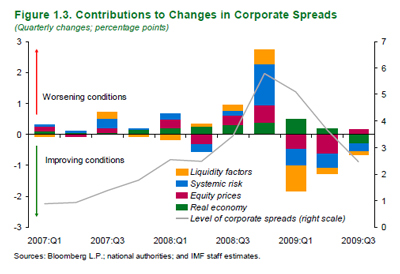
They produce an amazing chart decomposing credit spreads that I have trouble taking seriously:

There are no references cited for this decomposition. While I have great respect for IMF research and am sure they didn’t just pluck the numbers out of the air, it’s quite hard enough to decompose spreads into credit risk & liquidity (see, for example, The Value of Liquidity), without adding other factors.

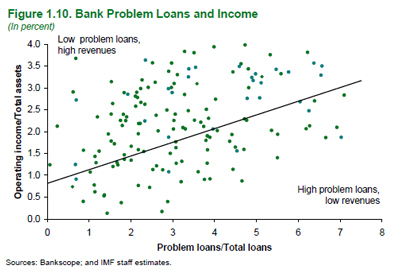
As if on purpose to reinforce my skepticism regarding connections between premises and conclusions, they publish an amazing regression analysis in the section titled “Will bank earnings be robust enough to absorb writedowns and rebuild capital cushions?”:

… with the comment:

To protect bottom line earnings, banks appear to have priced risky lending more expensively—as shown by the upward sloping trend line for European banks in Figure 1.10.

I think they’re trying too hard. Presented by the G-20 with a golden opportunity to expand their bureaucracy – after ten years of looking irrelevance in the face – I suspect that management has sent the word out to come up with the BEST conclusions and the BEST analysis and the BEST policy recommendations right away (for “best”, read “best looking”). Anybody who’s ever read a sell-side economic commentary will be very familiar with this paradigm.

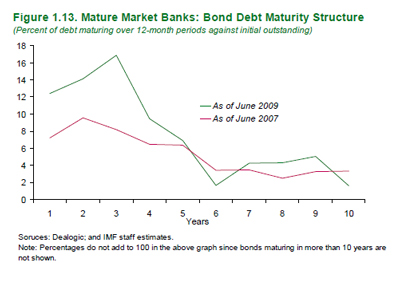
The term-shortening of bank financing was of interest:

We won’t be out of the woods until the term structure of bank liabilities returns to normal.

The second chapter provides a very good overview of securitization.

Interesting External Papers

FRB Boston Paper on Use of Funds from Housing ATM

The Boston Fed has released a Public Policy Discussion Paper by Daniel Cooper titled Did Easy Credit Lead to Economic Peril? Home Equity Borrowing and Household Behavior in the Early 2000s, which dispels at least part of the notion that Americans went insane earlier this decade and spent their home equity loans on beer and prostitutes:

Using data from the Panel Study of Income Dynamics, this paper examines how households’ home equity extraction during 2001‐to‐2003 and 2003‐to‐2005 affected their spending and saving behavior. The results show that a one‐dollar increase in equity extraction led to ninetyfive or ninety‐eight cents higher consumption expenditures. Nearly all of this spending increase was reversed in the subsequent period. A fair amount of these expenditures went toward home improvements and repairs. In addition, households used home equity to help finance their purchases of used cars. Equity extraction also led to some household balance sheet reshuffling. In particular, households who extracted equity were somewhat more likely than other households to pay down their higher‐cost credit card debt and to invest in other real estate and businesses. Overall, the results in this paper are consistent with households’ extracting equity during the first half of this decade to fund one‐time durable good consumption needs.

The author concludes, in part:

Overall, the results suggest that households’ reasons for borrowing against their homes have changed little over time. Households who have lower levels of financial wealth are more likely to extract equity as are households who experience strong local or regional house-price growth. In addition, the consumption analysis suggests that households borrowed against their homes in the early 2000s, to finance one-time consumption shocks. A one-dollar increase in equity extraction led to a roughly ninety-five cent increase in consumption between 2001 and 2003, which did not persist over time. In particular, consumption fell by roughly the same amount in the period ( 2003-to-2005) following the period when households extracted equity.

Additional analysis suggests that households extract equity for one-time, durable goods purchases. Roughly a quarter of each dollar of equity extraction goes toward home repairs and improvements, consistent with anecdotal evidence. Households also extract equity, for used car purchases. There is limited evidence, however, that households’ (non-durable) food purchases increase when they borrow against their homes. The findings also show that households have a roughly 10 percentage point higher predicted probability of paying down their non-collateralized debt when they extract equity than when they do not. Homeowners are also slightly more likely to invest in other real estate or personal businesses when they borrow against their houses. As a result, equity extraction has household balance sheet effects in addition to the effect of households’ borrowing to fund their one-time consumption needs.

The analysis in this paper does not cover the final years of the recent house-price boom, since the PSID data are available only through 2005.

So, while in hindsight it is obvious that American households became over-leveraged during the early part of the housing boom, it is something of a relief to learn that the money was spent on durable goods rather than immediate consumption.

Update, 2009-10-1: The Bank of Canada has released a related study by Ian Christensen, Paul Corrigan, Caterina Mendicino and Shin-Ichi Nishiyama titled Consumption, Housing Collateral, and the Canadian Business Cycle:

Using Bayesian methods, we estimate a small open economy model in which consumers face limits to credit determined by the value of their housing stock. The purpose of this paper is to quantify the role of collateralized household debt in the Canadian business cycle. Our findings show that the presence of borrowing constraints improves the performance of the model in terms of overall goodness of fit. In particular, the presence of housing collateral generates a positive correlation between consumption and house prices. Finally we find that housing collateral induced spillovers account for a large share of consumption growth during the housing market boom-bust cycle of the late 1980s.

Contingent Capital

HM Treasury Responds to Turner Report

The Turner Report on Financial Regulation was reported on PrefBlog in March. The government has now taken some time off from its regularly scheduled banker-bashing to address the issues raised.

The response was released on July 8 with the admission:

There were many causes of the financial crisis:

  • first and foremost, failures of market discipline, in particular of corporate governance, risk management, and remuneration policies. Some banks, boards and investors did not fully understand the complexities of their own businesses;
  • second, regulators and central banks did not sufficiently take account of the excessive risks being taken on by some firms, and did not adequately understand the extent of system-wide risk; and
  • third, the failure of global regulatory standards to respond to the major changes in the financial markets, which have increased complexity and system-wide risk, or to the tendency for system-wide risks to build up during economic upswings.

… which is a lot more balanced than what they spout for the benefit of the man in the street.

The British firm Barrow, Lyde & Gilbert has prepared a precis of the government response; there are, however, two proposals in the full-length report worthy of highlighting for preferred share investors:

Box 6.C: New international ideas for improving access to funding markets

Two ideas to improve banks access to capital during downturns or crises are being aired in academic and policy circles. Both have merits although how they could be applied in practice is yet to be determined.

Capital insurance:Banks essentially face an insurance problem: when faced with a shortage of capital, rather than having to raise new capital at a high market cost it would be more efficient if banks were delivered capital at a pre-agreed (lower) price though a pre-funded insurance policy. Paying the insurance premium in an expansion would be one method of providing some cost to the expansion of credit in an upturn. However, in a systemic crisis the insurance policy would need to pay out to several banks together. In order to ensure that these obligations could always be met, the insurance would probably need to be run by the state sector.

Debt-equity conversion: When banks are forced to raise new equity capital the initial benefits are shared with the existing debt holders as they have a senior claim over equity in the event of liquidation. One solution would be to make some of the debt (perhaps the subordinated debt tranche only) convertible into equity in the event of a systemic crisis and on the authority of the financial regulator. This would immediately inject capital into the bank and reduce the need to raise any new equity capital. The holders of the debt would also have more incentive to impose market discipline on the banks.

The reference supplied for the second option is “Building an incentive-compatible safety net”, C. Calomiris, in Journal of Banking and Finance, 1999; this article is available for purchase from Science Direct and is freely available in HTML form from the American Enterprise Institute for Public Policy Research. Assuming that the AEI transcript is reliable, though, I see very little support for the idea in the Calomiris paper (Calomiris’ ideas are frequently discussed on PrefBlog, but I certainly don’t remember seeing this one).

Regardless of origin, I consider this a fine idea at bottom, although I am opposed to the idea that the triggering mechanism be a ruling by regulatory authorities. I suggest that greater certainty for investors, regulators and issuers could be achieved with little controversy if conversion were to be triggered instead by the trading price of the bank’s common.

In such a world, regulators approving a preferred share for inclusion in Tier 1 Capital would require a forced conversion at some percentage of the current common price if the volume-weighted trading price for a calendar month (quarter?) was below that conversion price. Thus, assuming the chosen percentage was 50%, if RY were to issue preferreds at $25 par value at a time when its common was trading at $50, there would be forced conversion of prefs into common on a 1:1 basis if the common traded below $25 for the required period.

This could bring about interesting arbitrage plays with options – so much the better!

One effect would be that as the common traded lower – presumably in response to Bad Things happening at the company – the preferred share would start behaving more and more like an equity itself – which is precisely what we want.

We shall see, but I hope this idea gains some traction in the halls of power.

Update: Dr. Calomiris has very kindly responded to my query:

Yes, the citation of my work is relevant to the proposal, although it takes a little explaining to see the connection. I have been advocating the use of some form of uninsured debt requirement as part of capital requirements for a long time. The conversion of hybrid idea is a new version of that, which has the advantages of my proposal and also some additional advantages that Mark Flannery and others have pointed to. I like the idea of requiring a minimal amount of “contingent capital” which would take the form of sub debt that converts into equity in adverse circumstances.

You may quote me.

Interesting External Papers

IIAC Releases Securities Industry Performance Report 2Q09

The Investment Industry Association of Canada has released its Securities Industry Performance Report, 2Q09: fixed income trading was highlighted:

Particularly strong was debt underwriting which witnessed a 54% surge in revenue from the previous quarter as narrowing spreads made debt financings more alluring for issuers. Fixed-income principal trading revenue was also robust and totaled $640 million in the second quarter, a record high, and represented a 15% increase from the prior quarter. For the first half of 2009, industry fixed income revenues (debt underwriting plus debt principal trading) total $1.5 billion and already equal the total for the whole of 2008.

Gee, I sure hope nobody gets a bonus because of this surge in gross profit! Paying for performance can lead to … er … something bad.

There’s not enough data in the report even to make a good guess at the reason for the surge in trading revenue, but it seems probable that the desks have made profits for the same reason that my fund’s returns have been so good over the past year: lots of panic, lots of volatility, lots of players who really don’t have a clue.

Interesting External Papers

FRB Cleveland Releases September EconoTrends

The Federal Reserve Bank of Cleveland has released the September 2009 Edition of EconoTrends, with short articles on:

  • July Price Statistics
  • The Yield Curve, August 2009
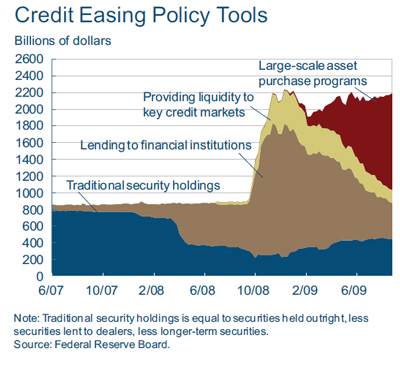
  • The Changing Composition of the Fed’s Balance Sheet
  • Borrow Less, Owe More: The U.S. Net International Investment Position
  • Real GDP: Second-Quarter 2009 Revised Estimate
  • Recent Forecasts of Government Debt
  • The Incidence and Duration of Unemployment over the Business Cycle
  • The Employment Situation, August 2009
  • Fourth District Employment Conditions
  • Bank Lending, Capital, Booms, and Busts

The last is under the general heading “Baking and Financial Institutions”, so I guess we’re cooked!

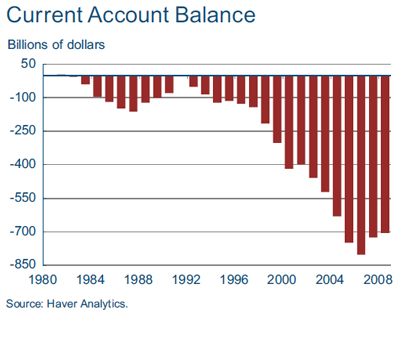
The next chart shows a source of our current problems that many consider more important that pesky bankers’ bonuses:

Interesting External Papers

Why Were Australian Banks So Resilient?

I will admit that I’m very unfamiliar with the Australian bank market, but the Reserve Bank of Australia has released its September 2009 Financial Stability Review:

A number of interrelated factors have contributed to the relatively strong performance of the Australian banking system in the face of the challenges of the past couple of years. One is that Australian banks typically entered the financial turmoil with only limited direct exposures to the types of securities – such as CDOs and US sub-prime RMBS – that led to losses for many banks abroad. Moreover, they have typically not relied on the income streams most affected by recent market conditions: trading income only accounted for around 5 per cent of the major banks’ total income prior to the turmoil. Banks’ wealth management operations have been affected by market developments, but the major banks still reported net income of around $2.3 billion from these activities in the latest half year.
One reason why Australian banks garnered a relatively low share of their income from trading and securities holdings is that they did not have as much incentive as many banks around the world to seek out higher-yielding, but higher-risk, offshore assets. In turn, this was partly because they were earning solid profits from lending to domestic borrowers, and already required offshore funding for these activities. As a result, Australian banks’ balance sheets are heavily weighted towards domestic loans, particularly to the historically low-risk household sector.

As discussed in detail in the previous Review, there are several factors that have contributed to the relatively strong outcome in Australia, including:

  • • Lending standards were not eased to the same extent as elsewhere. For example, riskier types of mortgages, such as non-conforming and negative amortisation loans, that became common in the United States, were not features of Australian banks’ lending.
  • • The level of interest rates in Australia did not reach the very low levels that had made it temporarily possible for many borrowers with limited repayment ability to obtain loans, as in some other countries.
  • • All Australian mortgages are ‘full recourse’ following a court repossession action, and households generally understand that they cannot just hand in the keys to the lender to extinguish the debt.
  • • The legal environment in Australia places a stronger obligation on lenders to make responsible lending decisions than is the case in the United States.
  • • The Australian Prudential Regulation Authority (APRA) has been relatively proactive in its approach to prudential supervision, conducting several stress tests of ADIs’ housing loan portfolios and strengthening the capital requirements for higher-risk housing loans.

The Australian housing stress-tests of 2003 have been discussed on PrefBlog.

Capitalization is also good:

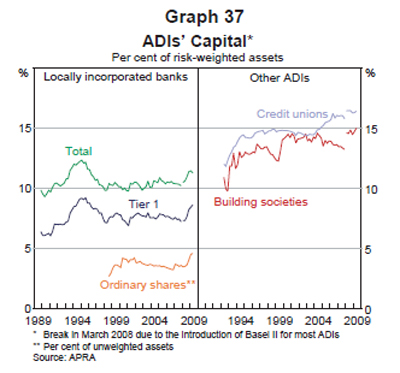
The Australian banking system remains soundly capitalised.The sector’s Tier 1 capital ratio rose by 1.3 percentage points over the 12 months to June 2009 to 8.6 per cent, its highest level in over a decade (Graph 37). In contrast, the Tier 2 capital ratio has fallen by around 0.7 percentage points over the same period, mainly because term subordinated debt declined. As a result of these developments, the banking system’s total capital ratio has risen by almost 0.7 percentage points over the past year, to stand at 11.3 per cent as at June 2009. A similar pattern has been evident in a simpler measure of leverage – the ratio of ordinary shares to (unweighted) assets – which has risen by around half a percentage point over the past six months. The credit union and building society sectors are also well capitalised, with aggregate total capital ratios of 16.4 per cent and 15 per cent.

In response to falling profits, many banks have cut their dividends (Graph 39). Despite these lower dividends, the major banks’ dividend payout ratio increased to around 80 per cent over the past year.

Most banks are endeavouring to increase their share of funding from deposits, in response to markets’ increased focus on funding liquidity risk. For some of the smaller banks, it is also because of a lack of alternative funding options, given the difficulties in the securitisation market. These factors have led to strong competition for deposits, especially for term deposits, and deposit spreads have widened. For instance, the average rate paid by the major banks on their term deposit ‘specials’ is currentlyaround 175 basis points above the 90-day bank bill rate, compared to about 75 basis points as at end December 2008.

I’m not sure just what a “special” might be … can any Australians elucidate the matter? I assume that a “bank bill” is essentially a bearer deposit note, but confirmation would be appreciated.

After the review of the current environment, there is a discussion of The International Regulatory Agenda and Australia:

As noted in The Australian Financial System chapter, following the capital raisings by the Australian banks this year, the Tier 1 capital ratio for the banking system is at its highest level in over a decade. In addition, APRA’s existing prudential standard requires that the highest form of capital (such as ordinary shares and retained earnings) must account for at least 75 per cent of Tier 1 capital (net of deductions); other components, such as non-cumulative preference shares, are limited to a maximum of 25 per cent. In some other countries this split has been closer to 50:50.

The old Canadian standard was 75%; after relaxing to 70% in January 2008, OSFI debased capital quality requirements in November 2008 to 60%.

Interesting External Papers

Boston Fed: Securitization and Moral Hazard

The Boston Fed – a rich source of high quality research – has released a paper by Ryan Bubb and Alex Kaufman titled Securitization and Moral Hazard: Evidence from a Lender Cutoff Rule:

Credit score cutoff rules result in very similar potential borrowers being treated differently by mortgage lenders. Recent research has used variation induced by these rules to investigate the connection between securitization and lender moral hazard in the recent financial crisis. However, the conclusions of such research depend crucially on understanding the origin of these cutoff rules. We offer an equilibrium model in which cutoff rules are a rational response of lenders to perapplicant fixed costs in screening. We then demonstrate that our theory fits the data better than the main alternative theory already in the literature, which supposes cutoff rules are exogenously used by securitizers. Furthermore, we use our theory to interpret the cutoff rule evidence and conclude that mortgage securitizers were in fact aware of and attempted to mitigate the moral hazard problem posed by securitization.

I am astounded that cut-off rules exist, but they do and they are step functions:

One promising research strategy for addressing this question is to use variation in the behavior of market participants induced by credit score cutoff rules. Credit scores are used by lenders as a summary measure of default risk, with higher credit scores indicating lower default risk. Examination of histograms of mortgage loan borrower credit scores, such as Figure 1, reveal that they are step-wise functions.

Using step functions to evaluate differences in complex systems is suspicious at the very least. Any time you hear a portfolio manager talk about a “screen” for instance, you should ensure that the screen is very coarse, throwing out only the most ridiculous of potential investments. For proper, verifiable, assessments of single entitites in a complex universe – whether it is a universe of government bonds, preferred shares, common equity, or mortgage applicants – you need a coherent system of continuous smooth functions.

The only rationale I can think of for using step functions at all is suggested by the authors: lenders must make a decision regarding whether or not to incur costs to collect additional data to feed into (a presumably rational) evaluation system and incurring such a cost – whether it’s a single charge, or a member of a sequence of possible charges – is a binary decision, implying a stepwise preliminary evaluation. But anyway, back to the paper:

It appears that borrowers with credit scores above certain thresholds are treated differently than borrowers just below, even though potential borrowers on either side of the threshold are very similar. These histograms suggest using a regression discontinuity design to learn about the effects of the change in behavior of market participants at these thresholds. But how and why does lender behavior change at these thresholds? In this paper we attempt to distinguish between two explanations for credit score cutoff rules, each with divergent implications for what they tell us about the relationship between securitization and lender moral hazard.

We refer to the explanation currently most accepted in the literature as the securitizer-first theory. First put forth by Keys, Mukherjee, Seru, and Vig (2008) (hereafter, KMSV), it posits that secondary-market mortgage purchasers employ rules of thumb whereby they are exogenously more willing to purchase loans made to borrowers with credit scores just above some cutoff. This difference in the ease of securitization induces mortgage lenders to adopt weaker screening standards for loan applicants above this cutoff, since lenders know they will be less likely to keep these loans on their books. In industry parlance, they will have less “skin in the game.” Because lenders screen applicants more intensely below the cutoff than above, loans below the cutoff are fewer but of higher quality (that is, lower default rate) than loans above the cutoff. We call this the “securitizer-first” theory because securitizers are thought to exogenously adopt a purchase cutoff rule, which causes lenders to adopt a screening cutoff rule in response. Under the securitizer-first theory, finding discontinuities in the default rate and securitization rate at the same credit score cutoff is evidence that securitization led to moral hazard in lender screening.

We offer an alternative rational theory for credit score cutoff rules and refer to our theory as the lender-first theory. When lenders face a fixed per-applicant cost to acquire additional information about each prospective borrower, cutoff rules in screening arise endogenously. Under the natural assumption that the benefit to lenders of collecting additional information is greater for higher default risk applicants, lenders will only collect additional information about applicants whose credit scores are below some cutoff (and hence the benefit of investigating outweighs the fixed cost). This additional information allows lenders to screen out more high-risk loan applicants. The lender-first theory thus predicts that the number of loans made and their default rate will be discontinuously lower for borrowers with credit scores just below the endogenous cutoff.

Such a cutoff rule in screening also results in a discontinuity in the amount of private information lenders have about loans.

We investigate these two theories of credit score cutoff rules using loan-level data and find that the lender-first theory of cutoff rules is substantially more consistent with the evidence than is the securitizer-first theory. We focus our investigation on the cutoff rule at the FICO score of 620. We do this for two reasons: of all the apparent credit score cutoff thresholds, the discontinuity in frequency at 620 is the largest in log point terms; also, 620 is the focus of inquiry in previous research. After reviewing institutional evidence that lenders adopted a cutoff rule in screening at 620 for reasons unrelated to the probability of securitization, we use a loan-level dataset to show that in several key mortgage subsamples there are discontinuities in the lending rate and the default rate at 620, but no discontinuity in the securitization rate. Without a securitization rate discontinuity at the cutoff, the securitizer-first theory is difficult to reconcile with the data.

Having established that the lender-first theory is the more likely explanation for the cutoff rules, we then interpret the evidence in light of the theory. We find that in the jumbo market of large loans, in which only private securitizers participate, the securitization rate is lower just below the screening threshold of 620. This suggests that private securitizers were aware of the moral hazard problem posed by loan purchases and sought to mitigate it.

However, in the conforming (non-jumbo) market dominated by Fannie Mae and Freddie Mac (the government sponsored enterprises, or GSEs), there is a substantial jump in the default rate but no jump in the securitization rate at the 620 threshold. One explanation for this is that the GSEs were unaware of the threat of moral hazard. An arguably more plausible explanation is that, as large repeat players in the industry, the GSEs had alternative incentive instruments to police lender moral hazard.

The authors conclude:

Interpreting the cutoff rule evidence in light of the lender-first theory, our evidence suggests that private mortgage securitizers adjusted their loan purchases around the lender screening threshold in order to maintain lender incentives to screen. Though our findings suggest that securitizers were more rational with regards to moral hazard than previous research has judged, the extent to which securitization contributed to the subprime mortgage crisis is still an open and pressing research question.