Category: Interesting External Papers

Interesting External Papers

The Term Structure of Inflation Expectations

Mikhail Chernov & Philippe Mueller: The Term Structure of Inflation Expectations:

The ten-year inflation premium declines from six to zero per cent during the post-monetary-experiment period. This decline suggests that long-run inflation expectations became more stable over time. Further, we reestimate our model every quarter and find that the long-run expectations have declined over time from 6% to 2%. The inflation persistence declined and the term structure of inflation expectations became flat over time. This evidence suggests that monetary policy became better anchored.

One implication of anchored inflation expectations is that it should be easier to forecast inflation and yields. Consistent with this prediction, we find that the model that incorporates both yields nd surveys dominates in out-of-sample forecasting of both inflation and yields. These results lead us to conclude that information in surveys is extremely important for establishing the links between inflation expectations and yields.

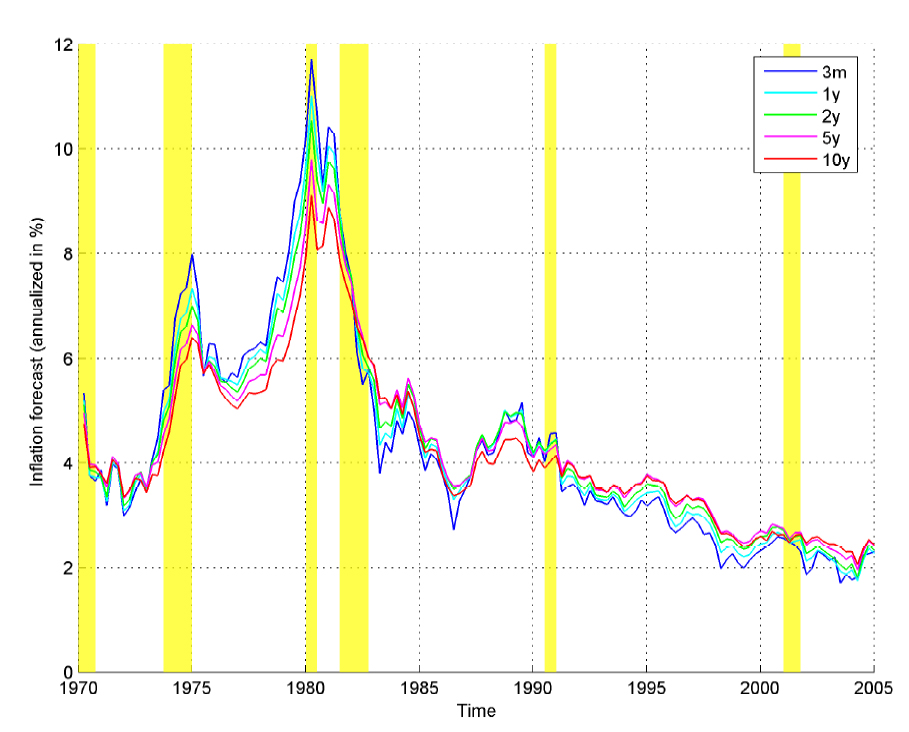
Figure 4 shows the time-series of the inflation expectations at multiple horizons. These expectations are computed from AO. In contrast to the survey forecasts in Figure 1, these objective, or marginal, expectations can be computed each period at any horizon.

The term structure effects are pronounced. The inflation curve becomes inverted in 1973, right before the recession, and continues to be inverted until early 1982. This period coincides with the unstable period of monetary policy during the Burns and Miller chairmanship of the US Federal Bank and the monetary policy experiment under Volcker’s chairmanship. The curve became inverted again briefly in the early part of Greenspan’s tenure from 1987 to 1991. afterwards, it had a normal, nearly flat, shape.


Click for big

The out-of-sample analysis of the model suggests that monetary policy became more effective over time. The long-run expectations are anchored at about 2%. The term structure of inflation expectations has flattened out over time. This suggests that the arrival of new data does not affect long-run expectations much, perhaps because the monetary policy is expected to address all short term fluctuations successfully.

Interesting External Papers

Canadian Inflation Risk Premium

Christopher Reid, Frédéric Dion and Ian Christensen, Real Return Bonds: Monetary Policy Credibility and Short-Term Inflation Forecasting, Bank of Canada Review, Autumn 2004:

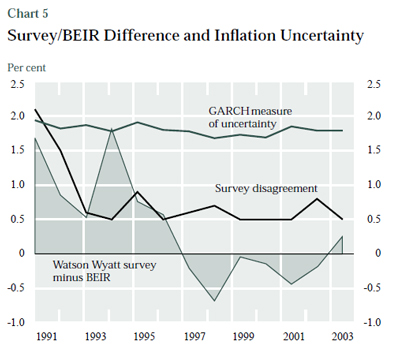
Chart 5 shows two proxies of long-run inflation uncertainty. The first is a measure of the disagreement among forecasters who responded to the Watson Wyatt survey, calculated as the difference between the upper and lower quartiles of reported inflation expectations at the 4- to 14-year horizon. The second measure is inflation uncertainty over a 5-year forecast horizon derived from a GARCH model developed by Crawford and Kasumovich (1996).

Côté et al. (1996) suggest that the increase in the BEIR [Break-Even Inflation Rate, Nominals less RRBs] in 1994, which was not accompanied by a similar move in survey measures, may reflect an increase in the inflation-risk premium. If changes in the premium for inflation uncertainty are an important factor in explaining movements in the BEIR, then sharp movements in these proxies should be associated with similar movements in the BEIR. Yet both measures fail to indicate a rise in inflation uncertainty in 1994 or a significant decline in 1997. Crawford and Kasumovich’s measure of inflation uncertainty fell dramatically during the 1980s but has been relatively stable since 1992. Similarly, survey disagreement fell between 1991 and 1994 but was relatively stable afterwards. The simplest explanation is that deviations of the BEIR from survey measures of inflation expectations are the result of some phenomenon other than changes in uncertainty regarding inflation.

Interesting External Papers

TIPS & the Inflation Risk Premium

Grishchenko, Olesya V. and Huang, Jing-Zhi, Inflation Risk Premium: Evidence from the TIPS Market (December 11, 2008).

“Inflation-indexed securities would appear to be the most direct source of information about in°ation expectations and real interest rates” (Bernanke, 2004). In this paper we study the term structure of real interest rates, expected in°ation and inflation risk premia using data on prices of Treasury Inflation Protected Securities (TIPS) over the period 2000-2007. The estimates of the 10-year inflation risk premium are between 11 and 22 basis points for 2000-2007 depending on the proxy used for the expected inflation. Furthermore, we find that the inflation risk premium is time varying and, specifically, negative in the first half (which might be due to either concerns of deflation or low liquidity of the TIPS market), but positive in the second half of the sample.

This paper represents perhaps the first attempt to estimate the inflation risk premium directly using the prices of Treasury Inflation Protected Securities (TIPS). Using the market data on prices of TIPS over the period 2000-2007, we find that the 10-year average inflation risk premium ranges from 11 to 22 basis points. We also find that it is time-varying. More specifically, it is negative in 2000-2003 but positive in 2004-2007. The negative inflation risk premium during 2000-2003 is due to either concerns of deflation or liquidity problems in the TIPS market. There seems to be more evidence that supports the former explanation. The estimated average 10-year in°ation risk premium over the second half varies between 29 and 48 basis points, depending on the proxy used for the expected inflation. The estimates based on Blue Chips inflation forecast are the lowest (29 basis points), and the estimates based on one-year SPF are the highest (48 basis points). We also find that the inflation risk premium is considerably less volatile during 2004-2007, a finding consistent with the observations that in°ation expectations became more stable during this period, investors became more familiar with the TIPS market, and the market liquidity has gradually improved.

Our empirical results on in°ation risk premium estimated directly from TIPS should be valuable for practitioners, monetary authorities and policymakers alike because they help to assess the inflation expectations and the inflation risk premium of bond market investors.

Interesting External Papers

The Inflation Risk Premium

The Inflation Risk Premium in the Term Structure of Interest Rates, Peter Hördahl, BIS Quarterly Review, September 2008:

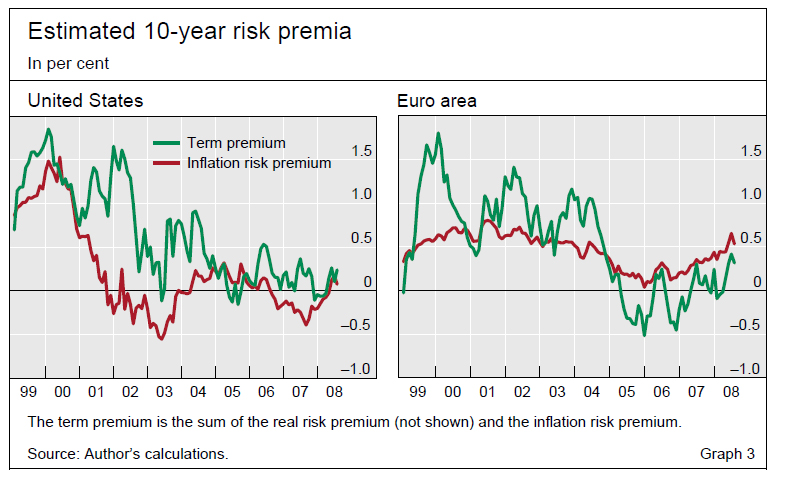
A dynamic term structure model based on an explicit structural macroeconomic framework is used to estimate inflation risk premia in the United States and the euro area. On average over the past decade, inflation risk premia have been relatively small but positive. They have exhibited an increasing pattern with respect to maturity for the euro area and a flatter one for the United States. Furthermore, the estimates imply that risk premia vary over time, mainly in response to fluctuations in economic growth and inflation.

This article estimates inflation risk premia using a dynamic term structure model based on an explicit structural macroeconomic model. The identification and quantification of such premia are important because they introduce a wedge between break-even inflation rates and investors’ expectations of future inflation. In addition, inflation risk premia per se may provide useful information to policymakers with respect to market participants’ aversion to inflation risks as well as to their perceptions about such risks.

The results show that inflation risk premia in the United States and in the euro area are on average positive, but relatively small. Moreover, the estimated premia vary over time, mainly in response to changes in economic activity, as measured by the output gap, and inflation. The estimates suggest that fluctuations in output drive much of the cyclical variation in inflation premia, while high-frequency premia fluctuations are mostly due to changes in the level of inflation.


Click for big
Interesting External Papers

FDIC Targets Brokered Deposits, Growth

I missed this when it came out.

The FDIC has released a rule increasing the complexity of deposit insurance premium calculations:

The final rule adds a new financial measure to the financial ratios method. This new financial measure, the adjusted brokered deposit ratio, will measure the extent to which brokered deposits are funding rapid asset growth. The adjusted brokered deposit ratio will affect only those established Risk Category I institutions whose total gross
assets are more than 40 percent greater than they were four years previously, after adjusting for mergers and acquisitions, rather than 20 percent greater as proposed in the NPR, and
whose brokered deposits (less reciprocal deposits) make up more than 10 percent of domestic deposits. Generally speaking, the greater an institution’s asset growth and the greater its percentage of brokered deposits, the greater will be the increase in its initial base assessment rate. Small changes in asset growth rate or brokered deposits as a percentage of domestic deposits will lead to small changes in assessment rates.

The Canadian approach is not nearly so nuanced since our bankers are ever so smart. In fact, they’re all equally smart, with the vast majority of assets in the system paying into the CDIC fund at the same rate, which is considered desirable. Not so in the States:

A commenting bank argued that:

Arbitrarily establishing targets for percentages of institutions that fall into a given assessment rate is inconsistent with not only the governing statute but the whole concept of risk-based pricing….

The FDIC disagrees with the commenting bank. The purpose of the new large bank method is to create an assessment system for large Risk Category I institutions that will respond more timely to changing risk profiles, will improve the accuracy of initial assessment rates, relative risk rankings, and will create a greater parity between small and large Risk Category I institutions.

Imagine that! Rewards for being better than the competition, even if only by a little bit! It’s a good thing we don’t have that sort of nonsense in Canada – it can lead to bonuses.

Since the FDIC is not Canadian, they address criticism, allowing investors and observers to take an informed view of the desirability of changes:

The FDIC received many comments arguing that brokered deposits should not increase assessment rates for Risk Category I institutions and that the brokered deposit provisions in the NPR do not account for the use to which institutions put these deposits. The FDIC is not persuaded by the arguments. Recent data show that institutions with a combination of brokered deposit reliance and robust asset growth tend to have a greater concentration in higher risk assets. In addition, there is a statistically significant correlation between the adjusted brokered deposit ratio, on the one hand, and the probability that an institution will be downgraded to a CAMELS rating of 3, 4, or 5 within a year, on the other, independent of the other measures of asset quality contained in the financial ratios method.

Interesting External Papers

Bank of Canada Releases Spring 2009 Review

The Bank of Canada has released the Spring 2009 Review with the following feature articles:

The concept of Price Level Targetting is explained in the first article:

Despite its recent successes in terms of macrostabilization, several authors have highlighted some shortcomings in the infl ation-targeting (IT) framework. Most notably, uncertainty on the price level grows with the planning horizon, since central banks with infl ation targets accommodate shocks to the price level, taking the post-shock level as given and aiming to stabilize infl ation from this level. In fact, the price level is unbounded at very distant horizons. Price-level targeting (PT) mitigates this uncertainty by committing central banks to restore the price level to a preannounced target following shocks. PT is frequently described as a departure from IT’s prescription for letting “bygones be bygones.”

Frankly, I didn’t find this issue particularly satisfying; there are necessarily many assumptions embedded in the papers. There is the prospect of lowering the term risk premium (flattening the yield curve) with Price Level Targetting, but on the other hand it’s asking rather a lot from the Central Bank, which will have to overcompensate for transient shocks rather than concentrating on getting things back to normal.

Interesting External Papers

TRACE and Corporate Bond Market Transparency

This seems to be a hot topic, so I’ll post a reference to Transparency and the Corporate Bond Market by Hendrik Bessembinder and William Maxwell of the universities of Utah and Arizona, respectively n.b.: link updated 2011-4-30. Old link no longer works:

The introduction of TRACE to the bond
market provides a rare opportunity to assess the effects of a substantial increase in transparency.

While over-the-counter corporate bond trades tend to be large, they also tend to be infrequent. Edwards, Harris, and Piwowar (2007) report that individual bond issues did not trade on 48 percent of days in their 2003 sample, and that the average number of daily trades in an issue, conditional on trading, is just 2.4 Corporate bonds trade infrequently even compared to other bonds. Although Table 1 shows that they comprise about 20 percent of outstanding U.S. bonds, corporate bonds account for only about 2.5 to 3.0 percent of trading activity in U.S. bonds in recent years, as shown in Table 3.

That execution costs for bonds decline with trade size may reflect in part that asymmetric information regarding issuing firm fundamentals is relatively unimportant for bond valuation. It could also reflect the absence of an inexpensive centralized system for processing small bond transactions. Or the higher execution costs for small bond trades could reflect the extraction of rents by better-informed bond dealers from relatively uninformed retail bond traders.

Well-functioning security markets provide investors with liquidity. However, the term “liquidity” is a broad and somewhat elusive concept, used to describe multiple properties of trading in security markets. For example, Kyle (1985) notes that liquidity can include “tightness,” which is the cost of completing a buy and sell transaction in a short period of time, “depth,” which the size of the buy or sell order required to move market prices by a given amount, and “resiliency,” which is the speed with which prices recover from a random shock in buy or sell orders. Alternately, practitioners sometimes use the word liquidity to describe the ease of transacting.

Empirical evidence on the introduction of transaction reporting in corporate bonds has been the subject of countless articles in the trade press and at least three articles published in refereed academic journals: Bessembinder, Maxwell and Venkataraman (2006), Edwards, Harris, and Piwowar (2007), and Goldstein, Hotchkiss, and Sirri (2007). Although the three studies use notably different samples and research designs, all three conclude that the increased transparency associated with TRACE transaction reporting is associated with a substantial decline in investors’ trading costs.

Bessembinder, Maxwell and Venkataraman (2006) also examine how transparency affects the competitive environment of the dealer market. They hypothesize that in an opaque market the largest dealers enjoy an informational advantage, but that this informational advantage is mitigated in a transparent market. Consistent with this reasoning, they report that in their sample the concentration ratio of trades completed by the largest 12 dealers falls from 56 percent pre-TRACE to 44 percent post-TRACE.

Market participants with whom we spoke, including both dealers and the traders at investment firms who are their customers, were nearly unanimous in the view that trading is more difficult after the introduction of TRACE. Whereas it may have previously been possible to complete a sizeable bond purchase with a single phone call to a dealer who held sufficient quantities of the bond in inventory, the post-TRACE environment may involve communications with multiple dealers, and delays as the dealers search for counterparties. A bond trader with a major insurance company told us that there is less liquidity, in that market makers carried less “product,” and it has become more difficult to locate bonds for purchase in the post-TRACE environment. A bond trader for a major investment company responded to the publication of Bessembinder, Maxwell, and Venkataraman (2006) by sending the authors an unsolicited e-mail stating: “I want to be able to execute a trade even if a bond dealer does not have a simultaneous counterparty lined up…. [T]oo much price transparency reduces dealers’ willingness to commit capital…. [T]he focus on the bid-ask spread is too narrow, and a case of being penny-wise and pound-foolish.”

One way to circumvent TRACE, which applies to publicly-issued bonds, is for a firm to issue privately placed bonds (sometimes referred to as Rule 144a securities, for the section of the Securities Act of 1933 that provides exemption from registration requirements). … In 2001, before TRACE, “144a for life” bonds were 7.3 percent of dollar volume and 9.6 percent of issues. The percentage of dollar volume in “144a for life” bonds jumped to 27.8 percent in 2003, the first full year after TRACE initiation, and grew to 39.8 percent in 2004, before declining to 16.9 percent in 2006.

Also consistent with a shift towards alternative asset classes, the credit default swap market experienced phenomenal growth in recent years relative to bonds. Table 6 reports on outstanding notional principal in these credit default swaps, which grew from $919 billion in 2001 to $34.4 trillion in 2006. One dealer suggested to us that, prior to TRACE introduction, ten times as much capital was allocated to corporate bond trading than to credit default swaps, but that the ratio has now been reversed.

To the extent that the shift to
privately placed bonds and bank loans was initiated by corporate borrowers, and in response to
TRACE, it suggests that the net costs of TRACE may exceed the benefits….Alternately, the shift to private markets could simply reflect agency issues if issuers failed to fully anticipate the potential effect of illiquidity on issue prices and underwriters and lenders persuaded corporations to issue private securities that could be traded more profitably.

A number of industry participants told us that bond dealers have either reduced expenditures for research regarding bond valuation, or have stopped providing the research to customers, instead using it for proprietary trading. A trader for a major market-making firm noted that the easiest way to cut expenses in the wake of lower bid-ask spreads was to reduce the number of analysts on the payroll. Some bond dealers, including Citibank, no longer provide external research on the corporate bond market.

The primary complaint against TRACE, which is heard both from dealer firms and from their customers (the bond traders at investment houses and insurance companies), is that trading is more difficult as dealers are reluctant to carry inventory and no longer share the results of their research. In essence, the cost of trading corporate bonds decreased, but so did the quality and quantity of the services formerly provided by bond dealers.

Interesting External Papers

Cash Flow Volatility & Corporate Bond Spreads

A recent draft paper by Alan V.S. Douglas, Alan G. Huang & Kenneth R. Vetzal (all of the School of Accounting & Finance, University of Waterloo), Cash Flow Volatility and Corporate Bond Yield Spreads demonstrates that there is pricing information in firms’ cash flow volatility that is not captured by more usual metrics:

Control variables were

  • Issuer Credit Rating
  • Years to Maturity
  • Coupon Rate
  • Liquidity
  • Debt Servicing Ability
  • Leverage
  • Equity return volatility
  • Term Structure Level
  • Term Structure Slope

A fundamental determinant of firm value is cash flow. Accordingly, the uncertainty or volatility associated with cash flow should be reflected in default probabilities and bond yield spreads. This paper tests the cross-sectional, inter-temporal and overall relationships between volatility and spread using both expected and historical measures of cash flow volatility. We find that cash flow volatility is economically significant in explaining yield spreads. Expected cash flow volatility explains 51 basis points of yield spread in the univariate regression, and 17 basis points after controlling for the commonly used spreadinformative variables. Historical cash flow volatility explains yield spread with a similar magnitude. Importantly, we show that the cash flow volatility effect is robust to the closest proxies of asset volatility used in the literature, namely, stock return volatility, accounting earnings volatility, and analyst forecast dispersion of earnings. Our study highlights the importance of cash flow uncertainty risk in pricing corporate bonds.

This paper is an interesting extension of the Merton Model; it would be most interesting to see how this measure of risk has evolved in importance over time.

Interesting External Papers

Addressing Bank Linkages

A good piece – with a lousy conclusion – on VoxEU by Jorge A. Chan-Lau, Marco A. Espinosa-Vega, Kay Giesecke and Juan Sole: Policymakers must prevent financial institutions from becoming too connected to fail:

Some policymakers (e.g., Stern and Feldman 2004) have long recognised this problem and have called for “macro-prudential” oversight and regulation focused on systemic risks, not just individual institutions. However, it is easy to ignore such admonitions when times are good because the probability of an extreme or tail event may appear remote—a phenomenon dubbed “disaster myopia.” Moreover, it is difficult to monitor the linkages that lead to the too-connected-to-fail problem. Yet to make macro-prudential oversight a reality—as G20 nations called for in the communiqué following their April 2 summit – —policymakers must be able to observe information on potentially systemic linkages.

Because it is virtually impossible for a country to undertake effective surveillance of potential cross-border systemic linkages alone, the IMF should assume a more prominent global financial surveillance role.

This smells like another IMF power-grab. They nod towards the idea of progressive capital charges – as I have advocated – with credit to Donato Masciandaro, whose VoxEU piece was discussed on January 14, but it’s clear that they want a lot of banks to fill in a lot of forms and send them off to a greatly expanded bureaucracy at the IMF. They’ll have to compete for staff with OSFI, who are expanding with not just one, but two positions in Toronto!

There are simpler ways. Section 3.1.5 of OSFI’s Capital Guidelines states:

Canadian deposit taking institutions (DTIs) include federally and provincially regulated institutions that take deposits and lend money. These include banks, trust or loan companies and co-operative credit societies.

The term bank refers to those institutions that are regarded as banks in the countries in which they are incorporated and supervised by the appropriate banking supervisory or monetary authority. In general, banks will engage in the business of banking and have the power to accept deposits in the regular course of business.

For banks incorporated in countries other than Canada, the definition of bank will be that used in the capital adequacy regulations of the host jurisdiction.

… and Section 3.1.6 states:

Claims on securities firms may be treated as claims on banks provided these firms are subject to supervisory and regulatory arrangements comparable to those under Basel II framework (including, in particular, risk-based capital requirements). Otherwise, such claims would follow the rules for claims on corporates.

Footnote: That is, capital requirements that are comparable to those applied to banks in this Framework. Implicit in the meaning of the word “comparable” is that the securities firm (but not necessarily its parent) is subject to consolidated regulation and supervision with respect to any downstream affiliates.

… and applies credit risk weights according to the credit rating of the sovereign; thus implicitly assuming that there will be a bail-out in times of trouble.

This smacks of bureaucratic bloat. If anything, if the regulators wish to address systemic risk, they must make it harder – requiring more capital – for banks to hold each other’s paper. The risk weight of the assets held should be:

  • based on the credit quality of the unsupported institution
  • subject to concentration penalties (e.g., holding 1% of assets in a single external bank requires more capital than holding 0.5% of assets in each of two external banks), and
  • be more expensive in terms of capital than the paper of a non-regulated, non-financial company

I will not go so far as to state definitely that there is no role for the IMF in bank supervision. I will say, however, that before I support such a role, I want somebody to explain to me, slowly and carefully, why we need a whole new additional set of rules instead of just adjusting the extant system based on experience.

Interesting External Papers

Pegged Orders

While searching for the Financial Post report of today’s block trades – couldn’t find it, by the way, I can only hope they’re still publishing it – I serendipituously came across an essay by Jeffrey MacIntosh, the Toronto Stock Exchange Professor of Capital Markets at the Faculty of Law, University of Toronto on Pegged Orders.

It really is excellent. As Dr. MacIntosh explains, fragmentation of the marketplace into many exchanges has resulted in order books that may not necessarily be showing the same bid and ask. Regulators require that orders be routed to the exchange that will give best execution, which in turn requires that all exchanges post their Best Bid and Offer to the National Best Bid and Offer book (NBBO).

A downside of having multiple marketplaces, however, is that only price, rather than price-time priority can effectively be enforced given existing technology. Herein lies the problem. Exploiting the absence of inter-market price-time priority, some trading venues have created order types that pose a danger to the virtual single market.

Some marketplaces, for example, have allowed their customers to enter “pegged” orders that adjust automatically to match the NBBO. These marketplaces then allow these orders to be executed ahead of identically priced orders that were previously posted on another marketplace

Dr. MacIntosh believes that Pegged Orders should be banned:

Allowing pegged orders to scoop the NBBO does more than create the impression of an unfair market. It allows traders using pegged orders to effectively remove their orders from the price discovery process. It also imprisons liquidity within a single marketplace, reducing the extent to which orders on different marketplaces interact. If my bid on Market A is the NBBO, for example, I would normally expect that a matching offer on Market B will be forwarded to Market A for execution. However, if Market B permits pegged orders, an inferior bid in Market B’s order book will jump the queue, leaving my order unexecuted. If this happens often, I will clearly think twice before lining Market A’s books — or any other market’s books — with orders.

This is simply because pegged orders reduce the returns to posting limit orders. This constitutes a direct assault on what makes stock exchanges tick. Those who post limit orders are liquidity makers, since they offer other traders the opportunity to trade at the posted price. Those who hit these orders are liquidity “takers.” Since liquidity is a valuable commodity, a limit order thus has an “option” value to all potential traders. It is for this reason that most modern stock trading venues actually pay traders to post limit orders, charging only the “active” side on any trade that results.

Liquidity makers and liquidity takers exist because traders and trading strategies are heterogeneous. One cannot exist without the other. Harming the interests of one harms the interests of both.

I’m of two minds about this. Assiduous Readers will know already what my instincts are: NO MORE BLOODY RULES! Let better traders make lots of money at the expense of those who aren’t so good. However, his point that retail might take their money and go home if they perceive that the market is unfair is certainly a valid concern.

However, is banning really the answer? Pegged Orders represent a simple-minded trading strategy – and there is nothing a trader (particularly a bond trader) likes better than exploiting the inefficiency of a simple-minded trading strategy.

Say, for instance, I’m attempting to sell some XYZ, a thinly traded stock with a wide bid-offer spread, and I see that there are a boatload of Pegged Orders on the bid. I should then be able to cackle with glee and put in a bid very close to the offer on some off-beat exchange for, say, 100 shares. All the pegged orders will move up to match my price within microseconds, I’ll hit them within microseconds and cancel my bid within microseconds. Total time to set up algorithmic trading routine: five minutes. Execution time: Less than 1 second. Profits: enormous.

I am not an expert on the intricacies of order regulation and I suspect I could get into a lot of trouble for doing this, with regulators whining that my one-second bid wasn’t honest enough. That, however, is part of my point. In their attempts to change the shark tank into a wading pool, regulators are forced to create more and more intricate layers of rules, which ultimately serve no purpose other than reducing the penalties for incompetent trading, getting honest traders into trouble if they forget subparagraph 14(a)(ii)(7)(z)(b) and, of course, providing steady employment for regulators.

Update: Pegged Orders have been allowed on NASDAQ since 2003, but the question of inter-market time priority is not addressed in the linked document. Dr. McIntosh’s full article was republished on the UofT Faculty of Law Blog.