Category: Interesting External Papers

Interesting External Papers

US Bank Deposits Increasing

The FDIC has released its December edition of the FDIC Quarterly, which contains an article on Highlights from the 2008 Summary of Deposits Data:

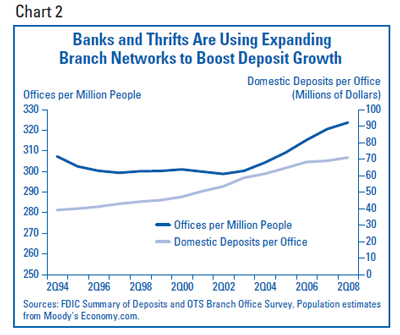
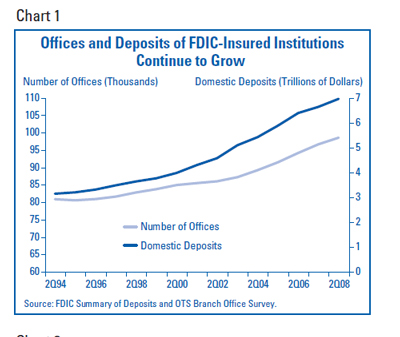
To better understand the industry’s level of expansion, it is useful to look at various measures of deposit and office growth in relation to demographic trends. For example, trends in deposit growth and population can be compared to the number of bank offices. As shown in Chart 2, banks continue to expand their retail presence at a faster pace than population growth at the national level. Both the number of offices per million people and the volume of deposits per office continue to increase. However, the pace of this growth is slowing. Indeed, the annual growth in both domestic deposits per office and offices per million people were below their respective five-year averages.

This will be another data point to support the thesis of Banks’ Advantage in Hedging Liquidity Risk.

Interesting External Papers

Liquidity & Credit Limitations in FX Market

I forget where I read it, but sombody at sometime held up the forwards market on foreign exchange as being the most efficient market anywhere. Plug in the spot rate and the two relevant risk-free rates for any two currencies and presto! you have the forward rate to as many decimal places as you want.

Like everything else in this market, this model is no longer as valid as it used to be: the implicit assumptions in the model are infinite liquidity and counterparty strength, neither of which are as very nearly true as they used to be. The Bank for International Settlements has released Working Paper #267 titled Interpreting deviations from covered interest parity during the financial market turmoil of 2007–08:

This paper investigates the spillover effects of money market turbulence in 2007–08 on the short-term covered interest parity (CIP) condition between the US dollar and the euro through the foreign exchange (FX) swap market. Sharp and persistent deviations from the CIP condition observed during the turmoil are found to be significantly associated with differences in the counterparty risk between European and US financial institutions. Furthermore, evidence is found that dollar term funding auctions by the ECB, supported by dollar swap lines with the Federal Reserve, have stabilized the FX swap market by lowering the volatility of deviations from CIP.

Our finding bears similarities with the Japan premium episode in the late 1990s. At that time, due to a substantial deterioration of their creditworthiness relative to that of other financial institutions in advanced nations, Japanese banks found it extremely difficult to raise dollars in global money markets, and a so-called Japan premium arose between dollar cash rates paid by Japanese banks and by other banks (Covrig, Low, and Melvin 2004; and Peek and Rosengren 2001). As suggested in Nishioka and Baba (2004) and Baba and Amatatsu (2008), Japanese banks then turned to the FX swap and longer-term cross-currency markets for dollar funding, which resulted in substantial deviations from the CIP condition in its traditional sense. The dislocations in the FX swap market that have been triggered by the turmoil may be understood in a similar context.

finding is consistent with the view that the demand for dollar liquidity in FX swap markets under the turmoil came from a wider array of financial institutions than just dollar Libor panel banks. A similar observation can be made for the Libor-OIS (euro-dollar) variable: it always has a significantly positive effect on the FX swap deviation under the turmoil but not so in all cases before the turmoil. The estimated coefficients during the period of turmoil are larger, more significant, and closer to the value of 1 suggested by the earlier decomposition (equation (3)). This is consistent with the view that relative liquidity conditions in the Libor funding markets mattered more to FX swap markets during the turmoil than before.

This paper has empirically investigated spillovers to the FX swap market from the money market turbulence that began in the summer of 2007. As documented in Baba, Packer, and Nagano (2008), an important aspect of the turmoil was a shortage of dollar funding for many financial institutions, particularly European institutions that needed to support US conduits for which they had committed backup liquidity facilities. At the same time, financial institutions on the dollar-lending side became more cautious because of their own growing needs for dollar funds and increased concerns over counterparty risk. Facing these unfavourable conditions in interbank markets, non-US institutions turned to the FX swap market to convert euros into dollars.

Our empirical results show a striking change in the relationship between perceptions of counterparty risk and FX swap prices after the onset of financial turmoil. That is, CDS spread differences between European and US financial institutions have a positive and statistically significant relationship with the deviations from [Covered Interest Parity] observed in the FX swap market. The result holds when we consider the CDS spreads of a range of financial institutions wider than that of the Libor panel. Our findings suggest that concern over the counterparty risk of European financial institutions was one of the important drivers of the deviation from covered interest parity in the FX swap market.

While not significantly reducing the level of FX swap deviations over the period, the ECB’s US dollar liquidity-providing operations to Eurosystem counterparties do appear to have lowered the volatility (and thus the associated uncertainty) of the FX swap deviations. Our estimation results thus support the view that the dollar term funding auctions conducted by the ECB, supported by dollar swap lines with the Federal Reserve, played a positive role in stabilizing the euro/dollar FX swap market.

This study covers a period that ends in September 2008 shortly before the bankruptcy of Lehman Brothers. After the Lehman failure, the turmoil in many markets become much more pronounced. In currency and money markets, what had principally been a dollar liquidity problem for European banks deepened into a phenomenon of global dollar shortage. The provision of dollar funds by central banks, supported in some cases by unlimited dollar swap lines with the Federal Reserve, expanded greatly. One promising line of research would focus on the effectiveness of the diverse array of policy measures taken in this recent, more severe stage of the financial crisis.

Interesting External Papers

Liquidity has Value!

The Bank of Canada has released a working paper on the value of debt liquidity, How Important is Liquidity Risk for Sovereign Bond Risk Premia? Evidence from the London Stock Exchange:

This paper uses the framework of arbitrage-pricing theory to study the relationship between liquidity risk and sovereign bond risk premia. The London Stock Exchange in the late 19th century is an ideal laboratory in which to test the proposition that liquidity risk affects the price of sovereign debt. This period was the last time that the debt of a heterogeneous set of countries was traded in a centralized location and that a sufficiently long time series of observable bond prices are available to conduct asset-pricing tests. Empirical analysis of these data establishes three new results. First, sovereign bonds with wide bid-ask spreads earn 3-4% more per year than bonds with narrow bid-ask spreads, and the difference is reflected in greater sensitivity to innovations in market liquidity. Second, small sovereign bonds, as measured by market value, earn 1.8-3.5% more per year than large sovereign bonds, and the difference is also reflected in their exposure to innovations in market liquidity. Third, market liquidity is a state variable important for pricing the cross-section of sovereign bonds. This paper thus provides estimates of the quantitative importance of liquidity risk as a determinant of the sovereign risk premium and underscores the significance of market liquidity as a nondiversifiable risk.

Interesting External Papers

BoC Releases December 2008 Financial System Review

The Bank of Canada has released its December 2008 Financial System Review.

An interesting comment was:

Further improvements by some Canadian banks would be desirable to align disclosure standards, particularly regarding valuation techniques, more closely with the best practices of leading foreign banks. On the issue of transparency of structured products, progress in implementing the [Financial Stability Forum] recommendations has been slow to materialize, and there is a role for provincial securities commissions to advance this initiative.

… which seems to be a nice way of saying the banks here are falling behind. The Financial Stability Forum has been discussed on PrefBlog.

Also of interest was a short section on revision of bank capital rules to reduce the procyclicity inherent in the current rules:

These concerns have motivated proposals that argue that systemic risks can be mitigated if macroeconomic conditions are taken into account in the design of capital regulations. Under these proposals, banks would be required to build up a capital buffer during the boom part of the cycle—thereby strengthening their balance sheets and reducing the risk that financial imbalances will develop from excessive easing of financial conditions. During a downturn, banks would be allowed to draw down these buffers, which would alleviate the need to liquidate assets or restrict loan growth at a time when credit conditions and asset prices are already under stress. Thus, minimum capital requirements would move procyclically—the reverse of what happens under the current Basel II framework— and would help moderate cyclical fluctuations in the economy. This strategy could be implemented by linking capital requirements to movements in macroeconomic indicators of the state of the credit cycle, such as loan growth and asset prices.

Another question is whether there should be a rules-based approach linking capital requirements in a predetermined way to observable variables such as loan or asset growth, or whether discretion should be used to adjust the minimum capital ratios. In a system with discretion, it would be necessary to define the appropriate roles for the prudential regulator and for other agencies (such as the central bank) that have a broader macroeconomic perspective.

I like the last bit – ‘Give us the work, not OSFI!’

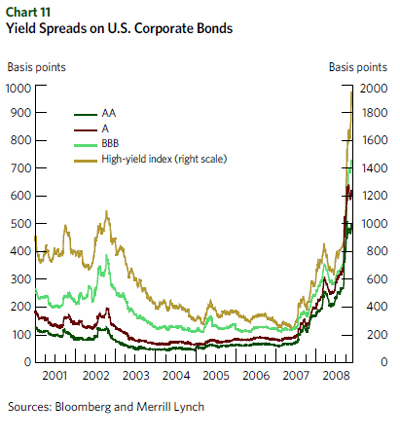
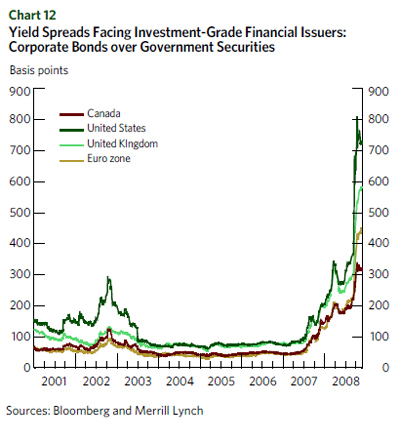
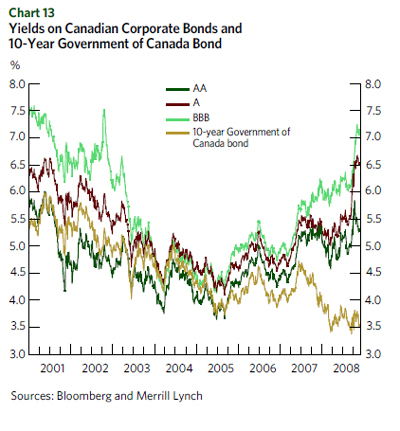
Longer-term credit markets have also deteriorated since the publication of the June FSR, as perceived default risk rose and the dysfunction in short term funding markets spread to longer-term debt markets. With the cost of financing trading positions higher and more uncertain, the liquidity premium demanded by agents also increased. This, in turn, contributed to the widening of credit spreads relative to government securities beyond what would be expected solely from the increase in default risk and expected losses. Yield spreads on corporate bonds around the globe rose to all-time highs in both the secondary bond and credit default swap markets, with the increase being particularly significant for high-yield and lower-rated issuers, reflecting an increasing degree of credit tiering (Chart 11).

There is a very topical note on DB Pension Funding:

Firms that sponsor defined-benefit (DB) pension plans are facing additional pressures. The funding condition of DB plans in Canada has deteriorated sharply in recent months as a consequence of the severe sell-off in equity markets. Chart 19 presents the trend in Mercer’s Pension Health Index, which incorporates indexes of the assets, liabilities, and funding positions (assets less liabilities) of a representative DB plan in Canada. Note that assets have recently been falling, whereas liabilities have continued to rise. Firms are required to make special contributions to eliminate deficits over a time period specified by the pension regulators. These contributions adversely affect the
earnings and cash flow of the sponsoring corporation.

Bank asset quality is always of interest:

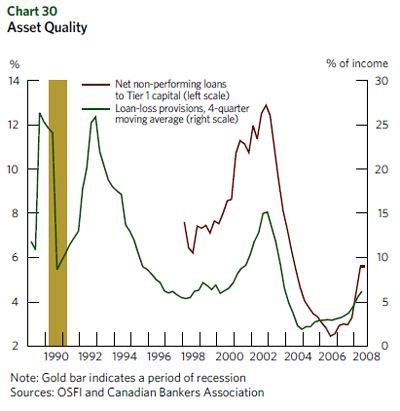
Profits and return on equity for the major Canadian banks have been on an improving track since the apparent trough in the first quarter of 2008, when writedowns seem to have peaked (Chart 29). Since the start of the turmoil, the major banks have reported cumulative capital market writedowns of almost $12 billion on a pre-tax basis. For the fourth quarter, five banks have pre-announced additional writedowns totalling around $2 billion.

As discussed, the volatility in the value of the securities portfolios of financial
institutions has continued (through the requirements of fair value accounting) to adversely affect their earnings.20 Recently, changes were announced by the Canadian Accounting Standards Board (AcSB), which mirror recent changes in International Accounting Standards (IAS). These modifications permit financial institutions, in some cases, to reclassify assets from the “held for trading” account to the banking book. This change is expected to reduce future volatility in the earnings of some banks. Several banks have since reclassified assets under these guidelines.
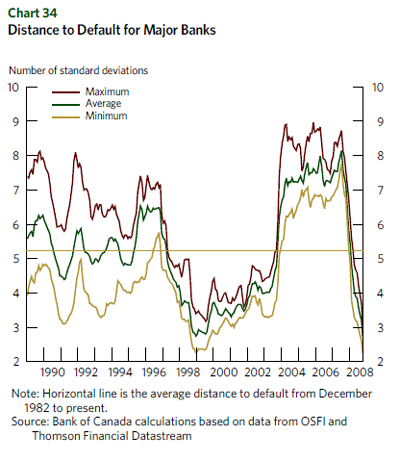
Of particular interest to preferred share investors is the banks’ “Distance to Default”, which is based solely on market prices – not on any fundamental analysis:

An assessment of overall default risk derived from market data, the distance to default for major Canadian banks, suggests a deterioration in their perceived credit quality since the June 2008 FSR (Chart 34). Driven by continued volatility in bank share prices, this measure has, in fact, reached its
lowest point on record.

And finally, given the recent MFC fiasco:

While the level of disclosure at life and health insurance companies has improved in recent years, it is generally not as detailed as that of banks, and recent events have underlined the need for further enhancements. For example, it would be desirable for life and health insurance companies to provide more information about the consolidated capital position of the enterprise as a whole, not just at the unconsolidated operating company level.

Thats the review section. There are also articles titled:

  • Credit, Asset Prices, and Financial Stress in Canada
  • Fair Value Accounting and Financial Stability
  • The Impact of Sovereign Wealth Funds on the International Financial System
  • Liquidity Risk at Banks: Trends and Lessons Learned from the Recent Turmoil
  • A Model of Housing Boom and Bust in a Small Open Economy
  • The Role of Bank Capital in the Propogation of Shocks
  • Good Policies or Good Fortune: What Drove the Compression in Emerging-Market Spreads?
Interesting External Papers

IMF Releases December 2008 Issue of Finance & Development

The IMF has released its December 2008 Issue of Finance & Development. Articles are:

  • Cracks in the System: Repairing th Damaged Global Economy
  • F&D on Financial Crisis Origins
  • Preventing Future Crises
  • When Crises Collide
  • A Crisis to Remember
  • Global Financial Turmoil Tests Asia
  • The Crisis through the Lens of History
  • Ensuring Food Security
  • Stockholm Solutions
  • Neighborly Investments
  • The Road to Recovery: A View from Japan
  • Nigeria’s Shot at Redemption
  • The Catch-Up Game
  • The Economic Geography of Regional Integration

To be frank, I wasn’t much impressed by the Stockholm Solutions article about the Nordic crisis. It was very general.

A topic more suited to generality was The Crisis through the Lens of History:

A second important lesson is the value of providing macroeconomic support in parallel with financial actions. With the effectiveness of monetary policy limited by financial disruptions, fiscal stimulus must play an important role to help maintain the momentum of the real economy and curtail negative feedbacks between the financial and real sectors. Indeed, increasing interest is now being paid to boosting infrastructure spending, akin to the public work programs of the Depression era. But, as the Japanese example makes clear, macroeconomic support by itself provides only breathing room, not a cure; it is essential to use the space provided to address the underlying financial problems or the outcome will be a series of fiscal packages with diminishing impact. And it should also be recognized that there will be limited space for macroeconomic responses in countries where the weakness of public sector management has been an integral source of the problem, as has often been the case in emerging market crises.

Additionally, the article on Preventing Future Crises contains many of the familiar old nostrums but, as a saving grace, adds an element I’ve been harping on:

Safeguarding diversity to promote systemic complementarities
The degree to which financial institutions with long maturing liabilities (for example, pension funds and life insurance companies) should be subject to mark-to-market requirements or to risk management standards based on risk models focused on short-run price volatility in managing
their assets could be reconsidered. Regulations could increase the scope for such institutions to play the role of long-term, hold-to-maturity investors. But low-leverage financial institutions with limited systemic importance may need only light, if any, regulation, thus allowing them to play a potentially stabilizing role in taking more risky or contrarian positions compared with other market participants (Nugée and Persaud, 2006).

I’ve said it before … I’ll say it again. The current crisis has shown significant cracks in bank regulation, but let’s not throw the baby out with the bathwater. What we should be aiming for is a rock solid banking system core, surrounded in turn by more exciting investment banks, which are in turn surrounded by a wild-n-wooly world of hedge funds, SIVs, and whatever else gets dreamed up to make a buck.

Interesting External Papers

BIS Quarterly Review Released

The Bank for International Settlements has released its Quarterly Review, December 2008.

Articles include:

  • Global financial crisis spurs unprecedented policy actions
  • Highlights of international banking and financial market activity
  • Developments in repo markets during the financial turmoil
  • Commodity prices and inflation dynamics
  • Bank health and lending to emerging markets
  • How many in negative equity? The role of mortgage contract characteristics

Repos and the Treasury Market Practices Group were briefly mentioned on November 24. The following is from the BIS article on repos:

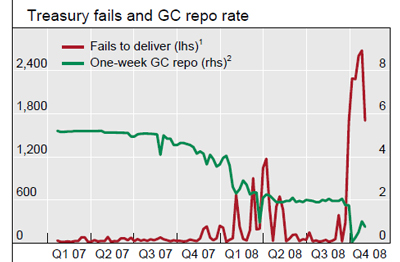
By March 2008, however, the financial turmoil reached a point where heightened risk aversion coupled with uncertainty over valuations of particularly risky products led participants in the repo market to abruptly stop accepting anything other than Treasury and agency collateral. As a result, investment banks such as Bear Stearns suddenly found themselves short of funding, as a large part of their collateral pool was no longer accepted by the US repo market. This change led to a sharp increase in the demand for government securities for repo transactions, which was compounded by significantly higher safe haven demand for US Treasuries and the increased unwillingness to lend such securities in repo transactions. As the crisis unfolded, this combination resulted in US government collateral becoming extremely scarce. As the available supply of Treasury collateral dropped, those market participants willing to lend out Treasuries were able to borrow cash at increasingly cheap rates. At times, this effect pushed US GC repo rates down to levels only a few basis points above zero.

The scarcity of US Treasuries for repo transactions also manifested itself in a sharp increase in the number of Treasury settlement fails. Whereas fails to deliver Treasuries had averaged around $90 billion per week during the two years preceding the crisis, they rose to above $1 trillion during the Bear Stearns episode and then soared to record highs of almost $2.7 trillion
following the Lehman default (Graph 5).

Interesting External Papers

FDIC Publishes 3Q08 US Bank Profile

The FDIC has released the 3Q08 Quarterly Banking Profile.

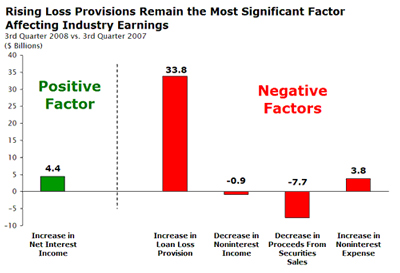
The headlines of the text give the flavour:

  • More Institutions Report Declining Earnings, Quarterly Losses
  • Lower Asset Values Add to the Downward Pressure on Earnings
  • Margin Improvement Provides a Boost to Net Interest Income
  • Loan Losses Continue to Mount
  • Growth in Reported Noncurrent Loans Remains High
  • Reserve Coverage of Noncurrent Declines
  • Failure-Related Restructuring Contributes to a Decline in Reported Capital
  • Liquidity Program Provides a Boost to Asset Growth
  • Discount Window Borrowings Fuel a Surge in Nondeposit Liabilities
  • Nine Failures in Third Quarter Include Washington Mutual Bank

The 2Q08 Report was previously noted on PrefBlog.

Interesting External Papers

Slow Moving Capital

I rather like academic papers that reinforce everything I’ve been saying throughout my career!

This paper is by Mark Mitchell of CNH Partners, Lasse Heje Pedersen of the Stern School of Business and Todd Pulvino of CNH Partners:

We first study the convertible bond market in 2005 when convertible hedge funds faced large redemptions of capital from investors.

We also study merger targets during the 1987 market crash.

Our findings do not support the frictionless economic paradigm. Under this paradigm, a shock to the capital of a relatively small subset of agents should have a trivial effect on security prices, since new capital would immediately flow into the market and prices would be bid up to fundamental values. Rather, the findings support an alternate view that market frictions are of first-order importance. Shocks to capital matter if arbitrageurs with losses face the prospect of investor redemptions (Andrei Shleifer and Robert W. Vishny 1997), particularly when margin constraints tighten during liquidity crises (Markus K. Brunnermeier and Pedersen 2006), when other agents lack both infrastructure and information to trade the affected securities (Robert C. Merton 1987), and when agents require a return premium to compensate for liquidity risk (Viral V. Acharya and Pedersen 2005).

After going through the evidence, the authors conclude:

However, in situations where external capital shocks force liquidity providers to reverse order and become liquidity demanders, it can take months to restore equilibrium to the dislocated market. This is because (a) information barriers separate investors from money managers; (b) it is costly to maintain dormant capital, infrastructure, and talent for long periods of time, while waiting for profitable opportunities; and (c) markets become highly illiquid when liquidity providers are constrained and traders demand higher expected returns as compensation for this lack of liquidity. The result is that profit opportunities for unconstrained firms can persist for months. Given the relative ease of estimating deviations from fundamentals in the convertible and merger markets, the time required to restore equilibrium is likely to be longer in other markets. We view our results as evidence that real world frictions impede arbitrage capital.

Interesting External Papers

Bank of Canada Releases Autumn 2008 Review

The Bank of Canada has announced the release of the Autumn 2008 Review, a special issue focussing on “Structural Factors, Adjustment and productivity”:

This special issue covers a variety of topics dealing with how structural factors or developments affect the economic performance of an advanced economy such as Canada.

I can’t say I spent a lot of time with it, since the articles are not particularly well related to the nitty-gritty of financial markets that I follow keenly – but doubtless some regulator will come along some time and require me to correct my negligence.

The articles are:

  • Productivity in Canada: Does Firm Size Matter?
  • Offshoring and Its Effects on the Labour Market and Productivity: A Survey of Recent Literature
  • Adjusting to the Commodity-Price Boom: The Experiences of Four Industrialized Countries
  • The Effects of Recent Relative Price Movements on the Canadian Economy
  • The Bank of Canada’s Senior Loan Officer Survey

It’s nice, however, to look at the titles and see that everything’s spelt properly (very rare in internationally available economic papers), but I’m afraid I must deprecate their use of “Can$” as the identifier for our currency.

Interesting External Papers

External Support and Bank Behaviour in the International Syndicated Loan Market

BIS has released Working Paper #265, by Blaise Gadanecz, Kostas Tsatsaronis and Yener Altunbase, with the captioned title.

The paper is quite interesting. First, the authors grouped banks according to FitchRatings’ assessment of their external (state) support:

In addition to the more traditional types of creditworthiness assessment, Fitch Ratings assigns to banks ratings related to the strength of outside support. The so-called support rating is an assessment of the likelihood and level of outside financial support that the bank may receive from outside entities (the government, its owners or third parties) in case of financial difficulty. The rating scale ranges from very high support (level 1) to no support (level 5). For the purposes of this paper banks with a rating of 1 or 2 are identified as “supported”. This choice was based on the characterisation that Fitch gives to these rating classes in its manual. Level 1 support indicates “a clear legal guarantee or state support would be forthcoming”. Level 2 is assigned in cases where “state support would be forthcoming in the absence of a legal guarantee”. This choice is consistent with other studies in the literature that rely on the same indicator of safety net support.9 The ratings methodology does not strictly identify the government purse as the source of financial support. However, for the higher support rating categories the methodology points to the existence of a legal commitment or highlights the systemic importance of the institution in the national and/or international arena. For the purpose of this analysis this is treated as being practically tantamount to government support. No private entity would have the resources or the incentives to provide this financial support in the case of financial difficulty.

This was then compared with details of each bank’s participation in international syndicated loans:

The syndicated loan information has been extracted from the Dealogic Loanware database. Each loan facility record identifies the members of the syndicate and their role as senior or junior members.

The information on the individual loan facilities was combined with information on the syndicate banks extracted from Bankscope. This database contains details about the balance sheet composition and income statement of individual banks.

The authors conclude:

Where supported banks seem to differ substantially from their peers is the attitude towards risk. Supported banks hold portfolios of loans that are on average lower priced than a market benchmark (although some of these lower spreads may be recouped in the form of higher fees, meaning that they may be substituting revenue for risk compensation). Moreover, as senior arrangers they tend to be involved in initiating loans that carry thinner spreads that the average loan with similar characteristics. Finally, they also seem to be less responsive to indicators of balance sheet risk in deciding whether to invest on a particular loan as compared to other banks.

This relatively relaxed attitude towards risk is more problematic from a policy perspective. It is an indication that support distorts the incentives of these banks and encourages risk taking that is not remunerated by market expected returns. Combined with a non-innovative attitude towards investment also suggests that these banks are likely to be using the funding benefits of their status to engage in price competition in the international loan market. This behaviour is not compatible with the typical motivation for support, and is akin to an abuse of their privileged status.

These results shed a sceptical light on the beneficial impact of state support. Clearly, the data used in this paper cannot examine the overall behaviour of the banks, but only a small component in their activities in the international arena. More research is needed to generate a more complete picture of the impact of support on the banks. Nevertheless, the results suggest that there are externalities from state support that go beyond the national markets. Hence, they warrant a more careful consideration of the conditions at which support is made available and the governance structures in these institutions.

As the authors remarked in the introduction:

Public sector interest is often associated with the existence of explicit forms of financial support or the market perceptions of implicit guarantees should the banks come under stress. Banking is also a business of taking and managing risk. The theory of moral hazard suggests that ill-conceived insurance against downside risks may lead to distorted incentives and excessive risk taking by banks.

We can only hope that the conclusions of this paper make their way into the hands of the G-20 planners of the New World Order (Financial Department).