Category: Interesting External Papers

Interesting External Papers

What Constrains Banks?

My interest was piqued by a paper by R. Alton Gilbert, a former VP of the St. Louis Fed; the paper was an advocacy piece, Keep the leverage ratio for large banks to limit the competitive effects of implementing Basel II capital requirements.

The abstract reads:

In October 2005, the agencies that supervise U.S. depository institutions proposed changes in the Basel I capital requirements that will apply to the banks that will not be subject to the new Basel II capital requirements. An objective of the U.S. bank supervisors for proposing changes in Basel I capital requirements is to mitigate any competitive inequalities created by implementing Basel II capital requirements. This paper explains why the proposed changes in Basel I capital requirements would not mitigate such competitive inequalities for many of the banks that will continue to be subject to the Basel I capital requirements. In addition, this paper argues that an important means of limiting competitive effects from implementing Basel II capital requirements is to maintain the leverage ratio as one of the capital requirements for the banks that adopt Basel II capital requirements.

… with the thesis:

This paper argues that the proposed changes in Basel I capital requirements would not mitigate the competitive effects of implementing Basel II for many of the banks that will continue to be subject to Basel I capital requirements. For various reasons some of these banks are not bound by the minimum capital requirements of Basel I, in the sense that they would not reduce their capital if the supervisors reduced the minimum capital requirements. Other banks are bound by the leverage ratio, rather than the risk-based capital requirements of Basel I. The leverage ratio is a minimum ratio of Tier 1 capital to a measure of total assets.

… and:

One way to mitigate competitive inequalities under Basel II is to maintain the leverage ratio for the large banks that will be subject to Basel II. The leverage ratio places a tight limit on the percentage by which the largest U.S. banking organizations would be permitted to increase their assets (for given capital) under Basel II. Chairman Powell of the Federal Deposit Insurance Corporation recently argued for retaining the leverage ratio for the banks that adopt Basel II. He argued for retaining the leverage ratio on the basis of the degree of risk assumed by the individual banking institutions that will adopt Basel II capital requirement. This paper adds another reason for retaining the leverage ratio for the banks that adopt Basel II. The changes in Basel I capital requirements the at the supervisors proposed in October 2005 will not affect the capital held by many of the banks that will continue to be subject to Basel I capital requirements. For these banks retaining the leverage ratio for the banks that adopt Basel II is a means of mitigating competitive inequalities created by implementing Basel II.

He supports the views of Powell – former FDIC Chairman – but for different reasons. Powell’s views were referenced in PrefBlog in the post Expected Losses and the Assets to Capital Multiple.

So, after reading through his paper, I wondered: what is the constraint on the balance sheets of Canadian Banks. I drew some data from the second quarter summary of Canadian banking capitalization and drilled down back into the supplementary packages reported by the banks to produce:

Big-6 Bank Constraint Summary
2Q08
  Note RY BNS BMO TD CM NA
Equity Capital A 17,527 16,113 13,499 15,069 9,078 3,534
Tier 1 Cap B 23,708 21,073 17,551 16,262 12,175 5,089
Tier 2 Cap C 4,889 5,642 4,124 6,434 6,061 2,667
Total
Capital
D 28,597 25,588 21,675 22,696 17,255 7,353
Tier 1 Ratio E 9.5% 9.6% 9.4% 9.1% 10.5% 9.2%
Total Ratio F 11.5% 11.7% 11.6% 12.7% 14.4% 13.3%
Assets to
Capital
Multiple
G 20.1 17.7 16.2 19.2 19.3 16.7
RWA to
T1R = 4%
H 137% 140% 135% 128% 162% 130%
RWA to
TotR = 8%
I 44% 46% 45% 59% 80% 66%
Assets to
ACM = 20
J -1% 13% 23% 4% 4% 20%
Assets to
ACM = 23
K 14% 30% 42% 20% 19% 38%
A : See Bank Capitalization Summary : 2Q08
B: From Supplementary Packages
C: From Supplementary Packages
D: From Supplementary Packages – will not be sum of B & C due to adjustments
E: From Supplementary Packages
F: From Supplementary Packages
G: See source notes from Note A reference; some are my estimates
H: Percentage increase in Risk Weighted Assets that results in a Tier 1 Ratio of 4%; = (E / 0.04 – 1) %
I: Percentage Increase in Risk Weighted Assets that results in a Total Capital Ratio of 8%; = (F / 0.08 -1) %
J: Percentage Increase in Assets that results in an Assets-to-Capital Multiple of 20x; = ((20 / G) – 1) %
K: Percentage Increase in Assets that results in an Assets-to-Capital Multiple of 23x; = ((23 / G) – 1) %

It should be noted that the percentage increases calculated imply no change in asset mix, which will not be accurate. It may be assumed, for instance, that in the event of credit lines being drawn down, or an unexpected burst of lending activity, other assets will be liquidated to fund them, rather than having them funded by new liabilities. Royal Bank, for instance, reports that as of April 30, securities held that were guaranteed by Canada or a province totalled $27.1-billion. This amount is very close to its total capitalization. Deposits with other regulated financial institutions (other than the Bank of Canada) totalled $15.8-billion. While some of these assets will be held in the ordinary course of business – trading operations and whatnot – a large chunk of these assets could be sold to fund new business expected to be more profitable than government securities. This would increase Risk Weighted Assets without affecting the ACM.

Still – given that Royal Bank is over the 20x ACM limit and had to apply for special permission to achieve this state, it looks to me that the major constraint is the Assets-to-Capital multiple; which is consistent with Powell’s and Gilbert’s assertions with respect to the US. It is not consistent, however, with an assertion by OSFI that “the leverage multiple is not usually the binding constraint for large complex banking organizations”.

I will have to investigate this further!
Interesting External Papers

Corporate Yield Spreads and Bond Liquidity

A paper available on SSRN. I haven’t yet done anything but skim it:

We examine whether liquidity is priced in corporate yield spreads. Using a battery of liquidity measures covering over 4000 corporate bonds and spanning investment grade and speculative grade categories, we find that more illiquid bonds earn higher yield spreads; and that an improvement of liquidity causes a significant reduction in yield spreads. These results hold after controlling for common bond-specific, firm-specific, and macroeconomic variables, and are robust to issuers’ fixed effect and potential endogeneity bias. Our finding mitigates the concern in the default risk literature that neither the level nor the dynamic of yield spreads can be fully explained by default risk determinants, and suggests that liquidity plays an important role in corporate bond valuation.

Interesting External Papers

OECD Estimate of Sub-Prime Losses

The OECD has published a paper by Adrian Blundell-Wignall, The Subprime Crisis: Size, Deleveraging and Some Policy Options … it was actually published in April, but I missed it … the numbers weren’t scary enough, I suppose, so it was ignored by bloggers and the media.

The abstract reads:

The paper revises our previous USD 300 bn estimate for mortgage related losses to a range of USD 350-420 bn. In doing this the paper explicitly rejects the previous approach based on implied defaults from ABX pricing, because these prices are affected by illiquidity and extreme volatility; they will likely lead to misleading estimates of losses. Instead it builds a proper default model approach and allows for recovery of collateral via house sales over time. The paper separates out the losses due to commercial banks in the US, and goes on to look at the implied deleveraging required to meet capital standards. It could take 6-12 months for banks to offset losses via earnings alone, depending on Fed rate cuts and the dividend policy of banks. Since even more capital than this is required if banks were to expand their balance sheets, the paper looks at possibilities for capital injections from groups like sovereign wealth funds; and it also looks at a novel plan for the use of public money with an RTC-style approach and the issue of zero coupon bonds. Finally the paper looks at the issues of moral hazard, the likely size of the impact in Europe and Asia and non-bank corporate leverage.

The author points out that mark-to-market estimates are more than just a little suspicious:

The ABX estimates are shown in Table 1. The prices for each tranche/vintage are shown in the top section of the table. Thus in the first row, for ABX 06(1), the 14 March price 86 implies that 14% losses are discounted for AAA.5 The weights by vintage and tranche (not shown) are applied and, the weighted expected loss is shown in the bottom row of the table. This number is applied to the stock of US RMBS. Using the September 7 numbers, USD 292 bn is the implied loss (the main basis of the work last year). But as can be seen, over time the implied size of the losses seems to get ever larger. On the 14th of March, a staggering USD 887 bn loss is implied.

A similar picture emerges from our naïve equity market-cap-loss approach in Table 2. Far from the USD 308 bn published in the last FMT, the market cap losses for levered financial institutions most affected by mortgages is now a staggering USD 702 bn, very much showing the same pattern as the ABX approach.

Both approaches are undermined by recent market panic and problems with price discovery. If it is agreed that these are features of recent experience, then it follows that these estimates of losses are way too high.

This estimate of ultimate losses may be compared with

Blundell-Wignall does not give a lot of details regarding his calculation. Essentially, he’s fitting into the formula

Total losses = (total outstanding) x (delinquency rate) x (foreclosures / delinquencies) x (loss given foreclosure)

There’s not a lot of information: I have tried and failed to find details of the parameterization of this equation in either the Bank of England model or the OECD model. The best I can do is state that the BoE assumes loss given foreclosure of 50%, while the OECD varies this in a range of 40%-60%.

Additionally, the BoE examined 1,400-billion in sub-prime, while the OECD is looking at 1,300-billion sub-prime and 1,000-billion “Alt-A, etc.”.

Interesting External Papers

FDIC Releases 1Q08 Report on US Banks

The full report is available on their website.

Of particular interest was:

Insured institutions continued to build their loan-loss reserves in the first quarter. They added $37.1 billion in loss provisions to their reserves, which was $17.5 billion more than was subtracted from reserves by charge-offs. The increased loss provisions were the main reason that reserves increased by $18.5 billion (18.1 percent) during the quarter, to $120.9 billion. The industry’s ratio of loss reserves to total loans and leases increased from 1.30 percent to 1.52 percent, the highest level since the first quarter of 2004. However, the growth in loss reserves was outstripped by the rise in noncurrent loans, and the industry’s “coverage ratio” fell for the eighth consecutive quarter, to 89 cents in reserves for every $1.00 of noncurrent loans from 93 cents at the end of 2007. This is the lowest level for the coverage ratio since the first quarter of 1993.

Capital levels benefited from a reduction in dividend payments by many institutions during the quarter. Of the 3,776 insured institutions that paid common stock dividends in the first quarter of 2007, almost half (48 percent) paid lower dividends in the first quarter of 2008, including 666 institutions that paid no dividends. Insured institutions paid $14.0 billion in total dividends in the first quarter, down $12.2 billion (46.5 percent) from a year earlier. Retained earnings (net income after dividends) totaled $5.3 billion, down $4.1 billion (43.6 percent) from a year earlier despite the lower dividend payments. Slightly more than half of all institutions (51.8 percent) reported year-over-year declines in retained earnings. Total regulatory capital increased by $25.5 billion (2.0 percent) in the first quarter, as tier 1 capital rose by $15.0 billion (1.5 percent) and tier 2 capital increased by $10.5 billion (4.1 percent). All of the increase in tier 2 capital consisted of higher loan-loss reserves. The industry’s core capital (leverage) ratio declined from 7.97 percent to 7.87 percent during the quarter, the tier 1 risk-based capital ratio slipped slightly from 10.11 percent to 10.10 percent, while the total risk-based capital ratio increased from 12.78 percent to 12.83 percent. Ninety-nine percent of all insured institutions continued to meet or exceed the highest regulatory capital standards as of the end of the first quarter. Equity capital increased by $13.5 billion in the quarter. The relatively low level of retained earnings and a sharp increase in unrealized losses on available-for-sale securities were the chief reasons for the modest rise in equity. Other comprehensive income, which includes unrealized losses on securities, reduced equity capital by $12.1 billion in the first quarter.

The number of institutions on the FDIC’s “Problem List” increased from 76 to 90 in the first quarter. Total assets of “problem” institutions rose from $22.2 billion to $26.3 billion. This is the sixth consecutive quarter that the number of “problem” institutions has increased, from a historic low of 47 institutions at the end of third quarter 2006. The current level represents the largest number of institutions on the list since third quarter 2004, when there were 95 “problem” institutions.

It is also interesting that the Deposit Insurance Fund (and as I have remarked, in the US they have a REAL deposit insurance fund) made money in the quarter, but did not increase as fast as insured deposits, resulting in a small decline in coverage.

There’s lots of numbers in this report! No matter what investment conclusion you’re determined to make, you’ll be able to justify it somehow!

Interesting External Papers

Willem Buiter's Revised Prescription

Willem Buiter has authored a paper Lessons from the North Atlantic Financial Crisis, which updates his previously reviewed ‘Lessons…’.

He states:

Very rapid growth of the broad monetary and credit aggregates could (and should) have been a warning sign that a financial bubble might be brewing. It was not considered worrying, probably because on the other side of these transactions were not primarily non-financial corporations and households but rather other, non-deposit-taking financial institutions. Leverage increased steadily in the financial sector (especially outside the commercial banks) and in the household sector. This was interpreted as financial deepening and further productivity and efficiency-enhancing financial sector development, rather than as a financial sector/household sector Ponzi game in which the expectations of future capital gains drove current capital values and made true earnings a side show.

One cause of the current crisis was securitization:

  • The greater opportunities for risk trading created by securitisation not only make it possible to hedge risk better (that is, to cover open positions); they also permit investors to seek out and take on additional risk, to further ‘unhedge’ risk and to create open positions not achievable before. … we can only be sure that the risk will end up with those most willing to bear it. There can be no guarantee that risk will end up being borne by those most able to bear it.
  • The ‘originate to distribute’ model destroys information compared to the ‘originate to hold’ model.
  • Securitisation also puts information in the wrong place. Whatever information is collected by the loan originator about the collateral value of the underlying assets and the credit worthiness of the ultimate borrower, remains with the originator …
  • Finally, there appears to be genuine irrationality afoot in the markets during periods of euphoria. Even non-diversifiable risk that is traded away is treated as though it no longer exists.

and proposes the following solutions:

  • Simpler structures … Central banks could accept as collateral in repos or at the discount window only reasonably transparent classes of ABS.
  • Unpicking’ securitisation (doing original credit analysis of the underlying) … This ‘solution’ is the ultimate admission of defeat in the securitisation process.
  • Retention of equity tranche by originator. … It could be made a regulatory requirement for the originator of
    residential mortgages, car loans etc. to retain the equity tranche of the securitised loans.
    Alternatively, the ownership of the equity tranche could be required to be made public
    information, permitting the market to draw its own conclusions.

  • External ratings. … This ‘solution’ to the information problem, however, brought with it a whole slew of new problems.

And that slew of new problems is then analyzed and discussed – it is virtually identical to the prior paper, which was discussed at length there, so I’ll skip over that.

The next section deals with the procyclical effects of leverage and bank regulation:

This pattern of procyclical leverage is reinforced through the Basel capital adequacy requirements. Banks have to hold a certain minimal fraction of their risk-weighted assets as capital. Credit ratings are procyclical. Consequently, a given amount of capital can support a larger stock of assets when the economy is booming then when it is slumping. This further reinforces the procyclical behaviour of leverage.

While I will agree that credit ratings are procyclical – the upgrade/downgrade ratio varies with the health of the economy, rather than being constant through a cycle, which is the ideal – I don’t think this element of his argument is particularly well documented; the effect, while there, is (in normal times) fairly small. It is certainly true, though, that credit ratings of non-AAA sub-prime RMBS have precipituously declined in a manner well-correlated to their prices and the housing market!

However, Dr. Buiter does not propose a solution for this problem, only further study and a re-opening of the Basel II accord.

He further attacks excessive disintermediation in the financial system and is in favour of most off-balance sheet vehicles being brought back on the balance sheet of their financial sponsors, claiming that their role is of regulatory arbitrage and tax-avoidance, rather than a more legitimate business purpose.

Bonuses paid to employees also come under attack, particularly when these are based on short-term performance and unrealized capital gains. It is interesting to consider this problem in light of his recommendation that issuers retain the equity tranche of securitizations … realizing the capital gain on a highly profitable undertaking could become a matter of decades! It is disappointing that there is no evidence presented in support of the idea that bonus sizes were a direct contributing factor to the crunch.

The remainder of the paper deals with macro-economic analysis which, while interesting, will not be reviewed here.

Interesting External Papers

IIAC 1Q08 Issuance Report

The IIAC has issued its 1Q08 Review of Equity New Issues and Trading, noting:

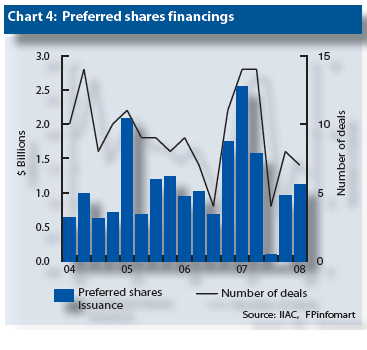
Preferred share issues were one of the brighter spots in the quarter – increasing by 17% from last quarter and raising $1.1 billion in capital on just seven offerings. This is attributed to financial institutions re-strengthening their capital base (Chart 4).

They report that the $1.1-billion in seven issues is down 56.5% by dollar value and 50% by number from 1Q07. I have previously suggested that heavy issuance in 1H07 was at least partly responsible for 2007’s horrible performance.

Hat tip: Streetwise Blog.

Interesting External Papers

Fitch on SubPrime: Losses High, Write-offs Finished

Fitch Ratings has released a Special Report: Subprime Mortgage-Related Losses – A Moving Target which endorses the relatively high loss estimates of Greenlaw et al. and the IMF and contradicts the Bank of England Estimate.

Fitch, bless ’em, explicitly states that their calculation is restricted to the USD 1.4-trillion-odd of securitized subprime mortgage assets – one problem in drawing up comparable figures is determining whether the asset universes are comparable. Europe also went nuts over real-estate, particularly Spain and the UK!

Given the size of the subprime market, estimated to have originated as much as USD1.4trn of loans in the last three years (2005: USD625bn; 2006: USD600bn; and 2007: USD179bn), the poor underwriting standards deployed in originating these loans and the deteriorating economic environment, Fitch estimates total losses for the market to be in the region of USD400bn. Alternative methods of calculating the potential losses using index prices suggest potentially higher losses up to a high of USD550bn.

This compares with Greenlaw et al. (USD 400-billion); the IMF (USD 565-billion) [“Aggregate losses are on the order of $565 billion for U.S. residential loans (nonprime and prime) and securities and $240 billion on commercial real estate securities.”]; and the BoE (USD 170-billion by credit analysis vs. USD 381-billion by market price vs USD USD 317-billion by model-estimated credit-component of market price).

Of great interest to investors will be Fitch’s related conclusion that, notwithstanding that their estimate is on the low side of their mark-to-market range:

  • Approximately 50% of total subprime mortgage related losses, totalling USD200bn, are estimated to reside within the banking sector. The balance 50% of losses is distributed among financial guarantors, insurance companies, asset managers and hedge funds. To the extent that institutions have effectively
    hedged their exposures with financially sound counterparties, these loss estimates may be over‐estimated. However, in the absence of detailed disclosures, it is difficult to get an accurate estimate of net losses.

  • Reported losses by banks at USD165.3bn indicate that over 80% of losses stemming from ABS‐CDO and subprime RMBS exposures have been disclosed.
  • As a significant proportion of the losses have been disclosed, further ratings action arising from ABS‐CDO and subprime RMBS exposures is likely to be minimal.

It’s a good paper, with a fair amount of detail provided regarding how they calculated their numbers.

Update: As noted on March 11, Fitch is very proud of how tough they are on subprime:

The full Bloomberg story explains the Fitch discrepency a little better:

“We have built in 20 percent more home price declines from the end of ’07,” said Glenn Costello, managing director for residential mortgage-backed securities at Fitch. “When you build in that much home price decline, I feel good when I pick up the paper and I see that home prices are only down another 3 percent. My ratings are still good.”

Interesting External Papers

Bank of Canada Review: Spring 2008

The BoC Review for Spring 2008 is now available, comprised of three articles:

  • Canada’s Experience with a Flexible Exchange Rate in the 1950s: Valuable Lessons Learned
  • Price Discovery Across Geographic Locations in the Foreign Exchange Market
  • Developing a Framework to Assess Financial Stability: Conference Highlights and Lessons

I regret that I am not much interested in Foreign Exchange, but the third article, reporting on a Financial Stability conference, is most interesting. Most of the papers presented are available on the BoC website and I’ll be working through them – slowly! – in the course of the next few weeks.

Update, 2008-5-23: One paper discussed the previously reported Stress Testing on Australian Banks : Housing Implosion. I have updated that post.

Interesting External Papers

Survey of European Corporate Bond Market: 2006

A reference on VoxEU alerted me to a CEPR study of the European Bond Market that supplies a few nuggets of information.

Spreads quoted on these electronic [indirect retail] platforms can be quite tight: 10 centimes. One of the reasons why banks are willing to post such tight spreads is that they want to attract volume. This provides them with information about what types of bond are in demand, and that information can then be valuable, for example, in the primary market. In addition, in small retail size, orders are unlikely to be motivated by private information about the fundamentals. Hence, spreads need not include an adverse selection component. This is not unlike market skimming strategies followed by some platforms in the equity market in the US.

I must admit, I don’t understand their comparison with market skimming strategies; which may simply be due to my unfamiliarity with technical marketting terms. According to Zhineng Hu of Sichuan University:

When launching a new product, a firm usually can choose between two distinct pricing strategies, i.e. market skimming and market penetration. A market-skimming strategy uses a high price initially to “skim” the market when the market is still developing. The market penetration strategy, in contrast, uses a low price initially to capture a large market share.

It seems to me that a “market skimming” strategy would imply high spreads, while low spreads imply a “market penetration” strategy. Something to ponder …

They have some things to say about the CDS market:

Lack of liquidity in the corporate bond market can arise because i) it is difficult and costly to short bonds, and ii) for each issuer, liquidity can be spread across a large number of bonds. These problems are overcome in the case of the CDS market. Because these are derivative contracts, they enable traders to take short or long position relative to the default risk of an issuer. Also, even if the issuing firm has issued several bonds, a single standardized CDS contract can be used to manage the corresponding default risk. Trading this contract can become a focal equilibrium. Such concentration of trading can increase liquidity and reduce trading costs. Longstaff et al. (2003) offer very interesting empirical evidence on this point. Controlling for credit risk by comparing CDS and underlying bonds, they find that yield spreads are greater in the cash market than in the CDS market. They show that this difference reflects (in part) the greater liquidity of the CDS market.

Ah, the good old days of the positive basis!

They propose a rather unusual definition of Yield-to-Maturity:

Well, I’ve discussed Yield-to-Maturity until I’m blue in the face … all I will say is that the formula given assumes infinite compounding, which is not how issuers quote their bonds!

Section 4.8.3 shows the real-world effects of over-regulation:

The primary market is regulated by the Prospectus Directive, together with its close counterpart the Transparency Directive, (both of which came into use in 2005), as well as national rules. This directive was designed to protect investors, by enhancing transparency. Firms marketing their bonds to the investor public must issue very complete prospectuses and comply with European accounting standards. This can have some perverse effects: retail investors actually do not read long and complex prospectuses, yet those are very costly to produce. Furthermore, for non European issuers, it can be a great burden to comply with European accounting standards. Some issuers reacted by taking measures that limit their bond sales to retail investors, to avoid the regulation. Thus they set the minimum bond size above € 50,000. This reduces the universe of bonds to which retail investors have access, and it can also be costly for smaller funds.

Canadian retail investors seeking to purchase Maple bonds will be very familiar with the process!

But of most interest was the data on trading frequency … I have been looking for some time for an authoritative reference to use when discussing corporate bond trading frequency!

Trading activity: The average number of trades per bond and per day is slightly above 3 for euro-denominated bonds and 2 for sterling-denominated bonds. For euro-denominated bonds the average transaction size is around one million euros. For sterling-denominated bonds it is around £800,000. Trading activity is relatively stable throughout our sample years.

Figure 7 depicts the average daily number of trades for bonds with different ratings. The relation between the average daily number of trades and the rating of the bond is Ushaped, for both currencies. AAA rated bonds and BBB rated bonds are the most frequently traded, while AA and A are somewhat less frequently traded. This could reflect the interaction of two countervailing effects. On the one hand, high rating can increase liquidity by reducing adverse selection. On the other hand, news affecting the values of higher risk bonds is relatively more frequent, thus generating relatively greater activity. Finally note that for both currencies and all ratings, there are no clear differences across years in terms of average number of bonds traded.

The European bonds in our sample are more frequently traded than the US corporate bonds analysed by Goldstein, Hotchkiss and Sirri (2005) and Edwards, Harris and Piwowar (2005). Goldstein, Hotchkiss and Sirri (2005), focusing on BBB bonds, find an average number of trades per day equal to 1.1, which is lower than the medians in our sample for BBB bonds in 2003: 4.12 for euros and 2.51 for sterling. Edwards, Harris and Piwowar (2005), study bonds spanning several ratings, and find an average number of trades per day equal to 1.9, again lower than what we find. This is all the more striking since our dataset, in contrast with theirs, does not include the small trades. The latter, although small in terms of total dollar trading volume, account for more than half the number of trades in the TRACE-based studies.

Interesting External Papers

BoE Research: Decomposing Corporate Bond Spreads

The fascinating Chart 1.18 in the April 2008 BoE Financial Stability Report led me to a paper in their 2007Q4 Bulletin by Lewis Webber & Rohan Churm, that seeks to decompose corporate bond spreads.

They use a Merton Model with a default boundary to estimate intrinsic default probabilities, which is similar to the Bank of Canada CDS Pricing research mentioned briefly on March 20. Further, the intrinsic default risk is differentiated from the premium demanded due to uncertainty regarding this intrinsic default risk by:

It is assumed that, in practice, corporate bond investors demand compensation for bearing both expected and unexpected default losses. The sum of these two components is calculated using the model by assuming that investors recognise the uncertainty surrounding the firm’s asset value growth rate. They therefore discount the future cash flows they expect in practice at a risky rate of return to reflect the possibility of default occurring looking forward. To isolate the compensation demanded for expected default losses, it is assumed that investors continue to expect risky rates of return, but instead discount expected cash flows at the default risk-free rate. Compensation for bearing the risk of unexpected default losses can then be obtained as the difference between these two values.

Equivalently, the total compensation investors demand for bearing expected and unexpected default losses is calculated in the model using risk-neutral valuation methods. This involves calculating the expected default frequency used in equation (5) under the risk-neutral probability measure. Compensation for expected default losses is isolated by calculating the expected default frequency used in equation (5) under the real-world probability measure.

Finally, they assign the residual between calculated and market yields – mostly a liquidity premium:

In addition, there may be a residual part of observed corporate bond spreads that the model cannot explain. This contains compensation for all non-credit factors, including a premium for the relative illiquidity of the corporate bond market compared to the government bond market. This gives three contributions to observed corporate spreads: the compensation investors demand for expected default losses; compensation for uncertainty about default losses; and a non-credit related residual.

There are many fascinating graphs!