Category: Interesting External Papers

Interesting External Papers

FRBKC Publishes 2Q10 Economic Review

The Federal Reserve Bank of Kansas City has released its 2Q10 Economic Review with articles:

  • The Efficacy of Large-Scale Asset Purchases at the Zero Lower Bound
  • What Is the Effect of Financial Stress on Economic Activity?
  • Taylor Rule Deviations and Financial Imbalances
  • The Changing Nature of U.S. Card Payment Fraud: industry and Public Policy Options

The Taylor Rule paper by George A. Khan is most interesting and concludes that the “strongest and most robust relationship is between house price indicators and Taylor Rule deviations”. Unfortunately, the PDF is locked (why do they do this?) so I won’t quote from it.

Interesting External Papers

BoC Releases June 2010 Financial System Review

The Bank of Canada has released the Financial System Review: June 2010.

The entire section on the the banking sector is well worth reading, but I will highlight only:

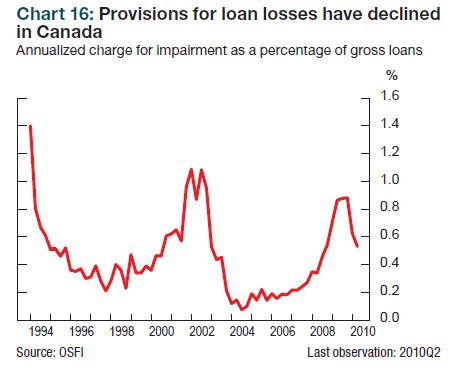
While Canadian banks continue to experience elevated loan losses, loss rates have declined materially in recent quarters (Chart 16).

footnote: We follow the convention of using the income statement expense, Provision for Credit Losses, as the measure of loan losses.


Click for big

Following the reviews of the financial and economic environment are the reports:

  • The Bank of Canada’s Extraordinary Liquidity Policies and Moral Hazard
  • The Impact of the Financial Crisis on Cross-Border Funding
  • The Role of Securities Lending in Market Liquidity
  • Securitized Products, Disclosure, and the Reduction of Systemic Risk
  • The Bank of Canada’s Analytic Framework for Assessing the Vulnerability of the Household Sector

Quite frankly, I find the reasoning in the Moral Hazard article to be a little opaque:

In an abnormal situation, where a large systemic event creates a widespread shortage of liquidity that disrupts a wide range of institutions and markets, distorting asset prices more generally, the Bank is most effective when it provides liquidity to a variety of institutions. Moral hazard is minimized by limiting such interventions to the shortest time period possible—specifically, to periods when the liquidity premium is significantly distorted across the system, leaving market participants fully exposed to risks associated with idiosyncratic shocks and small systemic shocks.

The idea that the BoC can determine when asset prices are distorted and when they are not smacks of hubris. Additionally, if the BoC is serious about minimizing moral hazard, its lending will always be at a penalty rate that ensures the borrowers are financing at a negative carry. Institutions with liquidity problems – all of them – should be offered a choice: finance your assets at the Bank at rates that will hurt you, or sell them at prices that will ruin you.

This was not done: the bank auctioned off credit at rates that made arbitrage profitable. The only excuse for doing so would be that the falling price of financial assets was having an effect on the real economy; but this was not the case in Canada.

Additionally:

Finally, the Bank supports the development, implementation, and ongoing functioning of the core infrastructure for generating liquidity in the Canadian financial system. This includes promoting greater use of central clearing counterparties for core funding markets, such as repos, as well as other mechanisms that help market participants to self insure against idiosyncratic liquidity shocks.

Do we have any engineers here? How many think that moving to a system subject to single-point failure is a step forward? Central clearing increases moral hazard by making the identity of your counterparties less important.

Contingent capital got a mention:

The prudential supervisor could also implement a scheme for converting subordinated debt into equity, contingent on a credit-risk event that depletes capital by an unacceptable amount.

footnote: See J. Dickson, “Protecting banks is best done by market discipline,” U.K. Financial Times, “Comment,” 8 April 2010.

The fact that the best reference the BoC can come up with is Dickson’s childish essay leads me to believe that the rot is spreading. I’m not sure whether it’s political capture (of the BoC by the Department/Minister of Finance) or regulatory capture (of the BoC by the banks), but either way is a sad thing; a sad thing that will ultimately cost us a lot of money.

The authors did not mention Carney’s notion to ban the bond. They’re going to get their knuckles rapped!

Finally, unable to defend the Bank’s actions during the crisis, the authors take refuge in an attempt to create a tautology where none exists:

It is impossible to eliminate all moral hazard, because
effective extraordinary intervention means that liquidity will be provided at a yield below what would prevail without the intervention.

Since liquidity premiums rise in a crisis because of the shortage of liquidity, the Bank provides liquidity at premiums below those prevailing in the market.

Very disappointing, and makes no allowance for the idea that in the absence of intervention some banks (hello, CM & BMO!) will have to borrow above the already elevated market rate.

The paper on securitization suffers greatly from the absence of Mark Zelmer, who, it will be recalled, wrote the single most sensible statement during the entire crisis:

In the end though, investors need to accept responsibility for managing credit risk in their portfolios. While complex instruments such as structured products enhance the benefits to be gained from relying on credit ratings, investors should not lose sight of the fact that one can delegate tasks but not accountability. Suggestions such as rating structured products on a different rating scale could be helpful, in that this may encourage investors to think twice before investing in such complex instruments. Nevertheless, investors still need to understand the products they invest in, so that they can critically review the credit opinions provided by the rating agencies.

Instead, the authors of this particular paper (as was the case with the authors of the December 2009 Review) drink the regulatory Kool-aid and insist that everybody is at fault except the guys who actually buy the stuff.

Much has been said about what went wrong with securitized products and what should be done to put securitization markets on a stable footing. The way forward includes several elements: (i) a better alignment of economic interests in the securitization process; (ii) appropriate prudential regulation and accounting standards; (iii) simplified and standardized structures based on high-quality real-economy assets; and (iv) greater standardization of documentation and increased transparency and disclosure to facilitate investors’ efforts to understand and manage the risks inherent in securitized products. Enhanced disclosure is only one necessary element of a comprehensive policy and industry response to the recent financial crisis.

Yes! After all, investing is simple. Let’s make sure that every bank teller in Canada can confidently recommend whatever is in the bank’s inventory, without ever having to know anything! Only in such a manner will bank profits be sufficient to hire lots of ex-regulators!

The way to eliminate the market’s systemic risk due to idiotic investing is to eliminate idiots from the market. This will be best done by publishing composite performance numbers as part of an advisor’s registration. In the case of banks, it is best accomplished by ensuring that traders actually trade, and surcharging risk-weighted assets if they become aged.

Mistakes are made by the best of us, and sometimes investments don’t turn out well even though no identifiable mistakes were made. But that only hurts you. Concentration kills you.

Contingent Capital

A Structural Model of Contingent Bank Capital

George Pennacchi, a Professor of Finance at the University of Illinois, has published a paper titled A Structural Model of Contingent Bank Capital that leads to some surprising – to me – conclusions:

This paper develops a structural credit risk model of a bank that issues deposits, share-holders’ equity, and fixed or floating coupon bonds in the form of contingent capital or subordinated debt. The return on the bank’s assets follows a jump-di¤usion process, and default-free interest rates are stochastic. The equilibrium pricing of the bank’s deposits, contingent capital, and shareholders’ equity is studied for various parameter values characterizing the bank’s risk and the contractual terms of its contingent capital. Allowing for the possibility of jumps in the bank’s asset value, as might occur during a financial crisis, has distinctive implications for valuing contingent capital. Credit spreads on contingent capital are higher the lower is the value of shareholders’ equity at which conversion occurs and the larger is the conversion discount from the bond’s par value. The effect of requiring a decline in a financial stock price index for conversion (dual price trigger) is to make contingent capital more similar to non-convertible subordinated debt. The paper also examines the bank’s incentive to increase risk when it issues di¤erent forms of contingent capital as well as subordinated debt. In general, a bank that issues contingent capital has a moral hazard incentive to raise its assets’risk of jumps, particularly when the value of equity at the conversion threshold is low. However, moral hazard when issuing contingent capital tends to be less than when issuing subordinated debt. Because it reduces e¤ective leverage and the pressure for government bailouts, contingent capital deserves serious consideration as part of a package of reforms that stabilize the financial system and eliminate “Too-Big-to-Fail”.

I am very pleased to see that the structure I have been advocating is receiving academic scrutiny. He discusses the model in terms of the CC proposals of McDonald and Flannery, both of which have been discussed on PrefBlog.

I have difficulty with some of the assumptions:

If a bank’s asset returns follow a pure difusion process without jumps, and fixed-coupon contingent capital converts to shareholders’ equity at its par value, then contingent capital’s new-issue yield-to-maturity (par coupon rate) equals a default-free par rate, such as a Treasury bond yield. But since the possibility of conversion lowers contingent capital’s effective maturity, contingent capital’s comparable default-free yield is less than that of its stated maturity. Thus, if the term structure of default-free Treasury yields is upward sloping, as it normally is, the yield on contingent capital will be less than that of an equivalent-maturity Treasury bond. However, for the case of contingent capital that pays floating-rate coupons, coupon credit spreads above the short-term, default-free interest rate always will be zero.

This assumes that

  • The converted noteholder sells his equity immediately upon receipt
  • He realizes the trigger price for it (or, as in the case of the McDonald pricing computations discussed elsewhere, very nearly)

This doesn’t work for me. According to me, in order to determine a credit spread, you would have to assume that the converted noteholder hangs on to his equity and sells it on the original maturity date. Assuming immediate sale at the trigger price (nearly) is akin to computing credit spreads due to default with the assumption that the holder can see default coming and sells early.

I suggest that, at the very least, one should look at the discount to market on bank new issues during the crisis (not rights issues, which will often be heavily discounted to ensure take-up; unfortunately this basically eliminates European banks from the sample), and apply this discount to the proceeds on conversion and sale. For example, the CIBC recapitalization was done with the help of a private placement at $62.65 net of fees, compared to its previous close of $72.07. A 14% haircut on conversion – even when converted at par, converting at an explicit discount will be worse – will change the numbers considerably.

Assiduous Readers may make their own assumptions about the effect of the “effective stop-loss order effect” of immediate market orders to sell upon conversion (during a crisis!) according to whatever answers they want to justify. But I don’t think an implicit assumption of 0% frictional or temporal cost is justifiable. It’s too much like assuming 100% recovery on default.

I have more difficulty – similar to my problems with recent advocacy of floating rate contingent capital:

If a bank’s asset returns follow a pure diffusion process without jumps, and fixed-coupon contingent capital converts to shareholders’ equity at its par value, then contingent capital’s new-issue yield-to-maturity (par coupon rate) equals a default-free par rate, such as a Treasury bond yield.

This ignores things like liquidity premia, central bank collateralization premia and default uncertainty, which in this case can be expressed as conversion uncertainty – and that’s just for starters!

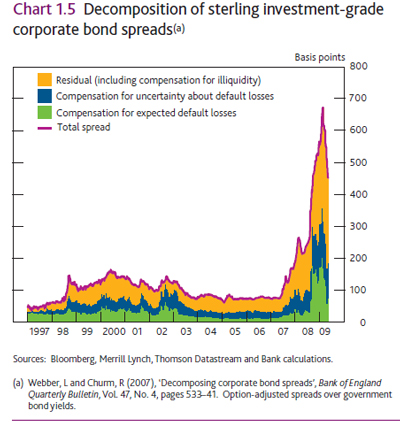
I feel compelled to republish one of my favourite graphs, previously shown in the post BoE Releases June 2009 Financial Stability Report:

Arguments that depend on corporate bond yields hugging the green line are doomed to failure, even when the bonds are senior! I will also point out that the liquidity premium on CC is likely to be significantly higher than that on senior bonds, as the investor base is likely to be significantly smaller.

When, more realistically, the bank’s asset returns incorporate a jump process, contingent capital that is speci…ed to convert at its par value will have a yield that rises above default-free yields. This positive credit spread is due to the potential losses that contingent capital investors would suffer if a sudden decline in the bank’s asset value requires conversion at below par value. An implication is that new issue credit spreads on contingent capital rise as the bank’s total capital and the value its original shareholders’ equity declines. Credit spreads on contingent capital also are higher the lower is the value of shareholders’ equity at which conversion is specified to occur and the larger is the conversion discount from the bond’s par value. The effect of requiring a decline in a financial stock price index for conversion, the “dual price trigger” feature proposed by McDonald (2009), is to make contingent capital more similar to non-convertible subordinated debt.

The guts of the paper are:

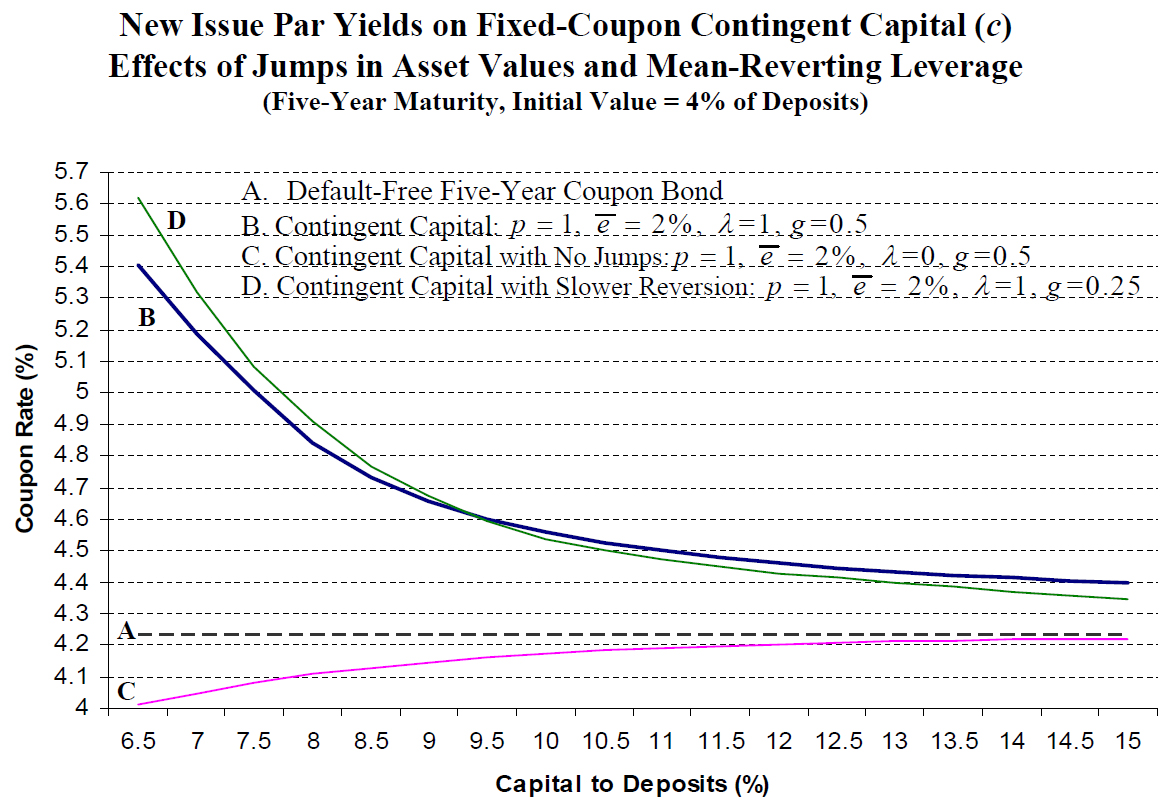
Figure 2 gives the new issue yields for …xed-coupon contingent capital, c, when the bank’s initial total capital ranges from 6.5% to 15%. Recall that the default-free term structure is assumed to have an initial instantaneous maturity interest rate of r0 equal to 3.5% and the par yield on a five-year Treasury coupon bond is 4.23%. This 4.23% default-free, five-year par yield is given by the dashed line denoted Schedule A in the …gure. In comparison, Schedule B of Figure 2 shows that the benchmark contingent capital bond’s new issue yield is 5.41%, 4.56%, and 4.39% when initial capital is 6.5%, 10%, and 15%, respectively.

This contingent capital bond’s yield spread above the five-year Treasury is due to the possibility that it could convert at less than par following a downward jump in the bank’s asset (and equity) value. If all of the benchmark parameters are maintained except one assumes there is no possibility of jumps (λ = 0), then the contingent capital bond’s spreads over the five-year Treasury yield would not be positive. Indeed, given the assumption of an upward-sloping term structure, Schedule C of Figure 2 shows that spreads would be slightly negative. Since conversion lowers the e¤ective maturity of contingent capital and, without jumps, it always converts at par, it is e¤ectively a default-free bond with a maturity of less than five years. Hence, its yield is more like a that of a shorter-term default-free bond, which is below the five-year default-free yield. Thus, one sees that the possibility of jumps in the bank’s asset value, as might occur during a financial crisis, has a qualitatively important impact on the pricing of contingent capital.


Click for Big

Other charts include:

  • Effect of Maturity
  • Effects of conversion terms
  • Effects of conversion parameters
  • Effect of a Dual Price Trigger

But by me, the most interesting conclusion is:

A bank that issues contingent capital faces a moral hazard incentive to increase its assets’ jump risks. However, this incentive to transfer value from contingent capital investors to the bank’s shareholders is smaller than that when the bank has issued a similar amount of subordinated debt rather than contingent capital. Thus, relative to the status quo, there is likely to be a decline in moral hazard if contingent capital replaces subordinated debt. The results show that excessive risk-taking incentives also decline as contingent capital’s equity conversion threshold rises. With a bigger “equity cushion” at the conversion threshold, there is a smaller likelihood that a sudden loss in bank asset value would prevent full conversion, thereby better protecting contingent capital investors from losses.

He even addresses Julie Dickson’s proposal (although not her fabricated assertion, unchallenged by the press, that fixed-dollar conversion is universally favoured):

In other words, for the benchmark contingent capital bond, at a point just before conversion, there would need to be a sudden asset value loss exceeding 2% to prevent full conversion, while for the contingent capital bond with e = 1%, at a point just before conversion, there would need to be a sudden asset value loss only slightly more than 1% for bondholders to sustain a conversion loss. This finding has implications for recent regulatory proposals that would have contingent capital convert only when a bank was in dire straits and close to being seized by regulators. [footnote] Delaying conversion to a point when the value of original shareholders’ equity is low raises the new issue yields on contingent capital.

footnote: Canada’s superintendent of financial institutions, Julie Dickson, proposes that the conversion trigger for contingent capital would be “when the regulator is ready to seize control of the institution because problems are so deep that no private buyer would be willing to acquire shares in the bank.” Financial Times, April 9, 2010.

Update, 2010-6-6: A new reader has very kindly provided extensive commentary on my critique of this post. He claims (as paraphrased by me, JH):

(i) New equity issues from banks are not structurally equivalent to CC conversion : New equity makes extant debt safer; therefore transfers value from extant equity holders to debt holders; therefore a decline in equity price is expected. This is not the case when CC is converted.

JH – By this reasoning, my reference to the 14% new issue discount on the CIBC recapitalization is not relevant. Well …maybe!

(ii) CC holders experience a regime change on conversion and the original maturity date does not apply. The new equity may be sold or held, depending upon the holders’ views on the stock. If the stock price rises from the trigger price, the noteholders could even realize excess returns. Thus, the CC may be thought of as being default-free as of the conversion date.

JH – Well, you can bet this is the line that the salesmen will take! A lot of it depends upon perspective: it may be true from the bank’s point of view, the market’s point of view and the regulators’ point of view … but, naturally enough, I am considering it from a specialist bond managers’ point of view: who will at the very least see the risk/return profile of the portfolio visibly change; whose mandate will almost certainly prohibit the holding of equity; and who will very likely be forced to sell the stock at whatever it will fetch which (due to the ‘cascading stop-loss effect’ at the very least) will likely be lower than the conversion price.

Additionally, the reasoning incorporates the assumptions that all mathematical models must incorporate, at least to some degree: that there is infinite liquidity and that assets will be fairly priced in the future. The credit crunch has reminded us of just how battered these assumptions can be during a crisis; as a practitioner, I must take a jaundiced view.

(iii) Bank asset values jump, therefore CC is in fact credit-risky; but credit risk declines with higher trigger points

In the presence of jumps, credit risks result from the potential for the equity value to jump over the trigger point; therefore the CC will convert at a higher price than market, therefore the CC holders will experience a loss; therefore the CC is credit risky.

But importantly, CC is less credit risky than sub-debt and, by reducing leverage, will facilitate new issues of equity. It is also important to note that the credit risk introduced by the jump process declines with higher trigger/conversion prices.

JH – Again, perspective is important; a specialist bond manager (or bond portfolio manager within an integrated firm, for that matter) will not view the paper as having minimal credit risk when the trigger price is 99.9% of the current stock price. Additionally, the significant amount of duration risk at this limiting point will make such an issue very hard to integrate into a well defined portfolio.

There may well be a branch of bond mathematics that deal with this question, but I am not aware of it: I am sufficiently arrogant to claim that if I am not aware of a branch of bond mathematics, then at least 95% of bond portfolio managers are similarly ignorant.

As an unconstrained bond manager, I would be sorely tempted to buy a put on the equity, with the strike price equal to the conversion price and view the CC + put as a package. My view on the attractiveness of the package would be heavily influenced by the net yield of the continuing position. However, the chances of me, as a bond specialist, of having a mandate that allows the purchase of equity puts are infinitesimal and there will be asset allocation problems at the most integrated of management firms. I think that this area becomes hedge fund territory.

Update, 2010-6-6: My correspondent was Prof. Pennacchi. He has given me permission to quote his remarks in full, which I have done in the post Pennacchi Discusses CoCo Structural Model.

Contingent Capital

Contingent Capital with a Dual Price Trigger

Robert McDonald of Northwestern University has published a paper titled Contingent Capital with a Dual Price Trigger that I consider excellent – mainly because it advocates a framework for Contingent Capital that includes the structure I advocate (and have been advocating ever since HM Treasury’s Turner Report response brought the basic idea to my attention) and supports it with rationale that reflects my biases.

This paper proposes a form of contingent capital for financial institutions that converts from debt to equity if two conditions are met: the firm’s stock price is at or below a trigger value and the value of a financial institutions index is also at or below a trigger value. This structure protects financial firms during a crisis, when all are performing badly, but during normal times permits a bank performing badly to go bankrupt. I discuss a number of issues associated with the design of a contingent capital claim, including susceptibility to manipulation and whether conversion should be for a fixed dollar amount of shares or a fixed number of shares; the susceptibility of different contingent capital schemes to different kinds of errors (under and over-capitalization); and the losses likely to be incurred by shareholders upon the imposition of a requirement for contingent capital. I also present some illustrative pricing examples.

His specific proposal is:

The contingent capital claim that I describe, “dual trigger contingent capital”, converts automatically based on market prices, without reference to accounting-based measures of capital. Specifically, it converts to equity when the bank’s own stock price falls sufficiently, and then only if a broad nancial stock index is also below a trigger value. (This condition can be eliminated by making the trigger sufficiently large.) This structure reduces the debt load for poorly-performing institutions in times of crisis, but permits individual banks to fail in good times.

The major benefits of using market prices are:

Simplicity and transparency should facilitate market acceptance and reduce the (appropriately-measured) cost to banks of issuing convertible claims. The use of market-based triggers, with no reliance on accounting numbers, means that conversion is unaffected by accounting rule reinterpretations or changes. Making conversion automatic and based only on market prices should reduce pressure on regulators and the accounting community at critical times. Also, private information of either the firm or the regulator has no bearing on the conversion decision.

My point that using market prices and fixed conversion rates will facilitate the hedging of CC in the options market – and therefore the liquidity in a crisis – may be considered included in the “facilitate market acceptance” phrase.

I did not address one point he considers critical (which was further discussed, albeit in a highly unsatisfactory manner, by FRBNY staff) is:

A critical issue is the precise manner in which conversion occurs, and the possibility of stock price manipulation. In Section 3 I discuss a number of design considerations and I conclude that conversion of the bond into a fixed number of shares at a premium price minimizes concerns about manipulation.(footnote) The tradeo is that such a structure raises the yield on convertible debt. (This greater yield is of course fair compensation for the loss imposed upon bondholders should conversion occur.)

footnote: “Premium price” here means that the value of the shares upon conversion is lower than the par value of the bonds. In e ect, the bondholder is paying a greater than market price for the shares received. I dicuss this more in Section 1.

So consider a pref issued at $25 when the common is at $50. In the base proposal, if the common falls below $25 (for a defined period), the pref will convert at par into the trigger price; preferred shareholders will receive one common for each pref. With “premium pricing”, preferred shareholders will received less than one share, while the trigger price remains the same. I’ll discuss this later.

Also, note that I am (for obvious reasons) focussing on preferred shares while all the academic discussion I have seen focusses on sub-debt. I think that should CC effectively replace sub-debt, then similar conversion features will be applied to prefs – otherwise, preferreds will be effectively senior to CC (in that they will retain their claims when everything else is converted, and remain senior when the bank goes bust) and I don’t think the markets will stand for such leapfrogging.

His example provides the rationale behind an expected yield spread over senior debt:

To more fully understand the events at conversion, suppose that at some time after issue the nancial index is below 90 and the stock price reaches $50. At this point bondholders are entitled to 20 shares. Typically, however, the stock price will not close exactly at $50, but say at $48. In this case the bondholders receive shares worth 20  $48 = $960. Thus, conversion on average will leave the bondholders slightly worse o than if the bond paid par value. As a result, the market will demand a slightly higher interest rate on the bond than if it were sure to convert into $50 worth of shares.(footnote)

footnote: An alternative would be to adjust the number of shares to make their value equal to the par value of the bond. As I discuss in Section 3, this alternative conversion scheme increases the returns to stock price manipulation.

In other words, the option effect. I should note that there will also be a spread required due to uncertainty – typically, bond holders will not have a mandate or desire to hold equity; hence, it is likely that the embedded short option will be overvalued.

He notes:

This structure accomplishes several things:

  • The conversion of bonds to shares occurs only if there is a widespread fall in the value of financial firm shares. One would expect such a widespread fall during a nancial crisis, not at other times.
  • A dual trigger convertible permits the failure of an institution as long as the nancial industry as a whole is peforming well. Without a fall in the index, bonds would not convert and the financial institution could go bankrupt. The note can be structured to avoid this.
  • There would be no regulatory involvement in the conversion decision
  • Conversion would not depend upon acccounting rules or the institution’s reported capital. If the market believed that a bank’s assets were worth less than the bank reported, conversion would occur if the share price and index conditions were satisifed.
  • The proposal is not subject to equity death spirals: In the fixed share structure, the number of shares exchanged for bonds would be fixed.

These are eminently sensible reasons. However, I remain dubious about the inclusion of the second, industry-wide trigger. Firstly, it will depend upon the composition of third-party indices, which can be – and often are – manipulated. Secondly, it will complicate pricing of the CC, which will mean that not all of the mathematical benefits of the reduced conversion chance will be realized.

Additionally, his footnote to the second point states:

If an institution is too-big-to-fail, the use of an index trigger raises the possibility of multiple equilibria. Consider a circumstance where a) the financial index would fall below the trigger if and only if the too-big-to-fail institution were to fail and b) conversion of the contingent capital would prevent failure. If the contingent capital were expected to convert and prevent failure, the index would never fall below the trigger value and thus the contingent capital would not convert. If the contingent capital were expected not to convert, the index would fall below the trigger value and the capital would convert. While the requirements seem empirically unlikely, it would be important to understand the equilibrium that would obtain in this case. I thank Zhenyu Wang for pointing out this issue.

He discusses the Flannery and Squam Lake proposals previously discussed on PrefBlog:

The Flannery and Squam Lake proposals differ in the nature of the trigger, but more importantly they differ in the severity of the event that will cause conversion. The Squam Lake proposal implicitly seems to view hybrid convertibles as a last-ditch measure: banks would have violated covenants and more importantly, regulators would have declared the existence of a crisis. Presumably one reason for using contingent capital would be to prevent a systemic crisis from occurring in the rst place. Is it possible that the use of a regulatory trigger creates multiple equilibria? Could regulators declaring the existence of a crisis could induce or worsen a crisis? More generally, it seems possible that regulators worrying about maintaining con dence in capital markets would would be reluctant to declare the existence of a crisis until it is too late.

I take the view that a regulatory declaration that a crisis existed would grossly exacerbate an already bad market situation. Additionally, prior uncertainty regarding a regulatory decision will depress the price of the CC, exacerbating the value transfer problem deplored by FRBNY staff.

McDonald discusses the potential for manipulation:

In the context of contingent capital, a concern is that unprofitable manipulation of the stock can become profitable when the trader also has a position in market-triggered contingent convertibles. This seems to be a legitimate concern. In this discussion we will suppose for the sake of argument that it is possible for traders to temporarily move the price (for example temporarily push it down), while maintaining the traditional academic skepticism that such trading in shares alone can be pro table. Ultimately the possibility of extensive manipulation and its importance is an empirical question.

He gives an example of manipulation:

To see how manipulation could be profitable, suppose that the stock is $51, and a $1000 bond converts into 20 shares when the price goes below $50. A trader owning this bond could possibly manipulate the price down to $49. This forces conversion, and the bondholder now owns 20 shares. When the price returns to $51, the bondholder has a position worth $1020, and has induced a 2% gain on the convertible (from $1000 to $1020) by triggering conversion.

It should be noted that the profitability of this eneavor will be increased if the trader has actually just purchased the CC at $900. But my question is: Is this manipulation, or is it arbitrage? Additionally, the assumption that the price returns to $51 implicitly assumes that the value of the firm is $51 and that markets are sufficiently efficient to reflect this value – this is a precise estimate and shaky assumption at the best of times and it may be assumed that conversion will occur during a period of highly inefficient markets.

To my mind, the important question is not whether a trader might be able to make a few bucks with the strategy, but whether such a strategy has the potential to cascade, with the approach of imminent conversion of other instruments – another series of bonds converting at $48. I’m not really all that concerned about transitory manipulation, since that simply provides an opportunity for value investors to buy at an artificially low price; but there could be genuine public policy concerns if this artificially low price made it difficult, or even impossible, for the firm to issue new capital at rates that permitted it to operate as a going concern. The attack on CIT group which essentially locked it out of the bond market until bankruptcy was triggered comes to mind as a possible example; but I have a feeling that we don’t know the whole story on that one.

It should be noted that, to the extent that converted former noteholders elect to sell their shares at the market, the effect can be modelled as a stop-loss order; such orders have been suggested as a factor in the May 6 market bungee-jump even though the exchanges have built in some protection against the effect.

I can’t really get all that excited about the issue of market manipulation – the only people hurt will be the idiots who trade on momentum. I suggest that the potential for what is, effectively, a stop-loss cascade is more worthy of academic attention.

His prescription is premium conversion:

The difficulty of the manipulation just described can be increased by creating a wedge between the par value of the bond and the conversion value of the shares, i.e, the bond could convert at a premium price for the shares. For example, the bond could convert into 19 shares rather than 20. The bondholder who forced conversion would then receive a position worth $950 at the $50 trigger price, a loss of ($1000 – $950)/19 = $2:63/share generated by conversion. If the share price were $51 as in the previous example, the bondholder would lose $1.63/share by manipulating the price below $50. Temporary manipulation to a price below $50 would not become profitable until the true share price was at least $52.63. Hence, any manipulation would have to be by a greater amount to compensate for the premium price. Because conversion at a premium price would require a greater manipulation to make conversion profitable, manipulation would be both less likely and easier to detect. In fact, if shares convert at a premium, bondholders would have an incentive to manipulate the price up to avoid conversion. This seems likely to be more difficult than the downward manipulation just discussed, because the price has to be kept up indefinitely (or until the bond matures) to forestall conversion. If at any time the price falls, the bond converts. Also, propping up the price will be increasingly difficult to accomplish if the bank is in distress.

This is not entirely satisfactory, as it assumes the manipulator will be buying the bond at par, whereas in practice it is much more probable – virtually certain – that the manipulator will have purchased the bond well below par from a spooked investor who is taking a loss. For any premium, there will be some bond price that restores profitability, which may be thought of as providing a floor for the bond price. Thus, extant holders will be indirect and incomplete beneficiaries of the potential for manipulation.

He then notes that fixed-dollar conversion (conversion at market value) and is more susceptible to manipulation than fixed-share conversion.

He discusses instances in which CC does not act optimally in the context of Type I errors (conversion occurs when capital is not required) and Type II (conversion does not occur when capital is required):

In summary, market-based triggers seem prone to type I errors, and regulatory and accounting-based triggers seem prone to type II errors. It seems unlikely that there would be a systemic crisis without financial firms having low stock prices. This would reduce the likelihood of a type II error for market-based triggers. Accounting and regulation, however, are not automatic, and both are subject to political winds and whims. Basing conversion on regulatory judgment would reduce the likelihood of a type I error, in which bonds converted into stock without any crisis. But as discussed, one can imagine regulators failing to act. It is interesting to note that both the Flannery and Squam Lake proposals try not to saddle financial firms with “too much” equity. Flannery’s would convert only enough bonds to meet a capital requirement, and Squam Lake’s would convert only for banks with a low capital ratio.

To my immense gratification, he details problems with accounting-based conversion triggers:

  • Most accounting is done periodically rather than continuously.
  • Accounting rules are subject to political pressure.
  • Accounting rules are subject to arbitrage.
  • Accounting measures are often backward-looking

Of immense interest are his calculations regarding CC pricing:

In this section I perform some simple pricing exercises to illustrate characteristics of a dual-trigger contingent convertible under the assumption that both the stock price of the firm and the index are lognormally-distributed. Specifically, I assume that the stock price, St, and index price,Qt, both follow Ito processes, which is the standard assumption in the Black-Scholes model:

The correlation between dSt and dQt is ρ. Appendix A details the calculations. The stock price cannot reach zero in equation (1), so the yield calculation occurs in a context where bankruptcy is impossible. The yields I report therefore reflect only the effects of conversion.

Critical inputs into the pricing model are the volatility of the index, which I set to equal 20%, approximately the historical volatility of the Dow Jones Financial Services index from 1992 to 2007, and the stock volatility, which I set to 30%, approximately the historical volatility of banks like Citi, BofA, and Wells Fargo over this period. The correlation between the firm stock return and that of the index, again selected based on history, is 0.85.

Tables 1 and 2 illustrate the pricing of the convertible in a simple setting where
bankruptcy of the firm does not occur under any circumstances, but the convertible converts when the stock and index triggers are both satisifed. Pricing is by Monte Carlo. Specifically, I simulate the stock and index price, drawing new prices every day. The first time the stock and index prices are both below the trigger, the bond converts into a fixed number of shares. This simulation thus explictly models conversion occurring at a price below the trigger price, and thus generates a yield greater than the risk-free rate. The number in both tables is the annual yield premium above the risk-free rate.

Table 1 presents the bond yield premium when conversion occurs at the trigger price: If the bond has a par value of $1000 and the trigger price is $50, the bond converts into 20 shares. The maximum yield occurs when the stock trigger is relatively high (70% of the initial price) and the index trigger is low (80% of the initial index price). In this case it is relatively likely that the index trigger will not be satisifed when the stock reaches the trigger price, and thus on average conversion will occur when the stock is signi cantly below the trigger price. The resulting premium is over 1%. Conversely, in the rightmost column the index trigger effectively does not exist. In this case the 25 basis point premium is entirely attributable to the bond converting below the trigger price. With a low stock trigger and a high index trigger, the bond premium is a negligible 2 basis points.

Table 2 examines the case where there is a 10% stock price premium at conversion.

>

Table 1: Debt premium as a function of the index trigger and stock trigger. Assumes S0 = $100, Q0 = $100, σs = 0:30, σi = 0:20, ρ = 0:80, T = 5:00 years, h = 0:0040 (simulation timestep), r = 0:0400, with 50000 simulations. The conversion premium is 0.0000.
Note: I have converted the figures from the published table into basis points – JH
Stock Trigger Index Trigger
80 100 120 140 1000
70 121 42 27 25 25
60 55 22 16 16 15
50 23 11 9 9 9
40 8 6 5 5 5
30 3 2 2 2 2

Thus, my original proposal is reflected in cell (1000, 50) of the table, and shows that there will be a yield premium of 9bp due to the conversion feature. Note, however, that this premium is a little bit of a cheat; losses are due only to the stock price over-shooting the conversion price, with the assumption that the shares are sold immediately.

Update, 2010-6-8: Prof. McDonald advises that: there is a certain amount of skepticism regarding the second, index-based, trigger; that there is concern regarding multiple equilibria if the conversion price is at a premium to the trigger price; that regulators consider the idea interesting but want more details and discussion; and that the potential for manipulation may increase the cost to issuers.

Update, 2010-6-10: I should note that the conversion trigger proposed by Prof. McDonald implies that a single trade of 100 shares can do the job. In my original proposal, I urged that the trigger be based on the common’s VWAP over a given period – say, 20 consecutive trading days. The latter format will make manipulation considerably more difficult, at the expense of potentially trapping CC noteholders in their investment if the common price declines precipituously over the VWAP measurement period.
Contingent Capital

FRBNY Staff Propose Floating Rate Contingent Capital

The Federal Reserve Bank of New York has released Staff Report #448, by Suresh Sundaresan and Zhenyu Wang, titled Design of Contingent Capital with a Stock Price Trigger for Mandatory Conversion:

The proposal for banks to issue contingent capital that must convert into common equity when the banks’ stock price falls below a specified threshold, or “trigger,” does not in general lead to a unique equilibrium in equity and contingent capital prices. Multiple or no equilibrium arises because both equity and contingent capital are claims on the assets of the issuing bank. For a security to be robust to price manipulation, it must have a unique equilibrium. For a unique equilibrium to exist, mandatory conversion cannot result in any value transfers between equity holders and contingent capital investors. The necessary condition for unique equilibrium is usually not satisfied by contingent capital with a fixed coupon rate; however, contingent capital with a floating coupon rate is shown to have a unique equilibrium if the coupon rate is set equal to the risk-free rate. This structure of contingent capital anchors its value to par throughout the time before conversion, making it implementable in practice. Although contingent capital with a unique equilibrium is robust to price manipulation, the no-value-transfer condition may preclude it from generating the desired incentives for bank managers and demand from investors.

They commence with an overview of the market and current issuance:

Recently there have been a few issues of junior debt with such conversion provisions. Lloyds Bank recently issued the so called contingent convertible (CC, or “Coco bonds”). These bonds will convert into ordinary shares if the consolidated core tier one ratio of Lloyds falls below 5%. The bonds themselves are subordinated bonds, which prior to conversion count as the lower tier 2 capital, but count as core tier 1 in the context of the Financial Services Authority (FSA) stress tests. They will count as core tier 1 for all purposes upon conversion. Swiss regulators are encouraging Swiss banks to issue contingent capital. In Germany, preferred stocks have been issued with similar features.

I didn’t know about the German prefs!

The authors are obsessed with value transfer:

The main thrust of our paper is the following: when triggers for mandatory conversion are placed directly on equity prices, there is a need to ensure that conversion does not transfer value between equity and CC holders. The economic intuition behind CC design problem is as follows. In the contingent capital (CC) proposed in the literature, junior debt converts to equity shares when the stock price reaches a certain threshold at low level. This sounds like a normal and innocuous feature. However, the unusual part of the CC design is that conversion into equity is mandatory as soon as stock price hits a trigger level from above. Since common stock is the residual claim of bank’s value, it must be priced together with the CC. Keeping firm value fixed, a dollar more for the CC value must be associated with a dollar less for the equity value.8 Therefore, a value transfer between equity and CC disturbs equilibrium by moving the stock price up or down, depending on the conversion ratio specified. The design of the conversion ratio must ensure that there is no such value transfer. The design proposals in the literature usually ensure that there is no value transfer at maturity, but do not ensure it before maturity.

Basically – as far as I can tell, the case against value transfer is not made explicit – value transfer will create an incentive for manipulation. If a Contingent Capital issue has a price and conversion feature such that conversion will be profitable, it will be in the interest of the investor to attack the bank stock in an attempt to force this conversion. My problem with this obsession is that I don’t have a problem with that and don’t think the regulators should, either. The potential for value transfer has been discussed on PrefBlog, in the post Payoff Structure of Contingent Capital with Trigger = Conversion.

The only way to prevent this is to ensure that there is no value transfer at conversion. This requires that at all possible conversion times, the value of converted shares must be exactly equal to the market value of the un-converted CC. This requirement implies that the conversion ratio usually cannot be chosen ex-ante once the trigger level has been chosen: this is due to the fact that the trigger level multiplied by the conversion ratio must equal the market value of the un-converted CC. However, there is one scenario when we can select the conversion ratio ex-ante: this corresponds to the design of CC such that the coupon payments are indexed in such a way that the CC always sells at par. In this case, we can set the conversion ratio as simply the par value divided by the trigger level of stock price at which mandatory conversion will occur. We explore this design possibility further in the paper.

In order to ensure that the CC is always priced at par, they take a huge leap:

To use the par value for conversion ratio, we need to focus on a structure that makes the market value of the CC immune to changes in interest rates and default risk. For example, if the CC had no default risk, then by selecting the coupon rate at each instant to be the instantaneously risk-free rate we can assure that the CC will trade at par. See Cox, Ingersoll and Ross (1980) for a proof of this assertion

It has been a long time since I’ve read the Cox, Ingersoll & Ross paper and, frankly, I don’t remember that conclusion. But I don’t need to remember it, since it’s nonsense. It implies that there is a zero (or at least constant) liquidity premium: if I am holding short term paper, it’s because I may want cash in the near future. Why would I buy long dated paper that I might be able to turn into a known quantity of cash when I can buy actual Treasury Bills that will definitely turn into cash? I need a premium to buy the long stuff, and that premium will be based on my assessment of the likelihood of my actually needing the cash. The premium will change according to my – and the market’s – changing assessment of the potential need. That’s basic Liquidity Hypothesis stuff.

With default risk, however, no design of floating coupons will actually guarantee that the CC will sell at par. However, by choosing the coupon to reflect the market rates on short-term default-risky bank obligations it is possible to keep the price close to the par value. For example, if the coupon is tied to London Inter-bank Offered Rates (LIBOR) then the price of CC, which is a bank floater should remain close to par.

There are notes like this already – for instance Scotiabank’s perps:

August 2085 Floating US $182 million bearing interest at a floating rate of the offered rate for six-month Eurodollar deposits plus 0.125%. Redeemable on any interest payment date. Total repurchases in 2009 amounted to approximately US $32 million

There was a craze for securities of this type in the late 1980’s. It collapsed. Just like Monthly Auction Preferred Shares and all the other crap that seeks to fund long term debt at short term rates [and who knows? Maybe FixedResets will be the next example!]

This disregard of financial history mars the paper, but there are some other good references and notes:

Consistent with many other observers (e.g., Acharya, Thakor and Mehran, 2010), we note that the mandatory conversion of junior debt should automatically result in suspension of dividends to all common stock holders. Holding other factors the same, this should serve to alleviate the selling pressure: any attempt to short the stock by the holders of CC will also result in losses in foregone future dividends on their long positions.

I don’t agree.

However, it is nice to see a Fed paper looking at the type of CC structure that I have been arguing in favour of for a long time! It’s also pleasant to see a proper paper, with proper references and no outright fabrications, unlike those produced by Julie Dickson of OSFI.

Interesting External Papers

FRBNY Staff Examine Sub-Prime RMBS Credit Ratings

The Federal Reserve Bank of New York has released Staff Report #449 by Adam Ashcraft, Paul Goldsmith-Pinkham and James Vickery titled MBS Ratings and the Mortgage Credit Boom:

We study credit ratings on subprime and Alt-A mortgage-backed-securities (MBS) deals issued between 2001 and 2007, the period leading up to the subprime crisis. The fraction of highly rated securities in each deal is decreasing in mortgage credit risk (measured either ex ante or ex post), suggesting that ratings contain useful information for investors. However, we also find evidence of significant time variation in risk-adjusted credit ratings, including a progressive decline in standards around the MBS market peak between the start of 2005 and mid-2007. Conditional on initial ratings, we observe underperformance (high mortgage defaults and losses and large rating downgrades) among deals with observably higher risk mortgages based on a simple ex ante model and deals with a high fraction of opaque lowdocumentation loans. These findings hold over the entire sample period, not just for deal cohorts most affected by the crisis.


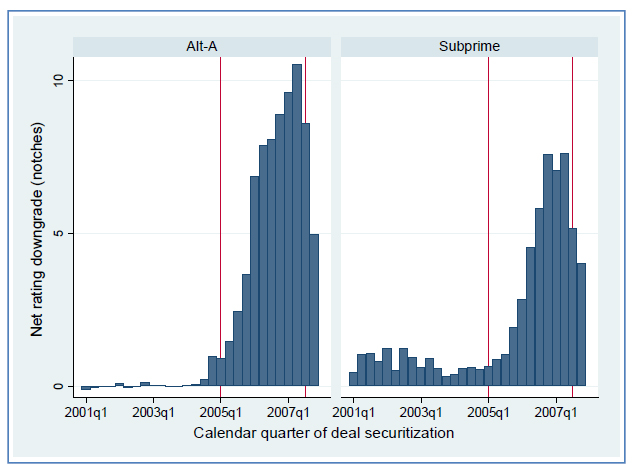
Click for Big

Figure plots average net nonprime MBS ratings revisions by calendar quarter of deal issuance. Covers subprime and Alt-A deals in our sample issued between Q1:2001 and Q4:2007. Y-axis measures the average net number of rating notches that securities issued in calendar quarter have been downgraded between issuance and August 2009, weighted by security original face value.

Figure 1 plots net rating revisions on subprime and Alt-A MBS issued since 2001. While net rating revisions are small for earlier vintages, MBS issued since 2005 have experienced historically large downgrades, by 3-10 rating notches on average, depending on the vintage. Critics interpret these facts as evidence of important flaws in the credit rating process, either due to incentive problems associated with the “issuer-pays” rating model, or simply insufficient diligence or competence (e.g. US Senate, 2010; White, 2009; Fons, 2008).1 In their defense however, rating agencies argue that recent MBS performance primarily reflects a set of large, unexpected shocks, including an unprecedented decline in home prices, and a financial crisis, events which surprised most market participants.

They look at the problem of relative risk:

The second part of our analysis examines how well credit ratings order relative risks across MBS deals from within a given cohort. Here we focus on studying variation in realized performance. If credit ratings are informative, mortgages underlying deals rated more optimistically (i.e. lower subordination, or equivalently a larger fraction of highly-rated securities), should perform better expost, in terms of lower mortgage default and loss rates. Furthermore, prior information available when the deal was initially rated should not be expected to systematically predict deal performance, after controlling for credit ratings. This is because this prior information should already be reflected in the ratings themselves, to the extent it is informative about default risk.

I strongly disagree with their assertions in thelast two sentences, which is simply a variation on the Efficient Market Hypothesis. As I have repeatedly stressed, financial markets represent a chaotic system, which is a system in which various factors leading to the result can interact in unusual ways – a small difference at time 0 can eventually be shown to lead to an enormous difference at time t.

If I work for a garden center and predict fine planting weather for the following weekend – which turns out to be disastrously wrong – the discovery that I neglected to account for a butterfly flapping its wings in China an extra time does not make me incompetent and does not prove that the conflict of interest presented by the nature of my employment corrupted my obectivity. Either conclusion could be true, but require a lot more proof than the premises stated.

Mind you, the authors’ data is much more obviously relevant to the problem than in the garden-centre scenario:

We find higher subordination is generally correlated with worse ex-post mortgage performance, as expected. However, conditional on subordination, time dummies and credit enhancement features, we also find significant variation in performance across different types of deals. First, MBS deals backed by loans with observably risky characteristics such as low FICO scores and high leverage (summarized by the projected default rate from our simple ex-ante model) perform poorly relative to initial subordination levels. Moreover, deals with a high share of low- and no-documentation loans (“low doc”), perform disproportionately poorly, even relative to other types of observably risky deals. This suggests such deals were not rated conservatively enough ex-ante.

Importantly, they show that these correlations are robust throughout the period of interest:

These findings hold robustly across several different measures of deal performance: (i) early-payment defaults; (ii) rating downgrades; (iii) cumulative losses; (iv) cumulative defaults. In some cases, our results are magnified for deals issued during the period of peak MBS issuance from the start of 2005 to mid-2007. However, perhaps most notably, we repeat our analysis separately for each annual deal cohort between 2001 and 2007. We find that the underperformance of low-doc and observably high risk deals holds surprisingly robustly over the entire sample period, including earlier deal vintages not significantly affected by the crisis. Indeed, these differences in performance can be observed even only based on performance data publicly available before the crisis starts.

This is an important test, but still does not prove incompetence or corruption. It is important to consider what information was available during the peak period – had these correlations shown up at that time? They address this question in the section “Loan Level Model”:

While we are careful to estimate the model parameters only using prior available data, a “look-back” bias may also arise if our choice of explanatory variables or model structure is influenced by knowledge of the evolution of the crisis. To minimize these concerns, we deliberately choose a simple model structure (a basic logit), and consider only explanatory variables that CRAs also used in the rating process. For example, Moody’s (2003) description of their primary subprime ratings model lists as inputs all the main variables included in our default model specification.8 We emphasize that this default model is intentionally simple, to avoid look-back biases, and in several respects is less complex than the models used by rating agencies themselves.9 Any shortcomings of our model lower the benchmark against which credit ratings are compared as a predictor of deal performance (see Section 7 for further discussion).

The literature review is CRA-hostile, ranging from the trivial:

Bolton et al. (2008) assume each CRA has a private signal of the quality of a security to be rated, which can be either reported truthfully or misreported. Misreporting leads to an exogenous reputation cost if detected, but generates higher fee income from security issuers in the current period. Bolton et al show ratings inflation is more severe when reputation costs are low relative to current rating profits, suggesting CRAs are more likely to misreport risk during booms.

… to the more interesting:

Turning to structured finance ratings, Benmelech and Dlugosz (2010) document the wave of recent downgrades across different types of collateralized debt obligations (CDOs). They find evidence that securities rated by only one CRA are downgraded more frequently, which is interpreted as evidence of rating shopping. Griffin and Tang (2009) find that published CDO ratings by a CRA are less accurate than the direct output of that CRA’s internal model, suggesting judgmental adjustments were applied to model-generated ratings that worsened rating quality. Coval, Jurek and Stafford (2009) show default probabilities for structured finance bonds are very sensitive to correlation assumptions. Studying MBS, He, Qian and Strahan (2009) present evidence that large security issuers receive more generous ratings, particularly for securities issued from 2004-06. (Unlike this paper, however, these authors are not able to control for information on deal structure or underlying mortgage collateral). Cohen (2010) finds evidence that measures of rating shopping incentives, such as the market share of each CRA, affects commercial MBS subordination.

Kisgen and Strahan (2009) present evidence that ratings influence prices through their role in financial regulation. They show the certification of DBRS by the SEC shifts prices in the direction of their DBRS rating amongst bonds already rated by DBRS. Adelino (2009) finds performance of junior triple-A MBS bonds is uncorrelated with initial prices, suggesting triple-A investors relied excessively on credit ratings, rather than conducting due diligence. Chernenko and Sunderam (2009) find ratings variation around the investment grade boundary creates market segmentation that affects credit supply and firm investment.

It is interesting to contrast Kisgen and Strahan’s point with the prior adoration of the Efficient Market Hypothesis!

The authors conclude in part:

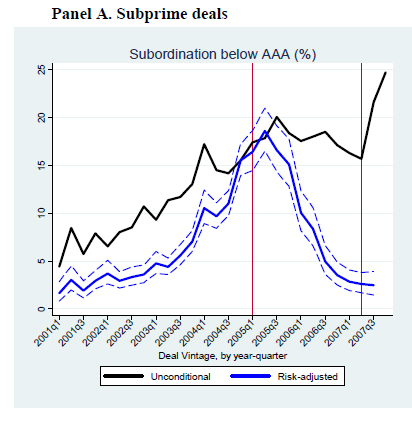
Our evidence does suggest that ratings are informative, and also rejects a simple story that credit rating standards deteriorate uniformly over the pre-crisis period. However, we find evidence of apparently significant time-series variation in subordination levels; most robustly, we observe a significant decline in risk-adjusted subordination levels between the start of 2005 and mid-2007.

Our analysis also suggests MBS ratings did not fully reflect publicly available data. Observably high-risk deals, measured by a simple ex-ante model, significantly underperform relative to their initial subordination levels. Deals with a high share of low-documentation mortgages also perform disproportionately worse compared to other types of risky deals. These two results are evident even for earlier vintages, and can be identified even only using pre-crisis data.

Our results are not conclusive about the role of explicit agency frictions in the rating process. However, two of our results appear consistent with recent theoretical literature modeling these frictions: (i) the poor performance relative to ratings of deals backed by opaque low-documentation loans, and (ii) the observed decline in risk-adjusted subordination around the peak of MBS issuance, when incentive problems are likely most severe. Further analysis of the importance of explicit rating shopping and other incentive problems is, we believe, an important topic for future research.


Click for Big

[The above chart presents] conditional and risk-adjusted AAA subordination for subprime and Alt-A deals, respectively. Risk-adjusted subordination reflects residual changes in credit ratings after controlling for the variables in Table 5 (such as the model-projected default rate, insurance dummy etc.)

Interesting External Papers

BoC Releases Spring 2010 Review

The Bank of Canada has released the Bank of Canada Review – Spring 2010 with feature articles:

  • Crude Oil Futures: A Crystal Ball?
  • Inflation Expectations and the Conduct of Monetary Policy: A Review of Recent Evidence and Experience
  • Monetary Policy Rules in an Uncertain Environment
  • An Uncertain Past: Data Revisions and Monetary Policy in Canada

The second article notes:

In the Canadian context, Christensen, Dion, and Reid (2004) find that the BEIR in Canada is not a reliable measure of inflation expectations because of the maturity and liquidity characteristics of Real Return Bonds. Simply, Canada’s Real Return Bonds have a 30-year maturity and are considerably less liquid than conventional 30-year bonds, which leads to frequent distortions in the measure of expected inflation. For the United States, Ang, Bekaert, and Wei (2007) find that survey data outperform market-based measures, times-series ARIMA models, and regressions using data on real economic activity. Consequently, the most recent evidence suggests that surveys may be a more reliable guide to inflation expectations for the United States and Canada.

The references are to

  • Christensen, I., F. Dion, and C. Reid. 2004. “Real Return Bonds, Inflation Expectations, and the Break-Even Inflation Rate.” Bank of Canada Working Paper No. 2004–43.
  • Ang, A., G. Bekaert, and M. Wei. 2007. “Do Macro Variables, Asset Markets, or Surveys Forecast Inflation Better?” Journal of Monetary Economics 54 (4): 1163–1212.

Christensen, Dion and Reid also published in the BoC Review of Autumn 2004; this paper has been summarized on PrefBlog.

The paper by Ang, Bekaert & Wei has not been reviewed here, but it has been referenced in Term Premia on Real-Return Bonds in the UK.

Interesting External Papers

Boston Fed Releases 2H09 Research Review

The Federal Reserve Bank of Boston has released the Research Review July 2009 – December 2009 with summaries of:

Public Policy Discussion Papers:

  • Why Don’t Lenders Renegotiate More Home Mortgages? Redefaults, Self-Cures, and Securitization
  • Securitization and Moral Hazard: Evidence from a Lender Cutoff Rule
  • Reinvigorating Springfield’s Economy: Lessons from Resurgent Cities
  • Did Easy Credit Lead to Overspending? Home Equity Borrowing and Household Behavior in the Early 2000s
  • A TIPS Scorecard: Are TIPS Accomplishing What They Were Supposed to Accomplish? Can They Be Improved?
  • Impending Spending Bust? The Role of Housing Wealth as Borrowing Collateral
  • The 2008 Survey of Consumer Payment Choice
  • Jobs in Springfield, Massachusetts: Understanding and Remedying the Causes of Low Resident Employment Rates

The TIPS paper has been discussed on PrefBlog.

Working Papers

  • Trends in U.S. Family Income Mobility, 1967–2004
  • Real Estate Brokers and Commission: Theory and Calibrations
  • Efficient Organization of Production: Nested versus Horizontal Outsourcing
  • Estimating the Border Effect: Some New Evidence
  • Social and Private Learning with Endogenous Decision Timing
  • Housing and Debt Over the Life Cycle and Over the Business Cycle
  • Financial Leverage, Corporate Investment, and Stock Returns
  • Inflation Persistence
  • Closed-Form Estimates of the New Keynesian Phillips Curve with Time-Varying Trend Inflation
  • Estimating Demand in Search Markets: The Case of Online Hotel Bookings
  • Multiple Selves in Intertemporal Choices
  • The Valuation Channel of External Adjustment
  • Productivity, Welfare, and Reallocation: Theory and Firm-Level Evidence
  • State-Dependent Pricing and Optimal Monetary Policy
  • Seeds to Succeed? Sequential Giving to Public Projects

Public Policy Briefs

  • A Proposal to Help Distressed Homeowners: A Government Payment-Sharing Plan
Contingent Capital

Greenspan Endorses Contingent Capital

Alan Greenspan has lost a little of his mystique since McCain said he continue as Fed Chairman after death, but he’s still one of the most knowledgable people out there.

He has delivered a speech at the Brookings Institute that is of great interest.

I can’t find a copyable paper (update: Dealbreaker has one), so you’ll just have to read the speech yourselves or rely on my paraphrases!

He notes that not a single hedge fund has defaulted on debt throughout the crisis, though many have suffered large losses and been forced to liquidate.

The crash of 1987 and the dotcom bubble bursting led the Fed to believe that financial bubbles had disengaged from the real economy.

He strongly doubts that stability can be achieved in the context of a competitive economy.

Capital and liquidity address all the regulatory shortcomings that were exposed by the crisis. Capital has the advantage that it is not necessary to identify which part of the financial structure is most at risk.

The behaviour of CDS spreads in the wake of the Lehman default and TARP imply that the “well capitalized” requirement for total bank capital should be 14%, not 10%, subject to some Herculean assumptions. This will allow bank equity to earn a competitive return while not constricting credit.

The solution, in my judgment, that has at least a reasonable chance of reversing the extraordinarily large “moral hazard” that has arisen over the past year is to require banks and possibly all financial intermediaries to hold contingent capital bonds, that is, debt which is automatically converted to equity when equity capital falls below a certain threshold. Such debt will, of course, be more costly on issuance than simple debentures, but its existence could materially reduce moral hazard.

The global housing bubble was driven by lower long-term rates, not policy rates. Home mortgage 30-year rates led the Case-Shiller index by 11 months with R-squared of 0.511, compared with Fed Funds, R-squared = 0.216 and and eight-month lead. This makes sense because housing is a long-term asset.

Some people (silly people) get this muddled because the correlation between Fed Funds and 30-year mortgages is 0.83 (until 2002). But the relationship delinked, which was the Greenspan Conundrum, so up yours.

Taylor’s wrong. He equates housing starts (supply) with demand. But starts don’t drive prices, it’s the other way ’round. Builders look at housing prices, not the Fed Funds rate. What’s more the correlation between house prices and consumer prices is small to negative.

Some people (silly people) believe that low Fed Fund rates lowered ARM teaser rates and led to increased demand. But the balance of probabilities is that the decision to buy preceded the decision on financing. Anyway, the correlation of Taylor rule deviations with house prices is statistically insignificant (Dokko, Jane, et al., “Monetary Policy and the Housing Bubble”, Finance & Economics Discussion Series, Federal Reserve Board, Dec. 22, 2009)

Any attempt to instigate a “Systemic Regulator” is ill-advised and doomed to fail. Their models and forecasting ain’t gonna be any better than anybody else’s.

Interesting External Papers

The Story of the CDO Market Meltdown

Anna Katherine Barnett-Hart’s senior thesis has attracted some media interest, so I’ll highlight it here – since a kind soul on Financial Webring Forum went to the trouble of finding the link.

The title is The Story of the CDO Market Meltdown: An Empirical Analysis:

Collateralized debt obligations (CDOs) have been responsible for $542 billion in write-downs at financial institutions since the beginning of the credit crisis. In this paper, I conduct an empirical investigation into the causes of this adverse performance, looking specifically at asset-backed CDO’s (ABS CDO’s). Using novel, hand-collected data from 735 ABS CDO’s, I document several main findings. First, poor CDO performance was primarily a result of the inclusion of low quality collateral originated in 2006 and 2007 with exposure to the U.S. residential housing market. Second, CDO underwriters played an important role in determining CDO performance. Lastly, the failure of the credit ratings agencies to accurately assess the risk of CDO securities stemmed from an overreliance on computer models with imprecise inputs. Overall, my findings suggest that the problems in the CDO market were caused by a combination of poorly constructed CDOs, irresponsible underwriting practices, and flawed credit rating procedures.

I must admit that the phrase “irresponsible underwriting practices” caught my attention. Since when does or should the underwriter care? It’s up to the buyer to figure out just what he’s buying.

As far as the CRAs are concerned, John Hull’s work on the ratings has been previously reported on PrefBlog – he concluded:

It should be noted that a CDO created from the triple BBB tranches of ABSs is quite different from a CDO created from BBB bonds. This is true even when the BBB tranches have been chosen so that their probabilities of default and expected losses are consistent with their BBB rating. The reason is that the probability distribution of the loss from a BBB tranche is quite different from the probability distribution of the loss from a BBB bond.

The AAA ratings for Mezz ABS CDOs are much less defensible. Scenarios where all the underlying BBB tranches lose virtually all their principal are sufficiently probable that it is not reasonable to assign a AAA rating to even a quite thin senior tranche. The risks in Mezz ABS CDOs depend critically on a) the width of the underlying BBB tranches, b) the correlation between pools, c) the tail default correlation, and d) the relationship between the recovery rate and the default rate. An important point is that the BBB tranche of an ABS cannot be assumed to be similar to a BBB bond for the purposes of determining the risks in ABS CDO tranches.

In practice Mezz ABS CDOs accounted for about 3% of all mortgage securitizations. Our conclusion is therefore that the vast majority of the AAA ratings assigned to tranches created from mortgages were reasonable, but in a small minority of the cases they cannot be justified.

The distinction between Mezz ABSs and Mezz ABS CDOs must be borne firmly in mind when trying to understand this thing. The Mezz ABSs is the BBB (about) tranche of a pool of mortgages. A Mezz ABS CDO is another security that does not hold mortgages directly; it holds Mezz ABSs.

So anyway, back to the Barnett-Hart paper:

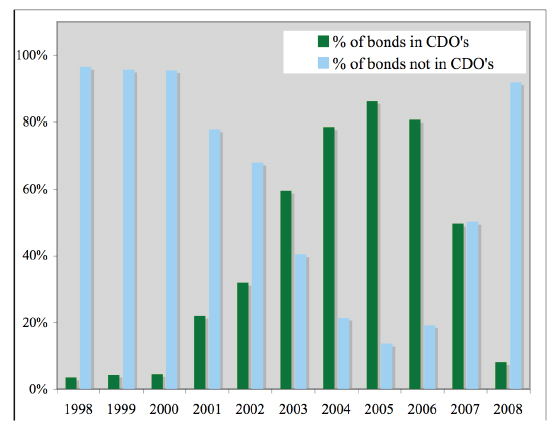
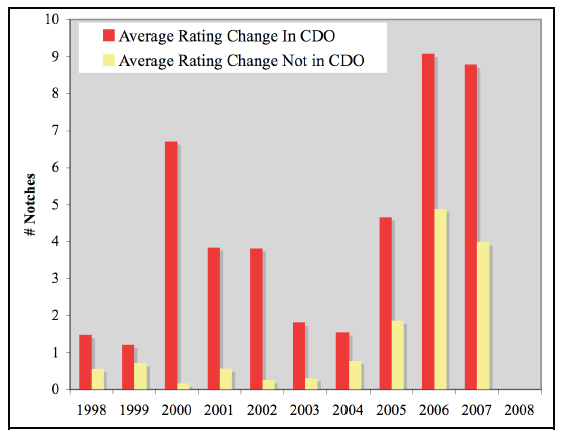
In response to the explosion in CDO issuance, the increased demand for subprime mezzanine bonds began to outpace their supply.12 Figure 2 shows the percentage of subprime bonds that were repackaged into CDOs, illustrating the drastic increase in subprime demand by CDOs. This surge in demand for subprime mezzanine bonds helped to push spreads down – so much so that the bond insurers and real estate investors that had traditionally held this risk were priced out of the market. The CDO managers that now purchased these mortgage bonds were often less stringent in their risk analysis than the previous investors, and willingly purchased bonds backed by ever-more exotic mortgage loans.13 Figure 3 looks specifically at the performance of the subprime collateral, comparing the rating downgrades of the subprime bonds that were in CDOs versus those that were not put in CDOs. Clearly, the bonds in the CDOs have performed worse, indicating that there might have been a degree of adverse selection in choosing the subprime bonds for CDOs14

Footnotes:
12: Deng et. al. (2008) find that the demand for subprime mezzanine bonds for CDOs was so great that it was a significant factor in causing a tightening in the subprime ABS-treasury spread prior to 2007.

13: A recent note by Adelson and Jacob (2008) argues that CDOs’ increasing demand for subprime bonds was the key event that fundamentally changed the market.

14: However, this result needs further investigation as it may be a result of the fact that the mezzanine tranches, most common in CDOs, have all performed the worst, or that the rating agencies had an incentive to monitor subprime bonds in CDOs more carefully, leading to a higher level of downgrades.


Click for Big


Click for Big

Investors came to rely almost exclusively on ratings to assess CDO investments: in essence substituting a letter grade for their own due diligence.

Footnote: In a report to shareholders, UBS cites over-reliance on ratings as a cause of their massive write-downs, saying that their risk committee “relied on the AAA rating of certain subprime positions, although the CDOs were built from lower-rated tranches of RMBS. This appears to have been common across the industry. A comprehensive analysis of the portfolios may have indicated that the positions would not necessarily perform consistent with their ratings”(UBS 39).

With respect to the above footnote, remember that UBS is also the poster-child for insane leverage ratios.

In addition to the problems with the accuracy of the ratings, there was also the fact that the ratings themselves were not meaningful indicators for assessing portfolio risk. As Coval et. al. (2009) notes, credit ratings, “by design only provide an assessment of the risks of the security’s expected payoff, with no information regarding whether the security is particularly likely to default at the same time as there is a large scale decline in the stock market or that the economy is in recession.” 28 Furthermore, ratings are a static measure, designed to give a representation of expected losses at a certain point in time with given assumptions. It is not possible for a single rating to encompass all the information about the probability distribution that investors need to assess its risk. Dr. Clarida, an executive vice president at PIMCO, points out that, “distributions are complicated beasts – they have means, variances, skews, and tails that can be skinny or, more often, fat. Also – they have kurtosis, fourth moments, and transition probabilities.”29 Investors often overcame these limitations by looking at ratings history, filling in their missing information with data about the track record of defaults for a given rating. Since there was little historical data for CDOs, investors instead looked at corporate bond performance. However, as noted above, asset-backed ratings have proven to have very different default distributions than corporate bonds, leading to false assessments.

So the question becomes: who were these bozo investors?

While the investment banks earned what they thought to be “riskless” profits from CDOs, they were actually loading up on more CDO risk than they realized thanks to so-called “super senior” tranches, created in part to generate even higher-yielding AAA tranches for CDO investors. To manufacture a super senior tranche, the AAA portion of a CDO was chopped up into smaller AAA tiers, enabling the “subordinate” AAA tranche to yield more and the “super senior” AAA tranche to carry an extremely low level of credit risk. Many banks found it convenient to simply retain the super senior tranches, as the Basel Accords imposed only a small capital charge for AAA securities. In addition, a significant amount of super senior exposure was retained not by choice, but rather because underwriters had difficulty selling these bonds.

Footnote: Krahen and Wilde (2005) gave a warning to regulators in 2005 about the increasing number of banks retaining senior tranches, saying that: “To the extent that senior tranches absorb extreme systematic losses, banks should be encouraged to sell these tranches to outside investors. In the interest of financial system stability, these outside buyers of bank risk should not be financial intermediaries themselves. Only if this requirement is fulfilled will the bank and the financial system be hedged against systematic shocks. Since this is supposedly one of the macroeconomic objectives of regulators, one would expect that regulatory requirements stipulate the sale of senior tranches, rather than encouraging their retention.

Which simply goes to show: don’t ever take investment advice from the sell-side.

It also makes a strong argument against tranche retention: I suggest that instead, retention of underwritten securities be penalized by capital regulation; this will ensure that the investment banks only create what they can actually sell, rather than relying on in-house analysts who, to put it bluntly, aren’t worth very much.

I will also suggest – again! – that a clear delineation be made in the new capital rules between investment banks (who should be encouraged to trade stuff and penalized for holding it) and vanilla banks (who should be encouraged to hold stuff and penalized for trading it).