Category: Issue Comments

Issue Comments

MFC.PR.F / MFC.PR.P: 21% Conversion to FloatingReset

Manulife Financial Corporation has announced:

that 1,664,169 of its currently outstanding 8,000,000 Non-cumulative Rate Reset Class 1 Shares Series 3 (the “Series 3 Preferred Shares”) have been elected for conversion on June 20, 2016, on a one-for-one basis, into Non-cumulative Floating Rate Class 1 Shares Series 4 of Manulife (the “Series 4 Preferred Shares”). As a result, on June 20, 2016, Manulife will have 6,335,831 Series 3 Preferred Shares and 1,664,169 Series 4 Preferred Shares issued and outstanding. The Series 3 Preferred Shares and the Series 4 Preferred Shares will be listed on the Toronto Stock Exchange under the symbols MFC.PR.F and MFC.PR.P, respectively.

Subject to certain conditions described in the prospectus supplement dated March 7, 2011 relating to the issuance of the Series 3 Preferred Shares, Manulife may redeem the Series 3 Preferred Shares, in whole or in part, on June 19, 2021 and on June 19 every five years thereafter and may redeem the Series 4 Preferred Shares, in whole or in part, after June 20, 2016.

Assiduous Readers will remember that MFC.PR.F will reset to 2.178%, while the FloatingReset issue, MFC.PR.P, will pay 3-Month T-Bills + 141bp, reset quarterly. I recommended against conversion.

Issue Comments

SJR.PR.A: Convert Or Hold?

It will be recalled that SJR.PR.A will reset to 2.791% effective June 30.

Holders of SJR.PR.A have the option to convert to FloatingResets, which will pay 3-month bills plus 200bp on the par value of $25.00, reset quarterly. The deadline for notifying the company of the intent to convert is 5:00 p.m. (EDT) on June 15, 2016; but note that this is a company deadline and that brokers will generally set their deadlines a day or two in advance, so there’s not much time to lose if you’re planning to convert! However, if you miss the brokerage deadline they’ll probably do it on a ‘best efforts’ basis if you grovel in a sufficiently entertaining fashion. The ticker for the new FloatingReset, if it is created, will be SJR.PR.B.

The most logical way to analyze the question of whether or not to convert is through the theory of Preferred Pairs, for which a calculator is available. Briefly, a Strong Pair is defined as a pair of securities that can be interconverted in the future (e.g., BAM.PR.R and the FloatingReset that will exist if enough holders convert). Since they will be interconvertible on this future date, it may be assumed that they will be priced identically on this date (if they aren’t then holders will simply convert en masse to the higher-priced issue). And since they will be priced identically on a given date in the future, any current difference in price must be offset by expectations of an equal and opposite value of dividends to be received in the interim. And since the dividend rate on one element of the pair is both fixed and known, the implied average rate of the other, floating rate, instrument can be determined. Finally, we say, we may compare these average rates and take a view regarding the actual future course of that rate relative to the implied rate, which will provide us with guidance on which element of the pair is likely to outperform the other until the next interconversion date, at which time the process will be repeated.

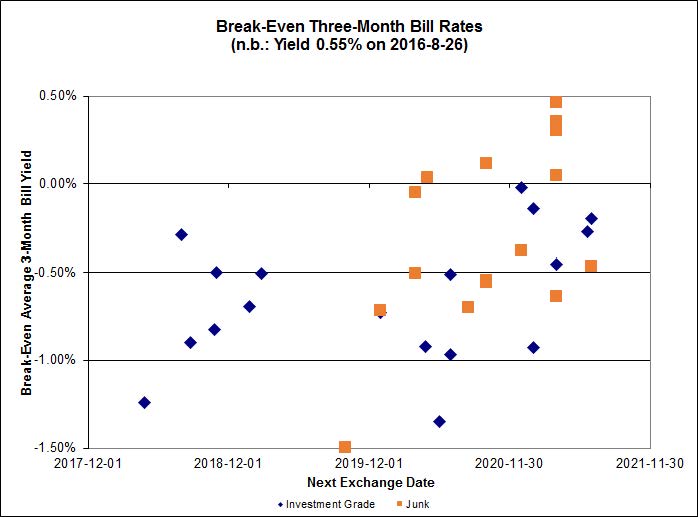
We can show the break-even rates for each FixedReset / FloatingReset Strong Pair graphically by plotting the implied average 3-month bill rate against the next Exchange Date (which is the date to which the average will be calculated).

pairs_FR_160610
Click for Big

The market appears to have a distaste at the moment for floating rate product; most of the implied rates until the next interconversion are lower than the current 3-month bill rate and the averages for investment-grade and junk issues are both below zero, at -0.66% and -0.07%, respectively! Whatever might be the result of the next few Bank of Canada overnight rate decisions, I suggest that it is unlikely that the average rate over the next five years will be lower than current – but if you disagree, of course, you may interpret the data any way you like.

Since credit quality of each element of the pair is equal to the other element, it should not make any difference whether the pair examined is investment-grade or junk, although we might expect greater variation of implied rates between junk issues on grounds of lower liquidity, and this is just what we see.

If we plug in the current bid price of the SJR.PR.A FixedReset, we may construct the following table showing consistent prices for its soon-to-be-issued FloatingReset counterpart given a variety of Implied Breakeven yields consistent with issues currently trading:

Estimate of FloatingReset (received in exchange for SJR.PR.A) Trading Price In Current Conditions
  Assumed FloatingReset
Price if Implied Bill
is equal to
FixedReset Bid Price Spread 0.00% -0.50% -1.00%
SJR.PR.A 12.95 200bp 12.16 11.66 11.16

Based on current market conditions, I suggest that the FloatingResets that will result from conversion are likely to be cheap and trading below the price of their FixedReset counterparts. Therefore, I recommend that holders of SJR.PR.A continue to hold the issue and not to convert. I will note that, given the apparent cheapness of the FloatingResets, it may be a good trade to swap the FixedReset for the FloatingReset in the market once both elements of each pair are trading and you can – presumably, according to this analysis – do it with a reasonably good take-out in price, rather than doing it through the company on a 1:1 basis. But that, of course, will depend on the prices at that time and your forecast for the path of policy rates over the next five years. There are no guarantees – my recommendation is based on the assumption that current market conditions with respect to the pairs will continue until the FloatingResets commence trading and that the relative pricing of the two new pairs will reflect these conditions.

Note as well that conversion rights are dependent upon at least one million shares of each series being outstanding after giving effect to holders’ instructions; e.g., if only 100,000 shares of SJR.PR.A are tendered for conversion, then no conversions will be allowed; but if only 100,000 shares of SJR.PR.A will remain after the rest are all tendered, then conversion will be mandatory. However, this is relatively rare: all 39 Strong Pairs currently extant have some version of this condition and all but five have both series outstanding.

Issue Comments

BPO.PR.N: Convert or Hold?

It will be recalled that BPO.PR.N will reset to 3.782% effective July 1.

Holders of BPO.PR.N have the option to convert to FloatingResets, which will pay 3-month bills plus 307bp on the par value of $25.00, reset quarterly. The deadline for notifying the company of the intent to convert is 5:00 p.m. (EDT) on June 15, 2016; but note that this is a company deadline and that brokers will generally set their deadlines a day or two in advance, so there’s not much time to lose if you’re planning to convert! However, if you miss the brokerage deadline they’ll probably do it on a ‘best efforts’ basis if you grovel in a sufficiently entertaining fashion. The ticker for the new FloatingReset, if it is created, will be BPO.PR.O.

The most logical way to analyze the question of whether or not to convert is through the theory of Preferred Pairs, for which a calculator is available. Briefly, a Strong Pair is defined as a pair of securities that can be interconverted in the future (e.g., BAM.PR.R and the FloatingReset that will exist if enough holders convert). Since they will be interconvertible on this future date, it may be assumed that they will be priced identically on this date (if they aren’t then holders will simply convert en masse to the higher-priced issue). And since they will be priced identically on a given date in the future, any current difference in price must be offset by expectations of an equal and opposite value of dividends to be received in the interim. And since the dividend rate on one element of the pair is both fixed and known, the implied average rate of the other, floating rate, instrument can be determined. Finally, we say, we may compare these average rates and take a view regarding the actual future course of that rate relative to the implied rate, which will provide us with guidance on which element of the pair is likely to outperform the other until the next interconversion date, at which time the process will be repeated.

We can show the break-even rates for each FixedReset / FloatingReset Strong Pair graphically by plotting the implied average 3-month bill rate against the next Exchange Date (which is the date to which the average will be calculated).

pairs_FR_160610
Click for Big

The market appears to have a distaste at the moment for floating rate product; most of the implied rates until the next interconversion are lower than the current 3-month bill rate and the averages for investment-grade and junk issues are both below zero, at -0.66% and -0.07%, respectively! Whatever might be the result of the next few Bank of Canada overnight rate decisions, I suggest that it is unlikely that the average rate over the next five years will be lower than current – but if you disagree, of course, you may interpret the data any way you like.

Since credit quality of each element of the pair is equal to the other element, it should not make any difference whether the pair examined is investment-grade or junk, although we might expect greater variation of implied rates between junk issues on grounds of lower liquidity, and this is just what we see.

If we plug in the current bid price of the BAM.PR.R FixedReset, we may construct the following table showing consistent prices for its soon-to-be-issued FloatingReset counterpart given a variety of Implied Breakeven yields consistent with issues currently trading:

Estimate of FloatingReset (received in exchange for BPO.PR.N) Trading Price In Current Conditions
  Assumed FloatingReset
Price if Implied Bill
is equal to
FixedReset Bid Price Spread 0.00% -0.50% -1.00%
BPO.PR.N 15.80 307bp 15.11 14.62 14.13

Based on current market conditions, I suggest that the FloatingResets that will result from conversion are likely to be cheap and trading below the price of their FixedReset counterparts. Therefore, I recommend that holders of BPO.PR.N continue to hold the issue and not to convert. I will note that, given the apparent cheapness of the FloatingResets, it may be a good trade to swap the FixedReset for the FloatingReset in the market once both elements of each pair are trading and you can – presumably, according to this analysis – do it with a reasonably good take-out in price, rather than doing it through the company on a 1:1 basis. But that, of course, will depend on the prices at that time and your forecast for the path of policy rates over the next five years. There are no guarantees – my recommendation is based on the assumption that current market conditions with respect to the pairs will continue until the FloatingResets commence trading and that the relative pricing of the two new pairs will reflect these conditions.

Note as well that conversion rights are dependent upon at least one million shares of each series being outstanding after giving effect to holders’ instructions; e.g., if only 100,000 shares of BPO.PR.N are tendered for conversion, then no conversions will be allowed; but if only 100,000 shares of BPO.PR.N will remain after the rest are all tendered, then conversion will be mandatory. However, this is relatively rare: all 39 Strong Pairs currently extant have some version of this condition and all but five have both series outstanding.

Issue Comments

BAM.PR.R: Convert or Hold?

It will be recalled that BAM.PR.R will reset to 3.014% effective July 1.

Holders of BAM.PR.R have the option to convert to FloatingResets, which will pay 3-month bills plus 230bp on the par value of $25.00, reset quarterly. The deadline for notifying the company of the intent to convert is 5:00 p.m. (EDT) on June 15, 2016; but note that this is a company deadline and that brokers will generally set their deadlines a day or two in advance, so there’s not much time to lose if you’re planning to convert! However, if you miss the brokerage deadline they’ll probably do it on a ‘best efforts’ basis if you grovel in a sufficiently entertaining fashion. The ticker for the new FloatingReset, if it is created, will be BAM.PR.S.

The most logical way to analyze the question of whether or not to convert is through the theory of Preferred Pairs, for which a calculator is available. Briefly, a Strong Pair is defined as a pair of securities that can be interconverted in the future (e.g., BAM.PR.R and the FloatingReset that will exist if enough holders convert). Since they will be interconvertible on this future date, it may be assumed that they will be priced identically on this date (if they aren’t then holders will simply convert en masse to the higher-priced issue). And since they will be priced identically on a given date in the future, any current difference in price must be offset by expectations of an equal and opposite value of dividends to be received in the interim. And since the dividend rate on one element of the pair is both fixed and known, the implied average rate of the other, floating rate, instrument can be determined. Finally, we say, we may compare these average rates and take a view regarding the actual future course of that rate relative to the implied rate, which will provide us with guidance on which element of the pair is likely to outperform the other until the next interconversion date, at which time the process will be repeated.

We can show the break-even rates for each FixedReset / FloatingReset Strong Pair graphically by plotting the implied average 3-month bill rate against the next Exchange Date (which is the date to which the average will be calculated).

pairs_FR_160610
Click for Big

The market appears to have a distaste at the moment for floating rate product; most of the implied rates until the next interconversion are lower than the current 3-month bill rate and the averages for investment-grade and junk issues are both below zero, at -0.66% and -0.07%, respectively! Whatever might be the result of the next few Bank of Canada overnight rate decisions, I suggest that it is unlikely that the average rate over the next five years will be lower than current – but if you disagree, of course, you may interpret the data any way you like.

Since credit quality of each element of the pair is equal to the other element, it should not make any difference whether the pair examined is investment-grade or junk, although we might expect greater variation of implied rates between junk issues on grounds of lower liquidity, and this is just what we see.

If we plug in the current bid price of the BAM.PR.R FixedReset, we may construct the following table showing consistent prices for its soon-to-be-issued FloatingReset counterpart given a variety of Implied Breakeven yields consistent with issues currently trading:

Estimate of FloatingReset (received in exchange for BAM.PR.R) Trading Price In Current Conditions
  Assumed FloatingReset
Price if Implied Bill
is equal to
FixedReset Bid Price Spread 0.00% -0.50% -1.00%
BAM.PR.R 15.35 141bp 14.62 14.12 13.61

Based on current market conditions, I suggest that the FloatingResets that will result from conversion are likely to be cheap and trading below the price of their FixedReset counterparts. Therefore, I recommend that holders of BAM.PR.R continue to hold the issue and not to convert. I will note that, given the apparent cheapness of the FloatingResets, it may be a good trade to swap the FixedReset for the FloatingReset in the market once both elements of each pair are trading and you can – presumably, according to this analysis – do it with a reasonably good take-out in price, rather than doing it through the company on a 1:1 basis. But that, of course, will depend on the prices at that time and your forecast for the path of policy rates over the next five years. There are no guarantees – my recommendation is based on the assumption that current market conditions with respect to the pairs will continue until the FloatingResets commence trading and that the relative pricing of the two new pairs will reflect these conditions.

Note as well that conversion rights are dependent upon at least one million shares of each series being outstanding after giving effect to holders’ instructions; e.g., if only 100,000 shares of BAM.PR.R are tendered for conversion, then no conversions will be allowed; but if only 100,000 shares of BAM.PR.R will remain after the rest are all tendered, then conversion will be mandatory. However, this is relatively rare: all 39 Strong Pairs currently extant have some version of this condition and all but five have both series outstanding.

Issue Comments

CSE.PR.A To Be Extended

Capstone Infrastructure Corporation has announced:

that it does not intend to exercise its right under the terms of its Cumulative 5-Year Rate Reset Preferred Shares, Series A (the “Series A shares”) to redeem all or part of the currently outstanding 3,000,000 Series A shares on July 31, 2016. As a result, subject to certain conditions, the holders of the Series A shares have the right to convert all or part of their Series A shares, on a one-for-one basis, into Cumulative Floating Rate Preferred Shares, Series B (the “Series B shares”) on August 2, 2016 (the “Conversion Date”) in accordance with the terms of the Series A shares.

Holders of Series A shares who do not exercise their right to convert their Series A shares into Series B shares on the Conversion Date will retain their Series A shares, subject to the conditions set out below.

The dividend rate applicable to the Series A shares for the five-year period from July 31, 2016 to but excluding July 31, 2021, and the dividend rate applicable to the Series B shares for the three-month period from July 31, 2016 to October 31, 2016, will be determined and announced by way of a news release on July 4, 2016.

Beneficial owners of Series A shares who wish to exercise their conversion right should communicate with their broker or other nominee to obtain instructions for exercising such right during the conversion period, which runs from July 4, 2016 until July 18, 2016 at 5:00 p.m. (EST).

The foregoing conversion rights are subject to the conditions, as set out in the terms of the Series A shares, that: (i) if Capstone determines that there would remain outstanding on the Conversion Date less than 1,000,000 Series B shares, after having taken into account all Series A shares tendered for conversion into Series B shares, then holders of Series A shares will not be entitled to convert their shares into Series B shares and all holders will continue to hold Series A shares, and (ii) alternatively, if Capstone determines that there would remain outstanding on the Conversion Date less than 1,000,000 Series A shares, after having taken into account all Series A shares tendered for conversion into Series B shares, then all remaining Series A shares will automatically be converted into Series B shares on a one-for-one basis on the Conversion Date and all holders will hold Series B shares. In either case, Capstone will give written notice to that effect to the registered holder of Series A shares no later than July 26, 2016.

I will report on the rate when determined and my recommendation for converting or holding in due course.

Issue Comments

RY Outlook Negative, Says S&P

Standard & Poor’s has announced:

  • •We believe Royal Bank of Canada’s (RBC) risk appetite has grown relative to peers’.
  • •We are revising our outlook on RBC to negative from stable, reflecting credit quality metrics that have recently converged to the peer average and the risk that this may continue (or worsen).
  • •We are affirming our ratings on the bank, including our ‘AA-/A-1+’ long- and short-term issuer credit ratings.
  • •The negative outlook reflects RBC’s higher risk appetite and aggregate loan risk exposure relative to those of its peers.


“The outlook revision reflects concerns over what we see as RBC’s higher risk appetite, relative to peers’,” said S&P Global Ratings credit analyst Lidia Parfeniuk. “We see one example of this in its aggressive growth in loans and commitments in the capital markets wholesale loan book, particularly in the U.S., with an emphasis on speculative-grade borrowers, including exposure to leveraged loans. RBC also has higher-than-peer average exposure to the highly indebted Canadian consumer and to oil and gas-producing regions. These exposures, and potential future growth, in aggregate, could lead to higher loan losses than peers’.”

RBC’s U.S. wholesale loan portfolio has grown very rapidly. The growth has been, on average, 16% per year, adjusted for foreign exchange from 2010 through 2015. We believe that the emphasis has been on speculative-grade loans. We also believe the bank has been increasing risky exposure to improve risk-adjusted returns amid low interest rates.

Adding to the bank’s risk exposures is its higher-than-peers exposure to leveraged loans, which we view as a frothy segment within wholesale lending. We believe that while credit conditions have been benign over the last few years, they may begin to worsen, particularly in a rising-rate environment.

The outlook is negative. We could lower the rating over the next two years if RBC’s credit quality metrics remain at the peer average (or worse) for several quarters. This would most likely result in the issuer credit rating falling by one notch to ‘A+’, to reflect the higher risk profile. We could revise the outlook to stable if we were to see evidence that risk appetite is moderating and that credit quality metrics recover to a more favorable stance than the peer average.

Oddly, the press release made no reference to the ‘bail-in’ regime, which the agency has previously assigned a position of some importance and which has been endorsed by the new government, as discussed March 22, 2016.

Affected issues are: RY.PR.A, RY.PR.B, RY.PR.C, RY.PR.D, RY.PR.E, RY.PR.F, RY.PR.G, RY.PR.H, RY.PR.I, RY.PR.J, RY.PR.K, RY.PR.L, RY.PR.M, RY.PR.N, RY.PR.O, RY.PR.P, RY.PR.Q, RY.PR.R, RY.PR.W and RY.PR.Z.

Issue Comments

SJR.PR.A To Reset To 2.791%

Shaw Communications Inc. has announced:

that it has given the registered shareholder of its Cumulative Redeemable Rate Reset Class 2 Preferred Shares, Series A (the “Series A Shares”) notices of the conversion right and dividend rates.

Beginning on May 31, 2016 and ending on June 15, 2016 holders of the Series A Shares will have the right to elect to convert any or all of their Series A Shares into an equal number of Cumulative Redeemable Floating Rate Class 2 Preferred Shares, Series B (the “Series B Shares”).

If Shaw does not receive an Election Notice from a holder of Series A Shares during the time fixed therefor, then the Series A Shares shall be deemed not to have been converted (except in the case of an Automatic Conversion). Holders of the Series A Shares and the Series B Shares will have the opportunity to convert their shares again on June 30, 2021, and every five years thereafter as long as the shares remain outstanding.

Effective June 30, 2016, the Annual Fixed Dividend Rate for the Series A Shares was set for the next five year period at 2.791%. Effective June 30, 2016, the Floating Quarterly Dividend for the Series B Shares was set for the first Quarterly Floating Rate Period (being the period from and including June 30, 2016 to but excluding September 30, 2016) at 2.539%. The Floating Quarterly Dividend Rate will be reset every quarter.

The Series A Shares are issued in “book entry only” form and, as such, the sole registered holder of the Series A Shares is the Canadian Depository for Securities Limited (“CDS”). All rights of beneficial holders of Series A Shares must be exercised through CDS or the CDS participant through which the Series A Shares are held. The deadline for the registered shareholder to provide notice of exercise of the right to convert Series A Shares into Series B Shares is 3:00 p.m. (MT) / 5:00 p.m. (ET) on June 15, 2016. Any notices received after this deadline will not be valid. As such, holders of Series A Shares who wish to exercise their right to convert their shares should contact their broker or other intermediary for more information and it is recommended that this be done well in advance of the deadline in order to provide the broker or other intermediary with time to complete the necessary steps.

After June 15, 2016, (i) if Shaw determines that there would remain outstanding on June 30, 2016, fewer than 1,000,000 Series A Shares, all remaining Series A Shares will be automatically converted into Series B Shares on a one-for one basis effective June 30, 2016; or (ii) if Shaw determines that there would remain outstanding after June 30, 2016, fewer than 1,000,000 Series B Shares, no Series A Shares will be permitted to be converted into Series B Shares effective June 30, 2016. There are currently 12,000,000 Series A Shares outstanding.

The Toronto Stock Exchange (TSX) has conditionally approved the listing of the Series B Shares effective on conversion. Listing of the Series B Shares is subject to the Shaw fulfilling all the listing requirements of the TSX and on approval, the Series B Shares will be listed on the TSX under the trading symbol SJR.PR.B. The Series A Shares are listed on the Toronto Stock Exchange under the ticker symbol SJR.PR.A.

For more information on the terms of, and risks associated with an investment in, the Series A Shares and the Series B Shares, see Shaw’s prospectus supplement dated May 20, 2011 which is available on sedar.com.

SJR.PR.A is a FixedReset 4.50%+200, that commenced trading 2011-5-31 after being announced 2011-5-18.

The new rate therefore represents a 38% cut in dividends.

As noted, the deadline to notify the company is 5 p.m. (ET) on June 15, 2016.; brokers will have internal deadlines a day or two in advance.

I will post a recommendation regarding whether or not to convert closer to the deadline.

Issue Comments

BPO.PR.N To Reset To 3.782%

Brookfield Office Properties Inc., a subsidiary of Brookfield Property Partners, has announced:

that it has determined the fixed dividend rate on its Class AAA Preference Shares, Series N (“Series N Shares”) (TSX: BPO.PR.N) for the five years commencing July 1, 2016 and ending June 30, 2021. If declared, the fixed quarterly dividends on the Series N Shares during that period will be paid at an annual rate of 3.782% ($0.236375 per share per quarter).

Holders of Series N Shares have the right, at their option, exercisable not later than 5:00 p.m. (Toronto time) on June 15, 2016, to convert all or part of their Series N Shares, on a one-for-one basis, into Class AAA Preference Shares, Series O (the “Series O Shares”), effective June 30, 2016.

The quarterly floating rate dividends on the Series O Shares have an annual rate, calculated for each quarter, of 3.07% over the annual yield on three-month Government of Canada treasury bills. The actual quarterly dividend rate in respect of the July 1, 2016 to September 30, 2016 dividend period for the Series O Shares will be 0.91244% (3.62% on an annualized basis) and the dividend, if declared, for such dividend period will be $0.22811 per share, payable on September 30, 2016.

Holders of Series N Shares are not required to elect to convert all or any part of their Series N Shares into Series O Shares.

As provided in the share conditions of the Series N Shares, (i) if Brookfield determines that there would be fewer than 1,000,000 Series N Shares outstanding after June 30, 2016, all remaining Series N Shares will be automatically converted into Series O Shares on a one-for-one basis effective June 30, 2016; and (ii) if Brookfield determines that there would be fewer than 1,000,000 Series O Shares outstanding after June 30, 2016, no Series N Shares will be permitted to be converted into Series O Shares. There are currently 11,000,000 Series N Shares outstanding.

The Toronto Stock Exchange (“TSX”) has conditionally approved the listing of the Series O Shares effective upon conversion. Listing of the Series O Shares is subject to Brookfield fulfilling all the listing requirements of the TSX and, upon approval, the Series O Shares will be listed on the TSX under the trading symbol “BPO.PR.O”.

BPO.PR.N is a FixedReset 6.15%+307, that commenced trading 2010-1-20 after being announced 2010-1-11. The issue attracted some unfavourable comment on issue due to the relatively long call lock-out period – which shows complete misunderstanding of the investment impact of an issuer call option, but we’ll ignore that.

The new rate therefore represents a 39% cut in dividends.

As noted, the deadline to notify the company is 5 p.m. (Toronto time) on June 15, 2016.; brokers will have internal deadlines a day or two in advance.

I will post a recommendation regarding whether or not to convert closer to the deadline.

Issue Comments

BAM.PR.R To Reset To 3.014%

Brookfield Asset Management Inc. has announced:

that it has determined the fixed dividend rate on its Cumulative Class A Preference Shares, Series 24 (“Series 24 Shares”) (TSX: BAM.PR.R) for the five years commencing July 1, 2016 and ending June 30, 2021. If declared, the fixed quarterly dividends on the Series 24 Shares during that period will be paid at an annual rate of 3.014% ($0.188375 per share per quarter). The implied yield on the Series 24 Shares based on the new fixed dividend rate that will apply for the five years commencing July 1, 2016 and today’s closing price for the Series 24 Shares is approximately 5.6%.

Holders of Series 24 Shares have the right, at their option, exercisable not later than 5:00 p.m. (Toronto time) on June 15, 2016, to convert all or part of their Series 24 Shares, on a one-for-one basis, into Cumulative Class A Preference Shares, Series 25 (the “Series 25 Shares”), effective June 30, 2016.

The quarterly floating rate dividends on the Series 25 Shares will be paid at an annual rate, calculated for each quarter, of 2.30% over the annual yield on three-month Government of Canada treasury bills. The actual quarterly dividend rate in respect of the July 1, 2016 to September 30, 2016 dividend period for the Series 25 Shares will be 0.71861% (2.851% on an annualized basis) and the dividend, if declared, for such dividend period will be $0.1796525 per share, payable on September 30, 2016.

Holders of Series 24 Shares are not required to elect to convert all or any part of their Series 24 Shares into Series 25 Shares.

As provided in the share conditions of the Series 24 Shares, (i) if Brookfield determines that there would be fewer than 1,000,000 Series 24 Shares outstanding after June 30, 2016, all remaining Series 24 Shares will be automatically converted into Series 25 Shares on a one-for-one basis effective June 30, 2016; and (ii) if Brookfield determines that there would be fewer than 1,000,000 Series 25 Shares outstanding after June 30, 2016, no Series 24 Shares will be permitted to be converted into Series 25 Shares. There are currently 10,970,000 Series 24 Shares outstanding.

The Toronto Stock Exchange (“TSX”) has conditionally approved the listing of the Series 25 Shares effective upon conversion. Listing of the Series 25 Shares is subject to Brookfield fulfilling all the listing requirements of the TSX and, upon approval, the Series 25 Shares will be listed on the TSX under the trading symbol “BAM.PR.S”.

BAM.PR.R is a FixedReset, 5.40%+230, that commenced trading 2010-1-14 after being announced 2010-1-5.

The new rate therefore represents a 44% cut in dividends. Ouch!

As noted, the deadline to notify the company is 5 p.m. (Toronto time) on June 15, 2016.; brokers will have internal deadlines a day or two in advance.

I will post a recommendation regarding whether or not to convert closer to the deadline.

Issue Comments

MFC.PR.F: Convert or Hold?

It will be recalled that MFC.PR.F will reset to 2.178% effective June 20.

Holders of MFC.PR.F have the option to convert to FloatingResets, which will pay 3-month bills plus 141bp on the par value of $25.00. The deadline for notifying the company of the intent to convert is 5:00 p.m. (EDT) on June 6, 2016; but note that this is a company deadline and that brokers will generally set their deadlines a day or two in advance, so there’s not much time to lose if you’re planning to convert! However, if you miss the brokerage deadline they’ll probably do it on a ‘best efforts’ basis if you grovel in a sufficiently entertaining fashion. The ticker for the new FloatingReset, if it is created, will be MFC.PR.P.

The most logical way to analyze the question of whether or not to convert is through the theory of Preferred Pairs, for which a calculator is available. Briefly, a Strong Pair is defined as a pair of securities that can be interconverted in the future (e.g., MFC.PR.F and the FloatingReset that will exist if enough holders convert). Since they will be interconvertible on this future date, it may be assumed that they will be priced identically on this date (if they aren’t then holders will simply convert en masse to the higher-priced issue). And since they will be priced identically on a given date in the future, any current difference in price must be offset by expectations of an equal and opposite value of dividends to be received in the interim. And since the dividend rate on one element of the pair is both fixed and known, the implied average rate of the other, floating rate, instrument can be determined. Finally, we say, we may compare these average rates and take a view regarding the actual future course of that rate relative to the implied rate, which will provide us with guidance on which element of the pair is likely to outperform the other until the next interconversion date, at which time the process will be repeated.

We can show the break-even rates for each FixedReset / FloatingReset Strong Pair graphically by plotting the implied average 3-month bill rate against the next Exchange Date (which is the date to which the average will be calculated).

pairs_FR_160602
Click for Big

The market appears to have a distaste at the moment for floating rate product; all of the implied rates until the next interconversion are lower than the current 3-month bill rate and the averages for investment-grade and junk issues are both well below zero, at -0.65% and -0.22%, respectively! Whatever might be the result of the next few Bank of Canada overnight rate decisions, I suggest that it is unlikely that the average rate over the next five years will be lower than current – but if you disagree, of course, you may interpret the data any way you like.

Since credit quality of each element of the pair is equal to the other element, it should not make any difference whether the pair examined is investment-grade or junk, although we might expect greater variation of implied rates between junk issues on grounds of lower liquidity, and this is just what we see.

If we plug in the current bid price of the MFC.PR.F FixedReset, we may construct the following table showing consistent prices for its soon-to-be-issued FloatingReset counterpart given a variety of Implied Breakeven yields consistent with issues currently trading:

Estimate of FloatingReset (received in exchange for MFC.PR.F) Trading Price In Current Conditions
  Assumed FloatingReset
Price if Implied Bill
is equal to
FixedReset Bid Price Spread 0.00% -1.00% -2.00%
MFC.PR.F 13.83 141bp 13.02 11.97 10.91

Based on current market conditions, I suggest that the FloatingResets that will result from conversion are likely to be cheap and trading below the price of their FixedReset counterparts. Therefore, I recommend that holders of MFC.PR.F continue to hold the issue and not to convert. I will note that, given the apparent cheapness of the FloatingResets, it may be a good trade to swap the FixedReset for the FloatingReset in the market once both elements of each pair are trading and you can – presumably, according to this analysis – do it with a reasonably good take-out in price, rather than doing it through the company on a 1:1 basis. But that, of course, will depend on the prices at that time and your forecast for the path of policy rates over the next five years. There are no guarantees – my recommendation is based on the assumption that current market conditions with respect to the pairs will continue until the FloatingResets commence trading and that the relative pricing of the two new pairs will reflect these conditions.

Note as well that conversion rights are dependent upon at least one million shares of each series being outstanding after giving effect to holders’ instructions; e.g., if only 100,000 shares of MFC.PR.F are tendered for conversion, then no conversions will be allowed; but if only 100,000 shares of MFC.PR.F will remain after the rest are all tendered, then conversion will be mandatory. However, this is relatively rare: all 39 Strong Pairs currently extant have some version of this condition and all but five have both series outstanding.