Category: Issue Comments

Issue Comments

L.PR.A To Be Redeemed

Loblaw Companies Limited has announced (as part of their new issue announcement):

that it intends to redeem all of its outstanding Second Preferred Shares, Series A (TSX:L.PR.A) (the “Preferred Shares Series A”) for cash on July 31, 2015 (“redemption date”). The redemption price for each Preferred Share Series A will be $25.00. Holders of Preferred Shares Series A will separately receive all accrued and unpaid dividends outstanding on the redemption date. Loblaw intends to use the net proceeds of the issue of Preferred Shares Series B to partially fund the redemption of its Preferred Shares Series A. The offering is expected to close on or about June 9, 2015.

This is not really the biggest surprise in the world – L.PR.A is an OperatingRetractible paying 5.95% which becomes redeemable at par on 2015-7-31 and also becomes retractible for shares on that date.

How times change! When this issue was announced 2008-6-11 I opined that it looked expensive and when it commenced trading 2008-6-20 it turned out that the market agreed with me.

Doubtless this will cause a certain amount of angst for some investors … given the imminent redemption of MFC.PR.A the ranks of OperatingRetractibles are dwindling quickly!

Issue Comments

Low Spread FixedResets: May 2015

As noted in MAPF Portfolio Composition: May 2015, the fund now has a large allocation to FixedResets, mostly of relatively low spread.

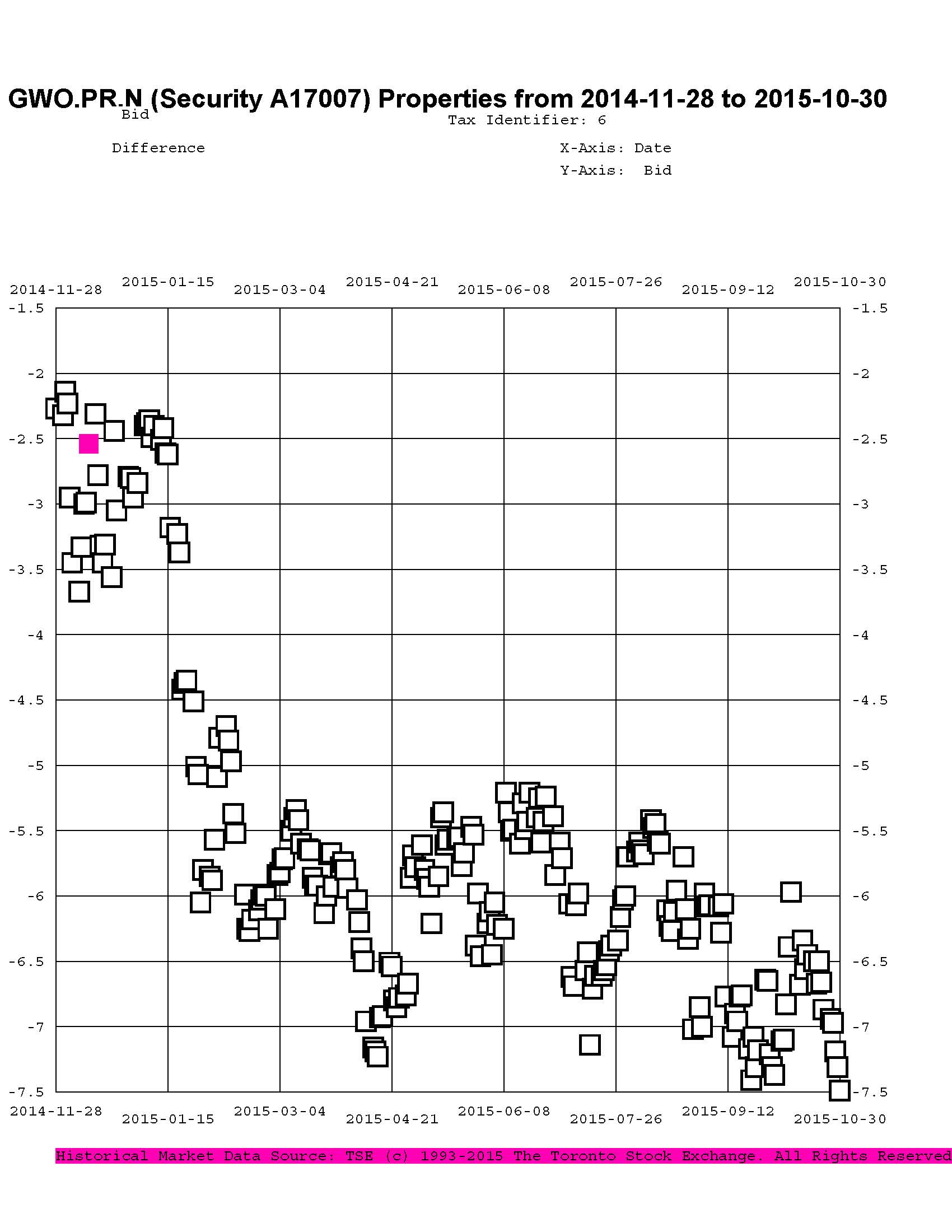
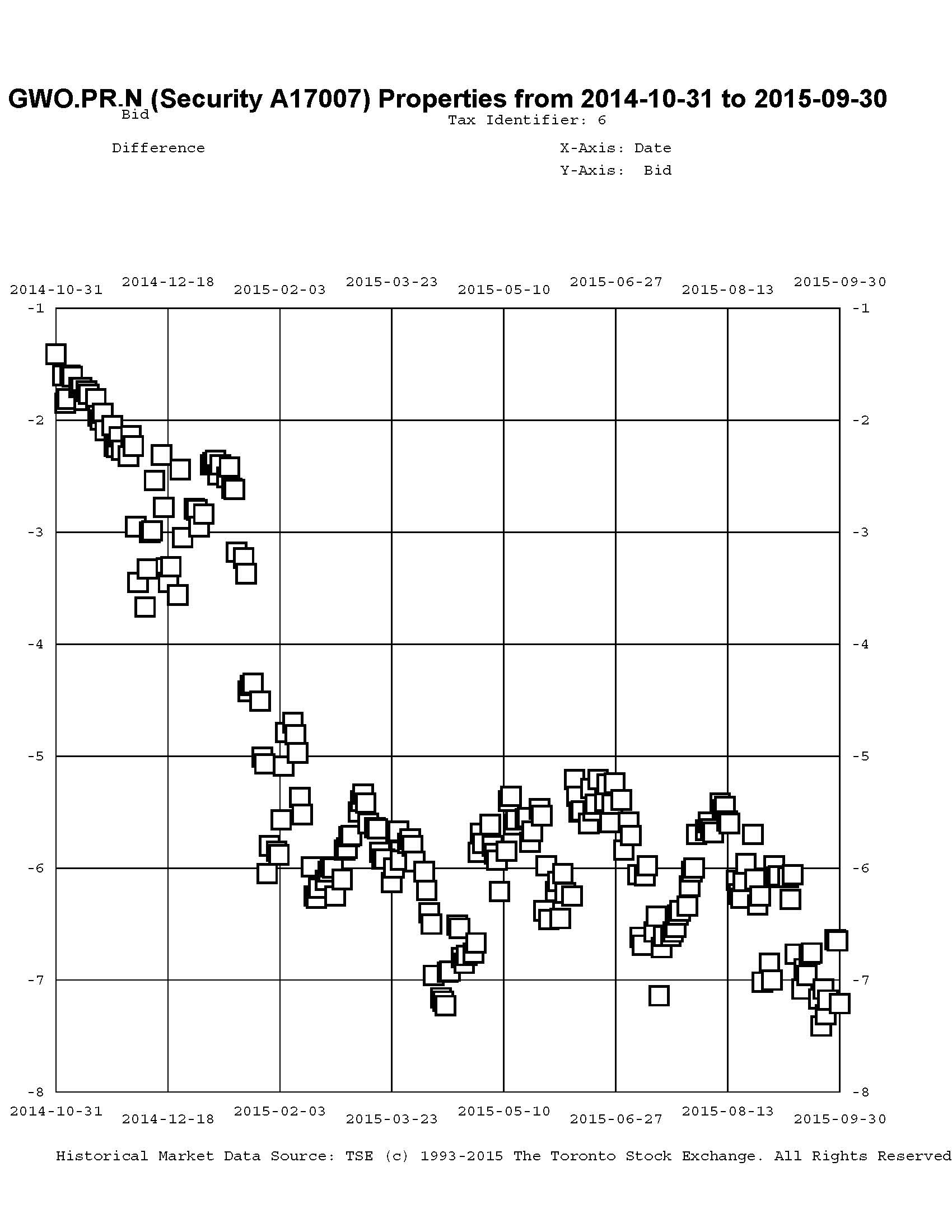
Many of these were largely purchased with proceeds of sales of DeemedRetractibles from the same issuer; it is interesting to look at the price trend of some of the Straight/FixedReset pairs. We’ll start with GWO.PR.N / GWO.PR.I; the fund sold the latter to buy the former at a takeout of about $1.00 in mid-June, 2014; relative prices over the past year are plotted as:

GWOPRN_GWOPRI_bidDiff_150529
Click for Big

Given that the May month-end take-out was $6.46, this is clearly a trade that has not worked out very well.

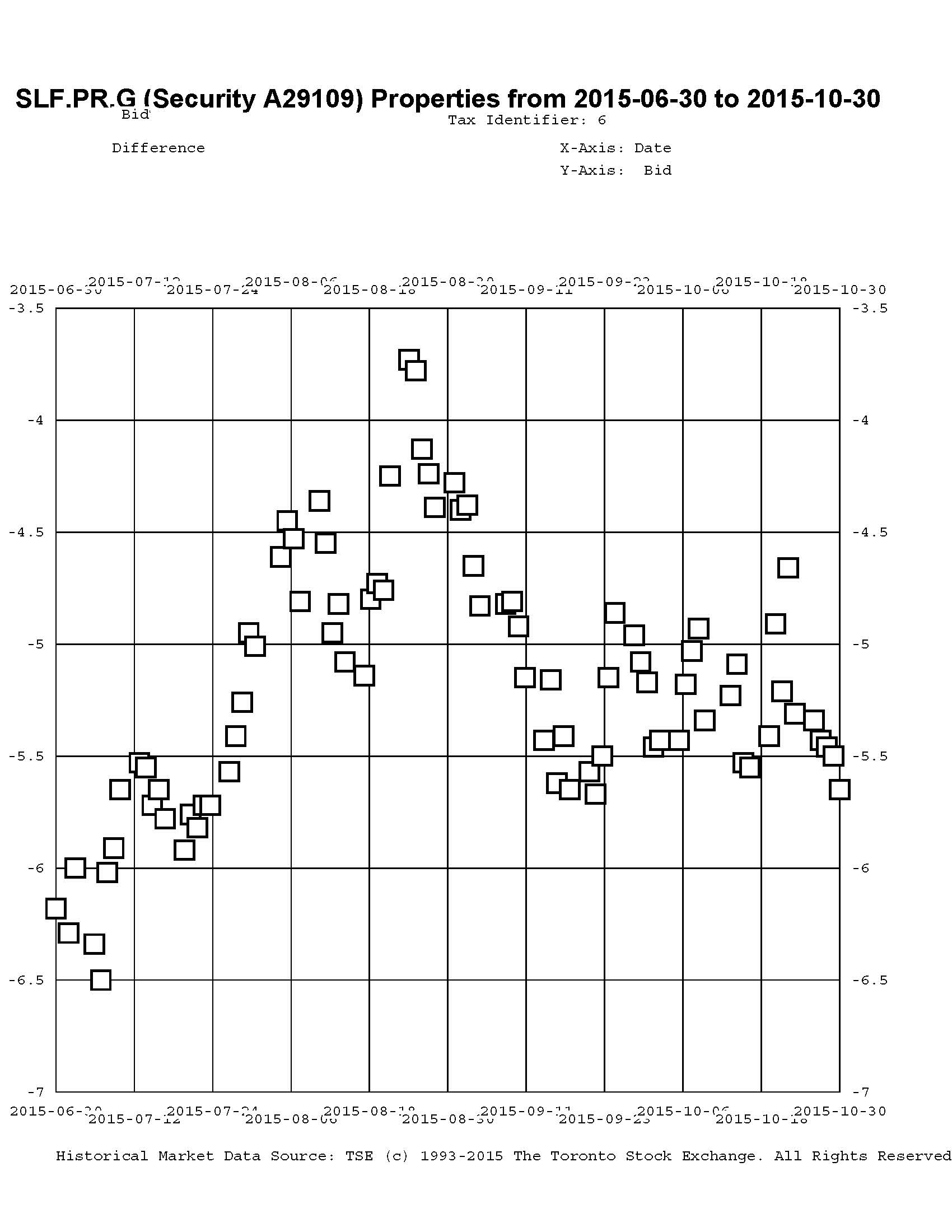
In July, 2014, I reported sales of SLF.PR.D to purchase SLF.PR.G at a take-out of about $0.15:

SLFPRG_SLFPRD_bidDiff_150529
Click for Big

There were similar trades in August, 2014 (from SLF.PR.C) at a take-out of $0.35. The April month-end take-out (bid price SLF.PR.D less bid price SLF.PR.G) was $5.61, so that hasn’t worked very well either.

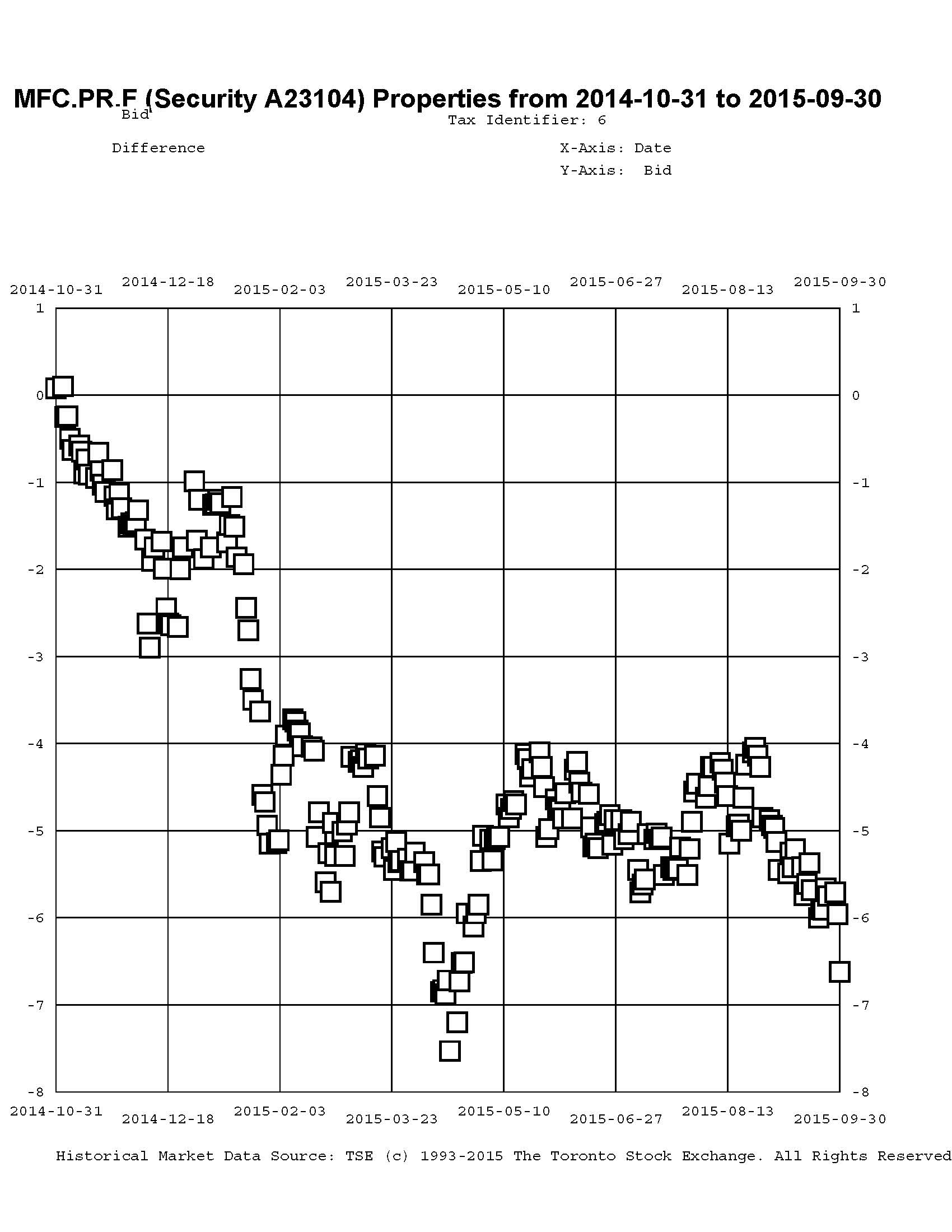
November saw the third insurer-based sector swap, as the fund sold MFC.PR.C to buy the FixedReset MFC.PR.F at a post-dividend-adjusted take-out of about $0.85 … given a May month-end take-out of about $4.88, that’s another regrettable trade, although another piece executed in December at a take-out of $1.57 has less badly.

MFCPRF_MFCPRC_bidDiff_150529
Click for Big

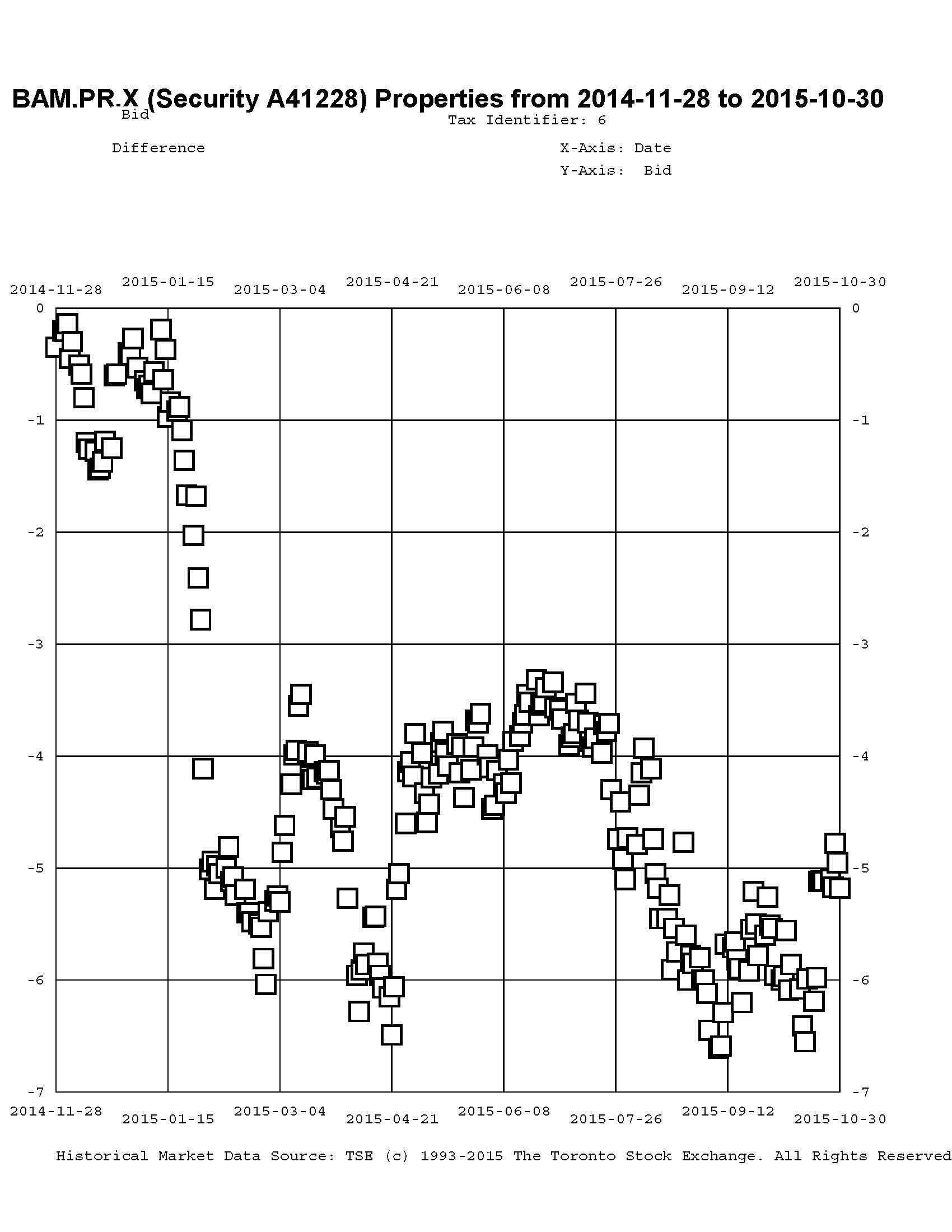
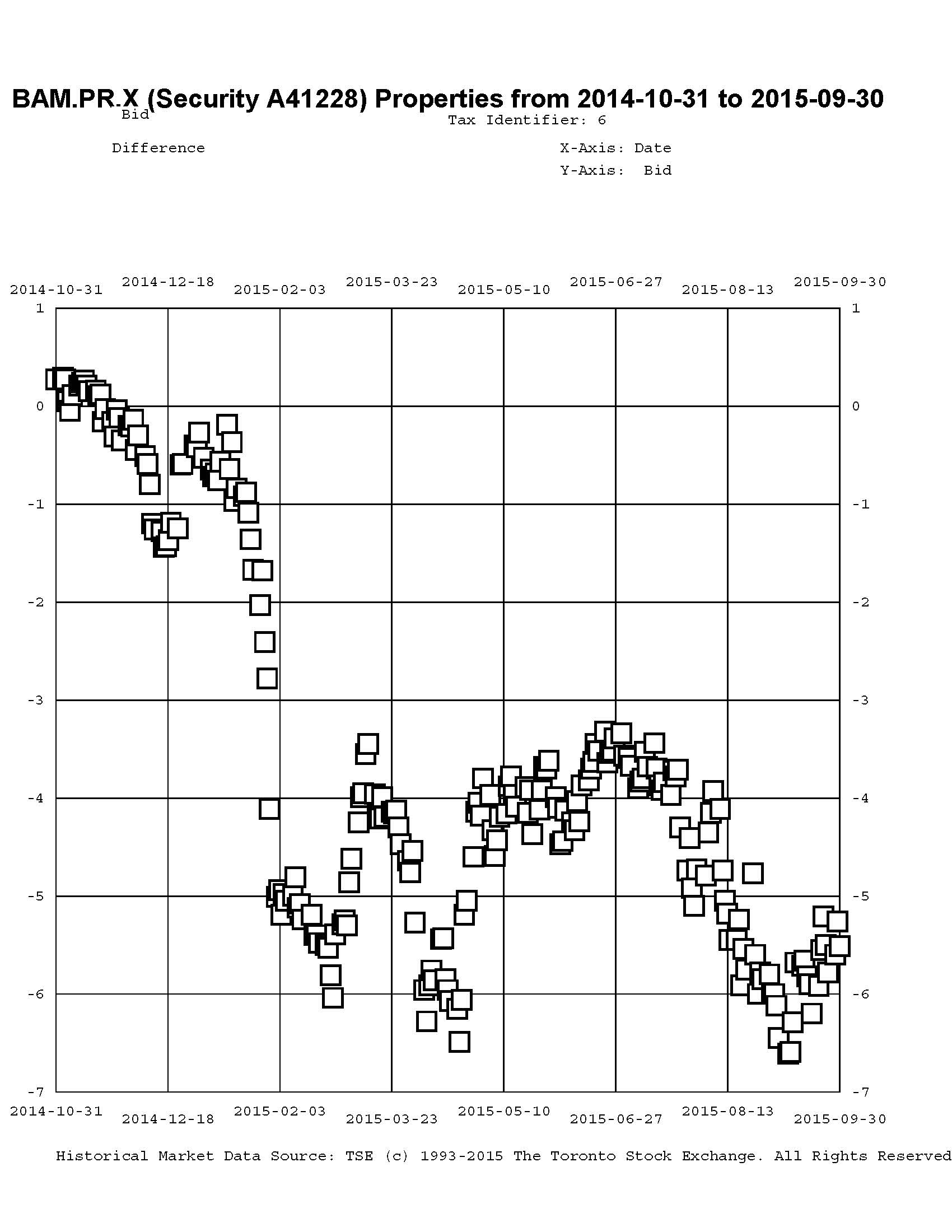
This trend is not restricted to the insurance sector, which I expect will become subject to NVCC rules in the relatively near future and are thus subject to the same redemption assumptions I make for DeemedRetractibles. Other pairs of interest are BAM.PR.X / BAM.PR.N:

BAMPRX_BAMPRN_bidDiff_150529
Click for Big

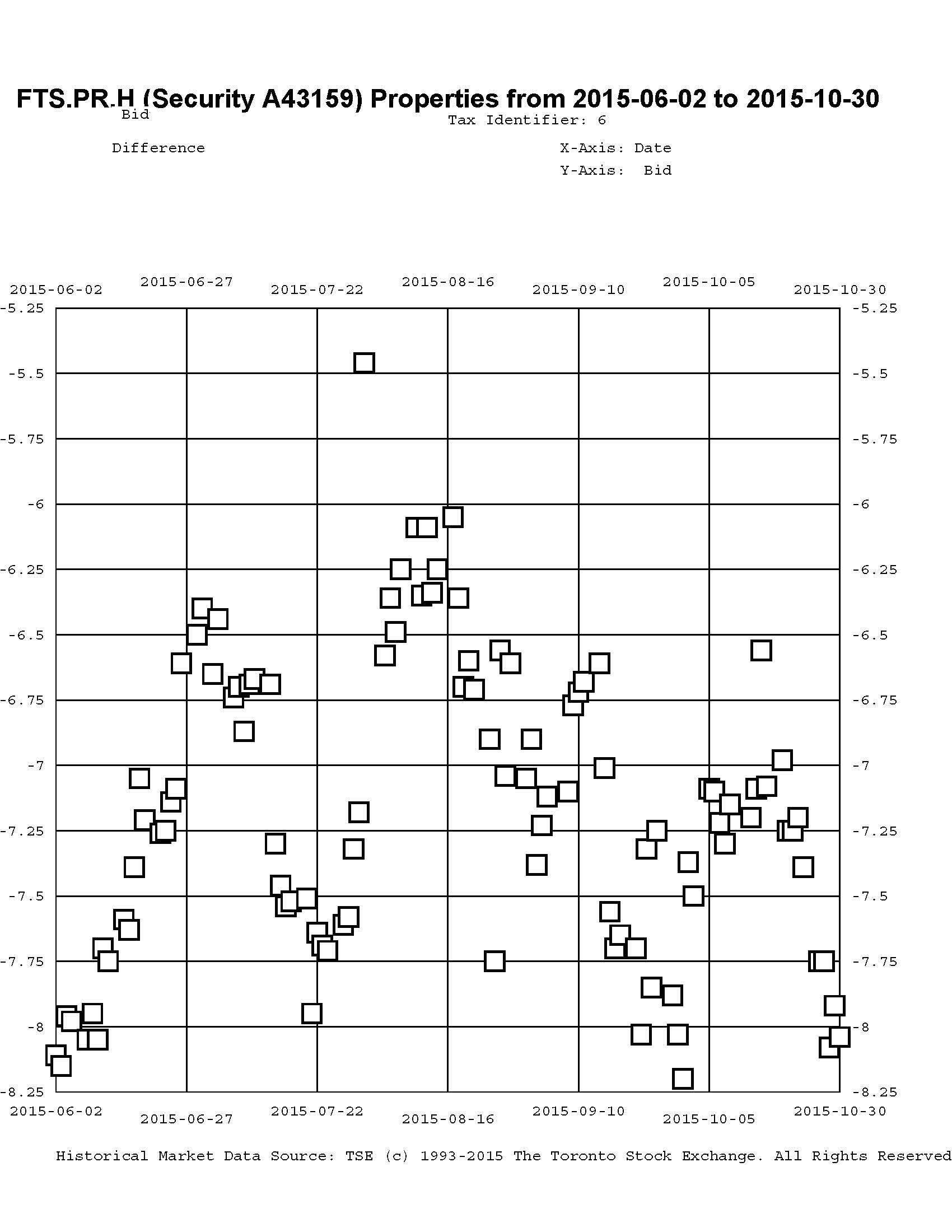
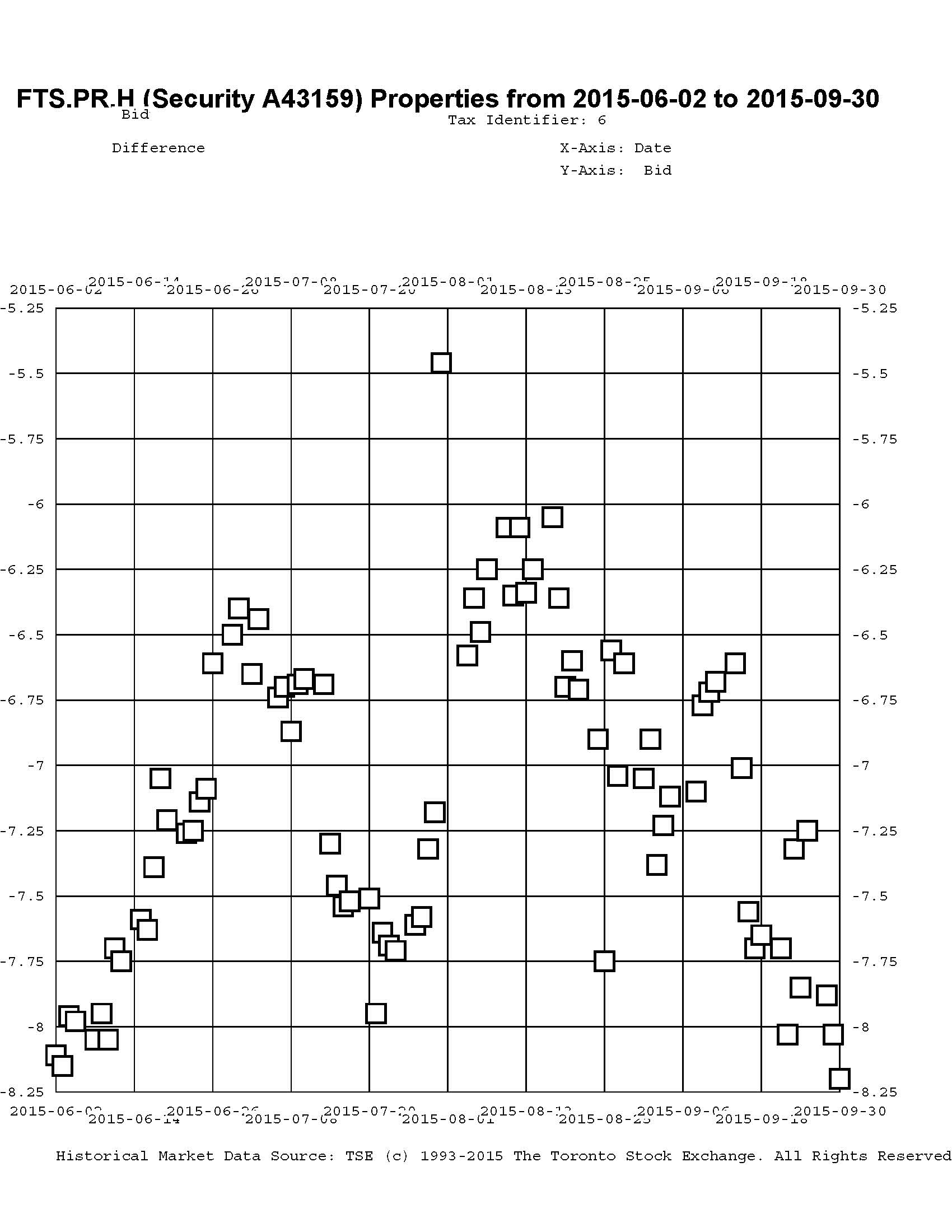
… and FTS.PR.H / FTS.PR.J:

FTSPRH_FTSPRJ_bidDiff_150529
Click for Big

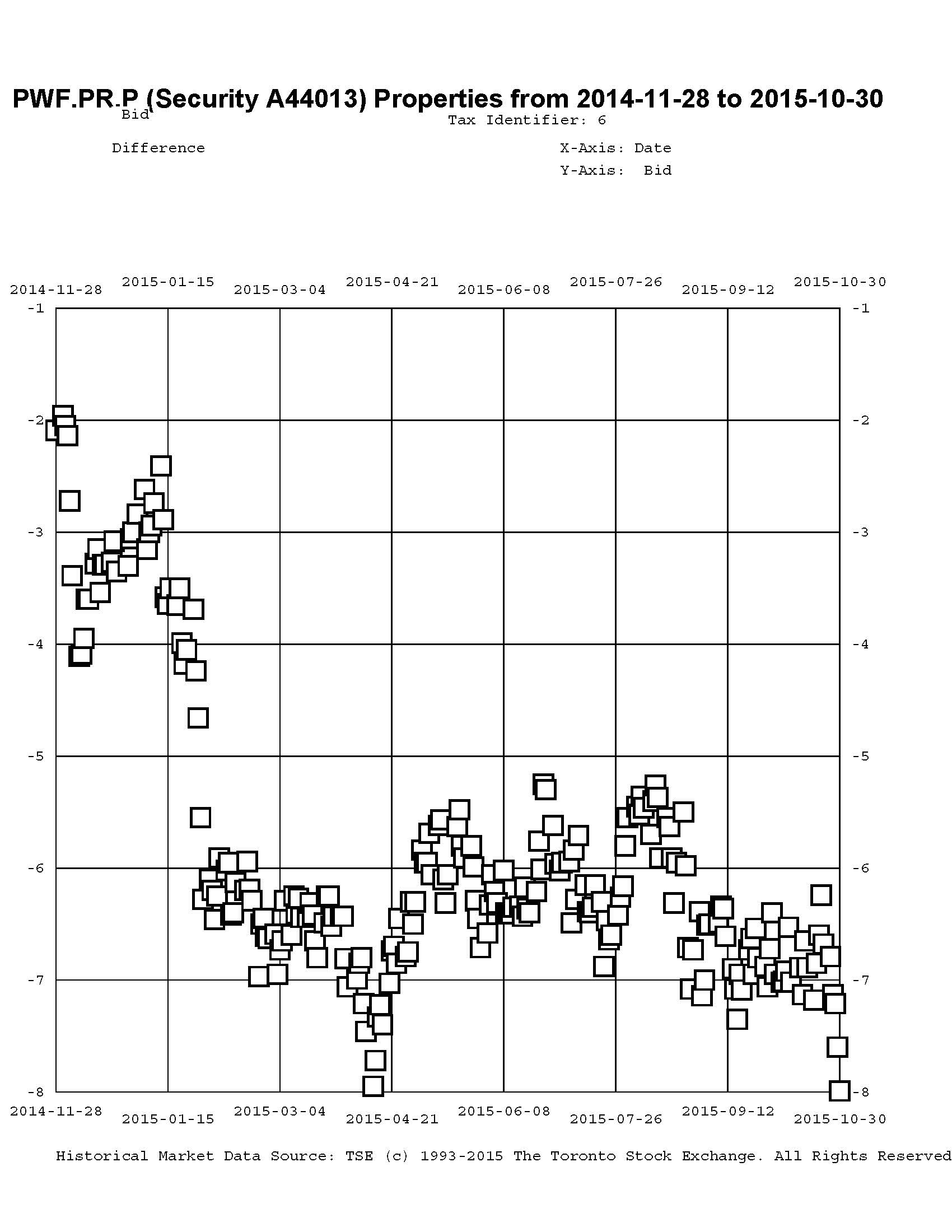
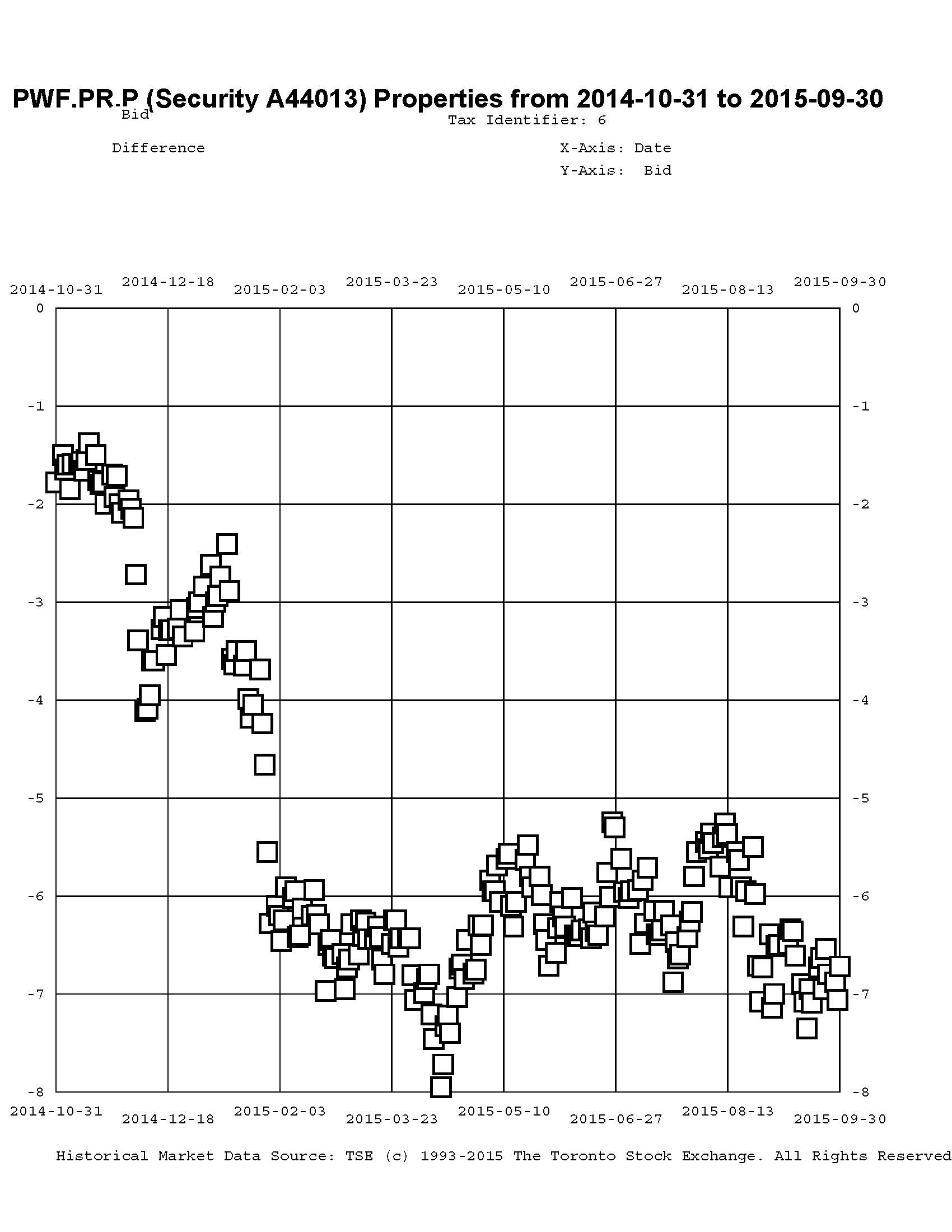
… and PWF.PR.P / PWF.PR.S:

PWFPRP_PWFPRS_bidDiff_150529
Click for Big

I will agree that the fund’s trades highlighted in this post may be decried as cases of monumental bad timing, but I should point out that in May, 2014, the fund was 63.9% Straight / 9.5% FixedReset while in May 2015 the fund was 11% Straight / 82% FixedReset, FloatingReset and FixedFloater (The latter figures include allocations from those usually grouped as ‘Scraps’). Given that the indices are roughly 30% Straight / 60% FixedReset & FloatingReset, it is apparent that the fund was extremely overweighted in Straights / underweighted in FixedResets in May 2014 but this situation has now reversed. HIMIPref™ analytics have been heavily favouring low-spread issues and the fund’s holdings are overwhelmingly of this type.

Summarizing the charts above in tabular form, we see:

FixedReset Straight Take-out
December 2013
Take-out
MAPF Trade
Take-out
December 2014
Take-out
April 2015
May 2015
GWO.PR.N
3.65%+130
GWO.PR.I
4.5%
($0.04) $1.00 $2.95 $5.69 6.46
SLF.PR.G
4.35%+141
SLF.PR.D
4.45%
($1.29) $0.25 $2.16 $6.25 5.61
MFC.PR.F
4.20%+141
MFC.PR.C
4.50%
($1.29) $0.86 $1.20 $5.35 4.98
BAM.PR.X
4.60%+180
BAM.PR.N
4.75%
($2.06)   $0.17 $4.18 3.62
FTS.PR.H
4.25%+145
FTS.PR.J
4.75%
$0.60   $5.68 $8.07 8.02
PWF.PR.P
4.40%+160
PWF.PR.S
4.80%
($0.67)   $3.00 $6.50 6.71
The ‘Take-Out’ is the bid price of the Straight less the bid price of the FixedReset; approximate execution prices are used for the “MAPF Trade” column. Bracketted figures in the ‘Take-Out’ columns indicate a ‘Pay-Up’

There was not much change from April month-end to May month-end.

In January, a slow decline due to fears of deflation got worse with Canada yields plummeting after the Bank of Canada rate cut with speculation rife about future cuts although this slowly died away.

And in late March / early April it got worse again, with one commenter attributing at least some of the blame to the John Heinzl piece in which I pointed out the expected reduction in dividend payouts! In May, a rise in the markets in the first half of the month was promptly followed by a slow decline in the latter half; perhaps due to increased fears that a lousy Canadian economy will delay a Canadian tightening.

All in all, I take the view that we’ve seen this show before: during the Credit Crunch, Floaters got hit extremely badly (to the point at which their fifteen year total return was negative) because (as far as I can make out) their dividend rate was dropping (as it was linked to Prime) while the yields on other perpetual preferred instruments were skyrocketing (due to credit concerns). Thus, at least some investors insisted on getting long term corporate yields from rates based (indirectly and with a lag, in the case of FixedResets) on short-term government policy rates. And it’s happening again!

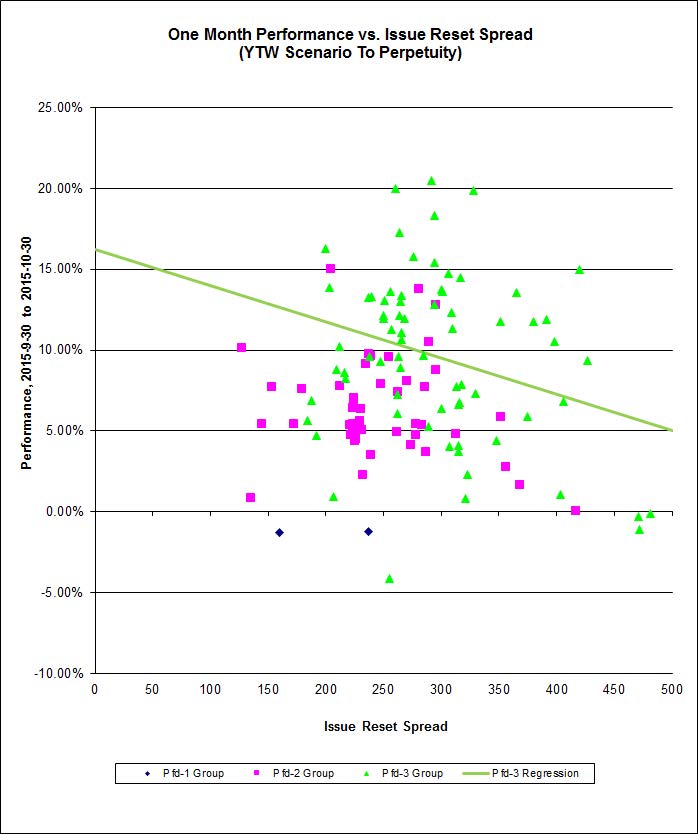
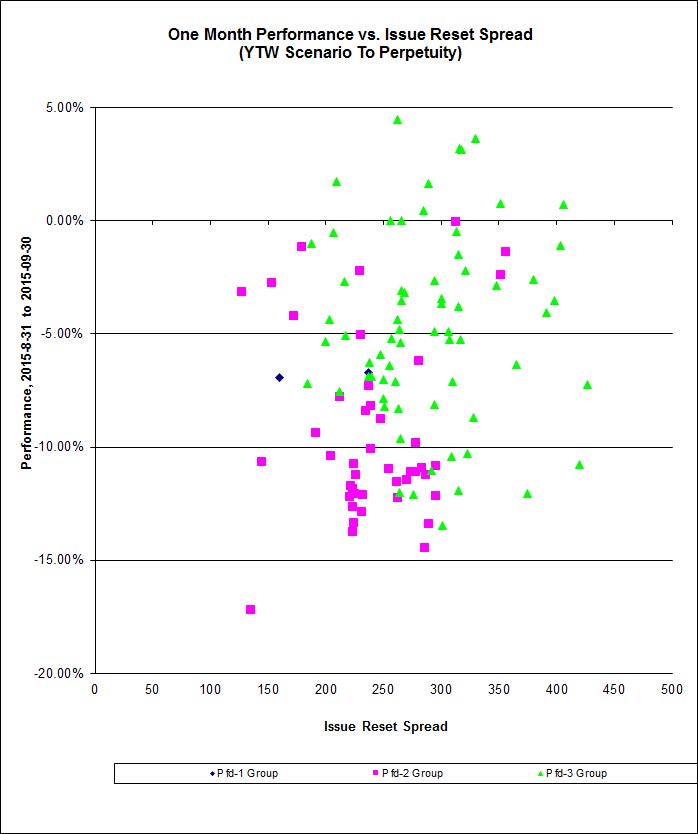
Here’s the May performance for FixedResets that had a YTW Scenario of ‘To Perptuity’ at mid-month.:

FR_1MoPerf_150529
Click for Big

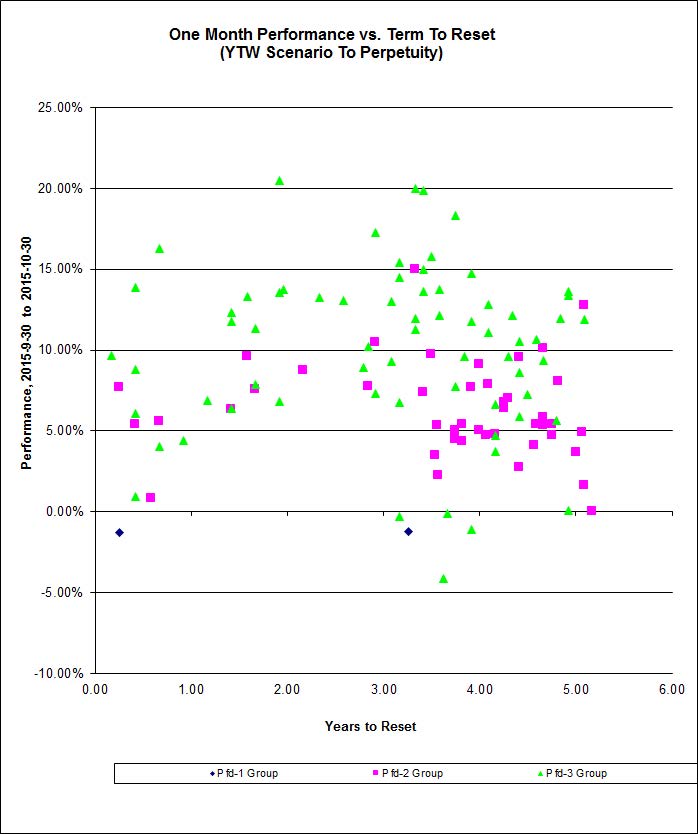
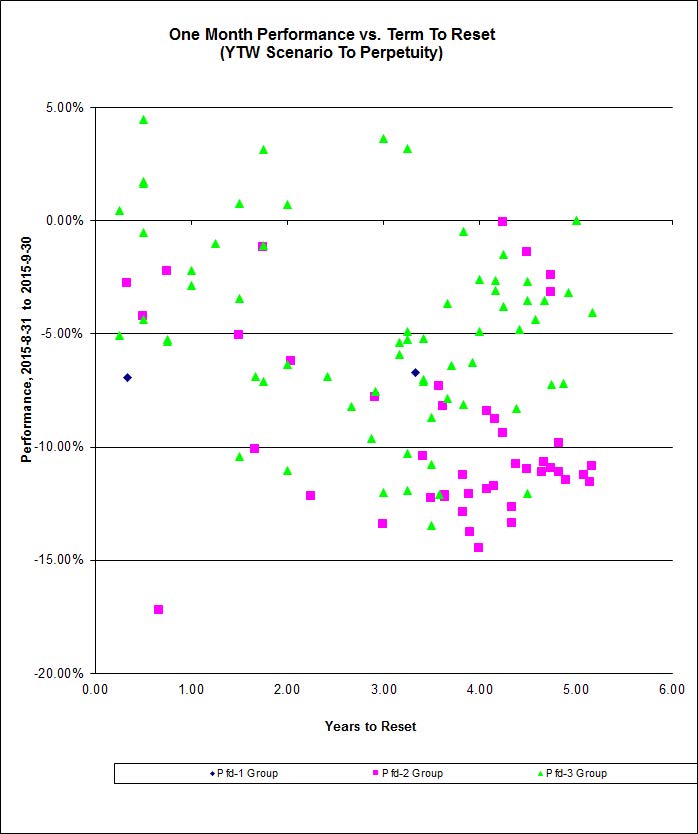
The market continues to be rather disorderly; correlations between Issue Reset Spread and monthly performance for May are basically zero. Interestingly, the correlation for the Pfd-2 Group issues against term to reset was a little better, although still lousy at 12%.

FR_1MoPerf_Term_150529
Click for Big
Issue Comments

FFN.PR.A To Get Bigger

Quadravest has announced:

North American Financial 15 Split Corp. (the “Company”) is pleased to announce it has filed a preliminary short form prospectus in each of the provinces of Canada with respect to an offering of Preferred Shares and Class A Shares of the Company. The offering will be co-led by National Bank Financial Inc., CIBC, RBC Capital Markets, Scotia Capital Inc., and will also include BMO Capital Markets, GMP Securities L.P., Canaccord Genuity Corp., Dundee Securities, Raymond James, Desjardins Securities Inc., Mackie Research Capital Corporation and Manulife Securities Incorporated.

The Preferred Shares will be offered at a price of $10.00 per Preferred Share to yield 5.25% on the issue price and the Class A Shares will be offered at a price of $8.65 per Class A Share to yield 13.87% on the issue price. The closing price on the TSX of each of the Preferred Shares and Class A Shares on May 27, 2015 was $10.08 and $9.19, respectively.

Since inception of the Company, the aggregate dividends paid on the Preferred Shares have been $5.58 per share and the aggregate dividends paid on the Class A Shares have been $8.85 per share (including one special distribution of $0.25 per share), for a combined total of $14.43. All distributions to date have been made in tax advantage eligible Canadian dividends or capital gains dividends.

The net proceeds of the secondary offering will be used by the Company to invest in a high quality portfolio consisting of 15 financial services companies made up of Canadian and U.S. issuers as follows:

Bank of Montreal National Bank of Canada Bank of America Corp.
The Bank of Nova Scotia Manulife Financial Corporation Citigroup Inc.
Canadian Imperial Bank of Commerce Sun Life Financial Services of Canada Inc. Goldman Sachs Group Inc.
Royal Bank of Canada Great-West Lifeco Inc. JP Morgan Chase & Co.
The Toronto-Dominion Bank CI Financial Corp. Wells Fargo & Co.

The Company’s investment objectives are:
Preferred Shares:
i. to provide holders of Preferred Shares with cumulative preferential monthly cash dividends, currently in the amount of 5.25% annually, to be set by the Board of Directors annually subject to a minimum of 5.25% until 2019; and
ii. on or about the termination date of December 1, 2019 (subject to further 5 year extensions thereafter), to pay the holders of the Preferred Shares $10 per Preferred Share.

Class A Shares:
i. to provide holders of the Class A Shares with regular monthly cash distributions in an amount to be determined by the Board of Directors; and
ii. to permit holders to participate in all growth in the net asset value of the Company above $10 per Unit, by paying holders on or about the termination date of December 1, 2019 (subject to further 5 year extensions thereafter) such amounts as remain in the Company after paying $10 per Preferred Share.

The sales period of this overnight offering will end at 9:00 a.m. (Toronto time) on May 29, 2015.

The NAVPU of the fund is 16.97 as of May 27 and the new Whole Units are being flogged at 18.65. When the Split Share structure is working as intended, it’s a thing of beauty! As well as being a counter-example to the Modigliani-Miller hypothesis, last mocked on PrefBlog on March 15, 2013.

FFN.PR.A was last mentioned on PrefBlog when they changed their name to North American Financial 15 Split Corp.; it will also be noted that they got bigger in August, 2014.

FFN.PR.A is tracked by HIMIPref™ but is relegated to the Scraps index on credit concerns.

Update, 2015-5-29: It did all right!

North American Financial 15 Split Corp. (the “Company”) is pleased to announce it has completed the overnight marketing of up to 1,380,000 Preferred Shares and up to 1,380,000 Class A Shares. Total proceeds of the offering are expected to be approximately $25.7 million.

The offering will be co-led by National Bank Financial Inc., CIBC, RBC Capital Markets, Scotia Capital Inc., and will also include BMO Capital Markets, GMP Securities L.P., Canaccord Genuity Corp., Dundee Securities, Raymond James, Desjardins Securities Inc., Mackie Research Capital Corporation and Manulife Securities Incorporated.

The sales period of the overnight offering has now ended.

Issue Comments

DGS.PR.A To Get Bigger

Brompton Group has announced:

Dividend Growth Split Corp. (the “Company”) is pleased to announce it has filed a preliminary short form prospectus with respect to a treasury offering of class A and preferred shares. The offering has been priced at $9.00 per class A share and $10.00 per preferred share. The offering prices were determined so as to be non-dilutive to the net asset value per unit of the Company on May 22, 2015, as adjusted for dividends and certain expenses accrued prior to or upon settlement of the offering.

The Company invests in a portfolio of common shares of high quality, large capitalization companies, which have among the highest dividend growth rates of those companies included in the S&P/TSX Composite Index. Upon closing of the offering, the portfolio will consist of common shares of the following 20 companies:

Great-West Lifeco Inc. The Bank of Nova Scotia CI Financial Corp. Shaw Communications Inc.
Industrial Alliance Insurance and Financial Services Inc. Canadian Imperial Bank of Commerce IGM Financial Inc. TELUS Corporation
Manulife Financial Corporation National Bank of Canada Power Corporation of Canada Canadian Utilities Limited
Sun Life Financial Inc. Royal Bank of Canada BCE Inc. Enbridge Inc.
Bank of Montreal The Toronto-Dominion Bank Rogers Communications Inc. TransCanada Corporation

The investment objectives for the class A shares are to provide holders with regular monthly cash distributions targeted to be $0.10 per class A share, and to provide the opportunity for growth in net asset value per class A share.

The investment objectives for the preferred shares are to provide holders with fixed cumulative preferential quarterly cash distributions currently in the amount of $0.13125 per preferred share, representing a yield on the original issue price of 5.25% per annum and to return the original issue price to holders of preferred shares on the maturity date of the Company, November 28, 2019.

The syndicate of agents for the offering is being led by RBC Capital Markets, CIBC, and Scotiabank and includes TD Securities Inc., BMO Capital Markets, National Bank Financial Inc., GMP Securities L.P., Raymond James Ltd., Canaccord Genuity Corp., Desjardins Securities Inc., Dundee Securities Ltd., Haywood Securities Inc., Industrial Alliance Securities Inc. and Mackie Research Capital Corporation.

I see the NAVPU as of May 21 is 18.19, while the units are being sold for 19.00 … nice work!

DGS.PR.A was last mentioned on PrefBlog when it got bigger last November. DGS.PR.A is tracked by HIMIPref™ but is relegated to the Scraps index on credit concerns.

Update, 2015-6-5: Offering completed:

Dividend Growth Split Corp. (the “Company”) is pleased to announce that it has completed a treasury offering of 2,200,000 class A shares and 2,200,000 preferred shares for aggregate gross proceeds of $41.8 million. The class A shares and preferred shares will continue to trade on the Toronto Stock Exchange under the existing symbols DGS (class A shares) and DGS.PR.A (preferred shares).

Issue Comments

DBRS: Bank Senior Debt On Trend-Negative Due to Government Support Uncertainty

DBRS has announced that it:

has today changed the trend on the senior and subordinated debt ratings of six Canadian Banks and their subsidiaries plus Desjardins Group (Desjardins) and its issuing entities to Negative from Stable. Additionally, Negative trends have been placed on those related short-term ratings that might be affected by a long-term rating change under DBRS methodologies.

The rating action reflects DBRS’s view that anticipated changes in Canadian legislation and regulation mean that the potential for timely systemic support for these systemically important institutions is declining and is likely to eventually result in a change in DBRS’s support assessment to SA3 from SA2 for these institutions. Currently, the final ratings of such deposit-taking institutions benefit from an uplift of one notch above their intrinsic assessment because of the SA2 support assessment. At the same time, DBRS notes that additional protection for non-bail-inable debt and deposits may eventually be provided by bail-inable senior debt under the anticipated bail-in debt regime. DBRS will assess the impact of the “Taxpayer Protection and Bank Recapitalization Regime” rules as more details are made available by the authorities.

DBRS currently has an SA2 support assessment for Desjardins based on DBRS’s view of likely support from the Government of Canada for this institution, which is systemically important for Québec. As DBRS’s view of Canadian Government support for the large banks shifts, so too will the potential for support for other deposit-taking institutions. While DBRS continues to view support for Desjardins as likely from the Province of Québec, a decline in support from Canada for the large banks and Desjardins may result in a change in the rating. Consequently, Desjardins rating trends have also been changed to Negative.

In other provinces, credit unions as well as their systems and centrals remain important for those individual provinces. In many rural areas, credit unions are the only providers of banking services. In addition, various provinces have 100% deposit guarantee programs. These systems, however, are not included in current legislative proposals. Accordingly, DBRS has not changed its view of the likelihood that provinces will support their credit union systems and centrals. Moreover, DBRS’s existing SA2 support assessment for the various credit union centrals is based on provincial government support and there are no trend changes in this announcement related to the centrals.

The proposed bail-in regime for Canadian banks has been previously discussed on PrefBlog. A similar outlook-change was announced by S&P in August, 2014 following a July, 2014 announcement by Moody’s.

I think it’s a little odd that Laurentian Bank was not affected.

DBRS will be hosting a conference call at 11am EDT 2015-5-21 to discuss the changes.

Separately, thirty-eight European banking groups were placed under Review-Negative:

DBRS Inc. and DBRS Ratings Limited, collectively DBRS, have placed Under Review with Negative Implications the senior debt and deposit ratings of 38 banking groups in Europe that currently benefit from some uplift for systemic support. The short-term debt ratings of 16 banking groups were also placed Under Review with Negative Implications.

These rating actions reflects DBRS’s view that recent developments in European regulation and legislation mean that there is less certainty about the likelihood of timely systemic support for these systemically important banks (SIBs). Currently, the final ratings of such banks benefit from an uplift of one or more notches above their intrinsic assessment (IA).

… which fed through to HSBC Bank Canada:

DBRS Limited (DBRS) has today placed the Long-Term Deposits and Senior Debt as well as the Subordinated Debt ratings of HSBC Bank Canada Under Review with Negative Implications. This change is a direct result of the concurrent rating review of HSBC Holdings plc, the parent entity of HSBC Bank Canada. The ratings of HSBC Holdings plc were placed Under Review with Negative Implications following the anticipated changes in regulation concerning government support.

Preferred shares are not affected by these changes, but outstanding instruments from the affected institutions are:

BMO.PR.J, BMO.PR.K, BMO.PR.L, BMO.PR.M, BMO.PR.Q, BMO.PR.R, BMO.PR.S, BMO.PR.T, BMO.PR.W.

BNS.PR.A, BNS.PR.B, BNS.PR.C, BNS.PR.D, BNS.PR.L, BNS.PR.M, BNS.PR.N, BNS.PR.O, BNS.PR.P, BNS.PR.Q, BNS.PR.R, BNS.PR.Y, BNS.PR.Z.

CM.PR.O, CM.PR.P, CM.PR.Q.

HSB.PR.C, HSB.PR.D.

NA.PR.M, NA.PR.Q, NA.PR.S, NA.PR.W

RY.PR.A, RY.PR.B, RY.PR.C, RY.PR.D, RY.PR.E, RY.PR.F, RY.PR.G, RY.PR.H, RY.PR.I, RY.PR.J, RY.PR.K, RY.PR.L, RY.PR.M, RY.PR.W, RY.PR.

TD.PF.A, TD.PF.B, TD.PF.C, TD.PF.D, TD.PF.E, TD.PR.S, TD.PR.T, TD.PR.Y, TD.PR.Z.

Issue Comments

SLF.PR.G To Be Extended

Sun Life Financial Inc. has announced:

that it does not intend to exercise its right to redeem its currently outstanding Class A Non-Cumulative Rate Reset Preferred Shares Series 8R (the “Series 8R Shares”) on June 30, 2015. As a result, subject to certain conditions, the holders of Series 8R Shares have the right to convert all or part of their Series 8R Shares on a one-for-one basis into Class A Non-Cumulative Floating Rate Preferred Shares Series 9QR of Sun Life Financial (the “Series 9QR Shares”) on June 30, 2015. Holders of Series 8R Shares who do not exercise their right to convert their Series 8R Shares into Series 9QR Shares on such date will retain their Series 8R Shares.

The foregoing conversions are subject to the conditions that: (i) if Sun Life Financial determines that there would be less than one million Series 8R Shares outstanding after June 30, 2015, then all remaining Series 8R Shares will automatically be converted into Series 9QR Shares on a one-for-one basis on June 30, 2015, and (ii) alternatively, if Sun Life Financial determines that there would be less than one million Series 9QR Shares outstanding after June 30, 2015, no Series 8R Shares will be converted into Series 9QR Shares. In either case, Sun Life Financial will give a written notice to that effect to any registered holder affected by the preceeding minimums on or before Monday, June 22, 2015.

The dividend rate applicable to the Series 8R Shares for the five-year period commencing on June 30, 2015 and ending on June 29, 2020, and the dividend rate applicable to the Series 9QR Shares for the three-month period commencing on June 30, 2015 and ending on September 29, 2015, will be determined on Monday, June 1, 2015 and will be announced in a news release on Monday, June 1, 2015.

Beneficial owners of Series 8R Shares who wish to exercise their right of conversion should communicate as soon as possible with their broker or other nominee and ensure that they follow their instructions in order to ensure that they meet the deadline to exercise such right, which is 5:00 p.m. (ET) on Monday, June 15, 2015.

Subject to regulatory approval, Sun Life Financial may redeem the Series 8R Shares and the Series 9QR Shares in whole or in part on June 30, 2020 and on the 30th of June in every fifth year thereafter.

An application will be made to list the Series 9QR Shares on the Toronto Stock Exchange.

SLF.PR.G is a FixedReset, 4.35%+141, that commenced trading 2010-5-25 after being announced 2015-5-13.

There can be no surprise regarding the extension seeing that it has been trading below $25.00 for some time and has lost considerable ground vs. SLF.PR.D over the past year. Today it is bid at $18.01, against $22.90 for SLF.PR.D, a spread of $4.89 – this may be compared to $6.25 at April month-end, $2.16 at 2014 year-end and ($1.29) [that is, a pay-up] at 2013 year-end.

As noted in the press release, the new dividend rate will be determined June 1 and announced later that day; if we use today’s GOC-5 rate of 1.09%, the new rate will be 1.09%+141bp = 2.50%, a stunning 43% reduction from its initial dividend.

Given current conditions for Strong Pairs, I expect that I will eventually recommend that the FixedReset be held rather than converted.

Estimate of SLF.PR.? FloatingReset Trading Price In Current Conditions Assuming Reset to 2.50% for SLF.PR.G FixedReset
  Assumed FloatingReset
Price if Implied Bill
is equal to
FixedReset Bid Price Spread 0% +0.30% +0.60%
SLF.PR.G 18.01 141bp 16.82 17.15 17.48

These various scenarios for the Implied Average Bill Yield can be compared with the current state of affairs for FixedReset / FloatingReset pairs:

pairs_FR_150519A
Click for Big

So, given current market conditions, it is reasonable to expect that the new FloatingReset issue (if it is issued) will be trading significantly lower than the continuing FixedReset issue (assuming there is enough of it left that the company does not force conversion) and thus those who really want the FloatingReset will be able to trade on the market on better terms than available through conversion. But there’s still a lot of time left before a decision has to be made, and the actual dividend rate for the next five years for SLF.PR.G isn’t even known yet. So regard these musings as tentative!

Issue Comments

RBS.PR.B: Partial Call For Redemption

Scotia Managed Companies has announced:

R Split III Corp. (the “Company”) announced today that it has called 111,228 Preferred Shares for cash redemption on May 29, 2015 (in accordance with the Company’s Articles) representing approximately 18.652% of the outstanding Preferred Shares as a result of the annual retraction of 222,456 Capital Shares by the holders thereof. The Preferred Shares shall be redeemed on a pro rata basis, so that each holder of Preferred Shares of record on May 27, 2015 will have approximately 18.652% of their Preferred Shares redeemed. The redemption price for the Preferred Shares will be $13.60 per share.

In addition, holders of a further 23,400 Capital Shares and 11,700 Preferred Shares have deposited such shares concurrently for retraction on May 29, 2015. As a result, a total of 245,856 Capital Shares and 111,228 Preferred Shares, or approximately 20.217% of both classes of shares currently outstanding, will be redeemed.

Holders of Preferred Shares that are on record for dividends but have been called for redemption will be entitled to receive dividends thereon which have been declared but remain unpaid up to but not including May 29, 2015.

Payment of the amount due to holders of Preferred Shares will be made by the Company on May 29, 2015. From and after May 29, 2015 the holders of Preferred Shares that have been called for redemption will not be entitled to dividends or to exercise any rights in respect of such shares except to receive the amount due on redemption.

R Split III Corp. is a mutual fund corporation created to hold a portfolio of common shares of Royal Bank of Canada. Capital Shares and Preferred Shares of R Split III Corp. are listed for trading on The Toronto Stock Exchange under the symbols RBS and RBS.PR.B respectively.

RBS.PR.B was last mentioned on PrefBlog when there was a partial redemption in May 2014. It is not tracked by HIMIPref™ since, with only about 600,000 shares outstanding with a par value of $13.60, it’s too small – and now it’s getting smaller!

Issue Comments

FTS.PR.H: Convert or Hold?

It will be recalled that FTS.PR.H will reset to 2.50% effective June 1 – a fact that was established with some difficulty!

Holders of FTS.PR.H have the option to convert to FloatingResets, FTS.PR.I, which will pay 3-month bills plus 145bp on its par value of $25.00. The deadline for notifying the company of the intent to convert is May 19; but note first that this is a company deadline and that brokers will generally set their deadlines a day or two in advance, so there’s not much time to lose if you’re planning to convert! Also, Monday 18 is a holiday in most of Canada and your brokerage will probably be closed. However, if you miss the brokerage deadline they’ll probably do it on a ‘best efforts’ basis if you grovel in a sufficiently entertaining fashion.

The most logical way to analyze the question of whether or not to convert is through the theory of Preferred Pairs, for which a calculator is available. Briefly, a Strong Pair is defined as a pair of securities that can be interconverted in the future (e.g., FTS.PR.H and the FloatingReset, FTS.PR.I, that will exist if enough holders convert). Since they will be interconvertible on this future date, it may be assumed that they will be priced identically on this date (if they aren’t then holders will simply convert en masse to the higher-priced issue). And since they will be priced identically on a given date in the future, any current difference in price must be offset by expectations of an equal and opposite value of dividends to be received in the interim. And since the dividend rate on one element of the pair is both fixed and known, the implied average rate of the other, floating rate, instrument can be determined. Finally, we say, we may compare these average rates and take a view regarding the actual future course of that rate relative to the implied rate, which will provide us with guidance on which element of the pair is likely to outperform the other until the next interconversion date, at which time the process will be repeated.

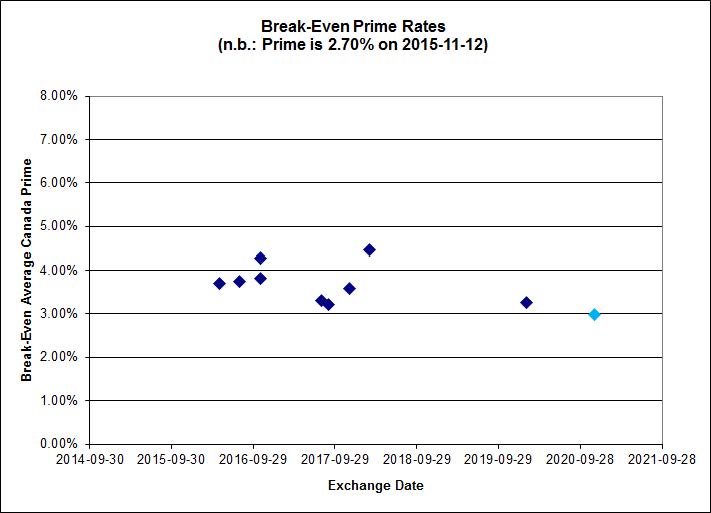
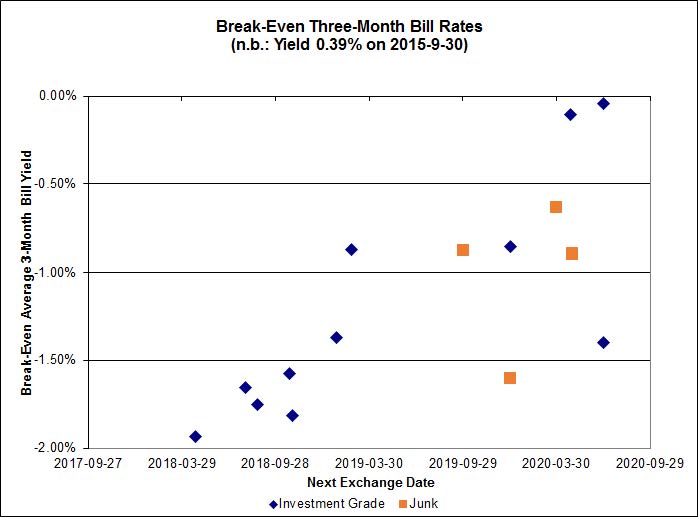
We can show the break-even rates for each FixedReset / FloatingReset Strong Pair graphically by plotting the implied average 3-month bill rate against the next Exchange Date (which is the date to which the average will be calculated).

pairs_FR_150514
Click for Big

The market appears to have a distaste at the moment for floating rate product; the implied rates until the next interconversion are all (except one!) lower than the current 3-month bill rate and one is significantly negative! Whatever might be the result of the next few Bank of Canada overnight rate decisions, I suggest that it is unlikely that the average rate over the next five years will be lower than current – but if you disagree, of course, you may interpret the data any way you like.

Since credit quality of each element of the pair is equal to the other element, it should not make any difference whether the pair examined is investment-grade or junk, although we might expect greater variation of implied rates between junk issues on grounds of lower liquidity. The average in the table above for the junk issues (except FFH.PR.E / FFH.PR.F at -0.85% and BRF.PR.A / BRF.PR.B at -1.05%) is about +0.30%; for the investment grade issues (except TRP.PR.A / TRP.PR.F) it is also about 0.30%. This is pretty good agreement.

If we plug in the current bid price of the FTS.PR.H FixedReset, we may construct the following table showing consistent prices for the soon-to-be-issued FTS.PR.I FloatingReset given a variety of Implied Breakeven yields consistent with issues currently trading:

Estimate of FTS.PR.I FloatingReset Trading Price In Current Conditions
  Assumed FloatingReset
Price if Implied Bill
is equal to
FixedReset Bid Price Spread 0% +0.30% +0.60%
FTS.PR.H 16.33 145bp 15.22 15.54 15.85

Based on current market conditions, I suggest that the FloatingReset that will result from conversion of FTS.PR.H will be cheap and trading a little below the price of FTS.PR.H. Therefore, I recommend that holders of FTS.PR.H continue to hold this issue and not to convert. I will note that, given the apparent cheapness of the FloatingResets, it may be a good trade to swap the FixedReset for the FloatingReset in the market once both elements of each pair are trading and you can – presumably, according to this analysis – do it with a reasonably good take-out in price, rather than doing it through the company on a 1:1 basis. But that, of course, will depend on the prices at that time. There are no guarantees – my recommendation is based on the assumption that current market conditions with respect to the pairs will continue until the FTS.PR.I commences trading and that the relative pricing of FTS.PR.H / FTS.PR.I will reflect these conditions.

Note as well that conversion rights are dependent upon at least one million shares of each series being outstanding after giving effect to holders’ instructions; e.g., if only 100,000 shares of FTS.PR.H are tendered for conversion, then no conversions will be allowed; but if only 100,000 shares of FTS.PR.H will remain after the rest are all tendered, then conversion will be mandatory. However, this is relatively rare: all 26 Strong Pairs currently extant have some version of this condition and all but two have both series outstanding.

Issue Comments

DFN.PR.A To Get Bigger

Quadravest has announced:

Dividend 15 Split Corp. (the “Company”) is pleased to announce it has filed a preliminary short form prospectus in each of the provinces of Canada with respect to an offering of Preferred Shares and Class A Shares of the Company. The offering will be co-led by National Bank Financial Inc., CIBC, RBC Capital Markets and will also include Scotia Capital Inc., TD Securities Inc., BMO Capital Markets, GMP Securities L.P., Canaccord Genuity Corp., Dundee Securities, Raymond James, Desjardins Securities Inc., Mackie Research Capital Corporation and Manulife Securities Incorporated.

The Preferred Shares will be offered at a price of $10.00 per Preferred Share to yield 5.25% on the issue price and the Class A Shares will be offered at a price of $11.90 per Class A Share to yield 10.08% on the issue price. The closing price on the TSX of each of the Preferred Shares and the Class A Shares on May 12, 2015 was $10.35 and $12.23, respectively.

Since inception of the Company, the aggregate dividends paid on the Preferred Shares have been $5.84 per share and the aggregate dividends paid on the Class A Shares have been $16.80 per share (including five special distributions of $0.25 per share, one special distribution of $0.50 per share and one special stock dividend of $1.75 per share), for a combined total of $22.64 per unit. All distributions to date have been made in tax advantage eligible Canadian dividends or capital gains dividends.

The net proceeds of the offering will be used by the Company to invest in an actively managed portfolio of dividend yielding common shares which includes each of the 15 Canadian companies listed below:

The Bank of Nova Scotia Manulife Financial Corp. Thomson-Reuters Corporation
BCE Inc. National Bank of Canada The Toronto-Dominion Bank
Canadian Imperial Bank of Commerce Royal Bank of Canada TransAlta Corporation
CI Financial Corp. Sun Life Financial Inc. TransCanada Corporation

The Company’s investment objectives are:
Preferred Shares:
i. to provide holders of the Preferred Shares with fixed, cumulative preferential monthly cash dividends in the amount of $0.04375 per Preferred Share to yield 5.25% per annum on the original issue price; and
ii. on or about December 1, 2019, to pay the holders of the Preferred Shares the original issue price of those shares.

Class A Shares:
i. to provide holders of the Class A Shares with regular monthly cash dividends currently targeted to be $0.10 per Class A; and
ii. on or about December 1, 2019, to pay the holders of Class A Shares at least the original issue price of those shares.

The sales period of this overnight offering will end at 9:00 a.m. (EST) on May 14, 2015.

The NAVPU of the Dividend 15 Corp. Whole Units is 20.06 as of May 12 … and these whole units are being sold for 21.90. Nice work if you can get it!

Update, 2015-5-15: This was extremely successful:

Dividend 15 Split Corp. (the “Company”) is pleased to announce it has completed the overnight marketing of up to 4,300,000 Preferred Shares and up to 4,300,000 Class A Shares of the Company. Total proceeds of the offering are expected to be approximately $94.2 million.

Issue Comments

MFC.PR.A To Be Redeemed

Manulife Financial Corporation has announced:

its intention to redeem all of its outstanding 14,000,000 Non-cumulative Class A Shares, Series 1 (“Series 1 Preferred Shares”) for cash on June 19, 2015. The Series 1 Preferred Shares (TSX: MFC.PR.A) are redeemable at Manulife’s option on June 19, 2015, at a redemption price per Series 1 Preferred Share equal to C$25.00 for an aggregate total of C$350 million. Formal notice will be delivered to holders of Series 1 Preferred Shares in accordance with the terms outlined in the share provisions for the Series 1 Preferred Shares.

Separately from the redemption price, the final quarterly dividend of C$0.25625 per Series 1 Preferred Share will be paid in the usual manner on June 19, 2015 to shareholders of record on May 20, 2015. After the Series 1 Preferred Shares are redeemed, holders of Series 1 Preferred Shares will cease to be entitled to distributions of dividends and will not be entitled to exercise any rights as holders other than to receive the redemption price.

This is one of the last Operating Retractibles still around – most were redeemed when accounting changes turned them into debt and this was reinforced by being disallowed as Tier 1 Capital by OSFI, although extant issues were grandfathered.

Many thanks to Assiduous Readers WT and GA for separately bringing this to my attention.