Category: Issue Comments

Issue Comments

TLM.PR.A To Be Taken Out At $25.00?

Talisman Energy Inc. has announced:

•A cash price of C$25 plus accrued and unpaid dividends per Talisman preferred share if holders approve their participation in the transaction

that it has entered into a definitive agreement (the “Arrangement Agreement”) with Repsol S.A. under which Repsol will acquire all of the outstanding common shares of Talisman for US$8.00 (C$9.33) per share in cash.

Following an extensive review and analysis of the proposed transaction and other available alternatives, the Talisman Board has unanimously approved the transaction and recommends that Talisman’s common shareholders and preferred shareholders vote in favor of the arrangement at a special meeting of shareholders to be held mid February 2015. In addition, certain of the directors and all of the executive officers of Talisman have signed agreements to vote their shares in favor of the transaction.

The transaction is to be effected pursuant to an arrangement under the Canada Business Corporations Act. The Arrangement Agreement between Talisman and Repsol provides for, among other things, a non-solicitation covenant on the part of Talisman, subject to customary “fiduciary out” provisions, that entitles Talisman to consider and accept a superior proposal if Repsol does not match the superior proposal. If the Arrangement Agreement is terminated in certain circumstances, including if Talisman enters into an agreement with respect to a superior proposal, Repsol is entitled to a termination payment of US$270 million.

Completion of the transaction is subject to customary closing conditions, including court approval of the Arrangement Agreement, approval of two-thirds of the votes cast by holders of common shares at the special meeting, and applicable government and regulatory approvals. The transaction is targeted to close in the second quarter of 2015.

Under the Arrangement Agreement, if approved by the holders in a separate class vote, Repsol will acquire the outstanding preferred shares of Talisman. However, closing of the Arrangement Agreement is not conditioned on approval by the holders of the Talisman preferred shares. If the requisite preferred shareholder approval is not obtained, the preferred shares will be excluded from the arrangement and will remain outstanding following completion of the arrangement.

Tim Kiladze comments in the Globe:

Combined, the two companies are expected to have net debt that amounts to 1.9 times earnings before interest, taxes, depreciation and amortization next year, which could fall to 1.2 times by 2017. However, that’s the base case scenario, which assumes $85 oil next year, and $99 oil in 2017. In a stress case with $71 oil next year and $79 oil in 2017, net debt is 2.3 times EBITDA next year and 1.7 times EBITDA in 2017.

As for the broad strategy, Repsol is willing to bet against the market. Most energy firms were punished for tacking on too many assets and projects as oil prices soared, and they are now scrambling to shed non-core positions and slash capital spending. Repsol believes adding diversity will help it through this energy downturn – so long as the assets are in politically safe regions like the Americas.

Rebecca Penty of Bloomberg notes:

Analysts widely recommended that shareholders accept Repsol’s bid, including those from BMO Capital Markets, CIBC World Markets Inc. and Raymond James Ltd.

TLM.PR.A was on fire today, rocketing up from yesterday’s closing quote of 19.60-20 to 23.70-72 today.

So what’s going on? First, I suggest that the discount to par represented by today’s quote is an uncertainty discount; if either common or preferred shareholders reject the deal, the price will tank again, since any credit improvement of the combined company will be minimal. DBRS comments:

Overall, DBRS expects this transaction to have a minimal impact on Talisman’s ratings. From a business risk perspective, the acquisition would be a net positive for Talisman given Repsol’s significant size and scale of integrated and geographically well-diversified operations. From a financial risk perspective, the pro forma financial metrics are expected to be reasonable to support an investment-grade rating.

Note that when DBRS talks about “investment grade” they are talking about the bonds, which are BBB. There is subordination notching for the preferreds, which are junk.

In May 2014, S&P affirmed Repsol at BBB- [Outlook Positive]:

  • •Spain-based energy company Repsol S.A. has executed its debt reduction measures by completing the sale of its liquefied natural gas (LNG) division. In addition, Repsol has sold its remaining stake in Argentina-based YPF and the related restitution bonds.
  • •Following this, the new higher level of Repsol’s credit ratios will depend on its uses of the cash and our forecast of growing production.
  • •We are therefore revising our outlook on Repsol to “positive” from “stable,” and affirming our ‘BBB-‘ long-term corporate credit rating on the company.
  • •The positive outlook mostly reflects our belief that the company will be able to generate higher operating cash flows, and have an increased ability to internally fund ongoing investments in exploration and development.

… and downgraded TLM to BBB- in October:

  • •We expect Talisman Energy Inc.’s operating performance, specifically its production and cost profile, to show limited improvement in the next 18-24 months, constraining any significant cash-flow growth.
  • •At the same time, we expect Talisman to significantly outspend internally generated cash flow through 2015. Even if the company meets its US$2 billion asset sale target in the next 12-18 months, we do not think its credit profile is commensurate with that of its ‘BBB’ rated peers.
  • •As a result, we are lowering our long-term corporate credit and senior unsecured debt ratings on Talisman to ‘BBB-‘ from ‘BBB’.
  • •We are also lowering our global scale rating on its preferred stock to ‘BB’ from ‘BB+’ and its Canada scale rating on the preferred stock to ‘P-3’ from ‘P-3 (High)’.
  • •The stable outlook reflects our view that Talisman’s cash flow from its increasing liquids production combined with any asset sales will allow the company to maintain its funds from operations-to-debt at more than 30% through 2015.


At the same time, Standard & Poor’s lowered its global scale rating on its preferred stock to ‘BB’ from ‘BB+’ and its Canada scale rating on the stock to ‘P-3’ from ‘P-3 (High)’.

The outlook is stable.

The latter action was reported on PrefBlog.

This is a tricky one. Remember the BCE Plan of Arrangement with its huge prices for the preferred shares? And remember how Prefs plunged when the deal got into trouble? And then the deal died? All this could – conceivably – happen again with the TLM.PR.A deal. Even if the deal is simply replaced by a better deal for common shareholders – a bid by the CPPIB has been mooted – the new plan might not necessarily involve taking out the preferreds.

So I don’t really have any advice for investors on this one. On December 10 the issue was quoted at 15.95-24 and oil hasn’t exactly rebounded since then. So if common shareholders reject the deal, the price will be … pick a number. If common shareholders accept the deal but preferred shareholders reject it (a very low probability scenario, according to me!) then the issue will remain outstanding and the price will be … pick a number. And if both common and preferred shareholders accept the deal, the price will be $25.00.

So there’s huge deal risk here, and I do preferred shares and yield curves. Deal risk is for charlatans magicians wiser heads than mine. My own inclination is that investors should unload the deal risk to speculators and try not to obsess too much about the potential upside being given up. But it’s all up to you.

TLM.PR.A is tracked by HIMIPref™ but is relegated to the Scraps index on credit concerns.
Issue Comments

IGM.PR.B Downgraded To P-2(high) by S&P

Standard & Poor’s has announced:

it reviewed its ratings on 37 global asset managers by applying its new ratings criteria for the sector (see “Key Credit Factors For Asset Managers,” published Dec. 9, 2014). As a result, we have taken rating actions on these entities (see ratings list). We also took rating actions on certain subsidiaries as a result of applying our new criteria to their parents. The rating actions were driven by revisions to our criteria rather than a sudden change of the issuers’ creditworthiness.

We define asset managers as companies that derive a majority of their revenues from management and performance fees for managing third-party money or assets on the behalf of retail or institutional investors. We rate asset managers under a similar framework to our corporate criteria. Our assessment reflects these companies’ business risk profiles, their financial risk profiles, and other factors that may modify the stand-alone credit profile.

We have now removed the under criteria observation (UCO) identifier from our ratings on all of the entities listed below.

We anticipate publishing, for most issuer credit ratings or outlooks that change, research updates within 30 business days. We anticipate publishing research updates in the first or second quarters of 2015 for those entities that we did not change our issuer credit ratings or outlooks on under the new criteria.

IGM Financial Inc.
Issuer Credit Rating A/Stable/A-1 A+/Stable/A-1
Senior Unsecured A A+
Preferred Stock BBB+ A-
P-2(High) P-1(Low)

The criteria have been published and discussed by S&P. We can look forward to publication of the specific reasons for the IGM downgrade.

Issue Comments

AZP.PR.B, TRP.PR.A & FFH.PR.C: Convert or Not?

It seems that some of the communications received by shareholders on the conversion are not particularly enlightening – I received the following complaint earlier this week:

Just to let you know that the conversion of series C to D is based on the 90 day Tbill rate not the 5 year GOC rate as noted on your prefinfo.com listing. I wish I would have checked this before as shares are now converting Dec 31. I do not understand notice from FFH that I would be getting $1.1445 per share which works out to 4.578 % share. I assume the 90 day rate is 0.90 + 3.15 % works out to 4.05 %.

I answered him:

Yes, if you convert to D, you will receive the 90-day bill rate plus 315bp, reset quarterly, with the first quarter’s dividend having been set at $0.25212 per share, payable on March 31, 2015.

However, if you retain your C, you will receive the 5 Year GOC Rate plus 315bp, which on December 2 was equal to a total of 4.578%, or $1.14450 per share per year, which is what the prefinfo.com description is referring to. This rate will not be reset until the next exchange date, 2019-12-31.

It is your choice as to whether you retain your C or convert to D. It’s a difficult question which I will address on PrefBlog.com on Thursday night. The first link in the next paragraph has some preliminary advice on the matter.

For more information on the reset, see http://prefblog.com/?p=26994, http://prefblog.com/?p=26996 and http://prefblog.com/?p=27036

If you have any ideas on how the prefinfo.com description can be made more clear, please let me know!

So the resets for the three captioned issues have been set, but the question remains – should they be converted into the FixedResets, which will pay a spread over three-month bills, reset quarterly, or not?

First, we will construct a table:

Imminent Resets
Issue Resets To Convertible to
Bills +X bp
Company Deadline for Conversion Instruction
TRP.PR.A 3.266% +192bp 2014-12-16-5pm
FFH.PR.C 4.578% +315bp 2014-12-16-5pm
AZP.PR.B 5.570% +418bp 2014-12-16-5pm
Note that the deadline given is the one given for receipt of instructions by the company. Your broker’s deadline will be earlier so don’t waste any time if you want to convert

Next, we will take a look at similar pairs currently trading:

Fixed Reset Fixed Rate Floating Reset Spread over Bills Bid Price
Fixed Reset
Bid Price
Floating Reset
Break-Even 3-Month Bill Rate
BNS.PR.P 3.35% BNS.PR.A 205 25.16 25.70 2.01%
TD.PR.S 3.371% TD.PR.T 160 25.23 25.31 1.87%
BMO.PR.M 3.39% BMO.PR.R 165 24.65 25.45 2.71%
BNS.PR.Q 3.61% BNS.PR.B 170 25.38 25.39 1.92%
TD.PR.Y 3.5595% TD.PR.Z 168 25.32 25.27 1.82%
BNS.PR.R 3.83% BNS.PR.C 188 25.39 25.45 2.02%
RY.PR.I 3.52% RY.PR.K 193 25.41 25.66 1.86%
DC.PR.B 5.688% DC.PR.D 410 25.07 25.00 1.51%

For further details of how the Break-Even Bill Rate is calculated, see the posts Pairs Equivalency Calculator and Strong Pairs. Basically, the idea is that the next time you have to make a choice, you won’t care which one of the pairs you are holding, because you’ll be able to convert. Therefore, the break-even bill rate is the rate at which the difference in total expected dividends equals the current difference in price.

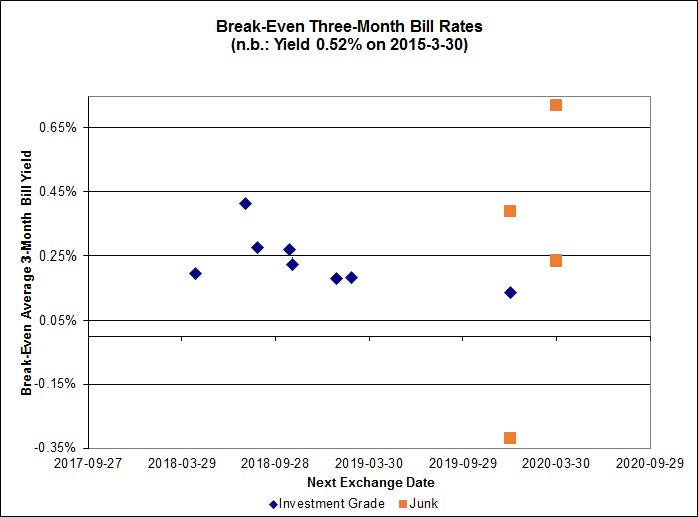
The above table provides the material for the following chart:

FixedFloatingResetPairs_141211

At some point in the future, there might be a sufficient spread of future exchange dates, sufficient data points and sufficient knowledge by the market that there will be slope to the curve drawn, whence it will be possible to calculate the predicted future course of 3-month bill rates … but we’re not there yet!

The average for the investment grade issues is 2.03%, but this is distorted by the high figure of 2.71% for the BMO.PR.M / BMO.PR.R pair. The lowest reasonable expectation for break-even rates on the three issues of interest is about 1.80% and the high is about 2.00%. So let’s plug in those numbers and see what we get.

Estimation of FloatingReset Trading Prices
  Estimated Price
of FloatingReset
FixedReset Price of
FixedReset
2014-12-11
if breakeven 1.80% if breakeven 2.00%
TRP.PR.A 20.40 20.88 21.09
FFH.PR.C 23.83 24.21 24.41
AZP.PR.B 11.80 12.12 12.28

Given these data, I recommend that all the FixedResets be converted to FloatingResets, on the grounds that a worth-while capital gain may result from conversion if these new pairs trade comparably to current pairs; but I will note that in the conversion of DC.PR.B / DC.PR.D the average break-even rate traded by the market changed substantially between the decision date and the first trading date of the FloatingReset and made a mockery of my calculations. All you can do is play the odds … and cross your fingers!

As stated above, the company deadline for receipt of instructions is 2014-12-16-5pm for each of these issues, but brokerage deadlines will be earlier, so don’t waste any time instructing your broker to instruct the company to convert your shares if you wish to convert.

Issue Comments

FCS.PR.B To Mature On Schedule

As indicated in the post New Issue: FCS SplitShare, Interest-Bearing, 6.00%, 4.5-Year, Faircourt Asset Management has announced (although not yet on their website):

The net proceeds of the Offering of Preferred Securities will be used to fund the redemption of the 6.25% preferred securities of the Trust which mature on December 31, 2014.

FCS.PR.B has been tracked by HIMIPref™ but has been relegated to the Scraps index on both credit and volume concerns. FCS.PR.B was last mentioned on PrefBlog in connection with the 2013 retraction.

Update, 2014-12-18: They have been more verbose (although again not yet on their website):

Faircourt Asset Management Inc., as manager for Faircourt Split Trust (TSX:FCS.UN)(TSX:FCS.PR.B) (the “Trust”) is pleased to remind the holders of the Trust’s 6.25% Preferred Securities that such 6.25% Preferred Securities are scheduled to mature on December 31, 2014. Payment of the principal will be made in accordance with the provisions of the trust indenture and first supplemental indenture governing the 6.25% Preferred Securities. Accrued interest will also be paid on December 31, 2014 to holders of record as of December 18, 2014, as per the Trust’s previously announced quarterly interest payment press release made on December 10, 2014.

Faircourt Asset Management Inc. is the Investment Advisor for Faircourt Gold Income Corp, Metals Plus Income Corp, and Faircourt Split Trust.

Issue Comments

HSE.PR.C Closes Firm On Decent Volume

Husky Energy has announced that it:

has completed its recently announced public offering of 10 million Cumulative Rate Reset Preferred Shares, Series 3 (the “Series 3 Shares”).

The aggregate gross proceeds to Husky from the completed upsized offering is $250 million.

The net proceeds from this offering will be used to further support the Company’s strong balance sheet and business plan as well as for general corporate purposes, which may include, among other things, the partial repayment of the 3.75% medium-term notes due in 2015.

The Series 3 Shares were offered by way of prospectus supplement dated December 2, 2014 under Husky’s existing short form base shelf prospectus.

Holders of the Series 3 Shares are entitled to receive a cumulative quarterly fixed dividend yielding 4.50 percent annually for the initial period ending December 31, 2019. Thereafter, the dividend rate will be reset every five years at a rate equal to the five-year Government of Canada bond yield plus 3.13 percent.

Holders of Series 3 Shares will have the right, at their option, to convert their shares into Cumulative Rate Reset Preferred Shares, Series 4 (the “Series 4 Shares”), subject to certain conditions, on December 31, 2019 and on December 31 every five years thereafter. Holders of the Series 4 Shares will be entitled to receive cumulative quarterly floating dividends at a rate equal to the 90-day Government of Canada Treasury Bill yield plus 3.13 percent.

The Series 3 Shares are listed on the Toronto Stock Exchange under the symbol HSE.PR.C.

HSE.PR.C is a FixedReset, 4.50%+313, announced December 1. The issue will be tracked by HIMIPref™ and has been assigned to the FixedResets subindex.

The issue traded 764,846 shares today (consolidated exchanges) in a range of 24.70-05 before closing at 25.01-05. Vital statistics are:

HSE.PR.C FixedReset YTW SCENARIO
Maturity Type : Limit Maturity
Maturity Date : 2044-12-09
Maturity Price : 23.16
Evaluated at bid price : 25.01
Bid-YTW : 4.46 %
Issue Comments

CM.PR.E To Be Redeemed

The Canadian Imperial Bank of Commerce has announced:

its intention to redeem all of its issued and outstanding Non-cumulative Class A Preferred Shares Series 27 (TSX: CM.PR.E), for cash. The redemption will occur on January 31, 2015. The redemption price is $25.00 per Series 27 share.

The $0.350000 quarterly dividend announced on December 4, 2014 will be the final dividend on the Series 27 shares and will be paid on January 28, 2015, covering the period to January 31, 2015, to shareholders of record on December 29, 2014.

Holders of the Series 27 shares should contact the financial institution, broker or other intermediary through which they hold the shares to confirm how they will receive their redemption proceeds.

CM.PR.E is a NVCC-compliant Straight Perpetual paying 5.60% of par. It has been tracked by HIMIPref™ and is currently assigned to the PerpetualPremium index.

Issue Comments

Deriving Reset Yields: Mystery Partially Resolved

In the post Deriving a Reset Yield, I noted a huge difference in the GOC-5 Yield used as a base for the resets of TRP.PR.A, AZP.PR.A and FFH.PR.C.

As it turns out, the calculation for TRP.PR.A was correctly based on the December 1 GOC-5 yield at 10am, while the calculations for the FFH was correctly based on the December 2 figure. AZP is still a bit of a mystery.

If we look at TRP.PR.A: SEDAR TransCanada Corporation Sep 23 2009 16:14:12 ET Prospectus supplement – English PDF 127 K, we find the definitions (emphasis added):

‘‘Fixed Rate Calculation Date’’ means, for any Subsequent Fixed Rate Period, the 30th day prior to the first day of such Subsequent Fixed Rate Period.

‘‘Subsequent Fixed Rate Period’’ means, for the initial Subsequent Fixed Rate Period, the period from and including December 31, 2014, to but excluding December 31, 2019, and for each succeeding Subsequent Fixed Rate Period means the period from and including the day immediately following the last day of the immediately preceding Subsequent Fixed Rate Period to but excluding December 31 in the fifth year thereafter.

… while for FFH.PR.C, SEDAR Fairfax Financial Holdings Limited Sep 29 2009 18:40:58 ET Prospectus supplement – English PDF 419 K, we find (emphasis added):

“Fixed Rate Calculation Date” means, for any Subsequent Fixed Rate Period, the 30th day prior to the first day of such Subsequent Fixed Rate Period.

“Subsequent Fixed Rate Period” means for the initial Subsequent Fixed Rate Period, the period commencing on January 1, 2015 and ending on and including December 31, 2019 and for each succeeding Subsequent Fixed Rate Period, the period commencing on the day immediately following the end of the immediately preceding Subsequent Fixed Rate Period and ending on and including December 31 in the fifth year thereafter.

… while for AZP.PR.B, SEDAR Atlantic Power Preferred Equity Ltd. Oct 21 2009 17:20:19 ET Final short form prospectus – English PDF 229 K, we find (emphasis added):

“Fixed Rate Calculation Date” means, for any Subsequent Fixed Rate Period, the 30th day prior to the first day of such Subsequent Fixed Rate Period.

“Subsequent Fixed Rate Period” means the period from and including December 31, 2014 to, but excluding, December 31, 2019 and each five year period thereafter from and including the day immediately following the end of the immediately preceding Subsequent Fixed Rate Period to, but excluding, December 31 in the fifth year thereafter.

So as it turns out, the critical element is the precise definition of the “Subsequent Fixed Rate Period”; TRP was quite correct in calculating their figure on December 1 and FFH was quite correct in calculating their figure on December 2.

Investor Relations at TRP (who are now my favourite people) sent me the following screenshot justifying their calculation:

GOC5_TRP_141201_10am
Click for Big

So that number of 1.346% that I calculated in the original post was justified. I have good reason to hope that I will shortly be receiving the screenshot for the December 2 calculation; if I get it, I’ll update this post.

I’ll have to call Atlantic Power again, since I continue to have problems with AZP: the calculation was performed on December 1, the same as TRP. As previously reported on PrefBlog, Atlantic Power stated:

The Reset Dividend Rate will be calculated on December 1, 2014

… but it looks like they used 1.39% as the GOC-5 rate and I don’t know where that number comes from.

Update, 2014-12-5: Here’s the screenshot for the FFH reset … 1.428%, as determined earlier:

prefFFHReset
Click for Big

… and a big THANK YOU for John Varnell at Fairfax!

Issue Comments

What Is The Yield Of HSE.PR.A?

Assiduous Reader B writes in and says:

I am a subscriber to your monthly newsletter but haven’t notice anything recent on this issue

My question is why would investors embrace the new issue at a yield of 4.50% while selling down the existing A issue which is now paying a yield that is a full percentage point higher.

I recognize the higher reset rate but the yield spread still seems excessive.

Thanks for your assistance

So, since he’s a customer I answered; and I said:

I will address your question in a post on prefblog.com tonight, but in the meantime can you tell me why you believe that HSE.PR.A is yielding a full percentage point higher?

… and he responded:

Thanks James for getting back to me – according to my screen on TD, HSE PR A is yielding 5.68 – the new issue is yielding 4.50% – I know there is something to be said for the extra reset pickup but the difference in current yield seems excessive

… and he included a picture:

HSEPRAquote
Click for Big

OK, so his first mistake is getting advice – even advice on such a simple thing as yield – from a bank. You should never seek advice or analysis from a bank, because they’re all domeless wonderboys, with about enough brains to say “We’re big!” and not much else.

In this particular case, TD has told him that the yield on HSE.PR.A, when quoted at 19.56-59, is 5.6789%, which a little experimentation tells us, is the Current Yield Ask, that is to say, the Current Dividend, 1.1125, divided by the Ask Price of 19.59, equals 5.6789178%, where I have tacked another three decimal places on to their reported figure just to sneer at the bank and their precious four decimal places of meaningless precision.

Never Use Current Yield When Analyzing Preferreds

It isn’t even accurate when evaluating Straight Perpetuals (since the relationship between the calculation date and the next payment date is a significant source of error), and is absolutely hopeless when evaluating something that may be called (which is not important in this case) or which is expected to experience a change in dividend (which is very important in this case).

Assiduous Reader B has made the mistake of assuming that the Issue Reset Spread is of minor importance, a mere adjustment to Current Yield, but in this case the projected dividend is so different from the current dividend that he’s wrong.

HSE.PR.A is a FixedReset, 4.45%+173, that commenced trading 2011-3-18 after being announced 2011-3-10. It resets in March, 2016, and if the GOC-5 yield continues to be at its yield of 1.45%, the reset rate will be 3.18%, a 29% drop from current levels.

One chart I am particularly fond of illustrates the relative importance of the Current Dividend vs. the Issue Reset Spread for FixedResets that may be assumed to be perpetual (which is a pretty good bet in this case):

PL_141114_App_FR_Chart_17
Click For Big

Given that HSE.PR.A resets in a little over one year, we see that the headline figure, 4.45%, contributes less than 10% of the valuation of the instrument – all the rest is entirely up to the Issue Reset Spread.

So, given that we know the importance of the Issue Reset Spread, how can we work out the all in yield of the issue in order to allow us to compare HSE.PR.A to the new issue, which is a FixedReset, 4.50%+313?

The answer is to use the Yield Calculator for Resets, which is an Excel Spreadsheet I have made available to the public, linked on the Right-Hand Navigation Panel under the heading “Calculators”. [Update: Note that this calculator has been improved since this post was written; the input of the data has been simplified. … JH 2015-8-7] It should be noticed that this is not a magic black box, nor is it particularly sophisticated. It’s simply a tool to allow a schedule of cash flows to be input into a spreadsheet easily. So to use the tool, we input our data into the yellow boxes. We’ll get the results of the calculation in the green boxes and the calculation is performed in the turquoise boxes;; we don’t touch them. Only touch the yellow boxes:

  • Current Price: we’ll put in 19.59, because that’s what the bank used.
  • Call Price: You can put in the call price here, but we’re not expecting the issue to be called – we expect it to remain outstanding in 25 years. So what will the price be in 25 years? There are various approaches to this, one of which is discussed in PrefLetter, but it’s reasonable to assume that in 25 years it will be priced the same as it is now, so we’ll put in 19.59. If you don’t like 19.59, put in some other number. It’s not magic. The Yield Calculation Police won’t take you away if you put in some other number. But your calculation is only as good as your assumptions, so if you calculate a very high yield by inputting some silly price – like $50.00 – as the end-price, well, your calculation is only as good as your assumptions.
  • Settlement Date: Strictly speaking, we should put in the date that a trade executed today will settle (2014-12-9), but I usually use the Trade Date, on the grounds that the bank won’t even let you enter the order unless you’ve got money available RIGHT NOW to pay for it. So I’ll input 2014-12-4.
  • Call Date: If it was priced at $26.00 and I was expecting it to be called, I would put in the call date. But I expect it to be around in twenty-five years (the maximum allowable in this spreadsheet) so I’ll put in 2039-12-4. Again, it’s up to you. If detailed examination of the numerological code embedded in The Gospel According To St. Mark has convinced you that it will be priced at 21.13 on 2028-7-8, go ahead and put in that call price and that date. Don’t worry about the Yield Calculation Police, I’ve paid them off.
  • Quarterly Dividend: So what dividend does it pay right now, expressed as a quarterly amount? I hate using a calculator to calculate six decimal places, so I will input a tiny Excel formula “=25 * 0.0445 / 4”, that is, “equal to the par value times the annual coupon rate divided by four”.
  • Cycle: This gets a little tricky, because we need to know the pay-date of each dividend. A little research tells us it’s paid on the last day of each quarter, March / June / September / December, which is cycle 3. So plug in “3”
  • Pay Date: So what day of these months? It’s the last day, so plug in “31”. In the cash flow schedule, the calculated date “June 31” will be transformed to “July 1”, as you can see in the turquoise area to the right of the data input area. This is a bit of an error, but a very tiny one.
  • Include First Dividend: This is quite important. As the spreadsheet tells you, the next dividend payment is December 31, based on the information you’ve input above. If you buy it today, will you earn that dividend? You’ll have to look up the ex-dividend date for the issue; in this case the ex-dividend date was 2014-11-25, which is now in the past, so you WON’T get the next dividend, so input “0”
  • First Dividend Value: For most issues, the first dividend payment is for a different amount from the others, since it’s adjusted to reflect the time from the security’s issue to the pay date, rather than pay-date to pay-date. HSE.PR.A has been around for a long time, so this does not apply and we’re not even earning the next dividend anyway, so it doubly doesn’t matter. Leave this field blank.
  • Reset Date: The issue resets 2016-3-31. Plug in this date
  • Quarterly Dividend After Reset: This is the moment we’ve all been waiting for! We have to estimate what the dividend will be after the reset, while bearing in mind that the yield we calculate will only be as good as our estimates. It’s generally best to assume that major market yields will not change; that on the reset calculation date the 5-year GOC yield will be the same as it is today, 1.45%. But if you feel this is unreasonable, put in another number you’re more comfortable with. If you think that 1.45% is ridiculous and that GOC-5 will be 2.00% on recalculation day, use 2.00%. You have to use some kind of assumption, there’s no way around that. We will note that TD’s calculation, in using Current Yield, assumed the dividend would not change; i.e., that the dividend would reset to be equal to the 4.45% it is currently, i.e., that GOC-5 on reset calculation date will be 2.72%. Well, if that’s the number you want to use, go ahead. It’s a free country and you can assume anything you like. Just remember that the quality of your yield estimate will reflect the quality of your assumptions; and also remember that consistency is a virtue, so if two issues are resetting at the same time, you should use the same estimate for GOC-5. But I will assume a future GOC-5 rate of 1.45%, so I’ll input the Excel formula “=25 * (0.0145 + 0.0173) / 4” = par value * (sum of assumed GOC-5 rate and Issue Reset Spread [expressed annually]) divided by 4 [quarters per year]. We should also note that the spreadsheet makes no provision for changes in GOC-5, so if you feel that GOC-5 will be 2.00% on the 2016 reset calculation date, but 3.00% on the 2021 reset calculation date, you’ll have to develop your own elaboration of this spreadsheet.

And that’s the end of our input and our answer pops up in the green boxes! Current Yield, 5.68%, just as advertised by TD, but an Annualized Quarterly Yield To Call of 4.17%. That’s quite a difference! And, I will note, it is substantially less than the New Issue FixedReset, 4.50%+313. Implied Volatility Theory tells us to expect less for a deeply discounted issue compared to one at or near par value, but just how much less it should be is a whole ‘nuther issue.

And, I suggest, you should always think of this number as “4.17%, assuming an end-price of 19.59 and a constant GOC-5 of 1.45%”, just to remind yourself of the two critical assumptions you made.

So there you have it. I suggest that those interested in using this spreadsheet as an adjunct to their trading first check all the calculations – Trust But Verify! – and second, play around with it a bit. Change the assumptions of end-price and GOC-5 estimate on reset, see how sensitive the answers are to the inputs. The better you understand your data, the better an investor you’ll be.

Issue Comments

Rating Agencies Unhappy With Enbridge

Enbridge announced some very shareholder-friendly moves yesterday:

  • 33% dividend increase, payable March 1, 2015
  • Plans to transfer Canadian Liquids Pipelines business to Enbridge Income Fund
  • New dividend payout policy range of 75% to 85% of adjusted earnings
  • 2015 Adjusted EPS guidance of $2.05 to $2.35
  • Parallel U.S. restructuring plan under consideration


These actions are intended to enhance the value to investors of the Company’s record organic growth capital program and enhance the competitiveness of its funding costs for new organic growth opportunities and asset acquisitions.

The Canadian restructuring plan has been approved in principle by Enbridge’s Board of Directors but remains subject to finalization of preliminary internal reorganization steps and a number of internal and external consents and approvals, including final approval of definitive transfer terms by the Enbridge Board and by the Boards of Holdings and the Fund following a recommendation by an independent committee of the Fund and Holdings, and the receipt of all necessary shareholder and regulatory approvals that may be required.

Enbridge also has under review a potential parallel U.S. restructuring plan which would involve transfer of its directly held U.S. Liquids Pipelines assets to its U.S. affiliate, Enbridge Energy Partners, L.P. (EEP). This review has not yet progressed to a conclusion.

Commenting on today’s announcement, Al Monaco, President and Chief Executive Officer, Enbridge Inc., noted the following:

“The 33% increase in our dividend that we announced today and 14% to 16% expected annual average dividend growth rate through 2018 reflects Management’s confidence in the strength and embedded cash flow growth from the existing assets and the capital projects that will be put into service over the next four years. The change in our dividend policy range to 75 – 85% of adjusted earnings is supported by the excellent progress we’ve made on our enterprise-wide funding program, raising some $16 billion in debt and equity capital over the last two years; the expected increase in free cash flow through 2018; and reliable access to effective sources of equity funding including from our sponsored vehicles.

Today, shareholders indicated they are in favour of shareholder friendliness:

Enbridge Inc. (ENB) surged the most in 27 years after Canada’s largest pipeline operator boosted its dividend and said it plans to shift assets to an affiliate.

The shares climbed 10 percent in Toronto, the biggest gain since October 1987. The stock has increased 29 percent this year.

Enbridge said yesterday it plans to move C$17 billion ($15 billion) worth of Canadian liquids pipelines to the Enbridge Income Fund to help pay for capital investment. The company also boosted its dividend 33 percent and said earnings per share next year will be C$2.05 to C$2.35.

The so-called dropdown allows Enbridge “to accelerate dividend growth immediately and for the next 4+ years,” Matthew Akman, a Toronto-based analyst for ScotiaBank, wrote in a note today.

The boost in dividend comes as oil producers are cutting their payouts. Canadian Oil Sands Ltd. yesterday said it would reduce its quarterly dividend by 42 percent to 20 cents a share in late January. Enbridge ships crude from Canadian producers through its network of pipelines across North America.

Assiduous Readers will have no problem with the following pop quiz: “Shareholder-friendly actions are creditor _______________” (for the answer, see the bottom of this post).

Moody’s affirmed the rating but changed the outlook to negative:

Moody’s Investors Service has affirmed its ratings on Enbridge Inc (ENB), Enbridge Energy Partners L.P. (EEP), Enbridge Income Fund (EIF) and Enbridge Energy Limited Partnership (EELP) and Enbridge (U.S.) Inc. At the same time, Moody’s changed the outlooks on ENB, EEP, and EELP to negative. The outlook on EIF has been changed to developing. This follows Enbridge’s news release dated December 3 announcing a material financial restructuring and significant dividend increase. For a complete list of Moody’s ratings actions see the end of this press release.

“The negative outlook reflects the uncertainty surrounding the announced financial restructuring plans and the prospects for increased structural subordination at ENB, the company’s weak consolidated financial metrics and the reduction in financial flexibility associated with the proposed increase in dividends.” said Gavin MacFarlane, Vice President/Senior Analyst.

The company’s financial restructuring plans represent a substantial change in the company’s structure, with approximately C$17 billion in assets to be transferred to EIF from ENB. This compares to current total assets at ENB of C$67 billion and EIF of C$2.7 billion at 30 September 2014. One of the entities being transferred, Enbridge Pipelines (Athabasca) Inc. has no external debt, highlighting the increased structural subordination that will result at ENB going forward. The Canadian liquids pipeline business currently with assets of $16 billion and an associated capital program of $15 billion dominates the proposed transfer. Management has also indicated that it is contemplating a potential parallel U.S. restructuring plan that would transfer all of ENB’s US liquids assets to EEP.

Consolidated FFO/debt of 10.2% on an LTM basis remains weak and is slightly above the 10% adjusted FFO/debt level we have associated with a potential downgrade. The proposed increase in the dividend payout ratio from a range of 60-70% to 75-85% weakens the company’s financial flexibility as it moves forward with its current consolidated capital program of about $44 billion over the period 2014-2018. The increase is slightly mitigated by being tied to the execution of the capital program and any associated moderation in spend. On a consolidated basis, the business risk profile of ENB is unchanged.

We will look to resolve the outlooks when there is greater certainty and clarity surrounding the proposed restructuring in 2015.

It was only two weeks ago that I reported that S&P changed the outlook on ENB to Negative. Now the other shoe has dropped:

  • •We are placing our ratings on Calgary, Alta.-based Enbridge Inc. and Enbridge Pipelines Inc., Toronto-based Enbridge Gas Distribution Inc., and Houston-based Enbridge Energy Partners L.P. on CreditWatch with negative implications.
  • •The CreditWatch placements follows the announcement of dropdown of assets from parent Enbridge to Enbridge Income Fund (EIF), as well as a change to the company’s dividend policy.
  • •We believe that there is a potential for financial metrics to weaken further due to the additional dividend expense.
  • •In addition, the dropdown into EIF could raise the issue of subordination of debt at the Enbridge level.


The CreditWatch placements reflect our assessment of the existing weak forecast financial metrics at parent Enbridge, combined with the announced change in dividend policy and the dropdown of assets to subsidiary Enbridge Income Fund (EIF). Enbridge intends to increase its dividend payout ratio to 75%-85% of adjusted net income, from 60%-70%, effective March 2015. In addition, the dropdown plan covers US$17 billion of assets, comprising the Canadian liquids pipeline and renewable energy portfolio.

“We believe that there is a potential for financial metrics to weaken further due to the additional dividend expense, depending on the ultimate financing strategy,” said Standard & Poor’s credit analyst Gerry Hannochko. “As well, the dropdown to EIF could raise the issue of subordination of debt at the Enbridge level,” Mr. Hannochko added.

In addition, the company is contemplating transferring Enbridge’s U.S.-based liquids pipeline assets to subsidiary EEP.

On Nov. 21, 2014, we revised the outlook on the Enbridge group to negative based on weak forecast financials that we assess to be below the threshold for the “significant” financial risk profile category.

Compared with this, DBRS has been quite restrained:

DBRS Limited (DBRS) has today placed all ratings of Enbridge Inc. (ENB), Enbridge Pipelines Inc. (EPI) and Enbridge Income Fund (EIF or the Fund) as follows Under Review with Developing Implications:

The current rating actions reflect uncertainty associated with the ongoing corporate developments, percentage take-up of the debt exchange and the future funding strategy among the entities within ENB’s organization. For clarity, DBRS does not rule out potential future rating changes for any of the entities placed Under Review today and will provide updates as more information becomes available

From a financial risk perspective, DBRS expects a mix of factors to affect ENB’s future ratings. Firstly, a material increase in dividend payout combined with the proposed Transaction would mean that ENB would have to rely more on external funds to finance its portion of capex which, while substantial over the 2014 to 2018 period, would be reduced on a direct-to-ENB basis. Secondly, direct external debt at ENB would be reduced by the proposed debt exchange, although the sizable preferred shares outstanding at ENB would remain unchanged and would continue to weigh on ENB’s credit metrics. Finally, since all assets of EPI and EPA would be transferred to the Fund, holders of ENB’s direct external debt would be further away from the cash flow of the Transferred Assets than is currently the case. Dividend distributions from the Transferred Assets would have to be used to support debt service at the Fund before dividends could then be distributed to ENB. At this time, there are uncertainties with respect to the debt exchange details and the future financing needs at the ENB level as well as the amount of dividends to be received at ENB. Consequently, while DBRS believes that Under Review with Developing Implications is the appropriate rating action at this time, DBRS does not rule out a negative rating action in the future based on further analysis.

Enbridge Inc. is the issuer of (deep breath) ENB.PR.A (Straight Perpetual), ENB.PR.B, ENB.PR.D, ENB.PR.F, ENB.PR.H, ENB.PR.J, ENB.PR.N, ENB.PR.P, ENB.PR.T, ENB.PR.Y, ENB.PF.A, ENB.PF.C, ENB.PF.E and ENB.PF.G (FixedResets) and ENB.PR.U, ENB.PR.V, ENB.PF.U and ENB.PF.V (US-Pay FixedResets).

All told, I believe that total issuance comprises roughly 10% of the Canadian preferred share market, virtually all of which has come out since the issue of ENB.PR.B just over three years ago. A downgrade to junk would certainly make the market a bit more interesting for a while!

Answer to Pop-Quiz : ʎlpuǝᴉɹɟun ɹoʇᴉpǝɹɔ ǝɹɐ suoᴉʇɔɐ ʎlpuǝᴉɹɟ-ɹǝploɥǝɹɐɥS

Issue Comments

MFC.PR.N Firm On Decent Volume

Manulife Financial Corporation has announced:

that it has completed its offering of 10 million Non-cumulative Rate Reset Class 1 Shares Series 19 (the “Series 19 Preferred Shares”) at a price of $25 per share to raise gross proceeds of $250 million.

The offering was underwritten by a syndicate of investment dealers co-led by Scotia Capital Inc., CIBC World Markets and RBC Capital Markets. The Series 19 Preferred Shares commence trading on the Toronto Stock Exchange today under the ticker symbol MFC.PR.N.

The Series 19 Preferred Shares were issued under a prospectus supplement dated November 26, 2014 to Manulife’s short form base shelf prospectus dated June 23, 2014.

MFC.PR.N is a FixedReset, 3.80%+230, announced November 26. It will be tracked by HIMIPref™ and has been assigned to the FixedResets index.

Note that since this is issued by an Insurance Holding Company and is not convertible (or otherwise potentially NVCC-compliant), I have added a DeemedMaturity to the option schedule for analytical purposes, at $25.00 for 2025-1-31.

MFC.PR.N traded 1,163,652 shares today (consolidated exchanges) in a range of 24.95-12 before closing at 25.07-10. Vital statistics are:

MFC.PR.N FixedReset YTW SCENARIO
Maturity Type : Hard Maturity
Maturity Date : 2025-01-31
Maturity Price : 25.00
Evaluated at bid price : 25.07
Bid-YTW : 3.72 %

Implied volatility theory suggests that this issue is fairly priced relative to other MFC issues … but remember that the Implied Volatility calculation ignores DeemedMaturities and the calculated volatility is very high!

impVol_MFC_141203