Category: Issue Comments

Issue Comments

BMO.PR.W To Reset At 3.851%

Bank of Montreal has announced (on October 28):

the applicable dividend rates for its Non-Cumulative 5-Year Rate Reset Class B Preferred Shares, Series 31 (the “Preferred Shares Series 31”) and Non-Cumulative Floating Rate Class B Preferred Shares, Series 32 (the “Preferred Shares Series 32”).

With respect to any Preferred Shares Series 31 that remain outstanding after November 25, 2019, commencing as of such date, holders thereof will be entitled to receive fixed rate non-cumulative preferential cash dividends on a quarterly basis, as and when declared by the Board of Directors of the Bank and subject to the provisions of the Bank Act (Canada). The dividend rate for the five-year period commencing on November 25, 2019, and ending on November 24, 2024, will be 3.851 per cent, being equal to the sum of the five-year Government of Canada bond yield as at October 28, 2019, plus 2.22 per cent, as determined in accordance with the terms of the Preferred Shares Series 31.

With respect to any Preferred Shares Series 32 that may be issued on November 25, 2019, holders thereof will be entitled to receive floating rate non-cumulative preferential cash dividends on a quarterly basis, calculated on the basis of the actual number of days elapsed in each quarterly floating rate period divided by 365, as and when declared by the Board of Directors of the Bank and subject to the provisions of the Bank Act (Canada). The dividend rate for the three-month period commencing on November 25, 2019, and ending on February 24, 2020, will be 3.856 per cent, being equal to the sum of the three-month Government of Canada Treasury bill yield as at October 28, 2019, plus 2.22 per cent, as determined in accordance with the terms of the Preferred Shares Series 32.

Beneficial owners of Preferred Shares Series 31 who wish to exercise their right of conversion should communicate as soon as possible with their broker or other nominee and ensure that they follow their instructions in order to ensure that they meet the deadline to exercise such right, which is 5:00 p.m.ET on November 12, 2019.

Conversion enquiries should be directed to BMO’s Registrar and Transfer Agent, Computershare Trust Company of Canada, at 1-800-340-5021.

BMO.PR.W is a FixedReset, 3.80%+222, that commenced trading 2014-7-30 after being announced 2014-7-22. Notice of extension was given 2019-9-27. It is tracked by HIMIPref™ and has been assigned to the FixedReset – Discount subindex.

The most logical way to analyze the question of whether or not to convert is through the theory of Preferred Pairs, for which a calculator is available. Briefly, a Strong Pair is defined as a pair of securities that can be interconverted in the future (e.g., BMO.PR.W and the FloatingReset that will exist if enough holders convert). Since they will be interconvertible on this future date, it may be assumed that they will be priced identically on this date (if they aren’t then holders will simply convert en masse to the higher-priced issue). And since they will be priced identically on a given date in the future, any current difference in price must be offset by expectations of an equal and opposite value of dividends to be received in the interim. And since the dividend rate on one element of the pair is both fixed and known, the implied average rate of the other, floating rate, instrument can be determined. Finally, we say, we may compare these average rates and take a view regarding the actual future course of that rate relative to the implied rate, which will provide us with guidance on which element of the pair is likely to outperform the other until the next interconversion date, at which time the process will be repeated.

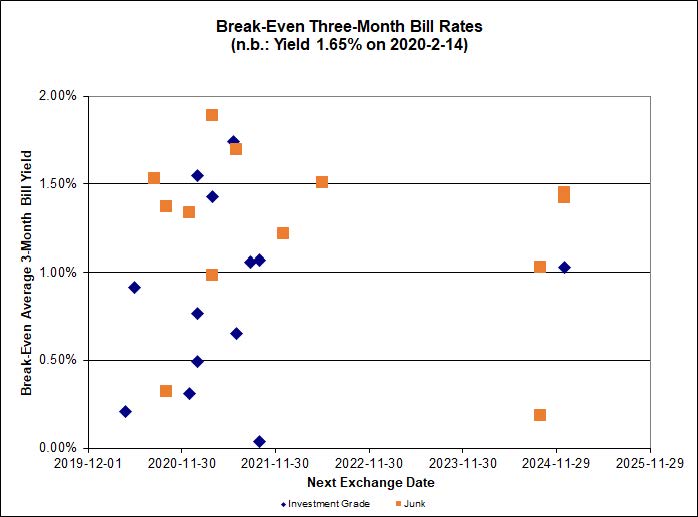
We can show the break-even rates for each FixedReset / FloatingReset Strong Pair graphically by plotting the implied average 3-month bill rate against the next Exchange Date (which is the date to which the average will be calculated). Inspection of the graph and the overall average break-even rates for extant pairs will provide a guide for estimating the break-even rate for the pair now under consideration assuming, of course, that enough conversions occur so that the pair is in fact created.

pairs_fr_191030
Click for Big

The market has lost enthusiasm for floating rate product; the implied rates until the next interconversion are generally well below the current 3-month bill rate as the averages for investment-grade and junk issues are at +0.46% and +0.67%, respectively, after removal of the outlying pair TRP.PR.A / TRP.PR.F from the investment grade universe and the pairs FFH.PR.C / FFH.PR.D and NPI.PR.A / NPI.PR.B from the junk group. Whatever might be the result of the next few Bank of Canada overnight rate decisions, I suggest that it is unlikely that the average rate over the next five years will be lower than current – but if you disagree, of course, you may interpret the data any way you like.

Since credit quality of each element of the pair is equal to the other element, it should not make any difference whether the pair examined is investment-grade or junk, although we might expect greater variation of implied rates between junk issues on grounds of lower liquidity, and this is just what we see.

If we plug in the current bid price of the BMO.PR.W FixedReset, we may construct the following table showing consistent prices for its soon-may-be-issued FloatingReset counterpart given a variety of Implied Breakeven yields consistent with issues currently trading:

Estimate of FloatingReset (received in exchange for BMO.PR.W) Trading Price In Current Conditions
  Assumed FloatingReset
Price if Implied Bill
is equal to
FixedReset Bid Price Spread 1.00% 0.50% 0.00%
BMO.PR.W 17.24 222bp 16.62 16.12 15.63

Based on current market conditions, I suggest that the FloatingResets that will result from conversion are likely to trade below the price of their FixedReset counterparts, BMO.PR.W. Therefore, it seems likely that I will recommend that holders of BMO.PR.W continue to hold the issue and not to convert, but I will wait until it’s closer to the November 12 notification deadline before making a final pronouncement. I will note that once the FloatingResets commence trading (if, in fact, they do) it may be a good trade to swap one issue for the other in the market once both elements of each pair are trading and you can – hopefully – do it with a reasonably good take-out in price, rather than doing it through the company on a 1:1 basis. But that, of course, will depend on the prices at that time and your forecast for the path of policy rates over the next five years. There are no guarantees – my recommendation is based on the assumption that current market conditions with respect to the pairs will continue until the FloatingResets commence trading and that the relative pricing of the two new pairs will reflect these conditions.

Issue Comments

DFN.PR.A To Get Bigger

Quadravest has announced:

Dividend 15 Split Corp. (the “Company”) is pleased to announce it will undertake an offering of Preferred Shares and Class A Shares of the Company.

The offering will be co-led by National Bank Financial Inc., CIBC World Markets Inc., Scotia Capital Inc. and RBC Capital Markets, and will also include TD Securities Inc., BMO Capital Markets, Canaccord Genuity Corp., Industrial Alliance Securities Inc., Echelon Wealth Partners, GMP Securities L.P., Raymond James Ltd., Desjardins Securities Inc., Mackie Research Capital Corporation, and Manulife Securities Incorporated.

The Preferred Shares will be offered at a price of $10.00 per Preferred Share to yield 5.25% and the Class A Shares will be offered at a price of $8.75 per Class A Share to yield 13.71%. The closing price on the TSX of each of the Preferred Shares and the Class A Shares on October 22, 2019 was $10.34 and $8.91, respectively.

Since inception of the Company, 186 consecutive dividends have been paid to both classes of shares. The aggregate dividends paid on the Preferred Shares have been $8.16 per share and the aggregate dividends paid on the Class A Shares have been $22.10 per share (including five special distributions of $0.25 per share, one special distribution of $0.50 per share and one special stock dividend of $1.75 per share), for a combined total of $30.26 per unit. All distributions to date have been made in tax advantage eligible Canadian dividends or capital gains dividends. The net proceeds of the offering will be used by the Company to invest in an actively managed, high quality portfolio consisting of 15 dividend yielding Canadian companies as follows:

Bank of Montreal Enbridge Inc. TELUS Corporation
The Bank of Nova Scotia Manulife Financial Corp. Thomson-Reuters Corporation Inc.
BCE Inc. National Bank of Canada The Toronto-Dominion Bank
Canadian Imperial Bank of Commerce Royal Bank of Canada TransAlta Corporation
CI Financial Corp. Sun Life Financial Inc. TC Energy

The Company’s investment objectives are:
Preferred Shares:
i. to provide holders of the Preferred Shares with fixed, cumulative preferential monthly cash dividends in the amount of 5.25% annually (5.50% effective December 1, 2019); and
ii. on or about the termination date, currently December 1, 2024 (subject to further 5 year extensions thereafter and it has been extended in the past), to pay the holders of the Preferred Shares $10.00 per Preferred Share.

Class A Shares:
i. to provide holders of the Class A Shares with regular monthly cash dividends currently targeted to be $0.10 per share; and
ii. on or about the termination date, currently December 1, 2024 (subject to further 5 year extensions thereafter and it has been extended in the past) to pay holders of Class A Shares at least the original issue price of those shares.

The sales period of this overnight offering will end at 9:00 a.m. EST on October 24, 2019. The offering is expected to close on or about October 31, 2019 and is subject to certain closing conditions including approval by the TSX.

So Whole Units are being offered for $10 + $8.75 = $18.75 and the NAVPU as of October 15 was 17.76, for a premium of 5.6%. What a great business this is!

DFN.PR.A was first traded 2004-3-16 as a 5.25% Split Share scheduled to mature 2009-12-1. A Special Resolution was proposed in April 2007 to extend term to 2014-12-1 with an unchanged dividend. The proposal was approved and shareholders had a wild ride during the Credit Crunch. There was another term extension approved in June 2013 with the dividend remaining unchanged. The fund then swallowed up CGQ & CGQ.E as well as STQ / STQ.E. The extension to 2024 was announced in February, 2019 and the dividend rate for the extension is 5.50%.

Update, 2019-10-26: They did well:

Dividend 15 Split Corp. (the “Company”) is pleased to announce it has completed the overnight marketing of up to 3,627,000 Preferred Shares and up to 3,627,000 Class A Shares of the Company. Total proceeds of the offering are expected to be approximately $68,006,250.

Issue Comments

TRP.PR.E : No Conversion To FloatingReset

TC Energy Corporation has announced:

that 173,386 of its 18,000,000 fixed rate Cumulative Redeemable First Preferred Shares, Series 9 (Series 9 Shares) were deposited for conversion on October 30, 2019 on a one-for-one basis into floating rate Cumulative Redeemable First Preferred Shares, Series 10 (Series 10 Shares).

As previously announced in our news release dated September 18, 2019, the conversions are subject to the conditions that: (i) if TC Energy determines that there would be less than one million Series 9 Shares outstanding after October 30, 2019, then all remaining Series 9 Shares will automatically be converted into Series 10 Shares on a one-for-one basis on October 30, 2019 and (ii) alternatively, if TC Energy determines that there would be less than one million Series 10 Shares outstanding after October 30, 2019, no Series 9 Shares will be converted into Series 10 Shares.

As the total number of Series 9 Shares deposited for conversion did not meet the threshold set out above, no Series 9 Shares will be converted into Series 10 Shares on October 30, 2019.

For more information on the terms of and risks associated with an investment in the Series 9 Shares and the Series 10 Shares, please see our prospectus supplement dated January 13, 2014 which is available on sedar.com or on our website.

It will be recalled that TRP.PR.E will reset at 3.762% effective October 30, 2019

TRP.PR.E is a FixedReset, 4.25%+235, that commenced trading 2014-1-20 after being announced 2014-1-13. Notice of extension was provided on 2019-9-18. TRP.PR.E will reset at 3.762% effective October 30, 2019. I recommended against conversion. The issue is tracked by HIMIPref™ and assigned to the FixedReset-Discount subindex.

Issue Comments

TD.PF.A : No Conversion To FloatingReset

The Toronto-Dominion Bank has announced:

that none of its 20 million Non-Cumulative 5-Year Rate Reset Preferred Shares, Series 1 (Non-Viability Contingent Capital (NVCC)) (the “Series 1 Shares”) will be converted on October 31, 2019 into Non-Cumulative Floating Rate Preferred Shares, Series 2 (NVCC) (the “Series 2 Shares”) of TD.

During the conversion period, which ran from October 1, 2019 to October 16, 2019, 230,894 Series 1 Shares were tendered for conversion into Series 2 Shares, which is less than the minimum 1,000,000 shares required to give effect to the conversion, as described in the prospectus supplement for the Series 1 Shares dated May 28, 2014. As a result, no Series 2 Shares will be issued on October 31, 2019 and holders of Series 1 Shares will retain their Series 1 Shares.

The Series 1 Shares are currently listed on the Toronto Stock Exchange under the symbol TD.PF.A. As previously announced on October 1, 2019, the dividend rate for the Series 1 Shares for the 5-year period from and including October 31, 2019 to but excluding October 31, 2024 will be 3.662%

TD.PF.A is a FixedReset, 3.90%+224, NVCC-compliant issue that commenced trading 2014-6-4 after being announced 2014-5-26. TD.PF.A will reset at 3.662% effective October 31, 2019. I recommended against conversion. It is tracked by HIMIPref™ and is assigned to the FixedReset – Discount subindex.

Issue Comments

SLF Upgraded To Pfd-2(high) By DBRS

DBRS has announced that it:

upgraded Sun Life Financial Inc.’s (SLF or the Company) Issuer Rating and Senior Unsecured Debentures rating to A (high) from “A,” its Subordinated Unsecured Debentures rating to “A” from A (low) and its Preferred Shares rating to Pfd-2 (high) from Pfd-2.

The ratings upgrade recognizes the Company’s improved franchise strength, the increasing diversification of earnings across its four core business segments and its excellent capitalization. Furthermore, DBRS Morningstar has gained comfort from management’s actions over the past year to turn around the performance of SLF’s legacy U.S. individual life block that is in run-off, including the reserve strengthening, which should reduce the probability of the block adversely impacting results. The ratings also consider the Company’s exposure to operational risk arising from operating in multiple jurisdictions with varying degrees of geopolitical risk in Asia, as well as its guaranteed products in Canada that can result in profit volatility. Also a ratings constraint is SLF’s higher proportion of mortgages, BBB-rated bonds and corporate loans in the Company’s investment portfolio relative to those of similarly rated peers.

SLF and its main operating insurance subsidiary, SLA, are maintaining strong regulatory capital ratios. Indeed, with sizable cushions over regulatory minimums under the Life Insurance Capital Adequacy Test (LICAT) framework that was implemented in 2018, DBRS Morningstar views the Company as very well positioned to navigate adverse scenarios. As of Q2 2019, the LICAT for the consolidated holding company was 144%, higher than SLA’s LICAT of 133%, as the holding company held $2.2 billion of additional assets comprising cash and other liquid assets. Solid earnings in the last five years have also contributed to the Company’s strong capitalization level. Moreover, financial leverage remains conservative at 20.4% with a fixed-charge coverage ratio of 9.0 times as of Q2 2019.

Affected issues are: SLF.PR.A, SLF.PR.B, SLF.PR.C, SLF.PR.D, SLF.PR.E, SLF.PR.G, SLF.PR.H, SLF.PR.I, SLF.PR.J and SLF.PR.K.

Issue Comments

DF.PR.A : Semi-Annual Report 2019H1

Dividend 15 Split Corp. II has released its Semi-Annual Report to May 31, 2019.

Figures of interest are:

MER: “A separate base management expense ratio has been presented to reflect the normal operating expenses of the Company excluding any one time offering expenses. Management expense ratio is based on total expenses for the stated period and is expressed as an annualized percentage of average net asset value during the period.” The fund reports a figure of 1.04%

Average Net Assets: We need this to calculate portfolio yield. The Total Assets of the fund at fiscal year end was $234.4-million, compared to $241.6-million on May 31, so call it an average of $238.0-million. Preferred share dividends of $4,313,981 were paid over the half year at 0.525 p.a., implying average units outstanding 16.44-million, at an average NAVPU of (14.26 + 14.70)/2 = 14.48, implies net assets of $238.0-million. Say the Average Net Assets are the average of the two estimates, $238.0-million.

Underlying Portfolio Yield: Income received of $4,592,138 divided by average net assets of $238.0-million, multiplied by two because it’s semiannual is 3.86%.

Income Coverage: Net investment income of $3,351,881 (after expenses, before transaction costs, before capital gains) divided by preferred share dividends of $4,313,981 is 78%.

The income coverage calculated is a bit less than the DBRS calculation in May 2019:

The dividend coverage ratio was approximately 0.8x.

Issue Comments

DGS.PR.A : Semi-Annual Report, 2019H1

Dividend Growth Split Corp has released its Semi-Annual Report to June 30, 2019.

Figures of interest are:

MER: ” The MER excluding Preferred share distributions and issuance costs was 0.88% in the first six months of 2019, unchanged from the same period in 2018.”

Average Net Assets: We need this to calculate portfolio yield. The Total Assets of the fund at year end was $499.6-million, compared to $549.9-million on June 30, so call it an average of $524.8-million. Preferred share dividends of $9,584,220 were paid over the half year at 0.525 p.a., implying average units outstanding 36.51-million, at an average NAVPU of (14.97 + 13.60)/2 = 14.28, implies net assets of $521.4-million. Say the Average Net Assets are the average of the two estimates, $523.1-million.

Underlying Portfolio Yield: Income received of $10,898,580 divided by average net assets of $523.1-million, multiplied by two because it’s semiannual is 4.17%.

Income Coverage: Net investment income of $8,543,279 (after expenses, before capital gains) divided by preferred share dividends of $9,584,220 is 89%.

The income coverage calculated is a bit less than the DBRS calculation in September 2019:

The dividend coverage ratio is approximately 1.0 times.

Issue Comments

FFN.PR.A To Maintain Dividend At 5.50% On Extension

Quadravest has announced (on September 19):

North American Financial 15 Split Corp. (the “Company”) announced previously on February 21, 2019 it will extend the termination date of the Company a further five year period from December 1, 2019 to December 1, 2024.

In connection with the extension, the Company is entitled to amend the prescribed minimum annual rate of cumulative preferential monthly dividends to be paid to the FFN.PR.A Preferred Shares (“Preferred Shares”) for the five year renewal period, commencing December 1, 2019. The Company may also amend the dividend entitlement of the Preferred Shares on an annual basis. Based on current market rates for preferred shares with similar terms, the minimum annual rate for the five year term will be set at 5.5% and the annual payment rate will remain unchanged at 5.5% per annum, based on the $10 repayment value. The Preferred shareholders have received a total of $7.85 per share in distributions since inception. The dividend policy for the FFN Class A Shares (“Class A Shares”) will remain unchanged.

In relation to the term extension and the Preferred Share minimum rate increase, the Company has an additional retraction right for those shareholders not wishing to continue holding their investment, allowing existing shareholders to tender one or both classes of Shares and receive a retraction price based on the November 29, 2019 net asset value per unit. Alternatively, shareholders may sell their shares for the market price at any time, potentially at a higher price than would be achieved through retraction, or shareholders may take no action and continue to hold their shares.

The Company invests in a high quality portfolio consisting of 15 financial services companies made up of Canadian and U.S. issuers as follows: Bank of Montreal, The Bank of Nova Scotia, Canadian Imperial Bank of Commerce, Royal Bank of Canada, Toronto-Dominion Bank, National Bank of Canada, Manulife Financial Corporation, Sun Life Financial, Great-West Lifeco, CI Financial Corp, Bank of America, Citigroup Inc., Goldman Sachs Group, JP Morgan Chase & Co. and Wells Fargo & Co.

The extension to 2024-12-1 was previously reported. The dividend rate was increased to 5.50% in 2017 and has remained there since. The name of the fund was changed from Financial 15 Split Corp. II in 2015. The term was extended in 2014 after the first extension in 2007. The issue had an exciting time during the Credit Crunch.

Issue Comments

TD.PF.A : Convert or Hold?

It will be recalled that TD.PF.A will reset at 3.662% effective October 31, 2019

TD.PF.A is a FixedReset, 3.90%+224, NVCC-compliant issue that commenced trading 2014-6-4 after being announced 2014-5-26. It is tracked by HIMIPref™ and is assigned to the FixedReset – Discount subindex.

The most logical way to analyze the question of whether or not to convert is through the theory of Preferred Pairs, for which a calculator is available. Briefly, a Strong Pair is defined as a pair of securities that can be interconverted in the future (e.g. TD.PF.A and the FloatingReset that will exist if enough holders convert). Since they will be interconvertible on this future date, it may be assumed that they will be priced identically on this date (if they aren’t then holders will simply convert en masse to the higher-priced issue). And since they will be priced identically on a given date in the future, any current difference in price must be offset by expectations of an equal and opposite value of dividends to be received in the interim. And since the dividend rate on one element of the pair is both fixed and known, the implied average rate of the other, floating rate, instrument can be determined. Finally, we say, we may compare these average rates and take a view regarding the actual future course of that rate relative to the implied rate, which will provide us with guidance on which element of the pair is likely to outperform the other until the next interconversion date, at which time the process will be repeated.

We can show the break-even rates for each FixedReset / FloatingReset Strong Pair graphically by plotting the implied average 3-month bill rate against the next Exchange Date (which is the date to which the average will be calculated).
pairs_fr_191011
Click for Big

The market appears to have lost its fleeting interest in floating rate product; the implied rates until the next interconversion are well below the current 3-month bill rate as the averages for investment-grade and junk issues are at +0.70% and +0.84%, respectively. Whatever might be the result of the next few Bank of Canada overnight rate decisions, I suggest that it is unlikely that the average rate over the next five years will be lower than current – but if you disagree, of course, you may interpret the data any way you like.

Since credit quality of each element of the pair is equal to the other element, it should not make any difference whether the pair examined is investment-grade or junk, although we might expect greater variation of implied rates between junk issues on grounds of lower liquidity, and this is just what we see.

If we plug in the current bid price of the TD.PF.A FixedReset, we may construct the following table showing consistent prices for its soon-may-be-issued FloatingReset counterpart given a variety of Implied Breakeven yields consistent with issues currently trading:

Estimate of FloatingReset (received in exchange for TD.PF.A) Trading Price In Current Conditions
  Assumed FloatingReset
Price if Implied Bill
is equal to
FixedReset Bid Price Spread 1.50% 1.00% 0.50%
TD.PF.A 17.00 224bp 17.08 16.58 16.08

Based on current market conditions, I suggest that the FloatingResets that will result from conversion are likely to trade below the price of their FixedReset counterparts, TD.PF.A. Therefore, I recommend that holders of TD.PF.A continue to hold the issue and not to convert. I will note that once the FloatingResets commence trading (if, in fact, they do) it may be a good trade to swap one issue for the other in the market once both elements of each pair are trading and you can – hopefully – do it with a reasonably good take-out in price, rather than doing it through the company on a 1:1 basis. But that, of course, will depend on the prices at that time and your forecast for the path of policy rates over the next five years. There are no guarantees – my recommendation is based on the assumption that current market conditions with respect to the pairs will continue until the FloatingResets commence trading and that the relative pricing of the two new pairs will reflect these conditions.

Those who wish to convert are advised that the deadline for notifying the company of such a desire is 5:00 p.m. (Toronto time) on October 16, 2019. This is the Wednesday following Thanksgiving, i.e., the second trading day following this post. Brokers and other intermediaries generally set their internal deadlines a day or two in advance of this date, so if you wish to convert there’s no time to waste! Note that brokers will, in general, try to execute the instruction on a ‘best efforts’ basis if received between the two deadlines, provided that the procrastinating shareholder grovels entertainingly enough.

Issue Comments

TRP.PR.E : Convert or Hold?

It will be recalled that TRP.PR.E will reset at 3.762% effective October 30, 2019

TRP.PR.E is a FixedReset, 4.25%+235, that commenced trading 2014-1-20 after being announced 2014-1-13. Notice of extension was provided on 2019-9-18. It is tracked by HIMIPref™ and assigned to the FixedReset-Discount subindex.

The most logical way to analyze the question of whether or not to convert is through the theory of Preferred Pairs, for which a calculator is available. Briefly, a Strong Pair is defined as a pair of securities that can be interconverted in the future (e.g. TRP.PR.E and the FloatingReset that will exist if enough holders convert). Since they will be interconvertible on this future date, it may be assumed that they will be priced identically on this date (if they aren’t then holders will simply convert en masse to the higher-priced issue). And since they will be priced identically on a given date in the future, any current difference in price must be offset by expectations of an equal and opposite value of dividends to be received in the interim. And since the dividend rate on one element of the pair is both fixed and known, the implied average rate of the other, floating rate, instrument can be determined. Finally, we say, we may compare these average rates and take a view regarding the actual future course of that rate relative to the implied rate, which will provide us with guidance on which element of the pair is likely to outperform the other until the next interconversion date, at which time the process will be repeated.

We can show the break-even rates for each FixedReset / FloatingReset Strong Pair graphically by plotting the implied average 3-month bill rate against the next Exchange Date (which is the date to which the average will be calculated).

pairs_fr_191011
Click for Big

The market appears to have lost its fleeting interest in floating rate product; the implied rates until the next interconversion are well below the current 3-month bill rate as the averages for investment-grade and junk issues are at +0.70% and +0.84%, respectively. Whatever might be the result of the next few Bank of Canada overnight rate decisions, I suggest that it is unlikely that the average rate over the next five years will be lower than current – but if you disagree, of course, you may interpret the data any way you like.

Since credit quality of each element of the pair is equal to the other element, it should not make any difference whether the pair examined is investment-grade or junk, although we might expect greater variation of implied rates between junk issues on grounds of lower liquidity, and this is just what we see.

If we plug in the current bid price of the TRP.PR.E FixedReset, we may construct the following table showing consistent prices for its soon-may-be-issued FloatingReset counterpart given a variety of Implied Breakeven yields consistent with issues currently trading:

Estimate of FloatingReset (received in exchange for TRP.PR.E) Trading Price In Current Conditions
  Assumed FloatingReset
Price if Implied Bill
is equal to
FixedReset Bid Price Spread 1.50% 1.00% 0.50%
TRP.PR.E 15.55 235bp 15.64 15.15 14.67

Based on current market conditions, I suggest that the FloatingResets that will result from conversion are likely to trade below the price of their FixedReset counterparts, TRP.PR.E. Therefore, I recommend that holders of TRP.PR.E continue to hold the issue and not to convert. I will note that once the FloatingResets commence trading (if, in fact, they do) it may be a good trade to swap one issue for the other in the market once both elements of each pair are trading and you can – hopefully – do it with a reasonably good take-out in price, rather than doing it through the company on a 1:1 basis. But that, of course, will depend on the prices at that time and your forecast for the path of policy rates over the next five years. There are no guarantees – my recommendation is based on the assumption that current market conditions with respect to the pairs will continue until the FloatingResets commence trading and that the relative pricing of the two new pairs will reflect these conditions.

Those who wish to convert are advised that the deadline for notifying the company of such a desire is 5 p.m. (EDT) on October 15, 2019. This is the Tuesday following Thanksgiving, i.e., the first trading day following this post. Brokers and other intermediaries generally set their internal deadlines a day or two in advance of this date, so if you wish to convert there’s no time to waste! Note that brokers will, in general, try to execute the instruction on a ‘best efforts’ basis if received between the two deadlines, provided that the procrastinating shareholder grovels entertainingly enough.