Category: Market Action

Market Action

August 5, 2014

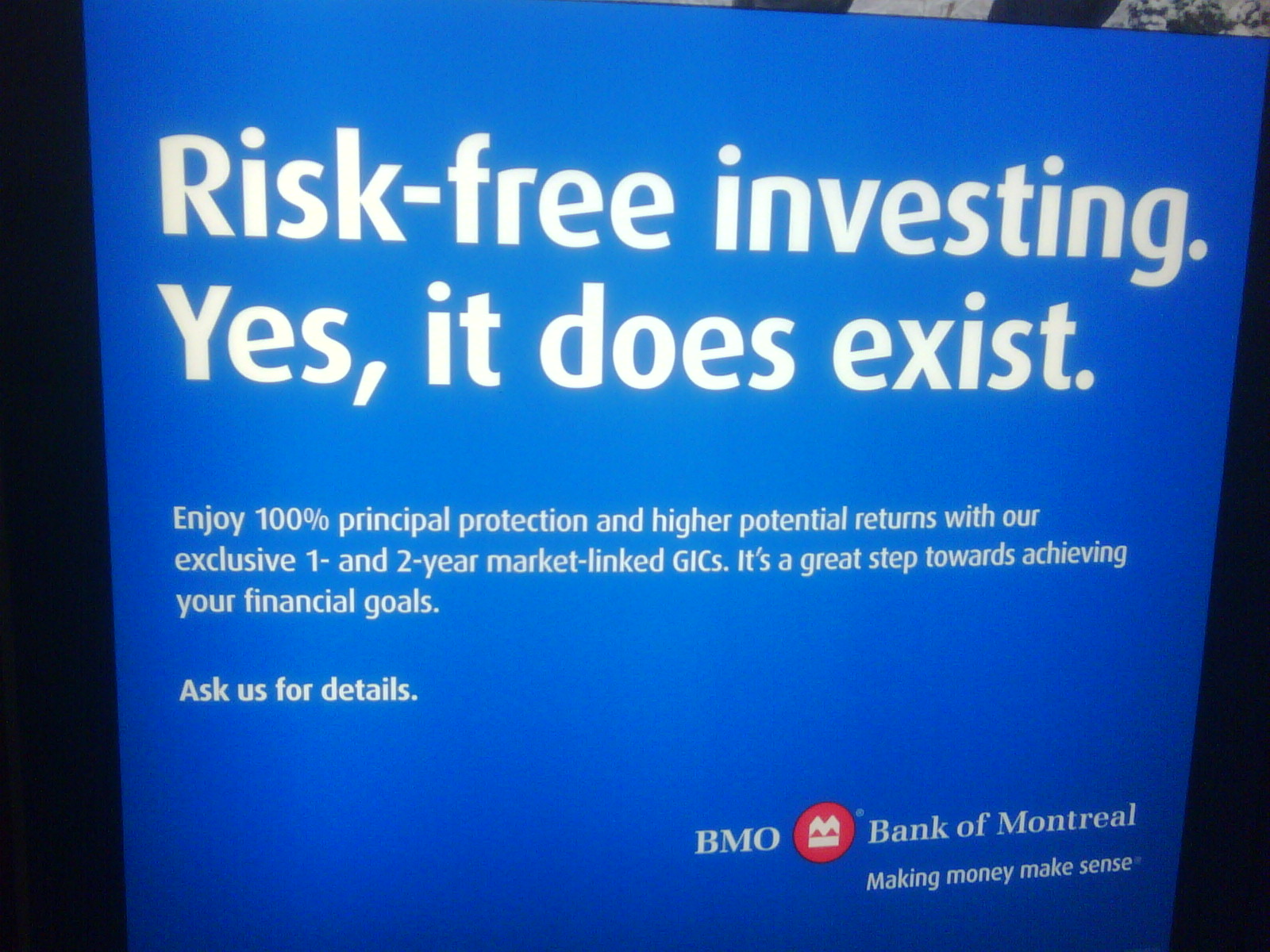
I would have thought it axiomatic that any investment in corporate securities bears with it a chance of loss – but maybe others have different axioms:

One of the biggest winners in the push to make money-market funds safer for investors is turning out to be none other than the U.S. government.

Rules adopted by regulators last month will require money funds that invest in riskier assets to abandon their traditional $1 share-price floor and disclose daily changes in value. For companies that use the funds like bank accounts, the prospect of prices falling below $1 may prompt them to shift their cash into the shortest-term Treasuries, creating as much as $500 billion of demand in two years, according to Bank of America Corp.

Boeing Co., the world’s largest maker of planes, and the state of Maryland are already looking to make the switch to avoid the possibility of any potential losses. With the $1.39 trillion U.S. bill market accounting for the smallest share of Treasuries in six decades, the extra demand may help the world’s largest debtor nation contain its own funding costs as the Federal Reserve moves to raise interest rates.

The changes are intended to prevent a repeat of 2008, when the collapse of the 37-year-old, $62.5 billion Reserve Primary Fund triggered a run on other money funds and deepened the worst financial crisis since the Great Depression.

Still, investors using prime funds to manage their idle cash may find floating prices an unnecessary risk when differences in fund rates are so minimal, said Brian Smedley, an interest-rate strategist at Bank of America in New York.

He estimates about half the $964 billion held in institutional prime funds will flow into those that only invest in government debt and yield about 0.013 percentage point less, before the new rules become fully effective in 2016.

“We’re not really getting paid for the risks associated” and the rules will make these funds even less attractive, Joseph D’Angelo, who oversees $70 billion as head of money-market fixed-income at Prudential Investment Management, said in a July 30 telephone interview from Newark, New Jersey.

“We’re definitely worried about breaking the buck,” Verett Mims, assistant treasurer at Chicago-based Boeing, said in a telephone interview on July 30. “That’s our biggest problem, the notion of principal preservation.”

The state of Maryland may also refrain from investing in prime money-market funds as a result of the floating-price rule, according to its treasurer, Nancy Kopp.

The changes “make these money market funds less usable, if not usable at all as investment vehicles,” she said in a July 22 conference call organized by the Chamber of Conference.

It seems pretty clear to me that the only thing that will do a lot of good in reducing the risk of capital loss in holding Money Market Funds is capital – whether such capital is directly issued by the MMF, or ‘borrowed’ through a guarantee relationship, probably with its sponsor. But not, apparently, clear to everybody.

It was a mostly negative day for the Canadian preferred share market, with PerpetualDiscounts down 18bp, FixedResets gaining 1bp and DeemedRetractibles off 17bp. There was a bit more volatility than usual. Volume was extremely low.

HIMIPref™ Preferred Indices
These values reflect the December 2008 revision of the HIMIPref™ Indices

Values are provisional and are finalized monthly
Index Mean
Current
Yield
(at bid)
Median
YTW
Median
Average
Trading
Value
Median
Mod Dur
(YTW)
Issues Day’s Perf. Index Value
Ratchet 0.00 % 0.00 % 0 0.00 0 0.7003 % 2,625.7
FixedFloater 4.17 % 3.40 % 26,521 18.61 1 -0.2188 % 4,163.9
Floater 2.92 % 3.04 % 45,340 19.59 4 0.7003 % 2,715.2
OpRet 4.03 % 0.29 % 77,632 0.08 1 0.0393 % 2,715.8
SplitShare 4.25 % 3.95 % 54,871 4.03 6 -0.0082 % 3,117.3
Interest-Bearing 0.00 % 0.00 % 0 0.00 0 0.0393 % 2,483.3
Perpetual-Premium 5.49 % -5.14 % 88,559 0.09 19 0.0641 % 2,436.2
Perpetual-Discount 5.23 % 5.19 % 118,171 15.17 17 -0.1809 % 2,585.4
FixedReset 4.29 % 3.58 % 196,063 8.56 75 0.0145 % 2,558.7
Deemed-Retractible 5.00 % 0.28 % 110,677 0.24 42 -0.1689 % 2,548.6
FloatingReset 2.69 % 2.21 % 79,873 3.84 6 0.0527 % 2,512.6
Performance Highlights
Issue Index Change Notes
CIU.PR.C FixedReset -1.68 % YTW SCENARIO
Maturity Type : Limit Maturity
Maturity Date : 2044-08-05
Maturity Price : 21.35
Evaluated at bid price : 21.66
Bid-YTW : 3.39 %
TRP.PR.B FixedReset -1.25 % YTW SCENARIO
Maturity Type : Limit Maturity
Maturity Date : 2044-08-05
Maturity Price : 19.80
Evaluated at bid price : 19.80
Bid-YTW : 3.57 %
FTS.PR.J Perpetual-Discount -1.23 % YTW SCENARIO
Maturity Type : Limit Maturity
Maturity Date : 2044-08-05
Maturity Price : 23.64
Evaluated at bid price : 24.01
Bid-YTW : 5.01 %
BAM.PR.X FixedReset 1.00 % YTW SCENARIO
Maturity Type : Limit Maturity
Maturity Date : 2044-08-05
Maturity Price : 21.86
Evaluated at bid price : 22.14
Bid-YTW : 3.93 %
MFC.PR.F FixedReset 2.27 % YTW SCENARIO
Maturity Type : Hard Maturity
Maturity Date : 2025-01-31
Maturity Price : 25.00
Evaluated at bid price : 23.02
Bid-YTW : 4.15 %
Volume Highlights
Issue Index Shares
Traded
Notes
TD.PF.B FixedReset 189,588 Recent new issue.
YTW SCENARIO
Maturity Type : Limit Maturity
Maturity Date : 2044-08-05
Maturity Price : 23.19
Evaluated at bid price : 25.08
Bid-YTW : 3.62 %
BMO.PR.W FixedReset 151,540 Recent new issue.
YTW SCENARIO
Maturity Type : Limit Maturity
Maturity Date : 2044-08-05
Maturity Price : 23.14
Evaluated at bid price : 24.98
Bid-YTW : 3.60 %
BNS.PR.M Deemed-Retractible 78,890 Scotia crossed 70,000 at 25.74.
YTW SCENARIO
Maturity Type : Call
Maturity Date : 2014-09-04
Maturity Price : 25.50
Evaluated at bid price : 25.72
Bid-YTW : -5.25 %
ENB.PF.E FixedReset 54,595 Recent new issue.
YTW SCENARIO
Maturity Type : Limit Maturity
Maturity Date : 2044-08-05
Maturity Price : 23.11
Evaluated at bid price : 24.99
Bid-YTW : 4.12 %
ENB.PR.F FixedReset 40,378 Scotia crossed 12,100 at 24.80.
YTW SCENARIO
Maturity Type : Limit Maturity
Maturity Date : 2044-08-05
Maturity Price : 23.16
Evaluated at bid price : 24.70
Bid-YTW : 3.98 %
ENB.PR.N FixedReset 30,165 Scotia crossed 24,300 at 24.90.
YTW SCENARIO
Maturity Type : Limit Maturity
Maturity Date : 2044-08-05
Maturity Price : 23.14
Evaluated at bid price : 24.78
Bid-YTW : 4.08 %
There were 15 other index-included issues trading in excess of 10,000 shares.
Wide Spread Highlights
Issue Index Quote Data and Yield Notes
TRP.PR.E FixedReset Quote: 25.37 – 25.95
Spot Rate : 0.5800
Average : 0.3298

YTW SCENARIO
Maturity Type : Limit Maturity
Maturity Date : 2044-08-05
Maturity Price : 23.26
Evaluated at bid price : 25.37
Bid-YTW : 3.74 %

PWF.PR.P FixedReset Quote: 23.11 – 23.49
Spot Rate : 0.3800
Average : 0.2377

YTW SCENARIO
Maturity Type : Limit Maturity
Maturity Date : 2044-08-05
Maturity Price : 22.69
Evaluated at bid price : 23.11
Bid-YTW : 3.40 %

CU.PR.D Perpetual-Discount Quote: 24.55 – 24.95
Spot Rate : 0.4000
Average : 0.2739

YTW SCENARIO
Maturity Type : Limit Maturity
Maturity Date : 2044-08-05
Maturity Price : 24.14
Evaluated at bid price : 24.55
Bid-YTW : 5.05 %

BAM.PR.G FixedFloater Quote: 22.80 – 23.23
Spot Rate : 0.4300
Average : 0.3100

YTW SCENARIO
Maturity Type : Limit Maturity
Maturity Date : 2044-08-05
Maturity Price : 22.85
Evaluated at bid price : 22.80
Bid-YTW : 3.40 %

CU.PR.E Perpetual-Discount Quote: 24.48 – 24.80
Spot Rate : 0.3200
Average : 0.2221

YTW SCENARIO
Maturity Type : Limit Maturity
Maturity Date : 2044-08-05
Maturity Price : 24.07
Evaluated at bid price : 24.48
Bid-YTW : 5.07 %

GWO.PR.I Deemed-Retractible Quote: 22.71 – 22.98
Spot Rate : 0.2700
Average : 0.1753

YTW SCENARIO
Maturity Type : Hard Maturity
Maturity Date : 2025-01-31
Maturity Price : 25.00
Evaluated at bid price : 22.71
Bid-YTW : 5.76 %

Market Action

August 1, 2014

At present, it appears that confidence in the markets is increased by regulation (at least according to the regulators):

Singapore will introduce a minimum price for mainboard shares and reduce the lot size for transactions after a slump in the stocks of three commodity companies erased $6.9 billion in market value over three days in October.

The city-state will impose a minimum trading price of S$0.20 to address risks of low-priced securities being more susceptible to excessive speculation and potential market manipulation, according to a joint statement by the Monetary Authority of Singapore and Singapore Exchange Ltd. (SGX) yesterday. Other new measures include collection of a 5 percent collateral and reporting of short positions.

The day will come when confidence in the markets is decreased by regulation.

Today’s jobs number was good, but not great:

Today’s U.S. jobs report supports Federal Reserve Chair Janet Yellen’s view that there’s still plenty of slack left in the labor market, bolstering the case for continued stimulus, economists said.

While the Labor Department report showed employers added more than 200,000 jobs for the sixth straight month in July, there were also signs of continued weakness. A broad measure of unemployment that includes people working part-time because they can’t find full-time jobs increased last month, while wages stagnated, the report showed.

The headline unemployment rate unexpectedly rose to 6.2 percent from 6.1 percent as more people sought jobs. The share of Americans employed or looking for work, known as the participation rate, increased to 62.9 percent in July from 62.8 percent in June, which matched the lowest level since 1978.

Junk ETFs got hammered this week:

It’s been an ugly week for U.S. high-yield bonds, the worst in more than a year.

As investors fled, they turned to the easiest exits and pulled more than $1 billion from exchange-traded funds, according to data compiled by Bloomberg. With Wall Street banks generally devoting less capital to trading, there wasn’t much of a buffer on the other side to prop up values.

The result: Yields on the notes posted their biggest weekly increase since May 2012, surging to 5.7 percent from 5.3 percent on July 25, according to Barclays U.S. Corporate High Yield index data. The notes tumbled 1.3 percent in July, the first month of losses since last August.

Interesting to see continued muttering about dealer inventories. Eventually, something’s gotta give.

Water woes in California are getting severe:

Rod Cardella, a Mendota, California, grower of wine grapes, onions and almonds, had to wait a year to have a fourth water well dug on his property as the record drought gripping the most populous U.S. state increased demand for groundwater.

Cardella, 66, who founded Cardella Ranch with his father in 1970 and produces grapes for E&J Gallo Winery, the largest exporter of California wines, paid $500,000 to add the well in June after the federal government said it wouldn’t supply his area with its usual water allocation. The drought forced Cardella to leave half his ranch, including onion and cotton fields, unplanted this year.

With 82 percent of California now experiencing extreme drought after three years of record low rainfall, reservoirs are 45 percent below normal and declining. Governor Jerry Brown has called for a statewide voluntary reduction of water use by 20 percent, and residents now face fines of as much as $500 a day for wasting water.

Farmers have left fallow an estimated half-million acres. The dry spell is likely to boost the prices of food nationwide, according to the U.S. Agriculture Department, as farm and shipping interests stand to lose billions in revenue. California produces half of the fruits, vegetables and nuts consumed in the U.S. The price that some farmers pay for water has risen as much as 10 times what it cost before the drought.

Maybe desalinization plants could run off solar energy? That sounds like a good use for intermittent power.

But we won’t answer that question in Canada:

According to the most recent data from the OECD (from 2011), Canada falls well behind most other wealthy nations on total spending on research and development. At 1.74 per cent of GDP, we lag behind countries including the U.S. (2.77 per cent), Sweden (3.37 per cent) and Finland (3.78 per cent). Israel, a powerhouse in innovation and creative design, tops the list at 4.38 per cent.

It was a mixed day for the Canadian preferred share market, with PerpetualDiscounts up 15bp, FixedResets off 4bp and DeemedRetractibles down 9bp. Volatility was minor. Volume was virtually non-existent, as everybody took a holiday except for the minimum-wage scum.

HIMIPref™ Preferred Indices
These values reflect the December 2008 revision of the HIMIPref™ Indices

Values are provisional and are finalized monthly
Index Mean
Current
Yield
(at bid)
Median
YTW
Median
Average
Trading
Value
Median
Mod Dur
(YTW)
Issues Day’s Perf. Index Value
Ratchet 0.00 % 0.00 % 0 0.00 0 0.0000 % 2,607.5
FixedFloater 4.16 % 3.39 % 26,907 18.64 1 0.2193 % 4,173.0
Floater 2.94 % 3.06 % 45,165 19.55 4 0.0000 % 2,696.3
OpRet 4.03 % 0.23 % 78,630 0.08 1 -0.0785 % 2,714.7
SplitShare 4.25 % 3.89 % 55,639 3.99 6 -0.1608 % 3,117.5
Interest-Bearing 0.00 % 0.00 % 0 0.00 0 -0.0785 % 2,482.3
Perpetual-Premium 5.49 % -3.99 % 91,665 0.09 19 0.0993 % 2,434.6
Perpetual-Discount 5.22 % 5.17 % 117,015 15.22 17 0.1459 % 2,590.1
FixedReset 4.29 % 3.56 % 198,723 8.57 75 -0.0408 % 2,558.3
Deemed-Retractible 4.99 % -0.38 % 115,073 0.15 42 -0.0948 % 2,552.9
FloatingReset 2.68 % 2.22 % 81,224 3.86 6 -0.1448 % 2,511.3
Performance Highlights
Issue Index Change Notes
MFC.PR.F FixedReset -3.10 % YTW SCENARIO
Maturity Type : Hard Maturity
Maturity Date : 2025-01-31
Maturity Price : 25.00
Evaluated at bid price : 22.51
Bid-YTW : 4.42 %
IGM.PR.B Perpetual-Premium 1.08 % YTW SCENARIO
Maturity Type : Call
Maturity Date : 2014-12-31
Maturity Price : 26.00
Evaluated at bid price : 26.30
Bid-YTW : 2.86 %
Volume Highlights
Issue Index Shares
Traded
Notes
TD.PF.B FixedReset 286,749 Recent new issue.
YTW SCENARIO
Maturity Type : Limit Maturity
Maturity Date : 2044-08-01
Maturity Price : 23.19
Evaluated at bid price : 25.09
Bid-YTW : 3.62 %
BMO.PR.W FixedReset 201,265 Recent new issue.
YTW SCENARIO
Maturity Type : Limit Maturity
Maturity Date : 2044-08-01
Maturity Price : 23.13
Evaluated at bid price : 24.97
Bid-YTW : 3.61 %
ENB.PF.E FixedReset 67,748 Recent new issue.
YTW SCENARIO
Maturity Type : Limit Maturity
Maturity Date : 2044-08-01
Maturity Price : 23.10
Evaluated at bid price : 24.95
Bid-YTW : 4.13 %
PWF.PR.T FixedReset 51,000 Nesbitt crossed 50,000 at 26.00.
YTW SCENARIO
Maturity Type : Call
Maturity Date : 2019-01-31
Maturity Price : 25.00
Evaluated at bid price : 25.86
Bid-YTW : 3.39 %
RY.PR.X FixedReset 36,200 Called for redemption, August 24.
YTW SCENARIO
Maturity Type : Call
Maturity Date : 2014-09-23
Maturity Price : 25.00
Evaluated at bid price : 24.99
Bid-YTW : 3.84 %
MFC.PR.C Deemed-Retractible 32,452 Scotia crossed 24,200 at 22.82.
YTW SCENARIO
Maturity Type : Hard Maturity
Maturity Date : 2025-01-31
Maturity Price : 25.00
Evaluated at bid price : 22.60
Bid-YTW : 5.83 %
There were 10 other index-included issues trading in excess of 10,000 shares.
Wide Spread Highlights
Issue Index Quote Data and Yield Notes
PWF.PR.O Perpetual-Premium Quote: 26.00 – 26.86
Spot Rate : 0.8600
Average : 0.5365

YTW SCENARIO
Maturity Type : Call
Maturity Date : 2018-10-31
Maturity Price : 25.00
Evaluated at bid price : 26.00
Bid-YTW : 4.78 %

MFC.PR.F FixedReset Quote: 22.51 – 23.20
Spot Rate : 0.6900
Average : 0.5472

YTW SCENARIO
Maturity Type : Hard Maturity
Maturity Date : 2025-01-31
Maturity Price : 25.00
Evaluated at bid price : 22.51
Bid-YTW : 4.42 %

SLF.PR.H FixedReset Quote: 25.45 – 25.83
Spot Rate : 0.3800
Average : 0.2632

YTW SCENARIO
Maturity Type : Call
Maturity Date : 2016-09-30
Maturity Price : 25.00
Evaluated at bid price : 25.45
Bid-YTW : 3.21 %

FTS.PR.F Perpetual-Discount Quote: 24.51 – 24.85
Spot Rate : 0.3400
Average : 0.2268

YTW SCENARIO
Maturity Type : Limit Maturity
Maturity Date : 2044-08-01
Maturity Price : 24.03
Evaluated at bid price : 24.51
Bid-YTW : 5.05 %

PVS.PR.C SplitShare Quote: 25.95 – 26.20
Spot Rate : 0.2500
Average : 0.1608

YTW SCENARIO
Maturity Type : Hard Maturity
Maturity Date : 2017-12-10
Maturity Price : 25.00
Evaluated at bid price : 25.95
Bid-YTW : 3.89 %

BAM.PR.G FixedFloater Quote: 22.85 – 23.11
Spot Rate : 0.2600
Average : 0.1784

YTW SCENARIO
Maturity Type : Limit Maturity
Maturity Date : 2044-08-01
Maturity Price : 22.89
Evaluated at bid price : 22.85
Bid-YTW : 3.39 %

Market Action

July 31, 2014

How ’bout that London property market, eh?:

For equity-derivatives broker Andrew Adamson, it was a trade too good to pass up.

In October, he was offered 1,000 pounds ($1,700) per square foot for his London townhouse. Other homes in the area were going for about 30 percent less. Adamson accepted it immediately.

London’s housing market, having outperformed the rest of the U.K. with price gains of more than 50 percent in five years, is cooling as owners like Adamson cash out. They’re leaving the city for less costly suburban and country homes because they expect mortgage rates to rise and new lending rules to damp prices. London estate agents had the largest increase in instructions to sell homes in Britain in June and the biggest drop in people seeking to buy them, according to the Royal Institution of Chartered Surveyors.

“Now is the time people are cashing in,” said Adamson, 46, who used the 2 million pounds he raised from the sale to buy a country manor in Hampshire, southern England, for 400,000 pounds less.

IIROC answers the question: what is the purpose of regulatory requirements for advisors to take CSI courses?

CSI was created in 1970 by one of IIROC’s predecessor organizations, the Investment Dealers Association (IDA), and the Canadian stock exchanges to educate and test the proficiency of individuals entering the industry. In 2002, CSI converted to a for-profit corporation with the IDA as its sole shareholder. The IDA sold CSI to ONCAP II, LP (a private equity fund managed by ONCAP Management Partners) for net proceeds of approximately $57 million in 2005 following a targeted auction. $28.5 million of those proceeds were applied as a membership fee reduction distributed to the IDA membership over two years. $28 million of the proceeds were applied to fund the creation of the Investment Industry Association of Canada.

The document notes that over ten thousand people took the Canadian Securities Course in 2013 at an average price of over $900 a head – and that’s just the biggest bit. Nice work if you can get it! The new generation of regulators is trying to think up another way of extracting money from the industry, so they can be bold entrepreneurs, too.

There’s more news about corporate bond liquidity:

The $8.2 billion of risk-sharing securities sold in the last year by government-controlled Fannie Mae and Freddie Mac can shift their losses from homeowner defaults to bond buyers. One slice of a deal issued in May traded at 95.7 cents on the dollar yesterday, down from 99.7 cents at the end of last month, according to Trace, the bond-price reporting system of the Financial Industry Regulatory Authority.

While JPMorgan Chase & Co. analysts say they fail to see “any fundamental reason” for the tumble, investors from CQS U.K. LLP to Calvert Investment Management Inc. are speculating that the drop is mainly about the growing amount of the debt running into limits created by new regulations on bond dealers’ ability to smooth trading by building up their inventories.

As a few holders continued selling the Fannie Mae and Freddie Mac securities without an immediate emergence of investor demand, most of the dealers active in trading the debt “disappeared,” said Vishal Khanduja, a money manager at Bethesda, Maryland-based Calvert, which oversees about $13 billion.

Until recently, “everybody wanted to trade it: I think there were 10 to 12 dealers messaging me and looking to make markets,” Khanduja said in a telephone interview. “It’s partially indicative of the regulations’ impact on their balance sheets.”

Dealers have reduced their bond holdings in response to rules ranging from the international Basel III accord on banks’ capital to the U.S. Volcker Rule limiting their ability to make bets with their own money. An expansion of Finra’s Trace trade disclosures to more types of debt is also increasing risks and cutting into profits for market makers.

Inventories of corporate securities and other debt without government backing at the biggest dealers fell to $56 billion in March 2013 from as much as $235 billion in 2007, according to the last Federal Reserve data before a change in calculations.

I continue to think there’s an opportunity there for an actively managed fund to make a bit of money pretending to be a trading desk. Call it ‘HFT comes to the bond markets’. You could call these shops by some kind of special name … maybe “investment dealers” or something like that.

Don’t get me wrong! I’m not completely convinced that the new Volcker and capital rules are completely wrong, in and of themselves. What bothers me is that not a single person ever thought about the consequences and how these consequences might impact on the purpose of the capital markets – which is not “To be nice to granny”, by the way, but “To get money from investors to businesses”.

OK now, call it in the air, heads or tails? Risk-On or Risk-Off?

The Dow fell 317.06 points, or 1.9 percent, to 16,563.30 at 4 p.m. in New York, for the largest one-day retreat since Feb. 3. The Standard & Poor’s 500 Index slid 2 percent, the most since April 10, to 1,930.67. The gauge dropped 1.5 percent in July, its first monthly decline since January. The Nasdaq 100 Index lost 2.1 percent. The MSCI All-Country World Index tumbled 1.5 percent for its worst loss in almost six months.

Concern grew that the improving economy may force the Federal Reserve to raise interest rates sooner than expected.

U.S. gross domestic product expanded at a 4 percent annual pace in the second quarter, confirming the central bank’s view that a first-quarter contraction was transitory. Data today showed fewer Americans filed applications for unemployment insurance benefits over the past month than at any time in more than eight years, signaling employers are hanging on to workers as demand improves.

Valener Inc., proud issuer of VNR.PR.A, was confirmed at Pfd-2(low) by DBRS:

DBRS has today confirmed Valener Inc.’s (Valener or the Company) Cumulative Rate Reset Preferred Shares, Series A rating at Pfd-2 (low), with a Stable trend. The rating is based on the credit quality of Valener’s 29%-owned Gaz Métro Limited Partnership (GMLP), which guarantees the First Mortgage Bonds and Senior Secured Notes (rated “A,” Stable) of Gaz Métro inc. (GMi), and Valener’s low non-consolidated leverage. GMi owns the remaining 71% of GMLP.

Valener’s rating is based on the following factors: (1) continually strong and predictable cash flow from GMLP to Valener. GMLP has made cash distributions to its partners in an amount of over 90% of its net income, excluding non-recurring items, for most of the last 20 years. (2) GMLP is expected to continue to maintain its distributions of at least 85% of its net income, excluding non-recurring items, as set out under the partnership agreement between Valener and GMLP (the Partnership Agreement). In the event that GMi, as general partner of GMLP, intends to distribute less than 85% of its net income, excluding non-recurring items, it would require the approval of at least 90% of GMi’s directors. (3) Valener’s non-consolidated debt-to-capital structure is expected to remain below 20%. If its non-consolidated debt leverage ratio is above 20%, Valener is expected to issue equity to bring the ratio back under the 20% threshold in a timely manner. (4) DBRS expects that the majority of Valener’s cash flow will be derived from GMLP. Any material investment carried out by Valener and not through GMLP could have a negative rating impact. (5) DBRS expects that Valener will maintain its 29% interest in GMLP and its pro rata representation on GMi’s board of directors.

Shaw Communications Inc., proud issuer of SJR.PR.A, was confirmed at Pfd-3 by DBRS:

DBRS has today confirmed Shaw Communications Inc.’s (Shaw or the Company) Issuer Rating at BBB, Senior Notes rating at BBB and Preferred Shares rating at Pfd-3. The confirmation follows the Company’s announcement to acquire ViaWest for USD 830 million, financed with approximately CAD 500 million of cash on hand and approximately CAD 400 million from Shaw’s existing credit facility. Shaw will also assume USD 370 million of borrowings under committed non-recourse debt financing at ViaWest. The purchase price of USD 1.2 billion represents a multiple of approximately 13.0x adjusted EBITDA annualized for the three months ended June 30, 2014, which is consistent with recent market transactions. The acquisition is expected to close in September 2014 and is subject to U.S. regulatory approval.

ViaWest is a privately held provider of data centre infrastructure, cloud technology and managed IT solutions. The company employs over 350 people and services more than 1,300 customers across seven states. ViaWest operates 27 data centers in Colorado, Utah, Oregon, Nevada, Texas, Minnesota and Arizona.

It was a mixed day for the Canadian preferred share market, with PerpetualDiscounts up 13bp, FixedResets gaining 11bp and DeemedRetractibles off 4bp. Floaters got hammered, otherwise volatility was a yawn. Volume was average.

HIMIPref™ Preferred Indices
These values reflect the December 2008 revision of the HIMIPref™ Indices

Values are provisional and are finalized monthly
Index Mean
Current
Yield
(at bid)
Median
YTW
Median
Average
Trading
Value
Median
Mod Dur
(YTW)
Issues Day’s Perf. Index Value
Ratchet 3.05 % 3.04 % 21,349 19.63 1 0.4090 % 2,607.5
FixedFloater 4.17 % 3.40 % 27,217 18.63 1 0.0000 % 4,163.9
Floater 2.94 % 3.05 % 44,990 19.58 4 -2.2855 % 2,696.3
OpRet 4.02 % -0.86 % 79,859 0.08 1 -0.2741 % 2,716.8
SplitShare 4.25 % 3.78 % 53,922 3.99 6 -0.0265 % 3,122.6
Interest-Bearing 0.00 % 0.00 % 0 0.00 0 -0.2741 % 2,484.3
Perpetual-Premium 5.52 % -3.22 % 82,318 0.08 17 -0.0046 % 2,432.2
Perpetual-Discount 5.22 % 5.16 % 101,771 15.22 20 0.1277 % 2,586.3
FixedReset 4.34 % 3.60 % 198,032 6.66 79 0.1118 % 2,559.4
Deemed-Retractible 4.99 % -0.85 % 116,925 0.15 42 -0.0398 % 2,555.4
FloatingReset 2.68 % 2.18 % 84,154 3.86 6 -0.0132 % 2,515.0
Performance Highlights
Issue Index Change Notes
BAM.PR.B Floater -3.35 % YTW SCENARIO
Maturity Type : Limit Maturity
Maturity Date : 2044-07-31
Maturity Price : 17.04
Evaluated at bid price : 17.04
Bid-YTW : 3.10 %
BAM.PR.K Floater -3.07 % YTW SCENARIO
Maturity Type : Limit Maturity
Maturity Date : 2044-07-31
Maturity Price : 17.06
Evaluated at bid price : 17.06
Bid-YTW : 3.10 %
BAM.PR.C Floater -3.03 % YTW SCENARIO
Maturity Type : Limit Maturity
Maturity Date : 2044-07-31
Maturity Price : 17.30
Evaluated at bid price : 17.30
Bid-YTW : 3.05 %
TRP.PR.C FixedReset 1.13 % YTW SCENARIO
Maturity Type : Limit Maturity
Maturity Date : 2044-07-31
Maturity Price : 21.90
Evaluated at bid price : 22.45
Bid-YTW : 3.44 %
GWO.PR.H Deemed-Retractible 1.16 % YTW SCENARIO
Maturity Type : Hard Maturity
Maturity Date : 2025-01-31
Maturity Price : 25.00
Evaluated at bid price : 24.40
Bid-YTW : 5.23 %
Volume Highlights
Issue Index Shares
Traded
Notes
TD.PF.B FixedReset 1,012,592 New issue settled today.
YTW SCENARIO
Maturity Type : Limit Maturity
Maturity Date : 2044-07-31
Maturity Price : 23.18
Evaluated at bid price : 25.07
Bid-YTW : 3.63 %
BMO.PR.W FixedReset 488,035 Recent new issue.
YTW SCENARIO
Maturity Type : Limit Maturity
Maturity Date : 2044-07-31
Maturity Price : 23.14
Evaluated at bid price : 25.01
Bid-YTW : 3.60 %
ENB.PF.E FixedReset 97,047 Recent new issue.
YTW SCENARIO
Maturity Type : Limit Maturity
Maturity Date : 2044-07-31
Maturity Price : 23.10
Evaluated at bid price : 24.95
Bid-YTW : 4.13 %
TD.PF.A FixedReset 92,440 Desjardins crossed blocks of 49,900 and 27,000, both at 25.38.
YTW SCENARIO
Maturity Type : Limit Maturity
Maturity Date : 2044-07-31
Maturity Price : 23.27
Evaluated at bid price : 25.38
Bid-YTW : 3.60 %
BMO.PR.S FixedReset 46,468 TD crossed 35,000 at 25.46.
YTW SCENARIO
Maturity Type : Call
Maturity Date : 2019-05-25
Maturity Price : 25.00
Evaluated at bid price : 25.40
Bid-YTW : 3.59 %
BAM.PR.X FixedReset 36,398 TD crossed 23,900 at 21.93.
YTW SCENARIO
Maturity Type : Limit Maturity
Maturity Date : 2044-07-31
Maturity Price : 21.53
Evaluated at bid price : 21.91
Bid-YTW : 3.98 %
There were 29 other index-included issues trading in excess of 10,000 shares.
Wide Spread Highlights
Issue Index Quote Data and Yield Notes
TRP.PR.C FixedReset Quote: 22.45 – 22.99
Spot Rate : 0.5400
Average : 0.3629

YTW SCENARIO
Maturity Type : Limit Maturity
Maturity Date : 2044-07-31
Maturity Price : 21.90
Evaluated at bid price : 22.45
Bid-YTW : 3.44 %

PWF.PR.F Perpetual-Discount Quote: 25.08 – 25.40
Spot Rate : 0.3200
Average : 0.2080

YTW SCENARIO
Maturity Type : Call
Maturity Date : 2014-08-30
Maturity Price : 25.00
Evaluated at bid price : 25.08
Bid-YTW : 1.35 %

CM.PR.K FixedReset Quote: 24.99 – 25.25
Spot Rate : 0.2600
Average : 0.1540

YTW SCENARIO
Maturity Type : Hard Maturity
Maturity Date : 2022-01-31
Maturity Price : 25.00
Evaluated at bid price : 24.99
Bid-YTW : 3.68 %

RY.PR.Z FixedReset Quote: 25.58 – 25.91
Spot Rate : 0.3300
Average : 0.2293

YTW SCENARIO
Maturity Type : Call
Maturity Date : 2019-05-24
Maturity Price : 25.00
Evaluated at bid price : 25.58
Bid-YTW : 3.43 %

SLF.PR.C Deemed-Retractible Quote: 22.48 – 22.76
Spot Rate : 0.2800
Average : 0.1830

YTW SCENARIO
Maturity Type : Hard Maturity
Maturity Date : 2025-01-31
Maturity Price : 25.00
Evaluated at bid price : 22.48
Bid-YTW : 5.83 %

FTS.PR.J Perpetual-Discount Quote: 24.24 – 24.60
Spot Rate : 0.3600
Average : 0.2697

YTW SCENARIO
Maturity Type : Limit Maturity
Maturity Date : 2044-07-31
Maturity Price : 23.85
Evaluated at bid price : 24.24
Bid-YTW : 4.96 %

Market Action

July 30, 2014

The Swedes are serious about bank regulation:

Sweden will start publishing banks’ individual capital requirements in a step designed to reveal risks investors have so far been unable to measure based on reported buffers.

The Swedish Financial Supervisory Authority is planning to follow its Danish counterpart and disclose so-called Pillar 2 requirements as Scandinavia leads Europe in stepping up efforts to improve transparency. In Denmark, which like Sweden has a bank industry whose assets are four times gross domestic product, lenders can be shut down by the regulator if reserves drop below individual requirements.

Sweden already requires its biggest banks to meet some of the world’s most rigorous capital standards, ranging from 14 percent for Nordea Bank AB (NDA) to 19 percent for Swedbank AB. In May, the FSA said banks should hold a 1 percent counter-cyclical buffer after household debt burdens swelled to a record.

BIS explains pillar 2 requirements:

There are three main areas that might be particularly suited to treatment under Pillar 2: risks considered under Pillar 1 that are not fully captured by the Pillar 1 process (e.g. the proposed operational risk charge in Pillar 1 may not adequately cover all the specific risks of any given institution); those factors not taken into account by the Pillar 1 process (e.g. interest rate risk); and factors external to the bank (e.g. business cycle effects).

Authoritarian governments world-wide are clamping down on housing bubbles:

Singapore and Hong Kong, as a special administrative region of China, have governments with policy-making power over their entire geographic areas, where they are relatively free of political opposition from neighborhood groups or borough councils that stymie directives or mitigate their effectiveness. The Asian cities control the land supply and are the biggest landlords.

That allows them to implement decisive policy measures. For example, in January 2013, the Monetary Authority of Singapore, effectively the central bank and chief regulator, cut the mortgage ratio allowable on purchases of second homes while more than doubling minimum down payments from 10 percent to 25 percent. The banks had no choice but to follow.

Hong Kong and Singapore haven’t shied away from using taxes to discriminate against foreign buyers — something other locales with surging prices have yet to do. Non-permanent residents in both cities are subject to an additional 15 percent tax when they buy property, except in Singapore where Americans are exempted by treaty.

The U.K. government has tried some measures. After it increased the stamp duty to 7 percent on high-value properties in March 2012, price increases for homes valued from 5 million pounds to 10 million pounds ($8.5 million to $17 million) slowed from 9.7 percent to 5.8 percent in the subsequent year, according to broker Knight Frank LLP.

Bank of England Governor Mark Carney announced another set of measures last month, citing concerns over household indebtedness and the threat of a property bubble. They limit mortgages to less than 4.5 times a borrowers’ annual income and require banks to refuse loans to those failing to prove they could afford a 3 percentage-point rise in interest rates.

But France wins the prize:

French President Francois Hollande’s government may have made a housing slump worse, pushing the construction market to its lowest in more than 15 years.

Housing starts fell 19 percent in the second quarter from a year earlier, and permits — a gauge of future construction — dropped 13 percent, the French Housing Ministry said yesterday.

The rout stems from a law this year that seeks to make housing more affordable by capping rents in expensive neighborhoods. To protect home buyers, the law also boosted the number of documents that must be provided by sellers, leading to a decline in home sales and longer transaction times.

Meanwhile, the Bank of England is cracking down on the rule of law:

Miscreant bankers face having their bonuses clawed back for up to seven years after their award under measures set out on Wednesday by the Bank of England, as it tightens its regulatory clampdown on wrongdoing in the financial sector.

Lawyers say enforcing clawbacks is untested in the UK courts if a banker refuses to pay up, and there are also questions over what happens to tax paid on a recovered bonus. But some senior figures in the sector support the idea.

The Bank and the fellow regulator the Financial Conduct Authority (FCA) also proposed in a new consultation that senior managers face clawbacks of up to 10 years if they are being investigated.

“These proposals are tougher than the industry would have liked, but there was a general resignation that they would be implemented whatever the costs and technical difficulties and however far it puts the UK outside international norms,” said Nicholas Stretch of law firm CMS.

Great, huh? Now the regulators can decide after the fact whether or not something was reckless and impose a fine of whatever they like. Untrammelled by parliament or those old fogeys in the courts! Hurrah!

…and there’s more!

Bank regulators have just given the top people in U.K. corporate life another reason to avoid job offers from domestic banks.

Requiring bankers to have annual “MOT”-style tests of their fit and proper status, and bringing in a new, tougher “senior manager regime” sounds good for accountability, post-Libor, and chief executives are used to longer deferral periods for their pay.

But incomers will hesitate about being held responsible, perhaps even criminally, for malpractice somewhere in their hugely complex universal bank.

Moreover, some of the BoE proposals are actively disconcerting. Banning so-called buyout clauses – compensation of new employees for deferred income lost by leaving their old jobs – would prevent some of the more outlandish recent payments made to bank bosses. But they also incentivise candidates to stay put.

Also, the ability to demand repayment of awards already paid will almost certainly make UK banks less inviting places to work, even though the minimum period in which bonuses can be clawed back has been cut by two years to seven years.

Today’s FOMC statement is moderately positive:

The Committee currently judges that there is sufficient underlying strength in the broader economy to support ongoing improvement in labor market conditions. In light of the cumulative progress toward maximum employment and the improvement in the outlook for labor market conditions since the inception of the current asset purchase program, the Committee decided to make a further measured reduction in the pace of its asset purchases.

To support continued progress toward maximum employment and price stability, the Committee today reaffirmed its view that a highly accommodative stance of monetary policy remains appropriate. In determining how long to maintain the current 0 to 1/4 percent target range for the federal funds rate, the Committee will assess progress–both realized and expected–toward its objectives of maximum employment and 2 percent inflation.

When the Committee decides to begin to remove policy accommodation, it will take a balanced approach consistent with its longer-run goals of maximum employment and inflation of 2 percent. The Committee currently anticipates that, even after employment and inflation are near mandate-consistent levels, economic conditions may, for some time, warrant keeping the target federal funds rate below levels the Committee views as normal in the longer run.

Voting against was Charles I. Plosser who objected to the guidance indicating that it likely will be appropriate to maintain the current target range for the federal funds rate for “a considerable time after the asset purchase program ends,” because such language is time dependent and does not reflect the considerable economic progress that has been made toward the Committee’s goals.

Jeff Kearns of Bloomberg notes:

Since meeting in mid-June, the committee has come closer to achieving its goals for stable prices and full employment. Employers added 288,000 jobs last month, helping push down unemployment to 6.1 percent, the lowest in almost six years.

Today’s Commerce Department report showed gross domestic product expanded at a 4 percent annual pace in the second quarter, confirming the Fed’s view that a first-quarter contraction was transitory.

Yellen told lawmakers this month that while her view of the economy has turned “more positive,” she’s concerned about signs of job-market “slack” such as low participation in the labor force.

“We need to be careful to make sure that the economy is on a solid trajectory before we consider raising interest rates,” she said in her semi-annual testimony. “There are mixed signals.”

Among them: average hourly earnings fell or were stagnant in the past four months, after adjusting for inflation.

Simon Kennedy of Bloomberg reports on an interesting difference between UK and US mortgage debt:

While investors bet the U.K. central bank will raise its benchmark interest rate as soon as the end of this year, with its U.S. counterpart following six months later, economists at London-based Fathom Consulting aren’t so sure.

While the International Monetary Fund has called the U.K. the fastest-growing rich economy this year, Fathom says the U.S. household sector may be better placed than that of the U.K. to stomach higher interest rates. No one expects Yellen’s Fed to act on interest rates when policy makers meet today.

A key measure of how vulnerable households are to increased rates is their exposure to variable-rate home loans, known as adjustable rate mortgages or ARMs in the U.S.

In the U.S., the share of mortgage applications based on such loans has declined to fewer than 20 percent from about 50 percent before the financial crisis, according to Fathom’s July 28 report.

By contrast, about 70 percent of outstanding British mortgages are at a variable rate, meaning the BOE will try to keep increases to a minimum, they said.

After all that we need some comic relief, so let’s mock an unsigned article that came to my attention today:

s we have discussed previously, the Portfolio Turnover Ratio (PTR) for any given mutual or exchange-traded fund is a quick and easy tool to use when you’re trying to figure out which is the better investment for your savings. A fund’s PTR gives you a way to judge how much activity and risk the professional money managers are taking on to generate their investment returns.

As you can clearly see from the PTRs listed above, and despite the same investment objectives and risk profiles, each fund’s manager has a completely different trading strategy! The PTRs for TD points to a serious disconnect between their managers’ actual trading strategy and their fund’s stated investment objective and risk profile, whereas the PTRs for the RBC managers fits aptly with their stated investment objective and risk profile.

OK, so maybe you bought the TD fund in 2008 and still hold it today thinking that you were staying true to your conservative buy and hold investment strategy. But unfortunately someone forgot to tell the fund’s investment managers at TD what kind of investor you are because, unbeknownst to you, they bought and sold every investment in the fund more than 14 times! Yes, that’s right! On average, they’ve traded your savings over and over again 2.82 times every year since 2008, which appears to be in contrast to the fund’s stated investment objective and risk profile!

Some of you may want to argue with me that your investment in the TD fund did fine in terms of your over-all rate of returns, and for some investors that’s all that matters – how much did I make? Some investors don’t care about the risks they have to take to get results, and in good markets even risky investments go up in value. But ignoring an investment’s risks can be dangerous when markets are not so good. These particular mutual funds are a good case in point. Look at the difference in losses between these two funds in the 2009 downturn in market: the TD Canadian Equity fund lost 46% in the 12 months ending February 2009 compared to a 23% decline for RBC Canadian Equity Fund. So, what we can learn from this particular case study is that when you take the time to study a fund’s PTR to make more informed investment choices, taking into account good and bad market cycles, you’ll come out the real winner.

Equating portfolio turnover to risk, without examining what those trades actually were, implying that TD’s underperformance in the twelve month’s ending February, 2009, was due to portfolio turnover, and completely ignoring benchmarks is the height of ignorance. According to one source (I can’t be bothered to look it up):

•By comparison, the Toronto Stock Exchange lost money almost 30% of the time. The worst 1 year return was -38% (ending February 2009).

This leads to a suspicion that the RBC fund got very lucky on its market timing, while TD underperformed by what would be a gigantic amount in normal times, but is somewhat less surprising considering the time period. But, of course, it’s only a suspicion. Only a complete idiot would draw any conclusions at all based solely on these numbers; but properly supported investment conclusions – even when it’s only a question of categorization – require a bit of work.

It was a mixed day for the Canadian preferred share market, with PerpetualDiscounts up 2bp, FixedResets off 11bp and DeemedRetractibles gaining 1bp. Volatility was minimal, but Assiduous Reader thom4kat will be gratified to see the table includes GWO.PR.N! The issue had 25 trades timestamped after 3:05pm, nothing very big, but it looks like they just kept chip-chip-chipping away at the bid and wore it out. It made the Wide Spreads Table, too, which tells you that … um … it made the Wide Spreads Table. Volume was average.

PerpetualDiscounts now yield 5.16%, equivalent to 6.71% interest at the standard equivalency factor of 1.3x. Long corporates now yield about 4.2%, so the pre-tax interest-equivalent spread (in this context, the “Seniority Spread”) is now about 250bp, a significant widening from the 240bp reported July 23.

HIMIPref™ Preferred Indices
These values reflect the December 2008 revision of the HIMIPref™ Indices

Values are provisional and are finalized monthly
Index Mean
Current
Yield
(at bid)
Median
YTW
Median
Average
Trading
Value
Median
Mod Dur
(YTW)
Issues Day’s Perf. Index Value
Ratchet 3.07 % 3.04 % 20,209 19.59 1 0.9080 % 2,596.9
FixedFloater 4.17 % 3.40 % 28,121 18.63 1 0.0000 % 4,163.9
Floater 2.87 % 2.96 % 45,044 19.82 4 -0.6121 % 2,759.4
OpRet 4.01 % -4.29 % 75,401 0.08 1 -0.0391 % 2,724.3
SplitShare 4.25 % 3.78 % 54,003 3.99 6 0.0730 % 3,123.4
Interest-Bearing 0.00 % 0.00 % 0 0.00 0 -0.0391 % 2,491.1
Perpetual-Premium 5.52 % -6.83 % 81,677 0.08 17 0.0346 % 2,432.3
Perpetual-Discount 5.23 % 5.16 % 104,392 15.22 20 0.0192 % 2,583.0
FixedReset 4.40 % 3.61 % 195,245 8.58 78 -0.1087 % 2,556.5
Deemed-Retractible 4.98 % -2.11 % 117,265 0.09 42 0.0094 % 2,556.4
FloatingReset 2.68 % 2.15 % 87,250 3.86 6 0.1247 % 2,515.3
Performance Highlights
Issue Index Change Notes
GWO.PR.N FixedReset -1.55 % YTW SCENARIO
Maturity Type : Hard Maturity
Maturity Date : 2025-01-31
Maturity Price : 25.00
Evaluated at bid price : 21.02
Bid-YTW : 4.95 %
BAM.PR.Z FixedReset -1.04 % YTW SCENARIO
Maturity Type : Call
Maturity Date : 2017-12-31
Maturity Price : 25.00
Evaluated at bid price : 25.80
Bid-YTW : 3.94 %
Volume Highlights
Issue Index Shares
Traded
Notes
BMO.PR.W FixedReset 1,311,855 New issue settled today.
YTW SCENARIO
Maturity Type : Limit Maturity
Maturity Date : 2044-07-30
Maturity Price : 23.13
Evaluated at bid price : 24.96
Bid-YTW : 3.61 %
BAM.PF.F FixedReset 181,250 Nesbitt crossed 176,000 at 25.41.
YTW SCENARIO
Maturity Type : Limit Maturity
Maturity Date : 2044-07-30
Maturity Price : 23.28
Evaluated at bid price : 25.41
Bid-YTW : 4.23 %
ENB.PF.E FixedReset 141,973 Recent new issue.
YTW SCENARIO
Maturity Type : Limit Maturity
Maturity Date : 2044-07-30
Maturity Price : 23.11
Evaluated at bid price : 24.99
Bid-YTW : 4.12 %
ENB.PR.N FixedReset 125,515 Scotia crossed two blocks of 25,000 each and one of 50,000, all at 24.87.
YTW SCENARIO
Maturity Type : Limit Maturity
Maturity Date : 2044-07-30
Maturity Price : 23.15
Evaluated at bid price : 24.82
Bid-YTW : 4.07 %
TRP.PR.D FixedReset 100,717 RBC crossed 34,500 at 25.24; Nesbitt crossed 38,400 at the same price.
YTW SCENARIO
Maturity Type : Limit Maturity
Maturity Date : 2044-07-30
Maturity Price : 23.22
Evaluated at bid price : 25.13
Bid-YTW : 3.75 %
ENB.PF.C FixedReset 93,510 Scotia crossed two blocks of 25,000 each, both at 25.10 and bought 14,400 from Instinet at 25.11.
YTW SCENARIO
Maturity Type : Limit Maturity
Maturity Date : 2044-07-30
Maturity Price : 23.16
Evaluated at bid price : 25.10
Bid-YTW : 4.12 %
There were 35 other index-included issues trading in excess of 10,000 shares.
Wide Spread Highlights
Issue Index Quote Data and Yield Notes
CIU.PR.A Perpetual-Discount Quote: 22.91 – 23.91
Spot Rate : 1.0000
Average : 0.6580

YTW SCENARIO
Maturity Type : Limit Maturity
Maturity Date : 2044-07-30
Maturity Price : 22.63
Evaluated at bid price : 22.91
Bid-YTW : 5.09 %

GWO.PR.N FixedReset Quote: 21.02 – 21.37
Spot Rate : 0.3500
Average : 0.2400

YTW SCENARIO
Maturity Type : Hard Maturity
Maturity Date : 2025-01-31
Maturity Price : 25.00
Evaluated at bid price : 21.02
Bid-YTW : 4.95 %

TRP.PR.A FixedReset Quote: 23.26 – 23.50
Spot Rate : 0.2400
Average : 0.1540

YTW SCENARIO
Maturity Type : Limit Maturity
Maturity Date : 2044-07-30
Maturity Price : 22.40
Evaluated at bid price : 23.26
Bid-YTW : 3.66 %

IAG.PR.F Deemed-Retractible Quote: 26.14 – 26.49
Spot Rate : 0.3500
Average : 0.2673

YTW SCENARIO
Maturity Type : Call
Maturity Date : 2018-03-31
Maturity Price : 25.25
Evaluated at bid price : 26.14
Bid-YTW : 4.96 %

ELF.PR.F Perpetual-Discount Quote: 24.10 – 24.38
Spot Rate : 0.2800
Average : 0.2025

YTW SCENARIO
Maturity Type : Limit Maturity
Maturity Date : 2044-07-30
Maturity Price : 23.85
Evaluated at bid price : 24.10
Bid-YTW : 5.53 %

MFC.PR.F FixedReset Quote: 23.01 – 23.74
Spot Rate : 0.7300
Average : 0.6545

YTW SCENARIO
Maturity Type : Hard Maturity
Maturity Date : 2025-01-31
Maturity Price : 25.00
Evaluated at bid price : 23.01
Bid-YTW : 4.16 %

Market Action

July 29, 2014

A silly publication titled Virtuous Banking: Placing ethos and purpose at the heart of finance has just hit the streets with a thud:

While it cannot plausibly be argued that a systematically stable system is not to be desired, the current approach focuses far too much on this and ignores the crucial root cause of the banking crisis: a calamity that has its origins in the profligate and irresponsible actions of a significant number of bankers and banking institutions, urged on by a banking culture that was at its core fundamentally self-serving. There was on the part of organisations and people,a systemic disregard for the regulatory system, a belief that the pursuit of individual advantage would act for the advantage of all. The banking sector had, in short, lost its ethos. Instead of a culture that prioritised its own self-interest, it should look towards the fulfilment of a broader common good and its wider social purpose.

Given the failure of rule following ethics as evinced by the crash and multiple scandals, bankers evidently and most obviously need to be of good character. Bankers need to know the good, do the good and be good.

In short, if we want to place ethos and virtue firmly at the heart of banking, policy makers will need to ensure that there are suitable internal checks on banking institutions through better governance, and that there are adequate external checks on banking behaviour through improved competition and diversity. The ten recommendations below outline how such a programme for reform could be pursed in the next parliament, regardless of which political party assumes power.

1. Define and enshrine an overarching purpose for banking: A criticism often levelled at the banks is that they either perform no clear social purpose or, if they do, this is often not reflected in the actions of bankers.

2. Co-design codes of conduct to place customers at the heart of standards:

3. Require all bankers to swear the Bankers’ Oath::

4. Toughen shareholder fiduciary duties to promote activism:

5. Encourage the banks to compete on customer satisfaction:

6. Reclassify small businesses as consumers:

7. Launch a competition to kick-start the online advice market:

8. Conduct an immediate review into the diversity of UK banking:

9. Localise the British Business Bank through [Local Enterprise Partnerships]:

10. Utilise public funds to boost the digital finance market: …. we recommend that the Department for Business, Innovation and Skills conduct a review to determine the viability of utilising local government funds to increase lending to small businesses and social enterprises through digital lending platforms.

How sweet. Wency Leung in the Globe quoted one instant rejoinder:

A proposed version of the bankers’ oath reads: “I will remember that I remain a member of society, with special obligations to the financial security and wellbeing of my customers, their families and the communities they reside in.”

“People pledge allegiance to flags and all sorts of things, but it may or may not affect their behaviour,” says Gini Graham Scott, a Lafayette, Calif.-based consultant specializing in business and work relationships, and author of The Truth About Lying: Why and How We All Do It and What to Do About It.

For some, she says, an oath may simply represent a token formality that doesn’t really have much meaning. And people tend to lie more often in cultures that emphasize competition and monetary, materialistic values, Scott says.

It was a mixed day for the Canadian preferred share market, with PerpetualDiscounts off 1bp, FixedResets gaining 7bp and DeemedRetractibles up 9bp. Volatility was minimal. Volume was below average.

HIMIPref™ Preferred Indices
These values reflect the December 2008 revision of the HIMIPref™ Indices

Values are provisional and are finalized monthly
Index Mean
Current
Yield
(at bid)
Median
YTW
Median
Average
Trading
Value
Median
Mod Dur
(YTW)
Issues Day’s Perf. Index Value
Ratchet 3.10 % 3.07 % 19,873 19.53 1 -0.5221 % 2,573.5
FixedFloater 4.17 % 3.40 % 28,388 18.63 1 0.0000 % 4,163.9
Floater 2.86 % 2.95 % 45,308 19.84 4 0.0272 % 2,776.4
OpRet 4.01 % -4.88 % 75,705 0.08 1 0.1961 % 2,725.4
SplitShare 4.25 % 3.86 % 53,422 4.00 6 0.0266 % 3,121.1
Interest-Bearing 0.00 % 0.00 % 0 0.00 0 0.1961 % 2,492.1
Perpetual-Premium 5.52 % -3.89 % 81,919 0.09 17 0.0254 % 2,431.4
Perpetual-Discount 5.23 % 5.14 % 104,401 15.21 20 -0.0149 % 2,582.5
FixedReset 4.40 % 3.60 % 193,525 6.75 77 0.0691 % 2,559.3
Deemed-Retractible 4.98 % 0.08 % 117,715 0.09 43 0.0879 % 2,556.1
FloatingReset 2.68 % 2.20 % 88,137 3.84 6 0.0329 % 2,512.2
Performance Highlights
Issue Index Change Notes
MFC.PR.F FixedReset -1.59 % YTW SCENARIO
Maturity Type : Hard Maturity
Maturity Date : 2025-01-31
Maturity Price : 25.00
Evaluated at bid price : 22.92
Bid-YTW : 4.20 %
CIU.PR.C FixedReset 1.57 % YTW SCENARIO
Maturity Type : Limit Maturity
Maturity Date : 2044-07-29
Maturity Price : 21.60
Evaluated at bid price : 22.00
Bid-YTW : 3.33 %
Volume Highlights
Issue Index Shares
Traded
Notes
RY.PR.X FixedReset 184,620 Called for redemption August 25.
YTW SCENARIO
Maturity Type : Call
Maturity Date : 2014-09-23
Maturity Price : 25.00
Evaluated at bid price : 24.97
Bid-YTW : 4.17 %
RY.PR.H FixedReset 139,810 Nesbitt crossed 117,600 at 25.20.
YTW SCENARIO
Maturity Type : Limit Maturity
Maturity Date : 2044-07-29
Maturity Price : 23.22
Evaluated at bid price : 25.20
Bid-YTW : 3.60 %
CM.PR.O FixedReset 85,920 Nesbitt crossed 40,000 at 25.60; TD sold 10,000 to anonymous at 25.59.
YTW SCENARIO
Maturity Type : Call
Maturity Date : 2019-07-31
Maturity Price : 25.00
Evaluated at bid price : 25.58
Bid-YTW : 3.53 %
CM.PR.M FixedReset 73,300 Called for redemption July 31.
YTW SCENARIO
Maturity Type : Hard Maturity
Maturity Date : 2022-01-31
Maturity Price : 25.00
Evaluated at bid price : 24.98
Bid-YTW : 5.86 %
ENB.PF.E FixedReset 73,000 Recent new issue.
YTW SCENARIO
Maturity Type : Limit Maturity
Maturity Date : 2044-07-29
Maturity Price : 23.11
Evaluated at bid price : 24.98
Bid-YTW : 4.12 %
PWF.PR.I Perpetual-Premium 69,235 TD crossed 60,000 at 25.40.
YTW SCENARIO
Maturity Type : Call
Maturity Date : 2014-08-28
Maturity Price : 25.00
Evaluated at bid price : 25.37
Bid-YTW : -11.93 %
There were 25 other index-included issues trading in excess of 10,000 shares.
Wide Spread Highlights
Issue Index Quote Data and Yield Notes
MFC.PR.F FixedReset Quote: 22.92 – 23.67
Spot Rate : 0.7500
Average : 0.5718

YTW SCENARIO
Maturity Type : Hard Maturity
Maturity Date : 2025-01-31
Maturity Price : 25.00
Evaluated at bid price : 22.92
Bid-YTW : 4.20 %

CIU.PR.A Perpetual-Discount Quote: 22.90 – 23.34
Spot Rate : 0.4400
Average : 0.2829

YTW SCENARIO
Maturity Type : Limit Maturity
Maturity Date : 2044-07-29
Maturity Price : 22.62
Evaluated at bid price : 22.90
Bid-YTW : 5.09 %

HSE.PR.A FixedReset Quote: 23.07 – 23.44
Spot Rate : 0.3700
Average : 0.2538

YTW SCENARIO
Maturity Type : Limit Maturity
Maturity Date : 2044-07-29
Maturity Price : 22.69
Evaluated at bid price : 23.07
Bid-YTW : 3.60 %

FTS.PR.F Perpetual-Discount Quote: 24.52 – 24.77
Spot Rate : 0.2500
Average : 0.1941

YTW SCENARIO
Maturity Type : Limit Maturity
Maturity Date : 2044-07-29
Maturity Price : 24.04
Evaluated at bid price : 24.52
Bid-YTW : 5.05 %

MFC.PR.I FixedReset Quote: 26.10 – 26.25
Spot Rate : 0.1500
Average : 0.0992

YTW SCENARIO
Maturity Type : Call
Maturity Date : 2017-09-19
Maturity Price : 25.00
Evaluated at bid price : 26.10
Bid-YTW : 3.10 %

SLF.PR.H FixedReset Quote: 25.41 – 25.64
Spot Rate : 0.2300
Average : 0.1800

YTW SCENARIO
Maturity Type : Call
Maturity Date : 2016-09-30
Maturity Price : 25.00
Evaluated at bid price : 25.41
Bid-YTW : 3.27 %

Market Action

July 28, 2014

A story on regulatory secrecy alerted me to the fact that Joe Oliver is no more honest than his predecessor:

When Finance Minister Joe Oliver went to Europe in June, he boasted about how the country’s financial system has been ranked the world’s soundest by the World Economic Forum for six years running.

The links supporting this assertion are from the Ministry of Finance, 2014-6-23:

◾For the sixth year in a row, the World Economic Forum rated Canada’s banking system as the world’s soundest.

and from the Ministry of Finance, 2013-9-5:

“I am very pleased to see that the World Economic Forum has ranked Canada’s banking system as the soundest in the world for the sixth consecutive year,” said Minister Flaherty.

These liars rely on the fact that nobody actually reads the World Economic Forum’s Global Competitiveness Report. The full report for 2013-14 makes no bones about its methodology:

The World Economic Forum’s Executive Opinion Survey
remains the largest poll of its kind, capturing the insight of more than 13,000 executives into critical drivers of their respective countries’ development. This scale could not be achieved without the tremendous efforts of the Forum’s network of over 160 Partner Institutes in carrying out the Survey at a national level. It gathers valuable information on a broad range of variables for which data sources are scarce or nonexistent. For this reason, and for the integrity of our publication and related research, sampling and comparability across the globe remain an essential and ongoing endeavor of The Global Competitiveness and Benchmarking Network.

It’s a poll – as I have pointed out before. Responses by Canadian interviewees regarding Canada are compared to responses from interviewees from other countries about those countries. In Canada, the poll is administered by The Conference Board of Canada, an organization I consider to be little more than a joke, but that’s beside the point. The point is, it’s a poll. There is no straight-up comparison of Canada’s financial system’s strength vs. the strength of any other country’s financial system. It’s a measure of confidence only, and the blind led the blind into the abyss, trumpeted by sleaze-bag politicians and abetted by shoddy journalism.

However, the Globe and Mail article does illuminate the current government’s desire to politicize everything:

The argument against Mr. Jenkins’s and Mr. Thiessen’s recommendation is a philosophical one: in a democracy, major decisions should be made by elected representatives. “I believe in elected people,” the late Jim Flaherty, Canada’s finance minister during the financial crisis, told me when I asked him in October 2013 whether he thought Canada needed a more rigorous regulatory regime. “I don’t think bureaucrats, and God love them, should run the world.”

DBRS commented on RONA, proud issuer of RON.PR.A:

Going forward, DBRS believes that stabilization of RONA’s earnings profile will remain challenging in the near term, particularly as the Company will continue to face intense competition in an uncertain demand and housing market, highlighted by significant regional disparity. RONA’s typically high inventory balance and working capital position at the end of Q1 traditionally unwinds through the course of the year. DBRS believes that despite the recent decline in balance sheet debt, RONA’s credit risk profile will remain pressured until it displays sustainable growth in organic operating income and cash flow. DBRS will continue to monitor the Company’s operating performance through the disproportionately significant spring and summer periods (Q2 and Q3 F2014), which should provide a greater indication of the impact of RONA’s restructuring and repositioning efforts, key to whether the rating will stabilize in the current BB (high) rating category. Should RONA achieve stabilization of same-store sales and operating income, as well as a modest improvement in key credit metrics through the end of Q3 F2014, the rating outlook could stabilize. However, should RONA’s credit risk profile continue to display deterioration in same-store sales, operating income and key credit metrics through the end of Q3 F2014 (i.e., lease-adjusted debt-to-EBITDAR over 4.0x and lease-adjusted EBITDA coverage below 4.5x), a further downgrade to BB and Pfd-4 could result.

It was a mixed day for the Canadian preferred share market, with PerpetualDiscounts down 6bp, FixedResets gaining 7bp and DeemedRetractibles off 4bp. Volatility was minimal. Volume was low.

HIMIPref™ Preferred Indices
These values reflect the December 2008 revision of the HIMIPref™ Indices

Values are provisional and are finalized monthly
Index Mean
Current
Yield
(at bid)
Median
YTW
Median
Average
Trading
Value
Median
Mod Dur
(YTW)
Issues Day’s Perf. Index Value
Ratchet 3.07 % 3.06 % 19,709 19.52 1 0.0820 % 2,587.0
FixedFloater 4.17 % 3.40 % 28,470 18.63 1 -0.0876 % 4,163.9
Floater 2.86 % 2.94 % 45,991 19.87 4 0.2592 % 2,775.6
OpRet 4.02 % -2.68 % 78,392 0.08 1 -0.0784 % 2,720.0
SplitShare 4.25 % 3.92 % 52,168 4.00 6 -0.0110 % 3,120.3
Interest-Bearing 0.00 % 0.00 % 0 0.00 0 -0.0784 % 2,487.2
Perpetual-Premium 5.52 % -2.81 % 81,732 0.09 17 -0.0785 % 2,430.8
Perpetual-Discount 5.23 % 5.07 % 108,433 15.23 20 -0.0638 % 2,582.9
FixedReset 4.40 % 3.62 % 194,808 8.58 77 0.0749 % 2,557.5
Deemed-Retractible 4.98 % -0.37 % 119,542 0.09 43 -0.0352 % 2,553.9
FloatingReset 2.68 % 2.21 % 91,772 3.84 6 -0.1053 % 2,511.3
Performance Highlights
Issue Index Change Notes
CIU.PR.C FixedReset -2.65 % YTW SCENARIO
Maturity Type : Limit Maturity
Maturity Date : 2044-07-28
Maturity Price : 21.35
Evaluated at bid price : 21.66
Bid-YTW : 3.40 %
BAM.PR.B Floater 1.08 % YTW SCENARIO
Maturity Type : Limit Maturity
Maturity Date : 2044-07-28
Maturity Price : 17.74
Evaluated at bid price : 17.74
Bid-YTW : 2.98 %
RY.PR.L FixedReset 1.29 % YTW SCENARIO
Maturity Type : Call
Maturity Date : 2019-02-24
Maturity Price : 25.00
Evaluated at bid price : 26.66
Bid-YTW : 2.65 %
Volume Highlights
Issue Index Shares
Traded
Notes
ENB.PR.F FixedReset 48,764 Nesbitt crossed 41,000 at 24.75.
YTW SCENARIO
Maturity Type : Limit Maturity
Maturity Date : 2044-07-28
Maturity Price : 23.14
Evaluated at bid price : 24.66
Bid-YTW : 4.00 %
ENB.PF.E FixedReset 46,500 Recent new issue.
YTW SCENARIO
Maturity Type : Limit Maturity
Maturity Date : 2044-07-28
Maturity Price : 23.11
Evaluated at bid price : 24.98
Bid-YTW : 4.12 %
BNS.PR.Q FixedReset 43,351 TD crossed 34,800 at 25.80.
YTW SCENARIO
Maturity Type : Call
Maturity Date : 2018-10-25
Maturity Price : 25.00
Evaluated at bid price : 25.48
Bid-YTW : 3.13 %
BAM.PF.F FixedReset 31,450 National bought 10,000 from Nesbitt at 25.48.
YTW SCENARIO
Maturity Type : Limit Maturity
Maturity Date : 2044-07-28
Maturity Price : 23.28
Evaluated at bid price : 25.41
Bid-YTW : 4.23 %
FTS.PR.G FixedReset 23,825 TD crossed 15,600 at 24.97.
YTW SCENARIO
Maturity Type : Limit Maturity
Maturity Date : 2044-07-28
Maturity Price : 23.21
Evaluated at bid price : 24.92
Bid-YTW : 3.60 %
MFC.PR.E FixedReset 23,400 YTW SCENARIO
Maturity Type : Call
Maturity Date : 2014-09-19
Maturity Price : 25.00
Evaluated at bid price : 25.32
Bid-YTW : 0.89 %
There were 18 other index-included issues trading in excess of 10,000 shares.
Wide Spread Highlights
Issue Index Quote Data and Yield Notes
CIU.PR.C FixedReset Quote: 21.66 – 22.98
Spot Rate : 1.3200
Average : 0.9812

YTW SCENARIO
Maturity Type : Limit Maturity
Maturity Date : 2044-07-28
Maturity Price : 21.35
Evaluated at bid price : 21.66
Bid-YTW : 3.40 %

RY.PR.C Deemed-Retractible Quote: 25.53 – 25.86
Spot Rate : 0.3300
Average : 0.2039

YTW SCENARIO
Maturity Type : Call
Maturity Date : 2014-08-27
Maturity Price : 25.50
Evaluated at bid price : 25.53
Bid-YTW : -0.98 %

W.PR.H Perpetual-Premium Quote: 25.09 – 25.42
Spot Rate : 0.3300
Average : 0.2179

YTW SCENARIO
Maturity Type : Call
Maturity Date : 2014-08-27
Maturity Price : 25.00
Evaluated at bid price : 25.09
Bid-YTW : 3.51 %

GWO.PR.F Deemed-Retractible Quote: 25.56 – 26.00
Spot Rate : 0.4400
Average : 0.3551

YTW SCENARIO
Maturity Type : Call
Maturity Date : 2014-08-27
Maturity Price : 25.00
Evaluated at bid price : 25.56
Bid-YTW : -15.02 %

MFC.PR.F FixedReset Quote: 23.29 – 23.75
Spot Rate : 0.4600
Average : 0.3764

YTW SCENARIO
Maturity Type : Hard Maturity
Maturity Date : 2025-01-31
Maturity Price : 25.00
Evaluated at bid price : 23.29
Bid-YTW : 4.02 %

ENB.PR.A Perpetual-Premium Quote: 25.35 – 25.55
Spot Rate : 0.2000
Average : 0.1244

YTW SCENARIO
Maturity Type : Call
Maturity Date : 2014-08-27
Maturity Price : 25.00
Evaluated at bid price : 25.35
Bid-YTW : -1.08 %

Market Action

July 25, 2014

Algonquin Power & Utilities Corporation, proud issuer of AQN.PR.A and AQN.PR.D, was confirmed at Pfd-3(low) today by DBRS:

APUC’s non-consolidated key financial metrics are in line with the current rating profile. Non-consolidated debt-to-capital has remained minimal (0% as of March 31, 2014) and APUC intends to maintain debt at the HoldCo level well below the 20% threshold. In addition, APUC’s financial profile is also supported by the small size of preferred dividends relative to the cash flow available to the HoldCo. For the year ended December 31, 2013, preferred dividends totalled $5.4 million, while estimated cash flow available to service these dividends totalled approximately $105 million, allowing the remaining cash to service common dividends and partially fund capital expenditure needs.

It was a mixed day for the Canadian preferred share market today, with PerpetualDiscounts off 1bp, FixedResets down 7bp and DeemedRetractibles gaining 5bp. Volatility was low, with two of the three issues mentioned being high-volatility Floaters. Volume was very low.

HIMIPref™ Preferred Indices
These values reflect the December 2008 revision of the HIMIPref™ Indices

Values are provisional and are finalized monthly
Index Mean
Current
Yield
(at bid)
Median
YTW
Median
Average
Trading
Value
Median
Mod Dur
(YTW)
Issues Day’s Perf. Index Value
Ratchet 3.07 % 3.06 % 19,563 19.52 1 0.4115 % 2,584.9
FixedFloater 4.16 % 3.40 % 28,148 18.65 1 0.0438 % 4,167.5
Floater 2.86 % 2.96 % 46,347 19.84 4 -0.2992 % 2,768.5
OpRet 4.02 % -4.01 % 79,133 0.08 1 0.1177 % 2,722.2
SplitShare 4.25 % 3.85 % 50,019 4.01 6 -0.0347 % 3,120.6
Interest-Bearing 0.00 % 0.00 % 0 0.00 0 0.1177 % 2,489.1
Perpetual-Premium 5.52 % -5.09 % 82,653 0.09 17 0.0300 % 2,432.7
Perpetual-Discount 5.23 % 5.08 % 105,690 15.24 20 -0.0149 % 2,584.5
FixedReset 4.40 % 3.59 % 195,658 8.59 77 -0.0712 % 2,555.6
Deemed-Retractible 4.98 % -1.40 % 121,058 0.09 43 0.0546 % 2,554.8
FloatingReset 2.66 % 2.16 % 93,176 3.85 6 -0.1904 % 2,514.0
Performance Highlights
Issue Index Change Notes
BAM.PR.B Floater -1.52 % YTW SCENARIO
Maturity Type : Limit Maturity
Maturity Date : 2044-07-25
Maturity Price : 17.55
Evaluated at bid price : 17.55
Bid-YTW : 3.01 %
PWF.PR.P FixedReset -1.11 % YTW SCENARIO
Maturity Type : Limit Maturity
Maturity Date : 2044-07-25
Maturity Price : 22.71
Evaluated at bid price : 23.12
Bid-YTW : 3.40 %
PWF.PR.A Floater 1.20 % YTW SCENARIO
Maturity Type : Limit Maturity
Maturity Date : 2044-07-25
Maturity Price : 20.30
Evaluated at bid price : 20.30
Bid-YTW : 2.58 %
Volume Highlights
Issue Index Shares
Traded
Notes
GWO.PR.N FixedReset 103,249 Scotia crossed 40,000 at 21.40; Desjardins crossed 56,200 at the same price.
YTW SCENARIO
Maturity Type : Hard Maturity
Maturity Date : 2025-01-31
Maturity Price : 25.00
Evaluated at bid price : 21.35
Bid-YTW : 4.75 %
GWO.PR.P Deemed-Retractible 77,290 TD crossed blocks of 30,000 and 45,000, both at 25.80.
YTW SCENARIO
Maturity Type : Call
Maturity Date : 2020-03-31
Maturity Price : 25.25
Evaluated at bid price : 25.70
Bid-YTW : 5.09 %
POW.PR.G Perpetual-Premium 76,100 TD crossed blocks of 30,000 and 45,000, both at 25.72.
YTW SCENARIO
Maturity Type : Call
Maturity Date : 2021-04-15
Maturity Price : 25.00
Evaluated at bid price : 25.76
Bid-YTW : 5.12 %
TD.PF.A FixedReset 72,500 TD crossed 50,000 at 25.28.
YTW SCENARIO
Maturity Type : Limit Maturity
Maturity Date : 2044-07-25
Maturity Price : 23.23
Evaluated at bid price : 25.28
Bid-YTW : 3.61 %
SLF.PR.A Deemed-Retractible 54,125 Desjardins crossed 49,200 at 24.20.
YTW SCENARIO
Maturity Type : Hard Maturity
Maturity Date : 2025-01-31
Maturity Price : 25.00
Evaluated at bid price : 24.15
Bid-YTW : 5.24 %
BNS.PR.P FixedReset 52,100 TD crossed 50,000 at 25.50.
YTW SCENARIO
Maturity Type : Call
Maturity Date : 2018-04-25
Maturity Price : 25.00
Evaluated at bid price : 25.45
Bid-YTW : 2.83 %
There were 16 other index-included issues trading in excess of 10,000 shares.
Wide Spread Highlights
Issue Index Quote Data and Yield Notes
TD.PR.P Deemed-Retractible Quote: 26.08 – 26.55
Spot Rate : 0.4700
Average : 0.2743

YTW SCENARIO
Maturity Type : Call
Maturity Date : 2014-08-24
Maturity Price : 25.75
Evaluated at bid price : 26.08
Bid-YTW : -11.11 %

GWO.PR.F Deemed-Retractible Quote: 25.75 – 26.20
Spot Rate : 0.4500
Average : 0.2620

YTW SCENARIO
Maturity Type : Call
Maturity Date : 2014-08-24
Maturity Price : 25.00
Evaluated at bid price : 25.75
Bid-YTW : -23.69 %

IAG.PR.F Deemed-Retractible Quote: 26.05 – 26.49
Spot Rate : 0.4400
Average : 0.2755

YTW SCENARIO
Maturity Type : Call
Maturity Date : 2018-03-31
Maturity Price : 25.25
Evaluated at bid price : 26.05
Bid-YTW : 5.05 %

BAM.PR.K Floater Quote: 17.60 – 18.00
Spot Rate : 0.4000
Average : 0.2599

YTW SCENARIO
Maturity Type : Limit Maturity
Maturity Date : 2044-07-25
Maturity Price : 17.60
Evaluated at bid price : 17.60
Bid-YTW : 3.00 %

BAM.PR.B Floater Quote: 17.55 – 17.95
Spot Rate : 0.4000
Average : 0.2697

YTW SCENARIO
Maturity Type : Limit Maturity
Maturity Date : 2044-07-25
Maturity Price : 17.55
Evaluated at bid price : 17.55
Bid-YTW : 3.01 %

PWF.PR.P FixedReset Quote: 23.12 – 23.45
Spot Rate : 0.3300
Average : 0.2080

YTW SCENARIO
Maturity Type : Limit Maturity
Maturity Date : 2044-07-25
Maturity Price : 22.71
Evaluated at bid price : 23.12
Bid-YTW : 3.40 %

Market Action

July 24, 2014

A paper by Nicholas Labelle, Varya Taylor titled Removal of the Unwinding Provisions in the Automated Clearing Settlement System: A Risk Assessment is interesting:

A default in the Automated Clearing Settlement System (ACSS) occurs when a Direct Clearer is unable to settle its final obligation. In August 2012, the Canadian Payments Association amended the ACSS by-law and rules to repeal the unwinding provisions from the ACSS default framework. Without unwinding, payment items are no longer returned by the defaulter to the other participants as a means of reducing the defaulter’s final obligation. Instead, the other Direct Clearers (survivors) pay only additional settlement obligations to cover the defaulter’s shortfall. To assess the potential exposures of an ACSS default without unwinding, we use simulations to estimate the value of additional settlement obligations for each survivor and compare these exposures to their capital and liquid assets. Results indicate that these exposures are indeed manageable by survivors and, therefore, that the ACSS does not pose systemic risk.

The global economy still looks lousy:

Today’s report from the IMF highlights, in particular, the struggles of the euro zone and the still-uneven recovery in the United States after a brutal winter, as well as the troubles in emerging markets.

In the update to its earlier world economic outlook, released in Mexico City, the IMF now forecasts that Canada’s economy will grow by 2.2 per cent this year, down marginally from its April forecast of 2.3 per cent. It held its 2015 outlook for Canada steady at 2.4 per cent.

Despite the trim, Canada’s economy will be outpaced this year among the G7 nations only by Britain, at 3.2 per cent. Next year, according to the forecast both Britain and the United States will outstrip Canada, at 2.7 per cent and 3 per cent, respectively.

The IMF forecast puts the spotlight on the euro zone, where Germany’s economy is projected to grow by 1.9 per cent this and 1.7 per cent in 2015, France by 0.7 per cent and 1.4 per cent, and Italy, by 0.3 per cent and 1.1 per cent.

Japan will also lag, at 1.6 per cent and 1.1 per cent.

Well, it looks like we have a winner for Quote of the Day!

BAMPRG_140724
Click for Big

Yes, that’s right, BAM.PR.G is quoted at 22.81-500.00, 1×9. Timestamped details are not yet available from the Toronto Stock Exchange, so it’s not clear whether this is due to a moronic market-maker, or to the TMX’s moronic practice of reporting the ‘last’ quote rather than the closing quote. I have followed my usual practice in such cases and reset the ask price used by HIMIPref™ to $1 above the bid.

Update: I’ve checked it out, buying all ‘Trades and Quotes’ between 3:55pm and 4:00pm. The only entry in the file is a quote timestamped 15:59:45, 22.81-500.00, 1×1. So what we have here, people, is a lackadaisical market-maker

It was a modestly negative day for the Canadian preferred share market, with PerpetualDiscounts flat, FixedResets down 8bp and DeemedRetractibles off 3bp. Volatility was negligible. Volume was average.

HIMIPref™ Preferred Indices
These values reflect the December 2008 revision of the HIMIPref™ Indices

Values are provisional and are finalized monthly
Index Mean
Current
Yield
(at bid)
Median
YTW
Median
Average
Trading
Value
Median
Mod Dur
(YTW)
Issues Day’s Perf. Index Value
Ratchet 3.09 % 3.07 % 19,802 19.49 1 -0.4098 % 2,574.3
FixedFloater 4.16 % 3.40 % 29,083 18.65 1 0.4846 % 4,165.7
Floater 2.86 % 2.95 % 46,302 19.85 4 -0.3118 % 2,776.8
OpRet 4.02 % -2.74 % 79,535 0.08 1 -0.5462 % 2,719.0
SplitShare 4.25 % 3.86 % 52,079 4.01 6 0.0398 % 3,121.7
Interest-Bearing 0.00 % 0.00 % 0 0.00 0 -0.5462 % 2,486.2
Perpetual-Premium 5.52 % -5.27 % 82,840 0.09 17 0.0878 % 2,432.0
Perpetual-Discount 5.23 % 5.09 % 109,492 15.24 20 0.0000 % 2,584.9
FixedReset 4.40 % 3.59 % 199,507 8.60 77 -0.0843 % 2,557.4
Deemed-Retractible 4.98 % 0.08 % 122,672 0.09 43 -0.0333 % 2,553.4
FloatingReset 2.66 % 2.13 % 94,093 3.82 6 -0.0787 % 2,518.8
Performance Highlights
Issue Index Change Notes
BAM.PF.A FixedReset -1.08 % YTW SCENARIO
Maturity Type : Call
Maturity Date : 2018-09-30
Maturity Price : 25.00
Evaluated at bid price : 25.53
Bid-YTW : 4.04 %
BMO.PR.S FixedReset -1.01 % YTW SCENARIO
Maturity Type : Limit Maturity
Maturity Date : 2044-07-24
Maturity Price : 23.30
Evaluated at bid price : 25.41
Bid-YTW : 3.70 %
Volume Highlights
Issue Index Shares
Traded
Notes
GWO.PR.Q Deemed-Retractible 303,100 Scotia crossed 298,800 at 24.95.
YTW SCENARIO
Maturity Type : Hard Maturity
Maturity Date : 2025-01-31
Maturity Price : 25.00
Evaluated at bid price : 24.95
Bid-YTW : 5.25 %
RY.PR.H FixedReset 268,050 Nesbitt crossed 153,100 and two blocks of 50,000 each, all at 25.26.
YTW SCENARIO
Maturity Type : Limit Maturity
Maturity Date : 2044-07-24
Maturity Price : 23.22
Evaluated at bid price : 25.20
Bid-YTW : 3.59 %
ELF.PR.H Perpetual-Discount 202,900 Nesbitt crossed 200,000 at 24.85.
YTW SCENARIO
Maturity Type : Limit Maturity
Maturity Date : 2044-07-24
Maturity Price : 24.38
Evaluated at bid price : 24.81
Bid-YTW : 5.56 %
GWO.PR.P Deemed-Retractible 199,660 TD crossed blocks of 75,000 shares, 35,000 and 85,000, all at 25.80.
YTW SCENARIO
Maturity Type : Call
Maturity Date : 2020-03-31
Maturity Price : 25.25
Evaluated at bid price : 25.80
Bid-YTW : 5.01 %
BAM.PF.F FixedReset 136,300 Nesbitt crossed 125,000 at 25.45.
YTW SCENARIO
Maturity Type : Limit Maturity
Maturity Date : 2044-07-24
Maturity Price : 23.29
Evaluated at bid price : 25.45
Bid-YTW : 4.21 %
GWO.PR.S Deemed-Retractible 90,600 RBC crossed 84,700 at 25.60.
YTW SCENARIO
Maturity Type : Hard Maturity
Maturity Date : 2025-01-31
Maturity Price : 25.00
Evaluated at bid price : 25.56
Bid-YTW : 5.12 %
There were 30 other index-included issues trading in excess of 10,000 shares.
Wide Spread Highlights
Issue Index Quote Data and Yield Notes
MFC.PR.C Deemed-Retractible Quote: 22.89 – 23.30
Spot Rate : 0.4100
Average : 0.2493

YTW SCENARIO
Maturity Type : Hard Maturity
Maturity Date : 2025-01-31
Maturity Price : 25.00
Evaluated at bid price : 22.89
Bid-YTW : 5.66 %

BAM.PR.G FixedFloater Quote: 22.81 – 23.81
Spot Rate : 1.0000
Average : 0.8542

YTW SCENARIO
Maturity Type : Limit Maturity
Maturity Date : 2044-07-24
Maturity Price : 22.86
Evaluated at bid price : 22.81
Bid-YTW : 3.40 %

IAG.PR.A Deemed-Retractible Quote: 23.20 – 23.68
Spot Rate : 0.4800
Average : 0.3518

YTW SCENARIO
Maturity Type : Hard Maturity
Maturity Date : 2025-01-31
Maturity Price : 25.00
Evaluated at bid price : 23.20
Bid-YTW : 5.58 %

BNS.PR.B FloatingReset Quote: 25.37 – 25.62
Spot Rate : 0.2500
Average : 0.1463

YTW SCENARIO
Maturity Type : Call
Maturity Date : 2018-10-25
Maturity Price : 25.00
Evaluated at bid price : 25.37
Bid-YTW : 2.13 %

VNR.PR.A FixedReset Quote: 25.33 – 25.68
Spot Rate : 0.3500
Average : 0.2571

YTW SCENARIO
Maturity Type : Call
Maturity Date : 2017-10-15
Maturity Price : 25.00
Evaluated at bid price : 25.33
Bid-YTW : 3.97 %

MFC.PR.B Deemed-Retractible Quote: 23.40 – 23.70
Spot Rate : 0.3000
Average : 0.2073

YTW SCENARIO
Maturity Type : Hard Maturity
Maturity Date : 2025-01-31
Maturity Price : 25.00
Evaluated at bid price : 23.40
Bid-YTW : 5.55 %

Market Action

July 23, 2014

The SEC has announced:

The Securities and Exchange Commission today adopted amendments to the rules that govern money market mutual funds.

The new rules require a floating net asset value (NAV) for institutional prime money market funds, which allows the daily share prices of these funds to fluctuate along with changes in the market-based value of fund assets and provide non-government money market fund boards new tools – liquidity fees and redemption gates – to address runs.

With a floating NAV, institutional prime money market funds (including institutional municipal money market funds) are required to value their portfolio securities using market-based factors and sell and redeem shares based on a floating NAV. These funds no longer will be allowed to use the special pricing and valuation conventions that currently permit them to maintain a constant share price of $1.00. With liquidity fees and redemption gates, money market fund boards have the ability to impose fees and gates during periods of stress. The final rules also include enhanced diversification, disclosure and stress testing requirements, as well as updated reporting by money market funds and private funds that operate like money market funds.

  • Liquidity Fees – Under the rules, if a money market fund’s level of “weekly liquid assets” falls below 30 percent of its total assets (the regulatory minimum), the money market fund’s board would be allowed to impose a liquidity fee of up to two percent on all redemptions. Such a fee could be imposed only if the money market fund’s board of directors determines that such a fee is in the best interests of the fund. If a money market fund’s level of weekly liquid assets falls below 10 percent, the money market fund would be required to impose a liquidity fee of one percent on all redemptions. However, such a fee would not be imposed if the fund’s board of directors determines that such a fee is not in the best interests of the fund or that a lower or higher (up to two percent) liquidity fee is in the best interests of the fund. Weekly liquid assets generally include cash, U.S. Treasury securities, certain other government securities with remaining maturities of 60 days or less, and securities that convert into cash within one week.
  • Redemption Gates – Under the rules, if a money market fund’s level of weekly liquid assets falls below 30 percent, a money market fund’s board could in its discretion temporarily suspend redemptions (gate). To impose a gate, the board of directors would find that imposing a gate is in the money market fund’s best interests. A money market fund that imposes a gate would be required to lift that gate within 10 business days, although the board of directors could determine to lift the gate earlier. Money market funds would not be able to impose a gate for more than 10 business days in any 90-day period.

SEC Chair Mary Jo White’s statement inadvertently explains why these measures won’t work:

During the last financial crisis, institutional prime money market funds experienced an unprecedented run when the Reserve Primary Fund “broke the buck” and declared it would no longer redeem investors’ shares dollar-for-dollar. In one week, investors pulled approximately $300 billion from prime money market funds, or 14 percent of the assets in those funds. This phenomenon, together with other events in the fall of 2008, caused the short-term financing markets to dry up, severely limiting the ability of companies to borrow funds, manage cash, and continue fueling the American economy. As part of a program of extraordinary support across the financial system, a temporary guarantee program was provided through Treasury to stop the run on institutional prime funds, and the Federal Reserve established liquidity facilities.

OK, so you’ve got a tense situation and suddenly BANG! A blue-chip company defaults leading to a run on the entire industry. But this run is actually worse than was experienced before, because not only are corporate treasurers worried about whether or not there will be default in the fund(s) that they own, but they will also be worried that the run itself will trigger redemption gates and fees on their fund – and you don’t put your corporate cash assets in MMFs so that you can pay fees and be subject to gates.

Ms. White counters this with the party line:

While many strongly favor this reform, others have expressed a concern that it could do harm by potentially triggering destructive “pre-emptive” runs. This concern is important, but addressing it need not — and should not — mean foregoing an important reform. What we have done in response to this concern is to make significant modifications to the original proposal that, while preserving the fundamental utility of fees and gates, mitigate the pre-emptive run risk and dampen the effects if they were to occur.

  • The recommendation, among other measures, increases the thresholds for imposing a fee or gate to a higher level of remaining liquid assets. A money market fund that imposes a fee or gate with substantial remaining internal liquidity is in a better position to bear those redemptions without a broader market impact because it can satisfy those redemption requests with cash, without selling assets, and this is less likely to generate a run in other funds.
  • The recommendation makes the imposition of a fee or gate more discretionary, rather than the result of strict triggers. The absence of such triggers make it less likely that informed investors will be able to “front run” the exercise of a fee or gate, thereby precipitating a run.
  • And the recommendation lessens the liquidity impact for investors of a fee or gate by, among other things, permitting only a short maximum gate. This change will also diminish the incentive of an investor to run in order to preserve liquidity.

Well, I guess we’ll just have to wait for the next crisis to see who’s right on this one. They come along every twenty years or so; it will give some interest to the twilight of my career. Until then I will argue that the only thing that has proved to be effective against a bank run is solvency backed up by central bank lending. And solvency in a crisis, when a certain proportion of holdings has either defaulting or is trading at stressed levels, requires capital. And these new rules ain’t got no capital.

Commissioner Kara M. Stein explained in her statement how solvency and liquidity were attained last time:

The Federal Reserve created several programs to support the liquidity of financial institutions, borrowers, and investors.[3] And the Treasury Department guaranteed nearly $2.4 trillion in money market fund assets through its Temporary Guarantee Program.[4]

[3] See, e.g., Commercial Paper Funding Facility (CPFF), Asset-Backed Commercial Paper Money Market Mutual Fund Liquidity Facility (AMLF), Money Market Investor Funding Facility (MMIF), and the Term Asset-Backed Securities Loan Facility (TALF). For descriptions of these programs, see http://www.federalreserve.gov/newsevents/reform_cpff.htm (reflecting $739 billion in CPFF loans and $738 billion in purchases of commercial paper), http://www.federalreserve.gov/newsevents/reform_amlf.htm (reflecting $217 billion in AMLF loans), http://www.federalreserve.gov/newsevents/reform_mmiff.htm (reflecting $0 in total loans as the MMIF facility was never used), and http://www.federalreserve.gov/newsevents/reform_talf.htm (reflecting $71.1 billion in TALF loans).

[4] See Press Release, Treasury Announces Temporary Guarantee Program for Money Market Funds (Sept. 29, 2008), available at http://www.treasury.gov/press-center/press-releases/Pages/hp1161.aspx.

Footnote [3] addresses liquidity, is an entirely normal feature of central bank crisis management and requires no apology or correction. Footnote [4] addresses solvency, is an unpleasant and unwelcome crisis measure by the government and reflects a situation that certainly should be corrected with new procedures and attitudes, but which is unaddressed by the new rules.

However, Ms. Stein makes some effort to redeem herself (at par):

However, after careful study, I am concerned that gates are the wrong tool to address this risk. As the chance that a gate will be imposed increases, investors will have a strong incentive to rush to redeem ahead of others to avoid the uncertainty of losing access to their capital. More importantly, a run in one fund could incite a system-wide run because investors in other funds likely will fear that they also will impose gates. I share the concerns of many commenters and economists that while a gate may be good for one fund because it stops a run in that fund, it could be very damaging to the financial system as a whole.[7]

Even further, while a run by investors in one fund may be halted when the gate for that fund is used, that does not mean the impact on the wholesale funding markets will stop. To the contrary, a fund that drops a gate likely would need to build liquidity to meet redemption requests when the gate is lifted. This means the fund is likely to stop re-investing maturing securities during the gated period, or will invest primarily in government securities, thereby cutting off funding to issuers. This effect could be amplified by investors, who likely will redeem assets from other funds if one fund imposes a gate. And if investors are not able to redeem before the gate comes down, they will be harmed as they are deprived of access to their capital.[8] Ultimately, this contagion could freeze the wholesale funding markets in much the same way as occurred during the recent financial crisis.

[7] See, e.g., Comment Letters from the Federal Reserve Bank of Boston (Sept. 12, 2013), The Systemic Risk Council (Sept. 16, 2013), Samuel Hanson, David Scharfstein, and Adi Sunderman (Sept. 16, 2013), Goldman Sachs Asset Management (Sept. 17, 2013 and July 21, 2014), Deutsche Investment Management Americas (Sept. 17, 2013), Committee on Capital Markets Regulation (Sept. 17, 2013), The Squam Lake Group (Sept. 17, 2013), and Americans for Financial Reform (Sept. 17, 2013). See also Federal Reserve Bank of New York, Staff Report No. 670, Gates, Fees, and Preemptive Runs (Apr. 2014).

See Kevin McCoy, Primary Fund Shareholders Put in a Bind, USA Today, Nov. 11, 2008 (discussing hardships faced by Reserve Primary Fund shareholders due to having their shareholdings frozen); John G. Taft, STEWARDSHIP: LESSONS LEARNED FROM THE LOST CULTURE OF WALL STREET (2012), at 2 (“Now that the Reserve Primary Fund had suspended redemptions of Fund shares for cash, our clients had no access to their cash. This meant, in many cases, that they had no way to settle pending securities purchases and therefore no way to trade their portfolios at a time of historic market volatility. No way to make minimum required distributions from retirement plans. No way to pay property taxes. No way to pay college tuition. It meant bounced checks and, for retirees, interruption of the cash flow distributions they were counting on to pay their day-to-day living expenses.”).

… and I will award Ms. Stein full marks for:

I also am not sufficiently persuaded by the argument that many investors with a low tolerance for gates will seek alternative financial products that are better aligned with their risk-return preferences. While this could happen, it seems just as likely that those same investors will continue to invest in money market funds because they believe they will be able to redeem before a gate is imposed, or that sponsor support will prevent the gate from ever being used. While the rule requires disclosure of sponsor support, it unfortunately does little to address the moral hazard that is created by it.

In addition to which, Ms. Stein is a whole lot younger and better looking than the average SEC commissioner. I wonder if she’s married, and if she’d like to meet a nice Canadian preferred share specialist.

Commissioner Michael S. Piwowar makes an argument I don’t buy:

As a threshold matter, there is no evidence that money market funds themselves pose any threat to the stability of the U.S. financial system. Rather, if there were any systemic risk related to the money markets, it would be over-reliance by financial institutions, particularly banks, on the money markets for short-term funding. In fact, it has been argued that the reason Treasury instituted the guarantee program in 2008 was to reduce financial pressure on banks that had guaranteed the commercial paper of off-balance sheet conduits established by the banks with the approval of the Federal Reserve.[5] As I have said before, if the banking regulators are concerned by banks’ over-reliance on short-term funding from money market funds, then they have the authority to address this bank regulatory shortcoming directly. Nothing in the Dodd-Frank Act weakened or repealed this authority.

[5] See Peter Wallison, Money Market Funds Were a Victim, Not a Cause, Of the Financial Crisis (May 2, 2014) available at [LINK]

Wallison’s linked article states:

It was always a bit implausible that Treasury would set up an insurance system just to protect the shareholders of MMFs against what many were calling a “run.” What interest could Treasury possibly have in whether MMF shareholders suffer losses?

But there’s another and more plausible reason for what Treasury did. By the mid-2000s, MMFs were a major financing source for $1.3 trillion in commercial paper that had been issued by off-balance sheet entities established and guaranteed by the largest U.S. banks. These entities, known as asset backed commercial paper conduits (ABCP conduits) had been set up with the approval of the Fed and had invested in prime and subprime mortgage-backed securities. Supporting long term assets like mortgages with short term commercial paper is profitable, but risky. If the mortgages begin to lose value, the financing sources may not roll over, and what would the banks do then?

These facts provide a completely different perspective than the conventional view of the of the Treasury’s action. It was not to save the shareholders of the MMFs — there was literally no reason for the Treasury to do that — but to ease the financial pressures on the banks that had guaranteed the commercial paper of their off-balance sheet conduits. It follows that in any future crisis — unless the banks are again allowed by the Fed to establish ABCP conduits — there is no likelihood that the Treasury will seek to use taxpayer funds to protect the shareholders of MMFs, even if one or more of those MMFs break the buck.

I don’t buy it. There’s been considerable commentary – reported at various times on PrefBlog, like f’rinstance in the post BIS Releases March 2009 Quarterly Review – that it was the European banks that were put at risk by a US MMF collapse, which in turn could have fed into global systemic collapse; or, if not collapse, then perhaps something even worse than what actually happened. So let’s just ignore Piwowar and his threshold matters.

And even PrefBlog’s favourite whipping boy, Commissioner Luis A. Aguilar, had a useful link, although I can’t say he actually proved his point:

Some observers, including staff at the Federal Reserve Bank of New York, have suggested the possibility that fees and gates may themselves cause pre-emptive runs, by encouraging investors to redeem their shares before fees and gates are imposed.[29] However, as discussed at length in today’s release, the Federal Reserve staff’s conclusion that fees and gates may cause pre-emptive runs is based on a model whose assumptions and features are different than the reforms we are adopting today.[30] Accordingly, as noted in the release, the Federal Reserve paper’s findings regarding the risks of pre-emptive redemptions are not likely to apply.[31]

[29] See, e.g., Federal Reserve Bank of New York Staff Report, Gates, Fees, and Preemptive Runs (Apr. 2014), available at http://www.newyorkfed.org/research/staff_reports/sr670.html.

[30] Id. For example, the Federal Reserve Bank of New York Staff Report relies upon a model that assumes that fees or gates are imposed only when a fund’s liquid assets are fully depleted. In contrast, under today’s reforms, fees or gates may be imposed while the fund still has substantial liquid assets, and thus investors may be dissuaded from pre-emptively redeeming from funds with substantial internal liquidity because the fund is more likely to be able to readily satisfy redemptions without adversely impacting the fund’s pricing. Adopting Release, supra note 1, at 63-66. Another important difference is that our reforms include a floating NAV for a significant portion of money market funds, which may have the effect of altering the behavior of investors under a model that took such a combination of effects into account. Id. at 65. Another significant difference is that our reforms include a floating NAV for institutional prime money market funds, which constitute a sizeable portion of all money market funds, but the model assumes a stable NAV. The floating NAV requirement may encourage those investors who are least able to bear risk of loss to redirect their investments to other investment opportunities (e.g., government money market funds), and this may have the secondary effect of removing from the funds those investors most prone to redeem should a liquidity event occur for which fees or gates could be imposed.

[31] Adopting Release, supra note 1, at 65-66.

Isn’t the US system great? You never see anything like this in Canadian regulatory discussion. The banks wouldn’t approve.

There has been a mass rebranding of the DEX bond indices to FTSE TMX Canada bond indices.

Has anyone here ever seen anything like this? Concrete paviors with a 3:1 plan ratio. I took this picture on Yorkville Avenue between Yonge and Bay.

All the stuff I can find on the internet merely talks about the aspect ratio – that is, the longest dimension divided by the vertical length, what I would call the depth, but what they call the thickness, noting only that 3:1 or less is required for vehicular traffic.

All I can find regarding the plan ratio simply notes that 2:1 or 3:1 can be set in an interlocking herringbone pattern … fine, but why not a 4:1 plan ratio? Would that make the aspect ratio silly, or unsafe, or uneconomic, or what? Certainly if a plan ratio of 4:1 was to be used for vehicular traffic, and therefore requiring a maximum 3:1 aspect ratio, then the depth would be greater than width and the installers would feel pretty silly. But are there other reasons?

And are there any advantages or disadvantages to a 3:1 plan ratio relative to a 2:1 plan ratio?

2014-07-23 18.00.19
Click for Big

It was a good day for the Canadian preferred share market, with PerpetualDiscounts up 10bp and both FixedResets and DeemedRetractibles gaining 7bp. Volatility was anemic. Volume was average.

PerpetualDiscounts now yield 5.09%, equivalent to 6.62% interest at the standard equivalency factor of 1.3x. Long corporates now yield about 4.2%, so the pre-tax interest-equivalent spread is now about 240bp, unchanged from July 9.

HIMIPref™ Preferred Indices
These values reflect the December 2008 revision of the HIMIPref™ Indices

Values are provisional and are finalized monthly
Index Mean
Current
Yield
(at bid)
Median
YTW
Median
Average
Trading
Value
Median
Mod Dur
(YTW)
Issues Day’s Perf. Index Value
Ratchet 3.07 % 3.06 % 19,911 19.52 1 0.0000 % 2,584.9
FixedFloater 4.19 % 3.41 % 30,232 18.61 1 1.4752 % 4,145.6
Floater 2.85 % 2.94 % 46,485 19.87 4 0.3412 % 2,785.5
OpRet 4.00 % -9.33 % 80,344 0.08 1 0.0000 % 2,733.9
SplitShare 4.25 % 4.00 % 48,216 4.01 6 0.1197 % 3,120.5
Interest-Bearing 0.00 % 0.00 % 0 0.00 0 0.0000 % 2,499.9
Perpetual-Premium 5.52 % -4.81 % 83,982 0.09 17 -0.0139 % 2,429.9
Perpetual-Discount 5.23 % 5.09 % 109,792 15.21 20 0.0958 % 2,584.9
FixedReset 4.40 % 3.59 % 203,446 8.57 77 0.0702 % 2,559.6
Deemed-Retractible 4.98 % -0.29 % 123,904 0.09 43 0.0713 % 2,554.3
FloatingReset 2.66 % 2.12 % 95,384 3.82 6 -0.1834 % 2,520.8
Performance Highlights
Issue Index Change Notes
MFC.PR.F FixedReset 1.17 % YTW SCENARIO
Maturity Type : Hard Maturity
Maturity Date : 2025-01-31
Maturity Price : 25.00
Evaluated at bid price : 23.29
Bid-YTW : 4.00 %
BAM.PR.G FixedFloater 1.48 % YTW SCENARIO
Maturity Type : Limit Maturity
Maturity Date : 2044-07-23
Maturity Price : 22.78
Evaluated at bid price : 22.70
Bid-YTW : 3.41 %
Volume Highlights
Issue Index Shares
Traded
Notes
TD.PF.A FixedReset 97,601 RBC crossed 25,000 at 25.36. Nesbitt bought 10,000 from TD at 25.30.
YTW SCENARIO
Maturity Type : Limit Maturity
Maturity Date : 2044-07-23
Maturity Price : 23.24
Evaluated at bid price : 25.30
Bid-YTW : 3.61 %
ENB.PF.E FixedReset 57,200 Recent new issue.
YTW SCENARIO
Maturity Type : Limit Maturity
Maturity Date : 2044-07-23
Maturity Price : 23.10
Evaluated at bid price : 24.97
Bid-YTW : 4.11 %
GWO.PR.P Deemed-Retractible 53,510 TD crossed 50,000 at 25.80.
YTW SCENARIO
Maturity Type : Call
Maturity Date : 2020-03-31
Maturity Price : 25.25
Evaluated at bid price : 25.72
Bid-YTW : 5.07 %
BNS.PR.Q FixedReset 47,000 RBC crossed 29,900 at 25.45. Desjardins crossed 15,000 at the same price.
YTW SCENARIO
Maturity Type : Call
Maturity Date : 2018-10-25
Maturity Price : 25.00
Evaluated at bid price : 25.43
Bid-YTW : 3.17 %
PVS.PR.D SplitShare 35,234 Recent new issue and ticker change.
YTW SCENARIO
Maturity Type : Hard Maturity
Maturity Date : 2021-10-08
Maturity Price : 25.00
Evaluated at bid price : 24.40
Bid-YTW : 4.95 %
BNS.PR.P FixedReset 33,400 RBC crossed 30,000 at 25.48.
YTW SCENARIO
Maturity Type : Call
Maturity Date : 2018-04-25
Maturity Price : 25.00
Evaluated at bid price : 25.45
Bid-YTW : 2.83 %
There were 30 other index-included issues trading in excess of 10,000 shares.
Wide Spread Highlights
Issue Index Quote Data and Yield Notes
BAM.PR.G FixedFloater Quote: 22.70 – 23.70
Spot Rate : 1.0000
Average : 0.6944

YTW SCENARIO
Maturity Type : Limit Maturity
Maturity Date : 2044-07-23
Maturity Price : 22.78
Evaluated at bid price : 22.70
Bid-YTW : 3.41 %

FTS.PR.F Perpetual-Discount Quote: 24.52 – 24.82
Spot Rate : 0.3000
Average : 0.2092

YTW SCENARIO
Maturity Type : Limit Maturity
Maturity Date : 2044-07-23
Maturity Price : 24.23
Evaluated at bid price : 24.52
Bid-YTW : 5.06 %

FTS.PR.H FixedReset Quote: 21.45 – 21.82
Spot Rate : 0.3700
Average : 0.2874

YTW SCENARIO
Maturity Type : Limit Maturity
Maturity Date : 2044-07-23
Maturity Price : 21.45
Evaluated at bid price : 21.45
Bid-YTW : 3.51 %

GWO.PR.H Deemed-Retractible Quote: 24.10 – 24.40
Spot Rate : 0.3000
Average : 0.2263

YTW SCENARIO
Maturity Type : Hard Maturity
Maturity Date : 2025-01-31
Maturity Price : 25.00
Evaluated at bid price : 24.10
Bid-YTW : 5.37 %

PWF.PR.G Perpetual-Premium Quote: 25.40 – 25.58
Spot Rate : 0.1800
Average : 0.1132

YTW SCENARIO
Maturity Type : Call
Maturity Date : 2014-08-22
Maturity Price : 25.00
Evaluated at bid price : 25.40
Bid-YTW : -14.46 %

IFC.PR.C FixedReset Quote: 25.77 – 25.94
Spot Rate : 0.1700
Average : 0.1103

YTW SCENARIO
Maturity Type : Call
Maturity Date : 2016-09-30
Maturity Price : 25.00
Evaluated at bid price : 25.77
Bid-YTW : 2.88 %

Market Action

July 22, 2014

There are musings about a possible drop in Canadian policy rates:

The Bank of Canada says it’s just going with the flow: If economic data in the months ahead get stronger than currently expected, it will ready for higher interest rates; if economic conditions unexpectedly worsen, the central bank says it is prepared to cut its benchmark interest rate from its already ultra-low setting of 1 per cent. For now, the central bank is totally neutral.

Craig Alexander, chief economist at Toronto-Dominion Bank, doesn’t really believe it. His latest commentary is inspired by a question about whether the central bank really could surprise and cut interest rates. Mr. Alexander politely considers the question, saying the possibility “is not ridiculous given some of the recent economic developments.” Then he goes about demolishing the idea almost entirely.

Mr. Alexander’s report sets the backdrop:

The Bank of Canada has been on hold for an unprecedented 45 months, and TD Economics expects the overnight rate to remain unchanged for at least another year. Futures markets are in agreement, as they anticipate the next move in rates will be a hike, but not until the fourth quarter of 2015. This consensus view is predicated on the belief that the economy will deliver only moderate growth, gradually eating up the available economic slack and closing the output gap in early 2016. The economic backdrop augurs that inflation will remain close to the Bank’s 2% target, implying no rush to reduce the degree of monetary stimulus, but also no need to lower rates.

There’s not much action in the US bond market:

Trading in U.S. government bonds has dropped 25 percent in the past few weeks from the comparable period last year, according to Federal Reserve data. Investment-grade (NTMBIV) and junk-bond trading have plunged 17 percent and 8 percent, respectively, since the end of the second quarter, according to Financial Industry Regulatory Authority data.

This means that, for one, it’s harder for investors to shuffle their portfolios even if they want to because there are fewer people out there looking to sell or buy. And, two, this eats into bond dealers’ already waning trading revenues.

Adding to the summer doldrums is a declining volume of corporate-debt sales. Companies have sold an average $22.7 billion of dollar-denominated bonds each week this month, compared with an average $36.2 billion per week in June, according to data compiled by Bloomberg. Investors typically transact more frequently in bonds that have been sold within the prior few months.

How much of this is economics and how much is regulation? What are the implications for capital markets if liquidity remains low for an extended period? Does anybody know? Does anybody care?

Meanwhile, there is politics being played with the Jackson Hole guest list:

As the Federal Reserve Bank of Kansas City prepares to host next month’s annual gathering of central bankers in Wyoming, seasoned Fed watchers from the financial markets, including the chief U.S. economists of the biggest American banks, aren’t being invited, according to past participants.

The exclusion of Wall Street may reflect a dispute between some regional Fed bank presidents who are more worried by loose monetary policy than Fed governors in Washington including Yellen, said Pippa Malmgren, founder of DRPM Group in London and another frequent delegate who won’t be attending this year.

“I fully support disinviting the chief economists of the largest beneficiaries of quantitative easing,” Malmgren said, referring to the Fed’s program of monthly bond purchases, which is on course to end this year.

“This weakens the support for the Yellen camp and gives her opponents more chance to make their case” during the meeting, said Malmgren, a former adviser to U.S. President George W. Bush.

It seems very odd to me that the Fed isn’t inviting its best salesmen to their trade show.

I moaned yesterday about an incomprehensible tax dodge being controversially used by Renaissance Capital. Matt Levine explains it.

DBRS has confirmed W.PR.H and W.PR.J at Pfd-2(low):

Westcoast is expected to continue its significant expansion projects in the medium term to take advantage of the strong exploration and unconventional drilling activity in Western Canada. The Company invested $946 million in capex in 2013, including $528 million of expansion capital, with an additional $950 million in capex planned for 2014. Increasing earnings and cash flow from expansions placed into service to date have resulted in relatively strong credit ratios. Although a major portion of capital spending is expected to be funded through the Company’s operating cash flow, incremental financing is likely from increased long-term debt issuance. While the capex program is substantial, spending is allocated to low-risk gathering and processing (G&P) and pipeline segments, and underpinned by long-term contractual commitments, which will continue to support Westcoast’s relatively strong business risk profile. DBRS expects the Company to fund its capital expenditure prudently and maintain credit metrics in line with the current rating category.

It was a negative day for the Canadian preferred share market, with PerpetualDiscounts flat, FixedResets down 22bp and DeemedRetractibles off 6bp. Volatility was average. Volume was quite high, probably due to portfolio shuffling after the new issue announcements from BMO, FixedReset, 3.80%+222 and TD, FixedReset, 3.80%+227.

HIMIPref™ Preferred Indices
These values reflect the December 2008 revision of the HIMIPref™ Indices

Values are provisional and are finalized monthly
Index Mean
Current
Yield
(at bid)
Median
YTW
Median
Average
Trading
Value
Median
Mod Dur
(YTW)
Issues Day’s Perf. Index Value
Ratchet 3.07 % 3.06 % 20,715 19.53 1 0.4115 % 2,584.9
FixedFloater 4.25 % 3.47 % 29,444 18.50 1 -1.8860 % 4,085.3
Floater 2.85 % 2.94 % 46,229 19.89 4 -0.2709 % 2,776.0
OpRet 4.00 % -9.46 % 81,590 0.08 1 0.4704 % 2,733.9
SplitShare 4.26 % 3.99 % 44,640 4.02 6 0.0000 % 3,116.7
Interest-Bearing 0.00 % 0.00 % 0 0.00 0 0.4704 % 2,499.9
Perpetual-Premium 5.52 % -3.41 % 84,586 0.08 17 -0.0193 % 2,430.2
Perpetual-Discount 5.23 % 5.15 % 110,342 15.21 20 0.0043 % 2,582.5
FixedReset 4.40 % 3.59 % 201,271 8.57 77 -0.2235 % 2,557.8
Deemed-Retractible 4.98 % -1.15 % 124,714 0.09 43 -0.0572 % 2,552.4
FloatingReset 2.65 % 0.72 % 98,833 0.16 6 -0.1308 % 2,525.4
Performance Highlights
Issue Index Change Notes
MFC.PR.F FixedReset -2.33 % YTW SCENARIO
Maturity Type : Hard Maturity
Maturity Date : 2025-01-31
Maturity Price : 25.00
Evaluated at bid price : 23.02
Bid-YTW : 4.13 %
BAM.PR.G FixedFloater -1.89 % YTW SCENARIO
Maturity Type : Limit Maturity
Maturity Date : 2044-07-22
Maturity Price : 22.54
Evaluated at bid price : 22.37
Bid-YTW : 3.47 %
ENB.PR.Y FixedReset -1.03 % YTW SCENARIO
Maturity Type : Limit Maturity
Maturity Date : 2044-07-22
Maturity Price : 22.78
Evaluated at bid price : 24.02
Bid-YTW : 4.01 %
CIU.PR.C FixedReset 1.19 % YTW SCENARIO
Maturity Type : Limit Maturity
Maturity Date : 2044-07-22
Maturity Price : 21.64
Evaluated at bid price : 22.06
Bid-YTW : 3.31 %
Volume Highlights
Issue Index Shares
Traded
Notes
BMO.PR.S FixedReset 427,622 RBC bought 13,300 from anonymous at 25.73. Desjardins crossed 85,000 at 25.75. Nesbitt crossed 50,000 at 25.75; Scotia crossed 200,000 at 25.75.
YTW SCENARIO
Maturity Type : Limit Maturity
Maturity Date : 2044-07-22
Maturity Price : 23.36
Evaluated at bid price : 25.62
Bid-YTW : 3.66 %
CM.PR.K FixedReset 327,845 Called for redemption July 31.
YTW SCENARIO
Maturity Type : Hard Maturity
Maturity Date : 2022-01-31
Maturity Price : 25.00
Evaluated at bid price : 24.98
Bid-YTW : 3.67 %
CM.PR.O FixedReset 161,825 Scotia crossed 20,000 at 25.48. Desjardins crossed 30,000 at 25.50. RBC crossed 50,000 at 25.50 and 13,400 at 25.46.
YTW SCENARIO
Maturity Type : Limit Maturity
Maturity Date : 2044-07-22
Maturity Price : 23.29
Evaluated at bid price : 25.40
Bid-YTW : 3.65 %
TD.PR.Y FixedReset 143,000 TD crossed 69,700 at 25.40.
YTW SCENARIO
Maturity Type : Call
Maturity Date : 2018-10-31
Maturity Price : 25.00
Evaluated at bid price : 25.40
Bid-YTW : 3.15 %
TD.PR.I FixedReset 126,172 Called for redemption July 31.
YTW SCENARIO
Maturity Type : Call
Maturity Date : 2014-08-30
Maturity Price : 25.00
Evaluated at bid price : 24.98
Bid-YTW : 5.62 %
ENB.PF.E FixedReset 103,688 Recent new issue.
YTW SCENARIO
Maturity Type : Limit Maturity
Maturity Date : 2044-07-22
Maturity Price : 23.10
Evaluated at bid price : 24.96
Bid-YTW : 4.11 %
CM.PR.M FixedReset 101,649 Called for redemption July 31.
YTW SCENARIO
Maturity Type : Hard Maturity
Maturity Date : 2022-01-31
Maturity Price : 25.00
Evaluated at bid price : 24.98
Bid-YTW : 5.83 %
There were 44 other index-included issues trading in excess of 10,000 shares.
Wide Spread Highlights
Issue Index Quote Data and Yield Notes
PWF.PR.I Perpetual-Premium Quote: 25.37 – 25.60
Spot Rate : 0.2300
Average : 0.1518

YTW SCENARIO
Maturity Type : Call
Maturity Date : 2014-08-21
Maturity Price : 25.00
Evaluated at bid price : 25.37
Bid-YTW : -13.24 %

GWO.PR.P Deemed-Retractible Quote: 25.65 – 25.89
Spot Rate : 0.2400
Average : 0.1619

YTW SCENARIO
Maturity Type : Call
Maturity Date : 2020-03-31
Maturity Price : 25.25
Evaluated at bid price : 25.65
Bid-YTW : 5.12 %

RY.PR.T FixedReset Quote: 24.97 – 25.19
Spot Rate : 0.2200
Average : 0.1430

YTW SCENARIO
Maturity Type : Call
Maturity Date : 2014-08-24
Maturity Price : 25.00
Evaluated at bid price : 24.97
Bid-YTW : 1.33 %

CM.PR.G Perpetual-Premium Quote: 25.46 – 25.72
Spot Rate : 0.2600
Average : 0.1837

YTW SCENARIO
Maturity Type : Call
Maturity Date : 2014-08-21
Maturity Price : 25.00
Evaluated at bid price : 25.46
Bid-YTW : -17.44 %

MFC.PR.F FixedReset Quote: 23.02 – 23.41
Spot Rate : 0.3900
Average : 0.3188

YTW SCENARIO
Maturity Type : Hard Maturity
Maturity Date : 2025-01-31
Maturity Price : 25.00
Evaluated at bid price : 23.02
Bid-YTW : 4.13 %

GWO.PR.Q Deemed-Retractible Quote: 24.85 – 25.05
Spot Rate : 0.2000
Average : 0.1289

YTW SCENARIO
Maturity Type : Hard Maturity
Maturity Date : 2025-01-31
Maturity Price : 25.00
Evaluated at bid price : 24.85
Bid-YTW : 5.30 %