Market Action

October 24, 2013

There are so many investors buying US real estate that there is chatter that end-users are being squeezed out of the market:

Home purchases by institutional buyers reached a record high in September and all-cash buyers accounted for almost half of sales as investors responded to rising demand from renters.

Institutional purchases accounted for 14 percent of sales, according to a report today from RealtyTrac. That was the highest share since the real estate data firm began in 2011 to track transactions by that group, which it defines as buyers of 10 or more homes a year. All-cash sales rose to 49 percent from 40 percent in August and 30 percent a year earlier, a sign that rising mortgage rates since May have kept some people out of the market and that smaller investors are stepping up purchases.

“Both investors and traditional buyers are trying to snap up cheap homes before prices go higher, but the investors have the advantage of paying cash and not having to go through a convoluted mortgage process,” said Michael Hanson, a former Federal Reserve economist now working for Bank of America Corp. in New York. “People are being bid out of some markets because of investor demand.”

High-end real-estate in the Hamptons is surging:

Josh Guberman paid $3.4 million in 2011 for a house that had lingered on the market in New York’s Hamptons for almost a year. He knew what it was missing.

Guberman tripled the size of the 3,400-square-foot (316-square-meter) property in Southampton, creating nine bedrooms, a wine cellar and zen garden, before putting it on the market again. In July, a buyer paid $8.8 million, $50,000 more than the asking price.

In Suffolk County, home to the Hamptons, 188 residential properties priced at at least $750,000 changed hands within a year of the previous purchase, according to third-quarter data from RealtyTrac. That’s up from 22 such high-end flips at the same time in 2012, the Irvine, California-based firm said.

Treasuries are responding to the wider economy:

Treasury 10-year note yields traded at almost a three-month low as signs of a loss of momentum in global economic growth stoked bets the Federal Reserve will delay slowing its stimulus program until next year.

U.S. government debt was poised for a weekly gain as more Americans than forecast filed applications for jobless benefits last week and the trade deficit was little changed in August as imports and exports stalled. Treasury Inflation Protected Securities headed for the biggest two-month increase in more than a year as a sale of $7 billion of 30-year TIPS drew strong demand in the first auction since lawmakers voted to raise the debt ceiling. The U.S. will sell $96 billion in notes next week.

Liquidity rules in the US are being used as an instrument of financial repression:

The biggest U.S. banks would be required to hold enough easily sold assets to survive a 30-day credit drought under Federal Reserve liquidity rules that exceed international standards adopted earlier this year.

The Fed liquidity coverage ratio proposal approved unanimously today at a meeting in Washington continues the U.S. trend of pushing further than Basel III accords, calling for earlier execution than in the European Union. The U.S. plan, most stringent for banks with more than $250 billion in assets or substantial international reach, seeks implementation by 2017 — two years ahead of the Basel deadline set in January.

The banks can use an unlimited amount of cash, Treasuries and central-bank reserves to fulfill the requirement and can also keep 40 percent of it in less liquid assets.

Those other assets can include sovereign debt with a 20 percent risk weight and debt from Fannie Mae and Freddie Mac (FMCC) — subject to a 15 percent haircut. A narrower 15 percent of the liquidity can be in investment-grade corporate debt and publicly traded company stock, with a 50 percent haircut.

Equities as part of a liquidity reserve, even with a 50% haircut? One wonders at the dealmaking process that produced that decision.

David Parkinson of the Globe remarks:

And what happened when the Fed decided at its mid-September policy meeting not to begin tapering after all? Since then, the U.S. 10-year yield has backtracked 35 basis points – and Canada’s 10-year yield has matched it point-for-point.

There’s another ridiculous article on Canadian mortgages:

It was expected that higher interest rates would do the rest of the work. But that’s now in question, after the Bank of Canada pushed out the timeline for raising short-term rates.

There are some minor moves that Ottawa is already planning that could have a bit of a cooling impact on the market. Sources say the Department of Finance has circulated a discussion paper on portfolio insurance. It proposes some changes such as limiting portfolio insurance to terms, such as five years, rather than having it be for the full life of the mortgages, and taking away the ability of banks to substitute one mortgage for another within a portfolio. Changes such as these would further reduce Ottawa’s exposure to the housing market.

Of course, selling less mortgage insurance would also reduce Ottawa’s exposure to the housing market. And charging more for it would certainly mitigate and probably reduce Ottawa’s exposure to the housing market. Why isn’t Spend-Every-Penny’s recklessness in fuelling the housing boom ever addressed?

It was a good day for the Canadian preferred share market, with PerpetualDiscounts winning 18bp, FixedResets up 9bp and DeemedRetractibles gaining 6bp. A surprisingly lengthy Performance Highlights table shows no clear patterns. Volume was very high.

HIMIPref™ Preferred Indices
These values reflect the December 2008 revision of the HIMIPref™ Indices

Values are provisional and are finalized monthly
Index Mean
Current
Yield
(at bid)
Median
YTW
Median
Average
Trading
Value
Median
Mod Dur
(YTW)
Issues Day’s Perf. Index Value
Ratchet 0.00 % 0.00 % 0 0.00 0 0.1860 % 2,500.6
FixedFloater 4.25 % 3.52 % 26,899 18.36 1 0.5848 % 3,950.7
Floater 2.71 % 2.96 % 62,860 19.81 5 0.1860 % 2,699.9
OpRet 4.62 % 2.79 % 66,089 0.43 3 -0.0385 % 2,639.8
SplitShare 4.78 % 5.31 % 68,759 3.97 6 0.0389 % 2,938.1
Interest-Bearing 0.00 % 0.00 % 0 0.00 0 -0.0385 % 2,413.9
Perpetual-Premium 5.81 % 3.66 % 106,889 0.08 7 0.0341 % 2,287.6
Perpetual-Discount 5.53 % 5.58 % 166,896 14.38 30 0.1816 % 2,354.3
FixedReset 4.98 % 3.68 % 230,541 3.56 85 0.0930 % 2,444.6
Deemed-Retractible 5.13 % 4.36 % 188,247 6.72 43 0.0620 % 2,386.7
Performance Highlights
Issue Index Change Notes
IAG.PR.A Deemed-Retractible -3.22 % YTW SCENARIO
Maturity Type : Hard Maturity
Maturity Date : 2025-01-31
Maturity Price : 25.00
Evaluated at bid price : 21.66
Bid-YTW : 6.35 %
IFC.PR.A FixedReset -1.73 % YTW SCENARIO
Maturity Type : Hard Maturity
Maturity Date : 2025-01-31
Maturity Price : 25.00
Evaluated at bid price : 23.86
Bid-YTW : 4.41 %
BNS.PR.Y FixedReset -1.43 % YTW SCENARIO
Maturity Type : Hard Maturity
Maturity Date : 2022-01-31
Maturity Price : 25.00
Evaluated at bid price : 23.41
Bid-YTW : 3.96 %
MFC.PR.F FixedReset -1.42 % YTW SCENARIO
Maturity Type : Hard Maturity
Maturity Date : 2025-01-31
Maturity Price : 25.00
Evaluated at bid price : 22.14
Bid-YTW : 4.92 %
POW.PR.B Perpetual-Discount 1.03 % YTW SCENARIO
Maturity Type : Limit Maturity
Maturity Date : 2043-10-24
Maturity Price : 23.32
Evaluated at bid price : 23.60
Bid-YTW : 5.70 %
CIU.PR.C FixedReset 1.10 % YTW SCENARIO
Maturity Type : Limit Maturity
Maturity Date : 2043-10-24
Maturity Price : 20.21
Evaluated at bid price : 20.21
Bid-YTW : 4.13 %
SLF.PR.E Deemed-Retractible 1.17 % YTW SCENARIO
Maturity Type : Hard Maturity
Maturity Date : 2025-01-31
Maturity Price : 25.00
Evaluated at bid price : 21.55
Bid-YTW : 6.30 %
TRI.PR.B Floater 1.19 % YTW SCENARIO
Maturity Type : Limit Maturity
Maturity Date : 2043-10-24
Maturity Price : 20.45
Evaluated at bid price : 20.45
Bid-YTW : 2.58 %
BAM.PF.B FixedReset 1.23 % YTW SCENARIO
Maturity Type : Limit Maturity
Maturity Date : 2043-10-24
Maturity Price : 22.66
Evaluated at bid price : 23.80
Bid-YTW : 4.59 %
BAM.PF.A FixedReset 1.55 % YTW SCENARIO
Maturity Type : Limit Maturity
Maturity Date : 2043-10-24
Maturity Price : 23.14
Evaluated at bid price : 24.93
Bid-YTW : 4.63 %
MFC.PR.B Deemed-Retractible 1.68 % YTW SCENARIO
Maturity Type : Hard Maturity
Maturity Date : 2025-01-31
Maturity Price : 25.00
Evaluated at bid price : 21.75
Bid-YTW : 6.38 %
TRP.PR.A FixedReset 2.34 % YTW SCENARIO
Maturity Type : Limit Maturity
Maturity Date : 2043-10-24
Maturity Price : 23.57
Evaluated at bid price : 24.05
Bid-YTW : 3.98 %
Volume Highlights
Issue Index Shares
Traded
Notes
RY.PR.E Deemed-Retractible 105,725 RBC crossed 60,000 at 25.18; TD crossed 25,000 at the same price.
YTW SCENARIO
Maturity Type : Call
Maturity Date : 2016-02-24
Maturity Price : 25.00
Evaluated at bid price : 25.19
Bid-YTW : 4.01 %
CM.PR.L FixedReset 87,416 TD sold 10,000 to Nesbitt at 25.49, then crossed 75,000 at 25.50.
YTW SCENARIO
Maturity Type : Call
Maturity Date : 2014-04-30
Maturity Price : 25.00
Evaluated at bid price : 25.48
Bid-YTW : 2.51 %
SLF.PR.F FixedReset 67,457 Scotia crossed 25,000 at 25.57; RBC crossed 25,000 at the same price.
YTW SCENARIO
Maturity Type : Call
Maturity Date : 2014-06-30
Maturity Price : 25.00
Evaluated at bid price : 25.57
Bid-YTW : 3.24 %
CU.PR.D Perpetual-Discount 67,000 Nesbitt crossed blocks of 25,000 and 40,000, both at 23.50.
YTW SCENARIO
Maturity Type : Limit Maturity
Maturity Date : 2043-10-24
Maturity Price : 23.18
Evaluated at bid price : 23.50
Bid-YTW : 5.28 %
RY.PR.N FixedReset 64,123 RBC crossed 60,000 at 25.19.
YTW SCENARIO
Maturity Type : Call
Maturity Date : 2014-02-24
Maturity Price : 25.00
Evaluated at bid price : 25.16
Bid-YTW : 2.76 %
GWO.PR.M Deemed-Retractible 63,525 TD crossed 50,000 at 25.45.
YTW SCENARIO
Maturity Type : Hard Maturity
Maturity Date : 2025-01-31
Maturity Price : 25.00
Evaluated at bid price : 25.41
Bid-YTW : 5.69 %
There were 58 other index-included issues trading in excess of 10,000 shares.
Wide Spread Highlights
Issue Index Quote Data and Yield Notes
MFC.PR.F FixedReset Quote: 22.14 – 22.78
Spot Rate : 0.6400
Average : 0.4204

YTW SCENARIO
Maturity Type : Hard Maturity
Maturity Date : 2025-01-31
Maturity Price : 25.00
Evaluated at bid price : 22.14
Bid-YTW : 4.92 %

CIU.PR.A Perpetual-Discount Quote: 20.81 – 21.26
Spot Rate : 0.4500
Average : 0.2756

YTW SCENARIO
Maturity Type : Limit Maturity
Maturity Date : 2043-10-24
Maturity Price : 20.81
Evaluated at bid price : 20.81
Bid-YTW : 5.62 %

IAG.PR.A Deemed-Retractible Quote: 21.66 – 22.28
Spot Rate : 0.6200
Average : 0.4724

YTW SCENARIO
Maturity Type : Hard Maturity
Maturity Date : 2025-01-31
Maturity Price : 25.00
Evaluated at bid price : 21.66
Bid-YTW : 6.35 %

TRI.PR.B Floater Quote: 20.45 – 21.09
Spot Rate : 0.6400
Average : 0.4968

YTW SCENARIO
Maturity Type : Limit Maturity
Maturity Date : 2043-10-24
Maturity Price : 20.45
Evaluated at bid price : 20.45
Bid-YTW : 2.58 %

HSB.PR.C Deemed-Retractible Quote: 24.97 – 25.29
Spot Rate : 0.3200
Average : 0.2055

YTW SCENARIO
Maturity Type : Hard Maturity
Maturity Date : 2022-01-31
Maturity Price : 25.00
Evaluated at bid price : 24.97
Bid-YTW : 5.20 %

BNS.PR.L Deemed-Retractible Quote: 25.18 – 25.46
Spot Rate : 0.2800
Average : 0.1796

YTW SCENARIO
Maturity Type : Hard Maturity
Maturity Date : 2022-01-31
Maturity Price : 25.00
Evaluated at bid price : 25.18
Bid-YTW : 4.41 %

Market Action

October 23, 2013

You’ve got to go a long way to find inflation but there is some:

Australia’s consumer prices gained more than economists forecast last quarter, sending the local currency higher as money markets pared bets the central bank will extend its two-year easing of monetary policy this year.

The trimmed mean gauge of core prices rose 0.7 percent from the previous quarter, the Bureau of Statistics said in Sydney today, compared with the median forecast of 25 economists for a 0.6 percent gain. The consumer price index gained 1.2 percent from the previous three months, compared with economists forecast for a 0.8 percent increase.

Reserve Bank of Australia Governor Glenn Stevens reduced borrowing costs eight times — for a total of 2.25 percentage points — from November 2011 to a record low 2.5 percent in August. With annual price rises within its 2 percent to 3 percent target, he’s seeking to boost job-intensive industries such as construction as a mining investment boom crests.

You won’t find much in Canada!

Inflation in Canada has remained low in recent months, reflecting the significant slack in the economy, heightened competition in the retail sector, and other sector-specific factors. With larger and more persistent excess supply in the economy, both total CPI and core inflation are expected to return more gradually to 2 per cent, around the end of 2015.

Although the Bank considers the risks around its projected inflation path to be balanced, the fact that inflation has been persistently below target means that downside risks to inflation assume increasing importance. However, the Bank must also take into consideration the risk of exacerbating already-elevated household imbalances. Weighing these considerations, the Bank judges that the substantial monetary policy stimulus currently in place remains appropriate and therefore has decided to maintain the target for the overnight rate at 1 per cent.

Michael Babad of the Globe emphasizes the ‘household imbalances’ risk:

It’s not that things aren’t necessarily going as expected, it’s the tweaks to the language. In September, for example, the central bank said in its policy announcement that housing had been “slightly stronger than anticipated,”

The central bank’s comments today underscore the angst surrounding Canada’s housing market and record high debt burdens among consumers.

The housing market slumped in the summer of 2012 after Finance Minister Jim Flaherty moved to cool it off with another round of mortgage restrictions.

Of course, Spend-Every-Penny continues to pump up the housing market with reckless provisions of guarantees by the CMHC. These have the ultimate effect of funding mortgage loans much cheaper for the banks than business loans.

The “crowdfunding” idea continues to move ahead slowly:

Entrepreneurs and start-up companies looking for backing will be able to solicit small investments over the Internet from the general public under a new proposal unveiled by U.S. regulators on Wednesday.

The crowdfunding rule would let small businesses raise more than $1-million a year by tapping unaccredited investors.

Companies could sell stakes to mom-and-pop investors without registering the securities with the SEC, a move designed to make it cheaper and less cumbersome for struggling startups trying to get their businesses off the ground.

They would still be required to raise the money through regulated broker-dealers such as CircleUp or through crowdfunding portals.

How many entities might register as crowdfunding portals is still unknown, as many are holding off making any decisions until they see how the SEC’s rules shape up.

Under the proposal, crowdfunding portals would be required to provide investors with educational materials and take certain steps to reduce the risk of fraud.

SEC Commissioner Michael S. Piwowar is supportive:

Still, the worthy goals of crowdfunding do not alter the fact that this new mechanism for raising capital presents a number of challenges. The JOBS Act not only requires the Commission to develop a completely new regulatory framework that promotes capital formation for startup companies, but also to implement this innovative framework in a way that protects investors from fraud.

Despite these challenges, crowdfunding presents a number of opportunities. Small businesses – the engines of innovation, economic growth, and job creation – will have the opportunity to access capital from sources that have been previously unavailable. All investors – not just the so-called “accredited investors” – will have the opportunity to invest in entrepreneurs and their ideas at an earlier stage than ever before. The concept of the “wisdom of the crowd,” which has proven to be useful in other areas, will now be unleashed to allocate capital to more productive uses.

Not surprisingly, SEC Commissioner Luis A. Aguilar supports less regulation as long as it is replaced with new regulation:

The use of crowdfunding to reach potentially vulnerable segments of society is a particular concern. Many of the SEC’s enforcement cases arise from “affinity frauds” that exploit the trust and friendship that often exists among members of any ethnic, religious, or other community.[Footnote] Given the possibility that crowdfunding may facilitate affinity fraud by making it easier to identify and target vulnerable groups, I would urge the Commission’s enforcement staff and state securities regulators to take a proactive approach to monitor the crowdfunding space for potential problems. In that regard, I am pleased to note that the North American Securities Administrators Association announced the formation of a task force on Internet fraud investigations shortly after the enactment of the JOBS Act.[Footnote]

It is therefore essential that the Commission work to establish this new financing technique in a responsible manner. Because of the importance of small business funding, I support the issuance of this proposal. However, I recognize that crowdfunding may entail substantial risks. I look forward to public comments, particularly from investors and investor advocates, as to how the rules can be improved. I also note that Title III of the JOBS Act expressly requires that, in carrying out the rulemaking required to implement the crowdfunding exemption, the Commission shall consult with the state securities commissions.[Footnote] To that end, I look forward to hearing from state regulators.

SEC Commissioner Kara M. Stein wants to ensure there are lots of jobs created handling the red-tape:

First, there is ambiguity in the statute about how much any single investor should be permitted to invest. There are essentially two tests: one based on the income of the investor, and another based on the net worth of the investor. However, it’s not clear from the statute which test should apply and when. One approach is to separately look at both the investor’s income and net worth, and allow the investor to invest up to the maximum amount allowed by the test permitting the greater investment amount. That is the approach taken in the proposed rule. The proposed rule also excludes from the calculation of net worth an individual’s primary residence. No senior citizen living off of a modest, fixed income should be at risk of losing her home to a crowdfunding venture. But even with primary residences excluded from the calculation, I remain concerned that taking the “greater than” approach may expose seniors or others to risks and losses they cannot afford. Another approach could be to limit the investor to the lower investment amount dictated by either the annual income or net worth tests. The release requests comment on which approach is appropriate, and I look forward to hearing from commenters on all sides of this fundamental issue.

The second area I’d like to highlight is whether we should permit funding portals not based in the United States to register and operate in the United States. The release proposes to allow non-U.S. funding portals to register as long as they meet certain requirements, including the portal’s ability to submit to an on-site examination. Given the complexities currently surrounding compliance and enforcement with respect to non-U.S. entities, I believe we need to hear from all parties on this issue and make certain, at a minimum, that all funding portals are fully within our examination and enforcement jurisdiction. I look forward to hearing commenters’ perspectives on this aspect of the proposal.

Third, there is substantial discussion in the release with respect to an issuer’s responsibility to keep complete and accurate records of its securityholders. I believe this is a critically important issue that could have far-reaching implications for the marketplace. A business simply must be able to track who its owners are. While I understand that requiring a registered transfer agent would increase the costs to an issuer, I would like to hear from commenters about possible third-party, cost-effective solutions to help crowdfunding issuers manage their recordkeeping responsibilities.

SEC Commissioner Daniel M. Gallagher is too shy to reveal his views:

The JOBs Act has provided for many investor protections in Title III, including disclosure requirements and the mandatory use of intermediaries called funding portals, and I believe our proposal is generally careful to not add additional, unnecessary frictions into this marketplace. That said, the proof is in the pudding and I look forward to hearing from commenters on whether the balance of investor protection and innovation we are seeking is appropriate.

And to be sure, there is a lot to comment on. In addition to the substantive rule proposal reflected in the proposed rule text and related release language, there are 295 questions in the release. On the actual rule proposal as well as the questions, I especially want to hear from both the small business entrepreneurs we seek to assist, and those investors who look forward to supporting them.

The full release is over 400 pages long. For those with less patience, the press release states:

Consistent with the JOBS Act, the proposed rules would among other things permit individuals to invest subject to certain thresholds, limit the amount of money a company can raise, require companies to disclose certain information about their offers, and create a regulatory framework for the intermediaries that would facilitate the crowdfunding transactions.

Under the proposed rules:

A company would be able to raise a maximum aggregate amount of $1 million through crowdfunding offerings in a 12-month period.
Investors, over the course of a 12-month period, would be permitted to invest up to:

  • $2,000 or 5 percent of their annual income or net worth, whichever is greater, if both their annual income and net worth are less than $100,000.
  • 10 percent of their annual income or net worth, whichever is greater, if either their annual income or net worth is equal to or more than $100,000. During the 12-month period, these investors would not be able to purchase more than $100,000 of securities through crowdfunding.

Certain companies would not be eligible to use the crowdfunding exemption. Ineligible companies include non-U.S. companies, companies that already are SEC reporting companies, certain investment companies, companies that are disqualified under the proposed disqualification rules, companies that have failed to comply with the annual reporting requirements in the proposed rules, and companies that have no specific business plan or have indicated their business plan is to engage in a merger or acquisition with an unidentified company or companies.

As mandated by Title III of the JOBS Act, securities purchased in a crowdfunding transaction could not be resold for a period of one year. Holders of these securities would not count toward the threshold that requires a company to register with the SEC under Section 12(g) of the Exchange Act.

Enforcing the limits per investor sounds like a job and a half! So fear not! There will be plenty of work for the regulators!

Interestingly, Canada Post no longer wants its debt rated by S&P:

  • We are affirming our ‘AAA’ long-term issuer credit and senior unsecured debt ratings and ‘A-1+’ short-term rating on Canada Post Corp. (CPC).
  • We have revised our assessment of CPC’s role with and link to the Canadian federal government to “critical” and “integral’ from “very important” and “very strong”, respectively, under our government-related entities criteria.
  • Accordingly, we have revised the company’s likelihood of receiving extraordinary government support to “almost certain” from “very high”.
  • We are withdrawing our ratings at CPC’s request.

I’m not quite sure what to make of that, particularly in light of Royal Mail’s IPO success:

Forget Twitter. The hottest stock offering of the year is the Royal Mail.

Shares in Britain’s 500-year-old postal service soared as high as 50 per cent over their initial offering price in the days after being listed this month, proving that a very mature business can still excite investors.

That has triggered a sense of postal envy in Ottawa. This could have been Canada Post’s big payday.

If nothing is done to fix its broken business model Canada Post says it will be losing nearly $1-billion a year by 2020.

None of the proposed options for fixing the post office are very palatable. They include moving all Canadians to community mailboxes, going to three-day-a week delivery from the current five, franchising more post offices, raising stamp prices and slowing mail delivery, according to a recent Conference Board of Canada report commissioned by the post office.

I don’t understand why the reporter thinks three-day-a-week delivery is unpalatable. What comes in the mail? Magazines and bills. Twice a week is fine for residential service. Maybe more often in high-volume areas, like downtown Toronto.

DBRS updated its report on Veresen, proud issuer of VSN.PR.A and VSN.PR.C:

Veresen continues to pursue its growth and diversification initiatives. In May 2013, the Company filed an application with the Federal Energy Regulatory Commission (FERC) to construct and operate an LNG export facility and related power and pipeline infrastructure at Coos Bay, Oregon (Jordan Cove Energy Project, or the Project). The estimated cost of the Project is $7.5 billion, with an expected in-service date of 2018. DBRS recognizes that the Project is significant and transformative, as it adds growth and diversification to Veresen’s business, and expects that its success will have a positive impact on the Company’s business risk profile. However, the Project is much larger than those undertaken by the Company in the past and entails significant execution risks. The underpinning of firm long-term anchor shipping contracts will be critical to financing the Project in the market, and DBRS expects the Project to be syndicated, due to its relative size and complexity. DBRS will continue to monitor the developments on the Project to assess any impact on the Company’s financial profile.

It was a mixed day for the Canadian preferred share market, with PerpetualDiscounts off 1bp, FixedResets down 6bp and DeemedRetractibles gaining 3bp. Volatility was at normal levels. Volume was high.

PerpetualDiscounts now yield 5.58%, equivalent to 7.25% interest at the standard equivalency factor of 1.3x. Long corporates now yield about 4.8%, so the pre-tax interest-equivalent spread (in this context, the “Seniority Spread”) is now about 245bp, unchanged from October 9.

HIMIPref™ Preferred Indices
These values reflect the December 2008 revision of the HIMIPref™ Indices

Values are provisional and are finalized monthly
Index Mean
Current
Yield
(at bid)
Median
YTW
Median
Average
Trading
Value
Median
Mod Dur
(YTW)
Issues Day’s Perf. Index Value
Ratchet 0.00 % 0.00 % 0 0.00 0 0.9281 % 2,495.9
FixedFloater 4.27 % 3.54 % 27,149 18.32 1 0.0450 % 3,927.7
Floater 2.71 % 2.96 % 63,110 19.83 5 0.9281 % 2,694.9
OpRet 4.62 % 2.84 % 64,791 0.59 3 -0.0898 % 2,640.8
SplitShare 4.78 % 5.28 % 67,507 3.98 6 -0.2004 % 2,937.0
Interest-Bearing 0.00 % 0.00 % 0 0.00 0 -0.0898 % 2,414.8
Perpetual-Premium 5.81 % 4.45 % 108,272 0.08 7 -0.0057 % 2,286.8
Perpetual-Discount 5.54 % 5.58 % 166,215 14.37 30 -0.0072 % 2,350.0
FixedReset 4.98 % 3.72 % 232,432 3.57 85 -0.0637 % 2,442.3
Deemed-Retractible 5.13 % 4.32 % 189,771 2.22 43 0.0267 % 2,385.2
Performance Highlights
Issue Index Change Notes
TRP.PR.C FixedReset -1.56 % YTW SCENARIO
Maturity Type : Limit Maturity
Maturity Date : 2043-10-23
Maturity Price : 21.61
Evaluated at bid price : 22.03
Bid-YTW : 3.96 %
BAM.PR.X FixedReset -1.55 % YTW SCENARIO
Maturity Type : Limit Maturity
Maturity Date : 2043-10-23
Maturity Price : 21.35
Evaluated at bid price : 21.66
Bid-YTW : 4.45 %
IFC.PR.C FixedReset -1.44 % YTW SCENARIO
Maturity Type : Call
Maturity Date : 2016-09-30
Maturity Price : 25.00
Evaluated at bid price : 25.29
Bid-YTW : 3.90 %
BAM.PR.K Floater 1.14 % YTW SCENARIO
Maturity Type : Limit Maturity
Maturity Date : 2043-10-23
Maturity Price : 17.82
Evaluated at bid price : 17.82
Bid-YTW : 2.96 %
BAM.PR.C Floater 1.19 % YTW SCENARIO
Maturity Type : Limit Maturity
Maturity Date : 2043-10-23
Maturity Price : 17.80
Evaluated at bid price : 17.80
Bid-YTW : 2.97 %
CIU.PR.C FixedReset 2.78 % YTW SCENARIO
Maturity Type : Limit Maturity
Maturity Date : 2043-10-23
Maturity Price : 19.99
Evaluated at bid price : 19.99
Bid-YTW : 4.17 %
Volume Highlights
Issue Index Shares
Traded
Notes
TD.PR.T FixedReset 128,118 Scotia crossed blocks of 25,000 and 18,600, both at 25.20. RBC crossed 25,000 and 44,400, both at the same price.
YTW SCENARIO
Maturity Type : Call
Maturity Date : 2018-07-31
Maturity Price : 25.00
Evaluated at bid price : 25.16
Bid-YTW : 2.25 %
RY.PR.P FixedReset 79,146 Nesbitt crossed 75,000 at 25.18.
YTW SCENARIO
Maturity Type : Call
Maturity Date : 2014-02-24
Maturity Price : 25.00
Evaluated at bid price : 25.15
Bid-YTW : 2.86 %
GWO.PR.R Deemed-Retractible 57,297 Desjardins crossed 26,400 at 22.40.
YTW SCENARIO
Maturity Type : Hard Maturity
Maturity Date : 2025-01-31
Maturity Price : 25.00
Evaluated at bid price : 22.30
Bid-YTW : 6.22 %
GWO.PR.J FixedReset 55,601 Desjardins crossed 50,000 at 25.19.
YTW SCENARIO
Maturity Type : Call
Maturity Date : 2013-12-31
Maturity Price : 25.00
Evaluated at bid price : 25.16
Bid-YTW : 4.64 %
IAG.PR.G FixedReset 54,505 RBC crossed 44,000 at 25.45.
YTW SCENARIO
Maturity Type : Call
Maturity Date : 2017-06-30
Maturity Price : 25.00
Evaluated at bid price : 25.37
Bid-YTW : 3.97 %
IAG.PR.C FixedReset 51,751 Desjardins crossed 50,000 at 25.22.
YTW SCENARIO
Maturity Type : Call
Maturity Date : 2013-12-31
Maturity Price : 25.00
Evaluated at bid price : 25.20
Bid-YTW : 4.05 %
There were 46 other index-included issues trading in excess of 10,000 shares.
Wide Spread Highlights
Issue Index Quote Data and Yield Notes
PWF.PR.A Floater Quote: 23.11 – 23.99
Spot Rate : 0.8800
Average : 0.6371

YTW SCENARIO
Maturity Type : Limit Maturity
Maturity Date : 2043-10-23
Maturity Price : 22.83
Evaluated at bid price : 23.11
Bid-YTW : 2.23 %

SLF.PR.G FixedReset Quote: 22.86 – 23.24
Spot Rate : 0.3800
Average : 0.2341

YTW SCENARIO
Maturity Type : Hard Maturity
Maturity Date : 2025-01-31
Maturity Price : 25.00
Evaluated at bid price : 22.86
Bid-YTW : 4.46 %

GWO.PR.N FixedReset Quote: 21.81 – 22.29
Spot Rate : 0.4800
Average : 0.3403

YTW SCENARIO
Maturity Type : Hard Maturity
Maturity Date : 2025-01-31
Maturity Price : 25.00
Evaluated at bid price : 21.81
Bid-YTW : 4.80 %

BAM.PR.G FixedFloater Quote: 22.23 – 22.72
Spot Rate : 0.4900
Average : 0.3566

YTW SCENARIO
Maturity Type : Limit Maturity
Maturity Date : 2043-10-23
Maturity Price : 22.57
Evaluated at bid price : 22.23
Bid-YTW : 3.54 %

FTS.PR.F Perpetual-Discount Quote: 23.03 – 23.41
Spot Rate : 0.3800
Average : 0.2509

YTW SCENARIO
Maturity Type : Limit Maturity
Maturity Date : 2043-10-23
Maturity Price : 22.74
Evaluated at bid price : 23.03
Bid-YTW : 5.39 %

CIU.PR.C FixedReset Quote: 19.99 – 20.49
Spot Rate : 0.5000
Average : 0.3853

YTW SCENARIO
Maturity Type : Limit Maturity
Maturity Date : 2043-10-23
Maturity Price : 19.99
Evaluated at bid price : 19.99
Bid-YTW : 4.17 %

Market Action

October 22, 2013

Buffet is discussing regulation again following the latest round of regulatory extortion:

Warren Buffett, the billionaire chairman of Berkshire Hathaway Inc. (BRK/A), said JPMorgan Chase & Co. (JPM) Chief Executive Officer Jamie Dimon has little room to bargain as regulators probe the sale of faulty mortgage bonds.

“If you’re a financial institution and you’re threatened with criminal prosecution, you have no ability to negotiate,” Buffett told Bloomberg Television’s Betty Liu in an interview today. “Basically, you’ve got to be like a wolf that bares its throat, you know, when it gets to the end. You cannot win.”

Dimon reached a tentative $13 billion settlement to resolve civil disputes between JPMorgan and the U.S. government. The bank won’t be released from criminal liabilities, according to a person familiar with the talks who asked not to be identified because they were private. Some of the practices under the probe relate to Bear Stearns Cos. and Washington Mutual, which JPMorgan bought in 2008 as the housing bubble burst.

The delayed September jobs number was anemic:

Employers in the U.S. added fewer workers to payrolls than projected in September, indicating the world’s largest economy had little momentum leading up to the federal government shutdown.

The addition of 148,000 workers followed a revised 193,000 gain in August that was larger than initially estimated, Labor Department figures showed today in Washington. The median forecast of 93 economists surveyed by Bloomberg called for a 180,000 advance. Unemployment fell to 7.2 percent, the lowest level since November 2008.

Stocks and Treasuries climbed as the report supported expectations that the Federal Reserve won’t hurry to reduce the monthly bond purchases aimed at spurring growth and employment. Progress in the labor market depends on how quickly the economy can bounce back from the loss of business and confidence caused by the budget battles in Washington.

Mark Zelmer of OSFI gave a speech titled Simplicity and Supervision: Rules are not enough in New York today. Not very interesting; there may be some nuances about modelling that will be of interest to specialists. It will be remembered that OSFI has no expertise in critiquing models whatsoever. Tim Kiladze of the Globe claims it’s a regulatory scuffle:

Canada’s top banking watchdog is pushing back against a growing chorus of global regulators who want to simplify the way that banks calculate their capital cushions.

Now the Basel Committee is considering proposals to monitor simple metrics such as non-performing assets to total assets, historical profit volatility and the leverage ratio. But while OSFI, the top Canadian regulator, agrees that it can be hard to compare risk models across banks, it is strongly urging its peers not to undo a good chunk of the past five years of work. “Simplifying the rule book will not change the game,” deputy superintendent Mark Zelmer said at a conference Tuesday.

The regulator may have been keeping mum on the issue because Canada’s banks capital levels arguably don’t look as strong under the leverage ratio. Now that other major countries, like the United States, are floating ideas to surpass the Basel III minimums under the leverage ratio, OSFI is speaking up in favour of its preferred method of regulation

There is muttering about a possible Global Housing Bubble Redux:

In Germany, the Bundesbank has warned about rising prices that are “difficult to justify based on fundamental factors,” like demographics or economic expansion. The central bank observed that apartment prices in key urban centres have jumped by more than 25 per cent in the past three years – and a whopping 80 per cent in Berlin – which could spark “fears of a broad-based property price boom.”

In China, concerted government efforts to take the air out of the bubble have largely been ineffective, as witnessed by the 9.1 per cent rise in new home prices, the biggest jump in three years. In the largest cities, the increases were in the double digits.

In Britain, which is still digging its way out of recession, average prices climbed the most in three years, as mortgage lending reached levels not seen in five years. But there was Jon Cunliffe, newly appointed deputy governor of the Bank of England, telling a parliamentary committee not to worry that the government’s popular Help to Buy mortgage loan scheme might inflate a bubble.

The problem is that so many people consider housing investment to be the sure ticket to riches – and stock market investment to be the road to ruin. Here in Canada, the feds pour fuel on the fire with there reckless expansion of CHMC insurance.

Part of the solution is to make it easier to go public, with the object of allowing people to buy pieces of local business that they recognize; that means decreasing regulation.

Of course, in some cases it’s a simple case of supply and demand:

The number of new homes sold in September in the Greater Toronto Area was up four per cent from the same month last year, but 2013 is shaping up to be the weakest year in a decade, according to industry figures.

In the first nine months of this year, there were 19,327 new homes sold in the GTA – 44 per cent below the 10-year average, according RealNet Canada figures released by the Building Industry and Land Development Association.

BILD attributes the weak sales activity to a significant reduction in the supply of land for building, which has pushed up prices.

And I don’t see much hope any time soon for decreased regulation, as extra-judicial punishments increase in popularity:

The yakuza, Japan’s organized-crime syndicates that have reaped billions from activities ranging from extortion to human trafficking, are finding their ranks decimated by authorities employing methods similar to those used to jail Al Capone: going after their money.

Japan’s Financial Services Agency delivered the latest blow, last month ordering Mizuho Financial Group Inc. (8411) to improve compliance and then demanding that top executives report by Oct. 28 what they knew and when about a consumer-credit affiliate found making loans to crime groups.

While the gangs themselves aren’t illegal in Japan, violating the exclusion ordinances — which also require customers seeking financial and other services to attest to non-association with a criminal enterprise — could come with a fine of 500,000 yen ($5,080) or a year in jail.

It was a good day for the Canadian preferred share market, with PerpetualDiscounts up 21bp, FixedResets gaining 7bp and DeemedRetractibles winning 24bp. A fairly lengthy performance highlights table is dominated by winners. Volume was above average.

HIMIPref™ Preferred Indices
These values reflect the December 2008 revision of the HIMIPref™ Indices

Values are provisional and are finalized monthly
Index Mean
Current
Yield
(at bid)
Median
YTW
Median
Average
Trading
Value
Median
Mod Dur
(YTW)
Issues Day’s Perf. Index Value
Ratchet 0.00 % 0.00 % 0 0.00 0 0.7449 % 2,473.0
FixedFloater 4.28 % 3.55 % 26,818 18.32 1 0.2708 % 3,926.0
Floater 2.73 % 2.97 % 63,787 19.79 5 0.7449 % 2,670.1
OpRet 4.62 % 2.34 % 64,854 0.43 3 0.0000 % 2,643.2
SplitShare 4.77 % 5.25 % 66,127 3.98 6 0.0206 % 2,942.9
Interest-Bearing 0.00 % 0.00 % 0 0.00 0 0.0000 % 2,417.0
Perpetual-Premium 5.81 % 3.76 % 108,652 0.08 7 0.1594 % 2,286.9
Perpetual-Discount 5.54 % 5.58 % 167,442 14.36 30 0.2074 % 2,350.2
FixedReset 4.98 % 3.66 % 231,275 3.39 85 0.0697 % 2,443.9
Deemed-Retractible 5.14 % 4.36 % 188,983 6.70 43 0.2350 % 2,384.6
Performance Highlights
Issue Index Change Notes
FTS.PR.H FixedReset -1.70 % YTW SCENARIO
Maturity Type : Limit Maturity
Maturity Date : 2043-10-22
Maturity Price : 20.86
Evaluated at bid price : 20.86
Bid-YTW : 4.11 %
GWO.PR.N FixedReset -1.48 % YTW SCENARIO
Maturity Type : Hard Maturity
Maturity Date : 2025-01-31
Maturity Price : 25.00
Evaluated at bid price : 21.90
Bid-YTW : 4.75 %
MFC.PR.B Deemed-Retractible 1.03 % YTW SCENARIO
Maturity Type : Hard Maturity
Maturity Date : 2025-01-31
Maturity Price : 25.00
Evaluated at bid price : 21.50
Bid-YTW : 6.51 %
PWF.PR.K Perpetual-Discount 1.04 % YTW SCENARIO
Maturity Type : Limit Maturity
Maturity Date : 2043-10-22
Maturity Price : 22.03
Evaluated at bid price : 22.39
Bid-YTW : 5.53 %
RY.PR.F Deemed-Retractible 1.15 % YTW SCENARIO
Maturity Type : Hard Maturity
Maturity Date : 2022-01-31
Maturity Price : 25.00
Evaluated at bid price : 25.15
Bid-YTW : 4.33 %
TRI.PR.B Floater 1.26 % YTW SCENARIO
Maturity Type : Limit Maturity
Maturity Date : 2043-10-22
Maturity Price : 20.05
Evaluated at bid price : 20.05
Bid-YTW : 2.63 %
SLF.PR.E Deemed-Retractible 1.38 % YTW SCENARIO
Maturity Type : Hard Maturity
Maturity Date : 2025-01-31
Maturity Price : 25.00
Evaluated at bid price : 21.30
Bid-YTW : 6.44 %
MFC.PR.F FixedReset 1.58 % YTW SCENARIO
Maturity Type : Hard Maturity
Maturity Date : 2025-01-31
Maturity Price : 25.00
Evaluated at bid price : 22.49
Bid-YTW : 4.74 %
CIU.PR.C FixedReset 1.83 % YTW SCENARIO
Maturity Type : Limit Maturity
Maturity Date : 2043-10-22
Maturity Price : 19.45
Evaluated at bid price : 19.45
Bid-YTW : 4.29 %
Volume Highlights
Issue Index Shares
Traded
Notes
PWF.PR.L Perpetual-Discount 90,279 Desjardins bought blocks of 17,200 and 54,400 from National, both at 22.65.
YTW SCENARIO
Maturity Type : Limit Maturity
Maturity Date : 2043-10-22
Maturity Price : 22.39
Evaluated at bid price : 22.68
Bid-YTW : 5.63 %
ENB.PR.T FixedReset 70,418 RBC crossed 50,000 at 23.40.
YTW SCENARIO
Maturity Type : Limit Maturity
Maturity Date : 2043-10-22
Maturity Price : 22.43
Evaluated at bid price : 23.33
Bid-YTW : 4.55 %
PWF.PR.O Perpetual-Premium 67,469 Scotia crossed 60,000 at 25.35.
YTW SCENARIO
Maturity Type : Call
Maturity Date : 2018-10-31
Maturity Price : 25.00
Evaluated at bid price : 25.32
Bid-YTW : 5.51 %
MFC.PR.E FixedReset 64,475 Nesbitt crossed two blocks of 25,000 each, both at 25.60.
YTW SCENARIO
Maturity Type : Call
Maturity Date : 2014-09-19
Maturity Price : 25.00
Evaluated at bid price : 25.60
Bid-YTW : 3.50 %
TD.PR.R Deemed-Retractible 55,033 Nesbitt crossed two blocks of 25,000 each, both at 26.05.
YTW SCENARIO
Maturity Type : Call
Maturity Date : 2013-11-21
Maturity Price : 26.00
Evaluated at bid price : 26.08
Bid-YTW : 0.02 %
SLF.PR.D Deemed-Retractible 44,206 YTW SCENARIO
Maturity Type : Hard Maturity
Maturity Date : 2025-01-31
Maturity Price : 25.00
Evaluated at bid price : 20.95
Bid-YTW : 6.58 %
There were 43 other index-included issues trading in excess of 10,000 shares.
Wide Spread Highlights
Issue Index Quote Data and Yield Notes
FTS.PR.H FixedReset Quote: 20.86 – 21.30
Spot Rate : 0.4400
Average : 0.2844

YTW SCENARIO
Maturity Type : Limit Maturity
Maturity Date : 2043-10-22
Maturity Price : 20.86
Evaluated at bid price : 20.86
Bid-YTW : 4.11 %

TRP.PR.B FixedReset Quote: 20.13 – 20.51
Spot Rate : 0.3800
Average : 0.2459

YTW SCENARIO
Maturity Type : Limit Maturity
Maturity Date : 2043-10-22
Maturity Price : 20.13
Evaluated at bid price : 20.13
Bid-YTW : 4.01 %

IAG.PR.E Deemed-Retractible Quote: 25.38 – 25.74
Spot Rate : 0.3600
Average : 0.2751

YTW SCENARIO
Maturity Type : Hard Maturity
Maturity Date : 2025-01-31
Maturity Price : 25.00
Evaluated at bid price : 25.38
Bid-YTW : 5.90 %

CIU.PR.C FixedReset Quote: 19.45 – 19.79
Spot Rate : 0.3400
Average : 0.2595

YTW SCENARIO
Maturity Type : Limit Maturity
Maturity Date : 2043-10-22
Maturity Price : 19.45
Evaluated at bid price : 19.45
Bid-YTW : 4.29 %

BMO.PR.K Deemed-Retractible Quote: 25.98 – 26.20
Spot Rate : 0.2200
Average : 0.1516

YTW SCENARIO
Maturity Type : Call
Maturity Date : 2014-11-25
Maturity Price : 25.50
Evaluated at bid price : 25.98
Bid-YTW : 4.17 %

RY.PR.B Deemed-Retractible Quote: 25.23 – 25.42
Spot Rate : 0.1900
Average : 0.1264

YTW SCENARIO
Maturity Type : Call
Maturity Date : 2015-08-24
Maturity Price : 25.00
Evaluated at bid price : 25.23
Bid-YTW : 3.97 %

Issue Comments

TD.PR.Y / TD.PR.Z Conversion Results Announced

The Toronto-Dominion Bank has announced:

that 4,518,147 of its 10 million Non-Cumulative 5-Year Rate Reset Preferred Shares, Series Y (the “Series Y Shares”) will be converted on October 31, 2013, on a one-for-one basis, into Non-Cumulative Floating Rate Preferred Shares, Series Z (the “Series Z Shares”) of TD. As a result, on October 31, 2013, TD will have 5,481,853 Series Y Shares and 4,518,147 Series Z Shares issued and outstanding. The Series Y Shares and the Series Z Shares will be listed on the Toronto Stock Exchange under the symbols TD.PR.Y and TD.PR.Z, respectively.

TD.PR.Y will reset at 3.5595%. I recommended conversion to TD.PR.Z.

Issue Comments

DGS.PR.A Gets Bigger

Brompton Group has announced:

) Dividend Growth Split Corp. is pleased to announce that it has completed a treasury offering of 3,130,000 class A shares and 3,130,000 preferred shares for aggregate gross proceeds of approximately $60 million. Shares will continue to trade on the Toronto Stock Exchange under the existing symbols DGS (class A shares) and DGS.PR.A (preferred shares).

Dividend Growth Split Corp. invests in a portfolio of common shares of high quality, large capitalization companies, which have among the highest dividend growth rates of those companies included in the S&P/TSX Composite Index. Currently, the portfolio consists of common shares of the following 20 companies:

Great-West Lifeco Inc. The Bank of Nova Scotia AGF Management Limited Shaw Communications Inc.
Industrial Alliance Insurance
and Financial Services Inc.
Canadian Imperial Bank of
Commerce
IGM Financial Inc. TELUS Corporation
Manulife Financial Corporation National Bank of Canada Power Corporation of Canada Canadian Utilities Limited
Sun Life Financial Inc. Royal Bank of Canada Manitoba Telecom Services Enbridge Inc.
Bank of Montreal The Toronto-Dominion Bank Rogers Communications Inc. TransCanada Corporation

The class A shares were offered at a price of $9.10 and the preferred shares were offered at a price of $10.07. The final class A and preferred share offering prices were determined so as to be non-dilutive to the most recent calculated net asset value per unit of the Company prior to the filing of the prospectus.

The investment objectives for the class A shares are to provide holders with regular monthly cash distributions targeted to be $0.10 per class A share, and to provide the opportunity for growth in net asset value.

The investment objectives for the preferred shares are to provide holders with fixed cumulative preferential quarterly cash distributions currently in the amount of $0.13125 per preferred share, representing a yield on the offer price of 5.2% per annum, and to return the original issue price to holders of preferred shares on the maturity date.

On October 1, 2013, the Company announced an extension of the maturity date of the class A and preferred shares of the Company for an additional 5 year term to November 28, 2019, subject to extension for successive terms of up to 5 years. The preferred share dividend rate for the extended term will be announced at least 60 days prior to the original November 30, 2014 maturity date. The new dividend rate will be determined based on then-current market yields for preferred shares with similar terms.

The syndicate of agents for the offering was led by RBC Capital Markets and CIBC and includes Scotiabank, TD Securities Inc., BMO Capital Markets, National Bank Financial Inc., GMP Securities L.P., Raymond James Ltd., Canaccord Genuity Corp., Desjardins Securities Inc., Dundee Securities Ltd., Mackie Research Capital Corporation, and Macquarie Private Wealth Inc.

The company’s intent to proceed with the Treasury Offering was previously reported on PrefBlog.

DGS.PR.A is tracked by HIMIPref™ but is relegated to the Scraps index on credit concerns.

Market Action

October 21, 2013

There’s an interesting battle shaping up for control of the Republican party:

A battle for control of the Republican Party has erupted as an emboldened Tea Party moved to oust senators who voted to reopen the government while business groups mobilized to defeat allies of the small-government movement.

“We are going to get engaged,” said Scott Reed, senior political strategist for the U.S. Chamber of Commerce. “The need is now more than ever to elect people who understand the free market and not silliness.” The chamber spent $35.7 million on federal elections in 2012, according to the Center for Responsive Politics, a Washington-based group that tracks campaign spending.

I remain a conservative, but I ended my involvement with the Conservative party when it became apparent that it was no longer the party of fiscal restraint and realism, but had morphed into a Junior Republican party.

Brian Milner of the Globe reminds us that, for all the talk of rising interest rates, the economy really needs stimulus rather than restraint:

The latest Canadian inflation figures inspire descriptions like benign, subdued, tepid and tame. Consumer price inflation remained steady in September at an annual rate of 1.1 per cent. The core price index, which excludes more volatile food and energy costs, also didn’t budge from the previous level of 1.3 per cent. With inflation essentially a non-factor, the conventional wisdom is that the Bank of Canada can afford to leave monetary policy untouched.

Right now, although prices have been rising slightly in most categories (led by booze and tobacco), the inflation rate sits perilously close to the bottom end of the bank’s target range of 1 to 3 per cent, well below the mid-point of 2 per cent the bank and its counterparts in other developed countries regard as ideal. Now, 1 per cent would be welcomed in deflation-ravaged Japan, which hasn’t posted a level that high since 2008. But it ought to be setting off warning bells here.

Isn’t market timing wonderful?

Hedge-fund manager John Paulson’s PFR Gold Fund fell 16 percent in September after bullion and related stocks declined, according to a report to investors obtained by Bloomberg News.
Last month’s loss brings the 2013 decline in the $350 million fund, which invests in gold stocks and derivatives, to 62 percent, according to the report. Bullion producers fell 9.4 percent and the metal dropped 5 percent in September after a Federal Reserve policy maker said a small reduction in bond purchases may occur in October and the threat of a U.S. attack on Syria eased.

Paulson, 57, is known for making $15 billion for his investors in 2007 by betting against subprime mortgages before the housing collapse.

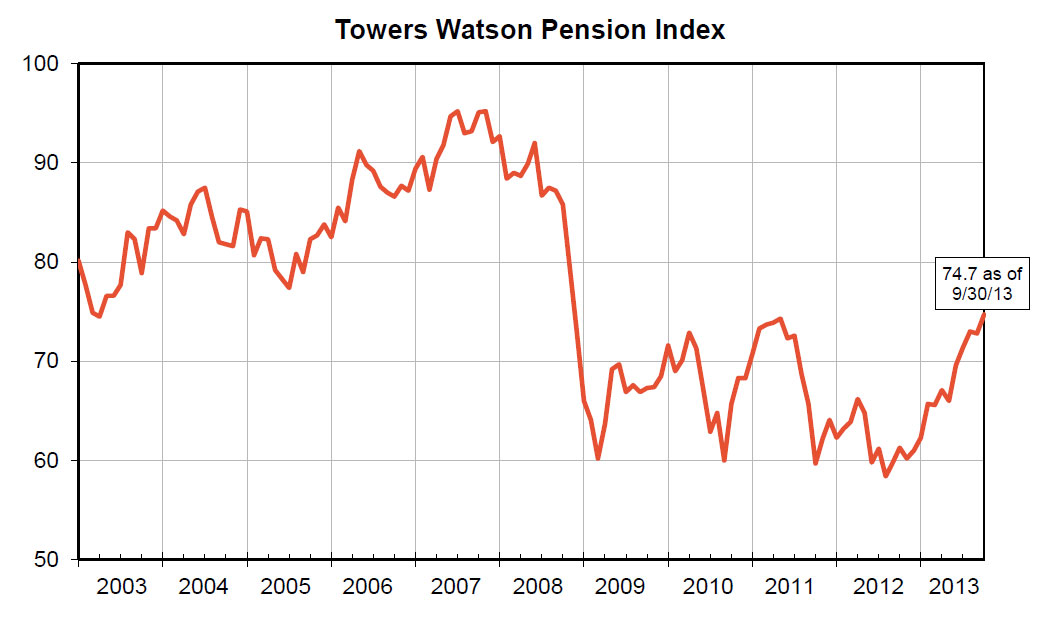
Towers Perrin reports:

A strong equity market drove September financial results. The benchmark asset portfolio earned almost 3% for the month, driving the Towers Watson Pension Index up 2.6% to 74.7. With this increase the index is now up almost 20% for the year.


Click for Big

It was a slightly positive day for the Canadian preferred share market, with PerpetualDiscounts gaining 6bp, FixedResets up 7bp and DeemedRetractibles flat. The Performance Highlights Table is surprisingly lengthy considering the modest overall changes and is dominated by winners. Volume was above average; block trading data is not available.

HIMIPref™ Preferred Indices
These values reflect the December 2008 revision of the HIMIPref™ Indices

Values are provisional and are finalized monthly
Index Mean
Current
Yield
(at bid)
Median
YTW
Median
Average
Trading
Value
Median
Mod Dur
(YTW)
Issues Day’s Perf. Index Value
Ratchet 0.00 % 0.00 % 0 0.00 0 0.5804 % 2,454.7
FixedFloater 4.29 % 3.56 % 27,926 18.30 1 0.2715 % 3,915.4
Floater 2.75 % 3.00 % 63,507 19.73 5 0.5804 % 2,650.4
OpRet 4.62 % 2.33 % 65,123 0.44 3 0.0642 % 2,643.2
SplitShare 4.77 % 5.25 % 63,297 3.98 6 -0.0718 % 2,942.3
Interest-Bearing 0.00 % 0.00 % 0 0.00 0 0.0642 % 2,417.0
Perpetual-Premium 5.82 % 4.96 % 108,543 0.08 7 -0.0797 % 2,283.3
Perpetual-Discount 5.55 % 5.59 % 166,612 14.37 30 0.0623 % 2,345.3
FixedReset 4.97 % 3.70 % 232,582 3.57 85 0.0695 % 2,442.2
Deemed-Retractible 5.14 % 4.44 % 188,641 6.84 43 0.0000 % 2,379.0
Performance Highlights
Issue Index Change Notes
ENB.PR.P FixedReset -1.62 % YTW SCENARIO
Maturity Type : Limit Maturity
Maturity Date : 2043-10-21
Maturity Price : 22.33
Evaluated at bid price : 23.12
Bid-YTW : 4.61 %
CIU.PR.C FixedReset -1.34 % YTW SCENARIO
Maturity Type : Limit Maturity
Maturity Date : 2043-10-21
Maturity Price : 19.10
Evaluated at bid price : 19.10
Bid-YTW : 4.37 %
ENB.PR.Y FixedReset 1.10 % YTW SCENARIO
Maturity Type : Limit Maturity
Maturity Date : 2043-10-21
Maturity Price : 22.27
Evaluated at bid price : 23.05
Bid-YTW : 4.52 %
BAM.PR.C Floater 1.15 % YTW SCENARIO
Maturity Type : Limit Maturity
Maturity Date : 2043-10-21
Maturity Price : 17.55
Evaluated at bid price : 17.55
Bid-YTW : 3.01 %
ENB.PR.N FixedReset 1.16 % YTW SCENARIO
Maturity Type : Limit Maturity
Maturity Date : 2043-10-21
Maturity Price : 22.92
Evaluated at bid price : 24.35
Bid-YTW : 4.45 %
BMO.PR.Q FixedReset 1.19 % YTW SCENARIO
Maturity Type : Hard Maturity
Maturity Date : 2022-01-31
Maturity Price : 25.00
Evaluated at bid price : 24.58
Bid-YTW : 3.67 %
BAM.PR.M Perpetual-Discount 1.27 % YTW SCENARIO
Maturity Type : Limit Maturity
Maturity Date : 2043-10-21
Maturity Price : 19.95
Evaluated at bid price : 19.95
Bid-YTW : 6.02 %
BAM.PF.C Perpetual-Discount 1.27 % YTW SCENARIO
Maturity Type : Limit Maturity
Maturity Date : 2043-10-21
Maturity Price : 19.92
Evaluated at bid price : 19.92
Bid-YTW : 6.16 %
BNS.PR.Y FixedReset 1.46 % YTW SCENARIO
Maturity Type : Hard Maturity
Maturity Date : 2022-01-31
Maturity Price : 25.00
Evaluated at bid price : 23.69
Bid-YTW : 3.79 %
TRP.PR.C FixedReset 1.59 % YTW SCENARIO
Maturity Type : Limit Maturity
Maturity Date : 2043-10-21
Maturity Price : 22.09
Evaluated at bid price : 22.36
Bid-YTW : 3.91 %
IFC.PR.A FixedReset 1.62 % YTW SCENARIO
Maturity Type : Hard Maturity
Maturity Date : 2025-01-31
Maturity Price : 25.00
Evaluated at bid price : 24.49
Bid-YTW : 4.12 %
Volume Highlights
Issue Index Shares
Traded
Notes
CIU.PR.B FixedReset 169,394 YTW SCENARIO
Maturity Type : Call
Maturity Date : 2014-06-01
Maturity Price : 25.00
Evaluated at bid price : 25.71
Bid-YTW : 3.56 %
TD.PR.S FixedReset 157,774 YTW SCENARIO
Maturity Type : Hard Maturity
Maturity Date : 2022-01-31
Maturity Price : 25.00
Evaluated at bid price : 24.52
Bid-YTW : 3.67 %
BMO.PR.M FixedReset 69,493 YTW SCENARIO
Maturity Type : Hard Maturity
Maturity Date : 2022-01-31
Maturity Price : 25.00
Evaluated at bid price : 24.62
Bid-YTW : 3.74 %
BNS.PR.P FixedReset 64,837 YTW SCENARIO
Maturity Type : Call
Maturity Date : 2018-04-25
Maturity Price : 25.00
Evaluated at bid price : 24.64
Bid-YTW : 3.69 %
CU.PR.C FixedReset 46,756 YTW SCENARIO
Maturity Type : Call
Maturity Date : 2017-06-01
Maturity Price : 25.00
Evaluated at bid price : 25.32
Bid-YTW : 3.80 %
BMO.PR.R FixedReset 33,910 YTW SCENARIO
Maturity Type : Call
Maturity Date : 2018-08-25
Maturity Price : 25.00
Evaluated at bid price : 25.11
Bid-YTW : 2.49 %
There were 42 other index-included issues trading in excess of 10,000 shares.
Wide Spread Highlights
Issue Index Quote Data and Yield Notes
TRI.PR.B Floater Quote: 19.80 – 20.23
Spot Rate : 0.4300
Average : 0.3135

YTW SCENARIO
Maturity Type : Limit Maturity
Maturity Date : 2043-10-21
Maturity Price : 19.80
Evaluated at bid price : 19.80
Bid-YTW : 2.66 %

TD.PR.R Deemed-Retractible Quote: 26.06 – 26.33
Spot Rate : 0.2700
Average : 0.1539

YTW SCENARIO
Maturity Type : Call
Maturity Date : 2013-11-20
Maturity Price : 26.00
Evaluated at bid price : 26.06
Bid-YTW : 0.78 %

IAG.PR.G FixedReset Quote: 25.55 – 25.90
Spot Rate : 0.3500
Average : 0.2363

YTW SCENARIO
Maturity Type : Call
Maturity Date : 2017-06-30
Maturity Price : 25.00
Evaluated at bid price : 25.55
Bid-YTW : 3.75 %

MFC.PR.K FixedReset Quote: 23.45 – 23.90
Spot Rate : 0.4500
Average : 0.3517

YTW SCENARIO
Maturity Type : Hard Maturity
Maturity Date : 2025-01-31
Maturity Price : 25.00
Evaluated at bid price : 23.45
Bid-YTW : 4.72 %

CU.PR.F Perpetual-Discount Quote: 21.26 – 21.59
Spot Rate : 0.3300
Average : 0.2363

YTW SCENARIO
Maturity Type : Limit Maturity
Maturity Date : 2043-10-21
Maturity Price : 21.26
Evaluated at bid price : 21.26
Bid-YTW : 5.38 %

ENB.PR.F FixedReset Quote: 23.37 – 23.70
Spot Rate : 0.3300
Average : 0.2374

YTW SCENARIO
Maturity Type : Limit Maturity
Maturity Date : 2043-10-21
Maturity Price : 22.50
Evaluated at bid price : 23.37
Bid-YTW : 4.57 %

Issue Comments

VSN.PR.C Soft On Good Volume

Veresen Inc. has announced:

that it has closed its previously announced bought deal offering of 6,000,000 Cumulative Redeemable Preferred Shares, Series C (the “Series Preferred Shares”) at a price of $25.00 per share representing aggregate gross proceeds of $150,000,000 (the “Offering”).

The Offering was first announced by Veresen on October 9, 2013 when Veresen entered into an agreement with a syndicate of underwriters co-lead by Scotiabank, TD Securities Inc. and CIBC.

Proceeds from the Offering will be used to reduce indebtedness and for general corporate purposes.

The Series C Preferred Shares have been rated Pfd-3 (High) by DBRS Limited and P-3 (High) by Standard & Poor’s, a division of The McGraw Hill Companies, Inc.

The Series C Preferred Shares will begin trading on the Toronto Stock Exchange today under the symbol “VSN.PR.C”.

VSN.PR.C is a FixedReset, 5.00%+301 announced October 9. It has been rated Pfd-3(high) [Stable] by DBRS; it will be tracked by HIMIPref™ but relegated to the Scraps index on credit concerns.

The issue traded 259,016 shares today in a range of 24.60-88 before closing at 24.70-82, 4×48.

Vital statistics are:

VSN.PR.C FixedReset YTW SCENARIO
Maturity Type : Limit Maturity
Maturity Date : 2043-10-21
Maturity Price : 23.03
Evaluated at bid price : 24.70
Bid-YTW : 4.89 %
Market Action

October 18, 2013

The New York Times touts an online personal finance video series:

After all, there are few entirely conflict-free places where investors can educate themselves on the topic, and there’s little to no money-related guidance offered within the public school system, which is where the financial groundwork should really be laid.

Joshua Rauh, a finance professor at the Stanford Graduate School of Business, is acutely aware of that. And it’s why he felt compelled to open his graduate-level course on the finance of retirement and pensions to the masses. “My goal is to try to empower people to make better decisions about their finances with an eye toward retirement and for retirees who are thinking about managing their money,” Professor Rauh said, “whether it is buying an annuity or having a spending rule.”

The course, which is offered free online, begins on Monday. I sat for nearly half of his online video lectures — on topics like “saving for retirement” and “making smart decisions as a stock market investor” — earlier this week. Watching remotely means you won’t be party to the discussion that will emerge from the Socratic method Professor Rauh uses in his traditional classroom on campus. And there are already 13,000 students, so it’s hard to expect any personal attention.

DBRS confirmed Advantaged Preferred Share Trust at STA-2 (middle):

Since October 2012, the performance of the Portfolio has been fairly stable. The weighted-average yield of the Portfolio is approximately 5.18%, as of September 30, 2013. The Trust’s current net income (including a regular additional payment under the forward agreement to offset operating expenses) covers the full distribution paid out to Unitholders. As a result, the rating of STA-2 (middle) on the Units has been confirmed. The main constraints to the rating are the interest rate risk of the Portfolio and the potential for capital losses and reductions in income resulting from underlying securities being called for redemption by their respective issuers.

DBRS confirmed TDS.PR.C at Pfd-2:

On October 18, 2012, DBRS upgraded the ratings on the Class C Preferred Shares to Pfd-2 from Pfd-2 (low), due to a steady increase in downside protection in the months leading up to the rating action, as well as a greatly improved dividend coverage ratio. Since then, performance has been generally positive, with the net asset value (NAV) of the Company fluctuating around $30.00 before increasing to $33.51 as of October 10, 2013. Downside protection available to holders of the Class C Preferred Shares increased to 70.2% as of October 2013, compared with 66.1% in October 2012. As a result, the rating of the Class C Preferred Shares has been confirmed at Pfd-2.

It was a mixed day for the Canadian preferred share market, with PerpetualDiscounts gaining 6bp, FixedResets off 7bp and DeemedRetractibles up 8bp. A surprisingly lengthy performance highlights table was dominated by FixedResets, both winners and losers. Volume was enormous.

HIMIPref™ Preferred Indices
These values reflect the December 2008 revision of the HIMIPref™ Indices

Values are provisional and are finalized monthly
Index Mean
Current
Yield
(at bid)
Median
YTW
Median
Average
Trading
Value
Median
Mod Dur
(YTW)
Issues Day’s Perf. Index Value
Ratchet 0.00 % 0.00 % 0 0.00 0 -0.3470 % 2,440.5
FixedFloater 4.30 % 3.57 % 28,862 18.28 1 0.0000 % 3,904.8
Floater 2.77 % 3.02 % 64,031 19.68 5 -0.3470 % 2,635.1
OpRet 4.62 % 2.72 % 64,291 0.60 3 0.0257 % 2,641.5
SplitShare 4.77 % 5.23 % 63,249 3.99 6 0.2071 % 2,944.4
Interest-Bearing 0.00 % 0.00 % 0 0.00 0 0.0257 % 2,415.4
Perpetual-Premium 5.82 % -0.07 % 108,543 0.08 7 0.2167 % 2,285.1
Perpetual-Discount 5.56 % 5.57 % 168,410 14.47 30 0.0624 % 2,343.8
FixedReset 4.98 % 3.78 % 235,758 3.40 85 -0.0656 % 2,440.5
Deemed-Retractible 5.14 % 4.40 % 187,794 6.85 43 0.0822 % 2,379.0
Performance Highlights
Issue Index Change Notes
ENB.PR.D FixedReset -1.82 % YTW SCENARIO
Maturity Type : Limit Maturity
Maturity Date : 2043-10-18
Maturity Price : 22.44
Evaluated at bid price : 23.22
Bid-YTW : 4.53 %
BNS.PR.Y FixedReset -1.35 % YTW SCENARIO
Maturity Type : Hard Maturity
Maturity Date : 2022-01-31
Maturity Price : 25.00
Evaluated at bid price : 23.35
Bid-YTW : 4.02 %
TRP.PR.A FixedReset -1.26 % YTW SCENARIO
Maturity Type : Limit Maturity
Maturity Date : 2043-10-18
Maturity Price : 22.97
Evaluated at bid price : 23.47
Bid-YTW : 4.11 %
BAM.PR.K Floater -1.25 % YTW SCENARIO
Maturity Type : Limit Maturity
Maturity Date : 2043-10-18
Maturity Price : 17.33
Evaluated at bid price : 17.33
Bid-YTW : 3.05 %
BAM.PR.B Floater -1.24 % YTW SCENARIO
Maturity Type : Limit Maturity
Maturity Date : 2043-10-18
Maturity Price : 17.48
Evaluated at bid price : 17.48
Bid-YTW : 3.02 %
MFC.PR.F FixedReset -1.21 % YTW SCENARIO
Maturity Type : Hard Maturity
Maturity Date : 2025-01-31
Maturity Price : 25.00
Evaluated at bid price : 22.02
Bid-YTW : 5.00 %
HSB.PR.D Deemed-Retractible 1.00 % YTW SCENARIO
Maturity Type : Call
Maturity Date : 2014-12-31
Maturity Price : 25.00
Evaluated at bid price : 25.25
Bid-YTW : 4.38 %
PWF.PR.A Floater 1.02 % YTW SCENARIO
Maturity Type : Limit Maturity
Maturity Date : 2043-10-18
Maturity Price : 22.50
Evaluated at bid price : 22.76
Bid-YTW : 2.30 %
IFC.PR.C FixedReset 1.02 % YTW SCENARIO
Maturity Type : Call
Maturity Date : 2016-09-30
Maturity Price : 25.00
Evaluated at bid price : 25.71
Bid-YTW : 3.28 %
SLF.PR.G FixedReset 1.09 % YTW SCENARIO
Maturity Type : Hard Maturity
Maturity Date : 2025-01-31
Maturity Price : 25.00
Evaluated at bid price : 23.15
Bid-YTW : 4.35 %
FTS.PR.H FixedReset 1.29 % YTW SCENARIO
Maturity Type : Limit Maturity
Maturity Date : 2043-10-18
Maturity Price : 21.20
Evaluated at bid price : 21.20
Bid-YTW : 4.08 %
CU.PR.C FixedReset 1.39 % YTW SCENARIO
Maturity Type : Call
Maturity Date : 2017-06-01
Maturity Price : 25.00
Evaluated at bid price : 25.48
Bid-YTW : 3.60 %
BAM.PR.X FixedReset 1.67 % YTW SCENARIO
Maturity Type : Limit Maturity
Maturity Date : 2043-10-18
Maturity Price : 21.67
Evaluated at bid price : 21.96
Bid-YTW : 4.42 %
Volume Highlights
Issue Index Shares
Traded
Notes
CIU.PR.B FixedReset 193,575 Deleted from TXPR.
YTW SCENARIO
Maturity Type : Call
Maturity Date : 2014-06-01
Maturity Price : 25.00
Evaluated at bid price : 25.71
Bid-YTW : 3.52 %
TD.PR.S FixedReset 168,183 I assume the index weight changed, due to partial conversion to TD.PR.T, which has been added to TXPR.
YTW SCENARIO
Maturity Type : Hard Maturity
Maturity Date : 2022-01-31
Maturity Price : 25.00
Evaluated at bid price : 24.52
Bid-YTW : 3.69 %
W.PR.H Perpetual-Discount 166,758 Added to TXPR.
YTW SCENARIO
Maturity Type : Limit Maturity
Maturity Date : 2043-10-18
Maturity Price : 24.19
Evaluated at bid price : 24.45
Bid-YTW : 5.65 %
BMO.PR.R FixedReset 147,381 Added to TXPR.
YTW SCENARIO
Maturity Type : Call
Maturity Date : 2018-08-25
Maturity Price : 25.00
Evaluated at bid price : 25.10
Bid-YTW : 2.48 %
FTS.PR.K FixedReset 130,701 Added to TXPR.
YTW SCENARIO
Maturity Type : Limit Maturity
Maturity Date : 2043-10-18
Maturity Price : 22.99
Evaluated at bid price : 24.58
Bid-YTW : 3.96 %
PWF.PR.L Perpetual-Discount 124,494 National sold 10,000 to TD at 22.70, then crossed 12,300 at 22.65. Anonymous crossed 10,000 at 22.66, then sold 45,000 to Desjardins at the same price and 15,000 to National at the same price again.
YTW SCENARIO
Maturity Type : Limit Maturity
Maturity Date : 2043-10-18
Maturity Price : 22.37
Evaluated at bid price : 22.66
Bid-YTW : 5.64 %
BMO.PR.M FixedReset 122,454 TD crossed blocks of 44,800 and 20,000 at 24.58. Nesbitt crossed 50,000 at 24.57.
YTW SCENARIO
Maturity Type : Hard Maturity
Maturity Date : 2022-01-31
Maturity Price : 25.00
Evaluated at bid price : 24.57
Bid-YTW : 3.78 %
CM.PR.M FixedReset 101,430 RBC crossed two blocks of 50,000 each, both at 25.82.
YTW SCENARIO
Maturity Type : Call
Maturity Date : 2014-07-31
Maturity Price : 25.00
Evaluated at bid price : 25.70
Bid-YTW : 2.63 %
There were 77 other index-included issues trading in excess of 10,000 shares.
Wide Spread Highlights
Issue Index Quote Data and Yield Notes
ENB.PR.Y FixedReset Quote: 22.80 – 23.14
Spot Rate : 0.3400
Average : 0.1960

YTW SCENARIO
Maturity Type : Limit Maturity
Maturity Date : 2043-10-18
Maturity Price : 22.13
Evaluated at bid price : 22.80
Bid-YTW : 4.61 %

BAM.PR.C Floater Quote: 17.35 – 17.75
Spot Rate : 0.4000
Average : 0.2707

YTW SCENARIO
Maturity Type : Limit Maturity
Maturity Date : 2043-10-18
Maturity Price : 17.35
Evaluated at bid price : 17.35
Bid-YTW : 3.04 %

BNA.PR.C SplitShare Quote: 24.16 – 24.46
Spot Rate : 0.3000
Average : 0.1902

YTW SCENARIO
Maturity Type : Hard Maturity
Maturity Date : 2019-01-10
Maturity Price : 25.00
Evaluated at bid price : 24.16
Bid-YTW : 5.23 %

BNS.PR.Y FixedReset Quote: 23.35 – 23.62
Spot Rate : 0.2700
Average : 0.1673

YTW SCENARIO
Maturity Type : Hard Maturity
Maturity Date : 2022-01-31
Maturity Price : 25.00
Evaluated at bid price : 23.35
Bid-YTW : 4.02 %

CU.PR.G Perpetual-Discount Quote: 21.10 – 21.49
Spot Rate : 0.3900
Average : 0.2927

YTW SCENARIO
Maturity Type : Limit Maturity
Maturity Date : 2043-10-18
Maturity Price : 21.10
Evaluated at bid price : 21.10
Bid-YTW : 5.41 %

CGI.PR.D SplitShare Quote: 23.80 – 24.07
Spot Rate : 0.2700
Average : 0.1899

YTW SCENARIO
Maturity Type : Soft Maturity
Maturity Date : 2023-06-14
Maturity Price : 25.00
Evaluated at bid price : 23.80
Bid-YTW : 4.43 %

Market Action

October 17, 2013

It appears that some people are ecstatic that Armageddon has been delayed by three months:

U.S. stocks rose, sending the Standard & Poor’s 500 Index to a record, as speculation grew that the Federal Reserve will maintain the pace of stimulus after Congress ended the budget standoff.

The S&P 500 rose 0.7 percent to 1,733.15 at 4 p.m. in New York, surpassing the previous record of 1,725.52 from Sept. 18. The Dow Jones Industrial Average fell 2.18 points to 15,371.65, held down by IBM and Goldman Sachs. About 6.6 billion shares changed hands on U.S. exchanges, 12 percent above the three-month average.

“The taper seems a little bit further out, certainly than anybody expected eight weeks ago and maybe even just a couple of weeks ago,” Walter Todd, chief investment officer at Greenwood Capital Inc., said in a phone interview from Greenwood, South Carolina. He helps manage $950 million. “It keeps a lid on rates and provides more liquidity for risk assets like stocks. People are back to focusing on the individual company dynamics that occur during earnings season.”

The S&P 500 gained 2.4 percent during the 16-day government closure that ended yesterday after President Barack Obama signed a bill to fund the government through Jan. 15 and extend the borrowing authority through Feb. 7.

My favourite Fed President, Richard Fisher, has some interesting views on US housing:

A top Federal Reserve official said on Thursday he is seeing fresh signs of a U.S. “housing bubble” and warned about the central bank’s ongoing purchases of mortgage-based bonds.

“I’m beginning to see signs not just in my district but across the country that we are entering, once again, a housing bubble,” Dallas Fed President Richard Fisher told reporters after a speech in New York. “So that leads me … to be very cautious about our mortgage-backed securities purchase program.”

Fisher, a vocal hawk on monetary policy, repeated he would not support a reduction in the quantitative easing (QE) program at a Fed meeting later this month in large part because of the fiscal “mess” in Washington.

But citing rising year-on-year house prices in Texas cities, and elsewhere in the country, he warned that the central bank’s hyper-accommodative policies could be inflating dangerous asset price bubbles.

It was a fine day for the Canadian preferred share market, with PerpetualDiscounts winning 42bp, FixedResets gaining 5bp and DeemedRetractibles up 20bp. The Performance Highlights table is heavily skewed towards the two better classes. Volume was high, with the Volume Highlights table comprised entirely of FixedResets.

HIMIPref™ Preferred Indices
These values reflect the December 2008 revision of the HIMIPref™ Indices

Values are provisional and are finalized monthly
Index Mean
Current
Yield
(at bid)
Median
YTW
Median
Average
Trading
Value
Median
Mod Dur
(YTW)
Issues Day’s Perf. Index Value
Ratchet 0.00 % 0.00 % 0 0.00 0 0.1896 % 2,449.0
FixedFloater 4.30 % 3.57 % 27,863 18.29 1 0.4089 % 3,904.8
Floater 2.76 % 2.98 % 64,182 19.78 5 0.1896 % 2,644.3
OpRet 4.62 % 2.59 % 65,012 0.61 3 -0.0642 % 2,640.8
SplitShare 4.78 % 5.28 % 61,734 3.99 6 -0.3308 % 2,938.3
Interest-Bearing 0.00 % 0.00 % 0 0.00 0 -0.0642 % 2,414.8
Perpetual-Premium 5.83 % 4.16 % 108,489 0.08 7 -0.0228 % 2,280.2
Perpetual-Discount 5.56 % 5.59 % 158,504 14.46 30 0.4166 % 2,342.4
FixedReset 4.97 % 3.79 % 233,547 3.41 85 0.0460 % 2,442.1
Deemed-Retractible 5.14 % 4.45 % 190,418 6.85 43 0.1963 % 2,377.0
Performance Highlights
Issue Index Change Notes
IAG.PR.E Deemed-Retractible -1.05 % YTW SCENARIO
Maturity Type : Hard Maturity
Maturity Date : 2025-01-31
Maturity Price : 25.00
Evaluated at bid price : 25.37
Bid-YTW : 5.90 %
FTS.PR.J Perpetual-Discount 1.07 % YTW SCENARIO
Maturity Type : Limit Maturity
Maturity Date : 2043-10-17
Maturity Price : 22.33
Evaluated at bid price : 22.65
Bid-YTW : 5.30 %
CIU.PR.C FixedReset 1.09 % YTW SCENARIO
Maturity Type : Limit Maturity
Maturity Date : 2043-10-17
Maturity Price : 19.55
Evaluated at bid price : 19.55
Bid-YTW : 4.31 %
SLF.PR.G FixedReset 1.10 % YTW SCENARIO
Maturity Type : Hard Maturity
Maturity Date : 2025-01-31
Maturity Price : 25.00
Evaluated at bid price : 22.90
Bid-YTW : 4.47 %
CU.PR.F Perpetual-Discount 1.14 % YTW SCENARIO
Maturity Type : Limit Maturity
Maturity Date : 2043-10-17
Maturity Price : 21.35
Evaluated at bid price : 21.35
Bid-YTW : 5.35 %
TRP.PR.A FixedReset 1.15 % YTW SCENARIO
Maturity Type : Limit Maturity
Maturity Date : 2043-10-17
Maturity Price : 23.27
Evaluated at bid price : 23.77
Bid-YTW : 4.06 %
SLF.PR.B Deemed-Retractible 1.24 % YTW SCENARIO
Maturity Type : Hard Maturity
Maturity Date : 2025-01-31
Maturity Price : 25.00
Evaluated at bid price : 22.05
Bid-YTW : 6.35 %
CIU.PR.A Perpetual-Discount 1.28 % YTW SCENARIO
Maturity Type : Limit Maturity
Maturity Date : 2043-10-17
Maturity Price : 20.65
Evaluated at bid price : 20.65
Bid-YTW : 5.66 %
SLF.PR.A Deemed-Retractible 1.30 % YTW SCENARIO
Maturity Type : Hard Maturity
Maturity Date : 2025-01-31
Maturity Price : 25.00
Evaluated at bid price : 21.85
Bid-YTW : 6.40 %
BAM.PF.D Perpetual-Discount 1.30 % YTW SCENARIO
Maturity Type : Limit Maturity
Maturity Date : 2043-10-17
Maturity Price : 20.26
Evaluated at bid price : 20.26
Bid-YTW : 6.11 %
BAM.PR.N Perpetual-Discount 1.69 % YTW SCENARIO
Maturity Type : Limit Maturity
Maturity Date : 2043-10-17
Maturity Price : 19.80
Evaluated at bid price : 19.80
Bid-YTW : 6.06 %
Volume Highlights
Issue Index Shares
Traded
Notes
TRP.PR.D FixedReset 107,851 Scotia crossed 100,000 at 24.87.
YTW SCENARIO
Maturity Type : Limit Maturity
Maturity Date : 2043-10-17
Maturity Price : 23.03
Evaluated at bid price : 24.71
Bid-YTW : 4.14 %
TD.PR.S FixedReset 106,062 Scotia crossed 37,300 at 24.50; Nesbitt crossed 63,800 at 24.50.
YTW SCENARIO
Maturity Type : Hard Maturity
Maturity Date : 2022-01-31
Maturity Price : 25.00
Evaluated at bid price : 24.47
Bid-YTW : 3.71 %
BMO.PR.M FixedReset 93,020 Nesbitt crossed blocks of 25,000 and 50,000, both at 24.58. According to TMXMoney, anyway. The Financial Post report is difficult to make out.
YTW SCENARIO
Maturity Type : Hard Maturity
Maturity Date : 2022-01-31
Maturity Price : 25.00
Evaluated at bid price : 24.55
Bid-YTW : 3.79 %
MFC.PR.J FixedReset 73,976 Scotia crossed 70,500 at 25.17.
YTW SCENARIO
Maturity Type : Call
Maturity Date : 2018-03-19
Maturity Price : 25.00
Evaluated at bid price : 25.03
Bid-YTW : 4.07 %
IAG.PR.G FixedReset 63,749 Scotia crossed 56,500 at 25.60.
YTW SCENARIO
Maturity Type : Call
Maturity Date : 2017-06-30
Maturity Price : 25.00
Evaluated at bid price : 25.51
Bid-YTW : 3.79 %
BAM.PF.A FixedReset 63,545 Scotia crossed 50,000 at 24.33.
YTW SCENARIO
Maturity Type : Limit Maturity
Maturity Date : 2043-10-17
Maturity Price : 22.89
Evaluated at bid price : 24.25
Bid-YTW : 4.82 %
There were 48 other index-included issues trading in excess of 10,000 shares.
Wide Spread Highlights
Issue Index Quote Data and Yield Notes
BNA.PR.E SplitShare Quote: 24.47 – 24.87
Spot Rate : 0.4000
Average : 0.2807

YTW SCENARIO
Maturity Type : Hard Maturity
Maturity Date : 2017-12-10
Maturity Price : 25.00
Evaluated at bid price : 24.47
Bid-YTW : 5.61 %

GCS.PR.A SplitShare Quote: 24.73 – 25.00
Spot Rate : 0.2700
Average : 0.1632

YTW SCENARIO
Maturity Type : Hard Maturity
Maturity Date : 2019-07-31
Maturity Price : 25.00
Evaluated at bid price : 24.73
Bid-YTW : 4.24 %

MFC.PR.K FixedReset Quote: 23.45 – 23.85
Spot Rate : 0.4000
Average : 0.3032

YTW SCENARIO
Maturity Type : Hard Maturity
Maturity Date : 2025-01-31
Maturity Price : 25.00
Evaluated at bid price : 23.45
Bid-YTW : 4.73 %

BAM.PR.M Perpetual-Discount Quote: 19.65 – 19.92
Spot Rate : 0.2700
Average : 0.1842

YTW SCENARIO
Maturity Type : Limit Maturity
Maturity Date : 2043-10-17
Maturity Price : 19.65
Evaluated at bid price : 19.65
Bid-YTW : 6.11 %

TRP.PR.C FixedReset Quote: 22.01 – 22.34
Spot Rate : 0.3300
Average : 0.2478

YTW SCENARIO
Maturity Type : Limit Maturity
Maturity Date : 2043-10-17
Maturity Price : 21.60
Evaluated at bid price : 22.01
Bid-YTW : 4.00 %

W.PR.J Perpetual-Discount Quote: 24.71 – 24.98
Spot Rate : 0.2700
Average : 0.1894

YTW SCENARIO
Maturity Type : Limit Maturity
Maturity Date : 2043-10-17
Maturity Price : 24.47
Evaluated at bid price : 24.71
Bid-YTW : 5.70 %

Issue Comments

GWO Seeks "Greater Flexibility To Manage Its Capital Structure"

Great-West Lifeco has announced:

that it will seek the consent of the holders of its 6.67% Debentures due March 21, 2033 (the “2033 Debentures”) to amend the trust indenture dated as of March 21, 2003, between Great-West Lifeco and Computershare Trust Company of Canada, as trustee, as amended and supplemented. The consent will eliminate the replacement capital covenants and related provisions applicable to certain of Great-West Lifeco’s preferred shares, the 5.691% Subordinated Debentures due June 21, 2067 issued by Great-West Lifeco Finance (Delaware) LP and the 7.127% Subordinated Debentures due June 26, 2068 issued by Great-West Lifeco Finance (Delaware) LP II.

Great-West Lifeco is seeking to remove the replacement capital covenants in order to have greater flexibility to manage its capital structure. Removal of the replacement capital covenants would provide Great-West Lifeco with the ability to be responsive to credit rating agency considerations and emerging regulatory capital developments. The proposed changes do not imply that Great-West Lifeco intends to take any future action with respect to the redemption of any of the securities currently subject to the replacement capital covenants.

Great-West Lifeco will solicit consents from holders of record of the 2033 Debentures as of 5:00 p.m., Toronto time, on October 11, 2013. The proposed amendments require the consent of holders of not less than 66 2/3% of the outstanding principal amount of the 2033 Debentures. The terms and conditions of the consent solicitation will be included in the consent solicitation statement and the accompanying form of consent.

Certain information regarding the 2033 Debentures and the terms of the offer and the consent solicitation is summarized in the table below:

Debentures CUSIP No. Principal Amount Outstanding Consent Fee (per $1,000
principal amount)
6.67% Debentures due March 21, 2033 39138CAD8 $400,000,000 $12.50

Great-West Lifeco will pay a consent fee of $12.50 in cash for each $1,000 in principal amount of 2033 Debentures for which Great-West Lifeco has received a valid (and unrevoked) consent prior to the expiration of the solicitation, subject to the conditions of the solicitation. Assuming receipt of the requisite 66 2/3% consent, payments of the consent fee are anticipated to be made to holders of the 2033 Debentures that provide valid (and unrevoked) consents on the third business day following the expiration of the solicitation. If the proposed amendments are approved, the amendments will bind all holders of the 2033 Debentures, including those that did not provide a consent.

The solicitation will expire at 5:00 p.m. (Toronto time) on October 30, 2013, unless extended by Great-West Lifeco at its discretion (such time on such date, as the same may be extended, the “Expiration Date”).

Great-West Lifeco will make an announcement by press release of any extension of the Expiration Date prior to 9:00 a.m. (Toronto time), on the next business day after the previously scheduled Expiration Date. Holders may deliver their consents with respect to the solicitation at any time prior to the Expiration Date. Holders may revoke their consents until the earlier of the Expiration Date and the date that the proposed amendment to the trust indenture is executed and becomes effective. Any holder who validly revokes a consent will not be eligible to receive the consent fee, unless such consent is redelivered and accepted by Great-West Lifeco prior to the Expiration Date.

Great-West Lifeco has retained RBC Dominion Securities Inc. to serve as the solicitation agent for the solicitation, Georgeson Shareholder Communications Canada Inc. to serve as the information agent and Computershare Trust Company of Canada to serve as the tabulation agent. Questions regarding the solicitation may be directed to RBC Dominion Securities Inc. at (416) 842-6311.

This is rather interesting – a vote to change a bond indenture doesn’t come up very often and the consent fee – of over a dollar a bond – is quite attractive.

According to the Consent Solicitation Statement:

The principal effect of the replacement capital covenant is to require that a specified portion of any funds used to repurchase, redeem or repay the Preferred Stock, GWL-LP Subordinated Debentures and GWL-LP II Subordinated Debentures must be obtained by the Corporation through the issuance of common shares or other equity or equity-like securities, in each case within a specified time period prior to the applicable repurchase, redemption or repayment.

The replacement capital covenants were provided by the Corporation voluntarily. For that reason, consent of the Holders of the 2033 Debentures was not required under the Indenture. The replacement capital covenants afforded Great-West Lifeco enhanced credit rating agency capital treatment. Subsequent changes to credit rating methodology means this benefit is no longer available to Great-West Lifeco. Accordingly, Great-West Lifeco is seeking to remove the replacement capital covenants in order to have greater flexibility to manage its capital structure without being subject to the restrictions and constraints of the replacement capital covenants.

So why don’t they just redeem these sub-debs, with their enormous (by current standards) coupon? A look at the prospectus (available on SEDAR, dated March 14, 2003; I am not allowed to link to this prospectus due to the bank-owned CDS’ abuse of the monopoly granted to it by the regulators) reveals:

The Corporation may, at its option, redeem Debentures on not less than 30 nor more than 60 days’ prior notice to the registered holder, in whole at any time or in part from time to time, at a redemption price equal to the greater of the Canada Yield Price and par, together in each case with accrued and unpaid interest to the date fixed for redemption. In cases of partial redemption of Debentures issued under a Trust Indenture, the Debentures to be redeemed will be selected by the Trustee pro rata or in such manner as it shall deem equitable. Any Debentures that are redeemed by the Corporation will be cancelled and will not be reissued.

‘‘Canada Yield Price’’, shall mean a price which, if the Debentures were to be issued at such price on the redemption date, would provide a yield thereon from the redemption date to March 21, 2018 in the case of 2018 Debentures and March 21, 2033 in the case of 2033 Debentures, equal to the Government of Canada Yield, plus 24 basis points for the 2018 Debentures and 30 basis points for the 2033 Debentures, compounded semi-annually and calculated on the day that is three business days prior to the date of redemption.

So say that 20-year Canadas are now at 3.00% (approximately) then the Canada Yield is 3.30% and the Canada Price is around $148 per $100 bond – a pretty fat premium and illustrative of just how wonderful Canada Calls are, as opposed to regular calls. Paying a premium of $1.25 (plus expenses) to change the indenture is a lot cheaper.

But just why they are doing this is a little mysterious. Given that 400-million par value of these things is outstanding, GWO is prepared to spend $5-million (plus expenses of … what? half a million?) to get this flexibility. While this is hardly crippling to a company the size of GWO, it’s not pocket change either. While they say The proposed changes do not imply that Great-West Lifeco intends to take any future action with respect to the redemption of any of the securities currently subject to the replacement capital covenants that’s a little bit of a fuzzy statement, if you look at it carefully … and besides, a contingency plan with a 99.999% chance of being executed is still only a contingency.

They have a few Straight Perpetuals with fat coupons outstanding, led by GWO.PR.F at 5.9% which is currently callable at par. Of more immediate interest is GWO.PR.J, a FixedReset, 6.00%+307, which has its first Exchange Date on 2013-12-31. This certainly looks like it should be called on economic grounds, but they may not wish to issue new securities to replace the capital; and it may be worth $5.5-million to them to avoid the necessity. In addition:

The Canada Life Assurance Company has one subordinated debenture outstanding with a face amount of $100 million. Great-West Lifeco Finance (Delaware) LP has one subordinated debenture outstanding with a face amount of $1 billion. Great-West Lifeco Finance (Delaware) LP II has one subordinated debenture outstanding with a face amount of $500 million. Great-West Life & Annuity Insurance Capital, LP has one subordinated debenture outstanding with a face amount of US$175 million, and Great-West Life & Annuity Insurance Capital, LP II has one subordinated debenture outstanding with a face amount of US$300 million.

From the 2012 Annual Report:

The Company regards the Series F, G, H, I, L, M, P, Q and R preferred shares as part of its core or permanent capital. The Series F, G, H, I, L and M preferred shares have a replacement capital covenant, the Company only intends to redeem these shares with proceeds raised from new capital instruments representing equal or greater benefit than the shares currently outstanding. The Series P, Q and R preferred shares do not have a replacement capital covenant. The Company regards the two series of subordinated debentures totaling $1,500 million issued by two subsidiary companies, Great-West Lifeco Finance (Delaware) LP and LPII, as comprising part of its core or permanent capital. As such the Company only intends to redeem the subordinated debentures prior to maturity with new capital instruments with a similar or more junior ranking security. The terms and conditions of the $1,000 million subordinated debentures due June 21, 2067 bear interest at a rate of 5.691% until 2017 and, thereafter at a rate equal to the Canadian 90-day Bankers’ Acceptance rate plus 1.49%, unsecured. The terms of the $500 million subordinated debentures due June 26, 2068 bear interest at a rate of 7.127% until 2018 and, thereafter, at a rate equal to the Canadian 90-day Bankers’ Acceptance rate plus 3.78%, unsecured.

I consider it rather odd that the Series J preferreds are not regarded as core capital, but this – contrary to my initial expectations – is not a new thing: they are omitted from the list in each of the past four Annual Reports. None of the words “permanent”, “replacement” or “indenture” occurs anywhere in the Series J prospectus, dated Nov 13 2008, but there’s nothing of interest in the Series M prospectus dated February 24, 2010, either, so that doesn’t mean much.

So anyway, I will admit that I am perplexed by this solicitation. The most facile answer is that they want to redeem GWO.PR.F (with its 5.9% coupon) and don’t want to issue replacement capital (or want to have the option to do this), but I wouldn’t place any large bets on that possibility.

Another possibility is that the covenant somehow violates OSFI rules and they have to get rid of it in order to qualify the preferreds, or perhaps even the sub-debs themselves, as quality – or consider that there is a high enough probability of this being a requirement that they want to get it out of the way.

Any opinions on possible motivations for this action will be most welcome!

GWO has the following preferred shares outstanding: GWO.PR.F, GWO.PR.G, GWO.PR.H, GWO.PR.I, GWO.PR.J, GWO.PR.L, GWO.PR.M, GWO.PR.N, GWO.PR.P, GWO.PR.Q and GWO.PR.R.

Update, 2013-11-7: GWO increased the consent fee

Great-West Lifeco Inc. is amending the terms of its consent solicitation of the holders of its 6.67% Debentures due March 21, 2033 (the “2033 Debentures”) to eliminate the replacement capital covenants and related provisions applicable to certain of Great-West Lifeco’s preferred shares, the 5.691% Subordinated Debentures due June 21, 2067 issued by Great-West Lifeco Finance (Delaware) LP and the 7.127% Subordinated Debentures due June 26, 2068 issued by Great-West Lifeco Finance (Delaware) LP II.

The consent solicitation is amended to provide that Great-West Lifeco will pay a consent fee of $17.50 in cash for each $1,000 in principal amount of 2033 Debentures to all holders of 2033 Debentures provided that it has received the requisite consent from 66 2/3% of the holders of the 2033 Debentures. If the proposed amendments are approved, the amendments will bind all holders of the 2033 Debentures, including those that did not provide a consent.

All other terms of the solicitation remain in effect unamended including the expiration of the solicitation at 5:00 p.m. (Toronto time) on Wednesday, October 30, 2013.

… and obtained consent:

Great-West Lifeco Inc. successfully completed its consent solicitation of the holders of its 6.67% Debentures due March 21, 2033 (the “2033 Debentures”). The holders of the 2033 Debentures approved the elimination of the replacement capital covenants and related provisions applicable to certain of Great-West Lifeco’s preferred shares, the 5.691% Subordinated Debentures due June 21, 2067 issued by Great-West Lifeco Finance (Delaware) LP and the 7.127% Subordinated Debentures due June 26, 2068 issued by Great-West Lifeco Finance (Delaware) LP II.