Market Action

November 9, 2012

We’ll probably never know just what the rights of the matters are … but it sure is entertaining!

Weber, who was chief investigator in the inspector general’s office, raised allegations in March that H. David Kotz, the agency’s former inspector general, may have had personal relationships that tainted reports on the SEC’s failure to catch the Bernard Madoff and R. Allen Stanford Ponzi schemes.

Weeks later, a number of Weber’s co-workers submitted complaints that he was creating a hostile work environment through his suggestions that he and others should be able to carry guns on the job. The SEC used an external security consultant to review whether Weber was a threat and then placed him on administrative leave in May.

Weber also reported to the SEC that he found evidence of possible espionage by foreign nationals related to a case he was investigating. The matter involved unencrypted computer hard drives that contained sensitive stock exchange information.

Cary Hansel, Weber’s lawyer, said that Weber received a letter from the SEC last week informing him he had been fired.

So up to now, it looks like the Lone Loony-Toon, right? But:

Weber’s original complaints prompted the SEC to bring in David Williams, the inspector general of the U.S. Postal Service, to conduct a review. Williams concluded that Kotz violated ethics rules by overseeing probes that involved people with whom he has “personal relationships.” Kotz resigned in January amid questions about his tactics and conduct.

Williams also said in his report that he didn’t find any evidence that indicated Weber’s conduct was improper or raised security concerns. Based on the report, Weber asked the SEC to reinstate him.

Humans are complex! When will we realize that an insistence on perfection in every area deprives us of talent? There’s Petraeus:

CIA Director David H. Petraeus, the retired four-star general widely commended for his oversight of the U.S. wars in Iraq and Afghanistan, resigned from his position due to an extramarital affair.

“After being married for over 37 years, I showed extremely poor judgment by engaging in an extramarital affair,” Petraeus wrote in a letter today to Central Intelligence Agency employees. “Such behavior is unacceptable, both as a husband and as the leader of an organization such as ours.”

… and Kubasik:

Christopher E. Kubasik, who was to become the next chief executive officer of Lockheed Martin Corp. (LMT), resigned after the company discovered he had a “close personal relationship” with a subordinate.

The company’s board elected Marillyn A. Hewson president and chief operating officer effective immediately. She is to become CEO on Jan. 1, Lockheed said today in a statement.

Robert Stevens, chairman and CEO of Lockheed, the world’s largest defense contractor, said he asked for Kubasik’s resignation after ascertaining Kubasik had a “lengthy, close and personal relationship with a subordinate who worked for him.”

It would be most interesting to get the inside dirt on these affairs. Not the “affairs”, I mean (as far as I can tell, that’s the business of exactly three people), but the decisions to “resign”. Are Obama and Stevens weeping crocodile tears over the necessity of firing fatally flawed employees? If they had been more cooperative, would they have got one of the special Get Out of Jail Free cards like a certain French politician I remember?

Guess what? An Income Trust is not an equity (according to Octagon Capital):

By letters dated June 27, 2008 and January 23, 2009, Octagon responded saying: … Regarding suitability, it is not unreasonable for a retired person who does not derive much of their income from their investments to split their investments into 50% equities (common shares) and 50% income producing securities (like income trusts).

For all it’s tough talk about “Naming and Shaming”, OBSI doesn’t identify the broker involved: it appears to be Randal William Harding. So nice that all responsibility is corporate, isn’t it? Personal responsibility is so … distasteful. For instance, there aren’t any NAMES of actual PEOPLE making the decisions at Octagon; “Octagon points out …” and “Octagon argues …” The closest is actually gets to actual naming and shaming is:

We discussed the complaint with Octagon’s Chief Compliance Officer, Mr. L.

“Mr. L.”?

Small brokerages are having a tough time:

GMP Capital Inc. has had another rough quarter, and its chief executive can’t pinpoint when things will turn around.

But Harris Fricker hopes a top-to-bottom review of Canada’s second-largest independent brokerage will spur “significant initiatives” that will pay off in 2013.

“Make no mistake, the goal is to increase the torque of our business, the financial benefit of which will become obvious in better market conditions,” Mr. Fricker said on the company’s third-quarter earnings call Friday after GMP reported a net loss of $358,000. “We remain confident we have the right people, platform and global market capabilities to make it happen,” he said.

Canada’s largest independent brokerage, Canaccord Financial Inc., also reported earnings this week, and it is finding ways to retool its own business to get through the persistently poor economic conditions. Canaccord posted a net loss of $14.8-million for its second quarter of fiscal 2013, as compared to a loss of $5.3-million in the same quarter in 2012.

The company said that the plan to close underperforming branches of its wealth management business (predominantly in smaller markets) is coming along well. “To date, seven branches have already been closed, with the remainder to close before the end of December,” said Canaccord CEO Paul Reynolds. He indicated this would allow the company to invest more heavily in the unit.

It was another mixed day for the Canadian preferred share market, with PerpetualPremiums off 1bp, FixedResets gaining 12bp and DeemedRetractibles up 20bp. Lots of volatility, with insurance issues notable on the upside. Volume returned to well below average levels.

HIMIPref™ Preferred Indices
These values reflect the December 2008 revision of the HIMIPref™ Indices

Values are provisional and are finalized monthly
Index Mean
Current
Yield
(at bid)
Median
YTW
Median
Average
Trading
Value
Median
Mod Dur
(YTW)
Issues Day’s Perf. Index Value
Ratchet 0.00 % 0.00 % 0 0.00 0 0.3621 % 2,461.8
FixedFloater 4.13 % 3.47 % 33,067 18.38 1 0.8330 % 3,895.7
Floater 2.81 % 3.00 % 57,841 19.69 4 0.3621 % 2,658.1
OpRet 4.60 % 0.31 % 40,234 0.63 4 0.2090 % 2,583.5
SplitShare 5.36 % 4.59 % 57,022 4.45 3 0.0130 % 2,861.5
Interest-Bearing 0.00 % 0.00 % 0 0.00 0 0.2090 % 2,362.3
Perpetual-Premium 5.27 % 1.32 % 75,226 0.29 29 -0.0080 % 2,316.2
Perpetual-Discount 4.89 % 4.92 % 100,479 15.56 3 0.0412 % 2,601.4
FixedReset 4.98 % 2.98 % 207,585 3.92 75 0.1202 % 2,448.8
Deemed-Retractible 4.90 % 3.44 % 127,280 1.01 46 0.2049 % 2,400.2
Performance Highlights
Issue Index Change Notes
IAG.PR.E Deemed-Retractible -1.35 % YTW SCENARIO
Maturity Type : Hard Maturity
Maturity Date : 2022-01-31
Maturity Price : 25.00
Evaluated at bid price : 26.36
Bid-YTW : 5.38 %
FTS.PR.G FixedReset -1.18 % YTW SCENARIO
Maturity Type : Limit Maturity
Maturity Date : 2042-11-09
Maturity Price : 24.66
Evaluated at bid price : 25.03
Bid-YTW : 3.50 %
SLF.PR.H FixedReset 1.21 % YTW SCENARIO
Maturity Type : Hard Maturity
Maturity Date : 2022-01-31
Maturity Price : 25.00
Evaluated at bid price : 25.05
Bid-YTW : 3.69 %
GWO.PR.P Deemed-Retractible 1.32 % YTW SCENARIO
Maturity Type : Hard Maturity
Maturity Date : 2022-01-31
Maturity Price : 25.00
Evaluated at bid price : 26.80
Bid-YTW : 4.55 %
GWO.PR.M Deemed-Retractible 1.39 % YTW SCENARIO
Maturity Type : Call
Maturity Date : 2015-03-31
Maturity Price : 26.00
Evaluated at bid price : 26.94
Bid-YTW : 4.28 %
BAM.PR.C Floater 2.28 % YTW SCENARIO
Maturity Type : Limit Maturity
Maturity Date : 2042-11-09
Maturity Price : 17.49
Evaluated at bid price : 17.49
Bid-YTW : 3.02 %
TD.PR.E FixedReset 3.79 % YTW SCENARIO
Maturity Type : Call
Maturity Date : 2014-04-30
Maturity Price : 25.00
Evaluated at bid price : 26.58
Bid-YTW : 1.97 %
Volume Highlights
Issue Index Shares
Traded
Notes
MFC.PR.F FixedReset 113,406 RBC crossed 88,200 at 24.00.
YTW SCENARIO
Maturity Type : Hard Maturity
Maturity Date : 2022-01-31
Maturity Price : 25.00
Evaluated at bid price : 24.12
Bid-YTW : 3.86 %
CU.PR.C FixedReset 46,106 Desjardins crossed 25,000 at 25.92.
YTW SCENARIO
Maturity Type : Call
Maturity Date : 2017-06-01
Maturity Price : 25.00
Evaluated at bid price : 25.85
Bid-YTW : 3.16 %
BNS.PR.Q FixedReset 42,434 RBC crossed 20,000 at 25.25 and bought 12,200 from Scotia at the same price.
YTW SCENARIO
Maturity Type : Hard Maturity
Maturity Date : 2022-01-31
Maturity Price : 25.00
Evaluated at bid price : 25.20
Bid-YTW : 3.13 %
NA.PR.Q FixedReset 38,625 Recent new issue.
YTW SCENARIO
Maturity Type : Call
Maturity Date : 2017-11-15
Maturity Price : 25.00
Evaluated at bid price : 25.41
Bid-YTW : 3.47 %
CM.PR.M FixedReset 36,045 TD crossed 35,000 at 26.82.
YTW SCENARIO
Maturity Type : Call
Maturity Date : 2014-07-31
Maturity Price : 25.00
Evaluated at bid price : 26.83
Bid-YTW : 2.28 %
TD.PR.S FixedReset 34,715 RBC crossed 20,000 at 25.05.
YTW SCENARIO
Maturity Type : Hard Maturity
Maturity Date : 2022-01-31
Maturity Price : 25.00
Evaluated at bid price : 25.03
Bid-YTW : 3.06 %
There were 20 other index-included issues trading in excess of 10,000 shares.
Wide Spread Highlights
Issue Index Quote Data and Yield Notes
ENB.PR.D FixedReset Quote: 25.57 – 25.98
Spot Rate : 0.4100
Average : 0.2398

YTW SCENARIO
Maturity Type : Limit Maturity
Maturity Date : 2042-11-09
Maturity Price : 23.32
Evaluated at bid price : 25.57
Bid-YTW : 3.54 %

TD.PR.G FixedReset Quote: 26.41 – 26.70
Spot Rate : 0.2900
Average : 0.1698

YTW SCENARIO
Maturity Type : Call
Maturity Date : 2014-04-30
Maturity Price : 25.00
Evaluated at bid price : 26.41
Bid-YTW : 2.43 %

W.PR.H Perpetual-Premium Quote: 25.61 – 26.00
Spot Rate : 0.3900
Average : 0.2751

YTW SCENARIO
Maturity Type : Call
Maturity Date : 2013-01-15
Maturity Price : 25.00
Evaluated at bid price : 25.61
Bid-YTW : -5.56 %

GWO.PR.F Deemed-Retractible Quote: 25.90 – 26.30
Spot Rate : 0.4000
Average : 0.2950

YTW SCENARIO
Maturity Type : Call
Maturity Date : 2012-12-09
Maturity Price : 25.00
Evaluated at bid price : 25.90
Bid-YTW : -27.32 %

BAM.PF.A FixedReset Quote: 25.86 – 26.24
Spot Rate : 0.3800
Average : 0.2838

YTW SCENARIO
Maturity Type : Call
Maturity Date : 2018-09-30
Maturity Price : 25.00
Evaluated at bid price : 25.86
Bid-YTW : 3.96 %

TCA.PR.X Perpetual-Premium Quote: 51.50 – 51.84
Spot Rate : 0.3400
Average : 0.2574

YTW SCENARIO
Maturity Type : Call
Maturity Date : 2013-10-15
Maturity Price : 50.00
Evaluated at bid price : 51.50
Bid-YTW : 2.49 %

Issue Comments

AQN.PR.A Settles Firm on Good Volume

Algonquin Power and Utilities Corp. has announced:

the closing of the previously announced offering of Cumulative Rate Reset Preferred Shares, Series A (the “Series A Shares”). Algonquin issued a total of 4,800,000 Series A Shares at $25 per share for aggregate gross proceeds of $120 million. For the initial period ending December 31, 2018, holders of Series A Shares are entitled to receive a cumulative quarterly fixed dividend of $1.1250 per share per annum (4.5% on the subscription price of $25 per share), as and when declared by the board of directors of the Corporation.

The offering was made on a bought deal basis through a syndicate of underwriters led by Scotiabank and TD Securities Inc., and included BMO Capital Markets, CIBC World Markets Inc., Desjardins Securities Inc., National Bank Financial Inc., RBC Capital Markets, Canaccord Genuity Corp., Cormark Securities Inc. and Raymond James Ltd.

The Series A Shares will commence trading on the Toronto Stock Exchange today under the symbol AQN.PR.A.

The net proceeds of the offering will be used to fund a portion of Algonquin’s investment in two wind farms (Minonk and Senate) in the United States and for general corporate purposes.

AQN.PR.A is a FixedReset, 4.50%+294, announced October 25. The issue will be tracked by HIMIPref™, but relegated to the Scraps index on credit concerns.

The issue traded 302,554 shares today in a range of 24.98-10 before closing at 24.96-99, 3×7. Vital statistics are:

AQN.PR.A FixedReset YTW SCENARIO
Maturity Type : Limit Maturity
Maturity Date : 2042-11-09
Maturity Price : 23.09
Evaluated at bid price : 24.96
Bid-YTW : 4.20 %
Market Action

November 8, 2012

There’s a bit more gossip on the Rochdale Securities fiasco:

The president of Rochdale Securities said the firm was nearing a rescue deal Wednesday, and its star analyst told potential investors he planned to stay on board if the life line panned out, according to a person familiar with the talks.

When reached by phone Wednesday, firm President Daniel Crowley said he was close to finalizing a deal to bolster Rochdale’s balance sheet. He declined to comment further. The Stamford, Conn. brokerage, a relatively small stock-trading and research firm that serves only institutional clients and doesn’t trade its own money, is best known for employing prominent bank analyst Dick Bove.

The stock purchase allegedly took place Oct. 25, just ahead of Apple’s quarterly earnings release. Mr. Miller bought 1,000 times the number of Apple shares a client requested, the person familiar with the rescue talks said, making the trade worth roughly $1 billion. Rochdale had about $3.4 million in capital at the end of 2011, according to a filing with the Securities and Exchange Commission. After the purchase, the person familiar with the talks said, Mr. Miller shut down his computer and left the office. He hasn’t returned calls from firm executives since, according to this person.

Mr. Miller has said the trade was an accident, according to two people familiar with the transaction.

Recent softness in the equity market may well be related to capital gain realization:

President Barack Obama’s re-election means his administration will push to let tax cuts enacted during the George W. Bush era expire for high earners, as scheduled, at year-end. Obama wants to increase the top federal income tax rate to 39.6 percent from 35 percent, boost rates on long-term capital gains to as much as 23.8 percent, and shrink exemptions from estate-and-gift taxes.

An investor who sells $100 of stock with a cost basis of $20 in 2012 would see proceeds — after capital gains taxes — of $88, according to an analysis by J.P. Morgan Private Bank. Next year, if Congress doesn’t act, earnings from the sale would drop to $80.96 if rates rise to 23.8 percent. That means the stock price would need to rise by at least 9 percent for an investor to be better off selling in 2013.

It was another mixed day for the Canadian preferred share market, with PerpetualPremiums up 11bp, FixedResets off 5bp and DeemedRetractibles gaining 1bp. Volatility was muted. Volume was average.

HIMIPref™ Preferred Indices
These values reflect the December 2008 revision of the HIMIPref™ Indices

Values are provisional and are finalized monthly
Index Mean
Current
Yield
(at bid)
Median
YTW
Median
Average
Trading
Value
Median
Mod Dur
(YTW)
Issues Day’s Perf. Index Value
Ratchet 0.00 % 0.00 % 0 0.00 0 -0.7454 % 2,452.9
FixedFloater 4.16 % 3.50 % 33,472 18.32 1 -0.8261 % 3,863.5
Floater 2.82 % 3.00 % 59,882 19.70 4 -0.7454 % 2,648.5
OpRet 4.61 % 0.12 % 41,880 0.63 4 0.0000 % 2,578.1
SplitShare 5.36 % 4.59 % 59,352 4.45 3 -0.1952 % 2,861.1
Interest-Bearing 0.00 % 0.00 % 0 0.00 0 0.0000 % 2,357.4
Perpetual-Premium 5.27 % 1.45 % 75,883 0.29 29 0.1103 % 2,316.4
Perpetual-Discount 4.89 % 4.92 % 100,713 15.57 3 0.0962 % 2,600.3
FixedReset 4.98 % 3.01 % 205,677 3.92 75 -0.0459 % 2,445.8
Deemed-Retractible 4.91 % 3.49 % 127,442 0.95 46 0.0093 % 2,395.3
Performance Highlights
Issue Index Change Notes
TD.PR.E FixedReset -3.76 % YTW SCENARIO
Maturity Type : Call
Maturity Date : 2014-04-30
Maturity Price : 25.00
Evaluated at bid price : 25.61
Bid-YTW : 4.63 %
BAM.PR.C Floater -2.84 % YTW SCENARIO
Maturity Type : Limit Maturity
Maturity Date : 2042-11-08
Maturity Price : 17.10
Evaluated at bid price : 17.10
Bid-YTW : 3.09 %
ELF.PR.H Perpetual-Premium 1.37 % YTW SCENARIO
Maturity Type : Call
Maturity Date : 2021-04-17
Maturity Price : 25.00
Evaluated at bid price : 25.86
Bid-YTW : 5.08 %
Volume Highlights
Issue Index Shares
Traded
Notes
CM.PR.E Perpetual-Premium 103,250 Desjardins crossed two blocks of 50,000 each, both at 25.75.
YTW SCENARIO
Maturity Type : Call
Maturity Date : 2012-12-08
Maturity Price : 25.00
Evaluated at bid price : 25.84
Bid-YTW : -30.40 %
NA.PR.O FixedReset 91,262 National crossed 87,100 at 26.30.
YTW SCENARIO
Maturity Type : Call
Maturity Date : 2014-02-15
Maturity Price : 25.00
Evaluated at bid price : 26.25
Bid-YTW : 2.50 %
TRI.PR.B Floater 84,850 Desjardins crossed 83,700 at 22.35.
YTW SCENARIO
Maturity Type : Limit Maturity
Maturity Date : 2042-11-08
Maturity Price : 22.07
Evaluated at bid price : 22.30
Bid-YTW : 2.34 %
NA.PR.Q FixedReset 79,605 Recent new issue.
YTW SCENARIO
Maturity Type : Call
Maturity Date : 2017-11-15
Maturity Price : 25.00
Evaluated at bid price : 25.42
Bid-YTW : 3.45 %
ENB.PR.B FixedReset 66,193 Scotia crossed blocks of 13,600 and 50,000, both at 25.56.
YTW SCENARIO
Maturity Type : Limit Maturity
Maturity Date : 2042-11-08
Maturity Price : 23.37
Evaluated at bid price : 25.56
Bid-YTW : 3.56 %
TD.PR.S FixedReset 55,524 RBC crossed 23,500 at 25.05.
YTW SCENARIO
Maturity Type : Hard Maturity
Maturity Date : 2022-01-31
Maturity Price : 25.00
Evaluated at bid price : 25.00
Bid-YTW : 3.08 %
There were 30 other index-included issues trading in excess of 10,000 shares.
Wide Spread Highlights
Issue Index Quote Data and Yield Notes
TD.PR.E FixedReset Quote: 25.61 – 26.65
Spot Rate : 1.0400
Average : 0.5570

YTW SCENARIO
Maturity Type : Call
Maturity Date : 2014-04-30
Maturity Price : 25.00
Evaluated at bid price : 25.61
Bid-YTW : 4.63 %

BAM.PR.C Floater Quote: 17.10 – 17.60
Spot Rate : 0.5000
Average : 0.2806

YTW SCENARIO
Maturity Type : Limit Maturity
Maturity Date : 2042-11-08
Maturity Price : 17.10
Evaluated at bid price : 17.10
Bid-YTW : 3.09 %

GWO.PR.M Deemed-Retractible Quote: 26.57 – 27.04
Spot Rate : 0.4700
Average : 0.2856

YTW SCENARIO
Maturity Type : Call
Maturity Date : 2015-03-31
Maturity Price : 26.00
Evaluated at bid price : 26.57
Bid-YTW : 4.91 %

GWO.PR.P Deemed-Retractible Quote: 26.45 – 26.89
Spot Rate : 0.4400
Average : 0.3401

YTW SCENARIO
Maturity Type : Hard Maturity
Maturity Date : 2022-01-31
Maturity Price : 25.00
Evaluated at bid price : 26.45
Bid-YTW : 4.73 %

MFC.PR.B Deemed-Retractible Quote: 24.16 – 24.44
Spot Rate : 0.2800
Average : 0.1854

YTW SCENARIO
Maturity Type : Hard Maturity
Maturity Date : 2022-01-31
Maturity Price : 25.00
Evaluated at bid price : 24.16
Bid-YTW : 5.23 %

VNR.PR.A FixedReset Quote: 25.80 – 26.09
Spot Rate : 0.2900
Average : 0.2050

YTW SCENARIO
Maturity Type : Call
Maturity Date : 2017-10-15
Maturity Price : 25.00
Evaluated at bid price : 25.80
Bid-YTW : 3.72 %

Market Action

November 7, 2012

With the US election over, the equity boys suddenly remembered that “fiscal cliff” thingamajig:

U.S. stocks slid, sending the Dow Jones Industrial Average to its biggest drop in a year, oil sank and Treasuries surged the most in five months as President Barack Obama’s re-election set up a budget showdown with the Republican-controlled House.

The Dow tumbled 312.95 points, or 2.4 percent, to 12,932.73 for its worst drop since Nov. 9, 2011. The Standard & Poor’s 500 Index, which is up 64 percent since Obama took office in 2009, lost 2.4 percent to 1,394.53, its lowest level since August. Ten-year U.S. yields sank 12 basis points to 1.64 percent. Oil slid almost 5 percent in its biggest decline of the year.

Obama now faces negotiating with Congress to avoid the so- called fiscal cliff of more than $600 billion in tax increases and spending cuts next year that threaten to slow U.S. growth. European stocks erased early gains as concern grew that the debt crisis was hurting Germany’s economy, while Greek police beat back anti-austerity protesters outside parliament.

“It’s a rush to safe haven,” said James Paulsen, the chief investment strategist at Minneapolis-based Wells Capital Management, which oversees about $325 billion. “We’re selling off further on rising fears about what a fiscal cliff negotiation is going to mean here. People bring all their worst fears in. At the end of the day, you have the fiscal cliff, Europe and you see a risk-off trade.”

Ooh! “risk-off trade”! What a totally cool portfolio management concept!

S&P upgraded CI Financial Corp. (a fundco) today – not a preferred share issuer, but there were some nuggets of interest:

  • •In our view, CI Investments Inc. (CII) does not face any material regulatory barriers in making payments to its holding company, CI Financial Corp. (CI). Structural subordination exists when there are regulatory restrictions on the operating subsidiary’s ability to upstream dividends to the holding company.
  • •CII is only required to maintain positive working capital plus $100,000 to remain registered as an investment manager, which is not much of a hurdle and is really intended to keep very small firms in line.

You have no idea how much it annoys me to kept “in line”.

As of Sept. 30, 2012, CI’s tangible equity was negative C$500.8 million, the consequence of goodwill and intangible assets, which the company generated by several of its acquisitions in the recent past, the most recent being Hartford Investments Canada Corp. in December 2010. But, in our view, asset managers having negative tangible equity is not a primary concern because we focus our analysis on the predictability and sustainability of cash flow generation.
That being said, we believe a minimum of positive tangible equity is necessary to absorb unexpected losses.

It was a mixed day for the Canadian preferred share market,with PerpetualPremiums down 11bp, FixedResets gaining 4bp and DeemedRetractibles off 5bp. Volatility was minimal. Volume was slightly below average.

PerpetualDiscounts (all THREE of them! From BOTH issuers!) now yield 4.93%, equivalent to 6.41% interest at the standard equivalency factor of 1.3x. Long Corporates now yield about 4.25%, so the pre-tax interest-equivalent spread (in this context, the “Seniority Spread”) is now about 215bp, a slight (and perhaps spurious) rise from the 210bp reported October 31.

HIMIPref™ Preferred Indices
These values reflect the December 2008 revision of the HIMIPref™ Indices

Values are provisional and are finalized monthly
Index Mean
Current
Yield
(at bid)
Median
YTW
Median
Average
Trading
Value
Median
Mod Dur
(YTW)
Issues Day’s Perf. Index Value
Ratchet 0.00 % 0.00 % 0 0.00 0 -0.0133 % 2,471.4
FixedFloater 4.13 % 3.47 % 34,576 18.39 1 0.0000 % 3,895.7
Floater 2.80 % 2.99 % 55,428 19.73 4 -0.0133 % 2,668.4
OpRet 4.61 % -0.06 % 43,592 0.63 4 0.6214 % 2,578.1
SplitShare 5.35 % 4.53 % 61,683 4.46 3 -0.0910 % 2,866.7
Interest-Bearing 0.00 % 0.00 % 0 0.00 0 0.6214 % 2,357.4
Perpetual-Premium 5.28 % 1.43 % 74,939 0.23 29 -0.1111 % 2,313.9
Perpetual-Discount 4.90 % 4.93 % 100,994 15.57 3 0.0826 % 2,597.8
FixedReset 4.98 % 2.98 % 209,101 3.92 75 0.0402 % 2,447.0
Deemed-Retractible 4.91 % 3.52 % 128,896 1.10 46 -0.0533 % 2,395.1
Performance Highlights
Issue Index Change Notes
ELF.PR.H Perpetual-Premium -1.39 % YTW SCENARIO
Maturity Type : Call
Maturity Date : 2021-04-17
Maturity Price : 25.00
Evaluated at bid price : 25.51
Bid-YTW : 5.28 %
BAM.PR.O OpRet 2.53 % YTW SCENARIO
Maturity Type : Option Certainty
Maturity Date : 2013-06-30
Maturity Price : 25.00
Evaluated at bid price : 25.95
Bid-YTW : -0.06 %
Volume Highlights
Issue Index Shares
Traded
Notes
NA.PR.Q FixedReset 1,663,080 New issue settled today.
YTW SCENARIO
Maturity Type : Call
Maturity Date : 2017-11-15
Maturity Price : 25.00
Evaluated at bid price : 25.39
Bid-YTW : 3.48 %
GWO.PR.R Deemed-Retractible 67,705 Scotia crossed 25,000 at 25.05.
YTW SCENARIO
Maturity Type : Hard Maturity
Maturity Date : 2022-01-31
Maturity Price : 25.00
Evaluated at bid price : 25.09
Bid-YTW : 4.83 %
BNS.PR.Z FixedReset 64,447 Desjardins crossed 56,000 at 25.11.
YTW SCENARIO
Maturity Type : Hard Maturity
Maturity Date : 2022-01-31
Maturity Price : 25.00
Evaluated at bid price : 25.07
Bid-YTW : 3.01 %
TD.PR.S FixedReset 49,130 RBC crossed 35,500 at 25.02.
YTW SCENARIO
Maturity Type : Hard Maturity
Maturity Date : 2022-01-31
Maturity Price : 25.00
Evaluated at bid price : 25.02
Bid-YTW : 3.07 %
CIU.PR.B FixedReset 44,100 National crossed blocks of 24,700 and 17,300, both at 26.95.
YTW SCENARIO
Maturity Type : Call
Maturity Date : 2014-06-01
Maturity Price : 25.00
Evaluated at bid price : 26.75
Bid-YTW : 1.88 %
ENB.PR.D FixedReset 34,100 National crossed 29,300 at 25.45.
YTW SCENARIO
Maturity Type : Limit Maturity
Maturity Date : 2042-11-07
Maturity Price : 23.28
Evaluated at bid price : 25.43
Bid-YTW : 3.57 %
There were 27 other index-included issues trading in excess of 10,000 shares.
Wide Spread Highlights
Issue Index Quote Data and Yield Notes
GWO.PR.J FixedReset Quote: 25.85 – 26.28
Spot Rate : 0.4300
Average : 0.3270

YTW SCENARIO
Maturity Type : Call
Maturity Date : 2013-12-31
Maturity Price : 25.00
Evaluated at bid price : 25.85
Bid-YTW : 3.54 %

GWO.PR.I Deemed-Retractible Quote: 24.23 – 24.50
Spot Rate : 0.2700
Average : 0.1700

YTW SCENARIO
Maturity Type : Hard Maturity
Maturity Date : 2022-01-31
Maturity Price : 25.00
Evaluated at bid price : 24.23
Bid-YTW : 5.01 %

BAM.PR.J OpRet Quote: 26.83 – 27.13
Spot Rate : 0.3000
Average : 0.2221

YTW SCENARIO
Maturity Type : Call
Maturity Date : 2014-03-31
Maturity Price : 26.00
Evaluated at bid price : 26.83
Bid-YTW : 3.27 %

IGM.PR.B Perpetual-Premium Quote: 27.15 – 27.46
Spot Rate : 0.3100
Average : 0.2332

YTW SCENARIO
Maturity Type : Call
Maturity Date : 2014-12-31
Maturity Price : 26.00
Evaluated at bid price : 27.15
Bid-YTW : 3.59 %

IAG.PR.A Deemed-Retractible Quote: 24.62 – 24.98
Spot Rate : 0.3600
Average : 0.2849

YTW SCENARIO
Maturity Type : Hard Maturity
Maturity Date : 2022-01-31
Maturity Price : 25.00
Evaluated at bid price : 24.62
Bid-YTW : 4.90 %

GWO.PR.F Deemed-Retractible Quote: 25.70 – 25.95
Spot Rate : 0.2500
Average : 0.1905

YTW SCENARIO
Maturity Type : Call
Maturity Date : 2012-12-07
Maturity Price : 25.00
Evaluated at bid price : 25.70
Bid-YTW : -19.32 %

Issue Comments

NA.PR.Q Rockets to Premium on Impressive Volume

NA.PR.Q, the FixedReset 3.80%+243 announced October 30 settled today.

The prospectus, dated October 31 and available on SEDAR, is noteworthy for its hopeless misunderstanding of the NVCC rules:

Under the new Basel III rules, effective January 1, 2013, all non-common Tier 1 and Tier 2 capital instruments issued by a bank must have, either in their contractual terms and conditions or by way of statute in the issuer’s home country, a clause requiring a full and permanent conversion into common shares of such bank upon certain trigger events at the point where such bank is determined to be no longer viable. The First Preferred Shares Series 28 and, if and when issued, the First Preferred Shares Series 29 as a result will not qualify as non-common Tier 1 capital under the new capital rules as no such conversion mechanism exists. For purposes of being included in the Bank’s regulatory capital under the new capital rules, the First Preferred Shares Series 28 and the First Preferred Shares Series 29 would be phased out beginning January 31, 2013 (their recognition will be capped at 90% of total Tier 1 capital from January 1, 2013, with the cap reducing by 10% in each subsequent year). As a result, the Bank may, with the prior approval of the Superintendent, redeem the First Preferred Shares Series 28 and the First Preferred Shares Series 29, if any, in accordance with their respective terms.

In fact, the cap for inclusion of non-NVCC Tier 1 will be set according to the amount outstanding at the end of this year. 100 percent of this total may be included in Tier 1 in 2013; 90% in 2014; and so on. The decline is by total non-NVCC, not by issue, so some banks may have entire issues included in Tier 1 by the time we get to the end of the schedule, as long as those issues are less than 10% of what they have outstanding at year-end.

However, such details did not hurt sales – TMX Money advises that there are 8-million shares outstanding, so we may conclude that the greenshoe option for a million shares was exercised in full.

In accordance with my policy with respect to non-NVCC issues of regulated financial institutions, I have added a maturity entry to the option schedule used for analytical purposes by my software, HIMIPref™; this instrument is analyzed with a call option at par on 2017-11-15 (as stated in the prospectus) and a maturity 2022-1-31 (a totally synthetic entry designed to reflect the likelihood of a call). I am all too well aware that the instrument will not, in fact, mature on 2022-1-31: for this and other instruments I will simply cross my fingers and hope that the situation clarifies in the next five years (it could be called; shareholders could vote to change the terms); if not then I will decide what to do when I change the terms of the issue in 2017 to reflect the reset dividend rate.

Also in accordance with my standard practice, this issue is being assigned to the FixedResets index, lumped together with all the non-financial issues for which NVCC is not applicable; I have not (yet) considered that the differences are significant enough for FixedResets to warrant the creation of a new index, as I did with DeemedRetractibles.

I really hate this mess. Thank you OSFI!

NA.PR.Q traded 1,663,080 shares today in a range of 25.27-42 before closing at 25.39-42, 100×6. Vital statistics are:

NA.PR.Q FixedReset YTW SCENARIO
Maturity Type : Call
Maturity Date : 2017-11-15
Maturity Price : 25.00
Evaluated at bid price : 25.39
Bid-YTW : 3.48 %
Market Action

November 6, 2012

It’s not a preferred share issuer – but it’s a sign of the times:

DBRS has today downgraded the Issuer Rating of Torstar Corporation (Torstar or the Company) to BBB (low) from BBB. The trend is Stable and the rating is no longer Under Review with Negative Implications. The downgrade reflects DBRS’s view that Torstar’s earnings profile has been structurally affected by a consumer shift to digital forms of media as the Company has struggled to sustain organic revenues and profitability. The new rating also reflects DBRS’s view that weakening demand will continue to place pressure on the Company’s revenues, margins and cash flow generation going forward. DBRS’s concern is not based primarily on the Company’s debt level, as Torstar has remained prudent in terms of financial management, but rather the Company’s income and cash-generating prospects.

There’s an interesting conflict of trends in consumer borrowing:

Overall non-mortgage debt loads continued to increase during the third quarter, up 1.8 per cent from the same quarter of last year, the credit-monitoring firm [Equifax Canada] said in its latest Quarterly Credit Trends Report released Tuesday. However, only 1.22 per cent of debts were unpaid after 90 days or more in the July-September quarter.

That’s down sharply from 1.37 per cent in the previous quarter and the lowest delinquency rate on record going back to early 2007, before the recession began.

It was a mixed day for the Canadian preferred share market, with PerpetualPremiums gaining 13bp, FixedResets off 1bp and DeemedRetractibles winning 15bp. Volatility was average. Volume was average.

HIMIPref™ Preferred Indices
These values reflect the December 2008 revision of the HIMIPref™ Indices

Values are provisional and are finalized monthly
Index Mean
Current
Yield
(at bid)
Median
YTW
Median
Average
Trading
Value
Median
Mod Dur
(YTW)
Issues Day’s Perf. Index Value
Ratchet 0.00 % 0.00 % 0 0.00 0 0.4277 % 2,471.7
FixedFloater 4.13 % 3.46 % 34,929 18.39 1 0.0000 % 3,895.7
Floater 2.79 % 3.00 % 57,603 19.71 4 0.4277 % 2,668.8
OpRet 4.64 % 3.26 % 72,244 1.34 4 -0.5703 % 2,562.2
SplitShare 5.35 % 4.43 % 62,302 4.46 3 0.3261 % 2,869.4
Interest-Bearing 0.00 % 0.00 % 0 0.00 0 -0.5703 % 2,342.9
Perpetual-Premium 5.27 % 1.29 % 72,743 0.30 29 0.1262 % 2,316.4
Perpetual-Discount 4.90 % 4.91 % 100,969 15.56 3 0.0964 % 2,595.6
FixedReset 4.99 % 3.00 % 208,507 3.93 74 -0.0055 % 2,446.0
Deemed-Retractible 4.91 % 3.50 % 132,208 1.11 46 0.1500 % 2,396.4
Performance Highlights
Issue Index Change Notes
BAM.PR.O OpRet -2.58 % YTW SCENARIO
Maturity Type : Option Certainty
Maturity Date : 2013-06-30
Maturity Price : 25.00
Evaluated at bid price : 25.31
Bid-YTW : 3.90 %
GWO.PR.F Deemed-Retractible 1.10 % YTW SCENARIO
Maturity Type : Call
Maturity Date : 2012-12-06
Maturity Price : 25.00
Evaluated at bid price : 25.79
Bid-YTW : -23.30 %
TRI.PR.B Floater 1.27 % YTW SCENARIO
Maturity Type : Limit Maturity
Maturity Date : 2042-11-06
Maturity Price : 22.05
Evaluated at bid price : 22.28
Bid-YTW : 2.34 %
ENB.PR.N FixedReset 1.47 % YTW SCENARIO
Maturity Type : Call
Maturity Date : 2018-12-01
Maturity Price : 25.00
Evaluated at bid price : 25.53
Bid-YTW : 3.58 %
Volume Highlights
Issue Index Shares
Traded
Notes
CU.PR.C FixedReset 44,035 Scotia crossed 29,900 at 26.10.
YTW SCENARIO
Maturity Type : Call
Maturity Date : 2017-06-01
Maturity Price : 25.00
Evaluated at bid price : 26.10
Bid-YTW : 3.15 %
BAM.PR.J OpRet 42,907 RBC crossed 38,900 at 26.80.
YTW SCENARIO
Maturity Type : Call
Maturity Date : 2014-03-31
Maturity Price : 26.00
Evaluated at bid price : 26.83
Bid-YTW : 3.26 %
BNS.PR.Y FixedReset 42,188 TD bought 15,400 from Nesbitt at 24.94.
YTW SCENARIO
Maturity Type : Hard Maturity
Maturity Date : 2022-01-31
Maturity Price : 25.00
Evaluated at bid price : 24.85
Bid-YTW : 2.83 %
TD.PR.A FixedReset 41,389 National crossed 25,000 at 25.72.
YTW SCENARIO
Maturity Type : Call
Maturity Date : 2014-01-31
Maturity Price : 25.00
Evaluated at bid price : 25.65
Bid-YTW : 2.92 %
PWF.PR.E Perpetual-Premium 38,040 Nesbitt crossed 31,200 at 25.38.
YTW SCENARIO
Maturity Type : Call
Maturity Date : 2013-01-31
Maturity Price : 25.00
Evaluated at bid price : 25.36
Bid-YTW : -0.23 %
BNS.PR.P FixedReset 34,800 National crossed 24,300 at 25.15.
YTW SCENARIO
Maturity Type : Hard Maturity
Maturity Date : 2022-01-31
Maturity Price : 25.00
Evaluated at bid price : 25.10
Bid-YTW : 3.39 %
There were 29 other index-included issues trading in excess of 10,000 shares.
Wide Spread Highlights
Issue Index Quote Data and Yield Notes
BAM.PR.O OpRet Quote: 25.31 – 26.04
Spot Rate : 0.7300
Average : 0.4413

YTW SCENARIO
Maturity Type : Option Certainty
Maturity Date : 2013-06-30
Maturity Price : 25.00
Evaluated at bid price : 25.31
Bid-YTW : 3.90 %

CIU.PR.B FixedReset Quote: 27.20 – 27.50
Spot Rate : 0.3000
Average : 0.1838

YTW SCENARIO
Maturity Type : Call
Maturity Date : 2014-06-01
Maturity Price : 25.00
Evaluated at bid price : 27.20
Bid-YTW : 1.80 %

IAG.PR.A Deemed-Retractible Quote: 24.65 – 24.95
Spot Rate : 0.3000
Average : 0.2026

YTW SCENARIO
Maturity Type : Hard Maturity
Maturity Date : 2022-01-31
Maturity Price : 25.00
Evaluated at bid price : 24.65
Bid-YTW : 4.88 %

GWO.PR.J FixedReset Quote: 26.00 – 26.30
Spot Rate : 0.3000
Average : 0.2140

YTW SCENARIO
Maturity Type : Call
Maturity Date : 2013-12-31
Maturity Price : 25.00
Evaluated at bid price : 26.00
Bid-YTW : 3.01 %

FTS.PR.E OpRet Quote: 26.87 – 27.15
Spot Rate : 0.2800
Average : 0.1969

YTW SCENARIO
Maturity Type : Call
Maturity Date : 2013-06-01
Maturity Price : 25.75
Evaluated at bid price : 26.87
Bid-YTW : -1.33 %

PWF.PR.R Perpetual-Premium Quote: 26.61 – 26.89
Spot Rate : 0.2800
Average : 0.2011

YTW SCENARIO
Maturity Type : Call
Maturity Date : 2021-04-30
Maturity Price : 25.00
Evaluated at bid price : 26.61
Bid-YTW : 4.62 %

Market Action

November 5, 2012

The US Treasury’s divestment of AIG is proceeding rapidly:

American International Group (AIG), the bailed-out insurer/ex-pyromaniac at the epicenter of the global financial meltdown, just posted a $1.86 billion quarterly profit, compared with the $4 billion loss it registered last year. The stat that most matters: Uncle Sam now owns just 16 percent of the company, with a complete disposal of its stake likely by the end of the year. The U.S. Treasury Department has recently been offloading hundreds of millions of shares—it sold $20.7 billion worth in September—after having owned as much as 92 percent of AIG in the wake of a government bailout that ballooned to $182 billion, including aid from the Federal Reserve Bank of New York.

If you’re to believe Treasury’s math—no small controversy there—taxpayers actually are in the black from the bailout. The U.S. profits off anything sold above its stated bailout per-share cost basis of $28.73, according to bank Drexel Hamilton. AIG stock now changes hands at $33, having surged 43 percent this year. That is less than half its book value (a measure of its assets minus liabilities) of just under $70 a share. The more of itself AIG repurchases from the government—and the more its business evolves back into bread-and-butter property-casualty, life insurance, and investing—the more it is thought its stock will approximate that book value. “The government ownership has been a real overhang for the company,” said Josh Stirling of Sanford Bernstein (AB), ahead of the quarterly earnings report.

Mind you, there are significant gimmicks in the numbers:

One point of contention is Treasury’s decision to allow AIG—along with TARP recipients Citigroup (C) and Ally Financial—to use operating losses from previous years to eliminate taxes on current income. The allowance, which typically does not apply to bankrupt or acquired companies, added $17.7 billion to AIG’s fourth-quarter earnings and will allow the company to shield profits from taxes for many years to come. “It’s important to remember that a substantial portion of AIG’s recent earnings were attributable to Treasury’s unilateral decision to preserve AIG’s net operating losses,” says J. Mark McWatters, a law professor at Southern Methodist University who was a Republican appointee to the TARP oversight committee.

Barofsky calls the price [that Treasury quotes as its acquisition cost] “a political manipulation of numbers.” He argues the calculation shouldn’t include 563 million AIG shares that Treasury received from the Federal Reserve in January 2011 because the shares were not acquired as part of the TARP program. Removing those shares from the calculation would lift Treasury’s per-share cost to $43.53, which means TARP would show a $16 billion loss if Treasury sold the rest of its holdings at $29.

Still, even if we give full weight to the carping, the AIG bailout has been much less expensive than Government Motors:

U.S. taxpayers kept the nation’s largest auto maker by sales afloat with a $50 billion bailout in 2009 and now own 26.5% of the Detroit company.

Earlier this summer, GM floated a plan with Treasury officials to repurchase 200 million of the roughly 500 million shares the U.S. holds in the auto maker, according to people familiar with the discussions. Under the plan, Treasury would sell the remaining shares through a public stock offering.

But Treasury officials aren’t interested in GM’s offer at the current price and aren’t in a rush to offload shares, according to people familiar with the matter. The biggest reason: A sale now would leave the government with a hefty loss on its investment.

At GM’s Friday share price of $24.14, the U.S. would lose about $15 billion on the GM bailout if it sold its entire stake. While GM stock would need to reach $53 a share for the U.S. to break even, Treasury officials would consider selling at a price in the $30s, people familiar with the government’s thinking have said.

Last month, the Obama administration increased the estimated loss on the $85 billion auto industry bailout, which also included aid to crosstown rival Chrysler Group LLC and auto parts suppliers, by $3 billion to more than $25 billion. That amount is still smaller than the government’s initial estimate of a $44 billion loss. Chrysler is already free and clear from its government bailout after taking out a loan to pay back what it owed.

The U.S. is still in the red on its investments in Fannie Mae and Freddie Mac, which have received $188 billion in taxpayer support.

How’s this for bad management? Rochdale Securities levered up 300:1 on Apple common:

Rochdale Securities LLC, the brokerage that employs bank analyst Dick Bove, is in advanced talks to save the firm after unauthorized trades in Apple Inc. (AAPL) went sour, said two people with knowledge of the negotiations

The potential deal to recapitalize Stamford, Connecticut- based Rochdale would be a merger or investment and may be announced as early as today, said the people, who requested anonymity because the talks are private. The deal for the 37- year-old firm could still fall apart, one of the people said.

Rochdale, led by President Daniel J. Crowley, has told potential investors that a trader made an unauthorized purchase last month of $750 million to $1 billion in Apple shares, which dropped in value and depleted capital at closely held Rochdale, the people said.

The firm had $3.44 million of capital at the end of last year, according to a filing with the U.S. Securities and Exchange Commission. Crowley didn’t immediately return phone calls seeking comment on the firm’s status.

There are rumours of naughtiness:

A person familiar with the thinking of Rochdale executives said a trader at the firm received an order for stock in Apple Inc. … but bought 1,000 times the number of shares requested. The trader is saying the extra shares were ordered by mistake, the person said, but the firm is alleging the actions were intentional. The company suspects the trader was working with an outside party to execute the trade and profit at the firm’s expense, according to this person.

Despite all the sound and fury over credit ratings, it looks like the ECB doesn’t do its own credit analysis. What a surprise.

The European Central Bank is investigating claims that it used a high credit rating from a Canadian ratings agency to grant loans to Spanish banks at a sweetheart rate that was not offered to another struggling euro zone country.

An ECB spokesman on Frankfurt, Philippe Rispal, said the bank is “currently investigating this matter” and that the probe would determine whether “the correct haircut has been applied” to the Spanish sovereign bonds that were used as collateral for ECB loans.

The term “haircut” refers to varying discounts applied to the collateral based on its credit quality. On the weekend, the German newspaper Die Welt am Sonntag said that about €80-billion ($102.3-billion U.S.) of Spanish treasury bills posted as collateral received only a 0.5 per cent haircut when a 5.5 per cent haircut would have been more appropriate, given Spain’s rising sovereign risks.

The newspaper said the ECB relied on the relatively high Spanish rating produced by Toronto’s DBRS in determining its collateral requirements. DBRS has assigned an A-low rating, with “negative trend” on all of Spain’s public sovereign debt. The other three ratings agencies – Fitch, Standard & Poor’s and Moody’s – have a lower single-B rating on the 18-month T-bills that were posted as collateral by the Spanish banks (DBRS rates the country, not the individual securities).

DBRS’s rating for Ireland is the same as its rating for Spain. Yet Die Welt said the Irish bonds used as ECB collateral were subject to a 5.5 per cent haircut, meaning the ECB apparently considered them much riskier than the Spanish collateral in spite of the identical country rating.

DBRS has released a new methodology titled DBRS Criteria: Preferred Share and Hybrid Criteria for Corporate Issuers (Excluding Financial Institutions). Not much of interest, but there are a few nuggets:

Rate Reset Preferred Shares
Cumulative redeemable preferred shares featuring rate reset provisions are prevalent in Canada. While having no stated maturity, these securities feature a rate reset mechanism, combined with the option to redeem (both typically occurring every fifth year). The redemption option and rate reset are not viewed as impediments to garnering high levels of equity treatment if (1) the reset spread, set at the time of initial issuance, is not viewed as onerous on a basis relative to market, and would therefore not be expected to be a major incentive to redeem (while this is subjective, as an issuer’s credit spread will change over time due to both market- and company-specific factors, DBRS will compare an issuer’s reset spread to its peer group to assess its potential to impact future actions) and (2) DBRS has a high degree of confidence that the securities will remain a permanent part of the issuer’s capital structure.

Preferred Share Default
A preferred share is only assigned a “D” rating (for default) when the security is in default according to the legal documents. As such, the non-payment of a dividend does not necessarily give rise to the assignment of a default rating. When preferred dividends are not declared, the preferred share rating will likely be downgraded by a minimum of one notch to refl ect the non-payment situation. Further downgrades may occur, should the overall ratings for the organization be downgraded as a result of a negative situation that relates to the decision not to pay preferred share dividends. In addition, DBRS may consider additional downward notching of the preferred share rating to refl ect concerns related to either (1) the expectation that non- payment of dividends may continue for several more quarters or (2) the probability of a future default, as defined in the legal documents, which could occur without any defaults of higher rated securities, including coercive exchange offers.

Cumulative vs. Non-Cumulative
Whether a security is cumulative or non-cumulative does not generally have a large impact on treatment and has no impact on ratings. While a non-cumulative security is more beneficial for an issuer, in that missed payments to do not have to be made up in the future, DBRS views this as a modest factor for equity treatment, as an issuer may be more hesitant to miss a payment on a non cumulative security given potential consequences, as already noted.

Additionally, the rating itself is generally rather indifferent to cumulative vs. non-cumulative, given the minimal difference in expected recovery.

It was a mixed day for the Canadian preferred share market, with PerpetualPremiums off 3bp, FixedResets up 6bp and DeemedRetractibles gaining 1bp. Volatility was minimal. Volume was very low.

HIMIPref™ Preferred Indices
These values reflect the December 2008 revision of the HIMIPref™ Indices

Values are provisional and are finalized monthly
Index Mean
Current
Yield
(at bid)
Median
YTW
Median
Average
Trading
Value
Median
Mod Dur
(YTW)
Issues Day’s Perf. Index Value
Ratchet 0.00 % 0.00 % 0 0.00 0 -0.4126 % 2,461.2
FixedFloater 4.13 % 3.46 % 35,366 18.39 1 -0.4329 % 3,895.7
Floater 2.81 % 2.99 % 58,051 19.73 4 -0.4126 % 2,657.4
OpRet 4.61 % -0.24 % 43,476 0.64 4 -0.0095 % 2,576.9
SplitShare 5.36 % 4.59 % 63,077 4.46 3 0.0914 % 2,860.0
Interest-Bearing 0.00 % 0.00 % 0 0.00 0 -0.0095 % 2,356.3
Perpetual-Premium 5.28 % 1.02 % 72,869 0.24 29 -0.0334 % 2,313.5
Perpetual-Discount 4.91 % 4.93 % 104,809 15.55 3 0.0000 % 2,593.1
FixedReset 4.99 % 2.98 % 211,094 3.93 74 0.0580 % 2,446.1
Deemed-Retractible 4.92 % 3.55 % 134,878 1.11 46 0.0051 % 2,392.8
Performance Highlights
Issue Index Change Notes
TRI.PR.B Floater -1.03 % YTW SCENARIO
Maturity Type : Limit Maturity
Maturity Date : 2042-11-05
Maturity Price : 21.75
Evaluated at bid price : 22.00
Bid-YTW : 2.37 %
Volume Highlights
Issue Index Shares
Traded
Notes
BMO.PR.Q FixedReset 212,494 Scotia crossed blocks of 100,000 and 50,000, both at 25.15. RBC crossed 50,000 at the same price.
YTW SCENARIO
Maturity Type : Hard Maturity
Maturity Date : 2022-01-31
Maturity Price : 25.00
Evaluated at bid price : 25.12
Bid-YTW : 2.99 %
SLF.PR.F FixedReset 45,604 National crossed 45,500 at 26.50.
YTW SCENARIO
Maturity Type : Call
Maturity Date : 2014-06-30
Maturity Price : 25.00
Evaluated at bid price : 26.47
Bid-YTW : 2.73 %
TD.PR.A FixedReset 33,991 National crossed 30,000 at 25.70.
YTW SCENARIO
Maturity Type : Call
Maturity Date : 2014-01-31
Maturity Price : 25.00
Evaluated at bid price : 25.70
Bid-YTW : 2.75 %
TD.PR.K FixedReset 31,546 National crossed 30,000 at 26.83.
YTW SCENARIO
Maturity Type : Call
Maturity Date : 2014-07-31
Maturity Price : 25.00
Evaluated at bid price : 26.73
Bid-YTW : 2.23 %
IGM.PR.B Perpetual-Premium 17,512 YTW SCENARIO
Maturity Type : Call
Maturity Date : 2014-12-31
Maturity Price : 26.00
Evaluated at bid price : 27.17
Bid-YTW : 3.54 %
BMO.PR.J Deemed-Retractible 17,416 YTW SCENARIO
Maturity Type : Call
Maturity Date : 2016-02-25
Maturity Price : 25.00
Evaluated at bid price : 25.50
Bid-YTW : 3.79 %
There were 14 other index-included issues trading in excess of 10,000 shares.
Wide Spread Highlights
Issue Index Quote Data and Yield Notes
W.PR.J Perpetual-Premium Quote: 25.40 – 25.73
Spot Rate : 0.3300
Average : 0.2056

YTW SCENARIO
Maturity Type : Call
Maturity Date : 2012-12-05
Maturity Price : 25.00
Evaluated at bid price : 25.40
Bid-YTW : -9.60 %

ELF.PR.G Perpetual-Discount Quote: 24.01 – 24.25
Spot Rate : 0.2400
Average : 0.1556

YTW SCENARIO
Maturity Type : Limit Maturity
Maturity Date : 2042-11-05
Maturity Price : 23.59
Evaluated at bid price : 24.01
Bid-YTW : 4.97 %

BMO.PR.J Deemed-Retractible Quote: 25.50 – 25.73
Spot Rate : 0.2300
Average : 0.1467

YTW SCENARIO
Maturity Type : Call
Maturity Date : 2016-02-25
Maturity Price : 25.00
Evaluated at bid price : 25.50
Bid-YTW : 3.79 %

TD.PR.P Deemed-Retractible Quote: 26.17 – 26.45
Spot Rate : 0.2800
Average : 0.1978

YTW SCENARIO
Maturity Type : Call
Maturity Date : 2012-12-05
Maturity Price : 26.00
Evaluated at bid price : 26.17
Bid-YTW : -2.05 %

GWO.PR.P Deemed-Retractible Quote: 26.43 – 26.74
Spot Rate : 0.3100
Average : 0.2334

YTW SCENARIO
Maturity Type : Hard Maturity
Maturity Date : 2022-01-31
Maturity Price : 25.00
Evaluated at bid price : 26.43
Bid-YTW : 4.73 %

IGM.PR.B Perpetual-Premium Quote: 27.17 – 27.47
Spot Rate : 0.3000
Average : 0.2247

YTW SCENARIO
Maturity Type : Call
Maturity Date : 2014-12-31
Maturity Price : 26.00
Evaluated at bid price : 27.17
Bid-YTW : 3.54 %

MAPF

MAPF Performance: October 2012

The fund outperformed in September, due largely to stellar performance by the SLF DeemedRetractibles, BNA.PR.C and several lower-rated issues. In contrast to the last few months, GWO, MFC & IAG DeemedRetractibles merely kept pace with the overall market – but DeemedRetractibles as a group outperformed FixedResets, +61bp vs. +35bp respectively.

The fund’s Net Asset Value per Unit as of the close October 31, 2012, was 10.7577.

Returns to October 31, 2012
Period MAPF BMO-CM “50” Index TXPR
Total Return
CPD
according to
Blackrock
One Month +0.82% +0.39% +0.25% +0.15%
Three Months +4.00% +1.28% +1.05% +0.85%
One Year +11.19% +6.23% +5.96% N/A
Market Price: +5.44%
Two Years (annualized) +6.69% +6.33% +5.20% N/A
Three Years (annualized) +11.33% +8.92% +7.44% +6.67%
Four Years (annualized) +23.34% +11.06% +9.53% N/A
Five Years (annualized) +16.90% +5.97% +4.65% +4.00%
Six Years (annualized) +13.31% +4.06%    
Seven Years (annualized) +12.28% +4.21%    
Eight Years (annualized) +11.53% +4.18%    
Nine Years (annualized) +11.96% +4.34%    
Ten Years (annualized) +13.33% +4.64%    
Eleven Years (annualized) +11.93% +4.53%    
MAPF returns assume reinvestment of distributions, and are shown after expenses but before fees.
CPD Returns are for the NAV and are after all fees and expenses.
* CPD does not directly report its two- or four-year returns.
Figures for Omega Preferred Equity (which are after all fees and expenses) for 1-, 3- and 12-months are +0.47%, +1.38% and +5.94%, respectively, according to Morningstar after all fees & expenses. Three year performance is +7.68%.
Figures for Jov Leon Frazer Preferred Equity Fund Class I Units (which are after all fees and expenses) for 1-, 3- and 12-months are +0.24%, +0.60% and +3.00% respectively, according to Morningstar. Three Year performance is +4.78%
Figures for Manulife Preferred Income Fund (formerly AIC Preferred Income Fund) (which are after all fees and expenses) for 1-, 3- and 12-months are +0.39%, +1.12% & +5.27%, respectively. Three Year performance is +5.66%
Figures for Horizons AlphaPro Preferred Share ETF (which are after all fees and expenses) for 1-, 3- and 12-months are +0.56%, +1.86% & +7.67%, respectively.

MAPF returns assume reinvestment of dividends, and are shown after expenses but before fees. Past performance is not a guarantee of future performance. You can lose money investing in Malachite Aggressive Preferred Fund or any other fund. For more information, see the fund’s main page. The fund is available either directly from Hymas Investment Management or through a brokerage account at Odlum Brown Limited.

A problem that has bedevilled the market over the past year has been the OSFI decision not to grandfather Straight Perpetuals as Tier 1 bank capital, and their continued foot-dragging regarding a decision on insurer Straight Perpetuals has segmented the market to the point where trading has become much more difficult. The fund has done well by trading between GWO issues, which have a good range of annual coupons, but is “stuck” in the MFC and SLF issues, which have a much narrower range of coupon, while the IAG DeemedRetractibles are quite illiquid. Until the market became so grossly segmented, this was not so much of a problem – but now banks are not available to swap into (because they are so expensive) and non-regulated companies are likewise deprecated (because they are not DeemedRetractibles; they should not participate in the increase in value that will follow the OSFI decision I anticipate). The fund’s portfolio is, in effect ‘locked in’ to the MFC & SLF issues due to projected gains from a future OSFI decision, to the detriment of trading gains.

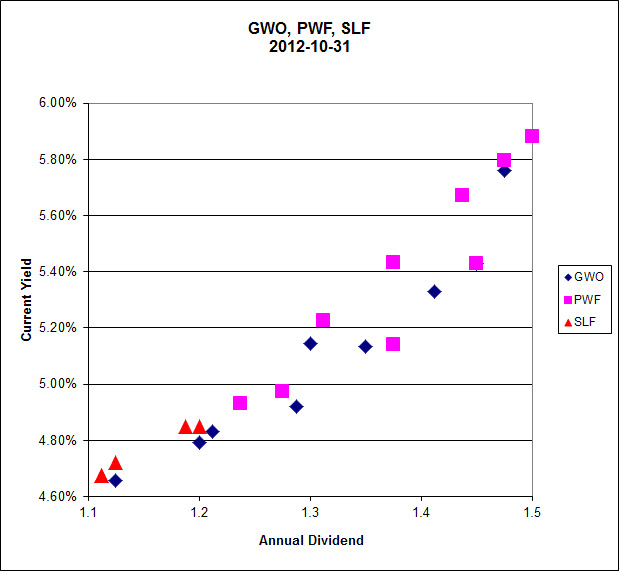
SLF DeemedRetractibles may be compared with PWF and GWO:


Click for Big

It is quite apparent that that the market continues to treat regulated insurance issues (SLF, GWO) no differently from unregulated issues (PWF) – despite the fact that the PWF issues are much more subject to unfavourable calls in the near term and should, logically, be deprecated on those grounds alone without any fancy-pants arguments about imposition of the NVCC rule!

Those of you who have been paying attention will remember that in a “normal” market (which we have not seen in well over a year) the slope of this line is related to the implied volatility of yields in Black-Scholes theory, as discussed in the January, 2010, edition of PrefLetter. The relationship is still far too large to be explained by Implied Volatility – the numbers still indicate an overwhelming degree of directionality in the market’s price expectations.

Sometimes everything works … sometimes it’s 50-50 … sometimes nothing works. The fund seeks to earn incremental return by selling liquidity (that is, taking the other side of trades that other market participants are strongly motivated to execute), which can also be referred to as ‘trading noise’. There were a lot of strongly motivated market participants during the Panic of 2007, generating a lot of noise! Unfortunately, the conditions of the Panic may never be repeated in my lifetime … but the fund will simply attempt to make trades when swaps seem profitable, without worrying about the level of monthly turnover.

There’s plenty of room for new money left in the fund. I have shown in recent issues of PrefLetter that market pricing for FixedResets is demonstrably stupid and I have lots of confidence – backed up by my bond portfolio management experience in the markets for Canadas and Treasuries, and equity trading on the NYSE & TSX – that there is enough demand for liquidity in any market to make the effort of providing it worthwhile (although the definition of “worthwhile” in terms of basis points of outperformance changes considerably from market to market!) I will continue to exert utmost efforts to outperform but it should be borne in mind that there will almost inevitably be periods of underperformance in the future.

The yields available on high quality preferred shares remain elevated, which is reflected in the current estimate of sustainable income.

Calculation of MAPF Sustainable Income Per Unit
Month NAVPU Portfolio
Average
YTW
Leverage
Divisor
Securities
Average
YTW
Capital
Gains
Multiplier
Sustainable
Income
per
current
Unit
June, 2007 9.3114 5.16% 1.03 5.01% 1.3240 0.3524
September 9.1489 5.35% 0.98 5.46% 1.3240 0.3773
December, 2007 9.0070 5.53% 0.942 5.87% 1.3240 0.3993
March, 2008 8.8512 6.17% 1.047 5.89% 1.3240 0.3938
June 8.3419 6.034% 0.952 6.338% 1.3240 $0.3993
September 8.1886 7.108% 0.969 7.335% 1.3240 $0.4537
December, 2008 8.0464 9.24% 1.008 9.166% 1.3240 $0.5571
March 2009 $8.8317 8.60% 0.995 8.802% 1.3240 $0.5872
June 10.9846 7.05% 0.999 7.057% 1.3240 $0.5855
September 12.3462 6.03% 0.998 6.042% 1.3240 $0.5634
December 2009 10.5662 5.74% 0.981 5.851% 1.1141 $0.5549
March 2010 10.2497 6.03% 0.992 6.079% 1.1141 $0.5593
June 10.5770 5.96% 0.996 5.984% 1.1141 $0.5681
September 11.3901 5.43% 0.980 5.540% 1.1141 $0.5664
December 2010 10.7659 5.37% 0.993 5.408% 1.0298 $0.5654
March, 2011 11.0560 6.00% 0.994 5.964% 1.0298 $0.6403
June 11.1194 5.87% 1.018 5.976% 1.0298 $0.6453
September 10.2709 6.10%
Note
1.001 6.106% 1.0298 $0.6090
December, 2011 10.0793 5.63%
Note
1.031 5.805% 1.0000 $0.5851
March, 2012 10.3944 5.13%
Note
0.996 5.109% 1.0000 $0.5310
June 10.2151 5.32%
Note
1.012 5.384% 1.0000 $0.5500
September 10.6703 4.61%
Note
0.997 4.624% 1.0000 $0.4934
October, 2012 10.7577 4.55% 0.993 4.582% 1.0000 $0.4929
NAVPU is shown after quarterly distributions of dividend income and annual distribution of capital gains.
Portfolio YTW includes cash (or margin borrowing), with an assumed interest rate of 0.00%
The Leverage Divisor indicates the level of cash in the account: if the portfolio is 1% in cash, the Leverage Divisor will be 0.99
Securities YTW divides “Portfolio YTW” by the “Leverage Divisor” to show the average YTW on the securities held; this assumes that the cash is invested in (or raised from) all securities held, in proportion to their holdings.
The Capital Gains Multiplier adjusts for the effects of Capital Gains Dividends. On 2009-12-31, there was a capital gains distribution of $1.989262 which is assumed for this purpose to have been reinvested at the final price of $10.5662. Thus, a holder of one unit pre-distribution would have held 1.1883 units post-distribution; the CG Multiplier reflects this to make the time-series comparable. Note that Dividend Distributions are not assumed to be reinvested.
Sustainable Income is the resultant estimate of the fund’s dividend income per current unit, before fees and expenses. Note that a “current unit” includes reinvestment of prior capital gains; a unitholder would have had the calculated sustainable income with only, say, 0.9 units in the past which, with reinvestment of capital gains, would become 1.0 current units.
DeemedRetractibles are comprised of all Straight Perpetuals (both PerpetualDiscount and PerpetualPremium) issued by BMO, BNS, CM, ELF, GWO, HSB, IAG, MFC, NA, RY, SLF and TD, which are not exchangable into common at the option of the company (definition refined in May, 2011). These issues are analyzed as if their prospectuses included a requirement to redeem at par on or prior to 2022-1-31, in addition to the call schedule explicitly defined. See OSFI Does Not Grandfather Extant Tier 1 Capital, CM.PR.D, CM.PR.E, CM.PR.G: Seeking NVCC Status and the January, February, March and June, 2011, editions of PrefLetter for the rationale behind this analysis.
Yields for September, 2011, to January, 2012, were calculated by imposing a cap of 10% on the yields of YLO issues held, in order to avoid their extremely high calculated yields distorting the calculation and to reflect the uncertainty in the marketplace that these yields will be realized. From February to September 2012, yields on these issues have been set to zero. All YLO issues held were sold in October 2012.

Significant positions were held in DeemedRetractible and FixedReset issues on October 31; all of these currently have their yields calculated with the presumption that they will be called by the issuers at par prior to 2022-1-31. This presents another complication in the calculation of sustainable yield. The fund also holds a position various SplitShare issues which also have their yields calculated with the expectation of a maturity at par.

I will no longer show calculations that assume the conversion of the entire portfolio into PerpetualDiscounts, as there are currently only four such issues of investment grade, from only two issuer groups. Additionally, the fund has no holdings of these issues.

It should be noted that the concept of this Sustainable Income calculation was developed when the fund’s holdings were overwhelmingly PerpetualDiscounts – see, for instance, the bottom of the market in November 2008. It is easy to understand that for a PerpetualDiscount, the technique of multiplying yield by price will indeed result in the coupon – a PerpetualDiscount paying $1 annually will show a Sustainable Income of $1, regardless of whether the price is $24 or $17.

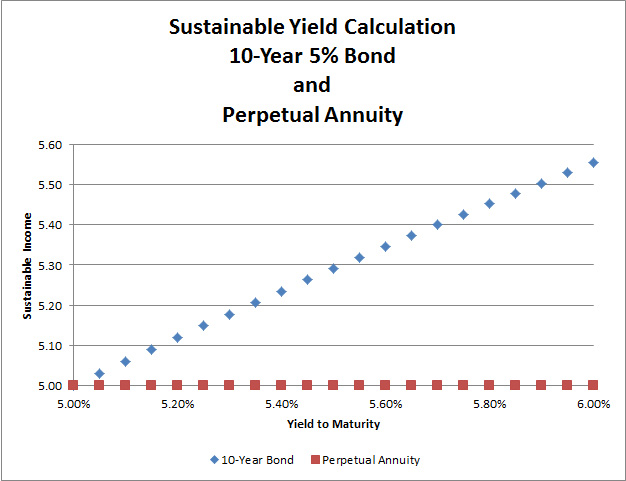
Things are not quite so neat when maturity dates and maturity prices that are different from the current price are thrown into the mix. If we take a notional Straight Perpetual paying $5 annually, the price is $100 when the yield is 5% (all this ignores option effects). As the yield increases to 6%, the price declines to 83.33; and 83.33 x 6% is the same $5. Good enough.

But a ten year bond, priced at 100 when the yield is equal to its coupon of 5%, will decline in price to 92.56; and 92.56 x 6% is 5.55; thus, the calculated Sustainable Income has increased as the price has declined as shown in the graph:


Click for Big

The difference is because the bond’s yield calculation includes the amortization of the discount; therefore, so does the Sustainable Income estimate.

Thus, the decline in the MAPF Sustainable Income from $0.5500 per unit in June to $0.4929 per unit in October should be looked at as a simple consequence of the fund’s holdings; virtually all of which have their yields calculated in a manner closer to bonds than to Perpetual Annuities.

Different assumptions lead to different results from the calculation, but the overall positive trend is apparent. I’m very pleased with the long-term results! It will be noted that if there was no trading in the portfolio, one would expect the sustainable yield to be constant (before fees and expenses). The success of the fund’s trading is showing up in

  • the very good performance against the index
  • the long term increases in sustainable income per unit

As has been noted, the fund has maintained a credit quality equal to or better than the index; outperformance is due to exploitation of trading anomalies.

Again, there are no predictions for the future! The fund will continue to trade between issues in an attempt to exploit market gaps in liquidity, in an effort to outperform the index and keep the sustainable income per unit – however calculated! – growing.

MAPF

MAPF Portfolio Composition: October 2012

Turnover continued to be almost non-existent in October, remaining at about 2%.

There is extreme segmentation in the marketplace, with OSFI’s NVCC rule changes in February 2011 having had the effect of splitting the formerly relatively homogeneous Straight Perpetual class of preferreds into three parts:

  • Unaffected Straight Perpetuals
  • DeemedRetractibles explicitly subject to the rules (banks)
  • DeemedRetractibles considered by me, but not (yet!) by the market, to be likely to be explicitly subject to the rules in the future (insurers and insurance holding companies)

This segmentation, and the extreme valuation differences between the segments, has cut down markedly on the opportunities for trading. Another trend that hasn’t helped has been the migration of PerpetualDiscounts into PerpetualPremiums (due to price increases) – many of the PerpetualPremiums have negative Yields-to-Worst and those that don’t aren’t particularly thrilling; speaking very generally, PerpetualPremiums are to be avoided, not traded! This effect has caused the first of the three segments noted above to disappear for most practical purposes.

Sectoral distribution of the MAPF portfolio on October 31 was as follows:

MAPF Sectoral Analysis 2012-10-31
HIMI Indices Sector Weighting YTW ModDur
Ratchet 0% N/A N/A
FixFloat 0% N/A N/A
Floater 0% N/A N/A
OpRet 0% N/A N/A
SplitShare 10.0% (-0.1) 4.95% 5.35
Interest Rearing 0% N/A N/A
PerpetualPremium 0.0% (0) N/A N/A
PerpetualDiscount 0.0% (0) N/A N/A
Fixed-Reset 19.2% (-0.6) 2.37% 1.52
Deemed-Retractible 61.5% (-0.3) 5.03% 7.40
Scraps (Various) 8.6% (+0.6) 5.97% 10.49
Cash 0.7% (+0.4) 0.00% 0.00
Total 100% 4.55% 6.28
Totals and changes will not add precisely due to rounding. Bracketted figures represent change from September month-end. Cash is included in totals with duration and yield both equal to zero.
DeemedRetractibles are comprised of all Straight Perpetuals (both PerpetualDiscount and PerpetualPremium) issued by BMO, BNS, CM, ELF, GWO, HSB, IAG, MFC, NA, RY, SLF and TD, which are not exchangable into common at the option of the company. These issues are analyzed as if their prospectuses included a requirement to redeem at par on or prior to 2022-1-31, in addition to the call schedule explicitly defined. See OSFI Does Not Grandfather Extant Tier 1 Capital, CM.PR.D, CM.PR.E, CM.PR.G: NVCC Status Confirmed and the January, February, March and June, 2011, editions of PrefLetter for the rationale behind this analysis. (all recent editions have a short summary of the argument included in the “DeemedRetractible” section)

The “total” reflects the un-leveraged total portfolio (i.e., cash is included in the portfolio calculations and is deemed to have a duration and yield of 0.00.). MAPF will often have relatively large cash balances, both credit and debit, to facilitate trading. Figures presented in the table have been rounded to the indicated precision.

Credit distribution is:

MAPF Credit Analysis 2012-10-31
DBRS Rating Weighting
Pfd-1 0 (0)
Pfd-1(low) 53.2% (-0.8)
Pfd-2(high) 27.5% (-0.1)
Pfd-2 0 (0)
Pfd-2(low) 10.0% (-0.1)
Pfd-3(high) 0.9% (+0.6)
Pfd-3 3.0% (-0.1)
Pfd-4(high) 0.6% (0)
Pfd-4 2.6% (0)
Pfd-4(low) 1.4% (0)
Cash 0.7% (+0.4)
Totals will not add precisely due to rounding. Bracketted figures represent change from September month-end.

Liquidity Distribution is:

MAPF Liquidity Analysis 2012-10-31
Average Daily Trading Weighting
<$50,000 13.9% (+0.2)
$50,000 – $100,000 10.8% (+9.7)
$100,000 – $200,000 46.5% (-2.7)
$200,000 – $300,000 19.6% (-6.6)
>$300,000 8.4% (-1.1)
Cash 0.7% (+0.4)
Totals will not add precisely due to rounding. Bracketted figures represent change from September month-end.

MAPF is, of course, Malachite Aggressive Preferred Fund, a “unit trust” managed by Hymas Investment Management Inc. Further information and links to performance, audited financials and subscription information are available the fund’s web page. The fund may be purchased either directly from Hymas Investment Management or through a brokerage account at Odlum Brown Limited. A “unit trust” is like a regular mutual fund, but is sold by offering memorandum rather than prospectus. This is cheaper, but means subscription is restricted to “accredited investors” (as defined by the Ontario Securities Commission) or those who subscribe for $150,000+. Fund past performances are not a guarantee of future performance. You can lose money investing in MAPF or any other fund.

A similar portfolio composition analysis has been performed on the Claymore Preferred Share ETF (symbol CPD) as of August 31, 2011, and published in the October, 2011, PrefLetter. While direct comparisons are difficult due to the introduction of the DeemedRetractible class of preferred share (see above) it is fair to say:

  • MAPF credit quality is better
  • MAPF liquidity is a lower
  • MAPF Yield is higher
  • Weightings in
    • MAPF is much more exposed to DeemedRetractibles
    • MAPF is much less exposed to Operating Retractibles
    • MAPF is much more exposed to SplitShares
    • MAPF is less exposed to FixFloat / Floater / Ratchet
    • MAPF weighting in FixedResets is much lower
Market Action

November 2, 2012

There was a good US jobs number:

American employers added more workers than forecast in October and a rush of people entering the labor force pushed the jobless rate higher, according to the last report on the labor market before next week’s presidential election.

Broad-based gains in employment — from car dealers and hospitals to factories and construction sites — indicate consumers are likely to spend more freely and shore up the three-year expansion in the face of a global economic slowdown and political gridlock in Washington over taxes and spending.

Hiring increased by 171,000 workers after a 148,000 gain in September that was bigger than first estimated, Labor Department figures showed today in Washington. October’s increase exceeded the most optimistic forecast in a Bloomberg survey with a median projection of a 125,000 gain. Unemployment rose to 7.9 percent.

Federal Reserve Bank of San Francisco President John Williams spoke in defense of QE3 today:

Concern that large-scale asset purchases “might ignite a bout of inflation” are unwarranted because price increases are being held in check by elevated unemployment and an economy that “isn’t operating at full speed,” Williams said.

“Unemployment is — and should be — a central focus of monetary policy right now,” Williams said. “This concentration on getting unemployment down in no way represents a lessening of the importance of price stability,” he said, adding that inflation may slow well below the Fed’s 2 percent goal if the U.S. recovery falters.

Williams said central bank purchases of bonds will help spur U.S. economic growth to 2.5 percent next year and 3.5 percent in 2014 while not fueling inflation.

“Our policy measures are having the desired effects,” Williams said today in remarks prepared for a speech in Salt Lake City. “We have substantial scope to use monetary policy to stimulate the economy without creating too much upward pressure on prices.”

It was a modestly good day for the Canadian preferred share market, with PerpetualPremiums up 9bp, FixedResets flat and DeemedRetractibles gaining 8bp. Volatility was at normal levels, all to the upside with a preponderance of insurance issues. Volume was below average.

HIMIPref™ Preferred Indices
These values reflect the December 2008 revision of the HIMIPref™ Indices

Values are provisional and are finalized monthly
Index Mean
Current
Yield
(at bid)
Median
YTW
Median
Average
Trading
Value
Median
Mod Dur
(YTW)
Issues Day’s Perf. Index Value
Ratchet 0.00 % 0.00 % 0 0.00 0 0.5756 % 2,471.4
FixedFloater 4.11 % 3.45 % 35,122 18.43 1 0.0000 % 3,912.6
Floater 2.80 % 2.99 % 58,877 19.74 4 0.5756 % 2,668.4
OpRet 4.61 % 0.72 % 42,941 0.61 4 -0.0855 % 2,577.1
SplitShare 5.37 % 4.58 % 63,472 4.47 3 -0.0783 % 2,857.4
Interest-Bearing 0.00 % 0.00 % 0 0.00 0 -0.0855 % 2,356.5
Perpetual-Premium 5.27 % 1.71 % 71,814 0.31 29 0.0889 % 2,314.3
Perpetual-Discount 4.91 % 4.93 % 105,156 15.56 3 0.2347 % 2,593.1
FixedReset 5.00 % 3.02 % 213,547 3.94 74 -0.0042 % 2,444.7
Deemed-Retractible 4.92 % 3.49 % 133,721 1.12 46 0.0772 % 2,392.7
Performance Highlights
Issue Index Change Notes
PWF.PR.M FixedReset 1.00 % YTW SCENARIO
Maturity Type : Call
Maturity Date : 2014-01-31
Maturity Price : 25.00
Evaluated at bid price : 26.20
Bid-YTW : 2.11 %
GWO.PR.M Deemed-Retractible 1.01 % YTW SCENARIO
Maturity Type : Call
Maturity Date : 2015-03-31
Maturity Price : 26.00
Evaluated at bid price : 26.98
Bid-YTW : 4.18 %
TRI.PR.B Floater 1.05 % YTW SCENARIO
Maturity Type : Limit Maturity
Maturity Date : 2042-11-02
Maturity Price : 22.00
Evaluated at bid price : 22.23
Bid-YTW : 2.35 %
GWO.PR.P Deemed-Retractible 1.25 % YTW SCENARIO
Maturity Type : Hard Maturity
Maturity Date : 2022-01-31
Maturity Price : 25.00
Evaluated at bid price : 26.68
Bid-YTW : 4.60 %
Volume Highlights
Issue Index Shares
Traded
Notes
BNS.PR.Z FixedReset 174,415 Desjardins crossed 150,000 at 25.13.
YTW SCENARIO
Maturity Type : Hard Maturity
Maturity Date : 2022-01-31
Maturity Price : 25.00
Evaluated at bid price : 25.08
Bid-YTW : 3.03 %
GWO.PR.J FixedReset 173,896 Desjardins crossed three blocks: 85,000 and two of 42,300 each, all at 26.00.
YTW SCENARIO
Maturity Type : Call
Maturity Date : 2013-12-31
Maturity Price : 25.00
Evaluated at bid price : 26.04
Bid-YTW : 2.84 %
FTS.PR.H FixedReset 102,944 TD crossed 100,000 at 25.65.
YTW SCENARIO
Maturity Type : Limit Maturity
Maturity Date : 2042-11-02
Maturity Price : 23.65
Evaluated at bid price : 25.60
Bid-YTW : 2.76 %
BAM.PR.M Perpetual-Discount 82,691 RBC crossed blocks of 30,000 shares, 10,000 and 38,100, all at 24.25.
YTW SCENARIO
Maturity Type : Limit Maturity
Maturity Date : 2042-11-02
Maturity Price : 23.98
Evaluated at bid price : 24.27
Bid-YTW : 4.93 %
IGM.PR.B Perpetual-Premium 81,001 RBC crossed 74,000 at 27.45.
YTW SCENARIO
Maturity Type : Call
Maturity Date : 2014-12-31
Maturity Price : 26.00
Evaluated at bid price : 27.39
Bid-YTW : 3.13 %
TD.PR.G FixedReset 65,131 TD crossed 60,300 at 26.55.
YTW SCENARIO
Maturity Type : Call
Maturity Date : 2014-04-30
Maturity Price : 25.00
Evaluated at bid price : 26.46
Bid-YTW : 2.26 %
There were 24 other index-included issues trading in excess of 10,000 shares.
Wide Spread Highlights
Issue Index Quote Data and Yield Notes
BMO.PR.K Deemed-Retractible Quote: 26.12 – 26.68
Spot Rate : 0.5600
Average : 0.3322

YTW SCENARIO
Maturity Type : Call
Maturity Date : 2012-12-25
Maturity Price : 26.00
Evaluated at bid price : 26.12
Bid-YTW : -0.32 %

W.PR.H Perpetual-Premium Quote: 25.53 – 26.00
Spot Rate : 0.4700
Average : 0.3322

YTW SCENARIO
Maturity Type : Call
Maturity Date : 2013-01-15
Maturity Price : 25.00
Evaluated at bid price : 25.53
Bid-YTW : -3.53 %

MFC.PR.E FixedReset Quote: 26.23 – 26.48
Spot Rate : 0.2500
Average : 0.1708

YTW SCENARIO
Maturity Type : Call
Maturity Date : 2014-09-19
Maturity Price : 25.00
Evaluated at bid price : 26.23
Bid-YTW : 3.28 %

PWF.PR.I Perpetual-Premium Quote: 25.48 – 25.74
Spot Rate : 0.2600
Average : 0.1810

YTW SCENARIO
Maturity Type : Call
Maturity Date : 2012-12-02
Maturity Price : 25.00
Evaluated at bid price : 25.48
Bid-YTW : -16.09 %

SLF.PR.F FixedReset Quote: 26.47 – 26.73
Spot Rate : 0.2600
Average : 0.1947

YTW SCENARIO
Maturity Type : Call
Maturity Date : 2014-06-30
Maturity Price : 25.00
Evaluated at bid price : 26.47
Bid-YTW : 2.72 %

BNA.PR.E SplitShare Quote: 25.52 – 25.77
Spot Rate : 0.2500
Average : 0.1915

YTW SCENARIO
Maturity Type : Hard Maturity
Maturity Date : 2017-12-10
Maturity Price : 25.00
Evaluated at bid price : 25.52
Bid-YTW : 4.58 %