Issue Comments

CBU.PR.A Completes Investment of New Issue Proceeds

Ordinarily this wouldn’t be worth a post. A split-share company starts up, they get a cheque from the underwriters, they put it to work. Big deal.

On this occasion, however, the announcement from First Asset had a certain Wow! factor:

When the preliminary prospectus was filed on September 10, 2008, the approximate dividend yield on the Portfolio would have been approximately 4.74% with the Preferred Shares having initial dividend coverage of 172%. As a result of the sell off prior to and during the investing period, the yield of the acquired Portfolio is 6.06% with dividend coverage of the Preferred Shares of 218% with approximately $0.25/Unit per annum of initial excess cash flow after deducting expenses. Any such excess cash flow will contribute to the growth of the Net Asset Value of the Company.

The closing of this issue was reported on PrefBlog. CBU.PR.A will not be tracked by HIMIPref™. It’s a shame, given the fat coupon and the 2.5:1 asset coverage, but it’s just too small to trade efficiently.

Market Action

November 26, 2008

Moody’s notes that its accuracy ratio has declined:

Moody’s ratings performance has deteriorated sharply from the elevated levels seen in recent years. The deterioration is primarily driven by investment grade defaults that include multiple affiliates of Lehman Brothers and Washington Mutual. The one-year horizon “accuracy ratio” (AR) was 78.7% in the third quarter relative to 94.7% a year ago. This sharp decline in performance is similar to that observed in previous downturns that were marked by a sudden surge in the aggregate default rate. The investment grade default rate at 0.12%, while above its historical average of 0.05%, is currently below the 0.5% observed at the peak of the previous downturn in
2000-2002.

Accrued Interest takes exception to Moody’s negative views on the Financial Guarantee business.

What a day! The TXPR index was down 5.94% on the BCE news.

Note that these indices are experimental; the absolute and relative daily values are expected to change in the final version. In this version, index values are based at 1,000.0 on 2006-6-30.
The Fixed-Reset index was added effective 2008-9-5 at that day’s closing value of 1,119.4 for the Fixed-Floater index.
Index Mean Current Yield (at bid) Mean YTW Mean Average Trading Value Mean Mod Dur (YTW) Issues Day’s Perf. Index Value
Ratchet N/A N/A N/A N/A 0 N/A N/A
Fixed-Floater 6.77% 7.12% 76,841 13.53 6 -25.0084% 776.5
Floater 9.15% 9.39% 57,533 9.94 2 +1.7664% 386.5
Op. Retract 5.46% 8.02% 137,799 3.87 15 -0.8053% 975.9
Split-Share 7.67% 16.26% 67,294 3.69 12 +0.2993% 804.8
Interest Bearing 9.26% 19.99% 59,358 2.99 3 +3.7771% 787.9
Perpetual-Premium N/A N/A N/A N/A N/A N/A N/A
Perpetual-Discount 8.49% 8.63% 185,439 10.80 71 -0.8010% 647.7
Fixed-Reset 6.07% 5.68% 968,924 14.14 12 -1.3168% 979.2
Major Price Changes
Issue Index Change Notes
BCE.PR.Z FixFloat -28.8889%  
BCE.PR.Y Ratchet -28.6423%  
BCE.PR.I FixFloat -28.2174%  
BCE.PR.G FixFloat -26.8603%  
BCE.PR.C FixFloat -24.5725%  
BCE.PR.R FixFloat -22.1333%  
BCE.PR.A FixFloat +4.7619%  
BAM.PR.J OpRet -11.3715% Now with a pre-tax bid-YTW of 15.80% based on a bid of 12.86 and a softMaturity 2018-3-30 at 25.00. Closing quote of 12.86-52, 3×5. Day’s range of 12.85-50.
BNA.PR.C SplitShare -10.0000% Asset coverage of 1.7-:1 based on BAM.A at 17.21 and 2.4 BAM.A / unit. Now with a pre-tax bid-YTW of 18.77% based on a bid of 9.00 and a hardMaturity 2019-1-10 at 25.00. Closing quote 9.00-9.69, 2×3. Day’s range of 9.00-10.00.
CIU.PR.A PerpetualDiscount -10.0000% Now with a pre-tax bid-YTW of 8.32% based on a bid of 13.95 and a limitMaturity. Closing quote 13.95-00, 1×75. Day’s range of 14.00-15.25.
POW.PR.A PerpetualDiscount -9.9493% Now with a pre-tax bid-YTW of 10.09% based on a bid of 14.21 and a limitMaturity. Closing quote 14.21-15.74 (!), 3×2. Day’s range of 13.82-15.75.
CL.PR.B PerpetualDiscount -6.6793% Now with a pre-tax bid-YTW of 8.12% based on a bid of 19.70 and a limitMaturity. Closing quote 19.70-28, 3×3. Day’s range of 19.50-21.50 (!).
BNA.PR.B SplitShare -6.6250% See BNA.PR.C, above. Now with a pre-tax bid-YTW of 13.95% based on a bid of 14.94 and a hardMaturity 2016-3-25 at 25.00. Closing quote of 14.94-15.99 (!), 4×1. Day’s range of 14.93-16.99 (!).
BNS.PR.Q FixedReset -6.4731%  
BNS.PR.P FixedReset -5.6180%  
PWF.PR.G PerpetualDiscount -5.5556% Now with a pre-tax bid-YTW of 8.83% based on a bid of 17.00 and a limitMaturity. Closing quote 17.00-93, 1×12. Day’s range of 16.90-18.00.
LBS.PR.A SplitShare -5.5215% Asset coverage of 1.3+:1 as of November 20, according to Brompton Group. Now with a pre-tax bid-YTW of 17.32% based on a bid of 6.16 and a hardMaturity 2013-11-29 at 10.00. Closing quote of 6.16-50, 35×2. Day’s range of 5.76-52.
BAM.PR.B Floater -5.0633%  
POW.PR.D PerpetualDiscount +5.4545% Now with a pre-tax bid-YTW of 8.81% based on a bid of 14.50 and a limitMaturity. Closing quote 14.50-87, 6×3. Day’s range of 13.75-51.
FTN.PR.A SplitShare +6.5467% Asset coverage of 1.7-:1 as of November 14, according to the company. Now with a pre-tax bid-YTW of 12.59% based on a bid of 6.69 and a hardMaturity 2015-12-1 at 10.00. Closing quote of 6.69-23, 32×5. Day’s range of 6.15-7.25.
FIG.PR.A +7.3171% InterestBearing Asset coverage of 1.1-:1 as of November 25, according to the Capital unit NAV of 1.39 and 0.71 Capital Units per preferred. Now with a pre-tax bid-YTW of 15.43% based on a bid of 6.60 and a hardMaturity 2014-12-31 at 10.00. Closing quote of 6.60-74, 4×1. Day’s range of 6.12-60
BAM.PR.K Floater +8.3333%  
LFE.PR.A SplitShare +12.1616% Asset coverage of 1.6-:1 as of November 14 according to the company. Now with a pre-tax bid-YTW of 15.70% based on a bid of 7.00 and a hardMaturity 2012-12-1 at 10.00. Closing quote of 7.00-24, 189×1. Day’s range of 6.52-25.
Volume Highlights
Issue Index Volume Notes
NSI.PR.C Scraps (would be OpRet, but there are volume concerns) 241,600 Nesbitt crossed 39,200 at 25.05 the CIBC crossed blocks of 178,400 & 21,600 at the same price. Now with a pre-tax bid-YTW of 4.96% based on a bid of 25.00 and optionCertainty 2038-11-26 at 24.75.
CGI.PR.B Scraps 202,700 CIBC crossed 192,000 at 22.70. Now with a pre-tax bid-YTW of 6.73% based on a bid of 22.70 and a softMaturity 2014-3-14 at 25.00.
L.PR.A Scraps (would be OpRet but there are credit concerns) 149,695 TD crossed 137,400 at 21.80. Now with a pre-tax bid-YTW of 8.70% based on a bid of 21.76 and a softMaturity 2015-7-30 at 25.00
SLF.PR.C PerpetualDiscount 121,050 CIBC crossed 100,000 at 12.50. Now with a pre-tax bid-YTW of 8.88% based on a bid of 12.55 and a limitMaturity.
SLF.PR.D PerpetualDiscount 117,909 CIBC crossed 100,000 at 12.40. Now with a pre-tax bid-YTW of 9.07% based on a bid of 12.30 and a limitMaturity.
WN.PR.B Scraps (would be OpRet but there are credit concerns) 112,200 Desjardins crossed 50,000 at 25.10, then CIBC crossed 50,000 at the same price. Now with a pre-tax bid-YTW of 6.59% based on a bid of 25.00 and optionCertainty 2009-6-30
TD.PR.M OpRet 101,710 CIBC bought 97,500 from Desjardins at 25.36. Now with a pre-tax bid-YTW of 4.47% based on a bid of 25.36 and a softMaturity 2013-10-30 at 25.00.
TCA.PR.Y PerpetualDiscount 83,562 National crossed 80,000 at 42.25. Now with a pre-tax bid-YTW of 6.84% based on a bid of 41.51 and a limitMaturity.
SBC.PR.A SplitShare 180,072 DIBC crossed 103,600 at 7.10, Desjardins crossed 70,000 at 7.02. Now with a pre-tax bid-YTW of 15.84% based on a bid of 7.03 and a hardMaturity 2012-11-30.

There were sixty other index-included $25-pv-equivalent issues trading over 10,000 shares today.

Issue Comments

UST.PR.A Renews Issuer Bid

First Asset has announced:

acceptance by the Toronto Stock Exchange (the “TSX”) of the Trust’s Notice of Intention to make a Normal Course Issuer Bid (the “NCIB”) to permit the Trust to acquire its Preferred Securities and Capital Units (collectively, the “Securities”).

Pursuant to the NCIB, the Trust proposes to purchase through the facilities of the TSX, from time to time, if it is considered advisable, up to 396,485 Preferred Securities and up to 396,485 Capital Units of the Trust, representing approximately 10% of the public float which is the same number as the Trust’s issued and outstanding Securities, being 3,964,850 Preferred Securities and 3,964,850 Capital Units as of the date hereof. The Trust will not purchase in any given 30-day period, in the aggregate, more than 79,297 Preferred Securities and 79,297 Capital Units, being 2% of the issued and outstanding Units as of the date hereof. Purchases of Units under the NCIB may commence on November 28, 2008. The Board of Directors of First Asset Funds Inc., the manager of the Trust, believes that such purchases are in the best interests of the Trust and are a desirable use of the Trust’s funds. All purchases will be made through the facilities of the TSX in accordance with its rules and policies. All Securities purchased by the Trust pursuant to the NCIB will not be cancelled and will be held for resale. The NCIB will expire on November 27, 2009.

On November 26, 2007, the Trust announced that it was making a Normal Course Issuer Bid, which commenced November 28, 2007, to purchase up to 461,420 Preferred Securities and up to 461,420 Capital Units through the facilities of the TSX. No Securities were repurchased under the bid, which expires on November 27, 2008.

UST.PR.A is not tracked by HIMIPref™.

Issue Comments

CGI.PR.B / CGI.PR.C : Capital Unit Dividend in Doubt

Assiduous Reader liketoretire gives me a well-deserved kick for not reporting yesterday’s announcement from Morgan Meighan:

as a result of market conditions and a dividend payment restriction contained in its Class A, Series 2 and Series 3 Preference Share provisions, it was not certain at today’s date whether the Company would be permitted to pay the $0.06 per common share dividend declared on October 15, 2008 to shareholders of record on November 28, 2008 and payable on December 15, 2008. The common shares will commence trading on the Toronto Stock Exchange (TSX) on an “ex dividend” basis at the opening of trading on Wednesday, November 26, 2008.

The dividend payment restriction provides that the Company shall not pay a dividend on its common shares unless after giving effect thereto, the ratio of its Assets to Obligations (both as defined in the Preference Share provisions) exceeds 2.5 times. As at the close of business on November 24, 2008, such ratio was approximately 2.6 times.

The restriction does not affect the scheduled payment of dividends on the Series 2 and Series 3 Preference Shares on December 15, 2008, which will proceed as previously announced.

The two series of preferreds are of high quality, as might be deduced from the very high level of asset coverage required in order to maintain the common dividend.

At one point I was greater consternated to find that I had classified some of the CGI preferred issues as SplitShares and others as OperatingRetractibles. After some thought, I decided they were split shares – they don’t have an actual business, after all, and they’re backed by a portfolio of investments … ergo, SplitShares. There was one Assiduous Reader who strongly disagreed, but I held firm.

CGI.PR.A was redeemed.

CGI.PR.B & CGI.PR.C are both in the “Scraps” index, due to volume concerns.

Interesting External Papers

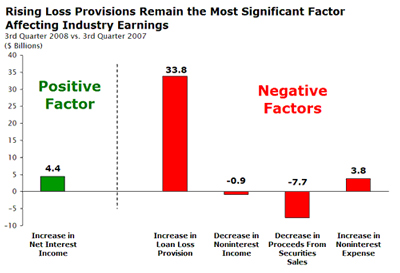
FDIC Publishes 3Q08 US Bank Profile

The FDIC has released the 3Q08 Quarterly Banking Profile.

The headlines of the text give the flavour:

  • More Institutions Report Declining Earnings, Quarterly Losses
  • Lower Asset Values Add to the Downward Pressure on Earnings
  • Margin Improvement Provides a Boost to Net Interest Income
  • Loan Losses Continue to Mount
  • Growth in Reported Noncurrent Loans Remains High
  • Reserve Coverage of Noncurrent Declines
  • Failure-Related Restructuring Contributes to a Decline in Reported Capital
  • Liquidity Program Provides a Boost to Asset Growth
  • Discount Window Borrowings Fuel a Surge in Nondeposit Liabilities
  • Nine Failures in Third Quarter Include Washington Mutual Bank

The 2Q08 Report was previously noted on PrefBlog.

Issue Comments

BCE Buyout in Trouble; Prefs Plunge

BCE has announced:

the company has received a preliminary view from KPMG that, based on current market conditions, its analysis to date and the amount of indebtedness involved in the LBO financing, it does not expect to be in a position to deliver on the scheduled effective date of BCE’s privatization, December 11,2008, an opinion that BCE would meet the solvency tests as defined in the definitive agreement, as amended. The receipt at the effective time of a positive solvency opinion is a condition to the closing of the transaction. At the same time, KPMG indicated that BCE would meet all solvency tests under its current capital structure.

“BCE today enjoys solid investment grade credit ratings, has $2.8 billion of cash on hand, a low level of mid-term debt maturities, and continues to deliver solid operating results,” said George Cope, President and CEO of BCE and Bell.

“We are disappointed with KPMG’s preliminary view of post-transaction solvency, which is based on numerous assumptions and methodologies that we are currently reviewing. The company disagrees that the addition of the LBO debt would result in BCE not meeting the technical solvency definition,” said Siim Vanaselja, BCE’s Chief Financial Officer. The company continues to work with KPMG and the Purchaser to seek to satisfy all closing conditions. Should KPMG be unable to deliver a favourable opinion on December 11, 2008, however, the transaction is unlikely to proceed.

That gust of wind you just felt was a sigh of relief from the purchasers and financers. Bloomberg notes:

“The chances of any deal getting done are very low now,” said Sachin Shah, a merger arbitrage analyst with ICAP Corporates LLC in Jersey City, New Jersey. “Having BCE’s auditor call the deal insolvent is what’s surprising here. The market had been expecting that the banks would balk.”

Citigroup Inc., Deutsche Bank AG, Toronto-Dominion Bank and Royal Bank of Scotland Group Plc are on the hook for about $34 billion for BCE, according to regulatory filings. The banks have sold debt that backed buyouts at discounts to face value to get the debt off their books. In the case of BCE, it would cost billions of dollars.

The average high-yield, high-risk loan is trading at about 66.6 cents on the dollar, just shy of the record, according to Standard & Poor’s LCD. Prices have plummeted almost 9 cents since Nov. 6 and 28.3 cents this year as investors in the debt have been forced to liquidate funds.

Preferred shares have plunged on light volume. I have uploaded a noon evaluation of the FixedFloater index which, unfortunately, could be more accurately referred to as the BCE index.

BCE has the following preferred shares outstanding: BCE.PR.A, BCE.PR.C, BCE.PR.D, BCE.PR.E, BCE.PR.F, BCE.PR.G, BCE.PR.H, BCE.PR.I, BCE.PR.R, BCE.PR.S, BCE.PR.T, BCE.PR.Y & BCE.PR.Z

The last dedicated post in this series was BCE / Teachers’ : A Giant Step Closer.

Update:DBRS has announced:

has today placed its ratings of BCE Acquisition Inc. (BAI), BCE Inc. and Bell Canada, a wholly owned subsidiary of BCE Inc. (BCE or the Company) Under Review with Developing Implications. This action follows BCE’s announcement today that based on preliminary indications it is unlikely that a condition – specifically, a positive solvency opinion – that was required upon closing the privatization of BCE on December 11, 2008, will be met.

DBRS notes that should the privatization not proceed as planned, DBRS expects to re-evaluate BCE and Bell Canada’s credit profiles and likely move the ratings of these entities to a strong investment-grade level.

Alternatively, should the privatization proceed as planned, DBRS’s current BB (low) issuer ratings on BAI and Bell Canada would remain in place. (See press release dated October 7, 2008.) However, should any element of the privatization change, DBRS would re-evaluate the appropriateness of these BB (low) issuer ratings.

DBRS notes that the $52 billion privatization of BCE was originally announced on June 30, 2007, and led by Ontario Teachers’ Pension Plan Board, Providence Equity Partners Inc. and Madison Dearborn Partners, LLC. Subsequently, Merrill Lynch took up an equity commitment as a principal investor. Collectively, as part of the agreement, as amended, the sponsors will invest approximately $7.75 billion in equity (possibly lower due to cash accumulation at BCE) to fund this privatization, with the remainder in debt.

Update: The agreement is available as a “Material Document” in the BCE filings on SEDAR, dated July 5, 2007.

“Solvent” when used with respect to the Company, means that, as of any date of determination (a) the amount of the “fair saleable value” of the assets of the Company will, as of such date, exceed (i) the value of all “liabilities of the Company, including contingent and other liabilities,” as of such date, as such quoted terms are generally determined in accordance with Applicable Laws governing determinations of the insolvency of debtors, and (ii) the amount that will be required to pay the probable liabilities of the Company on its existing debts (including contingent and other liabilities) as such debts become absolute and mature, (b) the Company will not have, as of such date, an unreasonably small amount of capital for the operation of the businesses and
transactions in which it intends to engage or proposes to be engaged following the Effective Date, (c) the Company will be able to meet its obligations as they generally become due and to pay its liabilities, including contingent and other liabilities, as they mature, and (d) the aggregate of the property of the Company is, at a fair valuation, sufficient, or, if disposed of at a fairly conducted sale under legal process, would be sufficient, to enable payment of all its obligations, due and accruing due. For purposes of this definition, “not have an unreasonably small amount of capital for the operation of the businesses in which it is engaged or proposed to be engaged” and “able to pay its liabilities, including contingent and other liabilities, as they mature” means that the Company will be able to generate enough cash from operations, asset dispositions or refinancing, or a combination thereof, to meet its obligations as they become due;

[Section 8.1 “Mutual Conditions Precedent”, (f), emphasis added] the Purchaser and the Company shall have received an opinion at the Effective Time from a nationally recognized valuation firm engaged by the Purchaser and agreed to by the Company, acting reasonably to the effect that the Company will, subject to certain qualifications, be Solvent as of the Effective Time and immediately after the consummation of the transactions contemplated by the Plan of Arrangement.

Market Action

November 25, 2008

The Fed continued its process of reintermediation today – this time purchasing Agency direct and mortgage-backed debt:

Spreads of rates on GSE debt and on GSE-guaranteed mortgages have widened appreciably of late. This action is being taken to reduce the cost and increase the availability of credit for the purchase of houses, which in turn should support housing markets and foster improved conditions in financial markets more generally.

Purchases of up to $100 billion in GSE direct obligations under the program will be conducted with the Federal Reserve’s primary dealers through a series of competitive auctions and will begin next week. Purchases of up to $500 billion in MBS will be conducted by asset managers selected via a competitive process with a goal of beginning these purchases before year-end. Purchases of both direct obligations and MBS are expected to take place over several quarters.

Assiduous readers will recall that on November 21 I reported a big move by the Chinese out of agencies and into Treasuries … now the Fed’s going to take the other side of that trade. Spreads narrowed considerably:

The yield premium, or spread, on the so-called current coupon 30-year fixed-rate mortgage securities guaranteed by Fannie Mae, over the benchmark U.S. 10-year note narrowed to 175 basis points, from 209 yesterday, data compiled by Bloomberg show.

That’s not all! The Fed will also be financing Asset Backed paper:

Under the TALF, the Federal Reserve Bank of New York (FRBNY) will lend up to $200 billion on a non-recourse basis to holders of certain AAA-rated ABS backed by newly and recently originated consumer and small business loans. The FRBNY will lend an amount equal to the market value of the ABS less a haircut and will be secured at all times by the ABS. The U.S. Treasury Department–under the Troubled Assets Relief Program (TARP) of the Emergency Economic Stabilization Act of 2008–will provide $20 billion of credit protection to the FRBNY in connection with the TALF. The attached terms and conditions document describes the basic terms and operational details of the facility. The terms and conditions are subject to change based on discussions with market participants in the coming weeks.

New issuance of ABS declined precipitously in September and came to a halt in October. At the same time, interest rate spreads on AAA-rated tranches of ABS soared to levels well outside the range of historical experience, reflecting unusually high risk premiums. The ABS markets historically have funded a substantial share of consumer credit and SBA-guaranteed small business loans. Continued disruption of these markets could significantly limit the availability of credit to households and small businesses and thereby contribute to further weakening of U.S. economic activity.

I have no idea of what the office politics behind these two moves might have been … but it is easy to speculate that one’s ideas are taken a lot more seriously when one is the Treasury Secretary Designate!

Sorry, folks! Not only is this late, but there’s only the index table done! I have rather a lot going on…

Note that these indices are experimental; the absolute and relative daily values are expected to change in the final version. In this version, index values are based at 1,000.0 on 2006-6-30.
The Fixed-Reset index was added effective 2008-9-5 at that day’s closing value of 1,119.4 for the Fixed-Floater index.
Index Mean Current Yield (at bid) Mean YTW Mean Average Trading Value Mean Mod Dur (YTW) Issues Day’s Perf. Index Value
Ratchet N/A N/A N/A N/A 0 N/A N/A
Fixed-Floater 5.07% 5.00% 75,352 15.63 6 +0.5272% 1,035.5
Floater 9.27% 9.52% 57,315 9.85 2 -0.9731% 379.8
Op. Retract 5.41% 6.64% 137,300 3.89 15 -0.5370% 983.9
Split-Share 7.65% 16.32% 65,835 3.72 12 -2.8686% 802.4
Interest Bearing 9.53% 21.32% 58,784 2.89 3 +0.9659% 759.3
Perpetual-Premium N/A N/A N/A N/A N/A N/A N/A
Perpetual-Discount 8.42% 8.55% 183,202 10.88 71 -2.0971% 653.0
Fixed-Reset 5.99% 5.60% 849,164 14.27 13 -2.8732% 992.3
Issue Comments

IAG.PR.C Meets Hostile Reception

Industrial Alliance has announced:

Industrial Alliance Insurance and Financial Services Inc. (“Industrial Alliance” or the “Company”) announced today the successful completion of a Canadian public offering of 4 million of Non-Cumulative 5-Year Rate Reset Class A Preferred Shares Series C (the “Series C Preferred Shares”) from Industrial Alliance for sale to the public at a price of $25.00 per preferred share, representing aggregate gross proceeds of $100 million.

The offering was underwritten by a syndicate of investment dealers led by Scotia Capital Inc. The Series C Preferred Shares commence trading on the Toronto Stock Exchange today under the symbol IAG.PR.C.

It would appear that no additional shares were sold by way of the greenshoe noted in the original announcement

The issue traded 115,300 shares in a range of 23.90-40, indicating that at least some of the issue made it off the underwriter’s shelves. It closed at 23.80-90, 100×4.

At the bid price, the YTW is 6.38% based on a Canada Five-Year rate of 2.57% and a limitMaturity. The “5-Year Yield” is 7.38%, based on a hoped for, but currently unlikely, call at par 2014-1-30.

The perpetual, IAG.PR.A, closed at 12.75-71 to yield 9.26% based on the bid price of 12.75 and a limitMaturity (yield from the ask is 8.54%). However you slice it, the spread vs. the straight is well over 200bp. Given that the 5-to-Long spread on Canadas is currently about 150bp I’d say the spreads between the straight perpetual yield and the Fixed-Reset’s Yield to Worst (not the five-year-call-yield) should be 100bp absolute maximum, and – I’m guessing, I can’t point to any analysis here and suspect that any such analysis would be … er … suspect – probably more like 60bp.

So, to me, these are still expensive. But I was saying that last spring and then look what happened!

New Issues

New Issue: BMO Fixed-Reset 6.50%+383

Fresh from releasing their 4Q08 Financials, BMO has announced:

a domestic public offering of $150 million of Non-Cumulative 5-year Rate Reset Class B Preferred Shares Series 18 (the “Preferred Shares”). The offering will be underwritten on a bought deal basis by a syndicate led by BMO Capital Markets. The Bank has granted to the underwriters an option to purchase up to an additional $100 million of the Preferred Shares exercisable at any time up to two days before closing.

The Preferred Shares will be issued to the public at a price of $25.00 per Preferred Share and holders will be entitled to receive non-cumulative preferential fixed quarterly dividends for an initial five years, as and when declared by the board of directors of the Bank, payable in the amount of $0.40625 per Preferred Share, to yield 6.50 per cent annually.

Thereafter, the dividend rate will reset every five years to be equal to the 5-Year Government of Canada Bond Yield plus 3.83 per cent. Subject to certain conditions, holders may elect to convert any or all of their Preferred Shares into an equal number of Non-Cumulative Floating Rate Class B Preferred Shares Series 19 on February 25, 2014 and on February 25th of every fifth year thereafter. Holders of the Preferred Shares Series 19 will be entitled to receive non-cumulative preferential floating rate quarterly dividends, as and when declared by the board of directors of the Bank, equal to the then 3-month Government of Canada Treasury Bill yield plus 3.83 per cent.

The anticipated closing date is December 11, 2008. The net proceeds from the offering will be used by the Bank for general corporate purposes.

The first dividend will be $0.73459 payable 2009-5-25 based on a December 11 closing.

BMO PerpetualDiscounts are currently yielding about 8.50% (it depends on which one you look at, the market is very sloppy) AND will provide a rather impressive capital gain should long rates decline substantiall and they get called away. This new issue has zero potential for capital gain, the same credit exposure and yields 200bp less. I simply cannot believe that the reset feature is worth that much! I thought the Fear Du Jour was deflation! I thought … a lot of things!

Regulatory Capital

BMO Capitalization: 4Q08

BMO has released its Fourth Quarter 2008 Report and Supplementary Package. Their earnings were good, so maybe there will be a slight cessation of the agonizing over whether their preferred dividend will be eliminated! I expect that tomorrow I will receive my first eMail regarding 1Q09 … ‘Well, what if there’s a nuclear war and all their assets are destroyed? Maybe I should sell!’.

Anyway it’s time to recalculate how much room they have to issue new preferred shares – assuming they want to, in this environment!

Step One is to analyze their Tier 1 Capital, reproducing the prior format:

BMO Capital Structure
October, 2007
& October, 2008
  4Q07 4Q08
Total Tier 1 Capital 16,994 18,729
Common Shareholders’ Equity 83.8% 85.3%
Preferred Shares 8.5% 10.7%
Innovative Tier 1 Capital Instruments 14.3% 13.3%
Non-Controlling Interests in Subsidiaries 0.2% 0.2%
Goodwill -6.7% -8.7%
Miscellaneous NA -0.7%

Next, the issuance capacity (from Part 3 of the introductory series):

BMO
Tier 1 Issuance Capacity
October 2007
& October 2008
  4Q07 4Q08
Equity Capital (A) 13,126 14,363
Non-Equity Tier 1 Limit (B=A/3), 4Q07
(B=0.666*A), 2Q08
4,375 9,566
Innovative Tier 1 Capital (C) 2,422 2,486
Preferred Limit (D=B-C) 1,953 7,080
Preferred Actual (E) 1,446 1,996
New Issuance Capacity (F=D-E) 507 5,084
Items A, C & E are taken from the table
“Basel II Regulatory Capital and Risk Weighted Assets”
of the supplementary information;
Note that Item A includes Goodwill and non-controlling interest; it is equal to “Net Tier 1 Capital less preferred shares & Innovative instruments.


Item B is as per OSFI Guidelines; the limit was recently increased.
Items D & F are my calculations

and the all important Risk-Weighted Asset Ratios!

BMO
Risk-Weighted Asset Ratios
October 2007
& October 2008
  Note 2007 4Q08
Equity Capital A 13,126 14,363
Risk-Weighted Assets B 178,687 191,608
Equity/RWA C=A/B 7.35% 7.49%
Tier 1 Ratio D 9.51% 9.77%
Capital Ratio E 11.74% 12.71%
Assets to Capital Multiple F 17.17x 16.42x
A is taken from the table “Issuance Capacity”, above
B, D & E are taken from BMO’s Supplementary Report
C is my calculation.
F is from OSFI (4Q07) and BMO’s Supplementary Report (4Q08)

BMO’s supplementary data discloses a “Tangible common equity-to-risk-weighted-assets” figure that sounds like it should be equal to my “Equity/RWA” in the table. Their figure is 7.47%; it is not immediately clear to me how this figure is calculated, but it’s pretty close!

Capital ratios deteriorated somewhat from 3Q08 due largely to an increase of Risk-Weighted $10-billion in “Corporate including specialized lending”. The increase in leverage (Q4 vs Q3) indicated by the Assets to Capital multiple was largely due to a $22-billion increase in Derivative Instrument Assets, $12-billion in Securities and $7-billion in loans, funded by a $9-billion increase in deposits, $24-billion in Derivative Instrument Liabilities. The gross-up in Derivatives appears (page 24 of the supplementary data) to be due to increases in OTC Interest Rate Swaps ($10-billion) and Foreign Exchange ($10-billion) [page 26 of the supplementary]. Unfortunately, there is no indication of the collateralization and/or counterparty strength of these exposures, so we’ll have to leave that as a question mark for now.

I note as well that there is no adjustment to capital for “Expected loss in excess of allowance”, indicating that their ALLL is again equal to the EL which is indicative of conservative approach to assessing credit write-offs. It is also noteworthy that their “Securities, Other Than Trading” includes $11-billion in Canadian Mortgage Backed Securities – which are eligible for the $50-billion buyback discussed on November 12 – this represents an increase of $2-billion from 3Q08.

All in all, it was a solid quarter. I would spend more time on earnings if I was an equity guy, but I’m not: I’m a fixed income guy focussing on whether or not they’ll go broke. Not very soon they won’t! The common dividend payout ratio remains high at 66.2%, but I agree with them that it’s “good overall performance in the context of current economic and market conditions”.

Update, 2008-11-28 The following query …

I note that there has been a significant gross-up in your balance sheet with respect to derivatives.

Do you have a table available showing the degree to which your derivative-based assets are collateralized or backed up by the credit strength of your counterparties? Or other information that would allow an assessment of the quality of these assets?

… has been met with the following response:

Thank you for your question.

Unfortunately we do not disclose information regarding the strength of our counterparties.

However, in Q4 the increase in derivatives is due mainly to the impact of the stronger U.S. Dollar. Page 29 of the Q4 supplemental package shows the exposure by risk weight and comparing quarter over quarter the actual risk weighting has not largely changed.

Our supplemental package is available at:

http://www2.bmo.com/ir/qtrinfo/1/2008-q4/Suppq408.pdfhttp://www2.bmo.com
/ir/qtrinfo/1/2008-q4/Suppq408.pdf.