Interesting External Papers

TBAC Claims Real Rates Bigger Problem Than Inflation

My attention was drawn to the latest efforts of the Treasury Borrowing Advisory Committee by a Bloomberg story:

The 13-member committee of bond dealers and investors that Treasury Secretary Timothy Geithner depends on for advice, and includes officials of Pacific Investment Management Co. and Goldman Sachs Group Inc., highlighted the surge on page 36 of a 67-page report on Nov. 3. On the same page, they showed inflation expectations are subdued based on gauges watched by the Federal Reserve. In their discussions, the group noted that a second year of government debt sales approaching $2 trillion may weigh on investors as the Fed stops buying notes and bonds.

The presentation is on-line. Lots of fascinating charts, including the two highlighted ones:

Option Skew…

…and forward inflation…

This looks like good stuff – and I believe I’ve highlighted some of their work before, in the context of five-year TIPS elimination – that I want to chew on for a while … but I’m knee-deep in PrefLetter at the moment … and then there’s some urgent programming … then a couple of letters …

How might an investor exploit a high-real-rate-low-inflation scenario? Answer that, win a kewpie doll.

Update: The report to the Treasury Secretary is online:

With regard to TIPS, the Committee recommends increasing TIPS issuance from $58 billion in 2009 to $70-$80 billion in 2010. The auction schedules for both 5 and 10-year TIPS would be maintained, although sizes would increase. However, 20-year TIPS issuance would be replaced with 30-year TIPS, on the same auction schedule, with larger sizes. The Committee felt that this would both lengthen the average maturity of Treasury’s debt, while attracting investors interested in longer duration inflation protection. In the medium term, the Committee felt that the market could support increases in both auction sizes and frequency, growing gross TIPS issuance to $100-$130 billion per annum. These actions maintain, if not increase, the proportion of TIPS to total marketable debt outstanding.

PrefLetter

November Edition of PrefLetter Now in Preparation

The markets have closed and the November edition of PrefLetter is now being prepared.

PrefLetter is the monthly newsletter recommending individual issues of preferred shares to subscribers. There is at least one recommendation from every major type of preferred share with investment-grade constituents. The recommendations are taylored for “buy-and-hold” investors.

The November edition will contain an appendix examining the advent of Alternative Trading Systems, their importance to the preferred share market and a note on order types.

Those taking an annual subscription to PrefLetter receive a discount on viewing of my seminars.

PrefLetter is available to residents of Ontario, Alberta, British Columbia and Manitoba as well as Quebec residents registered with their securities commission.

The November issue will be eMailed to clients and available for single-issue purchase with immediate delivery prior to the opening bell on Monday. I will write another post on the weekend advising when the new issue has been uploaded to the server … so watch this space carefully if you intend to order “Next Issue” or “Previous Issue”! Until then, the “Next Issue” is the November issue.

Market Action

November 13, 2009

A good solid day for the Canadian preferred share market, with PerpetualDiscounts up 15bp while FixedResets gained 4bp … reasonably close to a parallel shift in yields, given the difference in their weighted-median average modified duration. Not a lot of price volatility, not a lot of volume.

HIMIPref™ Preferred Indices
These values reflect the December 2008 revision of the HIMIPref™ Indices

Values are provisional and are finalized monthly
Index Mean
Current
Yield
(at bid)
Median
YTW
Median
Average
Trading
Value
Median
Mod Dur
(YTW)
Issues Day’s Perf. Index Value
Ratchet 0.00 % 0.00 % 0 0.00 0 0.5582 % 1,486.3
FixedFloater 6.02 % 4.14 % 43,467 18.63 1 1.3476 % 2,585.9
Floater 2.62 % 3.09 % 94,418 19.45 3 0.5582 % 1,856.8
OpRet 4.81 % -7.44 % 114,939 0.09 14 0.1082 % 2,306.2
SplitShare 6.35 % 6.34 % 352,496 3.89 2 -0.0219 % 2,084.0
Interest-Bearing 0.00 % 0.00 % 0 0.00 0 0.1082 % 2,108.8
Perpetual-Premium 5.92 % 5.67 % 126,864 1.15 4 -0.2486 % 1,857.4
Perpetual-Discount 5.89 % 5.95 % 182,981 13.97 70 0.1509 % 1,760.7
FixedReset 5.49 % 4.03 % 399,738 3.95 41 0.0418 % 2,128.2
Performance Highlights
Issue Index Change Notes
BMO.PR.J Perpetual-Discount -1.59 % YTW SCENARIO
Maturity Type : Limit Maturity
Maturity Date : 2039-11-13
Maturity Price : 19.78
Evaluated at bid price : 19.78
Bid-YTW : 5.71 %
BNS.PR.N Perpetual-Discount 1.10 % YTW SCENARIO
Maturity Type : Limit Maturity
Maturity Date : 2039-11-13
Maturity Price : 22.90
Evaluated at bid price : 23.05
Bid-YTW : 5.74 %
BAM.PR.G FixedFloater 1.35 % YTW SCENARIO
Maturity Type : Limit Maturity
Maturity Date : 2039-11-13
Maturity Price : 25.00
Evaluated at bid price : 18.05
Bid-YTW : 4.14 %
BAM.PR.B Floater 1.75 % YTW SCENARIO
Maturity Type : Limit Maturity
Maturity Date : 2039-11-13
Maturity Price : 12.82
Evaluated at bid price : 12.82
Bid-YTW : 3.09 %
HSB.PR.D Perpetual-Discount 1.98 % YTW SCENARIO
Maturity Type : Limit Maturity
Maturity Date : 2039-11-13
Maturity Price : 21.35
Evaluated at bid price : 21.62
Bid-YTW : 5.86 %
HSB.PR.C Perpetual-Discount 2.04 % YTW SCENARIO
Maturity Type : Limit Maturity
Maturity Date : 2039-11-13
Maturity Price : 22.40
Evaluated at bid price : 22.56
Bid-YTW : 5.73 %
Volume Highlights
Issue Index Shares
Traded
Notes
RY.PR.P FixedReset 99,550 RBC bought three blocks of 10,000 shares each from HSBC, all at 27.25, then crossed 25,000 at the same price.
YTW SCENARIO
Maturity Type : Call
Maturity Date : 2014-03-26
Maturity Price : 25.00
Evaluated at bid price : 27.21
Bid-YTW : 4.03 %
SLF.PR.F FixedReset 54,220 Nesbitt crossed 20,000 at 27.30; RBC crossed 25,000 at the same price.
YTW SCENARIO
Maturity Type : Call
Maturity Date : 2014-07-30
Maturity Price : 25.00
Evaluated at bid price : 27.30
Bid-YTW : 4.06 %
GWO.PR.H Perpetual-Discount 44,215 YTW SCENARIO
Maturity Type : Limit Maturity
Maturity Date : 2039-11-13
Maturity Price : 20.25
Evaluated at bid price : 20.25
Bid-YTW : 6.09 %
BMO.PR.J Perpetual-Discount 43,180 YTW SCENARIO
Maturity Type : Limit Maturity
Maturity Date : 2039-11-13
Maturity Price : 19.78
Evaluated at bid price : 19.78
Bid-YTW : 5.71 %
BNS.PR.P FixedReset 36,695 RBC crossed 25,000 at 26.00.
YTW SCENARIO
Maturity Type : Call
Maturity Date : 2013-05-25
Maturity Price : 25.00
Evaluated at bid price : 25.91
Bid-YTW : 3.95 %
TRI.PR.B Floater 32,600 RBC crossed 31,000 at 19.74.
YTW SCENARIO
Maturity Type : Limit Maturity
Maturity Date : 2039-11-13
Maturity Price : 19.60
Evaluated at bid price : 19.60
Bid-YTW : 2.02 %
There were 31 other index-included issues trading in excess of 10,000 shares.
Primers

Utilities and Preferred Shares

This is way out of date, but I ran across it and thought I’d pass it along anyway.

The following is from the Alberta Energy & Utilities Board Decision 2006-100, regarding Atco Utilities [AU]:

AU submitted that its preferred shares have ensured that its customers have enjoyed the benefits of the lowest cost financing on the most flexible terms available in the Canadian financial market because AU’s existing preferred shares provide support to its credit rating.

The Board notes that AU provided an analysis indicating that replacing preferred shares with debt would provide initial savings but the cumulative savings would become negative within four years due to the cumulative higher costs of new debt issued each year.

The Board notes that the approach used by both AU and CG to determine the cost effectiveness of preferred shares is dependent on AU’s specific debt requirement needs, with a focus on the next four to six years. However, all debt would eventually be refinanced and accordingly would be affected by any lower credit rating. In the Board’s view, the cost effectiveness of using preferred shares should be evaluated on a more generic basis that considers the long-run steady state impacts and that is not dependent on the particular immediate borrowing needs of AU. This can best be accomplished by comparing the total yearly cost of non-common equity financing with and without preferred shares at current market rates for debt and preferred shares. In this context “current” refers to the most current market figures available on the record of this proceeding.

AU’s updated evidence indicated that preferred shares had a current market cost of 4.60% and that AU’s income tax rate was currently 31.37%. This translates to a pre-tax cost of (4.60/ (1-0.3137)) 6.70%. AU’s updated evidence indicated that the current market cost for long-term debt was 5.75%. As a result, preferred shares were estimated to have a current market cost that was 95 basis points higher than the current market cost of debt, at the time of that estimate.

The ATCO Utilities proposed a preferred equity ratio of 6% and a debt ratio that approximates 57% across the four ATCO Utilities, which would then approximate 63% if the preferred shares were replaced with debt. In these proportions, the debt portion of capital is approximately 10 times larger than the preferred equity portion of capital. On this basis, the Board calculates that if the debt costs were to rise by any more than approximately 10 ( i.e. 95/10) basis points, due to the replacement of preferred shares with debt, then the added cost of the (then) approximately 63% debt component would outweigh the approximate 95 basis points savings on the current 6% preferred share component. The Board notes that, in keeping with its steady-state approach, this calculation assumes that the added cost would apply to both existing and new debt.

AU’s expert, Mr. Neysmith indicated that replacing AU’s preferred shares with debt would lead to a debt credit rating downgrade of at least one to two notches. AU estimated that this would increase its debt interest costs by 30 to 60 basis points. AU also provided a letter from a financial market advisor, Mr. Engen, which indicated that AU’s interest costs would rise by 5 to 10 basis points if the market viewed CU’s regulatory environment to be largely unchanged and 20 to 40 basis points if the market viewed CU’s regulatory environment as having worsened because of the Board’s decision to remove the preferred shares. Both of these estimates were based on current market conditions. Mr. Engen indicated that in a less attractive spread environment, the differential could be expected to widen.

It is not clear how many basis points would be added to AU’s debt costs if preferred shares were replaced with debt. However, the Board accepts that directionally it should expect some increase in debt costs in such a scenario. The Board accepts AU’s submission that the debt cost impact would vary depending on market conditions. In the Board’s view, a 10 basis points or greater increase in debt costs for AU resulting from the discontinuance of the use of preferred shares in AU’s capital structure would be sufficient to demonstrate the continued cost effectiveness of employing preferred shares. The Board considers the evidence provided by AU and its experts persuasive that the discontinuance of the use of preferred shares could be expected in the present market conditions to increase AU’s debt costs by approximately 10 basis points. The Board also notes that AU’s evidence indicated that the impact could be as high as 60 basis points. Therefore the Board finds that the continued use of preferred shares is cost effective at this time.

Under cross-examination by Board Counsel, AU indicated the optimum amount of preferred shares had been estimated by AU to be within a range of 5% to 10%.

It should be noted that the Alberta Utilities Commission sets Return-on-Equity allowances for the utilities it regulates based on common equity:

In addition, in Decision 2009-216, 2009 Generic Cost of Capital, issued today, the AUC set a new return-on-equity (ROE) level of nine per cent for all the utilities for 2009 and 2010, and established moderately higher individual equity ratios for each of the firms. The changes were in part to address pressures stemming from the global credit crunch.

The changes apply to all regulated utilities in Alberta serving the electricity and natural gas sectors. These include distribution and transmission providers. The uniform, or generic, ROE is applied to the portion of a utility’s rate base financed by common equity to determine the utility’s return on equity capital.

Regulation

OSFI Looking Closely at Lifeco Consolidated Capital

The Office of the Superintendant of Financial Institutions has released a remarks by Julie Dickson to the 2009 Life Insurance Forum.

Of greatest interest was the short section on consolidated capital. When the tenor the speech is taken together with the prior speech by Mark White (amusingly, Ms. Dickson’s remarks on this specific topic are almost word-for-word identical with those of Mr. White) and warnings in MFC’s 3Q09 results and SLF’s 3Q09 results … I suspect that this is going to happen, sooner rather than later:

Events such as those at AIG have shown that holding company strength is important to their regulated subsidiaries. This is particularly true where the holding company is the primary issuer of capital or is required to raise debt. As OSFI regulates non-operating insurers acting as holding companies, we are considering updating our current regulatory guidance for these entities to promote a more integrated and consistent approach to determining regulatory capital requirements. For example, OSFI’s MCCSR tests could be used to evaluate the group’s consolidated risk-based capital – and a test similar to the asset-to-capital multiple (ACM) test could be used to evaluate leverage.

Update, 2009-11-14: I just realized! She didn’t repeat the following assertion from Mr. White’s speech:

OSFI regulates both non-operating insurers acting as holding companies, and entities that are formed as holding companies under applicable financial institution legislation. Currently, this only affects the life insurance industry.

… which I believe to be incorrect. E-L Financial owns both Empire Life (a lifeco) and Dominion General (P&C).

Market Action

November 12, 2009

The SEC is casting aspersions on the hedge fund industry:

U.S. Securities and Exchange Commission Enforcement Director Robert Khuzami said the recent insider-trading cases among hedge funds including Galleon Group reflect “systemic behavior” in the industry.

“You have funds whose business model consisted of vigorous attempts to collect information from corporate insiders and to utilize that information to trade,” Khuzami said today at the Bloomberg Washington Summit. The cases point to “a more systemic approach to the problem and therefore potentially more dangerous.”

Whether that’s true or not I couldn’t say, but based on some of the people I’ve met in the industry … it doesn’t surprise me.

Canadian Pacific Railway has issued a thirty-year MTN with a 6.45% coupon:

DBRS has today assigned a BBB rating, with a Stable trend, to the $400 million in Medium-Term Notes (Notes) issued today by Canadian Pacific Railway Company (CP or the Company). The 6.45% Notes are due in November 2039, will rank pari passu with the Company’s existing senior unsecured debt, and include change of control provisions. The debt will be offered under the Company’s base shelf prospectus dated June 26, 2009 for up to $1.5 billion in medium-term notes. Proceeds from the issuance are expected to be used for general corporate purposes, which may include the funding of pension plan obligations and the reduction and restructuring of indebtedness.

There’s a speech by Julie Dickson on Lifeco regulation that demands it’s own post … but I don’t know if I’ll get to it tonight.

I note that NS Power and its tidal technology partner OpenHydro have successfully deployed the first commercial scale in-stream tidal turbine in the Bay of Fundy today. Thank heaven! I heard about those plans so often in high school that I achieved deep understanding of the term “tidal bore”.

It was a “little” day today … the market edged up a little; volume recovered a little.

HIMIPref™ Preferred Indices
These values reflect the December 2008 revision of the HIMIPref™ Indices

Values are provisional and are finalized monthly
Index Mean
Current
Yield
(at bid)
Median
YTW
Median
Average
Trading
Value
Median
Mod Dur
(YTW)
Issues Day’s Perf. Index Value
Ratchet 0.00 % 0.00 % 0 0.00 0 -0.7534 % 1,478.0
FixedFloater 6.11 % 4.21 % 45,207 18.54 1 1.7133 % 2,551.6
Floater 2.64 % 3.15 % 95,642 19.32 3 -0.7534 % 1,846.5
OpRet 4.81 % -8.93 % 119,092 0.09 14 -0.1989 % 2,303.7
SplitShare 6.34 % 6.32 % 357,922 3.90 2 -0.4139 % 2,084.5
Interest-Bearing 0.00 % 0.00 % 0 0.00 0 -0.1989 % 2,106.6
Perpetual-Premium 5.90 % 5.66 % 128,128 1.16 4 -0.0161 % 1,862.0
Perpetual-Discount 5.90 % 5.95 % 184,829 13.94 70 0.0669 % 1,758.1
FixedReset 5.49 % 4.03 % 395,554 3.96 41 0.0751 % 2,127.3
Performance Highlights
Issue Index Change Notes
BAM.PR.O OpRet -2.04 % YTW SCENARIO
Maturity Type : Option Certainty
Maturity Date : 2013-06-30
Maturity Price : 25.00
Evaluated at bid price : 25.45
Bid-YTW : 4.67 %
HSB.PR.D Perpetual-Discount -1.72 % YTW SCENARIO
Maturity Type : Limit Maturity
Maturity Date : 2039-11-12
Maturity Price : 21.20
Evaluated at bid price : 21.20
Bid-YTW : 5.99 %
GWO.PR.F Perpetual-Discount -1.48 % YTW SCENARIO
Maturity Type : Limit Maturity
Maturity Date : 2039-11-12
Maturity Price : 24.33
Evaluated at bid price : 24.63
Bid-YTW : 6.07 %
BAM.PR.B Floater -1.41 % YTW SCENARIO
Maturity Type : Limit Maturity
Maturity Date : 2039-11-12
Maturity Price : 12.60
Evaluated at bid price : 12.60
Bid-YTW : 3.15 %
BAM.PR.K Floater -1.25 % YTW SCENARIO
Maturity Type : Limit Maturity
Maturity Date : 2039-11-12
Maturity Price : 12.59
Evaluated at bid price : 12.59
Bid-YTW : 3.15 %
HSB.PR.C Perpetual-Discount 1.70 % YTW SCENARIO
Maturity Type : Limit Maturity
Maturity Date : 2039-11-12
Maturity Price : 21.98
Evaluated at bid price : 22.11
Bid-YTW : 5.85 %
BAM.PR.G FixedFloater 1.71 % YTW SCENARIO
Maturity Type : Limit Maturity
Maturity Date : 2039-11-12
Maturity Price : 25.00
Evaluated at bid price : 17.81
Bid-YTW : 4.21 %
PWF.PR.H Perpetual-Discount 1.73 % YTW SCENARIO
Maturity Type : Limit Maturity
Maturity Date : 2039-11-12
Maturity Price : 23.80
Evaluated at bid price : 24.16
Bid-YTW : 5.99 %
Volume Highlights
Issue Index Shares
Traded
Notes
BNS.PR.P FixedReset 206,500 Trade-a-rama! Nesbitt crossed 25,000; RBC crossed 35,000; Desjardins crossed 15,000; HSBC sold six blocks of 10,000 to anonymous and another 10,000 to Nesbitt; RBC crossed 25,000; all this was done at the 26.00 price point.
YTW SCENARIO
Maturity Type : Call
Maturity Date : 2013-05-25
Maturity Price : 25.00
Evaluated at bid price : 25.90
Bid-YTW : 3.96 %
CM.PR.L FixedReset 144,025 HSBC sold blocks of 10,000 and 20,000 to RBC at 27.52; RBC crossed 58,000 at 27.51.
YTW SCENARIO
Maturity Type : Call
Maturity Date : 2014-05-30
Maturity Price : 25.00
Evaluated at bid price : 27.55
Bid-YTW : 4.13 %
TRP.PR.A FixedReset 96,775 Scotia sold 21,100 to anonymous at 25.50; UBS sold 13,000 to anonymous at the same price; Nesbitt bought 16,000 from anonymous at 25.50.
YTW SCENARIO
Maturity Type : Call
Maturity Date : 2015-01-30
Maturity Price : 25.00
Evaluated at bid price : 25.46
Bid-YTW : 4.34 %
BAM.PR.O OpRet 63,392 TD crossed 47,700 at 25.45.
YTW SCENARIO
Maturity Type : Option Certainty
Maturity Date : 2013-06-30
Maturity Price : 25.00
Evaluated at bid price : 25.45
Bid-YTW : 4.67 %
NA.PR.L Perpetual-Discount 59,860 Canaccord bought blocks 15,000 and 17,500 from TD at 20.75 (there is no word regarding whether Canaccord considers itself to have expertise in preferred shares; I trust TD has taken legal advice on the trade).
YTW SCENARIO
Maturity Type : Limit Maturity
Maturity Date : 2039-11-12
Maturity Price : 20.73
Evaluated at bid price : 20.73
Bid-YTW : 5.89 %
RY.PR.A Perpetual-Discount 47,610 RBC crossed 30,000 at 19.57.
YTW SCENARIO
Maturity Type : Limit Maturity
Maturity Date : 2039-11-12
Maturity Price : 19.57
Evaluated at bid price : 19.57
Bid-YTW : 5.71 %
There were 34 other index-included issues trading in excess of 10,000 shares.
Market Action

November 11, 2009

To my embarassment, I must correct the November 9 mention of the G-20 and the proposed Tobin tax. A Reuters story quotes a somewhat irritated Gordon Brown on the controversy:

“I think if you read my speech on Saturday, what I was talking about was the social responsibility of financial institutions,” Brown said at his regular news conference.

The actual speech:

But what we need to consider is whether in fact we need to go further in recognising the social and economic responsibility of the financial system not least in mitigating the risks to the rest of society.

So I believe we should discuss whether we need a better economic and social contract to reflect the global responsibilities of financial institutions to society.

There have been proposals for an insurance fee to reflect systemic risk or a resolution fund or contingent capital arrangements or a global financial transactions levy.

Any measures we consider would have to be set against four core principles.

First, they would have to be global: to reflect the existence of the world’s first truly global sector and thereby create a level playing field for its operation.

Second, they would have to be non-distortionary to avoid damaging reductions in liquidity, inefficient allocation of capital and the temptation of avoidance.

Third, any measures should complement – and reinforce – the action we are already taking to enhance the stability of the international financial system and the global economy.

Fourth the contribution we ask the global financial services sector to make must be fair, measured and enable financial services to make their necessary contribution to future economic growth.

*sigh* That’s what I get for trusting a reporter instead of going straight to source documents.

The Dodd banking bill, briefly mentioned yesterday in the context of regulatory / monetary policy separation (I don’t believe arguments for either separation or combination are compelling, although I lean towards separation on the grounds that no institution should have too much power), also undermines Fed independence:

The financial-regulation overhaul proposed yesterday by Senator Christopher Dodd would strip the Fed of its role as a bank supervisor and give Congress a greater voice in naming the officials who set interest rates. The measure opens the door to interference from politicians who might disagree with any move by the Fed to raise rates from record lows, former central bank officials said.

Under the proposal, commercial banks would lose their power to appoint directors of the 12 regional Fed banks. Instead, directors would be chosen by the Fed’s Senate-confirmed governors, and each board chairman would be subject to Senate approval. Currently, two-thirds of directors are chosen by private-sector banks and one-third by the Washington-based governors.

Robert Benmosche of AIG, last mentioned on PrefBlog on August 31, is just about the only super-CEO who’s coming through the post-crisis recriminations with a good reputation. That reputation was burnished today:

American International Group Inc. Chief Executive Officer Robert Benmosche told the insurer’s board of directors that he may quit because of government limits on what the company can pay employees, according to a person familiar with the matter.

Benmosche made the comments at a board meeting last week, about three months after joining the company, said the person, who declined to be identified because the meeting was private. The CEO’s remarks were an expression of frustration, and Benmosche, 65, hasn’t acted on his declaration, the person said.

Can you imagine that? A CEO who actually stands up for his guys! Incredible, isn’t it?

Mark Pengelly of Risk Magazine has some interesting technical notes on the CIT CDS Recovery auction in CIT auction not likely to be heavily bid.

BIS has released its Regular OTC Derivatives Statistics:

Key developments:

  • •notional amounts of all types of OTC contracts rebounded somewhat to stand at $605 trillion at the end of June 2009, 10% above the level six months before,
  • •gross market values decreased by 21% to $25 trillion,
  • •gross credit exposures fell by 18% from an end-2008 peak of $4.5 trillion to $3.7 trillion,
  • •notional amounts of CDS contracts continued to decline, albeit at a slower pace than in the second half of 2008 and
  • •CDS gross market values shrank by 42%, following an increase of 60% during the previous six-month period.

More gains for Canadian preferreds today, as PerpetualDiscounts were up 13bp while FixedResets advanced 2bp, on thin volume. There were no losers in the Performance Highlights table.

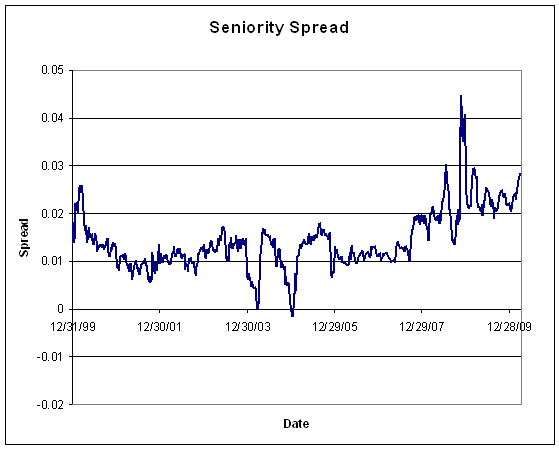
PerpetualDiscounts now yield an average 5.95%, equivalent to 8.33% interest at the standard equivalency factor of 1.4x. Long Corporates continue to yield about 6.0%, so the pre-tax interest-equivalent spread (also referred to as the Seniority Spread) is about 235bp, slightly tighter than the 240bp reported on November 4.

HIMIPref™ Preferred Indices
These values reflect the December 2008 revision of the HIMIPref™ Indices

Values are provisional and are finalized monthly
Index Mean
Current
Yield
(at bid)
Median
YTW
Median
Average
Trading
Value
Median
Mod Dur
(YTW)
Issues Day’s Perf. Index Value
Ratchet 0.00 % 0.00 % 0 0.00 0 0.4451 % 1,489.2
FixedFloater 6.21 % 4.31 % 45,434 18.42 1 0.0571 % 2,508.6
Floater 2.62 % 3.10 % 93,865 19.43 3 0.4451 % 1,860.5
OpRet 4.80 % -5.92 % 117,476 0.09 14 -0.0027 % 2,308.3
SplitShare 6.32 % 3.40 % 370,141 0.08 2 0.2840 % 2,093.1
Interest-Bearing 0.00 % 0.00 % 0 0.00 0 -0.0027 % 2,110.8
Perpetual-Premium 5.88 % 5.54 % 70,447 1.16 4 0.0595 % 1,862.3
Perpetual-Discount 5.90 % 5.95 % 185,887 13.93 70 0.1342 % 1,756.9
FixedReset 5.49 % 4.09 % 398,087 3.96 41 0.0154 % 2,125.7
Performance Highlights
Issue Index Change Notes
RY.PR.D Perpetual-Discount 1.02 % YTW SCENARIO
Maturity Type : Limit Maturity
Maturity Date : 2039-11-11
Maturity Price : 19.90
Evaluated at bid price : 19.90
Bid-YTW : 5.68 %
TRI.PR.B Floater 1.03 % YTW SCENARIO
Maturity Type : Limit Maturity
Maturity Date : 2039-11-11
Maturity Price : 19.60
Evaluated at bid price : 19.60
Bid-YTW : 2.02 %
MFC.PR.C Perpetual-Discount 1.09 % YTW SCENARIO
Maturity Type : Limit Maturity
Maturity Date : 2039-11-11
Maturity Price : 19.46
Evaluated at bid price : 19.46
Bid-YTW : 5.88 %
IAG.PR.A Perpetual-Discount 1.11 % YTW SCENARIO
Maturity Type : Limit Maturity
Maturity Date : 2039-11-11
Maturity Price : 19.15
Evaluated at bid price : 19.15
Bid-YTW : 6.10 %
ELF.PR.F Perpetual-Discount 1.29 % YTW SCENARIO
Maturity Type : Limit Maturity
Maturity Date : 2039-11-11
Maturity Price : 19.65
Evaluated at bid price : 19.65
Bid-YTW : 6.84 %
Volume Highlights
Issue Index Shares
Traded
Notes
TRP.PR.A FixedReset 48,450 RBC crossed 25,000 at 25.43.
YTW SCENARIO
Maturity Type : Call
Maturity Date : 2015-01-30
Maturity Price : 25.00
Evaluated at bid price : 25.42
Bid-YTW : 4.37 %
RY.PR.A Perpetual-Discount 30,682 YTW SCENARIO
Maturity Type : Limit Maturity
Maturity Date : 2039-11-11
Maturity Price : 19.52
Evaluated at bid price : 19.52
Bid-YTW : 5.73 %
ELF.PR.G Perpetual-Discount 27,375 RBC crossed 25,000 at 17.65.
YTW SCENARIO
Maturity Type : Limit Maturity
Maturity Date : 2039-11-11
Maturity Price : 17.62
Evaluated at bid price : 17.62
Bid-YTW : 6.83 %
GWO.PR.E OpRet 26,569 RBC crossed 11,700 at 25.81.
YTW SCENARIO
Maturity Type : Call
Maturity Date : 2009-12-11
Maturity Price : 25.50
Evaluated at bid price : 25.81
Bid-YTW : -3.67 %
RY.PR.X FixedReset 24,144 YTW SCENARIO
Maturity Type : Call
Maturity Date : 2014-09-23
Maturity Price : 25.00
Evaluated at bid price : 27.56
Bid-YTW : 3.94 %
PWF.PR.I Perpetual-Discount 21,200 RBC crossed 20,000 at 24.67.
YTW SCENARIO
Maturity Type : Limit Maturity
Maturity Date : 2039-11-11
Maturity Price : 24.40
Evaluated at bid price : 24.72
Bid-YTW : 6.11 %
There were 16 other index-included issues trading in excess of 10,000 shares.
Contingent Capital

Merrill Keeps Lloyds ECNs out of UK Bond Indices

at least until the wind changes:

Bank of America Merrill Lynch (BAC.N) reversed its position for a second time on Wednesday to decide its bond indexes would not include new contingent capital securities, devised for UK bank Lloyds (LLOY.L).
On Tuesday the U.S. bank said it would include these new bonds in its benchmark indexes, but many investors objected.

“The preponderance of feedback that we have received from investors who are measured against our indices indicates that most do not view the new contingent capital securities as part of their investment universe,” Bank of America Merrill Lynch said in a research note.

The Association of British Insurers (ABI) said on Tuesday its members were against including these new securities in bond indexes.

BofA Merrill Lynch had originally planned not to include the new bonds in its indexes, but then changed its mind on Tuesday.

“We have decided to evaluate the new securities on their own merits and will revert to our original decision to exclude them from the indexes,” Merrill’s research note said.

The note also said the bank would review all bank Tier 1 debt – the lowest ranking bank bond that has equity-like features – currently in the index to determine if there are, in fact, other securities that should be removed from the index.

No decision has been made yet for the iBoxx indexes, a leading benchmark in the investment grade arena, said Markit, which runs the indexes.

Markit’s oversight committee, made up of asset managers, regulators and consultants, is expected to meet next Tuesday to discuss a recommendation on this issue, Markit said.

Barclays Capital has already decided that contigent capital securities that are convertible to equity will not be eligible for broad-based investment-grade Barclays Capital bond indexes such as the Global Aggregate, Sterling Aggregate and US Aggregate indexes.

The new securities would also not be eligible for the bank’s high-yield benchmark indexes, but might be eligible for Barclays Capital Convertible Bond indexes, provided they meet inclusion rules, Barclays said.

I reported last week that UK authorities were promoting inclusion with the presumed purpose of widening the investor pool.

Two amusing things about this article are, firstly: “We have decided to evaluate the new securities on their own merits” which the smiley-boys at Merrill consider to be worthy of note, and secondly, that the stated reasons for exclusion have nothing whatsoever to do with whether these notes are bonds are not.

Can the issuer avoid bankruptcy while being a day late or a dollar short in their payments? No? Then it isn’t a bond.

Update: For all that, the issue is popular:

Lloyds Banking Group said yesterday that it may increase its capital-raising by £1.5 billion to £22.5 billion because of a clamour by investors to take up its offer to swap debt into equity.

Shares in the beleaguered banking group rose 5 per cent to 89¼p on the latest positive signal from the bank.

Investors are flocking to take up Lloyds’ offer to convert their tier 1 and tier 2 debt into new “contingent capital” because it will guarantee them an income of possibly 10 per cent or more in an annual coupon.

Issue Comments

ASC.PR.A: DBRS Discontinues Rating

DBRS has announced that it:

has today discontinued its rating of the Preferred Shares issued by AIC Global Financial Split Corp. at the request of AIC Limited (the Promoter).

The NAV was 11.16 as of November 6 according to Manulife Financial.

ASC.PR.A was last mentioned on PrefBlog when it was upgraded to Pfd-5 by DBRS. ASC.PR.A is tracked by HIMIPref™ but is relegated to the Scraps subindex on credit concerns.

Market Action

November 10, 2009

The question of whether central banking and bank regulation functions should be separated or not is heating up again in the States:

Senator Christopher Dodd will propose creating a single U.S. regulator that would strip the Federal Reserve and Federal Deposit Insurance Corp. of bank- supervision authority, said a person familiar with the matter.

Dodd, chairman of the Senate Banking Committee, would eliminate the Office of the Comptroller of the Currency and the Office of Thrift Supervision and fold the Treasury Department units into the new bank regulator, according to the person, who spoke on condition of anonymity because the plan isn’t public. The Connecticut Democrat is scheduled to release a draft of his financial-regulation overhaul plan today in Washington.

Deutsche Bank sees a big increase in hedge fund assets coming:

Hedge fund assets may top the previous $2 trillion high by the end of next year as double-digit average returns lure investors, said Barry Bausano, Deutsche Bank AG’s global co-head of prime finance.

Hedge fund assets parked with Deutsche Bank have risen recently and global investors plan to allocate new capital next year, New York-based Bausano said during a visit to Hong Kong on Nov. 6. His division provides services and products ranging from securities lending to financing and derivatives to the industry.

As the banks retreat – and are forced away, like Citigroup / Philbro – from proprietary trading, I think it entirely reasonable to suppose that hedge funds will take their place. Naturally, there are all kinds of hedge funds, just as there are all kinds of investment manager: most of the principals will just be jumped-up stockbrokers, but some of them will know what they’re doing.

I am pleased to see Dealbreaker taking a stand against lousy programming practices, but I can’t help feeling that it’s more complex than they state. Surely writing wrappers around external APIs, formats and codes is standard?

Integrity. Character. Forthrightness. These are the regulatory buzzwords today. And Senator Dodd (STASI, Connecticut) will lead the way to Nirvana:

Securities and Exchange Commission employees would get $50,000 awards for snitching on each other, under Senate Banking Committee Chairman Christopher Dodd’s proposed legislation to overhaul financial regulation.

Ralph Cioffi and Matthew Tannin, whose hedge fund at Bear Stearns collapsed and presaged the onset of the credit crunch, are not guilty:

A jury of eight women and four men deliberated less than a day before reaching a verdict this afternoon. Cioffi, 53, the portfolio manager for the hedge funds, and Tannin, 48, their chief operating officer, went on trial Oct. 13 in federal court in Brooklyn, New York, on charges of conspiracy, securities and wire fraud. Each faced as many as 20 years in prison if convicted. When the verdicts were read, the two men didn’t visibly react. Their wives burst into tears.

Juror Aram Hong said e-mails sent by Cioffi and Tannin showed that the men were working “24-7” to save the funds in the months before they collapsed.

“Just because you’re the captain of a ship and it gets hit doesn’t mean you should be blamed,” Hong said.

I have had no opinion on their guilt or innocence. There have been, and will be, convictions by the barrel related to the crisis; there’s always crime. But I also know that the US justice system is extraordinarily vindictive, that bursting into tears is ex-post de rigeur when things go wrong, that prosecutors are desperate for scalps to brandish during their next electoral campaign, and that the (shielded) regulators are desperate to divert attention from their own incompetence (who’s gone to jail for missing Madoff? Not criticized, not demoted, not fired … I want to know who has been charged with a criminal offense. Nobody? Golly, what a surprise). So I’m pleased by the verdict.

Another good strong day for preferreds, with PerpetualDiscounts gaining 19bp and FixedResets picking up 18bp. Volume recovered to good levels (GWO issues were a highlight), but I suspect that to get things really moving again we need more issuance.

HIMIPref™ Preferred Indices
These values reflect the December 2008 revision of the HIMIPref™ Indices

Values are provisional and are finalized monthly
Index Mean
Current
Yield
(at bid)
Median
YTW
Median
Average
Trading
Value
Median
Mod Dur
(YTW)
Issues Day’s Perf. Index Value
Ratchet 0.00 % 0.00 % 0 0.00 0 -0.3106 % 1,482.6
FixedFloater 6.21 % 4.31 % 46,936 18.41 1 1.4493 % 2,507.1
Floater 2.63 % 3.10 % 94,948 19.44 3 -0.3106 % 1,852.2
OpRet 4.80 % -7.88 % 119,068 0.09 14 0.1337 % 2,308.4
SplitShare 6.34 % 6.40 % 383,562 3.90 2 0.0875 % 2,087.2
Interest-Bearing 0.00 % 0.00 % 0 0.00 0 0.1337 % 2,110.8
Perpetual-Premium 5.89 % 5.82 % 73,297 1.16 4 -0.1287 % 1,861.2
Perpetual-Discount 5.91 % 5.95 % 188,414 13.93 70 0.1894 % 1,754.6
FixedReset 5.49 % 4.06 % 400,266 3.96 41 0.1849 % 2,125.4
Performance Highlights
Issue Index Change Notes
SLF.PR.C Perpetual-Discount -1.22 % YTW SCENARIO
Maturity Type : Limit Maturity
Maturity Date : 2039-11-10
Maturity Price : 18.62
Evaluated at bid price : 18.62
Bid-YTW : 6.07 %
MFC.PR.C Perpetual-Discount 1.05 % YTW SCENARIO
Maturity Type : Limit Maturity
Maturity Date : 2039-11-10
Maturity Price : 19.25
Evaluated at bid price : 19.25
Bid-YTW : 5.95 %
MFC.PR.A OpRet 1.10 % YTW SCENARIO
Maturity Type : Call
Maturity Date : 2010-07-19
Maturity Price : 26.25
Evaluated at bid price : 26.64
Bid-YTW : 2.56 %
GWO.PR.I Perpetual-Discount 1.10 % YTW SCENARIO
Maturity Type : Limit Maturity
Maturity Date : 2039-11-10
Maturity Price : 19.26
Evaluated at bid price : 19.26
Bid-YTW : 5.93 %
BAM.PR.G FixedFloater 1.45 % YTW SCENARIO
Maturity Type : Limit Maturity
Maturity Date : 2039-11-10
Maturity Price : 25.00
Evaluated at bid price : 17.50
Bid-YTW : 4.31 %
IAG.PR.C FixedReset 1.83 % YTW SCENARIO
Maturity Type : Call
Maturity Date : 2014-01-30
Maturity Price : 25.00
Evaluated at bid price : 27.85
Bid-YTW : 3.48 %
Volume Highlights
Issue Index Shares
Traded
Notes
GWO.PR.J FixedReset 355,000 TD crossed blocks of 135,000 and 100,000 shares at 27.10; RBC crossed 100,000 at the same price.
YTW SCENARIO
Maturity Type : Call
Maturity Date : 2014-01-30
Maturity Price : 25.00
Evaluated at bid price : 27.10
Bid-YTW : 4.02 %
GWO.PR.E OpRet 238,659 TD crossed 25.80 at 206,200; then sold 19,500 to Nesbitt at 25.81.
YTW SCENARIO
Maturity Type : Call
Maturity Date : 2009-12-10
Maturity Price : 25.50
Evaluated at bid price : 25.82
Bid-YTW : -4.28 %
GWO.PR.X OpRet 162,274 Nesbitt crossed blocks of 25,000 and 120,000 shares, both at 26.05.
YTW SCENARIO
Maturity Type : Soft Maturity
Maturity Date : 2013-09-29
Maturity Price : 25.00
Evaluated at bid price : 26.01
Bid-YTW : 3.85 %
MFC.PR.D FixedReset 141,609 Nesbitt crossed 100,000 at 27.85, then 30,000 at the same price.
YTW SCENARIO
Maturity Type : Call
Maturity Date : 2014-07-19
Maturity Price : 25.00
Evaluated at bid price : 27.92
Bid-YTW : 4.12 %
TD.PR.E FixedReset 115,100 RBC crossed three blocks, two of 25,000 and one of 15,000 shares, all at 27.25; Scotia crossed 11,300 at 27.25 then bought 22,900 from National at the same price.
YTW SCENARIO
Maturity Type : Call
Maturity Date : 2014-05-30
Maturity Price : 25.00
Evaluated at bid price : 27.30
Bid-YTW : 4.12 %
BNS.PR.X FixedReset 103,110 RBC crossed 100,000 at 27.50.
YTW SCENARIO
Maturity Type : Call
Maturity Date : 2014-05-25
Maturity Price : 25.00
Evaluated at bid price : 27.47
Bid-YTW : 3.97 %
There were 39 other index-included issues trading in excess of 10,000 shares.