Interesting External Papers

Transaction Costs In US Corporate Bonds

A Bloomberg piece titled How to Lose $667 Million in Bond Trades Without Trying discusses why stupid and lazy portfolio managers underperform:

Bond investors can waste a lot of money and not even know it.

They lost about $667 million in the year ended March 31 by paying higher prices for corporate bonds that were available at lower prices elsewhere, according to September research by Larry Harris, a business professor at the University of Southern California.

In most of the deals the investors simply did not know that the lower prices existed because they rely on human traders to tell them the value of bonds at any given moment before they make a trade. (Not to mention the salaries they need to pay those brokers to work the phones to find out who holds what and who might want to sell.)

The author, Lisa Abramowicz, mentions regulatory efforts to destroy the corporate bond market:

So far, the Securities and Exchange Commission is only encouraging big bond firms to use electronic marketplaces more frequently so that investors have an easier way to see market prices in real time.

But if that doesn’t work, regulators may take more invasive measures to streamline the playing field and make it cheaper to do business in the $8 trillion market for U.S. company bonds.

Regardless of what the SEC might do, it makes sense for Wall Street banks to work together to find a more efficient way to trade bonds because it may be the best for their bottom lines.

All this is interesting in light of the pending crippling of the Canadian corporate bond market discussed last week. Ms. Abramowicz buttresses her views – and regulators are virtually certain to follow her – by referencing a recent paper by Lawrence Harris of the University of Southern California titled Transaction Costs, Trade Throughs, and Riskless Principal Trading in Corporate Bond Markets:

This study analyzes the costs of trading bonds using previously unexamined quotations data consolidated across several electronic bond trading venues. Much bond market trading is now electronic, but the benefits largely accrue to dealers because their customers often do not trade at the best available prices. The trade through rate is 43%; the riskless principal trade (RPT) rate is above 42%; and 41% of customer trade throughs appear to be RPTs. Average customer transaction costs are 85 bp for retail-size trades and 52 bp for larger trades. Estimated total transaction costs for the year ended March 2015 are above $26 billion, of which about $0.5 billion is due to trade-through value while markups on customer RPTs transfer $0.7M to dealers. Small changes in bond market structure could substantially improve bond market quality.

The problem, as is usual with this type of paper, lies in the assumption of the very first sentence of the introduction:

Brokers are supposed to obtain the best available prices for their clients.

In virtually all cases in the bond market, the dealer is acting as principal. It is not just his privilege, but his job to leave his counterparties naked, hungry and freezing. This fundamental misstatement of the facts of the transaction persists throughout the paper. Particularly disgusting is the claim:

Although this transaction might not strictly be a trade through (it would not be if the broker-dealer exhausts all the size at the quoted price), the broker-dealer clearly is front-running the customer order, though not necessarily illegally.

Front-running is a breach of trust and can occur only when the intermediary is an agent of the trade initiator, therefore having a fiduciary responsibility to the initiator. The concept does not apply to trades executed as principal.

Another problem is with his definition of “transaction costs”:

I estimate the cost of trading for the side that initiated the trade by first identifying that side, and then by comparing the trade price to the quote midpoint price.

This definition makes dealer markups appear worse than they actually are.

Markups and commissions both contribute to transaction costs. Markups are incorporated in the price whereas commissions are tacked onto the price. Both allow brokers to recover the costs of arranging trades, and presumably all other costs of providing trading services to their clients.

Markups differ from commissions because broker-dealers generally do not fully disclose markups to their clients.

They also differ from commissions in that commissions apply to agency trades while markups apply to principal trading.

Even when broker-dealers fully disclose the nature of their relationships with their clients—that they are acting as principle [sic] and not as agent—many clients may not recognize the distinction and its implications. The distinction can be difficult to recognize when the broker-dealer sometimes acts as broker and sometimes as dealer, a process commonly called dual trading.

If clients do not recognize the distinction then they should not be trading. Traders in the institutional market will almost always be professionals and will have passed numerous proficiency tests set by the regulators. If retail traders want to play with the big boys and trade individual bonds themselves, they should recognize that step one is learning the rules of the game.

I will admit to long-term confusion over this whole concept of “fairness” and “equal access” as used by the regulators and rabble-rousers. Why are these things considered important points when discussing market structure? Are hospitals required to make operating rooms fairly accessible to DIY brain surgeons?

In his literature review, he (not surprisingly) refers to a number of papers I have discussed on PrefBlog before:

Biais and Green (2007) show that exchange-listed bond trading was quite liquid in municipal bonds before the late 1920s and in corporate bonds before the mid-1940s, and that transaction costs then were lower than they are now. The proliferation of electronic bond trading systems has the potential to substantially lower bond transaction costs, presumably to levels lower than Biais and Green document given the well-known economic efficiencies associated with electronic trading. Harris (2015) provides a survey of these efficiencies.

Well, that’s an inflammatory paragraph, isn’t it? But I reviewed Biais and Green in the post Exchange Traded Bonds? (emphasis added):

The third possibility [for the collapse of the exchange market] is due to the interaction of groups with differing objectives in a heterogeneous market:

Different equilibria will vary in terms of their attractiveness for different categories of market participants. Intermediaries benefit when liquidity concentrates in venues where they earn rents, such as opaque and fragmented markets. For reasons we will show were quite evident to observers at the time, large institutional investors fare better than retail investors in a dealership market. This was especially true on the NYSE until 1975, because commissions were regulated by the Constitution of the Exchange, while intermediary compensation was fully negotiable on the OTC market. We find that liquidity migrated from the exchange to the OTC market at times when institutional investors and dealers became more important relative to retail investors. As institutions and dealers became more prevalent in bond trading, they tipped the balance in favor of the over-the-counter markets.

Unlike many writers on this topic, Biais and Green show some understanding of the competing interests that determine market microstructure:

More Biais & Green:

Furthermore, the professionalized management and relatively frequent presence in the market of institutions makes transparency less important to them than to less sophisticated small investors who trade infrequently. The repeated interaction that dealers and institutions have with each other renders them less vulnerable to the opportunities which a lack of transparency affords other participants to profit at their expense on a one-time basis. Smaller institutions and individuals, for the opposite reasons, will tend to fare better in an exchange-based trading regime. Indeed, the theoretical model of Bernhardt et al (2005) shows that, in a dealer market, large institutions will trade more frequently and in larger amounts than retail investors, and incur lower transactions costs.(footnote)

Footnote: Bernhardt et al (2005) also offer an interesting empirical illustration of these effects in the case of the London Stock Exchange.

there was a dramatic increase in institutional ownership in corporate bonds between 1940 and 1960. In the 1940s the weight and importance of institutional investors in the bond market grew tremendously. These investors came to amount for the majority of the trading activity in the bond market. Naturally, they chose to direct their trades to the OTC market, where they could effectively exploit their bargaining power, without being hindered by reporting and price priority constraints, and where they could avoid the regulated commissions which prevailed on the Exchange. Thus, the liquidity of the corporate bond market migrated to the dealer market.

Having cited Biais and Green, we may assume that Dr. Harris is familiar with these details, but he has chosen to ignore them in his efforts to increase market regulation.

One important point that goes against the thrust of the paper is the fact that:

The quotes used in this study are not generally available to the public, though they are available to IB’s customers in real-time.

Zitzewitz (2010) identifies RPTs, which he calls “trade pairing,” in the TRACE data using similar methods to those presented in this study. He finds that RPTs are very common (46% of trades under $100,000) and that they are mostly small trades. These results are similar to those obtained in this study.

Interactive Brokers serves as an agency-only broker for its clients. To facilitate their bond trades, IB collects pre-trade quotes and indications from several electronic trading platforms that offer automated execution services. These bond market centers include BondDesk, BONDLARGE, Knight BondPoint, NYSE Arca Bonds, and Tradeweb, and a few other centers that specialize only in municipal bonds or treasuries.13 None of these platforms provides universal coverage of all bonds that trade in the U.S. corporate bond markets. IB presents the quoted prices and sizes to its customers in real-time just as it and other brokers do for stocks, options, and futures.

IB reported to me that during the week ended September 10, 2015, they obtained complete fills for about 83% of its customers’ marketable orders and that they did not receive any cancellations after filling. This statistic indicates that a substantial fraction of the quoted and indicated prices that IB records are actionable.

The fact that all these quotes are available to anybody who signs up with Interactive Brokers shows that no regulatory changes are necessary. Anybody who wants to access these electronic quotes can do so. I see no problem here.

Dr. Harris does acknowledge the differing sizes of the retail and institutional trades:

Practitioners and academics often label trades with par values of $100,000 or less as retail-size trades, and larger trades as institutional-size trades. Many trades are relatively small retail-size trades. During the Primary Period, 67.3% of the trades in the full sample are retail-size trades (Table 9). Retail-size trades represent a slightly larger fraction (69.7%) in the subset sample. The median par value size of the retail-size trades is $18,000 in both samples.

The median trade size for institutional-size trades is $500,000 in both samples. The percentages of trades reported with indicators for par value sizes of $1,000,000 (speculative grade bonds) and $5,000,000 (investment grade bonds) or more are 4.6% and 1.3% in the full sample and about the same in the subset sample. Assuming that the actual size of these trades is equal to their minimum possible sizes of $1,000,000 and $5,000,000, the truncated mean par value trade size for all institutional-size trades is $908K and $953K in the two samples.

Among trades of a given size class, interdealer trades represent the smallest percentage of the largest class—those trades marked 5MM+ (13.1%). Many of these large trades probably are agency trades in which broker-dealers, acting as brokers, intermediate trades between customer buyers and sellers. In contrast, interdealer trades account for 40.8% of retail-size trades. The results in Section 7 show that many of these trades are riskless principal trades.

Of particular interest is the discussion of Table 19:

Most (82.3%) of the customer trade throughs are retail-size trades (Table 19). The mean price improvement for these trades is -93 bp, nearly a 1% markup. These markups seem quite large for relatively easy-to-arrange trades that can be arranged electronically. The total trade-through value for the retail trades is $74M. The mean price dis-improvement is smaller for institutional trades that traded through. Although these institutional trades are much larger, the total trade-through value is relatively small because these trades outsize the quotes. The average ratio of quote size to trade size is only 1.2% for institutional size trades in comparison to 28% for retail-size trades.
….
Standing quote to trade size ratio is the ratio of the opposing side quote size to the trade size.

So if I’m reading this correctly, the average size of a “trade-through” trade is four times the size of the quote, even when we restrict the sampling to retail sized trades (which average $18M, remember!). So these are itsy-bitsy little quotes and the “markups” calculated with respect to trade-through value would seem to be more of a market-impact cost than an extortionate dealer mark-up.

The number reported in the Bloomberg article comes from the introduction:

I find that average transaction costs that customers incur when trading range between 84.5 bp for retail size trades (under $100,000 in par value) and 52.1 bp for larger trades. These costs are several times larger than costs for similar size trades in equity markets. Trades occurring in markets with two-sided quotes that have stood at least two seconds trade through 46.8% of those markets; 40.8% of these trade throughs appear to be riskless principal transactions—trades for which the dealer has no inventory risk exposure usually because the dealer simultaneously offsets a trade with a customer with an interdealer trade. RPT transactions account for more than 41.7% of all trades. Total transaction costs borne by customers in U.S. corporate bond markets for the year ended March 31, 2015 are at least $26B, of which about $0.5B is due to trade-through value. During this period, markups on customer RPTs transferred $667M to dealers.

OK, so now we get to the good part, which is Dr. Harris’ Section 10.1, Public Policy Recommendations:

Many reasons explain why transaction costs are higher in bond markets than in stock markets. The most common explanation is that so many different bond issues make matching buyers to sellers difficult. This explanation certainly is true for the inactively traded bonds, but many bonds trade as actively as do small- and some mid-cap stocks, and they would undoubtedly trade much more actively if transaction costs were lower. Customers would benefit if the 850 bonds that are quoted nearly continuously were traded in market structures more similar to equity markets than the current OTC markets.

The problem with this paragraph is that much of it has not been supported by prior argument. Which stocks trade about as actively as which bonds, and what is the bid-offer spread on these stocks? How much size is there in these markets? Let us turn briefly to a speech by SEC Commissioner Luis A. Aguilar titled The Need for Greater Secondary Market Liquidity for Small Businesses:

In addition, it’s been reported that venture exchanges—both here and abroad—have suffered from low liquidity and, at times, high volatility.[19] This means investors could lose a lot of money quickly, and could have trouble selling their shares in a downturn. The Commission should attempt to determine the underlying causes of these problems and how best to address them. In this regard, we may need to ask some difficult questions. For example, should venture exchanges be structured as dealer markets, rather than auction markets? Also, could venture exchanges enhance liquidity through batch auctions, rather than continuous trading? How can the Commission, consistent with the Exchange Act, encourage traders to execute transactions on venture exchanges, rather than in off-exchange venues?[20] And, finally, could larger ticker sizes enhance liquidity by encouraging market maker activity and fostering research coverage? In this regard, the Commission’s proposed tick size pilot program[21] may offer valuable insights on the role of tick sizes in ensuring an active secondary market for smaller companies.

So for at least some of these smaller issues there are musings about possibly moving the other way – from exchange trading to a dealer market! We can also look at the fascinating Table 2 from the SEC’s report A characterization of market quality for small capitalization US equities:

smallCapLiquidity
Click for Big

Given that most bond issues will be smaller than the largest equities on this table and that bonds trade less intensively than equities, it is clear that that a Dr. Harris needs to support his recommendation in considerably more detail than he has in this paper. As an aside, I think he needs to explain his tables a little better! I can’t figure out what 850 bonds he’s talking about in his Table 11! And when he’s talking about “size”, I don’t know if he’s talking about dollar value, multiples of 100, or multiples of 1000 … I suspect he means multiples of 100, but it’s certainly not very clear!

Another recommendation is:

The SEC also should consider enacting a trade through rule for bonds similar to that in Reg NMS (for equities) that would require that broker-dealers access electronically available orders when filling orders for their clients before trading through. The SEC may want to do so before a class-action lawsuit based on common law agency principles effectively imposes a Manning Rule for bonds similar to FINRA Rule 5320 (Prohibition Against Trading Ahead of Customer Orders) for equities

Well, I’m not going to pretend to know anything about the Manning Rule, or the chances that a class-action lawsuit might have! However, I will point out that while this might well apply to dealers acting as brokers, it does not apply to dealers acting as principal.

Dr. Harris suggests:

At the minimum, FINRA or the SEC should require that brokers disclose their markup rates on RPTs on a pre-trade basis as they do with their commission rates.34 Since the two rates are perfect substitutes for each other, investors would be less confused if one rate were simply set to zero. This brokerage pricing standard would ensure that brokers would compete on the same basis for order flow. Since customers understand commissions much better than they understand markups, simply banning markups on RPTs would be best. Such a ban would have no effect on competition because dealers could always raise their commissions to compensate for their lost markups. Their customers then would know the full cost of the intermediation services that they obtain from their brokers.

Readers who have gotten this far will know that I am going to object to the assertion that commissions and markups are equivalent – the former applies to brokerage and the latter to principals. I will also note that while full-service commissions are highly variable and considered top-secret, 1% for equity trades is a good place to start. The comparisons here appear to be with equity transactions via a discount brokerage, which is a different kettle of fish.

Update, 2015-9-27: I note from Rob Carrick’s fee project:

Two ways of paying for investing advice aren’t covered in depth by our calculator. One is the transactional model, where you pay commissions to trade securities. The investment industry consulting firm PriceMetrix says the average commission last year was 0.99 per cent of the cost of the trade.

Now back to Dr. Harris:

Finally, a rule that would require brokers to post limit orders of willing customers to venues (order display facilities) that widely disseminate these prices would help prevent many trade throughs. Many trade throughs undoubtedly happen simply because traders are unaware of better prices. Such a rule likely would substantially increase such offers of liquidity, especially if implemented in conjunction with a trade-through rule. These order display facilities could be existing exchanges and ATSs, or new ones formed for this purpose.

This follows from the idea that bond dealers act as brokers and the marketplace is an exchange.

If the SEC fails to take these actions, and if no class-action suit is successful, the markets will continue to improve as innovators such as IB continue to capture order flow by creating their own NBBOs. But it may be many years before most customers become sophisticated enough to demand these facilities from their brokers, if they ever do, and some brokers may never offer these facilities, either because their customers are not well enough informed or because their customers suffer various agency problems, including the problems associated with payments for order flow.

It’s the profitability of ‘innovators such as IB’ that makes the debate unnecessary. Let competition reign – particularly since for small investors the real competition is ETFs and funds.

With respect to trading, bonds are securities just like equities, only less risky. U.S. corporate and municipal bonds presently trade differently for historic reasons. They need not trade differently in the future. U.S. Treasury bonds and corporate bonds in several well developed countries trade in substantially more transparent markets that do corporate and municipal bonds in the U.S. presently do. The quality of these markets shows that opaque markets are not necessary for fixed income securities.

This paragraph is not supported by the text and ignores the work that has been done on market microstructure as it relates to market-depth and transparency.

Finally, note that the creation of more liquid markets will benefit issuers as well as customers. Investors are more willing to buy securities in the primary markets when they expect that they can sell them easily at low cost in the secondary markets. Low secondary trading costs thus imply higher bond IPO values, and lower corporate funding costs.

While it’s nice to see a nod to the interests of issuers, the evidence actually goes the other way. In the Bessembinder paper I reviewed in the post TRACE and Corporate Bond Market Transparency, it is shown that increased transparency caused a migration to less transparent “144a” structures, which are private placements:

One way to circumvent TRACE, which applies to publicly-issued bonds, is for a firm to issue privately placed bonds (sometimes referred to as Rule 144a securities, for the section of the Securities Act of 1933 that provides exemption from registration requirements). … In 2001, before TRACE, “144a for life” bonds were 7.3 percent of dollar volume and 9.6 percent of issues. The percentage of dollar volume in “144a for life” bonds jumped to 27.8 percent in 2003, the first full year after TRACE initiation, and grew to 39.8 percent in 2004, before declining to 16.9 percent in 2006.…
Also consistent with a shift towards alternative asset classes, the credit default swap market experienced phenomenal growth in recent years relative to bonds. Table 6 reports on outstanding notional principal in these credit default swaps, which grew from $919 billion in 2001 to $34.4 trillion in 2006. One dealer suggested to us that, prior to TRACE introduction, ten times as much capital was allocated to corporate bond trading than to credit default swaps, but that the ratio has now been reversed.

To the extent that the shift to privately placed bonds and bank loans was initiated by corporate borrowers, and in response to TRACE, it suggests that the net costs of TRACE may exceed the benefits….

All in all, it’s an interesting paper and a good reminder that corporate bond trades should ensure they have independent access to electronic marketplaces … but note that if a dealer is sitting on a stack of inventory he’s willing to sell at 102.00, then sees all the offers below 102.00 disappear, he’s probably going to raise his price! But the data needs to be presented with more explanation in the tables and the advocacy should be taken out and used elsewhere; in addition, more account needs to be taken of previous work on market microstructure and the interests of issuers which, I assert, must be paramount when contemplating changes to the system.

Market Action

September 22, 2015

Well, here’s another nail in Keystone’s coffin:

Ending years of declining to take a side on the issue because of her role in the Obama administration, Hillary Clinton on Tuesday announced her opposition to the construction of the Keystone XL oil pipeline.

“I don’t think we need to have a pipeline bringing very dirty oil, exploiting the tar sands in western Canada, across our border,” she told the Des Moines Register’s editorial board.

At a town hall in Des Moines beforehand, she expressed an eagerness to end the debate over Keystone, which had become a “distraction” from the broader fight against climate change. “I don’t think it’s in the best interest of what we need to do to combat climate change, ” she said in response to a question from a Drake University student.

Power Corporation, proud issuer of myriad preferred shares issues, has been confirmed at Pfd-2(high) by DBRS:

DBRS Limited (DBRS) has today confirmed the Senior Debt as well as the Non-Cumulative First Preferred Shares and Cumulative Redeemable First Preferred Shares, 1986 Series ratings of Power Corporation of Canada (POW or the Company) at A (high) and Pfd-2 (high), respectively. The trend on the ratings remains Stable. The credit strength of POW is directly tied to its 65.6% equity interest in Power Financial Corporation (PWF), which represents a substantial majority of the Company’s earnings and cash flow as well as the vast majority of the Company’s estimated net asset value. The Senior Debt rating of the Company is A (high) or one notch below the AA (low) rating on the Senior Debentures of PWF, reflecting the structural subordination of the holding company’s obligations.

Should PWF be upgraded, then POW could also benefit. Conversely, a shift in the Company’s risk profile resulting from a major divestiture or acquisition, a material increase in financial leverage or increased adoption of double leverage, deteriorating earnings and prolonged distress at the major operating subsidiaries, a downgrade of the rating of Great-West Lifeco Inc. (GWO) or PWF, or evidence of governance and control difficulties could have negative rating implications.

Similarly, Power Financial Corporation, issuer of myriad preferred share issues of its own, was confirmed at Pfd-1(low) by DBRS:

DBRS Limited (DBRS) has today confirmed the Issuer Rating and Senior Debentures rating of Power Financial Corporation (PWF or the Company) at AA (low), along with the Non-Cumulative First Preferred Shares and Cumulative First Preferred Shares (Series A) ratings at Pfd-1 (low). All trends remain Stable. The Company’s ratings are largely derived from its controlling interests in two of Canada’s leading financial service providers: Great-West Lifeco Inc. (GWO; Senior Debt rated AA (low) by DBRS), one of the three largest life insurance concerns in Canada, and IGM Financial Inc. (IGM; Senior Debt rated A (high) by DBRS), one of the largest mutual fund complexes in Canada as measured by long-term assets under management (AUM).

These two interests, accounting for more than 90% of the Company’s earnings, dividends and asset value, are a source of stable recurring earnings and cash flow. Under the strategic leadership of the Company, both GWO and IGM have become increasingly diversified as they have grown, both organically and by acquisition. The Company has correspondingly increased its exposure to the wealth management business in all of its chosen geographies. Both of these subsidiaries in turn benefit from the Company’s hands-on governance and risk-averse culture.

PWF’s ratings currently reflect the ratings of its most highly rated subsidiary, GWO. Should GWO be upgraded, PWF could also benefit. Conversely, a material increase in unconsolidated financial leverage giving rise to deterioration in coverage ratios; any deterioration in the creditworthiness of a major operating subsidiary, particularly a downgrade of the rating of GWO; a shift in the Company’s risk profile resulting from a major divestiture or acquisition; or evidence of governance and control difficulties could have negative rating implications.

It was a poor day for the Canadian preferred share market, with PerpetualDiscounts down 27bp, FixedResets losing 57bp and DeemedRetractibles off 10bp. The Performance Highlights table is very long, dominated by losing FixedResets, with only one winner amongst the carnage. Volume was slightly below average.

For as long as the FixedReset market is so violently unsettled, I’ll keep publishing updates of the more interesting and meaningful series of FixedResets’ Implied Volatilities. This doesn’t include Enbridge because although Enbridge has a large number of issues outstanding, all of which are quite liquid, the range of Issue Reset Spreads is too small for decent conclusions. The low is 212bp (ENB.PR.H; second-lowest is ENB.PR.D at 237bp) and the high is a mere 268 for ENB.PF.G.

Remember that all rich /cheap assessments are:
» based on Implied Volatility Theory only
» are relative only to other FixedResets from the same issuer
» assume constant GOC-5 yield
» assume constant Implied Volatility
» assume constant spread

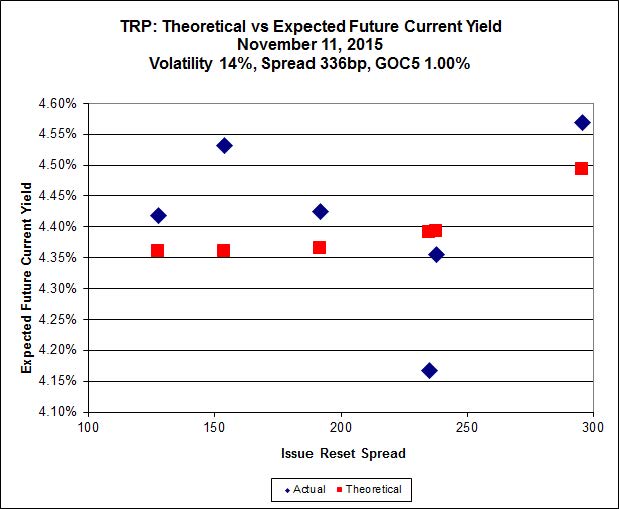
Here’s TRP:

impVol_TRP_150922
Click for Big

TRP.PR.E, which resets 2019-10-30 at +235, is bid at 19.85 to be $1.10 rich, while TRP.PR.C, resetting 2016-1-30 at +164, is $1.16 cheap at its bid price of 12.78.

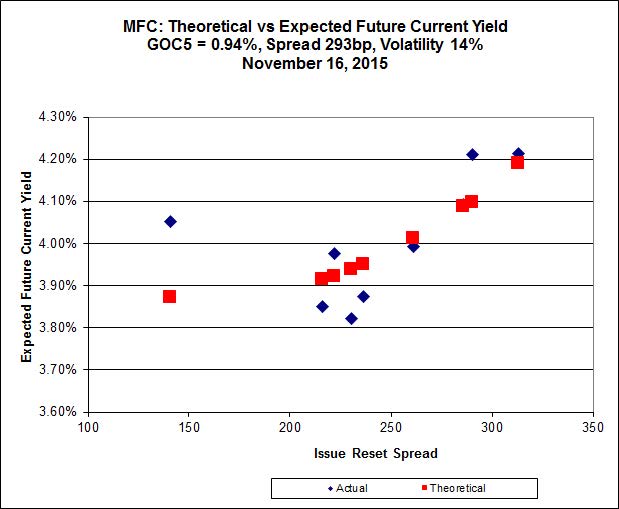
impVol_MFC_150922
Click for Big

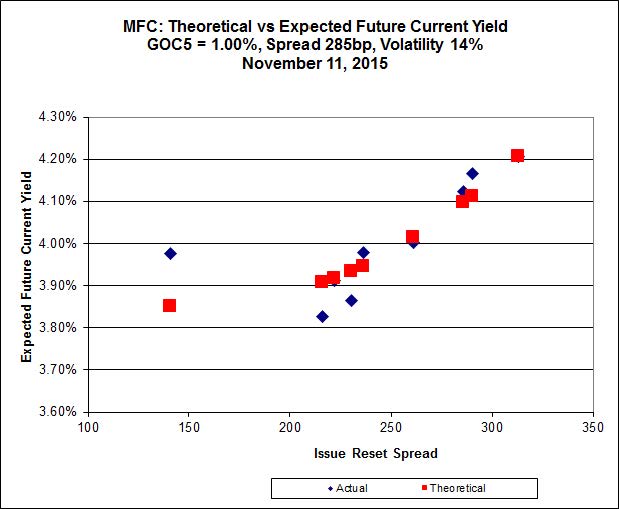
Another good fit today for MFC, with Implied Volatility falling significantly today.

Most expensive is MFC.PR.J, resetting at +261bp on 2018-3-19, bid at 22.65 to be 0.45 rich, while MFC.PR.G, resetting at +290bp on 2016-12-19, is bid at 22.91 to be 0.57 cheap.

impVol_BAM_150922
Click for Big

The fit on the BAM issues continues to be horrible.

The cheapest issue relative to its peers is BAM.PR.R, resetting at +230bp on 2016-6-30, bid at 16.70 to be $1.47 cheap. BAM.PF.G, resetting at +284bp on 2020-6-30 is bid at 22.45 and appears to be $1.15 rich.

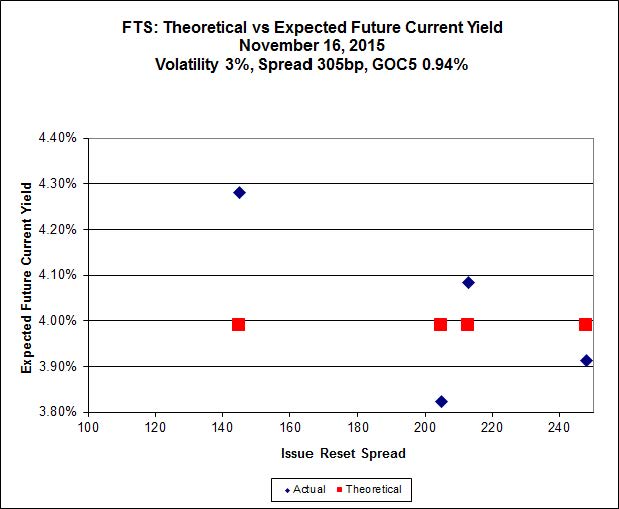
impVol_FTS_150922
Click for Big

FTS.PR.M, with a spread of +248bp, and bid at 21.90, looks $0.56 expensive and resets 2019-12-1. FTS.PR.G, with a spread of +213bp and resetting 2018-9-1, is bid at 18.70 and is $0.36 cheap.

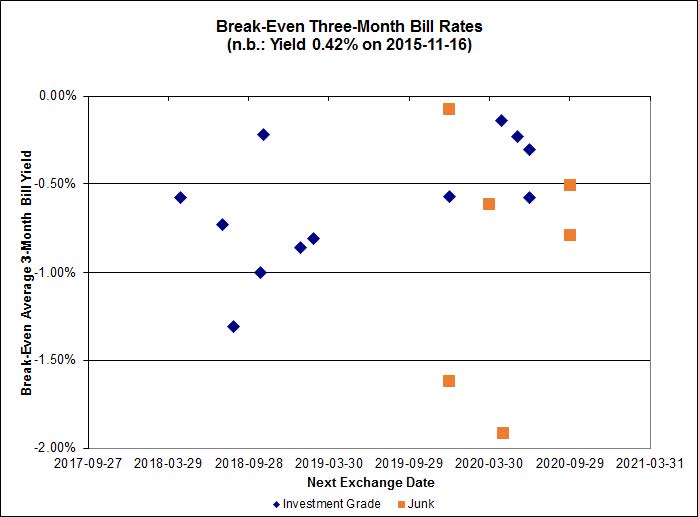
pairs_FR_150922
Click for Big

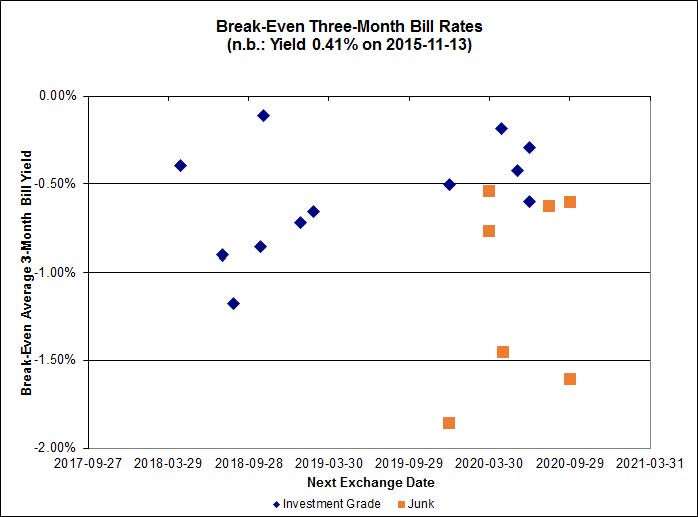
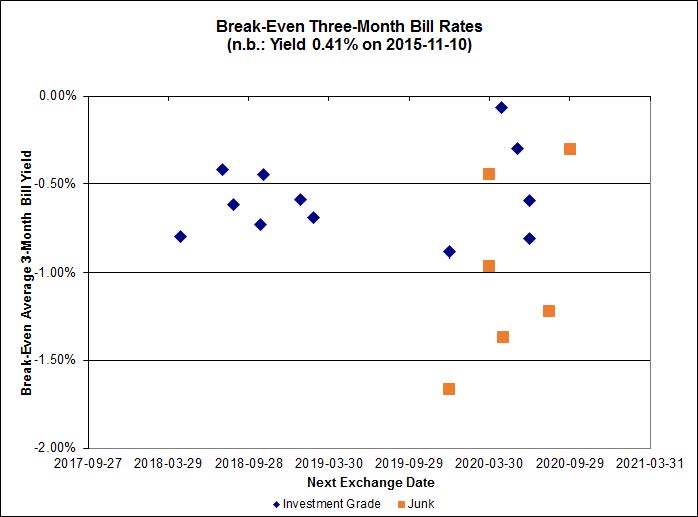
Investment-grade pairs predict an average three-month bill yield over the next five-odd years of -0.92%, with no outliers. The distribution’s bimodality has returned, with bank NVCC non-compliant pairs averaging -1.14% and other issues averaging -0.61%. There are two junk outliers above 0.00%.

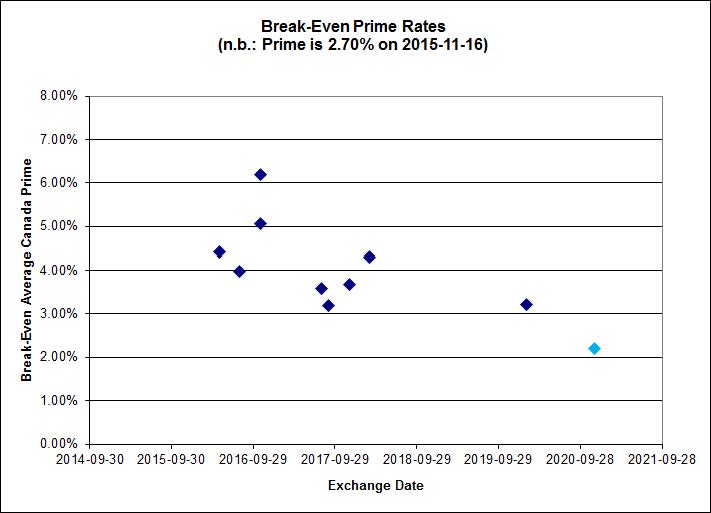
pairs_FF_150922
Click for Big

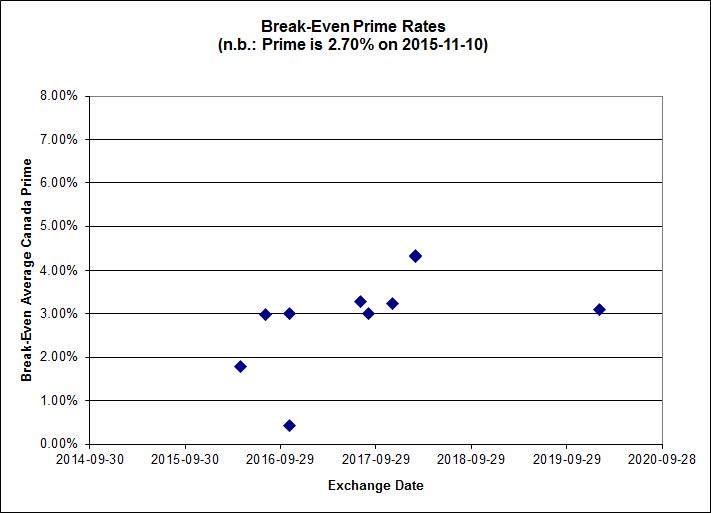
Shall we just say that this exhibits a high level of confidence in the continued rapacity of Canadian banks?

HIMIPref™ Preferred Indices
These values reflect the December 2008 revision of the HIMIPref™ Indices

Values are provisional and are finalized monthly
Index Mean
Current
Yield
(at bid)
Median
YTW
Median
Average
Trading
Value
Median
Mod Dur
(YTW)
Issues Day’s Perf. Index Value
Ratchet 0.00 % 0.00 % 0 0.00 0 0.0636 % 1,648.1
FixedFloater 0.00 % 0.00 % 0 0.00 0 0.0636 % 2,881.6
Floater 4.51 % 4.52 % 60,202 16.38 3 0.0636 % 1,752.0
OpRet 0.00 % 0.00 % 0 0.00 0 0.0742 % 2,769.8
SplitShare 4.48 % 4.83 % 62,815 3.05 4 0.0742 % 3,246.1
Interest-Bearing 0.00 % 0.00 % 0 0.00 0 0.0742 % 2,532.7
Perpetual-Premium 5.72 % 0.80 % 57,832 0.08 8 0.0901 % 2,498.4
Perpetual-Discount 5.47 % 5.57 % 66,407 14.52 30 -0.2677 % 2,593.5
FixedReset 4.78 % 4.27 % 178,259 15.80 74 -0.5695 % 2,130.0
Deemed-Retractible 5.16 % 4.54 % 92,174 5.48 33 -0.0997 % 2,576.3
FloatingReset 2.52 % 4.03 % 51,264 5.88 9 -1.0569 % 2,125.6
Performance Highlights
Issue Index Change Notes
SLF.PR.J FloatingReset -3.77 % YTW SCENARIO
Maturity Type : Hard Maturity
Maturity Date : 2025-01-31
Maturity Price : 25.00
Evaluated at bid price : 12.75
Bid-YTW : 9.95 %
TRP.PR.F FloatingReset -3.40 % YTW SCENARIO
Maturity Type : Limit Maturity
Maturity Date : 2045-09-22
Maturity Price : 14.20
Evaluated at bid price : 14.20
Bid-YTW : 4.03 %
TRP.PR.A FixedReset -3.34 % YTW SCENARIO
Maturity Type : Limit Maturity
Maturity Date : 2045-09-22
Maturity Price : 15.90
Evaluated at bid price : 15.90
Bid-YTW : 4.51 %
GWO.PR.S Deemed-Retractible -2.80 % YTW SCENARIO
Maturity Type : Hard Maturity
Maturity Date : 2025-01-31
Maturity Price : 25.00
Evaluated at bid price : 23.60
Bid-YTW : 6.07 %
FTS.PR.H FixedReset -2.72 % YTW SCENARIO
Maturity Type : Limit Maturity
Maturity Date : 2045-09-22
Maturity Price : 14.30
Evaluated at bid price : 14.30
Bid-YTW : 4.08 %
BMO.PR.T FixedReset -2.38 % YTW SCENARIO
Maturity Type : Limit Maturity
Maturity Date : 2045-09-22
Maturity Price : 20.55
Evaluated at bid price : 20.55
Bid-YTW : 3.95 %
IFC.PR.A FixedReset -2.26 % YTW SCENARIO
Maturity Type : Hard Maturity
Maturity Date : 2025-01-31
Maturity Price : 25.00
Evaluated at bid price : 16.00
Bid-YTW : 8.83 %
BNS.PR.D FloatingReset -2.17 % YTW SCENARIO
Maturity Type : Hard Maturity
Maturity Date : 2022-01-31
Maturity Price : 25.00
Evaluated at bid price : 19.86
Bid-YTW : 5.21 %
BAM.PF.D Perpetual-Discount -2.09 % YTW SCENARIO
Maturity Type : Limit Maturity
Maturity Date : 2045-09-22
Maturity Price : 21.26
Evaluated at bid price : 21.54
Bid-YTW : 5.70 %
BAM.PR.N Perpetual-Discount -1.96 % YTW SCENARIO
Maturity Type : Limit Maturity
Maturity Date : 2045-09-22
Maturity Price : 21.00
Evaluated at bid price : 21.00
Bid-YTW : 5.69 %
CM.PR.P FixedReset -1.90 % YTW SCENARIO
Maturity Type : Limit Maturity
Maturity Date : 2045-09-22
Maturity Price : 20.60
Evaluated at bid price : 20.60
Bid-YTW : 3.95 %
FTS.PR.K FixedReset -1.86 % YTW SCENARIO
Maturity Type : Limit Maturity
Maturity Date : 2045-09-22
Maturity Price : 18.50
Evaluated at bid price : 18.50
Bid-YTW : 4.17 %
MFC.PR.K FixedReset -1.73 % YTW SCENARIO
Maturity Type : Hard Maturity
Maturity Date : 2025-01-31
Maturity Price : 25.00
Evaluated at bid price : 19.84
Bid-YTW : 6.29 %
TRP.PR.C FixedReset -1.69 % YTW SCENARIO
Maturity Type : Limit Maturity
Maturity Date : 2045-09-22
Maturity Price : 12.78
Evaluated at bid price : 12.78
Bid-YTW : 4.74 %
VNR.PR.A FixedReset -1.69 % YTW SCENARIO
Maturity Type : Limit Maturity
Maturity Date : 2045-09-22
Maturity Price : 19.81
Evaluated at bid price : 19.81
Bid-YTW : 4.76 %
BNS.PR.Z FixedReset -1.68 % YTW SCENARIO
Maturity Type : Hard Maturity
Maturity Date : 2022-01-31
Maturity Price : 25.00
Evaluated at bid price : 21.09
Bid-YTW : 5.35 %
CM.PR.O FixedReset -1.66 % YTW SCENARIO
Maturity Type : Limit Maturity
Maturity Date : 2045-09-22
Maturity Price : 21.36
Evaluated at bid price : 21.36
Bid-YTW : 3.90 %
GWO.PR.N FixedReset -1.57 % YTW SCENARIO
Maturity Type : Hard Maturity
Maturity Date : 2025-01-31
Maturity Price : 25.00
Evaluated at bid price : 14.45
Bid-YTW : 8.95 %
BNS.PR.C FloatingReset -1.52 % YTW SCENARIO
Maturity Type : Hard Maturity
Maturity Date : 2022-01-31
Maturity Price : 25.00
Evaluated at bid price : 22.01
Bid-YTW : 4.42 %
BNS.PR.Y FixedReset -1.41 % YTW SCENARIO
Maturity Type : Hard Maturity
Maturity Date : 2022-01-31
Maturity Price : 25.00
Evaluated at bid price : 21.00
Bid-YTW : 4.83 %
SLF.PR.I FixedReset -1.36 % YTW SCENARIO
Maturity Type : Hard Maturity
Maturity Date : 2025-01-31
Maturity Price : 25.00
Evaluated at bid price : 21.06
Bid-YTW : 5.89 %
HSE.PR.A FixedReset -1.31 % YTW SCENARIO
Maturity Type : Limit Maturity
Maturity Date : 2045-09-22
Maturity Price : 13.55
Evaluated at bid price : 13.55
Bid-YTW : 4.83 %
BAM.PR.T FixedReset -1.28 % YTW SCENARIO
Maturity Type : Limit Maturity
Maturity Date : 2045-09-22
Maturity Price : 17.00
Evaluated at bid price : 17.00
Bid-YTW : 4.80 %
TD.PF.E FixedReset -1.19 % YTW SCENARIO
Maturity Type : Limit Maturity
Maturity Date : 2045-09-22
Maturity Price : 22.78
Evaluated at bid price : 24.02
Bid-YTW : 3.79 %
POW.PR.B Perpetual-Discount -1.16 % YTW SCENARIO
Maturity Type : Limit Maturity
Maturity Date : 2045-09-22
Maturity Price : 23.58
Evaluated at bid price : 23.85
Bid-YTW : 5.61 %
FTS.PR.M FixedReset -1.13 % YTW SCENARIO
Maturity Type : Limit Maturity
Maturity Date : 2045-09-22
Maturity Price : 21.60
Evaluated at bid price : 21.90
Bid-YTW : 3.96 %
BNS.PR.A FloatingReset -1.12 % YTW SCENARIO
Maturity Type : Hard Maturity
Maturity Date : 2022-01-31
Maturity Price : 25.00
Evaluated at bid price : 22.90
Bid-YTW : 3.91 %
TD.PF.C FixedReset -1.08 % YTW SCENARIO
Maturity Type : Limit Maturity
Maturity Date : 2045-09-22
Maturity Price : 21.00
Evaluated at bid price : 21.00
Bid-YTW : 3.87 %
BIP.PR.A FixedReset -1.05 % YTW SCENARIO
Maturity Type : Limit Maturity
Maturity Date : 2045-09-22
Maturity Price : 21.48
Evaluated at bid price : 21.77
Bid-YTW : 5.06 %
TD.PF.A FixedReset -1.03 % YTW SCENARIO
Maturity Type : Limit Maturity
Maturity Date : 2045-09-22
Maturity Price : 21.11
Evaluated at bid price : 21.11
Bid-YTW : 3.87 %
TRP.PR.B FixedReset -1.03 % YTW SCENARIO
Maturity Type : Limit Maturity
Maturity Date : 2045-09-22
Maturity Price : 12.53
Evaluated at bid price : 12.53
Bid-YTW : 4.22 %
IAG.PR.G FixedReset 1.08 % YTW SCENARIO
Maturity Type : Hard Maturity
Maturity Date : 2025-01-31
Maturity Price : 25.00
Evaluated at bid price : 22.54
Bid-YTW : 5.14 %
Volume Highlights
Issue Index Shares
Traded
Notes
BSC.PR.C SplitShare 65,570 New issue settled today.
YTW SCENARIO
Maturity Type : Hard Maturity
Maturity Date : 2020-09-22
Maturity Price : 19.71
Evaluated at bid price : 19.69
Bid-YTW : 4.04 %
TRP.PR.E FixedReset 50,191 RBC bought 10,000 from TD at 20.00. Desjardins crossed 14,700 at 19.85.
YTW SCENARIO
Maturity Type : Limit Maturity
Maturity Date : 2045-09-22
Maturity Price : 19.85
Evaluated at bid price : 19.85
Bid-YTW : 4.34 %
NA.PR.S FixedReset 42,908 TD crossed 29,100 at 21.70.
YTW SCENARIO
Maturity Type : Limit Maturity
Maturity Date : 2045-09-22
Maturity Price : 21.31
Evaluated at bid price : 21.60
Bid-YTW : 3.92 %
FTS.PR.K FixedReset 40,000 Nesbitt crossed 30,900 at 18.60.
YTW SCENARIO
Maturity Type : Limit Maturity
Maturity Date : 2045-09-22
Maturity Price : 18.50
Evaluated at bid price : 18.50
Bid-YTW : 4.17 %
FTS.PR.F Perpetual-Discount 33,050 RBC crossed 19,800 at 22.52.
YTW SCENARIO
Maturity Type : Limit Maturity
Maturity Date : 2045-09-22
Maturity Price : 22.23
Evaluated at bid price : 22.50
Bid-YTW : 5.49 %
BNS.PR.P FixedReset 31,300 RBC crossed 25,000 at 24.47.
YTW SCENARIO
Maturity Type : Hard Maturity
Maturity Date : 2022-01-31
Maturity Price : 25.00
Evaluated at bid price : 24.40
Bid-YTW : 3.59 %
There were 27 other index-included issues trading in excess of 10,000 shares.
Wide Spread Highlights
Issue Index Quote Data and Yield Notes
RY.PR.Z FixedReset Quote: 21.10 – 21.82
Spot Rate : 0.7200
Average : 0.4419

YTW SCENARIO
Maturity Type : Limit Maturity
Maturity Date : 2045-09-22
Maturity Price : 21.10
Evaluated at bid price : 21.10
Bid-YTW : 3.83 %

MFC.PR.G FixedReset Quote: 22.91 – 23.51
Spot Rate : 0.6000
Average : 0.3788

YTW SCENARIO
Maturity Type : Hard Maturity
Maturity Date : 2025-01-31
Maturity Price : 25.00
Evaluated at bid price : 22.91
Bid-YTW : 4.96 %

BAM.PF.D Perpetual-Discount Quote: 21.54 – 22.05
Spot Rate : 0.5100
Average : 0.3289

YTW SCENARIO
Maturity Type : Limit Maturity
Maturity Date : 2045-09-22
Maturity Price : 21.26
Evaluated at bid price : 21.54
Bid-YTW : 5.70 %

TD.PR.Z FloatingReset Quote: 22.43 – 22.98
Spot Rate : 0.5500
Average : 0.3939

YTW SCENARIO
Maturity Type : Hard Maturity
Maturity Date : 2022-01-31
Maturity Price : 25.00
Evaluated at bid price : 22.43
Bid-YTW : 3.88 %

BMO.PR.T FixedReset Quote: 20.55 – 21.05
Spot Rate : 0.5000
Average : 0.3618

YTW SCENARIO
Maturity Type : Limit Maturity
Maturity Date : 2045-09-22
Maturity Price : 20.55
Evaluated at bid price : 20.55
Bid-YTW : 3.95 %

BAM.PR.N Perpetual-Discount Quote: 21.00 – 21.40
Spot Rate : 0.4000
Average : 0.2829

YTW SCENARIO
Maturity Type : Limit Maturity
Maturity Date : 2045-09-22
Maturity Price : 21.00
Evaluated at bid price : 21.00
Bid-YTW : 5.69 %

Issue Comments

BSC.PR.C Firm On Good Volume

Scotia Managed Companies has announced:

BNS Split Corp. II (the “Company”) is pleased to announce that it has completed its public offering of Class B preferred shares, series 2 (“Preferred Shares”) raising $11,217,809 through the issuance of 569,143 Preferred Shares at a price per share of $19.71. In addition, the Company has redeemed all of its outstanding Class B preferred shares, series 1. The Preferred Shares were offered to the public on a best efforts basis by a syndicate of agents led by Scotiabank, which included CIBC and RBC Capital Markets.

BNS Split Corp. II is a mutual fund corporation created to hold a portfolio of common shares of The Bank of Nova Scotia. Capital Shares and Preferred Shares of BNS Split Corp. II are listed for trading on The Toronto Stock Exchange under the symbols BSC and BSC.PR.C, respectively.

The issue is a 4% Five-Year Split Share. It will be tracked by HIMIPref™ and has been assigned to the SplitShare subindex (although, given the size of the issue, I expect it to be permanently relegated to the Scraps subindex on volume concerns in fairly short order).

BSC.PR.C traded 65,570 shares today in a range of 19.71-72 before closing at 19.69-72, 1×10³. Vital statistics are:

BSC.PR.C SplitShare YTW SCENARIO
Maturity Type : Hard Maturity
Maturity Date : 2020-09-22
Maturity Price : 19.71
Evaluated at bid price : 19.69
Bid-YTW : 4.04 %

Note that BSC.PR.B has been redeemed.

Issue Comments

ALA Purchases Power Plants: New Issue Coming?

AltaGas Ltd. has announced:

that it and its indirect wholly owned subsidiary AltaGas Power Holdings (U.S.) Inc. have entered into a purchase and sale agreement with Highstar Capital IV, L.P. and certain of its affiliates to acquire GWF Energy Holdings LLC, which holds a portfolio of three natural gas-fired electrical generation facilities in northern California totalling 523 MW (the “Acquisition”), including the 330 MW Tracy facility, the 97 MW Hanford facility and the 96 MW Henrietta facility (collectively the “Facilities”). The purchase price of the Acquisition is US$642 million, subject to certain closing adjustments.

Acquisition Funding

AltaGas expects the cash to close the Acquisition will be provided from a combination of equity and debt, specifically from: (i) a portion of the proceeds of the Offering; (ii) AltaGas’ existing credit facilities; (iii) future debt and preferred share financings; and (iv) potential dispositions of non-core assets.

The Acquisition will be financed consistent with AltaGas’ current capital structure. AltaGas will continue to maintain its strong balance sheet and financial discipline and is committed to maintaining its investment grade credit rating.

Transaction Closing

The transaction is subject to customary approvals, including regulatory approvals from the Federal Energy Regulatory Commission of the United States government and the expiration or termination of the applicable waiting periods under the Hart-Scott-Rodino Antitrust Improvements Act of 1976. The acquisition is expected to close late in the fourth quarter of 2015.

Common Equity Offering

Pursuant to the Offering, AltaGas has agreed to sell, on a bought deal basis, an aggregate of 8,760,000 common shares at a price of $34.25 per common share (the “Offering Price”) for gross proceeds of approximately $300 million. The common shares will be offered through a syndicate of underwriters co-led by TD Securities Inc. and BMO Capital Markets as joint bookrunners. AltaGas has also granted the underwriters an option to purchase, in whole or part, up to an additional 1,314,000 common shares at the Offering Price to cover over-allotments, if any, for a period of 30 days following the closing of the Offering (the “Over-Allotment Option”). If the Over-Allotment Option is exercised in full, gross proceeds from the Offering will be approximately $345 million.

The Offering will be used, in part, to fund the Acquisition as well as to reduce indebtedness and for general corporate purposes.

DBRS comments:

DBRS views the Acquisition as modestly positive for the Company’s business risk profile as it would diversify AltaGas’ energy infrastructure portfolio through the addition of relatively low-risk, fully contracted and long-life gas-fired power assets in Northern California to its existing power generation assets located in Southern California (507 MW Blythe Energy Centre), thereby expanding its presence in the California power market. The PPAs with PG&E are structured as tolling arrangements for 100% of the energy, capacity and ancillary services, which eliminates price and volume risk. AltaGas benefits from a highly contracted portfolio of power assets, and the commissioning of Forest Kerr (195 MW in 2014) and Volcano Creek (16 MW in 2015) run-of-the-river projects supported by a 60-year PPA with British Columbia Hydro and Power Authority (rated AA (high), Stable, by DBRS) as well as the acquisition of three western U.S. gas-fired power assets (combined 164 MW in January 2015) have partially mitigated the impact of weaker realized Alberta power prices and volumes for the Company. DBRS estimates that, the Acquisition increases AltaGas’ power-generation capacity to 2,035 MW from the current 1,512 MW and, consequently, the Company’s EBITDA contribution from its Power segment is expected to increase to approximately 40% from 31%, resulting in a more diversified lower-risk asset portfolio. DBRS is moderately concerned that there is re-contracting risk on the GWF PPAs which expire in 2022. However, the California Renewable Portfolio Standard Policy requiring utilities to use 33% renewable energy by 2020 and state legislation to boost California’s greenhouse gas reduction target to 40% by 2030 could result in the retirement of coal-fired utilities, thereby supporting the continued existence of gas-fired utilities to ensure adequate power supply.

DBRS expects the Acquisition to have a neutral impact on the Company’s financial risk profile. DBRS notes that the funding for the acquisition is consistent with the Company’s current capital structure and that the Acquisition is expected to provide a stable stream of contracted EBITDA of approximately $95 million annually (approximately 17% of EBITDA for last 12 months ended June 30, 2015). While the Acquisition is being financed with an initial common share offering ($300 million to $345 million), the balance of the purchase price is likely to be financed by a combination of debt and preferred share issuance, resulting in minimal impact on leverage. DBRS does not expect the increase in dividends to $0.165 per share to have a meaningful impact on the Company’s cash flow.

DBRS estimates that, following the Acquisition, DBRS adjusted total debt-to-capital is likely to remain largely unchanged with cash flow and interest coverage ratios improving slightly on a 2015 full-year pro forma basis. Overall, the Acquisition is expected to maintain the Company’s credit metrics consistent with the current ratings.

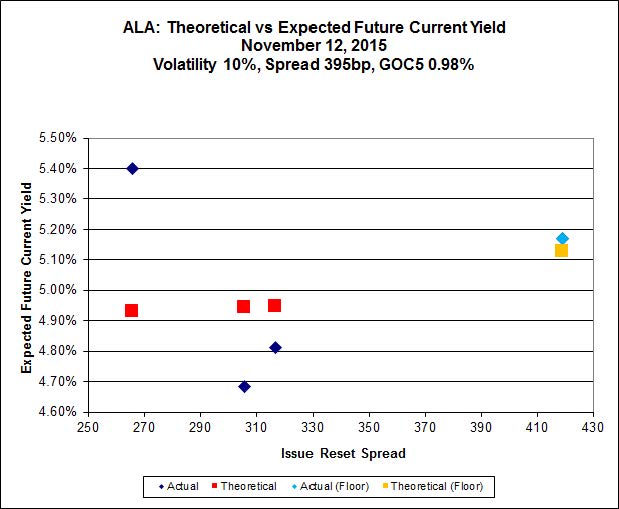
AltaGas has three preferred share issues outstanding, all FixedResets: ALA.PR.A, ALA.PR.E and ALA.PR.G. ALA.PR.A will reset shortly at 3.38%.

I suspect a new issue will have to yield somewhere around 5.00%-5.25%, with a reset-floor-rate. The company is best known for having the most useless investor relations department on earth.

Market Action

September 21, 2015

Fed officials are busily warning against complacency:

Federal Reserve officials argued that an interest-rate increase is still warranted this year, laying out the case for liftoff in remarks over the weekend that counter bets by traders that the central bank will stay on hold until 2016.

Three policy makers separately explained their rationale for enacting a rate increase at one of the Fed’s two remaining meetings of 2015, citing declines in unemployment and other gains in the U.S. economy that should outweigh headwinds from slower growth abroad and turbulent financial markets.

San Francisco Fed President John Williams, a policy centrist who has worked closely with Chair Janet Yellen, said Sunday that “in my mind, it was a close call” to delay a rate rise at last week’s Federal Open Market Committee meeting.

Williams’ comments on Fox News Channel’s “Sunday Morning Futures with Maria Bartiromo” echoed remarks he made the day before, and chimed with the reasoning of St. Louis Fed President James Bullard and Richmond Fed President Jeffrey Lacker. Both weighed in on Saturday over the FOMC’s vote to leave rates near zero.

Non-voting FOMC members are also weighing in:

Federal Reserve Bank of St. Louis President James Bullard said he pushed against the central bank’s decision this week to delay an interest rate increase, because the economy has more or less fulfilled policy makers’ goals.

“The case for policy normalization is quite strong, since Committee objectives have essentially been met,” Bullard said in slides prepared for a speech in Nashville, Tennessee. “I argued against the decision at the FOMC meeting.”

Bullard is not a voting member of the policy-setting Federal Open Market Committee in 2015, but will vote in 2016.

I’ve said it before, I’ll say it again – I’m sure that most, if not all, of these public statements are deliberately orchestrated by the FOMC as a whole. ‘You made some good points in the meeting, guys. You should speak up in public.’ In that way, the market learns a bit more about the decision than is available in the simple ternary result (up, unchanged, down) and about what elements of the data are considered important and on the cusp of change. It’s a lot better system than the Canadian one, in which (since Dodge retired) Moses descends from the mountain with the Finance Minister’s decision.

I’ve heard a rumour that Volkswagen has a new motto – “Don’t help me!”:

Discrepancies in the European tests on the diesel models of the VW Passat, the VW Jetta and the BMW X5 last year gave Peter Mock an idea.

Mock, European managing director of a little-known clean-air group, suggested replicating the tests in the U.S. The U.S. has higher emissions standards than the rest of the world and a history of enforcing them, so Mock and his American counterpart, John German, were sure the U.S. versions of the vehicles would pass the emissions tests, German said. That way, they reasoned, they could show Europeans it was possible for diesel cars to run clean.

“We had no cause for suspicion,” German, U.S. co-lead of the International Council on Clean Transportation, said in an interview. “We thought the vehicles would be clean.”

So began a series of events that resulted in Volkswagen AG admitting that it built “defeat device” software into a half-million of its diesel cars from 2009 to 2015 that automatically cheated on U.S. air-pollution tests. The world’s second-biggest carmaker now faces billions in fines, possible jail time for its executives and the undoing of its U.S. expansion plans.

Hat tip to Assiduous Reader JP, who brought this to my attention.

It didn’t do their stock price much good:

Volkswagen AG dropped 15 percent, the most in almost six years, after it admitted to cheating on U.S. air pollution tests for years.

The shares declined as much as 23.80 euros and were down 14 percent at 140 euros as of 9:03 a.m. in Frankfurt. The drop extends the fall for the year to 24 percent, valuing the Wolfsburg, Germany-based company at 66.2 billion euros ($74.9 billion).

Volkswagen Chief Executive Officer Martin Winterkorn said on Sunday that the company is cooperating with regulatory investigators and ordered its own external investigation into the issue. The CEO said he was “deeply sorry” for breaking the public’s trust.

Public trust is right!

John Decker bought his 2013 Volkswagen Jetta diesel thinking he was doing his part to improve the environment and reduce his carbon footprint.

Now that the German automaker has admitted its claims about the model’s performance were false, he just wants the company to buy it back from him.

“I feel completely deceived by Volkswagen,” Decker, of Sacramento, California, said in an interview. “I’m extremely upset about it. I feel defrauded.”

Decker wants Volkswagen to compensate him for the purchase. He said he has been in contact with the law firm of Hagens Berman Sobol Shapiro LLP in Seattle, which announced Sept. 18 that it was filing a federal lawsuit against Volkswagen. The firm estimates that some consumers paid as much as $7,000 more for a diesel model.

“I don’t want my car anymore, frankly,” Decker said. “I’d like Volkswagen to buy it back from me. I really don’t want it. I don’t want to drive it. I don’t want anything to do with Volkswagen.”

Assiduous Reader JP – who has been very industriously outperforming you other bums who never send me anything – also alerts me to the denouement of a Dutch takeover defence initiated last spring:

Israel’s Teva Pharmaceutical Industries Ltd. said Tuesday it is bidding $40 billion for Mylan NV, a drug company with headquarters in Canonsburg, Pa., but incorporated in the Netherlands. In early April, moving preemptively to thwart such an offer, a Dutch law firm submitted paperwork on Mylan’s behalf to the Netherlands trade registry to create an obscure but powerful legal vehicle called a “stichting.”

The entity, named Stichting Preferred Shares Mylan, is essentially an empty shell. But it possesses special powers, thanks to a shareholder-approved provision tucked into the paperwork for a previous Mylan acquisition: If Mylan ever receives an unsolicited takeover bid, the stichting can get veto rights over any takeover.

Stichtings, which mean “foundations” in Dutch, have been around for hundreds of years, primarily used by Dutch charities. During the World War II, Dutch companies transferred their ownership to stichtings based in the Dutch Antilles in the Caribbean to protect assets from the German occupiers, experts say.

Their key attribute is that stichtings, often referred to as orphan foundations, don’t have any legal owners. That means they can be used to put money or other assets outside the reach of government authorities, competitors or shareholders. The stichting’s purpose and the responsibilities of its board of directors can be tailored to the vehicle’s needs.

But management has decided it is sufficiently entrenched:

Mylan said Monday that it has moved to cancel the preferred shares issued to the entity in July, as the threats to the company “have been sufficiently addressed.”

In a bit of fun news that shows Natural Philosophy as a hobby is not yet dead, World Bank economist Kaushik Basu has proved the Pythagorean Theorem. I don’t know if there’s any listing of proofs that might be considered authoritative, but here’s one site with 111 versions. Keep them coming, boys! Should we ever meet aliens, it will be most interesting to learn how many proofs they have and which ones they consider standard.

Meanwhile Russians are voting with their feet:

Official statistics show the number of Russian citizens leaving permanently or for more than nine months reached 53,235 in 2014, up 11 percent and the highest in nine years. Germany, the U.S. and Israel all report increases in the numbers of applications for immigration visas from Russia.

russianEmmigration
Click for Big

Parakeet Poluz made a good point about Malthusian forecasts and Club of Rome projections:

But history has repeatedly shown that new technologies can quickly upend assumptions about future demand and supply.

For example, back in the 1970s, there were predictions that the world would run out of copper by the end of the century. The people who made that forecast did not foresee that copper wire, long a staple of communications infrastructure, would be replaced by fibre-optic cable, with its glass threads made from silica. This technology helped reduce the demand for copper, in essence extending its supply.

Similarly, digital photography had a dramatic impact on the photo-processing industry. Twenty years ago, the idea that everyone would carry around telephones that were also good-quality cameras was ridiculous. People took pictures with cameras that were loaded with film and took the film to a developer. The processing consumed a lot of silver. Back then, if you didn’t anticipate the emergence of digital photography, you might have expected this source of demand would continue indefinitely. Instead, according to the Washington-based Silver Institute, the use of silver in photography peaked in 1999 and has fallen by almost 80 per cent since.

It would appear that he fulfilled his cheerleading mandate in the question and answer period:

“In terms of being excessively dependent, I don’t buy that. Twenty per cent of our economy is the resource economy. That’s very important; it’s our backbone. It’s always been our history, and the rest is in some way dependent on that continuing to perform,” Mr Poloz told a business audience in Calgary, where the collapse in oil prices has led to deep cuts in spending and thousands of layoffs in the energy sector.

“We’re a highly diversified economy, and we should be thankful that we’ve got resources as part of our diversification, whereas lots of other countries don’t have that.”

During the federal election campaign, there has been considerable debate about the growing emphasis on energy-sector expansion under Conservative Leader Stephen Harper and, subsequently, the broad economic consequences of the industry’s downturn.

Excessively dependent? Bank of Canada research has noted:

Two aspects of the recent monetary history of Canada, Australia, and New Zealand stand out: the sensitivity of their dollars to prices of resource-based commodities, and inflation targeting.

… while less authoritative but still credible research asserts:

In the last ten years, over half of Canada’s total exports consisted of energy and non-energy commodities. Because the Canadian dollar is often called a “commodity currency”, this paper seeks to test the relevance of commodity prices in explaining the variation in the Canadian real exchange rate against the US dollar, the UK pound, and the Japanese yen. The currencies of these countries are chosen for the analysis because of Canada’s strong trade relationships with the United States, the United Kingdom, and Japan. The dynamic empirical model in this research demonstrates that the proportion of the variation in Canada’s real exchange rate that is attributable to a volatile commodity price shock differs depending on the currency pairing. The results also suggest that the relationship between commodity prices and the Canadian dollar has strengthened over the last two decades.

Sounds excessive to me! Meanwhile, Werner Antweiler of UBC has gone so far as to say:

Is the Canadian Dollar a petrodollar? If you had asked me this question in the 1990s, I would have said “only a little”. At the time, commodity prices were not generally thought to be primary drivers of the exchange rate. During that decade, oil prices were relatively flat and thus the observable variation in the exchange rate was driven by other factors. Most international economists, including those at the Bank of Canada who have a professional interest in this question, were indeed puzzled to find that the CAD/USD exchange rate was difficult to predict based on fundamental factors.

While I was researching oil prices for another issue, I had another look at the relationship between oil prices and the CAD/USD exchange rate, and was indeed a bit surprised how much the oil price matters for determining the value of the Canadian Dollar. As two diagrams show below, there can be little question that during the last fifteen years the Canadian Dollar has morphed into a “petrocurrency”.

In simple terms, a petrocurrency is a currency of an oil-producing country—such as Canada—whose oil exports as a share of total exports are sufficiently large that the value of that country’s currency rises and falls along with the price of oil. In other words, a petrocurrency appreciates when the oil price rises and depreciates when the oil price falls.

Perhaps Mr. Poluz will explain how a deeply rooted manufacturing complex is supposed to survive, when our currency fluctuates so much against our number one trading partner with such alarming amplitude?

One of the more entertaining corporate battles of recent times may have ended in a draw:

Sprott Asset Management LP (“Sprott” or “Sprott Asset Management”), together with Sprott Physical Gold Trust (NYSE:PHYS) (TSX:PHY.U) and Sprott Physical Silver Trust (NYSE:PSLV) (TSX:PHS.U), today announced that it has filed notices of extension in connection with the offers by Sprott Asset Management Gold Bid LP and Sprott Asset Management Silver Bid LP to acquire all of the outstanding units of Central GoldTrust (“GTU”) (TSX: GTU.UN) (TSX:GTU.U) (NYSEMKT:GTU) and Silver Bullion Trust (“SBT”) (TSX:SBT.UN) (TSX:SBT.U), respectively, for units of Sprott Physical Gold Trust and units of Sprott Physical Silver Trust, in each case on a net asset value (NAV) to NAV exchange basis (collectively, the “Sprott offers”). The notices of extension extend the expiry time of the Sprott offers to 5 p.m. (Toronto time) on October 9, 2015.

As of 5:00 p.m. (Toronto time) on September 18, 2015, there were 9,928,736 GTU units (51.45% of all outstanding units) and 2,065,574 SBT units (37.78% of all outstanding units) tendered into the respective Sprott offers.

IGM Financial, proud issuer of IGM.PR.B, has been confirmed at Pfd-2(high) by DBRS:

DBRS Limited (DBRS) has today confirmed the Issuer Rating and Unsecured Debentures rating of IGM Financial Inc. (IGM or the Company) at A (high) and the First Preferred Shares rating at Pfd-2 (high). The trends are Stable.

In addition to strong profitability, the Company’s credit rating also benefits from strong cash flows (which comfortably cover the upfront distribution costs of mutual fund sales), strong liquidity and a conservative financial profile. The Company’s ratio of debt plus preferred shares-to-total capitalization remains appropriate for the rating.

As a member of the Power Financial Corporation (Power) group of companies, IGM benefits from the additional financial flexibility of having a strategic shareholder and the associated strong governance and risk avoidance management model that is typical of Power subsidiaries.

It was a day of little overall movement for the Canadian preferred share market, with PerpetualDiscounts and DeemedRetractibles both off 6bp, while FixedResets gained 4bp. The placidity of the indices masked a lot of churn, though, as reported on the Performance Highlights table. Volume was very low.

For as long as the FixedReset market is so violently unsettled, I’ll keep publishing updates of the more interesting and meaningful series of FixedResets’ Implied Volatilities. This doesn’t include Enbridge because although Enbridge has a large number of issues outstanding, all of which are quite liquid, the range of Issue Reset Spreads is too small for decent conclusions. The low is 212bp (ENB.PR.H; second-lowest is ENB.PR.D at 237bp) and the high is a mere 268 for ENB.PF.G.

Remember that all rich /cheap assessments are:
» based on Implied Volatility Theory only
» are relative only to other FixedResets from the same issuer
» assume constant GOC-5 yield
» assume constant Implied Volatility
» assume constant spread

Here’s TRP:

impVol_TRP_150921
Click for Big

TRP.PR.E, which resets 2019-10-30 at +235, is bid at 20.00 to be $1.04 rich, while TRP.PR.C, resetting 2016-1-30 at +164, is $1.17 cheap at its bid price of 13.00.

impVol_MFC_150921
Click for Big

Another good fit today for MFC, with Implied Volatility falling a bit today.

Most expensive is MFC.PR.J, resetting at +261bp on 2018-3-19, bid at 22.65 to be 0.44 rich, while MFC.PR.G, resetting at +290bp on 2016-12-19, is bid at 23.03 to be 0.44 cheap.

impVol_BAM_150921
Click for Big

The fit on the BAM issues continues to be horrible.

The cheapest issue relative to its peers is BAM.PR.R, resetting at +230bp on 2016-6-30, bid at 16.50 to be $1.63 cheap. BAM.PF.G, resetting at +284bp on 2020-6-30 is bid at 22.60 and appears to be $1.31 rich.

impVol_FTS_150921
Click for Big

FTS.PR.M, with a spread of +248bp, and bid at 22.15, looks $0.54 expensive and resets 2019-12-1. FTS.PR.G, with a spread of +213bp and resetting 2018-9-1, is bid at 18.79 and is $0.53 cheap.

pairs_FR_150921
Click for Big

Investment-grade pairs predict an average three-month bill yield over the next five-odd years of -0.93%, with no outliers. The distribution’s bimodality has returned, with bank NVCC non-compliant pairs averaging -1.08% and other issues averaging -0.71%. There are two junk outliers above 0.00%.

pairs_FF_150921
Click for Big

Shall we just say that this exhibits a high level of confidence in the continued rapacity of Canadian banks?

HIMIPref™ Preferred Indices
These values reflect the December 2008 revision of the HIMIPref™ Indices

Values are provisional and are finalized monthly
Index Mean
Current
Yield
(at bid)
Median
YTW
Median
Average
Trading
Value
Median
Mod Dur
(YTW)
Issues Day’s Perf. Index Value
Ratchet 0.00 % 0.00 % 0 0.00 0 -0.0954 % 1,647.0
FixedFloater 0.00 % 0.00 % 0 0.00 0 -0.0954 % 2,879.8
Floater 4.51 % 4.54 % 59,940 16.36 3 -0.0954 % 1,750.9
OpRet 0.00 % 0.00 % 0 0.00 0 -0.3382 % 2,767.8
SplitShare 4.65 % 5.03 % 63,501 3.05 3 -0.3382 % 3,243.7
Interest-Bearing 0.00 % 0.00 % 0 0.00 0 -0.3382 % 2,530.8
Perpetual-Premium 5.71 % 1.09 % 53,552 0.08 8 0.0840 % 2,496.2
Perpetual-Discount 5.45 % 5.55 % 67,270 14.55 30 -0.0619 % 2,600.4
FixedReset 4.75 % 4.24 % 180,340 15.86 74 0.0365 % 2,142.2
Deemed-Retractible 5.15 % 4.68 % 91,108 5.49 33 -0.0606 % 2,578.9
FloatingReset 2.49 % 4.12 % 49,353 5.88 9 0.1700 % 2,148.3
Performance Highlights
Issue Index Change Notes
BIP.PR.A FixedReset -2.78 % YTW SCENARIO
Maturity Type : Limit Maturity
Maturity Date : 2045-09-21
Maturity Price : 21.65
Evaluated at bid price : 22.00
Bid-YTW : 5.00 %
GWO.PR.N FixedReset -2.46 % YTW SCENARIO
Maturity Type : Hard Maturity
Maturity Date : 2025-01-31
Maturity Price : 25.00
Evaluated at bid price : 14.68
Bid-YTW : 8.74 %
MFC.PR.F FixedReset -1.81 % YTW SCENARIO
Maturity Type : Hard Maturity
Maturity Date : 2025-01-31
Maturity Price : 25.00
Evaluated at bid price : 15.22
Bid-YTW : 8.58 %
TRP.PR.A FixedReset -1.79 % YTW SCENARIO
Maturity Type : Limit Maturity
Maturity Date : 2045-09-21
Maturity Price : 16.45
Evaluated at bid price : 16.45
Bid-YTW : 4.36 %
IFC.PR.C FixedReset -1.55 % YTW SCENARIO
Maturity Type : Hard Maturity
Maturity Date : 2025-01-31
Maturity Price : 25.00
Evaluated at bid price : 19.69
Bid-YTW : 6.65 %
BMO.PR.R FloatingReset -1.47 % YTW SCENARIO
Maturity Type : Hard Maturity
Maturity Date : 2022-01-31
Maturity Price : 25.00
Evaluated at bid price : 22.07
Bid-YTW : 4.12 %
BNS.PR.Y FixedReset -1.39 % YTW SCENARIO
Maturity Type : Hard Maturity
Maturity Date : 2022-01-31
Maturity Price : 25.00
Evaluated at bid price : 21.30
Bid-YTW : 4.58 %
BAM.PR.R FixedReset -1.31 % YTW SCENARIO
Maturity Type : Limit Maturity
Maturity Date : 2045-09-21
Maturity Price : 16.53
Evaluated at bid price : 16.53
Bid-YTW : 4.84 %
CU.PR.C FixedReset -1.24 % YTW SCENARIO
Maturity Type : Limit Maturity
Maturity Date : 2045-09-21
Maturity Price : 20.70
Evaluated at bid price : 20.70
Bid-YTW : 3.99 %
PWF.PR.F Perpetual-Discount -1.08 % YTW SCENARIO
Maturity Type : Limit Maturity
Maturity Date : 2045-09-21
Maturity Price : 23.63
Evaluated at bid price : 23.90
Bid-YTW : 5.57 %
BMO.PR.Y FixedReset 1.04 % YTW SCENARIO
Maturity Type : Limit Maturity
Maturity Date : 2045-09-21
Maturity Price : 22.47
Evaluated at bid price : 23.35
Bid-YTW : 3.86 %
MFC.PR.N FixedReset 1.07 % YTW SCENARIO
Maturity Type : Hard Maturity
Maturity Date : 2025-01-31
Maturity Price : 25.00
Evaluated at bid price : 20.78
Bid-YTW : 5.87 %
MFC.PR.J FixedReset 1.12 % YTW SCENARIO
Maturity Type : Hard Maturity
Maturity Date : 2025-01-31
Maturity Price : 25.00
Evaluated at bid price : 22.65
Bid-YTW : 4.88 %
TRP.PR.B FixedReset 1.12 % YTW SCENARIO
Maturity Type : Limit Maturity
Maturity Date : 2045-09-21
Maturity Price : 12.66
Evaluated at bid price : 12.66
Bid-YTW : 4.17 %
VNR.PR.A FixedReset 1.26 % YTW SCENARIO
Maturity Type : Limit Maturity
Maturity Date : 2045-09-21
Maturity Price : 20.15
Evaluated at bid price : 20.15
Bid-YTW : 4.68 %
MFC.PR.I FixedReset 1.27 % YTW SCENARIO
Maturity Type : Hard Maturity
Maturity Date : 2025-01-31
Maturity Price : 25.00
Evaluated at bid price : 23.19
Bid-YTW : 4.84 %
BAM.PR.X FixedReset 1.31 % YTW SCENARIO
Maturity Type : Limit Maturity
Maturity Date : 2045-09-21
Maturity Price : 15.50
Evaluated at bid price : 15.50
Bid-YTW : 4.52 %
HSE.PR.G FixedReset 1.34 % YTW SCENARIO
Maturity Type : Limit Maturity
Maturity Date : 2045-09-21
Maturity Price : 22.08
Evaluated at bid price : 22.65
Bid-YTW : 4.84 %
SLF.PR.H FixedReset 1.43 % YTW SCENARIO
Maturity Type : Hard Maturity
Maturity Date : 2025-01-31
Maturity Price : 25.00
Evaluated at bid price : 17.75
Bid-YTW : 7.46 %
BNS.PR.D FloatingReset 1.45 % YTW SCENARIO
Maturity Type : Hard Maturity
Maturity Date : 2022-01-31
Maturity Price : 25.00
Evaluated at bid price : 20.30
Bid-YTW : 4.83 %
BMO.PR.M FixedReset 1.47 % YTW SCENARIO
Maturity Type : Hard Maturity
Maturity Date : 2022-01-31
Maturity Price : 25.00
Evaluated at bid price : 24.15
Bid-YTW : 3.56 %
TRP.PR.C FixedReset 1.48 % YTW SCENARIO
Maturity Type : Limit Maturity
Maturity Date : 2045-09-21
Maturity Price : 13.00
Evaluated at bid price : 13.00
Bid-YTW : 4.65 %
BNS.PR.P FixedReset 1.57 % YTW SCENARIO
Maturity Type : Hard Maturity
Maturity Date : 2022-01-31
Maturity Price : 25.00
Evaluated at bid price : 24.52
Bid-YTW : 3.51 %
SLF.PR.J FloatingReset 1.69 % YTW SCENARIO
Maturity Type : Hard Maturity
Maturity Date : 2025-01-31
Maturity Price : 25.00
Evaluated at bid price : 13.25
Bid-YTW : 9.46 %
FTS.PR.K FixedReset 1.89 % YTW SCENARIO
Maturity Type : Limit Maturity
Maturity Date : 2045-09-21
Maturity Price : 18.85
Evaluated at bid price : 18.85
Bid-YTW : 4.09 %
TRP.PR.F FloatingReset 2.08 % YTW SCENARIO
Maturity Type : Limit Maturity
Maturity Date : 2045-09-21
Maturity Price : 14.70
Evaluated at bid price : 14.70
Bid-YTW : 3.89 %
PWF.PR.P FixedReset 2.36 % YTW SCENARIO
Maturity Type : Limit Maturity
Maturity Date : 2045-09-21
Maturity Price : 15.62
Evaluated at bid price : 15.62
Bid-YTW : 3.96 %
Volume Highlights
Issue Index Shares
Traded
Notes
FTS.PR.K FixedReset 112,520 Desjardins crossed blocks of 85,200 and 10,000, both at 18.95.
YTW SCENARIO
Maturity Type : Limit Maturity
Maturity Date : 2045-09-21
Maturity Price : 18.85
Evaluated at bid price : 18.85
Bid-YTW : 4.09 %
TRP.PR.E FixedReset 59,776 TD crossed blocks of 17,000 and 20,000, both at 20.05.
YTW SCENARIO
Maturity Type : Limit Maturity
Maturity Date : 2045-09-21
Maturity Price : 20.00
Evaluated at bid price : 20.00
Bid-YTW : 4.31 %
RY.PR.J FixedReset 36,284 TD crossed 17,000 at 22.62.
YTW SCENARIO
Maturity Type : Limit Maturity
Maturity Date : 2045-09-21
Maturity Price : 22.49
Evaluated at bid price : 23.36
Bid-YTW : 3.78 %
RY.PR.I FixedReset 33,900 Desjardins crossed blocks of 15,400 and 15,000, both at 24.80.
YTW SCENARIO
Maturity Type : Hard Maturity
Maturity Date : 2022-01-31
Maturity Price : 25.00
Evaluated at bid price : 24.62
Bid-YTW : 3.50 %
MFC.PR.G FixedReset 32,593 Nesbitt crossed 30,000 at 23.20.
YTW SCENARIO
Maturity Type : Hard Maturity
Maturity Date : 2025-01-31
Maturity Price : 25.00
Evaluated at bid price : 23.03
Bid-YTW : 4.89 %
TRP.PR.D FixedReset 28,912 YTW SCENARIO
Maturity Type : Limit Maturity
Maturity Date : 2045-09-21
Maturity Price : 19.29
Evaluated at bid price : 19.29
Bid-YTW : 4.40 %
There were 16 other index-included issues trading in excess of 10,000 shares.
Wide Spread Highlights
Issue Index Quote Data and Yield Notes
MFC.PR.M FixedReset Quote: 21.10 – 21.85
Spot Rate : 0.7500
Average : 0.5086

YTW SCENARIO
Maturity Type : Hard Maturity
Maturity Date : 2025-01-31
Maturity Price : 25.00
Evaluated at bid price : 21.10
Bid-YTW : 5.74 %

IFC.PR.C FixedReset Quote: 19.69 – 20.15
Spot Rate : 0.4600
Average : 0.3114

YTW SCENARIO
Maturity Type : Hard Maturity
Maturity Date : 2025-01-31
Maturity Price : 25.00
Evaluated at bid price : 19.69
Bid-YTW : 6.65 %

GWO.PR.R Deemed-Retractible Quote: 22.25 – 22.60
Spot Rate : 0.3500
Average : 0.2038

YTW SCENARIO
Maturity Type : Hard Maturity
Maturity Date : 2025-01-31
Maturity Price : 25.00
Evaluated at bid price : 22.25
Bid-YTW : 6.40 %

TD.PR.Z FloatingReset Quote: 22.40 – 22.74
Spot Rate : 0.3400
Average : 0.2227

YTW SCENARIO
Maturity Type : Hard Maturity
Maturity Date : 2022-01-31
Maturity Price : 25.00
Evaluated at bid price : 22.40
Bid-YTW : 3.90 %

GWO.PR.L Deemed-Retractible Quote: 25.15 – 25.50
Spot Rate : 0.3500
Average : 0.2367

YTW SCENARIO
Maturity Type : Hard Maturity
Maturity Date : 2025-01-31
Maturity Price : 25.00
Evaluated at bid price : 25.15
Bid-YTW : 5.59 %

BMO.PR.R FloatingReset Quote: 22.07 – 22.50
Spot Rate : 0.4300
Average : 0.3167

YTW SCENARIO
Maturity Type : Hard Maturity
Maturity Date : 2022-01-31
Maturity Price : 25.00
Evaluated at bid price : 22.07
Bid-YTW : 4.12 %

Market Action

September 18, 2015

Nothing happened today, except that bonds had a good day:

The S&P 500 retreated 1.6 percent at 4 p.m. in New York, erasing its gain for the week. The gauge ended lower yesterday by 0.4 percent, erasing a gain of as much as 1.3 percent after Yellen indicated that global developments overshadowed signs of strength in America.

U.S. two-year Treasuries extended their biggest one-day rally since 2009, while Pacific Investment Management Co. said policy makers may wait until next year before raising rates. JPMorgan Asset Management said the Fed’s statement was good for bonds and they still like debt due between seven and 10 years.

Bonds gained from Australia to Germany, while Treasuries added to an advance from Thursday. The yield on 10-year German bunds, the euro region’s benchmark sovereign securities, dropped 12 basis points to 0.66 percent, set for its biggest decline since July 7, on prospects for further easing by the European Central Bank.

Rates on similar-maturity Italian bonds fell 14 basis points to 1.76 percent, while those on Spain’s declined 15 basis points to 1.94 percent. The yield on U.S. 10-year Treasuries fell six basis points to 2.13 percent on Friday, after sliding 10 basis points the previous day.

It was yet another negative day for the Canadian preferred share market, with PerpetualDiscounts gaining 5bp, FixedResets down 48bp and DeemedRetractibles off 6bp. The Performance Highlights table is comprised entirely of losers, mostly FixedResets. Volume was extremely low.

For as long as the FixedReset market is so violently unsettled, I’ll keep publishing updates of the more interesting and meaningful series of FixedResets’ Implied Volatilities. This doesn’t include Enbridge because although Enbridge has a large number of issues outstanding, all of which are quite liquid, the range of Issue Reset Spreads is too small for decent conclusions. The low is 212bp (ENB.PR.H; second-lowest is ENB.PR.D at 237bp) and the high is a mere 268 for ENB.PF.G.

Remember that all rich /cheap assessments are:
» based on Implied Volatility Theory only
» are relative only to other FixedResets from the same issuer
» assume constant GOC-5 yield
» assume constant Implied Volatility
» assume constant spread

Here’s TRP:

impVol_TRP_150918
Click for Big

TRP.PR.E, which resets 2019-10-30 at +235, is bid at 20.06 to be $1.05 rich, while TRP.PR.C, resetting 2016-1-30 at +164, is $1.32 cheap at its bid price of 12.81.

impVol_MFC_150918
Click for Big

Another good fit today for MFC, with Implied Volatility falling a bit today.

Most expensive is MFC.PR.H, resetting at +313bp on 2017-3-19, bid at 24.41 to be 0.32 rich, while MFC.PR.G, resetting at +290bp on 2016-12-19, is bid at 23.03 to be 0.30 cheap.

impVol_BAM_150918
Click for Big

The fit on the BAM issues continues to be horrible.

The cheapest issue relative to its peers is BAM.PR.R, resetting at +230bp on 2016-6-30, bid at 16.80 to be $1.42 cheap. BAM.PF.G, resetting at +284bp on 2020-6-30 is bid at 22.54 and appears to be $1.17 rich.

impVol_FTS_150918
Click for Big

FTS.PR.M, with a spread of +248bp, and bid at 22.20, looks $0.66 expensive and resets 2019-12-1. FTS.PR.G, with a spread of +213bp and resetting 2018-9-1, is bid at 18.79 and is $0.43 cheap.

pairs_FR_150918
Click for Big

Investment-grade pairs predict an average three-month bill yield over the next five-odd years of -0.87%, with no outliers. The distribution’s bimodality has vanished. There are two junk outliers above 0.00%.

pairs_FR_150918
Click for Big

Shall we just say that this exhibits a high level of confidence in the continued rapacity of Canadian banks?

HIMIPref™ Preferred Indices
These values reflect the December 2008 revision of the HIMIPref™ Indices

Values are provisional and are finalized monthly
Index Mean
Current
Yield
(at bid)
Median
YTW
Median
Average
Trading
Value
Median
Mod Dur
(YTW)
Issues Day’s Perf. Index Value
Ratchet 0.00 % 0.00 % 0 0.00 0 -1.1003 % 1,648.6
FixedFloater 0.00 % 0.00 % 0 0.00 0 -1.1003 % 2,882.5
Floater 4.51 % 4.54 % 58,288 16.37 3 -1.1003 % 1,752.6
OpRet 0.00 % 0.00 % 0 0.00 0 0.0812 % 2,777.2
SplitShare 4.63 % 4.95 % 61,117 3.06 3 0.0812 % 3,254.7
Interest-Bearing 0.00 % 0.00 % 0 0.00 0 0.0812 % 2,539.4
Perpetual-Premium 5.71 % 2.95 % 53,691 0.08 8 0.1138 % 2,494.1
Perpetual-Discount 5.45 % 5.52 % 66,304 14.59 30 0.0476 % 2,602.0
FixedReset 4.75 % 4.21 % 178,672 15.99 74 -0.4801 % 2,141.4
Deemed-Retractible 5.15 % 4.75 % 91,336 5.50 33 -0.0580 % 2,580.4
FloatingReset 2.49 % 3.96 % 49,480 5.90 9 -0.5021 % 2,144.7
Performance Highlights
Issue Index Change Notes
TRP.PR.C FixedReset -4.33 % YTW SCENARIO
Maturity Type : Limit Maturity
Maturity Date : 2045-09-18
Maturity Price : 12.81
Evaluated at bid price : 12.81
Bid-YTW : 4.62 %
HSE.PR.A FixedReset -2.68 % YTW SCENARIO
Maturity Type : Limit Maturity
Maturity Date : 2045-09-18
Maturity Price : 13.80
Evaluated at bid price : 13.80
Bid-YTW : 4.65 %
TRP.PR.A FixedReset -2.62 % YTW SCENARIO
Maturity Type : Limit Maturity
Maturity Date : 2045-09-18
Maturity Price : 16.75
Evaluated at bid price : 16.75
Bid-YTW : 4.22 %
SLF.PR.J FloatingReset -2.40 % YTW SCENARIO
Maturity Type : Hard Maturity
Maturity Date : 2025-01-31
Maturity Price : 25.00
Evaluated at bid price : 13.03
Bid-YTW : 9.65 %
TRP.PR.F FloatingReset -2.04 % YTW SCENARIO
Maturity Type : Limit Maturity
Maturity Date : 2045-09-18
Maturity Price : 14.40
Evaluated at bid price : 14.40
Bid-YTW : 3.96 %
SLF.PR.H FixedReset -1.96 % YTW SCENARIO
Maturity Type : Hard Maturity
Maturity Date : 2025-01-31
Maturity Price : 25.00
Evaluated at bid price : 17.50
Bid-YTW : 7.59 %
MFC.PR.F FixedReset -1.96 % YTW SCENARIO
Maturity Type : Hard Maturity
Maturity Date : 2025-01-31
Maturity Price : 25.00
Evaluated at bid price : 15.50
Bid-YTW : 8.27 %
BAM.PR.K Floater -1.88 % YTW SCENARIO
Maturity Type : Limit Maturity
Maturity Date : 2045-09-18
Maturity Price : 10.42
Evaluated at bid price : 10.42
Bid-YTW : 4.54 %
SLF.PR.G FixedReset -1.73 % YTW SCENARIO
Maturity Type : Hard Maturity
Maturity Date : 2025-01-31
Maturity Price : 25.00
Evaluated at bid price : 15.35
Bid-YTW : 8.23 %
TD.PR.S FixedReset -1.56 % YTW SCENARIO
Maturity Type : Hard Maturity
Maturity Date : 2022-01-31
Maturity Price : 25.00
Evaluated at bid price : 23.97
Bid-YTW : 3.66 %
VNR.PR.A FixedReset -1.49 % YTW SCENARIO
Maturity Type : Limit Maturity
Maturity Date : 2045-09-18
Maturity Price : 19.90
Evaluated at bid price : 19.90
Bid-YTW : 4.68 %
BAM.PR.Z FixedReset -1.45 % YTW SCENARIO
Maturity Type : Limit Maturity
Maturity Date : 2045-09-18
Maturity Price : 21.00
Evaluated at bid price : 21.00
Bid-YTW : 4.62 %
TRP.PR.B FixedReset -1.42 % YTW SCENARIO
Maturity Type : Limit Maturity
Maturity Date : 2045-09-18
Maturity Price : 12.52
Evaluated at bid price : 12.52
Bid-YTW : 4.14 %
BMO.PR.T FixedReset -1.41 % YTW SCENARIO
Maturity Type : Limit Maturity
Maturity Date : 2045-09-18
Maturity Price : 20.94
Evaluated at bid price : 20.94
Bid-YTW : 3.82 %
PWF.PR.T FixedReset -1.39 % YTW SCENARIO
Maturity Type : Limit Maturity
Maturity Date : 2045-09-18
Maturity Price : 22.21
Evaluated at bid price : 22.70
Bid-YTW : 3.65 %
IFC.PR.C FixedReset -1.38 % YTW SCENARIO
Maturity Type : Hard Maturity
Maturity Date : 2025-01-31
Maturity Price : 25.00
Evaluated at bid price : 20.00
Bid-YTW : 6.39 %
IAG.PR.G FixedReset -1.36 % YTW SCENARIO
Maturity Type : Hard Maturity
Maturity Date : 2025-01-31
Maturity Price : 25.00
Evaluated at bid price : 22.50
Bid-YTW : 5.11 %
FTS.PR.K FixedReset -1.33 % YTW SCENARIO
Maturity Type : Limit Maturity
Maturity Date : 2045-09-18
Maturity Price : 18.50
Evaluated at bid price : 18.50
Bid-YTW : 4.11 %
GWO.PR.N FixedReset -1.31 % YTW SCENARIO
Maturity Type : Hard Maturity
Maturity Date : 2025-01-31
Maturity Price : 25.00
Evaluated at bid price : 15.05
Bid-YTW : 8.35 %
BAM.PR.R FixedReset -1.18 % YTW SCENARIO
Maturity Type : Limit Maturity
Maturity Date : 2045-09-18
Maturity Price : 16.75
Evaluated at bid price : 16.75
Bid-YTW : 4.70 %
HSE.PR.G FixedReset -1.11 % YTW SCENARIO
Maturity Type : Limit Maturity
Maturity Date : 2045-09-18
Maturity Price : 21.89
Evaluated at bid price : 22.35
Bid-YTW : 4.87 %
MFC.PR.I FixedReset -1.08 % YTW SCENARIO
Maturity Type : Hard Maturity
Maturity Date : 2025-01-31
Maturity Price : 25.00
Evaluated at bid price : 22.90
Bid-YTW : 4.96 %
FTS.PR.F Perpetual-Discount -1.05 % YTW SCENARIO
Maturity Type : Limit Maturity
Maturity Date : 2045-09-18
Maturity Price : 22.24
Evaluated at bid price : 22.51
Bid-YTW : 5.48 %
Volume Highlights
Issue Index Shares
Traded
Notes
TD.PF.F Perpetual-Discount 65,100 RBC crossed 48,200 at 24.35.
YTW SCENARIO
Maturity Type : Limit Maturity
Maturity Date : 2045-09-18
Maturity Price : 24.03
Evaluated at bid price : 24.39
Bid-YTW : 5.09 %
NA.PR.S FixedReset 52,575 TD crossed 46,700 at 21.75.
YTW SCENARIO
Maturity Type : Limit Maturity
Maturity Date : 2045-09-18
Maturity Price : 21.31
Evaluated at bid price : 21.60
Bid-YTW : 3.87 %
MFC.PR.G FixedReset 36,160 Nesbitt crossed 34,600 at 23.20.
YTW SCENARIO
Maturity Type : Hard Maturity
Maturity Date : 2025-01-31
Maturity Price : 25.00
Evaluated at bid price : 23.03
Bid-YTW : 4.84 %
GWO.PR.N FixedReset 32,586 Nesbitt crossed 28,700 at 15.30.
YTW SCENARIO
Maturity Type : Hard Maturity
Maturity Date : 2025-01-31
Maturity Price : 25.00
Evaluated at bid price : 15.05
Bid-YTW : 8.35 %
BNS.PR.Q FixedReset 27,200 RBC crossed 25,000 at 24.32.
YTW SCENARIO
Maturity Type : Hard Maturity
Maturity Date : 2022-01-31
Maturity Price : 25.00
Evaluated at bid price : 24.29
Bid-YTW : 3.65 %
SLF.PR.J FloatingReset 27,038 YTW SCENARIO
Maturity Type : Hard Maturity
Maturity Date : 2025-01-31
Maturity Price : 25.00
Evaluated at bid price : 13.03
Bid-YTW : 9.65 %
There were 12 other index-included issues trading in excess of 10,000 shares.
Wide Spread Highlights
Issue Index Quote Data and Yield Notes
RY.PR.J FixedReset Quote: 23.35 – 24.00
Spot Rate : 0.6500
Average : 0.4263

YTW SCENARIO
Maturity Type : Limit Maturity
Maturity Date : 2045-09-18
Maturity Price : 22.49
Evaluated at bid price : 23.35
Bid-YTW : 3.74 %

TRP.PR.F FloatingReset Quote: 14.40 – 15.20
Spot Rate : 0.8000
Average : 0.5885

YTW SCENARIO
Maturity Type : Limit Maturity
Maturity Date : 2045-09-18
Maturity Price : 14.40
Evaluated at bid price : 14.40
Bid-YTW : 3.96 %

HSE.PR.G FixedReset Quote: 22.35 – 22.99
Spot Rate : 0.6400
Average : 0.4319

YTW SCENARIO
Maturity Type : Limit Maturity
Maturity Date : 2045-09-18
Maturity Price : 21.89
Evaluated at bid price : 22.35
Bid-YTW : 4.87 %

MFC.PR.N FixedReset Quote: 20.56 – 21.18
Spot Rate : 0.6200
Average : 0.4233

YTW SCENARIO
Maturity Type : Hard Maturity
Maturity Date : 2025-01-31
Maturity Price : 25.00
Evaluated at bid price : 20.56
Bid-YTW : 5.98 %

TD.PR.S FixedReset Quote: 23.97 – 24.55
Spot Rate : 0.5800
Average : 0.3843

YTW SCENARIO
Maturity Type : Hard Maturity
Maturity Date : 2022-01-31
Maturity Price : 25.00
Evaluated at bid price : 23.97
Bid-YTW : 3.66 %

TRP.PR.C FixedReset Quote: 12.81 – 13.30
Spot Rate : 0.4900
Average : 0.2972

YTW SCENARIO
Maturity Type : Limit Maturity
Maturity Date : 2045-09-18
Maturity Price : 12.81
Evaluated at bid price : 12.81
Bid-YTW : 4.62 %

Regulation

CSA To Commence Crippling Canadian Corporate Bond Market

The Canadian Securities Administrators have announced that they have:

published for comment CSA Staff Notice 21-315 Next Steps in Regulation and Transparency of the Fixed Income Market, which describes the CSA’s plan to enhance fixed income regulation.

The Notice sets out the steps CSA staff are taking to improve market integrity, evaluate access to the fixed income market and facilitate more informed decision making among market participants.

The CSA Staff Notice can be found on CSA members’ websites. The 45-day comment period will close on November 1, 2015.

Naturally the CSA can’t put actual links on the press release announcing their existence. That would be too simple, but after some poking around we find on the OSC website CSA Staff Notice and Request for Comment 21-315 Next Steps in Regulation and Transparency of the Fixed Income Market:

On April 23, 2015, staff of the Ontario Securities Commission (OSC) published a report titled The Canadian Fixed Income Market 2014 (the Report).{2} The Report presented a fact-based snapshot of the $2 trillion fixed income market in Canada, with particular emphasis on the $500 billion in corporate debt outstanding.{3} The Report also highlighted the following:

1. fixed income data available is limited and fragmented across a number of sources, which makes it difficult to conduct a comprehensive assessment of the fixed income market;

2. the secondary fixed income market is a decentralized, over-the-counter market where large investors have significantly more bargaining power than small investors;

3. there is limited adoption of electronic trading and alternative trading systems, especially for corporate bonds; and

4. direct retail participation in the primary and secondary fixed income market is low and retail investors typically access the fixed income market by purchasing investment funds.

The purpose of this notice is to set out the CSA staff’s plan to enhance fixed income regulation to:

1. facilitate more informed decision-making among all market participants, regardless of their size;

2. improve market integrity; and

3. evaluate whether access to the fixed income market is fair and equitable for all investors.

Each of these steps is discussed in the sections below.

The report was discussed on PrefBlog in the post The Canadian Fixed Income Market: 2014.

It is noteworthy that not one of the objectives involves answering the question “What is the corporate bond market for?”. If this question was ever asked and it was decided that the purpose of the corporate bond market was to give Granny a good place to invest her $5,000 in a single particular bond at a good price then the other objectives make sense. If, however, the purpose of the market is to give corporations access to debt funding that is less constraining and cheaper than bank funding, so they can invest money, help the economy grow and create jobs, then other conclusions might be drawn.

However, CSA staff already has jobs, currently on the public payroll and quite often with the banks afterwards, so job creation by other corporations is hardly a meaningful concern.

As they are on the public payroll, they have very prudently not commenced crippling the government bond market:

NI 21-101 sets out transparency requirements for government debt securities. Specifically, marketplaces and inter-dealer bond brokers are required to report order or trade information, or both, to an information processor. However, an exemption from these transparency requirements is in place and was recently extended until January 1, 2018, through amendments to NI 21-101. As indicated in the notice published with the amendments,{9} no other jurisdiction has mandated transparency for government debt securities. The extension was granted in order to allow CSA staff to monitor international developments, including the expected implementation of the transparency regime that will be established across the European Union by the new Markets in Financial Instruments Directive (MiFID II) and the Markets in Financial Instrument Regulation (MiFIR) adopted by the European Commission,{10} and to determine whether the NI 21-101 transparency requirements for government debt securities should be implemented or whether changes are appropriate.

It is laughable that CSA staff boasts about the wonders of public dissemination of information via SEDAR without permitting direct links to these public documents, but the funniest part of this diktat is their lip service to liquidity:

As noted above, it is CSA staff’s goal to achieve transparency for trades in all corporate debt securities by the end of 2017. We have considered how to achieve this goal in light of:

• the fact that IIROC will be implementing the IIROC Debt Reporting Rule in two phases (described below); and

• concerns that have been raised globally about a decrease in the liquidity in corporate debt markets, and the potential impact of additional transparency on liquidity.{19}

It is intended that transparency for all corporate debt securities will be phased in over the next two years in two phases, as follows:

• in Phase I (expected to occur in mid-2016), IIROC, as an information processor, will disseminate post-trade information for all trades in the Designated Corporate Debt Securities and for retail trades{20} for all other corporate debt securities reported to IIROC; and

• in Phase II (expected to occur in mid-2017), IIROC will disseminate information for all trades in all corporate debt securities and for new issues of corporate debt.

Footnote 19 reads: Specifically, concerns have been raised globally about a potential decrease in the liquidity of the fixed income markets due to a number of factors, including an increase in corporate bond issuances coupled with, some believe, decreases in dealers’ inventories resulting from changes in regulation. We have also heard these concerns raised by Canadian buy-side and sell-side firms during our discussions regarding liquidity and transparency.

Oh, isn’t that just the sweetest thing you can imagine! They’ve “heard these concerns” and, of course, having heard them we can rely on our Wise Masters to have made the correct decision. Just what these concerns were and just why certain decisions were made is none of your business – not only are you mere investor scum but you’re not even government employees, so dry up and blow away, vermin.

I have written about liquidity ant transparency many times on this blog and provided some of the links in my review of the OSC literature survey that is being used as cover for the CSA’s shenanigans. The short version is: increasing transparency leads to markets with a narrower bid-ask spread, but less depth. This has been shown time and time again by academics studying all sorts of markets. Naturally, the regulators are focussing on a definition of liquidity that emphasizes the bid-ask spread; Granny will be able to trade her $5,000 worth of bonds much more cheaply. Investors who trade corporates in $1-million+ sized chunks, however, experience a sharp decline in liquidity. This, naturally, increases the risk of flash-crashes and ‘crowded-trades’ as retail dumps ETFs … but who cares? That will merely give the regulators another excuse for some crocodile tears and another expensive study.

Institutional level liquidity is not a joke and it’s not trivial. When investments are more volatile and less liquid, you want to get paid more for holding them. That is to say, you demand more yield. It is the issuers who are paying that yield and increases in this yield increase their costs, and make building that new factory just that much less attractive.

But nobody cares and the regulators can’t even be bothered to ask ‘What is the corporate bond market for?’.

I’ve had it with this sham. However, for those who are interested, there was a story in the Globe about this issue titled Canadian regulators unveil new system to report corporate bond trading data. The plan has been greeted with rapturous applause from non-investors.

Coming up next: industry regulators take on the Ontario Food Terminal. It is disgusting that purchase of food at wholesale prices is restricted! Let’s see some FAIRNESS!!!

Update, 2015-9-19: Other press mentions have been Canada to Boost Corporate Bond Market Transparency by 2017 and CSA seeks comments on enhancing fixed-income transparency. The former article is notable for the paragraph:

“The steps we have set out to enhance regulation in the fixed income market will improve market transparency and better protect investor interests,” Tracey Stern, head of market regulation at the Ontario Securities Commission, said in an e- mailed statement. “With increased transparency, investors will be in a better position to assess the quality of their executions.”

Do I really need to point out that the concept of judging “quality of their executions” is a concept that applies only to brokered trades, while virtually all bond transactions are done on a principal basis? It would appear that I do.

Press Clippings

Enbridge shares are popular – but heavily shorted

Many thanks to Larry MacDonald, who very kindly quoted me (via PrefBlog) in his recent article Enbridge shares are popular – but heavily shorted:

The floating of preferred shares has been particularly substantial. As James Hymas, manager of the Malachite Aggressive Preferred Fund, noted in his blog (prefblog.com) in late 2014, Enbridge’s issuance “comprises roughly 10 per cent of the Canadian preferred share market, virtually all of which has come out since … [2011].”

The post quoted was Rating Agencies Unhappy With Enbridge.

Market Action

September 17, 2015

Today’s big news was the FOMC release:

Information received since the Federal Open Market Committee met in July suggests that economic activity is expanding at a moderate pace. Household spending and business fixed investment have been increasing moderately, and the housing sector has improved further; however, net exports have been soft. The labor market continued to improve, with solid job gains and declining unemployment. On balance, labor market indicators show that underutilization of labor resources has diminished since early this year. Inflation has continued to run below the Committee’s longer-run objective, partly reflecting declines in energy prices and in prices of non-energy imports. Market-based measures of inflation compensation moved lower; survey-based measures of longer-term inflation expectations have remained stable.

To support continued progress toward maximum employment and price stability, the Committee today reaffirmed its view that the current 0 to 1/4 percent target range for the federal funds rate remains appropriate. In determining how long to maintain this target range, the Committee will assess progress–both realized and expected–toward its objectives of maximum employment and 2 percent inflation. This assessment will take into account a wide range of information, including measures of labor market conditions, indicators of inflation pressures and inflation expectations, and readings on financial and international developments. The Committee anticipates that it will be appropriate to raise the target range for the federal funds rate when it has seen some further improvement in the labor market and is reasonably confident that inflation will move back to its 2 percent objective over the medium term.

The Committee currently anticipates that, even after employment and inflation are near mandate-consistent levels, economic conditions may, for some time, warrant keeping the target federal funds rate below levels the Committee views as normal in the longer run.

Voting against the action was Jeffrey M. Lacker, who preferred to raise the target range for the federal funds rate by 25 basis points at this meeting.

Meanwhile, in Canada:

The number of EI beneficiaries rose 2 per cent to 545,200 in July from a month earlier, Statistics Canada said Thursday, led by increases in British Columbia, Ontario and Alberta. That level is 7.1 per cent higher than a year ago.

In Alberta, the province most exposed to lower oil prices, the number of EI beneficiaries climbed for the ninth straight month. EI numbers rose 1.8 per cent from a month earlier – a slower pace than in previous months – and are 72.2 per cent higher than in July of last year.

British Columbia and Ontario saw the biggest monthly percentage increases while Quebec and Saskatchewan also registered gains. Numbers fell in Manitoba and Newfoundland.

It was a mildly negative day for the Canadian preferred share market, with PerpetualDiscounts gaining 5bp, FixedResets off 8bp and DeemedRetractibles down 19bp. The Performance Highlights table is reasonably balanced. Volume was low.

For as long as the FixedReset market is so violently unsettled, I’ll keep publishing updates of the more interesting and meaningful series of FixedResets’ Implied Volatilities. This doesn’t include Enbridge because although Enbridge has a large number of issues outstanding, all of which are quite liquid, the range of Issue Reset Spreads is too small for decent conclusions. The low is 212bp (ENB.PR.H; second-lowest is ENB.PR.D at 237bp) and the high is a mere 268 for ENB.PF.G.

Remember that all rich /cheap assessments are:
» based on Implied Volatility Theory only
» are relative only to other FixedResets from the same issuer
» assume constant GOC-5 yield
» assume constant Implied Volatility
» assume constant spread

Here’s TRP:

impVol_TRP_150917
Click for Big

TRP.PR.E, which resets 2019-10-30 at +235, is bid at 20.00 to be $0.81 rich, while TRP.PR.C, resetting 2016-1-30 at +164, is $1.04 cheap at its bid price of 13.39.

impVol_MFC_150917
Click for Big

Another good fit today for MFC, with Implied Volatility falling a bit today.

Most expensive is MFC.PR.H, resetting at +313bp on 2017-3-19, bid at 24.36 to be 0.25 rich, while MFC.PR.G, resetting at +290bp on 2016-12-19, is bid at 23.07 to be 0.28 cheap.

impVol_BAM_150917
Click for Big

The fit on the BAM issues continues to be horrible.

The cheapest issue relative to its peers is BAM.PR.R, resetting at +230bp on 2016-6-30, bid at 17.00 to be $1.30 cheap. BAM.PF.G, resetting at +284bp on 2020-6-30 is bid at 22.48 and appears to be $1.06 rich.

impVol_FTS_150917
Click for Big

FTS.PR.M, with a spread of +248bp, and bid at 22.20, looks $0.61 expensive and resets 2019-12-1. FTS.PR.G, with a spread of +213bp and resetting 2018-9-1, is bid at 18.79 and is $0.50 cheap.

pairs_FR_150917
Click for Big

Investment-grade pairs predict an average three-month bill yield over the next five-odd years of -0.89%, with no outliers. The distribution’s bimodality has vanished. There are two junk outliers above 0.00%.

pairs_FF_150917
Click for Big

Shall we just say that this exhibits a high level of confidence in the continued rapacity of Canadian banks?

HIMIPref™ Preferred Indices
These values reflect the December 2008 revision of the HIMIPref™ Indices

Values are provisional and are finalized monthly
Index Mean
Current
Yield
(at bid)
Median
YTW
Median
Average
Trading
Value
Median
Mod Dur
(YTW)
Issues Day’s Perf. Index Value
Ratchet 0.00 % 0.00 % 0 0.00 0 0.0944 % 1,666.9
FixedFloater 0.00 % 0.00 % 0 0.00 0 0.0944 % 2,914.6
Floater 4.46 % 4.45 % 57,298 16.54 3 0.0944 % 1,772.1
OpRet 0.00 % 0.00 % 0 0.00 0 -0.2970 % 2,774.9
SplitShare 4.64 % 4.94 % 60,339 3.06 3 -0.2970 % 3,252.0
Interest-Bearing 0.00 % 0.00 % 0 0.00 0 -0.2970 % 2,537.4
Perpetual-Premium 5.72 % 4.73 % 54,130 0.08 8 -0.1087 % 2,491.2
Perpetual-Discount 5.45 % 5.53 % 67,104 14.59 30 0.0511 % 2,600.8
FixedReset 4.73 % 4.10 % 173,820 16.12 74 -0.0843 % 2,151.7
Deemed-Retractible 5.15 % 5.08 % 93,885 5.50 33 -0.1926 % 2,581.9
FloatingReset 2.47 % 3.88 % 49,687 5.91 9 -0.0764 % 2,155.5
Performance Highlights
Issue Index Change Notes
SLF.PR.J FloatingReset -2.84 % YTW SCENARIO
Maturity Type : Hard Maturity
Maturity Date : 2025-01-31
Maturity Price : 25.00
Evaluated at bid price : 13.35
Bid-YTW : 9.34 %
IFC.PR.A FixedReset -1.80 % YTW SCENARIO
Maturity Type : Hard Maturity
Maturity Date : 2025-01-31
Maturity Price : 25.00
Evaluated at bid price : 16.34
Bid-YTW : 8.48 %
IAG.PR.G FixedReset -1.64 % YTW SCENARIO
Maturity Type : Hard Maturity
Maturity Date : 2025-01-31
Maturity Price : 25.00
Evaluated at bid price : 22.81
Bid-YTW : 4.93 %
PWF.PR.T FixedReset -1.58 % YTW SCENARIO
Maturity Type : Limit Maturity
Maturity Date : 2045-09-17
Maturity Price : 22.41
Evaluated at bid price : 23.02
Bid-YTW : 3.59 %
SLF.PR.B Deemed-Retractible -1.48 % YTW SCENARIO
Maturity Type : Hard Maturity
Maturity Date : 2025-01-31
Maturity Price : 25.00
Evaluated at bid price : 22.02
Bid-YTW : 6.54 %
FTS.PR.K FixedReset -1.37 % YTW SCENARIO
Maturity Type : Limit Maturity
Maturity Date : 2045-09-17
Maturity Price : 18.75
Evaluated at bid price : 18.75
Bid-YTW : 4.06 %
HSE.PR.E FixedReset -1.31 % YTW SCENARIO
Maturity Type : Limit Maturity
Maturity Date : 2045-09-17
Maturity Price : 22.06
Evaluated at bid price : 22.60
Bid-YTW : 4.82 %
PWF.PR.S Perpetual-Discount -1.28 % YTW SCENARIO
Maturity Type : Limit Maturity
Maturity Date : 2045-09-17
Maturity Price : 21.99
Evaluated at bid price : 22.31
Bid-YTW : 5.44 %
BMO.PR.M FixedReset -1.27 % YTW SCENARIO
Maturity Type : Hard Maturity
Maturity Date : 2022-01-31
Maturity Price : 25.00
Evaluated at bid price : 24.01
Bid-YTW : 3.63 %
BNS.PR.P FixedReset -1.27 % YTW SCENARIO
Maturity Type : Hard Maturity
Maturity Date : 2022-01-31
Maturity Price : 25.00
Evaluated at bid price : 24.05
Bid-YTW : 3.81 %
NA.PR.S FixedReset -1.24 % YTW SCENARIO
Maturity Type : Limit Maturity
Maturity Date : 2045-09-17
Maturity Price : 21.52
Evaluated at bid price : 21.52
Bid-YTW : 3.91 %
RY.PR.I FixedReset -1.21 % YTW SCENARIO
Maturity Type : Hard Maturity
Maturity Date : 2022-01-31
Maturity Price : 25.00
Evaluated at bid price : 24.50
Bid-YTW : 3.56 %
TD.PF.F Perpetual-Discount -1.19 % YTW SCENARIO
Maturity Type : Limit Maturity
Maturity Date : 2045-09-17
Maturity Price : 23.83
Evaluated at bid price : 24.17
Bid-YTW : 5.13 %
PVS.PR.D SplitShare -1.03 % YTW SCENARIO
Maturity Type : Hard Maturity
Maturity Date : 2021-10-08
Maturity Price : 25.00
Evaluated at bid price : 24.05
Bid-YTW : 5.29 %
TD.PF.D FixedReset -1.03 % YTW SCENARIO
Maturity Type : Limit Maturity
Maturity Date : 2045-09-17
Maturity Price : 22.37
Evaluated at bid price : 23.16
Bid-YTW : 3.83 %
GWO.PR.S Deemed-Retractible -1.02 % YTW SCENARIO
Maturity Type : Hard Maturity
Maturity Date : 2025-01-31
Maturity Price : 25.00
Evaluated at bid price : 24.25
Bid-YTW : 5.68 %
MFC.PR.N FixedReset 1.02 % YTW SCENARIO
Maturity Type : Hard Maturity
Maturity Date : 2025-01-31
Maturity Price : 25.00
Evaluated at bid price : 20.76
Bid-YTW : 5.85 %
MFC.PR.J FixedReset 1.09 % YTW SCENARIO
Maturity Type : Hard Maturity
Maturity Date : 2025-01-31
Maturity Price : 25.00
Evaluated at bid price : 22.25
Bid-YTW : 5.06 %
SLF.PR.G FixedReset 1.10 % YTW SCENARIO
Maturity Type : Hard Maturity
Maturity Date : 2025-01-31
Maturity Price : 25.00
Evaluated at bid price : 15.62
Bid-YTW : 8.01 %
MFC.PR.I FixedReset 1.14 % YTW SCENARIO
Maturity Type : Hard Maturity
Maturity Date : 2025-01-31
Maturity Price : 25.00
Evaluated at bid price : 23.15
Bid-YTW : 4.81 %
HSE.PR.C FixedReset 1.22 % YTW SCENARIO
Maturity Type : Limit Maturity
Maturity Date : 2045-09-17
Maturity Price : 20.75
Evaluated at bid price : 20.75
Bid-YTW : 4.89 %
SLF.PR.H FixedReset 1.31 % YTW SCENARIO
Maturity Type : Hard Maturity
Maturity Date : 2025-01-31
Maturity Price : 25.00
Evaluated at bid price : 17.85
Bid-YTW : 7.32 %
GWO.PR.N FixedReset 1.40 % YTW SCENARIO
Maturity Type : Hard Maturity
Maturity Date : 2025-01-31
Maturity Price : 25.00
Evaluated at bid price : 15.25
Bid-YTW : 8.18 %
FTS.PR.M FixedReset 1.42 % YTW SCENARIO
Maturity Type : Limit Maturity
Maturity Date : 2045-09-17
Maturity Price : 21.82
Evaluated at bid price : 22.20
Bid-YTW : 3.85 %
MFC.PR.M FixedReset 1.44 % YTW SCENARIO
Maturity Type : Hard Maturity
Maturity Date : 2025-01-31
Maturity Price : 25.00
Evaluated at bid price : 21.20
Bid-YTW : 5.64 %
POW.PR.B Perpetual-Discount 1.47 % YTW SCENARIO
Maturity Type : Limit Maturity
Maturity Date : 2045-09-17
Maturity Price : 23.88
Evaluated at bid price : 24.13
Bid-YTW : 5.54 %
TRP.PR.F FloatingReset 2.37 % YTW SCENARIO
Maturity Type : Limit Maturity
Maturity Date : 2045-09-17
Maturity Price : 14.70
Evaluated at bid price : 14.70
Bid-YTW : 3.87 %
Volume Highlights
Issue Index Shares
Traded
Notes
RY.PR.L FixedReset 45,613 RBC crossed 38,000 at 25.65.
YTW SCENARIO
Maturity Type : Hard Maturity
Maturity Date : 2022-01-31
Maturity Price : 25.00
Evaluated at bid price : 25.49
Bid-YTW : 3.61 %
TD.PF.F Perpetual-Discount 41,450 YTW SCENARIO
Maturity Type : Limit Maturity
Maturity Date : 2045-09-17
Maturity Price : 23.83
Evaluated at bid price : 24.17
Bid-YTW : 5.13 %
FTS.PR.G FixedReset 40,390 Scotia crossed 40,000 at 18.90.
YTW SCENARIO
Maturity Type : Limit Maturity
Maturity Date : 2045-09-17
Maturity Price : 18.79
Evaluated at bid price : 18.79
Bid-YTW : 4.07 %
BAM.PR.B Floater 36,847 Nesbitt crossed 25,000 at 10.70.
YTW SCENARIO
Maturity Type : Limit Maturity
Maturity Date : 2045-09-17
Maturity Price : 10.71
Evaluated at bid price : 10.71
Bid-YTW : 4.41 %
PWF.PR.P FixedReset 31,282 Scotia crossed 22,800 at 15.40.
YTW SCENARIO
Maturity Type : Limit Maturity
Maturity Date : 2045-09-17
Maturity Price : 15.36
Evaluated at bid price : 15.36
Bid-YTW : 3.94 %
BAM.PF.A FixedReset 31,000 RBC crossed 24,400 at 21.72.
YTW SCENARIO
Maturity Type : Limit Maturity
Maturity Date : 2045-09-17
Maturity Price : 21.32
Evaluated at bid price : 21.62
Bid-YTW : 4.38 %
There were 17 other index-included issues trading in excess of 10,000 shares.
Wide Spread Highlights
Issue Index Quote Data and Yield Notes
FTS.PR.K FixedReset Quote: 18.75 – 19.59
Spot Rate : 0.8400
Average : 0.6315

YTW SCENARIO
Maturity Type : Limit Maturity
Maturity Date : 2045-09-17
Maturity Price : 18.75
Evaluated at bid price : 18.75
Bid-YTW : 4.06 %

BNS.PR.P FixedReset Quote: 24.05 – 24.47
Spot Rate : 0.4200
Average : 0.2499

YTW SCENARIO
Maturity Type : Hard Maturity
Maturity Date : 2022-01-31
Maturity Price : 25.00
Evaluated at bid price : 24.05
Bid-YTW : 3.81 %

SLF.PR.B Deemed-Retractible Quote: 22.02 – 22.45
Spot Rate : 0.4300
Average : 0.2965

YTW SCENARIO
Maturity Type : Hard Maturity
Maturity Date : 2025-01-31
Maturity Price : 25.00
Evaluated at bid price : 22.02
Bid-YTW : 6.54 %

FTS.PR.G FixedReset Quote: 18.79 – 19.25
Spot Rate : 0.4600
Average : 0.3417

YTW SCENARIO
Maturity Type : Limit Maturity
Maturity Date : 2045-09-17
Maturity Price : 18.79
Evaluated at bid price : 18.79
Bid-YTW : 4.07 %

MFC.PR.C Deemed-Retractible Quote: 21.18 – 21.62
Spot Rate : 0.4400
Average : 0.3260

YTW SCENARIO
Maturity Type : Hard Maturity
Maturity Date : 2025-01-31
Maturity Price : 25.00
Evaluated at bid price : 21.18
Bid-YTW : 6.76 %

PVS.PR.D SplitShare Quote: 24.05 – 24.40
Spot Rate : 0.3500
Average : 0.2443

YTW SCENARIO
Maturity Type : Hard Maturity
Maturity Date : 2021-10-08
Maturity Price : 25.00
Evaluated at bid price : 24.05
Bid-YTW : 5.29 %

New Issues

New Issue: BSC 4% Five-Year Split-Share

There was no formal announcement, but the final short form prospectus for the new BSC refunding issue has been released on SEDAR and may be found by searching for }BNS Split Corp. II Sep 15 2015 16:59:32 ET Final short form prospectus – English PDF 276 K”. I am not permitted to link directly to this document because the regulators feel that access to public documents by investor scum should be inconvenient.

The issue has a monthly retraction, but it’s pretty lousy:

A holder who surrenders a Series 2 Preferred Share for retraction will receive on the Retraction Payment Date the amount, if any, by which 95% of the Unit Value exceeds the aggregate of (i) the average cost to the Company, including commissions, of purchasing two Capital Shares in the market; and (ii) $1.00.

Additionally, there is the potential for annual redemptions at par and redemption any time at a small premium:

In addition, the Company may also redeem Series 2 Preferred Shares on any Annual Retraction Payment Date (defined herein) at a price per share equal to the issue price of a Series 2 Preferred Share. The Company will only redeem Series 2 Preferred Shares in these circumstances to the extent that unmatched Capital Shares have been tendered for retraction under the Special Annual Retraction (defined herein). Where less than all the Series 2 Preferred Shares are to be so redeemed, Series 2 Preferred Shares shall be redeemed on a pro rata basis or in such other manner as is approved by the Board of Directors of the Company. The Company may also redeem Series 2 Preferred Shares in the circumstances described under “Changes Affecting Portfolio Securities.”

In addition to the annual redemption right as described above, Series 2 Preferred Shares may be redeemed by the Company at any time prior to the Redemption Date at a price (the “Premium Redemption Price”) which, until September 2016, will equal the issue price of the Series 2 Preferred Shares multiplied by a premium which will initially be 4% and which will decline by 1% each year to nil after September 22, 2019.

The dividend is, as noted, 4%:

Holders of Series 2 Preferred Shares will be entitled to receive quarterly fixed cumulative preferential distributions equal to $0.1971 per Series 2 Preferred Share. Quarterly distributions on the Series 2 Preferred Shares are expected to be paid by the Company on or before the 22nd day of December, March, June and September in each year. On an annualized basis, this would represent a yield on the offering price of the Series 2 Preferred Shares of 4.0%. Based on the expected closing date of September 22, 2015, the initial dividend will be $0.1971 per Series 2 Preferred Share and is expected to be payable on or about December 22, 2015.

There is no NAV test for Capital Unit distributions, but according to the July Information Circular:

Holders of Class A Capital Shares are entitled to receive dividends as declared by the Board of Directors.

The policy of the Board of Directors is to only pay a dividend on the Class A Capital Shares provided that the Unit Value ras herein described) at the time of declaration of such dividend is, after giving effect to the dividend, greater than or equal to the original issue price of the Series 1 Preferred Shares. The current running yield on the Class A Capital Shares is 2.97% based on the closing price of the Class A Capital Shares of $19.85 on June 26, 2015.

Policies are nice things to have. Contractual obligations are better.

The issue is rated Pfd-2(low) by DBRS:

DBRS Limited (DBRS) has today finalized the provisional rating of Pfd-2 (low) of the Class B Preferred Shares, Series 2 (the Preferred Shares) to be issued by BNS Split Corp. II (the Company).

Dividends received from the BNS Shares will be used to pay fixed cumulative quarterly distributions to the holders of the Preferred Shares in the amount of $0.1971 per quarter, which represents an annual yield of 4.0% on the offering price. Excess dividends net of all expenses of the Company and after the preferred cumulative dividends have been paid to the holders of the Preferred Shares may be paid as dividends on the Capital Shares or re-invested by the Company in additional BNS Shares as determined by the Board of Directors of the Company.

The initial downside protection available to the holders of the Preferred Shares is expected to be approximately 62% (after offering expenses). Based on the current dividend yield on the Portfolio and the initial offering size, the Preferred Share Dividend coverage ratio is expected to be approximately 2.6 times.

The issue was previously discussed in the post BSC.PR.B Refunding Issue Moves Closer.