Interesting External Papers

Sheila Bair Writes Op-Ed on Super-Regulator

Sheila Bair, head of the FDIC has written a New York Times op-ed piece, The Case Against a Super-Regulator:

The truth is, no regulatory structure — be it a single regulator as in Britain or the multiregulator system we have in the United States — performed well in the crisis.

The principal enablers of our current difficulties were institutions that took on enormous risk by exploiting regulatory gaps between banks and the nonbank shadow financial system, and by using unregulated over-the-counter derivative contracts to develop volatile and potentially dangerous products.

The reference to derivative contracts and shadow banks is almost certainly made with AIG specifically in mind. Assiduous Readers will know that I have no problems with these two things … what made AIG a systemic threat was regulatory incompetence that allowed regulated institutions to have a lot of AIG paper on their books without sufficient collateral or capital charges.

We can’t put all our eggs in one basket. The risk of weak or misdirected regulation would be increased if power was consolidated in a single federal regulator.

Hear, hear!

One advantage of our multiple-regulator system is that it permits diverse viewpoints. The Federal Deposit Insurance Corporation voiced strong concerns about the Basel Committee on Banking Supervision’s relatively relaxed rules for determining how much capital banks should have on hand.

If I remember correctly, it was the FDIC that insisted that the leverage ratio be maintained as a regulatory measure.

Index Construction / Reporting

Index Performance: August 2009

Performance of the HIMIPref™ Indices for Performance, 2009, was:

Total Return
Index Performance
August 2009
Three Months
to
August 31, 2009
Ratchet +19.52% * +12.73% *
FixFloat +24.66% +28.42%
Floater +19.52% +12.73%
OpRet +1.31% +5.23%
SplitShare +4.32% +13.37%
Interest +1.31%**** +5.34%****
PerpetualPremium +2.09% +9.74%***
PerpetualDiscount +6.42% +14.39%
FixedReset +0.47% +6.31%
* The last member of the RatchetRate index was transferred to Scraps at the February, 2009, rebalancing; subsequent performance figures are set equal to the Floater index
*** The last member of the PerpetualPremium index was transferred to PerpetualDiscount at the October, 2008, rebalancing; subsequent performance figures are set equal to the PerpetualDiscount index. The PerpetualPremium index acquired four new members at the July, 2009, rebalancing.
**** The last member of the InterestBearing index was transferred to Scraps at the June, 2009, rebalancing; subsequent performance figures are set equal to the OperatingRetractible index
Passive Funds (see below for calculations)
CPD +3.11% +8.03%
DPS.UN +5.71% +12.93%
Index
BMO-CM 50 +4.76% +11.19%

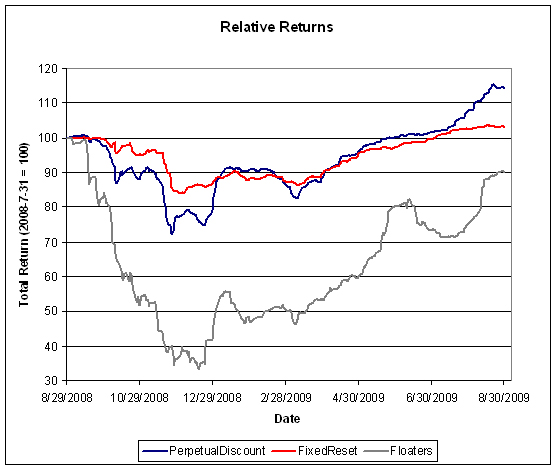
PerpetualDiscounts had a very good month, moving their trailing one-year performance decisively into the black, while the weaknesses of the FixedReset asset class (relatively recently issued at their call price with a near-term call for the issuer) started to make themselves apparent. At the median YTW of about 4%, expected monthly return is about 0.33% and they did better than that this month. I suspect that any significant future gains in index value will result from capture of new-issue concessions … but with forty member in the index that won’t amount to much, and the recent new issue announcements (BPO 6.75%+417, DC, 6.75%+410, WES Convertible, ETC, 7.25%+453) have been of relatively low credit quality.

I won’t make any bets on where the next preferred share market unhappiness is going to come from … but I’ll make a guess!

Meanwhile, Floaters continued their wild ride.


Click for big

Update Oopsy! I forgot to change the label for the y-axis in the above graph … total returns are normalized to 2008-08-29 = 100.0.

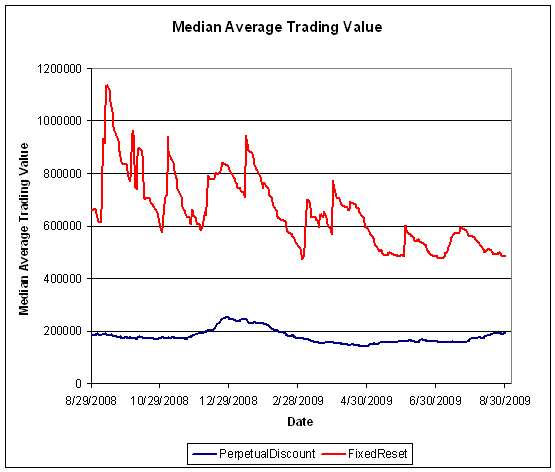
The calculation of the Median Average Trading Value for the FixedReset index is plagued by technical factors and cannot be considered the most reliable statistic in the world – but a downward trend as prior issues become seasoned and the flood of new issues turns to a trickle (which has both a technical effect and a real effect: a constant stream of new issues can keep an entire market liquid) is quite apparent. When they first appeared, I suspected that they would eventually become significantly less liquid than PerpetualDiscounts … not there yet, not even close, but we will see!


Click for big

Claymore has published NAV and distribution data (problems with the page in IE8 can be kludged by using compatibility view) for its exchange traded fund (CPD) and I have derived the following table:

CPD Return, 1- & 3-month, to August, 2009
Date NAV Distribution Return for Sub-Period Monthly Return
May 29, 2009 15.88 0.00    
June 25 15.88 0.2100 +1.32% +1.38%
June 30, 2009 15.89   +0.06%
July 31, 2009 16.42     +3.35%
August 31, 2009 16.93 0.00   +3.11%
Quarterly Return +8.03%

Claymore currently holds $275,986,648 (advisor & common combined) in CPD assets, a stunning increase from the $84,005,161 reported in the Dec 31/08 Annual Report.

The DPS.UN NAV for August 26 has been published so we may calculate the approximate August returns.

DPS.UN NAV Return, August-ish 2009
Date NAV Distribution Return for period
Estimated July Ending Stub -0.61% *
July 29, 2009 19.03    
August 26, 2009 20.30   +6.67%
Estimated August Ending Stub -0.29% **
Estimated August Return +5.71%
* CPD had a NAV of $16.32 on July 29 and a NAV of $16.42 on July 31. The return for the period was therefore +0.61%. This figure is subtracted from the DPS.UN period return to arrive at an estimate for the calendar month.
** CPD had a NAV of $16.98 on August 26 and a NAV of $16.93 on August 31. The return for the period was therefore -0.29%. This figure is added to the DPS.UN period return to arrive at an estimate for the calendar month.
The August return for DPS.UN’s NAV is therefore the product of three period returns, -0.61%, +6.67% and -0.29% to arrive at an estimate for the calendar month of +5.71%

Now, to see the DPS.UN quarterly NAV approximate return, we refer to the calculations for June and July:

DPS.UN NAV Returns, three-month-ish to end-August-ish, 2009
June-ish +2.28%
July-ish +4.45%
August-ish +5.71%
Three-months-ish +12.93%
Index Construction / Reporting

HIMIPref™ Index Rebalancing: August 2009

HIMI Index Changes, August 31, 2009
Issue From To Because
TRI.PR.B Scraps FloatingRate Volume
PWF.PR.A Scraps FloatingRate Volume
CGI.PR.B SplitShare Scraps Volume
RY.PR.H PerpetualDiscount PerpetualPremium Price
CL.PR.B PerpetualDiscount PerpetualPremium Price
GWO.PR.F PerpetualDiscount PerpetualPremium Price
NA.PR.M PerpetualDiscount PerpetualPremium Price
NA.PR.K PerpetualDiscount PerpetualPremium Price
BNS.PR.O PerpetualDiscount PerpetualPremium Price
PWF.PR.I PerpetualDiscount PerpetualPremium Price
TD.PR.Q PerpetualDiscount PerpetualPremium Price

The PerpetualPremium index is filling up nicely and now has twelve members! It disappeared at the October 2008 Rebalancing, when CL.PR.B fell below 25.00.

There were the following intra-month changes:

HIMI Index Changes during August 2009
Issue Action Index Because
BMT.PR.A Delete Scraps Redeemed
Issue Comments

Best & Worst Performers: August 2009

These are total returns, with dividends presumed to have been reinvested at the bid price on the ex-date. The list has been restricted to issues in the HIMIPref™ indices.

August 2009
Issue Index DBRS Rating Monthly Performance Notes (“Now” means “August 31”)
IGM.PR.A OpRet Pfd-2(high) -3.34% Now with a pre-tax bid-YTW of -23.52% based on a bid of 26.54 and a call 2009-9-30 at 26.00.
NA.PR.N FixedReset Pfd-2 -1.61% Now with a pre-tax bid-YTW of 3.99% based on a bid of 26.32 and a call 2013-9-14 at 26.32.
BAM.PR.P FixedReset Pfd-2(low) -0.75% Now with a pre-tax bid-YTW of 6.16% based on a bid of 26.40 and a call 2014-10-30 at 25.00.
BNS.PR.R FixedReset Pfd-1(low) -0.42% Now with a pre-tax bid-YTW of 4.32% based on a bid of 25.79 and a limitMaturity.
TD.PR.G FixedReset Pfd-1(low) -0.29% Now with a pre-tax bid-YTW of 3.99% based on a bid of 27.62 and a call 2014-5-30 at 25.00.
BAM.PR.N Perpetual-Discount Pfd-2(low) +12.92% Now with a pre-tax bid-YTW of 6.54% based on a bid of 18.53 and a limitMaturity.
IAG.PR.A Perpetual-Discount Pfd-2(high) +13.05% Now with a pre-tax bid-YTW of 5.76% based on a bid of 20.00 and a limitMaturity.
BAM.PR.B Floater Pfd-2(low) +19.22%
BAM.PR.K Floater Pfd-2(low) +19.81%
BAM.PR.G FixFloat Pfd-2(low) +24.66%
Market Action

August 31, 2009

Spend-Every-Penny has declared:

As the United States and other countries debate giving more authority to central banks and other regulatory agencies, [Spend-Every-Penny] Sunday said he is sticking with his current approach to systemic oversight, which brings together the heads of the Bank of Canada, the federal banking regulator and other key authorities on a regular basis to compare notes. The decision means a previously obscure grouping of senior officials – the Financial Institutions Supervisory Committee – will be thrust into the spotlight as Canada’s answer to the pledge the federal government and its allies in the Group of 20 made to correct regulatory failings that contributed to the financial crisis.

[Spend-Every-Penny] made clear that even though unelected public servants will play crucial roles, responsibility for ensuring that Canada stays out of financial trouble rests with him.

There’s a very good chance that there won’t be another major banking crisis before he retires, so it’s a pretty safe way to appear tough and authoritative. In most countries, however, the idea that the politicians are ultimately responsible for the performance of their appointees is generally understood. I can’t find a public copy of the speech anywhere, by the way. I hope Spend-Every-Penny won’t be so shy when something bad happens … but I won’t bet on it.

I see that Toronto, well known for its inability to license a souvlaki cart in less than three years is attempting to create a bigger sink-hole than the one on Finch Avenue by bidding to host the Pan-Am games. Send in the clowns!

I noted on March 23 that Liddy, the last CEO of AIG, demonstrated his lack of qualification for the office by throwing his people to the wolves during the bonus controversy. The new guy, Benmosche, is much better:

Benmosche criticized Cuomo and lawmakers during a town-hall style meeting this month for life insurance workers in Houston. Cuomo subpoenaed AIG in March during a national furor about $165 million in retention bonuses sent after the firm’s bailout and said those who returned the cash wouldn’t have their names published. That month, some employees received death threats and protesters visited the Connecticut homes of two AIG executives.

“What he did is so unbelievably wrong,” Benmosche said during the Aug. 11 remarks, according to a record obtained by Bloomberg. “He doesn’t deserve to be in government, and he surely shouldn’t be the attorney general of the state of New York. What he did is criminal. You don’t create lynch mobs to go out to people’s homes and do the things he did.”

Speaking of bonuses…:

U.S. Securities and Exchange Commission Chairman Mary Schapiro, in a letter to brokerage chiefs, warned that burgeoning recruitment bonuses may push employees to engage in improper sales and trades.

Large, up-front bonuses and enhanced commissions may lead brokers “to believe they must sell securities at a sufficiently high level to justify special arrangements,” she wrote today. “Those pressures may in turn create incentives to engage in conduct that may violate obligations to investors.”

Brokers may be motivated to make excessive trades to generate fees, a process known as churning, Schapiro said. They might recommend products that don’t suit their clients’ objectives or generate fees with transactions that aren’t in their customers’ interest, Schapiro said.

Warning! Increased political scrutiny may lead regulators to believe they must make gratuitously precious statements about activities that are already illegal.

Volume ticked upward today, but the market ended a very good month on a sour note, with PerpetualDiscounts losing 13bp and FixedResets down 14bp. The latter may be related to the BPO new issue.

PerpetualDiscounts closed with a pre-tax bid-YTW of 5.66%, equivalent to 7.92% interest at the standard equivalency factor of 1.4x. Long Corporates closed the month with a yield of about 5.95% (after generating +2.83% total return in August), implying that the pre-tax interest-equivalent spread remains at about 200bp.

HIMIPref™ Preferred Indices
These values reflect the December 2008 revision of the HIMIPref™ Indices

Values are provisional and are finalized monthly
Index Mean
Current
Yield
(at bid)
Median
YTW
Median
Average
Trading
Value
Median
Mod Dur
(YTW)
Issues Day’s Perf. Index Value
Ratchet 0.00 % 0.00 % 0 0.00 0 -0.3957 % 1,457.2
FixedFloater 5.72 % 4.00 % 60,880 18.60 1 0.4757 % 2,684.5
Floater 3.13 % 3.16 % 174,664 19.27 2 -0.3957 % 1,820.5
OpRet 4.86 % -10.56 % 132,541 0.09 15 0.1285 % 2,280.1
SplitShare 5.67 % 3.97 % 98,723 0.08 3 -0.3891 % 2,056.3
Interest-Bearing 0.00 % 0.00 % 0 0.00 0 0.1285 % 2,085.0
Perpetual-Premium 5.69 % 5.10 % 69,784 2.60 4 0.5453 % 1,888.0
Perpetual-Discount 5.68 % 5.66 % 188,811 14.31 67 -0.1288 % 1,812.5
FixedReset 5.50 % 4.00 % 483,272 4.12 40 -0.1369 % 2,104.2
Performance Highlights
Issue Index Change Notes
BAM.PR.P FixedReset -3.83 % YTW SCENARIO
Maturity Type : Call
Maturity Date : 2014-10-30
Maturity Price : 25.00
Evaluated at bid price : 26.40
Bid-YTW : 6.16 %
POW.PR.D Perpetual-Discount -2.74 % YTW SCENARIO
Maturity Type : Limit Maturity
Maturity Date : 2039-08-31
Maturity Price : 21.37
Evaluated at bid price : 21.65
Bid-YTW : 5.85 %
BAM.PR.I OpRet -2.63 % YTW SCENARIO
Maturity Type : Soft Maturity
Maturity Date : 2013-12-30
Maturity Price : 25.00
Evaluated at bid price : 25.56
Bid-YTW : 5.19 %
MFC.PR.B Perpetual-Discount -1.94 % YTW SCENARIO
Maturity Type : Limit Maturity
Maturity Date : 2039-08-31
Maturity Price : 20.27
Evaluated at bid price : 20.27
Bid-YTW : 5.76 %
NA.PR.L Perpetual-Discount -1.39 % YTW SCENARIO
Maturity Type : Limit Maturity
Maturity Date : 2039-08-31
Maturity Price : 21.31
Evaluated at bid price : 21.31
Bid-YTW : 5.75 %
CIU.PR.B FixedReset -1.39 % YTW SCENARIO
Maturity Type : Call
Maturity Date : 2014-07-01
Maturity Price : 25.00
Evaluated at bid price : 27.71
Bid-YTW : 4.26 %
GWO.PR.E OpRet 1.16 % YTW SCENARIO
Maturity Type : Call
Maturity Date : 2009-09-30
Maturity Price : 25.50
Evaluated at bid price : 26.21
Bid-YTW : -30.79 %
BNS.PR.O Perpetual-Discount 1.20 % YTW SCENARIO
Maturity Type : Call
Maturity Date : 2017-05-26
Maturity Price : 25.00
Evaluated at bid price : 25.30
Bid-YTW : 5.53 %
CM.PR.R OpRet 1.79 % YTW SCENARIO
Maturity Type : Call
Maturity Date : 2009-09-30
Maturity Price : 25.60
Evaluated at bid price : 26.78
Bid-YTW : -40.35 %
Volume Highlights
Issue Index Shares
Traded
Notes
BAM.PR.P FixedReset 44,640 YTW SCENARIO
Maturity Type : Call
Maturity Date : 2014-10-30
Maturity Price : 25.00
Evaluated at bid price : 26.40
Bid-YTW : 6.16 %
BMO.PR.L Perpetual-Premium 43,803 YTW SCENARIO
Maturity Type : Call
Maturity Date : 2017-06-24
Maturity Price : 25.00
Evaluated at bid price : 25.15
Bid-YTW : 5.76 %
CM.PR.I Perpetual-Discount 30,940 YTW SCENARIO
Maturity Type : Limit Maturity
Maturity Date : 2039-08-31
Maturity Price : 20.70
Evaluated at bid price : 20.70
Bid-YTW : 5.75 %
RY.PR.Y FixedReset 26,300 YTW SCENARIO
Maturity Type : Call
Maturity Date : 2014-12-24
Maturity Price : 25.00
Evaluated at bid price : 27.50
Bid-YTW : 4.07 %
BNS.PR.X FixedReset 23,568 YTW SCENARIO
Maturity Type : Call
Maturity Date : 2014-05-25
Maturity Price : 25.00
Evaluated at bid price : 27.82
Bid-YTW : 3.82 %
BAM.PR.N Perpetual-Discount 23,507 YTW SCENARIO
Maturity Type : Limit Maturity
Maturity Date : 2039-08-31
Maturity Price : 18.53
Evaluated at bid price : 18.53
Bid-YTW : 6.54 %
There were 44 other index-included issues trading in excess of 10,000 shares.
Interesting External Papers

A Financial Conditions Index for the US

The Bank of Canada has announced a new discussion paper by Kimberly Beaton, René Lalonde, and Corinne Luu, A Financial Conditions Index for the United States:

The financial crisis of 2007–09 has highlighted the importance of developments in financial conditions for real economic activity. The authors estimate the effect of current and past shocks to financial variables on U.S. GDP growth by constructing two growth based financial conditions indexes (FCIs) that measure the contribution to quarterly (annualized) GDP growth from financial conditions. One FCI is constructed using a structural vector-error correction model and the other is constructed using a large-scale macroeconomic model. The authors’ results suggest that financial factors subtracted around 5 percentage points from quarterly annualized real GDP growth in the United States in 2008Q4 and 2009Q1 and should subtract another 5 percentage points from growth in 2009Q2. Moreover, to assess the effect of financial shocks in terms of policy interest rate equivalent units, the authors convert the effect of financial developments on growth into the number of basis points by which the federal funds rate has been tightened. The authors show that the tightening of financial conditions since mid-2007 is equivalent to about 300 basis points of tightening in terms of the federal funds rate. Thus, the aggressive monetary easing undertaken by the Federal Reserve over the financial crisis has not been sufficient to offset the tightening of financial conditions. Finally, in a key contribution to the literature, the authors assess the relationship between financial shocks and real activity in the context of the zero lower bound. They find that the effect of the tightening of financial conditions on GDP growth in the current crisis may have been amplified by as much as 40 per cent due to the fact that policy interest rates reached the zero lower bound.

In particular, our MFCI adjusted for the binding lower bound suggests that financial factors subtracted around 5 percentage points from quarterly annualized growth in 2008Q4 and 2009Q1. Moreover, in order to assess the effect of financial shocks in terms of policy interest rate equivalent units, we have converted the effect of financial developments on growth into the number of basis points by which the federal funds rate has been tightened. The results suggest that the net tightening of financial conditions since mid-2007 is equivalent to about 300 basis points of tightening in terms of the federal funds rate, despite the actual 500 basis point decline in the policy rate. Given the ongoing disruptions in financial markets, the degree of tightening of price and non-price credit conditions and the substantial losses in wealth over 2008, and the long transmission lags between a shock to financial conditions and its impact on the real economy, these financial conditions are expected to continue to dampen growth going forward.

New Issues

New Issue: BPO FixedReset 6.75%+417

Issue: Brookfield Properties Corporation. Cumulative Class AAA Rate Reset Preference Shares Series L

Size: 6-million shares (=$150-million) + greenshoe 0.9-million shares (=$22.5-million)

Dividend: 6.75% (=$1.6875) p.a. until first Exchange Date, then resets to 5-Year GOC +417 if not called or exchanged. First Dividend $0.45308 payable 2009-12-31. Cumulative.

Exchange Dates: 2014-9-30 and every five years thereafter

Exchange: Every Exchange Date to and from Series M Floaters

Redemption: Every Exchange Date at $25.00. Series M are also redeemable at 25.50 at any time.

Closing: 2009-9-24

Update: Brookfield Properties has announced:

that as a result of strong investor demand for its previously announced public offering of 6.75% Preferred Shares, Series L, it has agreed to increase the size of the offering from C$150 million to C$250 million, or from 6.0 million shares to 10.0 million shares. The issue will be led by a syndicate of underwriters including CIBC and Scotia Capital Inc. for distribution to the public. The Preferred Shares, Series L will be issued at a price of C$25.00 per share, for aggregate gross proceeds of C$250 million. Holders of the Preferred Shares, Series L will be entitled to receive a cumulative quarterly fixed dividend yielding 6.75% annually for the initial five year period ending September 30, 2014. The dividend rate will be reset on September 30, 2014 and every five years thereafter at a rate equal to the 5-year Government of Canada bond yield plus 4.17%.

Holders of Preferred Shares, Series L will have the right, at their option, to convert their shares into cumulative Preferred Shares, Series M, subject to certain conditions, on September 30, 2014 and on September 30 every five years thereafter. Holders of the Preferred Shares, Series M will be entitled to receive cumulative quarterly floating dividends at a rate equal to the three-month Government of Canada Treasury Bill yield plus 4.17%.

Brookfield Properties Corporation has granted the underwriters an over-allotment option, exercisable in whole or in part anytime up to 30 days following closing, to purchase an additional 1,500,000 Preferred Shares, Series L at the same offering price. Should the over-allotment option be fully exercised, the total gross proceeds of the financing will be C$287.5 million.

Issue Comments

BSD.PR.A Semi-Annual Financials Published

Brookfield Soundvest Rising Distribution Split Trust has released its 1H09 Financials:

The published combined net asset value (the “Combined Net Asset Value”), which refers to the value of a capital unit and a preferred security of the Trust, was $8.52 at December 31, 2008 and increased by 13.4% during the period to $9.66 at June 30, 2009. During the same time frame, the S&P/TSX Capped Income Trust Total Return Index gained 14.5%. The Fund underperformed the index based on net asset value despite generating returns from all four income trust sectors in excess of the overall index. The underperformance is largely due to the net disbursements made from the Fund during the period ended June 30, 2009.

More underperformance!

To June 30, 2009, 13,400 capital units and 13,400 preferred securities had been purchased under the NCIB. We continue to be of the opinion that capital units and preferred securities of the Trust may become available during the proposed purchase period at prices that would make such purchases in the best interests of the Trust and its securityholders.

Subsequent to June 30, 2009, an additional 6,500 capital units and 6,500 preferred securities had been purchased under the normal course issuer bid.

Opinions are very nice, but cash is better. The capital units closed yesterday at 0.84-88, 6×2, while the preferreds were at 7.67-75, 1×9. The NAV was 10.46 on August 21 and, if anecdotal memory serves, this discount has been present throughout most of the piece. These guys have been refusing to execute their NCIB in a meaningful manner even with a discount to NAV on the order of 20%!

On October 23, 2008, the Trust announced that it was temporarily suspending the annual redemption rights that would have arisen in November in respect of both its Capital Units and Preferred Securities. The Trust’s Declaration of Trust provides for the suspension of redemptions when the Coverage Ratio cannot be maintained. The Trust is continuing to monitor its net asset value to determine when it will be able to resume redemptions.

This is a rather disingenuously phrased paragraph. The Declaration of Trust allows the manager to suspend redemptions when coverage is below 1.4, but does not stipulate that it must be suspended. Quite frankly, I consider the suspension of redemptions to be rather sharp practice by the Manager … and one reason why the combined units are trading so far below the combined NAV.

The Income Coverage Ratio is a rare piece of cheerful news. Gross Income for the half, excluding “Return of Capital” was 2,517,076; expenses were 431,767 (including Management fees of 275,909 and “General and Administrative” fees of 58,205, “Accounting and Administrative” fees of 16,916 and Directors’ fees of 6,928 … keep milking that cow, boys!); therefore net income was 2,085,309 to cover preferred security interest expense of 1,692,707. The Income Coverage Ratio is therefore 1.2+:1.

The directors signing the fund statements were Jeffrey M. Blidner & George E. Myhal, of Brookfield Investment Funds Management Inc., the Manager of the fund. One may only hope that, in their role as officers of the Manager of the Fund, they did not accept Directors Fees.

BSD.PR.A was last mentioned on PrefBlog when its Credit Trend was revised to “Stable” by DBRS.

BSD.PR.A is tracked by HIMIPref™, but has been relegated to the “Scraps” index due to credit concerns.
Interesting External Papers

S&P US Preferred Stock Primer

Standard & Poor’s published a Preferred Stock Primer dated 2009-3-25:

Preferred stock returns have low correlations with common stock returns, making them good diversifiers. They also have relatively low correlations with bonds, with expected volatility and returns between those of common stocks and bonds. This characteristic makes them a good complement to a bond portfolio.

Later on in the paper they cite a preferred/bond correlation of 0.309 and a preferred/common correlation of 0.491.

There are many types of preferreds and preferred trademark names. However, most preferreds are based on two main structural models: Traditional Preferreds and Trust Preferreds. Traditional Preferreds are closer to stocks and are generally REIT preferreds, foreign preference shares trading in the U.S. and straight preferred stocks issued by U.S. corporations.

Traditional preferreds are a senior form of equity which rank above common shares but below corporate debt in creditor standings. Dividends from traditional preferreds are taxed as capital gains. Trust Preferreds are closer to bonds and thus rank higher in general creditor standings than regular preferreds. Dividends from trust preferreds are taxed as ordinary income. As of February 27, 2009, the S&P Preferred Stock Index contained 35 trust preferreds out of a total 72 constituents.

Somwhate confusingly, they later state:

Some preferred stocks have qualified dividend distributions that are taxed in the same manner as qualified dividends of common stocks. Others have their dividends charged as interest income and are subject to higher tax rates. Those that do have qualified dividend distributions have holding period requirements that are higher than those for common stocks. Investors need to contact their tax advisors to assess their tax situation. The favorable tax treatment for some preferreds is a result of tax laws passed in 2003, and this may change in the future.

Figuring out the tax status of US preferreds sounds like a full-time job in itself!

The modern era for preferred stocks started in the early 1990s. Since then, the preferred stock market has grown rapidly, quadrupling in size by 2005 to $193 billion. Concerns about default and conversion risk shrunk the market to about $100 billion in early 2008. For a comparative perspective, the total size of the U.S. stock market was in the range of $9.5 trillion; and the U.S. corporate bond market was in the range of $4 trillion.