Indices and ETFs

TXPR Index Rebalancing

Standard & Poors Index Operations has announced:

the following index changes as a result of the semi-annual S&P/TSX Preferred Share Index Review. These changes will be effective at the open on Monday, January 19, 2009

TXPR Additions
Ticker HIMIPref™
SubIndex
DBRS
Credit
Rating
Average
Trading
Value
Total
Return
Nov. 30 –
Jan 9
Prior History
BMO.PR.L PerpetualDiscount Pfd-1 393M +21.51%  
BAM.PR.H OpRet Pfd-2(low) 195M +5.60%  
BAM.PR.O OpRet Pfd-2(low) 360M +0.54%  
FTS.PR.C Scraps
(Would be OpRet, but credit concerns)
Pfd-3(high) 46M +5.97% Deleted in July
GWO.PR.X OpRet Pfd-1(low) 101M +0.20% Deleted in July
HSB.PR.C PerpetualDiscount Pfd-1 145M +8.34% Deleted in July
L.PR.A Scraps
(Would be OpRet, but credit concerns)
Pfd-3 420M +6.44%  
NSI.PR.C Scraps
(Would be OpRet, but volume concerns)
Pfd-2(low) 6M (!) -7.14%  
NSI.PR.D Scraps
(Would be OpRet, but volume concerns)
Pfd-2(low) 13M (!) +0.52%  
RY.PR.I FixedReset Pfd-1 741M +6.82%  
TCA.PR.X PerpetualDiscount Pfd-2(low) 140M +14.13% Deleted in July
W.PR.J PerpetualDiscount Pfd-2(low) 100M +16.27%  
YPG.PR.B Scraps
(Would be OpRet, but credit concerns)
Pfd-3(high) 137M +24.82% Deleted in July
TXPR Deletions
Ticker HIMIPref™
SubIndex
DBRS
Credit
Rating
Average
Trading
Value
Total
Return
Nov. 30 –
Jan 9
Prior History
ACO.PR.A OpRet Pfd-2(low) 32M +2.73% Added in July
BAM.PR.K Floater Pfd-2(low) 71M +48.78%  
BAM.PR.N PerpetualDiscount Pfd-2(low) 229M +28.56% Added in July
DW.PR.A Scraps
(Would be OpRet, but credit concerns)
Pfd-3 124M +26.90%  
FTS.PR.E Scraps
(Would be OpRet, but credit concerns)
Pfd-3(high) 34M +6.44% Added in July
GWO.PR.I PerpetualDiscount Pfd-1(low) 318M +17.02% Added in July

Holy smokes! I wasn’t going to report volume figures … until after a double-take I saw that they have added not just one, but both NSI issues – which trade by appointment only. The very first line on S&P’s Methodology Brochure states:

The S&P/TSX Preferred Share Index is designed to serve the investment community’s need for an investable benchmark representing the Canadian preferred stock market.

… and in the “Eligibility” section …

The index is comprised of preferred stocks trading on the Toronto Stock Exchange that meet criteria relating to size, liquidity, and issuer rating.

… and …

Volume.The preferred stocks must have a minimum trailing three-month average daily value traded of C$100,000 at the time of the rebalancing.

I am stunned that S&P has ruled that the NSI issues meet liquidity requirements. Mind you, these are the guys who attemped to add a redeemed issue last time.

I recently wrote an essay on CPD/TXPR.

In summary and, perforce, ignoring any weightings that S&P might be assigning:

TXPR Changes by Sector
Assigning “Scraps” & “None” to “Would be”
Sector Adds Deletions Net
OpRet 8 3 +5
FixedReset 1 0 +1
PerpetualDiscount 4 2 +2
Floater 0 1 -1

… and …

TXPR Changes by Credit (DBRS)
Credit Adds Deletions Net
Pfd-1 3 0 +3
Pfd-1(low) 1 1 0
Pfd-2(high) 0 0 0
Pfd-2(low) 6 3 +3
Pfd-3(high) 2 1 +1
Pfd-3 1 1 0

Assiduous Readers will recall that the Claymore ETF (trading as CPD on the Toronto Exchange) is based on the TXPR Index discussed here.

PrefLetter

PrefLetter Now Available in Manitoba!

I am pleased to announce that PrefLetter is now available to residents of Manitoba.

PrefLetter is the monthly newsletter recommending individual issues of preferred shares to subscribers. There is at least one recommendation from every major type of preferred share (two of them recently added); the recommendations are taylored for “buy-and-hold” investors.

Preferred share dividends enjoy a privileged position with respect to taxes in Manitoba.

The next edition of PrefLetter will be prepared as of the close today, January 9, and be eMailed to subscribers in PDF format prior to the opening of the Toronto Stock Exchange on January 12.

Taxation

Marginal Tax Rates: Manitoba 2008

Here are the rates from the E&Y Tax Calculator, as updated to include legislation to October 22, 2008. There has been a marginal change since my last post on the topic.

Clawbacks are not included; I am hopeful that at some point I will be able to get some authoritative data on the effects of clawbacks, but have not found anything credible … please contact me if you do know of any credible public sources!

Investors Taxable Income Marginal Rate on Interest Marginal Rate on Dividends Equivalency Factor
Widows & Orphans $30,000 25.90% 0.00% 1.35
Professionals $75,000 39.40% 13.68% 1.42
Plutocrats $150,000 46.40% 23.83% 1.42

There are some notes about the calculation of the equivalency factor in the comments to an earlier post about Ontario.

Market Action

January 8, 2009

The Congressional Budget Office released its Ten Year Outlook for the US Economy, and my-oh-my, but it’s gloomy:

Under an assumption that current laws and policies regarding federal spending and taxation remain the same,
CBO forecasts the following:

  • A marked contraction in the U.S. economy in calendar year 2009, with real (inflation-adjusted) gross domestic product (GDP) falling by 2.2 percent.
  • A slow recovery in 2010, with real GDP growing by only 1.5 percent.
  • An unemployment rate that will exceed 9 percent early in 2010.
  • A continued decline in inflation, both because energy
    prices have been falling and because inflation excluding energy and food prices—the core rate—tends to ease during and immediately after a recession; for 2009, CBO anticipates that inflation, as measured by the consumer price index for all urban consumers (CPI-U), will be only 0.1 percent.

  • A drop in the national average price of a home, as measured by the Federal Housing Finance Agency’s purchase-only index, of an additional 14 percent between the third quarter of 2008 and the second quarter of 2010; the imbalance between the supply of and demand for housing persists, as reflected in unusually high vacancy rates and a low volume of housing starts.
  • A decrease of more than 1 percent in real consumption in 2009, followed by moderate growth in 2010;
  • the rise in unemployment, the loss of wealth, and tight consumer credit will continue to restrain consumption—although lower commodity prices will ease those effects somewhat.
  • A financial system that remains strained, although some credit markets have started to improve; it is too early to determine whether the government’s actions to date have been sufficient to put the system on a path to recovery.

There is more commentary by Paul Krugman of the NYT and Menzie Chinn of Econbrowser.

And there are some straws in the wind regarding the future of US bank regulation:

The biggest U.S. banks may face the threat of lower profits or pressure to break up under greater regulation following the financial crisis.

Federal Reserve officials have made tackling the issue of firms that are too big to fail a priority. Options may include banning or restricting activities that could threaten the stability of the financial system, analysts said.

I continue to suggest that there needs to be a clear delineation of the difference between banking and investment banking. We want a rock-solid banking core, a somewhat more exciting layer of investment banking around that, surrounded by a wild-n-wooly world of hedge funds and shadow banks.

To that end, I suggest that capital rules be modified to emphasize the functionality of these layers. Banks buy-and-hold assets. Therefore, trading should attract a higher capital charge for them. Investment banks buy-and-sell assets. Therefore, aging assets should attract a higher capital charge for them. And, perhaps, hedging inefficiencies should be recognized such that a long and short hedge will attract a small, but non-zero, capital charge on the gross position.

There are indications that the CP market in the US is recovering:

Corporate borrowing in the commercial paper market expanded to the highest level since before Lehman Brothers Holdings Inc. filed for bankruptcy in September as companies took advantage of the lowest rates on record.

U.S. commercial paper outstanding rose $83.1 billion, or 4.9 percent, during the week ended Jan. 7 to a seasonally adjusted $1.76 trillion, the Federal Reserve said today in Washington. That’s the highest since the week ended Sept. 10, five days before Lehman’s filing.

Julia Dickson, OSFI Superintendent, gave a speech on regulatory pro-cyclicity, but there is not much substance to it.

Watson Wyatt has released some cheerful analysis:

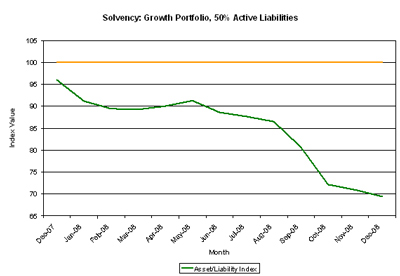
Market declines caused by the global financial crisis have left the solvency of Canadian defined benefit (DB) pension plans at historical lows and defined contribution (DC) plan members with shrinking retirement savings, according to an analysis by Watson Wyatt Worldwide, a leading global consulting firm.

The pension solvency funded ratio (the ratio of market value of plan assets to plan solvency liabilities) of the typical pension plan declined 27 percentage points in 2008, dropping from 96 percent at the beginning of the year to 69 percent at year-end. Watson Wyatt’s Pension Barometer, which reflects the combined impact of investment performance and interest rates on the solvency funded ratio of a typical Canadian pension plan, indicates that the funded status of the typical pension plan decreased 11 percentage points in the fourth quarter alone.

PerpetualDiscounts managed to stagger to another gain today, with some evidence that the market is becoming a little (just a little!) less sloppy. To my surprise, Fixed-Resets also did very well.

I’m almost finished fiddling with the format of the performance table, and am about to commence fiddling with the volume table. Once I’m happy with the machine-generated tables, I’ll be adding the occasional comment, as I did way back in 2008. Assiduous Readers will have no idea how happy I am that the drudgery of table preparation is now computerized …

HIMIPref™ Preferred Indices
These values reflect the December 2008 revision of the HIMIPref™ Indices

Values are provisional and are finalized monthly
Index Mean
Current
Yield
(at bid)
Median
YTW
Median
Average
Trading
Value
Median
Mod Dur
(YTW)
Issues Day’s Perf. Index Value
Ratchet 6.95 % 7.46 % 29,065 13.58 2 1.4639 % 877.3
FixedFloater 7.38 % 7.11 % 147,810 13.60 8 1.7415 % 1,386.5
Floater 5.39 % 5.15 % 34,132 15.27 4 3.1073 % 1,132.1
OpRet 5.35 % 4.66 % 124,934 3.87 15 0.4597 % 2,007.8
SplitShare 6.10 % 8.71 % 82,094 4.19 15 -0.6397 % 1,821.5
Interest-Bearing 7.16 % 11.53 % 44,918 0.93 2 0.0000 % 1,975.8
Perpetual-Premium 0.00 % 0.00 % 0 0.00 0 0.1175 % 1,555.3
Perpetual-Discount 6.88 % 6.94 % 239,673 12.59 71 0.1175 % 1,432.4
FixedReset 5.90 % 4.95 % 741,157 15.15 18 0.4615 % 1,807.9
Performance Highlights
Issue Index Change Notes
MFC.PR.C Perpetual-Discount -3.59 % Yield-to-Worst (at Bid) : 6.73 %
YTW SCENARIO
Maturity Type : Limit Maturity
Maturity Date : 2039-01-08
Maturity Price : 16.93

Evaluated at bid price : 16.93

ELF.PR.G Perpetual-Discount -3.46 % Yield-to-Worst (at Bid) : 8.26 %
YTW SCENARIO
Maturity Type : Limit Maturity
Maturity Date : 2039-01-08
Maturity Price : 14.50

Evaluated at bid price : 14.50

FBS.PR.B SplitShare -3.39 % Yield-to-Worst (at Bid) : 10.85 %
YTW SCENARIO
Maturity Type : Hard Maturity
Maturity Date : 2011-12-15
Maturity Price : 10.00

Evaluated at bid price : 8.55

SBC.PR.A SplitShare -3.26 % Yield-to-Worst (at Bid) : 10.68 %
YTW SCENARIO
Maturity Type : Hard Maturity
Maturity Date : 2012-11-30
Maturity Price : 10.00

Evaluated at bid price : 8.32

CU.PR.A Perpetual-Discount -3.22 % Yield-to-Worst (at Bid) : 6.60 %
YTW SCENARIO
Maturity Type : Limit Maturity
Maturity Date : 2039-01-08
Maturity Price : 21.93

Evaluated at bid price : 22.26

DF.PR.A SplitShare -3.00 % Yield-to-Worst (at Bid) : 8.06 %
YTW SCENARIO
Maturity Type : Hard Maturity
Maturity Date : 2014-12-01
Maturity Price : 10.00

Evaluated at bid price : 8.74

CIU.PR.A Perpetual-Discount -2.64 % Yield-to-Worst (at Bid) : 7.22 %
YTW SCENARIO
Maturity Type : Limit Maturity
Maturity Date : 2039-01-08
Maturity Price : 16.21

Evaluated at bid price : 16.21

SLF.PR.C Perpetual-Discount -2.38 % Yield-to-Worst (at Bid) : 7.42 %
YTW SCENARIO
Maturity Type : Limit Maturity
Maturity Date : 2039-01-08
Maturity Price : 15.16

Evaluated at bid price : 15.16

LFE.PR.A SplitShare -2.14 % Yield-to-Worst (at Bid) : 7.90 %
YTW SCENARIO
Maturity Type : Hard Maturity
Maturity Date : 2012-12-01
Maturity Price : 10.00

Evaluated at bid price : 9.15

BNS.PR.K Perpetual-Discount -2.11 % Yield-to-Worst (at Bid) : 6.65 %
YTW SCENARIO
Maturity Type : Limit Maturity
Maturity Date : 2039-01-08
Maturity Price : 18.11

Evaluated at bid price : 18.11

BCE.PR.C FixedFloater -1.95 % Yield-to-Worst (at Bid) : 7.45 %
YTW SCENARIO
Maturity Type : Limit Maturity
Maturity Date : 2039-01-08
Maturity Price : 25.00

Evaluated at bid price : 15.61

BNS.PR.Q FixedReset -1.94 % Yield-to-Worst (at Bid) : 4.50 %
YTW SCENARIO
Maturity Type : Limit Maturity
Maturity Date : 2039-01-08
Maturity Price : 21.69

Evaluated at bid price : 21.73

PWF.PR.K Perpetual-Discount -1.89 % Yield-to-Worst (at Bid) : 7.04 %
YTW SCENARIO
Maturity Type : Limit Maturity
Maturity Date : 2039-01-08
Maturity Price : 17.66

Evaluated at bid price : 17.66

ENB.PR.A Perpetual-Discount -1.66 % Yield-to-Worst (at Bid) : 5.86 %
YTW SCENARIO
Maturity Type : Limit Maturity
Maturity Date : 2039-01-08
Maturity Price : 23.48

Evaluated at bid price : 23.75

FTN.PR.A SplitShare -1.41 % Yield-to-Worst (at Bid) : 8.47 %
YTW SCENARIO
Maturity Type : Hard Maturity
Maturity Date : 2015-12-01
Maturity Price : 10.00

Evaluated at bid price : 8.39

BNA.PR.B SplitShare -1.29 % Yield-to-Worst (at Bid) : 9.00 %
YTW SCENARIO
Maturity Type : Hard Maturity
Maturity Date : 2016-03-25
Maturity Price : 25.00

Evaluated at bid price : 19.90

SLF.PR.B Perpetual-Discount -1.19 % Yield-to-Worst (at Bid) : 7.30 %
YTW SCENARIO
Maturity Type : Limit Maturity
Maturity Date : 2039-01-08
Maturity Price : 16.61

Evaluated at bid price : 16.61

CL.PR.B Perpetual-Discount -1.12 % Yield-to-Worst (at Bid) : 7.18 %
YTW SCENARIO
Maturity Type : Limit Maturity
Maturity Date : 2039-01-08
Maturity Price : 22.01

Evaluated at bid price : 22.01

NA.PR.L Perpetual-Discount -1.09 % Yield-to-Worst (at Bid) : 7.06 %
YTW SCENARIO
Maturity Type : Limit Maturity
Maturity Date : 2039-01-08
Maturity Price : 17.20

Evaluated at bid price : 17.20

NA.PR.M Perpetual-Discount -1.09 % Yield-to-Worst (at Bid) : 7.20 %
YTW SCENARIO
Maturity Type : Limit Maturity
Maturity Date : 2039-01-08
Maturity Price : 20.85

Evaluated at bid price : 20.85

NA.PR.K Perpetual-Discount -1.02 % Yield-to-Worst (at Bid) : 7.18 %
YTW SCENARIO
Maturity Type : Limit Maturity
Maturity Date : 2039-01-08
Maturity Price : 20.40

Evaluated at bid price : 20.40

RY.PR.W Perpetual-Discount -1.01 % Yield-to-Worst (at Bid) : 6.37 %
YTW SCENARIO
Maturity Type : Limit Maturity
Maturity Date : 2039-01-08
Maturity Price : 19.55

Evaluated at bid price : 19.55

CM.PR.I Perpetual-Discount -1.01 % Yield-to-Worst (at Bid) : 7.10 %
YTW SCENARIO
Maturity Type : Limit Maturity
Maturity Date : 2039-01-08
Maturity Price : 16.62

Evaluated at bid price : 16.62

PPL.PR.A SplitShare 1.00 % Yield-to-Worst (at Bid) : 7.89 %
YTW SCENARIO
Maturity Type : Hard Maturity
Maturity Date : 2012-12-01
Maturity Price : 10.00

Evaluated at bid price : 9.05

PWF.PR.H Perpetual-Discount 1.05 % Yield-to-Worst (at Bid) : 7.14 %
YTW SCENARIO
Maturity Type : Limit Maturity
Maturity Date : 2039-01-08
Maturity Price : 20.21

Evaluated at bid price : 20.21

CM.PR.D Perpetual-Discount 1.05 % Yield-to-Worst (at Bid) : 7.16 %
YTW SCENARIO
Maturity Type : Limit Maturity
Maturity Date : 2039-01-08
Maturity Price : 20.16

Evaluated at bid price : 20.16

CM.PR.J Perpetual-Discount 1.06 % Yield-to-Worst (at Bid) : 6.94 %
YTW SCENARIO
Maturity Type : Limit Maturity
Maturity Date : 2039-01-08
Maturity Price : 16.28

Evaluated at bid price : 16.28

RY.PR.N FixedReset 1.16 % Yield-to-Worst (at Bid) : 5.62 %
YTW SCENARIO
Maturity Type : Limit Maturity
Maturity Date : 2039-01-08
Maturity Price : 25.20

Evaluated at bid price : 25.25

NA.PR.N FixedReset 1.17 % Yield-to-Worst (at Bid) : 4.89 %
YTW SCENARIO
Maturity Type : Limit Maturity
Maturity Date : 2039-01-08
Maturity Price : 21.36

Evaluated at bid price : 21.66

BNS.PR.R FixedReset 1.18 % Yield-to-Worst (at Bid) : 4.74 %
YTW SCENARIO
Maturity Type : Limit Maturity
Maturity Date : 2039-01-08
Maturity Price : 21.50

Evaluated at bid price : 21.50

ALB.PR.A SplitShare 1.19 % Yield-to-Worst (at Bid) : 12.75 %
YTW SCENARIO
Maturity Type : Hard Maturity
Maturity Date : 2011-02-28
Maturity Price : 25.00

Evaluated at bid price : 21.27

BAM.PR.H OpRet 1.19 % Yield-to-Worst (at Bid) : 11.59 %
YTW SCENARIO
Maturity Type : Soft Maturity
Maturity Date : 2012-03-30
Maturity Price : 25.00

Evaluated at bid price : 21.25

POW.PR.C Perpetual-Discount 1.32 % Yield-to-Worst (at Bid) : 6.81 %
YTW SCENARIO
Maturity Type : Limit Maturity
Maturity Date : 2039-01-08
Maturity Price : 21.44

Evaluated at bid price : 21.44

BCE.PR.I FixedFloater 1.33 % Yield-to-Worst (at Bid) : 7.11 %
YTW SCENARIO
Maturity Type : Limit Maturity
Maturity Date : 2039-01-08
Maturity Price : 25.00

Evaluated at bid price : 15.97

CM.PR.P Perpetual-Discount 1.41 % Yield-to-Worst (at Bid) : 7.12 %
YTW SCENARIO
Maturity Type : Limit Maturity
Maturity Date : 2039-01-08
Maturity Price : 19.40

Evaluated at bid price : 19.40

RY.PR.F Perpetual-Discount 1.43 % Yield-to-Worst (at Bid) : 6.37 %
YTW SCENARIO
Maturity Type : Limit Maturity
Maturity Date : 2039-01-08
Maturity Price : 17.76

Evaluated at bid price : 17.76

SLF.PR.A Perpetual-Discount 1.50 % Yield-to-Worst (at Bid) : 7.08 %
YTW SCENARIO
Maturity Type : Limit Maturity
Maturity Date : 2039-01-08
Maturity Price : 16.96

Evaluated at bid price : 16.96

TCA.PR.X Perpetual-Discount 1.59 % Yield-to-Worst (at Bid) : 6.26 %
YTW SCENARIO
Maturity Type : Limit Maturity
Maturity Date : 2039-01-08
Maturity Price : 43.77

Evaluated at bid price : 44.70

PWF.PR.M FixedReset 1.63 % Yield-to-Worst (at Bid) : 5.43 %
YTW SCENARIO
Maturity Type : Limit Maturity
Maturity Date : 2039-01-08
Maturity Price : 24.85

Evaluated at bid price : 24.90

BNA.PR.C SplitShare 1.77 % Yield-to-Worst (at Bid) : 18.76 %
YTW SCENARIO
Maturity Type : Hard Maturity
Maturity Date : 2019-01-10
Maturity Price : 25.00

Evaluated at bid price : 9.20

CM.PR.A OpRet 1.84 % Yield-to-Worst (at Bid) : -21.17 %
YTW SCENARIO
Maturity Type : Call
Maturity Date : 2009-02-07
Maturity Price : 25.50

Evaluated at bid price : 26.01

RY.PR.A Perpetual-Discount 1.91 % Yield-to-Worst (at Bid) : 6.23 %
YTW SCENARIO
Maturity Type : Limit Maturity
Maturity Date : 2039-01-08
Maturity Price : 18.15

Evaluated at bid price : 18.15

POW.PR.A Perpetual-Discount 1.93 % Yield-to-Worst (at Bid) : 7.23 %
YTW SCENARIO
Maturity Type : Limit Maturity
Maturity Date : 2039-01-08
Maturity Price : 19.50

Evaluated at bid price : 19.50

RY.PR.C Perpetual-Discount 2.06 % Yield-to-Worst (at Bid) : 6.39 %
YTW SCENARIO
Maturity Type : Limit Maturity
Maturity Date : 2039-01-08
Maturity Price : 18.30

Evaluated at bid price : 18.30

BAM.PR.M Perpetual-Discount 2.14 % Yield-to-Worst (at Bid) : 9.71 %
YTW SCENARIO
Maturity Type : Limit Maturity
Maturity Date : 2039-01-08
Maturity Price : 12.41

Evaluated at bid price : 12.41

BCE.PR.Y Ratchet 2.17 % Yield-to-Worst (at Bid) : 7.94 %
YTW SCENARIO
Maturity Type : Limit Maturity
Maturity Date : 2039-01-08
Maturity Price : 25.00

Evaluated at bid price : 14.10

BAM.PR.K Floater 2.18 % Yield-to-Worst (at Bid) : 5.98 %
YTW SCENARIO
Maturity Type : Limit Maturity
Maturity Date : 2039-01-08
Maturity Price : 10.33

Evaluated at bid price : 10.33

RY.PR.L FixedReset 2.23 % Yield-to-Worst (at Bid) : 4.95 %
YTW SCENARIO
Maturity Type : Limit Maturity
Maturity Date : 2039-01-08
Maturity Price : 24.70

Evaluated at bid price : 24.75

BAM.PR.B Floater 2.31 % Yield-to-Worst (at Bid) : 6.07 %
YTW SCENARIO
Maturity Type : Limit Maturity
Maturity Date : 2039-01-08
Maturity Price : 10.19

Evaluated at bid price : 10.19

BNS.PR.O Perpetual-Discount 2.38 % Yield-to-Worst (at Bid) : 6.54 %
YTW SCENARIO
Maturity Type : Limit Maturity
Maturity Date : 2039-01-08
Maturity Price : 21.50

Evaluated at bid price : 21.50

TCA.PR.Y Perpetual-Discount 2.40 % Yield-to-Worst (at Bid) : 6.25 %
YTW SCENARIO
Maturity Type : Limit Maturity
Maturity Date : 2039-01-08
Maturity Price : 43.78

Evaluated at bid price : 44.76

LBS.PR.A SplitShare 2.82 % Yield-to-Worst (at Bid) : 9.45 %
YTW SCENARIO
Maturity Type : Hard Maturity
Maturity Date : 2013-11-29
Maturity Price : 10.00

Evaluated at bid price : 8.40

BAM.PR.I OpRet 2.96 % Yield-to-Worst (at Bid) : 10.32 %
YTW SCENARIO
Maturity Type : Soft Maturity
Maturity Date : 2013-12-30
Maturity Price : 25.00

Evaluated at bid price : 20.50

BCE.PR.G FixedFloater 3.23 % Yield-to-Worst (at Bid) : 7.02 %
YTW SCENARIO
Maturity Type : Limit Maturity
Maturity Date : 2039-01-08
Maturity Price : 25.00

Evaluated at bid price : 16.00

BCE.PR.Z FixedFloater 3.35 % Yield-to-Worst (at Bid) : 7.59 %
YTW SCENARIO
Maturity Type : Limit Maturity
Maturity Date : 2039-01-08
Maturity Price : 25.00

Evaluated at bid price : 15.10

BCE.PR.A FixedFloater 3.42 % Yield-to-Worst (at Bid) : 6.87 %
YTW SCENARIO
Maturity Type : Limit Maturity
Maturity Date : 2039-01-08
Maturity Price : 25.00

Evaluated at bid price : 16.92

PWF.PR.A Floater 3.52 % Yield-to-Worst (at Bid) : 4.79 %
YTW SCENARIO
Maturity Type : Limit Maturity
Maturity Date : 2039-01-08
Maturity Price : 12.95

Evaluated at bid price : 12.95

BAM.PR.N Perpetual-Discount 3.98 % Yield-to-Worst (at Bid) : 9.61 %
YTW SCENARIO
Maturity Type : Limit Maturity
Maturity Date : 2039-01-08
Maturity Price : 12.54

Evaluated at bid price : 12.54

TRI.PR.B Floater 4.17 % Yield-to-Worst (at Bid) : 5.15 %
YTW SCENARIO
Maturity Type : Limit Maturity
Maturity Date : 2039-01-08
Maturity Price : 11.99

Evaluated at bid price : 11.99

IAG.PR.A Perpetual-Discount 4.67 % Yield-to-Worst (at Bid) : 6.64 %
YTW SCENARIO
Maturity Type : Limit Maturity
Maturity Date : 2039-01-08
Maturity Price : 17.50

Evaluated at bid price : 17.50

BAM.PR.G FixedFloater 5.16 % Yield-to-Worst (at Bid) : 9.73 %
YTW SCENARIO
Maturity Type : Limit Maturity
Maturity Date : 2039-01-08
Maturity Price : 25.00

Evaluated at bid price : 11.83

Volume Highlights
Issue Index Shares
Traded
Notes
BNA.PR.C SplitShare 493,445
BAM.PR.B Floater 390,981
BAM.PR.O OpRet 133,637
WFS.PR.A SplitShare 119,635
IGM.PR.A OpRet 82,856
MFC.PR.A OpRet 77,885
GWO.PR.X OpRet 75,713
BCE.PR.A FixedFloater 52,541
SBC.PR.A SplitShare 50,800
RY.PR.N FixedReset 37,805
LBS.PR.A SplitShare 37,200
BMO.PR.J Perpetual-Discount 32,815
RY.PR.I FixedReset 31,158
SBN.PR.A SplitShare 28,000
SLF.PR.C Perpetual-Discount 25,808
CM.PR.I Perpetual-Discount 25,731
RY.PR.D Perpetual-Discount 24,155
TD.PR.O Perpetual-Discount 24,100
CM.PR.J Perpetual-Discount 22,930
TD.PR.C FixedReset 21,025
BMO.PR.H Perpetual-Discount 20,121
GWO.PR.I Perpetual-Discount 19,700
RY.PR.H Perpetual-Discount 18,350
CM.PR.H Perpetual-Discount 17,238
BNS.PR.O Perpetual-Discount 16,905
CM.PR.D Perpetual-Discount 16,390
RY.PR.W Perpetual-Discount 15,600
RY.PR.A Perpetual-Discount 13,665
GWO.PR.G Perpetual-Discount 13,475
RY.PR.B Perpetual-Discount 13,290
TD.PR.R Perpetual-Discount 13,065
CU.PR.B Perpetual-Discount 12,650
POW.PR.B Perpetual-Discount 11,600
CM.PR.P Perpetual-Discount 11,121
GWO.PR.E OpRet 10,981
CM.PR.G Perpetual-Discount 10,800
RY.PR.F Perpetual-Discount 10,750
ELF.PR.G Perpetual-Discount 10,512
SLF.PR.B Perpetual-Discount 10,085
LFE.PR.A SplitShare 10,000
Issue Comments

BMT.PR.A: Distribution Policy on Capital Shares Changed

According to the original 2004 prospectus:

It will be the policy of the Board of Directors to declare and pay quarterly dividends on the Capital Shares in an amount equal to the dividends received by the Company on the BMO Shares minus the distributions payable on the Preferred Shares and all administrative and operating expenses. Based on the current BMO Share dividends and estimated expenses of the Company, the Company expects to pay quarterly dividends of $0.0180 per Capital Share ($0.0720 per year or 0.47% of the Capital Share offering price).

The company has announced today:

that the Board has changed the dividend policy on the Capital Shares. As a result of the declining downside asset coverage on the Preferred Shares during the quarter, the Company has determined that any excess of the dividends received by the Company on the Bank of Montreal common shares minus the distributions payable on the Preferred Shares and all administrative and operating expenses will be invested in short-term debt securities or Bank of Montreal common shares until the scheduled redemption of the Company’s Capital Shares and Preferred Shares on August 5, 2009.

The preferred shares have asset coverage of 1.2-:1 as of January 2. They were caught up in the DBRS Mass Review of Splits and are currently under Review-Negative. I suspect the change in policy was prompted by discussions of this review.

BMT.PR.A is tracked by HIMIPref™. It would normally be included in the SplitShare index but has been relegated to “Scraps” on volume concerns.

Issue Comments

LSC.PR.C: Dividend Policy on Capital Units Changed

According to the original prospectus of July 2000:

It is not currently expected that holders of the Capital Shares will receive any dividends. If dividends on the Portfolio Shares exceed the amount of the fixed Preferred Share distributions and all expenses of the Company, the excess may be paid as dividends on the Capital Shares. In addition, if the Company realizes capital gains and would be liable to pay tax thereon, the Company may declare a capital gains dividend on the Capital Shares. Such dividend will minimize any tax payable by the Company and, as such, should benefit the Company and its shareholders. The Company expects to pay such dividend in Capital Shares rather than in cash. See ‘‘The Company – Distribution Policy’’.

In July 2006, following a refinancing of the preferred shares, the company announced:

In addition, the Board of Directors of the Company has declared a special dividend of $0.1290 per Capital Share payable on July 31, 2006 to holders of record at the close of business on July 28, 2006. The dividend on the Capital Shares represents the portfolio share dividends received in excess of the fixed Preferred Share dividends and forecasted expenses of the Company for its 2006 fiscal year.

… which was followed by regular quarterly dividends.

Today, the company announced:

Lifeco has determined to revise its Capital Share dividend policy so that to the extent the downside asset coverage on the Preferred Shares drops below 1.3 times at any time during the quarter, any excess of the dividends received on the underlying portfolio securities minus the distributions payable on the Preferred Shares and all administrative and operating expenses will be reinvested in short-term debt securities or underlying portfolio securities.

… which is good news for the preferred shareholders! According to the company, asset coverage on January 2 was 1.5-:1.

LSC.PR.C has been caught up in the latest DBRS Mass Review of Split Shares … I suspect that such a policy change was a requirement of keeping their rating … if, in fact, they keep it.

LSC.PR.C is not tracked by HIMIPref™.

Issue Comments

IAG.PR.C Inventory Blow-out Sale

IAG.PR.C met a hostile reception when issued in November, closing at 23.80-90 on its opening day, but has since struggled back to today’s close 24.40-50, 9×225, on volume of 1,000 shares all at 24.50.

That was then. This is now.

The underwriters have announced an inventory blow-out sale at 23.50, to close January 14.

Many thanks to Assiduous Reader MP for providing me with proof that this is public, if not particularly well-publicized, knowledge!

PrefLetter

PrefLetter Now Available in British Columbia!

I am pleased to announce that PrefLetter is now available to residents of British Columbia.

PrefLetter is the monthly newsletter recommending individual issues of preferred shares to subscribers. There is at least one recommendation from every major type of preferred share (two of them recently added); the recommendations are taylored for “buy-and-hold” investors.

Preferred share dividends enjoy a privileged position with respect to taxes in BC; even more so than in other major provinces.

The next edition of PrefLetter will be prepared as of the close tomorrow, January 9, and be eMailed to subscribers in PDF format prior to the opening of the Toronto Stock Exchange on January 12.

Taxation

Marginal Tax Rates: BC 2008 (updated)

Here are the rates from the E&Y Tax Calculator, as updated to include legislation to October 22, 2008. There has been a marginal change since my last post on the topic.

Clawbacks are not included; I am hopeful that at some point I will be able to get some authoritative data on the effects of clawbacks, but have not found anything credible … please contact me if you do know of any credible public sources!

Investors Taxable Income Marginal Rate on Interest Marginal Rate on Dividends Equivalency Factor
Widows & Orphans $30,000 20.06% 0.00% 1.27
Professionals $75,000 32.50% 4.40% 1.42
Plutocrats $150,000 43.70% 18.47% 1.45

Look at those rates, eh? The choice between interest and dividends is roughly the same as in Ontario at all income levels … but I look at the rate on dividends for “professionals” and I just can’t believe my eyes!

The comments to the Ontario update included some discussion of the calculation of the equivalency factor in the presence of the OAS clawback.

Banking Crisis 2008

Banks Cozy up to Feds: Quid Pro Quo?

Maybe I’m just a suspicious person. Maybe I’m too cynical. And I always worry about cluttering up this blog with politics, which in normal times is irrelevant to real life – for which westerners in general and Canadians in particular can be very grateful.

But two stories in the Globe today were on the same page:Economists’ advice to Flaherty: Cut taxes now:

At the Economic Club of Canada’s annual outlook roundtable, economists from the country’s five biggest banks called on Mr. Flaherty to make tax cuts and well-focused infrastructure spending the centerpieces of his Jan. 27 budget, and to resist futile bailouts for dying industries.

They also called on the Bank of Canada to continue cutting its interest rates to lend further stimulus to the struggling economy and credit markets.

And they stressed that any personal tax cut – something Mr. Flaherty has already hinted could be in the budget – needs to be permanent if it’s going to be effective, and needs to be offset in future years by reining in government spending.

A permanent tax cut starting now, to be offset by spending cuts, er, later? Haven’t I seen this movie before? The very suggestion is thoroughly irresponsible.

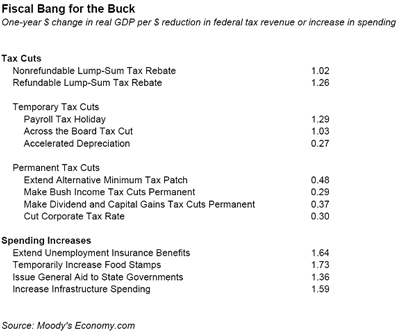
I will also point out that permanent tax cuts have very little stimulatory effect compared to other forms of stimulus:

The chart is from Moody’s Economy.com chief economist Mark Zandi’s testimony to the US House Committee on Small Business.

Why would the banks – and remember, sell-side economists are similar to sell-side analysts of any other description: sold for entertainment value only – be pushing such an lunatic plan that so conveniently fits into Spend-Every-Penny’s electoral strategy? Here’s a clue, in a story titled Loosen capital rules, banks ask watchdog:

The big banks are pushing Canada’s financial services regulator to loosen the rules about what counts as capital, a change that they say would enable them to hand out more loans.

Bank chief executive officers brought up the issue at this week’s meeting with the Finance Minister, the central bank Governor and the banking regulator, according to sources familiar with the discussion.

They want Julie Dickson, the head of the Office of the Superintendent of Financial Institutions, to let them develop new hybrid financial instruments that would count toward their capital ratios.

OSFI gave the banks new leeway in November, when it raised the level of preferred shares they could count as capital. As a result, the banks have been issuing a flurry of them. This week alone, Bank of Nova Scotia and Royal Bank of Canada each said they will sell $200-million worth of preferred shares, and Toronto-Dominion Bank said it is selling $300-million.

But bankers say they can’t issue enough preferred shares to use up all of the room OSFI has given them, because there is not enough demand from investors. Part of the problem, they say, is that pension funds are not inclined to buy preferred shares because of tax rules. So the banks want to develop a hybrid instrument that will generate higher demand from institutional investors.

Other countries give banks more flexibility when it comes to what types of instruments count as Tier 1 capital.

It is not clear just what is meant by the last paragraph – just what, precisely, are the banks asking for that is not permitted here but permitted elsewhere? The have recently been allowed to issue cumulative Tier 1 Capital with a set maturity, something that virtually unknown anywhere else.

Remember that OSFI is not independent: I’m sure Julia Dickson remembers who’s the boss – and why that’s important.

OSFI has shown gross irresponsibility in the past year, with no more public justification that bland reassurances that they know what’s best. It would be a tragedy if Canadian banking regulation were to be gutted as part of deal for the banks to support a boneheaded electoral strategy.