Market Action

April 15, 2008

There are reports that Citigroup’s sale of LBO debt is not going as planned, with investors picking off debt from the deals they know best, rather than buying the complete package holus-bolus.

And the SIV-unwinding proceeds apace. Bloomberg reports that State Street bought $850-million in assets from its sponsored conduits; Assiduous Readers will remember that PrefBlog reported on August 28 that State Street had the highest exposure to conduits of its American and European peers. However, they’ve experienced a strong first quarter:

“During the first quarter, we strengthened our regulatory capital position with strong net income of more than $500 million and the issuance of $500 million of tier-1 qualified regulatory capital.”

Their 8-K filed today discloses (page 32 of the PDF) that their Tier 1 Capital Ratio of 12.35% would decline to 10.15% if all their ABCP conduits were to be consolidated. They have a considerable investment portfolio devoted to AAA tranches of sub-prime – fortunately, mostly well seasoned, with a high degree of credit enhancement.

Credit enhancement is a good thing, with bank repossessions of houses doubling over 2007 levels! Meanwhile, Naked Capitalism highlights a story about increased corporate bankruptcies … some firms were dancing pretty close to the edge even in those halcyon days of easy money and have now been pushed off, as I suggested September 20.

Derivative indices have come in for some heavy criticism:

“The indices are just trading on their own account with no relationship whatsoever to an underlying cash market that’s ceased to exist,” Jacques Aigrain, chief executive officer of Zurich-based Swiss Reinsurance Co., said at a March 18 insurance conference in Dubai.

“The last thing the securitization market needs is another no-cash-upfront instrument that people can use to knock the markets about with,” said Andrew Dennis, the London-based head of the asset-backed debt syndication group for UBS AG of Zurich.

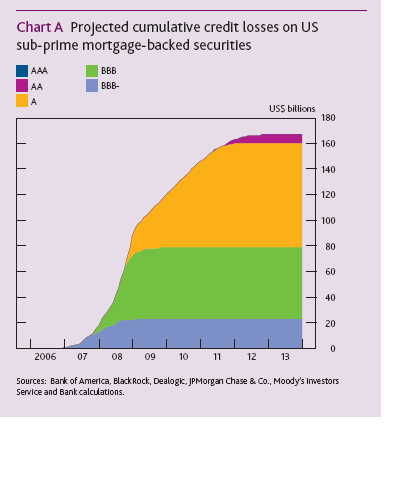
The latest version for AAA rated subprime mortgage bonds slumped by 43 percent since it began trading in August, according to Markit, as rising U.S. home loan delinquencies triggered a surge in the cost of credit-default swaps. That implies a 53 percent loss on the underlying mortgages, according to Schultz, almost four times the 13.75 percent rate predicted by Wachovia.

The cost to protect $10 million of AAA commercial mortgage securities jumped 10-fold during one six-month period to $100,000 a year, based on the first CMBX index from Markit. That implies about 13 percent losses on the underlying loans, more than four times the 2.8 percent forecast in the event of a recession by JPMorgan Chase & Co. analyst Alan Todd in New York.

“ABX, CMBX, any kind of X you like, are totally uncorrelated to any kind of underlying market,” Swiss Re’s Aigrain said at the Dubai conference.

Indices without an option of forcing delivery (of something! anything!) are evil. Assiduous Readers will remember that I pointed out the discrepency between the cash market and the index-marked market in my review of the IMF report as well as the earlier Goldman Sachs paper.

There was finally a day of decent volume for preferreds, but price moves were pretty insignificant.

Note that these indices are experimental; the absolute and relative daily values are expected to change in the final version. In this version, index values are based at 1,000.0 on 2006-6-30
Index Mean Current Yield (at bid) Mean YTW Mean Average Trading Value Mean Mod Dur (YTW) Issues Day’s Perf. Index Value
Ratchet 5.12% 5.17% 27,663 15.20 2 +0.0000% 1,088.4
Fixed-Floater 4.77% 5.20% 63,560 15.27 8 +0.3722% 1,048.1
Floater 5.01% 5.05% 67,669 15.44 2 +1.1311% 832.3
Op. Retract 4.85% 3.41% 85,355 3.32 15 -0.0150% 1,047.2
Split-Share 5.38% 6.00% 86,859 4.08 14 +0.0710% 1,029.8
Interest Bearing 6.16% 6.12% 64,909 3.89 3 +0.3055% 1,100.1
Perpetual-Premium 5.91% 5.59% 201,602 4.81 7 -0.0562% 1,017.7
Perpetual-Discount 5.65% 5.67% 286,676 13.65 63 -0.0703% 922.1
Major Price Changes
Issue Index Change Notes
RY.PR.A PerpetualDiscount -1.5370% Now with a pre-tax bid-YTW of 5.52% based on a bid of 20.50 and a limitMaturity.
HSB.PR.D PerpetualDiscount -1.0989% Now with a pre-tax bid-YTW of 5.60% based on a bid of 22.50 and a limitMaturity.
PWF.PR.F PerpetualDiscount +1.0204% Now with a pre-tax bid-YTW of 5.78% based on a bid of 22.77 and a limitMaturity.
BNA.PR.C SplitShare +1.0698% Asset coverage of just under 2.7:1 as of March 31, according to the company. Now with a pre-tax bid-YTW of 7.25% based on a bid of 19.84 and a hardMaturity 2019-1-10 at 25.00. Compare with BNA.PR.A (6.57% to 2010-9-30) and BNA.PR.B (8.45% to 2016-3-25).
LFE.PR.A SplitShare +1.1707% Asset coverage of 2.4+:1 as of March 31, according to the company. Now with a pre-tax bid-YTW of 4.42% based on a bid of 10.37 and a hardMaturity 2012-12-1 at 10.00.
BAM.PR.G FixFloat +1.4174%  
BAM.PR.B Floater +1.5385%  
Volume Highlights
Issue Index Volume Notes
BNS.PR.J PerpetualDiscount 115,900 Now with a pre-tax bid-YTW of 5.44% based on a bid of 23.93 and a limitMaturity.
BCE.PR.A FixFloat 74,550 Nesbitt crossed 18,000 at 23.90, then 50,000 at 24.05.
RY.PR.K OpRet 71,625 Anonymous bought 10,000 from Nesbitt at 25.30, then 10,000, then 19,900 at the same price, but not necessarily the same anonymous! Then, anonymous bought 12,000 from RBC at 25.30. Now with a pre-tax bid-YTW of 0.34% based on a bid of 25.26 and a call 2008-5-15 at 25.00.
BMO.PR.K PerpetualDiscount 59,300 Scotia crossed 50,000 at 22.90. Now with a pre-tax bid-YTW of 5.82% based on a bid of 22.90 and a limitMaturity.
CM.PR.A OpRet 58,315 Now with a pre-tax bid-YTW of -1.63% based on a bid of 25.85 and a call 2008-5-15 at 25.75.

There were twenty-six other index-included $25-pv-equivalent issues trading over 10,000 shares today.

Issue Comments

AO.PR.A & AO.PR.B On TSX Delisting Review

The TSX has announced that it is:

reviewing Algo Group Inc.’s Common Shares (Symbol: AO), Convertible Redeemable Retractable Third Preferred Shares Series I (Symbol: AO.PR.A) and 6% Cumulative Redeemable Convertible Second Preferred Shares Series I (Symbol: AO.PR.B) with respect to meeting the continued listing requirements. The Company has been granted 90 days in which to regain compliance with these requirements, pursuant to the Remedial Review
Process.

Algo is not having a nice time. The most recent financials on SEDAR show a working capital deficiency and a shareholders’ equity deficiency. Their recent press release was a tale of woe:

Algo Group Inc. (TSX : AO) announced that it has recently sold certain assets of its W. Green Jeans division and as a consequence ceased operations in this division. The sale was completed with 4453166 Canada Inc., a company controlled by Mr. Warren Green. The proceeds were used by the Company to reduce the loan with its primary lender. Mr. Green, previously the Company’s Vice President, Sportswear, has terminated his employment with the Company.
At the outset of 2008, due to an administrative reorganization of Algo, the services of the Company’s Chief Financial Officer, Mr. Ken Labelle, were terminated. Additionally, due to the administrative reorganization and Algo’s financial situation, Algo was not in a position early in the year to have its auditors commence the audit fieldwork required in order to complete its annual audit. As a result, the audit of Algo’s consolidated financial statements will not be completed by March 31, 2008 and, as such, Algo will not be in a position to file its audited consolidated financial statements, related audit report and MD&A by the March 31, 2008 filing deadline applicable to reporting issuers in Canada.

AO.PR.A and AO.PR.B are not tracked by HIMIPref™

Issue Comments

FSV.PR.U Put on Credit Review – Developing by DBRS

This is a USD denominated cumulative perpetual (see SEDAR, company search “FirstService”, Document type “Security holders documents – English”, dated June 27, 2007) issued as a stock dividend in June, 2007.

Following their announcement of the sale of their security division, DBRS has announced it:

has today placed the Pfd-3 (low) rating of FirstService Corporation’s (FSC or the Company) Preferred Share issue Under Review with Developing Implications.

The action follows FSC’s statement that it intends to use the proceeds from the recently announced divestiture of its integrated security division, together with existing funds and available capital, to finance organic growth and acquisitions in its commercial real estate, residential property management, and property improvement services divisions.

DBRS will also focus on FSC’s financial intentions, as we seek to gain comfort that credit metrics will remain appropriate for the current rating category within the context of the growth strategy and changing business profile. Prior to the divestiture, the Company’s debt balance was $331 million ($550 million lease-adjusted) at December 31, 2007 versus $230 million ($430 million lease-adjusted) at March 31, 2007, as a result of strong acquisition activity in its real estate services areas (total of $132 million in the first nine months of F2008). This has led debt-to-EBITDA for LTM ending December 31, 2007 to increase to 2.4 times (x) from 2.0x in F2007. (Corresponding lease-adjusted debt-to-EBITDAR has increased to 3.2x from 2.9x.)

FSV.PR.U is not tracked by HIMIPref™

Primers

Bank Regulation: The Assets to Capital Multiple

I have been fascinated with the IMF Global Financial Stability Report that was recently reviewed on PrefBlog … particularly Figure 1.17:

imf_117.jpg

The IMF comments:

Some banks have rapidly expanded their balance sheets in recent years, largely by increasing their holdings of highly rated securities that carry low risk weightings for regulatory capital purposes (see Box 1.3 on page 31). Part of the increase in assets reflects banks’ trading and investment activities. Investments grew as a share of total assets, and wholesale markets, including securitizations used to finance such assets, grew as a share of total funding (Figure 1.16). Banks that adopted this strategy aggressively became more vulnerable to illiquidity in the wholesale money markets, earnings volatility from marked-to-market assets, and illiquidity in structured finance markets. Equity markets appear to be penalizing those banks that adopted this strategy most aggressively (Figure 1.17).

The variation in multiple for the banks listed is ENORMOUS. The new derisive nickname for UBS is Union Bank of Singapore … but what are the implications for Canadian banks?

First, let’s gather up the ratios for these banks:

Assets to Risk-Weighted-Assets Ratios for Canadian Banks
  RBC BNS TD BMO CIBC
Risk-Weighted Assets 241,206 234,900 163,230 179,487 128,267
Total Assets 632,761 449,422 435,200 376,825 347,734
Assets:RWA 2.6 1.9 2.7 2.1 2.7

All the numbers are within the range for most banks – as reported by the IMF – but there are some fascinating differences that I might write about at another time.

Clearly, however, these differences can be significant and there is a clear indication that UBS was “gaming the system” by loading up with AAA assets that had no risk weight but – regardless of their investment merit – had, shall we say, considerable mark-to-market risk.

OSFI attempts to control such gaming by the imposition of an Assets-to-Capital multiple:

Institutions are expected to meet an assets to capital multiple test on a continuous basis. The assets to capital multiple is calculated by dividing the institution’s total assets, including specified off-balance sheet items, by the sum of its adjusted net tier 1 capital and adjusted tier 2 capital as defined in section 2.5 of this guideline. All items that are deducted from capital are excluded from total assets. Tier 3 capital is excluded from the test.

Off-balance sheet items for this test are direct credit substitutes1, including letters of credit and guarantees, transaction-related contingencies, trade-related contingencies and sale and repurchase agreements, as described in chapter 3. These are included at their notional principal amount. In the case of derivative contracts, where institutions have legally binding netting agreements (meeting the criteria established in chapter 3, Netting of Forwards, Swaps, Purchased Options and Other Similar Derivatives) the resulting on-balance sheet amounts can be netted for the purpose of calculating the assets to capital multiple.

Under this test, total assets should be no greater than 20 times capital, although this multiple can be exceeded with the Superintendent’s prior approval to an amount no greater than 23 times. Alternatively, the Superintendent may prescribe a lower multiple. In setting the assets to capital multiple for individual institutions, the Superintendent will consider such factors as operating and management experience, strength of parent, earnings, diversification of assets, type of assets and appetite for risk.

BMO is to be commended for disclosing its Asset-to-Capital multiple of 18.39, but I don’t see this number disclosed for any of the others. So … it will have to be done roughly, using the total assets from the table above, over the total regulatory capital:

Assets to Risk-Weighted-Assets Ratios for Canadian Banks
  RBC BNS TD BMO CIBC
Total Assets 632,761 449,422 435,200 376,825 347,734
Total Regulatory Capital
Tier 1 + Tier 2
27,113 23,874 23,117 20,203 18,713
Very Rough
Assets-to-Capital
Multiple
(internal check)
23.3
(23.3)
18.8
(18.6)
18.8
(19.0)
18.7
(18.6)
18.6
(18.5)
Reported
Total Capital
Ratio
11.2% 10.2% 14.2% 11.3% 14.6%
The internal check on the Assets-to-Capital multiple is the Assets-to-RWA multiple divided by the Total Capital Ratio. Variance will be due to rounding.

Well! This is interesting! According to these very, very rough calculations, RBC has an Assets-to-Capital multiple of 23.3:1, which is both over the limit and well above its competitors. This may be a transient thing … there was a jump in assets in the first quarter:

RBC: Change in Assets
From 4Q07 to 1Q08
Item Change ($-billion)
Securities +6
Repos +12
Loans +8
Derivatives +7
Total +33

I have sent the following message to RBC via their Investor Relations Page:

I would appreciate learning your Assets-to-Capital multiple (as defined by OSFI) as of the end of the first quarter, 2008, and any detail you can provide regarding its calculation.

I have derived a very rough estimate of 23.3:1, based on total assets of 632,761 and total regulatory capital of 27,113

Update, 2008-04-17: RBC has responded:

Thank you for your question about our assets to capital multiple (ACM). In keeping with prior quarter-end practice, we did not disclose our ACM in Q1/08 but were well within the OSFI minimum requirement. Our ACM is disclosed on a quarterly basis (with a 6-7 week lag) on OSFI’s website. We understand this should be available over the next few days. Below is an excerpt from the OSFI guidelines outlining the calculation of the ACM. We hope this helps.

Update, 2008-6-4: From the FDIC publication, Estimating the Capital Impact of Basel II in the United States:

Market Action

April 14, 2008

On March 31 I indicated my approval of the idea that the Fed should have discretion over the conduct of monetary policy; in Econbrowser, Prof. James Hamilton has pointed out that discretion should have boundaries:

And this is where I feel that Robert Reich raises an excellent point:

the Fed can expose taxpayers to hundreds of billions of dollars of potential losses without a single appropriation hearing, as it did recently when it allowed Wall Street’s major investment banks to exchange tainted mortgage-backed securities for nice clean loans from the Treasury. And the Fed can do amazing things– like decide one big bank, JP Morgan, is going to take over another, Bear Stearns, backed by $29 billion of taxpayer money.

Reich is exactly correct– the Fed’s recent behavior does expose U.S. taxpayers to a risk of default on these assets. While some may argue that the Treasury is exposed to risks in the current situation no matter what the Fed does, it seems to me that this decision is ultimately a matter for fiscal policy. And just as I don’t want Congress deciding how much money to print, I don’t want the Fed deciding how much taxpayer money is appropriate to pledge for purposes of promoting financial stability.

I agree very much that Congress has a quite proper role in determining the magnitude of the fiscal risk that the Fed opts to assume. Congress’s statutory limit on the quantity of debt that the Treasury can issue is something I have previously derided as political circus. But a statutory limit on the non-Treasury assets that the Fed is allowed to hold might make sense. Perhaps the outcome of a public debate on this issue would be a decision that the Fed needs the power to lend to private borrowers even more than the $800 billion or so limit that it would run into from completely swapping out its entire portfolio. Indeed, Greg Ip speculates on the possibility that the Fed could “ask Treasury to issue more debt than it needs to fund government operations.” Surely that would be something that should require congressional approval. Or perhaps after deliberations, Congress would decide that the business of swapping Treasury debt for private sector loans is one that is better run by the Treasury rather than the Federal Reserve.

Another bank, Wachovia, is cutting its dividend and raising capital, while Deutsche is flogging its LBO debt in an effort to delever … in competition with Citigroup’s efforts, mentioned April 11 to unload $12-billion worth.

A very quiet day for preferreds.

Note that these indices are experimental; the absolute and relative daily values are expected to change in the final version. In this version, index values are based at 1,000.0 on 2006-6-30
Index Mean Current Yield (at bid) Mean YTW Mean Average Trading Value Mean Mod Dur (YTW) Issues Day’s Perf. Index Value
Ratchet 5.14% 5.18% 28,002 15.20 2 +0.1428% 1,088.4
Fixed-Floater 4.79% 5.23% 61,964 15.22 8 +0.0694% 1,044.2
Floater 5.06% 5.10% 68,483 15.34 2 +0.3607% 823.0
Op. Retract 4.85% 4.07% 82,547 3.27 15 -0.1465% 1,047.3
Split-Share 5.38% 6.01% 87,290 4.08 14 -0.1779% 1,029.1
Interest Bearing 6.18% 6.21% 65,707 3.89 3 +0.0005% 1,096.8
Perpetual-Premium 5.91% 5.51% 206,484 4.81 7 -0.1835% 1,018.3
Perpetual-Discount 5.65% 5.67% 288,611 13.66 63 -0.0090% 922.7
Major Price Changes
Issue Index Change Notes
PWF.PR.F PerpetualDiscount -2.4665% Now with a pre-tax bid-YTW of 5.83% based on a bid of 22.54 and a limitMaturity.
BNA.PR.B SplitShare -1.4634% Asset coverage of just under 2.7:1 as of March 31, according to the company. Now with a pre-tax bid-YTW of 8.46% based on a bid of 20.20 and a hardMaturity 2016-3-25 at 25.00. Compare with BNA.PR.A (6.57% to 2010-9-30) and BNA.PR.C (7.38% to 2019-1-10).
PWF.PR.I PerpetualPremium -1.1792% Now with a pre-tax bid-YTW of 5.82% based on a bid of 25.14 and a call 2012-5-30 at 25.00.
SLF.PR.C PerpetualDiscount -1.0140% Now with a pre-tax bid-YTW of 5.48% based on a bid of 20.50 and a limitMaturity.
RY.PR.A PerpetualDiscount +1.1170% Now with a pre-tax bid-YTW of 5.43% based on a bid of 20.82 and a limitMaturity.
SLF.PR.A PerpetualDiscount +1.1463% Now with a pre-tax bid-YTW of 5.43% based on a bid of 22.06 and a limitMaturity.
Volume Highlights
Issue Index Volume Notes
PWF.PR.H PerpetualDiscount (for now!) 107,910 Nesbitt crossed 15,000 at 25.05, then 40,000 at the same price. Now with a pre-tax bid-YTW of 5.71% based on a bid of 25.01 and a call 2012-1-9 at 25.00.
TD.PR.Q PerpetualPremium 73,300 TD crossed 70,000 at 25.10. Now with a pre-tax bid-YTW of 5.59% based on a bid of 25.03 and a call 2017-3-2 at 25.00.
BMO.PR.H PerpetualDiscount 29,125 Now with a pre-tax bid-YTW of 5.72% based on a bid of 23.36 and a limitMaturity.
CU.PR.B PerpetualPremium 21,400 Three trades! CIBC crossed 10,000, then sold 2,000 to Nesbitt, then crossed 9,400, all at 25.40. Now with a pre-tax bid-YTW of 5.79% based on a bid of 25.41 and a call 2012-7-1 at 25.00.
TD.PR.R PerpetualDiscount 18,480 Now with a pre-tax bid-YTW of 5.67% based on a bid of 24.97 and a limitMaturity.

There were five other index-included $25-pv-equivalent issues trading over 10,000 shares today.

Miscellaneous News

RY Files Innovative Tier 1 Capital Prospectus

I was going to leave this one alone, but I see that some concern is being expressed in the comments to April 11.

Royal Bank has announced:

that it has filed a preliminary prospectus with securities commissions across Canada for the issuance of Innovative Tier 1 capital of the bank.

RBC Capital Trust, a subsidiary of Royal Bank of Canada, will issue RBC TruCS Series 2008-1. RBC Capital Trust is a closed-end trust established under the laws of Ontario. RBC Capital Markets acted as lead agent on the issue.

The capital will be issued for general corporate purposes.

This is pretty emphatic language (“will issue” … “acted as lead agent” … “will be issued”) so there doesn’t appear to be much doubt.

In the analysis of RY’s capital structure at year-end, it was found that RY’s Tier 1 capital was 15% comprised of Innovative Tier 1 Capital, which is the limit allowed by OSFI. Innovative Tier 1 Capital has been briefly discussed on PrefBlog … basically, it’s a preferred share dressed up in bonds’ clothing to seduce the unwary. Spreads have widened considerable during the credit crunch, and I now see the that the TruCS with a pretend-maturity of Dec 31/2015 are quoted at 282bp-272bp over Canadas, a huge increase over the 60-ish bp spread in February 2007.

Due to the nature of RY’s capital structure, I’m a bit surprised that they’re issuing the Innovative Tier 1 rather than preferred shares … but if we assume they can do a new deal at 300 over Canadas for a pretend-10-year term, that would be about 6.55%. If we assume that they would have to offer 5.8% for a preferred, that’s an interest equivalent of 8.12% and given the fragility of the market, a mere 5.8% is by no means assured.

For the nonce, Assiduous Readers may presume that this pseudo-bond issuance decreases – very, very slightly – the chance that speculation regarding a RY preferred issue will come to fruition.

Update: Here are the details on 1Q08 capital structure

RY Capital Structure
October, 2007
& January, 2008
  4Q07 1Q08
Total Tier 1 Capital 23,383 23,564
Common Shareholders’ Equity 95.2% 97.9%
Preferred Shares 10.0% 9.9%
Innovative Tier 1 Capital Instruments 14.9% 14.9%
Non-Controlling Interests in Subsidiaries 0.1% 0.1%
Goodwill -20.3% -22.8%
Note that the definition of “Goodwill” has not only changed from Basel 1 to Basel 2, but there are some exciting new categories of Tier 1 Capital deductions as well, which have been included in the “Goodwill” shown here

Principal #1 of the OSFI Draft Guidelines states:

Principle #1: OSFI expects FRFIs to meet capital requirements without undue reliance on innovative instruments.
Common shareholders’ equity (i.e., common shares, retained earnings and participating account surplus, as applicable) should be the predominant form of a FRFI’s Tier 1 capital.

1(a) Innovative instruments must not, at the time of issuance, make up more than 15% of a FRFI’s net Tier 1 capital. Any excess cannot be included in regulatory capital.
If, at any time after issuance, a FRFI’s ratio of innovative instruments to net Tier 1 capital exceeds 15%, the FRFI must immediately notify OSFI. The FRFI must also provide a plan, acceptable to OSFI, showing how the FRFI proposes to eliminate the excess quickly. A FRFI will generally be permitted to include such excesses in its Tier 1 capital until such time as the excess is eliminated in accordance with its plan.
1(b) A strongly capitalized FRFI should not have innovative instruments and perpetual non-cumulative preferred shares that, in aggregate, exceed 25% of its net Tier 1 capital. Tier 1-qualifying preferred shares issued in excess of this limit can be included in Tier 2 capital.
1(c) For the purposes of this principle, “net Tier 1 capital” means Tier 1 capital available after deductions for goodwill etc., as set out in OSFI’s MCCSR or CAR Guideline, as applicable.

An Advisory dated January 2008 states:

After taking into account the fundamental characteristics of tier 1 capital and reviewing guidance in other jurisdictions, OSFI has decided to increase this limit to 30%. The maximum amount of innovative tier 1 instruments that can be included in the aggregate limit calculation continues to be 15% of net tier 1.

RBC’s extant Innovative Tier 1 Capital does not have any interesting dates coming up. RY.PR.K has its soft-retraction coming up in August … but these are currently in Tier 1 capital in the “preferred” category, having been grandfathered from the old rules.

So what’s up? It would seem that there’s another shoe left to drop.

Update, 2008-04-21: They are issuing $500-million with a pretend-10-year maturity, at Canadas + 310bp

PrefLetter

April, 2008, Edition of PrefLetter Released!

The April, 2008, edition of PrefLetter has been released and is now available for purchase as the “Previous edition”.

Until further notice, the “Previous Edition” will refer to the April, 2008, issue, while the “Next Edition” will be the May, 2008, issue, scheduled to be prepared as of the close May 9 and eMailed to subscribers prior to market-opening on May 12.

PrefLetter is intended for long term investors seeking issues to buy-and-hold. At least one recommendation from each of the major preferred share sectors is included and discussed.

Note: PrefLetter, being delivered to clients as a large attachment by eMail, sometimes runs afoul of spam filters. If you have not received your copy within fifteen minutes of a release notice such as this one, please double check your (company’s) spam filtering policy and your spam repository. If it’s not there, contact me and I’ll get you your copy … somehow!

Market Action

April 11, 2008

The most interesting news today was a report that Scotiabank is interested in National City. National City has had some problems lately:

Our mortgage business came under considerable pressure starting in late July and early August 2007 with the near-total stoppage in the mortgage capital markets. While we ceased broker production of new national home equity originations immediately, we had a warehouse of loans held for sale for which there were no buyers, as well as a pipeline of approved applications awaiting funding. The retention of these loans increased the size of our balance sheet above where we had planned it to be, and also drove losses in the third and fourth quarters as we marked loans down to their current value. Other than conforming, agency-eligible mortgages, the market for virtually all other types of mortgage loans continues to be illiquid to non-existent. Therefore, we have further downsized and restructured our mortgage business, exiting all wholesale production channels and narrowing our mortgage product set to agency-eligible mortgages and a small amount of high-quality “jumbo” mortgages.

The combination of a larger balance sheet, further disruption in the capital markets, mortgage-driven losses, and other developments in the last two months of the year has taken the company’s year-end capital position below its target range. For that reason, we announced in early January plans to raise non-dilutive Tier 1 capital, as well as our Board’s decision to reduce the dividend by 49 percent. We did add $650 million of Tier 1 capital in January, exceeding our objective for that transaction. I can assure you that the decision to reduce the dividend was not taken lightly. However, it was and is an important step, in conjunction with the aforementioned capital issuance, to increase capital to the higher end of our announced target ranges: 5 to 6 percent for tangible common equity and 7 to 8 percent for Tier 1 risk-based capital. We have also embarked on an aggressive program to manage the size of the balance sheet to further accelerate the increase of these ratios to desired levels. A strong balance sheet is the foundation which will see us through difficult times.

National City’s year end ratios were appalling … Tangible common equity / Tangible assets of 5.28% (down from 7.77% at year end 2006); Tier 1 Capital of 6.53% (from 8.93%); Total Capital of 10.27% (from 12.16%). We shall see! I’ve been wondering for a long time when one or more of the Canadian banks would use its strong balance sheet to make a play in the States … but I think it was Ed Clark of TD Bank who said the problem with the idea was that after you bought it, you then had to recapitalize it.

On similar lines, Accrued Interest has a thoughtful piece on what appears to be a change in the Private Equity business model:

Private equity is one area where there is clearly plenty of capital. Its not just the WaMu transaction. Citi is apparently going to sell $12 billion in loans to private equity. Private equity is creating “PennyMac” to buy distressed mortgage loans. Etc. Etc.

So here is the question. Is private equity adroitly putting their excess capital to work in these distressed assets? Is this a case where PE is the only player with adequate capital to take on these risks, and therefore set to reap big profits?

Or is it a case where they have too much cash and not enough good ideas? Two years ago, PE was all about using their business acumen to acquire whole companies, usually by using huge leverage. Now, as Deal Journal’s Dennis Berman wrote, it isn’t PE’s smarts but their capital that’s in demand.

Time will tell. It would be my view that there are very good values in corporate loans. Some good values in residential mortgages, especially if there is some kind of government bailout. But for WaMu, I’m very skeptical. If I were a betting man, I’d bet on Washington Mutual eventually accepting a buyout offer from another bank, probably Wells Fargo or J.P. Morgan. Given that J.P. Morgan supposedly offered $8/share, TPG may wind up disappointed in their results.

I’ll suggest that what’s happening to Private Equity is the same thing that happened to Hedge Funds about ten years ago … time was, they were called “Hedge” funds because they … er … hedged. Market neutrality was the name of the game.

Then the market started getting a little more crowded and the salesmen needed a new gimmick. ‘A hedge’, they remembered, ‘is a position that wipes out the value of your good idea’. So the typical hedge fund model moved from “market neutral” to “highly levered”.

The private equity model is getting similarly crowded. There have been lots of complaints over the past couple of years that deals are getting harder to come by, it’s hard to find those 20% p.a. returns any more. So private equity is morphing too … the name is just a label. You can’t be sure it means anything until you look under the hood.

ABCP? I’m sorry … I just can’t seem to get interested in the whimpering over this fiasco, despite the discussion in the comments to April 9. Flaherty is claiming a federal regulator would have made everything better, but doesn’t say how. The Globe & Mail, of course, is doing its best to whip up hysteria, talking of “loopholes” and such. I’m sorry. It’s all meaningless and boring.

Very quiet day for preferreds today, but the market was up smartly, led by CM.

Note that these indices are experimental; the absolute and relative daily values are expected to change in the final version. In this version, index values are based at 1,000.0 on 2006-6-30
Index Mean Current Yield (at bid) Mean YTW Mean Average Trading Value Mean Mod Dur (YTW) Issues Day’s Perf. Index Value
Ratchet 5.15% 5.19% 27,727 15.24 2 -0.2029% 1,086.8
Fixed-Floater 4.79% 5.25% 63,090 15.20 8 +0.4479% 1,043.5
Floater 5.08% 5.12% 69,880 15.32 2 +0.1677% 820.0
Op. Retract 4.85% 3.73% 83,193 2.87 15 +0.1378% 1,048.9
Split-Share 5.37% 5.94% 88,495 4.09 14 +0.2357% 1,030.9
Interest Bearing 6.18% 6.22% 66,180 3.90 3 -0.0338% 1,096.8
Perpetual-Premium 5.90% 5.38% 203,673 2.99 7 -0.0614% 1,020.2
Perpetual-Discount 5.65% 5.67% 294,982 14.06 63 +0.2568% 922.8
Major Price Changes
Issue Index Change Notes
POW.PR.B PerpetualDiscount -1.0771% Now with a pre-tax bid-YTW of 5.85% based on a bid of 22.96 and a limitMaturity.
ELF.PR.F PerpetualDiscount +1.0091% Now with a pre-tax bid-YTW of 6.35% based on a bid of 21.02 and a limitMaturity.
SLF.PR.B PerpetualDiscount +1.1055% Now with a pre-tax bid-YTW of 5.51% based on a bid of 21.95 and a limitMaturity.
BCE.PR.Z FixFloat +1.1378%  
BNA.PR.B SplitShare +1.4349% Asset coverage of just under 2.7:1 as of March 31, according to the company. Now with a pre-tax bid-YTW of 8.21% based on a bid of 20.50 and a hardMaturity 2016-3-25 at 25.00. Compare with BNA.PR.A (6.70% to 2010-9-30) and BNA.PR.C (7.39% to 2019-1-10).
CM.PR.I PerpetualDiscount +1.6991% Now with a pre-tax bid-YTW of 5.80% based on a bid of 20.35 and a limitMaturity.
CM.PR.H PerpetualDiscount +1.9108% Now with a pre-tax bid-YTW of 5.79% based on a bid of 20.35 and a limitMaturity.
SLF.PR.C PerpetualDiscount +1.9193% Now with a pre-tax bid-YTW of 5.42% based on a bid of 20.71 and a limitMaturity.
CM.PR.G PerpetualDiscount +1.9754% Now with a pre-tax bid-YTW of 5.83% based on a bid of 23.23 and a limitMaturity.
CM.PR.P PerpetualDiscount +2.0220% Now with a pre-tax bid-YTW of 5.91% based on a bid of 23.21 and a limitMaturity.
BCE.PR.G FixFloat +2.1277%  
Volume Highlights
Issue Index Volume Notes
BCE.PR.A FixFloat 51,600 TD crossed 49,500 at 24.10.
TD.PR.R PerpetualDiscount 33,410 Now with a pre-tax bid-YTW of 5.66% based on a bid of 24.99 and a limitMaturity.
PWF.PR.G PerpetualPremium 31,400 CIBC crossed two tranches of 15,000 shares each at 25.25. Now with a pre-tax bid-YTW of 5.51% based on a bid of 25.25 and a call 2011-8-16 at 25.00
BMO.PR.J PerpetualDiscount 27,860 Now with a pre-tax bid-YTW of 5.69% based on a bid of 20.09 and a limitMaturity.
RY.PR.F PerpetualDiscount 16,690 Now with a pre-tax bid-YTW of 5.51% based on a bid of 20.53 and a limitMaturity.

There were six other index-included $25-pv-equivalent issues trading over 10,000 shares today.

PrefLetter

April Edition of PrefLetter Now in Preparation!

The markets have closed and the April edition of PrefLetter is now being prepared.

PrefLetter is the monthly newsletter recommending individual issues of preferred shares to subscribers. There is at least one recommendation from every major type of preferred share; the recommendations are taylored for “buy-and-hold” investors.

The April issue will be eMailed to clients and available for single-issue purchase with immediate delivery prior to the opening bell on Monday. I will write another post on the weekend advising when the new issue has been uploaded to the server … so watch this space carefully if you intend to order “Next Issue” or “Previous Issue”!

MAPF

MAPF: Response to a Potential Client's Concerns

There was a very gratifying exchange on FWF about Malachite Aggressive Preferred Fund that (so far!) has included the following concerns about the fund:

The outperformance of Malachite fund is indeed commendable and tempting for a newbie like myself currently investing in CPD. However turnover is very high, about 250 transactions for last year. We invest our non-registered fixed income in preferreds due to dividend tax credit advantage. Malachite’s high turnover seems highly tax inefficient, which would erode its outperformance. While its expense capped at 0.5% and fee of 1% for investment up to $0.5m is reasonable for a well managed active product, passive CPD’s MER is 0.45%. It may be interesting to work out the net outperformance after taking into consideration overall tax considerations and MER for such active versus passive products.

Fair enough. Let’s take the concerns in order:

However turnover is very high, about 250 transactions for last year.

The high turnover is a direct consequence of my philosophy as an active manager. I do not believe it is possible, in the long term, to make excess risk-adjusted returns by making macro-economic market-timing calls. So, for instance, I don’t think it possible that somebody can say “Oil will be going up for the next five years, therefore I’m going to invest in oil stocks” and have a reasonable expectation of making money.

As I never tire of saying, it’s a chaotic world we live in and even if you are able to analyze the world situation perfectly as of TODAY, there is every likelihood that the world will change tomorrow and mess up all your analysis.

There is, however, money to be made by selling liquidity … a rather arcane concept, but I’ll do the best I can.

How does a used car dealer make money? By and large, he’s not actually improving the cars … he’s just buying at one price and selling at another. Which is the key point. If you want to sell your car – you’ll go to him with a car “worth” $7,500 and accept $7,000 for it, because it’s convenient and probably cheaper than taking an ad out in the paper and spending time with potential buyers. If you want to buy a used car “worth” $7,500, you may well be happy to pay him $8,000 because of that same convenience and cost factor. So the dealer has, in this case, made $1,000 by “selling liquidity” – all he’s done is kept a parking lot in operation and been available at his place of business.

It’s the same thing with securities. There are always shifts in supply and demand that change the market price of a security without affecting the “fair” price. HIMIPref™, the proprietary software developed by my firm seeks to determine the fair value of each security in the preferred share universe it tracks. When the market value of something it doesn’t own becomes “sufficiently” cheaper than something it does – it trades. The word “sufficiently” is in quotes because solving that problem is just as hard as solving the “fair price” problem … at what point does the difference in value become so compelling that the possibility of gains outweighs the possibility of losses and the certainty of costs?

Not every trade will work – and I can’t, of course, provide any guarantees about the future – but the system has been sufficiently successful at this evaluation that returns over the first seven years of the fund’s existence have been very gratifying. As long as each trade meets the requirements and has a good potential profit … well, the more trades the better, I say!

Malachite’s high turnover seems highly tax inefficient, which would erode its outperformance.

Well … not really.

The concept of tax inefficiency is of major importance only with equities. An equity can easily double from its IPO price, for instance, while increasing its dividend. Given sufficient time, the price and the dividend can multiply by any amount you wish, with the unrealized capital gain giving rise to deferred tax, which is a lot nicer than having had to pay the tax earlier which would result from trading of the equities.

But preferred shares are fixed income instruments. A preferred share issued at $25 will, almost always, eventually be called at $25 (the exceptions are early calls, for which the issuer pays a slight premium, and defaults, for which a loss is expected which may be total). You do not make money from preferred shares from long term capital gains. Therefore, the concept of tax efficiency – at best – is limited to a few years’ deferral in a bull market.

While its expense capped at 0.5% and fee of 1% for investment up to $0.5m is reasonable for a well managed active product, passive CPD’s MER is 0.45%.

True enough. One generic advantage of MAPF – shared by most funds – is that you have a choice of whether to receive or to reinvest distributions. I’m not sure whether CPD offers a Dividend Reinvestment Plan at this point or not; or what the terms of such a plan might be.

More importantly, MAPF has historically beaten the index by more than the 1.05% difference in costs (the difference will decline as the amount invested gets larger).

An index product, for instance, will not sell a holding even when the yield-to-worst goes negative. An active fund can. An index product will not – usually – subscribe for a new issue, even when the issue has been priced at a substantial concession to extant issues. An active fund can.

I work hard to keep this track record going and have confidence that the fund will outperform in the future. Investors in the fund share that confidence, and I attempt to communicate to unitholders why I am confident. Just how convinced you are is up to you!

I hope this helps – please comment, eMail or call with any other questions you may have.