Issue Comments

EMA Subsidiary NSPI Issues 30-Year Notes at 5.61%

DBRS has announced that it:

has today assigned a rating of A (low) with a Stable trend to the prospective issue by Nova Scotia Power Inc. (NSPI) of $300 million, 5.61% medium-term notes, maturing June 15, 2040 (the Notes). The offering is expected to settle on June 15, 2010.

The Notes rank equally with all other unsecured obligations of NSPI and are being issued pursuant to the Short Form Base Shelf Prospectus dated May 21, 2010, as supplemented by the Prospectus Supplement dated June 9, 2010. Proceeds from this issue are expected to be used to repay short-term debt and for general corporate purposes.

NSPI is a wholly owned subsidiary of EMA.

It will be recalled that EMA recently issued EMA.PR.A, a FixedReset paying 4.40%+184.

Direct comparisons between the credits these issues are difficult; NSPI is a subsidiary of EMA, together with the difference in seniority.

Standard & Poor’s rates EMA’s preferreds at BBB- on the global scale and NSPI’s notes at BBB+; as a rough explanation, we can say that there is one notch for the holdco/sub relationship and one for the preferred/senior note relationship (which is much less than would be applied to a bank of the same credit quality).

It will be noticed that TCA recently issued long notes at 6.10% and TRP’s two FixedReset issues, TRP.PR.A and TRP.PR.B, closed last night yielding 4.12% (to call) and 3.95% (to perpetuity) respectively, while TCA’s two PerpetualDiscounts (TCA.PR.X and TCA.PR.Y) yield about 5.90%, down about 17bp from issue time. Make of it what you will!

Market Action

June 10, 2010

Different crimes for different times!

Sergio Natera and Anna McElaney are scheduled to be sentenced in Hartford’s federal court in August after pleading guilty to fraud. Their crime involved persuading lenders to approve the sale of homes for less than the balance owed –known as a short sale — without disclosing that there were better offers. They then flipped the houses for a profit.

A prevalent scam involves a practice called “flopping,” [special inspector general for the Troubled Asset Relief Program Neil] Barofsky said. In that scheme, investors or home buyers hire brokers to assess a home for less than its market value and convince banks to accept a sale at that level. The buyer conceals from the lender that he has lined up a higher offer and then quickly resells the property for a profit, as in the Connecticut case.

In the Connecticut case, Regions Bank in April 2008 agreed to a short sale of a Bridgeport house for $102,375, unaware that Natera and McElaney had a bidder willing to pay $132,500, according to the plea agreements. Eight weeks after the bank sold for a loss, the pair resold the house for a $30,125 gain.

The SEC wants to make competition illegal:

U.S. Securities and Exchange Commission Chairman Mary Schapiro said the agency may regulate the speed of stock orders in response to a surge in electronic trading and the May 6 plunge that wiped out $862 billion of market value in 20 minutes.

The SEC needs “to explore whether bids and orders should be regulated on speed so there is less incentive to engage in this microsecond arms race that might undermine long-term investors and the market’s capital-formation function,” she said at a conference in Montreal. “The markets have to serve that function for companies to raise money, create jobs and allow the economy to grow.”

The basic trouble is that old,school, comfortable, well connected, incompetent portfolio managers are having their lunch eaten by High Frequency Traders – which are often brokerage firms, hedge funds, and individuals with, say $10-million to play with. Since they can’t compete on results, they’ll compete on regulation.

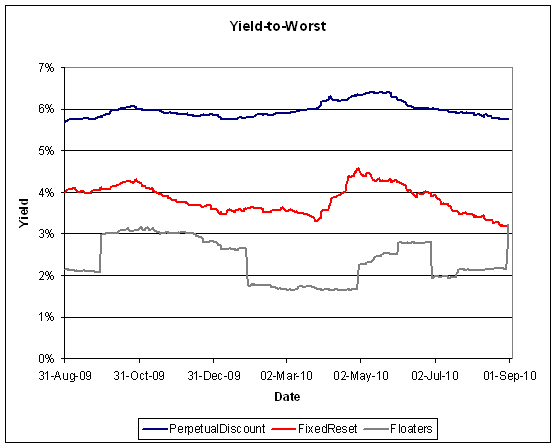
The pace of the rally in the Canadian preferred share market continued at a slower pace today, with PerpetualDiscounts up 18bp and FixedResets up 12bp.

HIMIPref™ Preferred Indices
These values reflect the December 2008 revision of the HIMIPref™ Indices

Values are provisional and are finalized monthly
Index Mean
Current
Yield
(at bid)
Median
YTW
Median
Average
Trading
Value
Median
Mod Dur
(YTW)
Issues Day’s Perf. Index Value
Ratchet 2.68 % 2.74 % 38,588 20.63 1 0.0000 % 2,093.6
FixedFloater 5.24 % 3.34 % 27,850 19.85 1 -1.1429 % 3,055.4
Floater 2.40 % 2.78 % 86,306 20.21 3 0.5893 % 2,245.8
OpRet 4.88 % 3.86 % 93,375 0.94 11 -0.0565 % 2,316.5
SplitShare 6.41 % 5.38 % 101,084 0.08 2 0.2437 % 2,163.4
Interest-Bearing 0.00 % 0.00 % 0 0.00 0 -0.0565 % 2,118.2
Perpetual-Premium 0.00 % 0.00 % 0 0.00 0 0.1810 % 1,884.8
Perpetual-Discount 6.01 % 6.06 % 202,662 13.82 77 0.1810 % 1,784.1
FixedReset 5.43 % 4.03 % 401,304 3.51 45 0.1169 % 2,175.6
Performance Highlights
Issue Index Change Notes
PWF.PR.G Perpetual-Discount -1.77 % YTW SCENARIO
Maturity Type : Limit Maturity
Maturity Date : 2040-06-10
Maturity Price : 23.59
Evaluated at bid price : 23.85
Bid-YTW : 6.27 %
PWF.PR.F Perpetual-Discount -1.45 % YTW SCENARIO
Maturity Type : Limit Maturity
Maturity Date : 2040-06-10
Maturity Price : 21.14
Evaluated at bid price : 21.14
Bid-YTW : 6.31 %
PWF.PR.J OpRet -1.20 % YTW SCENARIO
Maturity Type : Call
Maturity Date : 2011-05-30
Maturity Price : 25.25
Evaluated at bid price : 25.54
Bid-YTW : 4.01 %
BAM.PR.G FixedFloater -1.14 % YTW SCENARIO
Maturity Type : Limit Maturity
Maturity Date : 2040-06-10
Maturity Price : 25.00
Evaluated at bid price : 20.76
Bid-YTW : 3.34 %
CU.PR.B Perpetual-Discount -1.01 % YTW SCENARIO
Maturity Type : Limit Maturity
Maturity Date : 2040-06-10
Maturity Price : 24.14
Evaluated at bid price : 24.51
Bid-YTW : 6.16 %
CM.PR.M FixedReset 1.07 % YTW SCENARIO
Maturity Type : Call
Maturity Date : 2014-08-30
Maturity Price : 25.00
Evaluated at bid price : 27.50
Bid-YTW : 4.12 %
TRI.PR.B Floater 1.10 % YTW SCENARIO
Maturity Type : Limit Maturity
Maturity Date : 2040-06-10
Maturity Price : 22.71
Evaluated at bid price : 23.00
Bid-YTW : 1.88 %
PWF.PR.E Perpetual-Discount 1.24 % YTW SCENARIO
Maturity Type : Limit Maturity
Maturity Date : 2040-06-10
Maturity Price : 22.36
Evaluated at bid price : 22.83
Bid-YTW : 6.09 %
PWF.PR.O Perpetual-Discount 1.69 % YTW SCENARIO
Maturity Type : Limit Maturity
Maturity Date : 2040-06-10
Maturity Price : 23.81
Evaluated at bid price : 24.00
Bid-YTW : 6.13 %
ELF.PR.F Perpetual-Discount 2.11 % YTW SCENARIO
Maturity Type : Limit Maturity
Maturity Date : 2040-06-10
Maturity Price : 19.85
Evaluated at bid price : 19.85
Bid-YTW : 6.81 %
Volume Highlights
Issue Index Shares
Traded
Notes
SLF.PR.F FixedReset 77,600 TD crossed 75,000 at 24.93.
YTW SCENARIO
Maturity Type : Call
Maturity Date : 2014-07-30
Maturity Price : 25.00
Evaluated at bid price : 26.91
Bid-YTW : 3.94 %
RY.PR.R FixedReset 55,700 Desjardins crossed 50,000 at 27.13.
YTW SCENARIO
Maturity Type : Call
Maturity Date : 2014-03-26
Maturity Price : 25.00
Evaluated at bid price : 27.12
Bid-YTW : 3.97 %
RY.PR.A Perpetual-Discount 55,345 RBC crossed 25,000 at 19.61.
YTW SCENARIO
Maturity Type : Limit Maturity
Maturity Date : 2040-06-10
Maturity Price : 19.56
Evaluated at bid price : 19.56
Bid-YTW : 5.75 %
TD.PR.O Perpetual-Discount 49,905 RBC crossed two blocks of 20,000 shares each at 21.09.
YTW SCENARIO
Maturity Type : Limit Maturity
Maturity Date : 2040-06-10
Maturity Price : 21.05
Evaluated at bid price : 21.05
Bid-YTW : 5.85 %
BNS.PR.K Perpetual-Discount 48,100 National crossed 25,000 at 20.60.
YTW SCENARIO
Maturity Type : Limit Maturity
Maturity Date : 2040-06-10
Maturity Price : 20.58
Evaluated at bid price : 20.58
Bid-YTW : 5.92 %
CM.PR.M FixedReset 41,195 Desjardins crossed 14,800 at 27.53.
YTW SCENARIO
Maturity Type : Call
Maturity Date : 2014-08-30
Maturity Price : 25.00
Evaluated at bid price : 27.50
Bid-YTW : 4.12 %
There were 30 other index-included issues trading in excess of 10,000 shares.
Contingent Capital

Contingent Capital Canadian Commentary

Today’s Globe & Mail had a story titled Bankers cast doubt on tax alternative:

Some Canadian bankers are skeptical about the feasibility of Ottawa’s proposal for a new type of security that would enable banks to “self-insure” against failure, a key part of the country’s fight against plans for a global bank tax.

A key stumbling block, bankers say, is that the contingent capital securities would come with so much risk that investors will demand a high interest rate to buy them. That will make selling the securities unattractive to banks and could even lead to the securities being more costly to banks than a bank tax, some analysts say.

The biggest issue with the idea, some bankers say, is the potential conversion from debt to common stock. The last thing a debt investor wants is to end up owning equity in a troubled company, bankers said. That’s because in the event of a bankruptcy or liquidation, common shares rank behind debt. As a result, investors demand much higher returns from equity-like securities, making them more costly for the selling bank.

Also, many big investors such as some pension funds are not allowed to buy debt that converts into equity. That shrinks the potential market, again increasing the cost for banks.

The Canadian Bankers Association, the umbrella industry group, has highlighted the issue of finding buyers. “Careful consideration must also be given to the cost and marketability of such an instrument, particularly in a smaller market like Canada, which has a concentrated investor base,” the group said.

Selling ECC securities could raise a bank’s cost of capital by as much as one to two percentage points, reducing earnings by 4 per cent to 7 per cent, analyst John Reucassel of BMO Nesbitt Burns said in a note to clients. Mr. Reucassel said banks may also have to pay more to issue preferred shares, which are a big source of capital. That’s because preferred shares would rank below the new ECC notes in the capital structure of the bank, he said.

Other fears include the possibility that hedge funds or other investors could game the system, and that the conversion features could actually create more instability for a bank that’s in trouble and lead to a death spiral of dilution, Mr. Keefe said.

I don’t understand John Reucassel’s comment about preferred shares: CC is intended to replace sub-debt, which is currently senior to preferreds. If it converts, it will be equity and junior to preferreds – which is the reason why I feel that, should CC become important, a similar conversion will be applied to prefs.

The comment many big investors such as some pension funds are not allowed to buy debt that converts into equity. is a problem, but not insurmountable. Changing an investment mandate is not exactly the world’s most difficult task; having never had much interest in convertibles I don’t know whether any legislative changes would be necessary; but if so … change ’em.

As for selling it … just put the bank’s name in big letters at the top of the paper and shuffle it over to the salesmen. Canada’s docile investment community will buy whatever they’re told to buy. Hey – it worked for Tier 1 capital! Stick it in the index, too – that’s worked before as well.

And as for being more expensive for the issuers … well, yeah. That’s the whole point. Extant structures do not provide protection in a crisis. Contingent Capital will provide protection in a crisis.Therefore, a rational person might expect the paper to be more expensive. I suspect that CC will eventually come to pass when the regulators say “OK – you’ve got to have 6% Core Tier 1 capital, which is defined as equity + CC. At least two-thirds of that must be equity. For the rest, go choose.” As long as the CC is cheaper than equity, the banks will issue it, given that choice.

The Canadian Bankers Association states:

Embedded contingent capital is one of the alternatives to a global bank tax that is being proposed. With embedded contingent capital, banks would issue securities that would convert to common equity in the event that the bank faced serious financial difficulties.

The contingent capital proposals being contemplated are very complex and there are still many details to be ironed out. The CBA welcomes the opportunity to work with regulators in the development of this proposal.

The banks agree with the idea that the conversion of these securities should only be triggered when a financial institution is in very serious trouble. Careful consideration must also be given to the cost and marketability of such an instrument, particularly in a smaller market like Canada, which has a concentrated investor base.

It is fascinating to learn that The banks agree with the idea that the conversion of these securities should only be triggered when a financial institution is in very serious trouble. This will do nothing to contain a crisis.

It’s rather sad, though, that they couldn’t find it within themselves to acknowledge that several issues have been done in Europe.

And finally, Paul Volcker dismisses the whole idea:

“It sounds attractive, and it sounds attractive to me, but for some reason it never gets much traction,” Mr. Volcker, the physically towering former Federal Reserve chairman who is one of President Barack Obama’s key advisers on financial regulation, said of the Canadian proposal to have banks hold embedded contingent capital.

“If someone wanted to experiment with it, I would say, ‘God bless them.’’’

While in favour of contingent capital, Mr. Volcker stopped short of saying that he believed it would work. He said the concept has been around for 30 years, yet has never taken off.

Mr. Volcker said sophisticated investors tell him the market for such a security would be severely “constricted,” presenting challenges to any bank hoping to sell contingent capital at a favourable price. There’s also a legitimate question whether enough contingent capital could be sold to make a difference if a bank were seriously strained. If a bank is so strained that its only avenue to raise funds is to convert its own debt, then it’s probably too late, Mr. Volcker said.

“It might make the funeral look a little different, but it’s going to be a funeral anyway,” Mr. Volcker said.

At the very least, this forced the usually sycophantic Canadian press to print the idea that CC is not a brand new idea developed by those hard-nosed geniuses at OSFI!

Market Action

June 9, 2010

Merkel and Sarkozy have the perfect answer for those annoying brats who shout that the emperor has no clothes: jail ’em:

France and Germany called on the European Union to speed up curbs on financial speculation, saying some bets against stocks and government bonds should be banned as markets suffer a resurgence of “strong volatility.”

In a joint two-page letter, French President Nicolas Sarkozy and German Chancellor Angela Merkel sought proposals from European Commission President Jose Manuel Barroso on a ban on so-called naked short sales of “certain” stock and bonds, as well as on naked credit-default swaps on sovereign bonds. They call for proposals to be ready by the middle of next month rather than October as had been planned.

The clowns at Basis Yield Alpha Fund (last mentioned May 19) are squaring their rots for a good boohoohoo:

The lawyer, Eric Lewis, said Basis Yield Alpha Fund is suing Goldman to recoup the $56 million it lost on the now notorious Timberwolf collateralized debt obligation, which garnered a lot of attention during a recent congressional hearing.

The lawsuit, being filed on Wednesday in U.S. District Court for the Southern District of New York, also seeks $1 billion in punitive damages.

David Lehman, who joined Goldman in 2004 and worked as a managing director in Goldman’s mortgage trading operation, met with representatives of Basis to convince them that the prices Goldman was selling the Timberwolf deal at were fair and legitimate.

The lawsuit alleges that Goldman’s sales and trading desks worked together to sell the deal, which Goldman was taking a shorting position on.

“This is not a bad case for dealing with the whole issue of how Goldman was conducting its business,” said Lewis. “They were selling bonds like they were used cars, in that you say what you need to get it done.”

Golly, you know, I can’t remember a single trade I’ve ever done (including buying tomatoes at the supermarket) in which the salesman didn’t try to convince me that the price was fair and reasonable. But I guess I should point out that my experience is limited to the planet Earth. If BYAF’s principals had spent a tenth as much on analysis as they are on lawyers, their investors would be a lot better off. The full document is hosted on Scribd, world’s second worst document storage system.

Amidst all this abuse of the legal system, there’s a bit of good news:

Distressed-debt investors shouldn’t have to disclose key details of their holdings when they participate in bankruptcy cases, a U.S. judiciary advisory group said.

Hedge funds and other investors that join together during bankruptcies as creditors need not reveal the prices paid for a company’s debt or the dates of purchase, according to a proposed change by the Advisory Committee on Bankruptcy Rules of the Administrative Office of the U.S. Courts.

The move is a victory for funds that invest in an ailing company’s debt and sometimes take control after the bankruptcy. They opposed an earlier proposal from the rules committee that would have required investor groups to reveal the date they acquired a company’s debt and, if ordered by a judge, the price.

It was another very good day for the Canadian preferred share market, as PerpetualDiscounts gained 44bp and FixedResets gained 26bp on moderate-to-elevated volume.

PerpetualDiscounts now yield 6.08%, equivalent to 8.51% interest at the standard equivalency factor of 1.4x. Long corporates now yield about 5.65%, so the pre-tax interest-equivalent spread (also called the Seniority Spread) now stands at about 285bp, a dramatic tightening from the 305bp reported on June 2.

HIMIPref™ Preferred Indices
These values reflect the December 2008 revision of the HIMIPref™ Indices

Values are provisional and are finalized monthly
Index Mean
Current
Yield
(at bid)
Median
YTW
Median
Average
Trading
Value
Median
Mod Dur
(YTW)
Issues Day’s Perf. Index Value
Ratchet 2.68 % 2.73 % 40,162 20.65 1 0.0000 % 2,093.6
FixedFloater 5.18 % 3.28 % 27,970 19.93 1 1.4003 % 3,090.8
Floater 2.42 % 2.80 % 86,551 20.18 3 -0.1287 % 2,232.7
OpRet 4.87 % 3.77 % 96,715 0.94 11 0.0884 % 2,317.8
SplitShare 6.43 % 6.18 % 102,297 3.53 2 -0.3313 % 2,158.2
Interest-Bearing 0.00 % 0.00 % 0 0.00 0 0.0884 % 2,119.4
Perpetual-Premium 0.00 % 0.00 % 0 0.00 0 0.4365 % 1,881.4
Perpetual-Discount 6.02 % 6.08 % 203,995 13.80 77 0.4365 % 1,780.9
FixedReset 5.44 % 4.04 % 397,537 3.51 45 0.2596 % 2,173.1
Performance Highlights
Issue Index Change Notes
HSB.PR.C Perpetual-Discount -1.65 % YTW SCENARIO
Maturity Type : Limit Maturity
Maturity Date : 2040-06-09
Maturity Price : 20.90
Evaluated at bid price : 20.90
Bid-YTW : 6.23 %
CM.PR.M FixedReset -1.13 % YTW SCENARIO
Maturity Type : Call
Maturity Date : 2014-08-30
Maturity Price : 25.00
Evaluated at bid price : 27.21
Bid-YTW : 4.41 %
TRI.PR.B Floater -1.09 % YTW SCENARIO
Maturity Type : Limit Maturity
Maturity Date : 2040-06-09
Maturity Price : 22.49
Evaluated at bid price : 22.75
Bid-YTW : 1.91 %
HSB.PR.D Perpetual-Discount -1.06 % YTW SCENARIO
Maturity Type : Limit Maturity
Maturity Date : 2040-06-09
Maturity Price : 20.45
Evaluated at bid price : 20.45
Bid-YTW : 6.25 %
CM.PR.J Perpetual-Discount 1.01 % YTW SCENARIO
Maturity Type : Limit Maturity
Maturity Date : 2040-06-09
Maturity Price : 18.95
Evaluated at bid price : 18.95
Bid-YTW : 6.03 %
BNS.PR.Y FixedReset 1.03 % YTW SCENARIO
Maturity Type : Limit Maturity
Maturity Date : 2040-06-09
Maturity Price : 24.45
Evaluated at bid price : 24.50
Bid-YTW : 3.74 %
SLF.PR.A Perpetual-Discount 1.03 % YTW SCENARIO
Maturity Type : Limit Maturity
Maturity Date : 2040-06-09
Maturity Price : 19.60
Evaluated at bid price : 19.60
Bid-YTW : 6.08 %
TD.PR.R Perpetual-Discount 1.04 % YTW SCENARIO
Maturity Type : Limit Maturity
Maturity Date : 2040-06-09
Maturity Price : 24.04
Evaluated at bid price : 24.25
Bid-YTW : 5.85 %
PWF.PR.M FixedReset 1.06 % YTW SCENARIO
Maturity Type : Call
Maturity Date : 2014-03-02
Maturity Price : 25.00
Evaluated at bid price : 26.78
Bid-YTW : 4.14 %
IGM.PR.B Perpetual-Discount 1.07 % YTW SCENARIO
Maturity Type : Limit Maturity
Maturity Date : 2040-06-09
Maturity Price : 23.45
Evaluated at bid price : 23.62
Bid-YTW : 6.34 %
BNS.PR.K Perpetual-Discount 1.13 % YTW SCENARIO
Maturity Type : Limit Maturity
Maturity Date : 2040-06-09
Maturity Price : 20.60
Evaluated at bid price : 20.60
Bid-YTW : 5.92 %
CM.PR.K FixedReset 1.14 % YTW SCENARIO
Maturity Type : Call
Maturity Date : 2014-08-30
Maturity Price : 25.00
Evaluated at bid price : 26.70
Bid-YTW : 3.77 %
BAM.PR.J OpRet 1.16 % YTW SCENARIO
Maturity Type : Soft Maturity
Maturity Date : 2018-03-30
Maturity Price : 25.00
Evaluated at bid price : 26.15
Bid-YTW : 4.88 %
SLF.PR.B Perpetual-Discount 1.33 % YTW SCENARIO
Maturity Type : Limit Maturity
Maturity Date : 2040-06-09
Maturity Price : 19.80
Evaluated at bid price : 19.80
Bid-YTW : 6.08 %
BAM.PR.G FixedFloater 1.40 % YTW SCENARIO
Maturity Type : Limit Maturity
Maturity Date : 2040-06-09
Maturity Price : 25.00
Evaluated at bid price : 21.00
Bid-YTW : 3.28 %
PWF.PR.L Perpetual-Discount 1.74 % YTW SCENARIO
Maturity Type : Limit Maturity
Maturity Date : 2040-06-09
Maturity Price : 21.00
Evaluated at bid price : 21.00
Bid-YTW : 6.17 %
TD.PR.Q Perpetual-Discount 1.76 % YTW SCENARIO
Maturity Type : Limit Maturity
Maturity Date : 2040-06-09
Maturity Price : 24.01
Evaluated at bid price : 24.22
Bid-YTW : 5.86 %
IAG.PR.A Perpetual-Discount 1.84 % YTW SCENARIO
Maturity Type : Limit Maturity
Maturity Date : 2040-06-09
Maturity Price : 18.80
Evaluated at bid price : 18.80
Bid-YTW : 6.14 %
ELF.PR.G Perpetual-Discount 2.33 % YTW SCENARIO
Maturity Type : Limit Maturity
Maturity Date : 2040-06-09
Maturity Price : 17.60
Evaluated at bid price : 17.60
Bid-YTW : 6.88 %
Volume Highlights
Issue Index Shares
Traded
Notes
TRP.PR.A FixedReset 96,944 TD crossed blocks of 42,800 and 12,800 shares, both at 25.35. RBC crossed blocks of 25,000 and 10,000, both at 25.36.
YTW SCENARIO
Maturity Type : Call
Maturity Date : 2015-01-30
Maturity Price : 25.00
Evaluated at bid price : 25.36
Bid-YTW : 4.22 %
TD.PR.K FixedReset 59,165 RBC crossed 25,000 at 27.38; TD crossed 25,000 at the same price.
YTW SCENARIO
Maturity Type : Call
Maturity Date : 2014-08-30
Maturity Price : 25.00
Evaluated at bid price : 27.26
Bid-YTW : 4.11 %
GWO.PR.I Perpetual-Discount 57,355 TD crossed blocks of 29,400 and 10,000, both at 18.42.
YTW SCENARIO
Maturity Type : Limit Maturity
Maturity Date : 2040-06-09
Maturity Price : 18.42
Evaluated at bid price : 18.42
Bid-YTW : 6.13 %
RY.PR.W Perpetual-Discount 43,256 Desjardins crossed 30,000 at 21.17.
YTW SCENARIO
Maturity Type : Limit Maturity
Maturity Date : 2040-06-09
Maturity Price : 21.21
Evaluated at bid price : 21.21
Bid-YTW : 5.83 %
TD.PR.C FixedReset 41,772 TD crossed 25,000 at 26.53.
YTW SCENARIO
Maturity Type : Call
Maturity Date : 2014-03-02
Maturity Price : 25.00
Evaluated at bid price : 26.63
Bid-YTW : 3.90 %
HSB.PR.D Perpetual-Discount 34,533 Nesbitt crossed 20,000 at 20.70.
YTW SCENARIO
Maturity Type : Limit Maturity
Maturity Date : 2040-06-09
Maturity Price : 20.45
Evaluated at bid price : 20.45
Bid-YTW : 6.25 %
There were 34 other index-included issues trading in excess of 10,000 shares.
Market Action

June 8, 2010

I suspect the propused US financial legislation will have severe and unintended knock-on consequences:

Lawmakers are set to negotiate a bill passed May 20 by the Senate that would require standardized derivative trades to be cleared through a third party and traded on an exchange or so- called swap-execution facility; place a fiduciary duty on dealers in transactions with municipalities; and subject the foreign exchange swaps market to regulation.

The bill includes a provision that would require swaps dealers to report price information on a timely basis to the public — a provision designed to increase price transparency. Banks have opposed the language, arguing that it could reduce market liquidity. Gensler has backed the idea, which Stanford’s Duffie called one of “the most important additions” to the debate.

“Real time post-trade reporting of transactions is an essential element of a transparent marketplace,” Gensler said last week in his speech. “An effective conference committee report should include these provisions.”

Bond price reporting via TRACE has crippled the US public market in corporate bonds – see, for example, this post – but it doesn’t matter. The legislative climate is such that smooth functioning of the capital markets is not a concern; the concern is transparency, being nice to the little guy and bashing the banks.

The other big problem is fiduciary duty:

The fiduciary duty requirement was crafted in response to swaps deals between Wall Street and local governments designed to keep monthly interest payments low as lending rates change. Such deals often went sour during the economic crisis, pushing one municipality, Jefferson County, Alabama, to the brink of bankruptcy, Lincoln said.

“The bill’s ‘fiduciary duty’ provision would require swap dealers to put the financial interests of state and local governments, retirement plans, pensions and university endowments before its own, ensuring Wall Street doesn’t take advantage of Main Street and taxpayers,” Lincoln said in a June 4 statement provided by her office. “The stories of abuse in this area are alarming and need to be addressed.”

Asset-management firm BlackRock Inc. and some of the largest business trade groups in Washington have argued that imposing a fiduciary duty on deals with municipalities may shut down a market in which, for example, public retirement funds purchase derivatives in order to manage their portfolios.

‘No more buy-side, no more sell-side’ cry the legislators, ‘Capital markets should be a cooperative game, just like the ones we played in kindergarten!’

I suspect that what this will mean in practice is that institutional investors will no longer deal directly with the institutional desk. All orders will have to be routed through a stockbroker (who will probably be completely ignorant), garbled and transmitted. That broker will have to be paid, of course.

What I suspect might happen is that some of the larger asset management firms and hedge funds, not affected by the legislation, will take a more active approach to market-making via dark pools. Being headquartered in Dubai or Singapore will help, of course.

The Financial Crisis Investigation Committe Vice Chairman Bill Thomas demonstrated his integrity and deep committment to justice in the continuing scuffle over Goldman Sachs’ papers:

Blankfein, who has already testified in front of the FCIC along with other bank bosses back in January, is not expected to be asked to testify publicly again. A fired-up Thomas yesterday said the commission has no intention of giving Goldman a chance to make itself look cooperative.

“I’m not interested in providing [Blankfein] with a public forum to sound reasonable when in fact [Goldman’s] behavior has not been.”

Isn’t raking somebody over the coals publicly and under oath supposed to be a good corrective measure for wrongdoing or lack of cooperation? But I guess it’s more fun to vilify someone without giving him a chance to confront his accuser.

Banks’ holdings of each other’s paper – encouraged at the senior debt level by regulators – is attracting attention:

Small lenders, such as Riverside National Bank of Florida, were able to sell trust-preferred securities, known as TruPS, because investment bankers packaged them with those issued by dozens of other financial institutions.

Riverside, which started in a trailer in 1982, bought collateralized debt obligations made up of TruPS as it grew to 65 branches and $4.8 billion assets. When real estate soured and lenders racked up loan losses, Riverside and about 400 of its peers suspended interest payments on their TruPS, causing the CDOs to default or lose value and inflicting more harm on an industry suffering from the worst economy since the 1930s.

Congress may end the use of TruPS as capital, forcing banks that issued them to replenish their coffers. Banks are lobbying to remove a provision barring their use that was introduced by Maine Republican Susan Collins and included in the financial reform bill passed by the Senate last month. The Senate version is being reconciled with one passed by the House of Representatives in December that doesn’t include a ban.

It’s a totally asinine reaction. The problem is not that they have issued the TruPS (which are Innovative Tier 1 Capital and, as the story notes, have had their distributions suspended in many cases, which is exactly what’s supposed to happen); the problem is simply that the risk-weighting on the assets is too low. The Fed could change that tomorrow if it felt like it.

If a bank bought $100 of Citigroup shares, it would have to hold $100 of capital against that asset. The purchase of $100 in Citigroup TruPS would require only $8 of capital. For $100 of AAA rated CDOs that pool bank TruPS, the amount of regulatory capital to be set aside declines to $1.60.

And before we start feeling smugly superior to the Americans, up here with our so-called better regulation, remember ING Canada’s 4Q08 balance sheet. However, the provision has been withdrawn:

Banks couldn’t use their TruPS as capital during the financial crisis because deferring the dividends would have been seen as weakness and could have led to bank runs.

“It contributes to a downward spiral,” said George French, the FDIC’s deputy director for policy in the division of supervision and consumer protection.

Trouble continues in Euroland:

Bank credit-default swaps surged near to a record on concern Spanish lenders will have to raise $60 billion to shore up capital as lawmakers struggle to finance a swollen budget deficit.

The Markit iTraxx Financial Index of swaps on 25 European banks and insurers climbed as much as 14 basis points to 208, approaching the all-time closing high of 210 basis points set in March 2009, JPMorgan Chase & Co. prices show. Banco Santander SA, Spain’s biggest bank, increased 23 basis points to a record 258, according to CMA DataVision.

Spanish lenders need as much as 50 billion euros ($60 billion) of capital, according to Banco Bilbao Vizcaya Argentaria SA, as they face mounting writedowns triggered by a housing market collapse and losses on government bond holdings. Civil servants went on strike today to protest at Prime Minister Jose Luis Rodriguez Zapatero’s efforts to tame the euro area’s third-largest deficit.

Another good day in the Canadian preferred share market, with PerpetualDiscounts up 65bp and FixedResets gaining 6bp, on moderate-to-elevated volume.

This is quite a recovery for PerpetualDiscounts! The total return index has returned to its level of March 19; Since March 19, their total return has been -0.35%, compared to -1.73% for FixedResets. Month to date returns have be +2.94% and +0.58%, respectively.

HIMIPref™ Preferred Indices
These values reflect the December 2008 revision of the HIMIPref™ Indices

Values are provisional and are finalized monthly
Index Mean
Current
Yield
(at bid)
Median
YTW
Median
Average
Trading
Value
Median
Mod Dur
(YTW)
Issues Day’s Perf. Index Value
Ratchet 2.67 % 2.73 % 40,665 20.66 1 0.0000 % 2,093.6
FixedFloater 5.25 % 3.34 % 28,354 19.86 1 -1.3810 % 3,048.1
Floater 2.41 % 2.81 % 89,597 20.14 3 -0.2385 % 2,235.5
OpRet 4.88 % 3.78 % 95,024 0.95 11 0.1026 % 2,315.7
SplitShare 6.40 % -0.29 % 101,731 0.08 2 0.0442 % 2,165.3
Interest-Bearing 0.00 % 0.00 % 0 0.00 0 0.1026 % 2,117.5
Perpetual-Premium 0.00 % 0.00 % 0 0.00 0 0.6540 % 1,873.2
Perpetual-Discount 6.05 % 6.11 % 203,259 13.77 77 0.6540 % 1,773.1
FixedReset 5.45 % 4.14 % 408,654 3.57 45 0.0645 % 2,167.5
Performance Highlights
Issue Index Change Notes
BNS.PR.Y FixedReset -1.46 % YTW SCENARIO
Maturity Type : Limit Maturity
Maturity Date : 2040-06-08
Maturity Price : 24.20
Evaluated at bid price : 24.25
Bid-YTW : 3.77 %
BAM.PR.G FixedFloater -1.38 % YTW SCENARIO
Maturity Type : Limit Maturity
Maturity Date : 2040-06-08
Maturity Price : 25.00
Evaluated at bid price : 20.71
Bid-YTW : 3.34 %
MFC.PR.B Perpetual-Discount 1.01 % YTW SCENARIO
Maturity Type : Limit Maturity
Maturity Date : 2040-06-08
Maturity Price : 19.05
Evaluated at bid price : 19.05
Bid-YTW : 6.13 %
BNS.PR.M Perpetual-Discount 1.09 % YTW SCENARIO
Maturity Type : Limit Maturity
Maturity Date : 2040-06-08
Maturity Price : 19.47
Evaluated at bid price : 19.47
Bid-YTW : 5.87 %
CM.PR.E Perpetual-Discount 1.12 % YTW SCENARIO
Maturity Type : Limit Maturity
Maturity Date : 2040-06-08
Maturity Price : 23.22
Evaluated at bid price : 23.51
Bid-YTW : 6.03 %
CM.PR.K FixedReset 1.15 % YTW SCENARIO
Maturity Type : Call
Maturity Date : 2014-08-30
Maturity Price : 25.00
Evaluated at bid price : 26.40
Bid-YTW : 4.07 %
PWF.PR.O Perpetual-Discount 1.16 % YTW SCENARIO
Maturity Type : Limit Maturity
Maturity Date : 2040-06-08
Maturity Price : 23.34
Evaluated at bid price : 23.50
Bid-YTW : 6.26 %
IAG.PR.E Perpetual-Discount 1.16 % YTW SCENARIO
Maturity Type : Limit Maturity
Maturity Date : 2040-06-08
Maturity Price : 24.15
Evaluated at bid price : 24.35
Bid-YTW : 6.17 %
CM.PR.D Perpetual-Discount 1.17 % YTW SCENARIO
Maturity Type : Limit Maturity
Maturity Date : 2040-06-08
Maturity Price : 23.85
Evaluated at bid price : 24.23
Bid-YTW : 6.00 %
CM.PR.H Perpetual-Discount 1.17 % YTW SCENARIO
Maturity Type : Limit Maturity
Maturity Date : 2040-06-08
Maturity Price : 19.90
Evaluated at bid price : 19.90
Bid-YTW : 6.12 %
TD.PR.R Perpetual-Discount 1.18 % YTW SCENARIO
Maturity Type : Limit Maturity
Maturity Date : 2040-06-08
Maturity Price : 23.80
Evaluated at bid price : 24.00
Bid-YTW : 5.91 %
RY.PR.W Perpetual-Discount 1.19 % YTW SCENARIO
Maturity Type : Limit Maturity
Maturity Date : 2040-06-08
Maturity Price : 21.20
Evaluated at bid price : 21.20
Bid-YTW : 5.84 %
RY.PR.H Perpetual-Discount 1.24 % YTW SCENARIO
Maturity Type : Limit Maturity
Maturity Date : 2040-06-08
Maturity Price : 24.28
Evaluated at bid price : 24.50
Bid-YTW : 5.81 %
RY.PR.B Perpetual-Discount 1.28 % YTW SCENARIO
Maturity Type : Limit Maturity
Maturity Date : 2040-06-08
Maturity Price : 20.53
Evaluated at bid price : 20.53
Bid-YTW : 5.78 %
CM.PR.I Perpetual-Discount 1.34 % YTW SCENARIO
Maturity Type : Limit Maturity
Maturity Date : 2040-06-08
Maturity Price : 19.61
Evaluated at bid price : 19.61
Bid-YTW : 6.08 %
PWF.PR.K Perpetual-Discount 1.40 % YTW SCENARIO
Maturity Type : Limit Maturity
Maturity Date : 2040-06-08
Maturity Price : 20.32
Evaluated at bid price : 20.32
Bid-YTW : 6.18 %
CM.PR.G Perpetual-Discount 1.49 % YTW SCENARIO
Maturity Type : Limit Maturity
Maturity Date : 2040-06-08
Maturity Price : 22.29
Evaluated at bid price : 22.45
Bid-YTW : 6.10 %
ELF.PR.F Perpetual-Discount 1.55 % YTW SCENARIO
Maturity Type : Limit Maturity
Maturity Date : 2040-06-08
Maturity Price : 19.60
Evaluated at bid price : 19.60
Bid-YTW : 6.89 %
SLF.PR.C Perpetual-Discount 1.55 % YTW SCENARIO
Maturity Type : Limit Maturity
Maturity Date : 2040-06-08
Maturity Price : 18.29
Evaluated at bid price : 18.29
Bid-YTW : 6.10 %
PWF.PR.G Perpetual-Discount 1.65 % YTW SCENARIO
Maturity Type : Limit Maturity
Maturity Date : 2040-06-08
Maturity Price : 23.79
Evaluated at bid price : 24.05
Bid-YTW : 6.22 %
GWO.PR.I Perpetual-Discount 1.66 % YTW SCENARIO
Maturity Type : Limit Maturity
Maturity Date : 2040-06-08
Maturity Price : 18.41
Evaluated at bid price : 18.41
Bid-YTW : 6.13 %
HSB.PR.C Perpetual-Discount 1.67 % YTW SCENARIO
Maturity Type : Limit Maturity
Maturity Date : 2040-06-08
Maturity Price : 21.25
Evaluated at bid price : 21.25
Bid-YTW : 6.13 %
Volume Highlights
Issue Index Shares
Traded
Notes
CM.PR.L FixedReset 201,995 CIBC sold 10,000 to Desjardins at 27.33 and another 10,000 to TD at 27.35. RBC crossed 24,000 at 27.35; CIBC sold another 10,000 to Desjardins at 27.33. Desjardins bought 45,500 from anonymous at 27.38 and crossed 60,000 at 27.36.
YTW SCENARIO
Maturity Type : Call
Maturity Date : 2014-05-30
Maturity Price : 25.00
Evaluated at bid price : 27.35
Bid-YTW : 4.16 %
CM.PR.K FixedReset 51,640 RBC crossed 24,000 at 26.45, then 25,000 at 26.35.
YTW SCENARIO
Maturity Type : Call
Maturity Date : 2014-08-30
Maturity Price : 25.00
Evaluated at bid price : 26.40
Bid-YTW : 4.07 %
CM.PR.M FixedReset 33,760 YTW SCENARIO
Maturity Type : Call
Maturity Date : 2014-08-30
Maturity Price : 25.00
Evaluated at bid price : 27.52
Bid-YTW : 4.09 %
SLF.PR.G FixedReset 27,090 YTW SCENARIO
Maturity Type : Limit Maturity
Maturity Date : 2040-06-08
Maturity Price : 24.51
Evaluated at bid price : 24.56
Bid-YTW : 4.15 %
RY.PR.Y FixedReset 26,350 RBC crossed 10,000 at 27.14.
YTW SCENARIO
Maturity Type : Call
Maturity Date : 2014-12-24
Maturity Price : 25.00
Evaluated at bid price : 27.14
Bid-YTW : 4.13 %
CM.PR.I Perpetual-Discount 24,266 YTW SCENARIO
Maturity Type : Limit Maturity
Maturity Date : 2040-06-08
Maturity Price : 19.61
Evaluated at bid price : 19.61
Bid-YTW : 6.08 %
There were 33 other index-included issues trading in excess of 10,000 shares.
Issue Comments

FTS: DBRS Assigns Positive Trend

DBRS has announced that it:

confirmed the Unsecured Debentures and Preferred Shares ratings of Fortis Inc. (Fortis or the Company) at BBB (high) and Pfd-3 (high), respectively, and changed the trends to Positive from Stable. The trend change is largely driven by the Company’s low business risk profile (benefiting from its ownership of a diversified basket of utility businesses which provide over 90% of consolidated EBITDA), its strong credit metrics (which have improved modestly over the years), the significant reduction in external debt at subsidiary Terasen Inc. (Terasen) and the Company’s demonstrated ability to acquire and integrate stable utility businesses financed on a conservative basis.

Capital expenditures at the regulated utilities are subject to regulatory approval. It is anticipated that the majority of capital expenditures will be funded at the subsidiary level, with a combination of internally generated cash, operating company-level debt and equity from Fortis (expected to average $100 million annually for the next five years) to fund capital build-out programs, while maintaining their respective regulated capital structures. DBRS views the level of Fortis’s equity injections as reasonable, and does not anticipate that the Company will use debt to fund the injections, thereby avoiding double leverage.

DBRS will consider an upgrade to the Unsecured Debentures and Preferred Shares ratings if Fortis continues to exhibit strong financial and operating performance and maintain its conservative financial practices; barring any materially negative regulatory actions at the operating subsidiaries, or mergers and acquisitions activity financed on an aggressive basis.

Fortis’ preferreds are rated Pfd-3(high) by DBRS. S&P rates Series D, E and H as P-2; Series C is also rated P-2, but S&P seems to think that these are denominated in USD.

Fortis has five series of preferred shares outstanding: FTS.PR.C (OpRet); FTS.PR.E (OpRet); FTS.PR.F (PerpetualDiscount); FTS.PR.G (FixedReset) and FTS.PR.H (FixedReset). All are tracked by HIMIPref™ and all have been relegated to the Scraps index on credit concerns.

Market Action

June 7, 2010

There’s some hasty back-pedalling in Hungary:

“Any comparison with countries that have much higher credit default swap ratings than Hungary is unfortunate,” State Secretary Mihaly Varga told reporters today in Budapest. “The comments that have been made about this issue are exaggerated and if they come from colleagues that’s unfortunate.”

Prime Minister Viktor Orban, who took power a week ago, sought permission for a wider budget deficit from the European Union and the International Monetary Fund, which led the 20 billion-euro ($24 billion) bailout for Hungary. European Commission President Jose Manuel Barroso this week rebuffed Orban, urging him to continue fiscal consolidation.

The government will aim to meet the deficit target of 3.8 percent of gross domestic product, which is “attainable” through changes to spending and revenue plans, Varga said today. Orban called a three-day emergency cabinet meeting to hammer out the action plan.

Kenneth A. Posner writes an interesting piece on Contingent Capital:

This idea has in fact been around for some time: in 1991, Tom Stanton suggested contingent capital for Fannie Mae and Freddie Mac (FRE, Fortune 500) — if people had listened then, the idea would have saved taxpayers untold billions today — the government’s bailout of the two mortgage agencies is unlimited, with the Congressional Budget Office estimating it could cost $373 billion by 2020.

The proposed global bank tax has been rejected:

Group of 20 nations failed to agree on a proposal to impose a global tax on banks that was aimed at making the financial industry shoulder the cost of bailouts, settling instead for a common set of guidelines.

G-20 finance ministers and central bank governors said in a statement in Busan, South Korea, that governments will take account of each nation’s “circumstances and options.” The result allows nations such as Canada, China and Brazil, whose banks suffered less during the global financial crisis, to skip introducing a tax. European countries and the U.S. have advocated the levy.

“If we’re living in an ideal world, a global financial tax would be a good idea but in reality, it is almost impossible to implement,” said Tomo Kinoshita, an economist at Nomura Holdings Inc. in Hong Kong. “There are too many obstacles.”

Yesterday’s statement leaves in place an initiative to seek tighter global standards for capital levels at banks, which is a “more practical” way to help reduce the risk of financial crises, Kinoshita said. Banks have opposed the effort, warning that the costs may curb credit expansion and economic growth.

It is my understanding that the Europeans are opposed to increased capitalization, since a greater proportion of their credit markets consists of bank loans.

PrefBlog was mentioned in Larry McDonald’s Canadian Business Online Blog post Round-up of financial blogs. Thanks, Larry!

The Goldman pogrom continued:

The commission established by Congress to investigate the causes of the financial crisis issued a subpoena to Goldman Sachs on Monday for “failing to comply with a request for documents and interviews in a timely manner.”

A person briefed on the investigation said that Goldman had already provided more than 20 million pages of documents, and that the commission had begun interviewing witnesses, on a range of issued, including derivatives, the complex financial instruments that were at the heart of the crisis.

Not just 20-million!

Goldman Sachs sent more than a billion pages of documents, FCIC Vice Chairman Bill Thomas said on a conference call with reporters today. Not all of the information is what the panel requested, and Goldman Sachs didn’t cooperate with requests to interview Chief Executive Officer Lloyd Blankfein, Chief Operating Officer Gary Cohn and Chief Financial Officer David Viniar, FCIC Chairman Phil Angelides said.

“We did not ask them to pull up a dump truck to our offices and dump a bunch of rubbish,” said Angelides, 56, who previously served as California’s treasurer. “This has been a very deliberate effort over time to run out the clock.”

Bank CDS levels in Europe show a certain amount of nervousness:

The cost of insuring against a default on financial-company bonds surged, with the Markit iTraxx Financial Index of credit- default swaps linked to the senior debt of 25 European banks and insurers climbing 6 basis points to 189, according to CMA DataVision in London, near the highest level since March 2009. The Markit iTraxx SovX Western Europe Index of contracts on 15 governments fell 1.5 basis points to 167, compared with the record-high 174.4 reached on June 4.

It is my understanding that the recently issued and poorly received EMA.PR.A will be repriced and offered at 24.50.

It was another very strong day on the Canadian preferred share market, with PerpetualDiscounts up 67bp and FixedResets gaining 15bp. Volume was elevated.

HIMIPref™ Preferred Indices
These values reflect the December 2008 revision of the HIMIPref™ Indices

Values are provisional and are finalized monthly
Index Mean
Current
Yield
(at bid)
Median
YTW
Median
Average
Trading
Value
Median
Mod Dur
(YTW)
Issues Day’s Perf. Index Value
Ratchet 2.67 % 2.72 % 42,323 20.68 1 0.0000 % 2,093.6
FixedFloater 5.18 % 3.27 % 28,327 19.96 1 0.1908 % 3,090.8
Floater 2.41 % 2.79 % 91,149 20.19 3 0.0734 % 2,240.9
OpRet 4.88 % 3.79 % 95,117 0.95 11 0.2128 % 2,313.4
SplitShare 6.41 % -0.05 % 102,857 0.08 2 0.5331 % 2,164.4
Interest-Bearing 0.00 % 0.00 % 0 0.00 0 0.2128 % 2,115.4
Perpetual-Premium 0.00 % 0.00 % 0 0.00 0 0.6698 % 1,861.0
Perpetual-Discount 6.09 % 6.16 % 205,412 13.70 77 0.6698 % 1,761.6
FixedReset 5.45 % 4.19 % 415,259 3.51 45 0.1536 % 2,166.1
Performance Highlights
Issue Index Change Notes
CIU.PR.B FixedReset -1.09 % YTW SCENARIO
Maturity Type : Call
Maturity Date : 2014-07-01
Maturity Price : 25.00
Evaluated at bid price : 27.30
Bid-YTW : 4.31 %
TCA.PR.X Perpetual-Discount 1.05 % YTW SCENARIO
Maturity Type : Limit Maturity
Maturity Date : 2040-06-07
Maturity Price : 45.45
Evaluated at bid price : 47.20
Bid-YTW : 5.97 %
TD.PR.O Perpetual-Discount 1.07 % YTW SCENARIO
Maturity Type : Limit Maturity
Maturity Date : 2040-06-07
Maturity Price : 20.85
Evaluated at bid price : 20.85
Bid-YTW : 5.90 %
POW.PR.B Perpetual-Discount 1.07 % YTW SCENARIO
Maturity Type : Limit Maturity
Maturity Date : 2040-06-07
Maturity Price : 21.46
Evaluated at bid price : 21.73
Bid-YTW : 6.25 %
IAG.PR.A Perpetual-Discount 1.10 % YTW SCENARIO
Maturity Type : Limit Maturity
Maturity Date : 2040-06-07
Maturity Price : 18.41
Evaluated at bid price : 18.41
Bid-YTW : 6.27 %
NA.PR.K Perpetual-Discount 1.14 % YTW SCENARIO
Maturity Type : Limit Maturity
Maturity Date : 2040-06-07
Maturity Price : 23.72
Evaluated at bid price : 24.02
Bid-YTW : 6.15 %
BNS.PR.O Perpetual-Discount 1.15 % YTW SCENARIO
Maturity Type : Limit Maturity
Maturity Date : 2040-06-07
Maturity Price : 23.58
Evaluated at bid price : 23.78
Bid-YTW : 5.97 %
TD.PR.R Perpetual-Discount 1.15 % YTW SCENARIO
Maturity Type : Limit Maturity
Maturity Date : 2040-06-07
Maturity Price : 23.53
Evaluated at bid price : 23.72
Bid-YTW : 5.98 %
HSB.PR.D Perpetual-Discount 1.18 % YTW SCENARIO
Maturity Type : Limit Maturity
Maturity Date : 2040-06-07
Maturity Price : 20.50
Evaluated at bid price : 20.50
Bid-YTW : 6.23 %
PWF.PR.K Perpetual-Discount 1.21 % YTW SCENARIO
Maturity Type : Limit Maturity
Maturity Date : 2040-06-07
Maturity Price : 20.04
Evaluated at bid price : 20.04
Bid-YTW : 6.27 %
SLF.PR.B Perpetual-Discount 1.24 % YTW SCENARIO
Maturity Type : Limit Maturity
Maturity Date : 2040-06-07
Maturity Price : 19.54
Evaluated at bid price : 19.54
Bid-YTW : 6.16 %
RY.PR.B Perpetual-Discount 1.25 % YTW SCENARIO
Maturity Type : Limit Maturity
Maturity Date : 2040-06-07
Maturity Price : 20.27
Evaluated at bid price : 20.27
Bid-YTW : 5.85 %
POW.PR.A Perpetual-Discount 1.42 % YTW SCENARIO
Maturity Type : Limit Maturity
Maturity Date : 2040-06-07
Maturity Price : 22.66
Evaluated at bid price : 22.90
Bid-YTW : 6.21 %
PWF.PR.I Perpetual-Discount 1.54 % YTW SCENARIO
Maturity Type : Limit Maturity
Maturity Date : 2040-06-07
Maturity Price : 24.09
Evaluated at bid price : 24.47
Bid-YTW : 6.21 %
TD.PR.Q Perpetual-Discount 1.54 % YTW SCENARIO
Maturity Type : Limit Maturity
Maturity Date : 2040-06-07
Maturity Price : 23.54
Evaluated at bid price : 23.74
Bid-YTW : 5.98 %
NA.PR.M Perpetual-Discount 1.64 % YTW SCENARIO
Maturity Type : Limit Maturity
Maturity Date : 2040-06-07
Maturity Price : 24.63
Evaluated at bid price : 24.86
Bid-YTW : 6.10 %
GWO.PR.M Perpetual-Discount 1.72 % YTW SCENARIO
Maturity Type : Limit Maturity
Maturity Date : 2040-06-07
Maturity Price : 23.48
Evaluated at bid price : 23.65
Bid-YTW : 6.14 %
BMO.PR.H Perpetual-Discount 1.75 % YTW SCENARIO
Maturity Type : Limit Maturity
Maturity Date : 2040-06-07
Maturity Price : 22.24
Evaluated at bid price : 22.66
Bid-YTW : 5.88 %
Volume Highlights
Issue Index Shares
Traded
Notes
SLF.PR.G FixedReset 62,015 RBC crossed 16,000 at 24.35.
YTW SCENARIO
Maturity Type : Limit Maturity
Maturity Date : 2040-06-07
Maturity Price : 24.45
Evaluated at bid price : 24.50
Bid-YTW : 4.16 %
IAG.PR.E Perpetual-Discount 56,100 Desjardins crossed 19,800 at 24.14; TD crossed 17,700 at the ame price; TD sold 17,700 to Desjardins at the same price again.
YTW SCENARIO
Maturity Type : Limit Maturity
Maturity Date : 2040-06-07
Maturity Price : 23.88
Evaluated at bid price : 24.07
Bid-YTW : 6.24 %
BNA.PR.C SplitShare 55,000 RBC crossed 50,000 at 19.10.
YTW SCENARIO
Maturity Type : Hard Maturity
Maturity Date : 2019-01-10
Maturity Price : 25.00
Evaluated at bid price : 19.11
Bid-YTW : 8.28 %
TD.PR.G FixedReset 41,030 TD crossed 25,000 at 27.15.
YTW SCENARIO
Maturity Type : Call
Maturity Date : 2014-05-30
Maturity Price : 25.00
Evaluated at bid price : 27.10
Bid-YTW : 4.19 %
TD.PR.S FixedReset 39,673 TD crossed 24,000 at 25.70.
YTW SCENARIO
Maturity Type : Call
Maturity Date : 2018-08-30
Maturity Price : 25.00
Evaluated at bid price : 25.69
Bid-YTW : 4.21 %
CM.PR.I Perpetual-Discount 31,000 YTW SCENARIO
Maturity Type : Limit Maturity
Maturity Date : 2040-06-07
Maturity Price : 19.35
Evaluated at bid price : 19.35
Bid-YTW : 6.17 %
There were 41 other index-included issues trading in excess of 10,000 shares.
Contingent Capital

Hedging a McDonald CoCo

In the first update to the post A Structural Model of Contingent Bank Capital, when responding to Prof. Pennacchi’s commentary (then anonymous, then later quoted in full with permission), I said:

As an unconstrained bond manager, I would be sorely tempted to buy a put on the equity, with the strike price equal to the conversion price and view the CC + put as a package. My view on the attractiveness of the package would be heavily influenced by the net yield of the continuing position. However, the chances of me, as a bond specialist, of having a mandate that allows the purchase of equity puts are infinitesimal and there will be asset allocation problems at the most integrated of management firms. I think that this area becomes hedge fund territory.

So I decided to do a little playing with numbers to see how this might work.

In order to keep the assumptions close to those of McDonald’s original paper, I simulated a ten year bond with a coupon of 4.09%, while the risk-free ten year is at 4.00%. Additionally, I implemented the McDonald CoCo with the index trigger set arbitrarily high, so that the instrument reflects my original recommendation. As has been previously noted, I consider 9bp at issue time to be an unrealistically narrow spread (it considers only that portion of credit risk that is due to jumps in the bank’s asset value), but let’s see what happens anyway!

I then prepared a spreadsheet with various bond prices; commencing at 100.00 and decrementing with 0.50 intervals down to 79.00 (why 79.00? See below!). I then worked out the effective conversion price for each bond price; for instance, when the bond price is 90.00, the effective conversion price is 45.00, since I will be getting two shares in exchange should the stock price ever hit 50.00.

For each bond price, I then calculated the excess yield over the risk-free rate (which is presumed to be a flat yield curve at 4%) and converted this to a dollar figure. For instance, at a bond price of 100.00 the excess yield is 9bp, which is $0.09 annually. At a bond price of 90.00, the yield is 5.40%, 140bp over the risk-free rate, and 1.40% of 90 is just over $1.25 annually.

In order to hedge the conversion, I need to buy two puts, so when the bond price is 100.00 I can spend $0.045 per put and when the bond price is 90.00 I can spend $0.6288 per put.

The market price of the puts was calculated for a one-year term on the put, with a strike price equal to the effective conversion price and volatility of 30%. The current price of the stock was chosen so that the price of the put is equal to the amount I can spend.

It should be noted that this is not a true hedge: there is the opportunity for profit. For instance, say the price of the bond is 90.00 and I buy two one-year puts on the stock at 45.00. As long as the contemporary stock price is 65.06 or more, then my projected yield for the package for the first year of the ten year term of the bond will be 4% – the risk free rate that I am trying to hedge (similar in principle to owning a bond and buying a CDS on it).

There is a chance of underperforming the risk-free rate over the term of the bond if the stock price declines further and subsequent years’ puts become more expensive. However, there is always the chance of profit, based on the CoCo specification that the issuers’ put option is exercised immediately as soon as the stock price reaches the conversion trigger. Thus, this embedded put can never be in-the-money for the issuer; this in turn means that, for instance, if I am able to achieve the paper’s assumption that I will be able to sell the common at 50.00 then I will have outperformed significantly: I will have converted at the effective conversion price of less than 50.00 (given that I bought the bond below par), sold it at 50; and still have a long put option on the stock that, even if it is out of the money, may well have significant time value on it.

It is this question of mismatches on the time value of the option that lead me to use 1-year options; if the exercise is repeated with 10-year options (which would be OTC instruments) then the time-value mismatch makes the hedge a more expensive proposition.

Thus, when the bond price is 90.00, it yields 5.40%, providing me with 140bp over risk-free, or $1.2574 annually, used to buy two puts at $0.6288 with a strike price of 45.00 at a time when the price of the stock is 65.06.

Repeating these calculations provides the following charts:


Click for big

Click for big

These graphs look entirely reasonable in the light of our experience of the past few years: it seems entirely reasonable to me that spreads will widen from 9bp to 305bp when the stock price halves.

The minimum bond price calculated is 79.00; prices lower than this, hedging the conversion price at 39.50, require the stock to be priced at less than 50.00; at which point the bond will no longer exist. Mind you, with the bond at 79.00, you’re winning if the stock does touch 50.00 and you can dump it for more than 39.50; with this kind of gap, do you really need to hedge?

However, there is an implication for Prof. Pennacchi’s assertion that:

it is best to set a trigger than can result in conversion when the bank’s original shareholders’ equity is only mildly depleted rather than have a trigger where conversion occurs at a very low value of original shareholders’ equity.

The above charts show that hedging cost will rise dramatically as the stock price approaches the trigger/conversion price.

Please note that I have no quibbles with Prof. Pennacchi’s math or reasoning; my objection relates to the embedded assumption that investors will have the ability in practice of a stop-loss order to be executed at a predictable price (or, at least, one that is based on the fundamentals of a bank’s assets). The May 6 bungee-jump (or “flash-crash”, as the cool kids are calling it now) showed that. I will also remind Assiduous Readers of the 1987 crash, exacerbated by equally mathematically pure portfolio insurance.

The spreadsheet used to make the charts is available for the edification and amusement of those who want to play with the numbers a bit.

Contingent Capital

Pennacchi Discusses CoCo Structural Model

After posting my review of his paper, A Structural Model of Contingent Bank Capital, I eMailed Prof. Pennacchi asking him about the political, regulatory and academic response to his paper and inviting him to comment further,

He very kindly responded and has granted permission to quote his reply:

I have presented my paper at the NY Fed, a Moodys-NYU Conference (both in NYC), and just recently at the International Risk Management Conference in Florence, Italy. I must say that I really haven’t received any negative comments on the paper. The reception has been quite good.

I understand your concern that if contingent capital (CC) converts at par, and bank assets follow a diffusion process (which, mathematically, means the value of the assets have a continuous sample path and cannot experience (downward) “jumps” in value), the paper concludes that CC will be default free. You are concerned that this would only hold if the new equity is sold immediately by the CC investors and that, during a crisis, new bank equity issues may have to be issued at a discount.

I have a couple of observations. First, looking at historical new equity issues during a crisis may not be fully relevant to an environment where CC is converted. This is because, historically, new equity issues during a crisis have occurred in a context where there is significant “debt overhang.” The discount occurs because issuing new equity makes the bank safer (less likely to default on its debt), thereby transfering value from the original equityholders to the bank’s debt holders (such as subordinated debt investors). Hence, under these conditions we would expect that the announcement of a new equity issue would result in a fall in the bank’s stock price.

But CC is different. Indeed, one of its advantages is that it reduces the debt overhang problem. When contingent capital is converted, there is a simultaneous wiping out of existing debt (the CC bond) replaced with new shares of equity (to the former CC investors). Hence, there is not the type of transfer of value from the original equityholders to debtholders (CC investors) as would be the case if new equity was issued without wiping out the claims of the bank’s subordinated debtholders.

Second, assuming that there would be no discount at conversion, then CC investors would receive $1 of stock for every $1 of par value at the new issue debt. At this point, the model assumes the debt has been paid off in full, so there has been no default. You question whether this is really default-free. It may not be default-free based on the CC bonds’ original maturity date, but it is default-free at the conversion date.

Note that the CC investors who are now stockholders could sell but they could also hold if they thought there would be temporary downward pricing pressure from others who sell. It could be that by holding on to their shares they would receive even more than their par value as of the CC bond’s original maturity date, which would be even better than holding a default-free Treasury bond. Of course they could also get less if the stock price declines. But the point is, the situation no longer becomes comparable to a default-free investment. I am taking the perspective of the bond being default-free as of the conversion date. As I state in the paper, the effective maturity date of this default-free security is uncertain. If you do not want to think of that as a default-free security, I have no problem with that perspective. However, the CC investors will get their par value (in stock if prior to maturity and cash if at actual maturity) at some date in the future, even if that date is not known ahead of time.

Third, and finally, I do not believe that bank assets follow a diffussion (no jump) process. The main, unique contribution of my paper is to value CC under the assumption that bank asset values (and stock prices) are likely to jump, especially jump downward during a crisis. So while my reasoning may differ from yours, what my paper shows is that CC will indeed be credit risky, not default-free. As my paper shows, one should expect that CC will have a positive credit spread when issued. I only compare my model to the diffusion (no jump) case to emphasize why jumps in asset value matter. However, less one thinks that such jump risks make CC a flawed product, my paper also goes on to show that CC is less risky than if the bank has, instead, issued a comparable quantity of subordinated debt. In summary, it is unrealistic to think that CC is default-free. However, conversion to equity when the bank’s condition has a moderate decline is actually a safety valve that relieves financial distress and protects CC investors relative to if they were sub debt investors. Because CC capital conversion reduces the bank’s leverage, it would make it easier for the bank to issue further new shares of common stock without experiencing much, if any, of a discount because there would be little overhang.

One policy recommendation from my paper’s results is that CC becomes safer (less credit risky) the greater is the value of original shareholders’ equity when conversion is triggered. In other words, it is best to set a trigger than can result in conversion when the bank’s original shareholders’ equity is only mildly depleted rather than have a trigger where conversion occurs at a very low value of original shareholders’ equity.

I hope this response helps to provide some intuition regarding the risk characteristics of CC.

Thank you, sir!

Contingent Capital

A Structural Model of Contingent Bank Capital

George Pennacchi, a Professor of Finance at the University of Illinois, has published a paper titled A Structural Model of Contingent Bank Capital that leads to some surprising – to me – conclusions:

This paper develops a structural credit risk model of a bank that issues deposits, share-holders’ equity, and fixed or floating coupon bonds in the form of contingent capital or subordinated debt. The return on the bank’s assets follows a jump-di¤usion process, and default-free interest rates are stochastic. The equilibrium pricing of the bank’s deposits, contingent capital, and shareholders’ equity is studied for various parameter values characterizing the bank’s risk and the contractual terms of its contingent capital. Allowing for the possibility of jumps in the bank’s asset value, as might occur during a financial crisis, has distinctive implications for valuing contingent capital. Credit spreads on contingent capital are higher the lower is the value of shareholders’ equity at which conversion occurs and the larger is the conversion discount from the bond’s par value. The effect of requiring a decline in a financial stock price index for conversion (dual price trigger) is to make contingent capital more similar to non-convertible subordinated debt. The paper also examines the bank’s incentive to increase risk when it issues di¤erent forms of contingent capital as well as subordinated debt. In general, a bank that issues contingent capital has a moral hazard incentive to raise its assets’risk of jumps, particularly when the value of equity at the conversion threshold is low. However, moral hazard when issuing contingent capital tends to be less than when issuing subordinated debt. Because it reduces e¤ective leverage and the pressure for government bailouts, contingent capital deserves serious consideration as part of a package of reforms that stabilize the financial system and eliminate “Too-Big-to-Fail”.

I am very pleased to see that the structure I have been advocating is receiving academic scrutiny. He discusses the model in terms of the CC proposals of McDonald and Flannery, both of which have been discussed on PrefBlog.

I have difficulty with some of the assumptions:

If a bank’s asset returns follow a pure difusion process without jumps, and fixed-coupon contingent capital converts to shareholders’ equity at its par value, then contingent capital’s new-issue yield-to-maturity (par coupon rate) equals a default-free par rate, such as a Treasury bond yield. But since the possibility of conversion lowers contingent capital’s effective maturity, contingent capital’s comparable default-free yield is less than that of its stated maturity. Thus, if the term structure of default-free Treasury yields is upward sloping, as it normally is, the yield on contingent capital will be less than that of an equivalent-maturity Treasury bond. However, for the case of contingent capital that pays floating-rate coupons, coupon credit spreads above the short-term, default-free interest rate always will be zero.

This assumes that

  • The converted noteholder sells his equity immediately upon receipt
  • He realizes the trigger price for it (or, as in the case of the McDonald pricing computations discussed elsewhere, very nearly)

This doesn’t work for me. According to me, in order to determine a credit spread, you would have to assume that the converted noteholder hangs on to his equity and sells it on the original maturity date. Assuming immediate sale at the trigger price (nearly) is akin to computing credit spreads due to default with the assumption that the holder can see default coming and sells early.

I suggest that, at the very least, one should look at the discount to market on bank new issues during the crisis (not rights issues, which will often be heavily discounted to ensure take-up; unfortunately this basically eliminates European banks from the sample), and apply this discount to the proceeds on conversion and sale. For example, the CIBC recapitalization was done with the help of a private placement at $62.65 net of fees, compared to its previous close of $72.07. A 14% haircut on conversion – even when converted at par, converting at an explicit discount will be worse – will change the numbers considerably.

Assiduous Readers may make their own assumptions about the effect of the “effective stop-loss order effect” of immediate market orders to sell upon conversion (during a crisis!) according to whatever answers they want to justify. But I don’t think an implicit assumption of 0% frictional or temporal cost is justifiable. It’s too much like assuming 100% recovery on default.

I have more difficulty – similar to my problems with recent advocacy of floating rate contingent capital:

If a bank’s asset returns follow a pure diffusion process without jumps, and fixed-coupon contingent capital converts to shareholders’ equity at its par value, then contingent capital’s new-issue yield-to-maturity (par coupon rate) equals a default-free par rate, such as a Treasury bond yield.

This ignores things like liquidity premia, central bank collateralization premia and default uncertainty, which in this case can be expressed as conversion uncertainty – and that’s just for starters!

I feel compelled to republish one of my favourite graphs, previously shown in the post BoE Releases June 2009 Financial Stability Report:

Arguments that depend on corporate bond yields hugging the green line are doomed to failure, even when the bonds are senior! I will also point out that the liquidity premium on CC is likely to be significantly higher than that on senior bonds, as the investor base is likely to be significantly smaller.

When, more realistically, the bank’s asset returns incorporate a jump process, contingent capital that is speci…ed to convert at its par value will have a yield that rises above default-free yields. This positive credit spread is due to the potential losses that contingent capital investors would suffer if a sudden decline in the bank’s asset value requires conversion at below par value. An implication is that new issue credit spreads on contingent capital rise as the bank’s total capital and the value its original shareholders’ equity declines. Credit spreads on contingent capital also are higher the lower is the value of shareholders’ equity at which conversion is specified to occur and the larger is the conversion discount from the bond’s par value. The effect of requiring a decline in a financial stock price index for conversion, the “dual price trigger” feature proposed by McDonald (2009), is to make contingent capital more similar to non-convertible subordinated debt.

The guts of the paper are:

Figure 2 gives the new issue yields for …xed-coupon contingent capital, c, when the bank’s initial total capital ranges from 6.5% to 15%. Recall that the default-free term structure is assumed to have an initial instantaneous maturity interest rate of r0 equal to 3.5% and the par yield on a five-year Treasury coupon bond is 4.23%. This 4.23% default-free, five-year par yield is given by the dashed line denoted Schedule A in the …gure. In comparison, Schedule B of Figure 2 shows that the benchmark contingent capital bond’s new issue yield is 5.41%, 4.56%, and 4.39% when initial capital is 6.5%, 10%, and 15%, respectively.

This contingent capital bond’s yield spread above the five-year Treasury is due to the possibility that it could convert at less than par following a downward jump in the bank’s asset (and equity) value. If all of the benchmark parameters are maintained except one assumes there is no possibility of jumps (λ = 0), then the contingent capital bond’s spreads over the five-year Treasury yield would not be positive. Indeed, given the assumption of an upward-sloping term structure, Schedule C of Figure 2 shows that spreads would be slightly negative. Since conversion lowers the e¤ective maturity of contingent capital and, without jumps, it always converts at par, it is e¤ectively a default-free bond with a maturity of less than five years. Hence, its yield is more like a that of a shorter-term default-free bond, which is below the five-year default-free yield. Thus, one sees that the possibility of jumps in the bank’s asset value, as might occur during a financial crisis, has a qualitatively important impact on the pricing of contingent capital.


Click for Big

Other charts include:

  • Effect of Maturity
  • Effects of conversion terms
  • Effects of conversion parameters
  • Effect of a Dual Price Trigger

But by me, the most interesting conclusion is:

A bank that issues contingent capital faces a moral hazard incentive to increase its assets’ jump risks. However, this incentive to transfer value from contingent capital investors to the bank’s shareholders is smaller than that when the bank has issued a similar amount of subordinated debt rather than contingent capital. Thus, relative to the status quo, there is likely to be a decline in moral hazard if contingent capital replaces subordinated debt. The results show that excessive risk-taking incentives also decline as contingent capital’s equity conversion threshold rises. With a bigger “equity cushion” at the conversion threshold, there is a smaller likelihood that a sudden loss in bank asset value would prevent full conversion, thereby better protecting contingent capital investors from losses.

He even addresses Julie Dickson’s proposal (although not her fabricated assertion, unchallenged by the press, that fixed-dollar conversion is universally favoured):

In other words, for the benchmark contingent capital bond, at a point just before conversion, there would need to be a sudden asset value loss exceeding 2% to prevent full conversion, while for the contingent capital bond with e = 1%, at a point just before conversion, there would need to be a sudden asset value loss only slightly more than 1% for bondholders to sustain a conversion loss. This finding has implications for recent regulatory proposals that would have contingent capital convert only when a bank was in dire straits and close to being seized by regulators. [footnote] Delaying conversion to a point when the value of original shareholders’ equity is low raises the new issue yields on contingent capital.

footnote: Canada’s superintendent of financial institutions, Julie Dickson, proposes that the conversion trigger for contingent capital would be “when the regulator is ready to seize control of the institution because problems are so deep that no private buyer would be willing to acquire shares in the bank.” Financial Times, April 9, 2010.

Update, 2010-6-6: A new reader has very kindly provided extensive commentary on my critique of this post. He claims (as paraphrased by me, JH):

(i) New equity issues from banks are not structurally equivalent to CC conversion : New equity makes extant debt safer; therefore transfers value from extant equity holders to debt holders; therefore a decline in equity price is expected. This is not the case when CC is converted.

JH – By this reasoning, my reference to the 14% new issue discount on the CIBC recapitalization is not relevant. Well …maybe!

(ii) CC holders experience a regime change on conversion and the original maturity date does not apply. The new equity may be sold or held, depending upon the holders’ views on the stock. If the stock price rises from the trigger price, the noteholders could even realize excess returns. Thus, the CC may be thought of as being default-free as of the conversion date.

JH – Well, you can bet this is the line that the salesmen will take! A lot of it depends upon perspective: it may be true from the bank’s point of view, the market’s point of view and the regulators’ point of view … but, naturally enough, I am considering it from a specialist bond managers’ point of view: who will at the very least see the risk/return profile of the portfolio visibly change; whose mandate will almost certainly prohibit the holding of equity; and who will very likely be forced to sell the stock at whatever it will fetch which (due to the ‘cascading stop-loss effect’ at the very least) will likely be lower than the conversion price.

Additionally, the reasoning incorporates the assumptions that all mathematical models must incorporate, at least to some degree: that there is infinite liquidity and that assets will be fairly priced in the future. The credit crunch has reminded us of just how battered these assumptions can be during a crisis; as a practitioner, I must take a jaundiced view.

(iii) Bank asset values jump, therefore CC is in fact credit-risky; but credit risk declines with higher trigger points

In the presence of jumps, credit risks result from the potential for the equity value to jump over the trigger point; therefore the CC will convert at a higher price than market, therefore the CC holders will experience a loss; therefore the CC is credit risky.

But importantly, CC is less credit risky than sub-debt and, by reducing leverage, will facilitate new issues of equity. It is also important to note that the credit risk introduced by the jump process declines with higher trigger/conversion prices.

JH – Again, perspective is important; a specialist bond manager (or bond portfolio manager within an integrated firm, for that matter) will not view the paper as having minimal credit risk when the trigger price is 99.9% of the current stock price. Additionally, the significant amount of duration risk at this limiting point will make such an issue very hard to integrate into a well defined portfolio.

There may well be a branch of bond mathematics that deal with this question, but I am not aware of it: I am sufficiently arrogant to claim that if I am not aware of a branch of bond mathematics, then at least 95% of bond portfolio managers are similarly ignorant.

As an unconstrained bond manager, I would be sorely tempted to buy a put on the equity, with the strike price equal to the conversion price and view the CC + put as a package. My view on the attractiveness of the package would be heavily influenced by the net yield of the continuing position. However, the chances of me, as a bond specialist, of having a mandate that allows the purchase of equity puts are infinitesimal and there will be asset allocation problems at the most integrated of management firms. I think that this area becomes hedge fund territory.

Update, 2010-6-6: My correspondent was Prof. Pennacchi. He has given me permission to quote his remarks in full, which I have done in the post Pennacchi Discusses CoCo Structural Model.