Market Action

May 22, 2009

Every now and then an Assiduous Reader writes in and asks whether the banks will be purchasing thier deeply discounted prefs on the market to save themselves a few bucks …. and every now and then I have to resort to handwaving about leverage, Tier 1 capital, OSFI permissions and all that.

It is something of a relief to see that similar questions are being asked in New York:

The state, without bothering to take advantage of market interest rates, paid face value for auction-rate bonds in February and March when the same debt traded at discounts of as much as 40 percent, Municipal Securities Rulemaking Board prices show. The securities, maturing in 2011 and 2022, are part of $1.13 billion of auction-rate debt New York has remaining, which it might be able to repurchase at a discount of 10 percent, according to Kevin O’Connor, a managing director at New York- based Secondmarket.com.

“There are legal and investor relations issues involved, and we are reviewing these issues,” said Jeffrey Gordon a spokesman for the Division of Budget, in an e-mail.

Anticipation that government issuers will pay face value is keeping prices higher than they would be otherwise, said O’Connor, a former banker who helped start the auction-rate bond trading desk at New York-based JPMorgan Chase & Co. in 2000.

The 2011 and 2022 New York bonds’ indentures, or documents that spell out the rights of issuers and investors, say “the state may from time to time purchase bonds” at the prevailing price and retire them.

There’s no prohibition on local governments buying their bonds in the open market, said Troy Kilpatrick, a managing director at Bank of New York Mellon in Pittsburgh, a trustee of auction-rate bonds. “You just don’t see a lot of it happen.”

My guess? Bureaucratic inertia. Remember, this is the financial world we’re talking about, folks. Today was a short trading day because Monday is a holiday – a feature of the bond market that has irritated me since I first calculated a yield.

The Canadian Life Insurers Assurance Facility (whereby insurers can get a government guarantee for their debt in exchange for a fee) is officially under way.

The Fed has published as special rule allowing TARP preferreds to be part of Tier 1 Capital (as well as sub-debt, for smaller banks who were caught in a legalistic tangle and couldn’t issue preferred). There were problems with the dividend step-up and the issuance limits:

In particular, the Senior Perpetual Preferred Stock issued under the CPP has an initial dividend rate of five percent per annum, which will increase to nine percent per annum five years after issuance. In addition, following the redemption of all the Senior Perpetual Preferred Stock issued under the CPP, a banking organization will have the right to repurchase any other equity security of the organization (such as warrants or equity securities acquired through the exercise of such warrants) held by Treasury.

In the preamble to the interim rule, the Board recognized that some of the features of the Senior Perpetual Preferred Stock issued under the CPP if included in preferred stock issued to private investors would render the preferred stock ineligible for tier 1 capital treatment or limit its inclusion in tier 1 capital under the Board’s capital guidelines for bank holding companies. Bank holding companies generally may not include in tier 1 capital perpetual preferred stock (whether cumulative or noncumulative) that has a dividend rate step-up. Furthermore, the amount of eligible cumulative perpetual preferred stock that a bank holding company may include in its tier 1 capital generally is subject to a 25 percent limit.

In part of his continuing plan to make Dubai the world’s financial centre, Geithner’s about to unveil regulated pay scales:

Treasury Secretary Timothy Geithner called for major changes in compensation practices at financial companies and said the Obama administration’s plan to help realign pay with performance will be rolled out by mid-June.

“I don’t think we can go back to the way it was,” Geithner said in an interview on Bloomberg Television’s “Political Capital with Al Hunt,” to be aired tonight and over the weekend. “We’re going to need to see very, very substantial change.”

He said that Wall Street’s pay practices, which include big year-end bonuses, encouraged excessive risk-taking and helped precipitate the financial crisis. What’s needed is a set of broad standards that financial supervisors can use to make sure that doesn’t happen again, he said.

Typical penis-envy: he can’t negotiate worth a damn himself:

While 17 financial institutions have repaid TARP funds, only two have come to terms with the U.S. on the value of the rights to buy stock that taxpayers received for the risk of recapitalizing the industry. The first was Old National Bancorp in Evansville, Indiana, which gave the Treasury Department $1.2 million last week for warrants that may have been worth $5.81 million, according to the data.

If Geithner makes the same deal for all companies in the rescue program, lenders may walk away with 80 percent of profits taxpayers might have claimed.

All this interference might lead to the death of dealers. There is no reason why a hedge fund can’t make it known that it is willing to call a market on any security it pleases; and creating a trading desk organized on the same principles as an institutional desk. Dealers will be left trading governments. Hell, I’ve been trying to organize such a hedge fund for preferred shares for years; sadly, the pension funds I’ve talked to have advised me that one can’t make any money trading preferred shares as principal.

However, increased importance of hedge funds will make the insurers happy:

The cost of insuring hedge funds against negligence has risen as much as 20 percent in the past six months after Lehman Brothers Holdings Inc.’s bankruptcy and Bernard Madoff’s Ponzi scheme increased the threat of lawsuits.

A fund manager with $200 million of assets running a “straightforward” strategy is typically paying as much as $60,000 a year for $5 million of coverage, up from $50,000 at the end 2008, said Brian Horwell, director of professional risks at London-based Miller Insurance Services Ltd.

The FDIC has approved a proposal to increase the insurance premia charged to banks:

On October 7, 2008, the FDIC established a Restoration Plan for the DIF.2 The Restoration Plan called for the FDIC to set assessment rates such that the reserve ratio would return to 1.15 percent within five years. The plan also required the FDIC to update its loss and income projections for the fund and, if needed to ensure that the fund reserve ratio reached 1.15 percent within five years, increase assessment rates. The FDIC amended the Restoration Plan on February 27, 2009, and extended the time within which the reserve ratio must be returned to 1.15 percent from five years to seven years due to extraordinary circumstances.3 The FDIC also adopted a final rule (the assessments final rule) that, among other things, set quarterly initial base assessment rates at 12 to 45 basis points beginning in the second quarter of 2009.4 However, given the FDIC’s estimated losses from projected institution failures, these assessment rates will not be sufficient to return the fund reserve ratio to 1.15 percent within seven years and are unlikely to prevent the DIF fund balance and reserve ratio from falling to near zero or becoming negative in 2009.

The Designated Reserve Ratio is defined as the reserve fund size divided by insured deposits (which, by the way, makes the charging of premia on assets less Tier 1 capital a little suspicious; they should charge insurance premia only on what they’re insuring).

One may note that back here in Canada:

million.We increased our provision for insurance losses by $50 million to $650 million, a move that reflects CDIC’s increasing insurance risk. This provision, combined with retained earnings, resulted in our ex ante funding reaching $1.6 billion as at March 31, 2008. This represents 35 basis points of insured deposits, below our target range of 40 to 50 basis points.

Well, it’s a good thing our bankers are so smart, that’s all I can say!

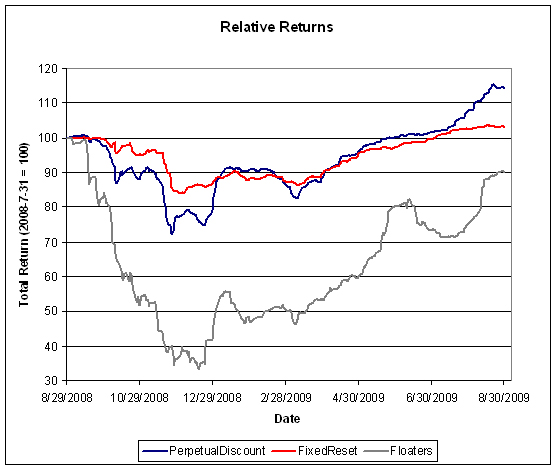
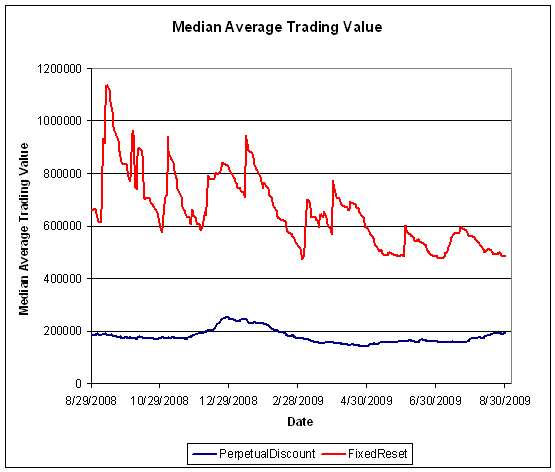
PerpetualDiscounts continued their ascent on continued elevated – albeit declining, probably a knock-on effect from the short trading day in the US – volume, while FixedResets were basically unchanged.

HIMIPref™ Preferred Indices
These values reflect the December 2008 revision of the HIMIPref™ Indices

Values are provisional and are finalized monthly
Index Mean
Current
Yield
(at bid)
Median
YTW
Median
Average
Trading
Value
Median
Mod Dur
(YTW)
Issues Day’s Perf. Index Value
Ratchet 0.00 % 0.00 % 0 0.00 0 -0.8941 % 1,164.8
FixedFloater 0.00 % 0.00 % 0 0.00 0 -0.8941 % 1,883.7
Floater 3.23 % 3.86 % 85,747 17.66 3 -0.8941 % 1,455.1
OpRet 5.04 % 3.75 % 128,492 2.58 15 0.0688 % 2,159.5
SplitShare 5.93 % 5.64 % 55,854 4.24 3 -0.1708 % 1,827.1
Interest-Bearing 5.99 % 6.73 % 25,849 0.59 1 0.0000 % 1,991.2
Perpetual-Premium 0.00 % 0.00 % 0 0.00 0 0.2222 % 1,713.8
Perpetual-Discount 6.38 % 6.43 % 159,346 13.29 71 0.2222 % 1,578.4
FixedReset 5.72 % 4.87 % 496,545 4.49 37 -0.0021 % 1,983.2
Performance Highlights
Issue Index Change Notes
TRI.PR.B Floater -2.97 % YTW SCENARIO
Maturity Type : Limit Maturity
Maturity Date : 2039-05-22
Maturity Price : 16.02
Evaluated at bid price : 16.02
Bid-YTW : 2.47 %
NA.PR.M Perpetual-Discount -1.26 % YTW SCENARIO
Maturity Type : Limit Maturity
Maturity Date : 2039-05-22
Maturity Price : 23.34
Evaluated at bid price : 23.51
Bid-YTW : 6.43 %
BAM.PR.I OpRet -1.11 % YTW SCENARIO
Maturity Type : Soft Maturity
Maturity Date : 2013-12-30
Maturity Price : 25.00
Evaluated at bid price : 24.01
Bid-YTW : 6.76 %
CU.PR.A Perpetual-Discount -1.04 % YTW SCENARIO
Maturity Type : Limit Maturity
Maturity Date : 2039-05-22
Maturity Price : 23.46
Evaluated at bid price : 23.75
Bid-YTW : 6.12 %
TD.PR.G FixedReset -1.04 % YTW SCENARIO
Maturity Type : Call
Maturity Date : 2014-05-30
Maturity Price : 25.00
Evaluated at bid price : 26.73
Bid-YTW : 4.81 %
BNS.PR.J Perpetual-Discount -1.01 % YTW SCENARIO
Maturity Type : Limit Maturity
Maturity Date : 2039-05-22
Maturity Price : 21.63
Evaluated at bid price : 21.63
Bid-YTW : 6.14 %
HSB.PR.C Perpetual-Discount -1.01 % YTW SCENARIO
Maturity Type : Limit Maturity
Maturity Date : 2039-05-22
Maturity Price : 19.70
Evaluated at bid price : 19.70
Bid-YTW : 6.59 %
BNS.PR.Q FixedReset 1.03 % YTW SCENARIO
Maturity Type : Limit Maturity
Maturity Date : 2039-05-22
Maturity Price : 24.50
Evaluated at bid price : 24.55
Bid-YTW : 4.12 %
CIU.PR.A Perpetual-Discount 1.07 % YTW SCENARIO
Maturity Type : Limit Maturity
Maturity Date : 2039-05-22
Maturity Price : 18.90
Evaluated at bid price : 18.90
Bid-YTW : 6.12 %
SLF.PR.A Perpetual-Discount 1.11 % YTW SCENARIO
Maturity Type : Limit Maturity
Maturity Date : 2039-05-22
Maturity Price : 18.16
Evaluated at bid price : 18.16
Bid-YTW : 6.67 %
CM.PR.P Perpetual-Discount 1.13 % YTW SCENARIO
Maturity Type : Limit Maturity
Maturity Date : 2039-05-22
Maturity Price : 21.55
Evaluated at bid price : 21.55
Bid-YTW : 6.46 %
PWF.PR.J OpRet 1.14 % YTW SCENARIO
Maturity Type : Soft Maturity
Maturity Date : 2013-07-30
Maturity Price : 25.00
Evaluated at bid price : 25.70
Bid-YTW : 4.06 %
PWF.PR.L Perpetual-Discount 1.16 % YTW SCENARIO
Maturity Type : Limit Maturity
Maturity Date : 2039-05-22
Maturity Price : 19.21
Evaluated at bid price : 19.21
Bid-YTW : 6.72 %
BAM.PR.K Floater 1.48 % YTW SCENARIO
Maturity Type : Limit Maturity
Maturity Date : 2039-05-22
Maturity Price : 10.30
Evaluated at bid price : 10.30
Bid-YTW : 3.86 %
CM.PR.G Perpetual-Discount 1.50 % YTW SCENARIO
Maturity Type : Limit Maturity
Maturity Date : 2039-05-22
Maturity Price : 20.31
Evaluated at bid price : 20.31
Bid-YTW : 6.73 %
CM.PR.H Perpetual-Discount 1.55 % YTW SCENARIO
Maturity Type : Limit Maturity
Maturity Date : 2039-05-22
Maturity Price : 19.00
Evaluated at bid price : 19.00
Bid-YTW : 6.39 %
CM.PR.E Perpetual-Discount 1.78 % YTW SCENARIO
Maturity Type : Limit Maturity
Maturity Date : 2039-05-22
Maturity Price : 21.16
Evaluated at bid price : 21.16
Bid-YTW : 6.70 %
MFC.PR.B Perpetual-Discount 1.81 % YTW SCENARIO
Maturity Type : Limit Maturity
Maturity Date : 2039-05-22
Maturity Price : 19.08
Evaluated at bid price : 19.08
Bid-YTW : 6.22 %
MFC.PR.C Perpetual-Discount 2.01 % YTW SCENARIO
Maturity Type : Limit Maturity
Maturity Date : 2039-05-22
Maturity Price : 18.25
Evaluated at bid price : 18.25
Bid-YTW : 6.18 %
GWO.PR.G Perpetual-Discount 2.24 % YTW SCENARIO
Maturity Type : Limit Maturity
Maturity Date : 2039-05-22
Maturity Price : 20.51
Evaluated at bid price : 20.51
Bid-YTW : 6.46 %
Volume Highlights
Issue Index Shares
Traded
Notes
SLF.PR.E Perpetual-Discount 205,784 National Bank crossed 200,000 at 17.30.
YTW SCENARIO
Maturity Type : Limit Maturity
Maturity Date : 2039-05-22
Maturity Price : 17.16
Evaluated at bid price : 17.16
Bid-YTW : 6.68 %
TD.PR.G FixedReset 120,330 TD crossed 109,700 at 26.80.
YTW SCENARIO
Maturity Type : Call
Maturity Date : 2014-05-30
Maturity Price : 25.00
Evaluated at bid price : 26.73
Bid-YTW : 4.81 %
SLF.PR.F FixedReset 58,505 Recent new issue.
YTW SCENARIO
Maturity Type : Call
Maturity Date : 2014-07-30
Maturity Price : 25.00
Evaluated at bid price : 25.75
Bid-YTW : 5.37 %
PWF.PR.M FixedReset 35,640 Nesbitt bought 25,100 from National at 26.05.
YTW SCENARIO
Maturity Type : Limit Maturity
Maturity Date : 2039-05-22
Maturity Price : 23.43
Evaluated at bid price : 25.82
Bid-YTW : 5.19 %
BAM.PR.H OpRet 32,042 YTW SCENARIO
Maturity Type : Soft Maturity
Maturity Date : 2012-03-30
Maturity Price : 25.00
Evaluated at bid price : 24.50
Bid-YTW : 6.89 %
RY.PR.Y FixedReset 31,425 YTW SCENARIO
Maturity Type : Call
Maturity Date : 2014-12-24
Maturity Price : 25.00
Evaluated at bid price : 26.15
Bid-YTW : 5.26 %
There were 30 other index-included issues trading in excess of 10,000 shares.
Interesting External Papers

TIPS & the Inflation Risk Premium

Grishchenko, Olesya V. and Huang, Jing-Zhi, Inflation Risk Premium: Evidence from the TIPS Market (December 11, 2008).

“Inflation-indexed securities would appear to be the most direct source of information about in°ation expectations and real interest rates” (Bernanke, 2004). In this paper we study the term structure of real interest rates, expected in°ation and inflation risk premia using data on prices of Treasury Inflation Protected Securities (TIPS) over the period 2000-2007. The estimates of the 10-year inflation risk premium are between 11 and 22 basis points for 2000-2007 depending on the proxy used for the expected inflation. Furthermore, we find that the inflation risk premium is time varying and, specifically, negative in the first half (which might be due to either concerns of deflation or low liquidity of the TIPS market), but positive in the second half of the sample.

This paper represents perhaps the first attempt to estimate the inflation risk premium directly using the prices of Treasury Inflation Protected Securities (TIPS). Using the market data on prices of TIPS over the period 2000-2007, we find that the 10-year average inflation risk premium ranges from 11 to 22 basis points. We also find that it is time-varying. More specifically, it is negative in 2000-2003 but positive in 2004-2007. The negative inflation risk premium during 2000-2003 is due to either concerns of deflation or liquidity problems in the TIPS market. There seems to be more evidence that supports the former explanation. The estimated average 10-year in°ation risk premium over the second half varies between 29 and 48 basis points, depending on the proxy used for the expected inflation. The estimates based on Blue Chips inflation forecast are the lowest (29 basis points), and the estimates based on one-year SPF are the highest (48 basis points). We also find that the inflation risk premium is considerably less volatile during 2004-2007, a finding consistent with the observations that in°ation expectations became more stable during this period, investors became more familiar with the TIPS market, and the market liquidity has gradually improved.

Our empirical results on in°ation risk premium estimated directly from TIPS should be valuable for practitioners, monetary authorities and policymakers alike because they help to assess the inflation expectations and the inflation risk premium of bond market investors.

Interesting External Papers

The Inflation Risk Premium

The Inflation Risk Premium in the Term Structure of Interest Rates, Peter Hördahl, BIS Quarterly Review, September 2008:

A dynamic term structure model based on an explicit structural macroeconomic framework is used to estimate inflation risk premia in the United States and the euro area. On average over the past decade, inflation risk premia have been relatively small but positive. They have exhibited an increasing pattern with respect to maturity for the euro area and a flatter one for the United States. Furthermore, the estimates imply that risk premia vary over time, mainly in response to fluctuations in economic growth and inflation.

This article estimates inflation risk premia using a dynamic term structure model based on an explicit structural macroeconomic model. The identification and quantification of such premia are important because they introduce a wedge between break-even inflation rates and investors’ expectations of future inflation. In addition, inflation risk premia per se may provide useful information to policymakers with respect to market participants’ aversion to inflation risks as well as to their perceptions about such risks.

The results show that inflation risk premia in the United States and in the euro area are on average positive, but relatively small. Moreover, the estimated premia vary over time, mainly in response to changes in economic activity, as measured by the output gap, and inflation. The estimates suggest that fluctuations in output drive much of the cyclical variation in inflation premia, while high-frequency premia fluctuations are mostly due to changes in the level of inflation.


Click for big
Seminars

Reminder: FixedReset Seminar, May 28

Just a reminder about the next seminar in the series on the theory and practice of preferred share investing.

These seminars are aimed at active and potential preferred share investors who wish to review relative valuation techniques in preferred share analysis.

All seminars will be presented by James Hymas, who has written extensively on the subject of preferred share investment and has been referred to as a "top expert" on the subject.

Questions are encouraged throughout the seminars, as well as in informal discussion at the end of the session.

Each seminar is two hours in length; coffee and tea will be served. The cost of attendance is $100, but a discount of $50 will be given to participants who have an annual subscription to PrefLetter with at least one issue remaining at the time of the seminar.

All seminars will be video-recorded for future distribution. Please note the slight change of venue: same hotel, different conference room.

Advance registration and payment may be performed on-line.

Thursday, May 28

Preferred Share – Fixed-Reset Issues:
Theory & Practice

"FixedReset Issues" are popular with investors who:

  • wish to obtain tax-advantaged income
  • want protection against future inflation

These issues are characterized by:

  • Mostly issued by financial institutions
  • Exchange Dates occur every five years
  • Dividends are fixed until the first Exchange Date
  • On every Exchange Date:
    • Company may redeem the issue at par
    • Rate until next exchange date is reset to 5-Year Canada bonds plus a spread
    • Issue may be exchanged to Floating Rate issues, paying 3-month Treasury Bills plus a spread, reset quarterly
  • Issues are perpetual

This seminar will review the theory of FixedReset Preferred evaluation, including:

  • Credit Quality
  • Embedded calls
  • Exchange Options
  • The importance of ex-Dividend dates
  • Investment characteristics relative to Straight Perpetuals

Examples of relative valuation in current markets will be supplied and discussed.

Attendence is limited; a reservation will avoid disappointment.

Location: Days Hotel & Conference Center, (at Carlton & College, downtown Toronto) College Room (see map).

Time: May 28, 2009, 6pm-8pm.

Reservations: Please visit the PrefLetter Seminar Page.

Interesting External Papers

FDIC Targets Brokered Deposits, Growth

I missed this when it came out.

The FDIC has released a rule increasing the complexity of deposit insurance premium calculations:

The final rule adds a new financial measure to the financial ratios method. This new financial measure, the adjusted brokered deposit ratio, will measure the extent to which brokered deposits are funding rapid asset growth. The adjusted brokered deposit ratio will affect only those established Risk Category I institutions whose total gross
assets are more than 40 percent greater than they were four years previously, after adjusting for mergers and acquisitions, rather than 20 percent greater as proposed in the NPR, and
whose brokered deposits (less reciprocal deposits) make up more than 10 percent of domestic deposits. Generally speaking, the greater an institution’s asset growth and the greater its percentage of brokered deposits, the greater will be the increase in its initial base assessment rate. Small changes in asset growth rate or brokered deposits as a percentage of domestic deposits will lead to small changes in assessment rates.

The Canadian approach is not nearly so nuanced since our bankers are ever so smart. In fact, they’re all equally smart, with the vast majority of assets in the system paying into the CDIC fund at the same rate, which is considered desirable. Not so in the States:

A commenting bank argued that:

Arbitrarily establishing targets for percentages of institutions that fall into a given assessment rate is inconsistent with not only the governing statute but the whole concept of risk-based pricing….

The FDIC disagrees with the commenting bank. The purpose of the new large bank method is to create an assessment system for large Risk Category I institutions that will respond more timely to changing risk profiles, will improve the accuracy of initial assessment rates, relative risk rankings, and will create a greater parity between small and large Risk Category I institutions.

Imagine that! Rewards for being better than the competition, even if only by a little bit! It’s a good thing we don’t have that sort of nonsense in Canada – it can lead to bonuses.

Since the FDIC is not Canadian, they address criticism, allowing investors and observers to take an informed view of the desirability of changes:

The FDIC received many comments arguing that brokered deposits should not increase assessment rates for Risk Category I institutions and that the brokered deposit provisions in the NPR do not account for the use to which institutions put these deposits. The FDIC is not persuaded by the arguments. Recent data show that institutions with a combination of brokered deposit reliance and robust asset growth tend to have a greater concentration in higher risk assets. In addition, there is a statistically significant correlation between the adjusted brokered deposit ratio, on the one hand, and the probability that an institution will be downgraded to a CAMELS rating of 3, 4, or 5 within a year, on the other, independent of the other measures of asset quality contained in the financial ratios method.

Market Action

May 21, 2009

The Bank of Canada has released a working paper by Hajime Tomura, Heterogeneous Beliefs and Housing-Market Boom-Bust Cycles in a Small Open Economy:

This paper introduces heterogeneous beliefs among households in a small open economy model for the Canadian economy. The model suggests that simultaneous boom-bust cycles in house prices, output, investment, consumption and hours worked emerge when credit-constrained mortgage borrowers expect that future house prices will rise and this expectation is neither shared by savers nor realized ex-post. With sticky prices and a standard monetary policy rule, the model shows that the nominal policy interest rate and the CPI inflation rate decline during housing booms and rise as house prices fall. These results replicate the stylized features of housing-market boom-bust cycles in industrialized countries. Policy experiments demonstrate that stronger policy responses to inflation amplify housing-market boom-bust cycles. Also, higher loan-to-value ratios amplify housing-market boom-bust cycles by encouraging speculative housing investments by mortgage borrowers during housing booms and increasing liquidation of housing collateral during housing busts.

OSFI has released a new Corporate Brochure. The Bank for International Settlements has released Principles for sound stress testing practices and supervision.

DBRS has downgraded ABN AMRO:

ABN AMRO Bank’s outstanding trust preferred securities have been downgraded from BBB to BB. The trend on these securities is Negative. Considering the significant cyclical and company-specific headwinds that RBS faces, DBRS sees an elevated risk of nonpayment of preferred dividends (which DBRS defines as a default on these instruments) which would likely entail a nonpayment of dividends on these securities.

Volume continued at its elevated levels but the market’s ascent was checked; PerpetualDiscounts only just barely managed to squeak out a gain, while FixedResets were slightly negative. But how ’bout them Floaters, eh? Up 17.2% on the month-to-date.

HIMIPref™ Preferred Indices
These values reflect the December 2008 revision of the HIMIPref™ Indices

Values are provisional and are finalized monthly
Index Mean
Current
Yield
(at bid)
Median
YTW
Median
Average
Trading
Value
Median
Mod Dur
(YTW)
Issues Day’s Perf. Index Value
Ratchet 0.00 % 0.00 % 0 0.00 0 3.3315 % 1,175.3
FixedFloater 0.00 % 0.00 % 0 0.00 0 3.3315 % 1,900.7
Floater 3.20 % 3.88 % 86,137 17.63 3 3.3315 % 1,468.3
OpRet 5.04 % 3.75 % 129,970 2.59 15 0.0847 % 2,158.1
SplitShare 5.92 % 5.61 % 56,181 4.24 3 0.2490 % 1,830.3
Interest-Bearing 5.99 % 6.70 % 26,838 0.59 1 0.0999 % 1,991.2
Perpetual-Premium 0.00 % 0.00 % 0 0.00 0 0.0242 % 1,710.0
Perpetual-Discount 6.39 % 6.43 % 159,106 13.29 71 0.0242 % 1,574.9
FixedReset 5.72 % 4.84 % 496,432 4.49 37 -0.0924 % 1,983.2
Performance Highlights
Issue Index Change Notes
GWO.PR.G Perpetual-Discount -3.88 % YTW SCENARIO
Maturity Type : Limit Maturity
Maturity Date : 2039-05-21
Maturity Price : 20.06
Evaluated at bid price : 20.06
Bid-YTW : 6.60 %
CM.PR.I Perpetual-Discount -1.55 % YTW SCENARIO
Maturity Type : Limit Maturity
Maturity Date : 2039-05-21
Maturity Price : 17.82
Evaluated at bid price : 17.82
Bid-YTW : 6.68 %
IAG.PR.C FixedReset -1.50 % YTW SCENARIO
Maturity Type : Limit Maturity
Maturity Date : 2039-05-21
Maturity Price : 25.56
Evaluated at bid price : 25.61
Bid-YTW : 5.50 %
MFC.PR.B Perpetual-Discount -1.42 % YTW SCENARIO
Maturity Type : Limit Maturity
Maturity Date : 2039-05-21
Maturity Price : 18.74
Evaluated at bid price : 18.74
Bid-YTW : 6.33 %
RY.PR.W Perpetual-Discount -1.27 % YTW SCENARIO
Maturity Type : Limit Maturity
Maturity Date : 2039-05-21
Maturity Price : 19.38
Evaluated at bid price : 19.38
Bid-YTW : 6.37 %
SLF.PR.B Perpetual-Discount -1.25 % YTW SCENARIO
Maturity Type : Limit Maturity
Maturity Date : 2039-05-21
Maturity Price : 18.17
Evaluated at bid price : 18.17
Bid-YTW : 6.73 %
MFC.PR.C Perpetual-Discount -1.21 % YTW SCENARIO
Maturity Type : Limit Maturity
Maturity Date : 2039-05-21
Maturity Price : 17.89
Evaluated at bid price : 17.89
Bid-YTW : 6.30 %
BAM.PR.K Floater -1.07 % YTW SCENARIO
Maturity Type : Limit Maturity
Maturity Date : 2039-05-21
Maturity Price : 10.15
Evaluated at bid price : 10.15
Bid-YTW : 3.92 %
IAG.PR.A Perpetual-Discount -1.00 % YTW SCENARIO
Maturity Type : Limit Maturity
Maturity Date : 2039-05-21
Maturity Price : 16.83
Evaluated at bid price : 16.83
Bid-YTW : 6.97 %
RY.PR.H Perpetual-Discount 1.14 % YTW SCENARIO
Maturity Type : Limit Maturity
Maturity Date : 2039-05-21
Maturity Price : 23.01
Evaluated at bid price : 23.16
Bid-YTW : 6.14 %
HSB.PR.D Perpetual-Discount 1.31 % YTW SCENARIO
Maturity Type : Limit Maturity
Maturity Date : 2039-05-21
Maturity Price : 19.35
Evaluated at bid price : 19.35
Bid-YTW : 6.58 %
NA.PR.L Perpetual-Discount 1.52 % YTW SCENARIO
Maturity Type : Limit Maturity
Maturity Date : 2039-05-21
Maturity Price : 19.40
Evaluated at bid price : 19.40
Bid-YTW : 6.31 %
BAM.PR.N Perpetual-Discount 1.62 % YTW SCENARIO
Maturity Type : Limit Maturity
Maturity Date : 2039-05-21
Maturity Price : 15.07
Evaluated at bid price : 15.07
Bid-YTW : 8.05 %
TRI.PR.B Floater 8.26 % Zooming up in the draft of the BAM floaters! Traded 5,200 shares in a range of 15.75-16.96 before closing at 16.51-49, 1×7.
YTW SCENARIO
Maturity Type : Limit Maturity
Maturity Date : 2039-05-21
Maturity Price : 16.51
Evaluated at bid price : 16.51
Bid-YTW : 2.40 %
Volume Highlights
Issue Index Shares
Traded
Notes
SLF.PR.F FixedReset 176,909 Recent new issue.
YTW SCENARIO
Maturity Type : Call
Maturity Date : 2014-07-30
Maturity Price : 25.00
Evaluated at bid price : 25.81
Bid-YTW : 5.31 %
BNS.PR.P FixedReset 117,605 Nesbitt crossed 100,000 at 24.93.
YTW SCENARIO
Maturity Type : Limit Maturity
Maturity Date : 2039-05-21
Maturity Price : 24.84
Evaluated at bid price : 24.90
Bid-YTW : 4.21 %
CM.PR.I Perpetual-Discount 86,785 YTW SCENARIO
Maturity Type : Limit Maturity
Maturity Date : 2039-05-21
Maturity Price : 17.82
Evaluated at bid price : 17.82
Bid-YTW : 6.68 %
RY.PR.R FixedReset 64,202 RBC crossed 13,600 at 26.60.
YTW SCENARIO
Maturity Type : Call
Maturity Date : 2014-03-26
Maturity Price : 25.00
Evaluated at bid price : 26.46
Bid-YTW : 4.91 %
RY.PR.Y FixedReset 59,504 Recent new issue.
YTW SCENARIO
Maturity Type : Call
Maturity Date : 2014-12-24
Maturity Price : 25.00
Evaluated at bid price : 26.12
Bid-YTW : 5.28 %
BAM.PR.H OpRet 56,707 YTW SCENARIO
Maturity Type : Soft Maturity
Maturity Date : 2012-03-30
Maturity Price : 25.00
Evaluated at bid price : 24.50
Bid-YTW : 6.89 %
There were 48 other index-included issues trading in excess of 10,000 shares.
Interesting External Papers

Bank of Canada Releases Spring 2009 Review

The Bank of Canada has released the Spring 2009 Review with the following feature articles:

The concept of Price Level Targetting is explained in the first article:

Despite its recent successes in terms of macrostabilization, several authors have highlighted some shortcomings in the infl ation-targeting (IT) framework. Most notably, uncertainty on the price level grows with the planning horizon, since central banks with infl ation targets accommodate shocks to the price level, taking the post-shock level as given and aiming to stabilize infl ation from this level. In fact, the price level is unbounded at very distant horizons. Price-level targeting (PT) mitigates this uncertainty by committing central banks to restore the price level to a preannounced target following shocks. PT is frequently described as a departure from IT’s prescription for letting “bygones be bygones.”

Frankly, I didn’t find this issue particularly satisfying; there are necessarily many assumptions embedded in the papers. There is the prospect of lowering the term risk premium (flattening the yield curve) with Price Level Targetting, but on the other hand it’s asking rather a lot from the Central Bank, which will have to overcompensate for transient shocks rather than concentrating on getting things back to normal.

Market Action

May 20, 2009

BofA was able to raise significant equity capital yesterday:

Bank of America Corp., the biggest U.S. bank by assets, said it raised about $13.5 billion in a sale of common stock as part of an effort to boost capital and weather an extended recession.

The bank issued 1.25 billion shares at an average price of $10.77 each, according to a statement today. The Charlotte, North Carolina-based company plans to boost common equity capital by $17 billion through the sale of stock and by converting preferred shares mostly held by institutional investors, Chief Executive Officer Kenneth Lewis said May 7.

Bank of America expects to add $10 billion more in capital through asset sales and at least $7 billion from improved pretax profits, the company said on May 7. Those numbers may change as the bank considers options to achieve its $33.9 billion target, spokesman Jerry Dubrowski said.

The Pension Benefit Guaranty Fund in the States is having about as much fun as other guarantors:

Pension Benefit Guaranty Corp.’s deficit tripled to $33.5 billion in the past six months as more companies canceled retirement plans amid the U.S. recession, according to the head of the government-owned corporation.

About $11 billion is for “completed and probable terminations,” and $7 billion is from an increase in interest rates that boosted liabilities, Vince Snowbarger, the acting PBGC director, said in written testimony to be delivered tomorrow to the Senate Special Committee on Aging.

The potential for General Motors Corp. and Chrysler LLC to end their plans has left the PBGC facing the prospect of adding 900,000 current and future beneficiaries. The PBGC, which pays retirement income to almost 44 million Americans, estimates that $77 billion of the automotive industry’s pensions are underfunded, with about $42 billion of that not funded at all.

There’s a report by internal audit of the fund that claims former PBGC director Millard was, at least, sloppy in separating his various activities – with the Placement Agent scandal still being whipped up, the response could be draconian.

Looks like the SEC is losing the jurisdictional catfight with the Fed:

The Obama administration may call for stripping the Securities and Exchange Commission of some of its powers under a regulatory reorganization that could be unveiled as soon as next week, people familiar with the matter said.

The proposal, still being drafted, is likely to give the Federal Reserve more authority to supervise financial firms deemed too big to fail. The Fed may inherit some SEC functions, with others going to other agencies, the people said. On the table: giving oversight of mutual funds to a bank regulator or a new agency to police consumer-finance products, two people said.

The politicians have to assign blame and shuffle responsibilities in order to make it clear that nothing was their fault.

The Obama administrations shameful conduct in the Chrysler bankruptcy is having some repercussions:

Hedge fund manager George Schultze says he may avoid lending to any more unionized companies after being burned by President Barack Obama in Chrysler LLC’s bankruptcy.

Obama put Chrysler under court protection on April 30 after lenders balked at a proposal giving them about 29 cents on the dollar for their $6.9 billion in debt. The investors said the president’s plan favored a union retiree medical fund whose claims ranked behind them for repayment. It was offered a 55 percent equity stake in the automaker.

Pacific Investment Management Co., Barclays Capital and Fridson Investment Advisors have joined Schultze Asset Management LLC in saying lenders may be unwilling to back unionized companies with underfunded pension and medical obligations, such as airlines and auto-industry suppliers, because Chrysler’s creditors failed to block Obama’s move.

Whether or not the rhetoric influences yield spreads and whether those yield spreads influence conduct is something we’ll just have to wait and see.

Anne Sibert pens a provocative thesis on VoxEU, Why did the bankers behave so badly?:

Greedy bankers are getting most of the blame for the current financial crisis. This column explains bankers did behave badly for mainly three reasons. They committed cognitive errors involving biases towards their own prior beliefs; too many male bankers high on testosterone took too much risk, and a flawed compensation structure rewarded perceived short-term competency rather than long-run results.

In a fascinating and innovative study, Coates and Herbert (2008) advance the notion that steroid feedback loops may help explain why male bankers behave irrationally when caught up in bubbles. These authors took samples of testosterone levels of 17 male traders on a typical London trading floor (which had 260 traders, only four of whom were female). They found that testosterone was significantly higher on days when traders made more than their daily one-month average profit and that higher levels of testosterone also led to greater profitability – presumably because of greater confidence and risk taking. The authors hypothesise that if raised testosterone were to persist for several weeks the elevated appetite for risk taking might have important behavioural consequences and that there might be cognitive implications as well; testosterone, they say, has receptors throughout the areas of the brain that neuro-economic research has identified as contributing to irrational financial decisions.

Well, I don’t know what’s up with the Toronto Stock Exchange. There was a problem last Friday retrieving prices that were available and today there’s a problem with availability. So I’m using an approximate, late-in-day-update to prepare today’s report. I did update the details for SLF.PR.F, though, since that one’s important.

It was another really good day for the preferred share market – and here’s a landmark for you: BAM floaters are now trading in the double digits! The low close of 6.40-69 was reached on 2008-12-18 on volume of 27,351 shares.

PerpetualDiscounts now yield 6.39% (pre-tax bid-YTW), equivalent to 8.95% interest at the standard equivalency factor of 1.4x. Long Corporates are now at 7.0%, having returned 4.63% Month-to-date and 9.29% Year-to-Date, so the pre-tax interest-equivalent spread is now about 195bp.

HIMIPref™ Preferred Indices
These values reflect the December 2008 revision of the HIMIPref™ Indices

Values are provisional and are finalized monthly
Index Mean
Current
Yield
(at bid)
Median
YTW
Median
Average
Trading
Value
Median
Mod Dur
(YTW)
Issues Day’s Perf. Index Value
Ratchet 0.00 % 0.00 % 0 0.00 0 3.8730 % 1,137.4
FixedFloater 0.00 % 0.00 % 0 0.00 0 3.8730 % 1,839.4
Floater 3.31 % 3.89 % 84,880 17.60 3 3.8730 % 1,420.9
OpRet 5.05 % 3.99 % 130,283 3.63 15 0.1167 % 2,156.2
SplitShare 5.94 % 5.48 % 52,349 4.24 3 0.4845 % 1,825.7
Interest-Bearing 5.99 % 6.84 % 27,930 0.60 1 0.1000 % 1,989.2
Perpetual-Premium 0.00 % 0.00 % 0 0.00 0 0.5059 % 1,709.6
Perpetual-Discount 6.40 % 6.39 % 159,029 13.29 71 0.5059 % 1,574.5
FixedReset 5.72 % 4.83 % 497,301 4.50 37 0.4306 % 1,985.1
Performance Highlights
Issue Index Change Notes
MFC.PR.C Perpetual-Discount -2.38 % YTW SCENARIO
Maturity Type : Limit Maturity
Maturity Date : 2039-05-20
Maturity Price : 17.64
Evaluated at bid price : 17.64
Bid-YTW : 6.39 %
IAG.PR.A Perpetual-Discount -1.41 % YTW SCENARIO
Maturity Type : Limit Maturity
Maturity Date : 2039-05-20
Maturity Price : 16.76
Evaluated at bid price : 16.76
Bid-YTW : 7.00 %
BAM.PR.M Perpetual-Discount 1.00 % YTW SCENARIO
Maturity Type : Limit Maturity
Maturity Date : 2039-05-20
Maturity Price : 15.11
Evaluated at bid price : 15.11
Bid-YTW : 8.03 %
SLF.PR.D Perpetual-Discount 1.01 % YTW SCENARIO
Maturity Type : Limit Maturity
Maturity Date : 2039-05-20
Maturity Price : 16.94
Evaluated at bid price : 16.94
Bid-YTW : 6.69 %
NA.PR.M Perpetual-Discount 1.02 % YTW SCENARIO
Maturity Type : Limit Maturity
Maturity Date : 2039-05-20
Maturity Price : 23.58
Evaluated at bid price : 23.76
Bid-YTW : 6.36 %
BMO.PR.K Perpetual-Discount 1.05 % YTW SCENARIO
Maturity Type : Limit Maturity
Maturity Date : 2039-05-20
Maturity Price : 21.22
Evaluated at bid price : 21.22
Bid-YTW : 6.23 %
POW.PR.A Perpetual-Discount 1.08 % YTW SCENARIO
Maturity Type : Limit Maturity
Maturity Date : 2039-05-20
Maturity Price : 21.50
Evaluated at bid price : 21.50
Bid-YTW : 6.61 %
CM.PR.M FixedReset 1.08 % YTW SCENARIO
Maturity Type : Call
Maturity Date : 2014-08-30
Maturity Price : 25.00
Evaluated at bid price : 27.06
Bid-YTW : 5.02 %
RY.PR.X FixedReset 1.09 % YTW SCENARIO
Maturity Type : Call
Maturity Date : 2014-09-23
Maturity Price : 25.00
Evaluated at bid price : 26.85
Bid-YTW : 4.88 %
RY.PR.L FixedReset 1.14 % YTW SCENARIO
Maturity Type : Limit Maturity
Maturity Date : 2039-05-20
Maturity Price : 23.41
Evaluated at bid price : 25.80
Bid-YTW : 4.57 %
ELF.PR.G Perpetual-Discount 1.15 % YTW SCENARIO
Maturity Type : Limit Maturity
Maturity Date : 2039-05-20
Maturity Price : 16.69
Evaluated at bid price : 16.69
Bid-YTW : 7.23 %
TD.PR.S FixedReset 1.24 % YTW SCENARIO
Maturity Type : Limit Maturity
Maturity Date : 2039-05-20
Maturity Price : 24.33
Evaluated at bid price : 24.40
Bid-YTW : 3.96 %
TRI.PR.B Floater 1.26 % YTW SCENARIO
Maturity Type : Limit Maturity
Maturity Date : 2039-05-20
Maturity Price : 15.25
Evaluated at bid price : 15.25
Bid-YTW : 2.60 %
TD.PR.P Perpetual-Discount 1.38 % YTW SCENARIO
Maturity Type : Limit Maturity
Maturity Date : 2039-05-20
Maturity Price : 21.35
Evaluated at bid price : 21.35
Bid-YTW : 6.22 %
PWF.PR.F Perpetual-Discount 1.50 % YTW SCENARIO
Maturity Type : Limit Maturity
Maturity Date : 2039-05-20
Maturity Price : 20.25
Evaluated at bid price : 20.25
Bid-YTW : 6.56 %
GWO.PR.G Perpetual-Discount 1.62 % YTW SCENARIO
Maturity Type : Limit Maturity
Maturity Date : 2039-05-20
Maturity Price : 20.71
Evaluated at bid price : 20.71
Bid-YTW : 6.39 %
BNA.PR.C SplitShare 1.93 % Asset coverage of 1.8-:1 as of April 30, according to the company. Went ex-Dividend today … I wonder if anybody noticed.
YTW SCENARIO
Maturity Type : Hard Maturity
Maturity Date : 2019-01-10
Maturity Price : 25.00
Evaluated at bid price : 14.62
Bid-YTW : 11.66 %
GWO.PR.I Perpetual-Discount 2.01 % YTW SCENARIO
Maturity Type : Limit Maturity
Maturity Date : 2039-05-20
Maturity Price : 17.25
Evaluated at bid price : 17.25
Bid-YTW : 6.64 %
POW.PR.C Perpetual-Discount 2.02 % YTW SCENARIO
Maturity Type : Limit Maturity
Maturity Date : 2039-05-20
Maturity Price : 21.91
Evaluated at bid price : 22.17
Bid-YTW : 6.63 %
MFC.PR.B Perpetual-Discount 2.10 % YTW SCENARIO
Maturity Type : Limit Maturity
Maturity Date : 2039-05-20
Maturity Price : 19.00
Evaluated at bid price : 19.00
Bid-YTW : 6.24 %
CIU.PR.A Perpetual-Discount 2.20 % YTW SCENARIO
Maturity Type : Limit Maturity
Maturity Date : 2039-05-20
Maturity Price : 18.60
Evaluated at bid price : 18.60
Bid-YTW : 6.22 %
CM.PR.H Perpetual-Discount 2.50 % YTW SCENARIO
Maturity Type : Limit Maturity
Maturity Date : 2039-05-20
Maturity Price : 18.87
Evaluated at bid price : 18.87
Bid-YTW : 6.44 %
ELF.PR.F Perpetual-Discount 2.66 % YTW SCENARIO
Maturity Type : Limit Maturity
Maturity Date : 2039-05-20
Maturity Price : 18.50
Evaluated at bid price : 18.50
Bid-YTW : 7.28 %
BAM.PR.B Floater 5.48 % YTW SCENARIO
Maturity Type : Limit Maturity
Maturity Date : 2039-05-20
Maturity Price : 10.20
Evaluated at bid price : 10.20
Bid-YTW : 3.90 %
BAM.PR.K Floater 6.35 % YTW SCENARIO
Maturity Type : Limit Maturity
Maturity Date : 2039-05-20
Maturity Price : 10.22
Evaluated at bid price : 10.22
Bid-YTW : 3.89 %
Volume Highlights
Issue Index Shares
Traded
Notes
SLF.PR.F FixedReset 727,983 New issue settled today.
YTW SCENARIO
Maturity Type : Call
Maturity Date : 2014-07-30
Maturity Price : 25.00
Evaluated at bid price : 25.79
Bid-YTW : 5.32 %
POW.PR.D Perpetual-Discount 93,700 YTW SCENARIO
Maturity Type : Limit Maturity
Maturity Date : 2039-05-20
Maturity Price : 18.75
Evaluated at bid price : 18.75
Bid-YTW : 6.77 %
BAM.PR.O OpRet 57,300 YTW SCENARIO
Maturity Type : Option Certainty
Maturity Date : 2013-06-30
Maturity Price : 25.00
Evaluated at bid price : 23.35
Bid-YTW : 7.11 %
RY.PR.B Perpetual-Discount 56,205 YTW SCENARIO
Maturity Type : Limit Maturity
Maturity Date : 2039-05-20
Maturity Price : 19.10
Evaluated at bid price : 19.10
Bid-YTW : 6.20 %
W.PR.H Perpetual-Discount 49,900 YTW SCENARIO
Maturity Type : Limit Maturity
Maturity Date : 2039-05-20
Maturity Price : 20.70
Evaluated at bid price : 20.70
Bid-YTW : 6.75 %
MFC.PR.A OpRet 47,340 YTW SCENARIO
Maturity Type : Soft Maturity
Maturity Date : 2015-12-18
Maturity Price : 25.00
Evaluated at bid price : 24.91
Bid-YTW : 4.12 %
There were 45 other index-included issues trading in excess of 10,000 shares.
Issue Comments

SLF.PR.F Rockets to Hefty Premium on Heavy Volume

SLF.PR.F, the 6.00%+379 FixedReset announced on May 8 settled today.

Sun Life Financial announced:

the successful completion of a Canadian public offering of $250 million of Class A Non-Cumulative 5-Year Rate Reset Preferred Shares Series 6R (the “Series 6R Shares”) at a price of $25.00 per share and yielding 6.00 per cent annually. The offering, initially for $200 million of Series 6R Shares, was increased to $250 million following exercise by the underwriting syndicate, co-led by TD Securities Inc. and BMO Nesbitt Burns Inc., of an option to purchase an additional $50 million of Series 6R Shares.

The Series 6R Shares were issued under a prospectus supplement dated May 8, 2009, which was issued pursuant to a short form base shelf prospectus dated April 1, 2009. Copies of those documents are available on the SEDAR website for Sun Life Financial Inc. at www.sedar.com. The Series 6R Shares are listed on the Toronto Stock Exchange under the ticker symbol SLF.PR.F.

So the greenshoe was fully exercised.

Vital statistics after the first day’s trading are:

SLF.PR.F FixedReset YTW SCENARIO
Maturity Type : Call
Maturity Date : 2014-07-30
Maturity Price : 25.00
Evaluated at bid price : 25.79
Bid-YTW : 5.32 %

It will be most interesting to learn whether the rapturous reception accorded SLF.PR.F will coax a few more issues out of the woodwork!

SLF.PR.F has been added to the FixedReset HIMIPref™ subindex.

Market Action

May 19, 2009

The Bank for International Settlements has released its report on OTC derivatives market activity in the second half of 2008:

Facing significant price drops, markets for commodity and equity derivatives recorded volumes which were 66.5% and 36.2% lower, respectively. Against a background of severely strained credit markets combined with efforts to improve multilateral netting of offsetting contracts, credit default swap (CDS) volumes decreased by 26.9%. Foreign exchange and interest rate derivatives markets recorded their first significant downturns. Amounts outstanding of foreign exchange contracts fell by 21.0%, while amounts outstanding of
interest rate contracts slid by 8.6%.

Gross market values, which measure the cost of replacing all existing contracts, represent a better measure of market risk than notional amounts. Despite the drop in amounts outstanding, significant price movements resulted in notably higher gross market values, which increased by 66.5% to $33.9 trillion at the end of December 2008 (Graph 1, right-hand panel). The higher market values were also reflected in gross credit exposures, which grew 29.7% to $5.0 trillion.

In the second half of 2008 the market for OTC interest rate derivatives declined for the first time, after recording an above average rate of growth in the first half of the year. Notional amounts of these instruments fell to $418.7 trillion at the end of December 2008, 8.6% lower than six months before (Graph 2 and Table 3). Despite the decrease in notional amounts outstanding, declining interest rates resulted in a notable 98.9% increase in the gross market value of interest rate derivatives, to $18.4 trillion.

Their statement Gross market values, which measure the cost of replacing all existing contracts, represent a better measure of market risk than notional amounts. is incorrect. If I short a bond future, the market value at time of execution is zero, but I have full market exposure and counterparty risk to the extent that I might win money that doesn’t get paid. If the market moves in my favour, that increases my counterparty risk but doesn’t affect my market exposure.

There are straws in the wind that the too-big-to-fail problem will not be addressed by fixing extant rules, but by adding another layer of new rules that will grant politicians more discretionary power:

Neel Kashkari, former administrator of the $700 billion U.S. bank-rescue program, said firms deemed too big to fail have an unfair advantage over smaller rivals because they can more cheaply raise money in the debt markets.

Kashkari, who left government May 1, said in a speech last night that some officials have discussed the possibility of a “debt tax” or “systemic tax” on those institutions, without saying if he supported that approach.

“If you have some huge, global institution that is systemically important, too big to fail, too interconnected to fail, in a sense it will always be able to issue debt cheaper,” said Kashkari, 35, at the San Francisco campus of the University of Pennsylvania’s Wharton School. “People who buy that debt believe that the government is standing behind it.”

“Debt Tax”? “Systemic Tax”? Presumably this is much the same idea as existing deposit insurance, except that the degree of protection received in exchange for premia will not be spelled out. It is very simple to address the TBTF problem and systemic risk problem by adjusting extant rules:

  • End the practice of risk-weighting bank debt according to the credit of the sovereign
  • Impose an upwards adjustment to Risk-Weighted Assets based on size of the bank

Here’s a scary proposal: inflation targetting of 6%:

What the U.S. economy may need is a dose of good old-fashioned inflation.

So say economists including Gregory Mankiw, former White House adviser, and Kenneth Rogoff, who was chief economist at the International Monetary Fund. They argue that a looser rein on inflation would make it easier for debt-strapped consumers and governments to meet their obligations. It might also help the economy by encouraging Americans to spend now rather than later when prices go up.

“I’m advocating 6 percent inflation for at least a couple of years,” says Rogoff, 56, who’s now a professor at Harvard University. “It would ameliorate the debt bomb and help us work through the deleveraging process.”

Another strong day in the preferred market, with volume returning to elevated levels after the long weekend.

HIMIPref™ Preferred Indices
These values reflect the December 2008 revision of the HIMIPref™ Indices

Values are provisional and are finalized monthly
Index Mean
Current
Yield
(at bid)
Median
YTW
Median
Average
Trading
Value
Median
Mod Dur
(YTW)
Issues Day’s Perf. Index Value
Ratchet 0.00 % 0.00 % 0 0.00 0 0.7334 % 1,095.0
FixedFloater 0.00 % 0.00 % 0 0.00 0 0.7334 % 1,770.8
Floater 3.44 % 4.11 % 84,806 17.14 3 0.7334 % 1,368.0
OpRet 5.05 % 4.09 % 131,756 2.59 15 0.0584 % 2,153.7
SplitShare 5.91 % 6.79 % 51,931 4.25 3 0.4672 % 1,816.9
Interest-Bearing 6.00 % 6.98 % 29,066 0.60 1 0.0000 % 1,987.2
Perpetual-Premium 0.00 % 0.00 % 0 0.00 0 0.3545 % 1,701.0
Perpetual-Discount 6.43 % 6.49 % 157,719 13.19 71 0.3545 % 1,566.6
FixedReset 5.74 % 4.88 % 490,761 4.47 36 0.1770 % 1,976.6
Performance Highlights
Issue Index Change Notes
TRI.PR.B Floater -4.38 % YTW SCENARIO
Maturity Type : Limit Maturity
Maturity Date : 2039-05-19
Maturity Price : 15.06
Evaluated at bid price : 15.06
Bid-YTW : 2.63 %
TD.PR.P Perpetual-Discount -1.63 % YTW SCENARIO
Maturity Type : Limit Maturity
Maturity Date : 2039-05-19
Maturity Price : 21.06
Evaluated at bid price : 21.06
Bid-YTW : 6.31 %
PWF.PR.G Perpetual-Discount -1.21 % YTW SCENARIO
Maturity Type : Limit Maturity
Maturity Date : 2039-05-19
Maturity Price : 22.02
Evaluated at bid price : 22.02
Bid-YTW : 6.78 %
TD.PR.Q Perpetual-Discount -1.14 % YTW SCENARIO
Maturity Type : Limit Maturity
Maturity Date : 2039-05-19
Maturity Price : 22.43
Evaluated at bid price : 22.55
Bid-YTW : 6.27 %
CU.PR.B Perpetual-Discount 1.02 % YTW SCENARIO
Maturity Type : Limit Maturity
Maturity Date : 2039-05-19
Maturity Price : 24.47
Evaluated at bid price : 24.76
Bid-YTW : 6.07 %
ENB.PR.A Perpetual-Discount 1.03 % YTW SCENARIO
Maturity Type : Limit Maturity
Maturity Date : 2039-05-19
Maturity Price : 24.30
Evaluated at bid price : 24.61
Bid-YTW : 5.60 %
BAM.PR.N Perpetual-Discount 1.03 % YTW SCENARIO
Maturity Type : Limit Maturity
Maturity Date : 2039-05-19
Maturity Price : 14.76
Evaluated at bid price : 14.76
Bid-YTW : 8.22 %
GWO.PR.F Perpetual-Discount 1.09 % YTW SCENARIO
Maturity Type : Limit Maturity
Maturity Date : 2039-05-19
Maturity Price : 21.89
Evaluated at bid price : 22.24
Bid-YTW : 6.74 %
CM.PR.I Perpetual-Discount 1.25 % YTW SCENARIO
Maturity Type : Limit Maturity
Maturity Date : 2039-05-19
Maturity Price : 17.78
Evaluated at bid price : 17.78
Bid-YTW : 6.69 %
PWF.PR.H Perpetual-Discount 1.31 % YTW SCENARIO
Maturity Type : Limit Maturity
Maturity Date : 2039-05-19
Maturity Price : 21.63
Evaluated at bid price : 21.63
Bid-YTW : 6.73 %
IAG.PR.A Perpetual-Discount 1.43 % YTW SCENARIO
Maturity Type : Limit Maturity
Maturity Date : 2039-05-19
Maturity Price : 17.00
Evaluated at bid price : 17.00
Bid-YTW : 6.89 %
HSB.PR.C Perpetual-Discount 1.74 % YTW SCENARIO
Maturity Type : Limit Maturity
Maturity Date : 2039-05-19
Maturity Price : 19.85
Evaluated at bid price : 19.85
Bid-YTW : 6.54 %
NA.PR.K Perpetual-Discount 2.32 % YTW SCENARIO
Maturity Type : Limit Maturity
Maturity Date : 2039-05-19
Maturity Price : 23.08
Evaluated at bid price : 23.33
Bid-YTW : 6.31 %
BAM.PR.M Perpetual-Discount 2.68 % YTW SCENARIO
Maturity Type : Limit Maturity
Maturity Date : 2039-05-19
Maturity Price : 14.96
Evaluated at bid price : 14.96
Bid-YTW : 8.11 %
POW.PR.A Perpetual-Discount 2.95 % YTW SCENARIO
Maturity Type : Limit Maturity
Maturity Date : 2039-05-19
Maturity Price : 21.27
Evaluated at bid price : 21.27
Bid-YTW : 6.68 %
ELF.PR.G Perpetual-Discount 3.00 % YTW SCENARIO
Maturity Type : Limit Maturity
Maturity Date : 2039-05-19
Maturity Price : 16.50
Evaluated at bid price : 16.50
Bid-YTW : 7.31 %
GWO.PR.G Perpetual-Discount 3.24 % YTW SCENARIO
Maturity Type : Limit Maturity
Maturity Date : 2039-05-19
Maturity Price : 20.38
Evaluated at bid price : 20.38
Bid-YTW : 6.49 %
BAM.PR.K Floater 4.12 % YTW SCENARIO
Maturity Type : Limit Maturity
Maturity Date : 2039-05-19
Maturity Price : 9.61
Evaluated at bid price : 9.61
Bid-YTW : 4.14 %
BAM.PR.B Floater 6.15 % Quite real, as the issue traded 23,920 shares in a range of 9.25-84 before closing at 9.67-85, 5×5.
YTW SCENARIO
Maturity Type : Limit Maturity
Maturity Date : 2039-05-19
Maturity Price : 9.67
Evaluated at bid price : 9.67
Bid-YTW : 4.11 %
Volume Highlights
Issue Index Shares
Traded
Notes
MFC.PR.D FixedReset 48,948 Nesbitt crossed 13,500 at 26.40, then another 15,000 at 26.50.
YTW SCENARIO
Maturity Type : Call
Maturity Date : 2014-07-19
Maturity Price : 25.00
Evaluated at bid price : 26.54
Bid-YTW : 5.14 %
TD.PR.P Perpetual-Discount 42,593 YTW SCENARIO
Maturity Type : Limit Maturity
Maturity Date : 2039-05-19
Maturity Price : 21.06
Evaluated at bid price : 21.06
Bid-YTW : 6.31 %
RY.PR.R FixedReset 31,665 RBC crossed 10,700 at 26.60.
YTW SCENARIO
Maturity Type : Call
Maturity Date : 2014-03-26
Maturity Price : 25.00
Evaluated at bid price : 26.55
Bid-YTW : 4.82 %
RY.PR.D Perpetual-Discount 30,945 YTW SCENARIO
Maturity Type : Limit Maturity
Maturity Date : 2039-05-19
Maturity Price : 18.19
Evaluated at bid price : 18.19
Bid-YTW : 6.23 %
RY.PR.G Perpetual-Discount 29,400 YTW SCENARIO
Maturity Type : Limit Maturity
Maturity Date : 2039-05-19
Maturity Price : 18.12
Evaluated at bid price : 18.12
Bid-YTW : 6.25 %
TD.PR.G FixedReset 29,290 YTW SCENARIO
Maturity Type : Call
Maturity Date : 2014-05-30
Maturity Price : 25.00
Evaluated at bid price : 26.70
Bid-YTW : 4.82 %
There were 42 other index-included issues trading in excess of 10,000 shares.