Market Action

February 24, 2015

Unintended consequences? Or a simple macro-economic effect on free markets?

When the federal government tightened mortgage rules in 2012, overheated condo markets in Toronto and Vancouver were widely seen as the main target. But little more than two years later, it’s many smaller cities that are bearing the brunt of stricter regulations.

Winnipeg, Montreal and Moncton are grappling with a surplus of unsold condo units driven by a surge in new construction and a dwindling supply of first-time buyers in the wake of Ottawa’s decision in June, 2012, to limit mortgage insurance to amortization periods of 25 years or less from 30 years.

Meanwhile…:

Home loans from $1 million to $5 million were the fastest growing part of the jumbo market in January, according to purchase application data from the Mortgage Bankers Association. Wealthy borrowers are seeking even bigger loans this year while luxury housing prices rise and lenders lure them with competitive terms.

As first-time homebuyers struggle to qualify for mortgages in a market that’s shrinking after the housing collapse, lenders are providing more multi-million dollar loans to Americans who pose less risk. These borrowers are using the loans to purchase high-end homes in cities such as San Francisco and Miami, where prices have been climbing.

Yellen spoke gentle words of dovish restraint in her Humphrey-Hawkins testimony:

The yield on the benchmark note fell below 2 percent for the first time in a week as Yellen repeated in testimony before Congress a pledge to be “patient” means an increase is unlikely for “at least the next couple” of meetings. She said the labor market wasn’t fully healed and that she saw no evidence that inflation was rising toward the central bank’s 2 percent goal.

The benchmark 10-year yield fell eight basis points, or 0.08 percentage point, to 1.98 percent at 1:32 p.m. New York time, according to Bloomberg Bond Trader data. It rose as high as 2.10 percent earlier. The price of the 2 percent note maturing in February 2025 rose 22/32, or $6.88 per $1,000 face amount, to 100 6/32.

Treasuries remained higher after the U.S. sold $26 billion of two-year notes at a yield of 0.603 percent as the Fed’s 22 primary dealers were left with their smallest share of the securities in almost a year.

“It is important to emphasize that a modification of the forward guidance should not be read as indicating that the committee will necessarily increase the target range in a couple of meetings,” Yellen said. “We are reasonably confident that inflation will move back to our 2 percent inflation target over time.”

The Fed’s preferred gauge of inflation, the personal consumption expenditures index, has stayed below 2 percent since April 2012, and it rose just 0.7 percent in the year through December.

Traders saw a 45 percent chance the Fed will raise the benchmark rate from between zero to 0.25 percent by its September meeting, according to fed funds futures data compiled by Bloomberg. That’s down from 51 percent prior to Tuesday’s testimony.

Meanwhile, it appears that Lapdog Carney has received instructions to undermine capitalism in order to do his electoral duty for the guys that hired him:

Bank of England chief Mark Carney warned employers on Tuesday not to use near-zero inflation as an excuse to offer staff low wage settlements, as that might derail Britain’s economic recovery.

British wages have only recently started to rise faster than inflation after years of real-term falls.

Many firms will agree 2015 wage deals in coming months amid falling inflation and political uncertainty before national elections in May that are likely to be closely fought.

Carney said risks from low inflation in Britain related mainly to the labour market, not to deferred consumption as occurred in Japan, where deflation became entrenched.

Other policy makers are more concerned about the risk of inflation overshooting, however.

MPC member Martin Weale told the same parliamentary panel rates could rise sooner than markets expected. They currently price in a first rise in around a year.

Both Weale and fellow policy maker Ian McCafferty voted five times late last year to raise rates, before dropping this call in January in the face of tumbling oil prices.

Another MPC member, Kristin Forbes, said earlier on Tuesday that there could be a case to start raising rates soon due to potential future pressure from wages, financial stability risks or unsustainable borrowing patterns.

“Any could factor into a case to tighten monetary policy in the near future. But they do not currently appear to be generating a sufficient cost to merit a change in interest rates today,” she said.

This “supply and demand” nonsense is so old fashioned, isn’t it?

Speaking of government policy, it seems that Parakeet Poluz wants to be less accountable:

Stephen Poloz says the time has come for the Bank of Canada and other central banks to reinvent monetary policy by moving beyond solely targeting inflation.

Central bankers need do a better job of making sense of a host of new risks buffeting the financial system, such as exchange rate moves and globalized production chains, the Bank of Canada governor said Tuesday.

“We need to develop a monetary policy framework that integrates inflation risks and financial stability risks, both statically and dynamically, and captures much more accurately the uncertainties we face,” he said.

After all, OSFI is given a free ride on incompetence, as long as the whole system doesn’t blow up. Why shouldn’t everybody else?

However, reduced US expectations of tightening were met with reduced Canadian expectations of loosening:

Market participants, however, keyed in on one statement that strongly suggests another rate cut from the central bank is not as imminent as one would have imagined.

“So the downside risk insurance from the interest rate cut buys us some time to see how the economy actually responds,” Mr. Poloz said in his concluding remarks.

The implication of this statement is that the central bank will wait to determine whether more monetary stimulus is required to offset the “unambiguously negative” effect of the decline in oil prices.

Market participants quickly digested this new information and began to bet against a Bank of Canada rate cut next week.

On Monday, the overnight index swap market was pricing in an 82 per cent chance of 25 basis point reduction in the overnight rate to 0.5 per cent on March 4th. This belief was supported by persistently low oil prices and underwhelming economic data. Soon after Mr. Poloz’s remarks were released, the overnight index swaps suggest the consensus view is for the bank to stand pat: the implied odds of a rate cut, as of the close on Tuesday, stand at 42 per cent.

And the feds continue to make taxation more regressive:

Parliamentary Budget Officer Jean-Denis Fréchette says the Conservative government’s plan to double the contribution limit for tax-free savings accounts would cost Ottawa and the provinces billions in revenue.

In a new report released Tuesday, the PBO notes that if the current annual limit of $5,500 is doubled to $11,000, Ottawa would lose $14.7-billion a year in federal revenue by 2060 and the provinces would lose $7.6-billion a year.

The PBO also notes that doubling the contribution rate would primarily benefit well-off Canadians, making the tax break “much more regressive.”

“By 2060, gains for high wealth households project to be twice the median and ten times that of low-wealth households,” the report states.

The PBO report comes on the same day as a similar report from Simon Fraser University Professor Rhys Kesselman, who also noted that while the program’s cost in terms of lost revenue is relatively small for now, it will grow significantly over time.

“Like a little baby who looks cuddly and cute, this proposed initiative would grow up to be the hulking teenager who eats everyone out of house and home,” Dr. Kesselman’s report for the SFU School of Public Policy states.

I have no objections at all to tax expenditures that encourage Canadians to save for a comfortable retirement – that strikes me as being very good political policy. However, I have seen very little discussion of proposed limits in terms of actual outcomes – and no, I’m not so short-sighted and ignorant as to suggest the outcome is ‘saving a few thousand in tax this year’. The actual outcome is measured in terms of the standard of living in retirement; while I am all in favour of programmes that will help Joe Lunchbucket save a bit so he can have total retirement income of $50,000 p.a., I am firmly opposed to tax expenditures that help Edwin Plutocrat III to have total retirement income of $150,000 p.a. But we never see discussion – by which I mean actual evidence and analysis – of the cost effectiveness of this.

Just as an example – and this is not only not an actuarial study, it’s also not an intensively researched post – look at the OTPP contribution limits:

This chart shows the total contributions that will be deducted in 2015 for your Teachers’ pension based on various gross salaries.

  Annual contributions
Annual salary 2015* 2014**
$30,000 $3,450 $3,450
$40,000 $4,600 $4,600
$50,000 $5,750 $5,750
$60,000 $7,002 $7,020
$70,000 $8,312 $8,330
$80,000 $9,622 $9,640
$90,000 $10,932 $10,950
$100,000 $12,242 $12,260

The Ontario government and other employers match total annual member contributions.

So, making the (possibly erroneous) assumption that the contribution rates are intended to maintain the standard of living implied by the related salary, this leads me to conclude that RRSP contribution limits should be about $14,000 p.a.; and that this limit should be adjusted downward to reflect the impact of TSFAs. Why are we taxing Joe Lunchbucket extra in order to assist Edwin Plutocrat III to achieve retirement income far in excess of the average Canadian salary?

However, just so you know … I think that when retirees downsize their home, the cash they take out on the transaction should be eligible (up to limits reflecting the above principles) for rollover to a TSFA. Saving via mortgage payments is still saving!

S&P has given something called the Floating Rate Investment Grade Preferred Fund a rating of P-2f, but I can’t find anything more regarding this new entrant.

There were modest gains in the Canadian preferred share market today, with PerpetualDiscounts gaining 8bp, FixedResets up 9bp and DeemedRetractibles winning 17bp. The Performance Highlights table continues to be lengthy, with ENB FixedResets prominent among the winners. Volume was above average; it is noteworthy that the larger blocks changed hands well below the closing bids.

For as long as the FixedReset market is so violently unsettled, I’ll keep publishing updates of the more interesting and meaningful series of FixedResets’ Implied Volatilities. This doesn’t include Enbridge because although Enbridge has a large number of issues outstanding, all of which are quite liquid, the range of Issue Reset Spreads is too small for decent conclusions. The low is 212bp (ENB.PR.H; second-lowest is ENB.PR.D at 237bp) and the high is a mere 268 for ENB.PF.G.

Remember that all rich /cheap assessments are:
» based on Implied Volatility Theory only
» are relative only to other FixedResets from the same issuer
» assume constant GOC-5 yield
» assume constant Implied Volatility
» assume constant spread

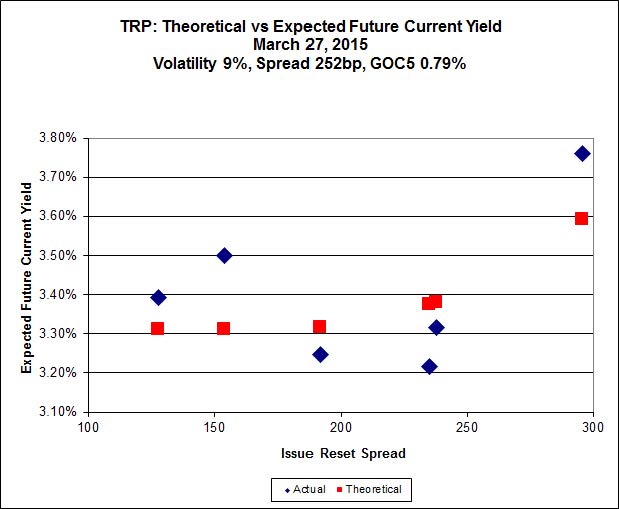
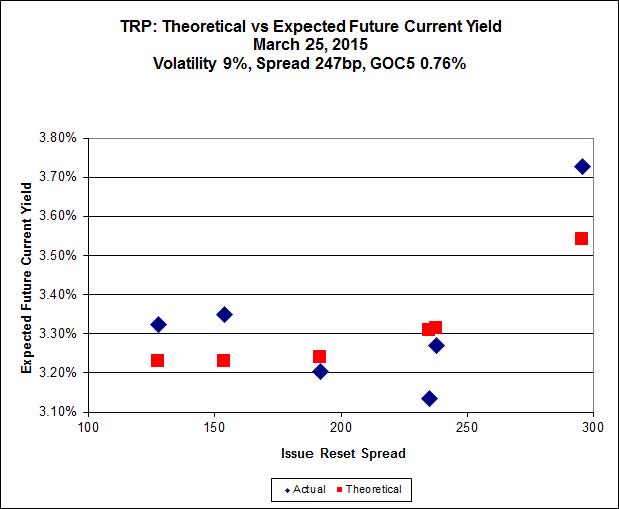
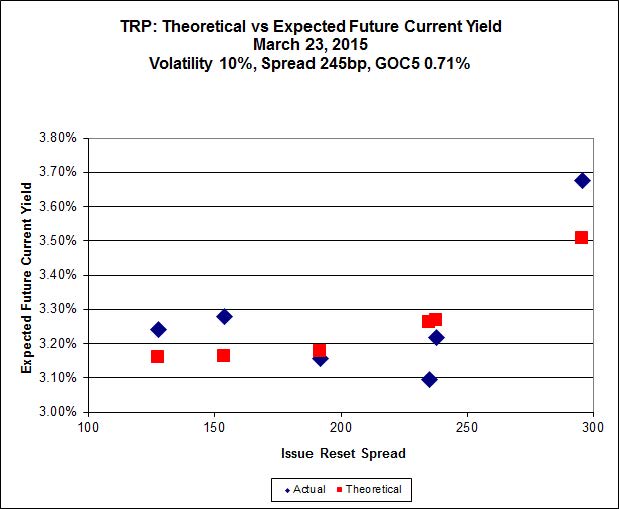
Here’s TRP:

impVol_TRP_150224
Click for Big

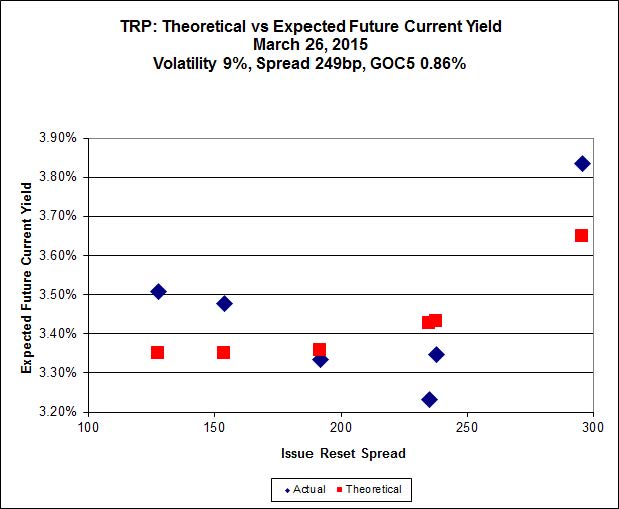
The new issue has caused a large change in the curve-fitting for the TRP series of FixedResets, which is discussed at greater length on the post announcing the new issue. TRP.PR.E, which resets 2019-10-30 at +235, is bid at 24.43 to be $1.40 rich, while the new issue, resetting 2020-11-30 at +296, is $1.15 cheap at its issue price of 25.00.

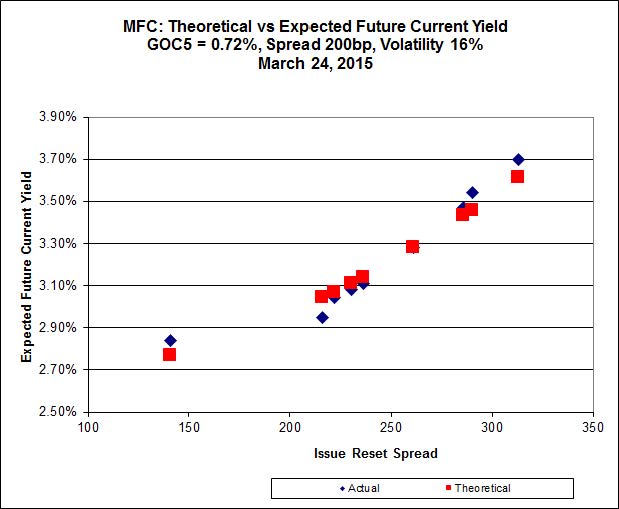
impVol_MFC_150224
Click for Big

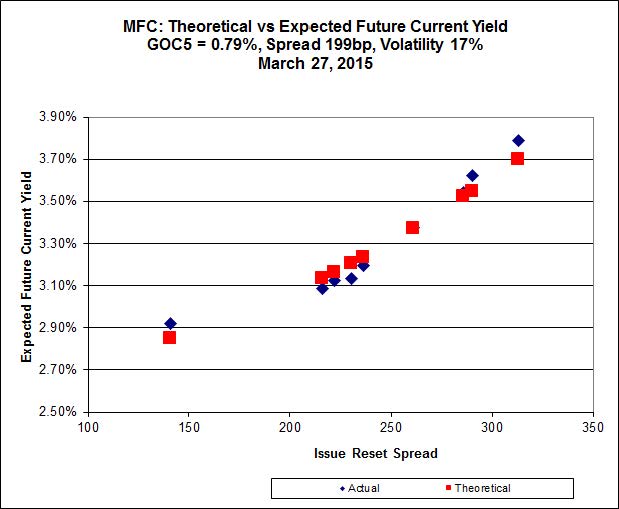
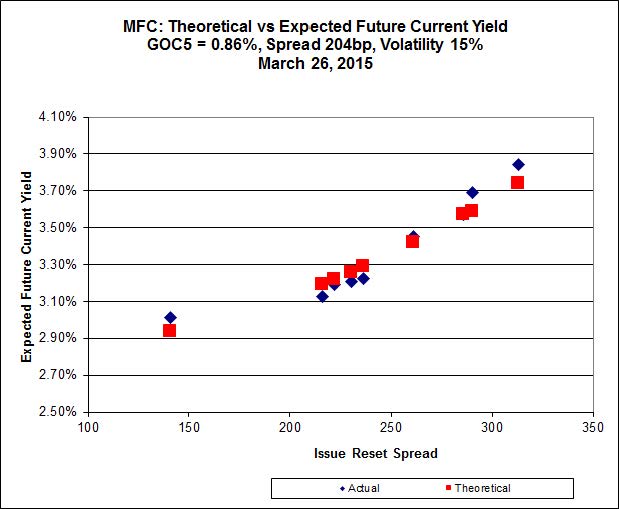
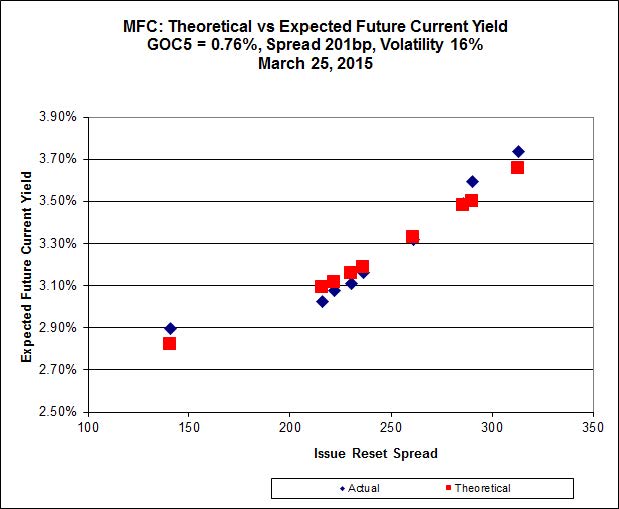
Another excellent fit, but the numbers are perplexing. Implied Volatility for MFC continues to be a conundrum, although it declined substantially today. It is still too high if we consider that NVCC rules will never apply to these issues; it is still too low if we consider them to be NVCC non-compliant issues (and therefore with Deemed Maturities in the call schedule).

Most expensive is MFC.PR.N, resetting at +230 on 2020-3-19, bid at 24.75 to be $0.65 rich, while MFC.PR.H, resetting at +313bp on 2017-3-19, is bid at 25.91 to be $0.57 cheap.

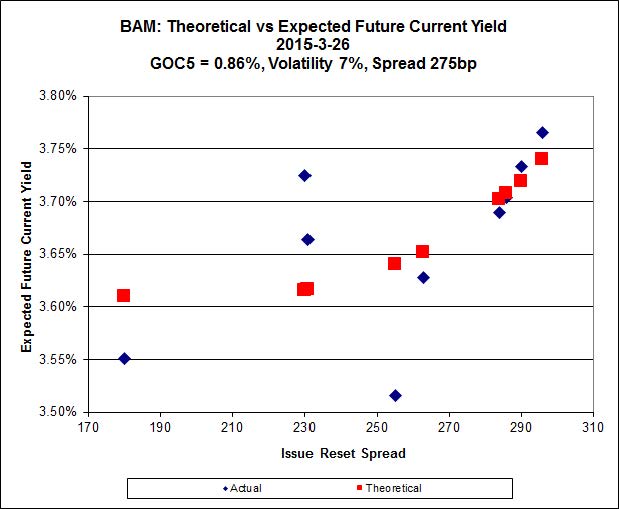
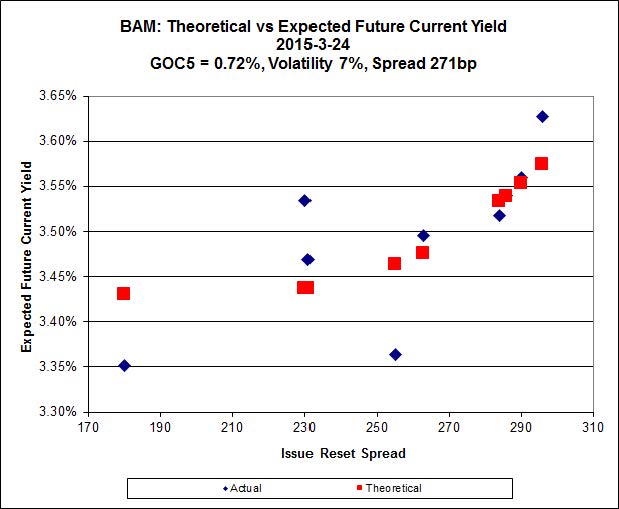
impVol_BAM_150224
Click for Big

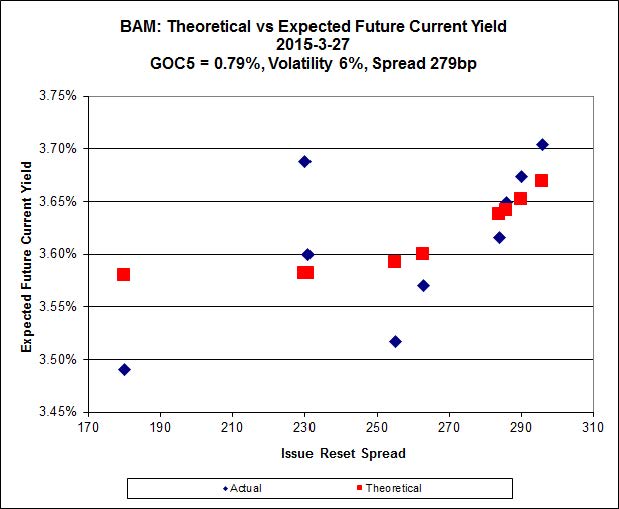
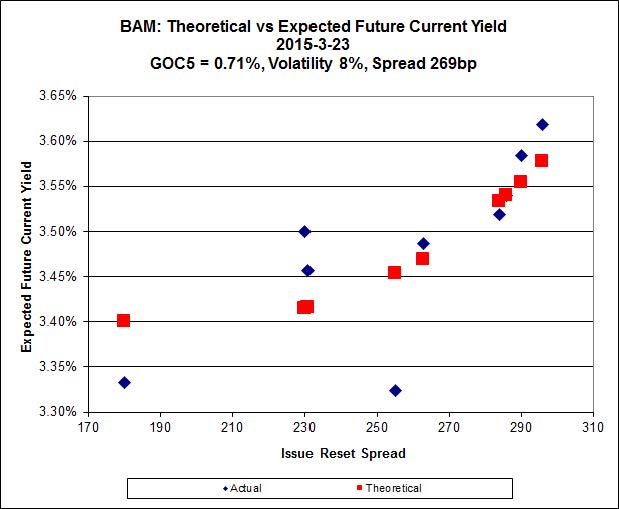
The fit on this series is actually quite reasonable – it’s the scale that makes it look so weird.

The cheapest issue relative to its peers is BAM.PR.Z, resetting at +296bp on 2017-12-31, bid at 25.31 to be $0.46 cheap. BAM.PF.E, resetting at +255bp 2020-3-31 is bid at 24.50 and appears to be $0.92 rich.

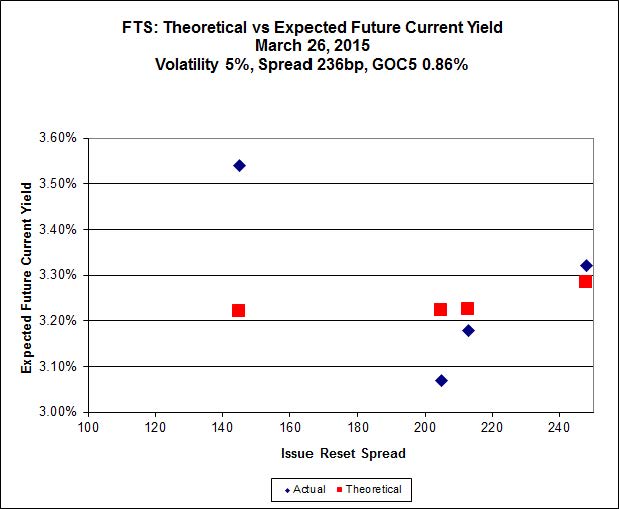
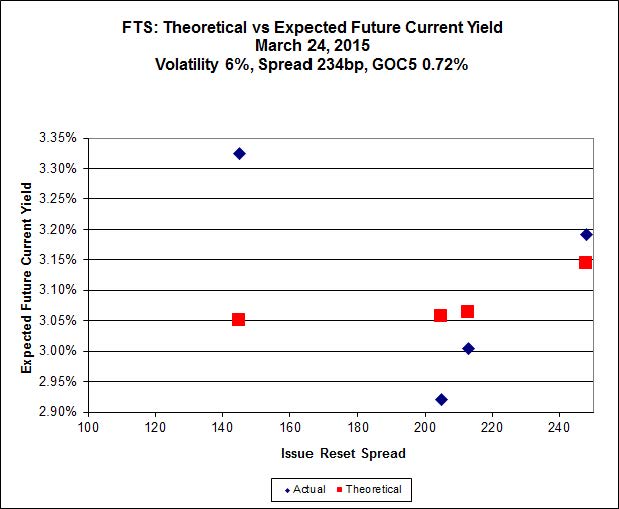
impVol_FTS_150224
Click for Big

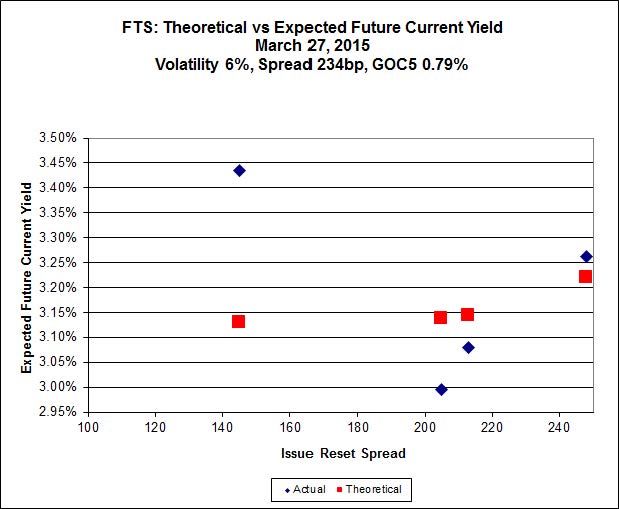
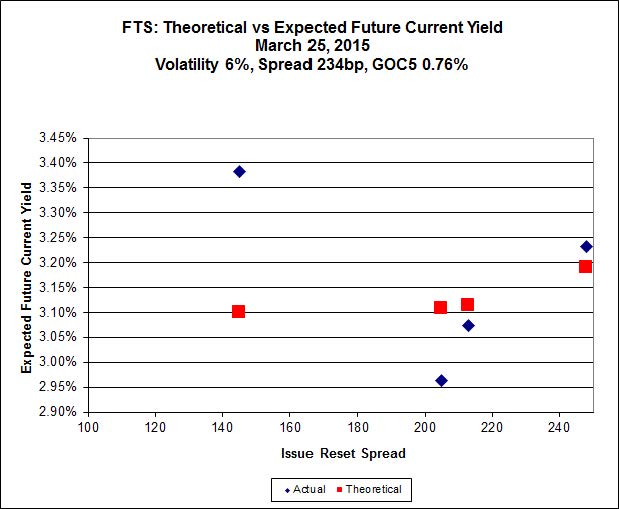
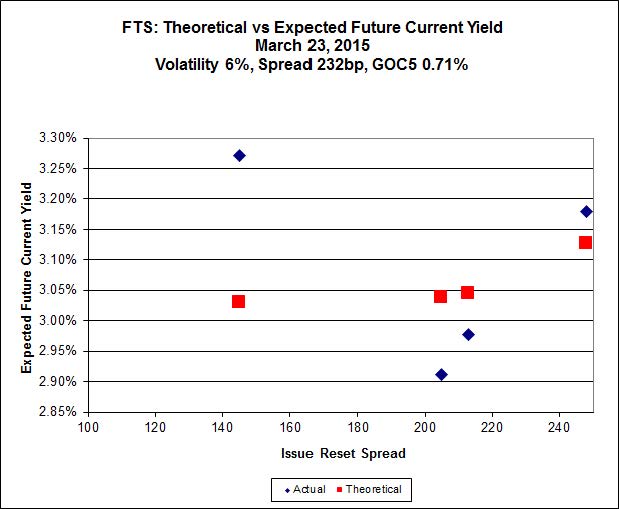
This is just weird because the middle is expensive and the ends are cheap but anyway … FTS.PR.H, with a spread of +145bp, and bid at 16.57, looks $1.05 cheap and resets 2015-6-1. FTS.PR.K, with a spread of +205bp and resetting 2019-3-1, is bid at 23.50 and is $0.96 rich.

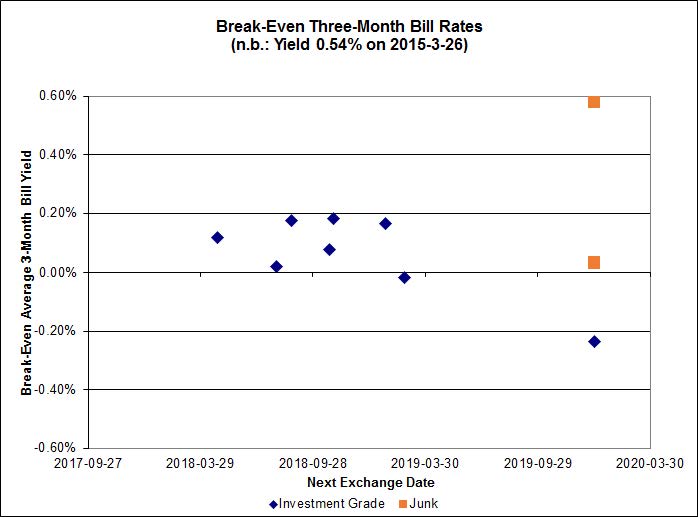
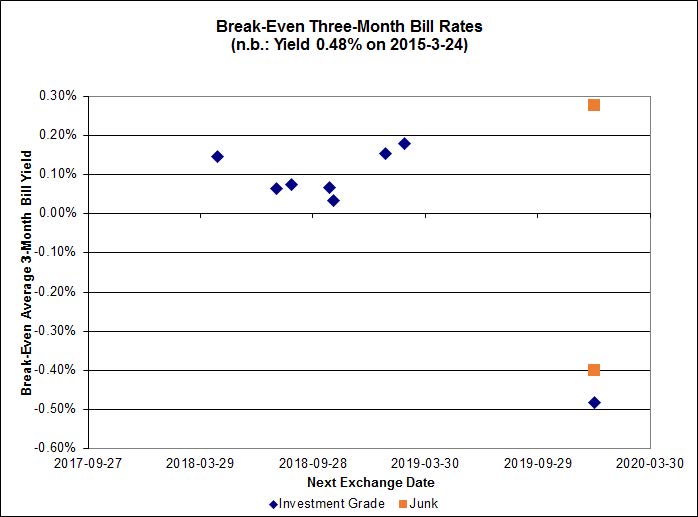
pairs_FR_150224
Click for Big

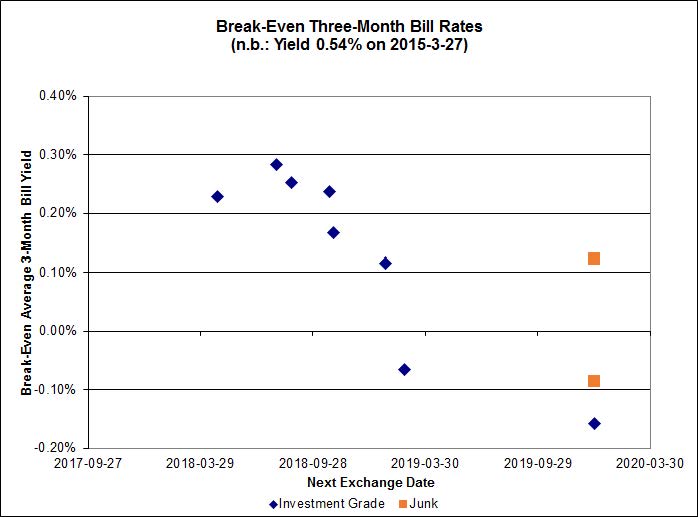
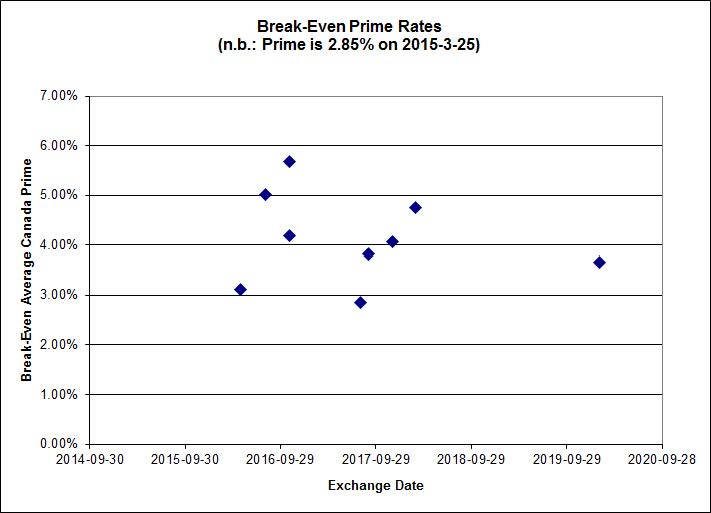
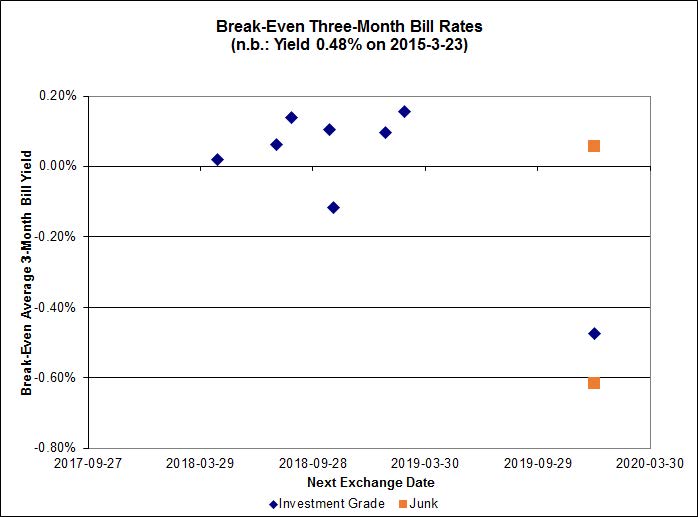
Most of the investment grade break-even rates are a little below zero.

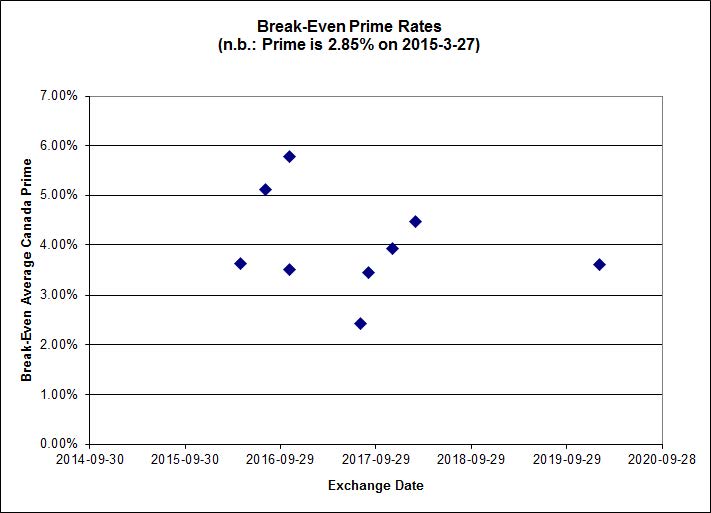
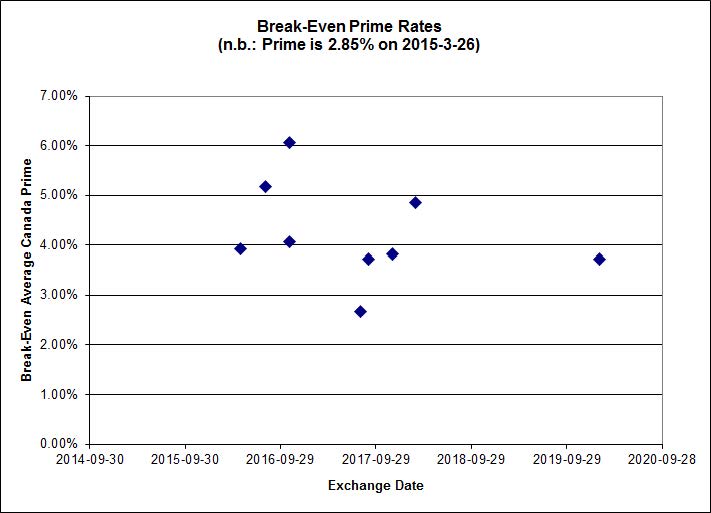
On the other hand, the market’s distaste for product linked to Money Market rates does not extend to prime, as shown by the FixedFloater/RatchetRate pairs:

pairs_FF_150224
Click for Big

Shall we just say that this exhibits a high level of confidence in the continued rapacity of Canadian banks?

HIMIPref™ Preferred Indices
These values reflect the December 2008 revision of the HIMIPref™ Indices

Values are provisional and are finalized monthly
Index Mean
Current
Yield
(at bid)
Median
YTW
Median
Average
Trading
Value
Median
Mod Dur
(YTW)
Issues Day’s Perf. Index Value
Ratchet 0.00 % 0.00 % 0 0.00 0 -1.4050 % 2,333.0
FixedFloater 4.37 % 3.51 % 18,322 18.38 1 0.0000 % 4,046.5
Floater 3.09 % 3.24 % 66,507 19.09 4 -1.4050 % 2,480.1
OpRet 4.08 % 1.37 % 111,855 0.31 1 0.1992 % 2,760.4
SplitShare 4.42 % 4.50 % 28,270 3.55 6 0.4068 % 3,197.6
Interest-Bearing 0.00 % 0.00 % 0 0.00 0 0.1992 % 2,524.1
Perpetual-Premium 5.33 % 2.11 % 57,807 0.08 24 -0.0539 % 2,513.3
Perpetual-Discount 4.95 % 4.82 % 111,101 15.29 10 0.0835 % 2,797.2
FixedReset 4.44 % 3.41 % 210,354 16.87 79 0.0931 % 2,412.9
Deemed-Retractible 4.91 % -0.58 % 106,636 0.10 39 0.1726 % 2,655.2
FloatingReset 2.43 % 2.83 % 88,016 6.39 7 0.1664 % 2,326.2
Performance Highlights
Issue Index Change Notes
ENB.PF.G FixedReset -3.11 % YTW SCENARIO
Maturity Type : Limit Maturity
Maturity Date : 2045-02-24
Maturity Price : 21.69
Evaluated at bid price : 22.10
Bid-YTW : 4.09 %
BAM.PR.C Floater -2.22 % YTW SCENARIO
Maturity Type : Limit Maturity
Maturity Date : 2045-02-24
Maturity Price : 15.45
Evaluated at bid price : 15.45
Bid-YTW : 3.26 %
BAM.PR.K Floater -1.86 % YTW SCENARIO
Maturity Type : Limit Maturity
Maturity Date : 2045-02-24
Maturity Price : 15.31
Evaluated at bid price : 15.31
Bid-YTW : 3.29 %
BAM.PR.B Floater -1.71 % YTW SCENARIO
Maturity Type : Limit Maturity
Maturity Date : 2045-02-24
Maturity Price : 15.55
Evaluated at bid price : 15.55
Bid-YTW : 3.24 %
CGI.PR.D SplitShare -1.36 % YTW SCENARIO
Maturity Type : Soft Maturity
Maturity Date : 2023-06-14
Maturity Price : 25.00
Evaluated at bid price : 25.30
Bid-YTW : 3.70 %
MFC.PR.I FixedReset -1.08 % YTW SCENARIO
Maturity Type : Call
Maturity Date : 2017-09-19
Maturity Price : 25.00
Evaluated at bid price : 25.56
Bid-YTW : 3.38 %
MFC.PR.J FixedReset -1.06 % YTW SCENARIO
Maturity Type : Hard Maturity
Maturity Date : 2025-01-31
Maturity Price : 25.00
Evaluated at bid price : 25.15
Bid-YTW : 3.41 %
ENB.PR.N FixedReset 1.03 % YTW SCENARIO
Maturity Type : Limit Maturity
Maturity Date : 2045-02-24
Maturity Price : 20.63
Evaluated at bid price : 20.63
Bid-YTW : 4.18 %
ENB.PR.D FixedReset 1.08 % YTW SCENARIO
Maturity Type : Limit Maturity
Maturity Date : 2045-02-24
Maturity Price : 18.80
Evaluated at bid price : 18.80
Bid-YTW : 4.24 %
ENB.PR.B FixedReset 1.14 % YTW SCENARIO
Maturity Type : Limit Maturity
Maturity Date : 2045-02-24
Maturity Price : 18.71
Evaluated at bid price : 18.71
Bid-YTW : 4.24 %
CU.PR.G Perpetual-Discount 1.31 % YTW SCENARIO
Maturity Type : Limit Maturity
Maturity Date : 2045-02-24
Maturity Price : 23.56
Evaluated at bid price : 23.92
Bid-YTW : 4.70 %
GWO.PR.G Deemed-Retractible 1.58 % YTW SCENARIO
Maturity Type : Call
Maturity Date : 2015-03-26
Maturity Price : 25.00
Evaluated at bid price : 25.75
Bid-YTW : -20.25 %
ENB.PR.F FixedReset 1.66 % YTW SCENARIO
Maturity Type : Limit Maturity
Maturity Date : 2045-02-24
Maturity Price : 19.60
Evaluated at bid price : 19.60
Bid-YTW : 4.23 %
ENB.PR.T FixedReset 1.83 % YTW SCENARIO
Maturity Type : Limit Maturity
Maturity Date : 2045-02-24
Maturity Price : 20.08
Evaluated at bid price : 20.08
Bid-YTW : 4.17 %
MFC.PR.F FixedReset 1.89 % YTW SCENARIO
Maturity Type : Hard Maturity
Maturity Date : 2025-01-31
Maturity Price : 25.00
Evaluated at bid price : 18.85
Bid-YTW : 5.61 %
PVS.PR.B SplitShare 2.31 % YTW SCENARIO
Maturity Type : Hard Maturity
Maturity Date : 2019-01-10
Maturity Price : 25.00
Evaluated at bid price : 24.85
Bid-YTW : 4.50 %
PWF.PR.P FixedReset 2.61 % YTW SCENARIO
Maturity Type : Limit Maturity
Maturity Date : 2045-02-24
Maturity Price : 18.50
Evaluated at bid price : 18.50
Bid-YTW : 3.18 %
Volume Highlights
Issue Index Shares
Traded
Notes
OSP.PR.A SplitShare 351,334 New issue settled today.
YTW SCENARIO
Maturity Type : Hard Maturity
Maturity Date : 2020-03-31
Maturity Price : 10.00
Evaluated at bid price : 10.11
Bid-YTW : 4.78 %
ENB.PR.N FixedReset 286,126 Nesbitt crossed 250,000 at 20.45.
YTW SCENARIO
Maturity Type : Limit Maturity
Maturity Date : 2045-02-24
Maturity Price : 20.63
Evaluated at bid price : 20.63
Bid-YTW : 4.18 %
IFC.PR.A FixedReset 181,890 RBC crossed 164,200 at 19.50.
YTW SCENARIO
Maturity Type : Hard Maturity
Maturity Date : 2025-01-31
Maturity Price : 25.00
Evaluated at bid price : 19.85
Bid-YTW : 5.83 %
PWF.PR.P FixedReset 68,678 RBC crossed 47,100 at 18.15.
YTW SCENARIO
Maturity Type : Limit Maturity
Maturity Date : 2045-02-24
Maturity Price : 18.50
Evaluated at bid price : 18.50
Bid-YTW : 3.18 %
NA.PR.W FixedReset 54,825 Nesbitt crossed 11,300 at 24.86.
YTW SCENARIO
Maturity Type : Limit Maturity
Maturity Date : 2045-02-24
Maturity Price : 23.11
Evaluated at bid price : 24.85
Bid-YTW : 3.01 %
BNS.PR.Y FixedReset 47,949 RBC crossed 28,600 at 22.00.
YTW SCENARIO
Maturity Type : Hard Maturity
Maturity Date : 2022-01-31
Maturity Price : 25.00
Evaluated at bid price : 22.00
Bid-YTW : 3.72 %
There were 38 other index-included issues trading in excess of 10,000 shares.
Wide Spread Highlights
Issue Index Quote Data and Yield Notes
ENB.PF.G FixedReset Quote: 22.10 – 22.79
Spot Rate : 0.6900
Average : 0.4260

YTW SCENARIO
Maturity Type : Limit Maturity
Maturity Date : 2045-02-24
Maturity Price : 21.69
Evaluated at bid price : 22.10
Bid-YTW : 4.09 %

HSB.PR.D Deemed-Retractible Quote: 25.37 – 25.95
Spot Rate : 0.5800
Average : 0.3867

YTW SCENARIO
Maturity Type : Call
Maturity Date : 2015-03-26
Maturity Price : 25.00
Evaluated at bid price : 25.37
Bid-YTW : -3.77 %

CGI.PR.D SplitShare Quote: 25.30 – 26.05
Spot Rate : 0.7500
Average : 0.5644

YTW SCENARIO
Maturity Type : Soft Maturity
Maturity Date : 2023-06-14
Maturity Price : 25.00
Evaluated at bid price : 25.30
Bid-YTW : 3.70 %

ENB.PR.J FixedReset Quote: 21.31 – 21.84
Spot Rate : 0.5300
Average : 0.3812

YTW SCENARIO
Maturity Type : Limit Maturity
Maturity Date : 2045-02-24
Maturity Price : 21.31
Evaluated at bid price : 21.31
Bid-YTW : 4.08 %

MFC.PR.I FixedReset Quote: 25.56 – 25.94
Spot Rate : 0.3800
Average : 0.2370

YTW SCENARIO
Maturity Type : Call
Maturity Date : 2017-09-19
Maturity Price : 25.00
Evaluated at bid price : 25.56
Bid-YTW : 3.38 %

VNR.PR.A FixedReset Quote: 24.90 – 25.40
Spot Rate : 0.5000
Average : 0.3672

YTW SCENARIO
Maturity Type : Limit Maturity
Maturity Date : 2045-02-24
Maturity Price : 23.41
Evaluated at bid price : 24.90
Bid-YTW : 3.51 %

Issue Comments

OSP.PR.A Well Bid On Good Volume

Brompton Funds Ltd. has announced:

that Brompton Oil Split Corp. (the “Company”) has completed its initial public offering of 2,800,000 Class A shares and 2,800,000 Preferred shares for total gross proceeds of $70 million. The Class A and Preferred shares will commence trading today on the Toronto Stock Exchange under the symbol OSP and OSP.PR.A, respectively.

The Company will invest in a portfolio (the “Portfolio”) of equity securities of at least 15 large capitalization North American oil and gas issuers selected by the Manager from the S&P 500 Index and the S&P/TSX Composite Index, giving consideration to, among other metrics, attractive valuation, growth prospects, profitability, liquidity, sustainability of dividends and a strong balance sheet. The Portfolio will be focused primarily on oil and gas issuers that have significant exposure to oil, and will initially include equities of the following oil and gas issuers:

ARC Resources Ltd. Chevron Corporation Occidental Petroleum Corporation
Canadian Natural Resources Limited Encana Corporation PrairieSky Royalty Ltd.
ConocoPhillips EOG Resources Inc. Suncor Energy Inc.
Crescent Point Energy Corp. Husky Energy Inc. Vermilion Energy Inc.
Cenovus Energy Inc. Imperial Oil Limited Exxon Mobil Corporation

The investment objectives for the Class A shares are to provide holders with regular monthly non-cumulative cash distributions targeted to be 8.0% per annum on the $15.00 issue price, and the opportunity for growth in net asset value. The investment objectives for the Preferred shares are to provide holders with fixed cumulative preferential quarterly cash distributions in the amount of 5.0% per annum on the $10.00 issue price, and to return the original issue price on the maturity date, March 31, 2020.

Brompton Funds Limited is the manager and portfolio manager of the Company. In addition to Brompton Oil Split Corp., the Manager currently manages 4 other split-share funds with assets under management over $900 million. The portfolio management team is led by Laura Lau, an award winning portfolio manager with over 20 years of experience in financial services, who has a proven track record in managing flow-through funds and resource assets. The team also includes Michael Clare, an experienced energy and flow-through portfolio manager who specializes in the analysis of crude oil and natural gas markets.

The syndicate of agents for the offering was led by Scotiabank, CIBC and RBC Capital Markets and included TD Securities Inc., BMO Capital Markets, National Bank Financial Inc., GMP Securities L.P., Raymond James Ltd., Canaccord Genuity Corp., Desjardins Securities Inc., Dundee Securities Ltd., Industrial Alliance Securities Inc. and Mackie Research Capital Corporation.

OSP.PR.A commenced trading today right on schedule. It is a Split Share, 5-Year, with a 5% coupon.

The issue traded 354,334 shares today (consolidated exchanges) in a range of 10.00-15 before closing at 10.11-14.

DBRS has confirmed its provisional rating of Pfd-3(high):

DBRS Limited (DBRS) has today finalized the provisional rating of Pfd-3 (high) to the Preferred Shares to be issued by Brompton Oil Split Corp. (the Company). The Company issued an equal number of Preferred Shares and Class A Shares at an issue price of $10.00 per Preferred Share and $15.00 per Class A Share. The Preferred Shares and Class A Shares are scheduled to mature on March 31, 2020.

Net proceeds from the offering were used to invest in the common shares of at least 15 large capitalization North American oil and gas issuers (the Portfolio). The Portfolio is initially equally weighted and will be rebalanced at least semi-annually. A portion of the Portfolio’s investments are denominated in U.S. dollars; however, this exposure is expected to be hedged completely back to the Canadian dollar.

The Company has advised DBRS that 2,800,000 Preferred Shares and 2,800,000 Class A Shares were issued on the initial offering, for gross proceeds of $70,000,000. The initial downside protection available to holders of the Preferred Shares is approximately 57.3% (after offering expenses). Dividends received on the Portfolio are used to pay a fixed cumulative quarterly distribution to holders of the Preferred Shares of $0.1250 per Preferred Share ($0.50 per annum or 5.0% per annum on the initial issue price of $10.00 per Preferred Share), while holders of the Capital Shares are expected to receive a regular monthly non-cumulative cash distribution of $0.10 per Class A Share. The Preferred Share dividend coverage ratio is approximately 0.9 times, based on the initial offering size. The Company has the ability to write covered call options or engage in securities lending in order to generate additional income. The Company has also granted a security interest in the Portfolio to RBC Investor Services Trust, in its capacity as custodian of the Company’s property (the Custodian), as security for any obligations owing by the Company to the Custodian. The Custodian also has a right to exercise set-off against the Company’s property (including the Portfolio) to the extent that the Company fails to satisfy any obligations owing to the Custodian.

Vital statistics are:

OSP.PR.A SplitShare YTW SCENARIO
Maturity Type : Hard Maturity
Maturity Date : 2020-03-31
Maturity Price : 10.00
Evaluated at bid price : 10.11
Bid-YTW : 4.78 %
Primers

What's The Benchmark Five-Year?

Assiduous Reader gsp of the Financial Wisdom Forum writes in and says:

as I posted on the Preferreds thread on FWF (LINK) I am having a hard time understanding which source to best trust when trying to figure out the GOC 5 year benchmark that resets are based on.

The site you link on prefblog(LINK) says the closing 5 year on Feb 20th was 0.72 while investing.com(LINK) says 0.79. The definitive source(BOC) today posted it as 0.80. I’m confused by the variance in all these quotes, especially for a closing rate.

I like to be as precise as possible when using your YTC resets spreadsheet, what’s the best source for intraday BOC 5 year quotes that I can access for free? I have no real use for real time quotes but prefer not to be out to lunch when the rate moves considerably intraday.

Using today’s quotes, we see that CBID’s site (which is the one I use) shows a “Closing Markets as of: 4:00 PM EST 23-Feb-15” yield of 0.66% for the “Canada 5 year”, while the invest.com GOC-5 yield list yield of 0.741% for February 23 for “Canada 5-Year Bond Yield Historical Data”.

That’s a big difference for a five year! So what’s a five-year bond, anyway? Is it the same one today as it was yesterday? Just what exactly is a “five year bond”?

According to the BoC Benchmark definition:

Selected benchmark bond yields are based on mid-market closing yields of selected Government of Canada bond issues that mature approximately in the indicated terms. The bond issues used are not necessarily the ones with the remaining time to maturity that is the closest to the indicated term and may differ from other sources. The selected 2-, 5-, 10-, or 30-year issues are generally changed when a building benchmark bond is adopted by financial markets as a benchmark, typically after the last auction for that bond. The selected 3-year issue is usually updated at approximately the same time as changes are made to the 2-year, and sometimes with the 5-year. The selected 7-year issue is typically updated at approximately the same time as the 5- or 10-year benchmarks are changed. The current benchmark bond issues and their effective dates, shown in brackets, are as follows.
•2 year – 2017.02.01, 1.50% (2014.11.21);
•3 year – 2017.08.01, 1.25% (2014.10.09);
•5 year – 2020.03.01, 1.50% (2015.02.20);
•7 year – 2022.06.01, 2.75% (2015.01.26);
•10 year – 2025.06.01, 2.25% (2015.01.26);
•Long – 2045.12.01, 3.50% (2014.02.21);
•RRB – 2041.12.01, 2.00% (2010.10.21);

So that’s pretty cool! The “Five Year Benchmark”, as defined by the Bank of Canada, changed last Friday, February 20;

From their page BOC Bond Auction information, we see that their Excel spreadsheet (updated to 2015-1-31) lists two prior auctions (of $3.4-billion a pop) of the 1.5% March 1, 2020, bond, on 2014-11-26 and 2014-10-08. The three prior five year auctions were for the 1.75% September 1, 2019, issue, on 2014-8-6, 2014-5-7 and 2014-4-9, each of which also had $3.4-billion size. And we also see that there was another “five year” auction February 18 for delivery February 23. So, it would seem, that they changed their official benchmark as of the day prior to delivery of the third and final auction of the issue.

We can go back to the CBID page: at the bottom, there are quotes for individual issues and we see:

Canada 1.750 2019-Sep-01 104.85 0.66
Canada 1.500 2020-Mar-01 103.72 0.74

So – while it’s not absolutely definitive, it would appear that investing.com is quoting the yield on the 1.5% of March 2020, while CBID is quoting the 1.75% of September 2019 as the “Five Year”.

Who’s right? Who’s wrong? It’s a meaningless question: virtually everything in the bond market is quoted in terms of convention, which is often highly exasperating when discussing yields.

How does the US Treasury do it? They provide a Constant Maturity Yield:

Treasury Yield Curve Rates. These rates are commonly referred to as “Constant Maturity Treasury” rates, or CMTs. Yields are interpolated by the Treasury from the daily yield curve. This curve, which relates the yield on a security to its time to maturity is based on the closing market bid yields on actively traded Treasury securities in the over-the-counter market. These market yields are calculated from composites of quotations obtained by the Federal Reserve Bank of New York. The yield values are read from the yield curve at fixed maturities, currently 1, 3 and 6 months and 1, 2, 3, 5, 7, 10, 20, and 30 years. This method provides a yield for a 10 year maturity, for example, even if no outstanding security has exactly 10 years remaining to maturity.

Treasury Yield Curve Methodology. The Treasury yield curve is estimated daily using a cubic spline model. Inputs to the model are primarily bid-side yields for on-the-run Treasury securities. See our Treasury Yield Curve Methodology page for details.

… and on the Treasury Yield Curve Methodology Page it states:

The Treasury’s yield curve is derived using a quasi-cubic hermite spline function. Our inputs are the Close of Business (COB) bid yields for the on-the-run securities. Because the on-the-run securities typically trade close to par, those securities are designated as the knot points in the quasi-cubic hermite spline algorithm and the resulting yield curve is considered a par curve. However, Treasury reserves the option to input additional bid yields if there is no on-the-run security available for a given maturity range that we deem necessary for deriving a good fit for the quasi-cubic hermite spline curve. For example, we are using composites of off-the-run bonds in the 20-year range reflecting market yields available in that time tranche. Previously, a rolled-down 10-year note with a remaining maturity nearest to 7 years was also used as an additional input. That input was discontinued on May 26, 2005.

More specifically, the current inputs are the most recently auctioned 4-, 13-, 26-, and 52-week bills, plus the most recently auctioned 2-, 3-, 5-, 7-, and 10-year notes and the most recently auctioned 30-year bond, plus the composite rate in the 20-year maturity range. The quotes for these securities are obtained at or near the 3:30 PM close each trading day. The inputs for the four bills are their bond equivalent yields.

Between August 6, 2004 and June 2, 2008, to reduce volatility in the 1-year Treasury Constant Maturity (CMT) rate, and due to the fact that there were no on-the-run issues between 6-months and 2-years, Treasury used an additional input to insure that the 1-year CMT rate was consistent with on-the-run yields on either side of it’s maturity range. Thus, Treasury interpolated between the secondary bond equivalent yield on the most recently auctioned 26-week bill and the secondary market yield on the most recently auctioned 2-year note and inputted the resulting yield as an additional knot point for the derivation of the daily Treasury Yield Curve. The result of that step was that the 1-year CMT was generally the same as the interpolated rate during that time period. As of June 3, 2008, the interpolated yield was dropped as a yield curve input and the on-the-run 52-week bill was added as an input knot point in the quasi-cubic hermite spline algorithm and resulting yield curve.

Between December 3, 2007 and November 7, 2008, due to Treasury’s discontinuance of 3-year notes, we added a composite rate in the 3-year range based on an average of off-the-run securities in that time tranche. This composite was replaced on November 10, 2008 with the on-the-run 3-year note upon its reintroduction.

Treasury does not provide the computer formulation of our quasi-cubic hermite spline yield curve derivation program. However, we have found that most researchers have been able to reasonably match our results using alternative cubic spline formulas.

Treasury reviews its yield curve derivation methodology on a regular basis and reserves the right to modify, adjust or improve the methodology at its option. If Treasury determines that the methodology needs to be changed or updated, Treasury will revise the above description to reflect such changes.

Yield curve rates are usually available at Treasury’s interest rate web sites by 6:00 PM Eastern Time each trading day, but may be delayed due to system problems or other issues. Every attempt is made to make this data available as soon as possible.

This is a much more sensible way to estimate what a reasonable person might call a “Five Year Yield”, with the reservation that I have always been deeply suspicious of the cubic spline curve fitting methodology. It is too abstract for me and there are mathematical problems at the knot points. But I can’t deny that it fits the data well.

While all of this may be considered illuminating, it still doesn’t really answer Assiduous Reader gsp-from-FWF’s problem: what number should he plug into his calculation in order to estimate a projected future dividend rate for FixedResets? Because the following definitions from the prospectus for RY.PR.J are pretty typical:

“Annual Fixed Dividend Rate” means, for any Subsequent Fixed Rate Period, the rate (expressed as a percentage rounded to the nearest one hundred–thousandth of one percent (with 0.000005% being rounded up)) equal to the Government of Canada Yield on the applicable Fixed Rate Calculation Date plus 2.74%.

“Bloomberg Screen GCAN5YR Page” means the display designated on page “GCAN5YR” on the Bloomberg Financial L.P. service (or such other page as may replace the GCAN5YR page on that service for purposes of displaying Government of Canada bond yields).

“Fixed Rate Calculation Date” means, for any Subsequent Fixed Rate Period, the 30th day prior to the first day of such Subsequent Fixed Rate Period.

“Government of Canada Yield” on any date means the yield to maturity on such date (assuming semi-annual compounding) of a Canadian dollar denominated non-callable Government of Canada bond with a term to maturity of five years as quoted as of 10:00 a.m. (Toronto time) on such date and which appears on the Bloomberg Screen GCAN5YR Page on such date; provided that, if such rate does not appear on the Bloomberg Screen GCAN5YR Page on such date, the Government of Canada Yield will mean the arithmetic average of the yields quoted to the Bank by two registered Canadian investment dealers selected by the Bank as being the annual yield to maturity on such date, compounded semi-annually, which a noncallable Government of Canada bond would carry if issued, in Canadian dollars in Canada, at 100% of its principal amount on such date with a term to maturity of five years.

And we don’t know how the GCAN5YR page is calculated (because it’s Bloomberg), although we can guess that it’s more akin to the US Treasury interpolation-on-a-fitted=curve method than it is to the Canadian pick-a-bond method because of the way the alternative calculation is stated. But that’s not a guarantee! Don’t bother calling your salesman to find out: if there’s one thing I have learnt over the course of my career, it’s that front-line staff don’t have a clue how their software works and wouldn’t understand it if they were told. They’re bankers, the sweet little dears, it’s their job to say “0.74 per cent” in a sincere voice, not to have a clue.

And, what’s more, we can’t even look up (for free) just what the GCAN5YR page might be saying at any particular point in time because fuck you, that’s why.

I don’t have Bloomberg – it’s incredibly expensive, it’s completely useless for serious work and it rots the brain – so I can’t provide any clues as to how the number might be calculated. Perhaps if some kind reader who does have access could provide a screenshot or two taken at around 4pm we can examine the matter more closely.

Market Action

February 23, 2015

Charles Kenny, a Senior Fellow with the Center for Global Development (a quite respectably ranked think-tank) writes a very good piece on Bloomberg about money laundering and regulations thereof:

In the best of cases, anti-money-laundering efforts are likely to do no more than raise the cost of transactions. A system that misses all but a fraction of a percent of criminal financial flows is almost guaranteed to miss terrorism finance in particular, which involves very small sums: The Madrid and London terror bombings cost no more than $10,000 to finance; the Sept. 11 attacks, less than $500,000. That may be one reason why none of the reported money laundering prosecutions to date have involved terror finance.

Though the regulations have limited impact on criminal activities, they still cost money. Tracking illicit money flows requires a considerable bureaucracy. Enforcing the regulations cost an estimated $7 billion in the U.S., and probably far more. Mauritius, a small, middle-income country of just 1.3 million people, has 25 government officials working on FATF implementation. That’s more people than are listed as opticians in the country. Each bank in Mauritius will also have staff tasked with carrying out customer investigations.

Perhaps most insidious, the regulations have disproportionately affected the kinds of business transactions that serve small, poor economies. FATF rules are why Merchants Bank of California cut off money transfers to Somalia last week, the last U.S. financial institution to do so. Between $160 million and $180 million of remittances will be affected by Merchants Bank’s action, but from its point of view, cutting services is the only safe course. It faced immense potential liabilities if it turned out that one of the accounts receiving funds in Somalia was linked to terrorist activity. Yet there’s no evidence any of the remittances were going to fund terror groups; most were being used to support schooling, housing, food, and other living costs for Somalis. The country is one of the poorest in the world and remittances are equal to about one-third of the country’s GDP.

No doubt, Somali expatriates will find other ways to send the money, but they will cost more and are likely to involve less savory financial institutions as intermediaries. Given that, and the link between people losing their livelihoods and terror recruitment, it is all too possible the FATF regulations will give rise to better-funded and larger terrorist groups.

Does anybody else remember 1994? And Orange County’s infamous carry-trades? It will be interesting to see what happens when policy rates rise:

Growth is on a tear, hiring is the strongest in decades and households are the most upbeat since 2011. Yet banks such as Bank of America Corp. keep plowing their burgeoning deposits into U.S. government and related debt — pushing the industry’s holdings past $2 trillion — instead of lending it all out.

Part of the buildup has to do with rules that require banks to hold more high-quality assets in the wake of the worst financial crisis since the Great Depression. But it also reflects how borrowers, particularly among Americans scarred by the housing bust, are still repairing their finances rather than going into debt to splurge on big-ticket items. And that may mean the U.S. recovery isn’t quite as robust as all the upbeat data would suggest.

Investing in government bonds is proving to be a profitable move for banks. They’re making over a full percentage point more by purchasing five-year Treasuries instead of leaving the idle cash parked at the Fed, where they earn only 0.25 percent. U.S. commercial banks held $2.83 trillion in cash as of Feb. 11, versus $2.57 trillion at the end of last year.

Having cash invested in five-year Treasuries is also netting banks an attractive spread over what they are paying depositors. The yield advantage for the notes over the average deposit rate for the four largest U.S. banks is above the norm over the past decade.

For Bank of America, the spread is about 1.44 percentage points, data compiled by Bloomberg show.

Pension troubles in New Jersey are getting harder to defer:

New Jersey Governor Chris Christie must make a $1.57 billion payment this year to the state pension system, a judge ruled while decrying the failure of the state to address a looming crisis.

“Because the state will now make nearly 70 percent less than the statutorily required $2.25 billion payment,” the expectations of workers have been “substantially impaired,” the judge ruled. “In short, the aim of the legislation is not being met.”

Jacobson’s ruling contrasts with her decision days before the last fiscal year ended June 30, when Christie said he faced a fiscal emergency. Workers sued then as well, and the judge said Christie acted reasonably in paying $696 million to the pension system to cover current employees while deferring $887 million to help close the gap left by previous governors.

The legislative and executive branches “have now had almost 10 months to find a solution to the pensions crisis for FY 2015,” Jacobson said in the latest ruling.

DBRS has confirmed Fairfax with a stable trend. I have updated the post regarding S&P’s revision to ‘Outlook Negative’.

Preferred share investors rushed to their monitors this morning to see what would happen at the start of a new week:

punch
Click for Big

It was a poor day for the Canadian preferred share market, with PerpetualDiscounts down 3bp, FixedResets losing 67bp and DeemedRetractibles off 2bp. ENB and TRP issues are prominent on the bad side of a suitably lengthy Performance Highlights table. Volume was high, with ENB issues again prominent – it looks like people are getting increasingly nervous about a possible downgrade.

For as long as the FixedReset market is so violently unsettled, I’ll keep publishing updates of the more interesting and meaningful series of FixedResets’ Implied Volatilities. This doesn’t include Enbridge because although Enbridge has a large number of issues outstanding, all of which are quite liquid, the range of Issue Reset Spreads is too small for decent conclusions. The low is 212bp (ENB.PR.H; second-lowest is ENB.PR.D at 237bp) and the high is a mere 268 for ENB.PF.G.

Remember that all rich /cheap assessments are:
» based on Implied Volatility Theory only
» are relative only to other FixedResets from the same issuer
» assume constant GOC-5 yield
» assume constant Implied Volatility
» assume constant spread

Here’s TRP:

impVol_TRP_150223
Click for Big

The new issue has caused a large change in the curve-fitting for the TRP series of FixedResets, which is discussed at greater length on the post announcing the new issue. TRP.PR.E, which resets 2019-10-30 at +235, is bid at 24.28 to be $1.37 rich, while the new issue, resetting 2020-11-30 at +296, is $1.07 cheap at its issue price of 25.00.

impVol_MFC_150223
Click for Big

Another excellent fit, but the numbers are perplexing. Implied Volatility for MFC continues to be a conundrum, although it declined substantially today. It is still too high if we consider that NVCC rules will never apply to these issues; it is still too low if we consider them to be NVCC non-compliant issues (and therefore with Deemed Maturities in the call schedule).

Most expensive is MFC.PR.N, resetting at +230 on 2020-3-19, bid at 24.68 to be $0.55 rich, while MFC.PR.H, resetting at +313bp on 2017-3-19, is bid at 25.97 to be $0.62 cheap.

impVol_BAM_150223
Click for Big

The fit on this series is actually quite reasonable – it’s the scale that makes it look so weird.

The cheapest issue relative to its peers is BAM.PR.Z, resetting at +296bp on 2017-12-31, bid at 25.45 to be $0.41 cheap. BAM.PF.E, resetting at +255bp 2020-3-31 is bid at 24.52 and appears to be $0.97 rich.

impVol_FTS_150223
Click for Big

This is just weird because the middle is expensive and the ends are cheap but anyway … FTS.PR.H, with a spread of +145bp, and bid at 16.61, looks $1.01 cheap and resets 2015-6-1. FTS.PR.K, with a spread of +205bp and resetting 2019-3-1, is bid at 23.50 and is $0.96 rich.

pairs_FR_150223
Click for Big

Most of the investment grade break-even rates are scattered around zero.

On the other hand, the market’s distaste for product linked to Money Market rates does not extend to prime, as shown by the FixedFloater/RatchetRate pairs:

pairs_FF_150223
Click for Big

Shall we just say that this exhibits a high level of confidence in the continued rapacity of Canadian banks?

HIMIPref™ Preferred Indices
These values reflect the December 2008 revision of the HIMIPref™ Indices

Values are provisional and are finalized monthly
Index Mean
Current
Yield
(at bid)
Median
YTW
Median
Average
Trading
Value
Median
Mod Dur
(YTW)
Issues Day’s Perf. Index Value
Ratchet 0.00 % 0.00 % 0 0.00 0 -0.9080 % 2,366.2
FixedFloater 4.37 % 3.52 % 18,990 18.38 1 0.0000 % 4,046.5
Floater 3.05 % 3.18 % 67,125 19.23 4 -0.9080 % 2,515.5
OpRet 4.08 % 1.99 % 112,950 0.32 1 -0.1722 % 2,754.9
SplitShare 4.32 % 4.62 % 28,133 3.55 5 -1.0670 % 3,184.6
Interest-Bearing 0.00 % 0.00 % 0 0.00 0 -0.1722 % 2,519.1
Perpetual-Premium 5.33 % 1.52 % 56,568 0.08 24 0.0327 % 2,514.6
Perpetual-Discount 4.95 % 4.82 % 115,235 15.25 10 -0.0334 % 2,794.8
FixedReset 4.45 % 3.30 % 206,478 16.90 79 -0.6720 % 2,410.7
Deemed-Retractible 4.91 % 0.02 % 104,901 0.10 39 -0.0215 % 2,650.6
FloatingReset 2.43 % 2.86 % 89,472 6.39 7 -0.0308 % 2,322.4
Performance Highlights
Issue Index Change Notes
PWF.PR.P FixedReset -3.99 % YTW SCENARIO
Maturity Type : Limit Maturity
Maturity Date : 2045-02-23
Maturity Price : 18.03
Evaluated at bid price : 18.03
Bid-YTW : 3.26 %
ENB.PR.T FixedReset -3.85 % YTW SCENARIO
Maturity Type : Limit Maturity
Maturity Date : 2045-02-23
Maturity Price : 19.72
Evaluated at bid price : 19.72
Bid-YTW : 4.25 %
PVS.PR.B SplitShare -3.80 % YTW SCENARIO
Maturity Type : Hard Maturity
Maturity Date : 2019-01-10
Maturity Price : 25.00
Evaluated at bid price : 24.29
Bid-YTW : 5.15 %
PWF.PR.A Floater -3.69 % YTW SCENARIO
Maturity Type : Limit Maturity
Maturity Date : 2045-02-23
Maturity Price : 18.26
Evaluated at bid price : 18.26
Bid-YTW : 2.74 %
ENB.PR.N FixedReset -3.50 % YTW SCENARIO
Maturity Type : Limit Maturity
Maturity Date : 2045-02-23
Maturity Price : 20.42
Evaluated at bid price : 20.42
Bid-YTW : 4.22 %
MFC.PR.F FixedReset -3.34 % YTW SCENARIO
Maturity Type : Hard Maturity
Maturity Date : 2025-01-31
Maturity Price : 25.00
Evaluated at bid price : 18.50
Bid-YTW : 5.84 %
ENB.PR.P FixedReset -3.33 % YTW SCENARIO
Maturity Type : Limit Maturity
Maturity Date : 2045-02-23
Maturity Price : 20.00
Evaluated at bid price : 20.00
Bid-YTW : 4.17 %
ENB.PF.C FixedReset -3.04 % YTW SCENARIO
Maturity Type : Limit Maturity
Maturity Date : 2045-02-23
Maturity Price : 21.84
Evaluated at bid price : 22.30
Bid-YTW : 3.98 %
ENB.PR.J FixedReset -2.98 % YTW SCENARIO
Maturity Type : Limit Maturity
Maturity Date : 2045-02-23
Maturity Price : 21.15
Evaluated at bid price : 21.15
Bid-YTW : 4.11 %
ENB.PF.A FixedReset -2.88 % YTW SCENARIO
Maturity Type : Limit Maturity
Maturity Date : 2045-02-23
Maturity Price : 21.81
Evaluated at bid price : 22.23
Bid-YTW : 4.00 %
TRP.PR.C FixedReset -2.40 % YTW SCENARIO
Maturity Type : Limit Maturity
Maturity Date : 2045-02-23
Maturity Price : 16.28
Evaluated at bid price : 16.28
Bid-YTW : 3.53 %
TRP.PR.A FixedReset -2.20 % YTW SCENARIO
Maturity Type : Limit Maturity
Maturity Date : 2045-02-23
Maturity Price : 19.52
Evaluated at bid price : 19.52
Bid-YTW : 3.55 %
TRP.PR.B FixedReset -2.10 % YTW SCENARIO
Maturity Type : Limit Maturity
Maturity Date : 2045-02-23
Maturity Price : 14.44
Evaluated at bid price : 14.44
Bid-YTW : 3.44 %
ENB.PR.Y FixedReset -1.92 % YTW SCENARIO
Maturity Type : Limit Maturity
Maturity Date : 2045-02-23
Maturity Price : 19.37
Evaluated at bid price : 19.37
Bid-YTW : 4.22 %
ENB.PR.F FixedReset -1.88 % YTW SCENARIO
Maturity Type : Limit Maturity
Maturity Date : 2045-02-23
Maturity Price : 19.28
Evaluated at bid price : 19.28
Bid-YTW : 4.30 %
PVS.PR.C SplitShare -1.68 % YTW SCENARIO
Maturity Type : Hard Maturity
Maturity Date : 2017-12-10
Maturity Price : 25.00
Evaluated at bid price : 25.12
Bid-YTW : 4.62 %
BAM.PR.T FixedReset -1.62 % YTW SCENARIO
Maturity Type : Limit Maturity
Maturity Date : 2045-02-23
Maturity Price : 21.52
Evaluated at bid price : 21.90
Bid-YTW : 3.58 %
ENB.PR.B FixedReset -1.60 % YTW SCENARIO
Maturity Type : Limit Maturity
Maturity Date : 2045-02-23
Maturity Price : 18.50
Evaluated at bid price : 18.50
Bid-YTW : 4.29 %
HSE.PR.A FixedReset -1.41 % YTW SCENARIO
Maturity Type : Limit Maturity
Maturity Date : 2045-02-23
Maturity Price : 17.50
Evaluated at bid price : 17.50
Bid-YTW : 3.61 %
ENB.PR.D FixedReset -1.38 % YTW SCENARIO
Maturity Type : Limit Maturity
Maturity Date : 2045-02-23
Maturity Price : 18.60
Evaluated at bid price : 18.60
Bid-YTW : 4.28 %
TRP.PR.D FixedReset -1.38 % YTW SCENARIO
Maturity Type : Limit Maturity
Maturity Date : 2045-02-23
Maturity Price : 22.66
Evaluated at bid price : 23.62
Bid-YTW : 3.36 %
PWF.PR.T FixedReset -1.34 % YTW SCENARIO
Maturity Type : Limit Maturity
Maturity Date : 2045-02-23
Maturity Price : 23.26
Evaluated at bid price : 25.02
Bid-YTW : 3.11 %
GWO.PR.G Deemed-Retractible -1.25 % YTW SCENARIO
Maturity Type : Call
Maturity Date : 2015-03-25
Maturity Price : 25.00
Evaluated at bid price : 25.35
Bid-YTW : -2.44 %
VNR.PR.A FixedReset -1.23 % YTW SCENARIO
Maturity Type : Limit Maturity
Maturity Date : 2045-02-23
Maturity Price : 23.41
Evaluated at bid price : 24.90
Bid-YTW : 3.51 %
BAM.PR.R FixedReset -1.15 % YTW SCENARIO
Maturity Type : Limit Maturity
Maturity Date : 2045-02-23
Maturity Price : 21.45
Evaluated at bid price : 21.45
Bid-YTW : 3.68 %
BAM.PF.E FixedReset -1.13 % YTW SCENARIO
Maturity Type : Limit Maturity
Maturity Date : 2045-02-23
Maturity Price : 22.98
Evaluated at bid price : 24.52
Bid-YTW : 3.49 %
HSE.PR.C FixedReset -1.02 % YTW SCENARIO
Maturity Type : Limit Maturity
Maturity Date : 2045-02-23
Maturity Price : 23.22
Evaluated at bid price : 25.14
Bid-YTW : 3.86 %
MFC.PR.K FixedReset -1.01 % YTW SCENARIO
Maturity Type : Hard Maturity
Maturity Date : 2025-01-31
Maturity Price : 25.00
Evaluated at bid price : 23.62
Bid-YTW : 3.89 %
BAM.PF.B FixedReset 1.05 % YTW SCENARIO
Maturity Type : Limit Maturity
Maturity Date : 2045-02-23
Maturity Price : 22.85
Evaluated at bid price : 24.00
Bid-YTW : 3.57 %
Volume Highlights
Issue Index Shares
Traded
Notes
RY.PR.J FixedReset 140,313 Recent new issue.
YTW SCENARIO
Maturity Type : Limit Maturity
Maturity Date : 2045-02-23
Maturity Price : 23.19
Evaluated at bid price : 25.13
Bid-YTW : 3.30 %
ENB.PR.T FixedReset 63,228 RBC crossed 33,000 at 19.25.
YTW SCENARIO
Maturity Type : Limit Maturity
Maturity Date : 2045-02-23
Maturity Price : 19.72
Evaluated at bid price : 19.72
Bid-YTW : 4.25 %
TD.PR.T FloatingReset 60,470 TD crossed 41,400 at 23.82 and bought 11,500 from Scotia at the same price.
YTW SCENARIO
Maturity Type : Hard Maturity
Maturity Date : 2022-01-31
Maturity Price : 25.00
Evaluated at bid price : 23.83
Bid-YTW : 2.78 %
ENB.PF.C FixedReset 40,945 YTW SCENARIO
Maturity Type : Limit Maturity
Maturity Date : 2045-02-23
Maturity Price : 21.84
Evaluated at bid price : 22.30
Bid-YTW : 3.98 %
TRP.PR.C FixedReset 31,658 RBC crossed 10,000 at 16.30.
YTW SCENARIO
Maturity Type : Limit Maturity
Maturity Date : 2045-02-23
Maturity Price : 16.28
Evaluated at bid price : 16.28
Bid-YTW : 3.53 %
ENB.PR.F FixedReset 28,981 YTW SCENARIO
Maturity Type : Limit Maturity
Maturity Date : 2045-02-23
Maturity Price : 19.28
Evaluated at bid price : 19.28
Bid-YTW : 4.30 %
There were 40 other index-included issues trading in excess of 10,000 shares.
Wide Spread Highlights
Issue Index Quote Data and Yield Notes
PVS.PR.B SplitShare Quote: 24.29 – 25.30
Spot Rate : 1.0100
Average : 0.5591

YTW SCENARIO
Maturity Type : Hard Maturity
Maturity Date : 2019-01-10
Maturity Price : 25.00
Evaluated at bid price : 24.29
Bid-YTW : 5.15 %

NEW.PR.D SplitShare Quote: 32.40 – 33.40
Spot Rate : 1.0000
Average : 0.7593

YTW SCENARIO
Maturity Type : Call
Maturity Date : 2015-06-26
Maturity Price : 32.07
Evaluated at bid price : 32.40
Bid-YTW : 3.17 %

PWF.PR.A Floater Quote: 18.26 – 18.96
Spot Rate : 0.7000
Average : 0.5045

YTW SCENARIO
Maturity Type : Limit Maturity
Maturity Date : 2045-02-23
Maturity Price : 18.26
Evaluated at bid price : 18.26
Bid-YTW : 2.74 %

MFC.PR.L FixedReset Quote: 23.80 – 24.50
Spot Rate : 0.7000
Average : 0.5105

YTW SCENARIO
Maturity Type : Hard Maturity
Maturity Date : 2025-01-31
Maturity Price : 25.00
Evaluated at bid price : 23.80
Bid-YTW : 3.89 %

ENB.PF.A FixedReset Quote: 22.23 – 22.72
Spot Rate : 0.4900
Average : 0.3063

YTW SCENARIO
Maturity Type : Limit Maturity
Maturity Date : 2045-02-23
Maturity Price : 21.81
Evaluated at bid price : 22.23
Bid-YTW : 4.00 %

GWO.PR.G Deemed-Retractible Quote: 25.35 – 25.75
Spot Rate : 0.4000
Average : 0.2751

YTW SCENARIO
Maturity Type : Call
Maturity Date : 2015-03-25
Maturity Price : 25.00
Evaluated at bid price : 25.35
Bid-YTW : -2.44 %

New Issues

New Issue: TRP FixedReset, 3.80%+296

TransCanada Corporation has announced:

that it will issue 10 million cumulative redeemable first preferred shares, series 11 (the “Series 11 Preferred Shares”) at a price of $25.00 per share for aggregate gross proceeds of $250 million on a bought deal basis to a syndicate of underwriters in Canada co-led by Scotiabank and RBC Capital Markets.

The holders of Series 11 Preferred Shares will be entitled to receive fixed cumulative dividends at an annual rate of $0.95 per share, payable quarterly on the last business day of February, May, August and November, as and when declared by the board of directors of TransCanada. The Series 11 Preferred Shares will yield 3.80 per cent per annum for the initial fixed rate period ending November 30, 2020 with the first dividend payment date scheduled for May 29, 2015. The dividend rate will reset on November 30, 2020 and on the last business day of November in every fifth year thereafter to a rate equal to the sum of the then five-year Government of Canada bond yield plus 2.96 per cent. The Series 11 Preferred Shares are redeemable by TransCanada, at its option, on November 30, 2020 and on the last business day of November in every fifth year thereafter at a price of $25.00 per share plus accrued and unpaid dividends.

The holders of Series 11 Preferred Shares will have the right to convert their shares into cumulative redeemable first preferred shares, series 12 (the “Series 12 Preferred Shares”), subject to certain conditions, on November 30, 2020 and on the last business day of November in every fifth year thereafter. The holders of Series 12 Preferred Shares will be entitled to receive quarterly floating rate cumulative dividends, as and when declared by the board of directors of TransCanada, at an annualized rate equal to the sum of the then 90-day Government of Canada treasury bill rate plus 2.96 per cent.

TransCanada has granted to the underwriters an option, exercisable at any time up to 48 hours prior to the closing of the offering, to purchase up to an additional two million Series 11 Preferred Shares at a price of $25.00 per share.

The anticipated closing date is March 2, 2015. The net proceeds of the offering will be used for general corporate purposes and to reduce short term indebtedness of TransCanada and its affiliates, which short term indebtedness was used to fund TransCanada’s capital program and for general corporate purposes.

Wonder of wonders, this issue actually looks cheap, continuing the brand new tradition set by the announcement of RY.PR.J (which is still cheap according to basic Implied Volatility theory, as far as that goes.

I don’t think this is due to any feelings of generosity amongst the issuers, however. It will be remembered that Implied Volatility theory (in its current stage of development) assumes a constant GOC-5 yield and does not incorporate the current coupon in its calculations (for which it has been harshly criticized).

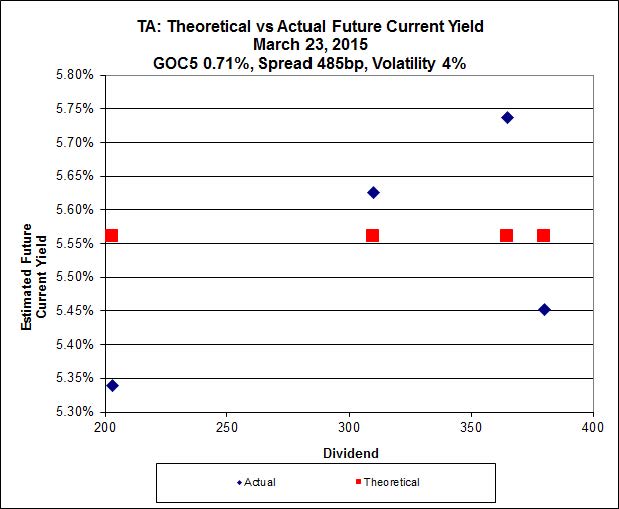
If instead we look at the single closest comparable, TRP.PR.E, which is a FixedReset 4.25%+235 currently bid at 24.52, we see that it has an Expected Future Current Yield (EFCY) of 3.06%, which is equal to Par Value * (GOC-5 + IRS) / Bid = 25 * (0.65% + 235bp) / 24.52.

If we say that the new issue should have the same EFCY, then its Issue Reset Spread (IRS) should be 3.06% – 0.65% = 241bp. This is 55bp below the actual IRS, implying that the current coupon should also be 55bp below the actual coupon, so we conclude that if it was to trade even-yield with TRP.PR.E, then the new issue should actually carry terms of 3.25%+241. Note that if we were being more precise, the EFCY of the new issue should be a bit more than that of TRP.PR.E, as compensation for the greater negative convexity – call it about 20bp more, which certainly changes the numbers considerably, but not by enough to affect my argument.

The trouble for the issuers is, however, that a current coupon of 3.25% will bring with it a large amount of expected sticker shock for retail. I’m not sure if it would be possible for the underwriters to sell an issue at 3.25%+241 based on current market conditions – or even possible to sell it at 3.45%+261, accounting for negative convexity and volatility. You can be pretty sure they’d try it if they thought they could get away with it!

So what I think is happening is that the issuers are simply selling it based on current coupon and letting the chips fall where they may as far as the Issue Reset Spread is concerned. To a large extent it doesn’t matter much to them – if GOC-5 recovers in the next five years and spreads narrow, then they can just call it and reissue new paper.

This is much the same thing as what the banks did in 2009, with their enormous issuance of FixedResets with huge Issue Reset Spreads.

And all these suppositions break Implied Volatility theory, because – assuming that expectations are met and the market behaves as expected – then there is directionality in market prices and it is entirely possible that capital gains on the currently discounted issues will swamp any differential in coupon. But we will see! Check back in five years.

Still, for what it’s worth, here’s the Implied Volatility Chart for TRP FixedResets, incorporating the new issue at par:

impVol_TRP_150223
Click for Big

According to this analysis, the new issue would be fairly priced at $26.07.

Market Action

February 20, 2015

Nothing happened today.

It was a mixed day for the Canadian preferred share market, with PerpetualDiscounts up 7bp, FixedResets off 31bp and DeemedRetractibles gaining 3bp. The Performance Highlights table is its usual lengthy self, with Enbridge FixedResets prominent on the downside and Floaters, of all things, prominent winners. Volume was below average, but Enbridge issues were again prominent.

For as long as the FixedReset market is so violently unsettled, I’ll keep publishing updates of the more interesting and meaningful series of FixedResets’ Implied Volatilities. This doesn’t include Enbridge because although Enbridge has a large number of issues outstanding, all of which are quite liquid, the range of Issue Reset Spreads is too small for decent conclusions. The low is 212bp (ENB.PR.H; second-lowest is ENB.PR.D at 237bp) and the high is a mere 268 for ENB.PF.G.

Remember that all rich /cheap assessments are:
» based on Implied Volatility Theory only
» are relative only to other FixedResets from the same issuer
» assume constant GOC-5 yield
» assume constant Implied Volatility
» assume constant spread

Here’s TRP:

impVol_TRP_150220
Click for Big

TRP.PR.E, which resets 2019-10-30 at +235, is bid at 24.52 to be $0.91 rich, while TRP.PR.C, resetting 2016-1-30 at +154, is bid at 16.68 to be $0.66 cheap.

impVol_MFC_150220
Click for Big

Another excellent fit, but the numbers are perplexing. Implied Volatility for MFC continues to be a conundrum, although it declined substantially today. It is still too high if we consider that NVCC rules will never apply to these issues; it is still too low if we consider them to be NVCC non-compliant issues (and therefore with Deemed Maturities in the call schedule).

Most expensive is MFC.PR.N, resetting at +230 on 2020-3-19, bid at 24.30 to be $0.35 rich, while MFC.PR.H, resetting at +313bp on 2017-3-19, is bid at 26.15 to be $0.52 cheap.

impVol_BAM_150220
Click for Big

The fit on this series is actually quite reasonable – it’s the scale that makes it look so weird.

The cheapest issue relative to its peers is BAM.PR.X, resetting at +180bp on 2017-6-30, bid at 17.84 to be $0.54 cheap. BAM.PF.E, resetting at +255bp 2020-3-31 is bid at 24.80 and appears to be $1.15 rich.

impVol_FTS_150220
Click for Big

This is just weird because the middle is expensive and the ends are cheap but anyway … FTS.PR.H, with a spread of +145bp, and bid at 16.70, looks $0.98 cheap and resets 2015-6-1. FTS.PR.K, with a spread of +205bp and resetting 2019-3-1, is bid at 23.62 and is $1.05 rich.

pairs_FR_150220
Click for Big

Most of the investment grade break-even rates are scattered around negative 10bp, but the BNS.PR.P/BNS.PR.A pair is an outlier at +36bp.

On the other hand, the market’s distaste for product linked to Money Market rates does not extend to prime, as shown by the FixedFloater/RatchetRate pairs:

pairs_FF_150220
Click for Big

Shall we just say that this exhibits a high level of confidence in the continued rapacity of Canadian banks?

HIMIPref™ Preferred Indices
These values reflect the December 2008 revision of the HIMIPref™ Indices

Values are provisional and are finalized monthly
Index Mean
Current
Yield
(at bid)
Median
YTW
Median
Average
Trading
Value
Median
Mod Dur
(YTW)
Issues Day’s Perf. Index Value
Ratchet 0.00 % 0.00 % 0 0.00 0 3.4764 % 2,387.9
FixedFloater 4.37 % 3.52 % 18,801 18.38 1 0.0000 % 4,046.5
Floater 3.02 % 3.18 % 66,011 19.23 4 3.4764 % 2,538.5
OpRet 4.04 % 1.40 % 105,616 0.32 1 0.2368 % 2,759.6
SplitShare 4.27 % 3.95 % 26,845 3.57 5 -0.1414 % 3,218.9
Interest-Bearing 0.00 % 0.00 % 0 0.00 0 0.2368 % 2,523.4
Perpetual-Premium 5.33 % 1.98 % 58,737 0.08 24 0.0131 % 2,513.8
Perpetual-Discount 4.95 % 4.81 % 115,417 15.24 10 0.0668 % 2,795.8
FixedReset 4.41 % 3.37 % 201,576 16.93 79 -0.3054 % 2,427.0
Deemed-Retractible 4.90 % 0.10 % 105,779 0.10 39 0.0262 % 2,651.2
FloatingReset 2.44 % 2.88 % 86,516 6.40 7 0.3151 % 2,323.1
Performance Highlights
Issue Index Change Notes
ENB.PR.F FixedReset -2.77 % YTW SCENARIO
Maturity Type : Limit Maturity
Maturity Date : 2045-02-20
Maturity Price : 19.65
Evaluated at bid price : 19.65
Bid-YTW : 4.30 %
BAM.PF.B FixedReset -2.66 % YTW SCENARIO
Maturity Type : Limit Maturity
Maturity Date : 2045-02-20
Maturity Price : 22.73
Evaluated at bid price : 23.75
Bid-YTW : 3.69 %
ENB.PR.J FixedReset -2.50 % YTW SCENARIO
Maturity Type : Limit Maturity
Maturity Date : 2045-02-20
Maturity Price : 21.53
Evaluated at bid price : 21.80
Bid-YTW : 4.03 %
ENB.PR.T FixedReset -2.24 % YTW SCENARIO
Maturity Type : Limit Maturity
Maturity Date : 2045-02-20
Maturity Price : 20.51
Evaluated at bid price : 20.51
Bid-YTW : 4.16 %
ENB.PR.P FixedReset -2.17 % YTW SCENARIO
Maturity Type : Limit Maturity
Maturity Date : 2045-02-20
Maturity Price : 20.69
Evaluated at bid price : 20.69
Bid-YTW : 4.11 %
ENB.PR.N FixedReset -2.08 % YTW SCENARIO
Maturity Type : Limit Maturity
Maturity Date : 2045-02-20
Maturity Price : 21.16
Evaluated at bid price : 21.16
Bid-YTW : 4.15 %
ENB.PR.D FixedReset -1.92 % YTW SCENARIO
Maturity Type : Limit Maturity
Maturity Date : 2045-02-20
Maturity Price : 18.86
Evaluated at bid price : 18.86
Bid-YTW : 4.31 %
ENB.PR.B FixedReset -1.88 % YTW SCENARIO
Maturity Type : Limit Maturity
Maturity Date : 2045-02-20
Maturity Price : 18.80
Evaluated at bid price : 18.80
Bid-YTW : 4.31 %
CU.PR.C FixedReset -1.76 % YTW SCENARIO
Maturity Type : Limit Maturity
Maturity Date : 2045-02-20
Maturity Price : 23.12
Evaluated at bid price : 24.05
Bid-YTW : 3.28 %
ENB.PR.Y FixedReset -1.64 % YTW SCENARIO
Maturity Type : Limit Maturity
Maturity Date : 2045-02-20
Maturity Price : 19.75
Evaluated at bid price : 19.75
Bid-YTW : 4.21 %
ENB.PR.H FixedReset -1.25 % YTW SCENARIO
Maturity Type : Limit Maturity
Maturity Date : 2045-02-20
Maturity Price : 18.22
Evaluated at bid price : 18.22
Bid-YTW : 4.21 %
PVS.PR.C SplitShare -1.16 % YTW SCENARIO
Maturity Type : Hard Maturity
Maturity Date : 2017-12-10
Maturity Price : 25.00
Evaluated at bid price : 25.55
Bid-YTW : 3.95 %
BAM.PR.Z FixedReset -1.01 % YTW SCENARIO
Maturity Type : Limit Maturity
Maturity Date : 2045-02-20
Maturity Price : 23.54
Evaluated at bid price : 25.41
Bid-YTW : 3.70 %
BMO.PR.R FloatingReset 1.02 % YTW SCENARIO
Maturity Type : Hard Maturity
Maturity Date : 2022-01-31
Maturity Price : 25.00
Evaluated at bid price : 23.80
Bid-YTW : 2.85 %
TRP.PR.B FixedReset 1.24 % YTW SCENARIO
Maturity Type : Limit Maturity
Maturity Date : 2045-02-20
Maturity Price : 14.75
Evaluated at bid price : 14.75
Bid-YTW : 3.50 %
TRP.PR.A FixedReset 2.25 % YTW SCENARIO
Maturity Type : Limit Maturity
Maturity Date : 2045-02-20
Maturity Price : 19.96
Evaluated at bid price : 19.96
Bid-YTW : 3.54 %
BAM.PR.K Floater 4.31 % YTW SCENARIO
Maturity Type : Limit Maturity
Maturity Date : 2045-02-20
Maturity Price : 15.50
Evaluated at bid price : 15.50
Bid-YTW : 3.25 %
BAM.PR.B Floater 4.42 % YTW SCENARIO
Maturity Type : Limit Maturity
Maturity Date : 2045-02-20
Maturity Price : 15.82
Evaluated at bid price : 15.82
Bid-YTW : 3.18 %
BAM.PR.C Floater 5.69 % YTW SCENARIO
Maturity Type : Limit Maturity
Maturity Date : 2045-02-20
Maturity Price : 15.80
Evaluated at bid price : 15.80
Bid-YTW : 3.18 %
Volume Highlights
Issue Index Shares
Traded
Notes
ENB.PR.D FixedReset 253,441 RBC crossed 218,000 at 18.95.
YTW SCENARIO
Maturity Type : Limit Maturity
Maturity Date : 2045-02-20
Maturity Price : 18.86
Evaluated at bid price : 18.86
Bid-YTW : 4.31 %
ENB.PR.B FixedReset 198,930 RBC crossed 10,000 at 19.00, another 10,000 at 18.91 and finally 139,800 at 18.85.
YTW SCENARIO
Maturity Type : Limit Maturity
Maturity Date : 2045-02-20
Maturity Price : 18.80
Evaluated at bid price : 18.80
Bid-YTW : 4.31 %
TD.PF.C FixedReset 98,455 TD crossed 14,900 at 24.83 and 50,000 at 24.85.
YTW SCENARIO
Maturity Type : Limit Maturity
Maturity Date : 2045-02-20
Maturity Price : 23.09
Evaluated at bid price : 24.78
Bid-YTW : 3.10 %
RY.PR.L FixedReset 82,883 Scotia crossed blocks of 31,400 and 50,000, both at 26.14.
YTW SCENARIO
Maturity Type : Call
Maturity Date : 2019-02-24
Maturity Price : 25.00
Evaluated at bid price : 26.14
Bid-YTW : 3.05 %
RY.PR.Z FixedReset 82,001 RBC crossed 65,500 at 25.05.
YTW SCENARIO
Maturity Type : Limit Maturity
Maturity Date : 2045-02-20
Maturity Price : 23.24
Evaluated at bid price : 25.06
Bid-YTW : 3.00 %
ENB.PR.H FixedReset 52,770 YTW SCENARIO
Maturity Type : Limit Maturity
Maturity Date : 2045-02-20
Maturity Price : 18.22
Evaluated at bid price : 18.22
Bid-YTW : 4.21 %
There were 25 other index-included issues trading in excess of 10,000 shares.
Wide Spread Highlights
Issue Index Quote Data and Yield Notes
BAM.PR.K Floater Quote: 15.50 – 16.80
Spot Rate : 1.3000
Average : 0.7751

YTW SCENARIO
Maturity Type : Limit Maturity
Maturity Date : 2045-02-20
Maturity Price : 15.50
Evaluated at bid price : 15.50
Bid-YTW : 3.25 %

ENB.PR.T FixedReset Quote: 20.51 – 21.05
Spot Rate : 0.5400
Average : 0.3423

YTW SCENARIO
Maturity Type : Limit Maturity
Maturity Date : 2045-02-20
Maturity Price : 20.51
Evaluated at bid price : 20.51
Bid-YTW : 4.16 %

PWF.PR.T FixedReset Quote: 25.36 – 25.84
Spot Rate : 0.4800
Average : 0.3208

YTW SCENARIO
Maturity Type : Limit Maturity
Maturity Date : 2045-02-20
Maturity Price : 23.37
Evaluated at bid price : 25.36
Bid-YTW : 3.12 %

BAM.PR.B Floater Quote: 15.82 – 16.20
Spot Rate : 0.3800
Average : 0.2304

YTW SCENARIO
Maturity Type : Limit Maturity
Maturity Date : 2045-02-20
Maturity Price : 15.82
Evaluated at bid price : 15.82
Bid-YTW : 3.18 %

RY.PR.E Deemed-Retractible Quote: 25.41 – 25.87
Spot Rate : 0.4600
Average : 0.3382

YTW SCENARIO
Maturity Type : Call
Maturity Date : 2015-03-26
Maturity Price : 25.25
Evaluated at bid price : 25.41
Bid-YTW : -2.84 %

MFC.PR.K FixedReset Quote: 24.10 – 24.50
Spot Rate : 0.4000
Average : 0.2851

YTW SCENARIO
Maturity Type : Hard Maturity
Maturity Date : 2025-01-31
Maturity Price : 25.00
Evaluated at bid price : 24.10
Bid-YTW : 3.81 %

New Issues

New Issue: FFH FixedReset, 4.75%+398

Fairfax Financial Holdings Limited has announced (emphasis added):

that it will issue in Canada 8 million Preferred Shares, Series M at a price of C$25.00 per share, for aggregate gross proceeds of C$200 million, on a bought deal basis to a syndicate of Canadian underwriters led by BMO Capital Markets, RBC Capital Markets and Scotia Capital Inc. (the “Preferred Share Offering”).

As previously announced, in light of the positive impact of the announcement of the recommended cash offer for Brit plc on February 17, 2015 and approaches from certain investors who expressed interest in investing in Fairfax equity, Fairfax entered into a bought deal financing for 1,000,000 Subordinate Voting Shares (the “Subordinate Voting Shares”), plus up to an additional 150,000 Subordinate Voting Shares pursuant to an over-allotment option, at a price of C$650.00 per Subordinate Voting Share for gross proceeds of C$650,000,000 or C$747,500,000 if the over-allotment option is exercised in full (the “Subordinate Voting Share Offering”).

Holders of the Preferred Shares, Series M will be entitled to receive a cumulative quarterly fixed dividend yielding 4.75% annually for the initial five year period ending March 31, 2020. Thereafter, the dividend rate will be reset every five years at a rate equal to the then current 5-year Government of Canada bond yield plus 3.98%.

Holders of Preferred Shares, Series M will have the right, at their option, to convert their shares into Preferred Shares, Series N, subject to certain conditions, on March 31, 2020, and on March 31 every five years thereafter. Holders of the Preferred Shares, Series N will be entitled to receive cumulative quarterly floating dividends at a rate equal to the then current three-month Government of Canada Treasury Bill yield plus 3.98%.

Fairfax has granted the underwriters an option, exercisable in whole or in part at any time up to 9:00 a.m. on the date that is two business days prior to the closing date, to purchase up to an additional 2 million Preferred Shares, Series M at the same offering price for additional gross proceeds of C$50 million.

Fairfax intends to use the net proceeds of the Preferred Share Offering and the Subordinate Voting Share Offering to partially fund the previously announced proposed acquisition of all of the issued and to be issued shares of Brit plc. Fairfax may raise additional funding for the acquisition of Brit plc through possible future debt issuances. There can be no assurance that such acquisition will be completed. If the acquisition is not successfully completed, Fairfax intends to use the net proceeds from the offerings to augment its cash position, to increase short-term investments and marketable securities held at the holding company level, to refinance or retire outstanding debt and other corporate obligations of Fairfax and its subsidiaries from time to time, and for general corporate purposes. The Preferred Share Offering is expected to close on or about March 3 2015.

Fairfax intends to file a prospectus supplement to its short form base shelf prospectus dated December 19, 2014 in respect of the Preferred Share Offering with the applicable Canadian securities regulatory authorities. Details of the Preferred Share Offering will be set out in the prospectus supplement which will be available on the SEDAR website for Fairfax at www.sedar.com. To comply with the provisions of the UK Takeover Code in connection with Fairfax’s offer for the issued and to be issued shares of Brit plc, purchasers of Preferred Shares, Series M pursuant to the prospectus supplement will be deemed to have represented and agreed that they and their affiliates do not own any shares of Brit plc and will not acquire any shares of Brit plc prior to the completion of Fairfax’s offer.

This press release shall not constitute an offer to sell or the solicitation of an offer to buy nor shall there be any sale of these securities in any jurisdiction in which such offer, solicitation or sale would be unlawful prior to registration or qualification under the securities laws of any such jurisdiction. This press release is not an offer of securities for sale in the United States, and the securities may not be offered or sold in the United States absent registration or an exemption from the registration requirements. The securities have not been and will not be registered under the United States Securities Act of 1933, as amended.

I find that a very interesting note about the prohibition on holding shares in Brit plc!

Fairfax has been busy since having their outlook downgraded to negative by S&P. First they offered $650-million in Subordinate Voting Shares:

Fairfax Financial Holdings Limited (“Fairfax” or the “Company”) (TSX:FFH)(TSX:FFH.U) has announced [February 19] that it has entered into an agreement with a syndicate of underwriters led by BMO Capital Markets, under which the underwriters have agreed to buy on a bought deal basis 1,000,000 Subordinate Voting Shares (the “Subordinate Voting Shares”), at a price of C$650.00 per Subordinate Voting Share for gross proceeds of C$650 million (the “Offering”). The Offering is expected to close on March 3, 2015.

Fairfax intends to use the net proceeds of the Offering to partially fund the previously announced proposed acquisition of all of the outstanding shares of Brit PLC (“Brit”). Fairfax may raise additional funding for the acquisition of Brit through possible future debt and/or preferred share issuances. There can be no assurance that the acquisition of Brit will be completed. If the acquisition is not successfully completed, Fairfax intends to use the net proceeds to augment its cash position, to increase short-term investments and marketable securities held at the holding company level, to refinance or retire outstanding debt and other corporate obligations of Fairfax and its subsidiaries from time to time, and for general corporate purposes.

Then they announced a $300-million 10-year notes offering:

Fairfax Financial Holdings Limited (TSX:FFH)(TSX:FFH.U) announces that it will issue C$300 million in aggregate principal amount of Senior Notes due 2025 on a bought deal basis to a syndicate of underwriters led by BMO Capital Markets, RBC Capital Markets and Scotiabank (the “Notes Offering”).

As previously announced, in light of the positive impact of the announcement of the recommended cash offer for Brit plc on February 17, 2015 and approaches from certain investors who expressed interest in investing in Fairfax equity, Fairfax entered into a bought deal financing for 1,000,000 Subordinate Voting Shares (the “Subordinate Voting Shares”), plus up to an additional 150,000 Subordinate Voting Shares pursuant to an over-allotment option, at a price of C$650.00 per Subordinate Voting Share for gross proceeds of C$650,000,000 or C$747,500,000 if the over-allotment option is exercised in full (the “Subordinate Voting Share Offering”). Fairfax also announced today a bought deal financing for 8 million Preferred Shares, Series M at a price of C$25.00 per share (the “Preferred Share Offering”). Fairfax has granted the underwriters in the Preferred Share Offering an option, exercisable in whole or in part at any time up to 9:00 a.m. on the date that is two business days prior to the closing date, to purchase up to an additional 2 million Preferred Shares, Series M at the same offering price.

Fairfax intends to use the net proceeds of the Notes Offering, the Preferred Share Offering and the Subordinate Voting Share Offering to partially fund the previously announced proposed acquisition of all of the issued and to be issued shares of Brit plc. There can be no assurance that such acquisition will be completed. If the acquisition is not successfully completed, Fairfax intends to use the net proceeds from the offerings to augment its cash position, to increase short-term investments and marketable securities held at the holding company level, to refinance or retire outstanding debt and other corporate obligations of Fairfax and its subsidiaries from time to time, and for general corporate purposes. The Notes Offering is expected to close on or about March 3, 2015.

And the notes offering was upsized:

Fairfax Financial Holdings Limited (TSX:FFH)(TSX:FFH.U) announces an increase in the size of its offering of Senior Notes due 2025 from $300 million to $350 million in aggregate principal amount, to be priced at $99.114 per $100 principal amount of Senior Notes (the “Notes Offering”). The Senior Notes are being offered through a syndicate of dealers led by BMO Capital Markets, RBC Capital Markets and Scotiabank. The Senior Notes will be unsecured obligations of Fairfax and will pay a fixed rate of interest of 4.95% per annum.

Fairfax has five other issues of FixedResets outstanding; FFH.PR.C, FFH.PR.E, FFH.PR.G, FFH.PR.I and FFH.PR.K.

FFH.PR.C reset 2014-12-31 to 4.578% (GOC5 +315bp) and about 40% of the issue was converted to FFH.PR.D, its FloatingReset Strong Pair counterpart. FFH.PR.E a FixedReset 4.75%+216 will have its first Exchange Date 2015-3-31, but no announcement has yet been made regarding extension; given a comparison of that spread and the new issue spread, I think extension can be regarded as a certainty!

Implied Volatility theory yields the following chart:

impVol_FFH_150220
Click for Big

According to this, the new issue is $0.87 cheap, which is not as cheap as FFH.PR.I, which resets 2015-12-31 at GOC5+285bp and is currently bid at 19.01 to be $1.11 cheap.

Market Action

February 19, 2015

It’s funny … the standard stock market manipulation in North America is Pump and Dump. In Asia, apparently, it’s Dump and Pump:

Scrutiny of anonymous research has intensified this month after the reports on Noble, a commodities trader, and Sound Global, a Chinese water-treatment firm, alleged accounting irregularities that both companies denied. The Monetary Authority of Singapore, or MAS, said it’s reviewing the report on Noble, produced by a group calling itself Iceberg Research, and will take action if securities laws were breached.

Noble, which said on Monday it “completely rejects the allegations,” lost as much as 15 percent over two days in Singapore trading after the Iceberg report. The stock rose 1.9 percent on Wednesday after the company said directors and management are “comfortable” that its balance sheet “fairly presents its book value.”

Iceberg doesn’t have any short position, or wager on a decline, in Noble securities and doesn’t work in tandem with funds, it said in the report. Iceberg’s website contains no analyst names, phone numbers or links to research notes, apart from the 17-page report on Noble.

The “Contact Us” page has a form for readers to submit comments and a link to follow a Twitter feed. When contacted on the website by Bloomberg News, Iceberg said it “cannot give phone calls” for an “anonymity reason.”

“No research should be anonymous,” said Jimmy Ho, president of the Society of Remisiers, Singapore’s biggest association of equity traders. “MAS should make sure analysts do not use their research for their own agenda.”

Thanks, Jimmy Ho, for calling for increased regulation! Will your operatives be combing through the commentary on Stockhouse and making sure nobody’s posting under a pseudonym?

More traders are jumping on the deflation bandwagon:

Federal fund futures give a 20.7 percent probability the central bank will lift borrowing costs at the June gathering, according to data compiled by Bloomberg. That is down from 25 percent yesterday.

Policy makers judged that risks facing the U.S. economy argued for keeping interest rates near record lows for longer, the minutes from the Jan. 27-28 meeting showed. Expectations for a possible June increase had been growing since a government report showed payroll gains in January capped the biggest three-month increase in 17 years.

SNC-Lavalin has been charged with doing business in Libya:

The RCMP has laid corruption and fraud charges against engineering firm SNC-Lavalin Group Inc. and two subsidiaries over alleged criminal acts that occurred doing business in Libya.

There is one count of corruption related to at least $47.7-million in alleged bribes to Libyan public or other officials. A second count is for fraud of about $130-million related to construction projects in Libya, including the Great Man Made River Project.

The RCMP, which worked with Swiss authorities, alleged in an affidavit last year that Mr. Ben Aissa funnelled an estimated $160-million in corrupt payments from SNC to Saadi Gadhafi, the son of the late Libyan dictator, and other officials in exchange for billions in engineering contracts.

Canada has an obligation to ensure that Libyan taxpayers are not overcharged for their engineering contracts, because they’re paying us a lot of money to look after their interests. Regrettably I was not able to find a media story specifying exactly how much we’re getting paid for our efforts, but I’m sure it’s billions. Billions!

The company has attempted to justify its conduct on the basis of having a Canadian headquarters:

The head of Canadian engineering giant SNC-Lavalin Group Inc. says any move by authorities to charge the company in connection with an extensive bribery scandal would immediately threaten its future and could force it to close down.

SNC chief executive officer Robert Card, speaking to The Globe and Mail’s editorial board, said he would be “deeply concerned” if the company was charged because it would hurt the business severely. And “if the company can’t do business, you really only have two choices. You are going to do some dismemberment and cease to exist entirely, or you are going to be owned by somebody else.”

A shift to a foreign owner would jeopardize the 5,000 Canadian SNC jobs that are associated with its headquarters, he said.

Our wise tough-on-crime masters consider corruption to be in the same category as wearing a niqab while pledging allegiance:

Anti-corruption experts say Ottawa has created a set of rules that is among the most far-reaching and inflexible anywhere in the world.

“The U.S., EU and World Bank all have a debarment process,” pointed out Peter Dent, president of the Canadian chapter of Transparency International, an organization committed to fighting corruption. “There is predictability, transparency and due process associated with all of them.”

The Canadian rules are “out of step” with regimes in most other countries, Transparency International said in a letter sent this week to Public Work Minister Diane Finley, who is considering possible changes to its regime.

… which brings us to S&P has downgraded the outlook for the company to negative:

  • • Federal charges have been laid by the Public Prosecution Service of
    Canada against SNC-Lavalin Group Inc., SNC-Lavalin International Inc., and SNC-Lavalin Construction Inc.

  • •Each entity has been charged with one count of fraud and one count of corruption.
  • •SNC-Lavalin has stated it will defend itself and plead not guilty
  • •There is no change to the company’s right and ability to bid or work on any public or private projects.
  • •As a result, we are revising our outlook on SNC-Lavalin to negative from stable and affirming all our ratings on the company, including our ‘BBB’ long-term corporate credit rating.
  • •The negative outlook reflects our concern as to the extent and magnitude that SNC’s competitive position will be affected following the charges being laid.


Standard & Poor’s is concerned about the effect that the charges will have on SNC-Lavalin’s competitive position, as well as how the company’s operations will be affected by management’s need to address the charges.

However, we continue to expect SNC-Lavalin will maintain strong liquidity over the next 18 months and that net cash will exceed recourse debt preserving the financial flexibility to manage possible financial penalties. We also note that the negative outlook could be maintained until we are confident as to the resolution of the criminal charges, which could take up to a number of years.

We could lower the ratings on the company if governance-related events affect its competitive position or if SNC-Lavalin increased recourse debt such that total debt-to-EBITDA increased beyond 1.5x with poor prospects for deleveraging. We also believe that downward pressure on the ratings could result from significantly weaker liquidity.

And Bombardier’s issuing shares:

Bombardier Inc. said it will issue about C$750 million ($600 million) in stock, fulfilling a pledge made last week when the company unveiled cost overruns on its CSeries family of jets.

Bombardier will sell 339.4 million Class B shares at C$2.21 apiece, 12 percent less than Wednesday’s closing price in Toronto. The offering is expected to be completed on or about Feb. 27, Montreal-based Bombardier said Thursday in a statement.

The company said Feb. 12 it would issue about $600 million of new equity and as much as $1.5 billion in long-term debt, depending on market conditions, to shore up its balance sheet. Bombardier also halted the dividend on its Class A and B shares, and named Alain Bellemare as CEO, replacing Pierre Beaudoin.

Together, unidentified members of the Bombardier family plan to place orders for about $50 million in subscription receipts, the company said. Each receipt will entitle the holder to receive one Class B share.

Bombardier’s Class B stock fell 2.4 percent to C$2.46 when trading was halted in late afternoon Toronto trading. The shares have lost 41 percent of their value this year.

Bombardier is the battered but still proud issuer of BBD.PR.B, BBD.PR.C and BBD.PR.D.

It was a mixed day for the Canadian preferred share market, with PerpetualDiscounts gaining 8bp, FixedResets down 18bp and DeemedRetractibles off 2bp. The Performance Highlights table is its usual lengthy self, with Enbridge issues prominent among the losers. Volume was above average.

For as long as the FixedReset market is so violently unsettled, I’ll keep publishing updates of the more interesting and meaningful series of FixedResets’ Implied Volatilities. This doesn’t include Enbridge because although Enbridge has a large number of issues outstanding, all of which are quite liquid, the range of Issue Reset Spreads is too small for decent conclusions. The low is 212bp (ENB.PR.H; second-lowest is ENB.PR.D at 237bp) and the high is a mere 268 for ENB.PF.G.

Remember that all rich /cheap assessments are:
» based on Implied Volatility Theory only
» are relative only to other FixedResets from the same issuer
» assume constant GOC-5 yield
» assume constant Implied Volatility
» assume constant spread

Here’s TRP:

impVol_TRP_150219
Click for Big

TRP.PR.E, which resets 2019-10-30 at +235, is bid at 24.55 to be $1.13 rich, while TRP.PR.B, resetting 2015-6-30 at +128, is bid at 14.60 to be $0.79 cheap.

impVol_MFC_150219
Click for Big

Another excellent fit, but the numbers are perplexing. Implied Volatility for MFC continues to be a conundrum, although it declined substantially today. It is still too high if we consider that NVCC rules will never apply to these issues; it is still too low if we consider them to be NVCC non-compliant issues (and therefore with Deemed Maturities in the call schedule).

Most expensive is MFC.PR.L, resetting at +216 on 2019-6-19, bid at 24.20 to be $0.26 rich, while MFC.PR.H, resetting at +313bp on 2017-3-19, is bid at 26.20 to be $0.52 cheap.

impVol_BAM_150219
Click for Big

The fit on this series is actually quite reasonable – it’s the scale that makes it look so weird.

The cheapest issue relative to its peers is BAM.PR.X, resetting at +180bp on 2017-6-30, bid at 17.87 to be $0.57 cheap. BAM.PF.E, resetting at +255bp 2020-3-31 is bid at 24.85 and appears to be $1.15 rich.

impVol_FTS_150219
Click for Big

This is just weird because the middle is expensive and the ends are cheap but anyway … FTS.PR.H, with a spread of +145bp, and bid at 16.80, looks $1.02 cheap and resets 2015-6-1. FTS.PR.K, with a spread of +205bp and resetting 2019-3-1, is bid at 23.61 and is $1.00 rich.

pairs_FR_150219
Click for Big

All the investment grade break-even rates are scattered around zero!

On the other hand, the market’s distaste for product linked to Money Market rates does not extend to prime, as shown by the FixedFloater/RatchetRate pairs:

pairs_FF_150219
Click for Big

Shall we just say that this exhibits a high level of confidence in the continued rapacity of Canadian banks?

HIMIPref™ Preferred Indices
These values reflect the December 2008 revision of the HIMIPref™ Indices

Values are provisional and are finalized monthly
Index Mean
Current
Yield
(at bid)
Median
YTW
Median
Average
Trading
Value
Median
Mod Dur
(YTW)
Issues Day’s Perf. Index Value
Ratchet 0.00 % 0.00 % 0 0.00 0 1.5585 % 2,307.7
FixedFloater 4.37 % 3.52 % 19,579 18.38 1 -0.0460 % 4,046.5
Floater 3.12 % 3.32 % 66,697 18.89 4 1.5585 % 2,453.2
OpRet 4.04 % 2.12 % 105,426 0.32 1 0.0395 % 2,753.1
SplitShare 4.27 % 3.50 % 26,997 3.57 5 0.1425 % 3,223.5
Interest-Bearing 0.00 % 0.00 % 0 0.00 0 0.0395 % 2,517.4
Perpetual-Premium 5.33 % 0.36 % 56,781 0.08 24 -0.0065 % 2,513.5
Perpetual-Discount 4.95 % 4.78 % 119,699 15.11 10 0.0794 % 2,793.9
FixedReset 4.40 % 3.35 % 202,127 17.03 79 -0.1831 % 2,434.4
Deemed-Retractible 4.90 % 0.10 % 106,904 0.19 39 -0.0171 % 2,650.5
FloatingReset 2.45 % 2.95 % 85,780 6.40 7 -0.2404 % 2,315.8
Performance Highlights
Issue Index Change Notes
MFC.PR.F FixedReset -4.59 % Desjardins was on the sell side of 12 (3,450 shares) of the last 15 (4,850 shares) trades executed after 3pm, with prices beginning at 19.91 and ending at 19.34. VWAP was 20.31 on 48,445 shares.
YTW SCENARIO
Maturity Type : Hard Maturity
Maturity Date : 2025-01-31
Maturity Price : 25.00
Evaluated at bid price : 19.34
Bid-YTW : 5.54 %
TRP.PR.A FixedReset -3.84 % A last minute – literally! – collapse, with an anonymous seller executing twelve trades totalling 3,400 shares at prices beginning at 20.31 and finishing at 19.75. VWAP was 20.36 on 19,270 shares.
YTW SCENARIO
Maturity Type : Limit Maturity
Maturity Date : 2045-02-19
Maturity Price : 19.52
Evaluated at bid price : 19.52
Bid-YTW : 3.63 %
ENB.PF.C FixedReset -1.98 % YTW SCENARIO
Maturity Type : Limit Maturity
Maturity Date : 2045-02-19
Maturity Price : 22.15
Evaluated at bid price : 22.79
Bid-YTW : 3.94 %
ENB.PR.Y FixedReset -1.57 % YTW SCENARIO
Maturity Type : Limit Maturity
Maturity Date : 2045-02-19
Maturity Price : 20.08
Evaluated at bid price : 20.08
Bid-YTW : 4.14 %
ENB.PF.E FixedReset -1.47 % YTW SCENARIO
Maturity Type : Limit Maturity
Maturity Date : 2045-02-19
Maturity Price : 22.18
Evaluated at bid price : 22.86
Bid-YTW : 3.96 %
ELF.PR.H Perpetual-Premium -1.27 % YTW SCENARIO
Maturity Type : Call
Maturity Date : 2020-04-17
Maturity Price : 25.25
Evaluated at bid price : 25.57
Bid-YTW : 5.31 %
ENB.PF.A FixedReset -1.25 % YTW SCENARIO
Maturity Type : Limit Maturity
Maturity Date : 2045-02-19
Maturity Price : 22.27
Evaluated at bid price : 22.96
Bid-YTW : 3.91 %
BAM.PR.R FixedReset -1.23 % YTW SCENARIO
Maturity Type : Limit Maturity
Maturity Date : 2045-02-19
Maturity Price : 21.37
Evaluated at bid price : 21.67
Bid-YTW : 3.70 %
TRP.PR.B FixedReset -1.22 % YTW SCENARIO
Maturity Type : Limit Maturity
Maturity Date : 2045-02-19
Maturity Price : 14.57
Evaluated at bid price : 14.57
Bid-YTW : 3.54 %
CU.PR.C FixedReset -1.13 % YTW SCENARIO
Maturity Type : Limit Maturity
Maturity Date : 2045-02-19
Maturity Price : 23.31
Evaluated at bid price : 24.48
Bid-YTW : 3.20 %
MFC.PR.L FixedReset -1.02 % YTW SCENARIO
Maturity Type : Hard Maturity
Maturity Date : 2025-01-31
Maturity Price : 25.00
Evaluated at bid price : 24.20
Bid-YTW : 3.85 %
BNS.PR.C FloatingReset -1.00 % YTW SCENARIO
Maturity Type : Hard Maturity
Maturity Date : 2022-01-31
Maturity Price : 25.00
Evaluated at bid price : 23.76
Bid-YTW : 3.11 %
BMO.PR.Q FixedReset 1.06 % YTW SCENARIO
Maturity Type : Hard Maturity
Maturity Date : 2022-01-31
Maturity Price : 25.00
Evaluated at bid price : 22.85
Bid-YTW : 3.75 %
CU.PR.D Perpetual-Premium 1.15 % YTW SCENARIO
Maturity Type : Call
Maturity Date : 2021-09-01
Maturity Price : 25.00
Evaluated at bid price : 25.44
Bid-YTW : 4.59 %
BAM.PF.B FixedReset 1.41 % YTW SCENARIO
Maturity Type : Limit Maturity
Maturity Date : 2045-02-19
Maturity Price : 23.01
Evaluated at bid price : 24.40
Bid-YTW : 3.55 %
IFC.PR.A FixedReset 1.57 % YTW SCENARIO
Maturity Type : Hard Maturity
Maturity Date : 2025-01-31
Maturity Price : 25.00
Evaluated at bid price : 20.04
Bid-YTW : 5.77 %
BAM.PR.C Floater 1.70 % YTW SCENARIO
Maturity Type : Limit Maturity
Maturity Date : 2045-02-19
Maturity Price : 14.95
Evaluated at bid price : 14.95
Bid-YTW : 3.37 %
TRP.PR.D FixedReset 1.91 % YTW SCENARIO
Maturity Type : Limit Maturity
Maturity Date : 2045-02-19
Maturity Price : 22.84
Evaluated at bid price : 24.00
Bid-YTW : 3.35 %
BAM.PR.B Floater 1.95 % YTW SCENARIO
Maturity Type : Limit Maturity
Maturity Date : 2045-02-19
Maturity Price : 15.15
Evaluated at bid price : 15.15
Bid-YTW : 3.32 %
BAM.PR.K Floater 1.99 % YTW SCENARIO
Maturity Type : Limit Maturity
Maturity Date : 2045-02-19
Maturity Price : 14.86
Evaluated at bid price : 14.86
Bid-YTW : 3.39 %
Volume Highlights
Issue Index Shares
Traded
Notes
HSB.PR.C Deemed-Retractible 146,545 Nesbitt crossed blocks of 90,000 and 50,000, both at 25.30.
YTW SCENARIO
Maturity Type : Call
Maturity Date : 2015-03-21
Maturity Price : 25.00
Evaluated at bid price : 25.30
Bid-YTW : -1.00 %
TD.PF.C FixedReset 126,910 TD sold 10,000 to Scotia at 24.85, crossed 50,000 at 24.87 and finally crossed 15,600 at 24.83.
YTW SCENARIO
Maturity Type : Limit Maturity
Maturity Date : 2045-02-19
Maturity Price : 23.10
Evaluated at bid price : 24.82
Bid-YTW : 3.09 %
HSB.PR.D Deemed-Retractible 119,900 Desjardins crossed blocs of 99,500 and 19,900, both at 25.35.
YTW SCENARIO
Maturity Type : Call
Maturity Date : 2015-03-21
Maturity Price : 25.00
Evaluated at bid price : 25.37
Bid-YTW : -4.57 %
RY.PR.J FixedReset 77,843 Recent new issue.
YTW SCENARIO
Maturity Type : Limit Maturity
Maturity Date : 2045-02-19
Maturity Price : 23.19
Evaluated at bid price : 25.15
Bid-YTW : 3.35 %
ENB.PR.H FixedReset 71,785 RBC crossed 43,200 at 18.25.
YTW SCENARIO
Maturity Type : Limit Maturity
Maturity Date : 2045-02-19
Maturity Price : 18.45
Evaluated at bid price : 18.45
Bid-YTW : 4.16 %
MFC.PR.N FixedReset 51,300 Scotia crossed 49,500 at 24.80.
YTW SCENARIO
Maturity Type : Hard Maturity
Maturity Date : 2025-01-31
Maturity Price : 25.00
Evaluated at bid price : 24.76
Bid-YTW : 3.67 %
There were 38 other index-included issues trading in excess of 10,000 shares.
Wide Spread Highlights
Issue Index Quote Data and Yield Notes
MFC.PR.F FixedReset Quote: 19.34 – 20.48
Spot Rate : 1.1400
Average : 0.7539

YTW SCENARIO
Maturity Type : Hard Maturity
Maturity Date : 2025-01-31
Maturity Price : 25.00
Evaluated at bid price : 19.34
Bid-YTW : 5.54 %

ELF.PR.H Perpetual-Premium Quote: 25.57 – 26.44
Spot Rate : 0.8700
Average : 0.5581

YTW SCENARIO
Maturity Type : Call
Maturity Date : 2020-04-17
Maturity Price : 25.25
Evaluated at bid price : 25.57
Bid-YTW : 5.31 %

TRP.PR.A FixedReset Quote: 19.52 – 20.51
Spot Rate : 0.9900
Average : 0.6918

YTW SCENARIO
Maturity Type : Limit Maturity
Maturity Date : 2045-02-19
Maturity Price : 19.52
Evaluated at bid price : 19.52
Bid-YTW : 3.63 %

NEW.PR.D SplitShare Quote: 32.37 – 32.95
Spot Rate : 0.5800
Average : 0.3915

YTW SCENARIO
Maturity Type : Call
Maturity Date : 2015-06-26
Maturity Price : 32.07
Evaluated at bid price : 32.37
Bid-YTW : 3.35 %

HSE.PR.A FixedReset Quote: 17.60 – 18.13
Spot Rate : 0.5300
Average : 0.3709

YTW SCENARIO
Maturity Type : Limit Maturity
Maturity Date : 2045-02-19
Maturity Price : 17.60
Evaluated at bid price : 17.60
Bid-YTW : 3.70 %

BMO.PR.R FloatingReset Quote: 23.56 – 23.87
Spot Rate : 0.3100
Average : 0.1896

YTW SCENARIO
Maturity Type : Hard Maturity
Maturity Date : 2022-01-31
Maturity Price : 25.00
Evaluated at bid price : 23.56
Bid-YTW : 3.01 %

Issue Comments

IAG.PR.F To Be Redeemed

Industrial Alliance Insurance and Financial Services Inc. has announced:

The net proceeds [from an offering of sub-debt] will be added to the Company’s general funds and will be used for general corporate purposes (including, subject to the prior approval of the Autorité des marchés financiers, the redemption of Industrial Alliance’s outstanding 5.90% Non-Cumulative Class A Preferred Shares Series F (the “Series F Preferred Shares”), which Industrial Alliance currently intends to effect on March 31, 2015 (the “Series F Redemption”)).

Subject to the prior approval of the Autorité des marchés financiers, following the closing of the Offering, Industrial Alliance intends to issue a redemption notice to redeem the Series F Preferred Shares. Upon the Series F Redemption, Industrial Alliance will pay to the holders of the Series F Preferred Shares the redemption price of $26 less any taxes required to be withheld or deducted. There are 4,000,000 Series F Preferred Shares outstanding as of today. A formal notice and instructions for the redemption of the Series F Preferred Shares will be sent to all shareholders in accordance with the rights, privileges, restrictions and conditions attached to the Series F Preferred Shares.

Separately from the redemption price, the final quarterly dividend of $0.36875 per Series F Preferred Share will be paid in the usual manner on March 31, 2015 to shareholders of record on February 27, 2015. After the Series F Preferred Shares are redeemed, holders of Series F Preferred Shares will cease to be entitled to distributions of dividends and will not be entitled to exercise any rights as holders other than to receive the redemption price and the final quarterly dividend described above.

On a pro forma basis, after giving effect to the Offering and the Series F Redemption, the Company estimates that, as at December 31, 2014: (i) its debt ratio would increase from 13.2% to 18.1% if only its outstanding debentures are considered “debt”; (ii) its debt ratio would increase from 23.7% to 26.1% if its outstanding debentures and preferred shares are considered “debt”; and (iii) its solvency ratio would increase by 7 percentage points to 216%.

Holders are reminded that the $26 redemption price is a premium of $1.00 over par value and this amount will be considered a Deemed Dividend for tax purposes – that is, the transaction will be considered as a sale at $25.00 and a dividend of $1.00. Thus, some taxable holders will find it advantageous to sell into the market at a few pennies below the redemption value, in order to maximize (minimize) their capital gain (loss) while minimizing dividend income. Please consult your personal tax advisor.

IAG.PR.F has been tracked by HIMIPref™ and is assigned to the DeemedRetractible subindex.

Issue Comments

TLM.PR.A Deal Approved – Redemption Coming Soon?

Talisman Energy Inc. has announced:

that the holders of its Common Shares and Preferred Shares have approved the proposed arrangement under which Repsol S.A., through a wholly-owned subsidiary, is to acquire all of the outstanding shares of Talisman. Of the votes cast, over 99% of holders of each class of shares voted in favour of the agreement at the special meeting of shareholders held earlier today.

The completion of the arrangement remains subject to the granting of a final order by the Court of Queen’s Bench of Alberta, the receipt of required regulatory approvals and the satisfaction or waiver of other customary closing conditions. It is anticipated that the completion of the transaction will occur in the second quarter of 2015 and all regulatory approvals are on track.

However, it looks like shareholder approval was already factored into market prices, since the common closed at $9.51, well within its range of the past two weeks and actually down $0.02 on the day, while the preferred improved from 24.00-12 yesterday to 24.25-34 today.

It looks like traders are still accounting for a healthy amount of deal risk, since the common closed today at USD 7.68 on the New York Exchange, with a closing quote of 7.45 bid without. The day’s range was 7.65-71, compared with a deal price of USD 8.00, which (at today’s currency close of 1.2459), equates to CAD 9.57. The USD 7.68 close represents a 4% discount to deal price.

Thus, given that the preferreds are bid at 24.25, and will go ex-dividend for $0.2625 on March 11 (estimated) payable March 31 (estimated), both issues are showing comparable deal-risk.

Is it too much or too little? I don’t know – as I stated in my initial report on the potential deal, I don’t do deal risk. I will, however, bet a nickel that if the deal falls through, the preferreds will drop by $10.00 instantly.

The deal has attracted the usual weeping and wailing over a head-office closing from the usual suspects, who consider Canadians to be too stupid to take whatever money they’ve made from the investment to start new companies.