New Issues

New Issue: FCS SplitShare, Interest-Bearing, 6.00%, 4.5-Year

Faircourt Asset Management has announced (although not yet on their website):

Faircourt Asset Management Inc., the manager of Faircourt Split Trust (the “Trust”) (TSX: FCS.UN; FCS.PR.B), is pleased to announce that it has filed a preliminary short form prospectus for an offering of a new series of 6.00% preferred securities (the “Preferred Securities”) in order to relever the existing trust units (the “Units”) of the Trust and additional Units and Preferred Securities on a matched basis (the “Offering”).

The Preferred Securities are to be issued at $10.00 per Preferred Security to yield 6.00% on the issue price. The Preferred Securities have been provisionally rated Pfd-3 (low) by DBRS Limited.

The Offering is expected to close on or about December 30, 2014. The net proceeds of the Offering of Preferred Securities will be used to fund the redemption of the 6.25% preferred securities of the Trust which mature on December 31, 2014. To the extent the net proceeds of the Offering exceed the funding requirements associated with these redemptions, the Trust may purchase additional securities to be held in the portfolio of securities of the Trust in accordance with the investment objectives and investment strategy of the Trust and subject to the investment restrictions of the Trust.

The syndicate of agents for the Offering is being co-led by National Bank Financial Inc. and CIBC World Markets Inc., and includes Canaccord Genuity Corp., GMP Securities L.P. and Raymond James Ltd.

The preliminary prospectus is available on SEDAR with the references “Dec 10 2014 10:59:07 ET Preliminary short form prospectus – English PDF 378 K”. I am not permitted to link directly to the preliminary prospectus since the Alberta Securities Commission has decided that this would make life too easy for retail scum like you. Suck it up, scumbags!

DBRS has assigned a preliminary rating of Pfd-3(low):

DBRS Limited (DBRS) has today assigned a provisional rating of Pfd-3 (low) to the 6.00% Preferred Securities to be issued by Faircourt Split Trust (the Company). The 6.00% Preferred Securities are being issued to fund the redemption of the currently outstanding 6.25% Preferred Securities, which are scheduled to mature on December 31, 2014. Additional 6.00% Preferred Securities and Trust Units may be issued on a matched basis. The 6.00% Preferred Securities will be scheduled to mature on June 30, 2019.

The Company has advised DBRS that the initial downside protection available to holders of the 6.25% Preferred Securities is expected to be approximately 34.9% after the payment of all issuance expenses. Dividends received on the Portfolio will be used to pay a fixed cumulative quarterly distribution to holders of the 6.00% Preferred Securities, while holders of the Trust Units are expected to receive a monthly distribution of $0.02. Based on the current dividend yield on the Portfolio as of November 24, 2014, the 6.00% Preferred Securities dividend coverage ratio is expected to be approximately 0.04 times.

The Dividend Coverage Ratio referred to by DBRS is extremely low but looks accurate. According to the 2014H1 Semi-Annual Report, the fund’s income from “Distributions and dividends” was $ 475,389 and “Interest for distribution purposes” was $27,866, is a total of $503,255. I am ignoring realized and unrealized capital gains for this purpose, as well as “Income from Derivatives” which is capital gains from options trading, and ignoring the Foreign Exchange loss.

Expenses include Management Fees, Service Fees, Audit Fees, Legal Fees, Security Holder Reporting Costs, Custodial Fees, Independent Review Committee Fees and Withholding Taxes, total $456,188 (I’m leaving out Commissions and Other Portfolio Transaction Costs) leaves a net $47,067 to cover $903,204 in Preferred Security interest payments, is an income coverage of 5%. So it looks like the DBRS estimate of 4% is entirely realistic.

This is likely to be a very small issue, but since HIMIPref™ has been tracking FCS.PR.B (which will be refunded from the proceeds of this issue), I’ll track this one too.

Interesting External Papers

Jack Mintz On Exempt Market Regulation

Jack Mintz has published an excellent commentary titled Muddling Up The Market: New Exempt-Market Regulations May Do More Harm Than Good To The Integrity Of Markets:

From private debt and equity markets to crowd funding, exempt markets have been used to raise more money for Canadian enterprises in recent years than all public offerings put together. Vastly more: Between 2010 and 2012, exempt-market offerings raised four times as much capital as the initial and secondary public offerings during the same period. The precise reasons behind the immense popularity of exempt markets can only be guessed at; it may well be due to the desire, by both issuers and by investors, to avoid the regulatory costs associated with raising capital in public markets. We are left to speculate, however, because the Canadian exempt market remains relatively unstudied, despite its enormous role in funding capital investments in Canada.

The lack of information about exempt markets, however, is not stopping provincial regulators in Canada’s largest markets from charging ahead with new proposals for rules that would govern exempt markets. Unfortunately, with so little information available about these markets, whatever the aim of the reforms in pursuing the goals of effective market regulation, they may end up being more harmful than helpful.

Ontario is proposing to broaden the category of investors eligible to participate in these markets under a new exemption. But the category will remain stricter than in many other markets and Ontario proposes to also put very low limits on how much each investor is allowed to put at risk. Quebec, Alberta and Saskatchewan are also proposing the same $30,000 limit for any given 12-month period. And Ontario will prohibit the sale of exemptmarket securities by agents that are related to, or affiliated with, the registrant, even if measures are employed that have previously been accepted in managing and mitigating conflicts of interest. This will have a direct and damaging impact on exempt-market dealers, who are only allowed to sell exempt-market securities.

All of these proposals are intended to protect investors from the higher risks that are presumed of exempt markets. However, there is no evidence — given the paucity of information about them — that exempt markets necessarily pose a greater risk of fraud or poorer returns and losses than do heavily regulated public markets. And if risk is indeed higher in the exempt markets, one would expect these proposed regulations to assist high quality firms from distinguishing themselves in the exempt market from low-quality firms. However, these regulations may actually have the opposite effect, making it harder for better-quality firms to signal their worthiness to investors.

Canadian productivity — which continues to lag relative to other developed economies — relies heavily on businesses being able to acquire capital for investing in new technologies. Canadian companies and investors appear to be voting with their feet for exempt markets in raising that capital, possibly discouraged from public markets by regulatory costs and inefficiencies. For policy-makers to layer additional regulation on top of exempt markets without fully understanding the impact that it will have, could well result in making Canadian markets, and Canada’s economy, weaker, rather than stronger.

The paper was prompted by an initiative led by the OSC:

Currently, Ontario primarily limits exempt markets to “accredited investors” who must satisfy certain rules, such as an investor and spouse having at least $1 million in net financial assets, or $5 million in total net assets, or net income above $200,000 (or $300,000 with a spouse) over the previous two years with a reasonable expectation of exceeding that in the current year.

Generally, few limitations are imposed on how much equity an investor may acquire or the size of offerings of exempt securities, and there is no requirement for the issuer to provide any disclosure to the accredited investor.

The proposed Ontario rules will broaden the category of investors to include “eligible investors” in a way that is similar, but not the same as, existing rules in all other provinces. The proposed Ontario rules would allow investors to invest in exempt securities, if they have:
(i) $400,000 in net assets or more, including their primary residence; or
(ii) $250,000 in net assets or more, excluding their primary residence; or
(iii) $75,000 in net income (or, with a spouse, $125,000 of net income) in the previous two years, with the expectation of having the same or larger net income in the year of the offering.

This is all provided that the issuer gives to the investor an offering memorandum (described below) prior to the investment.

Each “eligible investor” will also be restricted from purchasing, in aggregate from the market as a whole, no more than $30,000 in exempt securities over a rolling 12-month period under such an offering-memorandum exemption. Investors in Ontario who are not accredited investors or eligible investors will be restricted to acquiring, in aggregate from the market as a whole, not more than $10,000 in exempt securities over a rolling 12-month period under such an offering-memorandum exemption.

Mr. Mintz points out:

Certainly, risks can be significant for ill-informed investors, and exempt securities can have significantly less liquidity than securities issued by some public issuers. Yet, despite these risks, the exempt markets are a significant source of capital. This raises the question of whether businesses are accepting the higher financing costs due to any additional investor risk with less information disclosure, in exchange for faster speed of raising capital and lower regulatory costs than would be faced in the public markets. In other words, are businesses and investors voting with their feet to move to exempt markets? If so, this raises questions about the effectiveness of financial-market regulations with respect to market efficiency, financial stability and investor protection, to which I now turn.

Well, sure. While Mr. Mintz is exclusively concerned with firms raising bricks-and-mortar capital on the exempt market, Assiduous Readers will remember that my fund Malachite Aggressive Preferred Fund is not a public fund because it would cost too much. At least $500,000 for a prospectus, probably more, and grossly inflated operating costs due to the necessity for an Independent Review Committee and a Custodian; the cost of which means better distribution is absolutely required, which means membership in the big boys’ FundSERV which is not exactly cheap, and trailer fees because, bleating of do-gooders notwithstanding, ain’t nobody gonna sell it for free, (or if trailer fees are banned, I might just as well burn my money because of the ‘nobody ever got fired for buying IBM’ mindset, as well as the not-really-tied-selling-honestly in bank channels) … all of which would mean

  • higher costs for investors
  • I have to change my title to “Chief Salesman”, a job for which I am ill-suited and totally disinterested
  • I’d have to employ an ex-regulator whose job would be to tell his old buddies how totally on top of compliance he is

Screw that, as they say in French. But it would be nice, very nice, to be able to offer the fund to a wider potential clientele.

Mr. Mintz concludes:

The largely unstudied exempt markets account for a major share of securities issues by Canadian businesses. This paper provides an overview of the regulatory framework, suggesting that much more effort is needed to study this important market. The exempt market plays an important economic role in Canadian capital markets — regulations should be optimal in their design to balance market efficiency, financial stability and investor protection as objectives.

Regulations vary by province with different standards used to regulate disclosure requirements and investor qualifications for holding exempt securities. However, these regulations are set in a vacuum of information, as we do not understand the characteristics of exempt markets, the economic impact of various restrictions and alternative forms of investor protection. Certainly, regulators should consider not just the characteristics of investors but also other factors, such as different levels of disclosure, in formulating regulatory policy.

In a recent panel discussion:

Mr. Mintz isn’t so sure such a cap is necessary, nor is he convinced the current rules must be changed. After thorough research, he’s concluded there is almost no data on the private markets. “The first question we should be asking is: what is the problem?” he said during a panel discussion to discuss his new paper in Toronto Monday.

When it comes to regulation, [former OSC chair] Mr. [Ed] Waitzer said, “we don’t know what works in protecting investors from fraudsters. We don’t know what works in protecting investors from themselves.” That doesn’t meant the OSC’s proposals are bad, but he believes the rules may not be necessary or the best means of protection. Instead of targeting caps on private investments, maybe regulators should simply ensure investment advisers follow their fiduciary duties, he argued.

The OSC has responded in a letter that has been published as a PDF image, in order (as far as I can tell) to hinder public dissemination via copy-pasting. Interested parties are assured that the OSC is “taking a more balanced approach that includes important investor protections”. The letter addresses process, not evidence and argument.

Terence Corcoran commented in the Financial Post:

Instead of responding to the substance of Mr. Mintz’s paper, Mr. Turner waffled through hundreds of words that said nothing.

There were ‘extensive consultations that support our proposals,’ he said. There is data, he insisted, there have been stakeholder meetings, and in any case “we believe an incremental approach to broadening access is appropriate.”

Sounds like the precautionary principle creeping into the regulator’s office.

And Mr. Mintz has responded:

“I believe the Ontario Securities Commission is following a prudent path in creating an Offering Memorandum regime similar to those in Quebec, Alberta, BC and other provinces.

However, Ontario is also considering imposing new restrictions on the exempt market that have not existed before. Particularly, the $30,000 cap on individual investments. Now, a similar cap is being considered by other provinces.

Per my research, I remain concerned that this cap could do more harm than good by inhibiting business capital financing, especially for better companies. Further, there remains an absence of empirical evidence that a ‎cap is needed at all. Before imposing a cap like this, it is important to take a step back, gather empirical data, and understand the potential impacts of a cap on investment into the exempt market.

Finally, I am grateful that the OSC has taken such an interest in my research. However, to the points made in the letter, I do not believe that “consultation” is a substitute for empirical, data-based research on the impacts of regulatory changes to the exempt market. The onus is on regulators to engage in this research and gather data before proposing changes that could have a significant negative impact on what is a very important source of business funding in Canada.”

Market Action

December 9, 2014

Securities market participants will be gratified to learn that the tradition of administrative efficiency in Canadian securities regulation will be continued by the national securities regulator:

Canada’s new securities regulator is facing another delay on the bumpy road to its launch in 2015.

The group of participating provinces announced Friday that the regulations to outline the operating details of the new Cooperative Capital Markets Regulator will now be delayed until early spring and will not be out by Dec. 19, as previously anticipated.

Greek markets are beginning to resemble Canadian ones:

Greek stocks suffered their steepest daily fall in more than a quarter century on Tuesday and its bond yields jumped after Prime Minister Antonis Samaras brought forward a presidential election in a gamble over his, and the country’s future.

If Mr. Samaras fails to secure victory in parliament for his presidential candidate, snap national elections will be called that the leftist Syriza party – a fierce opponent of Greece’s bailout deal with the European Union and IMF – is likely to win.

The Athens general stock index tumbled 12.8 pe rcent, its biggest loss in a day since 1987. An index of Greece’s listed banks fell 14.7 per cent, with Attica Bank down 27.5 per cent.

The decision sent 10-year Greek government bond yields up 74 basis points to 8.09 per cent.

Canadian preferred share investors are currently looking for indicators to guide them through current market turmoil:

imagesQWLPGS53

The Canadian preferred share market took another good whacking today, with PerpetualDiscounts losing 41bp, FixedResets down 39bp and DeemedRetractibles off 20bp. The performance highlights table contains its usual lengthy list of FixedReset losers, but it is of interest to note that a large number of the credit-uncertain Enbridge issues were included. Volume was above average.

For as long as the FixedReset market is so violently unsettled, I’ll keep publishing updates of the more interesting and meaningful series of FixedResets’ Implied Volatilities. This doesn’t include Enbridge because although Enbridge has a large number of issues outstanding, all of which are quite liquid, the range of Issue Reset Spreads is too small for decent conclusions. The low is 212bp (ENB.PR.H; second-lowest is ENB.PR.D at 237bp) and the high is a mere 268 for ENB.PF.G.

Remember that all rich /cheap assessments are
» based on Implied Volatility Theory only
» are relative only to other FixedResets from the same issuer
» assume constant GOC-5 yield
» assume constant Implied Volatility
» assume constant spread

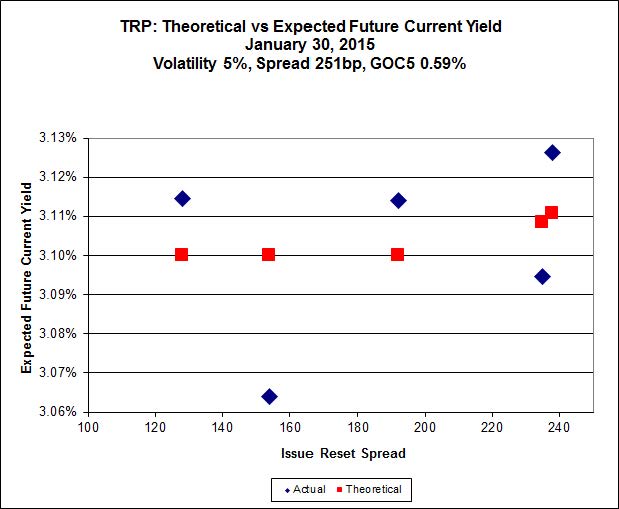
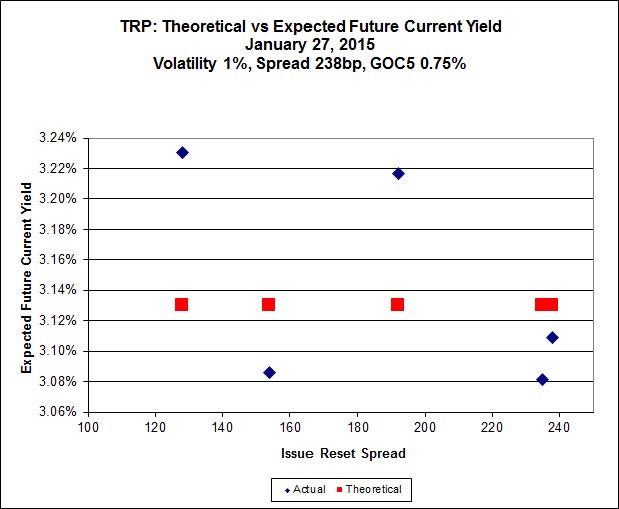
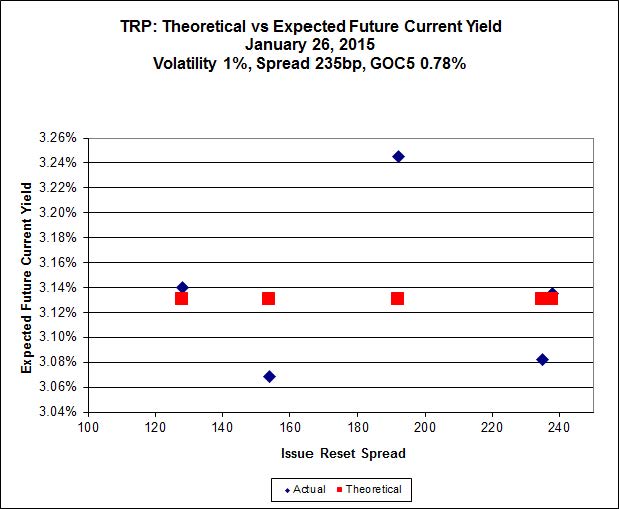
Here’s TRP:

ImpVol_TRP_141209
Click for Big

So according to this, TRP.PR.A, bid at 21.37, is $0.44 cheap, but it has already reset. TRP.PR.B, bid at 17.46, is $0.18 cheap, but it resets 2015-6-30. TRP.PR.C, bid at 19.55, is $0.21 expensive, but it resets 2016-1-30. The TRP issues seem to be steadily rationalizing.

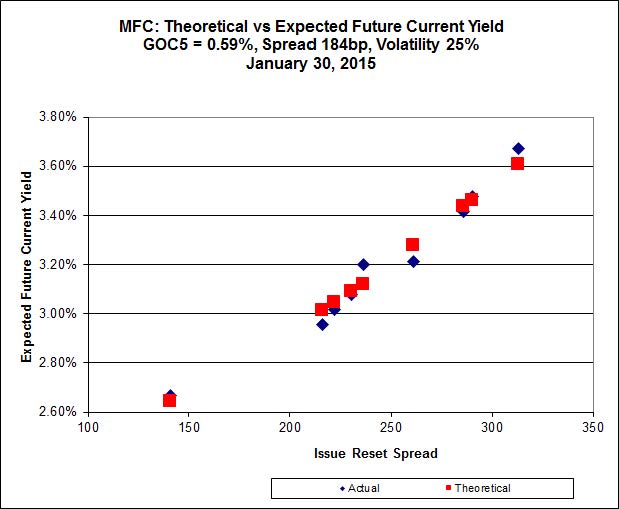
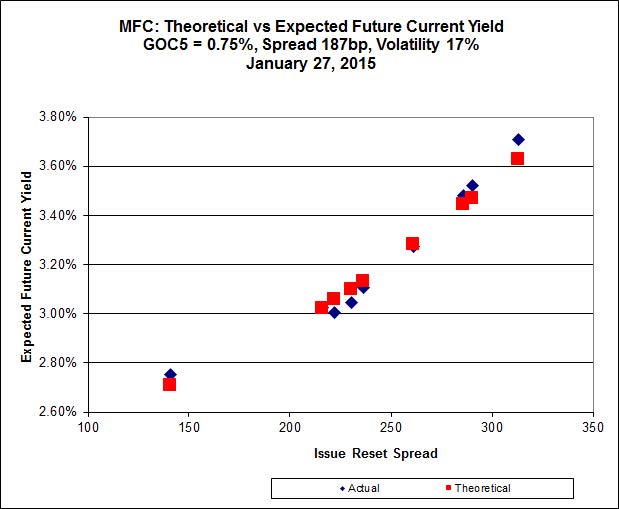
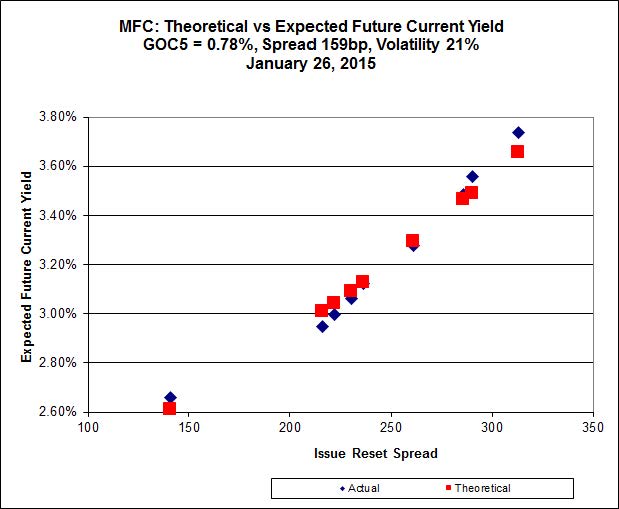
The MFC series is just weird.

ImpVol_MFC_141209
Click for Big

Clearly MFC.PR.F, resetting at +141 on 2016-06-19, is out of step with the others and is screwing up the calculation. To the extent that one can trust both Implied Volatility Theory AND the market’s reasonably more-or-less consistent application of it, MFC.PR.F should be bid significantly higher than its current 20.00 and the calculated Implied Volatility should be higher than the distorted value of 28%. The fit is pretty poor – all one can really tell is that the Spread is more than about 80bp and the Implied Volatility is more than about 13%.

ImpVol_MFC_varSpread_141209

Click for Big
ImpVol_MFC_varVol_141209
Click for Big

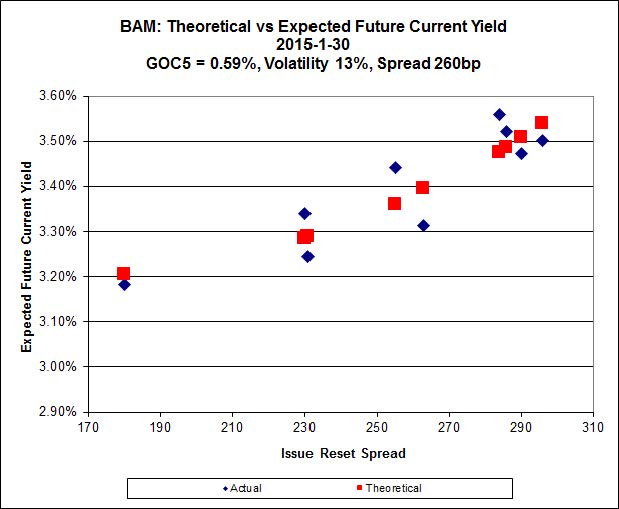
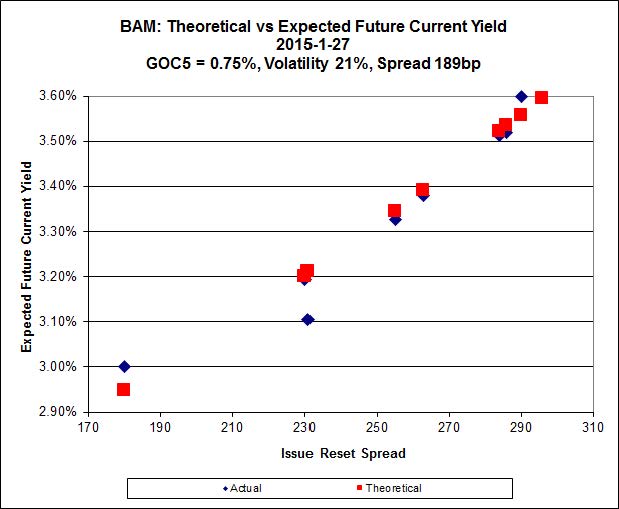
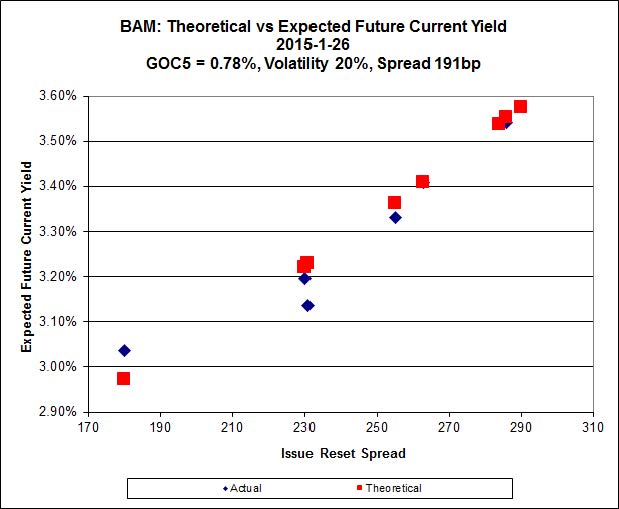
The BAM series is now also a little out of whack:

ImpVol_BAM_141209
Click for Big

BAM.PR.X, with a +180bp spread, bid at 20.91, looks $0.68 cheap and doesn’t reset until 2017-6-30 – but Implied Volatility continues to drop rapidly (a reduction in Implied Volatility flattens the curve and causes low-spread issues to underperform). BAM.PR.R, with a +230bp spread, bid at 25.34, looks $1.43 rich and resets 2016-6-30. So go figure that one out, wise guy.

ImpVol_FTS_141209

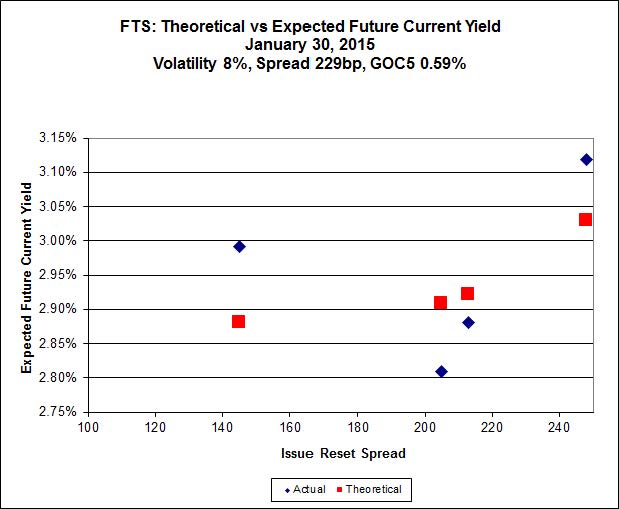
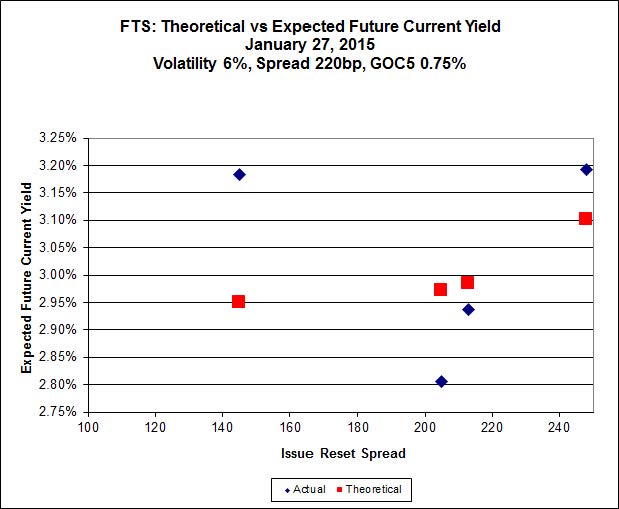
This is just weird because the middle is expensive and the ends are cheap but anyway … FTS.PR.H, with a spread of +145bp, and bid at 19.82, looks $0.35 cheap and resets 2015-6-1. FTS.PR.K, with a spread of +205bp, and bid at 24.62, looks $0.53 expensive and resets 2019-3-1

HIMIPref™ Preferred Indices
These values reflect the December 2008 revision of the HIMIPref™ Indices

Values are provisional and are finalized monthly
Index Mean
Current
Yield
(at bid)
Median
YTW
Median
Average
Trading
Value
Median
Mod Dur
(YTW)
Issues Day’s Perf. Index Value
Ratchet 0.00 % 0.00 % 0 0.00 0 -0.2129 % 2,523.2
FixedFloater 0.00 % 0.00 % 0 0.00 0 -0.2129 % 3,994.7
Floater 2.99 % 3.11 % 62,134 19.38 4 -0.2129 % 2,682.3
OpRet 4.41 % -6.18 % 28,767 0.08 2 -0.2345 % 2,752.0
SplitShare 4.29 % 4.01 % 39,096 3.73 5 0.0202 % 3,178.5
Interest-Bearing 0.00 % 0.00 % 0 0.00 0 -0.2345 % 2,516.4
Perpetual-Premium 5.44 % -1.52 % 72,150 0.09 20 0.0196 % 2,476.9
Perpetual-Discount 5.19 % 5.12 % 112,430 15.22 15 -0.4110 % 2,639.6
FixedReset 4.27 % 3.74 % 199,857 16.40 75 -0.3933 % 2,520.7
Deemed-Retractible 5.00 % 1.77 % 102,744 0.21 40 -0.2029 % 2,598.2
FloatingReset 2.54 % 1.89 % 60,996 3.47 5 0.0000 % 2,550.6
Performance Highlights
Issue Index Change Notes
MFC.PR.L FixedReset -3.99 % YTW SCENARIO
Maturity Type : Hard Maturity
Maturity Date : 2025-01-31
Maturity Price : 25.00
Evaluated at bid price : 24.06
Bid-YTW : 4.22 %
MFC.PR.F FixedReset -3.61 % YTW SCENARIO
Maturity Type : Hard Maturity
Maturity Date : 2025-01-31
Maturity Price : 25.00
Evaluated at bid price : 20.00
Bid-YTW : 5.72 %
ENB.PR.H FixedReset -3.18 % YTW SCENARIO
Maturity Type : Limit Maturity
Maturity Date : 2044-12-09
Maturity Price : 20.68
Evaluated at bid price : 20.68
Bid-YTW : 4.45 %
ENB.PF.C FixedReset -2.09 % YTW SCENARIO
Maturity Type : Limit Maturity
Maturity Date : 2044-12-09
Maturity Price : 22.73
Evaluated at bid price : 23.93
Bid-YTW : 4.31 %
ENB.PR.Y FixedReset -2.05 % YTW SCENARIO
Maturity Type : Limit Maturity
Maturity Date : 2044-12-09
Maturity Price : 21.65
Evaluated at bid price : 22.00
Bid-YTW : 4.40 %
ENB.PF.G FixedReset -2.01 % YTW SCENARIO
Maturity Type : Limit Maturity
Maturity Date : 2044-12-09
Maturity Price : 22.68
Evaluated at bid price : 23.86
Bid-YTW : 4.36 %
ENB.PF.A FixedReset -1.85 % YTW SCENARIO
Maturity Type : Limit Maturity
Maturity Date : 2044-12-09
Maturity Price : 22.73
Evaluated at bid price : 23.90
Bid-YTW : 4.33 %
ENB.PF.E FixedReset -1.69 % YTW SCENARIO
Maturity Type : Limit Maturity
Maturity Date : 2044-12-09
Maturity Price : 22.71
Evaluated at bid price : 23.90
Bid-YTW : 4.33 %
ENB.PR.F FixedReset -1.48 % YTW SCENARIO
Maturity Type : Limit Maturity
Maturity Date : 2044-12-09
Maturity Price : 22.53
Evaluated at bid price : 23.25
Bid-YTW : 4.24 %
ENB.PR.P FixedReset -1.38 % YTW SCENARIO
Maturity Type : Limit Maturity
Maturity Date : 2044-12-09
Maturity Price : 22.21
Evaluated at bid price : 22.80
Bid-YTW : 4.33 %
MFC.PR.B Deemed-Retractible -1.37 % YTW SCENARIO
Maturity Type : Hard Maturity
Maturity Date : 2025-01-31
Maturity Price : 25.00
Evaluated at bid price : 23.00
Bid-YTW : 5.72 %
CU.PR.C FixedReset -1.36 % YTW SCENARIO
Maturity Type : Call
Maturity Date : 2017-06-01
Maturity Price : 25.00
Evaluated at bid price : 25.30
Bid-YTW : 3.55 %
BAM.PR.R FixedReset -1.36 % YTW SCENARIO
Maturity Type : Limit Maturity
Maturity Date : 2044-12-09
Maturity Price : 23.83
Evaluated at bid price : 25.34
Bid-YTW : 3.79 %
CU.PR.D Perpetual-Discount -1.36 % YTW SCENARIO
Maturity Type : Limit Maturity
Maturity Date : 2044-12-09
Maturity Price : 23.61
Evaluated at bid price : 24.00
Bid-YTW : 5.12 %
GWO.PR.I Deemed-Retractible -1.35 % YTW SCENARIO
Maturity Type : Hard Maturity
Maturity Date : 2025-01-31
Maturity Price : 25.00
Evaluated at bid price : 22.69
Bid-YTW : 5.71 %
BAM.PR.X FixedReset -1.32 % YTW SCENARIO
Maturity Type : Limit Maturity
Maturity Date : 2044-12-09
Maturity Price : 20.91
Evaluated at bid price : 20.91
Bid-YTW : 4.18 %
TRP.PR.C FixedReset -1.26 % YTW SCENARIO
Maturity Type : Limit Maturity
Maturity Date : 2044-12-09
Maturity Price : 19.55
Evaluated at bid price : 19.55
Bid-YTW : 3.97 %
SLF.PR.B Deemed-Retractible -1.20 % YTW SCENARIO
Maturity Type : Hard Maturity
Maturity Date : 2025-01-31
Maturity Price : 25.00
Evaluated at bid price : 23.92
Bid-YTW : 5.35 %
ENB.PR.J FixedReset -1.17 % YTW SCENARIO
Maturity Type : Limit Maturity
Maturity Date : 2044-12-09
Maturity Price : 22.71
Evaluated at bid price : 23.74
Bid-YTW : 4.28 %
ENB.PR.N FixedReset -1.13 % YTW SCENARIO
Maturity Type : Limit Maturity
Maturity Date : 2044-12-09
Maturity Price : 22.67
Evaluated at bid price : 23.60
Bid-YTW : 4.28 %
CU.PR.E Perpetual-Discount -1.07 % YTW SCENARIO
Maturity Type : Limit Maturity
Maturity Date : 2044-12-09
Maturity Price : 23.61
Evaluated at bid price : 24.00
Bid-YTW : 5.12 %
SLF.PR.D Deemed-Retractible -1.01 % YTW SCENARIO
Maturity Type : Hard Maturity
Maturity Date : 2025-01-31
Maturity Price : 25.00
Evaluated at bid price : 22.60
Bid-YTW : 5.71 %
CGI.PR.D SplitShare 1.09 % YTW SCENARIO
Maturity Type : Soft Maturity
Maturity Date : 2023-06-14
Maturity Price : 25.00
Evaluated at bid price : 25.09
Bid-YTW : 3.71 %
MFC.PR.M FixedReset 1.37 % YTW SCENARIO
Maturity Type : Call
Maturity Date : 2019-12-19
Maturity Price : 25.00
Evaluated at bid price : 25.15
Bid-YTW : 3.76 %
TRP.PR.B FixedReset 1.51 % YTW SCENARIO
Maturity Type : Limit Maturity
Maturity Date : 2044-12-09
Maturity Price : 17.46
Evaluated at bid price : 17.46
Bid-YTW : 3.95 %
SLF.PR.G FixedReset 3.40 % YTW SCENARIO
Maturity Type : Hard Maturity
Maturity Date : 2025-01-31
Maturity Price : 25.00
Evaluated at bid price : 19.75
Bid-YTW : 5.66 %
Volume Highlights
Issue Index Shares
Traded
Notes
HSE.PR.C FixedReset 619,946 New issue settled today.
YTW SCENARIO
Maturity Type : Limit Maturity
Maturity Date : 2044-12-09
Maturity Price : 23.16
Evaluated at bid price : 25.01
Bid-YTW : 4.46 %
BMO.PR.P FixedReset 133,054 YTW SCENARIO
Maturity Type : Call
Maturity Date : 2015-02-25
Maturity Price : 25.00
Evaluated at bid price : 25.32
Bid-YTW : 0.37 %
IAG.PR.E Deemed-Retractible 125,050 YTW SCENARIO
Maturity Type : Call
Maturity Date : 2015-01-30
Maturity Price : 26.00
Evaluated at bid price : 25.97
Bid-YTW : 4.17 %
TRP.PR.A FixedReset 113,648 YTW SCENARIO
Maturity Type : Limit Maturity
Maturity Date : 2044-12-09
Maturity Price : 21.37
Evaluated at bid price : 21.37
Bid-YTW : 3.95 %
ENB.PR.D FixedReset 83,910 YTW SCENARIO
Maturity Type : Limit Maturity
Maturity Date : 2044-12-09
Maturity Price : 22.41
Evaluated at bid price : 23.00
Bid-YTW : 4.17 %
TD.PF.B FixedReset 77,745 YTW SCENARIO
Maturity Type : Limit Maturity
Maturity Date : 2044-12-09
Maturity Price : 23.21
Evaluated at bid price : 25.07
Bid-YTW : 3.63 %
There were 39 other index-included issues trading in excess of 10,000 shares.
Wide Spread Highlights
Issue Index Quote Data and Yield Notes
MFC.PR.L FixedReset Quote: 24.06 – 25.06
Spot Rate : 1.0000
Average : 0.5532

YTW SCENARIO
Maturity Type : Hard Maturity
Maturity Date : 2025-01-31
Maturity Price : 25.00
Evaluated at bid price : 24.06
Bid-YTW : 4.22 %

PVS.PR.C SplitShare Quote: 25.61 – 26.83
Spot Rate : 1.2200
Average : 0.8660

YTW SCENARIO
Maturity Type : Hard Maturity
Maturity Date : 2017-12-10
Maturity Price : 25.00
Evaluated at bid price : 25.61
Bid-YTW : 4.01 %

ELF.PR.H Perpetual-Premium Quote: 25.35 – 26.00
Spot Rate : 0.6500
Average : 0.4410

YTW SCENARIO
Maturity Type : Limit Maturity
Maturity Date : 2044-12-09
Maturity Price : 24.88
Evaluated at bid price : 25.35
Bid-YTW : 5.49 %

GWO.PR.N FixedReset Quote: 19.36 – 19.99
Spot Rate : 0.6300
Average : 0.4257

YTW SCENARIO
Maturity Type : Hard Maturity
Maturity Date : 2025-01-31
Maturity Price : 25.00
Evaluated at bid price : 19.36
Bid-YTW : 5.81 %

TRP.PR.C FixedReset Quote: 19.55 – 20.14
Spot Rate : 0.5900
Average : 0.4054

YTW SCENARIO
Maturity Type : Limit Maturity
Maturity Date : 2044-12-09
Maturity Price : 19.55
Evaluated at bid price : 19.55
Bid-YTW : 3.97 %

TRP.PR.D FixedReset Quote: 24.90 – 25.34
Spot Rate : 0.4400
Average : 0.2816

YTW SCENARIO
Maturity Type : Limit Maturity
Maturity Date : 2044-12-09
Maturity Price : 23.18
Evaluated at bid price : 24.90
Bid-YTW : 3.80 %

Issue Comments

HSE.PR.C Closes Firm On Decent Volume

Husky Energy has announced that it:

has completed its recently announced public offering of 10 million Cumulative Rate Reset Preferred Shares, Series 3 (the “Series 3 Shares”).

The aggregate gross proceeds to Husky from the completed upsized offering is $250 million.

The net proceeds from this offering will be used to further support the Company’s strong balance sheet and business plan as well as for general corporate purposes, which may include, among other things, the partial repayment of the 3.75% medium-term notes due in 2015.

The Series 3 Shares were offered by way of prospectus supplement dated December 2, 2014 under Husky’s existing short form base shelf prospectus.

Holders of the Series 3 Shares are entitled to receive a cumulative quarterly fixed dividend yielding 4.50 percent annually for the initial period ending December 31, 2019. Thereafter, the dividend rate will be reset every five years at a rate equal to the five-year Government of Canada bond yield plus 3.13 percent.

Holders of Series 3 Shares will have the right, at their option, to convert their shares into Cumulative Rate Reset Preferred Shares, Series 4 (the “Series 4 Shares”), subject to certain conditions, on December 31, 2019 and on December 31 every five years thereafter. Holders of the Series 4 Shares will be entitled to receive cumulative quarterly floating dividends at a rate equal to the 90-day Government of Canada Treasury Bill yield plus 3.13 percent.

The Series 3 Shares are listed on the Toronto Stock Exchange under the symbol HSE.PR.C.

HSE.PR.C is a FixedReset, 4.50%+313, announced December 1. The issue will be tracked by HIMIPref™ and has been assigned to the FixedResets subindex.

The issue traded 764,846 shares today (consolidated exchanges) in a range of 24.70-05 before closing at 25.01-05. Vital statistics are:

HSE.PR.C FixedReset YTW SCENARIO
Maturity Type : Limit Maturity
Maturity Date : 2044-12-09
Maturity Price : 23.16
Evaluated at bid price : 25.01
Bid-YTW : 4.46 %
Market Action

December 8, 2014

Assiduous Reader JP, who often sends me interesting snippets, unlike youse other bums, brings to my attention a small preferred share issue from China:

Industrial and Commercial Bank of China will issue US$5.7 billion worth of preferred shares in three currencies in what will be the largest offshore issuance of hybrid securities from a mainland firm.

ICBC proposed issuing US$2.94 billion in dollar-denominated shares, €600 million (HK$5.73 billion) and 12 billion yuan (HK$15.13 billion) all priced at 6 per cent, according to a regulatory filing.

The shares will count as additional tier-1 capital, boosting the bank’s capital adequacy ratio as defined by Basel III, an international accord aimed at raising the viability of banks and avoiding public bailouts.

The record deal also marked the first time a mainland bank issued offshore preferred shares denominated in three currencies.

ICBC International was the sole global coordinator and UBS, Bank of America Merrill Lynch and Goldman Sachs were joint book-runners on the deal.

It’s nice to see some real progress on solar power efficiency:

UNSW’s solar researchers have converted over 40% of the sunlight hitting a solar system into electricity, the highest efficiency ever reported.

The world-beating efficiency was achieved in outdoor tests in Sydney, before being independently confirmed by the National Renewable Energy Laboratory (NREL) at their outdoor test facility in the United States.

The work was funded by the Australian Renewable Energy Agency (ARENA) and supported by the Australia–US Institute for Advanced Photovoltaics (AUSIAPV).

“This is the highest efficiency ever reported for sunlight conversion into electricity,” UNSW Scientia Professor and Director of the Australian Centre for Advanced Photovoltaics (ACAP) Professor Martin Green said.

The price wasn’t mentioned, but the basic idea comes first, right? Then give it to the engineers to make it cheap. Too bad this research wasn’t done in Ontari-ari-ari-owe, but we blew our solar budget on political grandstanding.

After posting the MAPF November statements, I posted the following on the Canada Post Facebook Page:

I just sent a batch of letters with Madonna & Child stamps when a thought struck me and caused me to check your website.

I see your “Holiday 2014” collection is dominated by Santa Claus – rather childish in my view, but the important thing is that they are stamps and you stick them on letters and they get delivered.

But why are there no stamps with an Islamic theme? No Jewish stamps? No stamps for Kwanzai, Bohdi Day, Pancha Ganapati or Yule? It would make things more interesting.

It was an awful day for equities:

Oil, bank and raw-materials are the biggest laggards in Canada for the first time since at least 1988, fueling concern the nation’s economy is fading just as the U.S. is taking off.

The three industries, which collectively account for two-thirds of the Standard & Poor’s/TSX Composite Index, are the worst performers among 10 groups this year, according to data compiled by Bloomberg. The nation’s largest banks joined oil and materials in a rout that erased 4.1 percent from the benchmark index in three days, including the biggest one-day retreat since June 2013.

The selloff in the biggest pillars of the Canadian equity market comes as data showing a weaker jobs market coupled with slowing exports suggest a tentative economic recovery. Banks have slumped as earnings last week collectively missed estimates amid declining trading revenue and sluggish consumer borrowing. Meanwhile, the S&P 500 Index has reached all-time highs on signs of accelerating growth.

The S&P 500/TSX tumbled 329.53 points, or 2.3 percent, to 14,144.17 yesterday as the selloff in oil accelerated, with energy companies plunging the most since August 2011 as crude dropped to a five-year low.

The Canadian benchmark equity gauge has plunged 9.7 percent since reaching a record on Sept. 3, wiping out more than C$270 billion in market value and reducing its gain for the year to 3.8 percent. The S&P/TSX, which was the second-best performing market among developed nations through the first half of the year, now ranks 16th.

Happy crowds of preferred share investors held parades for their portfolios today.

funeralProcession
Click for Big

And with TXPR and TXPL down 0.76% and 0.96%, why not?

It was an appallingly poor day for the Canadian preferred share market, with PerpetualDiscounts off 24bp, FixedResets losing 85bp and DeemedRetractibles down 36bp. There is a very lengthy list of losers, dominated by FixedResets. Volume was high.

And given these massive changes, let’s have another look at some pictures of Implied Volatility. Remember that all rich /cheap assessments are

  • based on Implied Volatility Theory only
  • are relative only to other FixedResets from the same issuer
  • assume constant GOC-5 yield
  • assume constant Implied Volatility
  • assume constant spread

Here’s TRP:

ImpVol_TRP_141208A
Click for Big

So according to this, TRP.PR.A, bid at 21.36, is $0.57 cheap, but it has already reset. TRP.PR.B, bid at 17.20, is $0.55 cheap, but it resets 2015-6-30. TRP.PR.C, bid at 19.75, is $0.30 expensive, but it resets 2016-1-30. It looks like the market is beginning to realize that TRP.PR.C is overpriced.

ImpVol_MFC_141208
Click for Big

MFC implied volatility is still very high. The low-spread MFC.PR.F looks a little cheap … and it doesn’t reset until 2016-6-19.

ImpVol_BAM_141208
Click for Big

BAM.PR.X, with a +180bp spread, bid at 21.15, looks $0.79 cheap and doesn’t reset until 2017-6-30 – but Implied Volatility is still a little high and is dropping rapidly (a reduction in Implied Volatility flattens the curve and causes low-spread issues to underperform). BAM.PR.R, with a +230bp spread, bid at 25.51, looks $1.56 rich and resets 2016-6-30. So go figure that one out, wise guy.

ImpVol_FTS_141208
Click for Big

This is just weird because the middle is expensive and the ends are cheap but anyway … FTS.PR.H, with a spread of +145bp, and bid at 20.00, looks $0.41 cheap and resets 2015-6-1. FTS.PR.K, with a spread of +205bp, and bid at 24.70, looks $0.54 expensive and resets 2019-3-1

HIMIPref™ Preferred Indices
These values reflect the December 2008 revision of the HIMIPref™ Indices

Values are provisional and are finalized monthly
Index Mean
Current
Yield
(at bid)
Median
YTW
Median
Average
Trading
Value
Median
Mod Dur
(YTW)
Issues Day’s Perf. Index Value
Ratchet 0.00 % 0.00 % 0 0.00 0 -0.3254 % 2,528.6
FixedFloater 0.00 % 0.00 % 0 0.00 0 -0.3254 % 4,003.2
Floater 2.98 % 3.09 % 62,509 19.42 4 -0.3254 % 2,688.0
OpRet 4.40 % -11.74 % 26,639 0.08 2 -0.0195 % 2,758.5
SplitShare 4.30 % 3.92 % 40,711 3.73 5 -0.2697 % 3,177.9
Interest-Bearing 0.00 % 0.00 % 0 0.00 0 -0.0195 % 2,522.4
Perpetual-Premium 5.44 % -1.70 % 70,645 0.08 20 -0.4542 % 2,476.4
Perpetual-Discount 5.17 % 5.11 % 113,618 15.27 15 -0.2392 % 2,650.5
FixedReset 4.25 % 3.71 % 182,150 16.54 74 -0.8512 % 2,530.6
Deemed-Retractible 4.99 % 0.67 % 103,056 0.14 40 -0.3755 % 2,603.5
FloatingReset 2.54 % 1.89 % 60,065 0.08 5 -0.0861 % 2,550.6
Performance Highlights
Issue Index Change Notes
TRP.PR.C FixedReset -3.51 % YTW SCENARIO
Maturity Type : Limit Maturity
Maturity Date : 2044-12-08
Maturity Price : 19.80
Evaluated at bid price : 19.80
Bid-YTW : 3.92 %
ENB.PR.T FixedReset -3.49 % YTW SCENARIO
Maturity Type : Limit Maturity
Maturity Date : 2044-12-08
Maturity Price : 22.28
Evaluated at bid price : 22.95
Bid-YTW : 4.30 %
PWF.PR.P FixedReset -3.36 % YTW SCENARIO
Maturity Type : Limit Maturity
Maturity Date : 2044-12-08
Maturity Price : 20.40
Evaluated at bid price : 20.40
Bid-YTW : 3.87 %
MFC.PR.F FixedReset -3.35 % YTW SCENARIO
Maturity Type : Hard Maturity
Maturity Date : 2025-01-31
Maturity Price : 25.00
Evaluated at bid price : 20.75
Bid-YTW : 5.27 %
SLF.PR.G FixedReset -3.05 % YTW SCENARIO
Maturity Type : Hard Maturity
Maturity Date : 2025-01-31
Maturity Price : 25.00
Evaluated at bid price : 19.10
Bid-YTW : 6.06 %
ENB.PR.P FixedReset -2.49 % YTW SCENARIO
Maturity Type : Limit Maturity
Maturity Date : 2044-12-08
Maturity Price : 22.39
Evaluated at bid price : 23.12
Bid-YTW : 4.26 %
MFC.PR.I FixedReset -2.38 % YTW SCENARIO
Maturity Type : Call
Maturity Date : 2017-09-19
Maturity Price : 25.00
Evaluated at bid price : 25.42
Bid-YTW : 3.73 %
GWO.PR.N FixedReset -2.37 % YTW SCENARIO
Maturity Type : Hard Maturity
Maturity Date : 2025-01-31
Maturity Price : 25.00
Evaluated at bid price : 19.33
Bid-YTW : 5.83 %
HSE.PR.A FixedReset -2.27 % YTW SCENARIO
Maturity Type : Limit Maturity
Maturity Date : 2044-12-08
Maturity Price : 19.35
Evaluated at bid price : 19.35
Bid-YTW : 4.21 %
ENB.PR.J FixedReset -2.16 % YTW SCENARIO
Maturity Type : Limit Maturity
Maturity Date : 2044-12-08
Maturity Price : 22.84
Evaluated at bid price : 24.02
Bid-YTW : 4.21 %
ENB.PR.F FixedReset -1.87 % YTW SCENARIO
Maturity Type : Limit Maturity
Maturity Date : 2044-12-08
Maturity Price : 22.72
Evaluated at bid price : 23.60
Bid-YTW : 4.17 %
ENB.PF.E FixedReset -1.86 % YTW SCENARIO
Maturity Type : Limit Maturity
Maturity Date : 2044-12-08
Maturity Price : 22.88
Evaluated at bid price : 24.31
Bid-YTW : 4.24 %
ENB.PF.G FixedReset -1.85 % YTW SCENARIO
Maturity Type : Limit Maturity
Maturity Date : 2044-12-08
Maturity Price : 22.88
Evaluated at bid price : 24.35
Bid-YTW : 4.25 %
ENB.PF.A FixedReset -1.81 % YTW SCENARIO
Maturity Type : Limit Maturity
Maturity Date : 2044-12-08
Maturity Price : 22.92
Evaluated at bid price : 24.35
Bid-YTW : 4.22 %
MFC.PR.M FixedReset -1.74 % YTW SCENARIO
Maturity Type : Hard Maturity
Maturity Date : 2025-01-31
Maturity Price : 25.00
Evaluated at bid price : 24.81
Bid-YTW : 3.95 %
MFC.PR.C Deemed-Retractible -1.67 % YTW SCENARIO
Maturity Type : Hard Maturity
Maturity Date : 2025-01-31
Maturity Price : 25.00
Evaluated at bid price : 22.41
Bid-YTW : 5.89 %
BNS.PR.Y FixedReset -1.62 % YTW SCENARIO
Maturity Type : Hard Maturity
Maturity Date : 2022-01-31
Maturity Price : 25.00
Evaluated at bid price : 23.67
Bid-YTW : 3.44 %
IGM.PR.B Perpetual-Premium -1.52 % YTW SCENARIO
Maturity Type : Call
Maturity Date : 2018-12-31
Maturity Price : 25.00
Evaluated at bid price : 26.00
Bid-YTW : 5.00 %
ENB.PF.C FixedReset -1.45 % YTW SCENARIO
Maturity Type : Limit Maturity
Maturity Date : 2044-12-08
Maturity Price : 22.94
Evaluated at bid price : 24.44
Bid-YTW : 4.19 %
SLF.PR.A Deemed-Retractible -1.39 % YTW SCENARIO
Maturity Type : Hard Maturity
Maturity Date : 2025-01-31
Maturity Price : 25.00
Evaluated at bid price : 24.11
Bid-YTW : 5.20 %
GWO.PR.Q Deemed-Retractible -1.37 % YTW SCENARIO
Maturity Type : Hard Maturity
Maturity Date : 2025-01-31
Maturity Price : 25.00
Evaluated at bid price : 25.15
Bid-YTW : 5.06 %
BAM.PR.T FixedReset -1.36 % YTW SCENARIO
Maturity Type : Limit Maturity
Maturity Date : 2044-12-08
Maturity Price : 23.36
Evaluated at bid price : 24.61
Bid-YTW : 3.88 %
SLF.PR.E Deemed-Retractible -1.34 % YTW SCENARIO
Maturity Type : Hard Maturity
Maturity Date : 2025-01-31
Maturity Price : 25.00
Evaluated at bid price : 22.77
Bid-YTW : 5.66 %
ENB.PR.D FixedReset -1.33 % YTW SCENARIO
Maturity Type : Limit Maturity
Maturity Date : 2044-12-08
Maturity Price : 22.44
Evaluated at bid price : 23.05
Bid-YTW : 4.16 %
POW.PR.G Perpetual-Premium -1.30 % YTW SCENARIO
Maturity Type : Call
Maturity Date : 2021-04-15
Maturity Price : 25.00
Evaluated at bid price : 26.65
Bid-YTW : 4.57 %
ENB.PR.H FixedReset -1.25 % YTW SCENARIO
Maturity Type : Limit Maturity
Maturity Date : 2044-12-08
Maturity Price : 21.36
Evaluated at bid price : 21.36
Bid-YTW : 4.30 %
ELF.PR.H Perpetual-Premium -1.17 % YTW SCENARIO
Maturity Type : Limit Maturity
Maturity Date : 2044-12-08
Maturity Price : 24.83
Evaluated at bid price : 25.30
Bid-YTW : 5.50 %
PWF.PR.T FixedReset -1.16 % YTW SCENARIO
Maturity Type : Limit Maturity
Maturity Date : 2044-12-08
Maturity Price : 23.39
Evaluated at bid price : 25.50
Bid-YTW : 3.71 %
SLF.PR.B Deemed-Retractible -1.14 % YTW SCENARIO
Maturity Type : Hard Maturity
Maturity Date : 2025-01-31
Maturity Price : 25.00
Evaluated at bid price : 24.21
Bid-YTW : 5.20 %
PWF.PR.R Perpetual-Premium -1.10 % YTW SCENARIO
Maturity Type : Call
Maturity Date : 2021-04-30
Maturity Price : 25.00
Evaluated at bid price : 26.06
Bid-YTW : 4.85 %
GWO.PR.I Deemed-Retractible -1.08 % YTW SCENARIO
Maturity Type : Hard Maturity
Maturity Date : 2025-01-31
Maturity Price : 25.00
Evaluated at bid price : 23.00
Bid-YTW : 5.53 %
SLF.PR.I FixedReset -1.04 % YTW SCENARIO
Maturity Type : Call
Maturity Date : 2016-12-31
Maturity Price : 25.00
Evaluated at bid price : 25.78
Bid-YTW : 2.56 %
BAM.PF.C Perpetual-Discount -1.01 % YTW SCENARIO
Maturity Type : Limit Maturity
Maturity Date : 2044-12-08
Maturity Price : 21.27
Evaluated at bid price : 21.56
Bid-YTW : 5.72 %
Volume Highlights
Issue Index Shares
Traded
Notes
BMO.PR.P FixedReset 259,575 Desjardins crossed 200,000 at 25.32. TD crossed 53,600 at the same price.
YTW SCENARIO
Maturity Type : Call
Maturity Date : 2015-02-25
Maturity Price : 25.00
Evaluated at bid price : 25.30
Bid-YTW : 0.73 %
TRP.PR.A FixedReset 182,016 Will reset to 3.266% effective December 31. Nesbitt crossed 30,000 at 21.36. TD crossed 25,000 at the same price and Scotia crossed 30,000 at the same price again.
YTW SCENARIO
Maturity Type : Limit Maturity
Maturity Date : 2044-12-08
Maturity Price : 21.36
Evaluated at bid price : 21.36
Bid-YTW : 3.95 %
ENB.PR.T FixedReset 102,709 RBC crossed 50,700 at 23.15 and 21,800 at 23.00.
YTW SCENARIO
Maturity Type : Limit Maturity
Maturity Date : 2044-12-08
Maturity Price : 22.28
Evaluated at bid price : 22.95
Bid-YTW : 4.30 %
BAM.PF.F FixedReset 87,304 Desjardins crossed 75,000 at 25.70.
YTW SCENARIO
Maturity Type : Call
Maturity Date : 2019-09-30
Maturity Price : 25.00
Evaluated at bid price : 25.68
Bid-YTW : 4.09 %
FTS.PR.M FixedReset 73,932 RBC crossed 70,000 at 25.60.
YTW SCENARIO
Maturity Type : Call
Maturity Date : 2019-12-01
Maturity Price : 25.00
Evaluated at bid price : 25.50
Bid-YTW : 3.69 %
MFC.PR.M FixedReset 54,843 Scotia crossed 35,000 at 25.25.
YTW SCENARIO
Maturity Type : Hard Maturity
Maturity Date : 2025-01-31
Maturity Price : 25.00
Evaluated at bid price : 24.81
Bid-YTW : 3.95 %
There were 41 other index-included issues trading in excess of 10,000 shares.
Wide Spread Highlights
Issue Index Quote Data and Yield Notes
PWF.PR.A Floater Quote: 19.20 – 20.20
Spot Rate : 1.0000
Average : 0.6772

YTW SCENARIO
Maturity Type : Limit Maturity
Maturity Date : 2044-12-08
Maturity Price : 19.20
Evaluated at bid price : 19.20
Bid-YTW : 2.75 %

MFC.PR.I FixedReset Quote: 25.42 – 25.95
Spot Rate : 0.5300
Average : 0.3221

YTW SCENARIO
Maturity Type : Call
Maturity Date : 2017-09-19
Maturity Price : 25.00
Evaluated at bid price : 25.42
Bid-YTW : 3.73 %

IGM.PR.B Perpetual-Premium Quote: 26.00 – 26.46
Spot Rate : 0.4600
Average : 0.2744

YTW SCENARIO
Maturity Type : Call
Maturity Date : 2018-12-31
Maturity Price : 25.00
Evaluated at bid price : 26.00
Bid-YTW : 5.00 %

MFC.PR.M FixedReset Quote: 24.81 – 25.23
Spot Rate : 0.4200
Average : 0.2506

YTW SCENARIO
Maturity Type : Hard Maturity
Maturity Date : 2025-01-31
Maturity Price : 25.00
Evaluated at bid price : 24.81
Bid-YTW : 3.95 %

MFC.PR.F FixedReset Quote: 20.75 – 21.20
Spot Rate : 0.4500
Average : 0.2812

YTW SCENARIO
Maturity Type : Hard Maturity
Maturity Date : 2025-01-31
Maturity Price : 25.00
Evaluated at bid price : 20.75
Bid-YTW : 5.27 %

MFC.PR.C Deemed-Retractible Quote: 22.41 – 23.10
Spot Rate : 0.6900
Average : 0.5286

YTW SCENARIO
Maturity Type : Hard Maturity
Maturity Date : 2025-01-31
Maturity Price : 25.00
Evaluated at bid price : 22.41
Bid-YTW : 5.89 %

New Issues

New Issue: CM FixedReset, 3.75%+224

The Canadian Imperial Bank of Commerce has announced:

that it had entered into an agreement with a group of underwriters led by CIBC World Markets Inc. for an issue of 10 million Basel III-compliant non-cumulative Rate Reset Class A Preferred Shares, Series 41 (the “Series 41 Shares”) priced at $25.00 per Series 41 Share to raise gross proceeds of $250 million.

CIBC has granted the underwriters an option to purchase up to an additional two million Series 41 Shares at the same offering price, exercisable at any time up to two days prior to closing. Should the underwriters’ option be fully exercised, the total gross proceeds of the financing will be $300 million.

The Series 41 Shares will yield 3.75% per annum, payable quarterly, as and when declared by the Board of Directors of CIBC, for an initial period ending January 31, 2020. On January 31, 2020, and on January 31 every five years thereafter, the dividend rate will reset to be equal to the then current five-year Government of Canada bond yield plus 2.24%.

Subject to regulatory approval and certain provisions of the Series 41 Shares, on January 31, 2020 and on January 31 every five years thereafter, CIBC may, at its option, redeem all or any part of the then outstanding Series 41 Shares at par.

Subject to the right of redemption, holders of the Series 41 Shares will have the right to convert their shares into non-cumulative Floating Rate Class A Preferred Shares, Series 42 (the “Series 42 Shares”), subject to certain conditions, on January 31, 2020 and on January 31 every five years thereafter. Holders of the Series 42 Shares will be entitled to receive a quarterly floating rate dividend, as and when declared by the Board of Directors of CIBC, equal to the three-month Government of Canada Treasury Bill yield plus 2.24%.

Holders of the Series 42 Shares may convert their Series 42 Shares into Series 41 Shares, subject to certain conditions, on January 31, 2025 and on January 31 every five years thereafter.

The expected closing date is December 16, 2014. CIBC will make an application to list the Series 41 Shares as of the closing date on the Toronto Stock Exchange. The net proceeds of this offering will be used for general purposes of CIBC.

CM has only one other FixedReset outstanding, CM.PR.O, which is a NVCC-compliant FixedReset, 3.90%+232, which commenced trading 2014-6-11 after being announced 2014-6-2.

Issue Comments

CM.PR.E To Be Redeemed

The Canadian Imperial Bank of Commerce has announced:

its intention to redeem all of its issued and outstanding Non-cumulative Class A Preferred Shares Series 27 (TSX: CM.PR.E), for cash. The redemption will occur on January 31, 2015. The redemption price is $25.00 per Series 27 share.

The $0.350000 quarterly dividend announced on December 4, 2014 will be the final dividend on the Series 27 shares and will be paid on January 28, 2015, covering the period to January 31, 2015, to shareholders of record on December 29, 2014.

Holders of the Series 27 shares should contact the financial institution, broker or other intermediary through which they hold the shares to confirm how they will receive their redemption proceeds.

CM.PR.E is a NVCC-compliant Straight Perpetual paying 5.60% of par. It has been tracked by HIMIPref™ and is currently assigned to the PerpetualPremium index.

New Issues

New Issue: TD FixedReset, 3.75%+225

The Toronto-Dominion Bank has announced:

a domestic public offering of Non-Cumulative 5-Year Rate Reset Preferred Shares, Series 5 (the “Series 5 Shares”).

TD has entered into an agreement with a group of underwriters led by TD Securities Inc. to issue, on a bought deal basis, 12 million Series 5 Shares at a price of $25.00 per share to raise gross proceeds of $300 million. TD has also granted the underwriters an option to purchase, on the same terms, up to an additional 2 million Series 5 Shares. This option is exercisable in whole or in part by the underwriters at any time up to two business days prior to closing.

The Series 5 Shares will yield 3.75% annually, payable quarterly, as and when declared by the Board of Directors of TD, for the initial period ending January 31, 2020. Thereafter, the dividend rate will reset every five years at a level of 2.25% over the then five-year Government of Canada bond yield.

Subject to regulatory approval, on January 31, 2020 and on January 31 every 5 years thereafter, TD may redeem the Series 5 Shares, in whole or in part, at $25.00 per share. Subject to TD’s right of redemption, holders of the Series 5 Shares will have the right to convert their shares into Non-Cumulative Floating Rate Preferred Shares, Series 6 (the “Series 6 Shares”), subject to certain conditions, on January 31, 2020, and on January 31 every five years thereafter. Holders of the Series 6 Shares will be entitled to receive quarterly floating dividends, as and when declared by the Board of Directors of TD, equal to the three-month Government of Canada Treasury bill yield plus 2.25%.

The expected closing date is December 16, 2014. TD will make an application to list the Series 5 Shares as of the closing date on the Toronto Stock Exchange. The net proceeds of the offering will be used for general corporate purposes.

Later, they announced:

that as a result of strong investor demand for its previously announced domestic public offering of Non-Cumulative 5-Year Rate Reset Preferred Shares, Series 5 (the “Series 5 Shares”), the size of the offering has been increased to 20 million Series 5 Shares. The gross proceeds of the offering will now be $500 million. The offering will be underwritten by a group of underwriters led by TD Securities Inc.

I can’t say the Implied Volatility calculation is particularly helpful, but I’ll show it anyway:

impVol_TD_141205
Click for Big
Market Action

December 5, 2014

Jobs, jobs, jobs!

A November surprise that included a jump in wages as well as the biggest hiring surge in almost three years suggests the world’s largest economy is putting aside doubts about the strength of the expansion.

The 321,000 advance in payrolls followed a 243,000 increase in October that was stronger than previously reported, Labor Department figures showed today in Washington. The jobless rate held at a six-year low of 5.8 percent and earnings rose by the most since June of last year.

The breadth of industries hiring last month was the broadest since 1998, a sign the benefits of the expansion were rippling through the economy.

Factory payrolls rose by the most in a year, professional and business services companies took on more employees than at any time since November 2010, financial firms boosted payrolls by the most since early 2012 and hiring at retailers picked up.

The yield on the benchmark 10-year Treasury note rose to 2.31 percent at 2:47 p.m. in New York from 2.24 percent late yesterday. The Bloomberg Dollar Spot Index, which tracks the greenback against 10 trading partners, gained 0.8 percent, and the Standard & Poor’s 500 Index advanced 0.2 percent.

Up north, not so much:

The Canadian dollar reached a five-year low as data showed the economy lost jobs in November while U.S. payrolls swelled, adding to speculation the Federal Reserve will raise interest rates before the Bank of Canada.

The currency erased a weekly gain as the report showed employment fell by 10,700 jobs. The drop bolstered a Bank of Canada statement this week that, while the recovery shows signs of broadening, the labor market “continues to indicate significant slack in the economy.” The nation added 117,200 jobs over the previous two months.

Canadian government bonds fell, pushing the yield on the benchmark 10-year security up five basis points, or 0.05 percentage point, to 1.96 percent. It reached 1.98 percent, the highest level since Nov. 25. The price of the debt dropped 46 cents to C$104.67.

Employment declined after jumps of 43,100 and 74,100 the last two months, Statistics Canada said today from Ottawa. The unemployment rate rose to 6.6 percent from a six-year low of 6.5 percent. Economists surveyed by Bloomberg News projected employment would be unchanged and the jobless rate would rise to 6.6 percent, according to median forecasts.

And things are still sluggish in Germany:

But Germany’s Bundesbank halved its 2015 growth forecast for Germany to 1.0 per cent and also cut its estimate for this year to 1.4 per cent from a forecast of 1.9 per cent made in June. It also trimmed its prediction for 2016 to 1.6 per cent.

“However, there is reason to hope that the current sluggish phase will prove to be short-lived,” Bundesbank President Jens Weidmann said in a statement, adding that opportunities abroad would likely increase again next year.

He also said that if crude oil prices remained subdued for a longer period, gross domestic product (GDP) could expand by an additional 0.1-0.2 percentage points in both 2015 and 2016.

… and in Italy:

Standard & Poor’s cut Italy’s sovereign credit rating on Friday from triple-B to triple-B-minus, just one notch above junk, saying weak growth and poor competitiveness undermined the sustainability of its huge public debt.

The downgrade is a blow for Prime Minister Matteo Renzi, who came to office in February pledging an ambitious reform agenda to lift Italy out of recession, but has seen the economy continue to shrink.

S&P said the new triple-B-minus rating carried a stable outlook. It forecast Italian economic growth would be just 0.2 per cent in 2015 and would average 0.5 per cent in 2014-2017.

As recently as June, the agency had confirmed Italy’s triple-B rating and forecast average growth of 1.0 per cent over the three-year period.

Italy’s economy is expected to shrink in 2014 for the third consecutive year.

There’s an interesting paper by Gregory Thwaites titled Why are real interest rates so low? Secular stagnation and the relative price of investment goods:

Over the past four decades, real interest rates have risen then fallen across the industrialised world. Over the same period, nominal investment rates are down, while house prices and household debt are up. I explain these four trends with a fifth – the widespread fall in the relative price of investment goods. I present a simple closed-economy OLG model in which households finance retirement in part by selling claims on the corporate sector (capital goods) accumulated over their working lives. As capital goods prices fall, the interest rate must fall to reflect capital losses. And in the long run, a given quantity of saving buys more capital goods. This has ambiguous effects on interest rates in the long run: if the production function is inelastic, in line with most estimates in the literature, interest rates stay low even after relative prices have stopped falling. Lower interest rates reduce the user cost of housing, raising house prices and, given that housing is bought early in life, increasing household debt. I extend the model to allow for a heterogeneous bequest motive, and show that wealth inequality rises but consumption inequality falls. I test the model on cross-country data and find support for its assumptions and predictions. The analysis in this paper shows recent debates on macroeconomic imbalances and household and government indebtedness in a new light. In particular, low real interest rates may be the new normal. The debt of the young provides an alternative outlet for the retirement savings of the old; preventing the accumulation of debt, for example through macroprudential policy, leads to a bigger fall in interest rates.

This paper fleshes out a new, complementary explanation for the falls in real interest rates, rises in household debt and falling investment rates across the industrialised world. The story is based on the widespread fall in the price of investment goods – the machines, equipment and buildings that firms buy – relative to the prices of other things the economy produces. This fall has reduced the demand for savings, rather than the supply.

This makes sense to me. When you’re starting a business, you don’t (usually) need $100-million for a new factory any more; $10,000 for a couple of new computers will (often) do the trick. Thanks to Ian McGugan of the Globe for writing a review.

It’s a black day … the UK is redeeming some perps:

U.K. Chancellor George Osborne is to repay the state’s century-old war debt. By current standards, the undated stock is expensive for the government to service. Terms give holders of the hard-to-trade bond a decent payoff. It looks like a win-win. Time could prove a harsher judge of the deal.

The British government issued its War Loan in 1917. At first, the undated debt offered a yield of 5 per cent. It was restructured in 1947 to pay 3.5 per cent. Even that lower figure looks expensive by current standards. Weak economic growth and low inflation have suppressed long-dated yields. Ten-year UK government debt gives only 2 per cent at present.

I’ve always been fond of the British perps … fortunately, my all-time favourite, the 2.5% annuities issued in 1853 are still outstanding … all £1-million of them!

BSD.PR.A was confirmed at Pfd-4(low) by DBRS:

As of December 1, 2014, the Portfolio consisted of 72.0% Canadian common stock, 22.0% REITs, 4.0% limited partnerships and 2.0% Canadian preferred stock. The rating was last confirmed in December 2013 and performance has been generally positive in the first half year of 2014, but has since been volatile. Downside protection available to holders of the Preferred Securities rose to 29.9% in June 2014, but has since been volatile, dropping to approximately 20.0% at the end of November 2014 (similar to November 2013 levels). The yield on the Portfolio has decreased slightly, causing the distribution coverage ratio to drop to 0.70 times (as of November 28, 2014). The rating on the Preferred Securities continues to be constrained by the large percentage of underlying securities in the Portfolio that are not rated by any rating agency and the grind on the Portfolio due to distributions exceeding income.

I suggest that preferred share investors stop looking at their monitors and go for a nice walk … like this guy:

endOfTheWorld

It was another awful day for the Canadian preferred share market, with PerpetualDiscounts losing 38bp, FixedResets down 36bp and DeemedRetractibles off 5bp. Another lengthy Performance Report is – again – dominated by losing FixedResets which are – again – predominantly lower spread and Enbridge issues. Despite four issues (recent heavy losers) breaking the 100,000 share barrier, volume was slightly below average.

All this poor performance by the lower-reset issues should imply a decrease in Implied Volatility, so here are some pictures:

impVol_TRP_141205
Click for Big

So according to this, TRP.PR.A, bid at 21.40, is $0.74 cheap, but it has already reset. TRP.PR.B, bid at 17.37, is $0.60 cheap, but it resets 2015-6-30. TRP.PR.C, bid at 20.52, is $0.86 expensive, but it resets 2016-1-30. So an alternative way of resolving the differences between these three issues is to expect the GOC-5 yield to stay at 1.48% until TRP.PR.B resets, but to increase to about 1.72% prior to TRP.PR.C resetting.

impVol_MFC_141205
Click for Big

MFC volatility is still very high. The low-spread MFC.PR.F looks a little cheap … and it doesn’t reset until 2016-6-19.

impVol_BAM_141205
Click for Big

BAM.PR.X, with a +180bp spread, bid at 21.40, looks $1.06 cheap and doesn’t reset until 2017-6-30. BAM.PR.R, with a +230bp spread, bid at 25.71, looks $1.48 rich and resets 2016-6-30. So go figure that one out, wise guy.

impVol_FTS_141205
Click for Big

This is just weird because the middle is expensive and the ends are cheap but anyway … FTS.PR.H, with a spread of +145bp, and bid at 20.01, looks $0.39 cheap and resets 2015-6-1. FTS.PR.K, with a spread of +205bp, and bid at 24.81, looks $0.56 expensive and resets 2019-3-1.

HIMIPref™ Preferred Indices
These values reflect the December 2008 revision of the HIMIPref™ Indices

Values are provisional and are finalized monthly
Index Mean
Current
Yield
(at bid)
Median
YTW
Median
Average
Trading
Value
Median
Mod Dur
(YTW)
Issues Day’s Perf. Index Value
Ratchet 0.00 % 0.00 % 0 0.00 0 0.7412 % 2,536.8
FixedFloater 0.00 % 0.00 % 0 0.00 0 0.7412 % 4,016.3
Floater 2.97 % 3.08 % 62,774 19.45 4 0.7412 % 2,696.8
OpRet 4.40 % -11.75 % 26,721 0.08 2 -0.0195 % 2,759.0
SplitShare 4.28 % 3.84 % 40,220 3.74 5 -0.3663 % 3,186.5
Interest-Bearing 0.00 % 0.00 % 0 0.00 0 -0.0195 % 2,522.8
Perpetual-Premium 5.41 % -2.53 % 73,249 0.09 20 0.0117 % 2,487.7
Perpetual-Discount 5.16 % 5.06 % 114,478 15.34 15 -0.3773 % 2,656.8
FixedReset 4.21 % 3.63 % 194,795 16.75 74 -0.3560 % 2,552.4
Deemed-Retractible 4.97 % -0.83 % 102,250 0.15 40 -0.0505 % 2,613.3
FloatingReset 2.53 % 1.87 % 59,644 3.48 5 0.3221 % 2,552.8
Performance Highlights
Issue Index Change Notes
SLF.PR.G FixedReset -2.48 % YTW SCENARIO
Maturity Type : Hard Maturity
Maturity Date : 2025-01-31
Maturity Price : 25.00
Evaluated at bid price : 19.70
Bid-YTW : 5.60 %
GWO.PR.N FixedReset -2.46 % YTW SCENARIO
Maturity Type : Hard Maturity
Maturity Date : 2025-01-31
Maturity Price : 25.00
Evaluated at bid price : 19.80
Bid-YTW : 5.46 %
TRP.PR.B FixedReset -2.14 % YTW SCENARIO
Maturity Type : Limit Maturity
Maturity Date : 2044-12-05
Maturity Price : 17.37
Evaluated at bid price : 17.37
Bid-YTW : 3.85 %
PWF.PR.P FixedReset -1.81 % YTW SCENARIO
Maturity Type : Limit Maturity
Maturity Date : 2044-12-05
Maturity Price : 21.11
Evaluated at bid price : 21.11
Bid-YTW : 3.65 %
ENB.PR.B FixedReset -1.54 % YTW SCENARIO
Maturity Type : Limit Maturity
Maturity Date : 2044-12-05
Maturity Price : 22.92
Evaluated at bid price : 23.73
Bid-YTW : 3.96 %
CGI.PR.D SplitShare -1.51 % YTW SCENARIO
Maturity Type : Soft Maturity
Maturity Date : 2023-06-14
Maturity Price : 25.00
Evaluated at bid price : 24.85
Bid-YTW : 3.84 %
TRP.PR.C FixedReset -1.44 % YTW SCENARIO
Maturity Type : Limit Maturity
Maturity Date : 2044-12-05
Maturity Price : 20.52
Evaluated at bid price : 20.52
Bid-YTW : 3.68 %
MFC.PR.C Deemed-Retractible -1.43 % YTW SCENARIO
Maturity Type : Hard Maturity
Maturity Date : 2025-01-31
Maturity Price : 25.00
Evaluated at bid price : 22.79
Bid-YTW : 5.67 %
ENB.PR.H FixedReset -1.28 % YTW SCENARIO
Maturity Type : Limit Maturity
Maturity Date : 2044-12-05
Maturity Price : 21.33
Evaluated at bid price : 21.63
Bid-YTW : 4.15 %
ENB.PR.N FixedReset -1.27 % YTW SCENARIO
Maturity Type : Limit Maturity
Maturity Date : 2044-12-05
Maturity Price : 22.90
Evaluated at bid price : 24.10
Bid-YTW : 4.10 %
ENB.PR.D FixedReset -1.27 % YTW SCENARIO
Maturity Type : Limit Maturity
Maturity Date : 2044-12-05
Maturity Price : 22.62
Evaluated at bid price : 23.36
Bid-YTW : 4.02 %
PWF.PR.S Perpetual-Discount 1.16 % YTW SCENARIO
Maturity Type : Limit Maturity
Maturity Date : 2044-12-05
Maturity Price : 24.10
Evaluated at bid price : 24.50
Bid-YTW : 4.93 %
BAM.PR.B Floater 1.54 % YTW SCENARIO
Maturity Type : Limit Maturity
Maturity Date : 2044-12-05
Maturity Price : 17.18
Evaluated at bid price : 17.18
Bid-YTW : 3.08 %
Volume Highlights
Issue Index Shares
Traded
Notes
HSE.PR.A FixedReset 145,346 Nesbitt crossed 127,800 at 19.63.
YTW SCENARIO
Maturity Type : Limit Maturity
Maturity Date : 2044-12-05
Maturity Price : 19.80
Evaluated at bid price : 19.80
Bid-YTW : 4.02 %
TRP.PR.A FixedReset 132,032 Will reset at 3.266%. Nesbitt crossed 50,000 at 21.36.
YTW SCENARIO
Maturity Type : Limit Maturity
Maturity Date : 2044-12-05
Maturity Price : 21.40
Evaluated at bid price : 21.40
Bid-YTW : 3.85 %
ENB.PF.G FixedReset 122,942 RBC crossed blocks of 77,600 shares, 15,000 and 21,100, all at 24.85.
YTW SCENARIO
Maturity Type : Limit Maturity
Maturity Date : 2044-12-05
Maturity Price : 23.05
Evaluated at bid price : 24.81
Bid-YTW : 4.08 %
ENB.PF.C FixedReset 102,155 Desjardins sold blocks of 49,200 and 46,300 to anonymous, both at 24.90.
YTW SCENARIO
Maturity Type : Limit Maturity
Maturity Date : 2044-12-05
Maturity Price : 23.08
Evaluated at bid price : 24.80
Bid-YTW : 4.05 %
TD.PR.S FixedReset 98,336 TD crossed 90,000 at 25.42.
YTW SCENARIO
Maturity Type : Hard Maturity
Maturity Date : 2022-01-31
Maturity Price : 25.00
Evaluated at bid price : 25.35
Bid-YTW : 3.03 %
TRP.PR.E FixedReset 67,400 RBC crossed 62,000 at 25.55.
YTW SCENARIO
Maturity Type : Limit Maturity
Maturity Date : 2044-12-05
Maturity Price : 23.30
Evaluated at bid price : 25.40
Bid-YTW : 3.67 %
There were 24 other index-included issues trading in excess of 10,000 shares.
Wide Spread Highlights
Issue Index Quote Data and Yield Notes
PVS.PR.C SplitShare Quote: 25.90 – 26.90
Spot Rate : 1.0000
Average : 0.8043

YTW SCENARIO
Maturity Type : Call
Maturity Date : 2015-12-10
Maturity Price : 25.50
Evaluated at bid price : 25.90
Bid-YTW : 3.17 %

TD.PR.R Deemed-Retractible Quote: 26.27 – 26.88
Spot Rate : 0.6100
Average : 0.4440

YTW SCENARIO
Maturity Type : Call
Maturity Date : 2015-01-04
Maturity Price : 25.75
Evaluated at bid price : 26.27
Bid-YTW : -12.23 %

ENB.PR.B FixedReset Quote: 23.73 – 24.23
Spot Rate : 0.5000
Average : 0.3427

YTW SCENARIO
Maturity Type : Limit Maturity
Maturity Date : 2044-12-05
Maturity Price : 22.92
Evaluated at bid price : 23.73
Bid-YTW : 3.96 %

MFC.PR.H FixedReset Quote: 25.90 – 26.45
Spot Rate : 0.5500
Average : 0.4146

YTW SCENARIO
Maturity Type : Call
Maturity Date : 2017-03-19
Maturity Price : 25.00
Evaluated at bid price : 25.90
Bid-YTW : 2.90 %

MFC.PR.C Deemed-Retractible Quote: 22.79 – 23.27
Spot Rate : 0.4800
Average : 0.3517

YTW SCENARIO
Maturity Type : Hard Maturity
Maturity Date : 2025-01-31
Maturity Price : 25.00
Evaluated at bid price : 22.79
Bid-YTW : 5.67 %

FTS.PR.F Perpetual-Discount Quote: 24.51 – 25.00
Spot Rate : 0.4900
Average : 0.3672

YTW SCENARIO
Maturity Type : Limit Maturity
Maturity Date : 2044-12-05
Maturity Price : 24.07
Evaluated at bid price : 24.51
Bid-YTW : 5.01 %

Issue Comments

Deriving Reset Yields: Mystery Partially Resolved

In the post Deriving a Reset Yield, I noted a huge difference in the GOC-5 Yield used as a base for the resets of TRP.PR.A, AZP.PR.A and FFH.PR.C.

As it turns out, the calculation for TRP.PR.A was correctly based on the December 1 GOC-5 yield at 10am, while the calculations for the FFH was correctly based on the December 2 figure. AZP is still a bit of a mystery.

If we look at TRP.PR.A: SEDAR TransCanada Corporation Sep 23 2009 16:14:12 ET Prospectus supplement – English PDF 127 K, we find the definitions (emphasis added):

‘‘Fixed Rate Calculation Date’’ means, for any Subsequent Fixed Rate Period, the 30th day prior to the first day of such Subsequent Fixed Rate Period.

‘‘Subsequent Fixed Rate Period’’ means, for the initial Subsequent Fixed Rate Period, the period from and including December 31, 2014, to but excluding December 31, 2019, and for each succeeding Subsequent Fixed Rate Period means the period from and including the day immediately following the last day of the immediately preceding Subsequent Fixed Rate Period to but excluding December 31 in the fifth year thereafter.

… while for FFH.PR.C, SEDAR Fairfax Financial Holdings Limited Sep 29 2009 18:40:58 ET Prospectus supplement – English PDF 419 K, we find (emphasis added):

“Fixed Rate Calculation Date” means, for any Subsequent Fixed Rate Period, the 30th day prior to the first day of such Subsequent Fixed Rate Period.

“Subsequent Fixed Rate Period” means for the initial Subsequent Fixed Rate Period, the period commencing on January 1, 2015 and ending on and including December 31, 2019 and for each succeeding Subsequent Fixed Rate Period, the period commencing on the day immediately following the end of the immediately preceding Subsequent Fixed Rate Period and ending on and including December 31 in the fifth year thereafter.

… while for AZP.PR.B, SEDAR Atlantic Power Preferred Equity Ltd. Oct 21 2009 17:20:19 ET Final short form prospectus – English PDF 229 K, we find (emphasis added):

“Fixed Rate Calculation Date” means, for any Subsequent Fixed Rate Period, the 30th day prior to the first day of such Subsequent Fixed Rate Period.

“Subsequent Fixed Rate Period” means the period from and including December 31, 2014 to, but excluding, December 31, 2019 and each five year period thereafter from and including the day immediately following the end of the immediately preceding Subsequent Fixed Rate Period to, but excluding, December 31 in the fifth year thereafter.

So as it turns out, the critical element is the precise definition of the “Subsequent Fixed Rate Period”; TRP was quite correct in calculating their figure on December 1 and FFH was quite correct in calculating their figure on December 2.

Investor Relations at TRP (who are now my favourite people) sent me the following screenshot justifying their calculation:

GOC5_TRP_141201_10am
Click for Big

So that number of 1.346% that I calculated in the original post was justified. I have good reason to hope that I will shortly be receiving the screenshot for the December 2 calculation; if I get it, I’ll update this post.

I’ll have to call Atlantic Power again, since I continue to have problems with AZP: the calculation was performed on December 1, the same as TRP. As previously reported on PrefBlog, Atlantic Power stated:

The Reset Dividend Rate will be calculated on December 1, 2014

… but it looks like they used 1.39% as the GOC-5 rate and I don’t know where that number comes from.

Update, 2014-12-5: Here’s the screenshot for the FFH reset … 1.428%, as determined earlier:

prefFFHReset
Click for Big

… and a big THANK YOU for John Varnell at Fairfax!