Contingent Capital

UK FSA Proposes New Bank Capital Standards

The UK Financial Services Authority has announced release of a discussion paper, Strengthening Bank Capital Standards 3. Contingent Capital is now official (and stupid):

The CRD amendments impose a new limit structure on hybrid capital. These instruments will now be restricted to three buckets (15%, 35% and 50%) of total tier one capital after deductions. Hybrid capital instruments will be allocated to these buckets based on their characteristics.

The 50% bucket is limited to convertible instruments that convert either in emergency situations or at our initiative at any time based on our assessment of the financial and solvency situation of the firm. We also consider that issuers should have the ability to convert at any time, as elaborated by CEBS in CP27.

Instruments with a conversion feature in the 50% bucket would be converted into a fixed number of instruments, as determined at the date of issue. This predetermination would be based on the market value of the instruments at the issue date. The mechanism, as reflected in CEBS’s guidance, may reduce this predetermined number if the share price increases, but could not increase it if the share price falls.

In other words, Contingent Capital in the 50% bucket has no first-loss protection at all. I suppose that one might justify these instruments in terms of writing an option straddle (short call, short put) but how on earth will a bank be able to issue these so that they make sense for a wide range of investors?

The lower two buckets make more sense, dependent upon implementation:

Hybrids with going concern loss absorbency features (e.g. write-down or conversion) can be included up to 35% of tier one provided that they do not have an incentive to redeem.

Hybrids that have going concern loss absorbency features (e.g. write-down), but with a moderate incentive to redeem, such as a ‘step-up’ or principal stock settlement, can be included within the 15% bucket. Hybrid instruments issued via SPVs are also limited to this bucket.

However, the first-loss protection under the new regime is severely restricted:

Incentives to redeem: CEBS clarified the interpretation of a moderate incentive to redeem in its recently published guidance. We are proposing the following changes to our Handbook to reflect these clarifications:

  • • no more than one step-up will be allowed during the life of a hybrid instrument;
  • • the conversion ratio within a principal stock settlement mechanism will be restricted to 150% of the conversion ratio at the time of issue; and
  • • instruments that include an incentive to redeem at the time of issue (e.g. a synthetic maturity) will remain within the 15% hybrid bucket allocated for such instruments even if such features remain unused.

They explain:

We consider that conversion should not be unlimited for the other buckets, because this would involve no burden sharing by the hybrid holders. So, a determination at the issue date of a maximum number of shares to be delivered that would be no more than 150% of the market value of the hybrid, based on the share price at the issue date, would be acceptable. This would limit dilution. Shares must be available to be issued, so sufficient extra shares must already have been authorised.

As far as the trigger goes, they’re obsessed with discretion:

For all hybrids, the trigger for the the write-down or conversion mechanism should, at the latest, be where a significant deterioration in the firms’ financial or solvency situation is reasonably foreseeable or on a breach of capital requirements. For the 50% hybrid bucket the trigger would be an emergency situation or the regulator’s discretion.

Q3: Trigger for activation of loss absorbency mechanism
– Do you agree that in order for the mechanism to be effective in supporting the firm’s core capital in times of stress that the trigger needs to be activated at the discretion of the firm?

I think discretion – whether on the part of the firm or of the regulator – is the last thing wanted in times of stress. In such times, investors want as little uncertainty as possible and the exercise of entirely reasonable discretion in a manner not guessed beforehand by the market can have severe consequences, as Deutsche Bank found out, as discussed on December 19, 2008.

The only trigger that makes any kind of sense to me is a decline in the price of the common. Everything else is too uncertain and too susceptible to manipulation.

Interestingly, the FSA estimates the incremental coupon on Innovative Tier 1 Capital:

The new innovative instruments will need to offer a higher return to investors to compensate for the increased risk inherent in the new instrument. It is impossible to quantify the precise increase in cost to firms of servicing such instruments. Consistent with the previous analysis, we have estimated an upper-bound for the differential in coupons between the legacy innovative instruments and the new innovative instruments of 4.7%.
Market Action

December 9, 2009

The Investment Industry Regulatory Organization of Canada is going after Deutsche Bank for not functioning as Coventree’s Investor Relations department in the ABCP affair. Assiduous readers will recall that domestic banks are expected to enter a golden age:

But Mr. Downe said the exit of a number of non-bank competitors in the lending market means that the banks should be able to earn more on their loans.

“I think that the prospects for good asset growth at better margins over the next couple of years are quite realistic,” he told analysts on a conference call, adding that the banking system is absorbing more than $1-trillion worth of short-term financing previously done by other lenders.

PrefBlog anticipates that this golden age will bring with it the necessity of hiring many experienced compliance personnel at fat salaries. The whole thing is laughable: it is impossible to determine whether domestic banks’ BAs are junior, senior or pari passu with BDNs, but this lack of disclosure doesn’t worry their future staff members in the least.

It should be clear, however, that Alistair Darling will not be looking for work in finance:

Chancellor of the Exchequer Alistair Darling imposed a 50 percent levy on banker bonuses and said he will increase income taxes after elections next year as the worst recession on record drives up U.K. government borrowing.

But then, perhaps he likes living in London.

DBRS has placed Dexia preferreds and sub-debt on review negative following their October 30 announcement that, in order to get state aid, they had to agree that they would (among other things):

not to make any payment of any discretionary coupons, or to exercise any call options on any hybrid Tier 1 instruments or on any Upper Tier 2 perpetual instruments issued by any entity of the Group. Within this context, Dexia undertakes in particular (a) not to pay the coupons relating to the Tier 1 issues of Dexia Funding Luxembourg S.A. (November 2, 2009) and Dexia Crédit Local (November 18, 2009), and (b) to waive exercise of the call option on the Upper Tier 2 issue of Dexia Bank Belgium (Isin BE0116241358) dated November 18, 2009. The Dexia Group will issue a further communication in relation to the payment of the coupons for the Upper Tier 2 issue of Dexia Bank Belgium (Isin BE0116241358);

Volume jumped considerably today although price action was muted, with PerpetualDiscounts gaining 6bp and FixedResets up 1bp.

PerpetualDiscounts now yield 5.88%, equivalent to 8.23% interest at the standard equivalency factor of 1.4x. Long Corporates now yield just a hair under 6.0%, so the pre-tax interest-equivalent spread (also referred to as the Seniority spread) is now about 225bp, a slight tightening from the 230-235bp level reported on December 2.

HIMIPref™ Preferred Indices
These values reflect the December 2008 revision of the HIMIPref™ Indices

Values are provisional and are finalized monthly
Index Mean
Current
Yield
(at bid)
Median
YTW
Median
Average
Trading
Value
Median
Mod Dur
(YTW)
Issues Day’s Perf. Index Value
Ratchet 0.00 % 0.00 % 0 0.00 0 0.1955 % 1,522.2
FixedFloater 6.03 % 4.15 % 36,743 18.59 1 0.1111 % 2,581.6
Floater 2.56 % 3.03 % 99,930 19.57 3 0.1955 % 1,901.7
OpRet 4.85 % -3.53 % 148,024 0.08 15 0.0944 % 2,311.7
SplitShare 6.41 % -2.82 % 259,699 0.08 2 0.1328 % 2,096.3
Interest-Bearing 0.00 % 0.00 % 0 0.00 0 0.0944 % 2,113.9
Perpetual-Premium 5.86 % 5.64 % 66,277 2.36 7 0.3642 % 1,881.9
Perpetual-Discount 5.82 % 5.88 % 199,359 14.04 68 0.0571 % 1,787.3
FixedReset 5.42 % 3.75 % 366,932 3.89 41 0.0134 % 2,155.7
Performance Highlights
Issue Index Change Notes
ELF.PR.G Perpetual-Discount -1.93 % YTW SCENARIO
Maturity Type : Limit Maturity
Maturity Date : 2039-12-09
Maturity Price : 17.76
Evaluated at bid price : 17.76
Bid-YTW : 6.82 %
CIU.PR.B FixedReset -1.53 % YTW SCENARIO
Maturity Type : Call
Maturity Date : 2014-07-01
Maturity Price : 25.00
Evaluated at bid price : 28.31
Bid-YTW : 3.62 %
IAG.PR.A Perpetual-Discount -1.45 % YTW SCENARIO
Maturity Type : Limit Maturity
Maturity Date : 2039-12-09
Maturity Price : 18.97
Evaluated at bid price : 18.97
Bid-YTW : 6.08 %
CM.PR.K FixedReset -1.15 % YTW SCENARIO
Maturity Type : Call
Maturity Date : 2014-08-30
Maturity Price : 25.00
Evaluated at bid price : 26.65
Bid-YTW : 3.93 %
PWF.PR.H Perpetual-Discount -1.02 % YTW SCENARIO
Maturity Type : Limit Maturity
Maturity Date : 2039-12-09
Maturity Price : 23.83
Evaluated at bid price : 24.20
Bid-YTW : 6.01 %
CM.PR.D Perpetual-Discount 1.01 % YTW SCENARIO
Maturity Type : Limit Maturity
Maturity Date : 2039-12-09
Maturity Price : 24.79
Evaluated at bid price : 25.10
Bid-YTW : 5.79 %
BMO.PR.H Perpetual-Discount 1.02 % YTW SCENARIO
Maturity Type : Limit Maturity
Maturity Date : 2039-12-09
Maturity Price : 22.79
Evaluated at bid price : 23.71
Bid-YTW : 5.59 %
GWO.PR.F Perpetual-Premium 1.23 % YTW SCENARIO
Maturity Type : Limit Maturity
Maturity Date : 2039-12-09
Maturity Price : 24.29
Evaluated at bid price : 24.60
Bid-YTW : 6.00 %
Volume Highlights
Issue Index Shares
Traded
Notes
GWO.PR.H Perpetual-Discount 66,377 Nesbitt crossed 60,000 at 20.11.
YTW SCENARIO
Maturity Type : Limit Maturity
Maturity Date : 2039-12-09
Maturity Price : 20.10
Evaluated at bid price : 20.10
Bid-YTW : 6.05 %
GWO.PR.G Perpetual-Discount 65,426 RBC crossed 54,600 at 21.56.
YTW SCENARIO
Maturity Type : Limit Maturity
Maturity Date : 2039-12-09
Maturity Price : 21.48
Evaluated at bid price : 21.48
Bid-YTW : 6.07 %
MFC.PR.D FixedReset 62,713 Nesbitt crossed 45,000 at 27.81.
YTW SCENARIO
Maturity Type : Call
Maturity Date : 2014-07-19
Maturity Price : 25.00
Evaluated at bid price : 27.81
Bid-YTW : 3.92 %
SLF.PR.B Perpetual-Discount 60,100 TD crossed 19,500 at 20.10; RBC crossed 25,000 at the same price.
YTW SCENARIO
Maturity Type : Limit Maturity
Maturity Date : 2039-12-09
Maturity Price : 20.10
Evaluated at bid price : 20.10
Bid-YTW : 5.99 %
RY.PR.R FixedReset 57,700 RBC crossed 45,000 at 27.75.
YTW SCENARIO
Maturity Type : Call
Maturity Date : 2014-03-26
Maturity Price : 25.00
Evaluated at bid price : 27.73
Bid-YTW : 3.61 %
PWF.PR.D OpRet 56,960 RBC crossed 50,000 at 26.50.
YTW SCENARIO
Maturity Type : Call
Maturity Date : 2010-01-08
Maturity Price : 25.60
Evaluated at bid price : 26.39
Bid-YTW : -23.84 %
There were 49 other index-included issues trading in excess of 10,000 shares.
Issue Comments

BIG.PR.C Prospectus Filed

Big 8 Split Corp. has announced:

that it has filed a final prospectus in respect of a public offering of up to 2,743,877 Class C Preferred Shares, Series 1 at a price of $12.00 per preferred share and up to 2,103,674 additional Class A Capital Shares at a price of $20.00 per share (collectively, the “Shares”). The Shares are being offered to the public on a best efforts basis by a syndicate of agents led by TD Securities Inc. and Scotia Capital Inc., and including BMO Capital Markets, National Bank Financial Inc., Canaccord Capital Corporation, GMP Securities L.P., HSBC Securities (Canada) Inc., Raymond James Ltd., Blackmont Capital Inc., Desjardins Securities Inc., Dundee Securities Corporation, Manulife Securities Incorporated and Wellington West Capital Markets Inc. The offering is expected to close on December 15, 2009.

This issue involves the relevering of Big 8 and an almost certain downgrade for BIG.PR.B.

Neither BIG.PR.B nor BIG.PR.C are tracked by HIMIPref™.

Issue Comments

BPO: Issuer Bid for Retractibles?

Brookfield Properties has announced:

that the Toronto Stock Exchange accepted a notice filed by Brookfield Properties of its intention to make a normal course issuer bid for its class AAA preference shares, series F (“Series F Shares”), series G (“Series G Shares”), series H (“Series H Shares”), series I (“Series I Shares”), series J (“Series J Shares”) and series K (“Series K Shares”). Brookfield Properties stated that at times its class AAA preference shares trade in price ranges that do not fully reflect their value. As a result, from time to time, acquiring class AAA preference shares will represent an attractive and a desirable use of available funds.
The notice provides that Brookfield Properties may, during the twelve month period commencing December 11, 2009 and ending December 10, 2010, purchase on the Toronto Stock Exchange up to 400,000 Series F Shares, 220,000 Series G Shares, 400,000 Series H Shares, 400,000 Series I Shares, 400,000 Series J Shares and 300,000 Series K Shares, each representing approximately 5% of the issued and outstanding of the relevant series of class AAA preference shares. At December 3, 2009, there were 8,000,000 Series F Shares, 4,400,000 Series G Shares, 8,000,000 Series H Shares, 8,000,000 Series I Shares, 8,000,000 Series J Shares and 6,000,000 Series K Shares issued and outstanding. Under the normal course issuer bid, Brookfield Properties may purchase up to 2,652 Series F Shares, 1,000 Series G Shares, 2,614 Series H Shares, 4,439 Series I Shares, 2,026 Series J Shares, and 1,550 Series K Shares on the Toronto Stock Exchange during any trading day, each of which represents 25% of the average daily trading volume on the Toronto Stock Exchange for the most recently completed six calendar months prior to the Toronto Stock Exchange’s acceptance of the notice of the normal course issuer bid. This limitation does not apply to purchases made pursuant to block purchase exemptions.

The price to be paid for the class AAA preference shares under the normal course issuer bid will be the market price at the time of purchase. The actual number of class AAA preference shares to be purchased and the timing of such purchases will be determined by Brookfield Properties, and all class AAA preference shares will be purchased on the open market or such other means as approved by the Toronto Stock Exchange. All class AAA preference shares purchased by Brookfield Properties under this bid will be promptly cancelled.

The average daily trading volumes of the class AAA preference shares on the Toronto Stock Exchange during the six months ended November, 2009 was 10,606 with respect to the Series F Shares, 3,636 with respect to the Series G Shares, 10,454 with respect to the Series H Shares, 17,755 with respect to the Series I Shares, 8,103 with respect to the Series J Shares, and 6,199 with respect to the Series K Shares.

There is no mention of a preferred share NCIB in the 2008 Annual Report (although there is a significant common share NCIB), so this announcement is not something I would normally report. In this case, however, I was specifically asked about it by Assiduous Reader MP and there are some other things that give credence to the idea … like, f’rinstance, relative yields:

BPO Issues
Ticker Retraction YTW
BPO.PR.F 2013-3-31 6.35%
BPO.PR.H 2015-12-31 7.52%
BPO.PR.I 2011-1-1 4.65%
BPO.PR.J 2014-12-31 7.11%
BPO.PR.K 2016-12-31 7.58%
BPO.PR.L Never. Resets 2014-9-30 6.29% (to presumed call on reset date)

BPO.PR.L, the FixedReset, has been insanely expensive since its opening date, yielding less, with a lower chance of 5-year maturity, than the retractible.

Even that might not have been enough for me to take this bid seriously … but there is also the recent YPG FixedReset 6.90%+426 issue to consider. This, the second YPG FixedReset, has just been announced and YPG.PR.B, retractible 2017-6-30 and the target of a real issuer bid continues to trade with a double digit yield. Such is the allure of FixedResets!

A FixedReset issue, being perpetual, will appear in the equity section of the balance sheet (retractibles are considered liabilities for balance sheet purposes) improving credit ratios; additionally, credit rating agencies will assign a greater equity equivalency factor to perpetuals. In terms of lowering the cost of bond issues, refinancing retractibles with FixedResets makes all kinds of sense.

No predictions! But it will be interesting to see how this turns out.

Issue Comments

IGM.PR.B Opening Day Limp and Lifeless

Investors’ Group has announced:

the successful completion and closing of an offering of 5.90% Non-Cumulative First Preferred Shares, Series B (the “Series B Shares”), priced at $25.00 per share to raise gross proceeds of $150 million.

The issue was bought by an underwriting group co-led by BMO Capital Markets and by RBC Capital Markets.

The Series B Shares will be listed and posted for trading on the Toronto Stock Exchange under the symbol “IGM.PR.B”. Proceeds from the issue will be used to supplement IGM Financial’s financial resources and for general corporate purposes.

Vital statistics are:

IGM.PR.B Perpetual-Discount YTW SCENARIO
Maturity Type : Limit Maturity
Maturity Date : 2039-12-08
Maturity Price : 24.30
Evaluated at bid price : 24.50
Bid-YTW : 6.06 %

It still looks expensive to me! The issue was announced on November 30.

IGM.PR.B will be tracked by HIMIPref™. It has been assigned to the PerpetualDiscount index.

Market Action

December 8, 2009

CIT Group will shortly be exiting bankruptcy:

CIT Group Inc., the 101-year-old commercial lender, won court approval of a plan to cancel old shares, shed debt and exit bankruptcy court protection with new stock worth as much $11 billion.

U.S. Bankruptcy Judge Allan Gropper in New York today confirmed CIT’s so-called prepackaged Chapter 11 reorganization plan, which already had creditor support when CIT filed for bankruptcy last month. The U.S. won’t recover much, if any of the $2.3 billion in taxpayer money used in a bailout of CIT, and shareholders will be wiped out.

“I recognize, literally, billions of debt have agreed to this plan,” Gropper said, adding that the plan could take effect on Dec. 10. “It’s an enormous achievement to have gotten the vote that you’ve gotten.”

I missed this when it came out, but here’s the latest in the David Berry saga:

On March 7, 2008, Berry commenced this application (the “Application”) pursuant to section 21.7 of the Securities Act, R.S.O. 1990, c. S.5, as amended (the “Act”) for a hearing and review of the RS Stay Decision by the Ontario Securities Commission (the “Commission”). He submits that the RS Panel erred in refusing to stay the RS Proceeding and asks the Commission to set aside the RS Stay Decision and permanently stay the RS Proceeding.

[5] For the reasons set out below, we dismiss this Application. We conclude that UMIR are rules of RS and are applicable to and enforceable against Participants and other persons within the jurisdiction of the TSX.

A downdraft hit the preferred market today, with PerpetualDiscounts giving up 10bp (a portion of which is due to the lousy opening of IGM.PR.B) and FixedResets a hair on the wrong side of flat, losing under 1bp. Volume was normal.

HIMIPref™ Preferred Indices
These values reflect the December 2008 revision of the HIMIPref™ Indices

Values are provisional and are finalized monthly
Index Mean
Current
Yield
(at bid)
Median
YTW
Median
Average
Trading
Value
Median
Mod Dur
(YTW)
Issues Day’s Perf. Index Value
Ratchet 0.00 % 0.00 % 0 0.00 0 0.9871 % 1,519.3
FixedFloater 6.04 % 4.16 % 36,838 18.59 1 0.0000 % 2,578.8
Floater 2.57 % 3.04 % 98,334 19.55 3 0.9871 % 1,898.0
OpRet 4.86 % -4.19 % 147,267 0.08 15 0.1149 % 2,309.5
SplitShare 6.42 % -3.51 % 262,437 0.08 2 -0.7031 % 2,093.5
Interest-Bearing 0.00 % 0.00 % 0 0.00 0 0.1149 % 2,111.9
Perpetual-Premium 5.88 % 5.81 % 61,359 6.00 7 0.0285 % 1,875.1
Perpetual-Discount 5.82 % 5.87 % 184,633 14.05 68 -0.1020 % 1,786.3
FixedReset 5.42 % 3.75 % 366,072 3.90 41 -0.0080 % 2,155.5
Performance Highlights
Issue Index Change Notes
GWO.PR.I Perpetual-Discount -1.32 % YTW SCENARIO
Maturity Type : Limit Maturity
Maturity Date : 2039-12-08
Maturity Price : 18.73
Evaluated at bid price : 18.73
Bid-YTW : 6.03 %
BNA.PR.C SplitShare -1.30 % YTW SCENARIO
Maturity Type : Hard Maturity
Maturity Date : 2019-01-10
Maturity Price : 25.00
Evaluated at bid price : 18.96
Bid-YTW : 8.22 %
GWO.PR.F Perpetual-Premium -1.06 % YTW SCENARIO
Maturity Type : Limit Maturity
Maturity Date : 2039-12-08
Maturity Price : 23.99
Evaluated at bid price : 24.30
Bid-YTW : 6.07 %
PWF.PR.G Perpetual-Premium 1.00 % YTW SCENARIO
Maturity Type : Limit Maturity
Maturity Date : 2039-12-08
Maturity Price : 24.76
Evaluated at bid price : 25.15
Bid-YTW : 5.93 %
BAM.PR.J OpRet 1.10 % YTW SCENARIO
Maturity Type : Soft Maturity
Maturity Date : 2018-03-30
Maturity Price : 25.00
Evaluated at bid price : 26.70
Bid-YTW : 4.58 %
CM.PR.R OpRet 1.20 % YTW SCENARIO
Maturity Type : Call
Maturity Date : 2010-01-07
Maturity Price : 25.60
Evaluated at bid price : 26.25
Bid-YTW : -18.68 %
TRI.PR.B Floater 1.27 % YTW SCENARIO
Maturity Type : Limit Maturity
Maturity Date : 2039-12-08
Maturity Price : 20.00
Evaluated at bid price : 20.00
Bid-YTW : 1.98 %
BAM.PR.K Floater 1.41 % YTW SCENARIO
Maturity Type : Limit Maturity
Maturity Date : 2039-12-08
Maturity Price : 12.96
Evaluated at bid price : 12.96
Bid-YTW : 3.07 %
Volume Highlights
Issue Index Shares
Traded
Notes
GWO.PR.J FixedReset 249,515 TD crossed 28,700 at 27.10; National crossed 50,000 at 27.10; Nesbitt crossed 100,000 at 27.10; and finally National crossed 24,700 at 27.04.
YTW SCENARIO
Maturity Type : Call
Maturity Date : 2014-01-30
Maturity Price : 25.00
Evaluated at bid price : 27.04
Bid-YTW : 3.75 %
MFC.PR.D FixedReset 122,060 National bought 48,200 from anonymous at 27.90; then crossed 50,000 at 27.94.
YTW SCENARIO
Maturity Type : Call
Maturity Date : 2014-07-19
Maturity Price : 25.00
Evaluated at bid price : 27.85
Bid-YTW : 3.88 %
IGM.PR.B Perpetual-Discount 48,726 New issue settled today.
YTW SCENARIO
Maturity Type : Limit Maturity
Maturity Date : 2039-12-08
Maturity Price : 24.30
Evaluated at bid price : 24.50
Bid-YTW : 6.06 %
RY.PR.I FixedReset 47,775 RBC crossed 40,000 at 26.30.
YTW SCENARIO
Maturity Type : Call
Maturity Date : 2014-03-26
Maturity Price : 25.00
Evaluated at bid price : 26.31
Bid-YTW : 3.70 %
TRP.PR.A FixedReset 46,390 YTW SCENARIO
Maturity Type : Call
Maturity Date : 2015-01-30
Maturity Price : 25.00
Evaluated at bid price : 25.90
Bid-YTW : 3.77 %
BAM.PR.N Perpetual-Discount 34,002 RBC crossed 15,400 at 17.72.
YTW SCENARIO
Maturity Type : Limit Maturity
Maturity Date : 2039-12-08
Maturity Price : 17.71
Evaluated at bid price : 17.71
Bid-YTW : 6.86 %
There were 36 other index-included issues trading in excess of 10,000 shares.
Market Action

December 7, 2009

Bob Eisenbeis, Chief Monetary Economist at Cumberland Advisors, has posted a good commentary on Contingent Capital.

It was a mixed day for preferred shares, with PerpetualDiscounts down 10bp and FixedResets up 11bp – which took the weighted median yield-to-worst of the latter class down to 3.75%. How low can it go? The five lowest yields recorded on the FixedReset index have been observed on the last five trading days. Volume returned to normal levels.

HIMIPref™ Preferred Indices
These values reflect the December 2008 revision of the HIMIPref™ Indices

Values are provisional and are finalized monthly
Index Mean
Current
Yield
(at bid)
Median
YTW
Median
Average
Trading
Value
Median
Mod Dur
(YTW)
Issues Day’s Perf. Index Value
Ratchet 0.00 % 0.00 % 0 0.00 0 0.1538 % 1,504.4
FixedFloater 6.04 % 4.16 % 37,390 18.59 1 0.1669 % 2,578.8
Floater 2.59 % 3.04 % 97,849 19.55 3 0.1538 % 1,879.5
OpRet 4.87 % -3.81 % 140,288 0.08 15 -0.1555 % 2,306.9
SplitShare 6.37 % -6.89 % 271,118 0.08 2 -0.3067 % 2,108.3
Interest-Bearing 0.00 % 0.00 % 0 0.00 0 -0.1555 % 2,109.4
Perpetual-Premium 5.88 % 5.83 % 60,931 6.00 7 -0.3065 % 1,874.6
Perpetual-Discount 5.81 % 5.88 % 184,910 14.03 67 -0.1012 % 1,788.1
FixedReset 5.42 % 3.75 % 366,983 3.90 41 0.1056 % 2,155.6
Performance Highlights
Issue Index Change Notes
BMO.PR.H Perpetual-Discount -1.68 % YTW SCENARIO
Maturity Type : Limit Maturity
Maturity Date : 2039-12-07
Maturity Price : 22.61
Evaluated at bid price : 23.36
Bid-YTW : 5.68 %
BAM.PR.J OpRet -1.46 % YTW SCENARIO
Maturity Type : Soft Maturity
Maturity Date : 2018-03-30
Maturity Price : 25.00
Evaluated at bid price : 26.41
Bid-YTW : 4.75 %
MFC.PR.B Perpetual-Discount -1.37 % YTW SCENARIO
Maturity Type : Limit Maturity
Maturity Date : 2039-12-07
Maturity Price : 19.40
Evaluated at bid price : 19.40
Bid-YTW : 6.02 %
CM.PR.R OpRet -1.37 % YTW SCENARIO
Maturity Type : Call
Maturity Date : 2010-01-06
Maturity Price : 25.60
Evaluated at bid price : 25.94
Bid-YTW : -5.24 %
GWO.PR.I Perpetual-Discount -1.15 % YTW SCENARIO
Maturity Type : Limit Maturity
Maturity Date : 2039-12-07
Maturity Price : 18.98
Evaluated at bid price : 18.98
Bid-YTW : 5.94 %
BMO.PR.K Perpetual-Discount -1.01 % YTW SCENARIO
Maturity Type : Limit Maturity
Maturity Date : 2039-12-07
Maturity Price : 23.33
Evaluated at bid price : 23.51
Bid-YTW : 5.62 %
PWF.PR.K Perpetual-Discount 1.01 % YTW SCENARIO
Maturity Type : Limit Maturity
Maturity Date : 2039-12-07
Maturity Price : 21.07
Evaluated at bid price : 21.07
Bid-YTW : 5.96 %
HSB.PR.D Perpetual-Discount 1.27 % YTW SCENARIO
Maturity Type : Limit Maturity
Maturity Date : 2039-12-07
Maturity Price : 22.21
Evaluated at bid price : 22.35
Bid-YTW : 5.70 %
Volume Highlights
Issue Index Shares
Traded
Notes
PWF.PR.M FixedReset 212,750 National Bank crossed two blocks at 27.25, of 200,000 and 10,000 shares.
YTW SCENARIO
Maturity Type : Call
Maturity Date : 2014-03-02
Maturity Price : 25.00
Evaluated at bid price : 27.18
Bid-YTW : 3.90 %
SLF.PR.B Perpetual-Discount 79,596 RBC crossed 60,000 at 20.10.
YTW SCENARIO
Maturity Type : Limit Maturity
Maturity Date : 2039-12-07
Maturity Price : 20.02
Evaluated at bid price : 20.02
Bid-YTW : 6.01 %
TRI.PR.B Floater 75,000 RBC crossed two blocks at 19.75, of 50,000 and 25,000 shares.
YTW SCENARIO
Maturity Type : Limit Maturity
Maturity Date : 2039-12-07
Maturity Price : 19.75
Evaluated at bid price : 19.75
Bid-YTW : 2.01 %
TRP.PR.A FixedReset 73,585 Scotia crossed 50,000 at 25.85.
YTW SCENARIO
Maturity Type : Call
Maturity Date : 2015-01-30
Maturity Price : 25.00
Evaluated at bid price : 25.86
Bid-YTW : 3.80 %
SLF.PR.D Perpetual-Discount 62,748 RBC crossed 60,000 at 18.75.
YTW SCENARIO
Maturity Type : Limit Maturity
Maturity Date : 2039-12-07
Maturity Price : 18.71
Evaluated at bid price : 18.71
Bid-YTW : 5.96 %
BAM.PR.B Floater 56,648 RBC crossed 50,000 at 13.06.
YTW SCENARIO
Maturity Type : Limit Maturity
Maturity Date : 2039-12-07
Maturity Price : 13.06
Evaluated at bid price : 13.06
Bid-YTW : 3.04 %
There were 36 other index-included issues trading in excess of 10,000 shares.
New Issues

New Issue: YPG FixedReset 6.90%+426

Yellow Pages Income Fund has announced:

that its subsidiary, YPG Holdings Inc. (the “Issuer”), will be issuing 5,000,000 cumulative rate reset preferred shares, series 5 (the “Series 5 Preferred Shares”) for aggregate gross proceeds of $125 million on a bought deal basis to a syndicate of underwriters led by BMO Nesbitt Burns Inc., CIBC World Markets Inc., RBC Dominion Securities Inc. and Scotia Capital Inc., acting as joint book-runners. The Series 5 Preferred Shares will pay cumulative dividends of $1.7250 per share per annum, yielding 6.90% per annum, payable quarterly, for the initial five and one-half year period ending June 30, 2015. The dividend rate will be reset on June 30, 2015 and every five years thereafter at a rate equal to the 5-year Government of Canada bond yield plus 4.26 %. The Series 5 Preferred Shares will be redeemable by the Issuer on or after June 30, 2015, in accordance with their terms.

Holders of the Series 5 Preferred Shares will have the right, at their option, to convert their shares into cumulative floating rate preferred shares, series 6, (the “Series 6 Preferred Shares”) subject to certain conditions, on June 30, 2015 and on June 30 every five years thereafter. Holders of the Series 6 Preferred Shares will be entitled to receive cumulative quarterly floating dividends at a rate equal to the three-month Government of Canada Treasury Bill yield plus 4.26 %.

The Issuer has also granted the underwriters the option to purchase up to 750,000 additional Series 5 Preferred Shares to cover over-allotments, exercisable in whole or in part anytime up to 30 days following closing of the offering.

Net proceeds resulting from the sale of the Series 5 Preferred Shares of the Issuer shall be used by the Issuer to repay indebtedness, and for general corporate purposes.

The first dividend is payable on March 29, 2010 for $0.45842, assuming a closing date of 2009-12-22.

Interesting External Papers

BIS Publishes 4Q09 Quarterly Review

The Bank for International Settlements has released its December 2009 Quarterly Review with:

  • A review of current conditions
  • Macro stress tests and crises: what can we learn?
  • Monetary policy and the risk-taking channel
  • Government size and macroeconomic stability
  • Issues and developments in loan loss provisioning: the case of Asia
  • Dollar appreciation in 2008: safe haven, carry trades, dollar shortage and overhedging

The review contained the following snippet of interest:

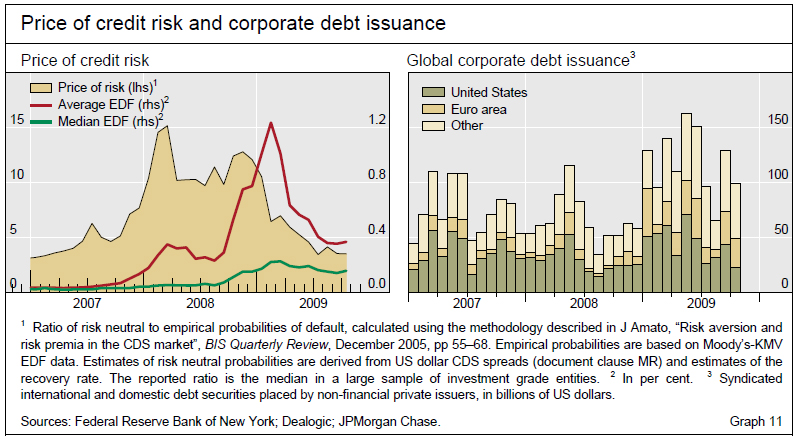
the market-implied price of credit risk also continued its downward trend, but to its pre-crisis level (Graph 11, left-hand panel).

The return to more normal credit market conditions was also reflected in corporate bond issuance (Graph 11, right-hand panel, and Highlights section).


Click for big

The methodology used to prepare the chart of market implied cost of risk has been summarized on PrefBlog.

The paper by Leonardo Gambacorta, Monetary policy and the risk-taking channel, has been highlighted by Bloomberg and makes the claim that ‘reaching for yield’ is not merely a retail problem:

This paper investigates the link between low interest rates and bank risk-taking. Monetary policy may influence banks’ perceptions of, and attitude towards, risk in at least two ways: (i) through a search for yield process, especially in the case of nominal return targets; and (ii) by means of the impact of interest rates on valuations, incomes and cash flows, which in turn can modify how banks measure risk. Using a comprehensive dataset of listed banks, this paper finds that low interest rates over an extended period cause an increase in banks’ risk-taking.

For instance:

The inertia in nominal targets at a time of lower interest rates may reflect a number of factors. Some are psychological, such as money illusion: investors may ignore the fact that nominal interest rates may decline to compensate for lower inflation. Others may reflect institutional or regulatory constraints.

More generally, financial institutions regularly enter into long-term contracts committing them to produce relatively high nominal rates of return. The same mechanism could be in place whenever private investors use short-term returns as a way of judging manager competence and withdraw funds after poor performance

In the short term, low interest rates reduce the probability of default of outstanding variable rate loans, by reducing interest burdens of existing borrowers. In the medium term, however, due to the higher collateral values and the search for yield, banks tend to grant more risky loans and, in general, to soften their lending standards: they lend more to borrowers with bad credit histories and with more uncertain prospects. Overall, these results suggest that low interest rates reduce credit risk in banks’ portfolios in the short term – since the volume of outstanding loans is larger than the volume of new loans – but raise it in the medium term.

The empirical exercise points to a number of other interesting findings. First, developments in housing prices prior to the crisis appear to have contributed to bank risk-taking. An inflation-adjusted house price growth rate that is 1 percentage point above its long-run average for six consecutive years leading up to the crisis increases the probability of default of the average bank by 1.5%. This result is in line with the view that the housing market had a substantial role in the crisis and that banking distress was typically more severe in countries that experienced a more pronounced boom-bust cycle in house prices.

Second, banks that experienced a higher growth rate of lending with respect to the industry average prior to the crisis proved to be riskier ex post. For example, lending of about 10% above average over the six years preceding the crisis caused an increase in bank probability of default by 3.9%.

Interesting External Papers

Risk aversion and risk premia in the CDS market

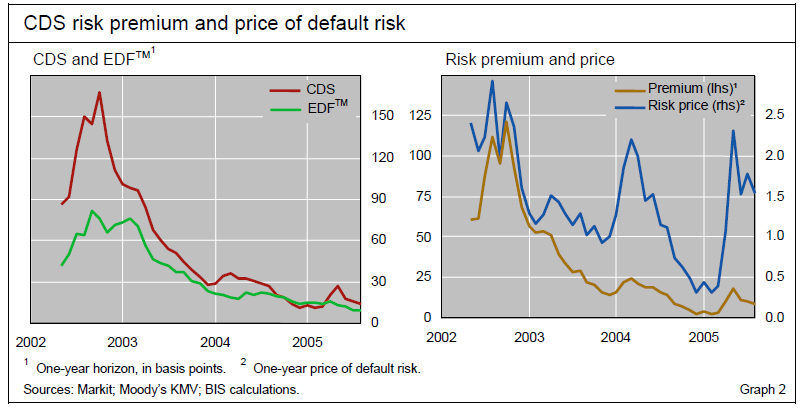
Jeffery D Amato wrote a paper with the captioned title in the BIS Quarterly Review, 4Q05:

Credit default swap (CDS) spreads compensate investors for expected loss, but they also contain risk premia because of investors’ aversion to default risk. We estimate CDS risk premia and default risk aversion to have been highly volatile during 2002–2005. Both measures appear to be related to fundamental macroeconomic factors, such as the stance of monetary policy, and technical market factors, such as issuance of collateralised debt obligations.

To proxy for default probabilities, we use one-year EDFs™ as in the study by Berndt et al (2005). EDFs™ are constructed using balance sheet and equity price data under the principles of a Merton-type model for gauging the likelihood of default. Our data on EDFs™ are available at a monthly frequency for all but two firms in the CDX.NA.IG.4 index. Aggregate and sector EDFs™ are constructed as simple arithmetic averages of existing data on the constituents.

In order to see how we obtain measures of risk premia and risk aversion, note that CDS spreads can be roughly decomposed as follows:

CDS spread = expected loss + risk premium
= expected loss x risk adjustment

where

risk adjustment = 1 + price of default risk

The first equation above says that the CDS spread is approximately equal to expected loss plus a risk premium, where the latter is compensation paid to investors for enduring exposure to default risk. In the second equation, the spread is re-expressed in terms of risk-adjusted expected loss, where the risk adjustment varies proportionally with the price of default risk. The price of default risk has the interpretation as the compensation per unit of expected loss. It is an indicator of investors’ aversion to default risk: a positive price of risk means that investors demand that they be paid more than actuarial losses. Hereafter, we will use the terms “price of default risk” and “indicator of default risk aversion” interchangeably.

While the formulations of spreads above isolate a “risk premium” and a “price of risk”, in principle there are two distinct types of default risk that may command a premium. One is cyclical variation in expected loss, which usually rises during economic downturns, when overall income growth is low. The other is the actual default of an entity and its impact on investors’ wealth due to an inability to perfectly diversify credit portfolios. In the literature, these are generally referred to as systematic and jump-at-default risk, respectively.


Click for big

The use of Moody’s KMV methodology to determine intrinsic default probability is similar to the Bank of England approach, but different from the recently published Bank of Canada liquidity research which, essentially, assigns a value of zero to the variable “price of default risk”.