New Issues

New Issue: TD FixedReset, 3.60%+279, NVCC

Toronto-Dominion Bank has announced:

a domestic public offering of Non-Cumulative 5-Year Rate Reset Preferred Shares, Series 7 (the “Series 7 Shares”).

TD has entered into an agreement with a group of underwriters led by TD Securities Inc. to issue, on a bought deal basis, 12 million Series 7 Shares at a price of $25.00 per share to raise gross proceeds of $300 million. TD has also granted the underwriters an option to purchase, on the same terms, up to an additional 2 million Series 7 Shares. This option is exercisable in whole or in part by the underwriters at any time up to two business days prior to closing.

The Series 7 Shares will yield 3.60% annually, payable quarterly, as and when declared by the Board of Directors of TD, for the initial period ending July 31, 2020. Thereafter, the dividend rate will reset every five years at a level of 2.79% over the then five-year Government of Canada bond yield.

Subject to regulatory approval, on July 31, 2020 and on July 31 every 5 years thereafter, TD may redeem the Series 7 Shares, in whole or in part, at $25.00 per share. Subject to TD’s right of redemption, holders of the Series 7 Shares will have the right to convert their shares into Non-Cumulative Floating Rate Preferred Shares, Series 8 (the “Series 8 Shares”), subject to certain conditions, on July 31, 2020, and on July 31 every five years thereafter. Holders of the Series 8 Shares will be entitled to receive quarterly floating dividends, as and when declared by the Board of Directors of TD, equal to the three-month Government of Canada Treasury bill yield plus 2.79%.

The expected closing date is March 10, 2015. TD will make an application to list the Series 7 Shares as of the closing date on the Toronto Stock Exchange. The net proceeds of the offering will be used for general corporate purposes.

The Bank, as previously announced, will redeem its outstanding Non-cumulative Redeemable Class A First Preferred Shares, Series P and Series Q on March 2, 2015. It is the intention of the Bank to exercise its right to redeem all of its outstanding 10 million Non-cumulative Redeemable Class A First Preferred Shares, Series R (the “Series R Shares”). The foregoing statement of intention does not constitute formal notice of redemption. Should the Bank exercise its right to redeem the Series R Shares, formal notice of redemption will be issued by the Bank in due course.

They later announced:

that, in connection with its recently announced public offering of 12,000,000 3.60% Non-Cumulative 5-Year Rate Reset Preferred Shares, Series 7 (the “Series 7 Shares”), the underwriters have exercised their option (the “Underwriters’ Option”) to purchase an additional 2,000,000 Series 7 Shares at a price of $25.00 per share. TD will receive additional gross proceeds of $50,000,000 from the exercise of the Underwriters’ Option, increasing the total size of the offering to $350,000,000. Closing of the Underwriters’ Option is expected to occur concurrent with the closing of the public offering on March 10, 2015.

The Implied Volatility calculation has some points of interest:

impVol_TD_150227
Click for Big

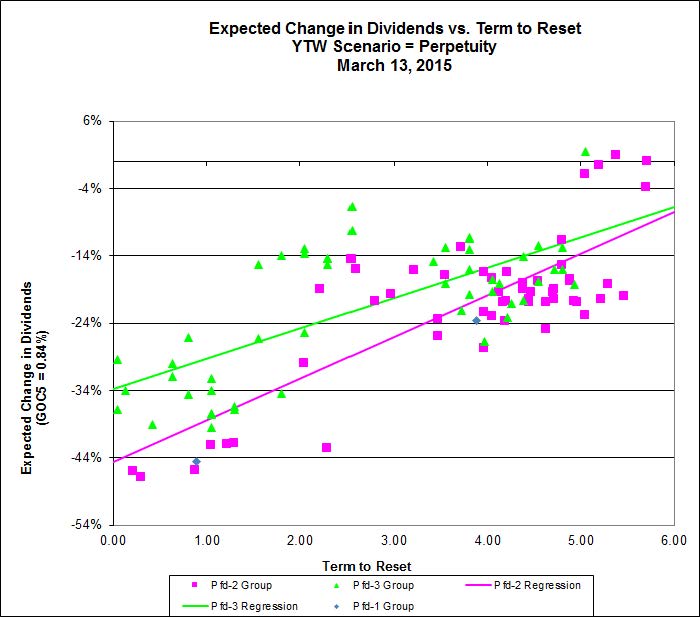
Firstly, the market does not appear to be differentiated between the NVCC compliant and non-compliant issues, as the latter appear to be plotted on a line more or less defined by the former. Additionally, the Implied Volatility is very high – ridiculously high, for NVCC-compliant issues – so I would expect the new issue to outperform the three non-compliant issues (TD.PF.A, TD.PF.B and TD.PF.C) as the market comes to realize what the word “perpetual” means.

Issue Comments

AIM.PR.A To Be Extended

Aimia has announced:

that it does not intend to exercise its right to redeem all or any part of the currently outstanding 6,900,000 Cumulative Rate Reset Preferred Shares, Series 1 (the “Series 1 Shares”) on March 31, 2015. As a result and subject to certain conditions set out in the prospectus supplement dated January 13, 2010 relating to the issuance of the Series 1 Shares, the holders of the Series 1 Shares have the right to convert all or part of their Series 1 Shares, on a one-for-one basis, into Cumulative Floating Rate Preferred Shares, Series 2 (the “Series 2 Shares”) of Aimia on March 31, 2015. Holders who do not exercise their right to convert their Series 1 Shares into Series 2 Shares on such date will continue to hold their Series 1 Shares.

The foregoing conversion right is subject to the conditions that: (i) if Aimia determines that there would be less than 1,000,000 Series 2 Shares outstanding after March 31, 2015, then holders of Series 1 Shares will not be entitled to convert their shares into Series 2 Shares, and (ii) alternatively, if Aimia determines that there would remain outstanding less than 1,000,000 Series 1 Shares after March 31, 2015, then all remaining Series 1 Shares will automatically be converted into Series 2 Shares on a one-for-one basis on March 31, 2015. In either case, Aimia will give written notice to that effect to registered holders of Series 1 Shares no later than March 24, 2015.

The dividend rate applicable to the Series 1 Shares for the 5-year period from and including March 31, 2015 to but excluding March 31, 2020, and the dividend rate applicable to the Series 2 Shares for the 3-month period from and including March 31, 2015 to but excluding June 30, 2015, will be announced by way of a press release on March 2, 2015.

Beneficial owners of Series 1 Shares who wish to exercise their conversion right should communicate as soon as possible with their broker or other nominee to obtain instructions for exercising such right on or prior to the deadline for exercise, which is 5:00 p.m. (Montreal time) on March 17, 2015.

Inquiries should be directed to Aimia’s Registrar and Transfer Agent, CST Trust Company, at 1-800-387-0825 (toll free in Canada and the United States).

No surprises here, since the issue resets at GOC5 + 375bp and was quoted at 22.38-50 on February 27 to yield 4.97%-93 to perpetuity.

AIM.PR.A changed its ticker from AER.PR.A in October, 2011. AER.PR.A commenced trading 2010-1-20 after being announced 2010-1-12.

Market Action

February 26, 2015

Assiduous Reader DW brings to my attention a piece titled BXF no longer a strip tease, which points out:

When First Asset created Canada’s first strip bond ETF in 2013, they claimed that the ETF was expected to be more tax-efficient than other short term bond products currently available in the marketplace.

With a full tax year behind us, and armed with a new methodology for calculating the after-tax returns of ETFs, we can put First Asset’s claim to the test. Spoiler alert: the results are not only impressive, but they make you wonder why other firms haven’t followed suit by offering their own brand of strip bond ETFs.

The results above should not be considered a fluke – as long as the other bond ETFs continue to have an average coupon that is significantly higher than their yield-to-maturity, BXF will be expected to outperform these plain-vanilla ETFs on an after-tax basis (for more information on this concept, please read Why Use a Strip Bond ETF? by Dan Bortolotti).

This has previously been an issue in the preferred share world – see the article Beware the tax trap of these tempting preferreds and the post Tax Impact on FixedResetPremium Yields. Remember the good old days, when FixedResets traded at a premium?

Strips are generally too expensive to hold in any account, let alone a taxable one, but the fact that they are treated as par bonds as of the purchase date is a very useful wrinkle. Regrettably, most strips are governments and to a large extent the tax savings will be offset by the liquidity premium – which retail shouldn’t pay for, because the ability to transact $50-million in one ‘phone call without moving the market isn’t exactly an attribute that should be of much interest to retail.

I have advised many clients in the past to open accounts at full-service brokers with the sole objective of gaining access to current coupon corporate new issues. This has worked out OK for them – the biggest problem is putting the fear of God into the broker so he never calls unless he’s got a new issue that meets pre-defined standards!

US brokers are attempting to whip up some fear-inspired trading in bonds:

While the Federal Reserve considers raising overnight borrowing costs from about zero, where they’ve been since 2008, central banks in Europe are dropping deposit rates into negative territory.

This backdrop has pushed a measure of expected Treasury price swings to levels that are about 40 percent higher this year than in the same period in 2014, according to Bank of America Merrill Lynch’s Option Volatility Estimate MOVE index.

“The risk in bonds has gone up,” Francesco Garzarelli, London-based co-head of macro and markets research at Goldman Sachs Group Inc., said in a Bloomberg Television interview Thursday. “The sensitivity to small changes in yield expectations from here will command very sizable price swings, and I just think that makes fixed income a very dangerous asset class.”

While the biggest banks have cut back on their positions in risky, speculative-grade debt, it’s steadily migrated to large institutions, insurance companies and mutual funds. Such firms have boosted their holdings of corporate and foreign bonds to $5.1 trillion, a 65 percent increase since the end of 2008, according to data compiled by UBS.

This has more than offset the $800 billion decline in holdings at banks and securities firms in the period, a regulator-prompted retrenchment that was intended to reinforce the financial system, UBS analysts Matthew Mish and Stephen Caprio wrote in a Feb. 26 report.

What we’re left with instead — ballooning bond funds that own more and more risky debt — may be a less bad option, but one that still threatens to wreak havoc in credit markets.

Rob Carrick highlights a TD publication in his piece What if interest rates never return to ‘normal’?:

I’m on record as having warned many times about rising rates, but I’m now in adjustment mode. What has me reconsidering is the kind of thinking found in a new report by TD Economics titled The New Normal: Low Rates in Advanced Economies for the Long Run. It argues that rates are low today because of weak global economic growth, and that they will move higher as the economy improves. However, rates will not return to levels we used to consider “neutral.” The reason: Aging, and in some cases, shrinking populations across the industrial world. They’ll keep a lid on growth in economic productivity and thereby reduce the need to crank rates higher.

The TD report THE NEW NORMAL: LOW RATES IN ADVANCED ECONOMIES FOR THE LONG RUN forecasts modest rates for years to come:

  • • Trend economic growth is likely to remain slower than it has been historically throughout advanced economies. The two key determinants, labor force and labor productivity growth, have been slowing nearly everywhere.
  • • Record low interest rates in many advanced economies is a result of both cyclical and structural factors. However, even once they begin to normalize, lower potential GDP growth will keep the long-term equilibrium level of interest rates lower than in the past. By extension, bond yields are also slated to be lower across the maturity spectrum.
  • • The equilibrium level of interest rates in the UK is set to be relatively similar to Canada’s and slightly below that of the US. In the euro area, the equilibrium level will be a notch below the UK’s, while it will be substantially lower in Japan.
  • • In the near term, it is perfectly clear that interest rates are set to remain far lower than their expected neutral level. Nonetheless, for long-term investors, such as pension funds, investing over multiple business cycles, lower neutral rates will make for a particular challenge.


In a recent paper, TD Economics estimated the long-run neutral level of the federal funds rate to be 3.25%, relative to a 1992-2007 average of 4.10%, and the long-run neutral Bank of Canada overnight rate to be 3.00%, compared to an average of 4.20% over the same time frame. This decline reflects slower labor force growth and modest productivity growth. A central question is whether this is a global phenomenon? In this paper, we explore the long-run neutral level of interest rates for the UK, euro area and Japan. Our conclusion is that across the advanced world, the long-term equilibrium level of interest rates will be lower than in the past.

And the paper referenced in the quoted paragraph is DIVERGENT VIEWS ON NEUTRAL INTEREST RATES

  • • With the Fed signaling an end to QE in October, financial markets are now debating both the timing of future rate hikes and, more importantly, the level to which interest rates will ultimately rise. The latter requires an understanding of the neutral level of interest rates.
  • • Disagreement over how high rates will rise in the future seems to be embedded in different timeframes under discussion. The view of a ‘new neutral’ real fed funds rate of close to zero (2.00% in nominal terms) is usually grounded in a shorter timeframe that is not consistent with the long-run level of rates of an economy in equilibrium – growing at a trend pace with stable inflation.
  • • TD Economics believes that the long-run neutral level of the fed funds rate is around 3.25% (1.25% real) and the neutral level of 10-year Treasury yields is close to 4.00% (2.00% real). However, the Fed is expected to reach those points slowly, over the course of more than three years, assuming the economic recovery remains on track. The result is that our real fed funds rate averages -0.5% from 2015 to 2017.


For some time, TD Economics has viewed the future long-run neutral level of rates as lower than the pre-recession experience. We forecast a neutral level of interest rates in a range of 3.00% to 3.50% (equal to 1.00%-1.50% real), and we use the middle of that range (3.25%) to anchor our long term interest rate projection.

Meanwhile, preferred share investors are contemplating inspirational public art:

scaffold
Click for Big

It was a rough day for the Canadian preferred share markets, with PerpetualDiscounts down 18bp, FixedResets losing 40bp and DeemedRetractibles off 10bp. MFC issues of all types are notable on the bad side of a lengthy Performance Highlights table, while ENB issues made an appearance on the good side. Volume was high.

For as long as the FixedReset market is so violently unsettled, I’ll keep publishing updates of the more interesting and meaningful series of FixedResets’ Implied Volatilities. This doesn’t include Enbridge because although Enbridge has a large number of issues outstanding, all of which are quite liquid, the range of Issue Reset Spreads is too small for decent conclusions. The low is 212bp (ENB.PR.H; second-lowest is ENB.PR.D at 237bp) and the high is a mere 268 for ENB.PF.G.

Remember that all rich /cheap assessments are:
» based on Implied Volatility Theory only
» are relative only to other FixedResets from the same issuer
» assume constant GOC-5 yield
» assume constant Implied Volatility
» assume constant spread

Here’s TRP:

impVol_TRP_150226
Click for Big

The new issue has caused a large change in the curve-fitting for the TRP series of FixedResets, which is discussed at greater length on the post announcing the new issue. TRP.PR.E, which resets 2019-10-30 at +235, is bid at 24.07 to be $1.24 rich, while the new issue, resetting 2020-11-30 at +296, is $0.87 cheap at its issue price of 25.00.

impVol_MFC_150226
Click for Big

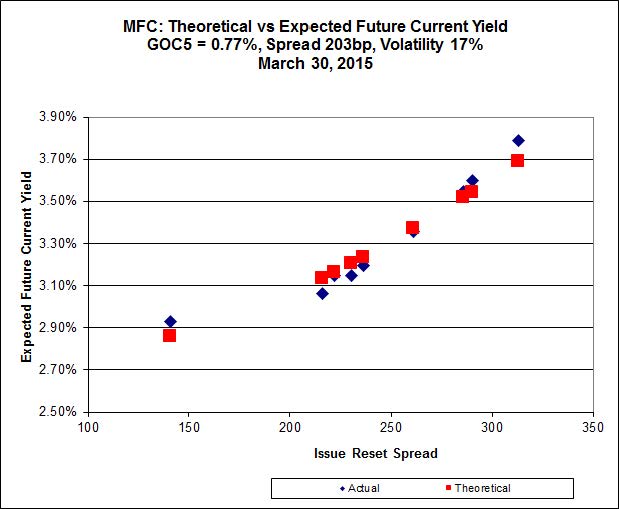
Another excellent fit, but the numbers are perplexing. Implied Volatility for MFC continues to be a conundrum, although it declined substantially today. It is still too high if we consider that NVCC rules will never apply to these issues; it is still too low if we consider them to be NVCC non-compliant issues (and therefore with Deemed Maturities in the call schedule).

Most expensive is MFC.PR.N, resetting at +230 on 2020-3-19, bid at 24.18 to be $0.38 rich, while MFC.PR.H, resetting at +313bp on 2017-3-19, is bid at 25.80 to be $0.46 cheap.

impVol_BAM_150226
Click for Big

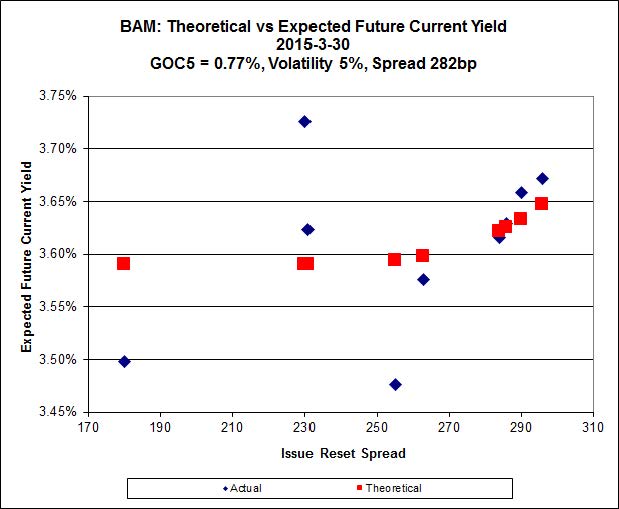
The fit on this series is actually quite reasonable – it’s the scale that makes it look so weird.

The cheapest issue relative to its peers is BAM.PR.X, resetting at +180bp on 2017-6-30, bid at 17.24 to be $0.84 cheap. BAM.PF.E, resetting at +255bp 2020-3-31 is bid at 24.39 and appears to be $1.03 rich.

impVol_FTS_150226
Click for Big

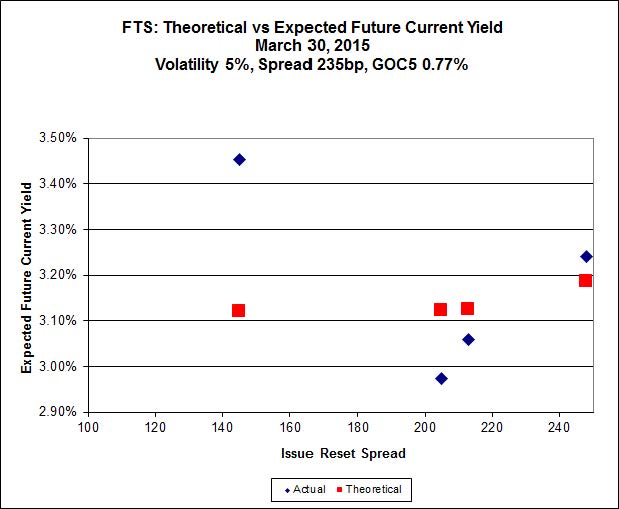
This is just weird because the middle is expensive and the ends are cheap but anyway … FTS.PR.H, with a spread of +145bp, and bid at 16.86, looks $0.83 cheap and resets 2015-6-1. FTS.PR.K, with a spread of +205bp and resetting 2019-3-1, is bid at 23.51 and is $0.94 rich.

pairs_FR_150226
Click for Big

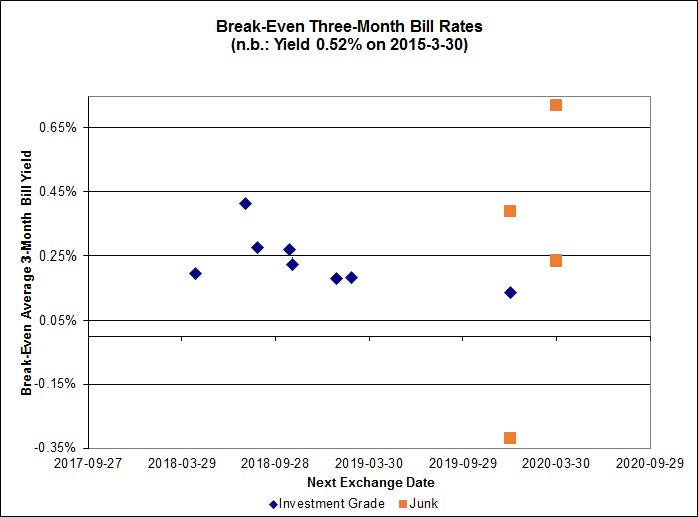
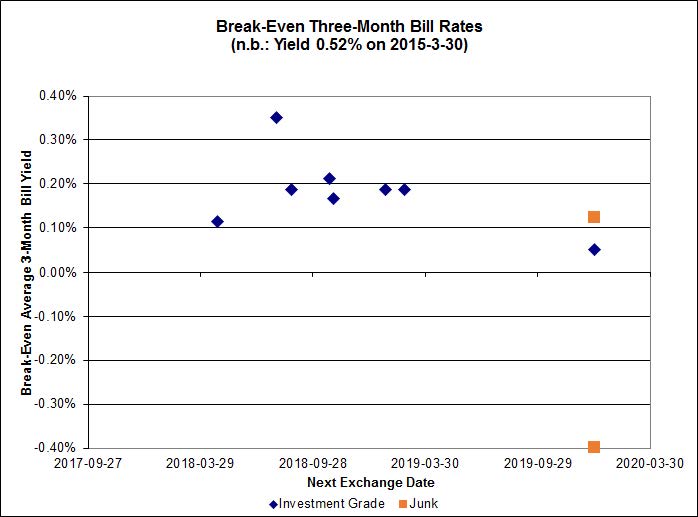
Most of the investment grade break-even rates are close to zero.

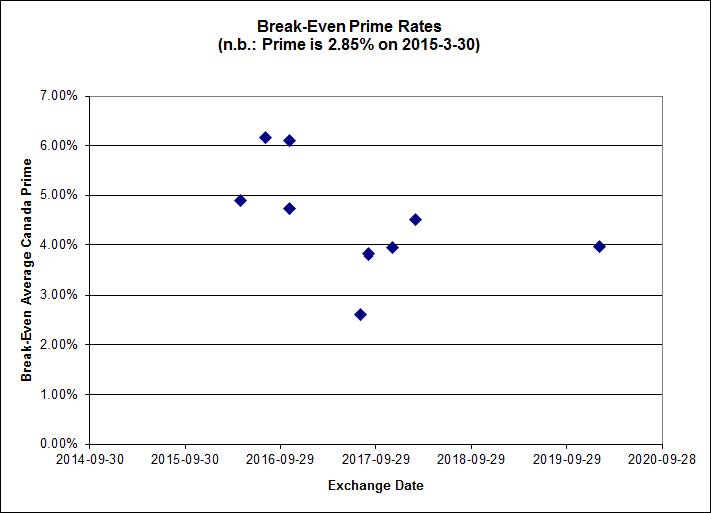
On the other hand, the market’s distaste for product linked to Money Market rates does not extend to prime, as shown by the FixedFloater/RatchetRate pairs:

pairs_FF_150226
Click for Big

Shall we just say that this exhibits a high level of confidence in the continued rapacity of Canadian banks?

HIMIPref™ Preferred Indices
These values reflect the December 2008 revision of the HIMIPref™ Indices

Values are provisional and are finalized monthly
Index Mean
Current
Yield
(at bid)
Median
YTW
Median
Average
Trading
Value
Median
Mod Dur
(YTW)
Issues Day’s Perf. Index Value
Ratchet 0.00 % 0.00 % 0 0.00 0 0.1262 % 2,294.0
FixedFloater 4.37 % 3.52 % 18,699 18.38 1 1.0233 % 4,041.0
Floater 3.14 % 3.29 % 64,663 18.94 4 0.1262 % 2,438.6
OpRet 4.08 % 1.39 % 110,236 0.31 1 0.0000 % 2,760.4
SplitShare 4.40 % 4.28 % 28,352 3.55 6 0.2370 % 3,220.0
Interest-Bearing 0.00 % 0.00 % 0 0.00 0 0.0000 % 2,524.1
Perpetual-Premium 5.33 % -0.17 % 55,716 0.08 24 0.0049 % 2,515.3
Perpetual-Discount 4.95 % 4.92 % 106,817 15.65 10 -0.1791 % 2,795.8
FixedReset 4.45 % 3.41 % 213,018 16.83 78 -0.3973 % 2,401.8
Deemed-Retractible 4.92 % 0.11 % 100,920 0.17 39 -0.0989 % 2,650.0
FloatingReset 2.43 % 2.85 % 94,896 6.38 7 0.1022 % 2,326.6
Performance Highlights
Issue Index Change Notes
MFC.PR.C Deemed-Retractible -2.64 % YTW SCENARIO
Maturity Type : Hard Maturity
Maturity Date : 2025-01-31
Maturity Price : 25.00
Evaluated at bid price : 23.61
Bid-YTW : 5.22 %
MFC.PR.L FixedReset -2.42 % YTW SCENARIO
Maturity Type : Hard Maturity
Maturity Date : 2025-01-31
Maturity Price : 25.00
Evaluated at bid price : 23.42
Bid-YTW : 4.09 %
PWF.PR.P FixedReset -2.15 % YTW SCENARIO
Maturity Type : Limit Maturity
Maturity Date : 2045-02-26
Maturity Price : 18.20
Evaluated at bid price : 18.20
Bid-YTW : 3.23 %
SLF.PR.H FixedReset -2.03 % YTW SCENARIO
Maturity Type : Hard Maturity
Maturity Date : 2025-01-31
Maturity Price : 25.00
Evaluated at bid price : 23.66
Bid-YTW : 3.61 %
ENB.PR.F FixedReset -2.02 % YTW SCENARIO
Maturity Type : Limit Maturity
Maturity Date : 2045-02-26
Maturity Price : 19.40
Evaluated at bid price : 19.40
Bid-YTW : 4.28 %
TRP.PR.C FixedReset -1.75 % YTW SCENARIO
Maturity Type : Limit Maturity
Maturity Date : 2045-02-26
Maturity Price : 16.31
Evaluated at bid price : 16.31
Bid-YTW : 3.52 %
BAM.PR.X FixedReset -1.54 % YTW SCENARIO
Maturity Type : Limit Maturity
Maturity Date : 2045-02-26
Maturity Price : 17.24
Evaluated at bid price : 17.24
Bid-YTW : 4.00 %
BAM.PF.G FixedReset -1.42 % YTW SCENARIO
Maturity Type : Limit Maturity
Maturity Date : 2045-02-26
Maturity Price : 23.14
Evaluated at bid price : 25.00
Bid-YTW : 3.67 %
CU.PR.G Perpetual-Discount -1.38 % YTW SCENARIO
Maturity Type : Limit Maturity
Maturity Date : 2045-02-26
Maturity Price : 23.29
Evaluated at bid price : 23.62
Bid-YTW : 4.77 %
TRP.PR.E FixedReset -1.35 % YTW SCENARIO
Maturity Type : Limit Maturity
Maturity Date : 2045-02-26
Maturity Price : 22.83
Evaluated at bid price : 24.07
Bid-YTW : 3.33 %
PWF.PR.A Floater -1.33 % YTW SCENARIO
Maturity Type : Limit Maturity
Maturity Date : 2045-02-26
Maturity Price : 17.76
Evaluated at bid price : 17.76
Bid-YTW : 2.82 %
MFC.PR.N FixedReset -1.31 % YTW SCENARIO
Maturity Type : Hard Maturity
Maturity Date : 2025-01-31
Maturity Price : 25.00
Evaluated at bid price : 24.18
Bid-YTW : 3.80 %
VNR.PR.A FixedReset -1.20 % YTW SCENARIO
Maturity Type : Limit Maturity
Maturity Date : 2045-02-26
Maturity Price : 23.33
Evaluated at bid price : 24.70
Bid-YTW : 3.55 %
MFC.PR.M FixedReset -1.14 % YTW SCENARIO
Maturity Type : Hard Maturity
Maturity Date : 2025-01-31
Maturity Price : 25.00
Evaluated at bid price : 24.26
Bid-YTW : 3.82 %
MFC.PR.B Deemed-Retractible -1.10 % YTW SCENARIO
Maturity Type : Hard Maturity
Maturity Date : 2025-01-31
Maturity Price : 25.00
Evaluated at bid price : 24.30
Bid-YTW : 5.00 %
TRP.PR.D FixedReset -1.05 % YTW SCENARIO
Maturity Type : Limit Maturity
Maturity Date : 2045-02-26
Maturity Price : 22.63
Evaluated at bid price : 23.56
Bid-YTW : 3.37 %
MFC.PR.I FixedReset -1.04 % YTW SCENARIO
Maturity Type : Call
Maturity Date : 2017-09-19
Maturity Price : 25.00
Evaluated at bid price : 25.63
Bid-YTW : 3.28 %
BAM.PR.G FixedFloater 1.02 % YTW SCENARIO
Maturity Type : Limit Maturity
Maturity Date : 2045-02-26
Maturity Price : 21.90
Evaluated at bid price : 21.72
Bid-YTW : 3.52 %
TRP.PR.B FixedReset 1.17 % YTW SCENARIO
Maturity Type : Limit Maturity
Maturity Date : 2045-02-26
Maturity Price : 14.42
Evaluated at bid price : 14.42
Bid-YTW : 3.35 %
ENB.PF.A FixedReset 1.23 % YTW SCENARIO
Maturity Type : Limit Maturity
Maturity Date : 2045-02-26
Maturity Price : 21.77
Evaluated at bid price : 22.17
Bid-YTW : 4.01 %
BAM.PR.K Floater 1.47 % YTW SCENARIO
Maturity Type : Limit Maturity
Maturity Date : 2045-02-26
Maturity Price : 15.20
Evaluated at bid price : 15.20
Bid-YTW : 3.31 %
ENB.PF.G FixedReset 1.50 % YTW SCENARIO
Maturity Type : Limit Maturity
Maturity Date : 2045-02-26
Maturity Price : 21.89
Evaluated at bid price : 22.40
Bid-YTW : 4.02 %
ENB.PF.C FixedReset 1.55 % YTW SCENARIO
Maturity Type : Limit Maturity
Maturity Date : 2045-02-26
Maturity Price : 21.81
Evaluated at bid price : 22.25
Bid-YTW : 3.99 %
CGI.PR.D SplitShare 1.58 % YTW SCENARIO
Maturity Type : Soft Maturity
Maturity Date : 2023-06-14
Maturity Price : 25.00
Evaluated at bid price : 25.70
Bid-YTW : 3.35 %
Volume Highlights
Issue Index Shares
Traded
Notes
RY.PR.J FixedReset 144,700 Recent new issue.
YTW SCENARIO
Maturity Type : Limit Maturity
Maturity Date : 2045-02-26
Maturity Price : 23.15
Evaluated at bid price : 25.02
Bid-YTW : 3.32 %
OSP.PR.A SplitShare 110,207 Recent new issue.
YTW SCENARIO
Maturity Type : Hard Maturity
Maturity Date : 2020-03-31
Maturity Price : 10.00
Evaluated at bid price : 10.12
Bid-YTW : 4.77 %
CM.PR.O FixedReset 73,930 TD crossed 50,000 at 24.70.
YTW SCENARIO
Maturity Type : Limit Maturity
Maturity Date : 2045-02-26
Maturity Price : 23.09
Evaluated at bid price : 24.67
Bid-YTW : 3.11 %
ENB.PR.F FixedReset 65,111 RBC bought 10,100 from Scotia at 19.80.
YTW SCENARIO
Maturity Type : Limit Maturity
Maturity Date : 2045-02-26
Maturity Price : 19.40
Evaluated at bid price : 19.40
Bid-YTW : 4.28 %
ENB.PR.N FixedReset 63,458 Scotia crossed 14,000 at 20.30.
YTW SCENARIO
Maturity Type : Limit Maturity
Maturity Date : 2045-02-26
Maturity Price : 20.34
Evaluated at bid price : 20.34
Bid-YTW : 4.24 %
BMO.PR.S FixedReset 49,288 Scotia crossed blocks of 17,600 and 25,000, both at 24.95.
YTW SCENARIO
Maturity Type : Limit Maturity
Maturity Date : 2045-02-26
Maturity Price : 23.20
Evaluated at bid price : 24.93
Bid-YTW : 3.05 %
There were 41 other index-included issues trading in excess of 10,000 shares.
Wide Spread Highlights
Issue Index Quote Data and Yield Notes
MFC.PR.C Deemed-Retractible Quote: 23.61 – 24.34
Spot Rate : 0.7300
Average : 0.4221

YTW SCENARIO
Maturity Type : Hard Maturity
Maturity Date : 2025-01-31
Maturity Price : 25.00
Evaluated at bid price : 23.61
Bid-YTW : 5.22 %

MFC.PR.L FixedReset Quote: 23.42 – 24.25
Spot Rate : 0.8300
Average : 0.6360

YTW SCENARIO
Maturity Type : Hard Maturity
Maturity Date : 2025-01-31
Maturity Price : 25.00
Evaluated at bid price : 23.42
Bid-YTW : 4.09 %

RY.PR.F Deemed-Retractible Quote: 25.50 – 25.91
Spot Rate : 0.4100
Average : 0.2356

YTW SCENARIO
Maturity Type : Call
Maturity Date : 2015-05-24
Maturity Price : 25.25
Evaluated at bid price : 25.50
Bid-YTW : 0.35 %

BAM.PF.G FixedReset Quote: 25.00 – 25.39
Spot Rate : 0.3900
Average : 0.2405

YTW SCENARIO
Maturity Type : Limit Maturity
Maturity Date : 2045-02-26
Maturity Price : 23.14
Evaluated at bid price : 25.00
Bid-YTW : 3.67 %

BAM.PR.N Perpetual-Discount Quote: 23.28 – 23.65
Spot Rate : 0.3700
Average : 0.2318

YTW SCENARIO
Maturity Type : Limit Maturity
Maturity Date : 2045-02-26
Maturity Price : 22.86
Evaluated at bid price : 23.28
Bid-YTW : 5.16 %

ENB.PR.F FixedReset Quote: 19.40 – 19.85
Spot Rate : 0.4500
Average : 0.3197

YTW SCENARIO
Maturity Type : Limit Maturity
Maturity Date : 2045-02-26
Maturity Price : 19.40
Evaluated at bid price : 19.40
Bid-YTW : 4.28 %

New Issues

New Issue: CM FixedReset, 3.60%+279

The Canadian Imperial Bank of Commerce has announced:

that it had entered into an agreement with a group of underwriters led by CIBC World Markets Inc. for an issue of 10 million Basel III-compliant Non-cumulative Rate Reset Class A Preferred Shares, Series 43 (the “Series 43 Shares”) priced at $25.00 per Series 43 Share to raise gross proceeds of $250 million.

CIBC has granted the underwriters an option to purchase up to an additional two million Series 43 Shares at the same offering price, exercisable at any time up to two days prior to closing. Should the underwriters’ option be fully exercised, the total gross proceeds of the financing will be $300 million.

The Series 43 Shares will yield 3.60% per annum, payable quarterly, as and when declared by the Board of Directors of CIBC, for an initial period ending July 31, 2020. On July 31, 2020, and on July 31 every five years thereafter, the dividend rate will reset to be equal to the then current five-year Government of Canada bond yield plus 2.79%.

Subject to regulatory approval and certain provisions of the Series 43 Shares, on July 31, 2020 and on July 31 every five years thereafter, CIBC may, at its option, redeem all or any part of the then outstanding Series 43 Shares at par.

Subject to the right of redemption, holders of the Series 43 Shares will have the right to convert their shares into Non-cumulative Floating Rate Class A Preferred Shares, Series 44 (the “Series 44 Shares”), subject to certain conditions, on July 31, 2020 and on July 31 every five years thereafter. Holders of the Series 44 Shares will be entitled to receive a quarterly floating rate dividend, as and when declared by the Board of Directors of CIBC, equal to the three-month Government of Canada Treasury Bill yield plus 2.79%.

Holders of the Series 44 Shares may convert their Series 44 Shares into Series 43 Shares, subject to certain conditions, on July 31, 2025 and on July 31 every five years thereafter.

The expected closing date is March 11, 2015. CIBC will make an application to list the Series 43 Shares as of the closing date on the Toronto Stock Exchange. The net proceeds of this offering will be used for general purposes of CIBC.

CIBC has two other series of FixedResets outstanding, CM.PR.O and CM.PR.P – sadly, insufficient to perform an Implied Volatility analysis.

I find it interesting that the issue won’t close until March 11 – two weeks is a relatively long marketing period for a major bank. The sluggishness of sales of current issues has been remarked upon both in comments on PrefBlog and elsewhere.

Press Clippings

Rush to liquidity leads to junk sell-off

Andrew Allentuck was kind enough to quote me in his January, 2015, piece Rush to liquidity leads to junk sell-off:

Given the higher level of risk caused by increased duration and the reduced liquidity caused by a bank’s need to cut holdings of dicey bonds, spreads between corporate bond prices and, especially, subinvestment-grade bonds are going to increase, says James Hymas, president of Hymas Investment Management Inc. in Toronto: “It is liquidity, not default risk, that is moving prices and yields in the junk debt market.”

Press Clippings

Bonds can improve portfolio stability

Andrew Allentuck was kind enough to quote me in his November, 2014, piece Bonds can improve portfolio stability:

Still, care should be taken not to err too far on the side of safety. “When you compare a 10-year – and longer – Government of Canada bond with a high, investment-grade corporate bond of similar term, you can see a spread of 150 bps,” says James Hymas, president of Hymas Investment Management Inc. in Toronto. “The spread on yield is not all compensation for risk. Only 20 bps to 30 bps covers the credit risk. The rest is liquidity, and most retail investors give up too much yield to get the liquidity.”

Press Clippings

“Burrito bonds” may cause indigestion

Andrew Allentuck was kind enough to quote me in his November, 2014, piece “Burrito bonds” may cause indigestion:

The 8% cash interest payment is £80 a year on the £1,000 note, or £320 over four years. The weekly free burrito boosts the return. During the four-year term, a bondholder would get 208 free burritos. Each burrito costs £6; that’s £1,248 worth of burritos. Add the £320 cash interest and the total return on the investment would be £1,568 – or 157% of an interest-equivalent return.

In contrast, the Bank of England currently offers 1.5% on its five-year gilts. On a £1,000 note, that would buy you two and half burritos a year. Not surprising, the burrito bond issue was heavily oversubscribed, given the current climate of low interest rates that provide insufficient income.

Even without the nosh, the Chilango bond would find takers, says James Hymas, president of Hymas Investment Management Inc. in Toronto, “especially when you offer 8% on a bond.”

Chilango has very fancy website and trumpet the success of the bond issue.

Press Clippings

It’s time to get used to low interest rates

Andrew Allentuck was kind enough to quote me in his October, 2014, piece It’s time to get used to low interest rates:

So, how long can the price of money hover in the low single digits?

“Yields at present are not sustainable, for real rates are below the replacement cost of capital,” says James Hymas, president of Hymas Investment Management Inc. in Toronto. “However, if we get into deflation, then the negative real interest rates prevailing now will turn positive. For now, investor sentiment does not show deflationary expectations, but there are many tripwires in the Middle East, Ukraine, and in the Baltic republics.”

Press Clippings

Product shelf now includes green bonds

Andrew Allentuck was kind enough to quote me in his October, 2014, piece Product shelf now includes green bonds:

In January 2014, the Commonwealth of Massachusetts issued a green bond called the Juvenile Justice Pay for Success Initiative. That US$9-million issue – and companion issues from Bank of America in negotiation at time of writing – are designed to provide funds to deter young criminals from committing more crimes.

Each person the program keeps out of jail for a year saves Massachusetts US$12,500 a year, according to a Bloomberg LP report. The state would win, social service agencies would win and the deterred criminals presumably would win. It’s all good economics designed to capture and monetize external matters, but there’s a critical flaw in the plan: those who are to be deterred have no direct interest in paying the bondholders.

It’s early in the life of these bonds and, so far, there have been no defaults. But bonds with an iffy payment mechanism need justification beyond yield to maturity.

These “stay out of jail” bonds were priced with huge payoffs if they work – and, of course, big losses if they don’t. In August 2012, the State of New York issued a US$9.6-million “social impact bond” designed to reduce recidivism. The investor, Goldman Sachs Group Inc. in this case, will receive US$9.6 million. But if recidivism were to drop by more than 10%, Goldman would get a payoff of up to US$2.1 million. If recidivism does not drop by at least that much, Goldman could lose as much as US$2.4 million.

The balance point is a change of plus or minus 10% in the recidivism rate of a defined set of convicted felons. “The risk is great,” says James Hymas, president Hymas Investment Management Inc. in Toronto. “And this is really equity in bond clothing.”

Market Action

February 25, 2015

There are many revolving doors in the world … this one is minor:

Michelle Choi, an analyst for Moody’s Investors Service, gave a credit rating to bonds issued by a New Jersey town in September. In October, she switched sides and started working for the town’s underwriter, Morgan Stanley.

Choi is one of hundreds of employees at Moody’s and other credit-rating companies, including Standard & Poor’s and Fitch Ratings, who’ve gone to work for Wall Street since the 2008 financial crisis exposed the conflicts at the heart of the ratings business.

While there’s no evidence that Choi’s job-hunting influenced the grade she gave Evesham Township’s debt, the rising number of job changes in the industry raises a question: can credit analysts be impartial about grading bonds while looking for employment at banks that underwrite them?

The ratings companies say the answer is yes. An academic study by longtime industry observers suggests otherwise.

Meanwhile, the SEC proudly trumpeted its compliance results:

Each year, the BSA Review Group makes hundreds of referrals based on information gleaned initially from SAR reporting. Some statistics drive home the usefulness of the information we receive through SARs:
• In the last six months or so we have been averaging around one temporary restraining order or asset freeze per month that was initiated based upon SARs reviewed by that group.
• In the last year or so, the SEC has brought actions against seven alleged Ponzi or pyramid schemes collectively involving over $100 million, and has opened a number of investigations or examinations into other possible Ponzi schemes, based on information we first obtained from SARs.
• Also in the last year or so, we’ve charged eight people with insider trading in cases where we allege they collectively earned well over $10 million – again based on information we first obtained from SAR reporting.
• Over the past three and a half years, the SEC has initiated hundreds of exams and investigations based on the leads generated by the group from SARs and other BSA reports.
• And the number of investigations or exams that the SEC has opened based on information first discovered in SARs has essentially doubled each of the past two years.

I share these statistics to illustrate the important point that the AML programs you oversee are critical in helping to expose fraud, the exploitation of vulnerable investors, and other misconduct. The quality of the reporting, and the industry expertise that you lend to your reports, often makes it possible for us to act more quickly than we otherwise could. And it increases the chance that we will be able to hold wrongdoers responsible and, we hope, recover investor losses.

It doesn’t sound like much to justify $7-billion in annual costs and the impetus given to terrorists, does it? And, of course, the whole programme was portrayed as an anti-terror weapon, since that is a more popular idea than just another intrusive “crime detection” programme.

And here’s a little more evidence that compliance costs are out of control:

Costs remain a challenge for the [HSBC] Group, with adjusted operating expenditure up by USD 2.2 billion, due to higher regulatory and compliance costs as well as inflationary pressures. Reporting a cost-income ratio of 67% in 2014 (59.6% in 2013), the Group has moved away from its previous target of a cost-income ratio in the mid-50s and is now just aiming to achieve positive jaws on an adjusted basis.

Who cares if any business gets done, as long as regulators are employed?

Here’s a view that the bond market doesn’t care much about the Fed:

Traders are taking the Federal Reserve chair’s comments over the past two days — labor market market isn’t fully healed and inflation is too low — as confirmation that the Fed is very unlikely to raise interest rates in the first half of the year. Economists including UBS Group AG’s Drew Matus and JPMorgan Chase & Co.’s Michael Feroli saw in her message reasons to reaffirm their calls for the first increase to come by June.

But there’s a third view about how Yellen’s testimony applies to the bond market, as expressed by Jim Bianco, the founder of Bianco Research LLC in Chicago: It doesn’t really matter.

In his alternative scenario, “everybody’s right,” Bianco said, in that the Fed could start raising its benchmark rate from near zero, like economists predict, and yields remain low, like traders seem to be anticipating.

With almost $2 trillion of sovereign debt in Europe offering negative yields, demand for U.S. fixed-income assets is unlikely to evaporate regardless of what the Fed does. That demand — coming in part from overseas — will ensure that bond prices remain high and yields low.

It was a mixed day for the Canadian preferred share market, with PerpetualDiscounts gaining 13bp, FixedResets off 7bp and DeemedRetractibles down 10bp. The Performance Highlights table is lengthy, dominated by FixedResets on both sides of the fence. Volume was high.

PerpetualDiscounts now yield 4.93%, equivalent to 6.41% interest at the standard equivalency factor of 1.3x. Long corporates now yield about 3.65%, so the pre-tax interest-equivalent spread (in this context, the “Seniority Spread”) is now about 275bp, a sharp widening from the 260bp reported February 18.

For as long as the FixedReset market is so violently unsettled, I’ll keep publishing updates of the more interesting and meaningful series of FixedResets’ Implied Volatilities. This doesn’t include Enbridge because although Enbridge has a large number of issues outstanding, all of which are quite liquid, the range of Issue Reset Spreads is too small for decent conclusions. The low is 212bp (ENB.PR.H; second-lowest is ENB.PR.D at 237bp) and the high is a mere 268 for ENB.PF.G.

Remember that all rich /cheap assessments are:
» based on Implied Volatility Theory only
» are relative only to other FixedResets from the same issuer
» assume constant GOC-5 yield
» assume constant Implied Volatility
» assume constant spread

Here’s TRP:

impVol_TRP_150225
Click for Big

The new issue has caused a large change in the curve-fitting for the TRP series of FixedResets, which is discussed at greater length on the post announcing the new issue. TRP.PR.E, which resets 2019-10-30 at +235, is bid at 24.40 to be $1.36 rich, while the new issue, resetting 2020-11-30 at +296, is $1.03 cheap at its issue price of 25.00.

impVol_MFC_150225
Click for Big

Another excellent fit, but the numbers are perplexing. Implied Volatility for MFC continues to be a conundrum, although it declined substantially today. It is still too high if we consider that NVCC rules will never apply to these issues; it is still too low if we consider them to be NVCC non-compliant issues (and therefore with Deemed Maturities in the call schedule).

Most expensive is MFC.PR.L, resetting at +216 on 2019-6-19, bid at 24.00 to be $0.57 rich, while MFC.PR.H, resetting at +313bp on 2017-3-19, is bid at 25.92 to be $0.57 cheap.

impVol_BAM_150225
Click for Big

The fit on this series is actually quite reasonable – it’s the scale that makes it look so weird.

The cheapest issue relative to its peers is BAM.PR.X, resetting at +180bp on 2017-6-30, bid at 17.51 to be $0.67 cheap. BAM.PF.E, resetting at +255bp 2020-3-31 is bid at 24.63 and appears to be $1.11 rich.

impVol_FTS_150225
Click for Big

This is just weird because the middle is expensive and the ends are cheap but anyway … FTS.PR.H, with a spread of +145bp, and bid at 16.90, looks $0.80 cheap and resets 2015-6-1. FTS.PR.K, with a spread of +205bp and resetting 2019-3-1, is bid at 23.63 and is $1.01 rich.

pairs_FR_140225
Click for Big

Most of the investment grade break-even rates are a little below zero.

On the other hand, the market’s distaste for product linked to Money Market rates does not extend to prime, as shown by the FixedFloater/RatchetRate pairs:

pairs_FF_140225
Click for Big

Shall we just say that this exhibits a high level of confidence in the continued rapacity of Canadian banks?

HIMIPref™ Preferred Indices
These values reflect the December 2008 revision of the HIMIPref™ Indices

Values are provisional and are finalized monthly
Index Mean
Current
Yield
(at bid)
Median
YTW
Median
Average
Trading
Value
Median
Mod Dur
(YTW)
Issues Day’s Perf. Index Value
Ratchet 0.00 % 0.00 % 0 0.00 0 -1.7968 % 2,291.1
FixedFloater 4.42 % 3.57 % 18,906 18.30 1 -1.1494 % 4,000.0
Floater 3.15 % 3.29 % 65,511 18.96 4 -1.7968 % 2,435.6
OpRet 4.08 % 1.38 % 110,211 0.31 1 0.0000 % 2,760.4
SplitShare 4.41 % 4.20 % 28,416 3.55 6 0.4648 % 3,212.4
Interest-Bearing 0.00 % 0.00 % 0 0.00 0 0.0000 % 2,524.1
Perpetual-Premium 5.33 % -0.55 % 56,589 0.08 24 0.0768 % 2,515.2
Perpetual-Discount 4.94 % 4.93 % 142,172 15.64 10 0.1293 % 2,800.8
FixedReset 4.42 % 3.37 % 212,278 16.79 79 -0.0655 % 2,411.3
Deemed-Retractible 4.91 % 0.17 % 102,710 0.17 39 -0.0961 % 2,652.6
FloatingReset 2.43 % 2.86 % 93,221 6.39 7 -0.0861 % 2,324.2
Performance Highlights
Issue Index Change Notes
BAM.PR.K Floater -2.16 % YTW SCENARIO
Maturity Type : Limit Maturity
Maturity Date : 2045-02-25
Maturity Price : 14.98
Evaluated at bid price : 14.98
Bid-YTW : 3.36 %
BAM.PR.C Floater -2.14 % YTW SCENARIO
Maturity Type : Limit Maturity
Maturity Date : 2045-02-25
Maturity Price : 15.12
Evaluated at bid price : 15.12
Bid-YTW : 3.33 %
ENB.PF.C FixedReset -1.66 % YTW SCENARIO
Maturity Type : Limit Maturity
Maturity Date : 2045-02-25
Maturity Price : 21.57
Evaluated at bid price : 21.91
Bid-YTW : 4.06 %
BAM.PR.X FixedReset -1.63 % YTW SCENARIO
Maturity Type : Limit Maturity
Maturity Date : 2045-02-25
Maturity Price : 17.51
Evaluated at bid price : 17.51
Bid-YTW : 3.93 %
BAM.PR.B Floater -1.61 % YTW SCENARIO
Maturity Type : Limit Maturity
Maturity Date : 2045-02-25
Maturity Price : 15.30
Evaluated at bid price : 15.30
Bid-YTW : 3.29 %
ENB.PF.E FixedReset -1.61 % YTW SCENARIO
Maturity Type : Limit Maturity
Maturity Date : 2045-02-25
Maturity Price : 21.67
Evaluated at bid price : 22.06
Bid-YTW : 4.06 %
MFC.PR.F FixedReset -1.59 % YTW SCENARIO
Maturity Type : Hard Maturity
Maturity Date : 2025-01-31
Maturity Price : 25.00
Evaluated at bid price : 18.55
Bid-YTW : 5.81 %
ENB.PF.A FixedReset -1.48 % YTW SCENARIO
Maturity Type : Limit Maturity
Maturity Date : 2045-02-25
Maturity Price : 21.58
Evaluated at bid price : 21.90
Bid-YTW : 4.07 %
PWF.PR.A Floater -1.37 % YTW SCENARIO
Maturity Type : Limit Maturity
Maturity Date : 2045-02-25
Maturity Price : 18.00
Evaluated at bid price : 18.00
Bid-YTW : 2.78 %
SLF.PR.G FixedReset -1.25 % YTW SCENARIO
Maturity Type : Hard Maturity
Maturity Date : 2025-01-31
Maturity Price : 25.00
Evaluated at bid price : 17.41
Bid-YTW : 6.20 %
BAM.PR.G FixedFloater -1.15 % YTW SCENARIO
Maturity Type : Limit Maturity
Maturity Date : 2045-02-25
Maturity Price : 21.79
Evaluated at bid price : 21.50
Bid-YTW : 3.57 %
MFC.PR.M FixedReset -1.05 % YTW SCENARIO
Maturity Type : Hard Maturity
Maturity Date : 2025-01-31
Maturity Price : 25.00
Evaluated at bid price : 24.54
Bid-YTW : 3.68 %
MFC.PR.N FixedReset -1.01 % YTW SCENARIO
Maturity Type : Hard Maturity
Maturity Date : 2025-01-31
Maturity Price : 25.00
Evaluated at bid price : 24.50
Bid-YTW : 3.64 %
ENB.PR.F FixedReset 1.02 % YTW SCENARIO
Maturity Type : Limit Maturity
Maturity Date : 2045-02-25
Maturity Price : 19.80
Evaluated at bid price : 19.80
Bid-YTW : 4.19 %
MFC.PR.L FixedReset 1.05 % YTW SCENARIO
Maturity Type : Hard Maturity
Maturity Date : 2025-01-31
Maturity Price : 25.00
Evaluated at bid price : 24.00
Bid-YTW : 3.79 %
PVS.PR.B SplitShare 1.09 % YTW SCENARIO
Maturity Type : Hard Maturity
Maturity Date : 2019-01-10
Maturity Price : 25.00
Evaluated at bid price : 25.12
Bid-YTW : 4.20 %
TRP.PR.A FixedReset 1.28 % YTW SCENARIO
Maturity Type : Limit Maturity
Maturity Date : 2045-02-25
Maturity Price : 19.85
Evaluated at bid price : 19.85
Bid-YTW : 3.49 %
MFC.PR.I FixedReset 1.33 % YTW SCENARIO
Maturity Type : Call
Maturity Date : 2017-09-19
Maturity Price : 25.00
Evaluated at bid price : 25.90
Bid-YTW : 2.84 %
TRP.PR.C FixedReset 1.53 % YTW SCENARIO
Maturity Type : Limit Maturity
Maturity Date : 2045-02-25
Maturity Price : 16.60
Evaluated at bid price : 16.60
Bid-YTW : 3.46 %
FTS.PR.H FixedReset 1.99 % YTW SCENARIO
Maturity Type : Limit Maturity
Maturity Date : 2045-02-25
Maturity Price : 16.90
Evaluated at bid price : 16.90
Bid-YTW : 3.13 %
CU.PR.C FixedReset 2.49 % YTW SCENARIO
Maturity Type : Limit Maturity
Maturity Date : 2045-02-25
Maturity Price : 23.25
Evaluated at bid price : 24.33
Bid-YTW : 3.16 %
Volume Highlights
Issue Index Shares
Traded
Notes
TD.PF.A FixedReset 118,915 TD crossed blocks of 12,000 at 24.80 and 25,000 at 24.77, sold 11,900 to Desjardins at 24.80 and 25,800 to anonymous at 24.82. Nesbitt crossed 40,000 at 24.80.
YTW SCENARIO
Maturity Type : Limit Maturity
Maturity Date : 2045-02-25
Maturity Price : 23.10
Evaluated at bid price : 24.75
Bid-YTW : 3.02 %
BMO.PR.S FixedReset 113,266 Scotia crossed blocks of 25,000 and 50,000, both at 25.00. TD crossed 15,000 at the same price.
YTW SCENARIO
Maturity Type : Limit Maturity
Maturity Date : 2045-02-25
Maturity Price : 23.20
Evaluated at bid price : 24.92
Bid-YTW : 3.06 %
OSP.PR.A SplitShare 78,932 Recent new issue.
YTW SCENARIO
Maturity Type : Hard Maturity
Maturity Date : 2020-03-31
Maturity Price : 10.00
Evaluated at bid price : 10.10
Bid-YTW : 4.81 %
BMO.PR.T FixedReset 75,733 RBC crossed 20,000 at 24.70. TD crossed blocks of 25,000 and 15,000 at the same price.
YTW SCENARIO
Maturity Type : Limit Maturity
Maturity Date : 2045-02-25
Maturity Price : 23.05
Evaluated at bid price : 24.57
Bid-YTW : 3.04 %
RY.PR.E Deemed-Retractible 62,900 Nesbitt crossed 60,000 at 25.53.
YTW SCENARIO
Maturity Type : Call
Maturity Date : 2015-03-27
Maturity Price : 25.25
Evaluated at bid price : 25.49
Bid-YTW : -6.80 %
SLF.PR.G FixedReset 44,686 YTW SCENARIO
Maturity Type : Hard Maturity
Maturity Date : 2025-01-31
Maturity Price : 25.00
Evaluated at bid price : 17.41
Bid-YTW : 6.20 %
There were 43 other index-included issues trading in excess of 10,000 shares.
Wide Spread Highlights
Issue Index Quote Data and Yield Notes
PWF.PR.T FixedReset Quote: 25.04 – 25.59
Spot Rate : 0.5500
Average : 0.3383

YTW SCENARIO
Maturity Type : Limit Maturity
Maturity Date : 2045-02-25
Maturity Price : 23.27
Evaluated at bid price : 25.04
Bid-YTW : 3.11 %

NEW.PR.D SplitShare Quote: 32.43 – 33.43
Spot Rate : 1.0000
Average : 0.8380

YTW SCENARIO
Maturity Type : Call
Maturity Date : 2015-06-26
Maturity Price : 32.07
Evaluated at bid price : 32.43
Bid-YTW : 2.94 %

BAM.PR.G FixedFloater Quote: 21.50 – 21.99
Spot Rate : 0.4900
Average : 0.3745

YTW SCENARIO
Maturity Type : Limit Maturity
Maturity Date : 2045-02-25
Maturity Price : 21.79
Evaluated at bid price : 21.50
Bid-YTW : 3.57 %

CM.PR.P FixedReset Quote: 24.42 – 24.75
Spot Rate : 0.3300
Average : 0.2150

YTW SCENARIO
Maturity Type : Limit Maturity
Maturity Date : 2045-02-25
Maturity Price : 22.96
Evaluated at bid price : 24.42
Bid-YTW : 3.09 %

MFC.PR.B Deemed-Retractible Quote: 24.57 – 24.94
Spot Rate : 0.3700
Average : 0.2720

YTW SCENARIO
Maturity Type : Hard Maturity
Maturity Date : 2025-01-31
Maturity Price : 25.00
Evaluated at bid price : 24.57
Bid-YTW : 4.86 %

MFC.PR.G FixedReset Quote: 25.54 – 25.77
Spot Rate : 0.2300
Average : 0.1541

YTW SCENARIO
Maturity Type : Call
Maturity Date : 2016-12-19
Maturity Price : 25.00
Evaluated at bid price : 25.54
Bid-YTW : 3.02 %