Issue Comments

NSI.PR.D To Be Redeemed

Nova Scotia Power Incorporated has announced:

that effective October 15, 2015 (the “Redemption Date”) the Company will redeem all of its outstanding Cumulative Redeemable First Preferred Shares, Series D (the “Series D Shares”) for a redemption price of $25.00 per share. In addition, on July 10, 2015, the Company declared a dividend on the Series D Shares in the amount of $0.36875 per share for the quarter ending on September 30, 2015. The dividend will be paid in the usual manner on October 15, 2015 to holders of record on October 1, 2015.

Beneficial holders of the Series D Shares should contact the financial institution, broker or other intermediary through which they hold the Series D Shares to confirm how they will receive their redemption proceeds.

After the Redemption Date, holders of the Series D Shares will cease to be entitled to dividends or to exercise any rights of shareholders.

NSI.PR.D was mentioned last week on PrefBlog when S&P put the company on Outlook-Negative due to fears that its parent Emera, was overextending itself with an acquisition.

NSI.PR.D is a rather odd issue; it pays a flat rate of $1.475, which is 5.90% of par, was issued 2000-10-27 and becomes callable for the first time at par 2015-10-15. That’s a nice long lock-out period! Further, commencing 2016-01-15 it becomes retractible at $24.75 which is the odd part of the deal. Nice to have, certainly, and while the sub-par retraction price does make sense, I can’t think of any other issue that works this way. However, it will soon be off the books and I won’t have to worry about it any more.

PrefLetter

September PrefLetter Released!

The Septembeer, 2015, edition of PrefLetter has been released and is now available for purchase as the “Previous edition”. Those who subscribe for a full year receive the “Previous edition” as a bonus.

The regular appendices reporting on DeemedRetractibles and FixedResets are included.

PrefLetter may now be purchased by all Canadian residents.

Until further notice, the “Previous Edition” will refer to the September, 2015, issue, while the “Next Edition” will be the October, 2015, issue, scheduled to be prepared as of the close October 9 and eMailed to subscribers prior to market-opening on October 13 (the 12th is Thanksgiving).

PrefLetter is intended for long term investors seeking issues to buy-and-hold. At least one recommendation from each of the major preferred share sectors is included and discussed.

Note: My verbosity has grown by such leaps and bounds that it is no longer possible to deliver PrefLetter as an eMail attachment – it’s just too big for my software! Instead, I have sent passwords – click on the link in your eMail and your copy will download.

Note: The PrefLetter website has a Subscriber Download Feature. If you have not received your copy, try it!

Note: PrefLetter eMails sometimes runs afoul of spam filters. If you have not received your copy within fifteen minutes of a release notice such as this one, please double check your (company’s) spam filtering policy and your spam repository – there are some hints in the post Sympatico Spam Filters out of Control. If it’s not there, contact me and I’ll get you your copy … somehow!

Note: There have been scattered complaints regarding inability to open PrefLetter in Acrobat Reader, despite my practice of including myself on the subscription list and immediately checking the copy received. I have had the occasional difficulty reading US Government documents, which I was able to resolve by downloading and installing the latest version of Adobe Reader. Also, note that so far, all complaints have been from users of Yahoo Mail. Try saving it to disk first, before attempting to open it.

Note: There have been other scattered complaints that double-clicking on the links in the “PrefLetter Download” email results in a message that the password has already been used. I have been able to reproduce this problem in my own eMail software … the problem is double-clicking. What happens is the first click opens the link and the second click finds that the password has already been used and refuses to work properly. So the moral of the story is: Don’t be a dick! Single Click!

Note: Assiduous Reader DG informs me:

In case you have any other Apple users: you need to install a free App from the apple store called “FileApp”. It comes with it’s own tutorial and allows you to download and save a PDF file.

However, Assiduous Reader Adrian informs me in the comments to the January 2015 release:

Some nitpicking for DG:
FileApp costs $1.19 in the Apple Store.

Issue Comments

DGS.PR.A Semi-Annual Report, 2015

Dividend Growth Split Corp. has released its Semi-Annual Report to June 30, 2015.

The company is the issuer of DGS.PR.A

Figures of interest are:

MER: Expenses were $2,414,610 for six months on assets of $349.2-million (see below) or 1.38% p.a..

Average Net Assets: We need this to calculate portfolio yield and MER. There were negligible capital transactions, so we’ll just take the average of the beginning and end of period assets (including preferred shares) so: (364.6-million + 349.7-million)/2 = $357.2-million. Total preferred dividends paid were 4,965,998 at 0.525 p.a., implying an average of 18.92-million units outstanding, at an average NAVPU of (17.42 + 18.65) / 2 = 18.04, implying average assets of $341.3. Taking the average of two methods results in an approximate value of 349.2-million.

Underlying Portfolio Yield: Total Income (excluding capital gains and losses) of $6.612-million semi-annually divided by average net assets of $349.2-million is 3.78% p.a..

Income Coverage: Net income of $4.197-million (before capital gains and losses) to cover preferred dividends of $4.966-million is 85%.

Issue Comments

PVS Semi-Annual Report, 2015

Partners Value Split Corp. has released its Semi-Annual Report to June 30, 2015.

The company has the following issues outstanding: PVS.PR.A, PVS.PR.B, PVS.PR.C and PVS.PR.D.

Figures of interest are:

MER: I suggest it is best to include the amortization of share issue costs in MER – after all, this is a charge against the stated value of the company. Therefore, expenses were $215,000 (regular expenses) + $739,000 (amortization) = $954,000 for six months on assets of $3.301-billion (see below) or 4bp p.a..

Average Net Assets: We need this to calculate portfolio yield and MER. There were negligible capital transactions, so we’ll just take the average of the beginning and end of period assets (including preferred shares) so: [(2.733-billion + 0.761-billion) + (2.348-billion + 0.760-billon)]/2 = $3.301-billion

Underlying Portfolio Yield: Total Income of $23.3-million semi-annually divided by average net assets of $3,301-million is 1.41% p.a..

Income Coverage: Net income of $23.068-million less amortization of $0.739-million is $22.329-million to cover senior preferred dividends and debenture interest of $12.964-million is 172%. However, I consider it prudent to include the $10-million p.a. stated entitlement of the Junior preferreds, even though none of this was actually paid in 2015 to date because the Juniors can be retracted at any time, which could prove embarrassing in times of extreme stress. So I’d say income coverage is 124%.

Market Action

September 11, 2015

Civil Forfeiture writ large! There can no longer be any doubt but that the War On Banks is nothing more than a populist tax-grab:

The Manhattan district attorney is sending $38 million taken in civil forfeiture from international banks in New York to cities and counties across the country to pay for testing 56,000 rape kits that have been collecting dust in police storage rooms for years.

The money comes from large settlements Mr. Vance’s office reached with international banks charged with violating United States sanctions, among them BNP Paribas, HSBC and Standard Chartered Bank. The office has amassed more than $800 million from these settlements, and Mr. Vance so far has used about $240 million to pay for local criminal justice programs, like providing computerized tablets to police officers and upgrading security in housing projects.

I’m pleased to learn that TSFA limits are becoming a campaign issue:

Just how much Canadians should be allowed to stash in their tax-free savings accounts is expected to become an election issue, after NDP Leader Tom Mulcair and Liberal Leader Justin Trudeau repeated promises this week to roll back a Conservative budget measure that nearly doubled the contribution limit on such accounts.

In interviews with CBC’s Peter Mansbridge broadcast this week, both opposition leaders confirmed they would scrap the Conservative move, unveiled in this year’s federal budget, to increase the limit for a tax-free savings account (TFSA) from $5,500 to $10,000.

“The doubling of it is irresponsible,” Mr. Trudeau said. “It’s only the wealthiest Canadians who have $10,000 laying around at the end of the year that they can put into that.”

I just wish our economically illiterate chatteratti had a more coherent plan than ‘soak the rich’, but if we insist on enthroning politicians whose greatest achievement in life was being born, then we have to take what we get.

I have long been of the view that contribution limits are ridiculously high; the lifetime limit for all tax-advantaged savings should be set so that an annuity purchased at age 65 will replace 75% of the median Canadian family income of about $75,000. So that’s an income requirement of about $56,000, which requires about $1.1-million in capital right now, which implies annual contributions totalling about $23,000 with a constant 3% real growth rate over thirty years. And all this includes CPP!

If you don’t like those numbers, suggest your own and we can talk. But I see no reason why somebody with expectations exceeding these levels should be subsidized.

And, just as some light relief, here’s the latest installment of Spy vs. Spy:

When the Justice Department arrested the chairman of Temple University’s physics department this spring and accused him of sharing sensitive American-made technology with China, prosecutors had what seemed like a damning piece of evidence: schematics of sophisticated laboratory equipment sent by the professor, Xi Xiaoxing, to scientists in China.

The schematics, prosecutors said, revealed the design of a device known as a pocket heater. The equipment is used in semiconductor research, and Dr. Xi had signed an agreement promising to keep its design a secret.

But months later, long after federal agents had led Dr. Xi away in handcuffs, independent experts discovered something wrong with the evidence at the heart of the Justice Department’s case: The blueprints were not for a pocket heater.

It was a reasonably good day for the Canadian preferred share market, with PerpetualDiscounts off 3bp, FixedResets up 46bp and DeemedRetractibles gaining 31bp. MFC FixedResets were notable on the good side of a relatively subdued Performance Highlights table. Volume was below average.

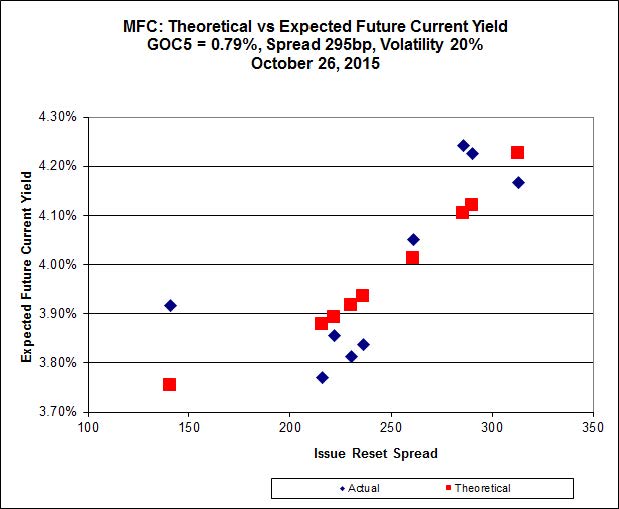
For as long as the FixedReset market is so violently unsettled, I’ll keep publishing updates of the more interesting and meaningful series of FixedResets’ Implied Volatilities. This doesn’t include Enbridge because although Enbridge has a large number of issues outstanding, all of which are quite liquid, the range of Issue Reset Spreads is too small for decent conclusions. The low is 212bp (ENB.PR.H; second-lowest is ENB.PR.D at 237bp) and the high is a mere 268 for ENB.PF.G.

Remember that all rich /cheap assessments are:
» based on Implied Volatility Theory only
» are relative only to other FixedResets from the same issuer
» assume constant GOC-5 yield
» assume constant Implied Volatility
» assume constant spread

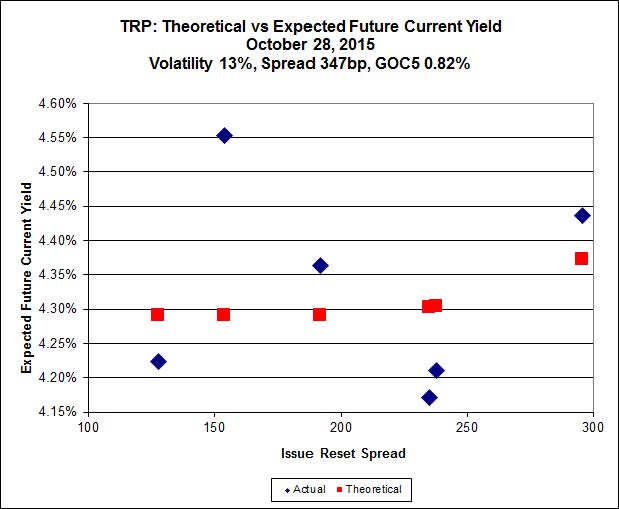
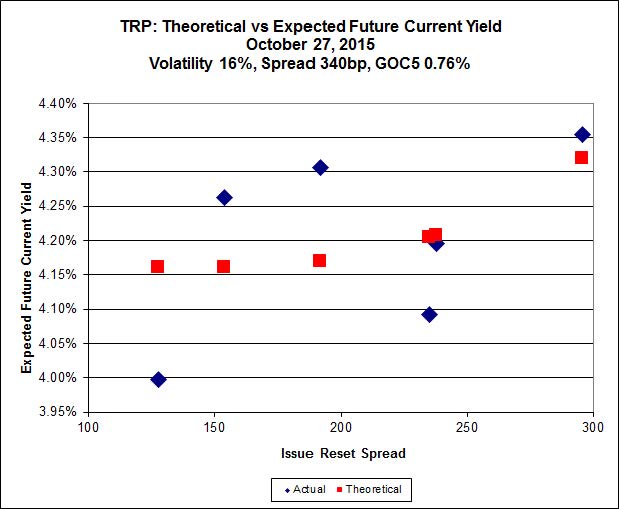
Here’s TRP:

impVol_TRP_150911
Click for Big

TRP.PR.E, which resets 2019-10-30 at +235, is bid at 20.30 to be $0.89 rich, while TRP.PR.C, resetting 2016-1-30 at +164, is $1.36 cheap at its bid price of 13.15.

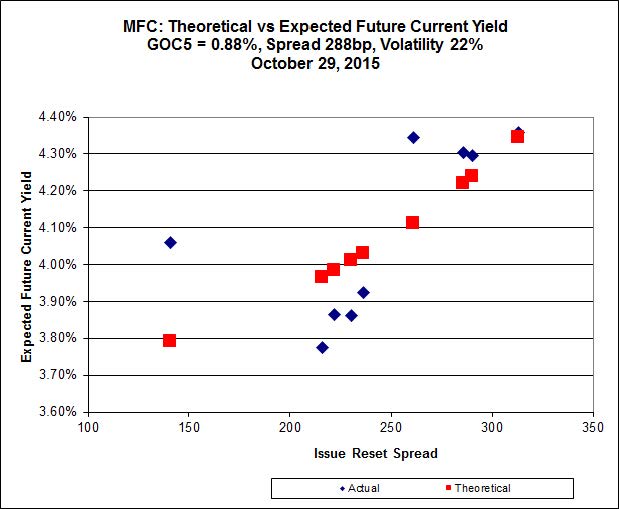
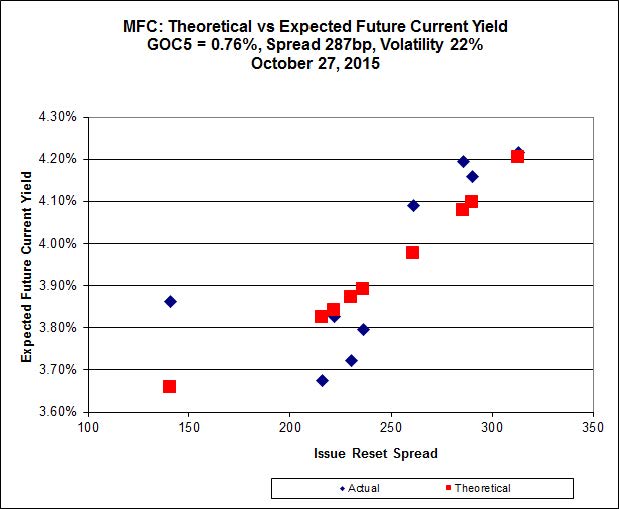
impVol_MFC_150911
Click for Big

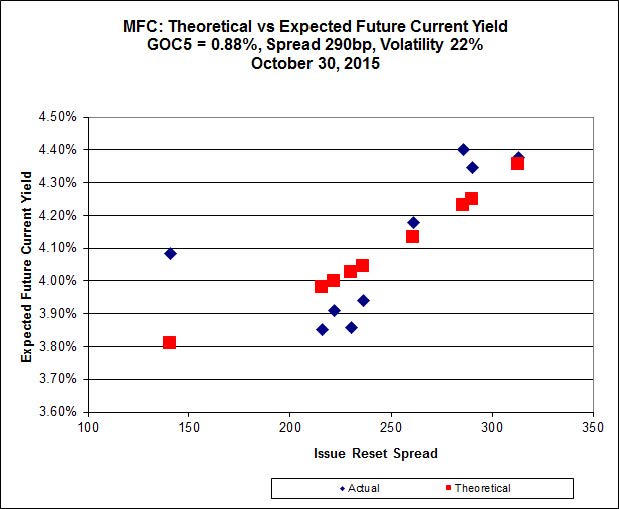
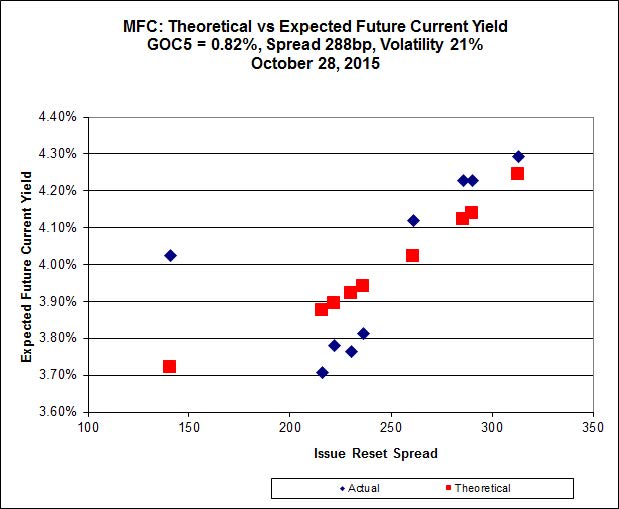
Another good fit today for MFC, with Implied Volatility edging up a bit today.

Most expensive is MFC.PR.M, resetting at +236bp on 2019-12-19, bid at 21.75 to be 0.42 rich, while MFC.PR.J, resetting at +261bp on 2018-3-19, is bid at 22.00 to be 0.38 cheap.

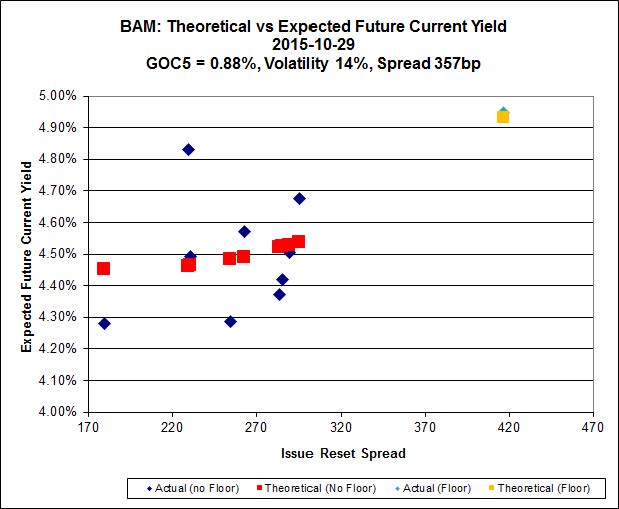
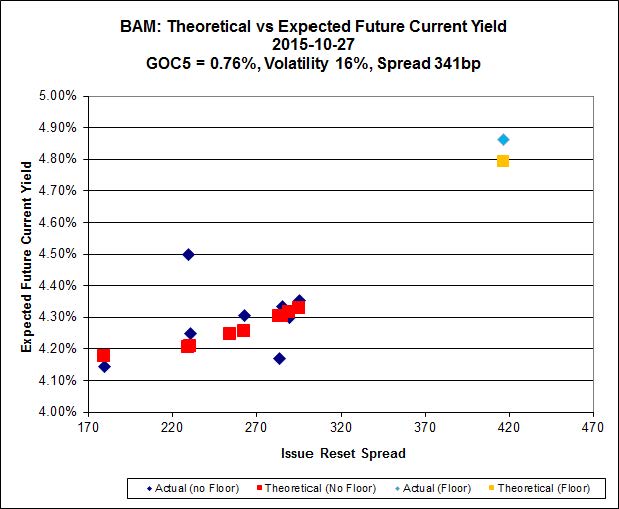
impVol_BAM_150911
Click for Big

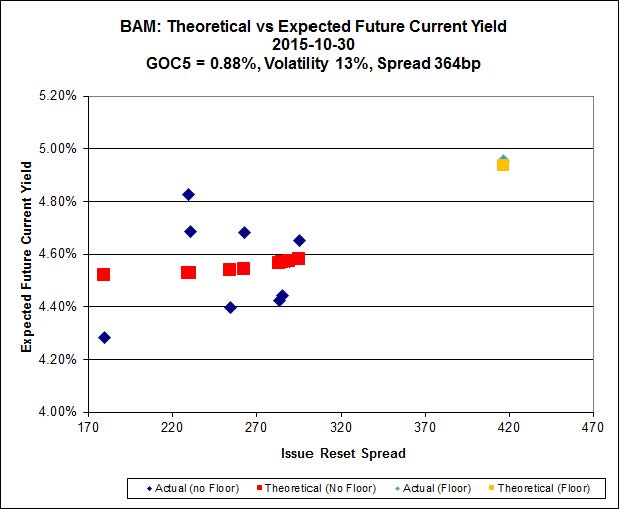
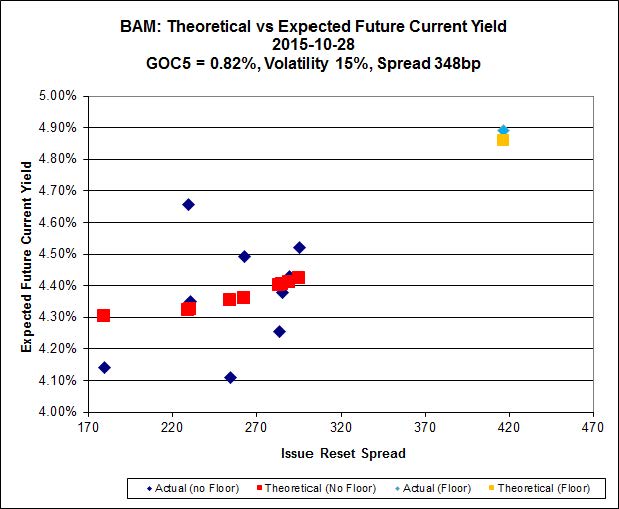
The fit on the BAM issues continues to be horrible.

The cheapest issue relative to its peers is BAM.PR.R, resetting at +230bp on 2016-6-30, bid at 17.08 to be $1.24 cheap. BAM.PF.G, resetting at +284bp on 2020-6-30 is bid at 22.50 and appears to be $0.96 rich.

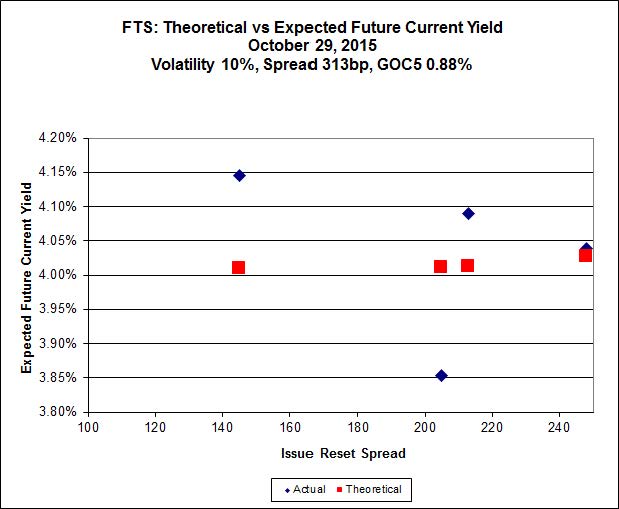
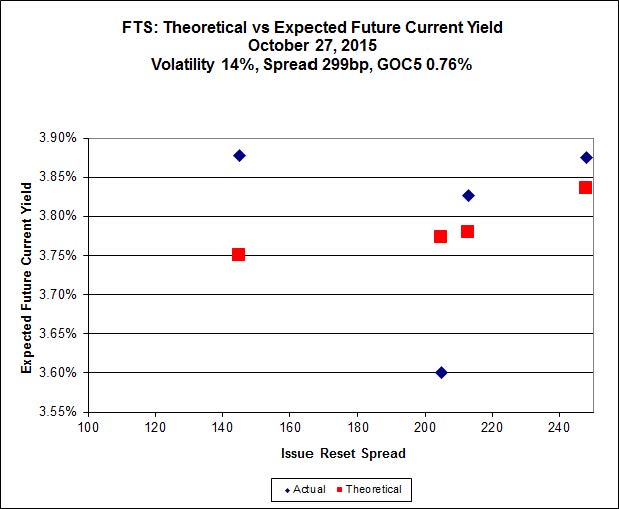
impVol_FTS_150911
Click for Big

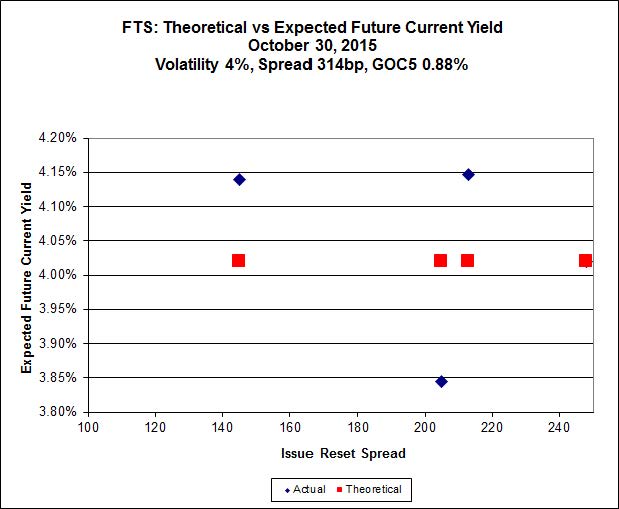
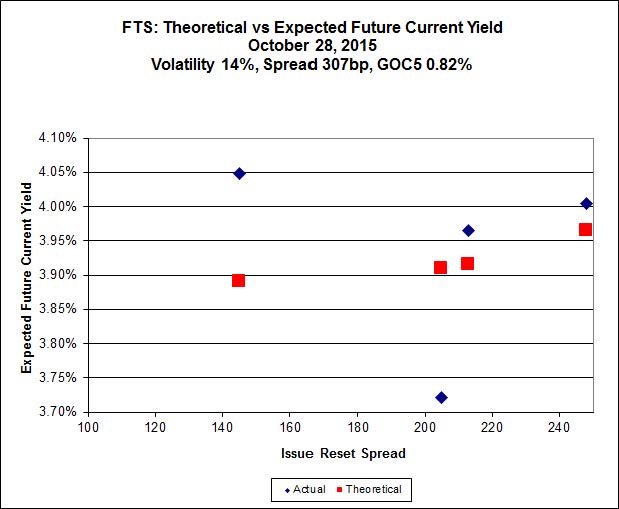
FTS.PR.K, with a spread of +205bp, and bid at 19.85, looks $0.59 expensive and resets 2019-3-1. FTS.PR.G, with a spread of +213bp and resetting 2018-9-1, is bid at 18.98 and is $0.76 cheap.

pairs_FR_150911
Click for Big

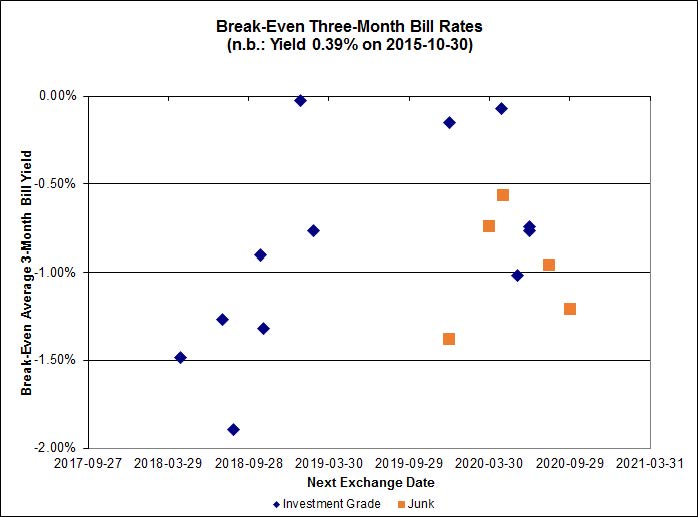
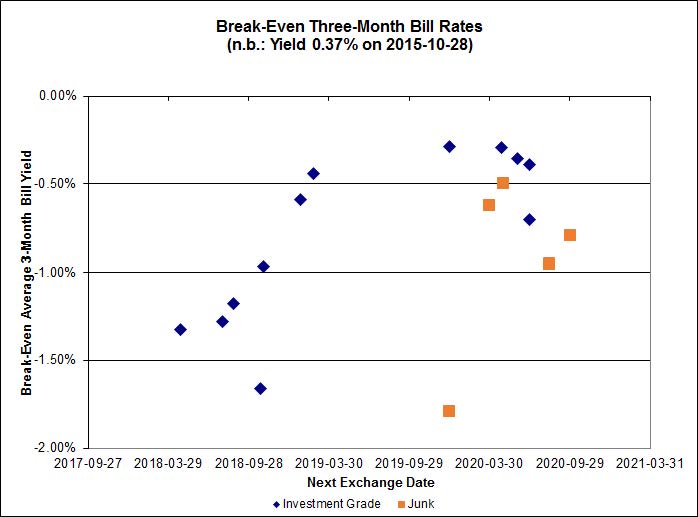
Investment-grade pairs predict an average three-month bill yield over the next five-odd years of -1.11%, with no outliers. Note that the distribution is bimodal, with NVCC non-compliant bank issues averaging -1.26% and the unregulated issues averaging -0.90%. There is one junk outlier below -2.00% and two above 0.00%.

pairs_FF_150911
Click for Big

Shall we just say that this exhibits a high level of confidence in the continued rapacity of Canadian banks?

HIMIPref™ Preferred Indices
These values reflect the December 2008 revision of the HIMIPref™ Indices

Values are provisional and are finalized monthly
Index Mean
Current
Yield
(at bid)
Median
YTW
Median
Average
Trading
Value
Median
Mod Dur
(YTW)
Issues Day’s Perf. Index Value
Ratchet 0.00 % 0.00 % 0 0.00 0 1.5962 % 1,659.6
FixedFloater 0.00 % 0.00 % 0 0.00 0 1.5962 % 2,901.8
Floater 4.48 % 4.45 % 57,633 16.54 3 1.5962 % 1,764.3
OpRet 0.00 % 0.00 % 0 0.00 0 -0.0135 % 2,782.4
SplitShare 4.63 % 4.92 % 63,045 3.08 3 -0.0135 % 3,260.9
Interest-Bearing 0.00 % 0.00 % 0 0.00 0 -0.0135 % 2,544.2
Perpetual-Premium 5.72 % 5.50 % 57,276 1.99 8 0.0940 % 2,493.6
Perpetual-Discount 5.43 % 5.50 % 70,742 14.59 30 -0.0311 % 2,606.7
FixedReset 4.67 % 4.16 % 177,528 16.22 74 0.4648 % 2,181.0
Deemed-Retractible 5.13 % 4.46 % 93,582 0.85 33 0.3059 % 2,593.3
FloatingReset 2.93 % 4.29 % 52,847 5.84 9 0.4498 % 2,180.8
Performance Highlights
Issue Index Change Notes
SLF.PR.H FixedReset -3.27 % YTW SCENARIO
Maturity Type : Hard Maturity
Maturity Date : 2025-01-31
Maturity Price : 25.00
Evaluated at bid price : 18.62
Bid-YTW : 6.76 %
GWO.PR.N FixedReset -2.38 % YTW SCENARIO
Maturity Type : Hard Maturity
Maturity Date : 2025-01-31
Maturity Price : 25.00
Evaluated at bid price : 15.15
Bid-YTW : 8.24 %
PWF.PR.P FixedReset -1.50 % YTW SCENARIO
Maturity Type : Limit Maturity
Maturity Date : 2045-09-11
Maturity Price : 15.78
Evaluated at bid price : 15.78
Bid-YTW : 3.83 %
SLF.PR.J FloatingReset -1.01 % YTW SCENARIO
Maturity Type : Hard Maturity
Maturity Date : 2025-01-31
Maturity Price : 25.00
Evaluated at bid price : 13.77
Bid-YTW : 9.50 %
MFC.PR.K FixedReset 1.04 % YTW SCENARIO
Maturity Type : Hard Maturity
Maturity Date : 2025-01-31
Maturity Price : 25.00
Evaluated at bid price : 20.36
Bid-YTW : 5.89 %
TD.PF.D FixedReset 1.07 % YTW SCENARIO
Maturity Type : Limit Maturity
Maturity Date : 2045-09-11
Maturity Price : 22.62
Evaluated at bid price : 23.65
Bid-YTW : 3.73 %
BAM.PF.B FixedReset 1.14 % YTW SCENARIO
Maturity Type : Limit Maturity
Maturity Date : 2045-09-11
Maturity Price : 20.45
Evaluated at bid price : 20.45
Bid-YTW : 4.35 %
BAM.PR.T FixedReset 1.18 % YTW SCENARIO
Maturity Type : Limit Maturity
Maturity Date : 2045-09-11
Maturity Price : 17.86
Evaluated at bid price : 17.86
Bid-YTW : 4.49 %
IFC.PR.A FixedReset 1.22 % YTW SCENARIO
Maturity Type : Hard Maturity
Maturity Date : 2025-01-31
Maturity Price : 25.00
Evaluated at bid price : 17.30
Bid-YTW : 7.69 %
MFC.PR.F FixedReset 1.44 % YTW SCENARIO
Maturity Type : Hard Maturity
Maturity Date : 2025-01-31
Maturity Price : 25.00
Evaluated at bid price : 16.25
Bid-YTW : 7.64 %
HSE.PR.E FixedReset 1.48 % YTW SCENARIO
Maturity Type : Limit Maturity
Maturity Date : 2045-09-11
Maturity Price : 22.09
Evaluated at bid price : 22.65
Bid-YTW : 4.80 %
GWO.PR.I Deemed-Retractible 1.58 % YTW SCENARIO
Maturity Type : Hard Maturity
Maturity Date : 2025-01-31
Maturity Price : 25.00
Evaluated at bid price : 21.92
Bid-YTW : 6.26 %
TRP.PR.A FixedReset 1.63 % YTW SCENARIO
Maturity Type : Limit Maturity
Maturity Date : 2045-09-11
Maturity Price : 17.50
Evaluated at bid price : 17.50
Bid-YTW : 4.03 %
MFC.PR.G FixedReset 1.80 % YTW SCENARIO
Maturity Type : Hard Maturity
Maturity Date : 2025-01-31
Maturity Price : 25.00
Evaluated at bid price : 23.17
Bid-YTW : 4.75 %
BAM.PR.B Floater 1.80 % YTW SCENARIO
Maturity Type : Limit Maturity
Maturity Date : 2045-09-11
Maturity Price : 10.67
Evaluated at bid price : 10.67
Bid-YTW : 4.42 %
TRP.PR.D FixedReset 1.94 % YTW SCENARIO
Maturity Type : Limit Maturity
Maturity Date : 2045-09-11
Maturity Price : 19.95
Evaluated at bid price : 19.95
Bid-YTW : 4.19 %
BIP.PR.A FixedReset 1.98 % YTW SCENARIO
Maturity Type : Limit Maturity
Maturity Date : 2045-09-11
Maturity Price : 21.79
Evaluated at bid price : 22.20
Bid-YTW : 4.90 %
BAM.PR.K Floater 2.20 % YTW SCENARIO
Maturity Type : Limit Maturity
Maturity Date : 2045-09-11
Maturity Price : 10.60
Evaluated at bid price : 10.60
Bid-YTW : 4.45 %
TRP.PR.F FloatingReset 2.34 % YTW SCENARIO
Maturity Type : Limit Maturity
Maturity Date : 2045-09-11
Maturity Price : 14.90
Evaluated at bid price : 14.90
Bid-YTW : 4.49 %
BAM.PR.R FixedReset 2.40 % YTW SCENARIO
Maturity Type : Limit Maturity
Maturity Date : 2045-09-11
Maturity Price : 17.08
Evaluated at bid price : 17.08
Bid-YTW : 4.61 %
IFC.PR.C FixedReset 2.86 % YTW SCENARIO
Maturity Type : Hard Maturity
Maturity Date : 2025-01-31
Maturity Price : 25.00
Evaluated at bid price : 21.08
Bid-YTW : 5.68 %
MFC.PR.L FixedReset 3.02 % YTW SCENARIO
Maturity Type : Hard Maturity
Maturity Date : 2025-01-31
Maturity Price : 25.00
Evaluated at bid price : 20.45
Bid-YTW : 5.93 %
BAM.PR.X FixedReset 3.33 % YTW SCENARIO
Maturity Type : Limit Maturity
Maturity Date : 2045-09-11
Maturity Price : 15.47
Evaluated at bid price : 15.47
Bid-YTW : 4.45 %
MFC.PR.M FixedReset 3.52 % YTW SCENARIO
Maturity Type : Hard Maturity
Maturity Date : 2025-01-31
Maturity Price : 25.00
Evaluated at bid price : 21.75
Bid-YTW : 5.30 %
MFC.PR.N FixedReset 3.59 % YTW SCENARIO
Maturity Type : Hard Maturity
Maturity Date : 2025-01-31
Maturity Price : 25.00
Evaluated at bid price : 21.37
Bid-YTW : 5.46 %
Volume Highlights
Issue Index Shares
Traded
Notes
CM.PR.P FixedReset 59,490 TD crossed 25,000 at 21.30.
YTW SCENARIO
Maturity Type : Limit Maturity
Maturity Date : 2045-09-11
Maturity Price : 21.30
Evaluated at bid price : 21.30
Bid-YTW : 3.77 %
BAM.PF.G FixedReset 51,095 RBC bought 37,500 from TD at 22.30.
YTW SCENARIO
Maturity Type : Limit Maturity
Maturity Date : 2045-09-11
Maturity Price : 21.99
Evaluated at bid price : 22.50
Bid-YTW : 4.21 %
TD.PF.A FixedReset 49,308 TD crossed 10,000 at 21.74.
YTW SCENARIO
Maturity Type : Limit Maturity
Maturity Date : 2045-09-11
Maturity Price : 21.37
Evaluated at bid price : 21.68
Bid-YTW : 3.69 %
RY.PR.I FixedReset 44,646 Desjardins crossed 39,700 at 24.82.
YTW SCENARIO
Maturity Type : Hard Maturity
Maturity Date : 2022-01-31
Maturity Price : 25.00
Evaluated at bid price : 24.80
Bid-YTW : 3.33 %
BAM.PF.E FixedReset 37,762 National bought 28,900 from Scotia at 20.32.
YTW SCENARIO
Maturity Type : Limit Maturity
Maturity Date : 2045-09-11
Maturity Price : 20.37
Evaluated at bid price : 20.37
Bid-YTW : 4.40 %
BMO.PR.T FixedReset 37,720 Scotia crossed 30,000 at 21.75.
YTW SCENARIO
Maturity Type : Limit Maturity
Maturity Date : 2045-09-11
Maturity Price : 21.51
Evaluated at bid price : 21.51
Bid-YTW : 3.72 %
There were 24 other index-included issues trading in excess of 10,000 shares.
Wide Spread Highlights
Issue Index Quote Data and Yield Notes
MFC.PR.G FixedReset Quote: 23.17 – 23.79
Spot Rate : 0.6200
Average : 0.3989

YTW SCENARIO
Maturity Type : Hard Maturity
Maturity Date : 2025-01-31
Maturity Price : 25.00
Evaluated at bid price : 23.17
Bid-YTW : 4.75 %

TRP.PR.G FixedReset Quote: 22.00 – 22.95
Spot Rate : 0.9500
Average : 0.7555

YTW SCENARIO
Maturity Type : Limit Maturity
Maturity Date : 2045-09-11
Maturity Price : 21.63
Evaluated at bid price : 22.00
Bid-YTW : 4.25 %

HSE.PR.G FixedReset Quote: 22.85 – 23.50
Spot Rate : 0.6500
Average : 0.4699

YTW SCENARIO
Maturity Type : Limit Maturity
Maturity Date : 2045-09-11
Maturity Price : 22.20
Evaluated at bid price : 22.85
Bid-YTW : 4.74 %

IGM.PR.B Perpetual-Premium Quote: 25.40 – 26.06
Spot Rate : 0.6600
Average : 0.4890

YTW SCENARIO
Maturity Type : Limit Maturity
Maturity Date : 2045-09-11
Maturity Price : 25.08
Evaluated at bid price : 25.40
Bid-YTW : 5.88 %

SLF.PR.H FixedReset Quote: 18.62 – 19.05
Spot Rate : 0.4300
Average : 0.2731

YTW SCENARIO
Maturity Type : Hard Maturity
Maturity Date : 2025-01-31
Maturity Price : 25.00
Evaluated at bid price : 18.62
Bid-YTW : 6.76 %

MFC.PR.L FixedReset Quote: 20.45 – 20.95
Spot Rate : 0.5000
Average : 0.3640

YTW SCENARIO
Maturity Type : Hard Maturity
Maturity Date : 2025-01-31
Maturity Price : 25.00
Evaluated at bid price : 20.45
Bid-YTW : 5.93 %

Issue Comments

NPI.PR.A, FFH.PR.G, ALA.PR.A: Convert Or Hold?

It will be recalled that

The deadline for notifying the companies of the intent to convert is September 15 at 5pm; but note that these are company deadlines and that brokers will generally set their deadlines a day or two in advance, so there’s not much time to lose if you’re planning to convert! However, if you miss the brokerage deadline they’ll probably do it on a ‘best efforts’ basis if you grovel in a sufficiently entertaining fashion.

The most logical way to analyze the question of whether or not to convert is through the theory of Preferred Pairs, for which a calculator is available. Briefly, a Strong Pair is defined as a pair of securities that can be interconverted in the future (e.g., NPI.PR.A and the FloatingReset, NPI.PR.?, that will exist if enough holders convert). Since they will be interconvertible on this future date, it may be assumed that they will be priced identically on this date (if they aren’t then holders will simply convert en masse to the higher-priced issue). And since they will be priced identically on a given date in the future, any current difference in price must be offset by expectations of an equal and opposite value of dividends to be received in the interim. And since the dividend rate on one element of the pair is both fixed and known, the implied average rate of the other, floating rate, instrument can be determined. Finally, we say, we may compare these average rates and take a view regarding the actual future course of that rate relative to the implied rate, which will provide us with guidance on which element of the pair is likely to outperform the other until the next interconversion date, at which time the process will be repeated.

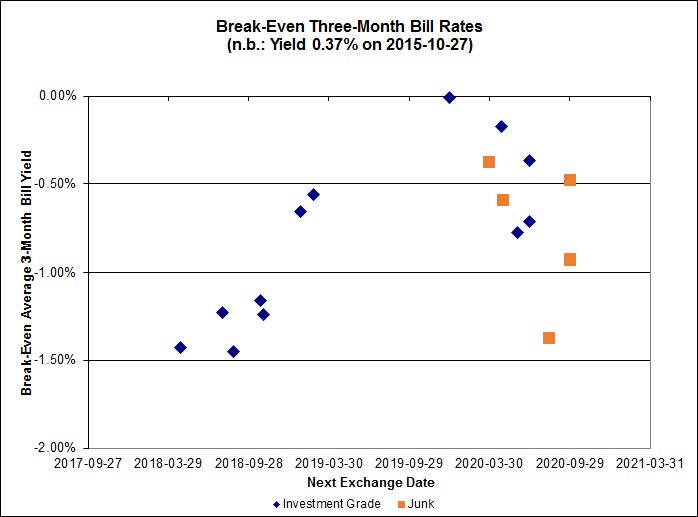
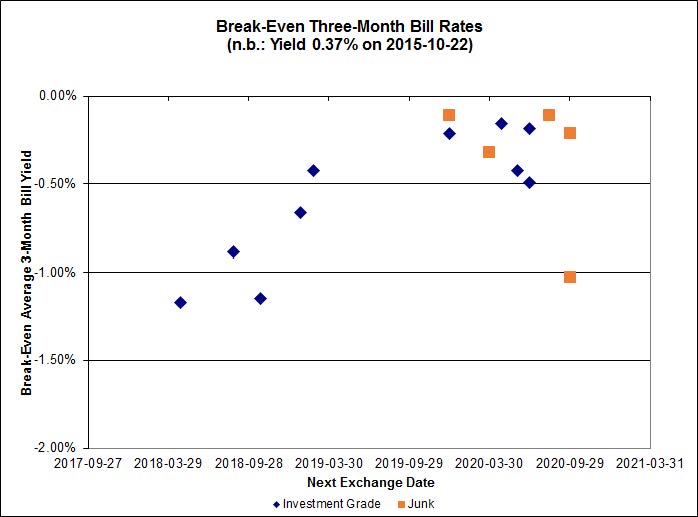
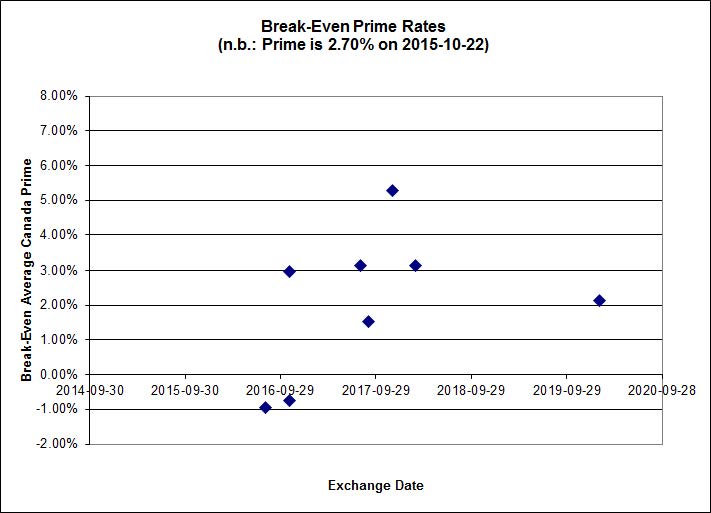
We can show the break-even rates for each FixedReset / FloatingReset Strong Pair graphically by plotting the implied average 3-month bill rate against the next Exchange Date (which is the date to which the average will be calculated).

pairs_FR_150910
Click for Big

The market appears to have a marked distaste at the moment for floating rate product; every single one of the implied rates until the next interconversion are lower than the current 3-month bill rate and nearly all pairs have a break-even yield significantly below zero! Whatever might be the result of the next few Bank of Canada overnight rate decisions, I suggest that it is unlikely that the average rate over the next five years will be lower than current – but if you disagree, of course, you may interpret the data any way you like.

Since credit quality of each element of the pair is equal to the other element, it should not make any difference whether the pair examined is investment-grade or junk, although we might expect greater variation of implied rates between junk issues on grounds of lower liquidity, and this is just what we see.

If we plug in the current bid price of the three FixedResets, we may construct the following table showing consistent prices for their soon-to-be-issued FloatingReset counterparts given a variety of Implied Breakeven yields consistent with issues currently trading:

Estimate of FloatingReset Trading Price In Current Conditions
  Assumed FloatingReset
Price if Implied Bill
is equal to
FixedReset Bid Price Spread -2.00% -1.00% 0.00%
NPI.PR.A. 14.71 280bp 12.08 13.05 14.02
ALA.PR.A 15.40 266bp 12.71 13.70 14.69
FFH.PR.G 14.50 256bp 11.79 12.78 13.76

Based on current market conditions, I suggest that the FloatingResets that will result from conversion are likely to be cheap and trading well below the price of their FixedReset counterparts. Therefore, I recommend that holders of NPI.PR.A, FFH.PR.G and ALA.PR.A continue to hold these issues and not to convert. I will note that current conditions make extant FloatingResets so cheap (in general) that it may be a good trade to swap the FixedReset for the FloatingReset in the market once both elements of each pair are trading and you can – presumably, according to this analysis – do it with a reasonably good take-out in price, rather than doing it through the company on a 1:1 basis. But that, of course, will depend on the prices at that time and your forecast for the future path of policy rates. There are no guarantees – my recommendation is based on the assumption that current market conditions with respect to the pairs will continue until the FloatingResets commence trading and that the relative pricing of the new pairs will reflect these conditions.

Note as well that conversion rights are dependent upon at least one million shares of each series being outstanding after giving effect to holders’ instructions; e.g., if only 100,000 shares of NPI.PR.A are tendered for conversion, then no conversions will be allowed; but if only 100,000 shares of NPI.PR.A will remain after the rest are all tendered, then conversion will be mandatory. However, this is relatively rare: all 30 Strong Pairs currently extant have some version of this condition and all but two have both series outstanding.

Market Action

September 10, 2015

CP Rail sold a century bond!

The railroad’s $900 million [USD] 100-year bond, sold with a coupon of 6.125 percent, shows how the once-troubled company has won over investor hearts and minds under new Chief Executive Officer Hunter Harrison, even as it embarks on a share-repurchase plan that would boost its debt load.

The century bond sale was the biggest by CP Rail since 1986. The company also issued $300 million in 20-year bonds with a 4.8 percent coupon. The average maturity on the Bank of America Merrill Lynch 15+ Year BBB US Corporate Index is 25 years with a yield of 5.5 percent, according to Bank of America Merrill Lynch data. The last century bond was issued by Brazil’s Petrobras Global Finance in June with a 6.85 percent coupon, according to data compiled by Bloomberg. Calgary-based Enbridge Inc., a pipeline operator, issued C$100 million ($76 million) of century bonds in Canada in 2012.

BMO has announced a major acquisition:

Bank of Montreal, Canada’s fourth-largest lender, agreed to buy General Electric Co.’s transportation finance business in the U.S. and Canada.

The unit had net earning assets of about C$11.5 billion ($8.7 billion) as of June 30, the Toronto-based bank said Thursday in a statement that didn’t disclose terms. The GE unit’s management team and about 600 employees will join Bank of Montreal, according to a presentation on the bank’s website.

Bank of Montreal’s agreement is the latest in a U.S. expansion that began in 1984 with its purchase of Chicago-based Harris Bank. The lender’s last major U.S. deal was its July 2011 takeover of Milwaukee-based Marshall & Ilsley Corp., which doubled deposits and branches and strengthened its commercial lending focus across the U.S. Midwest.

The relationship between ETFs, funds and crisis liquidity has been a hot issue. Barclays weighs in with some musings on ‘first-mover’ advantage:

Illiquidity in corporate bonds would in theory spell bad news for bond funds that promise investors the ability to immediately get out of their positions. The concern here is that once investors get a whiff of an impending mass selloff in bonds, they could potentially rush for the exits to try to get ahead of it.

With liquidity already low, that could put massive pressure on debt prices. Those who manage to squeeze through the keyhole first get rewarded for their speed but end up exacerbating this downward spiral. The slowest investors, meanwhile, get left with a portfolio of bonds that’s potentially much reduced in price.

By how much, you ask? Barclays estimates about 2 percent for funds that hold junk-rated corporate debt (boldface ours):

Mutual fund investors are, thus, faced with a first mover’s advantage to redeem in large selloff days because of a combination of inflated pricing and potential rebalancing costs. The magnitude of this advantage can be very meaningful economically. Assuming a 10 percent market shock leads to 10 percent outflows, we estimate that the first mover advantage is as much as 1.78 percent, or 1.61 percent from [net asset value] inflation and 0.17 percent from rebalancing costs.The benefit to early redeemers is effectively a tax on investors who remain invested through big downturns and ironically encourages demanding more liquidity.

They suggest a ‘scaled exit fee’:

“An “exit fee” that charges investors to withdraw their money from bond funds could arguably help slow theoretical outflows. (There is, of course, a converse argument that says such a fee would merely exacerbate the rush to the exit.) Barclays argues for a more refined approach that involves scaled fees:

Redemption fees are relatively straightforward and could be set such that they exactly neutralize the advantage of redeeming first in a down market. In our worst-case scenario, a redemption fee on the order of 2.0% would do the trick. That said, redemption fees are a somewhat blunt instrument. They penalize anyone withdrawing funds equally, regardless of how much liquidity the investor is demanding. Indeed, penalizing every investor based on a worst-case scenario may not be necessary. We believe a more nuanced approach would be to enforce minimum redemption fees according to a settlement schedule, with the minimum fee declining to zero as the investor allows settlement time to increase.

We wonder what the bond fund managers would say.

Well, PrefBlog says that, as stated, the idea is moronic, a typical product of a trading house that knows all about trading and nothing about investing.

What price will the redemption be at? Say you’ve got a million bucks in the fund and give me thirty days notice that you want out. So, notice period be damned, the price you’ll get is the day of actual redemption, thirty days hence. So should I sell securities now to raise the cash? Then I’ve got cash in the fund, which is kind of not the point of a fund (although the concept of fund investment is being increasingly circumscribed by liquidity rules and policies, as discussed on June 12). And I have to hold that cash in the fund for thirty days, reducing my duration and watching the market go up (because it always goes up in situations like this). So, nope, I’m not going to do it. I’m going to sell when I can get prices that will reasonably approximate the prices I use for determining the redemption value, which is to say, maybe half an hour prior to the close on the redemption date. So thirty day’s notice hasn’t done me a lot of good, has it?

The idea can be rescued by paying a blended price. Never mind “thirty day’s” notice, give me “twenty trading day’s” notice and agreed to get paid a blended price comprised of the NAV at the end of every equally weighted trading day. Then I can confidently sell 5% of your redemption value every day without screwing my other clients. There could be problems with this; if, for instance, a very large fund was to have a commitment to sell $10-million in preferreds for cash every day for the next twenty and this information becomes public … well, there won’t be much buying interest from other players for the next 15 trading days! So that’s got to be top-secret information … and in this business, ain’t nuthin’ top-secret.

A battle is brewing in the States over the right to bear screwdrivers:

Apple doesn’t publish repair manuals or sell parts to customers, and its warranty doesn’t apply if unauthorized repair damages its device. Samsung wouldn’t say why it doesn’t share repair information, though it makes some parts available to shops. Even John Deere gives only approved technicians access to the embedded software that controls systems in its machines. The manufacturers argue these limitations keep products working safely, and that copyright law lets them protect their intellectual property so it isn’t pirated.

“Bulls–t,” says Gay Gordon-Byrne, executive director of the Digital Right to Repair Coalition, based in North Haledon, N.J. “Repair is a profit center for a lot of companies, and sometimes it is more profitable than selling hardware.” Maintaining “repair monopolies,” she says, pushes up costs and makes customers more likely to simply junk old models for new ones. Apple charges $79 to replace an iPhone 4 battery. Repair website IFixit charges $20 for a battery and DIY kit for the same job.

Gordon-Byrne’s organization and advocates such as the Electronic Frontier Foundation are supporting bills introduced this year in Massachusetts, Minnesota, and New York that would require manufacturers to sell parts and provide manuals to hardware owners and independent repair shops. Separate efforts in Congress would amend the federal Digital Millennium Copyright Act by giving explicit permission for consumers to circumvent a manufacturer’s digital lock on its software for a lawful reason such as repair.

Times are tough in the dairy business:

Record prices last year primed farmers to bolster output in the U.S., where milk production in 2015 will reach 208.7 billion pounds—the fifth consecutive record-setting year. In April the EU, seeking to liberalize trade, removed quotas that had been in place for the past 30 years, leading to increased production from Ireland, the Netherlands, and the U.K. China is producing more milk thanks to investments such as a $140 million, 20,000-cow facility that China Modern Dairy Holdings, partly owned by private equity firm KKR, unveiled in 2013. The Chinese are also consuming stockpiled milk powder and importing less. Global milk supply grew 3.7 percent last year, almost triple the growth rate of 2013, the USDA says.

Overcapacity “is a long-term problem that a short-term fix won’t address,” says Robbie Turner, head of European markets at Rice Dairy International.

Nope, the only fix is to squeeze out the high-cost producers during times of oversupply, giving low-cost producers room to expand during times of undersupply. It’s called “economics”, though some prefer “competition”.

It was a mixed day in the Canadian preferred share market, with PerpetualDiscounts gaining 1bp, FixedResets off 9bp and DeemedRetractibles up 2bp. FixedResets comprised the entire good side of the Performance Highlights table. Volume was very, awfully, miserably, disgustingly, quietly low.

For as long as the FixedReset market is so violently unsettled, I’ll keep publishing updates of the more interesting and meaningful series of FixedResets’ Implied Volatilities. This doesn’t include Enbridge because although Enbridge has a large number of issues outstanding, all of which are quite liquid, the range of Issue Reset Spreads is too small for decent conclusions. The low is 212bp (ENB.PR.H; second-lowest is ENB.PR.D at 237bp) and the high is a mere 268 for ENB.PF.G.

Remember that all rich /cheap assessments are:
» based on Implied Volatility Theory only
» are relative only to other FixedResets from the same issuer
» assume constant GOC-5 yield
» assume constant Implied Volatility
» assume constant spread

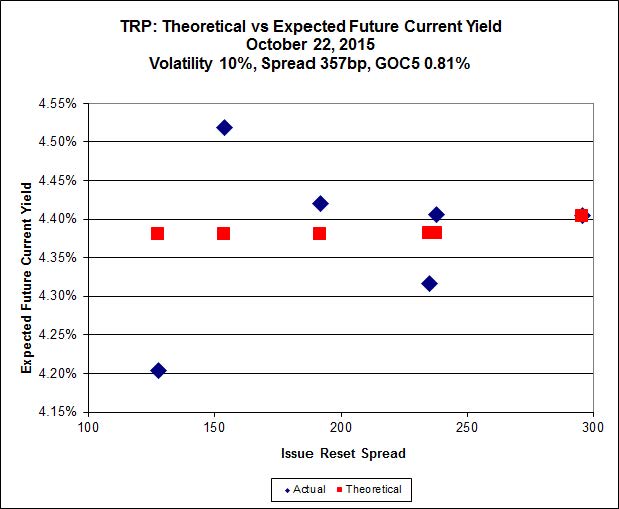
Here’s TRP:

impVol_TRP_150910
Click for Big

TRP.PR.E, which resets 2019-10-30 at +235, is bid at 20.15 to be $0.94 rich, while TRP.PR.C, resetting 2016-1-30 at +164, is $1.21 cheap at its bid price of 13.15.

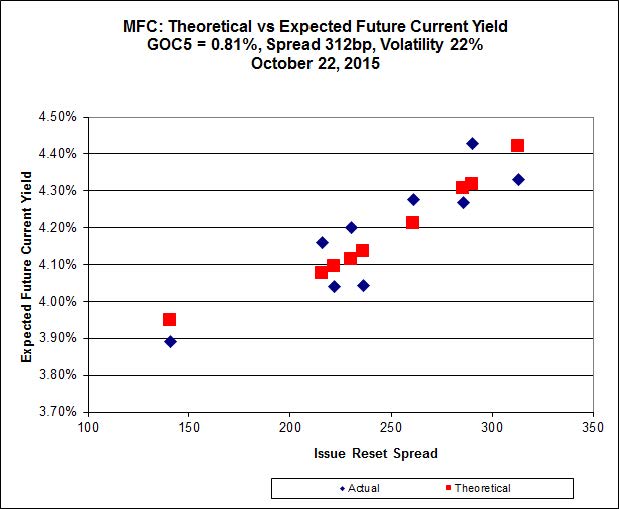
impVol_MFC_150910
Click for Big

Another good fit today for MFC, with Implied Volatility falling a bit today.

Most expensive is MFC.PR.H, resetting at +313bp on 2017-3-19, bid at 24.26 to be 0.44 rich, while MFC.PR.G, resetting at +290bp on 2016-12-19, is bid at 22.76 to be 0.36 cheap.

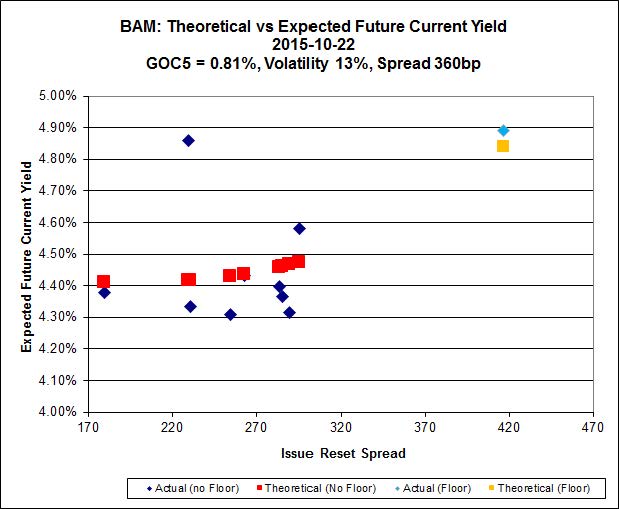
impVol_BAM_150910
Click for Big

The fit on the BAM issues continues to be horrible.

The cheapest issue relative to its peers is BAM.PR.R, resetting at +230bp on 2016-6-30, bid at 17.01 to be $1.41 cheap. BAM.PF.F, resetting at +286bp on 2019-9-30 is bid at 22.70 and appears to be $0.93 rich.

impVol_FTS_150910
Click for Big

FTS.PR.K, with a spread of +205bp, and bid at 19.73, looks $0.45 expensive and resets 2019-3-1. FTS.PR.G, with a spread of +213bp and resetting 2018-9-1, is bid at 19.13 and is $0.62 cheap.

pairs_FR_150910
Click for Big

Investment-grade pairs predict an average three-month bill yield over the next five-odd years of -1.17%, with no outliers. Note that the distribution is bimodal, with NVCC non-compliant bank issues averaging -1.32% and the unregulated issues averaging -0.94%. There are two junk outliers below -2.00% and one above 0.00%.

pairs_FF_150910
Click for Big

Shall we just say that this exhibits a high level of confidence in the continued rapacity of Canadian banks?

HIMIPref™ Preferred Indices
These values reflect the December 2008 revision of the HIMIPref™ Indices

Values are provisional and are finalized monthly
Index Mean
Current
Yield
(at bid)
Median
YTW
Median
Average
Trading
Value
Median
Mod Dur
(YTW)
Issues Day’s Perf. Index Value
Ratchet 0.00 % 0.00 % 0 0.00 0 -1.8657 % 1,633.5
FixedFloater 0.00 % 0.00 % 0 0.00 0 -1.8657 % 2,856.2
Floater 4.49 % 4.57 % 58,488 16.20 3 -1.8657 % 1,736.6
OpRet 0.00 % 0.00 % 0 0.00 0 0.3523 % 2,782.8
SplitShare 4.62 % 4.92 % 63,980 3.08 3 0.3523 % 3,261.3
Interest-Bearing 0.00 % 0.00 % 0 0.00 0 0.3523 % 2,544.6
Perpetual-Premium 5.72 % 2.89 % 56,870 0.08 8 0.0693 % 2,491.2
Perpetual-Discount 5.42 % 5.50 % 71,363 14.59 30 0.0129 % 2,607.5
FixedReset 4.68 % 4.12 % 172,457 15.92 74 -0.0872 % 2,170.9
Deemed-Retractible 5.14 % 5.21 % 94,479 5.38 33 0.0189 % 2,585.4
FloatingReset 2.44 % 3.89 % 54,843 5.93 9 -0.2756 % 2,171.0
Performance Highlights
Issue Index Change Notes
TRP.PR.B FixedReset -2.35 % YTW SCENARIO
Maturity Type : Limit Maturity
Maturity Date : 2045-09-10
Maturity Price : 12.47
Evaluated at bid price : 12.47
Bid-YTW : 4.18 %
BAM.PR.K Floater -2.23 % YTW SCENARIO
Maturity Type : Limit Maturity
Maturity Date : 2045-09-10
Maturity Price : 10.50
Evaluated at bid price : 10.50
Bid-YTW : 4.57 %
HSE.PR.E FixedReset -2.11 % YTW SCENARIO
Maturity Type : Limit Maturity
Maturity Date : 2045-09-10
Maturity Price : 21.88
Evaluated at bid price : 22.32
Bid-YTW : 4.90 %
TRP.PR.F FloatingReset -1.95 % YTW SCENARIO
Maturity Type : Limit Maturity
Maturity Date : 2045-09-10
Maturity Price : 14.56
Evaluated at bid price : 14.56
Bid-YTW : 3.89 %
BAM.PR.B Floater -1.94 % YTW SCENARIO
Maturity Type : Limit Maturity
Maturity Date : 2045-09-10
Maturity Price : 10.61
Evaluated at bid price : 10.61
Bid-YTW : 4.52 %
BAM.PR.R FixedReset -1.79 % YTW SCENARIO
Maturity Type : Limit Maturity
Maturity Date : 2045-09-10
Maturity Price : 17.01
Evaluated at bid price : 17.01
Bid-YTW : 4.78 %
HSE.PR.C FixedReset -1.65 % YTW SCENARIO
Maturity Type : Limit Maturity
Maturity Date : 2045-09-10
Maturity Price : 20.85
Evaluated at bid price : 20.85
Bid-YTW : 4.87 %
TD.PF.D FixedReset -1.47 % YTW SCENARIO
Maturity Type : Limit Maturity
Maturity Date : 2045-09-10
Maturity Price : 22.50
Evaluated at bid price : 23.40
Bid-YTW : 3.79 %
MFC.PR.F FixedReset -1.42 % YTW SCENARIO
Maturity Type : Hard Maturity
Maturity Date : 2025-01-31
Maturity Price : 25.00
Evaluated at bid price : 16.02
Bid-YTW : 7.84 %
BAM.PR.C Floater -1.42 % YTW SCENARIO
Maturity Type : Limit Maturity
Maturity Date : 2045-09-10
Maturity Price : 10.45
Evaluated at bid price : 10.45
Bid-YTW : 4.59 %
NA.PR.S FixedReset -1.39 % YTW SCENARIO
Maturity Type : Limit Maturity
Maturity Date : 2045-09-10
Maturity Price : 21.70
Evaluated at bid price : 22.00
Bid-YTW : 3.81 %
TD.PF.B FixedReset -1.19 % YTW SCENARIO
Maturity Type : Limit Maturity
Maturity Date : 2045-09-10
Maturity Price : 21.30
Evaluated at bid price : 21.59
Bid-YTW : 3.72 %
CM.PR.Q FixedReset -1.05 % YTW SCENARIO
Maturity Type : Limit Maturity
Maturity Date : 2045-09-10
Maturity Price : 22.52
Evaluated at bid price : 23.45
Bid-YTW : 3.79 %
TRP.PR.C FixedReset -1.05 % YTW SCENARIO
Maturity Type : Limit Maturity
Maturity Date : 2045-09-10
Maturity Price : 13.15
Evaluated at bid price : 13.15
Bid-YTW : 4.53 %
HSE.PR.A FixedReset -1.05 % YTW SCENARIO
Maturity Type : Limit Maturity
Maturity Date : 2045-09-10
Maturity Price : 14.15
Evaluated at bid price : 14.15
Bid-YTW : 4.56 %
TRP.PR.A FixedReset -1.03 % YTW SCENARIO
Maturity Type : Limit Maturity
Maturity Date : 2045-09-10
Maturity Price : 17.22
Evaluated at bid price : 17.22
Bid-YTW : 4.12 %
GWO.PR.I Deemed-Retractible -1.01 % YTW SCENARIO
Maturity Type : Hard Maturity
Maturity Date : 2025-01-31
Maturity Price : 25.00
Evaluated at bid price : 21.58
Bid-YTW : 6.47 %
RY.PR.Z FixedReset -1.01 % YTW SCENARIO
Maturity Type : Limit Maturity
Maturity Date : 2045-09-10
Maturity Price : 21.29
Evaluated at bid price : 21.58
Bid-YTW : 3.68 %
MFC.PR.H FixedReset 1.08 % YTW SCENARIO
Maturity Type : Hard Maturity
Maturity Date : 2025-01-31
Maturity Price : 25.00
Evaluated at bid price : 24.27
Bid-YTW : 4.42 %
TRP.PR.E FixedReset 1.10 % YTW SCENARIO
Maturity Type : Limit Maturity
Maturity Date : 2045-09-10
Maturity Price : 20.15
Evaluated at bid price : 20.15
Bid-YTW : 4.23 %
FTS.PR.H FixedReset 1.11 % YTW SCENARIO
Maturity Type : Limit Maturity
Maturity Date : 2045-09-10
Maturity Price : 15.52
Evaluated at bid price : 15.52
Bid-YTW : 3.71 %
MFC.PR.K FixedReset 1.15 % YTW SCENARIO
Maturity Type : Hard Maturity
Maturity Date : 2025-01-31
Maturity Price : 25.00
Evaluated at bid price : 20.15
Bid-YTW : 6.04 %
SLF.PR.H FixedReset 1.21 % YTW SCENARIO
Maturity Type : Hard Maturity
Maturity Date : 2025-01-31
Maturity Price : 25.00
Evaluated at bid price : 19.25
Bid-YTW : 6.34 %
BAM.PR.X FixedReset 1.26 % YTW SCENARIO
Maturity Type : Limit Maturity
Maturity Date : 2045-09-10
Maturity Price : 15.25
Evaluated at bid price : 15.25
Bid-YTW : 4.66 %
TRP.PR.G FixedReset 1.72 % YTW SCENARIO
Maturity Type : Limit Maturity
Maturity Date : 2045-09-10
Maturity Price : 21.56
Evaluated at bid price : 21.90
Bid-YTW : 4.29 %
FTS.PR.K FixedReset 2.39 % YTW SCENARIO
Maturity Type : Limit Maturity
Maturity Date : 2045-09-10
Maturity Price : 19.73
Evaluated at bid price : 19.73
Bid-YTW : 3.86 %
FTS.PR.G FixedReset 2.46 % YTW SCENARIO
Maturity Type : Limit Maturity
Maturity Date : 2045-09-10
Maturity Price : 19.13
Evaluated at bid price : 19.13
Bid-YTW : 4.02 %
IFC.PR.A FixedReset 2.54 % YTW SCENARIO
Maturity Type : Hard Maturity
Maturity Date : 2025-01-31
Maturity Price : 25.00
Evaluated at bid price : 17.35
Bid-YTW : 7.87 %
Volume Highlights
Issue Index Shares
Traded
Notes
FTS.PR.M FixedReset 40,520 RBC crossed 10,000 at 21.68; Scotia crossed 20,200 at 21.66.
YTW SCENARIO
Maturity Type : Limit Maturity
Maturity Date : 2045-09-10
Maturity Price : 21.35
Evaluated at bid price : 21.65
Bid-YTW : 3.97 %
BAM.PR.R FixedReset 20,486 YTW SCENARIO
Maturity Type : Limit Maturity
Maturity Date : 2045-09-10
Maturity Price : 17.01
Evaluated at bid price : 17.01
Bid-YTW : 4.78 %
TRP.PR.D FixedReset 16,684 YTW SCENARIO
Maturity Type : Limit Maturity
Maturity Date : 2045-09-10
Maturity Price : 19.57
Evaluated at bid price : 19.57
Bid-YTW : 4.29 %
RY.PR.Z FixedReset 16,140 YTW SCENARIO
Maturity Type : Limit Maturity
Maturity Date : 2045-09-10
Maturity Price : 21.29
Evaluated at bid price : 21.58
Bid-YTW : 3.68 %
BAM.PR.B Floater 16,089 YTW SCENARIO
Maturity Type : Limit Maturity
Maturity Date : 2045-09-10
Maturity Price : 10.61
Evaluated at bid price : 10.61
Bid-YTW : 4.52 %
BAM.PF.D Perpetual-Discount 15,985 YTW SCENARIO
Maturity Type : Limit Maturity
Maturity Date : 2045-09-10
Maturity Price : 21.86
Evaluated at bid price : 22.15
Bid-YTW : 5.63 %
There were 6 other index-included issues trading in excess of 10,000 shares.
Wide Spread Highlights
Issue Index Quote Data and Yield Notes
IFC.PR.C FixedReset Quote: 20.75 – 21.60
Spot Rate : 0.8500
Average : 0.6733

YTW SCENARIO
Maturity Type : Hard Maturity
Maturity Date : 2025-01-31
Maturity Price : 25.00
Evaluated at bid price : 20.75
Bid-YTW : 6.07 %

TRP.PR.F FloatingReset Quote: 14.56 – 15.24
Spot Rate : 0.6800
Average : 0.5079

YTW SCENARIO
Maturity Type : Limit Maturity
Maturity Date : 2045-09-10
Maturity Price : 14.56
Evaluated at bid price : 14.56
Bid-YTW : 3.89 %

ELF.PR.F Perpetual-Discount Quote: 23.02 – 23.51
Spot Rate : 0.4900
Average : 0.3381

YTW SCENARIO
Maturity Type : Limit Maturity
Maturity Date : 2045-09-10
Maturity Price : 22.73
Evaluated at bid price : 23.02
Bid-YTW : 5.84 %

MFC.PR.M FixedReset Quote: 21.01 – 21.49
Spot Rate : 0.4800
Average : 0.3450

YTW SCENARIO
Maturity Type : Hard Maturity
Maturity Date : 2025-01-31
Maturity Price : 25.00
Evaluated at bid price : 21.01
Bid-YTW : 5.76 %

GWO.PR.H Deemed-Retractible Quote: 22.45 – 22.95
Spot Rate : 0.5000
Average : 0.3764

YTW SCENARIO
Maturity Type : Hard Maturity
Maturity Date : 2025-01-31
Maturity Price : 25.00
Evaluated at bid price : 22.45
Bid-YTW : 6.31 %

MFC.PR.N FixedReset Quote: 20.63 – 21.45
Spot Rate : 0.8200
Average : 0.6975

YTW SCENARIO
Maturity Type : Hard Maturity
Maturity Date : 2025-01-31
Maturity Price : 25.00
Evaluated at bid price : 20.63
Bid-YTW : 5.93 %

Market Action

September 9, 2015

The top news of the day is the unchanged BoC overnight rate:

The Bank of Canada today announced that it is maintaining its target for the overnight rate at 1/2 per cent. The Bank Rate is correspondingly 3/4 per cent and the deposit rate is 1/4 per cent.

Inflation has evolved in line with the outlook in the Bank’s July Monetary Policy Report (MPR). Total CPI inflation remains near the bottom of the target range, reflecting year-over-year price declines for consumer energy products. Core inflation has been close to 2 per cent, with disinflationary pressures from economic slack being offset by transitory effects of the past depreciation of the Canadian dollar and some sector-specific factors. The dynamics of GDP growth in Canada outlined in July’s MPR also remain intact. The stimulative effects of previous monetary policy actions are working their way through the Canadian economy.

Canada’s resource sector continues to adjust to lower prices for oil and other commodities, with some spillover to the rest of the economy. These adjustments are complex and are expected to take considerable time. Economic activity continues to be underpinned by solid household spending and a firm recovery in the United States, with particular strength in the sectors of the U.S. economy that are important for Canadian exports.

Increasing uncertainty about growth prospects for China and other emerging-market economies, in contrast, is raising questions about the pace of the global recovery. This has contributed to heightened financial market volatility and lower commodity prices. Movements in the Canadian dollar are helping to absorb some of the impact of lower commodity prices and are facilitating the adjustments taking place in Canada’s economy. While the overall export picture is still uncertain, the latest data confirm that exchange rate-sensitive exports are regaining momentum.

Meanwhile, risks to financial stability are evolving as expected. Taking all of these developments into consideration, the Bank judges that the risks to the outlook for inflation remain within the zone for which the current stance of monetary policy is appropriate. Therefore, the target for the overnight rate remains at 1/2 per cent.

Nice piece in the NYT magazine about the state of American campuses:

As Benjamin Ginsberg details in his 2011 book, ‘‘The Fall of the Faculty: The Rise of the All-Administrative University and Why It Matters,’’ a constantly expanding layer of university administrative jobs now exists at an increasing remove from the actual academic enterprise. It’s not unheard-of for colleges now to employ more senior administrators than professors. There are, of course, essential functions that many university administrators perform, but such an imbalance is absurd — try imagining a high school with more vice principals than teachers. This legion of bureaucrats enables a world of pitiless surveillance; no segment of campus life, no matter how small, does not have some administrator who worries about it. Piece by piece, every corner of the average campus is being slowly made congruent with a single, totalizing vision. The rise of endless brushed-metal-and-glass buildings at Purdue represents the aesthetic dimension of this ideology. Bent into place by a small army of apparatchiks, the contemporary American college is slowly becoming as meticulously art-directed and branded as a J. Crew catalog. Like Niketown or Disneyworld, your average college campus now leaves the distinct impression of a one-party state.

In the interest of fairness, here’s something for people who hate drones:

A new laser weapon that can burn up targets in just a few seconds recently melted and destroyed a test drone flying over California.

Known as the Compact Laser Weapons System, the futuristic, drone-shooting weapon is a smaller, more versatile version of the High Energy Laser Mobile Demonstrator (HEL MD), a system developed by Boeing to be mounted on top of U.S. Army vehicles.

It was another good day for the Canadian preferred share market, with PerpetualDiscounts gaining 24bp, FixedResets up 26bp and DeemedRetractibles winning 27bp. The lengthy Performance Highlights table was notable for a large population of winning FixedResets, but Floaters made a triumphant appearance at the summit. Volume was very low.

PerpetualDiscounts now yield 5.52%, equivalent to 7.18% interest at the standard equivalency factor of 1.3x. Long corporates now yield about 4.2%, so the pre-tax interest-equivalent spread (in this context, the “Seniority Spread”) is now about 300bp, unchanged from the level reported September 2.

For as long as the FixedReset market is so violently unsettled, I’ll keep publishing updates of the more interesting and meaningful series of FixedResets’ Implied Volatilities. This doesn’t include Enbridge because although Enbridge has a large number of issues outstanding, all of which are quite liquid, the range of Issue Reset Spreads is too small for decent conclusions. The low is 212bp (ENB.PR.H; second-lowest is ENB.PR.D at 237bp) and the high is a mere 268 for ENB.PF.G.

Remember that all rich /cheap assessments are:
» based on Implied Volatility Theory only
» are relative only to other FixedResets from the same issuer
» assume constant GOC-5 yield
» assume constant Implied Volatility
» assume constant spread

Here’s TRP:

impVol_TRP_150909
Click for Big

TRP.PR.E, which resets 2019-10-30 at +235, is bid at 19.93 to be $0.76 rich, while TRP.PR.C, resetting 2016-1-30 at +164, is $1.13 cheap at its bid price of 13.29.

impVol_MFC_150909
Click for Big

Another good fit today for MFC, with Implied Volatility rising a bit today.

Most expensive is MFC.PR.H, resetting at +313bp on 2017-3-19, bid at 24.01 to be 0.32 rich, while MFC.PR.K, resetting at +222bp on 2018-9-19, is bid at 19.92 to be 0.41 cheap.

impVol_BAM_150909
Click for Big

The fit on the BAM issues continues to be horrible.

The cheapest issue relative to its peers is BAM.PR.R, resetting at +230bp on 2016-6-30, bid at 17.32 to be $1.10 cheap. BAM.PF.F, resetting at +286bp on 2019-9-30 is bid at 22.70 and appears to be $0.93 rich.

impVol_FTS_150909
Click for Big

FTS.PR.K, with a spread of +205bp, and bid at 19.27, looks $0.30 expensive and resets 2019-3-1. FTS.PR.G, with a spread of +213bp and resetting 2018-9-1, is bid at 18.67 and is $0.79 cheap.

pairs_FR_150909
Click for Big

Investment-grade pairs predict an average three-month bill yield over the next five-odd years of -1.13%, with no outliers. Note that the distribution is bimodal, with NVCC non-compliant bank issues averaging -1.29% and the unregulated issues averaging -0.91%. There are two junk outliers below -2.00% and one above 0.00%.

pairs_FF_150909
Click for Big

Shall we just say that this exhibits a high level of confidence in the continued rapacity of Canadian banks?

HIMIPref™ Preferred Indices
These values reflect the December 2008 revision of the HIMIPref™ Indices

Values are provisional and are finalized monthly
Index Mean
Current
Yield
(at bid)
Median
YTW
Median
Average
Trading
Value
Median
Mod Dur
(YTW)
Issues Day’s Perf. Index Value
Ratchet 0.00 % 0.00 % 0 0.00 0 2.6165 % 1,664.6
FixedFloater 0.00 % 0.00 % 0 0.00 0 2.6165 % 2,910.5
Floater 4.41 % 4.46 % 58,021 16.40 3 2.6165 % 1,769.6
OpRet 0.00 % 0.00 % 0 0.00 0 0.1493 % 2,773.0
SplitShare 4.64 % 5.03 % 66,212 3.09 3 0.1493 % 3,249.8
Interest-Bearing 0.00 % 0.00 % 0 0.00 0 0.1493 % 2,535.7
Perpetual-Premium 5.72 % 2.69 % 57,783 0.08 8 0.0297 % 2,489.5
Perpetual-Discount 5.42 % 5.52 % 72,447 14.60 30 0.2415 % 2,607.2
FixedReset 4.68 % 4.12 % 177,218 15.89 74 0.2629 % 2,172.8
Deemed-Retractible 5.14 % 5.21 % 97,239 5.50 33 0.2663 % 2,584.9
FloatingReset 2.44 % 3.84 % 55,594 5.93 9 0.2709 % 2,177.0
Performance Highlights
Issue Index Change Notes
BIP.PR.A FixedReset -2.89 % YTW SCENARIO
Maturity Type : Limit Maturity
Maturity Date : 2045-09-09
Maturity Price : 21.54
Evaluated at bid price : 21.85
Bid-YTW : 5.01 %
SLF.PR.J FloatingReset -2.10 % YTW SCENARIO
Maturity Type : Hard Maturity
Maturity Date : 2025-01-31
Maturity Price : 25.00
Evaluated at bid price : 14.00
Bid-YTW : 8.70 %
BAM.PF.E FixedReset -1.40 % YTW SCENARIO
Maturity Type : Limit Maturity
Maturity Date : 2045-09-09
Maturity Price : 20.46
Evaluated at bid price : 20.46
Bid-YTW : 4.49 %
TRP.PR.C FixedReset -1.19 % YTW SCENARIO
Maturity Type : Limit Maturity
Maturity Date : 2045-09-09
Maturity Price : 13.29
Evaluated at bid price : 13.29
Bid-YTW : 4.48 %
PWF.PR.K Perpetual-Discount 1.01 % YTW SCENARIO
Maturity Type : Limit Maturity
Maturity Date : 2045-09-09
Maturity Price : 22.80
Evaluated at bid price : 23.08
Bid-YTW : 5.42 %
POW.PR.B Perpetual-Discount 1.04 % YTW SCENARIO
Maturity Type : Limit Maturity
Maturity Date : 2045-09-09
Maturity Price : 24.05
Evaluated at bid price : 24.30
Bid-YTW : 5.59 %
SLF.PR.C Deemed-Retractible 1.14 % YTW SCENARIO
Maturity Type : Hard Maturity
Maturity Date : 2025-01-31
Maturity Price : 25.00
Evaluated at bid price : 21.29
Bid-YTW : 6.59 %
GWO.PR.S Deemed-Retractible 1.15 % YTW SCENARIO
Maturity Type : Hard Maturity
Maturity Date : 2025-01-31
Maturity Price : 25.00
Evaluated at bid price : 24.73
Bid-YTW : 5.39 %
BMO.PR.Q FixedReset 1.17 % YTW SCENARIO
Maturity Type : Hard Maturity
Maturity Date : 2022-01-31
Maturity Price : 25.00
Evaluated at bid price : 21.60
Bid-YTW : 4.76 %
BNS.PR.Y FixedReset 1.18 % YTW SCENARIO
Maturity Type : Hard Maturity
Maturity Date : 2022-01-31
Maturity Price : 25.00
Evaluated at bid price : 21.45
Bid-YTW : 4.43 %
SLF.PR.B Deemed-Retractible 1.18 % YTW SCENARIO
Maturity Type : Hard Maturity
Maturity Date : 2025-01-31
Maturity Price : 25.00
Evaluated at bid price : 22.29
Bid-YTW : 6.35 %
MFC.PR.J FixedReset 1.21 % YTW SCENARIO
Maturity Type : Hard Maturity
Maturity Date : 2025-01-31
Maturity Price : 25.00
Evaluated at bid price : 21.81
Bid-YTW : 5.32 %
BAM.PR.X FixedReset 1.21 % YTW SCENARIO
Maturity Type : Limit Maturity
Maturity Date : 2045-09-09
Maturity Price : 15.06
Evaluated at bid price : 15.06
Bid-YTW : 4.72 %
MFC.PR.B Deemed-Retractible 1.34 % YTW SCENARIO
Maturity Type : Hard Maturity
Maturity Date : 2025-01-31
Maturity Price : 25.00
Evaluated at bid price : 22.00
Bid-YTW : 6.39 %
BAM.PF.A FixedReset 1.34 % YTW SCENARIO
Maturity Type : Limit Maturity
Maturity Date : 2045-09-09
Maturity Price : 21.52
Evaluated at bid price : 21.90
Bid-YTW : 4.41 %
TRP.PR.F FloatingReset 1.37 % YTW SCENARIO
Maturity Type : Limit Maturity
Maturity Date : 2045-09-09
Maturity Price : 14.85
Evaluated at bid price : 14.85
Bid-YTW : 3.81 %
BMO.PR.T FixedReset 1.44 % YTW SCENARIO
Maturity Type : Limit Maturity
Maturity Date : 2045-09-09
Maturity Price : 21.55
Evaluated at bid price : 21.82
Bid-YTW : 3.66 %
MFC.PR.F FixedReset 1.50 % YTW SCENARIO
Maturity Type : Hard Maturity
Maturity Date : 2025-01-31
Maturity Price : 25.00
Evaluated at bid price : 16.25
Bid-YTW : 7.66 %
MFC.PR.L FixedReset 1.53 % YTW SCENARIO
Maturity Type : Hard Maturity
Maturity Date : 2025-01-31
Maturity Price : 25.00
Evaluated at bid price : 19.85
Bid-YTW : 6.33 %
SLF.PR.A Deemed-Retractible 1.65 % YTW SCENARIO
Maturity Type : Hard Maturity
Maturity Date : 2025-01-31
Maturity Price : 25.00
Evaluated at bid price : 22.20
Bid-YTW : 6.35 %
FTS.PR.H FixedReset 1.66 % YTW SCENARIO
Maturity Type : Limit Maturity
Maturity Date : 2045-09-09
Maturity Price : 15.35
Evaluated at bid price : 15.35
Bid-YTW : 3.75 %
BNS.PR.D FloatingReset 1.70 % YTW SCENARIO
Maturity Type : Hard Maturity
Maturity Date : 2022-01-31
Maturity Price : 25.00
Evaluated at bid price : 20.35
Bid-YTW : 4.74 %
BAM.PR.C Floater 2.32 % YTW SCENARIO
Maturity Type : Limit Maturity
Maturity Date : 2045-09-09
Maturity Price : 10.60
Evaluated at bid price : 10.60
Bid-YTW : 4.52 %
BAM.PR.B Floater 2.37 % YTW SCENARIO
Maturity Type : Limit Maturity
Maturity Date : 2045-09-09
Maturity Price : 10.82
Evaluated at bid price : 10.82
Bid-YTW : 4.43 %
FTS.PR.M FixedReset 2.95 % YTW SCENARIO
Maturity Type : Limit Maturity
Maturity Date : 2045-09-09
Maturity Price : 21.36
Evaluated at bid price : 21.66
Bid-YTW : 3.97 %
BAM.PR.K Floater 3.17 % YTW SCENARIO
Maturity Type : Limit Maturity
Maturity Date : 2045-09-09
Maturity Price : 10.74
Evaluated at bid price : 10.74
Bid-YTW : 4.46 %
Volume Highlights
Issue Index Shares
Traded
Notes
BAM.PF.B FixedReset 129,791 RBC sold 10,000 to Scotia at 20.30 and crossed blocks of 38,300 and 38,000 at the same price. Scotia crossed 25,000 at the same price again.
YTW SCENARIO
Maturity Type : Limit Maturity
Maturity Date : 2045-09-09
Maturity Price : 20.32
Evaluated at bid price : 20.32
Bid-YTW : 4.48 %
TD.PF.F Perpetual-Discount 34,543 RBC crossed 15,000 at 24.49.
YTW SCENARIO
Maturity Type : Limit Maturity
Maturity Date : 2045-09-09
Maturity Price : 24.09
Evaluated at bid price : 24.45
Bid-YTW : 5.06 %
SLF.PR.J FloatingReset 32,490 YTW SCENARIO
Maturity Type : Hard Maturity
Maturity Date : 2025-01-31
Maturity Price : 25.00
Evaluated at bid price : 14.00
Bid-YTW : 8.70 %
BMO.PR.S FixedReset 27,938 Nesbitt crossed 22,600 at 22.40.
YTW SCENARIO
Maturity Type : Limit Maturity
Maturity Date : 2045-09-09
Maturity Price : 21.93
Evaluated at bid price : 22.32
Bid-YTW : 3.66 %
BMO.PR.Z Perpetual-Discount 26,116 RBC crossed 15,000 at 24.88.
YTW SCENARIO
Maturity Type : Limit Maturity
Maturity Date : 2045-09-09
Maturity Price : 24.43
Evaluated at bid price : 24.82
Bid-YTW : 5.08 %
GWO.PR.F Deemed-Retractible 22,960 Scotia crossed 20,000 at 25.21.
YTW SCENARIO
Maturity Type : Call
Maturity Date : 2015-10-09
Maturity Price : 25.00
Evaluated at bid price : 25.16
Bid-YTW : -5.91 %
There were 13 other index-included issues trading in excess of 10,000 shares.
Wide Spread Highlights
Issue Index Quote Data and Yield Notes
MFC.PR.N FixedReset Quote: 20.70 – 21.45
Spot Rate : 0.7500
Average : 0.5631

YTW SCENARIO
Maturity Type : Hard Maturity
Maturity Date : 2025-01-31
Maturity Price : 25.00
Evaluated at bid price : 20.70
Bid-YTW : 5.88 %

MFC.PR.K FixedReset Quote: 19.92 – 20.41
Spot Rate : 0.4900
Average : 0.3350

YTW SCENARIO
Maturity Type : Hard Maturity
Maturity Date : 2025-01-31
Maturity Price : 25.00
Evaluated at bid price : 19.92
Bid-YTW : 6.19 %

TRP.PR.E FixedReset Quote: 19.93 – 20.49
Spot Rate : 0.5600
Average : 0.4057

YTW SCENARIO
Maturity Type : Limit Maturity
Maturity Date : 2045-09-09
Maturity Price : 19.93
Evaluated at bid price : 19.93
Bid-YTW : 4.28 %

BNS.PR.Z FixedReset Quote: 21.50 – 21.83
Spot Rate : 0.3300
Average : 0.2019

YTW SCENARIO
Maturity Type : Hard Maturity
Maturity Date : 2022-01-31
Maturity Price : 25.00
Evaluated at bid price : 21.50
Bid-YTW : 4.95 %

MFC.PR.H FixedReset Quote: 24.01 – 24.48
Spot Rate : 0.4700
Average : 0.3673

YTW SCENARIO
Maturity Type : Hard Maturity
Maturity Date : 2025-01-31
Maturity Price : 25.00
Evaluated at bid price : 24.01
Bid-YTW : 4.56 %

BMO.PR.R FloatingReset Quote: 22.37 – 22.70
Spot Rate : 0.3300
Average : 0.2318

YTW SCENARIO
Maturity Type : Hard Maturity
Maturity Date : 2022-01-31
Maturity Price : 25.00
Evaluated at bid price : 22.37
Bid-YTW : 3.84 %

Market Action

September 8, 2015

In reaction to the trashing of five-hundred years of bankruptcy law as irrelevant, DBRS is proposing yet another tier of bank obligation for analytical purposes:

DBRS Ratings Limited (DBRS) is proposing to introduce a Preferred Obligations Rating (POR), initially in jurisdictions where legislation is in place or is expected to be introduced under the European Bank Recovery and Resolution Directive (BRRD). This rating would address the risk of default of particular obligations/exposures at certain banks that have a higher probability of remaining in a continuing bank in the event of the resolution of a troubled bank. Even though these preferred obligations may not be explicitly excluded from being bailed-in under the BRRD, DBRS expects them to receive preferential treatment relative to other senior obligations.

A preferred obligations rating would likely encompass, but not be limited to, the following obligations:

– Derivatives and collateralized exposures
– Payment and collection services
– Obligations of a bank as issuer of covered bonds, referred to as the covered bond attachment point in DBRS’s covered bond methodology
– Certain liquidity lines/ contingent liabilities

Some of these preferred obligations may be part of structured finance transactions and therefore have implications for DBRS’s structured finance ratings. DBRS notes as well that Article 79 of the BRRD protects, in all but extreme circumstances, structured finance arrangements from being broken up or amended.

Covered bonds are explicitly excluded from bail-in, and Article 79 of the BRRD applies to covered bonds as well as structured finance arrangements. In addition, DBRS expects the likelihood that the covered bond programme remains part of a continuing bank in resolution to be high if the covered bond programme is considered part of the bank’s critical functions. Hence, the attachment point for a covered bond is expected to be higher than the rating of senior bonds.

Geez, I wish they’d stayed away from the word “preferred”!

Here’s the latest in 3-D printing news:

Britain’s navy could be using a fleet of unmanned surface and underwater vessels and small 3D-printed ships within 15 years, according to a report from the former government defense-research laboratory, Qinetiq Group Plc.

Three-dimensional printing of craft up to 15-meters (50 feet) long and formed from layers of metal and plastic powder would permit cheaper and quicker production, according to the Global Marine Technology Trends 2030 report, published Monday. Navies could also use the process to print mission-critical equipment at sea, allowing them to spend less time in dock.

And, since talk about 3-D printing immediately brings drones to mind, here’s a good Thanksgiving project for all you home handy-men out there: The Swarm Manned Aerial Vehicle Multirotor Super Drone Flying:

The Swarm man carrying multi-rotor airborne flight testing montage. 54 counter-rotation propellers, six grouped control channels with KK2.15 stabilization. Take off weight 148kg, max lift, approx. 164kg. Endurance10 minutes. Power approx. 22KW.

Just a bit of fun for my self, never intended for making a significant journey or flying much above head height. Approx cost £6000.

It was good day for the Canadian preferred share market, with PerpetualDiscounts up 21bp, FixedResets winning 27bp and DeemedRetractibles gaining 2bp. The Performance Highlights table is notable for its contingent of TRP winners, which have been hit relatively hard through the last month of the downturn. Volume was very low.

For as long as the FixedReset market is so violently unsettled, I’ll keep publishing updates of the more interesting and meaningful series of FixedResets’ Implied Volatilities. This doesn’t include Enbridge because although Enbridge has a large number of issues outstanding, all of which are quite liquid, the range of Issue Reset Spreads is too small for decent conclusions. The low is 212bp (ENB.PR.H; second-lowest is ENB.PR.D at 237bp) and the high is a mere 268 for ENB.PF.G.

Remember that all rich /cheap assessments are:
» based on Implied Volatility Theory only
» are relative only to other FixedResets from the same issuer
» assume constant GOC-5 yield
» assume constant Implied Volatility
» assume constant spread

Here’s TRP:

impVol_TRP_150908
Click for Big

TRP.PR.E, which resets 2019-10-30 at +235, is bid at 19.86 to be $0.67 rich, while TRP.PR.C, resetting 2016-1-30 at +164, is $1.02 cheap at its bid price of 13.45.

impVol_MFC_150908
Click for Big

Another good fit today for MFC, with Implied Volatility rising a bit today.

Most expensive is MFC.PR.H, resetting at +313bp on 2017-3-19, bid at 24.14 to be 0.52 rich, while MFC.PR.K, resetting at +222bp on 2018-9-19, is bid at 19.73 to be 0.42 cheap.

impVol_BAM_150908
Click for Big

The fit on the BAM issues continues to be horrible.

The cheapest issue relative to its peers is BAM.PR.R, resetting at +230bp on 2016-6-30, bid at 17.29 to be $1.06 cheap. BAM.PF.G, resetting at +284bp on 2020-6-30 is bid at 22.50 and appears to be $0.92 rich.

impVol_FTS_150908
Click for Big

FTS.PR.K, with a spread of +205bp, and bid at 19.25, looks $0.52 expensive and resets 2019-3-1. FTS.PR.G, with a spread of +213bp and resetting 2018-9-1, is bid at 18.57 and is $0.62 cheap.

pairs_FR_150908
Click for Big

Investment-grade pairs predict an average three-month bill yield over the next five-odd years of -1.11%, with no outliers; not only that, but all data points are negative! Note that the distribution is bimodal, with NVCC non-compliant bank issues averaging -1.32% and the unregulated issues averaging -0.81%. There are two junk outliers below -2.00%.

pairs_FF_150908
Click for Big

Shall we just say that this exhibits a high level of confidence in the continued rapacity of Canadian banks?

HIMIPref™ Preferred Indices
These values reflect the December 2008 revision of the HIMIPref™ Indices

Values are provisional and are finalized monthly
Index Mean
Current
Yield
(at bid)
Median
YTW
Median
Average
Trading
Value
Median
Mod Dur
(YTW)
Issues Day’s Perf. Index Value
Ratchet 0.00 % 0.00 % 0 0.00 0 -0.6026 % 1,622.2
FixedFloater 0.00 % 0.00 % 0 0.00 0 -0.6026 % 2,836.3
Floater 4.52 % 4.60 % 58,358 16.13 3 -0.6026 % 1,724.5
OpRet 0.00 % 0.00 % 0 0.00 0 -0.0949 % 2,768.9
SplitShare 4.65 % 5.08 % 65,694 3.09 3 -0.0949 % 3,245.0
Interest-Bearing 0.00 % 0.00 % 0 0.00 0 -0.0949 % 2,531.9
Perpetual-Premium 5.73 % 3.48 % 58,561 0.08 8 -0.0099 % 2,488.8
Perpetual-Discount 5.44 % 5.51 % 73,699 14.59 30 0.2147 % 2,600.9
FixedReset 4.69 % 4.14 % 178,868 15.98 74 0.2662 % 2,167.1
Deemed-Retractible 5.15 % 5.26 % 99,946 5.50 33 0.0202 % 2,578.0
FloatingReset 2.44 % 3.91 % 54,279 5.93 9 -0.1677 % 2,171.1
Performance Highlights
Issue Index Change Notes
GWO.PR.S Deemed-Retractible -1.65 % YTW SCENARIO
Maturity Type : Hard Maturity
Maturity Date : 2025-01-31
Maturity Price : 25.00
Evaluated at bid price : 24.45
Bid-YTW : 5.55 %
BMO.PR.Q FixedReset -1.43 % YTW SCENARIO
Maturity Type : Hard Maturity
Maturity Date : 2022-01-31
Maturity Price : 25.00
Evaluated at bid price : 21.35
Bid-YTW : 4.96 %
BAM.PR.C Floater -1.43 % YTW SCENARIO
Maturity Type : Limit Maturity
Maturity Date : 2045-09-08
Maturity Price : 10.36
Evaluated at bid price : 10.36
Bid-YTW : 4.63 %
TD.PR.Z FloatingReset -1.37 % YTW SCENARIO
Maturity Type : Hard Maturity
Maturity Date : 2022-01-31
Maturity Price : 25.00
Evaluated at bid price : 22.27
Bid-YTW : 3.95 %
BMO.PR.T FixedReset -1.33 % YTW SCENARIO
Maturity Type : Limit Maturity
Maturity Date : 2045-09-08
Maturity Price : 21.51
Evaluated at bid price : 21.51
Bid-YTW : 3.73 %
MFC.PR.K FixedReset -1.00 % YTW SCENARIO
Maturity Type : Hard Maturity
Maturity Date : 2025-01-31
Maturity Price : 25.00
Evaluated at bid price : 19.73
Bid-YTW : 6.31 %
HSE.PR.A FixedReset 1.05 % YTW SCENARIO
Maturity Type : Limit Maturity
Maturity Date : 2045-09-08
Maturity Price : 14.40
Evaluated at bid price : 14.40
Bid-YTW : 4.48 %
TRP.PR.G FixedReset 1.08 % YTW SCENARIO
Maturity Type : Limit Maturity
Maturity Date : 2045-09-08
Maturity Price : 21.53
Evaluated at bid price : 21.53
Bid-YTW : 4.39 %
GWO.PR.N FixedReset 1.11 % YTW SCENARIO
Maturity Type : Hard Maturity
Maturity Date : 2025-01-31
Maturity Price : 25.00
Evaluated at bid price : 15.52
Bid-YTW : 7.96 %
BAM.PF.D Perpetual-Discount 1.33 % YTW SCENARIO
Maturity Type : Limit Maturity
Maturity Date : 2045-09-08
Maturity Price : 21.81
Evaluated at bid price : 22.09
Bid-YTW : 5.64 %
TRP.PR.F FloatingReset 1.38 % YTW SCENARIO
Maturity Type : Limit Maturity
Maturity Date : 2045-09-08
Maturity Price : 14.65
Evaluated at bid price : 14.65
Bid-YTW : 3.87 %
MFC.PR.C Deemed-Retractible 1.42 % YTW SCENARIO
Maturity Type : Hard Maturity
Maturity Date : 2025-01-31
Maturity Price : 25.00
Evaluated at bid price : 21.50
Bid-YTW : 6.53 %
BAM.PF.C Perpetual-Discount 1.45 % YTW SCENARIO
Maturity Type : Limit Maturity
Maturity Date : 2045-09-08
Maturity Price : 21.41
Evaluated at bid price : 21.74
Bid-YTW : 5.67 %
NA.PR.S FixedReset 1.61 % YTW SCENARIO
Maturity Type : Limit Maturity
Maturity Date : 2045-09-08
Maturity Price : 21.81
Evaluated at bid price : 22.15
Bid-YTW : 3.78 %
FTS.PR.M FixedReset 1.64 % YTW SCENARIO
Maturity Type : Limit Maturity
Maturity Date : 2045-09-08
Maturity Price : 21.04
Evaluated at bid price : 21.04
Bid-YTW : 4.11 %
MFC.PR.F FixedReset 1.65 % YTW SCENARIO
Maturity Type : Hard Maturity
Maturity Date : 2025-01-31
Maturity Price : 25.00
Evaluated at bid price : 16.01
Bid-YTW : 7.85 %
IFC.PR.A FixedReset 1.80 % YTW SCENARIO
Maturity Type : Hard Maturity
Maturity Date : 2025-01-31
Maturity Price : 25.00
Evaluated at bid price : 16.95
Bid-YTW : 8.18 %
BAM.PR.M Perpetual-Discount 1.85 % YTW SCENARIO
Maturity Type : Limit Maturity
Maturity Date : 2045-09-08
Maturity Price : 21.42
Evaluated at bid price : 21.42
Bid-YTW : 5.66 %
NA.PR.W FixedReset 2.09 % YTW SCENARIO
Maturity Type : Limit Maturity
Maturity Date : 2045-09-08
Maturity Price : 21.50
Evaluated at bid price : 21.50
Bid-YTW : 3.78 %
FTS.PR.K FixedReset 2.12 % YTW SCENARIO
Maturity Type : Limit Maturity
Maturity Date : 2045-09-08
Maturity Price : 19.25
Evaluated at bid price : 19.25
Bid-YTW : 3.96 %
HSE.PR.E FixedReset 2.22 % YTW SCENARIO
Maturity Type : Limit Maturity
Maturity Date : 2045-09-08
Maturity Price : 22.30
Evaluated at bid price : 23.00
Bid-YTW : 4.73 %
TRP.PR.C FixedReset 2.44 % YTW SCENARIO
Maturity Type : Limit Maturity
Maturity Date : 2045-09-08
Maturity Price : 13.45
Evaluated at bid price : 13.45
Bid-YTW : 4.43 %
TRP.PR.A FixedReset 2.49 % YTW SCENARIO
Maturity Type : Limit Maturity
Maturity Date : 2045-09-08
Maturity Price : 17.28
Evaluated at bid price : 17.28
Bid-YTW : 4.10 %
BAM.PR.T FixedReset 2.50 % YTW SCENARIO
Maturity Type : Limit Maturity
Maturity Date : 2045-09-08
Maturity Price : 18.03
Evaluated at bid price : 18.03
Bid-YTW : 4.57 %
TRP.PR.D FixedReset 3.03 % YTW SCENARIO
Maturity Type : Limit Maturity
Maturity Date : 2045-09-08
Maturity Price : 19.70
Evaluated at bid price : 19.70
Bid-YTW : 4.26 %
TRP.PR.B FixedReset 3.15 % YTW SCENARIO
Maturity Type : Limit Maturity
Maturity Date : 2045-09-08
Maturity Price : 12.77
Evaluated at bid price : 12.77
Bid-YTW : 4.08 %
Volume Highlights
Issue Index Shares
Traded
Notes
TD.PF.D FixedReset 46,900 RBC crossed 39,200 at 23.85.
YTW SCENARIO
Maturity Type : Limit Maturity
Maturity Date : 2045-09-08
Maturity Price : 22.69
Evaluated at bid price : 23.80
Bid-YTW : 3.71 %
RY.PR.O Perpetual-Discount 16,400 YTW SCENARIO
Maturity Type : Limit Maturity
Maturity Date : 2045-09-08
Maturity Price : 23.99
Evaluated at bid price : 24.35
Bid-YTW : 5.08 %
BMO.PR.Z Perpetual-Discount 15,833 YTW SCENARIO
Maturity Type : Limit Maturity
Maturity Date : 2045-09-08
Maturity Price : 24.41
Evaluated at bid price : 24.80
Bid-YTW : 5.09 %
TD.PF.F Perpetual-Discount 15,200 YTW SCENARIO
Maturity Type : Limit Maturity
Maturity Date : 2045-09-08
Maturity Price : 23.99
Evaluated at bid price : 24.35
Bid-YTW : 5.09 %
TRP.PR.C FixedReset 15,131 YTW SCENARIO
Maturity Type : Limit Maturity
Maturity Date : 2045-09-08
Maturity Price : 13.45
Evaluated at bid price : 13.45
Bid-YTW : 4.43 %
TRP.PR.D FixedReset 14,265 YTW SCENARIO
Maturity Type : Limit Maturity
Maturity Date : 2045-09-08
Maturity Price : 19.70
Evaluated at bid price : 19.70
Bid-YTW : 4.26 %
There were 10 other index-included issues trading in excess of 10,000 shares.
Wide Spread Highlights
Issue Index Quote Data and Yield Notes
TRP.PR.G FixedReset Quote: 21.53 – 23.00
Spot Rate : 1.4700
Average : 0.9484

YTW SCENARIO
Maturity Type : Limit Maturity
Maturity Date : 2045-09-08
Maturity Price : 21.53
Evaluated at bid price : 21.53
Bid-YTW : 4.39 %

MFC.PR.F FixedReset Quote: 16.01 – 16.88
Spot Rate : 0.8700
Average : 0.6017

YTW SCENARIO
Maturity Type : Hard Maturity
Maturity Date : 2025-01-31
Maturity Price : 25.00
Evaluated at bid price : 16.01
Bid-YTW : 7.85 %

BMO.PR.Q FixedReset Quote: 21.35 – 22.08
Spot Rate : 0.7300
Average : 0.4733

YTW SCENARIO
Maturity Type : Hard Maturity
Maturity Date : 2022-01-31
Maturity Price : 25.00
Evaluated at bid price : 21.35
Bid-YTW : 4.96 %

FTS.PR.M FixedReset Quote: 21.04 – 21.69
Spot Rate : 0.6500
Average : 0.3999

YTW SCENARIO
Maturity Type : Limit Maturity
Maturity Date : 2045-09-08
Maturity Price : 21.04
Evaluated at bid price : 21.04
Bid-YTW : 4.11 %

IGM.PR.B Perpetual-Premium Quote: 25.41 – 25.99
Spot Rate : 0.5800
Average : 0.3619

YTW SCENARIO
Maturity Type : Call
Maturity Date : 2017-12-31
Maturity Price : 25.25
Evaluated at bid price : 25.41
Bid-YTW : 5.86 %

TRP.PR.A FixedReset Quote: 17.28 – 18.00
Spot Rate : 0.7200
Average : 0.5049

YTW SCENARIO
Maturity Type : Limit Maturity
Maturity Date : 2045-09-08
Maturity Price : 17.28
Evaluated at bid price : 17.28
Bid-YTW : 4.10 %

Issue Comments

NSI.PR.D on Review-Negative by S&P

As mentioned in the post EMA Outlook-Negative by S&P; Review-Developing by DBRS, Emera’s Canadian subsidiary Nova Scotia Power has been put on Outlook-Negative by S&P:

  • •On Sept. 4, Emera announced the US$10.4 billion proposed acquisition of TECO Energy, a Florida-based holding company that wholly owns regulated utilities Tampa Electric Co. and New Mexico Gas Co.
  • •The proposed acquisition is partly being financed with the issuance of convertible debentures, and the additional debt load pushes Emera’s adjusted funds from operations-to-debt ratio to below 11%, the downgrade trigger.
  • •As a result of the financing risk associated with this large acquisition that will double the size of the company, we are revising our outlook on Emera and its Canadian subsidiary Nova Scotia Power Inc. to negative from stable.
  • •We are also revising the financial risk profile to “aggressive” from “significant”. The business risk of the consolidated entity post acquisition remains “excellent”.
  • •We are affirming all ratings on Emera and NSPI, including our ‘BBB+’ long-term corporate credit ratings.


The negative outlooks on Emera and NSPI reflect the financing risk associated with this large acquisition and our expectation that the consolidated pro forma credit metrics will materially weaken due to the C$1.9 billion convertible debenture issuance to finance, in part, the purchase of TECO Energy.

Although we expect that the debentures have a high likelihood of conversion due to several factors including no interest after acquisition close, targeted sale to institutions that would be buyers of Emera equity, not debt), in the meantime credit metrics are expected to be below 11%. If conversion does not occur as expected and metrics remain below 11%, we could lower the ratings on Emera and NSPI.

We could revise our outlook to stable within our two-year outlook period if we expect consolidated AFFO-to-debt to be sustained comfortably above 11%, all else being equal. This could occur if the debentures are successfully converted.

The DBRS announcement regarding Emera made no mention of Nova Scotia Power.