Issue Comments

W.PR.K Closes Better Than Expected On Disappointing Volume

Westcoast Energy Inc. has announced:

that it has closed its previously announced public offering (the “Offering”) of Cumulative 5-Year Minimum Rate Reset Redeemable First Preferred Shares, Series 10 (the “Series 10 First Preferred Shares”). The Offering was conducted through a syndicate of underwriters co-led by BMO Capital Markets and Scotiabank (collectively, the “Underwriters”).

In connection with closing, the Underwriters exercised the previously granted option (the “Over-Allotment Option”) to purchase an additional 15% of the Series 10 First Preferred Shares at the offering price. As a result of the exercise in full of the Over-Allotment Option, the Corporation issued 4,600,000 Series 10 First Preferred Shares at a price of $25.00 per share for total gross proceeds of $115,000,000. The Series 10 First Preferred Shares will begin trading on the TSX today under the symbol W.PR.K. The proceeds are expected to be used to refinance upcoming debt maturities and for general corporate purposes.

The Series 10 First Preferred Shares were offered only in the provinces of Canada by means of a short form prospectus of the Corporation dated December 7, 2015.

This news release does not constitute an offer to sell securities, nor is it a solicitation of an offer to buy securities, in any jurisdiction. All sales will be made through registered securities dealers in jurisdictions where the offering has been qualified for distribution.

Westcoast Energy Inc. is an indirect subsidiary of Spectra Energy Corp.

W.PR.K is a FixedReset, 5.25%+426M525, announced November 24. At the close on November 24, the TXPL Total Return Index Value was 802.86; at the close December 15, this index stood at 746.11, a decline of about 7.1%. By that standard, the decline of less than 4% in W.PR.K from issue price looks pretty good! Purists will object that TXPL contains a lot of junk and W.PR.K is investment grade (at least, according to DBRS); purists will also object that W.PR.K has a floor on reset and is therefore even less comparable with the index. Purists can suck eggs.

The issue will be tracked by HIMIPref™ and has been assigned to the FixedReset subindex.

The issue traded 241,305 shares in a range of 23.75-37 before closing at 24.10-15, 19×9. Vital statistics are:

W.PR.K FixedReset YTW SCENARIO
Maturity Type : Limit Maturity
Maturity Date : 2045-12-15
Maturity Price : 22.81
Evaluated at bid price : 24.10
Bid-YTW : 5.41 %
Issue Comments

DC.PR.C: Consider Exercising Dissent Rights To Defeat Management's Coercive Plan

Assiduous Reader prefman alerted me in the comments to the post “DC.PR.C: Coercive Exchange Offer” that the Notice of Special Meeting of Holders of First Preference Shares, Series 4 of Dundee Corporation to be held on January 7, 2016 and Management Information Circular has been published on Dundee’s website.

Update, 2015-12-16: The company announced the mailing of the information circular and published some FAQs on December 10.

Simultaneously, the market has shown distinct distasted for the plan by giving the issue a good thumping: it closed today at 14.62 with a VWAP of 14.75, which compares to par value of 17.84. The performance of the issue since the November 24 announcement and the Globe story on December 4 doesn’t look very good!

DCPRC_151215_1Mo
Click for Big

One thing that is made clear in the Information Circular is that widespread dissent can be fatal to the plan:

Completion of the Arrangement is conditional on the occurrence of the following, each of which may be waived
by the Company to the extent permitted under applicable law:

  • • Approval of the Arrangement Resolution. The Arrangement Resolution is approved by not less than two-thirds (662/3%) of the votes cast by the holders of Series 4 Preferred Shares who vote in respect of the Arrangement Resolution in person or by proxy at the Meeting;
  • • Interim Order and Final Order. The Interim Order and the Final Order shall have each been obtained on terms acceptable to the Company, and shall not have been set aside or modified in a manner unacceptable to the Company;
  • • TSX Approval. The approval of the TSX (including the approval of the TSX for the listing and posting for trading of the Series 5 Preferred Shares to be issued pursuant to the Arrangement on the TSX) is obtained on terms acceptable to the Company;
  • • Dissent Rights. Dissent Rights shall not have been validly exercised and not withdrawn with respect to more than 10% of the issued and outstanding Series 4 Preferred Shares;
  • • Legality. No applicable law, constitution, treaty, convention, ordinance, code, rule, regulation, order, injunction, judgement, decree ruling or other similar requirement shall be in effect that makes the consummation of the Arrangement illegal or otherwise prohibits or enjoins the Company from consummating the Arrangement; and
  • • Board of Directors of the Company. The Board of Directors not having determined not to proceed with the Arrangement.

So while a “no” vote of just over one-third is required to defeat the plan, a “dissent” of just over 10% is sufficient to defeat it.

The company maintains its cheerful outlook:

The Company has received substantial support for the Arrangement based on confidential consultations with representatives of significant holders of the Series 4 Preferred Shares.

… but the meaning of the phrase “substantial support” is rendered dubious by the price action of the issue since the announcement, the fact that the company is including a very substantial payment to advisors who are able to obtain favourable votes, and the fact that the company is not allowing holders to get out on the original terms. Assiduous Readers of PrefBlog will know that such an offer is de rigueur when Split Share Corporations extend term (see, for example, the “Special Retraction Rights” offered on the past FTN.PR.A term extension) and that I get very upset when a Special Retraction is not part of the deal.

Dissent rights may be exercised as follows (emphasis in original removed):

A Beneficial Shareholder who wishes to exercise Dissent Rights should immediately contact the Intermediary with whom the Beneficial Shareholder deals in respect of its Series 4 Preferred Shares and either: (i) instruct the Intermediary to exercise the Dissent Rights on the Beneficial Shareholder’s behalf (which, if the Series 4 Preferred Shares are registered in the name of CDS or other clearing agency, may require that such Series 4 Preferred Shares first be re-registered in the name of the Intermediary), or (ii) instruct the Intermediary to re-register such Series 4 Preferred Shares in the name of the Beneficial Shareholder, in which case the Beneficial Shareholder would be able to exercise the Dissent Rights directly.

A Registered Series 4 Preferred Shareholder who wishes to dissent must provide a written notice of dissent (the “Dissent Notice”) to the Company at 1 Adelaide St. East, Suite 2100, Toronto, Ontario, Canada, M5C 2V9, Attention: Lili Mance, to be received not later than 9:00 a.m. (Toronto time) on January 5, 2016 (or, in the case of any adjournment or postponement of the Meeting, not less than 48 hours (excluding Saturdays, Sundays and holidays) prior to the time of such adjourned or postponed meeting). Failure to properly exercise Dissent Rights may result in the loss or unavailability of the right to dissent.

The filing of a Dissent Notice does not deprive a Registered Series 4 Preferred Shareholder of the right to vote
at the Meeting.

Once dissent has been exercised, we get into the whole back and forth ritual that is such a complete waste of time and money for all concerned:

Within ten days after the holders of Series 4 Preferred Shares adopt the Arrangement Resolution, the Company is required to notify each Dissenting Shareholder that the Arrangement Resolution has been adopted. Such notice is not required to be sent to any holder of Series 4 Preferred Shares who voted FOR the Arrangement
Resolution or who has withdrawn its Dissent Notice.

A Dissenting Shareholder who has not withdrawn its Dissent Notice prior to the Meeting must then, within twenty days after receipt of notice that the Arrangement Resolution has been adopted, or if the Dissenting Shareholder does not receive such notice, within twenty days after learning that the Arrangement Resolution has been adopted, send to the Company, care of the Company’s transfer agent, Computershare Investor Services Inc. (the “Transfer Agent”) at its Toronto office located at 100 University Avenue, 8th Floor, Toronto, Ontario, Canada, M5J 2Y1, a written notice containing his or her name and address, the number of Series 4 Preferred Shares in respect of which it, he or she dissents (the “Dissenting Shares”), and a demand for payment of the fair value of such Series 4 Preferred Shares (the “Demand for Payment”). Within thirty days after sending a Demand for Payment, the Dissenting Shareholder must send to the Company, care of the Transfer Agent, certificates representing the Series 4 Preferred Shares in respect of which he or she dissents.

The Company will or will cause the Transfer Agent to endorse on the applicable Series 4 Preferred Share certificates received from a Dissenting Shareholder a notice that the holder is a Dissenting Shareholder and will forthwith return such Series 4 Preferred Share certificates to the Dissenting Shareholder.

Failure to strictly comply with the requirements set forth in section 185 of the OBCA, as modified by the Plan of Arrangement and Interim Order, may result in the loss of any right to dissent.

One of the many things about the Way We Do Business In Canada that appalls me is the fact that notices such as this continue to babble about certificates. Why does this bother me? Well, let’s look at the original prospectus, available on SEDAR, a public document to which I am not entitled to link because the regulators have no intention or interest in furthering the interests of investor-taxpayer scum. You will have to search for “Dundee Corporation Jun 21 2006 14:01:56 ET Final short form prospectus – English -PDF 336 K”. It will be recalled that this issue was issued as DBC.PR.A; the symbol changed to DC.PR.A, and then DC.PR.C was issued as partial consideration for DC.PR.A. As stated in the original prospectus:

BOOK-BASED SYSTEM

Registration of interests in and transfers of the Series 1 Shares will only be made through the book-based system administered by CDS. On or about the date of closing of this offering, the Corporation will deliver to CDS a certificate evidencing the aggregate number of Series 1 Shares subscribed for under this offering. Series 1 Shares must be purchased, transferred and surrendered for redemption, conversion or retraction through a participant in CDS (a ‘‘CDS Participant’’). All rights of an owner of Series 1 Shares must be exercised through, and all payments or other property to which such owner is entitled will be made or delivered by, CDS or the CDS Participant through which the owner holds Series 1 Shares. Upon a purchase of any Series 1 Shares, the owner will receive only the customary confirmation. References in this short form prospectus to a holder of Series 1 Shares mean, unless the context otherwise requires, the owner of the beneficial interest in such shares.

The ability of a beneficial owner of Series 1 Shares to pledge such shares or otherwise take action with respect to such owner’s interest in such shares (other than through a CDS Participant) may be limited due to the lack of a physical certificate.

The Corporation has the option to terminate registration of the Series 1 Shares through the book-based system, in which event certificates for Series 1 Shares in fully registered form will be issued to the beneficial owners of such shares or their nominees.

When we prudently check the Management Information Circular for the conversion to DC.PR.C [SEDAR, Dundee Corporation Apr 18 2013 16:57:07 ET Management information circular – English PDF 7227 K], we find:

As soon as practicable following the Effective Time, the global certificate formerly representing the Dundee Series 1 Preference Shares registered in the name of CDS will be withdrawn from CDS and replaced with a global certificate representing the Dundee New Series 4 Preference Shares and a global certificate representing the DREAM Series 1 Preference Shares.

So … ain’t no certificates. The politicians can’t be bothered to make a minor change in the law to acknowledge the existence of the 21st century, and the regulators can’t be bothered to make sure that circulars of this type have any degree of relationship to reality. It’s nice work, if you can get it.

So, basically, read the information circular carefully, tell your custodial broker what you want to do, and keep written records of all conversations.

So what happens then?

The Company is required, not later than seven days after the later of the Effective Date or the date on which a Demand for Payment is received from a Dissenting Shareholder, to send to each Dissenting Shareholder who has sent a Demand for Payment an Offer to Pay for its Dissenting Shares in an amount considered by the Board of Directors to be the fair value of the Series 4 Preferred Shares, accompanied by a statement showing the manner in which the fair value was determined. Every Offer to Pay for Series 4 Preferred Shares must be on the same terms. The Company must, subject to applicable law, pay for the Dissenting Shares of a Dissenting Shareholder within ten days after an Offer to Pay has been accepted by a Dissenting Shareholder, but any such offer lapses if the Company does not receive an acceptance within thirty days after the Offer to Pay has been made.

If the Company fails to make an Offer to Pay for Dissenting Shares, or if a Dissenting Shareholder fails to accept an Offer to Pay that has been made, the Company may, within fifty days after the Effective Date or within such further period as a court may allow, apply to a court to fix a fair value for the Dissenting Shares. If the Company fails to apply to a court, a Dissenting Shareholder may apply to a court for the same purpose within a further period of twenty days or within such further period as a court may allow. A Dissenting Shareholder is not required to give security for costs in such an application.

If the Company or a Dissenting Shareholder makes an application to court, the Company will be required to notify each affected Dissenting Shareholder of the date, place and consequences of the application and of its right to appear and be heard in person or by counsel. Upon an application to a court, all Dissenting Shareholders who have not accepted an Offer to Pay will be joined as parties and be bound by the decision of the court. Upon any such application to a court, the court may determine whether any person is a Dissenting Shareholder who should be joined as a party, and the court would then be expected to fix a fair value for the Dissenting Shares of all Dissenting Shareholders. The final order of a court would be expected to be rendered against the Company in favour of each Dissenting Shareholder for the amount of the fair value of its Dissenting Shares as fixed by the court. The court may, in its discretion, allow a reasonable rate of interest on the amount
payable to each Dissenting Shareholder from the Effective Date until the date of payment.

So, if there’s no agreement on what constitutes fair value, it will go to court. In many cases, as I understand it, the court will decide that Fair Value is what everybody else took, which [since it got this far in the first place] will be the new, extended-term shares. However, a good argument could be made that Fair Value is represented by the original deal: you either get your $17.64 in June, 2016, or you get discounted DC.A Subordinate Voting Shares in lieu, if the company would rather pay you that way.

It’s a tangled web and one that is not without risk – by dissenting, a holder is giving up the Consent Payment, for instance, which is one reason why the company is abusing its investors by making the consent payment so high. There may be costs associated with the court case, if the company makes a derisory “Fair Value” offer. On the other hand, the market is clearly showing its distaste for the plan by marking down the market value of DC.PR.C and the current highlighting of junk bond liquidity woes may make institutional holders more diligent in their protection of their investors’ interests.

I make no recommendation; I do investment analysis, not investment law! However, from an investment perspective, I suggest that the dissenting route is worthy of consideration.

Market Action

December 14, 2015

Mohamed A. El-Erian commented on the Third Avenue fund closure:

The scale of the accident increases significantly if individual managers within the asset class have ventured to more exotic and less liquid securities in search of returns. I don’t mean to say that it isn’t worthwhile to pursue such investments, especially when underpinned by solid credit research. It is, but in the proper context and size. Such investments can be particularly dangerous to an open-fund structure during periods of market dislocations if a significant part of the investor base acts on the belief that daily liquidity for exit is available at a decent valuation.

Depending on how far the situation deteriorates, price overshoots can take valuations well beyond what is warranted by credit and economic fundamentals, as well as fuel contagion within the asset class. Then, investor outflows are likely to accelerate further, putting pressure on both liquid and illiquid names. And even though the turmoil can create attractive investment opportunities, fresh cash takes time to engage.

The greater the dislocation of the asset class, the higher the risk of spillovers to other types of investments, starting with the asset classes that share the same characteristics of credit, default and liquidity risks.

Broker-dealers will be less willing and able to act as stabilizers by stepping up with their own balance sheets. Both regulatory and market forces have limited their appetite for this countercyclical role. In addition, their willingness to accumulate such inventory decreases as we get closer to the close of their fiscal year (which, for many, is December).

There’s one casualty already:

Third Avenue Management is parting ways with Chief Executive Officer David M. Barse after he announced plans last week to freeze redemptions in its troubled high-yield mutual fund, the Wall Street Journal reported, citing unidentified people familiar with the matter.

Barse was let go and isn’t allowed back in the building, the newspaper said, citing a security guard at the firm’s New York headquarters. Daniel Gagnier, a spokesman for Third Avenue, declined to comment when reached by Bloomberg. Barse didn’t respond to messages left at his home over the weekend.

A C.D.Howe paper by Craig Alexander and Paul Jacobson titled Mortgaged to the Hilt: Risks From The Distribution of Household Mortgage Debt has some interesting things to say:

The National Balance Sheet Accounts show the dramatic rise of household mortgage debt growth since 1999, jumping from $375 billion to $1.16 trillion in 2014. The increasing size of mortgages was clearly tied to rising demand and soaring cost for residential real estate. From 1999 to 2014, national average resale home prices soared by 158 percent, requiring larger mortgages for many buyers.

According to the national average data from the National Balance Sheet Accounts, mortgage debt as a share of disposable income climbed from 66 percent in 1999 to 99 percent in 2012 and reached 104 percent in 2014. But, these economy-wide averages understate the degree of financial risk for those that carried mortgages because they divide the value of mortgages across the income of households with and without mortgages.

The SFS data show that primary mortgages have increased significantly. The primary mortgage debt-to-disposable income ratio has climbed from 144 percent of income in 1999 to 204 percent in 2012. However, this also understates the degree of financial risk for a significant minority of households. The share of exceptionally high mortgage-leverage households has increased. This can be seen in the ratio of primary residence mortgage debt to after-tax income across mortgaged households. In 1999, 12.6 percent of households had mortgages that exceeded 300 percent of disposable income (Figure 1). By 2012, the share had reached 27.4 percent. And, the share of households with mortgages at 500 percent or more of disposable income has climbed from 3.4 percent in 1999 to 10.8 percent in 2012. The underlying story is that as older, smaller mortgages were paid off, they were replaced by larger new mortgages reflecting the increase in home prices that has far outpaced household income growth.

And it looks like OSFI’s contemplating making mortgage applications even more of a paperwork nightmare than they are already:

Canada’s banking and insurance regulator highlighted fraudulent mortgage practices as a key threat to the country’s financial system, prompting consultations with lenders over how to ensure that the system can withstand a severe housing market downturn.

“It has come to light that institutions have been, I would say inadvertently, making mortgages to people whose income has been falsified,” said Jeremy Rudin, superintendent of financial institutions.

“One of things we’ve been doing is encouraging sound risk management. And as we set out in our guideline on mortgage underwriting, income verification – checking to make sure the borrower has the ability to carry the loan – is an important part of sound underwriting.”

Decisions, decisions…:

As the Treasury Department ponders which American woman should be featured on the $10 bill, an abundance of ideas is delaying the decision until next year.

The department is taking additional time to consider a range of options after receiving more suggestions than originally expected, the Treasury said Friday in an e-mailed statement. Secretary Jacob Lew is now expected to announce the choice in 2016.

I vote for Scarlett Johansson, nude.

But such happy thoughts are interrupted by warning stickers that might be put on preferred share buy confirmations soon:

cliffWarning
Click for Big

It was an utterly appalling day for the Canadian preferred share market, with PerpetualDiscounts down 84bp, FixedResets losing 194bp and DeemedRetractibles off 44bp. What can I say about the Performance Highlights table. “It is long”? How does that sound? Volume was enormous again.

For those keeping score, TXPR is now down 9.00% on the month to date and is now 1.07% below the low of October 14.

TXPR_151214
Click for Big

TXPL is down about 11.70% on the month to date and is 2.50% below the low the October 14.

TXPL_151214
Click for Big

For as long as the FixedReset market is so violently unsettled, I’ll keep publishing updates of the more interesting and meaningful series of FixedResets’ Implied Volatilities. This doesn’t include Enbridge because although Enbridge has a large number of issues outstanding, all of which are quite liquid, the range of Issue Reset Spreads is too small for decent conclusions. The low is 212bp (ENB.PR.H; second-lowest is ENB.PR.D at 237bp) and the high is a mere 268 for ENB.PF.G.

Remember that all rich /cheap assessments are:
» based on Implied Volatility Theory only
» are relative only to other FixedResets from the same issuer
» assume constant GOC-5 yield
» assume constant Implied Volatility
» assume constant spread

Here’s TRP:

impVol_TRP_151214
Click for Big

TRP.PR.E, which resets 2019-10-30 at +235, is bid at 17.60 to be $1.26 rich, while TRP.PR.C, resetting 2016-1-30 at +154, is $1.08 cheap at its bid price of 11.10.

impVol_MFC_151214
Click for Big

Most expensive is MFC.PR.H, resetting at +313bp on 2017-3-19, bid at 20.85 to be 0.73 rich, while MFC.PR.G, resetting at +290bp on 2016-12-19, is bid at 18.81 to be 0.68 cheap.

impVol_BAM_151214
Click for Big

The cheapest issue relative to its peers is BAM.PR.R, resetting at +230bp on 2016-6-30, bid at 14.12 to be $1.04 cheap. BAM.PF.G, resetting at +284bp on 2020-6-30 is bid at 18.60 and appears to be $0.79 rich.

impVol_FTS_151214
Click for Big

FTS.PR.K, with a spread of +205bp, and bid at 16.93, looks $0.82 expensive and resets 2019-3-1. FTS.PR.G, with a spread of +213bp and resetting 2018-9-1, is bid at 15.75 and is $0.79 cheap.

pairs_FR_151214
Click for Big

Investment-grade pairs predict an average three-month bill yield over the next five-odd years of -0.09%, with no outliers. There is one junk outlier below -1.00% and one above +1.00%. Note the vertical axis of this graph has been changed.

pairs_FF_151214
Click for Big

Shall we just say that this exhibits a high level of confidence in the continued rapacity of Canadian banks?

HIMIPref™ Preferred Indices
These values reflect the December 2008 revision of the HIMIPref™ Indices

Values are provisional and are finalized monthly
Index Mean
Current
Yield
(at bid)
Median
YTW
Median
Average
Trading
Value
Median
Mod Dur
(YTW)
Issues Day’s Perf. Index Value
Ratchet 5.13 % 6.24 % 33,251 16.36 1 -0.3759 % 1,512.4
FixedFloater 7.44 % 6.59 % 33,611 15.52 1 -0.6226 % 2,623.3
Floater 4.49 % 4.61 % 85,427 16.24 4 -0.9656 % 1,700.2
OpRet 4.87 % 4.25 % 28,516 0.70 1 0.0000 % 2,734.3
SplitShare 4.88 % 5.85 % 84,172 1.88 6 -0.5928 % 3,167.3
Interest-Bearing 0.00 % 0.00 % 0 0.00 0 -0.5928 % 2,471.3
Perpetual-Premium 5.88 % 5.95 % 91,987 13.85 7 -0.0750 % 2,462.6
Perpetual-Discount 5.88 % 5.96 % 102,618 13.90 33 -0.8390 % 2,435.7
FixedReset 5.63 % 5.06 % 254,121 14.65 78 -1.9400 % 1,833.9
Deemed-Retractible 5.32 % 5.88 % 135,492 7.03 33 -0.4371 % 2,520.7
FloatingReset 2.88 % 4.62 % 64,478 5.67 11 -1.0367 % 2,048.8
Performance Highlights
Issue Index Change Notes
GWO.PR.N FixedReset -7.26 % A little bit real, but not quite as bad as it looks. The issue traded 32,758 shares in a range of 12.87-77 before closing at 12.52-75, 2×3 … so while the bid is reasonable compared to the offer, the offer is below the low for the day, which is less reasonable. The last trade of the day was at 13.04, timestamped 3:58, for 100 shares. VWAP was 13.23.
YTW SCENARIO
Maturity Type : Hard Maturity
Maturity Date : 2025-01-31
Maturity Price : 25.00
Evaluated at bid price : 12.52
Bid-YTW : 10.80 %
HSE.PR.A FixedReset -6.68 % Quite real enough! The issue traded 19,609 shares today in a range of 10.61-40 before closing at 10.61-02, 2×4. There were six trades totalling 900 shares timestamped 3:59 done at 10.61. VWAP was 10.99.
YTW SCENARIO
Maturity Type : Limit Maturity
Maturity Date : 2045-12-14
Maturity Price : 10.61
Evaluated at bid price : 10.61
Bid-YTW : 5.88 %
W.PR.J Perpetual-Discount -6.54 % Not real. The issue traded 1,100 shares today in a range of 23.10-26 before closing at 22.16-08, 6×6. The last trade of the day was for 100 shares at 23.10, timestamped 3:47. VWAP was 23.22. I have not checked whether this lamentable state of affairs is due to inadequate Toronto Stock Exchange reporting or inadequate Toronto Stock Exchange supervision of market-makers.
YTW SCENARIO
Maturity Type : Limit Maturity
Maturity Date : 2045-12-14
Maturity Price : 21.92
Evaluated at bid price : 22.16
Bid-YTW : 6.43 %
W.PR.H Perpetual-Discount -6.46 % Not real, as the issue traded 1,335 shares in a range of 22.92-50 before closing at 22.56-80, 12×10. It will be noted that here I am reporting a 22.56 closing bid and using a 22.00 bid for calculation purposes. Well, all I can say is that the 22.00 is what I have bought from the Toronto Exchange at great expense, and the 22.56 is what they report on their website. I suppose the National Best Bid was on another exchange.
YTW SCENARIO
Maturity Type : Limit Maturity
Maturity Date : 2045-12-14
Maturity Price : 21.75
Evaluated at bid price : 22.00
Bid-YTW : 6.36 %
TRP.PR.C FixedReset -6.01 % It looks like this issue was targeted by the seller who took the market down late in the day, as the last twenty-four trades all list “anonymous” as the seller. These trades started at 3:51 at a price of 11.13 and lasted until 3:59 at 11.12 – most of the trades were executed above these levels. These trades totalled 3,000 shares, vs. 28,104 on the day. The day’s VWAP was 11.53.
YTW SCENARIO
Maturity Type : Limit Maturity
Maturity Date : 2045-12-14
Maturity Price : 11.10
Evaluated at bid price : 11.10
Bid-YTW : 5.24 %
BIP.PR.B FixedReset -4.88 % YTW SCENARIO
Maturity Type : Limit Maturity
Maturity Date : 2045-12-14
Maturity Price : 21.91
Evaluated at bid price : 22.40
Bid-YTW : 6.17 %
PWF.PR.P FixedReset -4.59 % YTW SCENARIO
Maturity Type : Limit Maturity
Maturity Date : 2045-12-14
Maturity Price : 12.90
Evaluated at bid price : 12.90
Bid-YTW : 4.62 %
TRP.PR.D FixedReset -4.50 % YTW SCENARIO
Maturity Type : Limit Maturity
Maturity Date : 2045-12-14
Maturity Price : 16.54
Evaluated at bid price : 16.54
Bid-YTW : 5.06 %
CIU.PR.C FixedReset -4.41 % YTW SCENARIO
Maturity Type : Limit Maturity
Maturity Date : 2045-12-14
Maturity Price : 13.00
Evaluated at bid price : 13.00
Bid-YTW : 4.14 %
BMO.PR.S FixedReset -4.17 % YTW SCENARIO
Maturity Type : Limit Maturity
Maturity Date : 2045-12-14
Maturity Price : 16.77
Evaluated at bid price : 16.77
Bid-YTW : 4.90 %
BNS.PR.Z FixedReset -4.01 % YTW SCENARIO
Maturity Type : Hard Maturity
Maturity Date : 2022-01-31
Maturity Price : 25.00
Evaluated at bid price : 18.20
Bid-YTW : 7.99 %
HSE.PR.C FixedReset -4.00 % YTW SCENARIO
Maturity Type : Limit Maturity
Maturity Date : 2045-12-14
Maturity Price : 16.32
Evaluated at bid price : 16.32
Bid-YTW : 6.20 %
PWF.PR.T FixedReset -3.79 % YTW SCENARIO
Maturity Type : Limit Maturity
Maturity Date : 2045-12-14
Maturity Price : 21.07
Evaluated at bid price : 21.07
Bid-YTW : 3.96 %
TRP.PR.A FixedReset -3.70 % YTW SCENARIO
Maturity Type : Limit Maturity
Maturity Date : 2045-12-14
Maturity Price : 14.59
Evaluated at bid price : 14.59
Bid-YTW : 4.81 %
MFC.PR.F FixedReset -3.69 % YTW SCENARIO
Maturity Type : Hard Maturity
Maturity Date : 2025-01-31
Maturity Price : 25.00
Evaluated at bid price : 13.58
Bid-YTW : 10.04 %
IFC.PR.A FixedReset -3.57 % YTW SCENARIO
Maturity Type : Hard Maturity
Maturity Date : 2025-01-31
Maturity Price : 25.00
Evaluated at bid price : 14.32
Bid-YTW : 10.28 %
MFC.PR.I FixedReset -3.43 % YTW SCENARIO
Maturity Type : Hard Maturity
Maturity Date : 2025-01-31
Maturity Price : 25.00
Evaluated at bid price : 19.17
Bid-YTW : 7.36 %
TRP.PR.B FixedReset -3.31 % YTW SCENARIO
Maturity Type : Limit Maturity
Maturity Date : 2045-12-14
Maturity Price : 10.50
Evaluated at bid price : 10.50
Bid-YTW : 4.92 %
BNS.PR.R FixedReset -3.30 % YTW SCENARIO
Maturity Type : Hard Maturity
Maturity Date : 2022-01-31
Maturity Price : 25.00
Evaluated at bid price : 22.53
Bid-YTW : 5.30 %
MFC.PR.G FixedReset -3.19 % YTW SCENARIO
Maturity Type : Hard Maturity
Maturity Date : 2025-01-31
Maturity Price : 25.00
Evaluated at bid price : 18.81
Bid-YTW : 7.57 %
BAM.PR.R FixedReset -2.69 % YTW SCENARIO
Maturity Type : Limit Maturity
Maturity Date : 2045-12-14
Maturity Price : 14.12
Evaluated at bid price : 14.12
Bid-YTW : 5.50 %
BNS.PR.Y FixedReset -2.65 % YTW SCENARIO
Maturity Type : Hard Maturity
Maturity Date : 2022-01-31
Maturity Price : 25.00
Evaluated at bid price : 18.70
Bid-YTW : 6.98 %
BMO.PR.Y FixedReset -2.57 % YTW SCENARIO
Maturity Type : Limit Maturity
Maturity Date : 2045-12-14
Maturity Price : 18.56
Evaluated at bid price : 18.56
Bid-YTW : 4.82 %
PVS.PR.D SplitShare -2.54 % YTW SCENARIO
Maturity Type : Hard Maturity
Maturity Date : 2021-10-08
Maturity Price : 25.00
Evaluated at bid price : 21.85
Bid-YTW : 7.25 %
BMO.PR.T FixedReset -2.51 % YTW SCENARIO
Maturity Type : Limit Maturity
Maturity Date : 2045-12-14
Maturity Price : 16.67
Evaluated at bid price : 16.67
Bid-YTW : 4.80 %
BMO.PR.W FixedReset -2.48 % YTW SCENARIO
Maturity Type : Limit Maturity
Maturity Date : 2045-12-14
Maturity Price : 16.52
Evaluated at bid price : 16.52
Bid-YTW : 4.81 %
CU.PR.C FixedReset -2.47 % YTW SCENARIO
Maturity Type : Limit Maturity
Maturity Date : 2045-12-14
Maturity Price : 17.36
Evaluated at bid price : 17.36
Bid-YTW : 4.67 %
CM.PR.P FixedReset -2.43 % YTW SCENARIO
Maturity Type : Limit Maturity
Maturity Date : 2045-12-14
Maturity Price : 16.44
Evaluated at bid price : 16.44
Bid-YTW : 4.90 %
RY.PR.I FixedReset -2.39 % YTW SCENARIO
Maturity Type : Hard Maturity
Maturity Date : 2022-01-31
Maturity Price : 25.00
Evaluated at bid price : 22.50
Bid-YTW : 5.11 %
FTS.PR.H FixedReset -2.37 % YTW SCENARIO
Maturity Type : Limit Maturity
Maturity Date : 2045-12-14
Maturity Price : 12.77
Evaluated at bid price : 12.77
Bid-YTW : 4.48 %
CM.PR.Q FixedReset -2.36 % YTW SCENARIO
Maturity Type : Limit Maturity
Maturity Date : 2045-12-14
Maturity Price : 17.81
Evaluated at bid price : 17.81
Bid-YTW : 5.06 %
CU.PR.I FixedReset -2.22 % YTW SCENARIO
Maturity Type : Limit Maturity
Maturity Date : 2045-12-14
Maturity Price : 22.89
Evaluated at bid price : 24.25
Bid-YTW : 4.59 %
BMO.PR.M FixedReset -2.17 % YTW SCENARIO
Maturity Type : Hard Maturity
Maturity Date : 2022-01-31
Maturity Price : 25.00
Evaluated at bid price : 22.50
Bid-YTW : 4.81 %
NA.PR.W FixedReset -2.17 % YTW SCENARIO
Maturity Type : Limit Maturity
Maturity Date : 2045-12-14
Maturity Price : 16.20
Evaluated at bid price : 16.20
Bid-YTW : 5.01 %
TRP.PR.E FixedReset -2.17 % YTW SCENARIO
Maturity Type : Limit Maturity
Maturity Date : 2045-12-14
Maturity Price : 17.60
Evaluated at bid price : 17.60
Bid-YTW : 4.82 %
PWF.PR.A Floater -2.16 % YTW SCENARIO
Maturity Type : Limit Maturity
Maturity Date : 2045-12-14
Maturity Price : 11.75
Evaluated at bid price : 11.75
Bid-YTW : 4.05 %
RY.PR.L FixedReset -2.13 % YTW SCENARIO
Maturity Type : Hard Maturity
Maturity Date : 2022-01-31
Maturity Price : 25.00
Evaluated at bid price : 23.85
Bid-YTW : 4.82 %
NA.PR.Q FixedReset -2.03 % YTW SCENARIO
Maturity Type : Hard Maturity
Maturity Date : 2022-01-31
Maturity Price : 25.00
Evaluated at bid price : 23.60
Bid-YTW : 4.52 %
SLF.PR.H FixedReset -2.02 % YTW SCENARIO
Maturity Type : Hard Maturity
Maturity Date : 2025-01-31
Maturity Price : 25.00
Evaluated at bid price : 15.53
Bid-YTW : 9.25 %
TD.PF.E FixedReset -1.96 % YTW SCENARIO
Maturity Type : Limit Maturity
Maturity Date : 2045-12-14
Maturity Price : 19.00
Evaluated at bid price : 19.00
Bid-YTW : 4.86 %
RY.PR.M FixedReset -1.93 % YTW SCENARIO
Maturity Type : Limit Maturity
Maturity Date : 2045-12-14
Maturity Price : 17.76
Evaluated at bid price : 17.76
Bid-YTW : 4.88 %
BNS.PR.Q FixedReset -1.93 % YTW SCENARIO
Maturity Type : Hard Maturity
Maturity Date : 2022-01-31
Maturity Price : 25.00
Evaluated at bid price : 22.33
Bid-YTW : 5.19 %
RY.PR.J FixedReset -1.91 % YTW SCENARIO
Maturity Type : Limit Maturity
Maturity Date : 2045-12-14
Maturity Price : 17.95
Evaluated at bid price : 17.95
Bid-YTW : 4.94 %
BMO.PR.Z Perpetual-Discount -1.88 % YTW SCENARIO
Maturity Type : Limit Maturity
Maturity Date : 2045-12-14
Maturity Price : 22.09
Evaluated at bid price : 22.41
Bid-YTW : 5.62 %
TD.PR.Z FloatingReset -1.87 % YTW SCENARIO
Maturity Type : Hard Maturity
Maturity Date : 2022-01-31
Maturity Price : 25.00
Evaluated at bid price : 21.48
Bid-YTW : 4.78 %
MFC.PR.N FixedReset -1.87 % YTW SCENARIO
Maturity Type : Hard Maturity
Maturity Date : 2025-01-31
Maturity Price : 25.00
Evaluated at bid price : 17.31
Bid-YTW : 8.37 %
MFC.PR.J FixedReset -1.86 % YTW SCENARIO
Maturity Type : Hard Maturity
Maturity Date : 2025-01-31
Maturity Price : 25.00
Evaluated at bid price : 18.50
Bid-YTW : 7.57 %
CM.PR.O FixedReset -1.85 % YTW SCENARIO
Maturity Type : Limit Maturity
Maturity Date : 2045-12-14
Maturity Price : 17.00
Evaluated at bid price : 17.00
Bid-YTW : 4.85 %
RY.PR.A Deemed-Retractible -1.75 % YTW SCENARIO
Maturity Type : Hard Maturity
Maturity Date : 2022-01-31
Maturity Price : 25.00
Evaluated at bid price : 24.21
Bid-YTW : 5.13 %
TRP.PR.F FloatingReset -1.69 % YTW SCENARIO
Maturity Type : Limit Maturity
Maturity Date : 2045-12-14
Maturity Price : 12.78
Evaluated at bid price : 12.78
Bid-YTW : 4.62 %
HSE.PR.G FixedReset -1.69 % YTW SCENARIO
Maturity Type : Limit Maturity
Maturity Date : 2045-12-14
Maturity Price : 17.50
Evaluated at bid price : 17.50
Bid-YTW : 6.26 %
BAM.PR.Z FixedReset -1.67 % YTW SCENARIO
Maturity Type : Limit Maturity
Maturity Date : 2045-12-14
Maturity Price : 17.65
Evaluated at bid price : 17.65
Bid-YTW : 5.45 %
BIP.PR.A FixedReset -1.60 % YTW SCENARIO
Maturity Type : Limit Maturity
Maturity Date : 2045-12-14
Maturity Price : 18.40
Evaluated at bid price : 18.40
Bid-YTW : 5.95 %
FTS.PR.G FixedReset -1.56 % YTW SCENARIO
Maturity Type : Limit Maturity
Maturity Date : 2045-12-14
Maturity Price : 15.75
Evaluated at bid price : 15.75
Bid-YTW : 4.85 %
IAG.PR.G FixedReset -1.55 % YTW SCENARIO
Maturity Type : Hard Maturity
Maturity Date : 2025-01-31
Maturity Price : 25.00
Evaluated at bid price : 19.00
Bid-YTW : 7.40 %
SLF.PR.J FloatingReset -1.55 % YTW SCENARIO
Maturity Type : Hard Maturity
Maturity Date : 2025-01-31
Maturity Price : 25.00
Evaluated at bid price : 12.72
Bid-YTW : 10.26 %
TRP.PR.H FloatingReset -1.53 % YTW SCENARIO
Maturity Type : Limit Maturity
Maturity Date : 2045-12-14
Maturity Price : 9.68
Evaluated at bid price : 9.68
Bid-YTW : 4.44 %
TD.PF.B FixedReset -1.51 % YTW SCENARIO
Maturity Type : Limit Maturity
Maturity Date : 2045-12-14
Maturity Price : 16.95
Evaluated at bid price : 16.95
Bid-YTW : 4.75 %
TD.PF.C FixedReset -1.41 % YTW SCENARIO
Maturity Type : Limit Maturity
Maturity Date : 2045-12-14
Maturity Price : 16.73
Evaluated at bid price : 16.73
Bid-YTW : 4.80 %
ELF.PR.H Perpetual-Discount -1.39 % YTW SCENARIO
Maturity Type : Limit Maturity
Maturity Date : 2045-12-14
Maturity Price : 22.37
Evaluated at bid price : 22.66
Bid-YTW : 6.17 %
GWO.PR.F Deemed-Retractible -1.39 % YTW SCENARIO
Maturity Type : Hard Maturity
Maturity Date : 2025-01-31
Maturity Price : 25.00
Evaluated at bid price : 24.80
Bid-YTW : 6.02 %
BAM.PR.X FixedReset -1.39 % YTW SCENARIO
Maturity Type : Limit Maturity
Maturity Date : 2045-12-14
Maturity Price : 12.78
Evaluated at bid price : 12.78
Bid-YTW : 5.34 %
PVS.PR.C SplitShare -1.37 % YTW SCENARIO
Maturity Type : Hard Maturity
Maturity Date : 2017-12-10
Maturity Price : 25.00
Evaluated at bid price : 24.41
Bid-YTW : 6.21 %
NA.PR.S FixedReset -1.35 % YTW SCENARIO
Maturity Type : Limit Maturity
Maturity Date : 2045-12-14
Maturity Price : 16.75
Evaluated at bid price : 16.75
Bid-YTW : 5.03 %
BNS.PR.P FixedReset -1.32 % YTW SCENARIO
Maturity Type : Hard Maturity
Maturity Date : 2022-01-31
Maturity Price : 25.00
Evaluated at bid price : 23.18
Bid-YTW : 4.49 %
FTS.PR.I FloatingReset -1.30 % YTW SCENARIO
Maturity Type : Limit Maturity
Maturity Date : 2045-12-14
Maturity Price : 11.40
Evaluated at bid price : 11.40
Bid-YTW : 4.17 %
CIU.PR.A Perpetual-Discount -1.28 % YTW SCENARIO
Maturity Type : Limit Maturity
Maturity Date : 2045-12-14
Maturity Price : 20.10
Evaluated at bid price : 20.10
Bid-YTW : 5.78 %
RY.PR.O Perpetual-Discount -1.27 % YTW SCENARIO
Maturity Type : Limit Maturity
Maturity Date : 2045-12-14
Maturity Price : 21.50
Evaluated at bid price : 21.80
Bid-YTW : 5.66 %
TD.PR.Y FixedReset -1.25 % YTW SCENARIO
Maturity Type : Hard Maturity
Maturity Date : 2022-01-31
Maturity Price : 25.00
Evaluated at bid price : 23.00
Bid-YTW : 4.60 %
GWO.PR.G Deemed-Retractible -1.24 % YTW SCENARIO
Maturity Type : Hard Maturity
Maturity Date : 2025-01-31
Maturity Price : 25.00
Evaluated at bid price : 22.30
Bid-YTW : 6.81 %
TD.PF.F Perpetual-Discount -1.22 % YTW SCENARIO
Maturity Type : Limit Maturity
Maturity Date : 2045-12-14
Maturity Price : 21.60
Evaluated at bid price : 21.93
Bid-YTW : 5.65 %
BAM.PF.H FixedReset -1.20 % YTW SCENARIO
Maturity Type : Limit Maturity
Maturity Date : 2045-12-14
Maturity Price : 23.04
Evaluated at bid price : 24.65
Bid-YTW : 4.99 %
MFC.PR.M FixedReset -1.19 % YTW SCENARIO
Maturity Type : Hard Maturity
Maturity Date : 2025-01-31
Maturity Price : 25.00
Evaluated at bid price : 17.38
Bid-YTW : 8.39 %
BNS.PR.D FloatingReset -1.16 % YTW SCENARIO
Maturity Type : Hard Maturity
Maturity Date : 2022-01-31
Maturity Price : 25.00
Evaluated at bid price : 17.86
Bid-YTW : 7.30 %
TD.PF.A FixedReset -1.15 % YTW SCENARIO
Maturity Type : Limit Maturity
Maturity Date : 2045-12-14
Maturity Price : 17.15
Evaluated at bid price : 17.15
Bid-YTW : 4.70 %
BMO.PR.R FloatingReset -1.14 % YTW SCENARIO
Maturity Type : Hard Maturity
Maturity Date : 2022-01-31
Maturity Price : 25.00
Evaluated at bid price : 21.70
Bid-YTW : 4.56 %
BAM.PF.A FixedReset -1.12 % YTW SCENARIO
Maturity Type : Limit Maturity
Maturity Date : 2045-12-14
Maturity Price : 17.70
Evaluated at bid price : 17.70
Bid-YTW : 5.36 %
GWO.PR.I Deemed-Retractible -1.09 % YTW SCENARIO
Maturity Type : Hard Maturity
Maturity Date : 2025-01-31
Maturity Price : 25.00
Evaluated at bid price : 19.96
Bid-YTW : 7.61 %
FTS.PR.J Perpetual-Discount -1.08 % YTW SCENARIO
Maturity Type : Limit Maturity
Maturity Date : 2045-12-14
Maturity Price : 21.07
Evaluated at bid price : 21.07
Bid-YTW : 5.69 %
RY.PR.F Deemed-Retractible -1.06 % YTW SCENARIO
Maturity Type : Hard Maturity
Maturity Date : 2022-01-31
Maturity Price : 25.00
Evaluated at bid price : 24.30
Bid-YTW : 5.06 %
IFC.PR.C FixedReset 1.10 % YTW SCENARIO
Maturity Type : Hard Maturity
Maturity Date : 2025-01-31
Maturity Price : 25.00
Evaluated at bid price : 17.50
Bid-YTW : 8.22 %
RY.PR.P Perpetual-Discount 1.24 % YTW SCENARIO
Maturity Type : Limit Maturity
Maturity Date : 2045-12-14
Maturity Price : 24.04
Evaluated at bid price : 24.40
Bid-YTW : 5.47 %
MFC.PR.K FixedReset 1.79 % YTW SCENARIO
Maturity Type : Hard Maturity
Maturity Date : 2025-01-31
Maturity Price : 25.00
Evaluated at bid price : 17.10
Bid-YTW : 8.30 %
Volume Highlights
Issue Index Shares
Traded
Notes
RY.PR.Z FixedReset 94,695 GMP bought blocks of 18,400 and 16,900 from National at 17.25.
YTW SCENARIO
Maturity Type : Limit Maturity
Maturity Date : 2045-12-14
Maturity Price : 17.10
Evaluated at bid price : 17.10
Bid-YTW : 4.65 %
TRP.PR.A FixedReset 69,180 RBC crossed 50,400 at 15.25.
YTW SCENARIO
Maturity Type : Limit Maturity
Maturity Date : 2045-12-14
Maturity Price : 14.59
Evaluated at bid price : 14.59
Bid-YTW : 4.81 %
TRP.PR.F FloatingReset 59,315 RBC crossed 53,000 at 12.60.
YTW SCENARIO
Maturity Type : Limit Maturity
Maturity Date : 2045-12-14
Maturity Price : 12.78
Evaluated at bid price : 12.78
Bid-YTW : 4.62 %
TRP.PR.D FixedReset 56,782 YTW SCENARIO
Maturity Type : Limit Maturity
Maturity Date : 2045-12-14
Maturity Price : 16.54
Evaluated at bid price : 16.54
Bid-YTW : 5.06 %
BAM.PF.H FixedReset 54,415 Nesbitt crossed 25,000 at 24.85.
YTW SCENARIO
Maturity Type : Limit Maturity
Maturity Date : 2045-12-14
Maturity Price : 23.04
Evaluated at bid price : 24.65
Bid-YTW : 4.99 %
NA.PR.S FixedReset 53,016 Nesbitt crossed 29,000 at 16.90.
YTW SCENARIO
Maturity Type : Limit Maturity
Maturity Date : 2045-12-14
Maturity Price : 16.75
Evaluated at bid price : 16.75
Bid-YTW : 5.03 %
There were 82 other index-included issues trading in excess of 10,000 shares.
Wide Spread Highlights
Issue Index Quote Data and Yield Notes
BIP.PR.B FixedReset Quote: 22.40 – 23.40
Spot Rate : 1.0000
Average : 0.5767

YTW SCENARIO
Maturity Type : Limit Maturity
Maturity Date : 2045-12-14
Maturity Price : 21.91
Evaluated at bid price : 22.40
Bid-YTW : 6.17 %

W.PR.J Perpetual-Discount Quote: 22.16 – 23.08
Spot Rate : 0.9200
Average : 0.5539

YTW SCENARIO
Maturity Type : Limit Maturity
Maturity Date : 2045-12-14
Maturity Price : 21.92
Evaluated at bid price : 22.16
Bid-YTW : 6.43 %

W.PR.H Perpetual-Discount Quote: 22.00 – 22.80
Spot Rate : 0.8000
Average : 0.4906

YTW SCENARIO
Maturity Type : Limit Maturity
Maturity Date : 2045-12-14
Maturity Price : 21.75
Evaluated at bid price : 22.00
Bid-YTW : 6.36 %

BMO.PR.S FixedReset Quote: 16.77 – 17.30
Spot Rate : 0.5300
Average : 0.3183

YTW SCENARIO
Maturity Type : Limit Maturity
Maturity Date : 2045-12-14
Maturity Price : 16.77
Evaluated at bid price : 16.77
Bid-YTW : 4.90 %

CIU.PR.C FixedReset Quote: 13.00 – 13.79
Spot Rate : 0.7900
Average : 0.5804

YTW SCENARIO
Maturity Type : Limit Maturity
Maturity Date : 2045-12-14
Maturity Price : 13.00
Evaluated at bid price : 13.00
Bid-YTW : 4.14 %

CM.PR.Q FixedReset Quote: 17.81 – 18.46
Spot Rate : 0.6500
Average : 0.4432

YTW SCENARIO
Maturity Type : Limit Maturity
Maturity Date : 2045-12-14
Maturity Price : 17.81
Evaluated at bid price : 17.81
Bid-YTW : 5.06 %

PrefLetter

PrefLetter: December Errata

Assiduous Reader AC writes in and says:

I think an error was made on page 54 … the table of sub investment grade fixed resets… gets to LB.pr>h and then just repeats that… can you please correct?

Well, he’s quite right. The first column of the table – with the ticker symbols – simply repeats itself after reaching LB.PR.H.

For the correction, with the proper symbols for each row, please click here for the PDF.

PrefLetter

December PrefLetter Released!

The December, 2015, edition of PrefLetter has been released and is now available for purchase as the “Previous edition”. Those who subscribe for a full year receive the “Previous edition” as a bonus.

The regular appendices reporting on DeemedRetractibles and FixedResets are included.

PrefLetter may now be purchased by all Canadian residents.

Until further notice, the “Previous Edition” will refer to the December, 2015, issue, while the “Next Edition” will be the January, 2016, issue, scheduled to be prepared as of the close January 8 and eMailed to subscribers prior to market-opening on January 11.

PrefLetter is intended for long term investors seeking issues to buy-and-hold. At least one recommendation from each of the major preferred share sectors is included and discussed.

Note: My verbosity has grown by such leaps and bounds that it is no longer possible to deliver PrefLetter as an eMail attachment – it’s just too big for my software! Instead, I have sent passwords – click on the link in your eMail and your copy will download.

Note: The PrefLetter website has a Subscriber Download Feature. If you have not received your copy, try it!

Note: PrefLetter eMails sometimes runs afoul of spam filters. If you have not received your copy within fifteen minutes of a release notice such as this one, please double check your (company’s) spam filtering policy and your spam repository – there are some hints in the post Sympatico Spam Filters out of Control. If it’s not there, contact me and I’ll get you your copy … somehow!

Note: There have been scattered complaints regarding inability to open PrefLetter in Acrobat Reader, despite my practice of including myself on the subscription list and immediately checking the copy received. I have had the occasional difficulty reading US Government documents, which I was able to resolve by downloading and installing the latest version of Adobe Reader. Also, note that so far, all complaints have been from users of Yahoo Mail. Try saving it to disk first, before attempting to open it.

Note: There have been other scattered complaints that double-clicking on the links in the “PrefLetter Download” email results in a message that the password has already been used. I have been able to reproduce this problem in my own eMail software … the problem is double-clicking. What happens is the first click opens the link and the second click finds that the password has already been used and refuses to work properly. So the moral of the story is: Don’t be a dick! Single Click!

Note: Assiduous Reader DG informs me:

In case you have any other Apple users: you need to install a free App from the apple store called “FileApp”. It comes with it’s own tutorial and allows you to download and save a PDF file.

However, Assiduous Reader Adrian informs me in the comments to the January 2015 release:

Some nitpicking for DG:
FileApp costs $1.19 in the Apple Store.

Issue Comments

FFN.PR.A: 15H1 Semi-Annual Report

North American Financial 15 Split Corp. has released its Semi-Annual Report to May 31, 2015.

Figures of interest are:

MER: 1.31% of the whole unit value

Average Net Assets: We need this to calculate portfolio yield. No change in Number of Units Outstanding, so just calculate as [129.2-million (NAV at beginning of period) + 126.6-million (NAV at end of period)] / 2 = 127.9-million.

Underlying Portfolio Yield: Dividends received (net of withholding) of 1.874-million times two because it’s only half a year divided by average net assets of 127.9-million is 2.93%

Income Coverage: Net Investment Income of 982,591 divided by Preferred Share Distributions of 1,978,585 is 50%.

Issue Comments

INE.PR.A To Be Extended

Innergex Renewable Energy Inc. has announced:

that it does not intend to exercise its right to redeem all or any part of the currently outstanding Cumulative Rate Reset Preferred Shares, Series A of the Corporation (“Series A shares”) (TSX: INE.PR.A) on January 15, 2016. There are currently 3,400,000 Series A shares outstanding.

As a result, subject to certain conditions, the holders of the Series A shares have the right to convert all or part of their Series A shares, on a one-for-one basis, into Cumulative Floating Rate Preferred Shares, Series B of the Corporation (“Series B shares”) on January 15, 2016 (the “Conversion Date”). A formal notice of the right to convert Series A Shares into Series B Shares will be sent to the registered holder of the Series A Shares.

Holders who do not exercise their right to convert their Series A shares into Series B shares will continue to hold their Series A shares and will have the opportunity to convert their shares again on January 15, 2021, and every five years thereafter as long as the shares remain outstanding.

The foregoing conversion right is subject to the following conditions:
i. if the Corporation determines that there would be less than 1,000,000 Series B shares outstanding after the Conversion Date, then holders of Series A shares will not be entitled to convert their shares into Series B shares, and
ii. alternatively, if the Corporation determines that there would remain outstanding less than 1,000,000 Series A shares after the Conversion Date, then all remaining Series A shares will automatically be converted into Series B shares on a one-for-one basis on the Conversion Date.

In either case, the Corporation will give written notice to that effect to any registered holders affected by the preceding condition no later than January 7, 2016.

The dividend rate applicable for the Series A shares for the five-year period from and including January 15, 2016 to but excluding January 15, 2021, and the dividend rate applicable to the Series B shares for the 3-month period from and including January 15, 2016 and ending on and excluding April 15, 2016, will be determined on December 16, 2015 and notice of such dividend rates shall be provided to the registered holders of the Series A shares on that day.

Beneficial owners of Series A shares who wish to exercise their conversion right should communicate with their broker or other nominee to obtain instructions for exercising such right during the conversion period, which runs from December 16, 2015, until 5:00 p.m. (Montreal time) on December 31, 2015.

The Corporation may redeem the Series A Shares, in whole or in part, on January 15, 2021 and on January 15 every five years thereafter for $25.00 per share plus declared and unpaid dividends and may redeem the Series B Shares, in whole or in part, after January 15, 2016 for $25.50 per share plus declared and unpaid dividends, unless such Series B Shares are redeemed on January 15, 2021 or on January 15 every five years thereafter, in which case the redemption price will be $25.00 per share plus declared and unpaid dividends.

The Toronto Stock Exchange (“TSX”) has conditionally approved the listing of the Series B shares effective upon conversion. Listing of the Series B shares is subject to the Corporation fulfilling all the listing requirements of the TSX and upon approval, the Series B shares will be listed on the TSX under the trading symbol INE.PR.B.

The Series A shares and Series B shares have not been and will not be registered under the United States Securities Act of 1933, as amended, or any state securities laws. The Series A shares and the Series B shares may not be offered, sold or delivered, directly or indirectly, in the United States of America for the account or benefit of U.S. persons. This press release does not constitute an offer to sell or a solicitation of an offer to buy such securities in the United States.
For more information on the terms and risks associated with an investment in the Series A shares and the Series B shares, please see the Corporation’s prospectus dated September 7, 2010 which is available on sedar.com or on the Corporation’s website at www.innergex.com.

No surprises here, since INE.PR.A is a FixedReset, 5.00%+279, which commenced trading 2010-9-14 after being announced 2010-8-23.

I can’t really say much more until I know the reset rate!

Issue Comments

GWO.PR.N, FFH.PR.I, CPX.PR.A: Convert or Hold?

It will be recalled that

The deadline for notifying the companies of the intent to convert is December 16 at 5pm; but note that these are company deadlines and that brokers will generally set their deadlines a day or two in advance, so there’s not much time to lose if you’re planning to convert! However, if you miss the brokerage deadline they’ll probably do it on a ‘best efforts’ basis if you grovel in a sufficiently entertaining fashion.

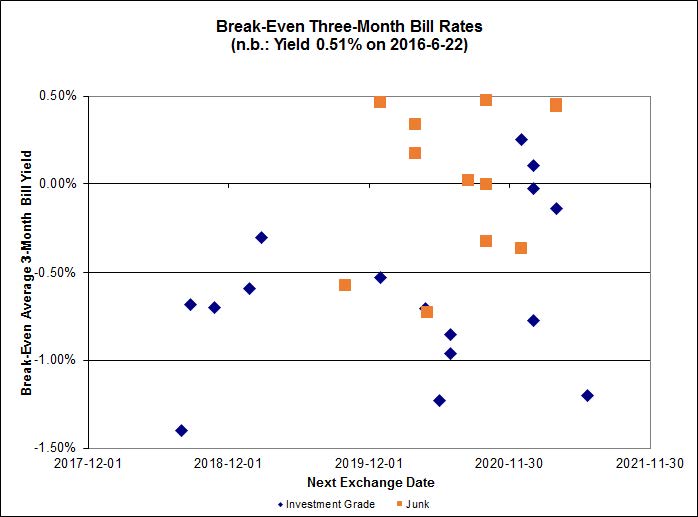
The most logical way to analyze the question of whether or not to convert is through the theory of Preferred Pairs, for which a calculator is available. Briefly, a Strong Pair is defined as a pair of securities that can be interconverted in the future (e.g., CPX.PR.A and the FloatingReset, CPX.PR.B, that will exist if enough holders convert). Since they will be interconvertible on this future date, it may be assumed that they will be priced identically on this date (if they aren’t then holders will simply convert en masse to the higher-priced issue). And since they will be priced identically on a given date in the future, any current difference in price must be offset by expectations of an equal and opposite value of dividends to be received in the interim. And since the dividend rate on one element of the pair is both fixed and known, the implied average rate of the other, floating rate, instrument can be determined. Finally, we say, we may compare these average rates and take a view regarding the actual future course of that rate relative to the implied rate, which will provide us with guidance on which element of the pair is likely to outperform the other until the next interconversion date, at which time the process will be repeated.

We can show the break-even rates for each FixedReset / FloatingReset Strong Pair graphically by plotting the implied average 3-month bill rate against the next Exchange Date (which is the date to which the average will be calculated).

pairs_FR_151211A
Click for Big

The market appears to have a marked distaste at the moment for floating rate product; every single one of the implied rates until the next interconversion are lower than the current 3-month bill rate and most pairs have a break-even yield significantly below zero! Whatever might be the result of the next few Bank of Canada overnight rate decisions, I suggest that it is unlikely that the average rate over the next five years will be lower than current – but if you disagree, of course, you may interpret the data any way you like.

Since credit quality of each element of the pair is equal to the other element, it should not make any difference whether the pair examined is investment-grade or junk, although we might expect greater variation of implied rates between junk issues on grounds of lower liquidity, and this is just what we see.

If we plug in the current bid price of the three FixedResets, we may construct the following table showing consistent prices for their soon-to-be-issued FloatingReset counterparts given a variety of Implied Breakeven yields consistent with issues currently trading:

Estimate of FloatingReset Trading Price In Current Conditions
  Assumed FloatingReset
Price if Implied Bill
is equal to
FixedReset Bid Price Spread -1.00% -0.50% 0.00%
GWO.PR.N. 13.50 130bp 11.53 12.05 12.58
FFH.PR.I 15.28 285bp 13.48 13.97 14.45
CPX.PR.A 9.80 217bp 8.09 8.54 8.99

Based on current market conditions, I suggest that the FloatingResets that will result from conversion are likely to be cheap and trading well below the price of their FixedReset counterparts. Therefore, I recommend that holders of GWO.PR.N, FFH.PR.I and CPX.PR.A continue to hold these issues and not to convert. I will note that current conditions make extant FloatingResets so cheap (in general) that it may be a good trade to swap the FixedReset for the FloatingReset in the market once both elements of each pair are trading and you can – presumably, according to this analysis – do it with a reasonably good take-out in price, rather than doing it through the company on a 1:1 basis. But that, of course, will depend on the prices at that time and your forecast for the future path of policy rates. There are no guarantees – my recommendation is based on the assumption that current market conditions with respect to the pairs will continue until the FloatingResets commence trading and that the relative pricing of the new pairs will reflect these conditions.

Note as well that conversion rights are dependent upon at least one million shares of each series being outstanding after giving effect to holders’ instructions; e.g., if only 100,000 shares of GWO.PR.N are tendered for conversion, then no conversions will be allowed; but if only 100,000 shares of GWO.PR.N will remain after the rest are all tendered, then conversion will be mandatory. However, this is relatively rare: all 30 Strong Pairs currently extant have some version of this condition and all but two have both series outstanding.

Contingent Capital

S&P Revises Bank Outlook to Stable on Federal Complacency

Standard & Poor’s has announced:

  • •We continue to evaluate the likelihood, degree, and timeframe with respect to which the default risk of systemically important Canadian banks may change as a result of the government’s progress toward introducing a bank bail-in framework.
  • •We now expect that the timeframe could be substantially longer than we had previously assumed. We see the absence of the topic from the new government’s Dec. 4 Speech from the Throne as recent, incremental evidence in this regard.
  • •We now do not expect to consider the removal of rating uplift for our expectation of the likelihood of extraordinary government support from the issuer credit ratings (ICRs) on systemically important Canadian banks until a point beyond our standard two-year outlook horizon for investment-grade ratings, if at all.
  • •When and if we remove such uplift, the potential ratings impact will also consider uplift for additional loss-absorbing capacity, as well as any changes to our stand-alone credit profiles on these banks.
  • •As a result, we are revising our outlooks on all systemically important Canadian banks to stable from negative.

RATING ACTION
On Dec. 11, 2015, Standard & Poor’s Ratings Services revised its outlooks on the Canadian banks that it views as having either “high” (Bank of Montreal, The Bank of Nova Scotia, Canadian Imperial Bank of Commerce, Royal Bank of Canada, The Toronto-Dominion Bank), or “moderate” (Caisse centrale Desjardins and National Bank of Canada) systemic importance, to stable from negative (see ratings list). The issuer credit ratings (ICRs) on the banks are unchanged.

RATIONALE
We believe that the potential negative ratings impact of a declining likelihood of extraordinary government support, at least within our standard two-year outlook horizon, has subsided. This reflects our updated view that there could be an extended implementation timetable–2018 or later–for the proposed Canadian bail-in framework. Importantly, at the point we would consider removing any uplift from the likelihood of extraordinary government support from our ratings, we would also consider the potential ratings impact of any uplift for additional loss-absorbing capacity (ALAC), as well as any
changes to our stand-alone credit profiles (SACPs) on these banks. In our view, the extended timetable introduces some potential that either the presence of ALAC or fundamental changes in credit quality at individual banks might come into play more than under the previously contemplated timetable.

We had revised our outlooks on systemically important Canadian banks to negative chiefly in reaction to the former government’s “Taxpayer Protection and Bank Recapitalization Regime” consultation paper of Aug. 1, 2014, as we then expected a bail-in regime could be fully implemented by 2016 (see “Outlook On Six Big Canadian Banks Revised To Negative Following Review Of Bail-In Policy Proposal,” published Aug. 8, 2014, on RatingsDirect). A number of subsequent developments have caused us to re-evaluate this expectation:

  • •In its April 2015 budget proposal, the former government affirmed its intention to introduce a bank bail-in regime in Canada, but it provided only very limited additional information relative to what it had outlined in its 2014 consultation paper; nor did the government make substantial subsequent public statement on the topic; nor did it specify timing for the announcement of its fully-developed (post-consultation) legislative proposal.
  • •The Oct. 19 federal election changed the party in government to Liberal (center-left), from Conservative (center-right). The former government’s proposed bail-in regime did not feature prominently in election debates.
  • •The new government’s Dec. 4 Speech from the Throne made no mention of the proposed bail-in framework, nor were any of the legislative priorities enumerated therein closely related, in our opinion. We believe this indicates the introduction of a bail-in framework is not among the immediate priorities of the new government.

Moreover, with Canada experiencing no government bank bail-outs, nor large bank failures, for decades, we believe the political incentive to rapidly end “too-big-to-fail” is less in Canada than in the U.S. and several EU countries, which are jurisdictions under which we have already removed uplift for our expectation of the likelihood of extraordinary government support from our ratings (see “U.S. Global Systemically Important Bank Holding Companies Downgraded Based On Uncertain Likelihood Of Government Support,” and “Most European Bank Ratings Affirmed Following Government Support And ALAC Review,” both published Dec. 2, on RatingsDirect). We will take this factor into consideration as we continue to evaluate our view on the likelihood of extraordinary government support in Canada relative to not only the U.S. and Europe, but also other jurisdictions where we maintain a government support assessment of “supportive” or “highly supportive” under our criteria (such as for many countries in Latin America and Asia-Pacific; see “Banking Industry Country Risk Assessment Update: November 2015,” published Nov. 27).

We now believe the procedural hurdles to passing legislation and related regulations (the latter after passage of the former) for a bail-in regime will alone require a minimum of one-to-two years, after the new government decides on a final legislative framework to propose to Parliament. Considering all of this, we now expect the eventual date for initial implementation of the bail-in regime (that is, banks issuing bail-inable debt) could be in 2018 or later.

In addition, and in contrast to bail-in frameworks outlined by U.S. authorities or in European countries like Germany, Canadian officials’ statements have made clear that only debt issued or renegotiated after an initial implementation date would be subject to conversion. It will take some time for the banks to issue or renegotiate bail-inable debt. We believe this means it could take several years after the initial implementation date before we would consider a Canadian bail-in regime effective, so as to provide a viable alternative to the direct provision of extraordinary government support.

As well, and again in contrast to the U.S. and EU jurisdictions, Canadian governments have made no attempt to limit their ability to provide direct extraordinary support to their banks, if needed. We expect bailing in senior creditors to be the first Canadian policy response in the face of a crisis. At the same time, we believe Canadian governments would be likely to consider all policy options, in such a circumstance. It is therefore not certain that the introduction of a bail-in regime would of itself result in our revising our government support assessment on Canada to “uncertain” from the current “supportive” and the removal of rating uplift for our view on the likelihood of extraordinary government support from our ICRs on systemically important Canadian banks. Rather, our decision would depend, among other factors, on the details of the eventual bail-in regime, including the extent to which bail-inable and unbail-inable senior debt is distinguishable.

Partly to honor G-20 and other international commitments, the Canadian government will, we expect, present a finalized legislative proposal for the bail-in framework in 2016 or 2017. However, we expect an implementation date that could be in 2018 or later, and we think it could take at least one and possibly several years more for substantial bail-in eligible debt to be in place. With a runway that long, the potential ratings impact from removing uplift for the likelihood of extraordinary government support is beyond our standard two-year outlook horizon for investment-grade ratings, and could by then be more meaningfully affected by either ALAC uplift (from the bail-inable debt, assuming our related criteria are met) or SACP changes, than under the previously contemplated timetable.

When the government presents the detailed provisions of the framework, along with a more specific timeframe, we will review the applicable notching for various bank liabilities, taking into account the framework’s implications on different instruments. We expect that issue ratings on new bail-inable instruments will be at a level that is notched in reference to banks’ SACPs, while ratings on non-bailinable senior debt may continue to incorporate rating uplift above the banks’ SACPs, based on our expectation of the likelihood of extraordinary government support, or ALAC.

OUTLOOK
Our outlooks on the systemically important Canadian banks are stable, based on our reassessment of the likelihood, degree, and timeframe with respect to which the default risk of systemically important Canadian banks may change as a result of the government’s progress toward introducing a bank bail-in framework. We believe that the likelihood of extraordinary government support will continue to be a factor in systemically important Canadian bank ratings throughout the current outlook period.

Moreover, we believe these banks will continue to exhibit broad revenue diversification, conservative underwriting standards, and strong overall asset quality. Our current view is that the impact of low oil prices on their profitability and credit quality will be contained, given the modest direct exposure of the banks to the oil and gas sector, and the limited knock-on impact so far on consumer credit in regional economies affected by low oil prices.

On the other hand, we continue to monitor a number of key downside risks to our ratings on these banks, including low margins, high Canadian consumer leverage, residential real estate prices we believe are at least somewhat inflated in some parts of Canada, a Canadian macroeconomic outlook that is very tentative, and the higher-risk nature of certain recent foreign acquisitions.

The August 2014 imposition of Outlook-Negative was reported on PrefBlog, as was the federal consultation on the recapitalization regime. As far as I can tell, the comments received on the consultation paper have not been published; I believe this is because Canadians are too stupid to understand smart stuff like legislation and parliament and all that – if given a pile of comments to work through, we’d probably try to eat them.

Issues affected are:

BMO.PR.K, BMO.PR.L, BMO.PR.M, BMO.PR.Q, BMO.PR.R, BMO.PR.S, BMO.PR.T, BMO.PR.W, BMO.PR.Y and BMO.PR.Z

BNS.PR.A, BNS.PR.B, BNS.PR.C, BNS.PR.D, BNS.PR.L, BNS.PR.M, BNS.PR.N, BNS.PR.O, BNS.PR.P, BNS.PR.Q, BNS.PR.R, BNS.PR.Y and BNS.PR.Z

CM.PR.O, CM.PR.P and CM.PR.Q

NA.PR.Q, NA.PR.S and NA.PR.W

RY.PR.A, RY.PR.B, RY.PR.C, RY.PR.D, RY.PR.E, RY.PR.F, RY.PR.G, RY.PR.H, RY.PR.I, RY.PR.J, RY.PR.K, RY.PR.L, RY.PR.M, RY.PR.N, RY.PR.O, RY.PR.P RY.PR.W and RY.PR.Z

TD.PF.A, TD.PF.B, TD.PF.C, TD.PF.D, TD.PF.E, TD.PF.F, TD.PR.S, TD.PR.T, TD.PR.Y and TD.PR.Z

Market Action

December 11, 2015

We have a new government, but the same old central planners:

Finance Minister Bill Morneau today announced changes to the rules for government-backed mortgage insurance to contain risks in the housing market, reduce taxpayer exposure and support long-term stability. Effective February 15, 2016, the minimum down payment for new insured mortgages will increase from 5 per cent to 10 per cent for the portion of the house price above $500,000. The 5 per cent minimum down payment for properties up to $500,000 remains unchanged.

Today’s announcement represents a graduated approach to increasing the down payment requirement proportionally to the cost of a home. Canadians who already hold mortgages will not be affected by this announcement.

The Government continuously monitors the housing market and is committed to implementing policy measures that maintain a healthy, competitive and stable housing market. Higher homeowner equity plays a key role in maintaining a stable and secure housing market.

The backgrounder reveals nothing relevant:

The Bank Act requires federally regulated lenders to obtain mortgage default insurance (“mortgage insurance”) for homebuyers who make a down payment of less than 20 per cent of the property purchase price. The homebuyer pays the premium for this insurance, which protects the lender against mortgage loan losses if the homebuyer defaults.

By reducing risk to lenders, mortgage insurance enables consumers to purchase homes with a down payment as low as 5 per cent of the property value and at lower mortgage interest rates that are comparable to those received by homebuyers with higher down payments.

The Government guarantee of mortgage insurance is intended to support access to homeownership for creditworthy buyers and promote stability in the housing market, financial system and economy. As part of its role to promote stability, and to protect taxpayers from potential mortgage loan losses, the Government sets the eligibility rules for new government-backed insured mortgages.

Between 2008 and 2012, four rounds of changes were made to the eligibility rules, aimed at encouraging insured borrowers to build and retain housing equity and take on mortgage debt that they are able to service over the economic cycle.

And the FAQs are puerile:

Why is the Government making this change at this time?

The Government continuously monitors the housing market and is prepared to implement policy measures to maintain a healthy, competitive and stable housing market. The new measure reduces housing market risks by increasing borrower equity. This protects the stability of the housing market and the economy as a whole, as well as the interests of taxpayers who ultimately back government-guaranteed mortgage insurance.

What will be the impact of the higher down payment requirement on the Canadian economy?

Higher homeowner equity will help maintain a stable and secure housing market and balanced economic growth over the long-term. In the short term, this targeted measure will dampen somewhat the pace of housing activity over the next year, as some prospective homebuyers save for the increased minimum down payment.

There is no meat on these bones at all. There is nothing to quantify any improvement in government policy objectives that is served by this policy. It’s just another randomly chosen measure that will be touted as an indication to those who are unable to compete for housing that Your Government Is Doing Something.

But the cheerleaders were out in force:

Some new buyers in Toronto and Vancouver will be knocked out of the market temporarily.

But that’s a fair price for bringing some stability to a housing market where prices in many cities have for years risen far in excess of incomes.

Boomers in particular are living in homes that have increased many times in value. A big decline in house prices would be a shocking setback to these people and could negatively affect their financial health in retirement.

Mild as it is, the new down payment rule could only momentarily slow hot markets. But at least the new Liberal government has shown that it’s monitoring housing and ready to act to keep it in line. For homeowners, that’s far better news than another month of big price gains.

As I have noted before, the fact that people are taking advantage of low interest rate to load up on non-productive housing assets instead of productive capital assets is a genuine concern for the western world. There was a story illustrating the process the other day:

It was after losing a huge chunk of money in the stock market, twice, that Ottawa couple Denise and Stuart MacPherson decided they needed to find a new way to save for retirement.

The first bath they took was during the dot-com bust at the start of the century, after getting caught up in the hype around technology stocks. The second was the global financial crisis in 2008, when they watched half of their investments go down the drain.

“That was a very hard lesson to learn, mostly because we didn’t really understand what we were investing in,” says Ms. MacPherson, 61. “It was a wake-up call for us.”

Instead of jumping back into the market, the couple, working then as civil servants, decided to start investing in something they could see and understand.

“That’s when we started looking at real estate,” Ms. MacPherson says.

I suggest that from a policy perspective, what we need is more housing price volatility, not less. Let’s wipe out a swath of real-estate entrepreneurs – as happened in the early eighties and again in the early nineties – pour encourager les autres. Trying to turn the housing market into a 5% GIC – as the repeated lauding of ‘stability’ implies – will have quite the opposite effect from that which is intended. The trouble is, of course, that the central planners and regulators want to turn everything into a 5% GIC, since they run into less criticism that way.

I was more impressed with OSFI’s note titled Updating capital requirements for residential mortgages:

OSFI is planning to update the regulatory capital requirements for loans secured by residential real estate properties (i.e. residential mortgages).

The purpose of OSFI’s regulatory capital framework is to ensure, as much as possible, that federally regulated financial institutions can absorb severe but plausible losses. The potential severity of loss scenarios in the residential mortgage market depends crucially on price developments. In particular, potential losses become more severe during extended periods where house prices have recently risen rapidly and/or are high relative to borrower incomes. As a result, the potential severity of losses may vary across Canada.

Accordingly, for banks using internal models, OSFI will propose a risk-sensitive floor for one of the model inputs (losses in the event of default) that will be tied to increases in local property prices and/or to house prices that are high relative to borrower incomes. This will ensure a level of consistency and conservatism in the protection provided to depositors and unsecured creditors.

For federally regulated private mortgage insurers, we will introduce a new standardized approach that updates the capital requirements for mortgage guarantee insurance risk. It will require more capital when house prices are high relative to borrower incomes. This will ensure a level of conservatism in the protection provided to policyholders and unsecured creditors.

The part of this policy that looks back at past prices to determine risk is – in broad outlines – something I’ve been advocating for years, most recently on November 30:

There are two approaches that can be taken: the first is to insist that for risk-management purposes, the loan-to-value ratio of a mortgage be calculated not according to the sale price or to the appraised value, but to an estimate of what this would have been five or ten years ago, adjusted for inflation. So, for instance, if we have a house that sold in 2014 for $567,000 and has a mortgage of $400,000, we would now currently say the LTV is 71%. I suggest that for regulatory risk purposes we use the 2009 price of $395,000, add on 10% to reflect plain vanilla inflation for a notional value of $435,000, and say OK, you’ve got to put up capital reflecting this notional LTV of 92%, which is a different kettle of fish altogether.

The second approach would simply say … 40% of your balance sheet is now mortgages, the average over the last ten years is 30%, the difference is 10% and 10% of that is 1%, so there’s a countercyclical capital surcharge of 1% that will be applied to your risk weighted assets. A solution would need to be more detailed, with meaningful categorizations of bank assets and threshold values for surcharges so that slow change is not discouraged, but that’s the general idea.

Such broad-brush changes are strongly preferable to the micro-management of the economy implicit in down-payment rules.

Meanwhile Third Avenue Management rocked the junk market by liquidating its junk fund:

I am writing to inform you that the Board of Trustees of the Third Avenue Trust has adopted a Plan of Liquidation for the Third Avenue Focused Credit Fund (“FCF”). Pursuant to this Plan, on or about December 16, 2015, there will be a distribution to all FCF shareholders of the Fund’s cash assets not required for the expenses of the Fund and its liquidation. The remaining assets have been placed into a liquidating trust (the “Liquidating Trust”) and interests in that trust will also be distributed to FCF shareholders on or about December 16, 2015. These two distributions will constitute the full redemption for all shares of FCF and existing FCF shareholders will all become beneficiaries of the Liquidating Trust, which will make periodic distributions as cash is received for the remaining investments. The record date for these distributions is December 9, 2015, so no further subscriptions or redemptions will be accepted. Interests in the Liquidating Trust will not trade and will, in general, be transferable only by operation of law.

In line with its investment approach, FCF has some investments in companies that have undergone restructurings in the last eighteen months, and while we believe that these investments are likely to generate positive returns for shareholders over time, if FCF were forced to sell those investments immediately, it would only realize a portion of those investments’ fair value given current market conditions. We believe that doing so would be contrary to the interests of all of our shareholders, which is why we have taken steps to protect shareholder value by returning cash and implementing the Liquidating Trust to seek maximum value for these investments.

The past performance of this fund – which I have not examined in any detail at all – makes it seem like just another go-go fund:

In 2010, it earned 15.63%, according to Morningstar MORN +0.00%, outperforming the Barclays Aggregate Bond Index by over 900 basis points. That out-performance turned in 2011 when bond markets were spooked by the government’s near-breach of a debt limit, but it returned the following year. In 2013, the Third Avenue Credit Fund was the top fund in its category, according to Morningstar, returning 16.8%, outperforming its index by a whopping 1,800 basis points.

Over the past 24-months, Third Avenue’s performance turned sharply negative, testing investors’ patience. Part of the fund’s troubles come from owning debts in some of the largest leveraged buyouts that remain in the coffers of private equity firms, or stumbled in their return to public markets.

But, as a chart prepared by the WSJ indicates, go-go investing works really well for managers!

thirdAvenueCash
Click for Big

Look at all that money chasing performance! But all good things come to an end:

The fund, which had $3.5 billion in assets as recently as July of last year, suffered almost $1 billion in redemptions this year through November. The Third Avenue fund lost 13 percent in the past month and is down 27 percent this year, according to data compiled by Bloomberg. Assets have declined to $788 million as of Dec. 8 as clients pulled an estimated $979 million this year through November, according to Morningstar Inc.

“It’s significantly bad news for the market, and another straw on the camel’s back,” said Martin Fridson, a money manager at Lehmann Livian Fridson Advisors LLC. “It’s not typical, but it raises the question: Can this happen to the next-worst fund? You just don’t know. It certainly doesn’t encourage people to put money in, and that just exacerbates the liquidity problem there.”

The weakness in the market comes as credit quality in speculative-grade debt is falling. For every junk-bond issuer that had its rating boosted this year, two have been downgraded, a ratio not seen since 2009, according to data compiled by Bloomberg.

And companies are increasingly defaulting on their debt. Swift Energy Co.’s failure to make an $8.9 million interest payment last week raised the global tally of defaults to 102 issuers, a figure last exceeded in 2009, according to Standard & Poor’s.

And there is some credibility to the claim that the fund fell into a shark tank:

Mutual funds that own hard-to-trade debt are gunning for an advantage when it comes to returns, but they can face a big disadvantage when it comes time to sell.

They are often the weakest hand in a market of hungry experienced traders simply by virtue of their structure. They must publicly report their holdings, albeit on a delayed basis, and disclose information about investor inflows and outflows. Hedge funds, on the other hand, do not have to disclose nearly as much.

That’s like putting a huge “kick me” sign on these mutual funds when investors start asking for their money back. Because the debt these funds own may only trade a few times a year, prices are as reliant on supply and demand as the actual fundamentals of a given company.

Exhibit A of this phenomenon is Third Avenue Management. After it decided to liquidate its $788 million mutual fund that focuses on highly distressed debt — and to gate in remaining investors to avoid a fire sale of the remaining assets — its chief executive hinted that the fund was a victim of just such behavior.

“Our portfolio was well known, it’s almost like we were targeted,” CEO David Barse said, according to the Wall Street Journal.

But misery loves company, and fund holders had that, all right:

Global financial markets turned gloomy as the prospects for a Federal Reserve interest-rate increase next week and a drop in oil helped spark a selloff in riskier assets, from equities to commodities to high-yield debt.

U.S. stocks tumbled to a two-month low, with the Dow Jones Industrial Average dropping more than 300 points, while shares in developing nations extended the longest slump since June. Oil plunged below $36 a barrel to cap its worst week in a year, and junk bonds had their worst day since December 2012. Treasuries rallied with the yen on haven demand.

The Standard & Poor’s 500 Index slumped 1.9 percent to 2,012.37 at 4 p.m. in New York, to the lowest level since Oct. 14. The gauge sank 3.8 percent in the week. That’s the most since Aug. 21, when signs of slowing growth from China to Europe rekindled concern that weakness could spread to America.

The iShares iBoxx $ High Yield Corporate Bond exchange-traded fund, known by its ticker of HYG, tumbled 2.7 percent as oil extended its loss. Trading in the high-yield ETF options surged as billionaire investor Carl Icahnsaid more pain is coming. “The meltdown in High Yield is just beginning,” he wrote on his verified Twitter account Friday.

Traders are pricing in a 72 percent chance that the Fed will raise rates at its Dec. 16 meeting, with data out of the U.S. Friday showing growth in retail sales and producer prices for November. That’s down from 80 percent earlier this week, amid the turmoil on financial markets.

The Stoxx Europe 600 Index tumbled 2 percent, taking its weekly loss to 4 percent. The regional benchmark fell to its lowest level since October and has sunk 7.7 in December amid a rout in commodity companies and disappointment over the European Central Bank’s last meeting.

The risk premium on the Markit CDX North American High Yield Index, a credit-default swaps benchmark tied to the debt of 100 speculative-grade companies, rose 36 basis points to 514.52 basis points, the highest since December 2012. BlackRock’s iShares iBoxx High Yield Corporate Bond ETF, the largest fund of its kind, fell to the lowest levels since 2009.

U.S. 10-year yields fell nine basis points to 2.13 percent on Friday, compared with 2.17 percent on Dec. 31, 2014. The yield on similar-maturity German bunds was at 0.54 percent.

Oil declined to the lowest level since 2008 in London amid estimates that OPEC’s decision to scrap production limits will keep the market oversupplied. West Texas Intermediate for January delivery slipped to $35.62 a barrel for the lowest settlement since 2009.

Crude capped its worst week in a year. The global oil surplus will persist at least until late 2016 as demand growth slows and OPEC shows “renewed determination” to maximize output, the International Energy Agency said in a report released Friday.

I ran across an interesting blog post today – CBO: Tangled Web of Welfare Programs Creates High Tax Rates on Participants, which included this chart:

cbo_tableau_marginal
Click for Big

… and this map of US federal programmes:

house_human_resources_welfare_chart
Click for Big

Despite all this there are still many people willing to snare people in the poverty trap; if this requires intellectual dishonesty when discussing a universal refundable tax credit, so what?

E-L Financial, proud issuer of ELF.PR.F, ELF.PR.G and ELF.PR.H, has Solidified its Long-term Interest in Empire Life:

Financial Corporation Limited (E-L Financial) (TSX:ELF) (TSX:ELF.PR.F) (TSX:ELF.PR.G) (TSX:ELF.PR.H) has agreed to purchase Guardian Assurance Limited’s (Guardian) 19% share of holding company E-L Financial Services Limited (ELFS). As a result of this agreement, E-L Financial will own 100% of ELFS, which owns 98.3% of The Empire Life Insurance Company (Empire Life).

The transaction will close next week, at a purchase price of approximately book value, or $200 million (CDN).

“For years, Empire Life has been an important long-term investment for E-L Financial,” said Mr. Duncan Jackman, Chairman and Chief Executive Officer of E-L Financial, “We are very excited about being able to increase our stake in this great company and reinforce our continued commitment to its ongoing success.” Mr. Jackman also acknowledged Guardian’s strong contribution to Empire Life.

It was a mixed day for the Canadian preferred share market, with PerpetualDiscounts gaining 33bp, FixedResets off 15bp and DeemedRetractibles up 41bp. Today’s big move in government rates took the YTW of FixedResets below 5%. The Performance Highlights table continues to show a lot of churn. Volume was extremely high by all standards save those of the last few days.

For as long as the FixedReset market is so violently unsettled, I’ll keep publishing updates of the more interesting and meaningful series of FixedResets’ Implied Volatilities. This doesn’t include Enbridge because although Enbridge has a large number of issues outstanding, all of which are quite liquid, the range of Issue Reset Spreads is too small for decent conclusions. The low is 212bp (ENB.PR.H; second-lowest is ENB.PR.D at 237bp) and the high is a mere 268 for ENB.PF.G.

Remember that all rich /cheap assessments are:
» based on Implied Volatility Theory only
» are relative only to other FixedResets from the same issuer
» assume constant GOC-5 yield
» assume constant Implied Volatility
» assume constant spread

Here’s TRP:

impVol_TRP_151211
Click for Big

TRP.PR.E, which resets 2019-10-30 at +235, is bid at 17.99 to be $1.14 rich, while TRP.PR.C, resetting 2016-1-30 at +154, is $0.89 cheap at its bid price of 11.81.

impVol_MFC_151211
Click for Big

Mostexpensive is MFC.PR.H, resetting at +313bp on 2017-3-19, bid at 21.00 to be 0.57 rich, while MFC.PR.K, resetting at +222bp on 2018-9-19, is bid at 16.80 to be 0.59 cheap.

impVol_BAM_151211
Click for Big

The cheapest issue relative to its peers is BAM.PR.R, resetting at +230bp on 2016-6-30, bid at 14.51 to be $0.83 cheap. BAM.PF.G, resetting at +284bp on 2020-6-30 is bid at 19.50 and appears to be $1.44 rich.

impVol_FTS_151211
Click for Big

FTS.PR.K, with a spread of +205bp, and bid at 17.00, looks $0.75 expensive and resets 2019-3-1. FTS.PR.G, with a spread of +213bp and resetting 2018-9-1, is bid at 16.00 and is $0.75 cheap.

pairs_FR_151211A
Click for Big

Investment-grade pairs predict an average three-month bill yield over the next five-odd years of -0.40%, with no outliers. There is one junk outlier below -1.50%.

pairs_FF_151211A
Click for Big

Shall we just say that this exhibits a high level of confidence in the continued rapacity of Canadian banks?

HIMIPref™ Preferred Indices
These values reflect the December 2008 revision of the HIMIPref™ Indices

Values are provisional and are finalized monthly
Index Mean
Current
Yield
(at bid)
Median
YTW
Median
Average
Trading
Value
Median
Mod Dur
(YTW)
Issues Day’s Perf. Index Value
Ratchet 5.11 % 6.21 % 33,729 16.39 1 1.0638 % 1,518.1
FixedFloater 7.39 % 6.55 % 33,493 15.58 1 -2.5038 % 2,639.7
Floater 4.45 % 4.63 % 86,239 16.21 4 -1.5309 % 1,716.8
OpRet 4.87 % 4.20 % 28,843 0.71 1 0.0000 % 2,734.3
SplitShare 4.85 % 5.62 % 84,680 1.89 6 -0.5335 % 3,186.2
Interest-Bearing 0.00 % 0.00 % 0 0.00 0 -0.5335 % 2,486.0
Perpetual-Premium 5.88 % 5.94 % 93,087 13.89 7 0.2430 % 2,464.5
Perpetual-Discount 5.83 % 5.91 % 102,793 13.96 33 0.3315 % 2,456.3
FixedReset 5.52 % 4.90 % 258,329 14.80 78 -0.1508 % 1,870.1
Deemed-Retractible 5.30 % 5.46 % 136,053 5.32 33 0.4072 % 2,531.7
FloatingReset 2.85 % 4.44 % 64,555 5.68 11 -0.4301 % 2,070.3
Performance Highlights
Issue Index Change Notes
BIP.PR.B FixedReset -3.29 % YTW SCENARIO
Maturity Type : Limit Maturity
Maturity Date : 2045-12-11
Maturity Price : 22.56
Evaluated at bid price : 23.55
Bid-YTW : 5.83 %
HSE.PR.A FixedReset -2.74 % YTW SCENARIO
Maturity Type : Limit Maturity
Maturity Date : 2045-12-11
Maturity Price : 11.37
Evaluated at bid price : 11.37
Bid-YTW : 5.48 %
HSE.PR.G FixedReset -2.73 % YTW SCENARIO
Maturity Type : Limit Maturity
Maturity Date : 2045-12-11
Maturity Price : 17.80
Evaluated at bid price : 17.80
Bid-YTW : 6.15 %
BAM.PR.K Floater -2.65 % YTW SCENARIO
Maturity Type : Limit Maturity
Maturity Date : 2045-12-11
Maturity Price : 10.10
Evaluated at bid price : 10.10
Bid-YTW : 4.68 %
BAM.PR.G FixedFloater -2.50 % YTW SCENARIO
Maturity Type : Limit Maturity
Maturity Date : 2045-12-11
Maturity Price : 25.00
Evaluated at bid price : 12.85
Bid-YTW : 6.55 %
BAM.PR.C Floater -2.08 % YTW SCENARIO
Maturity Type : Limit Maturity
Maturity Date : 2045-12-11
Maturity Price : 10.15
Evaluated at bid price : 10.15
Bid-YTW : 4.65 %
RY.PR.L FixedReset -2.05 % YTW SCENARIO
Maturity Type : Hard Maturity
Maturity Date : 2022-01-31
Maturity Price : 25.00
Evaluated at bid price : 24.37
Bid-YTW : 4.40 %
BNS.PR.B FloatingReset -1.90 % YTW SCENARIO
Maturity Type : Hard Maturity
Maturity Date : 2022-01-31
Maturity Price : 25.00
Evaluated at bid price : 21.15
Bid-YTW : 5.07 %
BAM.PR.B Floater -1.70 % YTW SCENARIO
Maturity Type : Limit Maturity
Maturity Date : 2045-12-11
Maturity Price : 10.20
Evaluated at bid price : 10.20
Bid-YTW : 4.63 %
BNS.PR.R FixedReset -1.69 % YTW SCENARIO
Maturity Type : Hard Maturity
Maturity Date : 2022-01-31
Maturity Price : 25.00
Evaluated at bid price : 23.30
Bid-YTW : 4.66 %
BIP.PR.A FixedReset -1.63 % YTW SCENARIO
Maturity Type : Limit Maturity
Maturity Date : 2045-12-11
Maturity Price : 18.70
Evaluated at bid price : 18.70
Bid-YTW : 5.85 %
BNS.PR.Q FixedReset -1.56 % YTW SCENARIO
Maturity Type : Hard Maturity
Maturity Date : 2022-01-31
Maturity Price : 25.00
Evaluated at bid price : 22.77
Bid-YTW : 4.82 %
BNS.PR.D FloatingReset -1.53 % YTW SCENARIO
Maturity Type : Hard Maturity
Maturity Date : 2022-01-31
Maturity Price : 25.00
Evaluated at bid price : 18.07
Bid-YTW : 7.08 %
CM.PR.Q FixedReset -1.41 % YTW SCENARIO
Maturity Type : Limit Maturity
Maturity Date : 2045-12-11
Maturity Price : 18.24
Evaluated at bid price : 18.24
Bid-YTW : 4.94 %
BAM.PR.Z FixedReset -1.35 % YTW SCENARIO
Maturity Type : Limit Maturity
Maturity Date : 2045-12-11
Maturity Price : 17.95
Evaluated at bid price : 17.95
Bid-YTW : 5.36 %
MFC.PR.M FixedReset -1.35 % YTW SCENARIO
Maturity Type : Hard Maturity
Maturity Date : 2025-01-31
Maturity Price : 25.00
Evaluated at bid price : 17.59
Bid-YTW : 8.21 %
TRP.PR.C FixedReset -1.34 % YTW SCENARIO
Maturity Type : Limit Maturity
Maturity Date : 2045-12-11
Maturity Price : 11.81
Evaluated at bid price : 11.81
Bid-YTW : 4.92 %
FTS.PR.I FloatingReset -1.28 % YTW SCENARIO
Maturity Type : Limit Maturity
Maturity Date : 2045-12-11
Maturity Price : 11.55
Evaluated at bid price : 11.55
Bid-YTW : 4.12 %
NA.PR.S FixedReset -1.28 % YTW SCENARIO
Maturity Type : Limit Maturity
Maturity Date : 2045-12-11
Maturity Price : 16.98
Evaluated at bid price : 16.98
Bid-YTW : 4.96 %
TRP.PR.B FixedReset -1.27 % YTW SCENARIO
Maturity Type : Limit Maturity
Maturity Date : 2045-12-11
Maturity Price : 10.86
Evaluated at bid price : 10.86
Bid-YTW : 4.75 %
PVS.PR.E SplitShare -1.24 % YTW SCENARIO
Maturity Type : Hard Maturity
Maturity Date : 2022-10-31
Maturity Price : 25.00
Evaluated at bid price : 23.90
Bid-YTW : 6.35 %
PVS.PR.D SplitShare -1.23 % YTW SCENARIO
Maturity Type : Hard Maturity
Maturity Date : 2021-10-08
Maturity Price : 25.00
Evaluated at bid price : 22.42
Bid-YTW : 6.72 %
BMO.PR.S FixedReset -1.19 % YTW SCENARIO
Maturity Type : Limit Maturity
Maturity Date : 2045-12-11
Maturity Price : 17.50
Evaluated at bid price : 17.50
Bid-YTW : 4.68 %
MFC.PR.N FixedReset -1.18 % YTW SCENARIO
Maturity Type : Hard Maturity
Maturity Date : 2025-01-31
Maturity Price : 25.00
Evaluated at bid price : 17.64
Bid-YTW : 8.10 %
HSE.PR.C FixedReset -1.16 % YTW SCENARIO
Maturity Type : Limit Maturity
Maturity Date : 2045-12-11
Maturity Price : 17.00
Evaluated at bid price : 17.00
Bid-YTW : 5.95 %
TD.PR.S FixedReset -1.04 % YTW SCENARIO
Maturity Type : Hard Maturity
Maturity Date : 2022-01-31
Maturity Price : 25.00
Evaluated at bid price : 22.91
Bid-YTW : 4.47 %
PVS.PR.B SplitShare -1.03 % YTW SCENARIO
Maturity Type : Hard Maturity
Maturity Date : 2019-01-10
Maturity Price : 25.00
Evaluated at bid price : 24.00
Bid-YTW : 5.83 %
SLF.PR.D Deemed-Retractible 1.03 % YTW SCENARIO
Maturity Type : Hard Maturity
Maturity Date : 2025-01-31
Maturity Price : 25.00
Evaluated at bid price : 19.64
Bid-YTW : 7.77 %
CU.PR.F Perpetual-Discount 1.04 % YTW SCENARIO
Maturity Type : Limit Maturity
Maturity Date : 2045-12-11
Maturity Price : 19.40
Evaluated at bid price : 19.40
Bid-YTW : 5.85 %
BAM.PR.E Ratchet 1.06 % YTW SCENARIO
Maturity Type : Limit Maturity
Maturity Date : 2045-12-11
Maturity Price : 25.00
Evaluated at bid price : 13.30
Bid-YTW : 6.21 %
BMO.PR.Z Perpetual-Discount 1.11 % YTW SCENARIO
Maturity Type : Limit Maturity
Maturity Date : 2045-12-11
Maturity Price : 22.51
Evaluated at bid price : 22.84
Bid-YTW : 5.51 %
GWO.PR.S Deemed-Retractible 1.13 % YTW SCENARIO
Maturity Type : Hard Maturity
Maturity Date : 2025-01-31
Maturity Price : 25.00
Evaluated at bid price : 24.12
Bid-YTW : 5.75 %
GWO.PR.I Deemed-Retractible 1.15 % YTW SCENARIO
Maturity Type : Hard Maturity
Maturity Date : 2025-01-31
Maturity Price : 25.00
Evaluated at bid price : 20.18
Bid-YTW : 7.45 %
SLF.PR.A Deemed-Retractible 1.16 % YTW SCENARIO
Maturity Type : Hard Maturity
Maturity Date : 2025-01-31
Maturity Price : 25.00
Evaluated at bid price : 20.94
Bid-YTW : 7.21 %
GWO.PR.Q Deemed-Retractible 1.17 % YTW SCENARIO
Maturity Type : Hard Maturity
Maturity Date : 2025-01-31
Maturity Price : 25.00
Evaluated at bid price : 22.55
Bid-YTW : 6.59 %
FTS.PR.K FixedReset 1.19 % YTW SCENARIO
Maturity Type : Limit Maturity
Maturity Date : 2045-12-11
Maturity Price : 17.00
Evaluated at bid price : 17.00
Bid-YTW : 4.45 %
MFC.PR.G FixedReset 1.20 % YTW SCENARIO
Maturity Type : Hard Maturity
Maturity Date : 2025-01-31
Maturity Price : 25.00
Evaluated at bid price : 19.43
Bid-YTW : 7.12 %
GWO.PR.R Deemed-Retractible 1.20 % YTW SCENARIO
Maturity Type : Hard Maturity
Maturity Date : 2025-01-31
Maturity Price : 25.00
Evaluated at bid price : 21.01
Bid-YTW : 7.22 %
POW.PR.A Perpetual-Discount 1.22 % YTW SCENARIO
Maturity Type : Limit Maturity
Maturity Date : 2045-12-11
Maturity Price : 23.74
Evaluated at bid price : 24.05
Bid-YTW : 5.91 %
IFC.PR.A FixedReset 1.22 % YTW SCENARIO
Maturity Type : Hard Maturity
Maturity Date : 2025-01-31
Maturity Price : 25.00
Evaluated at bid price : 14.85
Bid-YTW : 9.76 %
TRP.PR.H FloatingReset 1.24 % YTW SCENARIO
Maturity Type : Limit Maturity
Maturity Date : 2045-12-11
Maturity Price : 9.83
Evaluated at bid price : 9.83
Bid-YTW : 4.37 %
FTS.PR.J Perpetual-Discount 1.28 % YTW SCENARIO
Maturity Type : Limit Maturity
Maturity Date : 2045-12-11
Maturity Price : 21.30
Evaluated at bid price : 21.30
Bid-YTW : 5.62 %
GWO.PR.P Deemed-Retractible 1.37 % YTW SCENARIO
Maturity Type : Hard Maturity
Maturity Date : 2025-01-31
Maturity Price : 25.00
Evaluated at bid price : 23.65
Bid-YTW : 6.18 %
IFC.PR.C FixedReset 1.58 % YTW SCENARIO
Maturity Type : Hard Maturity
Maturity Date : 2025-01-31
Maturity Price : 25.00
Evaluated at bid price : 17.31
Bid-YTW : 8.36 %
FTS.PR.G FixedReset 1.59 % YTW SCENARIO
Maturity Type : Limit Maturity
Maturity Date : 2045-12-11
Maturity Price : 16.00
Evaluated at bid price : 16.00
Bid-YTW : 4.77 %
MFC.PR.K FixedReset 1.63 % YTW SCENARIO
Maturity Type : Hard Maturity
Maturity Date : 2025-01-31
Maturity Price : 25.00
Evaluated at bid price : 16.80
Bid-YTW : 8.53 %
SLF.PR.C Deemed-Retractible 1.65 % YTW SCENARIO
Maturity Type : Hard Maturity
Maturity Date : 2025-01-31
Maturity Price : 25.00
Evaluated at bid price : 19.74
Bid-YTW : 7.70 %
MFC.PR.L FixedReset 1.70 % YTW SCENARIO
Maturity Type : Hard Maturity
Maturity Date : 2025-01-31
Maturity Price : 25.00
Evaluated at bid price : 17.35
Bid-YTW : 8.20 %
SLF.PR.J FloatingReset 1.73 % YTW SCENARIO
Maturity Type : Hard Maturity
Maturity Date : 2025-01-31
Maturity Price : 25.00
Evaluated at bid price : 12.92
Bid-YTW : 10.05 %
MFC.PR.J FixedReset 1.89 % YTW SCENARIO
Maturity Type : Hard Maturity
Maturity Date : 2025-01-31
Maturity Price : 25.00
Evaluated at bid price : 18.85
Bid-YTW : 7.30 %
TRP.PR.G FixedReset 1.90 % YTW SCENARIO
Maturity Type : Limit Maturity
Maturity Date : 2045-12-11
Maturity Price : 18.75
Evaluated at bid price : 18.75
Bid-YTW : 5.02 %
SLF.PR.H FixedReset 1.93 % YTW SCENARIO
Maturity Type : Hard Maturity
Maturity Date : 2025-01-31
Maturity Price : 25.00
Evaluated at bid price : 15.85
Bid-YTW : 8.96 %
BAM.PR.R FixedReset 2.40 % YTW SCENARIO
Maturity Type : Limit Maturity
Maturity Date : 2045-12-11
Maturity Price : 14.51
Evaluated at bid price : 14.51
Bid-YTW : 5.35 %
CU.PR.C FixedReset 4.09 % YTW SCENARIO
Maturity Type : Limit Maturity
Maturity Date : 2045-12-11
Maturity Price : 17.80
Evaluated at bid price : 17.80
Bid-YTW : 4.55 %
Volume Highlights
Issue Index Shares
Traded
Notes
BNS.PR.A FloatingReset 378,986 TD crossed blocks of 80,476 and 284,943, both at 22.82.
YTW SCENARIO
Maturity Type : Hard Maturity
Maturity Date : 2022-01-31
Maturity Price : 25.00
Evaluated at bid price : 22.83
Bid-YTW : 4.07 %
PWF.PR.K Perpetual-Discount 305,430 Nesbitt crossed 300,000 at 21.46.
YTW SCENARIO
Maturity Type : Limit Maturity
Maturity Date : 2045-12-11
Maturity Price : 21.44
Evaluated at bid price : 21.44
Bid-YTW : 5.86 %
PWF.PR.E Perpetual-Discount 301,700 Nesbitt crossed 300,000 at 23.36.
YTW SCENARIO
Maturity Type : Limit Maturity
Maturity Date : 2045-12-11
Maturity Price : 23.10
Evaluated at bid price : 23.36
Bid-YTW : 5.96 %
PWF.PR.S Perpetual-Discount 213,165 Nesbitt crossed 200,000 at 20.82.
YTW SCENARIO
Maturity Type : Limit Maturity
Maturity Date : 2045-12-11
Maturity Price : 20.60
Evaluated at bid price : 20.60
Bid-YTW : 5.91 %
BAM.PR.K Floater 211,400 TD crossed 200,000 at 10.20.
YTW SCENARIO
Maturity Type : Limit Maturity
Maturity Date : 2045-12-11
Maturity Price : 10.10
Evaluated at bid price : 10.10
Bid-YTW : 4.68 %
BAM.PR.C Floater 207,699 TD crossed 200,000 at 10.20.
YTW SCENARIO
Maturity Type : Limit Maturity
Maturity Date : 2045-12-11
Maturity Price : 10.15
Evaluated at bid price : 10.15
Bid-YTW : 4.65 %
PWF.PR.L Perpetual-Discount 203,425 Nesbitt crossed 200,000 at 21.82.
YTW SCENARIO
Maturity Type : Limit Maturity
Maturity Date : 2045-12-11
Maturity Price : 21.57
Evaluated at bid price : 21.83
Bid-YTW : 5.91 %
CU.PR.I FixedReset 149,244 Desardins crossed 50,000 at 24.90. Scotia crossed blocks of 25,000 and 50,000 at the same price.
YTW SCENARIO
Maturity Type : Limit Maturity
Maturity Date : 2045-12-11
Maturity Price : 23.09
Evaluated at bid price : 24.80
Bid-YTW : 4.46 %
TD.PF.B FixedReset 109,519 Nesbitt crossed 65,700 at 17.20.
YTW SCENARIO
Maturity Type : Limit Maturity
Maturity Date : 2045-12-11
Maturity Price : 17.21
Evaluated at bid price : 17.21
Bid-YTW : 4.67 %
FTS.PR.E OpRet 100,400 Scotia crossed 100,000 at 25.22.
YTW SCENARIO
Maturity Type : Soft Maturity
Maturity Date : 2016-08-31
Maturity Price : 25.00
Evaluated at bid price : 25.16
Bid-YTW : 4.20 %
There were 77 other index-included issues trading in excess of 10,000 shares.
Wide Spread Highlights
Issue Index Quote Data and Yield Notes
RY.PR.L FixedReset Quote: 24.37 – 25.00
Spot Rate : 0.6300
Average : 0.3805

YTW SCENARIO
Maturity Type : Hard Maturity
Maturity Date : 2022-01-31
Maturity Price : 25.00
Evaluated at bid price : 24.37
Bid-YTW : 4.40 %

CIU.PR.A Perpetual-Discount Quote: 20.36 – 21.19
Spot Rate : 0.8300
Average : 0.6453

YTW SCENARIO
Maturity Type : Limit Maturity
Maturity Date : 2045-12-11
Maturity Price : 20.36
Evaluated at bid price : 20.36
Bid-YTW : 5.70 %

HSE.PR.C FixedReset Quote: 17.00 – 17.50
Spot Rate : 0.5000
Average : 0.3312

YTW SCENARIO
Maturity Type : Limit Maturity
Maturity Date : 2045-12-11
Maturity Price : 17.00
Evaluated at bid price : 17.00
Bid-YTW : 5.95 %

GWO.PR.M Deemed-Retractible Quote: 24.81 – 25.26
Spot Rate : 0.4500
Average : 0.2836

YTW SCENARIO
Maturity Type : Hard Maturity
Maturity Date : 2025-01-31
Maturity Price : 25.00
Evaluated at bid price : 24.81
Bid-YTW : 5.90 %

TD.PF.E FixedReset Quote: 19.38 – 19.90
Spot Rate : 0.5200
Average : 0.3627

YTW SCENARIO
Maturity Type : Limit Maturity
Maturity Date : 2045-12-11
Maturity Price : 19.38
Evaluated at bid price : 19.38
Bid-YTW : 4.76 %

MFC.PR.G FixedReset Quote: 19.43 – 19.97
Spot Rate : 0.5400
Average : 0.4013

YTW SCENARIO
Maturity Type : Hard Maturity
Maturity Date : 2025-01-31
Maturity Price : 25.00
Evaluated at bid price : 19.43
Bid-YTW : 7.12 %