Category: Issue Comments

Issue Comments

TRP.PR.C To Reset At 2.263%

TransCanada Corporation has announced [although not yet on their website]:

that it has notified the registered shareholder of the applicable dividend rates for Cumulative Redeemable First Preferred Shares, Series 5 (Series 5 Shares) and the Cumulative Redeemable First Preferred Shares, Series 6 (Series 6 Shares). The rates were calculated today, in accordance with the process defined in the prospectus supplement dated June 17, 2010.

As previously announced in our news release dated December 15, 2015, holders of the Series 5 Shares have the right on January 30, 2016 to convert on a one-for-one basis, any or all of their Series 5 Shares into Series 6 Shares and receive a floating rate quarterly dividend, or retain any or all of their Series 5 Shares and receive a new fixed rate quarterly dividend.

Should a holder of Series 5 Shares choose to retain their shares, such shareholders will receive the new annual fixed dividend rate applicable to the Series 5 Shares of 2.263 per cent for the five-year period commencing January 30, 2016 to, but excluding, January 30, 2021.

Should a holder of Series 5 Shares choose to convert their shares to Series 6 Shares, given that the conversion date of January 30, 2016 is not a business day, the conversion will be effective on the next business day, February 1, 2016. As a result, such shareholders will retain their Series 5 Shares until February 1 and receive the new annual fixed dividend rate for such shares for two days, January 30 and 31. Holders of Series 6 Shares will receive the floating quarterly dividend rate applicable to the Series 6 Shares of 2.037 per cent for the quarterly floating rate period commencing effective February 1, 2016 to, but excluding, April 30, 2016. The floating quarterly dividend rate will be reset every quarter.

Beneficial owners of Series 5 Shares are reminded that those who wish to exercise their right of conversion should communicate as soon as possible with their broker or other nominee and ensure that they follow their instructions in order to meet the deadline to exercise such right, which is 5 p.m. (EDT) on January 15, 2016.

For more information on the terms of, and risks associated with an investment in the Series 5 Shares and the Series 6 Shares, please see the Corporation’s prospectus supplement dated June 17, 2010 which is available on sedar.com or on the Corporation’s website.

The company’s decision to extend the issue was previously reported on PrefBlog.

TRP.PR.C has been a FixedReset, 4.40%+154, that commenced trading 2010-6-29 after being announced 2010-6-17. The reset to 2.263% thus represents a dividend cut of 49%. Ouch!

As noted in the press release, the deadline for notification to the company of a desire to convert to the FloatingReset issue is January 15, 2016, at 5pm EDT. However, brokerage deadlines will normally be a day or two in advance; they will usually attempt to exercise the conversion if notified between the two deadlines, but only on ‘best-efforts’ basis and only if the shareholder grovels in a sufficiently entertaining fashion.

Accordingly, I will make a recommendation regarding the conversion after the market close on January 11. Given market conditions, it is highly probable that the recommendation will be to hold TRP.PR.C … but market conditions can change!

Issue Comments

INE.PR.A: Convert Or Hold?

It will be recalled that INE.PR.A will reset to 3.608% effective January 15.

Holders of INE.PR.A have the option to convert to FloatingResets, which will pay 3-month bills plus 279bp on the par value of $25.00. The deadline for notifying the company of the intent to convert is December 31 at 5pm; but note that this is a company deadline and that brokers will generally set their deadlines a day or two in advance, so there’s not much time to lose if you’re planning to convert! However, if you miss the brokerage deadline they’ll probably do it on a ‘best efforts’ basis if you grovel in a sufficiently entertaining fashion. The ticker for the new FloatingReset will be INE.PR.B.

The most logical way to analyze the question of whether or not to convert is through the theory of Preferred Pairs, for which a calculator is available. Briefly, a Strong Pair is defined as a pair of securities that can be interconverted in the future (e.g., INE.PR.A and the FloatingReset, INE.PR.B, that will exist if enough holders convert). Since they will be interconvertible on this future date, it may be assumed that they will be priced identically on this date (if they aren’t then holders will simply convert en masse to the higher-priced issue). And since they will be priced identically on a given date in the future, any current difference in price must be offset by expectations of an equal and opposite value of dividends to be received in the interim. And since the dividend rate on one element of the pair is both fixed and known, the implied average rate of the other, floating rate, instrument can be determined. Finally, we say, we may compare these average rates and take a view regarding the actual future course of that rate relative to the implied rate, which will provide us with guidance on which element of the pair is likely to outperform the other until the next interconversion date, at which time the process will be repeated.

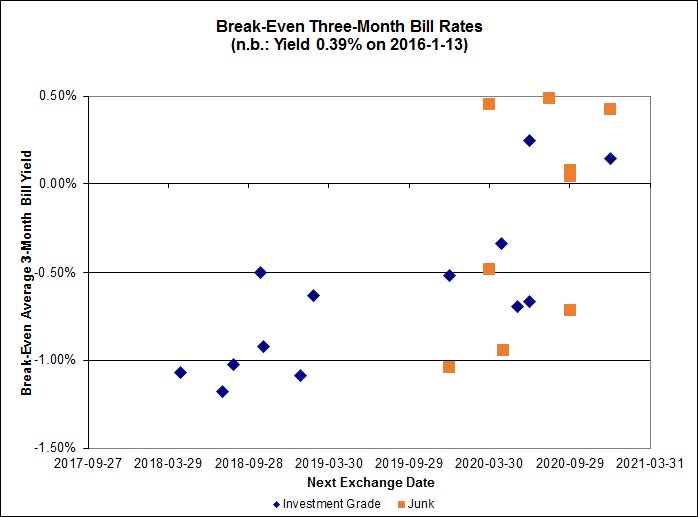
We can show the break-even rates for each FixedReset / FloatingReset Strong Pair graphically by plotting the implied average 3-month bill rate against the next Exchange Date (which is the date to which the average will be calculated).

pairs_FR_151224
Click for Big

The market appears to have a distaste at the moment for floating rate product; almost all of the implied rates until the next interconversion are lower than the current 3-month bill rate and the averages for investment-grade and junk issues are both well below zero, at -1.45% and -1.08%, respectively! Whatever might be the result of the next few Bank of Canada overnight rate decisions, I suggest that it is unlikely that the average rate over the next five years will be lower than current – but if you disagree, of course, you may interpret the data any way you like.

Since credit quality of each element of the pair is equal to the other element, it should not make any difference whether the pair examined is investment-grade or junk, although we might expect greater variation of implied rates between junk issues on grounds of lower liquidity, and this is just what we see.

If we plug in the current bid price of the INE.PR.A FixedReset, we may construct the following table showing consistent prices for its soon-to-be-issued FloatingReset counterpart, INE.PR.B, given a variety of Implied Breakeven yields consistent with issues currently trading:

Estimate of INE.PR.B FloatingReset Trading Price In Current Conditions
  Assumed FloatingReset
Price if Implied Bill
is equal to
FixedReset Bid Price Spread -1.00% -1.50% -2.00%
INE.PR.A 13.65 279bp 11.93 11.45 10.98

Based on current market conditions, I suggest that the FloatingResets that will result from conversion are likely to be cheap and trading below the price of their FixedReset counterparts. Therefore, I recommend that holders of INE.PR.A continue to hold the issue and not to convert. I will note that, given the apparent cheapness of the FloatingResets, it may be a good trade to swap the FixedReset for the FloatingReset in the market once both elements of each pair are trading and you can – presumably, according to this analysis – do it with a reasonably good take-out in price, rather than doing it through the company on a 1:1 basis. But that, of course, will depend on the prices at that time and your forecast for the future path of policy rates. There are no guarantees – my recommendation is based on the assumption that current market conditions with respect to the pairs will continue until the FloatingResets commence trading and that the relative pricing of the two new pairs will reflect these conditions.

Note as well that conversion rights are dependent upon at least one million shares of each series being outstanding after giving effect to holders’ instructions; e.g., if only 100,000 shares of INE.PR.A are tendered for conversion, then no conversions will be allowed; but if only 100,000 shares of INE.PR.A will remain after the rest are all tendered, then conversion will be mandatory. However, this is relatively rare: all 33 Strong Pairs currently extant have some version of this condition and all but two have both series outstanding.

Issue Comments

BRF.PR.E: Amended Exchange Offer Filed

As reported recently, Brookfield Renewable has amended and extended its exchange offer for BRF.PR.E.

The prospectus for the offer may now be found on SEDAR by searching for “Brookfield Renewable Energy Partners L.P. Dec 23 2015 07:39:11 ET Prospectus supplement – English PDF 792 K”. The regulators refuse to allow direct linking to these public documents.

It is of interest to note that the fairness opinion from PricewaterhouseCoopersLLP has not changed in the new prospectus – not even the date!

To be frank, I have not yet been able to determine any differences between the current offer and the previous one. If anybody finds a difference, let me know!

Issue Comments

BRF.PR.E: Exchange Offer Extended, To Be Amended

Brookfield Renewable Energy Partners L.P. has announced:

that it has extended the expiry time of its offer to exchange each issued and outstanding Class A Preference Share, Series 5 of Brookfield Renewable Power Preferred Equity Inc. (TSX:BRF.PR.E) with an annual dividend rate of 5.00% (collectively, the “Series 5 Preferred Shares”) for one newly issued Class A Preferred Limited Partnership Unit, Series 5 of Brookfield Renewable with an annual distribution rate of 5.59% (the “Exchange Offer”) to 5:00 p.m. (Toronto Time) on January 20, 2016.

The Exchange Offer is being extended pursuant to an amendment and restatement of Brookfield Renewable’s prospectus supplement dated November 9, 2015 to its short form base shelf prospectus dated May 12, 2015 (the “Amended and Restated Prospectus Supplement”). Full details of the Exchange Offer are contained in the Amended and Restated Prospectus Supplement, which will be filed with securities regulatory authorities in each of the provinces and territories of Canada and mailed to holders of Series 5 Preferred Shares (“Series 5 Preferred Shareholders”) as required under applicable Canadian securities laws on or about December 23, 2015. Copies of the Amended and Restated Prospectus Supplement will be available on SEDAR at www.sedar.com and on Brookfield Renewable’s website at www.brookfieldrenewable.com at such time. Series 5 Preferred Shareholders are urged to evaluate carefully all information in the Exchange Offer, including risk factors, and to consult their own investment, tax and legal advisors.

Computershare Investor Services Inc. is the Depositary for the Exchange Offer and D.F. King Canada, a division of CST Investor Services Inc., is the Information Agent. Any questions or requests for assistance concerning the Exchange Offer or further information about tendering to the Exchange Offer should be directed to the Depositary at 1-800-564-6253 (toll free in North America) or 1-514-982-7555, or by e-mail at corporateactions@computershare.com; or to the Information Agent at 1-800-332-4904 (toll free in North America) or 1-201-806-7301, or by e-mail at inquiries@dfking.com.

Copies of the Amended and Restated Prospectus Supplement may be obtained free of charge upon request to the Depositary or the Information Agent. Series 5 Preferred Shareholders whose Series 5 Preferred Shares are registered in the name of a broker, investment dealer, bank, trust company or other nominee should contact such nominee for assistance in depositing their Series 5 Preferred Shares to the Exchange Offer.

The original offer was reported in PrefBlog in the post BRF.PR.E: Coercive Exchange Offer. Readers will know I consider the offer coercive because there is no mechanism whereby holders of BRF.PR.E may ensure they receive the original deal; BRF.PR.E could be delisted by the issuer without compensation to a stubborn holder, which could have serious consequences, particular for those who hold the issue in a registered account.

The press release makes reference to an “Amended and Restated Prospectus Supplement, which will be filed with securities regulatory authorities … on or about December 23, 2015.” When I’ve had a chance to look at it, I’ll comment.

Some readers may be interested to learn that Barry Critchley wrote a sadly garbled version of the exchange offer in his piece Brookfield Renewable and Dundee show that pref shares may not be preferred:

Next Friday, Brookfield Renewable preferred shareholders have to decide on an exchange offer whereby they swap their five-per-cent securities issued in 2013 for 5.59-per-cent Series 5 preferred units offered by Brookfield Renewable Power Preferred Equity, a different but related issuer.

It seems the market — and $175 million of these perpetual prefs were issued — has given its judgement: the prefs hit a six-month low during the week. The prefs, now yielding 6.75 per cent, have traded down since the November announcement of the offer.

Those prefs came with certain terms, specifically that they couldn’t be redeemed prior to April 30, 2018. After that date, the issuer was required to pay a premium that declines to $25 “on or after April 30, 2022.”

It appears holders won’t be getting any of those potential benefits if more than two-thirds of the holders tend into the offer.

The proposal has upset some holders, with one suggesting Brookfield Renewable “seems to be urging current owners of the shares to redeem for a lesser product which they pretend is a better investment.”

For example, the Series 5 preferred units “do not have a fixed maturity date and are not redeemable at the option of the holders of Series 5 Preferred Units,” according to a Brookfield Renewable circular. “The ability of a holder to liquidate its holdings of Series 5 Preferred Units may be limited.”

The circular also said that the exchange offers holders increased distributions, substantially similar other terms and conditions, unanimous board recommendation and a fairness opinion. Calls to the company seeking further comment were not returned.

Issue Comments

INE.PR.A To Reset at 3.608%

Innergex Renewable Energy Inc. has announced:

the applicable dividend rates for its Cumulative Rate Reset Preferred Shares, Series A (“Series A shares”) and Cumulative Floating Rate Preferred Shares, Series B (“Series B shares”).

With respect to any Series A shares that remain outstanding after January 15, 2016, commencing as of such date, the holders thereof will be entitled to receive fixed cumulative preferential cash dividends, as and when declared by the Board of Directors, payable quarterly on the 15th day (or, if such day is not a Business Day, the immediately following Business Day) of January, April, July and October in each year from and including January 15, 2016 to, but excluding, January 15, 2021. The dividend rate for the five-year period commencing on January 15, 2016 to but excluding January 15, 2021 will be 3.608% per annum or $0.2255 per share per quarter, being equal to the sum of the Government of Canada Yield (as the term is defined in the Prospectus referred to below) on December 16, 2015 plus 2.79%.

With respect to any Series B shares that may be issued on January 15, 2016, the holders thereof will be entitled to receive floating rate cumulative preferential cash dividends, as and when declared by the Board of Directors, payable quarterly on the 15th day (or, if such day is not a Business Day, the immediately following Business Day) of January, April, July and October in each year (the “Quarterly Commencement Date”), in the annual amount per Series B Share determined by multiplying the applicable Floating Quarterly Dividend Rate (as defined herein) by $25.00. The Floating Quarterly Dividend Rate from and including January 15, 2016 to, but excluding, April 15, 2016, and thereafter the period from and including the day immediately following the end of the immediately preceding Quarterly Floating Rate Period to, but excluding, the next succeeding Quarterly Commencement Date (the “Quarterly Floating Rate Period”) will be equal to the sum of the T-Bill Rate (as the term is defined in the Prospectus referred to below) plus 2.79% per annum (calculated on the basis of the actual number of days in the applicable Quarterly Floating Rate Period divided by 365) determined on the 30th day prior to the first day of the applicable Quarterly Floating Rate Period. The dividend rate for the Quarterly Floating Rate Period commencing on January 15, 2016 to but excluding April 15, 2016 will be equal to 3.262% per annum or $0.203316 per share as determined in accordance with the terms of the Series B shares.

Beneficial owners of Series A shares who wish to exercise their right of conversion should communicate as soon as possible with their broker or other nominee and ensure that they follow their instructions in order to meet the deadline to exercise such right, which is 5:00 p.m. (Montreal Time) on Thursday, December 31, 2015.

The extension of INE.PR.A was previously reported on PrefBlog.

INE.PR.A is a FixedReset, 5.00%+279, which commenced trading 2010-9-14 after being announced 2010-8-23. The new rate of 3.608% thus represents a 28% cut in dividend.

As noted in the Press Release, holders have until 5:00 p.m. (Montreal Time) on Thursday, December 31, 2015, to notify the company of a desire to convert to the FloatingReset Series B. Brokerage deadlines will be earlier; missing the deadline at the brokerage probably means you’re going to have to grovel to get them to try to get the instruction to the company in time and in such a case they will do it only on a ‘best efforts’ basis. So ensure you know well in advance – by which I mean ‘right now’ – just when your brokerage’s internal deadline is.

I will make a recommendation December 24 based on the theory of Preferred Pairs, for which a calculator is available. Given recent market behaviour, it is highly likely that I will recommend holding INE.PR.A and not to convert, but that won’t be final until Christmas Eve!

Issue Comments

Low-Spread FixedResets: November, 2015

As noted in MAPF Portfolio Composition: November 2015, the fund now has a large allocation to FixedResets, mostly of relatively low spread.

Many of these were largely purchased with proceeds of sales of DeemedRetractibles from the same issuer; it is interesting to look at the price trend of some of the Straight/FixedReset pairs. We’ll start with GWO.PR.N / GWO.PR.I; the fund sold the latter to buy the former at a takeout of about $1.00 in mid-June, 2014; relative prices over the past year are plotted as:

GWOPRN_GWOPRI_151130_bidDiff
Click for Big

Given that the November month-end take-out was $7.88, this is clearly a trade that has not worked out very well.

In July, 2014, I reported sales of SLF.PR.D to purchase SLF.PR.G at a take-out of about $0.15:

SLFPRG_SLFPRD_151130_bidDiff
Click for Big

There were similar trades in August, 2014 (from SLF.PR.C) at a take-out of $0.35. The October month-end take-out (bid price SLF.PR.D less bid price SLF.PR.G) was $5.68, so that hasn’t worked very well either.

November, 2014, saw the third insurer-based sector swap, as the fund sold MFC.PR.C to buy the FixedReset MFC.PR.F at a post-dividend-adjusted take-out of about $0.85 … given a November month-end take-out of $6.26, that’s another regrettable trade, although another piece executed in December at a take-out of $1.57 has less badly.

MFCPRF_MFCPRC_151130_bidDiff
Click for Big

This trend is not restricted to the insurance sector, which I expect will become subject to NVCC rules in the relatively near future and are thus subject to the same redemption assumptions I make for DeemedRetractibles. Other pairs of interest are BAM.PR.X / BAM.PR.N:

BAMPRX_BAMPRN_151130_bidDiff
Click for Big

… and FTS.PR.H / FTS.PR.J:

FTSPRH_FTSPRJ_151130_bidDiff
Click for Big

… and PWF.PR.P / PWF.PR.S:

PWFPRP_PWFPRS_151130_bidDiff
Click for Big

I will agree that the fund’s trades highlighted in this post may be decried as cases of monumental bad timing, but I should point out that in May, 2014, the fund was 63.9% Straight / 9.5% FixedReset while in May 2015 the fund was 12% Straight / 86% FixedReset, FloatingReset and FixedFloater (The latter figures include allocations from those usually grouped as ‘Scraps’). Given that the indices are roughly 30% Straight / 60% FixedReset & FloatingReset, it is apparent that the fund was extremely overweighted in Straights / underweighted in FixedResets in May 2014 but this situation has now reversed. HIMIPref™ analytics have been heavily favouring low-spread issues and the fund’s holdings are overwhelmingly of this type.

Getting back to price spreads between low-spread FixedResets and their Straight Perpetual comparators, we can summarize the data above in tabular form and see:

FixedReset Straight Take-out
December 2013
Take-out
MAPF Trade
Take-out
December 2014
October 2015 November 2015
GWO.PR.N
3.65%+130
GWO.PR.I
4.5%
($0.04) $1.00 $2.95 7.49 7.88
SLF.PR.G
4.35%+141
SLF.PR.D
4.45%
($1.29) $0.25 $2.16 5.65 5.68
MFC.PR.F
4.20%+141
MFC.PR.C
4.50%
($1.29) $0.86 $1.20 6.88 6.26
BAM.PR.X
4.60%+180
BAM.PR.N
4.75%
($2.06)   $0.17 5.18 4.94
FTS.PR.H
4.25%+145
FTS.PR.J
4.75%
$0.60   $5.68 8.04 7.23
PWF.PR.P
4.40%+160
PWF.PR.S
4.80%
($0.67)   $3.00 7.99 7.47
The ‘Take-Out’ is the bid price of the Straight less the bid price of the FixedReset; approximate execution prices are used for the “MAPF Trade” column. Bracketted figures in the ‘Take-Out’ columns indicate a ‘Pay-Up’

In January, a slow decline due to fears of deflation got worse with Canada yields plummeting after the Bank of Canada rate cut with speculation rife about future cuts although this slowly died away.

And in late March / early April it got worse again, with one commenter attributing at least some of the blame to the John Heinzl piece in which I pointed out the expected reduction in dividend payouts! In May, a rise in the markets in the first half of the month was promptly followed by a slow decline in the latter half; perhaps due to increased fears that a lousy Canadian economy will delay a Canadian tightening. Changes in June varied as the markets were in an overall decline.

In August we saw increased fear of global deflation emanating from China, although the ‘China Effect’ is disputed.

In September the market just collapsed for no apparent reason; in October the market reversed the September collapse for no apparent reason.

All in all, I take the view that we’ve seen this show before: during the Credit Crunch, Floaters got hit extremely badly (to the point at which their fifteen year total return was negative) because (as far as I can make out) their dividend rate was dropping (as it was linked to Prime) while the yields on other perpetual preferred instruments were skyrocketing (due to credit concerns). Thus, at least some investors insisted on getting long term corporate yields from rates based (indirectly and with a lag, in the case of FixedResets) on short-term government policy rates. And it’s happening again!

There is further discussion of the extremely poor performance in the seven months to July 31 of FixedResets in the post eMail to a Client. Things haven’t really changed since that was written; they’ve just gotten ever so much more so.

What happened, essentially, is that the software assumes a certain amount of efficiency in the market. For instance, in 2013 PerpetualDiscounts were trading to yield 250-300bp over FixedResets (see the chart “PDIE-FR Spread”, below, for the PerpetualDiscount Interest Equivalent – FixedReset Spread), where the yield-to-perpetuity of FixedResets was calculated using the contemporary five-year Canada yield of 1.50%-2.00% (see the chart “Historical Government Yields”, below, for the historical government yields). The software assumes the market will get the big things right, so it therefore assumed that this 250-300bp spread would be maintained; and that a spread in this range represented fair value. Therefore, it would only purchase FixedResets if they were sufficiently cheap to other FixedResets to give a good chance of making up this fairly large yield difference.

When this spread started increasing in 2014, FixedResets started looking more attractive as the system assumes a certain amount of mean reversion and the system started buying those issues that were cheap to other FixedResets. However, the underlying assumption that the market would get the big things more-or-less right appears to have been unjustified in this instance: incredibly, the market was not accounting for changes in the five-year Canada rate (and therefore for changes in the projected dividend rate on reset) during this period. So we can call this period an episode of structural change in the markets – and no quantitative system can account for future structural change unless that is programmed into the system … in which case the analysis is no longer quantitative.

PDIE_FR_spread
Click for Big
histGovtYields
Click for Big

Here’s the November performance for FixedResets that had a YTW Scenario of ‘To Perpetuity’ at mid-month.:

FRPerf_151130_1Mo_IRS_A
Click for Big

The market was very disorderly in November and correlations of performance are negligible, whether against spread or term-to-reset. However, I have added the regression line for the Pfd-2 group to the above chart, not because the correlation is so great (at only 12%, it isn’t) but because it shows that to the extent that there is a correlation between spreads and returns, the slope is negative.

FRPerf_151130_1Mo_Term
Click for Big

Three month performance is uncorrelated for both the Pfd-2 and Pfd-3 groups:

FRPerf_151130_3Mo_IRS
Click for Big
Issue Comments

CPX.PR.A: No Conversion to FloatingReset

Capital Power Corporation has announced:

that after having taken into account all Election Notices following the December 16, 2015 conversion deadline, in respect of the Cumulative Rate Reset Preference Shares, Series 1 (Series 1 Shares) tendered for conversion into Cumulative Floating Rate Preference Shares, Series 2 (Series 2 Shares), the holders of Series 1 Shares were not entitled to convert their shares. There were approximately 930,800 Series 1 Shares tendered for conversion, which was less than the one million shares required for conversion into Series 2 Shares.

There are five million Series 1 Shares listed on the Toronto Stock Exchange (TSX) under the symbol CPX.PR.A. Effective December 31, 2015, the annual fixed dividend rate for the next five year period has been reset to 3.06%.

For more information on the terms and risks associated with an investment in the Series 1 Shares, please see Capital Power’s prospectus supplement dated December 1, 2010 which is available on sedar.com or on Capital Power’s website at capitalpower.com.

It will be recalled that I recommended against conversion and

CPX.PR.A will reset to 3.06% effective December 31. Holders of CPX.PR.A have the option to convert to FloatingResets, which will pay 3-month bills plus 217bp, reset quarterly.

Issue Comments

GWO.PR.N / GWO.PR.O: 15% Conversion to FloatingReset

Great-West Lifeco Inc. has announced:

that holders of 1,475,578 Lifeco Non-Cumulative 5-Year Rate Reset First Preferred Shares, Series N (the “Series N Shares”) have elected to convert their Series N Shares on a one-for-one basis into Non-Cumulative Floating Rate First Preferred Shares, Series O (the “Series O Shares”) on December 31, 2015.

Consequently, on December 31, 2015, Lifeco will have 8,524,422 Series N Shares and 1,475,578 Series O Shares issued and outstanding. The Series N Shares and Series O Shares will be listed on the Toronto Stock Exchange under the symbols GWO.PR.N and GWO.PR.O respectively.

It will be recalled that I recommended against the conversion and

GWO.PR.N will reset to 2.176% effective December 31. Holders of GWO.PR.N have the option to convert to FloatingResets, which will pay 3-month bills plus 130bp, reset quarterly.

Issue Comments

BNS.PR.E Firm On Good Volume

The Bank of Nova Scotia has announced:

that it has completed the domestic public offering of Non-cumulative 5-Year Rate Reset Preferred Shares Series 34 (Non-Viability Contingent Capital (NVCC)) (the “Preferred Shares Series 34”).

Scotiabank sold 14 million Preferred Shares Series 34 at a price of $25.00 per share and holders will be entitled to receive a non-cumulative quarterly fixed dividend for the initial period ending April 25, 2021 yielding 5.50% per annum, as and when declared by the Board of Directors of Scotiabank. The gross proceeds of the offering were $350 million.

The offering was made through a syndicate of underwriters led by Scotia Capital Inc. The Preferred Shares Series 34 commence trading on the Toronto Stock Exchange today under the symbol BNS.PR.E.

On April 26, 2021 and on April 26 every five years thereafter, Scotiabank may, at its option, with the prior approval of the Superintendent of Financial Institutions (Canada), redeem all or any part of the Preferred Shares Series 34 then outstanding at a redemption price which is equal to par. Thereafter, the dividend rate will reset every five years at a rate equal to 4.51% over the 5-year Government of Canada bond yield. Holders of Preferred Shares Series 34 will, subject to certain conditions, have the right to convert all or any part of their shares to Non-cumulative Floating Rate Preferred Shares Series 35 (Non-Viability Contingent Capital (NVCC)) (the “Preferred Shares Series 35”) of Scotiabank on April 26, 2021 and on April 26 every five years thereafter.

Holders of the Preferred Shares Series 35 will be entitled to receive a non-cumulative quarterly floating dividend at a rate equal to the 3-month Government of Canada Treasury Bill yield plus 4.51%, as and when declared by the Board of Directors of Scotiabank. Holders of Preferred Shares Series 35 will, subject to certain conditions, have the right to convert all or any part of their shares to Preferred Shares Series 34 on April 26, 2026 and on April 26 every five years thereafter.

BNS.PR.E is a FixedReset 5.50%+451, announced 2015-12-8. It will be tracked by HIMIPref™ and has been assigned to the FixedResets subindex.

The issue traded 1,123,441 shares today in a range of 25.12-28 before closing at 25.20-26, 2×15. Vital statistics are:

BNS.PR.E FixedReset YTW SCENARIO
Maturity Type : Call
Maturity Date : 2021-04-25
Maturity Price : 25.00
Evaluated at bid price : 25.20
Bid-YTW : 5.36 %

DBRS finalized the rating at Pfd-2.

Issue Comments

DC.PR.C: Dundee Gets Support from Glass, Lewis & Co., Proxy Advisors

Dundee Corporation has announced:

that Glass Lewis & Co. (“Glass Lewis”), a leading, independent, governance analysis and proxy voting firm, has recommended that holders of Dundee’s First Preference Shares, Series 4 (the “Series 4 Preferred Shares”) vote FOR the special resolution to approve the proposed preferred share exchange transaction whereby each of its Series 4 Preferred Shares would be exchanged for 0.7136 of a First Preference Share, Series 5 (the “Series 5 Preferred Shares”) pursuant to a statutory plan of arrangement under the Business Corporations Act (Ontario) (the “Arrangement”). The resolution will be considered at the upcoming special meeting of holders of Series 4 Preferred Shares to be held on January 7, 2016 at 9:00 a.m. (Toronto time) at the offices of Dundee Corporation, 1 Adelaide St. East, Suite 2100, Toronto, Ontario, Canada.

In its recommendation, Glass Lewis noted that while “the retraction date of the Series 4 Preferred Shares will be effectively extended three years through the Arrangement, the par value of the Series 5 Preferred Shares is functionally equivalent to that of the Series 4 Preferred Shares, their cumulative dividend rate is greater, and the redemption features of the Series 5 Preferred Shares are more generous”. Glass Lewis also stated that it believes that “decisions regarding a Company’s capital structure, business and operations are best left to the judgment of the board” and that “the arrangement resolution proposed by the board is reasonable and consistent with standard market practice”.

The Company continues to seek dialogue with significant institutional holders who have expressed concerns about the proposal, and there can be no assurance that such discussions will be successful or that the proposal will proceed as currently proposed or at all.

I am unable to find a copy of the report on-line (not surprising, since Glass, Lewis is Subscriber-Pay), so I am unable to comment regarding what the report may contain that Dundee did not choose to highlight. I will note that the quoted sections do not address the investment merits of the potential new issue compared to those of the old one.

Update, 2015-12-18: I sent Glass, Lewis the following eMail:

Subject: Recommendation Regarding Dundee Corporation Preferred Shares

Sirs,

I was astonished to read that you have recommended that holders of Dundee’s First Preference Shares, Series 4 vote FOR the special resolution to approve the proposed preferred share exchange transaction (http://www.dundeecorp.com/pdf/2015-12-17-Glass-Lewis.pdf )

How may I obtain a copy of your full report?

Sincerely,

A few hours later I received the reply:

Hello James,

If you are interested in our research the fee for the report, based on Dundee’s market cap, is $3,500.

Please let me know if you are interested or if you have any other questions.

Best,

I’m not particularly surprised, but I will say that I eagerly await the comments of those Assiduous Readers who are convinced that “Subscriber Pay” is the only way to go for Credit Rating Agencies.

I will not comment much on the Glass, Lewis recommendation, since I have not seen anything of it other than the very short quotations provided by Dundee. However, I will reiterate that the quotations do not address the investment merits of the Series 5 shares vs. the Series 4 and that while it is of course true that:

“decisions regarding a Company’s capital structure, business and operations are best left to the judgment of the board”

it is also true that decisions regarding an investors portfolio are best left to the judgment of the investor!