Interesting External Papers

The Canadian Fixed Income Market: 2014

On April 23, the OSC announced:

Today the Ontario Securities Commission (OSC) published The Canadian Fixed Income Market Report and OSC Staff Notice 21-708 – OSC Staff Report on the Canadian Fixed Income Market and Next Steps to Enhance Regulation and Transparency of Fixed Income Markets. Together, these materials summarize the OSC’s study of the fixed income markets and set out the steps the OSC will take to enhance the transparency and regulation of fixed income markets.

“With this report, we have compiled research that confirms our focus on enhanced post-trade transparency and regulation of the fixed income markets in Canada,” said Howard Wetston, Q.C., Chair and CEO of the OSC. “Our priority now is to develop regulation that will promote more informed decision-making for market participants regardless of size, improve market integrity and ensure that the market is fair and equitable to all investors.”

The Staff Notice stated:

In light of the observations in the Report, Staff considered steps that could be taken at this time to enhance fixed income regulation to achieve the following objectives:

  • 1. Facilitate more informed decision making among all market participants, irrespective of their size;
  • 2. Improve market integrity; and
  • 3. Ensure that the market is fair and equitable for all investors


In the coming year, we will take additional steps to facilitate more informed decision making by market participants for all fixed income securities, specifically:

  • a. Monitoring the implementation of new CSA cost and performance reporting rules in National Instrument 31-103 Registration Requirements, Exemptions and Ongoing Registrant Obligations, which will help retail investors better understand the cost of their fixed income transactions, and which will be fully implemented by July 2016; and
  • b. Working with the CSA to make it easier for investors to find relevant documents for fixed income offerings, especially trust indentures and credit agreements, in the SEDAR system.

Subject to determining exactly what they mean, I don’t have a huge amount of problems with their second intention, to make more information available on SEDAR (although I suspect that they will not address my perennial complaint regarding their prohibition on linking directly to these public documents). As a caveat to that, however, I’ll say that I suspect it won’t make an atom’s worth of difference: it became apparent to me about ten years ago that nobody other than the lawyers ever read bond prospectuses; if there was any information anywhere other than on Bloomberg, it didn’t really exist. And Bloomberg’s information was grossly circumscribed; the summary omitted a lot of interesting stuff, like call schedules.

I will note that my direct experience of the institutional bond market is getting pretty rusty, but I was managing a small – but still institutionally sized – corporate bond portfolio in 2007/8; things were not much different than they were in the ’90’s; the big difference was that all the dealer crap came by eMail rather than fax and snail-mail. They could improve access to information quite easily by clarifying the rules about offering memoranda; on at least one occasion, I refused to consider buying an offered bond that fit the portfolio needs quite admirably, according to the basic information available, because the only documentation the dealer had (and this dealer was the original underwriter of the deal) was the offering memorandum and they refused to send me a copy on the grounds that OSC rules forbid the dissemination of the document.

All that being said, it is a pity that the report itself was written with the purpose of providing a veneer of respectability for the next OSC implementation of mission creep. For all that the report, titled The Canadian Fixed Income Market: 2014, is quite a good collection of references.

Furthermore, a significant number of bonds, ranging from 23-47%, are privately placed and only available to accredited investors.[Footnote]

Footnote reads: Based on an analysis of FP Infomart data from 2010-2013. These securities can only be traded and held by accredited investors.

Many of these private placements will be small issues, issued to institutions like pension funds and insurance companies on a bespoke basis, but it is a great pity that this characteristic was not followed up in an effort to determine why issuers choose to issue bonds privately. For example, on September 23, 2014 I noted:

However, as has been pointed out by Ron Mendel of Hartford Investment Management in his admirable essay Private Placement Debt: Diversification, yield potential in a complementary IG asset:

Private placement investors require additional yield relative to comparable public bond issues, as lenders demand greater yield to compensate for increased liquidity risk as well as the underwriting and monitoring costs. This premium is variable over time and is a function of technical, supply and demand characteristics, credit fundamentals and insurance liability requirements. The typical liquidity premium historically ranges between 25 – 45 basis points.

For those wanting some more opinion regarding private placements, the nomenclature in the states is “144a bonds” (or 144(a)), after the rule by which our wise masters graciously permit money to be borrowed and lent privately.

So why are there private placements? One answer is the price of underwriting a public issue, as a (now rather dated) paper by Oya Altınkılıç  and Robert S. Hansen, titled Are There Economies of Scale in Underwriting Fees? Evidence of Rising External Financing Costs reports:

underwritingFees
Click for Big

That’s not the end of it, as they show with some data for Chilean issues listed in the US market, taken from a paper by Sara Zervos titled The Transactions Costs of Primary Market Issuance: The Case of Brazil, Chile, and Mexico:

issueCosts
Click for Big

Wow! Issuance costs of nearly 5% on a small issue is something fierce! While Canadian issuers will not have to deal with such an obscene amount of taxes on a bond issue, I suspect that the legal cost quoted …:

While legal fees can range according to any complications that arise, most parties quoted an approximate $50,000 for completing a straightforward deal.

… is absurdly low in today’s environment, particularly for smaller issuers that do not have a shelf prospectus in place. If we look at the recent Split Share offering by Brompton (a cookie-cutter SplitShare Corporation), found on SEDAR at “Brompton Oil Split Corp. Jan 30 2015 15:09:40 ET Final long form prospectus – English PDF 991 K” (not allowed to link!) we find:

The Company will pay the expenses incurred in connection with the offering of Preferred Shares and Class A Shares by the Company, estimated to be $725,000.

That was before selling fees of 3% (preferred) and 6% (Capital Units). An old buddy of mine blew his brains out with an ETF … spent about $750,000 and couldn’t sell the issue. So basically I think this report suffers by not examining issuance costs more – and yes, I know that legal fees aren’t public information and are therefore beyond the scope of this report. I don’t care. If they’re going to talk about costs of issue, they should have at least highlighted the fact that the cost information presented is both non-Canadian and dated.

I will also note that the information presented in the report does not differentiate by term; if we look at the information presented on SEDAR as “TELUS Corporation Mar 24 2015 17:34:26 ET Underwriting or agency agreements (or amendment thereto) PDF 275 K ” (not allowed to link!) we find:

(i) up to Cdn.$250,000,000 principal amount of Series CS Notes at a price of Cdn.$999.62 per Cdn.$1,000 principal amount of 1.50% Notes, Series CS due March 27, 2018 (the “Series CS Notes”) plus accrued interest, if any, from March 27, 2015 to the date of delivery, (ii) up to Cdn.$1,000,000,000 principal amount of Series CT Notes at a price of Cdn.$997.31 per Cdn.$1,000 principal amount of 2.35% Notes, Series CT due March 28, 2022 (the “Series CT Notes”) plus accrued interest, if any, from March 27, 2015 to the date of delivery, and (iii) up to Cdn.$500,000,000 principal amount of Series CU Notes at a price of Cdn.$999.72 per Cdn.$1,000 principal amount of 4.40% Notes, Series CU due January 29, 2046 (the “Series CU Notes”)

the Company agrees to pay to the Agents, at the Closing Date a fee of (i) Cdn. $2.50 per Cdn. $1,000 principal amount of Series CS Notes actually sold, (ii) Cdn. $3.70 per Cdn. $1,000 principal amount of Series CT Notes actually sold, and (iii) Cdn. $5.00 per Cdn. $1,000 principal amount of Series CU Notes actually sold, in each case exclusive of any applicable goods and services tax or any similar applicable tax.

So the underwriting costs in this case were 25bp for the Short-Term notes, 37bp for the Medium-Term notes and 50bp for the Long-Term notes.

But anyway, the main thrust of the report is to detail the difficulties retail investors have in building a portfolio of directly held bonds, e.g.:

In a 2010 study of US corporate bond trades, researchers observed that transaction costs were ten to twenty times lower for trades of $500,000 or more than for trades up to $100,000.[Footnotes]

[Footnotes read]: Transactions under $100,000 are considered to be retail transactions. See Appendix I: Additional Background, “Table 4: Spreads by Trade Size – Corporate Bonds (November 2008-April 2010)”.

Equivalent Canadian data is not available; however, we would expect to see a large disparity in Canada as well.

They do acknowledge concerns about transparency:

Negotiated Markets

In the fixed income market, there are many differentiated securities that do not trade very frequently. This leads to high search costs for each transaction since the market for individual securities tends to be concentrated among a small number of participants (fragmented liquidity).

This is one of the reasons the fixed income market operates as a negotiated market, where buyers and sellers negotiate the price of each transaction.

To facilitate the matching of buyers and sellers, dealers (or market makers) can help facilitate a transaction by serving as the trade counterparty. The market maker then assumes inventory risk while it looks for a seller (or buyer) to net out its position.

Complete transparency can deter market makers from participating for a number of reasons. One concern is that buyers or sellers can gain bargaining power over market makers. This could allow them to determine a market maker’s position and cost information, which drastically reduces the market maker’s potential profit.

The other concern is the free-rider effect: in a negotiated market, the initial search costs are high, but the marginal cost of disseminating and using this information is (or close to) zero. Full transparency can reduce bid-ask spreads but also reduces the incentive for market makers to participate because they rely on these spreads to compensate for their search efforts. While spreads in the fixed income market appear high relative to those in the equity market, one could argue that it is more appropriate to compare the fixed income market to other negotiated markets such as those for real estate and private equity, where both search and transaction costs can be significantly higher.

They acknowledge disputes about the effects of TRACE, without actually defining what they mean by liquidity:

A consensus on lower transaction costs with a continuing debate on liquidity Empirical evidence, gathered after the rollout of the TRACE system, showed that post-trade transparency lowered transaction costs in the fixed income market without decreasing liquidity.[Footnotes] As a corollary, these findings indicate that greater price transparency, leads to less information asymmetry and lower economic rents,[Footnote] which makes the market more efficient.[Footnote] However, in a more recent study, researchers argue that while post-trade transparency has reduced transaction costs in the fixed income market, it has had a negative impact on liquidity, particularly for less frequently traded bonds.[Footnote]

Footnotes read:

See Edwards, Amy K., Lawrence E. Harris, and Michael S. Piwowar. “Corporate Bond Market Transaction Costs and Transparency.” The Journal of Finance 62.3 (2007): 1421-451. Web. 24 July 2014. <[LINK]>; Learner, Heidi. “An Examination of Transparency in European Bond Markets.” An Examination of Transparency in European Bond Markets. CFA Institute, Oct. 2011. Web. 06 Apr. 2015. <[LINK}>;and M. Goldstein, E. Hotchkiss, and E. Sirri, “Transparency and Liquidity: A Controlled Experiment on Corporate Bonds,” Babson College working paper, 2005, <[LINK]>.

See International Comparisons, “Comparing Transparency” for additional details related to TRACE.

Economic rent represents the return on an asset in excess of the amount needed to keep it productive in a competitive market. Alternatively economic rent is the return that can be eliminated by competition. Rent-seeking actors are those that enter a market to capture economic rents.

Large traders can obtain a proprietary advantage by keeping the traded prices of bonds hidden. See United States. Library of Congress. Congressional Research Service. Does Price Transparency Improve Market Efficiency? Implications of Empirical Evidence in Other Markets for the Health Sector. By D. Andrew Austin and Jane G. Gravelle. United States Congress, 24 July 2007. Web. 31 July 2014. <[LINK]>.

Asquith, Paul, Thomas R. Covert, and Parag Pathak. The Effects of Mandatory Transparency in Financial Market Design: Evidence from the Corporate Bond Market. Working paper. SSRN, 5 Sept. 2013. Web. 25 Nov. 2014. <[LINK]>

I reviewed the last of these papers in the post TRACE and the Bond Market. And I’m pretty upset that they did not include the observations of Bessembinder and Maxwell (which I reviewed in the post TRACE and Corporate Bond Market Transparency) in this section, although they’re clearly aware of this paper since they cited it twice. One observation is critical and was conveniently ignored; it was:

Market participants with whom we spoke, including both dealers and the traders at investment firms who are their customers, were nearly unanimous in the view that trading is more difficult after the introduction of TRACE. Whereas it may have previously been possible to complete a sizeable bond purchase with a single phone call to a dealer who held sufficient quantities of the bond in inventory, the post-TRACE environment may involve communications with multiple dealers, and delays as the dealers search for counterparties. A bond trader with a major insurance company told us that there is less liquidity, in that market makers carried less “product,” and it has become more difficult to locate bonds for purchase in the post-TRACE environment. A bond trader for a major investment company responded to the publication of Bessembinder, Maxwell, and Venkataraman (2006) by sending the authors an unsolicited e-mail stating: “I want to be able to execute a trade even if a bond dealer does not have a simultaneous counterparty lined up…. [T]oo much price transparency reduces dealers’ willingness to commit capital…. [T]he focus on the bid-ask spread is too narrow, and a case of being penny-wise and pound-foolish.”

However, having acknowledged (however imperfectly) a debate about liquidity, the authors of the OSC paper immediately start advocating for greater transparency:

Why is price transparency important?

Markets can operate more efficiently when pricing is transparent for both buyers and sellers. Price transparency helps to ensure the buyer can make a more informed purchase, especially in financial markets that involve an intermediary, and helps sellers by making it easier to gauge demand. Price transparency also helps to prevent price discrimination in the market, where different people pay different prices for otherwise identical goods or services.

Why are prices in some markets less transparent than others?
1. Search costs. There are opportunity, including time, and monetary costs to acquire information; and
2. Privacy. Some participants are concerned that any increase in transparency might have a negative effect on their ability to manage their positions. However, it is not clear if these privacy concerns should dominate if most participants do not intend to trade the securities.

What are some of the arguments for greater transparency in the fixed income market?
1. The internet has significantly reduced search costs for consumers across many industries ranging from consumer retail to stock markets by reducing the marginal cost of information dissemination close to zero; and
2. Given that fixed income markets are generally not liquid, many participants in the market are buy-and-hold investors, so it is not clear if the privacy concerns are valid for investors that do not intend to trade these bonds.

And then there’s the usual whining:

Transparency depends on the investor’s level of sophistication … The market is relatively transparent to institutional investors … There is limited information available to retail investors … COSTS TO INVESTORS ARE NOT TRANSPARENT

In short, as I stated at the beginning of this post, the report itself was written with the purpose of providing a veneer of respectability for the next OSC implementation of mission creep. There is very little attempt to address the issue of ‘what is the corporate bond market for’ and an overarching bias towards the idea that greater transparency is always good. Well, maybe it’s good for retail investors, but is it good for the capital markets? Is it good for issuers who seek to raise funds to invest in fixed assets? As Assiduous Readers know, I take the view that it ain’t. Retail investors are well served by ETFs and, to a lesser extent (because of the fees!), by mutual funds; I have explained in the past Why only millionaires should invest in bonds directly. I have advocated for a version of Treasury Direct to be established in Canada, but those are for Canada bonds; and it’s in the context of creating something more useful than CSBs for small retail investors.

All in all, if the OSC really wants to know how investors get abused in the bond marketplace, they would be better advised to investigate manipulation of the bond indices.

But my prediction is that increased transparency will in fact come to the Canadian corporate bond market and quote spreads will in fact tighten and all the morons will be very, very happy. As a corollary to this, the market will become thinner, therefore more volatile and less liquid (when we define liquidity along the lines of ‘the ability to perform a 1-million pv transaction in a reasonable time without significant market impact); therefore investors will want higher spreads, therefore more issuers will head to the States and build fewer factories. We might also see an increase in the bespoke market, where issuers do more financing by with tiny issues sold in their entirety to insurance companies and pension plans. But the allegedly good part is a headline and the bad parts are only statistics, so who cares?

Morningstar had an article on the paper, titled Regulators: Retail investors deserve true bond transparency, which makes it clear that facts don’t matter; increased transparency and the degradation of Canada’s tiny corporate bond market is a foregone conclusion:

”We believe there is a need for additional transparency, both to regulators and to market participants, as well as enhanced regulation,” says Susan Greenglass, director of market regulation at the OSC.

In the Bank of Canada’s December 2003 Financial System Review, Tran-Minh Vu wrote Transparency in the Canadian Fixed-Income Market: Opportunities and Constraints which included a very peculiar assertion:

In Canada, because of the decentralized nature of the fixed-income market, customers typically contact several dealers to obtain the best price.[Footnote]

Footnote reads: Because they are primarily institutional investors, customers usually have a fiduciary duty to obtain at least three quotes from different dealers.

Let’s just say I’d like to see some supporting documentation for both parts of that quotation!

Market Action

June 19, 2015

battlingRobots
Click for Big

It’s time for … Battling Robots!

Vanguard has an ally in Palo Alto, California–based Wealthfront. The company’s algorithms direct about 90 percent of the average portfolio to Vanguard funds. The firms don’t have a financial relationship, and they’re chasing different markets. Yet their CEOs praise each other’s strategies. “I’m a big fan of what’s happened in the robo-world,” Vanguard CEO Bill McNabb says.

Fidelity is embracing the robo-product route via the 3,200 independent advisory firms for which it clears trades and holds about $1.5 trillion in assets. Boston-based Fidelity teamed up with No. 2 robo-firm Betterment in October to steer those advisers toward Betterment’s software. The robo-programs pick portfolios, often based on Vanguard funds, and automatically rebalance them to cut time and costs. Fidelity gets a referral fee, which it won’t disclose, from its New York–based partner. “Financial firms can no longer wait for the emerging affluent to appear at their doorstep when they have enough assets,” says David Canter, who heads a Fidelity unit serving independent advisers. “You have to think about them now.”

In the rising robo-rivalry between Fidelity and Vanguard, the winner may be … Charles Schwab Corp. The largest independent U.S. brokerage by client assets started a robo-offering for retail investors on March 9. By the end of May, the new program had $2.4 billion in client money and about 33,000 accounts. “The pressure is on,” Aite’s Pirker says.

So far, at any rate, there doesn’t appear to be any big threat to human advisors; everything’s happening in the discount space and clients are those who were already willing to go it alone, but are willing to pay a few bucks for some reassurance. Eventually I’m quite certain that every comprehensive fund family – and who is more comprehensive than Vanguard? – will have one.

Bond ETF outflows are rising:

Investors in U.S. exchange-traded funds have sold the most bonds in June in 15 months. So far, it’s proving to be a winning bet.

They pulled $2.14 billion out of fixed-income funds since May 31, on course to be the biggest monthly withdrawal since March 2014, according to data compiled by Bloomberg.

With everyone getting ready for the Federal Reserve to raise interest rates, Treasuries have fallen almost 1 percent since the end of May, based on Bloomberg World Bond Indexes. It’s the biggest monthly decline since February.

Tim Kiladze of the Globe notes the current disaffection with FixedResets:

A sudden change of heart from retail investors is making financing decisions much tougher for Canada’s biggest companies.

Until recently, retail investors were happy to buy new issues of rate reset preferred shares from companies such as Royal Bank of Canada, TransCanada Corp. and Husky Energy Inc.

Such a heavy appetite for the product made it easy for these issuers to raise cash. In 2014, $14-billion worth of these securities were gobbled up.

But lately, retail investors are giving rate reset preferred shares the cold shoulder. Burned by poor performing issues, they are much less willing to buy new offerings of these securities.

My comments of June 16 regarding the Brondesbury Group report on Mutual Fund Fee Research commissioned by the OSC attracted some attention from a well-known activist … so I replied with an eMail:

At the risk of putting words in your mouth, I’ll suggest that you’re concerned with the 1-5% (?) of cases in which the salesman-client relationship goes badly wrong.

I am concerned about these cases, but in the same way I’m concerned about murder and burglary. When people clearly do wrong, catch ’em and punish ’em, I say – I do not advocate that we require people to prove that they have no intention of murdering or burglarizing anybody, and to prove that they have adequate supervision to ensure they don’t go astray. Nor do I advocate that police check everybody’s house annually to ensure the locks are up to the latest standards and the ‘safe-room’ is adequately secured against armed marauders, or that the citizen sign a release stating that he does not want these things and file it with the proper authorities.

I am more concerned with the effects on capital markets of a blanket fiduciary standard. Mainly, capital markets do not exist for the purpose of giving Granny a safe investment; giving Granny a good place to put her $50,000 is only a means to an end. Capital markets exist for the purpose of transmitting money from savers to direct investors – companies that need a few billion to build a pipeline, or a factory or whatever. All regulation must not only recognize this, but recognize that all other aspects of capital markets are subordinate to this purpose.

So my major problem with a blanket fiduciary standard is: who’s going to do the selling? Selling is hard work and it’s valuable to the entity whose goods are being sold. So we have new issue commissions, paid directly from the issuer to the salesman, just like happens with the friendly salesman at your local electronics store. So who are these people going to be?

Under a blanket fiduciary standard, it obviously cannot be the fiduciary, so Granny can’t buy a new issue bond and capture (to some extent) the new issue concession. Granny must buy whatever is available on the secondary market and pay a markup that is (proportionately) pretty big. Granny can’t buy a GIC either, because GICs have the profit margin and sales commission (or salary, if it’s a teller doing the work) built in to the offered yield (taken off the top!) and are therefore (according to some) inherently evil.

However, fiduciaries are a valuable part of capital markets. I should know – I’m a fiduciary myself. Fiduciaries allow for a certain amount of trust in a relationship between naive client and big-shot markets guy, thereby encouraging more direct participation by clients in the capital market’s purpose of turning cash under the mattress into new skyscrapers.

So we need fiduciaries and we need salesmen in our idealized capital markets – and guess what? We have that already! There are lots of fiduciaries around for those that want them; there are lots of salesmen around for those who want them, too. There will be lots of individuals who will want relationships with both types of professional; and, I suggest, there will be lots of investors who will maintain accounts with salesmen only when an objective evaluation will suggest a fiduciary. ‘Why should I pay this fiduciary?’ they will ask. ‘Last year he only did two trades and charged me $3,000!’

What we don’t have is strict separation of functions. Given the huge amount of money that’s made from new issue commissions (as I mentioned on June 16, this exceeds mutual fund commission revenue at the major brokerages), it should be clear that strict separation is necessary. Not only should any individual market professional be prohibited from being both a salesman and a fiduciary (even to different clients), but any given corporate group should be prohibited from assuming both roles. If X is a sales channel and Y is a fiduciary channel and Z owns both X and Y … there will be problems, conflicts of interest and leakages. Guaranteed. So all investment professionals and all their employers must be forced to make the choice. Sell Side or Buy Side? Choose!

It won’t happen. There are a lot of very large corporate interests that make very good money by being all things to all people and there are lots of regulators and politicians who want to work for these large corporations in their futures at double the paycheque. So we’ll keep muddling along, true to the ideal that we can all achieve moral perfection as long as there are enough rules and enough people to enforce them and enough money spent on compliance instead of laying bricks for the new factory.

Actually, this eMail turned out rather longer than I expected and I like it. So I’m going to publish it on my blog tonight (your name will not be mentioned).

By the way, I have a small and nascent sideline providing expert witness reports for negligence and misconduct cases involving preferred shares; it’s something I think can grow, since I have the belief that the guys in the big firms won’t work for plaintiffs. You might want to keep me in mind when one of the 1-5% (?) of relationships crosses your desk.

Sincerely,

Actually, I should have also pointed out that the typical problem I see when reviewing portfolios is not that investors have too much equity, but that they have too little. Not only are they grossly overweighted in fixed-income, but that fixed income is short term, and not only is it short term, but it’s federal debt. If anything, commissions on selling equities should be increased because people simply aren’t holding enough of them.

On cue, Rob Carrick writes a piece in the Globe about fee based accounts:

Fee-based advice is where the momentum is in the investment industry today. PriceMetrix says the percentage of fee-based assets rose to 35 per cent in 2014 from 31 per cent in 2013, while the percentage of total fee revenue from fee-based accounts rose to 53 per cent from 47 per cent. “More and more advisers are realizing that operating on a fee-for-service basis is simply a more productive way to grow your business,” said Patrick Kennedy, co-founder and chief customer officer at Toronto-based PriceMetrix.

The general unavailability of fee information is a problem, though. Try this: Google the name of an investment firm you know and see if there’s a “fees” or “pricing” tab on their website. Outside of some online robo-adviser firms, I couldn’t find a single example of a company doing this.

Fee secrecy is good for business. Clients are told what the costs are and they have no context to judge them. They can negotiate, but without the knowledge that there may be other firms doing the same kind of work for half a percentage point less. On a $500,000 portfolio, that difference amounts to $2,500 per year.

It’s not just fee information that is hard to get (I publish my fees!) but, more critically, it is performance information that is very difficult to get. I didn’t mention it in my long eMail, above, but I think anybody charging a fee for discretionary asset management should be required to publish a comprehensive performance report, going back to inception. Composites can be created either by asset type or account characteristics (or both!), I don’t care, but performance must be published! What’s more, returns should be reported using Time-Weighted returns, not the Dollar-Weighted returns so beloved of regulators and morons (see November 26, 2012 for the initial fluttering of eyelashes; the eventual decision to mandate dollar-weighted returns was discussed in greater detail in PrefLetter).

John Heinzl in the Globe gave a sensible response to a small investor wailing about preferred share prices:

A few years ago I started accounts worth $5,000 for each of two grandchildren, and invested all of the money in BCE preferred shares (BCE.PR.K). The value of these accounts has since fallen to about $3,900, but my adviser recommends we leave them as is. The funds will not be needed for the grandchildren until about 15 years from now. I have thought about dumping the shares but feel the capital loss at this point would be significant, and perhaps the shares will pick up in the years to come?

Two other factors to consider are the time horizon and diversification. If the money will not be needed for 15 years, you might wish to consider investing in something that provides more growth potential (preferred shares are usually purchased for income, not growth). Investing the entire account in a single stock is probably not a good idea, however, because it entails too much risk; a low-cost index exchange-traded fund or mutual fund – particularly one that allows full reinvestment of dividends to maximize compounding – will give you both growth potential and diversification.

Fifteen year time horizon? For the kids? There are only two legitimate choices:

  • Canadian equity ETF
  • One, maybe two, single stocks

I’ll also note that ‘selling things because they’ve gone down’ is as common as it is silly; it’s probably a factor in the current very long stretch of drip-drip-drip losses.

One of the best investments I ever made (well, it was made on my behalf, but never mind that) was 100 shares (or so) of Irwin Toy when I was about ten years old. Investment returns were no great shakes, and I’m not even sure if I got dividend cheques, but it was a company whose products I was familiar with AND I could watch the stock price AND I could read a little bit of the quarterly reports (although I found them pretty boring – I was only ten!) AND, best of all, Irwin Toy had a Junior Shareholders Club, and if we went to the annual meeting we got a present. I still wonder, from time to time, whether there were a few boys from Marketting in attendance, making notes about kids reactions to the game or toy they received.

Anyway, it was a superb introduction to the concept of stocks. So while the investor didn’t say anything about his personal circumstances, I suggest that those with a little bit of breathing room in their finances would be well advised to buy their kids a few shares (not necessarily a board lot, but worth enough that a ten year old will consider it a significant investment) in something like Walt Disney common. Or Apple. Or Loblaw. Or Cineplex. Or Hudson’s Bay Company. Or Restaurant Brands. Are these good investments, by the standards of my very astute Assiduous Readers? I don’t know. Who cares?

Getting back to economics for a moment, numbers released today were soft:

Canada’s consumer prices advanced 0.9 per cent in May from a year earlier while retail sales for April posted a surprise decline, signs the second-quarter recovery the central bank is counting on remains in doubt.

Core inflation, which excludes eight volatile products, slowed to 2.2 per cent from 2.3 per cent in April, Statistics Canada said Friday from Ottawa. April retail sales fell 0.1 per cent on declines in food and electronics. Economists had expected sales to rise 0.7 per cent, according to the median forecast in a Bloomberg News survey.

Total inflation, while exceeding April’s 0.8 per cent pace, is still outside the Bank of Canada’s 1 per cent to 3 per cent target range. The 0.1 per cent April decline in retail sales exceeded even the most bearish economist forecast, suggesting economic weakness in the first quarter from lower crude oil prices is lingering into the second.

And, just to cap the week, Barrie McKenna wrote about one of our favourite off-topics:

At the moment, demand is growing for butter and cream, but it’s flat for fluid milk. The excess skim milk is turned into powder for baby formula, used as animal feed, or thrown away.

Trade is generally not an option. Canada is severally limited in what it can export because the World Trade Organization deems the fixed domestic milk prices a subsidy.

Imports have been growing rapidly, and will continue to rise when the free-trade deal with Europe is put in place. If Canada eventually joins the Trans-Pacific Partnership, experts say even more imported dairy products will pour into the country.

Canada’s trade deficit in dairy products has more than doubled since 2006. In 2014, dairy imports reached $900-million versus exports of $281-million, and the trend has accelerated in the first three months of this year. Exports were lower in 2014 than they were in 2006.

“Canada’s dairy sector is being seriously squeezed and faces a growing trade deficit,” according to a report slated to be released Monday by the Canadian Agri-Food Policy Institute. “This is hardly a growth formula for one of Canada’s largest agri-food sectors, but more importantly, a significant threat to the current system.”

The dairy industry is a great example of the long-term evils of trade protectionism.

It was another bad day for the Canadian preferred share market, with PerpetualDiscounts and FixedResets both down 30bp and DeemedRetractibles off 10bp. FixedResets dominated the bad part of the Performance Highlights table; the good part wasn’t big enough to be worth noticing. Volume was below average.

For as long as the FixedReset market is so violently unsettled, I’ll keep publishing updates of the more interesting and meaningful series of FixedResets’ Implied Volatilities. This doesn’t include Enbridge because although Enbridge has a large number of issues outstanding, all of which are quite liquid, the range of Issue Reset Spreads is too small for decent conclusions. The low is 212bp (ENB.PR.H; second-lowest is ENB.PR.D at 237bp) and the high is a mere 268 for ENB.PF.G.

Remember that all rich /cheap assessments are:
» based on Implied Volatility Theory only
» are relative only to other FixedResets from the same issuer
» assume constant GOC-5 yield
» assume constant Implied Volatility
» assume constant spread

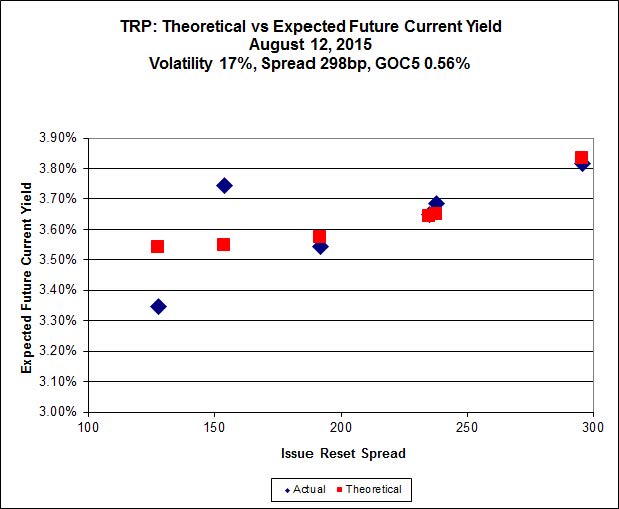
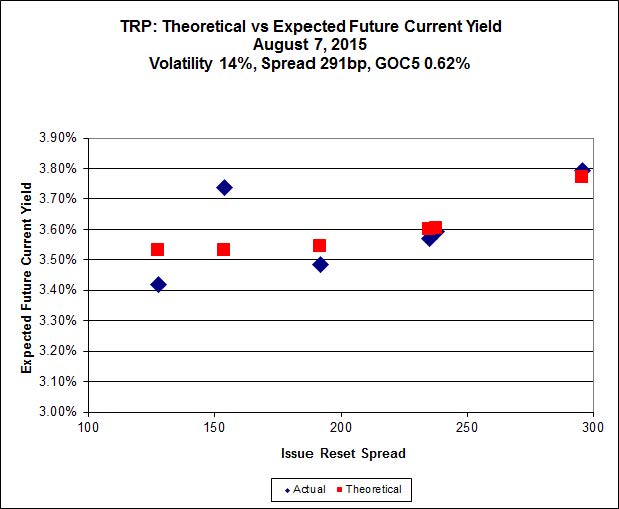
Here’s TRP:

impVol_TRP_150619
Click for Big

TRP.PR.A, which resets 2019-12-31 at +192, is bid at 20.20 to be $0.84 rich, while TRP.PR.C, resetting 2016-1-30 at +154, is $0.51 cheap at its bid price of 16.27.

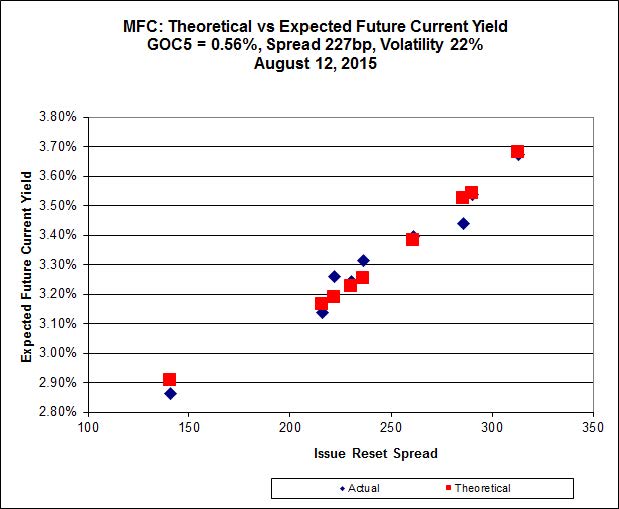
impVol_MFC_150619
Click for Big

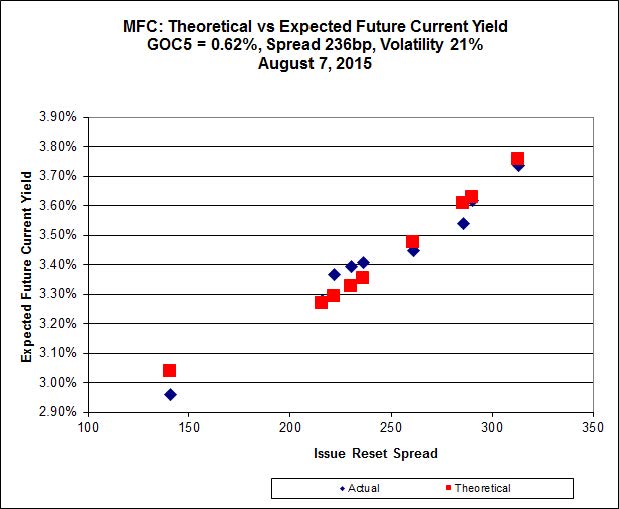
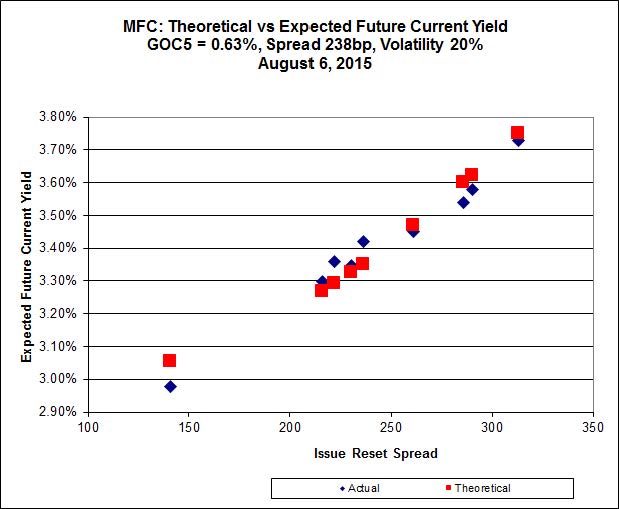
Another excellent fit, but the numbers are perplexing. Implied Volatility for MFC continues to be a conundrum. It is still too high if we consider that NVCC rules will never apply to these issues; it is still too low if we consider them to be NVCC non-compliant issues (and therefore with Deemed Maturities in the call schedule).

Most expensive is MFC.PR.J, resetting at +261bp on 2018-3-19, bid at 24.69 to be $0.49 rich, while MFC.PR.H, resetting at +313bp on 2017-3-19, is bid at 25.70 to be $0.23 cheap.

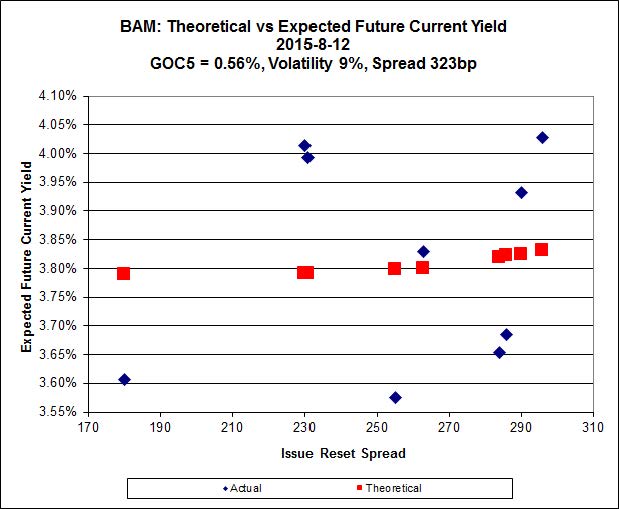
impVol_BAM_150619
Click for Big

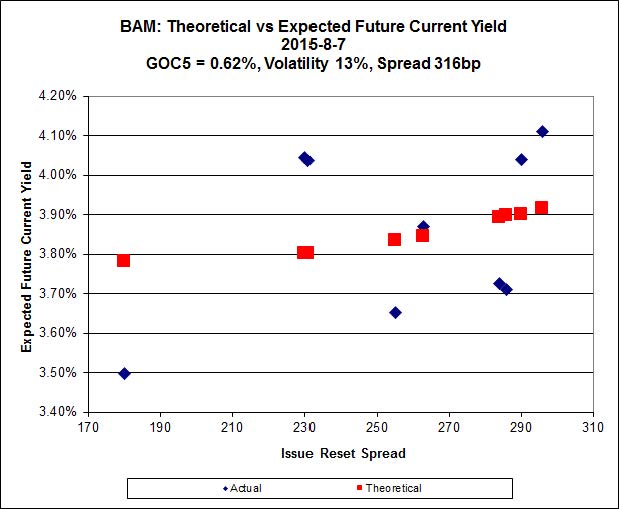
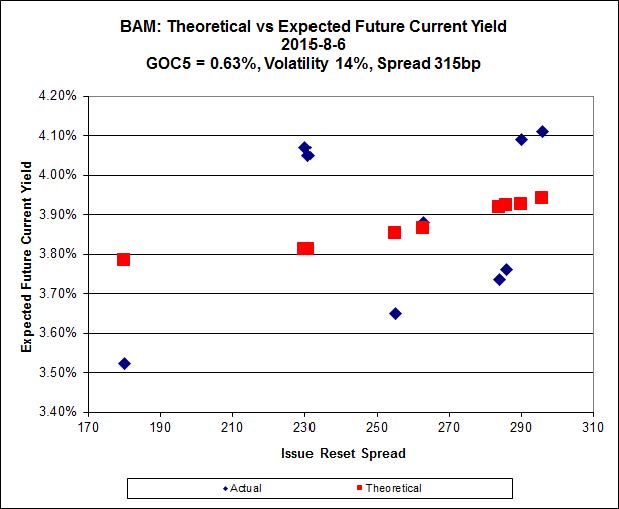
The cheapest issue relative to its peers is BAM.PR.R, resetting at +230bp on 2016-6-30, bid at 19.50 to be $0.92 cheap. BAM.PF.E, resetting at +255bp 2020-3-31 is bid at 22.70 and appears to be $0.69 rich.

impVol_FTS_150619
Click for Big

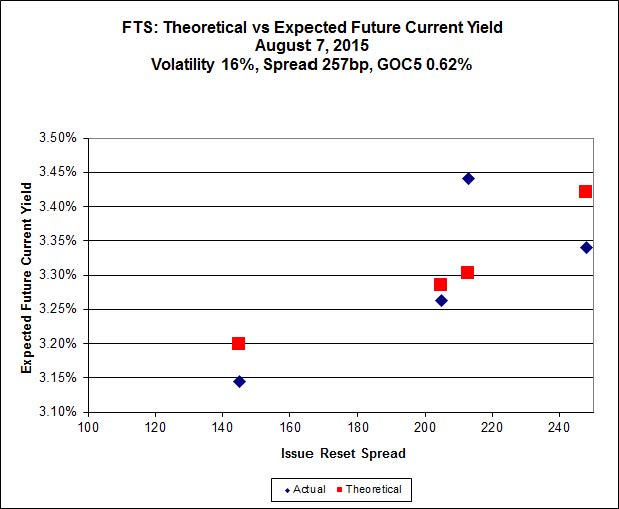
FTS.PR.H, with a spread of +145bp, and bid at 16.39, looks $0.32 cheap and resets 2020-6-1. FTS.PR.K, with a spread of +205bp and resetting 2019-3-1, is bid at 21.15 and is $0.19 rich.

pairs_FR_150619
Click for Big

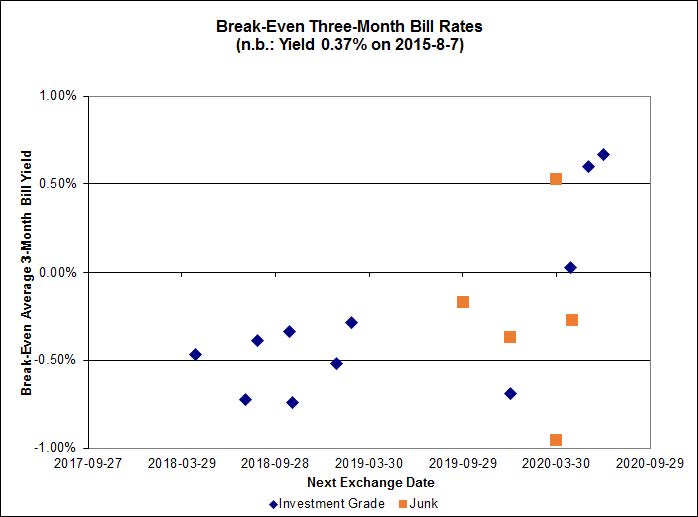
Investment-grade pairs predict an average three-month bill yield over the next five-odd years of about 0.45%, including the outliers TRP.PR.A / TRP.PR.F at -0.34% and FTS.PR.H / FTS.PR.I at +1.17%. On the junk side there are two outliers: FFH.PR.E / FFH.PR.F at -0.87% and DC.PR.B / DC.PR.D at -0.46%.

pairs_FF_150619
Click for Big

Shall we just say that this exhibits a high level of confidence in the continued rapacity of Canadian banks?

HIMIPref™ Preferred Indices
These values reflect the December 2008 revision of the HIMIPref™ Indices

Values are provisional and are finalized monthly
Index Mean
Current
Yield
(at bid)
Median
YTW
Median
Average
Trading
Value
Median
Mod Dur
(YTW)
Issues Day’s Perf. Index Value
Ratchet 0.00 % 0.00 % 0 0.00 0 -0.3746 % 2,202.4
FixedFloater 0.00 % 0.00 % 0 0.00 0 -0.3746 % 3,850.8
Floater 3.52 % 3.52 % 63,131 18.48 3 -0.3746 % 2,341.3
OpRet 4.78 % -9.28 % 23,474 0.08 1 0.0395 % 2,781.3
SplitShare 4.60 % 4.92 % 68,816 3.28 3 -0.1608 % 3,244.1
Interest-Bearing 0.00 % 0.00 % 0 0.00 0 0.0395 % 2,543.2
Perpetual-Premium 5.47 % 4.76 % 58,985 4.98 19 -0.0069 % 2,518.1
Perpetual-Discount 5.20 % 5.15 % 115,336 15.21 15 -0.3036 % 2,708.1
FixedReset 4.54 % 3.88 % 241,764 16.21 88 -0.3001 % 2,337.4
Deemed-Retractible 5.01 % 3.34 % 112,089 0.76 34 -0.1038 % 2,621.0
FloatingReset 2.51 % 2.93 % 57,860 6.10 9 0.1524 % 2,341.1
Performance Highlights
Issue Index Change Notes
HSE.PR.A FixedReset -2.75 % YTW SCENARIO
Maturity Type : Limit Maturity
Maturity Date : 2045-06-19
Maturity Price : 15.56
Evaluated at bid price : 15.56
Bid-YTW : 4.54 %
TRP.PR.C FixedReset -2.52 % YTW SCENARIO
Maturity Type : Limit Maturity
Maturity Date : 2045-06-19
Maturity Price : 16.27
Evaluated at bid price : 16.27
Bid-YTW : 4.04 %
IFC.PR.C FixedReset -2.37 % YTW SCENARIO
Maturity Type : Hard Maturity
Maturity Date : 2025-01-31
Maturity Price : 25.00
Evaluated at bid price : 22.70
Bid-YTW : 4.95 %
TRP.PR.E FixedReset -2.24 % YTW SCENARIO
Maturity Type : Limit Maturity
Maturity Date : 2045-06-19
Maturity Price : 21.85
Evaluated at bid price : 22.26
Bid-YTW : 4.01 %
ENB.PR.N FixedReset -2.08 % YTW SCENARIO
Maturity Type : Limit Maturity
Maturity Date : 2045-06-19
Maturity Price : 18.82
Evaluated at bid price : 18.82
Bid-YTW : 4.98 %
BAM.PR.K Floater -1.77 % YTW SCENARIO
Maturity Type : Limit Maturity
Maturity Date : 2045-06-19
Maturity Price : 13.85
Evaluated at bid price : 13.85
Bid-YTW : 3.60 %
MFC.PR.L FixedReset -1.76 % YTW SCENARIO
Maturity Type : Hard Maturity
Maturity Date : 2025-01-31
Maturity Price : 25.00
Evaluated at bid price : 22.30
Bid-YTW : 4.94 %
FTS.PR.K FixedReset -1.63 % YTW SCENARIO
Maturity Type : Limit Maturity
Maturity Date : 2045-06-19
Maturity Price : 21.15
Evaluated at bid price : 21.15
Bid-YTW : 3.84 %
CIU.PR.C FixedReset -1.59 % YTW SCENARIO
Maturity Type : Limit Maturity
Maturity Date : 2045-06-19
Maturity Price : 16.14
Evaluated at bid price : 16.14
Bid-YTW : 3.78 %
ENB.PR.J FixedReset -1.44 % YTW SCENARIO
Maturity Type : Limit Maturity
Maturity Date : 2045-06-19
Maturity Price : 19.21
Evaluated at bid price : 19.21
Bid-YTW : 4.91 %
FTS.PR.G FixedReset -1.28 % YTW SCENARIO
Maturity Type : Limit Maturity
Maturity Date : 2045-06-19
Maturity Price : 21.32
Evaluated at bid price : 21.62
Bid-YTW : 3.76 %
FTS.PR.H FixedReset -1.27 % YTW SCENARIO
Maturity Type : Limit Maturity
Maturity Date : 2045-06-19
Maturity Price : 16.39
Evaluated at bid price : 16.39
Bid-YTW : 3.78 %
ENB.PF.A FixedReset -1.26 % YTW SCENARIO
Maturity Type : Limit Maturity
Maturity Date : 2045-06-19
Maturity Price : 19.61
Evaluated at bid price : 19.61
Bid-YTW : 4.94 %
TD.PF.A FixedReset -1.20 % YTW SCENARIO
Maturity Type : Limit Maturity
Maturity Date : 2045-06-19
Maturity Price : 22.37
Evaluated at bid price : 23.10
Bid-YTW : 3.66 %
ENB.PF.C FixedReset -1.17 % YTW SCENARIO
Maturity Type : Limit Maturity
Maturity Date : 2045-06-19
Maturity Price : 19.48
Evaluated at bid price : 19.48
Bid-YTW : 4.97 %
ENB.PF.E FixedReset -1.06 % YTW SCENARIO
Maturity Type : Limit Maturity
Maturity Date : 2045-06-19
Maturity Price : 19.64
Evaluated at bid price : 19.64
Bid-YTW : 4.96 %
FTS.PR.M FixedReset -1.03 % YTW SCENARIO
Maturity Type : Limit Maturity
Maturity Date : 2045-06-19
Maturity Price : 22.84
Evaluated at bid price : 24.05
Bid-YTW : 3.69 %
RY.PR.K FloatingReset 1.15 % YTW SCENARIO
Maturity Type : Hard Maturity
Maturity Date : 2022-01-31
Maturity Price : 25.00
Evaluated at bid price : 24.73
Bid-YTW : 2.69 %
MFC.PR.H FixedReset 1.18 % YTW SCENARIO
Maturity Type : Call
Maturity Date : 2017-03-19
Maturity Price : 25.00
Evaluated at bid price : 25.70
Bid-YTW : 2.95 %
IFC.PR.A FixedReset 1.44 % YTW SCENARIO
Maturity Type : Hard Maturity
Maturity Date : 2025-01-31
Maturity Price : 25.00
Evaluated at bid price : 19.75
Bid-YTW : 6.13 %
Volume Highlights
Issue Index Shares
Traded
Notes
GWO.PR.F Deemed-Retractible 344,965 Scotia crossed blocks of 155,000 and 187,600, both at 25.42. Nice tickets!
YTW SCENARIO
Maturity Type : Call
Maturity Date : 2015-07-19
Maturity Price : 25.00
Evaluated at bid price : 25.35
Bid-YTW : -12.77 %
MFC.PR.H FixedReset 99,831 RBC bought blocks of 10,700 and 33,900 from National at 25.65, then another 30,800 at 25.70.
YTW SCENARIO
Maturity Type : Call
Maturity Date : 2017-03-19
Maturity Price : 25.00
Evaluated at bid price : 25.70
Bid-YTW : 2.95 %
HSE.PR.G FixedReset 90,627 Recent new issue.
YTW SCENARIO
Maturity Type : Limit Maturity
Maturity Date : 2045-06-19
Maturity Price : 23.01
Evaluated at bid price : 24.59
Bid-YTW : 4.54 %
FTS.PR.M FixedReset 78,000 RBC crossed 75,000 at 24.45.
YTW SCENARIO
Maturity Type : Limit Maturity
Maturity Date : 2045-06-19
Maturity Price : 22.84
Evaluated at bid price : 24.05
Bid-YTW : 3.69 %
RY.PR.I FixedReset 73,233 TD crossed blocks of 34,200 and 25,000, both at 25.23.
YTW SCENARIO
Maturity Type : Hard Maturity
Maturity Date : 2022-01-31
Maturity Price : 25.00
Evaluated at bid price : 25.23
Bid-YTW : 3.16 %
TRP.PR.G FixedReset 57,060 RBC crossed 39,400 at 24.90.
YTW SCENARIO
Maturity Type : Limit Maturity
Maturity Date : 2045-06-19
Maturity Price : 23.10
Evaluated at bid price : 24.91
Bid-YTW : 3.83 %
There were 26 other index-included issues trading in excess of 10,000 shares.
Wide Spread Highlights
Issue Index Quote Data and Yield Notes
HSE.PR.C FixedReset Quote: 23.61 – 24.44
Spot Rate : 0.8300
Average : 0.5285

YTW SCENARIO
Maturity Type : Limit Maturity
Maturity Date : 2045-06-19
Maturity Price : 22.63
Evaluated at bid price : 23.61
Bid-YTW : 4.42 %

IFC.PR.C FixedReset Quote: 22.70 – 23.59
Spot Rate : 0.8900
Average : 0.6494

YTW SCENARIO
Maturity Type : Hard Maturity
Maturity Date : 2025-01-31
Maturity Price : 25.00
Evaluated at bid price : 22.70
Bid-YTW : 4.95 %

CU.PR.G Perpetual-Discount Quote: 21.97 – 22.68
Spot Rate : 0.7100
Average : 0.4885

YTW SCENARIO
Maturity Type : Limit Maturity
Maturity Date : 2045-06-19
Maturity Price : 21.64
Evaluated at bid price : 21.97
Bid-YTW : 5.15 %

TRP.PR.E FixedReset Quote: 22.26 – 22.93
Spot Rate : 0.6700
Average : 0.5056

YTW SCENARIO
Maturity Type : Limit Maturity
Maturity Date : 2045-06-19
Maturity Price : 21.85
Evaluated at bid price : 22.26
Bid-YTW : 4.01 %

ELF.PR.H Perpetual-Premium Quote: 25.05 – 25.56
Spot Rate : 0.5100
Average : 0.3632

YTW SCENARIO
Maturity Type : Limit Maturity
Maturity Date : 2045-06-19
Maturity Price : 24.56
Evaluated at bid price : 25.05
Bid-YTW : 5.57 %

GWO.PR.S Deemed-Retractible Quote: 26.10 – 26.50
Spot Rate : 0.4000
Average : 0.2555

YTW SCENARIO
Maturity Type : Hard Maturity
Maturity Date : 2025-01-31
Maturity Price : 25.00
Evaluated at bid price : 26.10
Bid-YTW : 4.69 %

Issue Comments

SLF.PR.G / SLF.PR.J: 50% Conversion to FloatingResets

Sun Life Financial Inc. has announced:

that 6,007,314 of its 11,200,000 Class A Non-cumulative Rate Reset Preferred Shares Series 8R (the “Series 8R Shares”) have been elected for conversion on June 30, 2015, on a one-for-one basis, into Class A Non-cumulative Floating Rate Preferred Shares Series 9QR (the “Series 9QR Shares”). Consequently, on June 30, 2015, Sun Life Financial will have 5,192,686 Series 8R Shares and 6,007,314 Series 9QR Shares issued and outstanding. The Series 8R Shares and Series 9QR Shares will be listed on the Toronto Stock Exchange under the symbols SLF.PR.G and SLF.PR.J, respectively.

Subject to regulatory approval, Sun Life Financial may redeem the Series 8R Shares and the Series 9QR Shares in whole or in part on June 30, 2020 and on the 30th of June every five years thereafter.

The conversion rate is much higher than the most recent conversion, FTS.PR.H / FTS.PR.I, in which a 30% conversion was seen.

And the conversion rate flies in the face of my recommendation to hold SLF.PR.G, the FixedReset. Oh well, we’ll see how it turns out.

Issue Comments

ENB Finalizes Dropdown; S&P Downgrades To P-2(low); DBRS Review-Negative

Enbridge Inc. has announced:

  • •$30.4 billion transfer of the Canadian Mainline, the Regional Oil Sands System and Canadian renewable energy assets to Enbridge Income Fund
  • •Transaction supports higher dividend payout and positions Enbridge to extend its industry leading growth rate beyond 2018
  • •Available Cash Flow from Operations growth expected to average approximately 18 percent from 2014 to 2018
  • •33 percent dividend per share growth in 2015, as previously announced
  • •14 to 16 percent expected annual average dividend per share growth from 2016 to 2018
  • •Transformation of Enbridge Income Fund Holdings to a premier Liquids Pipelines investment vehicle in Canada
  • •Enbridge to remain as manager and operator of transferred assets

Enbridge Inc. (TSX:ENB) (NYSE:ENB) (Enbridge or the Company) has reached agreement with Enbridge Income Fund (the Fund) to transfer its Canadian Liquids Pipelines Business, held by Enbridge Pipelines Inc. (EPI) and Enbridge Pipelines Athabasca Inc. (EPA), and certain Canadian renewable energy assets to the Fund for consideration payable at closing valued at $30.4 billion (the Transaction). The Transaction is subject to customary regulatory approvals and closing conditions, as well as a vote of the public shareholders of Enbridge Income Fund Holdings Inc. (TSX: ENF) (ENF), which is expected to occur in August 2015.

The Transaction is a key component of Enbridge’s Financial Strategy Optimization introduced in December of last year which included an increase in the Company’s targeted dividend payout. It advances the Company’s sponsored vehicle strategy and supports Enbridge’s previously announced 33 percent dividend increase in 2015 and expected annual average dividend per share (DPS) growth of 14 to 16 percent from 2016 through to 2018. It also positions Enbridge to extend its industry leading DPS growth beyond 2018. The Transaction is expected to provide Enbridge with an alternate source of funding for its enterprise wide growth initiatives and enhance its competitiveness for new organic growth opportunities and asset acquisitions.

The transaction (often referred to as the dropdown), and its resultant rating agency unhappiness with the company, was discussed on PrefBlog in December, 2014. Now it has advanced a step and the first thing that happened was a downgrade from S&P:

  • •We are lowering our ratings on Calgary, Alta.-based Enbridge Inc. (EI), Enbridge Pipelines Inc. (EPI), and Toronto-based Enbridge Gas Distribution Inc. (EGD), including our long-term corporate credit rating on each to ‘BBB+’ from ‘A-‘.
  • •We are also lowering our corporate credit rating on Houston-based Enbridge Energy Partners L.P. (EEP) to ‘BBB’ from ‘BBB+’.
  • •We are removing the ratings from CreditWatch, where they were placed Dec. 4, 2014.
  • •The downgrade reflects our assessment of weak forecast financial metrics at EI.
  • •The announced dropdown transaction of assets to Enbridge Income Fund (EIF) does not change our assessment of business or financial risk profiles at EI, nor does it introduce a sufficient level of subordination to further lower EI debt ratings.
  • •We assess EGD and EPI to be “core” and EEP to be “highly strategic” to EI.


We view Enbridge’s financial risk profile as “aggressive.” The continuing large capital program to expand existing and build new liquids pipelines will continue to pressure financial metrics for the next several years. We forecast adjusted funds from operations (AFFO)-to-debt of 10%-13% under our forecast capital expenditures and financing plans over the next two years. The lower financial risk profile reflects our expectation of lower consolidated funds from operations (FFO)-to-debt ratios that are in the aggressive financial risk profile category using the medial cash flow volatility table. The company has brought large-scale capital projects in service on time and on budget, and we expect this to continue. Financial policy has generally been credit-supportive, although growing capital expenditures from new projects, and the parents support of subsidiary companies with internal equity financing, have shifted to what we believe is a more neutral stance.

A downgrade could occur if AFFO-to-debt stays below 11%, which could result from weaker financial performance, due to mainline volumes falling below expectations, or a more aggressive funding of the large capital program throughout our outlook period.

Maintaining AFFO-to-debt above 15% could result in an upgrade by revising the financial risk profile to “significant” from aggressive.

DBRS was more restrained, changing the status of the Review to Negative from Developing:

DBRS Limited (DBRS) has today changed the status of the following ratings of Enbridge Inc. (ENB) to Under Review with Negative Implications from Under Review with Developing Implications, where they were placed on December 3, 2014:
— Enbridge Inc., Issuer Rating of A (low)
— Enbridge Inc., Medium-Term Notes & Unsecured Debentures rated A (low)
— Enbridge Inc., Cumulative Redeemable Preferred Shares rated Pfd-2 (low)
— Enbridge Inc., Commercial Paper rated R-1 (low)


DBRS expects the combination of the Transaction and the Plan to have a negative impact on ENB’s credit risk profile mainly due to the following factors:

(1) Following completion of the Transaction and the Plan, holders of ENB’s direct external debt would be further away from the cash flow of the assets transferred to EIF (the Transferred Assets). Dividends from the Transferred Assets would be needed to service EIF debt prior to the payment of common dividends to EIFH’s public shareholders and payment of preferred and common share dividends to ENB, the latter of which would be available to meet the obligations to ENB’s external debt and preferred shareholders. Conversely, as part of the Plan, ENB’s direct external debt holders would be closer to EEP’s assets, which would be owned directly by ENB (through EECI) rather than through EPI (and then EECI) following completion of the Plan. For context, however, the Transferred Assets accounted for more than 40% of ENB’s 2014 segment earnings compared with 12% for EEP.

(2) The initial 33% increase in ENB’s common share dividend and its move to a higher dividend payout ratio range (75% to 85% of adjusted earnings, converting to 40% to 50% of available cash flow from operations), combined with the impacts of the Transaction and the Plan, would result in higher consolidated ENB funding needs. Consequently, ENB would be relying more heavily on dividends from (and external funding at) its directly encumbered subsidiaries (including EIF) to finance the direct-to-ENB portion (including its joint ventures with EEP) of the substantial consolidated growth capital expenditure (capex) program over the 2015 to 2018 period. This factor would be at least partly offset by the offloading of at least part of the direct-to-ENB funding needs to EIF. DBRS’s ENB ratings incorporate expected improvement in ENB’s credit metrics on both fully and modified consolidated bases as longer-dated organic growth projects come on-stream and begin to generate cash flow in the later years of its five-year growth capex program.

Based on its review to date, DBRS expects to downgrade all of ENB’s ratings by one notch, with Stable trends, upon completion of the Transaction; therefore, DBRS believes that Under Review with Negative Implications is the appropriate rating action at this time.

Moody’s had nothing to say but the Outlook remains Negative.

Affected issues are: ENB.PF.A, ENB.PF.C, ENB.PF.E, ENB.PF.G, ENB.PR.A, ENB.PR.B, ENB.PR.D, ENB.PR.F, ENB.PR.H, ENB.PR.J, ENB.PR.N, ENB.PR.P, ENB.PR.T and ENB.PR.Y.

Market Action

June 18, 2015

The Greek tragedy is approaching a climax:

The European Central Bank plans to hold an emergency session of its Governing Council on Friday to discuss the deteriorating liquidity situation of Greek banks, three people familiar with the matter said.

The call is scheduled for noon Frankfurt time on Friday, and the officials will consider a Bank of Greece request for an increase of more than 3 billion euros in Emergency Liquidity Assistance, one of the people said. All three asked not to be identified as the plans aren’t public. An ECB spokesman declined to comment.

The request comes just a day after Greece received an increase in its liquidity line of 1.1. billion euros ($1.25 billion), which raised the limit to 84.1 billion euros.

The short interval may be a signal that deposit flight is accelerating as the latest bailout talks ended without progress on Thursday.

Frankly, I’m surprised that there’s any money left in the Greek banking system to take flight.

And it looks like there’s a lot of internal politicking in Athens:

Prime Minister Alexis Tsipras’s government said there was an effort under way to spur capital flight, with Finance Minister Yanis Varoufakis later accusing the central bank of stoking fears.

The scaremongering seeks to undermine the financial system and strengthen the position of the country’s creditors, a Greek government official said in an e-mail to reporters.

“These tactics facilitate creditors who want to further blackmail the Greek government,” the official said in the statement. “Greece won’t be blackmailed.”

Further to the discussion of the OSC’s Brondesbury Report on June 16, today saw the publication of the Kenmar Commentary on CSA Fund Fee Report. This polemic does not address the question of new issue commissions, proxy solicitation fees, the willingness of small investors to pay advisors directly or the effects on capital markets of a change in fee schedules; changes are advocated as a method of smuggling in the concept of fiduciary duty.

On a related note, Michael P Regan of Bloomberg passes on a very bullish prediction on robo-advice:

Their popularity is going to explode even more, if new projections from consulting firm A.T. Kearney are in the right ballpark. Assets under management by robo advisers are estimated to increase 68 percent annually to about $2.2 trillion in five years, according to a forecast from the firm. About half of that is expected to come from money that’s already invested and the rest from non-invested assets.

As far as I can tell, Bloomberg just got a review copy of the paper; while the A.T. Kearney website features a front page link to the Bloomberg piece, the paper itself does not appear to be on the site.

I can’t resist passing on another shot at supply management:

Faced with a stagnant domestic market, Montreal-based Saputo Inc. and other major Canadian dairy producers have been investing heavily outside the country, where growth opportunities are better. This has exacerbated the skim milk surplus because dairies aren’t expanding their Canadian production of butter, cream or milk powder.

Martha Hall Findlay, a former Liberal MP and fellow at the University of Calgary School of Public Policy, said the real victims of the wastage are low-income Canadians, who aren’t getting the benefit of lower prices.

In a free market, surpluses would typically lead to lower consumer prices, but that isn’t the case in Canada because prices are fixed, she pointed out. “The system can’t accommodate fluctuations in demand,” said Ms. Findlay, who has written a series of reports advocating the dismantling of the supply management system.

It was another negative day for the Canadian preferred share market, with PerpetualDiscounts losing 59bp, FixedResets off 5bp and DeemedRetractibles down 14bp. PerpetualDiscounts are, predictably, overweighted in the bad part of the Performance Highlights table, while FixedResets are conspicuous on both sides. Volume was slightly above average.

For as long as the FixedReset market is so violently unsettled, I’ll keep publishing updates of the more interesting and meaningful series of FixedResets’ Implied Volatilities. This doesn’t include Enbridge because although Enbridge has a large number of issues outstanding, all of which are quite liquid, the range of Issue Reset Spreads is too small for decent conclusions. The low is 212bp (ENB.PR.H; second-lowest is ENB.PR.D at 237bp) and the high is a mere 268 for ENB.PF.G.

Remember that all rich /cheap assessments are:
» based on Implied Volatility Theory only
» are relative only to other FixedResets from the same issuer
» assume constant GOC-5 yield
» assume constant Implied Volatility
» assume constant spread

Here’s TRP:

impVol_TRP_150618
Click for Big

TRP.PR.A, which resets 2019-12-31 at +192, is bid at 20.36 to be $0.73 rich, while TRP.PR.B, which will reset June 30 at 2.152% (+128), is $0.49 cheap at its bid price of 14.78

impVol_MFC_150618
Click for Big

Another excellent fit, but the numbers are perplexing. Implied Volatility for MFC continues to be a conundrum. It is still too high if we consider that NVCC rules will never apply to these issues; it is still too low if we consider them to be NVCC non-compliant issues (and therefore with Deemed Maturities in the call schedule). Note that the lowest spread issue, MFC.PR.F, is again clearly off the line defined by the other issues.

Most expensive is MFC.PR.L, resetting at +216bp on 2019-6-19, bid at 22.70 to be $0.53 rich, while MFC.PR.H, resetting at +313bp on 2017-3-19, is bid at 25.40 to be $0.44 cheap.

impVol_BAM_150618
Click for Big

The cheapest issue relative to its peers is BAM.PR.R, resetting at +230bp on 2016-6-30, bid at 19.53 to be $0.94 cheap. BAM.PF.G, resetting at +284bp 2020-6-30 is bid at 24.50 and appears to be $0.65 rich.

impVol_FTS_150618
Click for Big

FTS.PR.H, with a spread of +145bp, and bid at 16.60, looks $0.40 cheap and resets 2020-6-1. FTS.PR.K, with a spread of +205bp and resetting 2019-3-1, is bid at 21.50 and is $0.25 rich.

pairs_FR_150618
Click for Big

Investment-grade pairs predict an average three-month bill yield over the next five-odd years of about 0.35%, including the outliers TRP.PR.A / TRP.PR.F at -0.54% and FTS.PR.H / FTS.PR.I at +0.95%. On the junk side there’s only one outlier: FFH.PR.E / FFH.PR.F at -0.93%.

pairs_FF_150618
Click for Big

Shall we just say that this exhibits a high level of confidence in the continued rapacity of Canadian banks?

HIMIPref™ Preferred Indices
These values reflect the December 2008 revision of the HIMIPref™ Indices

Values are provisional and are finalized monthly
Index Mean
Current
Yield
(at bid)
Median
YTW
Median
Average
Trading
Value
Median
Mod Dur
(YTW)
Issues Day’s Perf. Index Value
Ratchet 0.00 % 0.00 % 0 0.00 0 1.8845 % 2,210.7
FixedFloater 0.00 % 0.00 % 0 0.00 0 1.8845 % 3,865.2
Floater 3.50 % 3.52 % 63,308 18.49 3 1.8845 % 2,350.1
OpRet 4.45 % -8.98 % 24,337 0.08 2 -0.0987 % 2,780.2
SplitShare 4.59 % 4.89 % 71,608 3.28 3 0.2956 % 3,249.3
Interest-Bearing 0.00 % 0.00 % 0 0.00 0 -0.0987 % 2,542.2
Perpetual-Premium 5.45 % 4.77 % 59,653 4.92 19 0.1160 % 2,518.2
Perpetual-Discount 5.18 % 5.12 % 117,337 15.22 15 -0.5936 % 2,716.4
FixedReset 4.52 % 3.88 % 241,212 16.36 88 -0.0527 % 2,344.4
Deemed-Retractible 5.01 % 3.40 % 112,577 0.77 34 -0.1441 % 2,623.7
FloatingReset 2.52 % 2.93 % 58,555 6.11 9 0.0590 % 2,337.5
Performance Highlights
Issue Index Change Notes
HSE.PR.A FixedReset -1.96 % YTW SCENARIO
Maturity Type : Limit Maturity
Maturity Date : 2045-06-18
Maturity Price : 16.00
Evaluated at bid price : 16.00
Bid-YTW : 4.41 %
BAM.PF.C Perpetual-Discount -1.79 % YTW SCENARIO
Maturity Type : Limit Maturity
Maturity Date : 2045-06-18
Maturity Price : 21.44
Evaluated at bid price : 21.44
Bid-YTW : 5.68 %
CU.PR.G Perpetual-Discount -1.78 % YTW SCENARIO
Maturity Type : Limit Maturity
Maturity Date : 2045-06-18
Maturity Price : 21.82
Evaluated at bid price : 22.11
Bid-YTW : 5.12 %
SLF.PR.G FixedReset -1.72 % YTW SCENARIO
Maturity Type : Hard Maturity
Maturity Date : 2025-01-31
Maturity Price : 25.00
Evaluated at bid price : 16.03
Bid-YTW : 7.80 %
BAM.PF.D Perpetual-Discount -1.61 % YTW SCENARIO
Maturity Type : Limit Maturity
Maturity Date : 2045-06-18
Maturity Price : 21.62
Evaluated at bid price : 21.94
Bid-YTW : 5.59 %
GWO.PR.G Deemed-Retractible -1.59 % YTW SCENARIO
Maturity Type : Hard Maturity
Maturity Date : 2025-01-31
Maturity Price : 25.00
Evaluated at bid price : 24.21
Bid-YTW : 5.64 %
ENB.PR.F FixedReset -1.37 % YTW SCENARIO
Maturity Type : Limit Maturity
Maturity Date : 2045-06-18
Maturity Price : 18.00
Evaluated at bid price : 18.00
Bid-YTW : 5.03 %
RY.PR.H FixedReset -1.20 % YTW SCENARIO
Maturity Type : Limit Maturity
Maturity Date : 2045-06-18
Maturity Price : 22.36
Evaluated at bid price : 23.06
Bid-YTW : 3.65 %
BAM.PR.N Perpetual-Discount -1.17 % YTW SCENARIO
Maturity Type : Limit Maturity
Maturity Date : 2045-06-18
Maturity Price : 21.20
Evaluated at bid price : 21.20
Bid-YTW : 5.63 %
ENB.PR.H FixedReset -1.16 % YTW SCENARIO
Maturity Type : Limit Maturity
Maturity Date : 2045-06-18
Maturity Price : 17.05
Evaluated at bid price : 17.05
Bid-YTW : 4.84 %
PWF.PR.P FixedReset -1.13 % YTW SCENARIO
Maturity Type : Limit Maturity
Maturity Date : 2045-06-18
Maturity Price : 18.34
Evaluated at bid price : 18.34
Bid-YTW : 3.69 %
FTS.PR.J Perpetual-Discount -1.09 % YTW SCENARIO
Maturity Type : Limit Maturity
Maturity Date : 2045-06-18
Maturity Price : 23.28
Evaluated at bid price : 23.65
Bid-YTW : 5.04 %
IFC.PR.A FixedReset -1.07 % YTW SCENARIO
Maturity Type : Hard Maturity
Maturity Date : 2025-01-31
Maturity Price : 25.00
Evaluated at bid price : 19.47
Bid-YTW : 6.32 %
IFC.PR.C FixedReset -1.06 % YTW SCENARIO
Maturity Type : Hard Maturity
Maturity Date : 2025-01-31
Maturity Price : 25.00
Evaluated at bid price : 23.25
Bid-YTW : 4.65 %
ENB.PF.E FixedReset -1.05 % YTW SCENARIO
Maturity Type : Limit Maturity
Maturity Date : 2045-06-18
Maturity Price : 19.85
Evaluated at bid price : 19.85
Bid-YTW : 4.90 %
TRP.PR.E FixedReset -1.00 % YTW SCENARIO
Maturity Type : Limit Maturity
Maturity Date : 2045-06-18
Maturity Price : 22.18
Evaluated at bid price : 22.77
Bid-YTW : 3.90 %
BAM.PF.F FixedReset 1.03 % YTW SCENARIO
Maturity Type : Limit Maturity
Maturity Date : 2045-06-18
Maturity Price : 23.04
Evaluated at bid price : 24.50
Bid-YTW : 3.99 %
TRP.PR.G FixedReset 1.22 % YTW SCENARIO
Maturity Type : Limit Maturity
Maturity Date : 2045-06-18
Maturity Price : 23.11
Evaluated at bid price : 24.93
Bid-YTW : 3.83 %
BAM.PF.E FixedReset 1.35 % YTW SCENARIO
Maturity Type : Limit Maturity
Maturity Date : 2045-06-18
Maturity Price : 22.02
Evaluated at bid price : 22.55
Bid-YTW : 4.15 %
TRP.PR.D FixedReset 1.36 % YTW SCENARIO
Maturity Type : Limit Maturity
Maturity Date : 2045-06-18
Maturity Price : 21.91
Evaluated at bid price : 22.31
Bid-YTW : 3.94 %
TRP.PR.B FixedReset 1.37 % YTW SCENARIO
Maturity Type : Limit Maturity
Maturity Date : 2045-06-18
Maturity Price : 14.78
Evaluated at bid price : 14.78
Bid-YTW : 3.88 %
BAM.PR.K Floater 1.44 % YTW SCENARIO
Maturity Type : Limit Maturity
Maturity Date : 2045-06-18
Maturity Price : 14.10
Evaluated at bid price : 14.10
Bid-YTW : 3.53 %
FTS.PR.I FloatingReset 1.54 % YTW SCENARIO
Maturity Type : Limit Maturity
Maturity Date : 2045-06-18
Maturity Price : 16.50
Evaluated at bid price : 16.50
Bid-YTW : 3.14 %
BAM.PR.B Floater 1.69 % YTW SCENARIO
Maturity Type : Limit Maturity
Maturity Date : 2045-06-18
Maturity Price : 14.46
Evaluated at bid price : 14.46
Bid-YTW : 3.44 %
MFC.PR.L FixedReset 1.79 % YTW SCENARIO
Maturity Type : Hard Maturity
Maturity Date : 2025-01-31
Maturity Price : 25.00
Evaluated at bid price : 22.70
Bid-YTW : 4.71 %
BAM.PR.C Floater 2.54 % YTW SCENARIO
Maturity Type : Limit Maturity
Maturity Date : 2045-06-18
Maturity Price : 14.15
Evaluated at bid price : 14.15
Bid-YTW : 3.52 %
Volume Highlights
Issue Index Shares
Traded
Notes
HSE.PR.G FixedReset 250,190 Recent new issue.
YTW SCENARIO
Maturity Type : Limit Maturity
Maturity Date : 2045-06-18
Maturity Price : 23.01
Evaluated at bid price : 24.59
Bid-YTW : 4.54 %
TD.PF.E FixedReset 192,193 TD crossed blocks of 100,000 and 75,000, both at 25.10.
YTW SCENARIO
Maturity Type : Limit Maturity
Maturity Date : 2045-06-18
Maturity Price : 23.15
Evaluated at bid price : 25.04
Bid-YTW : 3.73 %
GWO.PR.F Deemed-Retractible 100,938 Scotia crossed 100,000 at 25.42.
YTW SCENARIO
Maturity Type : Call
Maturity Date : 2015-07-18
Maturity Price : 25.00
Evaluated at bid price : 25.40
Bid-YTW : -15.19 %
BMO.PR.Y FixedReset 100,072 Recent new issue.
YTW SCENARIO
Maturity Type : Limit Maturity
Maturity Date : 2045-06-18
Maturity Price : 23.03
Evaluated at bid price : 24.66
Bid-YTW : 3.69 %
BMO.PR.L Deemed-Retractible 90,150 Nesbitt crossed 84,100 at 25.71.
YTW SCENARIO
Maturity Type : Call
Maturity Date : 2015-07-18
Maturity Price : 25.50
Evaluated at bid price : 25.70
Bid-YTW : 0.68 %
BMO.PR.R FloatingReset 68,382 TD crossed 65,000 at 24.15.
YTW SCENARIO
Maturity Type : Hard Maturity
Maturity Date : 2022-01-31
Maturity Price : 25.00
Evaluated at bid price : 24.11
Bid-YTW : 2.83 %
There were 38 other index-included issues trading in excess of 10,000 shares.
Wide Spread Highlights
Issue Index Quote Data and Yield Notes
MFC.PR.N FixedReset Quote: 22.60 – 23.60
Spot Rate : 1.0000
Average : 0.6362

YTW SCENARIO
Maturity Type : Hard Maturity
Maturity Date : 2025-01-31
Maturity Price : 25.00
Evaluated at bid price : 22.60
Bid-YTW : 4.85 %

HSE.PR.A FixedReset Quote: 16.00 – 16.47
Spot Rate : 0.4700
Average : 0.3318

YTW SCENARIO
Maturity Type : Limit Maturity
Maturity Date : 2045-06-18
Maturity Price : 16.00
Evaluated at bid price : 16.00
Bid-YTW : 4.41 %

TD.PF.A FixedReset Quote: 23.38 – 23.78
Spot Rate : 0.4000
Average : 0.2729

YTW SCENARIO
Maturity Type : Limit Maturity
Maturity Date : 2045-06-18
Maturity Price : 22.52
Evaluated at bid price : 23.38
Bid-YTW : 3.60 %

MFC.PR.F FixedReset Quote: 17.39 – 17.83
Spot Rate : 0.4400
Average : 0.3207

YTW SCENARIO
Maturity Type : Hard Maturity
Maturity Date : 2025-01-31
Maturity Price : 25.00
Evaluated at bid price : 17.39
Bid-YTW : 7.04 %

BAM.PF.C Perpetual-Discount Quote: 21.44 – 21.76
Spot Rate : 0.3200
Average : 0.2027

YTW SCENARIO
Maturity Type : Limit Maturity
Maturity Date : 2045-06-18
Maturity Price : 21.44
Evaluated at bid price : 21.44
Bid-YTW : 5.68 %

IFC.PR.C FixedReset Quote: 23.25 – 23.75
Spot Rate : 0.5000
Average : 0.3856

YTW SCENARIO
Maturity Type : Hard Maturity
Maturity Date : 2025-01-31
Maturity Price : 25.00
Evaluated at bid price : 23.25
Bid-YTW : 4.65 %

Market Action

June 17, 2015

The big news of the day was the FOMC statement:

Information received since the Federal Open Market Committee met in April suggests that economic activity has been expanding moderately after having changed little during the first quarter. The pace of job gains picked up while the unemployment rate remained steady. On balance, a range of labor market indicators suggests that underutilization of labor resources diminished somewhat. Growth in household spending has been moderate and the housing sector has shown some improvement; however, business fixed investment and net exports stayed soft. Inflation continued to run below the Committee’s longer-run objective, partly reflecting earlier declines in energy prices and decreasing prices of non-energy imports; energy prices appear to have stabilized. Market-based measures of inflation compensation remain low; survey-based measures of longer-term inflation expectations have remained stable.

To support continued progress toward maximum employment and price stability, the Committee today reaffirmed its view that the current 0 to 1/4 percent target range for the federal funds rate remains appropriate. In determining how long to maintain this target range, the Committee will assess progress–both realized and expected–toward its objectives of maximum employment and 2 percent inflation. This assessment will take into account a wide range of information, including measures of labor market conditions, indicators of inflation pressures and inflation expectations, and readings on financial and international developments. The Committee anticipates that it will be appropriate to raise the target range for the federal funds rate when it has seen further improvement in the labor market and is reasonably confident that inflation will move back to its 2 percent objective over the medium term.

There were no dissents. Other information released indicates that the committee is dovish:

For Federal Reserve officials, the U.S. economy is a glass house where aggressive moves could break something.

While the median forecast of policy makers still calls for two interest-rate increases by year-end, more officials say just one would be enough in 2015. Still more advocate a go-slow approach to further tightening in 2016.

Projections from the Federal Open Market Committee published Wednesday showed that five officials foresee one increase in the federal funds rate this year, up from just a single policy maker who said so in March. And while policy makers said the economy has picked up after a first-quarter slump, Fed Chair Janet Yellen said she still wants to see more “decisive” evidence of a lasting turnaround.

At her press conference following the FOMC meeting, Yellen cited signs of “cyclical weakness” in the labor market, and noted wage growth remains “subdued.”

“Although progress clearly has been achieved, room for further improvement remains,” Yellen said. “Economic conditions are currently anticipated to evolve in a manner that will warrant only gradual increases in the target federal funds rate.”

As a result:

Treasuries climbed and the dollar weakened against the euro after the Federal Reserve revised down its outlook for interest rates amid fragile economic conditions.

Yields on 10-year U.S. notes fell four basis points to 2.28 percent by 11:05 a.m. in Tokyo, with rates on Japanese and Australian debt also down. The greenback weakened to $1.1362 per euro and slipped 0.2 percent versus the yen.

Back in April, Natixis Global Asset Management (parent of NexGen Financial) released the results of a poll of Canadian investors:

The majority of those surveyed (54%) say they fear future oil price drops, 61 percent admit they are not willing to take more investment risk compared to a year ago and 59 percent said they feel vulnerable when it comes to protecting their portfolios from market shocks.

Besides oil prices, investors’ other concerns include a worldwide economic slowdown (cited by 54%), slower global growth (39%) and higher interest rates (37%).

Despite the economic challenges, 88 percent of Canadian investors believe their current approach will enable them to have a steady income when they retire. To get there, investors say their portfolio needs to gain an average of 9.3 percent annually, over and above inflation, the survey found. Eighty percent of investors think their target is realistic.

Retirement remains the top financial priority, and most investors (57%) say the responsibility of funding retirement is falling increasingly to individuals and away from government- and employer-sponsored schemes.

They anticipate 50 percent of their retirement income will come from their own efforts – saving, investing, selling their home or business or picking up a job after retiring. Of the rest of their retirement income, 26 percent would come from an employer pension, 18 percent from government support and 6 percent from other sources (including support from children).

Natixis surveyed 250 individual investors across Canada with a minimum of C$256,460 (US$205,230) in investable assets. The online survey was conducted in February 2015 and is part of a larger global study of 7,000 investors in 17 countries from Europe, the Americas and the Middle East. The findings are published in a new whitepaper, “Close enough isn’t good enough.” For more information, visit durableportfolios.com.

9.3% annual returns, over and above inflation? Good luck with that!

The global summary has an amusing section on retirement expectations:

When asked at what age they would like to retire, younger investors are clearly focused on early retirement: Millennials say age 58, while Generation X say 62. When asked when they think they will actually retire, their aspirations moderate only slightly at age 60 and age 63 respectively.

Asked the same questions, Baby Boomers say age 68 on both counts. Pre-Boomers respond with 73 on both counts. In reality, for members of those generations who are already retired, the day came much earlier at age 59 and 63 respectively.

… but respondents have a Plan B:

Should they fall short on their retirement savings, investors have clear plans on how they will make up the difference. The largest number (45%) say employment will be the answer, followed by support from their spouse or significant other (36%), government programs (35%), and family (23%).

And finally, there’s a little section on the value of advice:

valueOfAdvice
Click for Big

Now, this study is hardly up to academic standards – it’s in Natixis’ best interests to convince everybody (particularly those with over $200,000 in investible assets) that they need an advisor and they need alternative investments. But I suspect that meticulously unbiased research would give similar results.

And it is, perhaps, these unrealistic expectations and the expectation of government support that is driving the trend towards enhanced public pension plans, both in Ontario (as discussed May 1, 2014; also see the official ORPP website) and in the States:

The U.S. retirement system is a failure, in at least one respect: Half of private-sector workers have no access to a 401(k) or a pension plan on the job, so millions of Americans have scant retirement savings or none at all. To retire, they’ll need to rely on programs such as Social Security and Medicaid.

The federal government has done little to get more Americans saving for retirement. In December the White House launched a pilot program called myRA (My Retirement Account), an individual retirement account (or IRA) set up through an employer’s payroll system and aimed at low-income workers. But participation is voluntary, and Congress has gotten nowhere with bills proposed to encourage workplace retirement plans.

So the states are stepping up. This month, an Illinois law went into effect that would give a state-run IRA to all employees of companies with at least 25 people on staff who don’t have their own retirement plan. Workers would automatically be signed up to contribute 3 percent of their salary to the IRA and could opt out or adjust their contribution. The system is scheduled to be up and running by June 2017.

California is working on a similar plan, and on Tuesday the Oregon State Senate sent the governor a bill requiring automatic IRAs at private employers by July 2017. By early next year, Connecticut officials must finish a study, mandated by the state legislature, of how feasible a state-run retirement plan would be there. There are advocates for similar plans in at least a dozen other state legislatures.

Separately, we are told that employees are idiots:

Canadians are missing out on billions of dollars of potential retirement savings every year by not taking full advantage of matching contributions by their employers in group RRSP and defined contribution retirement plans.

Tom Reid of Sun Life Financial estimates more than $3-billion a year of potential company contributions go unmade because employees don’t make the required matching contributions to obtain them.

A survey by Great-West Life found significant numbers of respondents weren’t taking advantage of voluntary plans. It found a 79 per cent participation rate for voluntary DC plans and just 51 per cent for voluntary group RRSPs in 2014.

Meanwhile there is a call to eliminate Canada Savings Bonds:

The private sector already offers various savings products, backed by deposit insurance, according to a report prepared by KPMG LLP for the Canadian Finance Department. Canadian households appear to like those options better, as the stock of retail debt outstanding in the Canada Savings Bond program plummeted to just under 8 billion Canadian dollars ($6.5 billion) in 2013 from a 1987 level of C$55 billion. That’s an average decline of C$1.8 billion a year.

“There is currently no valid economic rationale for the retail debt program,” KPMG said. “Outstanding stock is expected to reach a level where, despite all the recent accomplishments in cost reduction, it will be difficult to justify the existence of the program either on economic grounds, on participation levels, or as a share of retail debt outstanding to market debt.”

A spokeswoman for Canada’s Finance Department said the Canada Savings Bonds Program would be maintained in its current format, while officials would look at potential ways to reduce the scheme’s costs. The spokeswoman said more than a million Canadians still purchase securities from the program, “demonstrating their continuing interest” in the program.

The U.S. and Germany have essentially terminated their retail debt programs, which like the Canadian one were created to provide citizens with a guaranteed savings instrument in an era when the retail banking sector was underdeveloped, and there was no such mechanism as deposit insurance. In Germany’s case, it concluded it could no longer issue a cost-effective rate that would attract retail investor interest.

I love the official response. It must be nice to be in government and never have to show any intellectual integrity at all!

The actual report includes a fascinating graph:

CSBsOutstanding
Click for Big

In terms of spread:

We notice that the CPB rate is tracking closely the 3-year benchmark Government of Canada bond since 2008 with a spread ranging between minus 20 to plus 60 basis points (bps) leaving little or no margin to offset unit administration and option costs (see Chart 6). Likewise, the CSB rate, even with spreads ranging from 10 to 70 bps compared to the 1 year treasury bill rate since 2009 does not leave enough margin to cover unit administration and option costs.

In terms of cost:

Today, the operating costs of the Retail Debt Program at $58 million are equivalent to the yearly interest costs (approx. $58 million) on the outstanding stock of retail debt (see Chart 7). Of course this relation may change in the future, based on the evolution of interest rates and changes in the cost structure. It is nevertheless an interesting snapshot putting the overall costs of the Retail Debt Program in perspective.

The largest component of the operating costs for the Retail Debt Program is the HP back-office operations which stand at $36 million or 62% of the expenses.

Given all the recent fuss, one wonders whether some aspects of the programme will be changed …

Introduced in 1997 by Canada Investment and Savings Agency (CI&S), trailer fees were discontinued in the fall of 2010 and replaced by an up-front 35 bps commission. This proved a significant cost reduction measure. Beforehand, financial institutions benefitted from annual trailer fees of 23 bps until maturity. In 2009 trailer fees accounted for 93% of total commissions to financial institutions.

Based on the pre-2000 issues still outstanding and on the estimated pace of redemptions, trailer fees are expected to end in 2019-2020. We estimate that in 2012-2013 they still represent approximately 92% of the commission expense as this would be consistent with $3.5 billion of outstanding debt still being subject to the 23 bps trailer fee (see Table 4).

KPMG makes one recommendation I really like … but it comes with a warning label!

Consider making the Retail Debt Program totally internet-based, with no intermediaries: This is the current US model, and the phase-in would likely be very expensive. With respect to the US example, it should be noted that the infrastructure they built behind their Treasury Direct website is mostly used for individuals purchasing retail sizes of wholesale US Treasury securities.

It’s surprisingly difficult to find information on the size of the Treasury Direct retail programme; if anybody knows where I can get this information, let me know!

It was a mixed day for the Canadian preferred share market, with PerpetualDiscounts down 21bp, FixedResets off 8bp and DeemedRetractibles gaining 6bp. FixedResets continue to dominate the Performance Highlights table at both ends. Volume was average.

For as long as the FixedReset market is so violently unsettled, I’ll keep publishing updates of the more interesting and meaningful series of FixedResets’ Implied Volatilities. This doesn’t include Enbridge because although Enbridge has a large number of issues outstanding, all of which are quite liquid, the range of Issue Reset Spreads is too small for decent conclusions. The low is 212bp (ENB.PR.H; second-lowest is ENB.PR.D at 237bp) and the high is a mere 268 for ENB.PF.G.

Remember that all rich /cheap assessments are:
» based on Implied Volatility Theory only
» are relative only to other FixedResets from the same issuer
» assume constant GOC-5 yield
» assume constant Implied Volatility
» assume constant spread

Here’s TRP:

impVol_TRP_150617
Click for Big

TRP.PR.E, which resets 2019-10-30 at +235, is bid at 23.00 to be $0.87 rich, while TRP.PR.B, which will reset June 30 at 2.152% (+128), is $0.63 cheap at its bid price of 14.58

impVol_MFC_150617
Click for Big

Another excellent fit, but the numbers are perplexing. Implied Volatility for MFC continues to be a conundrum. It is still too high if we consider that NVCC rules will never apply to these issues; it is still too low if we consider them to be NVCC non-compliant issues (and therefore with Deemed Maturities in the call schedule).

Most expensive is MFC.PR.J, resetting at +261bp on 2018-3-19, bid at 24.60 to be $0.44 rich, while MFC.PR.H, resetting at +313bp on 2017-3-19, is bid at 25.50 to be $0.41 cheap.

impVol_BAM_150617
Click for Big

The cheapest issue relative to its peers is BAM.PR.R, resetting at +230bp on 2016-6-30, bid at 19.41 to be $0.94 cheap. BAM.PR.X, resetting at +180bp 2017-6-30 is bid at 17.82 and appears to be $0.61 rich.

impVol_FTS_150617
Click for Big

FTS.PR.H, with a spread of +145bp, and bid at 16.52, looks $0.43 cheap and resets 2020-6-1. FTS.PR.G, with a spread of +213bp and resetting 2018-9-1, is bid at 21.95 and is $0.16 rich.

pairs_FR_150617
Click for Big

Investment-grade pairs predict an average three-month bill yield over the next five-odd years of about 0.40%, including the outlier TRP.PR.A / TRP.PR.F at -0.37%. On the junk side, three of the six currently extant pairs are outside the range of the graph: DC.PR.B / DC.PR.D at -0.22%; AZP.PR.B / AZP.PR.C at +1.01%; and FFH.PR.E / FFH.PR.F at -0.86%.

pairs_FF_150617
Click for Big

Shall we just say that this exhibits a high level of confidence in the continued rapacity of Canadian banks?

HIMIPref™ Preferred Indices
These values reflect the December 2008 revision of the HIMIPref™ Indices

Values are provisional and are finalized monthly
Index Mean
Current
Yield
(at bid)
Median
YTW
Median
Average
Trading
Value
Median
Mod Dur
(YTW)
Issues Day’s Perf. Index Value
Ratchet 0.00 % 0.00 % 0 0.00 0 -1.4111 % 2,169.8
FixedFloater 0.00 % 0.00 % 0 0.00 0 -1.4111 % 3,793.8
Floater 3.57 % 3.58 % 63,853 18.35 3 -1.4111 % 2,306.6
OpRet 4.44 % -11.38 % 23,529 0.08 2 0.1979 % 2,782.9
SplitShare 4.60 % 4.91 % 69,262 3.28 3 0.0538 % 3,239.7
Interest-Bearing 0.00 % 0.00 % 0 0.00 0 0.1979 % 2,544.7
Perpetual-Premium 5.46 % 4.92 % 58,688 4.92 19 0.0477 % 2,515.3
Perpetual-Discount 5.14 % 5.11 % 118,950 15.24 15 -0.2108 % 2,732.6
FixedReset 4.52 % 3.85 % 243,492 16.30 88 -0.0803 % 2,345.7
Deemed-Retractible 5.00 % 3.26 % 111,233 0.68 34 0.0572 % 2,627.5
FloatingReset 2.52 % 2.91 % 56,090 6.11 9 -0.0590 % 2,336.1
Performance Highlights
Issue Index Change Notes
BAM.PR.C Floater -1.78 % YTW SCENARIO
Maturity Type : Limit Maturity
Maturity Date : 2045-06-17
Maturity Price : 13.80
Evaluated at bid price : 13.80
Bid-YTW : 3.61 %
BAM.PR.K Floater -1.70 % YTW SCENARIO
Maturity Type : Limit Maturity
Maturity Date : 2045-06-17
Maturity Price : 13.90
Evaluated at bid price : 13.90
Bid-YTW : 3.58 %
MFC.PR.F FixedReset -1.48 % YTW SCENARIO
Maturity Type : Hard Maturity
Maturity Date : 2025-01-31
Maturity Price : 25.00
Evaluated at bid price : 17.35
Bid-YTW : 7.07 %
MFC.PR.N FixedReset -1.35 % YTW SCENARIO
Maturity Type : Hard Maturity
Maturity Date : 2025-01-31
Maturity Price : 25.00
Evaluated at bid price : 22.67
Bid-YTW : 4.81 %
PWF.PR.T FixedReset -1.33 % YTW SCENARIO
Maturity Type : Limit Maturity
Maturity Date : 2045-06-17
Maturity Price : 23.35
Evaluated at bid price : 25.16
Bid-YTW : 3.40 %
TD.PF.A FixedReset -1.19 % YTW SCENARIO
Maturity Type : Limit Maturity
Maturity Date : 2045-06-17
Maturity Price : 22.43
Evaluated at bid price : 23.20
Bid-YTW : 3.63 %
BMO.PR.S FixedReset -1.13 % YTW SCENARIO
Maturity Type : Limit Maturity
Maturity Date : 2045-06-17
Maturity Price : 22.63
Evaluated at bid price : 23.52
Bid-YTW : 3.63 %
BAM.PR.R FixedReset -1.12 % YTW SCENARIO
Maturity Type : Limit Maturity
Maturity Date : 2045-06-17
Maturity Price : 19.41
Evaluated at bid price : 19.41
Bid-YTW : 4.39 %
SLF.PR.G FixedReset 1.05 % YTW SCENARIO
Maturity Type : Hard Maturity
Maturity Date : 2025-01-31
Maturity Price : 25.00
Evaluated at bid price : 16.31
Bid-YTW : 7.58 %
TRP.PR.E FixedReset 1.10 % YTW SCENARIO
Maturity Type : Limit Maturity
Maturity Date : 2045-06-17
Maturity Price : 22.31
Evaluated at bid price : 23.00
Bid-YTW : 3.85 %
HSE.PR.E FixedReset 1.22 % YTW SCENARIO
Maturity Type : Limit Maturity
Maturity Date : 2045-06-17
Maturity Price : 23.11
Evaluated at bid price : 24.81
Bid-YTW : 4.49 %
FTS.PR.K FixedReset 1.28 % YTW SCENARIO
Maturity Type : Limit Maturity
Maturity Date : 2045-06-17
Maturity Price : 21.35
Evaluated at bid price : 21.35
Bid-YTW : 3.80 %
FTS.PR.G FixedReset 1.34 % YTW SCENARIO
Maturity Type : Limit Maturity
Maturity Date : 2045-06-17
Maturity Price : 21.70
Evaluated at bid price : 21.95
Bid-YTW : 3.70 %
HSE.PR.A FixedReset 1.37 % YTW SCENARIO
Maturity Type : Limit Maturity
Maturity Date : 2045-06-17
Maturity Price : 16.32
Evaluated at bid price : 16.32
Bid-YTW : 4.32 %
MFC.PR.K FixedReset 1.65 % YTW SCENARIO
Maturity Type : Hard Maturity
Maturity Date : 2025-01-31
Maturity Price : 25.00
Evaluated at bid price : 22.75
Bid-YTW : 4.62 %
Volume Highlights
Issue Index Shares
Traded
Notes
HSE.PR.G FixedReset 966,420 New issue settled today.
YTW SCENARIO
Maturity Type : Limit Maturity
Maturity Date : 2045-06-17
Maturity Price : 23.01
Evaluated at bid price : 24.59
Bid-YTW : 4.54 %
ENB.PR.P FixedReset 129,554 RBC crossed 111,800 at 18.10.
YTW SCENARIO
Maturity Type : Limit Maturity
Maturity Date : 2045-06-17
Maturity Price : 18.51
Evaluated at bid price : 18.51
Bid-YTW : 4.91 %
MFC.PR.L FixedReset 93,106 TD crossed 50,000 at 22.70. RBC crossed 40,000 at the same price.
YTW SCENARIO
Maturity Type : Hard Maturity
Maturity Date : 2025-01-31
Maturity Price : 25.00
Evaluated at bid price : 22.30
Bid-YTW : 4.94 %
BMO.PR.R FloatingReset 92,925 TD crossed blocks of 27,500 and 60,000, both at 24.15.
YTW SCENARIO
Maturity Type : Hard Maturity
Maturity Date : 2022-01-31
Maturity Price : 25.00
Evaluated at bid price : 24.15
Bid-YTW : 2.80 %
NA.PR.Q FixedReset 59,010 TD crossed 58,500 at 25.25.
YTW SCENARIO
Maturity Type : Hard Maturity
Maturity Date : 2022-01-31
Maturity Price : 25.00
Evaluated at bid price : 25.20
Bid-YTW : 3.51 %
MFC.PR.J FixedReset 52,700 RBC crossed 50,000 at 24.75.
YTW SCENARIO
Maturity Type : Hard Maturity
Maturity Date : 2025-01-31
Maturity Price : 25.00
Evaluated at bid price : 24.60
Bid-YTW : 3.95 %
There were 33 other index-included issues trading in excess of 10,000 shares.
Wide Spread Highlights
Issue Index Quote Data and Yield Notes
MFC.PR.M FixedReset Quote: 23.07 – 24.00
Spot Rate : 0.9300
Average : 0.5832

YTW SCENARIO
Maturity Type : Hard Maturity
Maturity Date : 2025-01-31
Maturity Price : 25.00
Evaluated at bid price : 23.07
Bid-YTW : 4.65 %

TRP.PR.F FloatingReset Quote: 18.55 – 19.28
Spot Rate : 0.7300
Average : 0.4375

YTW SCENARIO
Maturity Type : Limit Maturity
Maturity Date : 2045-06-17
Maturity Price : 18.55
Evaluated at bid price : 18.55
Bid-YTW : 3.40 %

RY.PR.K FloatingReset Quote: 24.51 – 24.98
Spot Rate : 0.4700
Average : 0.3561

YTW SCENARIO
Maturity Type : Hard Maturity
Maturity Date : 2022-01-31
Maturity Price : 25.00
Evaluated at bid price : 24.51
Bid-YTW : 2.84 %

BAM.PF.G FixedReset Quote: 24.27 – 24.57
Spot Rate : 0.3000
Average : 0.2017

YTW SCENARIO
Maturity Type : Limit Maturity
Maturity Date : 2045-06-17
Maturity Price : 22.89
Evaluated at bid price : 24.27
Bid-YTW : 4.04 %

MFC.PR.N FixedReset Quote: 22.67 – 23.00
Spot Rate : 0.3300
Average : 0.2374

YTW SCENARIO
Maturity Type : Hard Maturity
Maturity Date : 2025-01-31
Maturity Price : 25.00
Evaluated at bid price : 22.67
Bid-YTW : 4.81 %

BAM.PR.R FixedReset Quote: 19.41 – 19.73
Spot Rate : 0.3200
Average : 0.2276

YTW SCENARIO
Maturity Type : Limit Maturity
Maturity Date : 2045-06-17
Maturity Price : 19.41
Evaluated at bid price : 19.41
Bid-YTW : 4.39 %

Issue Comments

HSE.PR.G Soft On Good Volume

Husky Energy has announced that it:

has completed its recently announced public offering of 6,000,000 Cumulative Redeemable Preferred Shares, Series 7 (the “Series 7 Shares”) with a syndicate of underwriters led by RBC Capital Markets, BMO Capital Markets and Scotia Capital Inc.

The aggregate gross proceeds to Husky from the completed offering are $150 million.

The net proceeds of the offering will be used for general corporate purposes which may include, among other things, the partial repayment of bank debt incurred by the Company to further advance its near-term heavy oil thermal projects.

The Series 7 Shares were offered by way of prospectus supplement to the short form base shelf prospectus of Husky Energy dated February 23, 2015.

Holders of the Series 7 Shares are entitled to receive a cumulative quarterly fixed dividend yielding 4.60 percent annually for the initial period ending June 30, 2020. Thereafter, the dividend rate will be reset every five years at a rate equal to the five-year Government of Canada bond yield plus 3.52 percent.

Holders of Series 7 Shares will have the right, at their option, to convert their shares into Cumulative Redeemable Preferred Shares, Series 8 (the “Series 8 Shares”), subject to certain conditions, on June 30, 2020 and on June 30 every five years thereafter. Holders of the Series 8 Shares will be entitled to receive cumulative quarterly floating dividends at a rate equal to the 90-day Government of Canada Treasury Bill rate plus 3.52 percent.

The Series 7 Shares are listed on the Toronto Stock Exchange under the symbol HSE.PR.G.

HSE.PR.G is a FixedReset, 4.60%+352, announced June 9. It will be tracked by HIMIPref™ and has been assigned to the FixedReset subindex.

The issue traded 1,051,829 shares today (consolidated exchanges) in a range of 24.50-73 before closing at 24.59-60. Since announcement date the FixedReset subindex is down just a hair over 1%, so the weakness in this issue is not fully explained by market movement. Vital statistics are:

HSE.PR.G FixedReset YTW SCENARIO
Maturity Type : Limit Maturity
Maturity Date : 2045-06-17
Maturity Price : 23.01
Evaluated at bid price : 24.59
Bid-YTW : 4.54 %

Similarly to the analysis of announcement day, the chart of Implied Volatility for the series of HSE FixedResets indicates that the new issue can be thought of as being a little cheap because the Implied Volatility seems a little high, indicating that there is, perhaps, a little bit more downside protection with the higher-spread issues than with the lower-spread issues.

impVol_HSE_150617
Click for Big

Update, 2015-6-18: Rated Pfd-2(low) by DBRS.

Market Action

June 16, 2015

After a very brief review of the recently released OSC-commissioned report Mutual Fund Fee Research, I have seen the future and it is Spanish:

First, credit institutions heavily dominate the Spanish mutual fund industry: banks and savings banks6. In fact, 91% of mutual funds are distributed through banks (63%) and savings banks (28%), and 91% of mutual fund assets are managed by companies belonging to banks (66%) and savings banks (25%). The reason for this predominance is perhaps the traditional universal banking model, which has provided credit institutions with a vast base of clients for their mutual funds. In fact, the business of mutual fund management accounts for a non-negligible part of Spanish banks’ revenues. If we take only the three most important management companies (belonging to credit institutions) that manage 52% of all assets (as of December 2001), we find that their sales revenues contribute to 1.71% (the largest company), 2.15% (the second largest), and 3.22% (the smallest) of their respective group’s total ordinary revenues. Clearly, this situation gives rise to a number of potential conflicts of interest. For instance, bank customers are more vulnerable to marketing or advice from their bank and therefore more likely to invest in bank-managed mutual funds than to shop for better quality or cheaper funds. Also, fund managers could be biased towards investing in financial assets issued by companies belonging to their own financial group. Finally, the fact that only credit institutions can become custodial institutions of the assets held by the mutual funds gives banks and savings banks an advantage over independent management companies. The extent to which such potential conflicts of interest translate into agency costs in delegated portfolio management remains an open empirical question.

As far as total returns go (according to the OSC’s report):

Where regulation has been changed to ban or limit commission,there is evidence that this change impacted investor outcomes.

  • In the absence of embedded compensation, advisors recommend lower cost products. These typically have better returns because of lower expenses.
  • While removing commission lowers product cost, advisory fees may rise as a means of paying for the cost of service. There may also be new or increased administrative fees, higher costs on margin accounts and lower payments on cash balances.
  • It is not yet clear whether moving from commission-based to asset-based compensation will result in a net improvement in the overall return to the investor.


Based on the research cited, we can formulate some high level conclusions that are backed by substantial evidence. In addition to compensation, we identify some related issues that affect investor outcomes.

  • In jurisdictions that have moved to fee-based compensation, people with less wealth and less income find it harder to get advisory service than others. We do not know whether it is more difficult with fee-based compensation than it was before the change in compensation regime. Alternative advisor methods (e.g., robo-advisors) are developing to fill the advisory gap.

So we all know how this movie is going to turn out, assuming the regulators get their way. Regulators were created for the purpose of insulating politicians from public opprobrium following scandals. The fewer scandals, the better they’ve done their job and the sooner they can start working in the compliance department of a bank. So the ideal is a plain vanilla portfolio for everybody, preferably provided by one of the regulators’ future employers. If a hundred people get put into ridiculously risky portfolios by a some commission driven salesmen … that’s a scandal. If a hundred thousand people retire with significantly less money than they should have, due to a long-term emphasis on short-term (bank issued) fixed income (including GICs) … that’s a statistic.

As I have come to expect, there is nothing in the OSC report that covers new issue commission and proxy solicitation fees; the former form of compensation has been alleged to have played a role in some preferred share complaints I have seen. Admittedly, these forms of compensation were not in the report’s mandate; golly, I wonder why. According to the IIAC, the “Firms that are national in scope and have extensive retail and institutional operations; includes dealers of the six major chartered banks” had investment banking revenue that exceeded their mutual fund commission revenue.

Central GoldTrust is fighting an exchange offer from Sprott Asset Management Gold Bid LP to exchange units of Central GoldTrust for units of Sprott Physical Gold Trust, and its Trustee’s Circular contains an entertaining attack on Sprott’s competence:

A large number of Sprott Inc. actively managed funds also suffer from chronic underperformance, while Sprott Inc. continues to generate very significant management fees from these funds. The table below shows that over the past three years the selected group of poorly performing Sprott funds underperformed by approximately 13% on average against their respective Sprott-selected benchmark indices, while Sprott Inc. and SAM have collected over approximately $110 million in management fees from these funds over the same three year period.

When looking at the broader group of Sprott funds where information is publicly available, similarly poor returns were observed relative to their respective benchmarks. As shown below, these funds over the past three years have underperformed, on average, 11% below their respective benchmarks.

I don’t see a response from Sprott Physical Bullion; Sprott’s response did not address the charges.

I keep reading a lot about how entrepreneurial millennials are:

Call it entitlement, call it independence: Millennials want to be a generation of entrepreneurs.

Roughly two in every three Gen Y-ers have aspirations of going into business for themselves. About 18% of them are actually doing it, according to a new report from Babson College that found entrepreneurship across all ages is on the incline. (Meanwhile, just 13% of millennials are interested in climbing the corporate ladder.)

Millennials fit into the role of a self-starter easily for a number of reasons; we’re digital natives, with heady career dreams and a job market that has taught us to think outside the box — because we might not be hired within it very quickly.

… which always makes me wonder why there aren’t more plumbers, electricians and computer repair shops. And I wonder how many entrepreneurs get driven to work by their moms. And I wonder how many of them are entrepreneurial and how many just dream of being a big-shot. I wonder why virtually every stranger who knocks on my door is begging for a hand-out (for charity, or to participate in sports tournament, or whatever) and why so few of them are trying to sell me a product or service (and why those that do try to sell me something are always so careful to emphasize that it’s ‘for school’). I wonder a lot of things, and wasn’t too surprised at this rebuttal:

When she started her research, “I thought that I was doing a next-generation-of-leadership focus; I thought that the criteria was age specific,” [author of The Creator’s Code: The Six Essential Skills of Extraordinary Entrepreneurs, Amy] Wilkinson said. But her research led her to a different place—it turns out that fewer millennials are starting businesses than the generations preceding them. “The most interesting and problematic thing I learned is that millennials aren’t starting companies the way previous generations did—all the research confirms this,” she said, pointing to research by the Kansas City-based Kauffman Foundation and the Brookings Institute, among others. And research that just came out this week from Kauffman only helps confirm this: for example, new entrepreneurs ages 20 to 34 fell to 24.7% last year, compared to the 34.3% of people who were in the same age demographic in 1996 when they started businesses.

It was a mixed day for the Canadian preferred share market, with PerpetualDiscounts off 24bp, FixedResets gaining 1bp and DeemedRetractibles up 2bp. FixedResets dominated both sides of the Performance Highlights table, with a notable preponderance of winners. Volume was extremely high.

For as long as the FixedReset market is so violently unsettled, I’ll keep publishing updates of the more interesting and meaningful series of FixedResets’ Implied Volatilities. This doesn’t include Enbridge because although Enbridge has a large number of issues outstanding, all of which are quite liquid, the range of Issue Reset Spreads is too small for decent conclusions. The low is 212bp (ENB.PR.H; second-lowest is ENB.PR.D at 237bp) and the high is a mere 268 for ENB.PF.G.

Remember that all rich /cheap assessments are:
» based on Implied Volatility Theory only
» are relative only to other FixedResets from the same issuer
» assume constant GOC-5 yield
» assume constant Implied Volatility
» assume constant spread

Here’s TRP:

impVol_TRP_150616
Click for Big

TRP.PR.A, which resets 2019-12-31 at +192, is bid at 20.26 to be $0.71 rich, while TRP.PR.B, which will reset June 30 at 2.152% (+128), is $0.51 cheap at its bid price of 14.67

impVol_MFC_150616
Click for Big

Another excellent fit, but the numbers are perplexing. Implied Volatility for MFC continues to be a conundrum. It is still too high if we consider that NVCC rules will never apply to these issues; it is still too low if we consider them to be NVCC non-compliant issues (and therefore with Deemed Maturities in the call schedule).

Most expensive is MFC.PR.J, resetting at +261bp on 2018-3-19, bid at 24.60 to be $0.45 rich, while MFC.PR.H, resetting at +313bp on 2017-3-19, is bid at 25.50 to be $0.30 cheap.

impVol_BAM_150616
Click for Big

The cheapest issue relative to its peers is BAM.PR.R, resetting at +230bp on 2016-6-30, bid at 19.63 to be $0.81 cheap. BAM.PF.G, resetting at +284bp 2020-6-30 is bid at 24.16 and appears to be $0.41 rich.

impVol_FTS_150616
Click for Big

FTS.PR.H, with a spread of +145bp, and bid at 16.40, looks $0.36 cheap and resets 2020-6-1. FTS.PR.M, with a spread of +248bp and resetting 2019-12-1, is bid at 24.18 and is $0.17 rich.

pairs_FR_150616
Click for Big

Investment-grade pairs predict an average three-month bill yield over the next five-odd years of about 0.40%, including the outliers TRP.PR.A / TRP.PR.F at -0.33% and FTS.PR.H / FTS.PR.I at +1.00%. On the junk side, only one of the six currently extant pairs is within the range of the graph.

pairs_FF_150616
Click for Big

Shall we just say that this exhibits a high level of confidence in the continued rapacity of Canadian banks?

HIMIPref™ Preferred Indices
These values reflect the December 2008 revision of the HIMIPref™ Indices

Values are provisional and are finalized monthly
Index Mean
Current
Yield
(at bid)
Median
YTW
Median
Average
Trading
Value
Median
Mod Dur
(YTW)
Issues Day’s Perf. Index Value
Ratchet 0.00 % 0.00 % 0 0.00 0 0.2594 % 2,200.8
FixedFloater 0.00 % 0.00 % 0 0.00 0 0.2594 % 3,848.1
Floater 3.52 % 3.52 % 62,681 18.49 3 0.2594 % 2,339.6
OpRet 4.45 % -7.00 % 24,394 0.08 2 -0.1975 % 2,777.5
SplitShare 4.60 % 4.91 % 70,121 3.28 3 -0.1343 % 3,238.0
Interest-Bearing 0.00 % 0.00 % 0 0.00 0 -0.1975 % 2,539.7
Perpetual-Premium 5.46 % 4.93 % 59,619 4.92 19 0.0145 % 2,514.1
Perpetual-Discount 5.13 % 5.08 % 111,527 15.28 15 -0.2443 % 2,738.3
FixedReset 4.52 % 3.84 % 246,064 16.31 87 0.0145 % 2,347.6
Deemed-Retractible 5.00 % 3.08 % 110,615 0.53 34 0.0191 % 2,626.0
FloatingReset 2.52 % 2.91 % 51,939 6.11 9 -0.0688 % 2,337.5
Performance Highlights
Issue Index Change Notes
MFC.PR.M FixedReset -1.48 % YTW SCENARIO
Maturity Type : Hard Maturity
Maturity Date : 2025-01-31
Maturity Price : 25.00
Evaluated at bid price : 23.28
Bid-YTW : 4.54 %
IFC.PR.A FixedReset -1.45 % YTW SCENARIO
Maturity Type : Hard Maturity
Maturity Date : 2025-01-31
Maturity Price : 25.00
Evaluated at bid price : 19.74
Bid-YTW : 6.13 %
MFC.PR.F FixedReset -1.34 % YTW SCENARIO
Maturity Type : Hard Maturity
Maturity Date : 2025-01-31
Maturity Price : 25.00
Evaluated at bid price : 17.61
Bid-YTW : 6.88 %
ENB.PR.P FixedReset -1.24 % YTW SCENARIO
Maturity Type : Limit Maturity
Maturity Date : 2045-06-16
Maturity Price : 18.33
Evaluated at bid price : 18.33
Bid-YTW : 4.96 %
FTS.PR.M FixedReset -1.10 % YTW SCENARIO
Maturity Type : Limit Maturity
Maturity Date : 2045-06-16
Maturity Price : 22.89
Evaluated at bid price : 24.18
Bid-YTW : 3.66 %
BNS.PR.D FloatingReset -1.05 % YTW SCENARIO
Maturity Type : Hard Maturity
Maturity Date : 2022-01-31
Maturity Price : 25.00
Evaluated at bid price : 22.52
Bid-YTW : 3.27 %
HSE.PR.C FixedReset -1.05 % YTW SCENARIO
Maturity Type : Limit Maturity
Maturity Date : 2045-06-16
Maturity Price : 22.65
Evaluated at bid price : 23.65
Bid-YTW : 4.41 %
BAM.PF.F FixedReset 1.17 % YTW SCENARIO
Maturity Type : Limit Maturity
Maturity Date : 2045-06-16
Maturity Price : 22.92
Evaluated at bid price : 24.22
Bid-YTW : 4.04 %
BAM.PF.B FixedReset 1.18 % YTW SCENARIO
Maturity Type : Limit Maturity
Maturity Date : 2045-06-16
Maturity Price : 21.85
Evaluated at bid price : 22.21
Bid-YTW : 4.20 %
GWO.PR.N FixedReset 1.74 % YTW SCENARIO
Maturity Type : Hard Maturity
Maturity Date : 2025-01-31
Maturity Price : 25.00
Evaluated at bid price : 17.56
Bid-YTW : 6.64 %
TRP.PR.A FixedReset 1.81 % YTW SCENARIO
Maturity Type : Limit Maturity
Maturity Date : 2045-06-16
Maturity Price : 20.26
Evaluated at bid price : 20.26
Bid-YTW : 3.71 %
SLF.PR.G FixedReset 1.83 % YTW SCENARIO
Maturity Type : Hard Maturity
Maturity Date : 2025-01-31
Maturity Price : 25.00
Evaluated at bid price : 16.14
Bid-YTW : 7.71 %
FTS.PR.I FloatingReset 1.87 % YTW SCENARIO
Maturity Type : Limit Maturity
Maturity Date : 2045-06-16
Maturity Price : 16.35
Evaluated at bid price : 16.35
Bid-YTW : 3.17 %
TRP.PR.E FixedReset 1.93 % YTW SCENARIO
Maturity Type : Limit Maturity
Maturity Date : 2045-06-16
Maturity Price : 22.17
Evaluated at bid price : 22.75
Bid-YTW : 3.90 %
CIU.PR.C FixedReset 2.52 % YTW SCENARIO
Maturity Type : Limit Maturity
Maturity Date : 2045-06-16
Maturity Price : 16.30
Evaluated at bid price : 16.30
Bid-YTW : 3.74 %
Volume Highlights
Issue Index Shares
Traded
Notes
BNS.PR.M Deemed-Retractible 114,240 Nesbitt crossed blocks of 49,900 and 50,000, both at 25.51. TD crossed 11,000 at the same price.
YTW SCENARIO
Maturity Type : Call
Maturity Date : 2015-07-27
Maturity Price : 25.25
Evaluated at bid price : 25.50
Bid-YTW : 0.74 %
BAM.PF.C Perpetual-Discount 83,558 Nesbitt crossed blocks of 40,000 and 17,800, both at 22.05.
YTW SCENARIO
Maturity Type : Limit Maturity
Maturity Date : 2045-06-16
Maturity Price : 21.65
Evaluated at bid price : 21.97
Bid-YTW : 5.52 %
BMO.PR.L Deemed-Retractible 83,162 Nesbitt crossed 80,600 at 25.71.
YTW SCENARIO
Maturity Type : Call
Maturity Date : 2015-07-16
Maturity Price : 25.50
Evaluated at bid price : 25.70
Bid-YTW : 0.30 %
NA.PR.Q FixedReset 77,858 TD crossed two blocks of 30,000 each, both at 25.25, and bought 10,700 at the same price from RBC.
YTW SCENARIO
Maturity Type : Hard Maturity
Maturity Date : 2022-01-31
Maturity Price : 25.00
Evaluated at bid price : 25.22
Bid-YTW : 3.49 %
PWF.PR.L Perpetual-Premium 75,020 Scotia crossed blocks of 33,000 and 40,000, both at 25.10.
YTW SCENARIO
Maturity Type : Limit Maturity
Maturity Date : 2045-06-16
Maturity Price : 24.86
Evaluated at bid price : 25.08
Bid-YTW : 5.15 %
BNS.PR.L Deemed-Retractible 57,544 Nesbitt crossed 50,000 at 25.49.
YTW SCENARIO
Maturity Type : Call
Maturity Date : 2015-07-16
Maturity Price : 25.25
Evaluated at bid price : 25.50
Bid-YTW : -0.61 %
There were 56 other index-included issues trading in excess of 10,000 shares.
Wide Spread Highlights
Issue Index Quote Data and Yield Notes
MFC.PR.L FixedReset Quote: 22.44 – 23.30
Spot Rate : 0.8600
Average : 0.6155

YTW SCENARIO
Maturity Type : Hard Maturity
Maturity Date : 2025-01-31
Maturity Price : 25.00
Evaluated at bid price : 22.44
Bid-YTW : 4.86 %

FTS.PR.H FixedReset Quote: 16.40 – 16.95
Spot Rate : 0.5500
Average : 0.3566

YTW SCENARIO
Maturity Type : Limit Maturity
Maturity Date : 2045-06-16
Maturity Price : 16.40
Evaluated at bid price : 16.40
Bid-YTW : 3.78 %

ENB.PR.H FixedReset Quote: 17.21 – 17.68
Spot Rate : 0.4700
Average : 0.3106

YTW SCENARIO
Maturity Type : Limit Maturity
Maturity Date : 2045-06-16
Maturity Price : 17.21
Evaluated at bid price : 17.21
Bid-YTW : 4.80 %

FTS.PR.M FixedReset Quote: 24.18 – 24.55
Spot Rate : 0.3700
Average : 0.2379

YTW SCENARIO
Maturity Type : Limit Maturity
Maturity Date : 2045-06-16
Maturity Price : 22.89
Evaluated at bid price : 24.18
Bid-YTW : 3.66 %

CIU.PR.C FixedReset Quote: 16.30 – 16.95
Spot Rate : 0.6500
Average : 0.5467

YTW SCENARIO
Maturity Type : Limit Maturity
Maturity Date : 2045-06-16
Maturity Price : 16.30
Evaluated at bid price : 16.30
Bid-YTW : 3.74 %

CU.PR.F Perpetual-Discount Quote: 22.34 – 22.69
Spot Rate : 0.3500
Average : 0.2471

YTW SCENARIO
Maturity Type : Limit Maturity
Maturity Date : 2045-06-16
Maturity Price : 22.00
Evaluated at bid price : 22.34
Bid-YTW : 5.06 %

PrefLetter

June PrefLetter Released!

The June, 2015, edition of PrefLetter has been released and is now available for purchase as the “Previous edition”. Those who subscribe for a full year receive the “Previous edition” as a bonus.

The regular appendices reporting on DeemedRetractibles and FixedResets are included.

PrefLetter may now be purchased by all Canadian residents.

Until further notice, the “Previous Edition” will refer to the June, 2015, issue, while the “Next Edition” will be the July, 2015, issue, scheduled to be prepared as of the close July 10 and eMailed to subscribers prior to market-opening on July 13.

PrefLetter is intended for long term investors seeking issues to buy-and-hold. At least one recommendation from each of the major preferred share sectors is included and discussed.

Note: My verbosity has grown by such leaps and bounds that it is no longer possible to deliver PrefLetter as an eMail attachment – it’s just too big for my software! Instead, I have sent passwords – click on the link in your eMail and your copy will download.

Note: The PrefLetter website has a Subscriber Download Feature. If you have not received your copy, try it!

Note: PrefLetter eMails sometimes runs afoul of spam filters. If you have not received your copy within fifteen minutes of a release notice such as this one, please double check your (company’s) spam filtering policy and your spam repository – there are some hints in the post Sympatico Spam Filters out of Control. If it’s not there, contact me and I’ll get you your copy … somehow!

Note: There have been scattered complaints regarding inability to open PrefLetter in Acrobat Reader, despite my practice of including myself on the subscription list and immediately checking the copy received. I have had the occasional difficulty reading US Government documents, which I was able to resolve by downloading and installing the latest version of Adobe Reader. Also, note that so far, all complaints have been from users of Yahoo Mail. Try saving it to disk first, before attempting to open it.

Note: There have been other scattered complaints that double-clicking on the links in the “PrefLetter Download” email results in a message that the password has already been used. I have been able to reproduce this problem in my own eMail software … the problem is double-clicking. What happens is the first click opens the link and the second click finds that the password has already been used and refuses to work properly. So the moral of the story is: Don’t be a dick! Single Click!

Note: Assiduous Reader DG informs me:

In case you have any other Apple users: you need to install a free App from the apple store called “FileApp”. It comes with it’s own tutorial and allows you to download and save a PDF file.

However, Assiduous Reader Adrian informs me in the comments to the January 2015 release:

Some nitpicking for DG:
FileApp costs $1.19 in the Apple Store.

Market Action

June 15, 2015

There is grave concern that some young adults are paying off their student loans:

In a growing refinancing boom, a new generation of private lenders — backed by hedge-fund billionaires and Silicon Valley royalty — is targeting successful graduates with professional degrees and student loans. For the borrowers, “it’s an uncashed lottery ticket,” said Brendan Coughlin, head of education finance for Citizens Financial Group Inc.

There’s a catch. Their good fortune could cost taxpayers billions and damage the credit quality of the government’s $1.2 trillion student-loan portfolio, the biggest pool of U.S. debt, except for mortgages. That’s because professional-school graduates and other borrowers with successful careers subsidize the less fortunate, who are more likely to default.

“Cream-skimming by private lenders will remove these profitable loans and leave mainly — or only — the more risky loans,” said James McAndrews, executive vice president and director of research at the Federal Reserve Bank of New York.

Precisely, Mr. McAndrews, and that’s just the way it should be. If the government decides that it is good policy to write loans to borderline students taking degrees in – shall we say – relatively impractical subjects because they’re easy … fine. That’s a political decision, made for (in theory) the greater good of society and elected representatives will (in theory) be accountable for the decision. But since it’s for the greater good of society, society as a whole should pay for it … it should not be paid by excessive, disproportionate taxation on young, smart STEM graduates.

federalUSStudentLoans
Click for Big

Fixed income volatility is causing some scratching of heads:

The gyrations gripping the world’s fixed-income market are so great that it’s almost impossible to make sense of them on a historical basis. In Germany, for example, yields on 10-year securities have surged from almost nothing in late April to about 1 percent last week — a move so swift that some strategists are likening it to a once-in-a-generation event.

Across Europe, investors are ripping up their old models to analyze the $100 trillion global bond market that dictates how much consumers and companies pay to borrow. Volatility is soaring as central-bank policies diverge, whiffs of inflation emerge and new regulations cause big banks to back away from their traditional role facilitating buying and selling.

BlackRock is testing how risky its holdings are by running them through new worst-case scenarios that assume more volatility and varying correlation among asset classes. And strategists at JPMorgan Chase & Co., the world’s biggest debt underwriter, now see the need to calculate a “liquidity premium” for top-rated, longer-maturity government bonds in Europe, a new wrinkle for benchmark securities that are considered the safest assets available because of their deep markets.

Yield volatility on 10-year bunds has climbed to nine-times its average during the past 15 years, giving traders a taste of the turbulence European Central Bank President Mario Draghi said June 3 they should get used to as the byproduct of record monetary stimulus.

A measure of 30-day volatility on bunds surged to 300 percent in May. It hadn’t gone above 100 before this year, in data compiled by Bloomberg going back to the middle of 2005. The market’s gyrations are being magnified by record-low yields: In the week of Draghi’s remarks, yields soared 0.36 percentage point, the biggest jump since 1998. The yield was at 0.82 percent on Monday at 6:19 a.m. in New York, up from a record of 0.049 percent on April 17.

Hank Greenberg won on principle, but lost on cash:

Hank Greenberg won his fight to hold the U.S. responsible for the bitter pill it forced down the throat of American International Group Inc. shareholders. But that’s about it.

The judge who called the terms of the $85 billion bailout illegally onerous also ruled that without it investors would have gotten nothing. As a result, he awarded Greenberg no money.

The split-decision sets up the possibility that both sides will appeal, and that a battle over a key element of the government response to the 2008 financial crisis will continue for months or years to come.

“In the end, the Achilles’ heel of Starr’s case is that, if not for the government’s intervention, AIG would have filed for bankruptcy,” U.S. Court of Claims Judge Thomas Wheeler said. “AIG’s shareholders would most likely have lost 100 percent of their stock value.”

In response, the Fed issued a press release:

The Federal Reserve strongly believes that its actions in the AIG rescue during the height of the financial crisis in 2008 were legal, proper and effective. The court’s decision today in Starr International Company, Inc. v. the United States recognizes that AIG’s shareholders are not entitled to compensation for that decision, and that the Federal Reserve’s extension of credit to AIG prevented losses to millions of policyholders, small businesses, and American workers who would have been harmed by AIG’s collapse during the financial crisis. The terms of the credit were appropriately tough to protect taxpayers from the risks the rescue loan presented when it was made.

I take issue with that. In the first place, it is not the business of a central bank to make risky loans. Central banks must restrict themselves to loans made to solvent institutions, where the loans are secured by sound collateral, and the interest rate is punitive. Otherwise you wind up with the danger of a politicized institution determining who goes into selective bankruptcy. This is classical central banking that dates back to Bagehot.

If the “authorities” feel that bankruptcy will lead to horrible knock-on effects and the path of least evil is a bail-out … fine. But that’s a political decision; if AIG was to have been bailed out, it should have been by the Treasury Department.

In the second place, it is not entirely clear to me why the bankruptcy of the holding company should have led to such horrid knock-on effects. The company with the biggest exposure to AIG – which was Goldman Sachs – proved itself to be the only institution on Wall Street that had the brains it was born with when it showed that all the exposure to bankruptcy had been laid off to third parties. All the bail-out money left the country; some of it helped out CIBC.

Jamie Dimon had some good things to say about proxy advisors:

JPMorgan Chase & Co. Chief Executive Officer Jamie Dimon chided shareholders as “lazy” for casting votes at annual meetings based on the advice of proxy advisers.

“God knows how any of you can place your vote based on ISS or Glass Lewis,” Dimon, 59, said Wednesday at an investor conference in New York. “If you do that, you are just irresponsible, I’m sorry. And you probably aren’t a very good investor, either.”

JPMorgan’s board is reviewing how it pays top executives including Dimon after a record low percentage of shareholders voted this month to approve their latest packages. Investors are seeking that a greater portion of executives’ incentive pay be based on performance, Lee Raymond, the board’s lead director and chairman of the compensation committee, said at the firm’s annual meeting May 19.

Proxy advisers Institutional Shareholder Services and Glass Lewis & Co. had recommended investors reject the pay resolution, saying the bank lacks preset goals to determine compensation and didn’t give a good reason for giving Dimon his first cash bonus in three years.

It may have been inspired by a fit of pique over his pay, but he’s right anyway … well, mostly. It does not reflect well on the industry – but Portfolio Managers just don’t have time to examine a routine proxy vote carefully. Quick – how many issues are there in the S&P 500? Did you say 500? Award yourself a kewpie doll! Now do some quick arithmetic … that’s two companies per day. And how big a team is going to make the decisions? I mean, really? Four, tops, maybe? At most shops, one? Being generous? And this is after having to plough through such trivia as, you know, investment qualities? Give me a break. Proxy votes will only be examined carefully when they are meaningful; routine director elections will be rubber-stamped … except that rubber-stamping is illegal nowadays. OK, fine, hire an advisory company and pay them whatever it takes to keep the business legal. Stick the charge onto the MER. No problem. Granny’s got lots of money.

Who remembers Cracked magazine? It was the a defining symbol of twelve year old hipsters in the 1970s who found it more authentic than Mad magazine. Anyway, it’s been through several incarnations and is now a website attempting to appeal to young men; it’s a men’s magazine without the boobs, which means that their stock in trade is they look at actual issues or experiences from a first person perspective and report it in the ever-popular list format with a large dollop of (often rather predictable) sardonic humour. Much of it is quite good; they recently published 5 Nightmare Realities When Your Money Is Suddenly Worthless, giving a personal perspective of what it was like in Zimbabwe during their period of hyperinflation.

It was a mixed day for the Canadian preferred share market, with PerpetualDiscounts gaining 4bp, FixedResets off 31bp and DeemedRetractibles up 16bp. Floaters got hammered; BAM FixedResets were prominent losers on the Performance Highlights table. Volume was well above average.

For as long as the FixedReset market is so violently unsettled, I’ll keep publishing updates of the more interesting and meaningful series of FixedResets’ Implied Volatilities. This doesn’t include Enbridge because although Enbridge has a large number of issues outstanding, all of which are quite liquid, the range of Issue Reset Spreads is too small for decent conclusions. The low is 212bp (ENB.PR.H; second-lowest is ENB.PR.D at 237bp) and the high is a mere 268 for ENB.PF.G.

Remember that all rich /cheap assessments are:
» based on Implied Volatility Theory only
» are relative only to other FixedResets from the same issuer
» assume constant GOC-5 yield
» assume constant Implied Volatility
» assume constant spread

Here’s TRP:

impVol_TRP_150615
Click for Big

TRP.PR.A, which resets 2019-12-31 at +192, is bid at 19.90 to be $0.53 rich, while TRP.PR.B, which will reset June 30 at 2.152% (+128), is $0.44 cheap at its bid price of 14.65

impVol_MFC_150615
Click for Big

Another excellent fit, but the numbers are perplexing. Implied Volatility for MFC continues to be a conundrum. It is still too high if we consider that NVCC rules will never apply to these issues; it is still too low if we consider them to be NVCC non-compliant issues (and therefore with Deemed Maturities in the call schedule).

Most expensive is MFC.PR.M, resetting at +236bp on 2019-12-19, bid at 23.63 to be $0.44 rich, while MFC.PR.H, resetting at +313bp on 2017-3-19, is bid at 25.36 to be $0.47 cheap.

impVol_BAM_150615
Click for Big

The cheapest issue relative to its peers is BAM.PR.R, resetting at +230bp on 2016-6-30, bid at 19.80 to be $0.62 cheap. BAM.PF.G, resetting at +284bp 2020-6-30 is bid at 24.15 and appears to be $0.53 rich.

impVol_FTS_150615
Click for Big

FTS.PR.H, with a spread of +145bp, and bid at 16.41, looks $0.47 cheap and resets 2020-6-1. FTS.PR.M, with a spread of +248bp and resetting 2019-12-1, is bid at 24.45 and is $0.36 rich.

pairs_FR_150615
Click for Big

Investment-grade pairs predict an average three-month bill yield over the next five-odd years of about 0.45%, with no ridiculous outliers. On the junk side, three out of the six pairs are outside the range of the graph: FFH.PR.E / FFH.PR.F at -1.23%; AIM.PR.A / AIM.PR.B at -0.37%; and DC.PR.B / DC.PR.D at -1.32%.

pairs_FF_150615
Click for Big

Shall we just say that this exhibits a high level of confidence in the continued rapacity of Canadian banks?

HIMIPref™ Preferred Indices
These values reflect the December 2008 revision of the HIMIPref™ Indices

Values are provisional and are finalized monthly
Index Mean
Current
Yield
(at bid)
Median
YTW
Median
Average
Trading
Value
Median
Mod Dur
(YTW)
Issues Day’s Perf. Index Value
Ratchet 0.00 % 0.00 % 0 0.00 0 -2.7740 % 2,195.1
FixedFloater 0.00 % 0.00 % 0 0.00 0 -2.7740 % 3,838.1
Floater 3.53 % 3.54 % 62,756 18.44 3 -2.7740 % 2,333.6
OpRet 4.44 % -11.69 % 25,402 0.08 2 0.0000 % 2,782.9
SplitShare 4.60 % 4.92 % 69,997 3.29 3 -0.2010 % 3,242.3
Interest-Bearing 0.00 % 0.00 % 0 0.00 0 0.0000 % 2,544.7
Perpetual-Premium 5.46 % 4.92 % 59,945 4.92 19 0.0311 % 2,513.7
Perpetual-Discount 5.12 % 5.08 % 105,224 15.22 15 0.0369 % 2,745.1
FixedReset 4.52 % 3.87 % 242,259 16.40 87 -0.3114 % 2,347.2
Deemed-Retractible 5.00 % 3.24 % 109,877 0.68 34 0.1576 % 2,625.5
FloatingReset 2.51 % 2.90 % 52,751 6.12 9 0.1624 % 2,339.1
Performance Highlights
Issue Index Change Notes
BAM.PR.K Floater -3.91 % YTW SCENARIO
Maturity Type : Limit Maturity
Maturity Date : 2045-06-15
Maturity Price : 14.01
Evaluated at bid price : 14.01
Bid-YTW : 3.55 %
BAM.PR.B Floater -2.38 % YTW SCENARIO
Maturity Type : Limit Maturity
Maturity Date : 2045-06-15
Maturity Price : 14.34
Evaluated at bid price : 14.34
Bid-YTW : 3.47 %
BAM.PF.A FixedReset -2.09 % YTW SCENARIO
Maturity Type : Limit Maturity
Maturity Date : 2045-06-15
Maturity Price : 22.64
Evaluated at bid price : 23.41
Bid-YTW : 4.23 %
IFC.PR.A FixedReset -2.05 % YTW SCENARIO
Maturity Type : Hard Maturity
Maturity Date : 2025-01-31
Maturity Price : 25.00
Evaluated at bid price : 20.03
Bid-YTW : 5.94 %
BAM.PR.C Floater -2.02 % YTW SCENARIO
Maturity Type : Limit Maturity
Maturity Date : 2045-06-15
Maturity Price : 14.06
Evaluated at bid price : 14.06
Bid-YTW : 3.54 %
BAM.PR.R FixedReset -1.88 % YTW SCENARIO
Maturity Type : Limit Maturity
Maturity Date : 2045-06-15
Maturity Price : 19.80
Evaluated at bid price : 19.80
Bid-YTW : 4.30 %
BAM.PF.E FixedReset -1.68 % YTW SCENARIO
Maturity Type : Limit Maturity
Maturity Date : 2045-06-15
Maturity Price : 21.80
Evaluated at bid price : 22.22
Bid-YTW : 4.22 %
NA.PR.S FixedReset -1.60 % YTW SCENARIO
Maturity Type : Limit Maturity
Maturity Date : 2045-06-15
Maturity Price : 23.13
Evaluated at bid price : 24.65
Bid-YTW : 3.50 %
ENB.PR.B FixedReset -1.50 % YTW SCENARIO
Maturity Type : Limit Maturity
Maturity Date : 2045-06-15
Maturity Price : 17.75
Evaluated at bid price : 17.75
Bid-YTW : 4.92 %
MFC.PR.N FixedReset -1.33 % YTW SCENARIO
Maturity Type : Hard Maturity
Maturity Date : 2025-01-31
Maturity Price : 25.00
Evaluated at bid price : 23.00
Bid-YTW : 4.62 %
BAM.PF.F FixedReset -1.28 % YTW SCENARIO
Maturity Type : Limit Maturity
Maturity Date : 2045-06-15
Maturity Price : 22.80
Evaluated at bid price : 23.94
Bid-YTW : 4.11 %
BIP.PR.A FixedReset -1.19 % YTW SCENARIO
Maturity Type : Limit Maturity
Maturity Date : 2045-06-15
Maturity Price : 22.80
Evaluated at bid price : 24.06
Bid-YTW : 4.65 %
FTS.PR.G FixedReset -1.10 % YTW SCENARIO
Maturity Type : Limit Maturity
Maturity Date : 2045-06-15
Maturity Price : 21.30
Evaluated at bid price : 21.60
Bid-YTW : 3.76 %
ENB.PR.T FixedReset -1.07 % YTW SCENARIO
Maturity Type : Limit Maturity
Maturity Date : 2045-06-15
Maturity Price : 18.50
Evaluated at bid price : 18.50
Bid-YTW : 4.92 %
BAM.PF.G FixedReset -1.02 % YTW SCENARIO
Maturity Type : Limit Maturity
Maturity Date : 2045-06-15
Maturity Price : 22.84
Evaluated at bid price : 24.15
Bid-YTW : 4.06 %
RY.PR.M FixedReset -1.02 % YTW SCENARIO
Maturity Type : Limit Maturity
Maturity Date : 2045-06-15
Maturity Price : 22.90
Evaluated at bid price : 24.35
Bid-YTW : 3.67 %
SLF.PR.A Deemed-Retractible 1.07 % YTW SCENARIO
Maturity Type : Hard Maturity
Maturity Date : 2025-01-31
Maturity Price : 25.00
Evaluated at bid price : 23.55
Bid-YTW : 5.54 %
BMO.PR.Q FixedReset 1.11 % YTW SCENARIO
Maturity Type : Hard Maturity
Maturity Date : 2022-01-31
Maturity Price : 25.00
Evaluated at bid price : 23.58
Bid-YTW : 3.48 %
HSE.PR.A FixedReset 1.76 % YTW SCENARIO
Maturity Type : Limit Maturity
Maturity Date : 2045-06-15
Maturity Price : 16.20
Evaluated at bid price : 16.20
Bid-YTW : 4.35 %
GWO.PR.R Deemed-Retractible 2.38 % YTW SCENARIO
Maturity Type : Hard Maturity
Maturity Date : 2025-01-31
Maturity Price : 25.00
Evaluated at bid price : 24.50
Bid-YTW : 5.07 %
FTS.PR.I FloatingReset 2.43 % YTW SCENARIO
Maturity Type : Limit Maturity
Maturity Date : 2045-06-15
Maturity Price : 16.05
Evaluated at bid price : 16.05
Bid-YTW : 3.23 %
Volume Highlights
Issue Index Shares
Traded
Notes
BNS.PR.N Deemed-Retractible 83,560 YTW SCENARIO
Maturity Type : Call
Maturity Date : 2016-01-27
Maturity Price : 25.25
Evaluated at bid price : 25.70
Bid-YTW : 3.35 %
SLF.PR.G FixedReset 74,736 Reset imminent, last day to tender for exchange.
YTW SCENARIO
Maturity Type : Hard Maturity
Maturity Date : 2025-01-31
Maturity Price : 25.00
Evaluated at bid price : 15.85
Bid-YTW : 7.94 %
MFC.PR.G FixedReset 71,323 YTW SCENARIO
Maturity Type : Hard Maturity
Maturity Date : 2025-01-31
Maturity Price : 25.00
Evaluated at bid price : 25.00
Bid-YTW : 3.99 %
FTS.PR.M FixedReset 63,826 YTW SCENARIO
Maturity Type : Limit Maturity
Maturity Date : 2045-06-15
Maturity Price : 23.00
Evaluated at bid price : 24.45
Bid-YTW : 3.61 %
MFC.PR.M FixedReset 53,801 YTW SCENARIO
Maturity Type : Hard Maturity
Maturity Date : 2025-01-31
Maturity Price : 25.00
Evaluated at bid price : 23.63
Bid-YTW : 4.35 %
TD.PR.T FloatingReset 51,710 YTW SCENARIO
Maturity Type : Hard Maturity
Maturity Date : 2022-01-31
Maturity Price : 25.00
Evaluated at bid price : 24.24
Bid-YTW : 2.77 %
There were 45 other index-included issues trading in excess of 10,000 shares.
Wide Spread Highlights
Issue Index Quote Data and Yield Notes
BAM.PF.A FixedReset Quote: 23.41 – 23.93
Spot Rate : 0.5200
Average : 0.3142

YTW SCENARIO
Maturity Type : Limit Maturity
Maturity Date : 2045-06-15
Maturity Price : 22.64
Evaluated at bid price : 23.41
Bid-YTW : 4.23 %

TD.PF.A FixedReset Quote: 23.30 – 23.80
Spot Rate : 0.5000
Average : 0.3130

YTW SCENARIO
Maturity Type : Limit Maturity
Maturity Date : 2045-06-15
Maturity Price : 22.48
Evaluated at bid price : 23.30
Bid-YTW : 3.61 %

TRP.PR.A FixedReset Quote: 19.90 – 20.29
Spot Rate : 0.3900
Average : 0.2632

YTW SCENARIO
Maturity Type : Limit Maturity
Maturity Date : 2045-06-15
Maturity Price : 19.90
Evaluated at bid price : 19.90
Bid-YTW : 3.78 %

BAM.PF.E FixedReset Quote: 22.22 – 22.60
Spot Rate : 0.3800
Average : 0.2609

YTW SCENARIO
Maturity Type : Limit Maturity
Maturity Date : 2045-06-15
Maturity Price : 21.80
Evaluated at bid price : 22.22
Bid-YTW : 4.22 %

FTS.PR.I FloatingReset Quote: 16.05 – 16.70
Spot Rate : 0.6500
Average : 0.5497

YTW SCENARIO
Maturity Type : Limit Maturity
Maturity Date : 2045-06-15
Maturity Price : 16.05
Evaluated at bid price : 16.05
Bid-YTW : 3.23 %

MFC.PR.C Deemed-Retractible Quote: 22.43 – 22.80
Spot Rate : 0.3700
Average : 0.2703

YTW SCENARIO
Maturity Type : Hard Maturity
Maturity Date : 2025-01-31
Maturity Price : 25.00
Evaluated at bid price : 22.43
Bid-YTW : 5.94 %